

You’re not going crazy, you’re going sane in a crazy world!
Ben Edlund (b. 1968) American cartoonist, writer, producer
The Tick, Ep. 1, “The Tick vs. The Idea Men” (1994)

THE TICK: And isn’t sanity really just a one-trick pony anyway? I mean, all of you get is one trick, rational thinking. But when you’re good and crazy, oohoo-hoo-hoo-hoo, the sky’s the limit!
Ben Edlund (b. 1968) American cartoonist, writer, producer
The Tick (cartoon), 02×09 “Ants in the Pants!” (1995-11-18) [w. Ralph Soll]
(Source)
Oh what a goofy work is man!
Ben Edlund (b. 1968) American cartoonist, writer, producer
The Tick
On justice and on friendship, there is no price, but there are established credit limits.
Ben Edlund (b. 1968) American cartoonist, writer, producer
The Tick, Ep. 13, “The Tick vs. Arthur’s Bank Account” (1995)
Destiny’s powerful hand has made the bed of my future and it’s up to me to lie in it. I am destined to be a superhero to right wrongs and pound two-fisted justice into the hearts of evil-doers everywhere. You don’t fight destiny, no sir! And you don’t eat crackers in the bed of your future or you get all … scratchy. Hey, I’m narrating here!
Ben Edlund (b. 1968) American cartoonist, writer, producer
The Tick, Ep. 1, “The Tick vs. The Idea Men” (1994)
Well, once again my friend, we find that science is a two-headed beast. One head is nice, it gives us aspirin and other modern conveniences … but the other head of science is bad! Oh beware the other head of science, Arthur, it bites!
Ben Edlund (b. 1968) American cartoonist, writer, producer
The Tick, Ep. 3, “The Tick vs. Dinosaur Neil” (1994)
And so, may evil beware and may good dress warmly and eat lots of fresh vegetables.
Ben Edlund (b. 1968) American cartoonist, writer, producer
The Tick
It’s starting to smell a little like danger in here — or heavily fried food.
Ben Edlund (b. 1968) American cartoonist, writer, producer
The Tick, Ep. 12, “The Tick vs. Proto Clown” (1995)
Perhaps one of the only pieces of advice that I was ever given was that supplied by an old courtier who observed: Only two rules really count. Never miss an opportunity to relieve yourself; never miss a chance to sit down and rest your feet.
Edward VIII (1894–1972) King of England [Edward, Duke of Windsor]
A King’s Story (1951)
Right actions for the future are the best apologies for wrong ones in the past.
Tryon Edwards (1809–1894) American theologian, writer, lexicographer
(Attributed)
He that never changes his opinions, never corrects his mistakes, will never be wiser on the morrow than he is today.
Tryon Edwards (1809–1894) American theologian, writer, lexicographer
(Attributed)
The most beautiful experience we can have is the mysterious. It is the fundamental emotion that stands at the cradle of true art and true science. Whoever does not know it and can no longer wonder, no longer marvel, is as good as dead, and his eyes are dimmed. It was the experience of mystery — even if mixed with fear — that engendered religion. A knowledge of the existence of something we cannot penetrate, our perceptions of the profoundest reason and the most radiant beauty, which only in their most primitive forms are accessible to our minds: it is this knowledge and this emotion that constitute true religiosity. In this sense, and only this sense, I am a deeply religious man.
Albert Einstein (1879–1955) German-American physicist
The World As I See It, Title Essay (1931) (1949)
(Source)
The essay is also known as "Mein Weltbild" or "My Worldview." Alternate translation: "The fairest thing we can experience is the mysterious. It is the fundamental emotion which stands at the cradle of true art and true science. He who knows it not and can no longer wonder, no longer feel amazement, is as good as dead, a snuffed-out candle. It was the experience of mystery -- even if mixed with fear -- that engendered religion. A knowledge of the existence of something we cannot penetrate, of the manifestations of the profoundest reason and the most radiant beauty, which are only accessible to our reason in their most elementary forms -- it is this knowledge and this emotion that constitute the truly religious attitude; in this sense, and in this alone, I am a deeply religious man."
Few people are capable of expressing with equanimity opinions which differ from the prejudices of their social environment. Most people are even incapable of forming such opinions.
[Wenige sind imstande, von den Vorurteilen der Umgebung abweichende Meinungen gelassen auszusprechen; die Meisten sind sogar unfähig, überhaupt zu solchen Meinungen zu gelangen.]
Albert Einstein (1879–1955) German-American physicist
Essay (1953-05-23), “Aphorisms for Leo Baeck [Neun Aphorismen], No. 4, Essays Presented to Leo Baeck on the Occasion of His Eightieth Birthday (1954) [Einstein Archives 28-962]
(Source)
People like us, who believe in physics, know that the distinction between past, present, and future is only a stubbornly persistent illusion.
Albert Einstein (1879–1955) German-American physicist
Letter to the family of Michele Besso after learning of his death (Mar. 1955)
Quoted in Science and the Search for God Disturbing the Universe (1979) by Freeman Dyson. Probable source of the common attribution: "Reality is merely an illusion, albeit a very persistent one."
God does not care about our mathematical difficulties. He integrates empirically.
Albert Einstein (1879–1955) German-American physicist
(Attributed)
quoted in Quest by L. Infeld (1942)
A new type of thinking is essential if mankind is to survive and move toward higher levels.
Albert Einstein (1879–1955) German-American physicist
Letter (1946-05-25), quoted in “Atomic Education Urged by Einstein,” New York Times
(Source)
This may be the source of some otherwise unsourced Einstein quotes:The missive was sent by telegram to "several hundred prominent Americans."
- "The significant problems we face cannot be solved at the same level of thinking we were at when we created them"
- "The world we have created today as a result of our thinking thus far has problems which cannot be solved by thinking the way we thought when we created them."
- "The world we have created is a product of our thinking; it cannot be changed without changing our thinking."
- "This problem will not be solved by the same minds that created it."
- "We cannot solve our problems with the same thinking we used when we created them."
- "We can't solve problems by using the same kind of thinking that created them."
Einstein revisited (alt. source) this theme in "The Real Problem Is in the Hearts of Men," New York Times Magazine (1946-06-23): "Many persons have inquired concerning a recent message of mine that 'a new type of thinking is essential if mankind is to survive and move toward higher levels.' [...] Past thinking and methods did not prevent world wars. Future thinking must prevent wars."
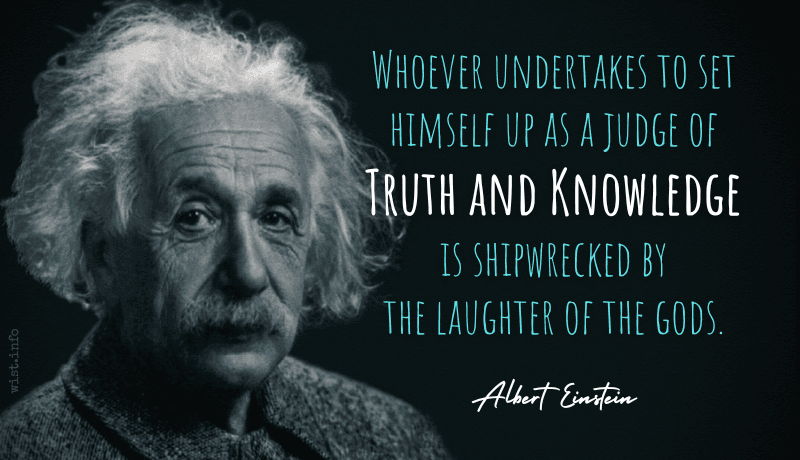
Whoever undertakes to set himself up as a judge of Truth and Knowledge is shipwrecked by the laughter of the gods.
[Wer es unternimmt, auf dem Gebiet der Wahrheit und der Erkenntnis als Autoritat aufzutreten, scheitert am Gelachter der Gotter.]
Albert Einstein (1879–1955) German-American physicist
Essay (1953-05-23), “Aphorisms for Leo Baeck [Neun Aphorismen], No. 8, Essays Presented to Leo Baeck on the Occasion of His Eightieth Birthday (1954) [Einstein Archives 28-962]
(Source)
Leo Baeck (1873-1956) was a noted a German rabbi, scholar, and theologian.
(Source (German)). Another translation:He who endeavors to present himself as an authority in matters of truth and cognition, will be wrecked by the laughter of the gods.
[Source]
This subject brings me to that vilest offspring of the herd mind — the odious militia. The man who enjoys marching in line and file to the strains of music falls below my contempt; he received his great brain by mistake — the spinal cord would have been amply sufficient. This heroism at command, this senseless violence, this accursed bombast of patriotism — how intensely I despise them! War is low and despicable, and I had rather be smitten to shreds than participate in such doings.
Albert Einstein (1879–1955) German-American physicist
“What I Believe,” Forum and Century (Oct 1930)
(Source)
Einstein crafted and recrafted his credo multiple times in this period, and specifics are often muddled by differing translations and by his reuse of certain phrases in later writing. The Forum and Century entry appears to be the earliest. Some important variants:This topic brings me to that worst outcrop of herd life, the military system, which I abhor. That a man cant take pleasure in marching in fours to the strains of a band is enough to make me despise him. He has only been given his big brain by mistake; unprotected spinal marrow was all he needed. This plague-spot of civilization ought to be abolished with all possible speed. Heroism on command, senseless violence, and all the loathsome nonsense that goes by the name of patriotism -- how passionately I hate them! How vile and despicable seems war to me! I would rather be hacked in pieces than take part in such an abominable business.
— "The World As I See It [Mein Weltbild] [tr. Bargmann (1954)]This topic brings me to that worst outcrop of the herd nature, the military system, which I abjor. That a man can take pleasure in marching in formation to the strains of a band is enough to make me despise him. He has only been given his big brain by mistake; a backbone was all he needed. This plague-spot of civilization ought to be abolished with all possible speed. Heroism by order, senseless violence, and all the pestilent nonsense that does by the name of patriotism -- how I hate them! War seems to me a mean, contemptible thing: I would rather be hacked in pieces than take part in such an abominable business.
— "The World As I See It [Mein Weltbild] [tr. Harris (1934)]
I would rather be an optimist and a fool than be a pessimist and correct.
Albert Einstein (1879–1955) German-American physicist
(Attributed)
Not everything that counts can be counted, and not everything that can be counted counts.
Albert Einstein (1879–1955) German-American physicist
Sign in Einstein’s Princeton office
It's not established this was original to Einstein. Sometimes quoted in reverse: "Not everything that can be counted counts, and not everything that counts can be counted."
A man’s ethical behavior should be based effectually on sympathy, education, and social ties and needs; no religious basis is necessary. Man would indeed be in a poor way if he had to be restrained by fear of punishment and hopes of reward after death.
Albert Einstein (1879–1955) German-American physicist
“Religion and Science,” New York Times Magazine (9 Nov 1930)
(Source)
Strange is our situation here upon the earth. Each of us comes for a short visit, not knowing why, yet sometimes seeming to divine a purpose.
Albert Einstein (1879–1955) German-American physicist
(Attributed)
quoted from James A. Haught, ed., 2000 Years of Disbelief
Common sense is the collection of prejudices acquired by age eighteen.
Albert Einstein (1879–1955) German-American physicist
(Spurious)
Not found in Einstein's writings. There is no evidence of Einstein saying or writing anything like this. It's deemed probably not an Einstein quotation by Einstein scholar Alice Calaprice, The Expanded Quotable Einstein (2000).
Variants:As Einstein has pointed out, common sense is actually nothing more than a deposit of prejudices laid down in the mind prior to the age of eighteen.
[Lincoln Barnett, "The Universe and Dr. Einstein, Part 2," Harper's Magazine (May 1948), reprinted in The Universe and Dr. Einstein (1950); Einstein wrote the foreword to the book.]Common sense is that layer of prejudices which we acquire before we are sixteen.
[E. T. Bell, Mathematics, Queen and Servant of the Sciences (1951)]
More discussion of this quotation: Common Sense Is Nothing More Than a Deposit of Prejudices Laid Down in the Mind Before Age Eighteen – Quote Investigator.
It can scarcely be denied that the supreme goal of all theory is to make the irreducible basic elements as simple and as few as possible without having to surrender the adequate representation of a single datum of experience.
Albert Einstein (1879–1955) German-American physicist
Lecture (1933-06-10), “On the Method of Theoretical Physics,” Herbert Spencer Lecture, Oxford
(Source)
Often shortened down, as "Einstein's Law," to something like "Make everything as simple as possible, but not simpler" or "Everything should be made as simple as possible, but not simpler."
This in turn appears to first come from an article "How a 'Difficult' Composer Gets That Way," by Roger Sessions, New York Times (1950-01-08), where he says (clearly paraphrasing):I also remember a remark of Albert Einstein, which certainly applies to music. He said, in effect, that everything should be as simple as it can be but not simpler!
Shortly after that, other references were made elsewhere treating the phrase as an actual quotation by Einstein.
For more about this quotation and its origin, see:
- Quote Origin: Everything Should Be Made as Simple as Possible, But Not Simpler – Quote Investigator®.
- Alice Calaprice, ed., The Quotable Einstein, "Attributed to Einstein" (2005 ed.).
The most important human endeavor is striving for morality in our actions. Our inner balance and even our very existence depends on it. Only morality in our actions can give beauty and dignity to our lives.
Albert Einstein (1879–1955) German-American physicist
(Attributed)
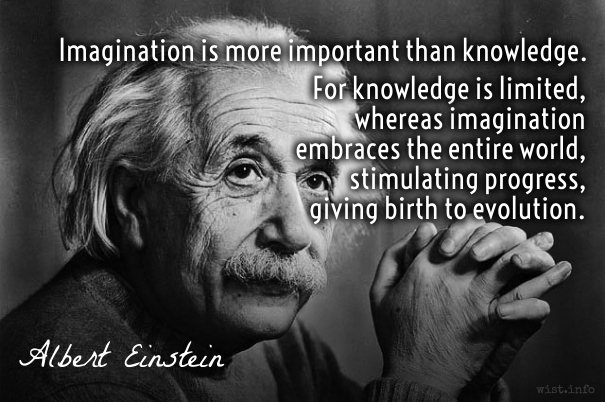
I am enough of an artist to draw freely upon my imagination. Imagination is more important than knowledge. For knowledge is limited, whereas imagination embraces the entire world, stimulating progress, giving birth to evolution.
Albert Einstein (1879–1955) German-American physicist
“What Life Means to Einstein,” Interview with G. Viereck, Saturday Evening Post (26 Oct 1929)
(Source)
Quoted as "I am enough of an artist to draw freely upon my imagination. Imagination is more important than knowledge. Knowledge is limited. Imagination encircles the world," in Viereck, Glimpses of the Great (1930).
Try not to become a success, but rather try to become a man of value.
Albert Einstein (1879–1955) German-American physicist
(Attributed)
Quoted by LIFE magazine (2 May 1955)
Insofar as statements of mathematics refer to reality, they are uncertain, and insofar as they are certain, they do not refer to reality.
[Insofern sich die Sätze der Mathematik auf die Wirklichkeit beziehen, sind sie nicht sicher, und insofern sie sicher sind, beziehen sie sich nicht auf die Wirklichkeit.]
Albert Einstein (1879–1955) German-American physicist
“Geometry and Experience [Geometrie und Erfahrung],” lecture (27 Jan 1921)
(Source)
Sometimes given as "Insofar as the statements of geometry speak about reality, they are not certain, and in so far as they are certain, they do not speak about reality. [Sofern die Sätze der Geometrie streng gültig sind, beziehen sie sich nicht auf de Wirklichkeit; sofern sie sich auf dei Wirklichkeit beziehen, sind sie nicht streng gültig.]" -- this version was popularized by Karl Popper, but it was from a misquote by Morris Schlick.
I think and think for months and years. Ninety-nine times, the conclusion is false. The hundredth time I am right.
Albert Einstein (1879–1955) German-American physicist
(Attributed)
Subtle is God, but malicious He is not.
[Raffiniert ist der Herr Gott, aber boshaft ist er nicht.]
Albert Einstein (1879–1955) German-American physicist
Remark at Princeton University (Apr. 1921)
Later inscribed in Fine Hall, Princeton University. Quoted in Einstein, ch. 14, R.W. Clark (1973). Einstein in 1946 gave a looser translation: "God is slick, but he ain’t mean."
The important thing is not to stop questioning. Curiosity has its own reason for existing. One cannot help but be in awe when he contemplates the mysteries of eternity, of life, of the marvelous structure of reality. It is enough if one tries merely to comprehend a little of this mystery every day.
Albert Einstein (1879–1955) German-American physicist
Memoirs of William Miller, quoted in Life (2 May 1955)
(Source)
Perfection of means and confusion of ends seem to characterize our age.
Albert Einstein (1879–1955) German-American physicist
Out of My Later Years, ch. 14 (1950)
We should take care not to make the intellect our god; it has, of course, powerful muscles, but no personality.
Albert Einstein (1879–1955) German-American physicist
Out of My Later Years, ch. 51 (1950)
You don’t promote the cause of peace by talking only to people with whom you agree.
Dwight David Eisenhower (1890–1969) American general, US President (1953–61)
News conference (20 Jan 1957)
History does not long entrust the care of freedom to the weak or the timid.
Dwight David Eisenhower (1890–1969) American general, US President (1953–61)
Inaugural Address (20 Jan 1953)
As quickly as you start spending federal money in large amounts, it looks like free money.
Dwight David Eisenhower (1890–1969) American general, US President (1953–61)
(Attributed)
Peace and justice are two sides of the same coin.
Dwight David Eisenhower (1890–1969) American general, US President (1953–61)
News conference, Washington (6-Feb-1957)
The world moves and ideas that were good once are not always good.
Dwight David Eisenhower (1890–1969) American general, US President (1953–61)
Press Conference. Washington. D.C. (31 Aug. 1955)
The best morale exists when you never hear the word mentioned. When you hear a lot of talk about it, it’s usually lousy.
Dwight David Eisenhower (1890–1969) American general, US President (1953–61)
(Attributed)
Don’t join the book burners. Don’t think you are going to conceal thoughts by concealing evidence that they ever existed. Don’t be afraid to go in your library and read every book, as long as that document does not offend your own ideas of decency. That should be the only censorship.
Dwight David Eisenhower (1890–1969) American general, US President (1953–61)
Commencement Speech, Dartmouth College (14 Jun 1953)
A people that values its privileges above its principles soon loses both.
Dwight David Eisenhower (1890–1969) American general, US President (1953–61)
Inaugural Address (20 Jan 1953)
You don’t lead by hitting people over the head — that’s assault, not leadership.
Dwight David Eisenhower (1890–1969) American general, US President (1953–61)
(Attributed)
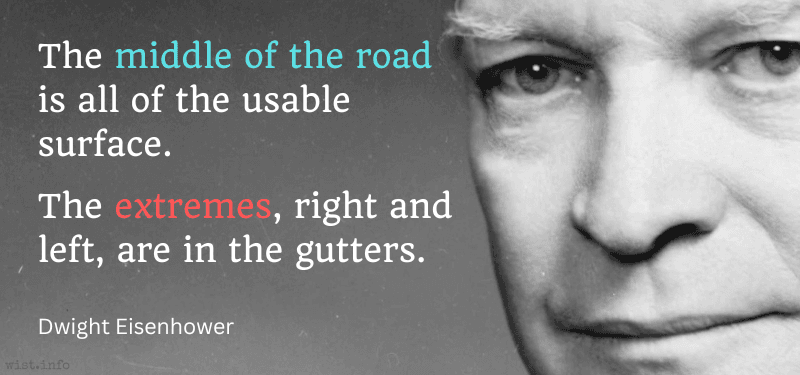
People talk about the middle of the road as though it were unacceptable. Actually, all human problems, excepting morals, come into the gray areas. Things are not all black and white. There have to be compromises. The middle of the road is all of the usable surface. The extremes, right and left, are in the gutters.
Dwight David Eisenhower (1890–1969) American general, US President (1953–61)
Interview (1963-11-05) by William Stringer, “Midroad View at Gettysburg,” Christian Science Monitor
(Source)
Unless each day can be looked back upon by an individual as one in which he has had some fun, some joy, some real satisfaction, that day is a loss.
Dwight David Eisenhower (1890–1969) American general, US President (1953–61)
(1963)
The ideals men die for often become the prejudices their descendents kill for.
Paul Eldridge (1888–1982) American educator, novelist, poet
Maxims for a Modern Man (1965)

I’m not denyin’ the women are foolish; God Almighty made ’em to match the men.
George Eliot (1819–1880) English novelist [pseud. of Mary Ann Evans]
Adam Bede (1859)
Blows are sarcasms turned stupid: wit is a form of force that leaves the limbs at rest.
George Eliot (1819–1880) English novelist [pseud. of Mary Ann Evans]
Felix Holt, the Radical (1866)
For the growing good of the world is partly dependent on unhistoric acts; and that things are not so ill with you and me as they might have been, is half owing to the number who lived faithfully a hidden life, and rest in unvisited tombs.
George Eliot (1819–1880) English novelist [pseud. of Mary Ann Evans]
Middlemarch (1871)
(last sentence of the book)
Half the harm that is done in this world
Is due to people who want to feel important.
They don’t mean to do harmT. S. Eliot (1888–1965) American-British poet, critic, playwright [Thomas Stearns Eliot]
“The Cocktail Party” (1949)
Blessed is the man who, having nothing to say, abstains from giving us wordy evidence of the fact.
George Eliot (1819–1880) English novelist [pseud. of Mary Ann Evans]
The Impressions of Theophrastus Such, ch. 4 (1879)
(Source)
To do the useful thing, to say the courageous thing, to contemplate the beautiful thing: that is enough for one man’s life.
T. S. Eliot (1888–1965) American-British poet, critic, playwright [Thomas Stearns Eliot]
(Attributed)
Where is the wisdom we have lost in knowledge?
Where is the knowledge we have lost in information?T. S. Eliot (1888–1965) American-British poet, critic, playwright [Thomas Stearns Eliot]
The Rock, Chorus (1934)
The responsibility of tolerance lies in those who have the wider vision.
T. S. Eliot (1888–1965) American-British poet, critic, playwright [Thomas Stearns Eliot]
“The Cocktail Party” (1949)
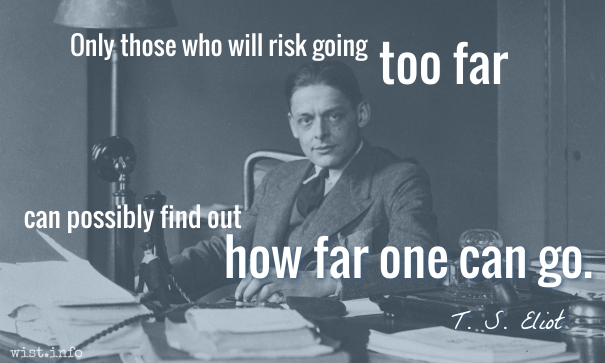
Only those who will risk going too far can possibly find out how far one can go.
T. S. Eliot (1888–1965) American-British poet, critic, playwright [Thomas Stearns Eliot]
Preface to Transit of Venus: Poems by Harry Crosby (1931)
No! I am not Prince Hamlet, nor was meant to be;
Am an attendant lord, one that will do
To swell a progress, start a scene or two,
Advise the prince; no doubt, an easy tool,
Deferential, glad to be of use,
Politic, cautious, and meticulous;
Full of high sentence, but a bit obtuse;
At times, indeed, almost ridiculous —
Almost, at times, the Fool.T. S. Eliot (1888–1965) American-British poet, critic, playwright [Thomas Stearns Eliot]
“The Love Song of J. Alfred Prufrock” (1917)
I think laughter may be a form of courage. As humans we sometimes stand tall and look into the sun and laugh, and I think we are never more brave than when we do that.
Linda Ellerbee (b. 1944) American broadcast journalist
McCall’s (Jan. 1993)
on cancer treatment

The problem with the future is that it’s boring. Its big secret is that it’s the present, and the present is never as attractive as the future. It should be, but it’s not.
Warren Ellis (b. 1968) English writer
www.warrenellis.com (16 Jan 2001)

The two most abundant things in the universe are Hydrogen and stupidity.
Harlan Ellison (1934–2018) American writer
(Attributed)
used in Who's Who bio entry

My philosophy of life is that the meek shall inherit nothing but debasement, frustration, and ignoble deaths
Harlan Ellison (1934–2018) American writer
The Harlan Ellison Hornbook (9 Aug. 1973)
The only reward of virtue is virtue; the only way to have a friend is to be one.
Ralph Waldo Emerson (1803–1882) American essayist, lecturer, poet
Essay (1841), “Friendship,” Essays: First Series, No. 6
(Source)
The human soul, the world, the universe are laboring on to their magnificent consummation. We are not fashioned
Ralph Waldo Emerson (1803–1882) American essayist, lecturer, poet
Journal (1820-12-05)
Every actual State is corrupt. Good men must not obey the laws too well.
Ralph Waldo Emerson (1803–1882) American essayist, lecturer, poet
“Politics,” Essays: Second Series (1844)
Nothing can bring you peace but yourself. Nothing can bring you peace but the triumph of principles.
Ralph Waldo Emerson (1803–1882) American essayist, lecturer, poet
Essay (1841), “Self-Reliance,” Essays: First Series, No. 2
(Source)
Closing words.
This essay was inspired by his reading of Walter Savage Landor in 1833, with passages pulled from his lecture "Individualism," last in his course on "The Philosophy of History" (1836–1837), with other passages from the lectures "School," "Genius," and "Duty" in his course on "Human Life" (1838–1839).
All great masters are chiefly distinguished by the power of adding a second, a third, and perhaps a fourth step in a continuous line. Many a man had taken the first step. With every additional step you enhance immensely the value of your first.
Ralph Waldo Emerson (1803–1882) American essayist, lecturer, poet
“Powers and Laws of Thought,” Natural History of Intellect, Lecture 1, Harvard (1870, Spring)
(Source)
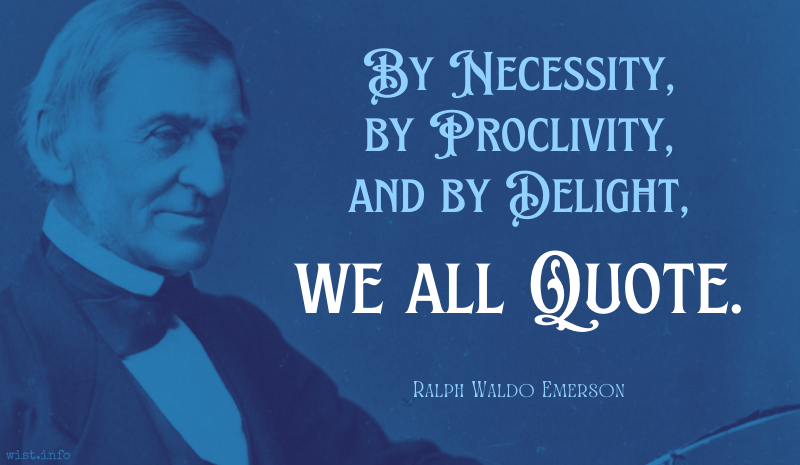
Our debt to tradition through reading and conversation is so massive, our protest or private addition so rare and insignificant, — and this commonly on the ground of other reading or hearing, — that, in a large sense, one would say there is no pure originality. All minds quote. Old and new make the warp and woof of every moment. There is no thread that is not a twist of these two strands. By necessity, by proclivity, and by delight, we all quote.
Ralph Waldo Emerson (1803–1882) American essayist, lecturer, poet
“Quotation and Originality,” Letters and Social Aims (1876)
(Source)
Shallow men believe in luck, believe in circumstances — it was somebody’s name, or he happened to be there at the time, or it was so then, and another day would have been otherwise. Strong men believe in cause and effect.
Ralph Waldo Emerson (1803–1882) American essayist, lecturer, poet
Essay (1860), “Worship,” The Conduct of Life, ch. 6
(Source)
Based on a course of lectures, "The Conduct of Life," delivered in Pittsburg (1851-03).
Trust men and they will be true to you; treat them greatly and they will show themselves great.
Ralph Waldo Emerson (1803–1882) American essayist, lecturer, poet
Essay (1841), “Prudence,” Essays: First Series, No. 7
(Source)
Based on a lecture (winter 1837-1838), Boston, the seventh in his course on "Human Culture."
We aim above the mark to hit the mark.
Ralph Waldo Emerson (1803–1882) American essayist, lecturer, poet
“Nature,” Essays: Second Series (1844)
(Source)
Life is a perpetual instruction in cause and effect.
Ralph Waldo Emerson (1803–1882) American essayist, lecturer, poet
“Natural Religion” (1861-02-03)
It is one of the most beautiful compensations of this life that no man can sincerely try to help another without helping himself.
Charles Dudley Warner (1829–1900) American essayist and novelist
Backlog Studies, Fifth Study, sec. 3 (1872)
(Source)
Originally published in Scribner's Monthly (Apr 1872). Frequently misattributed to Ralph Waldo Emerson.
A friend is a person with whom I may be sincere. Before him, I may think aloud.
Ralph Waldo Emerson (1803–1882) American essayist, lecturer, poet
Essay (1841), “Friendship,” Essays: First Series, No. 6
(Source)
The purpose of life is not to be happy. It is to be useful, to be honorable, to be compassionate, to have it make some difference that you have lived and lived well.
Ralph Waldo Emerson (1803–1882) American essayist, lecturer, poet
(Misattributed)
Though widely credited to Emerson, this appears to be a misattributed variation of a Leo Rosten quotation. More discussion of the connection here: The Purpose of Life Is Not To Be Happy But To Matter – Quote Investigator.
Every observation of history inspires a confidence that we shall not go far wrong; that things will mend.
Ralph Waldo Emerson (1803–1882) American essayist, lecturer, poet
“The Young American,” lecture, Mercantile Library Association, Boston (1844-02-07)
(Source)
Life is not so short but that there is always time enough for courtesy.
Ralph Waldo Emerson (1803–1882) American essayist, lecturer, poet
“Social Aims,” lecture, Boston (1864-12-04), Letters and Social Aims (1875)
No member of a crew is praised for the rugged individuality of his rowing.
Alfred North Whitehead (1861–1947) English mathematician and philosopher
“Harvard: The Future,” sec. 5, The Atlantic Monthly (Sep 1936)
(Source)
Reprinted in Essays in Science and Philosophy, Part 3 (1947). Often misattributed to Ralph Waldo Emerson.
We must trust the perfection of the creation so far, as to believe that whatever curiosity the order of things has awakened in our minds, the order of things can satisfy.
Ralph Waldo Emerson (1803–1882) American essayist, lecturer, poet
“Nature,” Introduction, Nature: Addresses and Lectures (1849)
(Source)
The ornament of a house is the friends who frequent it. There is no event greater in life than the appearance of new persons about our hearth, except it be the progress of the character which draws them.
Ralph Waldo Emerson (1803–1882) American essayist, lecturer, poet
“Domestic Life,” Society and Solitude (1870)
(Source)
What you do speaks so loudly that I cannot hear what you say to the contrary.
Ralph Waldo Emerson (1803–1882) American essayist, lecturer, poet
“Social Aims,” lecture, Boston (1864-12-04), Letters and Social Aims (1875)
Whatever games are played with us, we must play no games with ourselves, but deal in our privacy with the last honesty and truth.
Ralph Waldo Emerson (1803–1882) American essayist, lecturer, poet
Essay (1860), “Illusions,” The Conduct of Life, ch. 9
(Source)
Based on a course of lectures by that name first delivered in Pittsburg (1851-03).
Culture is one thing — and varnish another.
Ralph Waldo Emerson (1803–1882) American essayist, lecturer, poet
Journal (1868)
You shall have joy, or you shall have power, said God; you shall not have both.
Ralph Waldo Emerson (1803–1882) American essayist, lecturer, poet
Journal (1842-10)
Nature is too thin a screen, — the glory of the One breaks in everywhere.
Ralph Waldo Emerson (1803–1882) American essayist, lecturer, poet
“Religion,” The Present Age Lecture 7, Boston (1840-01-29)
(Source)
Lecture series initially presented 4 Dec 1839 - 12 Feb 1840. This particular phrase can be found in Emerson's writing going back to 1837. It also was reused in his Cambridge lecture, "The Preacher" (5 May 1879), in a somewhat different context.
The phrase is also rendered "Nature is too thin a screen; the glory of the omnipresent God bursts through everywhere."
A foolish consistency is the hobgoblin of little minds, adored by little statesmen and philosophers and divines.
Ralph Waldo Emerson (1803–1882) American essayist, lecturer, poet
Essay (1841), “Self-Reliance,” Essays: First Series, No. 2
(Source)
This thought continues here.
This essay was inspired by his reading of Walter Savage Landor in 1833, with passages pulled from his lecture "Individualism," last in his course on "The Philosophy of History" (1836–1837), with other passages from the lectures "School," "Genius," and "Duty" in his course on "Human Life" (1838–1839).
A hero is no braver than an ordinary man, but he is braver five minutes longer.
Ralph Waldo Emerson (1803–1882) American essayist, lecturer, poet
(Spurious)
Frequently ascribed to him, especially in recent decades, but not found in his works.
More discussion about this quotation:
Do not be too timid and squeamish about your actions. All life is an experiment. The more experiments you make the better. What if they are a little coarse, and you may get your coat soiled or torn? What if you do fail, and get fairly rolled in the dirt once or twice. Up again, you shall never be so afraid of a tumble.
Though we travel the world over to find the beautiful, we must carry it with us or we find it not.
Ralph Waldo Emerson (1803–1882) American essayist, lecturer, poet
Essay (1841), “Art,” Essays: First Series, No. 12
(Source)
Part of a paragraph taken from the course "Human Culture," lecture "Eye and Ear."
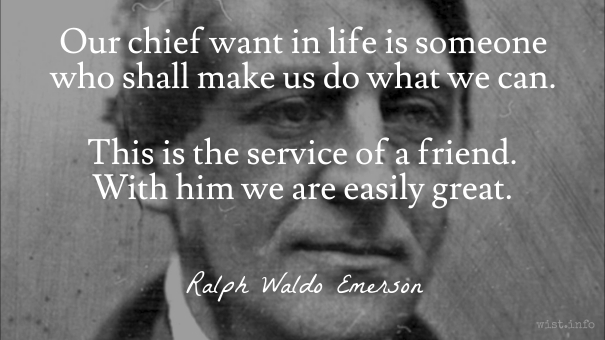
Our chief want in life is someone who shall make us do what we can. This is the service of a friend. With him we are easily great.
Ralph Waldo Emerson (1803–1882) American essayist, lecturer, poet
Essay (1860), “Considerations by the Way,” The Conduct of Life, ch. 7
(Source)
Based on a course of lectures by that name first delivered in Pittsburg, 1851-03.
The glory of friendship is not the outstretched hand, nor the kindly smile nor the joy of companionship; it is the spiritual inspiration that comes to one when he discovers that someone else believes in him and is willing to trust him with his friendship.
Ralph Waldo Emerson (1803–1882) American essayist, lecturer, poet
(Attributed)
A man builds a fine house; and now he has a master, and a task for life; he is to furnish, watch, show it, and keep it in repair, the rest of his days.
Ralph Waldo Emerson (1803–1882) American essayist, lecturer, poet
“Works and Days,” Society and Solitude, ch. 7 (1870)
(Source)
It is one of the blessings of old friends that you can afford to be stupid with them.
Let us treat men and women well; treat them as if they were real; perhaps they are.
Ralph Waldo Emerson (1803–1882) American essayist, lecturer, poet
“Experience,” Essays: Second Series (1844)
With consistency a great soul has simply nothing to do. He may as well concern himself with his shadow on the wall. Speak what you think to-day in words as hard as cannon-balls and to-morrow speak what to-morrow thinks in hard words again, though it contradict every thing you said to-day.
Ralph Waldo Emerson (1803–1882) American essayist, lecturer, poet
Essay (1841), “Self-Reliance,” Essays: First Series, No. 2
(Source)
Inspired by his reading of Walter Savage Landor in 1833, with passages pulled from his lecture "Individualism," last in his course on "The Philosophy of History" (1836–1837), with other passages from the lectures "School," "Genius," and "Duty" in his course on "Human Life" (1838–1839).
Nothing astonishes men so much as common sense and plain dealing.
Ralph Waldo Emerson (1803–1882) American essayist, lecturer, poet
Essay (1841), “Art,” Essays: First Series, No. 12
(Source)
The reward of a thing well done, is to have done it.
Ralph Waldo Emerson (1803–1882) American essayist, lecturer, poet
“New England Reformers,” lecture, Boston (1844-03-03), Essays: Second Series (1844)
(Source)
Reprinted in Essays: Second Series (1844).
I stir in it for the sad reason that no other mortal will move, and if I do not, why, it is left undone. The amount of it, be sure, is merely a Scream; but sometimes a scream is better than a thesis.
Ralph Waldo Emerson (1803–1882) American essayist, lecturer, poet
Journal (1838)
Referring to his attempts to stop the US Government's forced expulsion of the Cherokee from their land.
Let me never fall into the vulgar mistake of dreaming that I am persecuted whenever I am contradicted.

I could never think well of a man’s intellectual or moral character, if he was habitually unfaithful to his appointments.
Nathaniel Emmons (1745–1840) American Calvinist preacher
(Attributed)
Traditionally, most of Australia’s imports come from overseas.
Keppel "Kep" Enderbery (1926–2015) Australian politician and jurist
(Attributed)
The rate at which a person can mature is directly proportional to the embarrassment he can tolerate.
Douglas Engelbart (1925–2013) American computer scientist, pioneer
(Attributed)
http://www.bootstrap.org/chronicle/press/tiaobrian/part1.htm
No, folks don’t like the truth. … It’s easier lyin’. Stops us havin’ to fess up to trouble when it comes along. To do right insteada wrong. … But I hate a lie, Cass. My own most of all. They keep us crawlin’ in the dust when we could an’ should be climbin’ for the stars.
Garth Ennis (b. 1970) Irish writer
Preacher, #31, “Underworld”
What is the first business of one who studies philosophy? To part with self-conceit. For it is impossible for any one to begin to learn what he thinks that he already knows.
Epictetus (c. 55-c. 135 AD) Greek (Phrygian) Stoic philosopher [Ἐπίκτητος, Epíktētos]
The Discourses, ch. 17, “How To Apply General Principles to Particular Cases” (c. AD 101-108)
Other translations: "It is impossible for a man to begin to learn what he thinks he knows." [tr. Long (1890)]
In my sex fantasy, nobody ever loves me for my mind.
Nora Ephron (1941–2012) American screenwriter, author, journalist, director
(Attributed)

First say to yourself what you would be; and then do what you have to do.
Epictetus (c. 55-c. 135 AD) Greek (Phrygian) Stoic philosopher [Ἐπίκτητος, Epíktētos]
The Discourses, ch. 23, “Concerning Such as Read and Dispute Ostentatiously” (c. AD 101-108)
Men are disturbed, not by things, but by the principles and notions which they form concerning things.
Epictetus (c. 55-c. 135 AD) Greek (Phrygian) Stoic philosopher [Ἐπίκτητος, Epíktētos]
The Enchiridion (c. 135)
Other translations: "We suffer not from the events in our lives, but from our judgment about them."
The impious one is not the one who takes away the gods of the masses, but rather the one who imposes the ideas of the masses on the gods.
Epicurus (341–270 BC) Greek philosopher
Letter to Menoeceus
Do not spoil what you have by desiring what you have not; but remember that what you now have was once among the things you only hoped for.
Epicurus (341–270 BC) Greek philosopher
The Vatican Sayings
Your anxiety is directly proportional to your forgetfulness of nature, for you bring on yourself unlimited fears and desires.
Epicurus (341–270 BC) Greek philosopher
Fragment
It is not so much our friends’ help that helps us as the confidence of their help.
Epicurus (341–270 BC) Greek philosopher
The Vatican Sayings
Other translations: "It is not so much our friends' help that helps us as the confident knowledge that they will help us."
For me, writing is foremost a mode of thinking and, when it works well, an act of discovery.
Joseph Epstein (b. 1937) American writer
The Bedford Reader, “Postscript on Process” (ed. Kennedy and Kennedy, 2d ed.) (1985)
When I get a little money, I buy books; and if any is left, I buy food and clothes.
Desiderius Erasmus (1465–1536) Dutch humanist philosopher and scholar
(Attributed)

Money is what people without talent use to keep score.
(Other Authors and Sources)
Jeremy C. Epworth
It is part of the highest civility if, while never erring yourself, you ignore the errors of others.
Desiderius Erasmus (1465–1536) Dutch humanist philosopher and scholar
(Attributed)
It is the chiefest point of happiness that a man is willing to be what he is.
Desiderius Erasmus (1465–1536) Dutch humanist philosopher and scholar
(Attributed)
Whatever the form, whether prose or verse, or whatever the theme, write, write, and again write.
Desiderius Erasmus (1465–1536) Dutch humanist philosopher and scholar
De Ratione Studii (1511)
You and I want our lives to matter. We want our lives to make a real difference — to be of genuine consequence in the world. We know that there is no satisfaction in merely going through the motions, even if those motions make us successful, or even if we have arranged to make those motions pleasant. We want to know we have made some impact on the world. In fact, you and I want to contribute to the quality of life. We want to make the world work.
Werner Erhard (b. 1935) American self-improvement teacher [b. John (Jack) Paul Rosenberg]
(Attributed)
Prevention is better than cure.
Desiderius Erasmus (1465–1536) Dutch humanist philosopher and scholar
(Attributed)
There are none so blind as those who think they can see.
Graham Ericsson (b. 1961) American technologist, writer, aphorist
Journal (undated)

Aesthetics are not morality. Don’t confuse Taste for Truth, Icky for Evil, or Preference for Perfection.
Graham Ericsson (b. 1961) American technologist, writer, aphorist
Journal (undated)
Poverty, when voluntary, is quite probably a virtue. But few can blame those subjected to it involuntarily for wishing to be done with it.
Graham Ericsson (b. 1961) American technologist, writer, aphorist
Journal (undated)
To say, “You’re angry over such a little thing,” is like saying, “The fire started with just a little match.” It may well be true, but it does nothing to alleviate the present situation.
Graham Ericsson (b. 1961) American technologist, writer, aphorist
Journal (undated)
Just because the other person is obviously, blindingly wrong, doesn’t mean we can be sloppy in our arguments against him. All we do in that case is strengthen his position and weaken our own.
Graham Ericsson (b. 1961) American technologist, writer, aphorist
Journal (undated)
There is no good cause for religious persecution. No convert is true who comes to the faith through pain and fear. All persecution does is plant seeds of doubt amongst the hearts of the faithful as to the truth of their cause.
Graham Ericsson (b. 1961) American technologist, writer, aphorist
Journal (undated)
We don’t have any enemies. Just friends we wish wouldn’t call so often.
Graham Ericsson (b. 1961) American technologist, writer, aphorist
Journal (undated)
History is unchanging truths veiled in ever-changing circumstances.
Graham Ericsson (b. 1961) American technologist, writer, aphorist
Journal (undated)
Do what you need to do.
Graham Ericsson (b. 1961) American technologist, writer, aphorist
Journal (undated)
The road to hell is paved with religious conservatives? Nah, probably not. I’ve no doubt, though, that there are a few being used to fill in the potholes.
Graham Ericsson (b. 1961) American technologist, writer, aphorist
Journal (undated)
Anger is a corpse in the closet: the longer locked up, the greater the stink when brought out.
Graham Ericsson (b. 1961) American technologist, writer, aphorist
Journal (undated)
I don’t use drugs; my dreams are frightening enough.
M. C. Escher (1898–1972) Dutch artist [Maurits Cornelius Escher]
(Attributed)

He who has learned to disagree without being disagreeable has discovered the most valuable secret of a diplomat.
Robert Estabrook (1918–2011) American journalist, editor, foreign correspondent
(Attributed)
I think it’s always a lot easier to come to firm decisions when we are ignorant. Once we start to learn something, things tend to become much more complicated and truth becomes much more difficult to come by.
Ralph Estling (1930–2007) British essayist and skeptic
(Attributed)
PEASANT: ‘Tis in such shifts
As these, I care for riches, to make gifts
To friends, or lead a sick man back to health
With ease and plenty. Else small aid is wealth
For daily gladness; once a man be done
With hunger, rich and poor are all as one.[ΑΥΤΟΥΡΓΌΣ: ἐν τοῖς τοιούτοις δ᾽ ἡνίκ᾽ ἂν γνώμης πέσω,
σκοπῶ τὰ χρήμαθ᾽ ὡς ἔχει μέγα σθένος,
ξένοις τε δοῦναι σῶμά τ᾽ ἐς νόσους πεσὸν
δαπάναισι σῷσαι: τῆς δ᾽ ἐφ᾽ ἡμέραν βορᾶς
ἐς σμικρὸν ἥκει: πᾶς γὰρ ἐμπλησθεὶς ἀνὴρ
ὁ πλούσιός τε χὡ πένης ἴσον φέρει.]Euripides (485?-406? BC) Greek tragic dramatist
Electra [Ἠλέκτρα], l. 426ff (c. 420 BC) [tr. Murray (1905)]
(Source)
(Source (Greek)). Other translations:When on these matters I reflect, I mark
How great the power of riches, to bestow
Upon the needy stranger, or expend them
To heal our bodies wasting with disease.
But for the diet of one day, is wealth
Of small importance : for the appetites
Of all men, whether rich or poor, demand
An equal share of necessary food.
[tr. Wodhull (1809)]It is in such cases, whenever I fail in my intentions, that I see how wealth has great power, to give to strangers, and to expend in curing the body when it falls sick; but money for our daily food comes to little; for every man when full, rich or poor, gets an equal amount.
[tr. Coleridge (1891)]But when my mind falls upon this subject, I consider how great a power wealth has, botht o bestow on strangers, and by expense to preserve one's body when fallen into sickness; but for one's daily food it comes to little. For every man once filled, rich or poor, bears an equality.
[tr. Buckley (1892)]In such things, when my thoughts turn thitherward,
I mark what mighty vantage substance hath,
To give to guests, to medicine the body
In sickness: but for needs of daily food
Not far it reacheth. Each man, rich and poor,
Can be but filled, when hunger is appeased.
[tr. Way (1896)]When I think of such things then I see what mighty power money has! Not only you help your friends with the stuff but you can also heal yourself from any illness when you have the money to pay. The cost of a normal everyday meal is cheap, because everyone, rich and poor, once he had enough he feels the same joy.
[tr. Theodoridis (2006)]It’s at times like this,
when I have no idea how to manage,
I think of the great power money has
for giving things to strangers and paying
to save someone whenever he falls sick.
The meals we need each day don’t come to much,
for all men, once they have eaten their fill,
feel much the same, whether rich or poor.
[tr. Johnston (2009), l. 515ff][...] whether rich or poor
Everyone is equal when their belly is full.
[tr. @sentantiq (2020)]
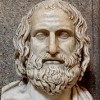
Waste not fresh tears over old griefs.
Slight not what’s near through aiming at what’s far.
Euripides (485?-406? BC) Greek tragic dramatist
Rhesus, 482
MESSENGER: Nothing is more useful to mankind than a prudent distrust.
[ἌΓΓΕΛΟΣ:σώφρονος δ᾽ ἀπιστίας
οὐκ ἔστιν οὐδὲν χρησιμώτερον βροτοῖς.]Euripides (485?-406? BC) Greek tragic dramatist
Helen [Ἑλένη], l. 1617ff (412 BC) [tr. Coleridge (1891)]
(Source)
Informing Theoklymenos that Helen and Menelaos have escaped to Greece.
(Source (Greek)). Other translations:Nought to man's welfare more
Avails, than disbelief by prudence rul'd.
[tr. Potter (1783), l. 1750ff]There's nought more beneficial to mankind
Than wise distrust.
[tr. Wodhull (1809)]But there is naught more useful to mortals than a wise distrust.
[tr. Buckley (1850)]Nought is of more avail
For mortals' need than wise mistrustfulness.
[tr. Way (Loeb) (1912)]My lord, I fear
There are advantages in honest doubt.
That lesson of my tale at least is clear.
[tr. Sheppard (1925)]I say there's nothing of more use
to mortals than a wise suspension of belief.
[tr. Warner (1951)]Well, there is one thing every man has to learn: it is, not to be too trustful.
[tr. Vellacott (1954)]Man's most valuable trait
is a judicious sense of what not to believe.
[tr. Lattimore (1956)]Knowing when not to believe someone ...
now that's the kind of wisdom we could use!
[tr. Meagher (1986)]To sum up, there’s nothing more useful in life than showing a healthy scepticism.
[tr. Davie (2002)]Ah! there is naught more serviceable to mankind than a prudent distrust.
[tr. Athenian Society (2006)]Seems you were a bit naive, sir:
There's nothing more useful in life
Than a good suspicious nature.
[tr. A. Wilson (2007)]Nothing is more useful than a prudent doubt.
[tr. Theodoridis (2011)]Nothing is more useful to man than thoughtful skepticism.
[Ambrose et al. (2018)]Nothing is more useful to mankind than a balanced [sōphrōn] distrust.
[tr. Coleridge / Helen Heroization Team]
It is a good thing to be rich, it is a good thing to be strong, but it is a better thing to be beloved of many friends.
Euripides (485?-406? BC) Greek tragic dramatist
(Attributed)
Curiosity is the clay from which all knowledge is formed.
Mark Evanier (b. 1952) American writer
Groo, Mini-Series I, #3 (The Sage) (Mar. 1998)
This is the sort of bellowing profundity that earns a man the awe of one generation and the contempt of the next.
Bergen Evans (1904–1978) American educator, writer, lexicographer
The Dictionary of Quotations (1968)
Freedom of speech and freedom of action are meaningless without freedom to think. And there is no freedom of thought without doubt.
Bergen Evans (1904–1978) American educator, writer, lexicographer
The Natural History of Nonsense, ch. 19 (1946)
The mere abhorrence of vice is not a virtue at all.
Bergen Evans (1904–1978) American educator, writer, lexicographer
The Dictionary of Quotations (1968)
That is the essence of a witch-hunt, that any questioning of the evidence or the procedures in itself constitutes proof of complicity.
Bergen Evans (1904–1978) American educator, writer, lexicographer
The Dictionary of Quotations (1968)
Even though eternity lies before us, this is the life in which the work of this life is to be done. The life that lies beyond will have its own work to do, its own decisions to be made, its own distance to travel.
Richard Louis Evans (1906–1971) American writer and radio commentator
(Attributed)
Don’t let life discourage you; everyone who got where he is had to begin where he was.
Richard Louis Evans (1906–1971) American writer and radio commentator
(Attributed)
Many a friendship — long, loyal, and self-sacrificing — rested at first upon no thicker a foundation than a kind word.
Frederick W. Faber (1814–1863) British hymnist, theologian
(Attributed)
When you read a classic you do not see in the book more than you did before. You see more in you than there was before.
Clifton Fadiman (1904–1999) American critic, lecturer, editor
Any Number Can Play (1957)

To feel at home, stay at home. A foreign country is not designed to make you comfortable. It’s designed to make its own people comfortable.
Clifton Fadiman (1904–1999) American critic, lecturer, editor
(Attributed)
If you do the best you can, you will find, nine times out of ten, that you have done as well as or better than anyone else.
William Feather (1889–1981) American publisher, author
(Attributed)
Some of us might find happiness if we would quit struggling so desperately for it.
William Feather (1889–1981) American publisher, author
(Attributed)
I have found that the greatest help in meeting any problem with decency and self-respect and whatever courage is demanded, is to know where you yourself stand. That is, to have in words what you believe and are acting from.
William Faulkner (1897–1962) American novelist
Letter to David Kirk, Oxford, Miss. (8 Mar 1956)
(Source)
Intellectual brilliance is no guarantee against being dead wrong.
David Fasold (1939–1998) American salvage expert, amateur archaeologist
(Attributed)

No man is a failure who is enjoying life.
William Feather (1889–1981) American publisher, author
(Attributed)
Widely attributed to Feather (e.g. Laurence Peter, Peter's Quotations (1977)), but no citation to be found online. A particularly common quote (usually without attribution) in school yearbooks, collections of wisdom / happiness quotations, etc.The earliest use of it that I can find is as anonymous column filler in The Deaf-Mutes' Journal, Vol. 61, No. 50 (1932-12-15).
A variant adds "No man is a success who isn't."
Early morning cheerfulness can be extremely obnoxious.
William Feather (1889–1981) American publisher, author
(Attributed)
Beware of the person who can’t be bothered by details.
William Feather (1889–1981) American publisher, author
(Attributed)
So long as we are full of self, we are shocked at the faults of others. Let us think often of our own sin, and we shall be lenient to the sins of others.
François Fénelon (1651–1715) French Catholic archbishop, theologian, poet, writer [François de Salignac de la Mothe-Fénelon]
(Attributed)
With every passing hour our solar system comes forty-three thousand miles closer to globular cluster M13 in the constellation Hercules, and still there are some misfits who continue to insist that there is no such thing as progress.
Ransom K. Ferm (contemp.)
(Attributed)
There are two possible outcomes: If the result confirms the hypothesis, then you’ve made a measurement. If the result is contrary to the hypothesis, then you’ve made a discovery.
Enrico Fermi (1901–1954) Italian-American physicist
(Attributed)
The inexperienced, and crackpots, and people like that, make guesses that are simple, but you can immediately see that they are wrong, so that does not count. Others, the inexperienced students, make guesses that are very complicated, and it sort of looks as if it is all right, but I know it is not true because the truth always turns out to be simpler than you thought.
Richard Feynman (1918–1988) American physicist
The Character of Physical Law, ch 7 “Seeking New Laws” (1965)
(Source)
Scientists take it for granted that it is perfectly consistent to be unsure — that it is possible to live and not know. But I don’t know whether everyone realizes that this is true.
Richard Feynman (1918–1988) American physicist
What Do You Care What Other People Think? (1988)
I have argued flying saucers with lots of people. … I was interested in this: they keep arguing that it is possible. And that’s true. It is possible. They do not appreciate that the problem is not to demonstrate whether it’s possible or not, but whether it’s going on or not. Whether it’s probably occurring or not, not whether it could occur.
The first principle is that you must not fool yourself — and you are the easiest person to fool.
Richard Feynman (1918–1988) American physicist
“Cargo Cult Science,” commencement address, California Institute of Technology (1974)
(Source)
Madam, there’s no such thing as a tough child — if you parboil them first for seven hours, they always come out tender.
W. C. Fields (1880–1946) American entertainer [b. William Claude Dukenfield]
(Attributed)
Everybody should believe in something. I believe I’ll have another drink.
W. C. Fields (1880–1946) American entertainer [b. William Claude Dukenfield]
(Attributed)
Goodwill is the one and only asset that competition cannot undersell or destroy.
Marshall Field (1834–1906) American merchant
(Attributed)
If we would only give, just once, the same amount of reflection to what we want to get out of life that we give to the question of what to do with a two weeks’ vacation, we would be startled at our false standards and the aimless procession of our busy days.
Dorothy Canfield Fisher (1879–1958) American author and essayist
(Attributed)
There is no point at which you can say, ‘Well, I’m successful now. I might as well take a nap.’
Carrie Fisher (1956–2016) American actress, writer
(Attributed)

Always carry a flagon of whiskey in case of snakebite; and furthermore, always carry a small snake.
W. C. Fields (1880–1946) American entertainer [b. William Claude Dukenfield]
(Attributed)
It isn’t where you came from; it’s where you’re going that counts.
Ella Fitzgerald (1917–1996) American jazz singer
(Attributed)
in Kliment, Bud, Ella Fitzgerald: First Lady of American Song

Just don’t give up trying to do what you really want to do. Where there is love and inspiration, I don’t think you can go wrong.
Ella Fitzgerald (1917–1996) American jazz singer
(1987)
The test of a first-rate intelligence is the ability to hold two opposed ideas in mind at the same time and still retain the ability to function. One should, for example, be able to see that things are hopeless and yet be determined to make them otherwise.
F. Scott Fitzgerald (1896–1940) American writer [Francis Scott Key Fitzgerald]
“The Crack-Up,” Esquire (Feb 1936)
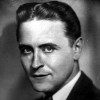
If you’re strong enough, there are no precedents.
F. Scott Fitzgerald (1896–1940) American writer [Francis Scott Key Fitzgerald]
The Crack-Up, “The Note-Books,” ed. Edmund Wilson (1945)
It seems to me that if we were all supposed to wind up in the same place, we would have been put there to begin with.
Nancy Flannigan (contemp.)
Belief-L
It is only when you recognize that you CAN do what Hitler did that you can consciously choose not to.
Joseph C. Fletcher (1905–1991) American ethicist
(Attributed)
Enlightened self-interest is a wonderful thing. Turning on the light can be hard.
Peter Flom (contemp.)
Belief-L (24 Jan. 2001)

The (to me) proper reason for treating people nicely is not so they will treat you nicely, but because it is, in a word, nicer to do so.
Peter Flom (contemp.)
Belief-L (24 Jan. 2001)
Money can’t buy happiness, but poverty can’t buy anything.
Peter Flom (contemp.)
Belief-L (6 Jun. 2001)
Money can’t buy happiness, but it can make misery a lot more comfortable.
Peter Flom (contemp.)
Belief-L (6 Jun. 2001)
I believe that the First Amendment should cover everything. Even the incredibly icky, distasteful stuff. Because if we let “them” start making ethical judgments, they might not stop until it’s nothing but Norman Rockwell and Hummel figurines.
Phil Foglio (b. 1956) American writer, cartoonist
(Attributed)
confirmed in private e-mail, 6-Sep-03
It isn’t what they say about you, it’s what they whisper.
Errol Flynn (1909–1959) Australian-American actor
(Attributed)

There are those who have thought that Winslow was the ideal form for life itself. Advanced civilizations who hold this theory, while interesting for a while, tend not to last very long. A very few civilizations have decided that Winslow is merely the ideal form for small fuzzy green aligators and never quite understood what all the fuss was about. They are usually exterminated in holy wars by their neighbors.
Phil Foglio (b. 1956) American writer, cartoonist
“Winslow” (1982)
Heroes come in many forms. Some are more frightening than others.
Phil Foglio (b. 1956) American writer, cartoonist
Bill & Barry – The Heterodyne Boys! (1987)
MINSK: Dis iz turnink into vun of dose plans … the kind vere ve kill everybody dot notices dot ve’s killin’ people?
GORB: It is?
MINSK: Uh huh. And how do dose alvays end?
GORB: De dirigible iz in flames, everyboddyz dead an’ I’ve lost my hat.
MINSK: Dot’s right. Und any plan vere you lose you hat iz?
GORB: A bad plan?
MINSK: Right again!Phil Foglio (b. 1956) American writer, cartoonist
Girl Genius, #6 (May-Jun. 2002)
We are living in a new culture, one of responsibility dodgers and corner cutters. Nobody cares if a thing is right or not. If you try to trace a poor job or craftsmanship back, you will find, inevitably, that nobody did it.
Robert Fontaine (contemp.)
(Attributed)
The one important think I have learnt over the years is the difference between taking one’s work seriously and taking oneself seriously. The first is imperative and the second disastrous.
Dame Margot Fonteyn (1919–1991) English dancer [b. Margaret Hookham]
Margot Fonteyn: An Autobiography (1976)
Don’t forget until too late that the business of life is not business, but living.
Any business arrangement that is not profitable to the other person will in the end prove unprofitable for you. The bargain that yields mutual satisfaction is the only one that is apt to be repeated.
Bertie Charles (B. C.) Forbes (1880–1954) American publisher
(Attributed)
History has demonstrated that the most notable winners usually encountered heartbreaking obstacles before they triumphed. They won because they refused to become discouraged by their defeats.
Bertie Charles (B. C.) Forbes (1880–1954) American publisher
Forbes, Issue No. 1 (Sep 1917)
(Source)
One worthwhile task carried to a successful conclusion is worth half-a-hundred half-finished tasks.
Bertie Charles (B. C.) Forbes (1880–1954) American publisher
(Attributed)
(also attrib. Malcolm Forbes)
Anyone who says businessmen deal in facts, not fiction, has never read old five-year projections.
Malcolm Forbes (1919–1990) American billionaire
(Attributed)

People who matter are most aware that everyone else does, too.
Malcolm Forbes (1919–1990) American billionaire
The Sayings of Chairman Malcolm (1978)
The biggest mistake people make in life is not trying to make a living at doing what they most enjoy.
Malcolm Forbes (1919–1990) American billionaire
(Attributed)
If you have a job without aggravations, you don’t have a job.
Malcolm Forbes (1919–1990) American billionaire
(Attributed)
A government big enough to give you everything you want is a government big enough to take from you everything you have.
Gerald R. Ford (1913–2006) American politician, US President (1974–77) [b. Leslie Lynch King, Jr.]
Speech to the Republican National Convention (19 Aug 1976)
Also cited as a speech to Congress (12 Aug 1976) Also attrib. B. Goldwater
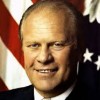
Don’t compromise yourself. You are all you’ve got.
Betty Ford (1918–2011) American First Lady (1974–77), philanthropist [Elizabeth Bloomer Warren Ford]
(Attributed)

Administrivia: (2003-09-12) W, not V
A reader was kind enough to point out that the W page was showing V quotes. I discovered what the error was, and things seem to be working again.
I encourage folks to write me (via the Contact Me link in the sidebar) if you run across errors in structure or format. WIST relies on your help!
Administrivia: (2003-09-01) Updates to A, B, and C
Finished going through A, B, and C for citations, and the updated files have been posted. (Of course, I added a bunch of quotes along the way. Otherwise, it would hardly be fun.)
Administrivia: (2003-08-26) Author, author!
I’ve reinstated one of the old features from the previous version of WIST, the list of quoted folk, now available in the Authors link in the sidebar.
I’ve not done it as a Table as I did before. It looked good, but, damn, it took forever to load a 1,500 row. Now it’s just bulleted text, and much faster.
The names are hyperlinked; ultimately, they’ll go to anchors on the right page where the person’s quotes start, but I’ll have to change the quotations exports to include those links. For the moment, they go only to the right page.
Administrivia: (2003-08-20) Saving Space
Just cut-over from the FrontPage pages to the MT pages. It appears to have gone nearly no hitch (a couple of graphics paths were a tad off).
One intersting item is looking at system resources used.
In FrontPage, the system took up 4.2Mb of space, consisting of 803 files in 41 folders under root.
In MT, the system takes up 2.2Mb of space, 153 files, 1 folder under root.
Note that’s with 300 extra quotations. And with all the content being duplicated between two directories (for odd reasons I won’t go into here).
Sweet.
Administrivia: (2003-08-19) Doing the numbers
For those who are interested in such things, here are some stats related to WIST.
First off, how many quotes do I actually have here?
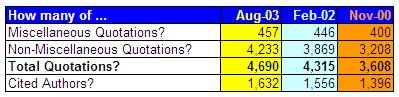
Hmmm. Looks like I’ve been slacking. In reality, though, I’ve been focusing on cleaning up and fleshing out citations. Quality over quantity, so to speak.
Secondly, who said what — and who are the most “popular” quote-makers here?
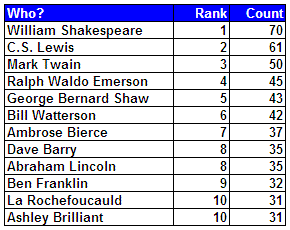
Bear in mind, of course, that things like having a Shakespeare Quote-a-Day calendar could influence the count …
One last bit — total visitors to the front page of WIST since June 1999 have gone as follows:
September 2001: 8,400
Februrary 2002: 12,859
August 2003: 46,958
Cool!
Administrivia: (2003-06-06) Searching glances
I neglected to mention that I’m using Atomz for the search engine here. As a free (limited) service, they do some very slick search stuff, and because they provide contextual results (showin the words they found, in context), they are ideal here. I heartily recommend them.
UPDATE (24 Jul 07): No longer using Atomz, but the internal MT search system (possibly to be someday updated to MT FastSearch, or even possibly MTGoogle). Atomz (now part of WebSideStory) has done well by me, so I still encourage you to consider it in your own site design, even if it doesn’t fit mine any more.
Administrivia: (2003-06-06) MT promises
Unlike what I scribed previously, it wasn’t quite as trivial to plug this stuff into MT as I’d hoped, largely because of limits in HTML form entry sizes.
So instead I’m using Server Side Includes to bring in formatted text files to the entries. Still a lot of advantages to doing things this way (not least of which is that content and presentation are logically divided), but I thought I’d mention the problem I ran into.