

And the multitude of them that believed were of one heart and of one soul: neither said any of them that ought of the things which he possessed was his own; but they had all things common. […] Neither was there any among them that lacked: for as many as were possessors of lands or houses sold them, and brought the prices of the things that were sold, and laid them down at the apostles’ feet: and distribution was made unto every man according as he had need.
[Τοῦ δὲ πλήθους τῶν πιστευσάντων ἦν καρδία καὶ ψυχὴ μία, καὶ οὐδὲ εἷς τι τῶν ὑπαρχόντων αὐτῷ ἔλεγεν ἴδιον εἶναι ἀλλ᾽ ἦν αὐτοῖς ἅπαντα κοινά. […] οὐδὲ γὰρ ἐνδεής τις ἦν ἐν αὐτοῖς· ὅσοι γὰρ κτήτορες χωρίων ἢ οἰκιῶν ὑπῆρχον, πωλοῦντες ἔφερον τὰς τιμὰς τῶν πιπρασκομένων καὶ ἐτίθουν παρὰ τοὺς πόδας τῶν ἀποστόλων, διεδίδετο δὲ ἑκάστῳ καθότι ἄν τις χρείαν εἶχεν.]
The Bible (The New Testament) (AD 1st - 2nd C) Christian sacred scripture
Acts 4: 32, 34-35 [KJV (1611)]
(Source)
(Source (Greek)). Alternate translations:The whole group of believers was united, heart and soul; no one claimed for his own use anything that he had, as everything they owned was held in common. [...] None of their members was ever in want, as all those who owned land or houses would sell them, and bring the money from them, to present it to the apostles; it was then distributed to any members who might be in need.
[JB (1966)]The whole group of believers was united, heart and soul; no one claimed private ownership of any possessions, as everything they owned was held in common. [...] None of their members was ever in want, as all those who owned land or houses would sell them, and bring the money from the sale of them, to present it to the apostles; it was then distributed to any who might be in need.
[NJB (1985)]The group of believers was one in mind and heart. None of them said that any of their belongings were their own, but they all shared with one another everything they had. [...] There was no one in the group who was in need. Those who owned fields or houses would sell them, bring the money received from the sale, and turn it over to the apostles; and the money was distributed according to the needs of the people.
[GNT (1992 ed.)]The community of believers was one in heart and mind. None of them would say, “This is mine!” about any of their possessions, but held everything in common. [...] There were no needy persons among them. Those who owned properties or houses would sell them, bring the proceeds from the sales, and place them in the care and under the authority of the apostles. Then it was distributed to anyone who was in need.
[CEB (2011)]Now the whole group of those who believed were of one heart and soul, and no one claimed private ownership of any possessions, but everything they owned was held in common. [...] There was not a needy person among them, for as many as owned lands or houses sold them and brought the proceeds of what was sold. They laid it at the apostles’ feet, and it was distributed to each as any had need.
[NRSV (2021 ed.)]
Quotations about:
charity
Note not all quotations have been tagged, so Search may find additional quotes on this topic.

Temperance and abstinence, faith and devotion, are in themselves perhaps as laudable as any other virtues; but those which make a man popular and beloved are justice, charity, munificence, and, in short, all the good qualities which render us beneficial to each other.
Joseph Addison (1672-1719) English essayist, poet, statesman
Essay (1711-12-08), The Spectator, No. 243
(Source)

Another not uncommon victim of persecution mania is a certain type of philanthropist, who is always doing good to people against their will, and is amazed and horrified that they display no gratitude. Our motives in doing good are seldom as pure as we imagine them to be. Love of power is insidious; it has many disguises, and is often the source of the pleasure we derive from doing what we believe to be good to other people.

I have somewhere met with the epitaph of a charitable man, which has very much pleased me. I cannot recollect the words, but the sense of it is to this purpose: What I spent I lost; what I possessed is left to others; what I gave away remains with me.
Joseph Addison (1672-1719) English essayist, poet, statesman
Essay (1711-09-27), The Spectator, No. 177
(Source)
The epitaph was on a tomb in St. George's Church at Doncaster, Yorkshire, and read:How now, who is heare?
I Robin of Doncastere,
And Margaret, my feare [wife]:
That I spent, that I had,
That I gave, that I have,
That I left, that I lost
A. D. 1579.
Quoth Robertus Byrks, who in this World did reign Three score years and seven, & yet lived not one.
(There are variation of spelling in various records of this epitaph, e.g., 1, 2, 3)
And if you lend only to those from whom you hope to get it back, why should you receive a blessing? Even sinners lend to sinners, to get back the same amount! No! Love your enemies and do good to them; lend and expect nothing back. You will then have a great reward, and you will be children of the Most High God. For he is good to the ungrateful and the wicked.
[καὶ ἐὰν δανίσητε παρ᾽ ὧν ἐλπίζετε λαβεῖν, ποία ὑμῖν χάρις [ἐστίν]; καὶ ἁμαρτωλοὶ ἁμαρτωλοῖς δανίζουσιν ἵνα ἀπολάβωσιν τὰ ἴσα. πλὴν ἀγαπᾶτε τοὺς ἐχθροὺς ὑμῶν καὶ ἀγαθοποιεῖτε καὶ δανίζετε μηδὲν ἀπελπίζοντες· καὶ ἔσται ὁ μισθὸς ὑμῶν πολύς, καὶ ἔσεσθε υἱοὶ ὑψίστου, ὅτι αὐτὸς χρηστός ἐστιν ἐπὶ τοὺς ἀχαρίστους καὶ πονηρούς.]
The Bible (The New Testament) (AD 1st - 2nd C) Christian sacred scripture
Luke 6: 34-35 (Jesus) [GNT (1992 ed.)]
(Source)
No Synoptic parallels.
(Source (Greek)). Alternate translations:And if ye lend to them of whom ye hope to receive, what thank have ye? for sinners also lend to sinners, to receive as much again. But love ye your enemies, and do good, and lend, hoping for nothing again; and your reward shall be great, and ye shall be the children of the Highest: for he is kind unto the unthankful and to the evil.
[KJV (1611)]And if you lend to those from whom you hope to receive, what thanks can you expect? Even sinners lend to sinners to get back the same amount. Instead, love your enemies and do good, and lend without any hope of return. You will have a great reward, and you will be sons of the Most High, for he himself is kind to the ungrateful and the wicked.
[JB (1966)]And if you lend to those from whom you hope to get money back, what credit can you expect? Even sinners lend to sinners to get back the same amount. Instead, love your enemies and do good to them, and lend without any hope of return. You will have a great reward, and you will be children of the Most High, for he himself is kind to the ungrateful and the wicked.
[NJB (1985)]If you lend to those from whom you expect repayment, why should you be commended? Even sinners lend to sinners expecting to be paid back in full. Instead, love your enemies, do good, and lend expecting nothing in return. If you do, you will have a great reward. You will be acting the way children of the Most High act, for he is kind to ungrateful and wicked people.
[CEB (2011)]If you lend to those from whom you expect to receive payment, what credit is that to you? Even sinners lend to sinners, to receive as much again. Instead, love your enemies, do good, and lend, expecting nothing in return. Your reward will be great, and you will be children of the Most High, for he himself is kind to the ungrateful and the wicked.
[NRSV (2021 ed.)]
Then why not better use this proud excess
Of worthless wealth? Why lives in deep distress
A man unworthy to be poor, or why
The temples of the gods in ruins lie?
Why not of such a massy treasure spare
To thy dear country, wretch, a moderate share?[Ergo,
quod superat non est melius quo insumere possis?
Cur eget indignus quisquam te divite? Quare
templa ruunt antiqua Deum? Cur, inprobe, carae
non aliquid patriae tanto emetiris acervo?]Horace (65–8 BC) Roman poet, satirist, soldier, politician [Quintus Horatius Flaccus]
Satires [Saturae, Sermones], Book 2, # 2, “Quae virtus et quanta,” l. 101ff (2.2.101-105) (30 BC) [tr. Francis (1747)]
(Source)
Reply when a rich person argues they are so wealthy they need not be concerned about wasteful spending.(Source (Latin)). Alternate translations:Therfore, the surplus of thy goodes applye to better ende.
Why wante the silly needie soules refreshyng at thy hande?
Why doo the temples of the gods, without repayryng stande?
Thou corsye carle, thy countrey dere, from hougie substance suche
Shall she have naught, wylt onely thou devoure alone so muche?
[tr. Drant (1567)]What then? Can there no better way be found
To spend that Wealth, with which you so abound?
Why should so many brave men want? and why
Should the Gods ancient Temples ruin'd lie
While you are rich? Vile wretch! Why wilt not thou
Out of thy needless store something allow
For thy dear Countries good?
[tr. A. F.; ed. Brome (1666)]Then is there no way else to spend thy Store?
Why since thou'rt Rich, is any good Man Poor?
Why are not ruin'd Fanes rebuilt? And why
Doth not thy Wealth thy Neighbours wants supply?
And hath thy Country this superfluous Coin?
What measure hath it from this heap of Thine?
[tr. Creech (1684)]And is there then, I ask, no other end
On which the surplus thou might'st nobly spend?
Say, why does merit starve in rags? or say,
Why fall our ancient temples to decay?
Why not from those superfluous hoards bestow
A mite to sooth thy burthen'd country's woe?
[tr. Howes (1845)]Why then have you no better method of expending your superfluities? Why is any man, undeserving [of distressed circumstances], in want, while you abound? How comes it to pass, that the ancient temples of the gods are falling to ruin? Why do not you, wretch that you are, bestow something on your dear country, out of so vast a hoard?
[tr. Smart/Buckley (1853)]Then is there nothing on which you can spend your surplus income better? Why do any suffer want they don't deserve while you are rich? Why do the gods' time-honoured fanes fall to decay? And why, insatiate wretch, don't you mete out from those large stores of wealth some portion for your fatherland which should be dear?
[tr. Millington (1870)]Untold indeed! then can you not expend
Your superflux on some diviner end?
Why does one good man want while you abound?
Why are Jove's temples tumbling to the ground?
O selfish! what? devote no modicum
To your dear country from so vast a sum?
[tr. Conington (1874)]Well, is there no better object on which you can spend your surplus? Why is any worthy man in want, while you are rich? Why are the ancient temples of the gods in ruin? Why, shameless man, do you not measure out something from that great heap for your dear country?
[tr. Fairclough (Loeb) (1926)]And therefore there's no better way for you to unload
Thie surplus? Why should a single deserving man
Be in need when you are so rich? Why do the gods' ancient temples
Fall into ruin? Why not dig into your pile
And measure some out for your own dear country, you wretch?
[tr. Palmer Bovie (1959)]If that's so and you have more
money than you need, why not spend it in a better way?
Why is anyone poor who shouldn't be, if you're so rich?
Why do the gods' old temples need repair? You ingrate,
for your beloved country's sake can't you dip into your stash?
[tr. Fuchs (1977)]Well, in that case, why not find a better
way to spend your surplus? Why,
so long as you are rich, should anyone be lacking
in everything through no fault of his own?
Why are the ancient temples of the gods
falling into ruin? Why, shameless one,
do you not siphon off something
from that great reservoir of money
to present to your dear country?
[tr. Alexander (1999)]There's nothing
better you could spend your surplus for?
Why's any good man poor while you're so rich?
The temples of the gods could use repair.
Are you so shameless you'll give nothing
to your country?
[tr. Matthews (2002)]Well then, can't you think of a better way
to get rid of your surplus? Why should any decent man
be in need while you are rich> Why, if you've any conscience,
don't you give something from that pile you've made to the land of your birth?
[tr. Rudd (2005 ed.)]Well then, isn’t there something
Better you can spend the surplus on? Why, when you’re
Rich, are there any deserving men in need? Why are
The ancient temples of the gods in ruins? Why, man
Without shame, don’t you offer your dear country a tithe
From that vast heap?
[tr. Kline (2015)]
That is why I decline to recognize the mere multimillionaire, the man of mere wealth, as an asset of value to any country, and especially as not an asset to my own country. If he has earned or uses his wealth in a way that makes him of real benefit, of real use — and such is often the case — why, then he does become an asset of worth. But it is the way in which it has been earned or used, and not the mere fact of wealth, that entitles him to the credit.
Theodore Roosevelt (1858-1919) American politician, statesman, conservationist, writer, US President (1901-1909)
Speech (1910-04-23), “Citizenship in a Republic [The Man in the Arena],” Sorbonne, Paris
(Source)
Here, then, is the pitiful fix of the rich man; here is that needle’s eye in which he stuck already in the days of Christ, and still sticks to-day, firmer, if possible, than ever: that he has the money and lacks the love which should make his money acceptable. Here and now, just as of old in Palestine, he has the rich to dinner, it is with the rich that he takes his pleasure: and when his turn comes to be charitable, he looks in vain for a recipient. His friends are not poor, they do not want; the poor are not his friends, they will not take. To whom is he to give?
Robert Louis Stevenson (1850-1894) Scottish essayist, novelist, poet
Essay (1888-03), “Beggars,” sec. 4, Scribner’s Magazine, Vol. 3, No. 3
(Source)
Collected in Across the Plains, ch. 9 (1892).
What an art it is, to give, even to our nearest friends! and what a test of manners to receive! How, upon either side, we smuggle away the obligation, blushing for each other; how bluff and dull we make the giver; how hasty, how falsely cheerful, the receiver! and yet an act of such difficulty and distress between near friends, it is supposed we can perform to a total stranger and leave the man transfixed with grateful emotions. The last thing you can do to a man is to burthen him with an obligation, and it is what we propose to begin with! But let us not be deceived: unless he is totally degraded to his trade, anger jars in his inside, and he grates his teeth at our gratuity.
We should wipe two words from our vocabulary: gratitude and charity. In real life, help is given out of friendship, or it is not valued; it is received from the hand of friendship, or it is resented.Robert Louis Stevenson (1850-1894) Scottish essayist, novelist, poet
Essay (1888-03), “Beggars,” sec. 4 Scribner’s Magazine, Vol. 3, No. 3
(Source)
Collected in Across the Plains, ch. 9 (1892).
Give of thy gold, though small thy portion be.
Gold rusts and shrivels in the hand that keeps it.
It grows in one that opens wide and free.
Who sows his harvest is the one who reaps it.Ella Wheeler Wilcox (1850-1919) American author, poet, temperance advocate, spiritualist
Poem (1901), “Give,” st. 3, New Thought Pastels (1906)
(Source)

Cadfael was not of the opinion that a man’s main business in this world was to save his own soul. There are other ailing souls, as there are ailing bodies, in need of a hoist towards health.
Ellis Peters (1913-1995) English writer, translator [pseud. of Edith Mary Pargeter, who also wrote under the names John Redfern, Jolyon Carr, Peter Benedict]
The Confession of Brother Haluin, ch. 3 (1988)
(Source)

It is a mere illusion that, above a certain income, the personal desires will be satisfied and leave a wider margin for the generous impulse.
Robert Louis Stevenson (1850-1894) Scottish essayist, novelist, poet
Familiar Studies of Men and Books, “Henry David Thoreau,” § 2 (1882)
(Source)
There are those who will thank you for what you gave them and others who will blame you for what you did not give them.
Nassim Nicholas Taleb (b. 1960) Lebanese-American essayist, statistician, risk analyst, aphorist
The Bed of Procrustes: Philosophical and Practical Aphorisms, “Ethics” (2010)
(Source)

Thare iz a grate deal ov charity in this world so koldly rendered that it fairly hurts, it iz like lifting a drowning man out ov the water bi the hair ov the hed, and then letting him drop on the ground.
[There is a great deal of charity in this world so coldly rendered that it fairly hurts. It is like lifting a drowning man out of the water by the hair of the head, and then letting him drop on the ground.]Josh Billings (1818-1885) American humorist, aphorist [pseud. of Henry Wheeler Shaw]
Everybody’s Friend, Or; Josh Billing’s Encyclopedia and Proverbial Philosophy of Wit and Humor, ch. 155 “Affurisms: Ink Lings” (1874)
(Source)

During one Lent a youthful vicar came to preach in the cathedral at Digne and did so with some eloquence. His theme was charity. He urged the rich to give to the poor so that they might escape the torments of Hell, which he depicted in hideous terms, and attain to Paradise, which he made to sound altogether delightful, Among the congregation was a Monsieur Geborand, a wealthy and grasping retired merchant, who had made a fortune in the cloth-trade but had never been known to give anything to the poor. It was observed, after this sermon, that on Sundays he handed a single sou to the old beggar-women clustered outside the cathedral door. There were six of them to share it. Noting the event, the bishop smiled and said to his sister: “Monsieur Geborand is buying a penny-worth of Paradise.”
[Pendant un carême, un jeune vicaire vint à Digne et prêcha dans la cathédrale. Il fut assez éloquent. Le sujet de son sermon était la charité. Il invita les riches à donner aux indigents, afin d’éviter l’enfer, qu’il peignit le plus effroyable qu’il put, et de gagner le paradis, qu’il fit désirable et charmant. Il y avait dans l’auditoire un riche marchand retiré, un peu usurier, nommé M. Géborand, lequel avait gagné deux millions à fabriquer de gros draps, des serges, des cadis et des gasquets. De sa vie M. Géborand n’avait fait l’aumône à un malheureux. À partir de ce sermon, on remarqua qu’il donnait tous les dimanches un sou aux vieilles mendiantes du portail de la cathédrale. Elles étaient six à se partager cela. Un jour, l’évêque le vit faisant sa charité et dit à sa sœur avec un sourire : — Voilà monsieur Géborand qui achète pour un sou de paradis.]
Victor Hugo (1802-1885) French writer
Les Misérables, Part 1 “Fantine,” Book 1 “An Upright Man,” ch. 4 (1.1.4) (1862) [tr. Denny (1976)]
(Source)
(Source (French)). Alternate translations:Once, during Lent, a young vicar came to D---, and preached in the cathedral. The subject of his sermon was charity, and he treated it very eloquently. He called upon the rich to give alms to the poor, if they would escape the tortures of hell, which he pictured in the most fearful colours, and enter that paradise which he painted as so desirable and inviting. There was a retired merchant of wealth in the audience, a little given to usury, M. Geborand, who had accumulated an estate of two millions in the manufacture of coarse cloths and serges. Never, in the whole course of his life, had M. Geborand given alms to the unfortunate ; but from the date of this sermon it was noticed that he gave regularly, every Sunday, a penny to the old beggar women at the door of the cathedral. There were six of them to share it. The bishop chanced to see him one day, as he was performing this act of charity, and said to his sister, with a smile, “See Monsieur Geborand, buying a pennyworth of paradise.”
[tr. Wilbour (1862)]During one Lent a young vicar came to D.... and preached at the cathedral. He was rather eloquent, and the subject of his sermon was charity. He invited the rich to give to the needy in order to escape hell, which he painted in the most frightful way he could, and reach paradise, which he made desirable and charming. There was among the congregation a rich retired merchant, somewhat of an usurer, who had acquired $400,000 by manufacturing coarse cloths, serges, and caddis. In his whole lifetime M. Géborand had never given alms to a beggar, but after this sermon it was remarked that he gave every Sunday a cent to the old beggars at the cathedral gate. There were six women to share it. One day the bishop saw him bestowing his charity, and said to his sister, with a smile, “Look at M. Géborand buying a bit of paradise for a cent.”
[tr. Wraxall (1862)]In the course of one Lent, a youthful vicar came to Digne, and preached in the cathedral. He was tolerably eloquent. The subject of his sermon was charity. He urged the rich to give to the poor, in order to avoid hell, which he depicted in the most frightful manner of which he was capable, and to win paradise, which he represented as charming and desirable. Among the audience there was a wealthy retired merchant, who was somewhat of a usurer, named M. Geborand, who had amassed two millions in the manufacture of coarse cloth, serges, and woolen galloons. Never in his whole life had M. Geborand bestowed alms on any poor wretch. After the delivery of that sermon, it was observed that he gave a sou every Sunday to the poor old beggar-women at the door of the cathedral. There were six of them to share it. One day the Bishop caught sight of him in the act of bestowing this charity, and said to his sister, with a smile, "There is M. Geborand purchasing paradise for a sou."
[tr. Hapgood (1887)]Once, during Lent, a young vicar came to Digne, and preached in the cathedral. The subject of his sermon was charity, and he treated it very eloquently. He called upon the rich to give alms to the poor, if they were to escape the tortures of hell, which he pictured in the most fearful colors, and enter paradise, which he portrayed as desirable and inviting. There was a wealthy retired merchant at the service, somewhat inclined to usury, a M. Geborand, who had accumulated an estate of two million from manufacturing coarse cloth and woolens. Never in all his life had M. Geborand given alms to the unfortunate; but from the day of this sermon it was noticed that regularly every Sunday he gave a penny to the old beggar women at the door of the cathedral. There were six of them to share it. One day the bishop, seeing him perform this act of charity, said to his sister with a smile, 'There's Monsieur Geborand, buying a pennyworth of paradise."
[tr. Wilbour/Fahnestock/MacAfee (1987)]Once, during Lent, a young vicar came to Digne and preached in the cathedral. He was quite eloquent. The subject of his sermon was charity. He urged the rich to give to the poor so to as avoid going to hell, which he depicted in the most dreadful terms he could, and to get to parasdise, which he represented as desirable and delightful. Among hsi audience was a somewhat tight-fisted retired wealthy merchant named Monsieur Géborand, who had amassed half a million in the manufacture of coarse cloth, serge, caddis and felt caps. Monsieur Géborand had never in his life been charitable to any poor unfortunate. After that sermon it was noticed he gave one sou every Sunday to the old beggar-women at the cathedral door. They had to share it between six of them. One day the bishop saw him making his donation and said to his sister with a smile, "There's Monsieur Géborand buying one sou's worth of paradise."
[tr. Donougher (2013)]

Benevolence is a natural instinct of the human mind. When A sees B in grievous distress, his conscience always urges him to entreat C to help him.
Sydney Smith (1771-1845) English clergyman, essayist, wit
(Attributed)
(Source)
In Hesketh Pearson, The Smith of Smiths, ch. 10 (1934).

Who are the greedy? Those who are not satisfied with what suffices for their own needs. Who are the robbers? Those who take for themselves what rightfully belongs to everyone. And you, are you not greedy? Are you not a robber? The things you received in trust as a stewardship, have you not appropriated them for yourself? Is not the person who strips another of clothing called a thief? And those who do not clothe the naked when they have the power to do so, should they not be called the same? The bread you are holding back is for the hungry, the clothes you keep put away are for the naked, the shoes that are rotting away with disuse are for those who have none, the silver you keep buried in the earth is for the needy. You are thus guilty of injustice toward as many as you might have aided, and did not.
Basil of Caesarea (AD 330-378) Christian bishop, theologian, monasticist, Doctor of the Church [Saint Basil the Great, Ἅγιος Βασίλειος ὁ Μέγας]
“I Will Tear Down My Barns [καθελῶ μου τὰς ἀποθήκας],” Sermon # 6 [tr. Schroeder (2009)]
(Source)

You seem to have great possessions! How else can this be, but that you have preferred your own enjoyment to the consolation of the many? For the more you abound in wealth, the more you lack in love.
[ἀλλὰ μὴν φαίνῃ ἔχων κτήματα πολλά. Πόθεν ταῦτα; ἢ δῆλον ὅτι τὴν οἰκείαν ἀπόλαυσιν προτι μοτέραν τῆς τῶν πολλῶν παραμυθίας ποιούμενος. Ὅσον οὖν πλεονάζεις τῷ πλούτῳ, τοσοῦτον ἐλλείπεις τῇ ἀγάπῃ.]
Basil of Caesarea (AD 330-378) Christian bishop, theologian, monasticist, Doctor of the Church [Saint Basil the Great, Ἅγιος Βασίλειος ὁ Μέγας]
“To the Rich [Ὁμιλία πρὸς τοὺς πλουτούντας],” sermon (c. 368) [tr. Schroeder (2009)]
(Source)
In C. Paul Schroeder, ed., Saint Basil on Social Justice (2009).
Incline us oh God! to think humbly of ourselves, to be severe only in the examination of our own conduct, to consider our fellow-creatures with kindness, and to judge of all they say and do with that charity which we would desire from them ourselves.
Jane Austen (1775-1817) English author
Prayer 3 “Another Day Now Gone”
(Source)
On e of three surviving prayers Austen wrote. More discussion: Exploring Jane Austen’s Prayers | Jane Austen's World.

Now Scripture enjoins nothing except charity, and condemns nothing except lust, and in that way fashions the lives of men.
[Non autem praecipit Scriptura nisi caritatem, nec culpat nisi cupiditatem, et eo modo informat mores hominum.]
Augustine of Hippo (354-430) Christian church father, philosopher, saint [b. Aurelius Augustinus]
On Christian Doctrine [De Doctrina Christiana], Book 3, ch. 10 / § 15 (3.10.15) (AD 397) [tr. Shaw (1858)]
(Source)
On how people treat Scripture as literal when it agrees with their and their culture's judgment, and figurative when not.
(Source (Latin)). Alternate translations:But Scripture teaches nothing but charity, nor condemns anything except cupidity, and in this way shapes the minds of men.
[tr. Robertson (1958)]Scripture enjoins nothing but love, and centures nothing but lust, and moulds men's minds accordingly.
[tr. Green (1995)]

Iz it charity tew giv tew a thankless cuss in need? certainly; jest az mutch az it would be to save a drouning cow.
[Is it charity to give to a thankless cuss in need? Certainly; just as much as it would be to save a drowning cow.]
Josh Billings (1818-1885) American humorist, aphorist [pseud. of Henry Wheeler Shaw]
Everybody’s Friend, Or; Josh Billing’s Encyclopedia and Proverbial Philosophy of Wit and Humor, ch. 132 “Affurisms: Chips” (1874)
(Source)
The moral thing I wish to say to [future generations] is very simple. I should say love is wise, hatred is foolish. In this world which is getting more and more closely interconnected, we have to learn to tolerate each other. We have to learn to put up with the fact that some people say things that we don’t like. We can only live together in that way, and if we are to live together and not die together we must learn the kind of charity and kind of tolerance which is absolutely vital to the continuation of human life on this planet.
Bertrand Russell (1872-1970) English mathematician and philosopher
Interview by John Freeman, Face to Face, BBC TV (1959-03-04)
(Source)
Give all thou canst; high Heaven rejects the lore
Of nicely calculated less or more.William Wordsworth (1770-1850) English poet
“Inside of King’s College Chapel, Cambridge,” Ecclesiastical Sonnets, Part 3, # 43, ll. 6-7 (1822)
(Source)

For all you can hold in your cold dead hand
Is what you have given away.Joaquin Miller (1837-1913) American poet [pen name of Cincinnatus Heine (or Hiner) Miller]
“Peter Cooper (Died 1883),” ll. 11-12, In Classic Shades and Other Poems (1890)
(Source)
This phrasing of the sentiment seems to have been made by Miller, but the sentiment itself predates him in various ways. See, for example, Martial, Epigram 5.42 (AD 90): "You keep thus always what you gave."
Edward Gibbon, in his Decline and Fall of the Roman Empire,, ch. 61 (1776), notes the epitaph of 15th Century Earl Edward Courtenay of Devonshire:What we gave, we have;
What we spent, we had;
What we left, we lost.
Miller was himself quoted by Edwin M. Poteat, President of Furman University, in his poem "What You Have Given Away" (1909). Poteat put the phrase in quotation marks, but is sometimes still given full credit.
Elbert Hubbard may have been borrowing from Miller in his Little Journeys to the Homes of the Great, Vol. 12 "Great Scientists," "Haeckel" (collected in 1916, but published earlier), where he writes:We keep things by giving them to others. The dead carry in their clenched hands only that which they have given away; and the living carry only the love in their hearts which they have bestowed on others.
Finally, often in the variant form "All we can hold in our cold dead hands is what we have given away," the phrase is today often identified as a Sanskrit proverb. The universality of thought means it may well have an ancient Indian inspiration, but the language may indicate a tie to Miller's poem, as promulgated. The "Sanscrit proverb" appears as such in Hoyt's New Cyclopedia of Practical Quotations (1922), but not in the 1896 edition. This may be taken from a letter to the editor, New York Times (1908-07-25) by Emily Noble, identifying this as the translation of a Sanskrit proverb.
The Holy Supper is kept, indeed,
In whatso we share with another’s need;
Not what we give, but what we share, —
For the gift without the giver is bare;
Who gives himself with his alms feeds three, —
Himself, his hungering neighbor, and me.James Russell Lowell (1819-1891) American diplomat, essayist, poet
“The Vision of Sir Launfal,” Part 2, st. 8 (1848)
(Source)
Christ / the Holy Grail speaking to Sir Launfal. See Matthew 25:31-46.
Give, give, give — what is the point of having experience, knowledge, or talent if I don’t give it away? Of having stories if I don’t tell them to others? Of having wealth if I don’t share it? I don’t intend to be cremated with any of it! It is in giving that I connect with others, with the world, and with the divine.
Isabel Allende (b. 1942) Chilean-American writer
“In Giving I Connect with Others,” This I Believe series, All Things Considered, NPR (2005-04-04)
(Source)
Written as a tribute to her daughter, Paula, who died in December 1992.

The rule is, we are to Give as we would Receive, cheerfully, quickly, and without Hesitation; for there’s no Grace in a Benefit that sticks to the fingers.
Seneca the Younger (c. 4 BC-AD 65) Roman statesman, philosopher, playwright [Lucius Annaeus Seneca]
Morals, Part 1 “Of Benefits,” ch. 7 “The Manner of Obliging” [tr. L’Estrange (1693)]
(Source)
On the necessary points, unity. On the questionable points, liberty. In everything, love.
Augustine of Hippo (354-430) Christian church father, philosopher, saint [b. Aurelius Augustinus]
(Misattributed)
A commentary on theological / doctrinal dispute, frequently attributed to Augustine, but not found in his works.
The first known occurrence of such an expression is in Marco Antonio de Dominis, De Republica Ecclesiastica, Book 4, ch. 8, penultimate sentence (1617):Omnesque mutuam amplecteremur unitatem in necessariis, in non necessariis libertatem, in omnibus caritatem.
[And let us all embrace one another, unity in what is necessary, liberty in what is not necessary, charity in all things.]
The phrase was also adapted by Richard Baxter (1615-1691) as his motto. See also Rupertus Meldenius (1626).
More discussion about this quotation here: Liber locorum communium: In necessariis unitas, in non necessariis libertas, in utrisque caritas (Marco Antonio De Dominis, 1617), cf. In necessariis unitas, in dubiis libertas, in omnibus caritas (and other variants). English: "In essentials unity ..."
It is well to give when asked, but it is better to give unasked, through understanding.
Kahlil Gibran (1883-1931) Lebanese-American poet, writer, painter [Gibran Khalil Gibran]
The Prophet, “Giving” (1923)
(Source)
The cure for all the ills and wrongs, the cares, the sorrows, and crimes of humanity, all lie in that one word LOVE. It is the divine vitality that produces and restores life. To each and every one of us it gives the power of working miracles, if we will.
Lydia Maria Child (1802-1880) American abolitionist, activist, journalist, suffragist
Letters from New-York, # 28, 1842-09-29 (1843)
(Source)
But if nature does not ratify law, then all the virtues may lose their sway. For what becomes of generosity, patriotism, or friendship? Where will the desire of benefitting our neighbours, or the gratitude that acknowledges kindness, be able to exist at all? For all these virtues proceed from our natural inclination to love mankind.
[Atqui si natura confirmatura ius non erit, uirtutes omnes tollantur. Vbi enim liberalitas, ubi patriae caritas, ubi pietas, ubi aut bene merendi de altero aut referendae gratiae uoluntas poterit existere? Nam haec nascuntur ex eo quod natura propensi sumus ad diligendos homines, quod fundamentum iuris est.]
Marcus Tullius Cicero (106-43 BC) Roman orator, statesman, philosopher
De Legibus [On the Laws], Book 1, ch. 15 / sec. 43 (1.15/1.43) [Marcus] (c. 51 BC) [tr. Barham/Yonge (1878)]
(Source)
(Source (Latin)). Alternate translations:If nature does not ratify law, all the virtues lose their sway. What becomes of generosity, patriotism, or friendship? Where should we find the desire of benefitting our neighbours, or the gratitude that acknowledges kindness? For all these virtues proceed from our natural inclination to love and cherish our associates.
[tr. Barham (1842)]And if Nature is not to be considered the foundation of Justice, that will mean the destruction [of the virtues on which human society depends]. For where then will there be a place for generosity, or love of country, or loyalty, or the inclination to be of service to others, or to show gratitude for favours received? For these virtues originate in our natural inclination to love our fellow-men, and this is the foundation of Justice.
[tr. Keyes (1928)]That is why every virtue is abolished if nature is not going to support justice. What room will there be for liberality, patriotism, and devotion; or for the wish to serve others or to show gratitude? These virtues are rooted in the fact that we are inclined by nature to have a regard for others; and that is the basis of justice.
[tr. Rudd (1998)]If nature will not confirm justice, all the virtues will be eliminated. Where will there be a place for liberality, for love of country, for piety, for the desire to do well by others or return kindness? These all arise because we are inclined by nature to love other humans, and that is the foundation of justice.
[tr. Zetzel (1999)]And if right has not been confirmed by nature, they may be eliminated. In fact, where will liberality be able to exist, where affection for the fatherland, where piety, where the will either to deserve well of another or to or to return a service? These things originate in this, that we are inclined by nature to to cherish human beings; that is the foundation of right.
[tr. Fott (2013)]
Altruism is a hard master; but so is opportunism.
Mignon McLaughlin (1913-1983) American journalist and author
The Neurotic’s Notebook, ch. 5 (1963)
(Source)

‘Tis unbecoming not to shed a tear
Over the wretched; he too is devoid
Of virtue, who abounds in wealth, yet scruples
Thro’ sordid avarice to relieve their wants.Euripides (485?-406? BC) Greek tragic dramatist
Antiope [Αντιοπη], frag. (c. 410 BC) [tr. Wodhall (1809)]
(Source)
Barnes frag. 62, Musgrave frag. 40.
We have no right to prejudice another in his civil enjoiments because he is of another church. If any man err from the right way, it is his own misfortune, no injury to thee; nor therefore art thou to punish him in the things of this life because thou supposeth he will be miserable in that which is to come — on the contrary accdg to the spirit of the gospel, charity, bounty, liberality is due to him.
Thomas Jefferson (1743-1826) American political philosopher, polymath, statesman, US President (1801-09)
Essay (1776-10), “Notes on Religion” (fragment)
(Source)
Labeled by Jefferson "Scraps Early in the Revolution."
It’s like this: if you have one piece of cake, and you eat it, that’s fine. If you have two pieces of cake, you should probably share some with a friend. But maybe not. Occasionally we could all use two pieces of cake. But if you have a whole cake, and you eat all of it, that’s not very cool. It’s not just selfish, it’s kinda sick and unhealthy.
Patrick Rothfuss (b. 1973) American author
“Concerning Cake, Bilbo Baggins and Charity,” Blog Entry (19 Jan 2014)
(Source)

To have and not give is in some cases worse than stealing.
[Haben und nichts geben, ist in manchen Fällen schlechter als stehlen.]
Marie von Ebner-Eschenbach (1830-1916) Austrian writer
Aphorisms [Aphorismen], No. 41 (1880-1893) [tr. Wister (1882)]
(Source)
(Source (German)). Alternate translation:To have and not give is in some instances worse than stealing.
[tr. Scrase/Mieder (1994)]

We are obligated to be more scrupulous in fulfilling the commandment of charity than any other positive commandment because charity is the sign of a righteous man, the seed of Abraham our Father.
Maimonides (1135-1204) Spanish Jewish philosopher, scholar, astronomer, physician [Moses ben Maimon, Rambam, רמב״ם]
Mishneh Torah [Repetition of the Torah] / Sefer Yad ha-Hazaka [The Strong Hand], Book 7 “Seeds [Sefer Zeraim],” ch. 10, #1 (1180)
(Source)
As quoted in Isadore Twersky, ed., A Maimonides Reader (1972), and the most common English translation. Alternate translation:We must be especially careful to observe the mitzvah of tzedakah, more so than any other positive mitzvah, for tzedakah is a sign of the righteous [tzadik] lineage of Abraham, our father.
[tr. Meszler (2003)]
More discussion of the connotations of the Hebrew tzedakah that are not covered by the English charity here: Tzedakah - charity in the Jewish tradition - BJE

Technological advance is rapid. But without progress in charity, technological advance is useless. Indeed, it is worse than useless. Technological progress has merely provided us with more efficient means for going backwards.
Aldous Huxley (1894-1963) English novelist, essayist and critic
Ends and Means: An Inquiry Into the Nature of Ideals, ch. 1 (1937)
(Source)

Humility makes us charitable toward our neighbor. Nothing will make us so generous and merciful to the faults of others as seeing our own faults.
François Fénelon (1651-1715) French theologian, poet, writer [François de Salignac de la Mothe-Fénelon]
Letter, Undated [tr. Edmonson / Helms]
(Source)
In Robert J. Edmonson, Hal M. Helms (eds.), The Complete Fénelon, Part 2, ch. 8 (2008). Alternate translations:Nothing will make us so charitable and tender to the faults of others as by self-examination thoroughly to know our own.
[Source (1895)]Humility renders us charitable towards our neighbor; nothing will make us so tender and indulgent to the faults of others as a view of our own.
[tr. Metcalf (1853)]
“Faith, hope, and charity, these three; but the greatest of these is charity.”
There is a deeper meaning in this text than we at first see. Of “these three,” two concern ourselves; the third concerns others. When faith and hope fail, as they do sometimes, we must try charity, which is love in action. We must speculate no more on our duty, but simply do it. When we have done it, however blindly, perhaps Heaven will show us the reason why.
Dinah Craik (1826-1887) English novelist and poet [b. Dinah Maria Mulock]
Christian’s Mistake, ch. 2 (1865)
(Source)
A reference to the Bible, 1 Cor. 13:13, the "Three Theological Virtues."

You have to be very careful when you give to others that you don’t tell them how great you are rather than how much you value them.
Merle Shain (1935-1989) Canadian journalist and author
When Lovers Are Friends, ch. 9 (1980)
(Source)

That charity which longs to publish itself ceases to be charity.
Eliza Cook (1818-1889) English author and poet
“Diamond Dust,” Eliza Cook’s Journal, # 90 (18 Jan 1851)
(Source)
Did universal charity prevail, earth would be a heaven, and hell a fable.
Charles Caleb "C. C." Colton (1780-1832) English cleric, writer, aphorist
Lacon: Or, Many Things in Few Words, Vol. 1, § 160 (1820)
(Source)
Indeed, the highest exercise of charity is, charity towards the uncharitable.
Joseph S. Buckminster (1784-1812) American Unitarian preacher and Bible scholar
Sermon on 2 Peter 1:5-7
(Source)
Sermon 24 in Sermons by the Late Rev. J. S. Buckminster (1814). Scriptural reference.

“Some people say we shouldn’t give alms to the poor, Shirley.”
“They are great fools for their pains. For those who are not hungry, it is easy to palaver about the degradation of charity, and so on; but they forget the brevity of life, as well as its bitterness. We have none of us long to live: let us help each other through seasons of want and woe, as well as we can, without heeding in the least the scruples of vain philosophy.”
Charlotte Brontë (1816-1855) British novelist [pseud. Currer Bell]
Shirley, ch. 14 [Lina and Shirley] (1849)
(Source)

We should be sure, when we rebuke a want of charity, to do it with charity.
Christian Nestell Bovee (1820-1904) American epigrammatist, writer, publisher
Intuitions and Summaries of Thought, Vol. 1, “Charity” (1862)
(Source)
The desire of power in excess caused the angels to fall; the desire of knowledge in excess caused man to fall; but in charity there is no excess, neither can angel or man come in danger by it.
Francis Bacon (1561-1626) English philosopher, scientist, author, statesman
“Of Goodness and Goodness of Nature,” Essays, No. 13 (1625)
(Source)
Often trimmed down to "In charity there is no excess."

While we do our good works let us not forget that the real solution lies in a world in which charity will have become unnecessary.
Chinua Achebe (1930-2013) Nigerian novelist, poet, professor, critic [Albert Chinualumogu Achebe]
Anthills of the Savannah (1987)
(Source)
So come, young soldiers, welcome to our house.
My destiny, harrying me with trials hard as yours,
led me as well, at last, to anchor in this land.
Schooled in suffering, now I learn to comfort
those who suffer too.[Quare agite, O tectis, iuvenes, succedite nostris.
Me quoque per multos similis fortuna labores
iactatam hac demum voluit consistere terra.
Non ignara mali, miseris succurrere disco]Virgil (70-19 BC) Roman poet [b. Publius Vergilius Maro; also Vergil]
The Aeneid [Ænē̆is], Book 1, l. 627ff (1.627-630) [Dido] (29-19 BC) [tr. Fagles (2006), l. 748ff]
(Source)
(Source (Latin)). Alternate translations:Therefore bold Trojans to our Court advance;
We in such dangers tost, and various chance
At length our selves did in this countrey plant,
I know t'help others, taught by my own want.
[tr. Ogilby (1649)]Enter, my noble guest, and you shall find,
If not a costly welcome, yet a kind:
For I myself, like you, have been distress'd,
Till Heav'n afforded me this place of rest;
Like you, an alien in a land unknown,
I learn to pity woes so like my own.
[tr. Dryden (1697)]Then enter, chiefs, these friendly doors;
I too have had my fate, like yours,
Which, many a suffering overpast,
Has willed to fix me here at last.
Myself not ignorant of woe,
Compassion I have learned to show.
[tr. Conington (1866)]Come then, O warriors, enter our abodes!
I also from calamities like yours
Have suffered much, till here I set my feet.
Not ignorant of trouble, I have learned
To succor the distressed
[tr. Cranch (1872), l. 817ff]Come therefore, O men, and enter our house. Me too hath a like fortune driven through many a woe, and willed at last to find my rest in this land. Not ignorant of ill do I learn to succour the afflicted.
[tr. Mackail (1885)]So hasten now to enter in 'neath roofs of me and mine.
Me too a fortune such as yours, me tossed by many a toil,
Hath pleased to give abiding-place at last upon this soil,
Learned in illhaps full wise am I unhappy men to aid.
[tr. Morris (1900)]Welcome, then, heroes! Me hath Fortune willed
Long tost, like you, through sufferings, here to rest
And find at length a refuge. Not unskilled
In woe, I learn to succour the distrest.
[tr. Taylor (1907), st. 83, l. 739ff]Therefore, behold, our portals are swung wide
for all your company. I also bore
hard fate like thine. I too was driven of storms
and after long toil was allowed at last
to call this land my home. O, I am wise
in sorrow, and I help all suffering souls!
[tr. Williams (1910)]Come therefore, sirs, and pass within our halls. Me, too, has a like fortune driven through many toils, and willed that at last I should find rest in this land. Not ignorant of ill do I learn to befriend the unhappy.
[tr. Fairclough (1916)]Enter my house. I, too, am fortune-driven
Through many sufferings; this land at last
Has brought me rest. Not ignorant of evil,
I know one thing, at least, -- to help the wretched.
[tr. Humphries (1951)]So, gentlemen, do not hesitate to come under my roof.
I too have gone through much; like you, have been roughly handled
By fortune; but now at last it has willed me to settle here.
Being acquainted with grief, I am learning to help the unlucky.
[tr. Day Lewis (1952)]Thus, young men, you are welcome to our halls.
My destiny, like yours, has willed that I,
a veteran of hardships, halt at last
in this country. Not ignorant of trials,
I now can learn to help the miserable.
[tr. Mandelbaum (1971), l. 878ff]Come, then, soldiers, be our guests. My life
Was one of hardship and forced wandering
Like your own, till in this land at length
Fortune would have me rest. Through pain I've learned
To comfort suffering men.
[tr. Fitzgerald (1981)]This is why I now invite your warriors to come into my house. I, too, have known ill fortune like yours and been tossed from one wretchedness to another until at last I have been allowed to settle in this land. Through my own suffering, I am learning to help those who suffer.
[tr. West (1990)]So come, young lords, and enter our palace.
Fortune, pursuing me too, through many similar troubles,
willed that I would find peace at last in this land.
Not being unknown to evil, I’ve learned to aid the unhappy.
[tr. Kline (2002)]And so, young men, come under my roof.
My fortune too has long been adverse
But at last has allowed me to rest in this land.
My own acquaintance with suffering
Has taught me to aid others in need.
[tr. Lombardo (2005), l. 767]So come, young men, enter my home. Fortune once harassed me with hardship like your own. At last, the fates let me settle in this land. Knowing pain, I can learn to help the pain of others.
[tr. Bartsch (2021)]
My advice is: Do not think about your character. If you will think about what you ought to do for other people, your character will take care of itself. Character is a by-product, and any man who devotes himself to its cultivation in his own case will become a selfish prig.
Woodrow Wilson (1856-1924) US President (1913-20), educator, political scientist
Speech, YMCA, Pittsburgh, Pennsylvania (24 Oct 1914)
(Source)
We’d all like a reputation for generosity, and we’d all like to buy it cheap.
Mignon McLaughlin (1913-1983) American journalist and author
The Neurotic’s Notebook, ch. 9 (1963)
(Source)
Therefore, Christian men, be sure,
wealth or rank possessing,
Ye who now will bless the poor,
shall yourselves find blessing.
There iz nothing that a man kan do that should cut him off from pitty, the fakt that he iz human should always entitle him to commiserashun.
[There is nothing that a man can do that should cut him off from pity; the fact that he is human should always entitle him to commiseration.]
Josh Billings (1818-1885) American humorist, aphorist [pseud. of Henry Wheeler Shaw]
Everybody’s Friend, Or; Josh Billing’s Encyclopedia and Proverbial Philosophy of Wit and Humor, “Plum Pits” (1874)
(Source)
Unhappiness makes people vulnerable, incessant suffering unjust. Just as in the relations between a creditor and a debtor there is always an element of the disagreeable that can never be overcome, for the very reason that the one is irrevocably committed to the role of giver and the other to that of receiver, so in a sick person a latent feeling of resentment at every obvious sign of consideration is always ready to burst forth.
Stefan Zweig (1881-1942) Austrian novelist, playwright, journalist, biographer
Beware of Pity (1939)
This man who has fetched up here is some unlucky wanderer; we must now look after him, because all strangers and beggars are under Zeus’ protection, and any gift, though small, is welcome.
[ἀλλ’ ὅδε τις δύστηνος ἀλώμενος ἐνθάδ’ ἱκάνει,
τὸν νῦν χρὴ κομέειν· πρὸς γὰρ Διός εἰσιν ἅπαντες
ξεῖνοί τε πτωχοί τε, δόσις δ’ ὀλίγη τε φίλη τε.]Homer (fl. 7th-8th C. BC) Greek author
The Odyssey [Ὀδύσσεια], Book 6, l. 206ff (6.206) [Nausicaa] (c. 700 BC) [tr. Verity (2016)]
(Source)
(Source (Greek)). This is later echoed by Eumæus in Book 14. Alternate translations:This man, minding nought
But his relief, a poor unhappy wretch,
Wrack’d here, and hath no other land to fetch,
Him now we must provide for. From Jove come
All strangers, and the needy of a home,
Who any gift, though ne’er so small it be,
Esteem as great, and take it gratefully.
[tr. Chapman (1616)]But by evil weather
To come to land this man hath forced been;
Let’s do him good. From Jove come beggars all,
And welcome to them is whate’er they get;
Our givings to him will be very small.
[tr. Hobbes (1675), l. 195ff]'Tis ours this son of sorrow to relieve,
Cheer the sad heart, nor let affliction grieve.
By Jove the stranger and the poor are sent;
And what to those we give to Jove is lent.
[tr. Pope (1725)]This man, a miserable wand’rer comes,
Whom we are bound to cherish, for the poor
And stranger are from Jove, and trivial gifts
To such are welcome.
[tr. Cowper (1792)]Now comes this wanderer -- let us treat him well;
All strangers and all poor by Zeus are sent,
And love can make a little gift excel.
[tr. Worsley (1861), st. 27]But, he,
This wand'ring outcast, is before us come
For whom it well beseems us to take thought;
For not without the warrant of great Jove
Appeal the strangers and the abject poor.
However small the boon, 'tis dearly priz'd!
[tr. Musgrave (1869), l. 315ff]But this -- some hapless wanderer -- hither comes:
Him it behoves us care for: since from Zeus
Come strangers all, and poor men: and a gift
Small to the giver -- blesses him that takes it.
[tr. Bigge-Wither (1869)]Nay, but this man is some helpless one come hither in his wanderings, whom now we must kindly entreat, for all strangers and beggars are from Zeus, and a little gift is dear.
[tr. Butcher/Lang (1879)]But this man, a hapless wanderer, to usward now is sent,
And him is it meet to cherish; since from Zeus come guestfolk all
And suppliants; and full welcome is the gift, albeit but small.
[tr. Morris (1887)]But this poor man has come here having lost his way, and we should give him aid; for in the charge of Zeus all strangers and beggars stand, and a small gift is welcome.
[tr. Palmer (1891)]This is only some poor man who has lost his way, and we must be kind to him, for strangers and foreigners in distress are under Jove's protection, and will take what they can get and be thankful.
[tr. Butler (1898)]This is some hapless wanderer that has come hither. Him must we now tend; for from Zeus are all strangers and beggars, and a gift, though small, is welcome.
[tr. Murray (1919)]This man appeals as a luckless wanderer whom we must now kindly entertain. Homeless and broken men are all of them in the sight of Zeus, and it is a good deed to make them some small alms.
[tr. Lawrence (1932)]The man you see is an unfortunate wanderer who has strayed here, and now commands our care, since all strangers and beggars come under the protection of Zeus, and the charity that is a trifle to us can be precious to others.
[tr. Rieu (1946)]This man is a castaway, poor fellow; we must take care of him. Strangers and beggars come from Zeus: a small gift, then, is friendly.
[tr. Fitzgerald (1961)]But, since this is some poor wanderer who has come to us,
we must now take care of him, since all strangers and wanderers
are sacred in the sight of Zeus, and the gift is a light and a dear one.
[tr. Lattimore (1965)]But this man is a luckless fellow, one
who wandered here, and he deserves our care;
the stranger and the beggar -- both are sent
by Zeus, and even small gifts win their thanks.
[tr. Mandelbaum (1990)]But here's an unlucky wanderer strayed our way
and we must tend him well. Every stranger and beggar
comes from Zeus, and whatever scrap we give him
he'll be glad to get.
[tr. Fagles (1996)]This poor man comes here as a wanderer,
And we must take care of him now. All strangers,
All beggars, are under the protection of Zeus,
And even small gifts are welcome.
[tr. Lombardo (2000)]No, this man is a luckless wanderer who has arrived here; we must now give him succor, for every stranger and beggar has the protection of Zeus, and a gift though little is welcome.
[tr. Merrill (2002)]This man is an unfortunate wanderer who has strayed here, and we must look after him, since all strangers and beggars come under the protection of Zeus, and to such people a small gift can mean much.
[tr. DCH Rieu (2002)]But this man is lost, poor thing. We must look after him. All foreigners and beggars come from Zeus, and any act of kindness is a blessing.
[tr. Wilson (2017)]No, this is some ill-starred drifter who's ended up here, and we must now take of, since from Zeus are all strangers and beggars: any gift, though small, is welcome.
[tr. Green (2018)]So this man
is some poor wanderer who’s just come here.
We must look after him, for every stranger,
every beggar, comes from Zeus, and any gift,
even something small, is to be cherished.
[tr. Johnston (2019), l. 264]But this man who has wandered here, who is so ill-starred,
It is right to care for him now. For all are from Zeus,
The strangers and the beggars, and our gift is small but dear to them.
[tr. @sentantiq (2020)]
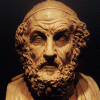
A man on one occasion reproached him for having given a contribution to one who was not a good man (for the story which I have mentioned before is also quoted in this way), and his answer was, “I gave not to the man, but to humanity.”
[πρὸς τὸν αἰτιασάμενον ὡς εἴη μὴ ἀγαθῷ ἔρανον δεδωκώσ–φέρεται γὰρ καὶ οὕτωσ–“οὐ τῷ ἀνθρώπῳ,” φησίν, “ἔδωκα, ἀλλὰ τῷ ἀνθρωπίνῳ.”]
Aristotle (384-322 BC) Greek philosopher
Attributed in Diogenes Laërtius, Lives and Opinions of Eminent Philosophers [Vitae Philosophorum], Book 5, sec. 11 [tr. Yonge (1853)]
(Source)
(Source (Greek)). The previously mentioned story is here. Alternate translations:When someone accused him of having given a subscription to a dishonest man -- for the story is also told in this form -- "It was not the man," said he, "that I assisted, but humanity."
[tr. Hicks (1925), sec. 21]When someone blamed him for giving membership to a base man, he said, “I didn’t give it to a man, but to humanity.”
[tr. @sentantiq (2016)]To someone who faulted him for having made a loan to a dishonest man -- for the story is also told in this way -- he said, "It was not the man that I assisted, but mankind."
[tr. Mensch (2018)]
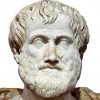
Reproached one day because he gave alms to a good-for-nothing, he said, “It was the man that I pitied, not his conduct.”
[ὀνειδιζόμενός ποτε ὅτι πονηρῷ ἀνθρώπῳ ἐλεημοσύνην ἔδωκεν, “οὐ τὸν τρόπον,” εἶπεν, “ἀλλὰ τὸν ἄνθρωπον ἠλέησα.”]
Aristotle (384-322 BC) Greek philosopher
Attributed in Diogenes Laërtius, Lives and Opinions of Eminent Philosophers [Vitae Philosophorum], Book 5, sec. 11 [tr. Mensch (2018)]
(Source)
(Greek Source). Alternate translations:On one occasion he was blamed for giving alms to a worthless man, and he replied, “I did not pity the man, but his condition.”
[tr. Yonge (1853)]Being once reproached for giving alms to a bad man, he rejoined, "It was the man and not his character that I pitied."
[tr. Hicks (1925), sec. 17]After he was reproached for giving money to a wretched man, he said, “It wasn’t the character, but the man I pitied.”
[tr. @sentantiq [2016)]Once, he was reproached because he gave charity to a lowly person, so he said, "I gave charity to a man, not a way of life."
[Source, sec. 17]
It’s wrong, my friend, to send any stranger packing —
even one who arrives in worse shape than you.
Every stranger and beggar comes from Zeus
and whatever scrap they get from the likes of us,
they’ll find it welcome.[Ξεῖν’, οὔ μοι θέμις ἔστ’, οὐδ’ εἰ κακίων σέθεν ἔλθοι,
ξεῖνον ἀτιμῆσαι· πρὸς γὰρ Διός εἰσιν ἅπαντες
ξεῖνοί τε πτωχοί τε. δόσις δ’ ὀλίγη τε φίλη τε
γίνεται ἡμετέρη.]Homer (fl. 7th-8th C. BC) Greek author
The Odyssey [Ὀδύσσεια], Book 14, l. 56ff (14.56) [Eumæus/Eumaios] (c. 700 BC) [tr. Fagles (1996)]
(Source)
(Source (Greek)). The language is an echo of Nausicaa in Book 6. Alternate translations:Guest! If one much worse
Arriv’d here than thyself, it were a curse
To my poor means, to let a stranger taste
Contempt for fit food. Poor men, and unplac’d
In free seats of their own, are all from Jove
Commended to our entertaining love.
But poor is th’ entertainment I can give,
Yet free and loving.
[tr. Chapman (1616)]Stranger, then said Eumæus, it was never
My custom any stranger to neglect;
The poor and stranger are in God’s hand ever.
Few are my gifts, and but of small effect.
[tr. Hobbes (1675)]It never was our guise
To slight the poor, or aught humane despise:
For Jove unfold our hospitable door,
'Tis Jove that sends the stranger and the poor.
[tr. Pope (1725)]My guest! I should offend, treating with scorn
The stranger, though a poorer should arrive
Than ev’n thyself; for all the poor that are,
And all the strangers are the care of Jove.
Little, and with good will, is all that lies
Within my scope.
[tr. Cowper (1792), l. 68ff]O friend, I dare not, though a worse man sought
These doors, a stranger use discourteously.
All strangers and all poor by Zeus are brought;
Sweet is our gift, yet small.
[tr. Worsley (1862), st. 7]O stranger! 'Twere a wrongful act of mine,
Ev'n should a wretch more hapless than thyself
Before me come, on such a stranger's claim
To cast contempt: for ev'ry one Unknown
And ev'ry Mendicant from Jove Himself
His claim prefers. But, small, indeed, though kind
Are our donations all.
[tr. Musgrave (1869), l. 90ff]Sir guest, 'tis not my wont, not e'en should come
A worser man than thou, to slight a guest.
From Zeus are strangers all, and begger-men:
My gift is small, tho' proof of kindliness.
[tr. Bigge-Wither (1869)]Guest of mine, it were an impious thing for me to slight a stranger, even if there came a meaner man than thou; for from Zeus are all strangers and beggars; and a little gift from such as we, is dear.
[tr. Butcher/Lang (1879)]O guest, it were not rightful, though e'en worser than thou he were sped,
To put shame upon a stranger; since guest and bedesman all,
From Zeus they are; and our giving, although it be but small,
Is dear.
[tr. Morris (1887)]Stranger, it is not right for me to slight a stranger, not even one in poorer plight than you; for in the charge of Zeus all strangers and beggars stand, and our small gift is welcome.
[tr. Palmer (1891)]Stranger, though a still poorer man should come here, it would not be right for me to insult him, for all strangers and beggars are from Jove. You must take what you can get and be thankful.
[tr. Butler (1898)]Nay, stranger, it were not right for me, even though one meaner than thou were to come, to slight a stranger: for from Zeus are all strangers and beggars, and a gift, though small, is welcome from such as we.
[tr. Murray (1919)]My guest, I should sin if I failed in attention to any stranger, even one poorer than yourself. The needy and the strangers are all from Zeus; and with the likes of us a quite slender gift can convey goodwill.
[tr. Lawrence (1932)]"Sir," said the swineherd Eumaeus, "my conscience would not let me turn away a stranger in a worse state even than yourself, for strangers and beggars all come in Zeus’ name, and a gift from folk like us is none the less welcome for being small."
[tr. Rieu (1946)]Tush, friend,
rudeness to a stranger is not decency,
poor though he may be, poorer than you.
All wanderers
and beggars come from Zeus. What we can give
is slight but well-meant.
[tr. Fitzgerald (1961)]Stranger, I have no right to deny the stranger, not
even if one came to me who was meaner than you. All vagabonds
and strangers are under Zeus, and the gift is a light and a dear one
that comes from us.
[tr. Lattimore (1965)]Dear guest. I'd never slight the least of strangers. Not even one more wretched than you are; for it is Zeus who sends to us all beggars and strangers; and a gift, however small, means much when given by a man like me.
[tr. Mandelbaum (1990)]Stranger, for me it would not be right to dishonor a stranger, though one baser than you came, for every stranger and beggar has the protection of Zeus; and a gift, though little, but welcome, lies in our power to give.
[tr. Merrill (2002)]Stranger, it is not right for me to turn away any stranger, even one in a worse state than you are, for strangers and beggars all come in Zeus' name, and a gift from folk like us is none the less welcome for being small.
[tr. DCH Rieu (2002)]Stranger, it is not right for me to treat a guest dishonorably, not even one in a worse state than you; all strangers and beggars are under the protection of Zeus. What I can offer is small, but you are welcome to it.
[tr. Verity (2016)]One must honor guests and foreigners and strangers, even those much poorer than oneself. Zeus watches over beggars and guests and strangers. What I have to give is small, but I will give it gladly.
[tr. Wilson (2017)]Stranger, were one even meaner than you than you to come here, I'd still have no right to reject him, for all strangers and beggars are from Zeus, and a gift, however small, is friendly from folk such as us.
[tr. Green (2018)]It would be wrong,
stranger, for me to disrespect a guest,
even if one worse off than you arrived,
for every guest and beggar comes from Zeus,
and any gift from people like ourselves,
though small, is welcome.
[tr. Johnston (2019)]
The selfish man believes that by closing his heart against his fellows, and centering in self every thought and feeling, he escapes much suffering. But his egotistical calculations are invariably defeated; for his contracted sympathies being all directed to one focus, he so aggravates the ills he endures, that he expends on self along more painful pity than the most enthusiastic philanthropist devotes to mankind.
Marguerite Gardiner, Countess of Blessington (1789-1849) Irish novelist [Lady Blessington, b. Margaret Power]
Desultory Thoughts and Reflections (1839)
(Source)

Errors and mistakes, however gross, in matters of opinion, if they are sincere, are to be pitied, but not punished nor laughed at. The blindness of the understanding is as much to be pitied as the blindness of the eye, and there is neither jest nor guilt in a man’s losing his way in either case. Charity bids us set him right if we can, by arguments and persuasions; but charity, at the same time, forbids, either to punish or ridicule his misfortune.
Lord Chesterfield (1694-1773) English statesman, wit [Philip Dormer Stanhope]
Letter to his son, #126 (21 Sep 1747)
(Source)
On religious tolerance.

Santa Claus is anyone who loves another and seeks to make them happy; who gives himself by thought or word or deed in every gift that he bestows; who shares his joys with those who are sad; whose hand is never closed against the needy; whose arm is ever outstretched to aid the week; whose sympathy is quick and genuine in time of trouble; who recognizes a comrade and brother in every man he meets upon life’s common road; who lives his life throughout the entire year in the Christmas spirit.
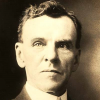
The Faith you mention has doubtless its use in the World. I do not desire to see it diminished, nor would I endeavour to lessen it in any Man. But I wish it were more productive of good Works, than I have generally seen it: I mean real good Works, Works of Kindness, Charity, Mercy, and Publick Spirit; not Holiday-keeping, Sermon-Reading or Hearing; performing Church Ceremonies, or making long Prayers, filled with Flatteries and Compliments, despis’d even by wise Men, and much less capable of pleasing the Deity.
Benjamin Franklin (1706-1790) American statesman, scientist, philosopher, aphorist
Letter to Joseph Huey (6 Jun 1753)
(Source)
The worst days of darkness through which I have ever passed have been greatly alleviated by throwing myself with all my energy into some work relating to others.
James A. Garfield (1831-1881) US President (1881), lawyer, lay preacher, educator
Letter to B. A. Hinsdale (30 Apr 1874)
(Source)
If a man who was rich enough in this world’s goods saw that one of his brothers was in need, but closed his heart to him, how could the love of God be living in him? My children, our love is not to be just words or mere talk, but something real and active.
[ὃς δ’ ἂν ἔχῃ τὸν βίον τοῦ κόσμου καὶ θεωρῇ τὸν ἀδελφὸν αὐτοῦ χρείαν ἔχοντα καὶ κλείσῃ τὰ σπλάγχνα αὐτοῦ ἀπ’ αὐτοῦ πῶς ἡ ἀγάπη τοῦ Θεοῦ μένει ἐν αὐτῷ. Τεκνία μὴ ἀγαπῶμεν λόγῳ μηδὲ τῇ γλώσσῃ ἀλλὰ ἐν ἔργῳ καὶ ἀληθείᾳ.]
The Bible (The New Testament) (AD 1st - 2nd C) Christian sacred scripture
1 John 3:17-18 [JB (1966)]
(Source)
(Source (Greek)). Alternate translations:But whoso hath this world's good, and seeth his brother have need, and shutteth up his bowels of compassion from him, how dwelleth the love of God in him?
My little children, let us not love in word, neither in tongue; but in deed and in truth.
[KJV (1611)]If we are rich and see others in need, yet close our hearts against them, how can we claim that we love God? My children, our love should not be just words and talk; it must be true love, which shows itself in action.
[GNT (1976)]If anyone is well-off in worldly possessions and sees his brother in need but closes his heart to him, how can the love of God be remaining in him? Children, our love must be not just words or mere talk, but something active and genuine.
[NJB (1985)]But if someone has material possessions and sees a brother or sister in need but refuses to help—how can the love of God dwell in a person like that?
Little children, let’s not love with words or speech but with action and truth.
[CEB (2011)]If anyone has material possessions and sees a brother or sister in need but has no pity on them, how can the love of God be in that person? Dear children, let us not love with words or speech but with actions and in truth.
[NIV (2011)]How does God’s love abide in anyone who has the world’s goods and sees a brother or sister in need and yet refuses help?
Little children, let us love, not in word or speech, but in truth and action.
[NRSV (2021 ed.)]
How long will you judge unjustly
and show partiality to the wicked? Selah
Give justice to the weak and the orphan;
maintain the right of the lowly and the destitute.
Rescue the weak and the needy;
deliver them from the hand of the wicked.The Bible (The Old Testament) (14th - 2nd C BC) Judeo-Christian sacred scripture [Tanakh, Hebrew Bible], incl. the Apocrypha (Deuterocanonicals)
Psalm 82: 2-4 [NRSV (2021 ed.)]
(Source)
Alternate translations:How long will ye judge unjustly, and accept the persons of the wicked? Selah.
Defend the poor and fatherless: do justice to the afflicted and needy.
Deliver the poor and needy: rid them out of the hand of the wicked.
[KJV (1611)]No more mockery of justice,
no more favouring the wicked! Pause
Let the weak and the orphan have justice,
be fair to the wretched and destitute;
rescue the weak and needy,
save them from the clutches of the wicked!
[JB (1966)]You must stop judging unjustly;
you must no longer be partial to the wicked!
Defend the rights of the poor and the orphans;
be fair to the needy and the helpless.
Rescue them from the power of evil people.
[GNT (1976)]How much longer will you give unjust judgements and uphold the prestige of the wicked? Pause
Let the weak and the orphan have justice, be fair to the wretched and the destitute.
Rescue the weak and the needy, save them from the clutches of the wicked.
[NJB (1985)]How long will you judge unjustly
by granting favor to the wicked? Selah
Give justice to the lowly and the orphan;
maintain the right of the poor and the destitute!
Rescue the lowly and the needy.
Deliver them from the power of the wicked!
[CEB (2011)]How long will you judge perversely,
showing favor to the wicked? Selah.
Judge the wretched and the orphan,
vindicate the lowly and the poor,
rescue the wretched and the needy;
save them from the hand of the wicked.
[RJPS (2023 ed.)]
Who kindly sets a wand’rer on his way
Does e’en as if he lit another’s lamp by his:
No less shines his, when he his friend’s hath lit.[Homó, qui erranti cómiter monstrát viam,
Quasi lúmen de suo lúmine accendát, facit.
Nihiló minus ipsi lúcet, cum illi accénderit.]Ennius (239-169 BC) Roman poet, writer [Quintus Ennius]
Telephus, frag 412-414 [tr. Miller (1913)]
(Source)
The fragment comes to us from Cicero, De Officiis [On Duties; On Moral Duty; The Offices], Book 1, ch. 16 / sec. 51 (44 BC). Original Latin. Alt. trans.:He that directs the wandering traveller,
Doth, as it were, light another's torch by his own;
Which gives him ne'er the less of light, for that
It gave another.
[tr. Cockman (1699)]The man who kindly points out the way to the wandering traveller, gives light to the lamp of another, without diminishing by the communication the light of his own.
[tr. McCartney (1798)]He who kindly shows the bewildered traveller the right road, does as it were light his lamp by his own; which affords none the less light to himself after it has lighted the other.
[tr. Edmonds (1865)]Who kindly shows a wanderer his way,
Lights, as it were, a torch from his own torch, --
In kindling others' light, no less he shines.
[tr. Peabody (1883)]The man who kindly points the way top a wanderer, does as though he kindles a light from the light that is his; it shines none the less for himself when he has kindled it for his fellow.
["trib Teleph. R suae lumine accendit facis Hartman, Mnemoe., XXI, 382 fortass recte"]
For Yahweh your God is God of gods and Lord of lords, the great God, triumphant and terrible, never partial, never to be bribed. It is he who sees justice done for the orphan and the widow, who loves the stranger and gives him food and clothing. Love the stranger then, for you were strangers in the land of Egypt.
The Bible (The Old Testament) (14th - 2nd C BC) Judeo-Christian sacred scripture [Tanakh, Hebrew Bible], incl. the Apocrypha (Deuterocanonicals)
Deuteronomy 10:17-19 [JB (1966)]
(Source)
Alternate translations:For the Lord your God is God of gods, and Lord of lords, a great God, a mighty, and a terrible, which regardeth not persons, nor taketh reward: He doth execute the judgment of the fatherless and widow, and loveth the stranger, in giving him food and raiment. Love ye therefore the stranger: for ye were strangers in the land of Egypt.
[KJV (1611)]The Lord your God is supreme over all gods and over all powers. He is great and mighty, and he is to be obeyed. He does not show partiality, and he does not accept bribes. He makes sure that orphans and widows are treated fairly; he loves the foreigners who live with our people, and gives them food and clothes. So then, show love for those foreigners, because you were once foreigners in Egypt.
[GNT (1976)]For the Lord your God is God of gods and Lord of lords, the great God, mighty and awesome, who is not partial and takes no bribe, who executes justice for the orphan and the widow, and who loves the strangers, providing them food and clothing. You shall also love the stranger, for you were strangers in the land of Egypt.
[NRSV (1989 ed.)]For your God יהוה is God supreme and Lord supreme, the great, the mighty, and the awesome God, who shows no favor and takes no bribe, but upholds the cause of the fatherless and the widow, and befriends the stranger, providing food and clothing. -- You too must befriend the stranger, for you were strangers in the land of Egypt.
[RJPS (2006)]For the Lord your God is God of gods and Lord of lords, the great God, mighty and awesome, who shows no partiality and accepts no bribes. He defends the cause of the fatherless and the widow, and loves the foreigner residing among you, giving them food and clothing. And you are to love those who are foreigners, for you yourselves were foreigners in Egypt.
[NIV (2011 ed.)]
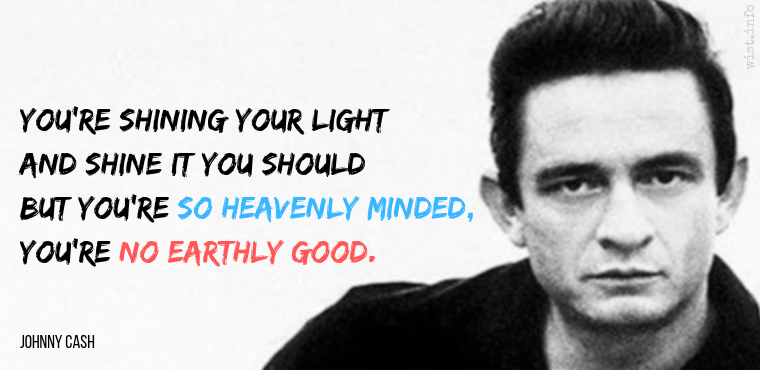
Come heed me, my brothers, come heed, one and all
Don’t brag about standing or you’ll surely fall
You’re shining your light and shine it you should
But you’re so heavenly minded, you’re no earthly goodIf you’re holding heaven, then spread it around
There’s hungry hands reaching up here from the ground
Move over and share the high ground where you stood
So heavenly minded, you’re no earthly good
John R. "Johnny" Cash (1932-2003) American singer-songwriter, guitarist, actor, author
“So Heavenly Minded, You’re No Earthly Good”
(Source)

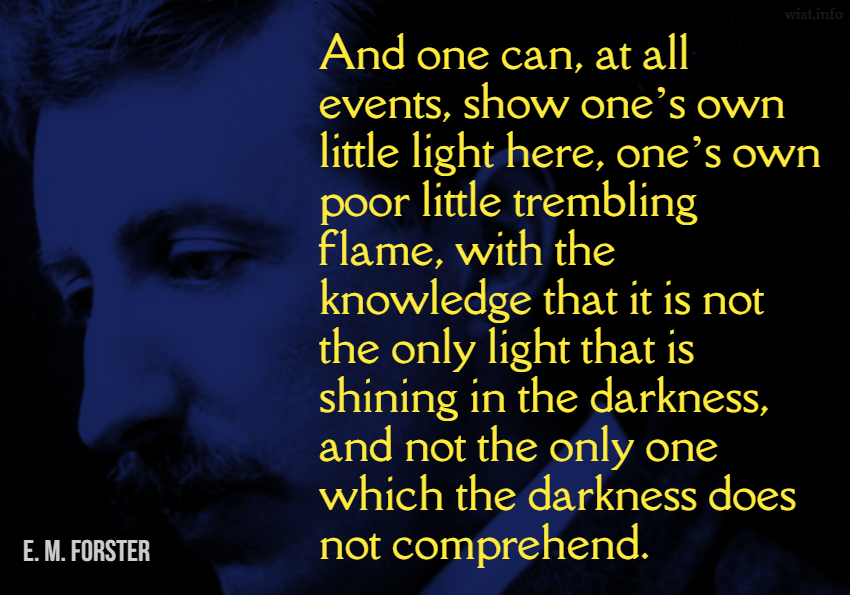
One must be fond of people and trust them if one is not to make a mess of life, and it is therefore essential that they should not let one down. They often do. The moral of which is that I must, myself, be as reliable as possible, and this I try to be. But reliability is not a matter of contract — that is the main difference between the world of personal relationships and the world of business relationships. It is a matter for the heart, which signs no documents. In other words, reliability is impossible unless there is a natural warmth. Most men possess this warmth, though they often have bad luck and get chilled. Most of them, even when they are politicians, want to keep faith. And one can, at all events, show one’s own little light here, one’s own poor little trembling flame, with the knowledge that it is not the only light that is shining in the darkness, and not the only one which the darkness does not comprehend.
E. M. Forster (1879-1970) English novelist, essayist, critic, librettist [Edward Morgan Forster]
“What I Believe,” The Nation (16 Jul 1938)
(Source)
Love is the crowning grace of humanity, the holiest right of the soul, the golden link which binds us to duty and truth, the redeeming principle that chiefly reconciles the heart to life, and is prophetic of eternal good.
Francesco Petrarca (1304-1374) Italian scholar and poet [a.k.a. Petrarch]
(Attributed)
(Source)
Quoted in In Henry T. Tuckerman, "Petrarch," The American Whig Review (May 1845). The first word is sometimes quoted as "charity".

He who gives only what he would as readily throw away gives without generosity; for the essence of generosity is in self-sacrifice.
Henry Taylor (1800-1886) English dramatist, poet, bureaucrat, man of letters
“Money,” Notes from Life (1847)
(Source)

God is pleased with no music from below so much as in the thanksgiving songs of relieved widows, of supported orphans, of rejoicing, and comforted, and thankful persons.
Jeremy Taylor (1613-1667) English cleric and author
Sermon 25, “The Duties of the Tongue,” Part 4 [Eph. 4:29]
(Source)

Loving-kindness is greater than laws; and the charities of life are more than all ceremonies.
The Talmud (AD 200-500) Collection of Jewish rabbinical writings
(Unreferenced)

“I hope that you did not give him anything, Mr Sanderson!”
“Of course I did, ma’am.”
“But he would only spend it on drink! You know what the working classes are!”
“Indeed, ma’am, and why should he not spend it on drink? Would you deprive the poor, whose lives are bad and miserable and comfortless enough, of the solace of a little relief from grinding poverty? A sordid, sodden relief perhaps, but would you be so heartless as to deny the poor even that pleasure in which all of us indulge at your generous expense?”

He that gives should never remember. He that receives should never forget.
The Talmud (AD 200-500) Collection of Jewish rabbinical writings
(Unreferenced)
Deeds of kindness are equal in weight to all the commandments.
The Talmud (AD 200-500) Collection of Jewish rabbinical writings
Mishnah, Zeraim, Pe’ah 4:19
(Source)
If a civil word or two will render a man happy, he must be a wretch indeed who will not give them to him.
Louis XIV (1638-1715) French monarch (1643-1715) [Louis the Great, the Sun King)
(Attributed)
(Source)
Quoted in William Seward, Anecdotes of Distinguished Persons, Vol 4, 5th ed. (1804).
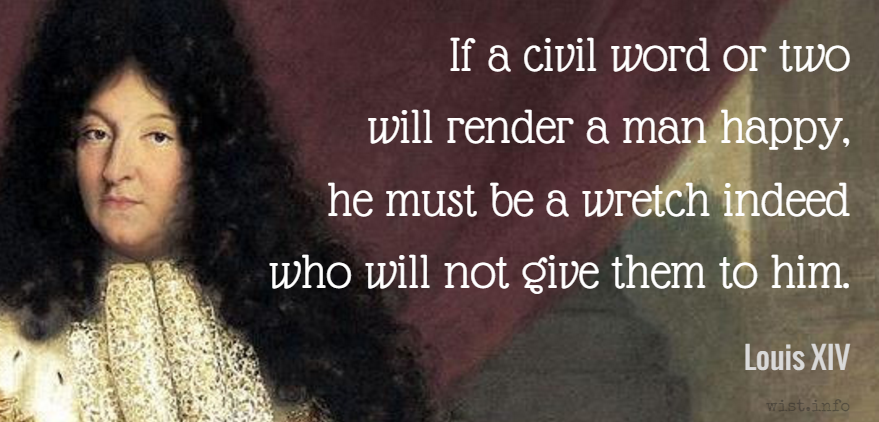

In Christmas feasting pray take care;
Let not your table be a Snare;
But with the Poor God’s Bounty share.
Benjamin Franklin (1706-1790) American statesman, scientist, philosopher, aphorist
Poor Richard’s Almanack, December (1748)
(Source)
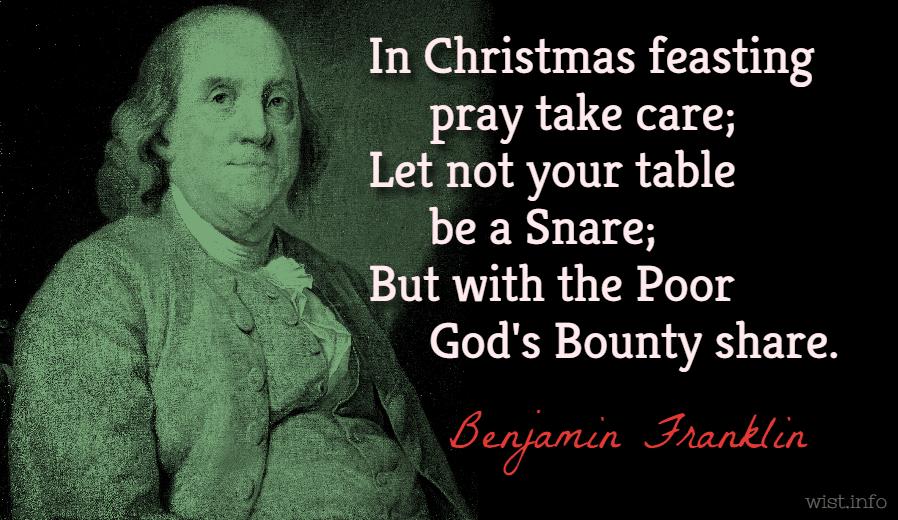
Christmas Day is a day of joy and charity. May God make you very rich in both.
Phillips Brooks (1835-1893) American clergyman, hymnist
Sermons, “Christmas Day” (1910)
(Source)
Full quote: "It is a day of joy and charity. May God make you very rich in both by giving you abundantly the glory of the Incarnation, the peace of Christ's kingship, and the grace of Christ's salvation."
Convinced that character is all and circumstances nothing, [the Puritan] sees in the poverty of those who fall by the way, not a misfortune to be pitied and relieved, but a moral failing to be condemned, and in riches, not an object of suspicion but the blessing which rewards the triumph of energy and will.
R. H. Tawney (1880-1962) English writer, economist, historian, social critic [Richard Henry Tawney]
Religion and the Rise of Capitalism, ch. 4 (1926)
(Source)
GERVAIS: Whenever I do a thing about animals, there’s always someone that goes, “What about children dying in Syria?” Yeah, that’s bad, too — can’t we care about both? Sometimes I go, “You carry on all your good work for the fucking children in Syria, and I’ll do this.” I love the fact that there’s a hierarchy of things that you’ve got to care about. I tweeted “I love humans — they’re just not my favorite animal.” That was to annoy people.
GQ: True, though?
GERVAIS: No, I’m not a maniac. Of course humans are my favorite animal. [pauses] But I’ve never met an animal who was a cunt.
Ricky Gervais (b. 1961) English comedian, actor, director, writer
Interview with Chris Heath, GQ (15 May 2013)
(Source)

He who withholds but a pennyworth of worldly goods from his neighbor, knowing him to be in need of it, is a robber in the sight of God.
Meister Eckhart (c. 1260-1328?) German theologian, philosopher, mystic [a.k.a. Johannes Eckhart von Hochheim; Eckhart; Eckehart]
Meister Eckhart, Tractate 6, “Sister Katrei” [ed. Pfeiffer (1857), tr. Evans]
(Source)

Great minds, like heaven, are pleased in doing good,
Though the ungrateful subjects of their favors
Are barren in return.Nicholas Rowe (1674-1718) English poet and dramatist
Tamerlane, Act 2, sc. 2 (1701)

In giving of thy alms, inquire not so much into the person, as his necessity. God looks not so much upon the merits of him that requires, as into the manner of him that relieves; if the man deserve not, thou hast given it to humanity.

I will enjoy the pleasure of what I give by giving it alive, and seeing another enjoy it. When I die, I should be ashamed to leave enough to build me a monument if there were a wanting friend above ground.
Alexander Pope (1688-1744) English poet
Letter to Jonathan Swift (9 Oct 1729)

The very poor can always be depended upon. They never turn away the hungry. Time and again, all over the United States, have I been refused food at the big house on the hill; and always have I received food from the little shack down by the creek or marsh, with its broken windows stuffed with rags and its tired-faced mother broken with labor. Oh! you charity-mongers, go to the poor and learn, for the poor alone are the charitable. They neither give nor withhold from the excess. They have no excess. They give, and they withhold never, from what they need for themselves. A bone to the dog is not charity. Charity is the bone shared with the dog when you are just as hungry as the dog.
Jack London (1876-1916) American novelist
“My Life in the Underworld,” Cosmopolitan Magazine (May 1907)
(Source)
Republished in The Road, Part 1, ch. 1 (1907). Recalling his days as a hobo in 1892.
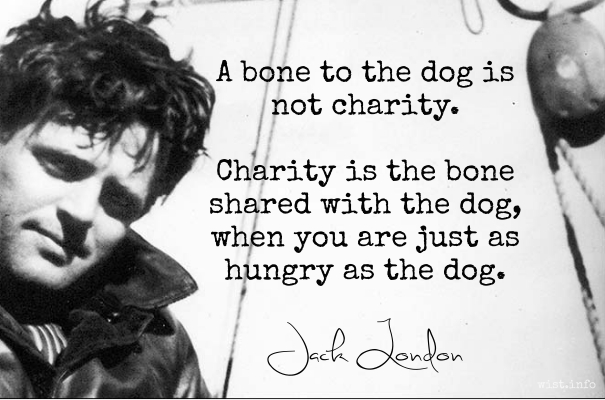
Be charitable and indulgent to every one but yourself.
Joseph Joubert (1754-1824) French moralist, philosopher, essayist, poet
(Attributed)
(Source)
Frequently attributed to Joubert, but with no citation from his works. Earliest quoted in Maturin M. Ballou, ed., Treasury of Thought (1884 ed.).
Sometimes given "but thyself."
We do not quite forgive a giver. The hand that feeds us is in some danger of being bitten. We can receive anything from love, for that is a way of receiving it from ourselves; but not from any one who assumes to bestow.
Ralph Waldo Emerson (1803-1882) American essayist, lecturer, poet
“Gifts,” Essays: Second Series, No. 5 (1844)
(Source)
The man who has received a benefit ought always to remember it, but he who has granted it ought to forget the fact at once.
Demosthenes (384-322 BC) Greek orator and statesman
(Attributed)
(Source)
Attributed in Hugh Percy Jones, A New Dictionary of Foreign Phrases and Classical Quotations (1900).
For a man to love again where he is loved, it is the charity of publicans contracted by mutual profit and good offices; but to love a man’s enemies is one of the cunningest points of the law of Christ, and an imitation of the divine nature.
Francis Bacon (1561-1626) English philosopher, scientist, author, statesman
Sacred Meditations [Meditationes Sacræ], “Of the Exaltation of Charity” (1597)
Posthumous charities are the very essence of selfishness, when bequeathed by those who, when alive, would part with nothing.
Charles Caleb "C. C." Colton (1780-1832) English cleric, writer, aphorist
Lacon: Or, Many Things in Few Words, Vol. 1, § 314 (1820)
(Source)
Do not give, as many rich men do, like a hen that lays her egg and then cackles.
Henry Ward Beecher (1813-1887) American clergyman and orator
“Plymouth Pulpit” (26 Jun 1869)
A man should fear when he enjoys only what good he does publicly. Is it not the publicity, rather than the charity, that he loves?
Henry Ward Beecher (1813-1887) American clergyman and orator
In Henry Ward Beecher and Edna Dean Proctor, Life Thoughts: Gathered From the Extemporaneous Discourses of Henry Ward Beecher (1858)
See Matthew.
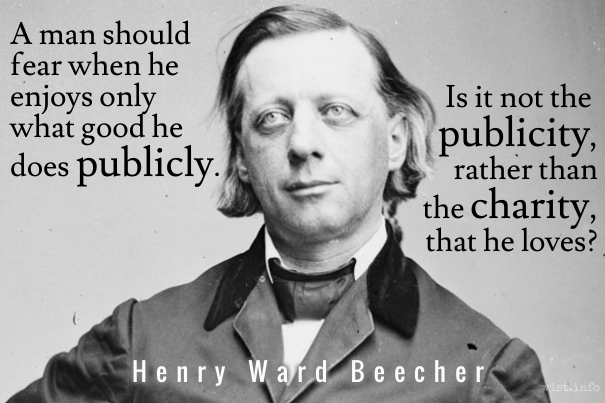
The last, best fruit that comes to perfection, even in the kindliest soul, is tenderness toward the hard; forbearance toward the unforbearing; warmth of heart toward the cold; and philanthropy toward the misanthropic.
Jean Paul Richter (1763-1825) German writer, art historian, philosopher, littérateur [Johann Paul Friedrich Richter; pseud. Jean Paul]
(Attributed)
Quoted in Josiah Hotchkiss Gilbert, Dictionary of Burning Words of Brilliant Writers (1895).
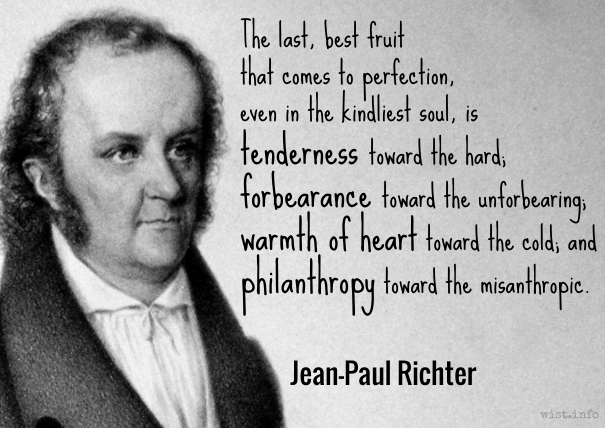

It’s okay if you don’t want to feed the hungry, or heal the sick, or house the homeless. Just don’t say you’re doing it for their own good. Don’t say you’d like to help people, but your hands are tied, because if you did it would cause a “culture of dependency,” or “go against the Bible,” or, worst of all, “rob them of their freedom” to be sick and hungry. Just admit you’re selfish, and based on how little your beliefs mirror the actual teachings of Jesus you might as well be worshiping Despicable Me.
William "Bill" Maher (b. 1956) American comedian, political commentator, critic, television host.
Real Time with Bill Maher (8 Nov 2013)

Of great riches there is no real use, except it be in the distribution; the rest is but conceit.
Francis Bacon (1561-1626) English philosopher, scientist, author, statesman
“Of Riches,” Essays, No. 34 (1625)
(Source)
Defer not thy charities till death; for certainly, if a man weight it rightly, he that doth so is rather liberal of another man’s than his own.
Francis Bacon (1561-1626) English philosopher, scientist, author, statesman
“Of Riches,” Essays, No. 34 (1625)
(Source)
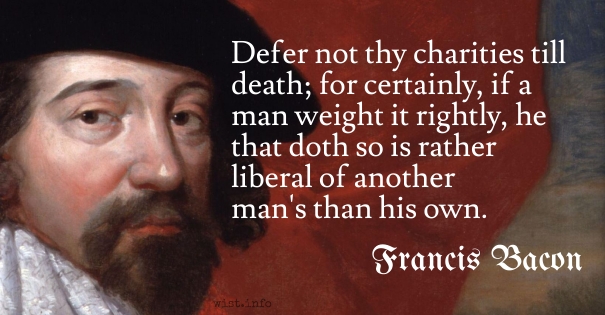
A man’s first duty is to make a competence and be independent. But his whole duty does not end there. It his his duty to do something for his needy neighbors who are less favored than himself. It is his duty to contribute to the general good of the community in which he lives. He has been protected by its laws. Because he has been protected in his various enterprises he has been able to make money sufficient for his needs and those of his family. All beyond this belongs in justice to the protecting power that has fostered him and enabled him to win pecuniary success. To try and make the world in some way better than you have found is to have a noble motive in life.
Andrew Carnegie (1835-1919) American industrialist and philanthropist
The Empire of Business, “Thrift as a Duty” (1902)
Are there no ideals more stirring than those of martial glory? Is this generation conscious of calls to the service of native land in ways no more worthy than the way of taking a musket and killing somebody? You ask, in the language of Prof. James, for a moral equivalent for war. A patriot needs only look about to find numberless causes that ought to warm the blood and stir the imagination. The dispelling of ignorance and the fostering of education, the investigation of disease and the searching out of remedies that will vanquish the giant ills that decimate the race, the inculcation of good feeling in the industrial world, the cause of the aged, the cause of the men and women who had so little chance — tell me, has war anything that beckons as these things beckon with alluring and compelling power? Whoso wants to share the heroism of battle let him join the fight against ignorance and disease — and the mad idea that war is necessary.
Andrew Carnegie (1835-1919) American industrialist and philanthropist
“A Plea for Peace,” New York Times (7 Apr 1907)
(Source)
“I have often thought,” says Sir Roger, “it happens very well that Christmas should fall out in the middle of winter. It is the most dead uncomfortable time of the year, when the poor people would suffer very much from their poverty and cold, if they had not good cheer, warm fires, and Christmas gambols to support them. I love to rejoice their poor hearts at this season, and to see the whole village merry in my great hall.”
Joseph Addison (1672-1719) English essayist, poet, statesman
Essay (1712-01-08), The Spectator, No. 269
(Source)
Quoting Roger de Coverley. While the more frequent shorter excerpt (as in the image) conjures up enjoyment of the winter season, the broader quote demonstrates a noblesse oblige regarding the poor in winter.

I am sure I have always thought of Christmas time, when it has come round — apart from the veneration due to its sacred name and origin, if anything belonging to it can be apart from that — as a good time; a kind, forgiving, charitable, pleasant time: the only time I know of, in the long calendar of the year, when men and women seem by one consent to open their shut-up hearts freely, and to think of people below them as if they really were fellow-passengers to the grave, and not another race of creatures bound on other journeys. And therefore, uncle, though it has never put a scrap of gold or silver in my pocket, I believe that it has done me good, and will do me good; and I say, God bless it!
Charles Dickens (1812-1870) English writer and social critic
A Christmas Carol [Fred] (1843)
Yet the day is not far distant when the man who dies leaving behind him millions of available wealth, which was his to administer during his life, will pass away “unwept, unhonoured and unsung,” no matter to what uses he leaves the dross which he cannot take with him. The man who dies thus rich dies disgraced.
Andrew Carnegie (1835-1919) American industrialist and philanthropist
“The Gospel of Wealth,” Part 1, North American Review (1889-06)
(Source)
Collected in The Gospel of Wealth and Other Timely Essays (1900).
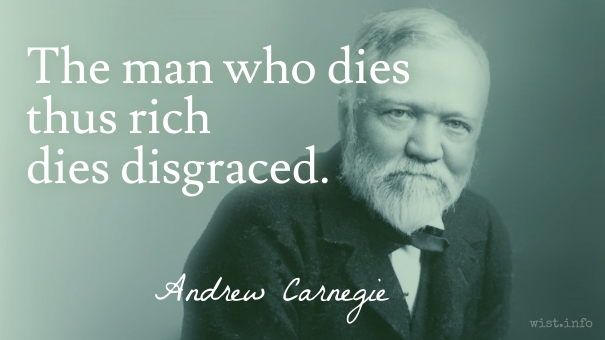
I know that a man who shows me his wealth is like the beggar who shows me his poverty; they are both looking for alms from me, the rich man for the alms of my envy, the poor man for the alms of my guilt.
Ben Hecht (1894-1964) American writer, director, producer, journalist
A Child of the Century (1954)
It will not bother me in the hour of death to reflect that I have been ‘had for a sucker’ by any number of impostors: but it would be a torment to know that one had refused even one person in need. After all, the parable of the sheep and goats makes our duty perfectly plain, doesn’t it? Another thing that annoys me is when people say ‘Why did you give that man money? He’ll probably go and drink it.’ My reply is ‘But if I’d kept [it] I should probably have drunk it.’
C. S. Lewis (1898-1963) English writer, literary scholar, lay theologian [Clive Staples Lewis]
Letter to Mary Willis Shelburne (26 Oct 1962)

He that feeds the hungry feeds God also.
The Talmud (AD 200-500) Collection of Jewish rabbinical writings
(Unreferenced)
Whoever destroys a soul, it is considered as if he destroyed an entire world. And whoever saves a life, it is considered as if he saved an entire world.
The Talmud (AD 200-500) Collection of Jewish rabbinical writings
Mishnah Sanhedrin 4:9; Yerushalmi Talmud, Tractate Sanhedrin 37a
(Source)
Alt. trans.: "Whoever destroys a single life is as guilty as though he had destroyed the entire world; and whoever rescues a single life earns as much merit as though he had rescued the entire world."
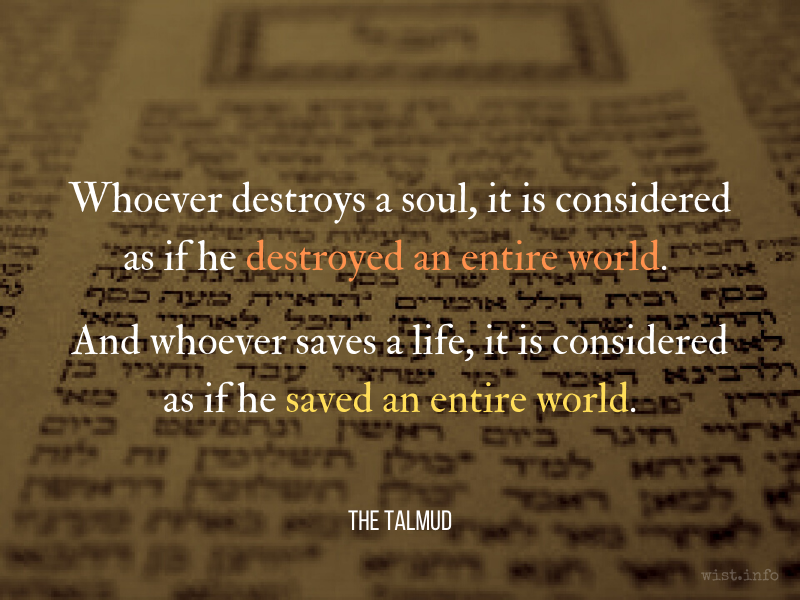
Every good act is charity. A man’s true wealth hereafter is the good that he does in this world to his fellows.
Muhammad (AD c. 570-632) Arab religious, military, and political leader; founder of Islam [Mohammed, مُحَمَّد]
(Attributed)
(Source)
Attributed in Rev. James Wood (ed.) Dictionary of Quotations from Ancient and Modern, English and Foreign Sources (1893). Also sometimes attributed to Moliere.

Those who demand consideration for their sacrifices were making investments, not sacrifices.
James Richardson (b. 1950) American poet
Vectors: Aphorisms and Ten-Second Essays, # 2 (2001)

The greatest pleasure I know is to do a good action by stealth, and to have it found out by accident.
Charles Lamb (1775-1834) Welsh-English essayist
“Table Talk, by the Late Elia,” London Athenaeum (4 Jan 1834)
(Source)

COUNTESS: Love all, trust a few,
Do wrong to none.William Shakespeare (1564-1616) English dramatist and poet
All’s Well That Ends Well, Act 1, sc. 1, l. 66ff (1.1.66-67)(1602?)
(Source)

We must show by our behavior that we believe in equality and justice and that our religion teaches faith and love and charity to our fellow men. Here is where each of us has a job to do that must be done at home, because we can lose the battle on the soil of the United States just as surely as we can lose it in any one of the countries of the world.
Eleanor Roosevelt (1884-1962) First Lady of the US (1933-45), politician, diplomat, activist
India and the Awakening East (1953)

A rich man without charity is a rogue; and perhaps it would be no difficult matter to prove that he is also a fool.
Henry Fielding (1707-1754) English novelist, dramatist, satirist
The Covent-Garden Journal, #44 (2 Jun 1752)
(Source)
You cannot push anyone up the ladder unless he is willing to climb.
Andrew Carnegie (1835-1919) American industrialist and philanthropist
(Attributed)
Most common form of an adage Carnegie frequently used regarding charity. Variants:
- "It is of no use to boost a man up a ladder unless he is willing to climb himself." -- In Cyrus Holdridge, "A Millionaire and His Hobby," Our Day (Jan 1900).
- "You cannot push anyone up a ladder unless he is willing to climb a little himself." -- Elbert Hubbard, Little Journeys to the Homes of Great Business Men, Vol. 25 (1909).
You make a living by what you earn, you make a life by what you give.
Winston Churchill (1874-1965) British statesman and author
(Spurious)
Frequently attributed to Churchill, but not found in any of his writings or records of his spoken words by the Churchill Centre.
People who insist that the sacredness of Scripture depends on belief in creation in a literal six days seem never to insist on a literal reading of “to him who asks, give,” or “sell what you have and give the money to the poor.” In fact, their politics and economics align themselves quite precisely with those of their adversaries, who yearn to disburden themselves of the weak, and to unshackle the great creative forces of competition. The defenders of “religion” have made religion seem foolish while rendering it mute in the face of a prolonged and highly effective assault on the poor.
Marilynne Robinson (b. 1943) American novelist and essayist
“Darwinism,” The Death of Adam: Essays on Modern Thought (1998)

It is not from the benevolence of the butcher, the brewer, or the baker, that we expect our dinner, but from their regard to their own interests. We address ourselves, not to their humanity but to their self-love, and never talk to them of our own necessities but of their advantage. Nobody but a beggar chooses to depend chiefly upon the benevolence of his fellow-citizens. Even a beggar does not depend upon it entirely.
Adam Smith (1723-1790) Scottish economist
The Wealth of Nations, 1.2 (1776)
What do you think God gave you more wealth than is requisite to satisfy your rational wants for, when you look around and see how many are in absolute need of that which you do not need? Can you not take the hint?
J. G. Holland (1819-1881) American novelist, poet, editor [Josiah Gilbert Holland; pseud. Timothy Titcomb]
(Attributed)
Quoted in Josiah Hotchkiss Gilbert, Dictionary of Burning Words of Brilliant Writers (1895)

A large part of altruism, even when it is perfectly honest, is grounded upon the fact that it is uncomfortable to have unhappy people about one.
H. L. Mencken (1880-1956) American writer and journalist [Henry Lewis Mencken]
“On the Nature of Man: The Altruist,” Prejudices: Fourth Series (1924)
Open your hands, ye whose hands are full! The world is waiting for you! The whole machinery of the Divine beneficence is clogged by your hard hearts and rigid fingers. Give and spend, and be sure that God will send; for only in giving and spending do you fulfill the object of His sending.
J. G. Holland (1819-1881) American novelist, poet, editor [Josiah Gilbert Holland; pseud. Timothy Titcomb]
(Attributed)
Quoted in Josiah Hotchkiss Gilbert, Dictionary of Burning Words of Brilliant Writers (1895)
Having given all he had,
He then is very rich indeed.Lao-tzu (604?-531? BC) Chinese philosopher, poet [also Lao-tse, Laozi]
The Way of Life, 81 [tr. Blakney (1955)]
But the greatest of all the Reformers of the depraved religion of his own country, was Jesus of Nazareth. Abstracting what is really his from the rubbish in which it is buried, easily distinguished by its lustre from the dross of his biographers, and as separable from that as the diamond from the dung hill, we have the outlines of a system of the most sublime morality which has ever fallen from the lips of man: outlines which it is lamentable he did not live to fill up. Epictetus & Epicurus give us laws for governing ourselves, Jesus a supplement of the duties & charities we owe to others. The establishment of the innocent and genuine character of this benevolent Moralist, and the rescuing it from the imputation of imposture, which has resulted from artificial systems,* invented by Ultra-Christian sects, unauthorized by a single word ever uttered by him, is a most desirable object, and one to which Priestley has successfully devoted his labors and learning. It would in time, it is to be hoped, effect a quiet euthanasia of the heresies of bigotry and fanaticism which have so long triumphed over human reason, and so generally & deeply afflicted mankind; but this work is to be begun by winnowing the grain from the chaff of the historians of his life.
* e.g. The immaculate conception of Jesus, his deification, the creation of the world by him, his miraculous powers, his resurrection & visible ascension, his corporeal presence in the Eucharist, the Trinity, original sin, atonement, regeneration, election, orders of Hierarchy, Etc.
Thomas Jefferson (1743-1826) American political philosopher, polymath, statesman, US President (1801-09)
Letter (1819-10-31) to William Short
(Source)
I think you may judge of a man’s character by the persons whose affection he seeks. If you find a man seeking only the affection of those who are great, depend upon it he is ambitious and self-seeking; but when you observe that a man seeks the affection of those who can do nothing for him, but for whom he must do everything, you know that he is not seeking himself, but that pure benevolence sways his heart.
Charles Spurgeon (1834-1892) British Baptist preacher, author [Charles Haddon (C.H.) Spurgeon]
Sermon (15 Jun 1876)
(Source)
A predecessor to the sentiment usually attributed to Paul Eldridge.

Above all things, lose no occasion of exercising your dispositions to be grateful, to be generous, to be charitable, to be humane, to be true, just, firm, orderly, courageous, &c. Consider every act of this kind, as an exercise which will strengthen your moral faculties and increase your worth.
Thomas Jefferson (1743-1826) American political philosopher, polymath, statesman, US President (1801-09)
Letter (1787-08-10) to Peter Carr
(Source)
The best thing to give to your enemy is forgiveness; to an opponent, tolerance; to a friend, your heart; to your child, a good example; to a father, deference; to your mother, conduct that will make her proud of you; to yourself, respect; to all men, charity.
Clara Lucas Balfour (1808-1878) English novelist, lecturer, temperance campaigner
Sunbeams for All Seasons: Counsels, Cautions, and Precepts (1861 ed.)
That the greatest of evils is idleness, that the poor are the victims, not of circumstances, but of their own “idle, irregular, and wicked courses,” that the truest charity is not to enervate them by relief, but so to reform their characters that relief may be unnecessary — such doctrines turned severity from a sin into a duty, and froze the impulse of natural pity with an assurance that, if indulged, it would perpetuate the suffering which it sought to allay.
R. H. Tawney (1880-1962) English writer, economist, historian, social critic [Richard Henry Tawney]
Religion and the Rise of Capitalism, ch. 4, sec. 4 (1926)
(Source)
Once a man came to Jesus. “Teacher,” he asked, “what good thing must I do to receive eternal life?”
“Why do you ask me concerning what is good?” answered Jesus. “There is only One who is good. Keep the commandments if you want to enter life.”
“What commandments?” he asked.
Jesus answered, “Do not commit murder; do not commit adultery; do not steal; do not accuse anyone falsely; respect your father and your mother; and love your neighbor as you love yourself.”
“I have obeyed all these commandments,” the young man replied. “What else do I need to do?”
Jesus said to him, “If you want to be perfect, go and sell all you have and give the money to the poor, and you will have riches in heaven; then come and follow me.”
When the young man heard this, he went away sad, because he was very rich.[Καὶ ἰδοὺ εἷς προσελθὼν αὐτῷ εἶπεν Διδάσκαλε τί ἀγαθὸν ποιήσω ἵνα σχῶ ζωὴν αἰώνιον. Ὁ δὲ εἶπεν αὐτῷ Τί με ἐρωτᾷς περὶ τοῦ ἀγαθοῦ εἷς ἐστιν ὁ ἀγαθός εἰ δὲ θέλεις εἰς τὴν ζωὴν εἰσελθεῖν τήρησον* τὰς ἐντολάς. Λέγει αὐτῷ Ποίας Ὁ δὲ Ἰησοῦς εἶπεν* Τὸ Οὐ φονεύσεις Οὐ μοιχεύσεις Οὐ κλέψεις Οὐ ψευδομαρτυρήσεις τίμα τὸν πατέρα καὶ τὴν μητέρα καὶ Ἀγαπήσεις τὸν πλησίον σου ὡς σεαυτόν. Λέγει αὐτῷ ὁ νεανίσκος Ταῦτα πάντα ἐφύλαξα τί ἔτι ὑστερῶ. Ἔφη αὐτῷ ὁ Ἰησοῦς Εἰ θέλεις τέλειος εἶναι ὕπαγε πώλησόν σου τὰ ὑπάρχοντα καὶ δὸς [τοῖς] πτωχοῖς καὶ ἕξεις θησαυρὸν ἐν οὐρανοῖς καὶ δεῦρο ἀκολούθει μοι. Ἀκούσας δὲ ὁ νεανίσκος τὸν λόγον (τοῦτον) ἀπῆλθεν λυπούμενος ἦν γὰρ ἔχων κτήματα πολλά.]
The Bible (The New Testament) (AD 1st - 2nd C) Christian sacred scripture
Matthew 19:16-22 [GNT (1976)]
(Source)
The first commandments given are a portion the Decalogue (see Exodus 20:12-16, Deut. 5:16-20), the ones not oriented toward God. The commandment to love your neighbor is from Leviticus 19:18.
This passage is paralleled in Mark 10:17-22 and Luke 18:18-23.
Jesus describes the Greatest Commandments in Matthew 22:36-40.
(Source (Greek)). Alternate translations:And, behold, one came and said unto him, Good Master, what good thing shall I do, that I may have eternal life? And he said unto him, Why callest thou me good? there is none good but one, that is, God: but if thou wilt enter into life, keep the commandments. He saith unto him, Which? Jesus said, Thou shalt do no murder, Thou shalt not commit adultery, Thou shalt not steal, Thou shalt not bear false witness, Honour thy father and thy mother: and, Thou shalt love thy neighbour as thyself. The young man saith unto him, All these things have I kept from my youth up: what lack I yet? Jesus said unto him, If thou wilt be perfect, go and sell that thou hast, and give to the poor, and thou shalt have treasure in heaven: and come and follow me. But when the young man heard that saying, he went away sorrowful: for he had great possessions.
[KJV (1611)]And there was a man who came to him and asked, 'Master, what good deed must I do to possess eternal life?' Jesus said to him, 'Why do you ask me about what is good? There is one alone who is good. But if you wish to enter into life, keep the commandments.' He said, 'Which?' 'These:' Jesus replied 'You must not kill. You must not commit adultery. You must not bring false witness. Honour your father and mother, and: you must love your neighbour as yourself.' The young man said to him, 'I have kept all these. What more do I need to do?' Jesus said, 'If you wish to be perfect, go and sell what you own and give the money to the poor, and you will have treasure in heaven; then come, follow me'. But when the young man heard these words he went away sad, for he was a man of great wealth.
[JB (1966)]And now a man came to him and asked, 'Master, what good deed must I do to possess eternal life?' Jesus said to him, 'Why do you ask me about what is good? There is one alone who is good. But if you wish to enter into life, keep the commandments.' He said, 'Which ones?' Jesus replied, 'These: You shall not kill. You shall not commit adultery. You shall not steal. You shall not give false witness. Honour your father and your mother. You shall love your neighbour as yourself.' The young man said to him, 'I have kept all these. What more do I need to do?' Jesus said, 'If you wish to be perfect, go and sell your possessions and give the money to the poor, and you will have treasure in heaven; then come, follow me.' But when the young man heard these words he went away sad, for he was a man of great wealth.
[NJB (1985)]A man approached him and said, “Teacher, what good thing must I do to have eternal life?”
Jesus said, “Why do you ask me about what is good? There’s only one who is good. If you want to enter eternal life, keep the commandments.”
The man said, “Which ones?”
Then Jesus said, “Don’t commit murder. Don’t commit adultery. Don’t steal. Don’t give false testimony. Honor your father and mother,[a] and love your neighbor as you love yourself.”
The young man replied, “I’ve kept all these. What am I still missing?”
Jesus said, “If you want to be complete, go, sell what you own, and give the money to the poor. Then you will have treasure in heaven. And come follow me.”
But when the young man heard this, he went away saddened, because he had many possessions.
[CEB (2011)]Just then a man came up to Jesus and asked, “Teacher, what good thing must I do to get eternal life?”
“Why do you ask me about what is good?” Jesus replied. “There is only One who is good. If you want to enter life, keep the commandments.”
“Which ones?” he inquired.
Jesus replied, “‘You shall not murder, you shall not commit adultery, you shall not steal, you shall not give false testimony, honor your father and mother,’ and ‘love your neighbor as yourself.’”
“All these I have kept,” the young man said. “What do I still lack?”
Jesus answered, “If you want to be perfect, go, sell your possessions and give to the poor, and you will have treasure in heaven. Then come, follow me.”
When the young man heard this, he went away sad, because he had great wealth.
[NIV (2011 ed.)]Then someone came to him and said, “Teacher, what good deed must I do to have eternal life?” And he said to him, “Why do you ask me about what is good? There is one who is good. If you wish to enter into life, keep the commandments.” He said to him, “Which ones?” And Jesus said, “You shall not murder. You shall not commit adultery. You shall not steal. You shall not bear false witness. Honor your father and mother. Also, you shall love your neighbor as yourself.” The young man said to him, “I have kept all these; what do I still lack?” Jesus said to him, “If you wish to be perfect, go, sell your possessions, and give the money to the poor, and you will have treasure in heaven; then come, follow me.” When the young man heard this word, he went away grieving, for he had many possessions.
[NRSV (2021 ed.)]
On the one hand we are called to play the good Samaritan on life’s roadside; but that will be only an initial act. One day the whole Jericho road must be transformed so that men and women will not be beaten and robbed as they make their journey through life. True compassion is more than flinging a coin to a beggar; it is not haphazard and superficial. It comes to see an edifice which produces beggars needs restructuring.
Martin Luther King, Jr. (1929-1968) American clergyman, civil rights leader, social activist, preacher
“A Time to Break Silence,” speech, Clergy and Laity Concerned meeting, Riverside Church, New York City (4 Apr 1967)
(Source)
This address was reworked the following year into his book, Where Do We Go From Here: Chaos or Community?, ch. 6, "The World House," sec. 3 (1968), in a slightly altered form:We are called to play the good Samaritan on life's roadside; but that will be only an initial act. One day the whole Jericho road must be transformed so that men and women will not be beaten and robbed as they make their journey through life. True compassion is more than flinging a coin to a beggar; it understands that an edifice which produces beggars needs restructuring.
You can easily judge the character of a man by how he treats those who can do nothing for him.
Malcolm Forbes (1919-1990) American billionaire
(Attributed)
Quoted in Earl Wilson, "Coco Offered Fatty Arbuckle Role," Hartford Courant (6 Aug 1972); earliest reference found for Forbes. A variant is found in The Sayings of Chairman Malcolm (1978): “You can easily judge the character of others by how they treat those who can do nothing for them or to them.”
The earliest version of the sentiment appears to be Paul Eldridge.

Thus says the Lord of hosts: Render true judgments, show kindness and mercy to one another; do not oppress the widow, the orphan, the alien, or the poor; and do not devise evil in your hearts against one another.
But they refused to listen and turned a stubborn shoulder and stopped their ears in order not to hear. They made their hearts adamant in order not to hear the law and the words that the Lord of hosts had sent by his spirit through the former prophets. Therefore great wrath came from the Lord of hosts.The Bible (The Old Testament) (14th - 2nd C BC) Judeo-Christian sacred scripture [Tanakh, Hebrew Bible], incl. the Apocrypha (Deuterocanonicals)
Zechariah 7: 9-12 [NRSV (2021 ed.)]
(Source)
Alternate translations:Thus speaketh the Lord of hosts, saying, Execute true judgment, and shew mercy and compassions every man to his brother:
And oppress not the widow, nor the fatherless, the stranger, nor the poor; and let none of you imagine evil against his brother in your heart.
But they refused to hearken, and pulled away the shoulder, and stopped their ears, that they should not hear.
Yea, they made their hearts as an adamant stone, lest they should hear the law, and the words which the Lord of hosts hath sent in his spirit by the former prophets: therefore came a great wrath from the Lord of hosts.
[KJV (1611)]Yahweh Sabaoth says this. He said, "Apply the law fairly, and practice kindness and compassion towards one another. Do not oppress the widow and the orphan, the settler and the poor man, and do not secretly plan evil against one another." But they would not pay attention; they turned a petulant shoulder; they stopped their ears rather than hear; they made their hearts adamant rather than listen to the teaching and the words that Yahweh Sabaoth had sent by his spirit through the prophets in the past. This aroused great anger on the part of of Yahweh Sabaoth overtook them.
[JB (1966)]“Long ago I gave these commands to my people: ‘You must see that justice is done, and must show kindness and mercy to one another. Do not oppress widows, orphans, foreigners who live among you, or anyone else in need. And do not plan ways of harming one another.’
“But my people stubbornly refused to listen. They closed their minds and made their hearts as hard as rock. Because they would not listen to the teaching which I sent through the prophets who lived long ago, I became very angry."
[GNT (1976)]'Yahweh Sabaoth says this. He said, "Apply the law fairly, and show faithful love and compassion towards one another.
Do not oppress the widow and the orphan, the foreigner and the poor, and do not secretly plan evil against one another."
But they would not listen; they turned a rebellious shoulder; they stopped their ears rather than hear;
they made their hearts adamant rather than listen to the teaching and the words that Yahweh Sabaoth had sent -- by his spirit -- through the prophets in the past; and consequently the fury of Yahweh Sabaoth overtook them.
[NJB (1985)]The Lord of heavenly forces proclaims:
Make just and faithful decisions; show kindness and compassion to each other! Don’t oppress the widow, the orphan, the stranger, and the poor; don’t plan evil against each other! But they refused to pay attention. They turned a cold shoulder and stopped listening.
They steeled their hearts against hearing the Instruction and the words that the Lord of heavenly forces sent by his spirit through the earlier prophets. As a result, the Lord of heavenly forces became enraged.
[CEB (2011)]Thus said GOD of Hosts: Execute true justice; deal loyally and compassionately with one another.
Do not defraud the widow, the orphan, the stranger, and the poor; and do not plot evil against one another. --
But they refused to pay heed. They presented a balky back and turned a deaf ear.
They hardened their hearts like adamant against heeding the instruction and admonition that GOD of Hosts sent to them by divine spirit through the earlier prophets; and a terrible wrath issued from GOD of Hosts.
[RJPS (2023 ed.)]
“At this festive season of the year, Mr. Scrooge,” said the gentleman, taking up a pen, “it is more than usually desirable that we should make some slight provision for the Poor and Destitute, who suffer greatly at the present time. Many thousands are in want of common necessaries; hundreds of thousands are in want of common comforts, sir.”
“Are there no prisons?” asked Scrooge.
“Plenty of prisons,” said the gentleman, laying down the pen again.
“And the Union workhouses?” demanded Scrooge. “Are they still in operation?”
“They are. Still,” returned the gentleman, “I wish I could say they were not.”
“The Treadmill and the Poor Law are in full vigour, then?” said Scrooge.
“Both very busy, sir.”
“Oh! I was afraid, from what you said at first, that something had occurred to stop them in their useful course,” said Scrooge. “I’m very glad to hear it.”
“Under the impression that they scarcely furnish Christian cheer of mind or body to the multitude,” returned the gentleman, “a few of us are endeavouring to raise a fund to buy the Poor some meat and drink and means of warmth. We choose this time, because it is a time, of all others, when Want is keenly felt, and Abundance rejoices. What shall I put you down for?”
“Nothing!” Scrooge replied.
“You wish to be anonymous?”
“I wish to be left alone,” said Scrooge. “Since you ask me what I wish, gentlemen, that is my answer. I don’t make merry myself at Christmas and I can’t afford to make idle people merry. I help to support the establishments I have mentioned — they cost enough; and those who are badly off must go there.”
“Many can’t go there; and many would rather die.”
“If they would rather die,” said Scrooge, “they had better do it, and decrease the surplus population. Besides — excuse me — I don’t know that.”
“But you might know it,” observed the gentleman.
“It’s not my business,” Scrooge returned. “It’s enough for a man to understand his own business, and not to interfere with other people’s. Mine occupies me constantly. Good afternoon, gentlemen!”
Charles Dickens (1812-1870) English writer and social critic
A Christmas Carol, Stave 1 “Marley’s Ghost” (1843)
(Source)
All people should be loved equally. But you cannot do good to all people equally, so you should take particular thought for those who by the chance of place or time or anything else are, as if by lot, in particularly close contact with you.
[Omnes autem aeque diligendi sunt. Sed cum omnibus prodesse non possis, his potissimum consulendum est, qui pro locorum et temporum vel quarumlibet rerum opportunitatibus constrictius tibi quasi quadam sorte iunguntur.]
Augustine of Hippo (354-430) Christian church father, philosopher, saint [b. Aurelius Augustinus]
On Christian Doctrine [De Doctrina Christiana], Book 1, ch. 28 / § 29 (1.28.29) (AD 397) [tr. Green (1995), § 61]
(Source)
(Source (Latin)). Alternate translations:Further, all men are to be loved equally. But since you cannot do good to all, you are to pay special regard to those who, by the accidents of time, or place, or circumstance, are brought into closer connection with you.
[tr. Shaw (1858)]All other men are to be loved equally; but since you cannot be of assistance to everyone, those especially are to be cared for who are most closely bound to you by place, time, or opportunity, as if by chance.
[tr. Robertson (1958)]
We may also observe that a great many people do many things that seem to be inspired more by a spirit of ostentation than by heart-felt kindness; for such people are not really generous but are rather influenced by a sort of ambition to make a show of being open-handed. Such a pose is nearer akin to hypocrisy than to generosity or moral goodness.
[Videre etiam licet plerosque non tam natura liberales quam quadam gloria ductos, ut benefici videantur, facere multa, quae proficisci ab ostentatione magis quam a voluntate videantur. Talis autem sinulatio vanitati est coniunctior quam aut liberalitati aut honestati.]
Marcus Tullius Cicero (106-43 BC) Roman orator, statesman, philosopher
De Officiis [On Duties; On Moral Duty; The Offices], Book 1, ch. 14 (1.14) / sec. 44 (44 BC) [tr. Miller (1913)]
(Source)
(Source (Latin)). Alternate translations:trans.:One may also observe in a great many people, that they take a sort of pride in being counted magnificent, and give very plentifully, not from any generous principle in their natures, but only to appear great in the eye of the world; so that all their bounty is resolved into nothing but mere outside and pretense, and is nearer of kin to vanity and folly, than it is to either liberality or honesty.
[tr. Cockman (1699)]Besides we may observe, that most men, not so much from a liberal disposition, as led by some show of apparent beneficence, do acts of kindness, which seem to flow more from ostentation than from the heart. This conduct is more allied to vanity than to liberality or honour.
[tr. McCartney (1798)]For it is easy to observe, that most of them are not so much by nature generous, as they are misled by a kind of pride to do a great many things in order that they may seem to be generous; which things seem to spring not so much from good will as from ostentation. Now such a simulation is more nearly allied to duplicity than to generosity or virtue.
[tr. Edmonds (1865)]We can see, also, that a large number of persons, less from a liberal nature than for the reputation of generosity, do many things that evidently proceed from ostentation rather than from good will.
[tr. Peabody (1883)]It is also manifest that the conduct of men who are not really generous but only ambitious of the name often springs from vainglory rather than from a pure motive. Such hypocrisy, I hold, savours more of deceit than of liberality or honour.
[tr. Gardiner (1899)]It is quite clear that many individuals who are not so much innately generous as they are swayed by the vain desire to seem generous, often indulge in gestures that apparently originate in ostentation rather than in genuine open-handedness. This kind of pretense is closer to vanity than to generosity or uprightness.
[tr. Edinger (1974)]
This brother, who is little remembered, was a complacent miser who, being a priest, felt obliged to give alms to the poor he encountered, though he never gave them anything but worthless Revolutionary coins or demonetized sous, thereby contriving to go to hell by following the path to paradise.
[Ce frère, dont il est resté peu de souvenir, était un paisible avare, qui, étant prêtre, se croyait obligé de faire l’aumône aux pauvres qu’il rencontrait, mais il ne leur donnait jamais que des monnerons ou des sous démonétisés, trouvant ainsi moyen d’aller en enfer par le chemin du paradis.]Victor Hugo (1802-1885) French writer
Les Misérables, Part 3 “Marius,” Book 2 “The Grand Bourgeois,” ch. 6 (3.2.6) (1862) [tr. Donougher (2013)]
(Source)
(Source (French)). Alternate translations:This brother, of whom hardly a memory is left, was a quiet miser, who, being a priest, felt obliged to give alms to the poor whom he met, but never gave them anything more than coppers or worn-out sous, finding thus the means of going to Hell by the road to Paradise.
[tr. Wilbour (1862); tr. Wilbour / Fahnestock / MacAfee (1987)]This brother, who is not much remembered, was a great miser, who, as he was a priest, thought himself bound to give alms to the poor he met, but he never gave them aught but bad or called-in money, thus finding means of going to Hades by the road to Paradise.
[tr. Wraxall (1862)]This brother, of whom but little memory remains, was a peaceable miser, who, being a priest, thought himself bound to bestow alms on the poor whom he met, but he never gave them anything except bad or demonetized sous, thereby discovering a means of going to hell by way of paradise.
[tr. Hapgood (1887)]The brother, whom he scarcely remembered, had been a peaceable skinflint who, being a priest, felt it his duty to give alms to such of the poor as he encountered; but the coins he gave them were always obsolete currency, and thus he found means of going to Hell by way of Paradise.
[tr. Denny (1976)]
If this is going to be a Christian nation that doesn’t help the poor, either we have to pretend that Jesus is just as selfish as we are or we’ve got to acknowledge that he commanded us to love the poor and serve the needy without condition. And then admit that we just don’t want to do it.
Stephen Colbert (b. 1964) American political satirist, writer, comedian
“Jesus Is a Liberal Democrat,” The Colbert Report (16 Dec 2010)
Full video.

“It is impossible to help all,” says the miser, and — helps none.
[Man kann nicht allen helfen! sagt der Engherzige und — hilft Keinem.]
Marie von Ebner-Eschenbach (1830-1916) Austrian writer
Aphorisms [Aphorismen], No. 105 (1880) [tr. Wister (1883)]
(Source)
(Source (German)). Alternate translation:You can't be of help to everybody! say the narrow-minded, and help nobody.
[tr. Scrase/Mieder (1994)]
Now when the Human One comes in his majesty and all his angels are with him, he will sit on his majestic throne. All the nations will be gathered in front of him. He will separate them from each other, just as a shepherd separates the sheep from the goats. He will put the sheep on his right side. But the goats he will put on his left.
Then the king will say to those on his right, ‘Come, you who will receive good things from my Father. Inherit the kingdom that was prepared for you before the world began. I was hungry and you gave me food to eat. I was thirsty and you gave me a drink. I was a stranger and you welcomed me. I was naked and you gave me clothes to wear. I was sick and you took care of me. I was in prison and you visited me.’
Then those who are righteous will reply to him, ‘Lord, when did we see you hungry and feed you, or thirsty and give you a drink? When did we see you as a stranger and welcome you, or naked and give you clothes to wear? When did we see you sick or in prison and visit you?’ Then the king will reply to them, ‘I assure you that when you have done it for one of the least of these brothers and sisters of mine, you have done it for me.’
Then he will say to those on his left, ‘Get away from me, you who will receive terrible things. Go into the unending fire that has been prepared for the devil and his angels. I was hungry and you didn’t give me food to eat. I was thirsty and you didn’t give me anything to drink. I was a stranger and you didn’t welcome me. I was naked and you didn’t give me clothes to wear. I was sick and in prison, and you didn’t visit me.’
Then they will reply, ‘Lord, when did we see you hungry or thirsty or a stranger or naked or sick or in prison and didn’t do anything to help you?’ Then he will answer, ‘I assure you that when you haven’t done it for one of the least of these, you haven’t done it for me.’ And they will go away into eternal punishment. But the righteous ones will go into eternal life.[Ὅταν δὲ ἔλθῃ ὁ υἱὸς τοῦ ἀνθρώπου ἐν τῇ δόξῃ αὐτοῦ καὶ πάντες οἱ ἄγγελοι μετ’ αὐτοῦ τότε καθίσει ἐπὶ θρόνου δόξης αὐτοῦ. καὶ συναχθήσονται ἔμπροσθεν αὐτοῦ πάντα τὰ ἔθνη καὶ ἀφορίσει αὐτοὺς ἀπ’ ἀλλήλων ὥσπερ ὁ ποιμὴν ἀφορίζει τὰ πρόβατα ἀπὸ τῶν ἐρίφων. καὶ στήσει τὰ μὲν πρόβατα ἐκ δεξιῶν αὐτοῦ τὰ δὲ ἐρίφια ἐξ εὐωνύμων.
Τότε ἐρεῖ ὁ Βασιλεὺς τοῖς ἐκ δεξιῶν αὐτοῦ Δεῦτε οἱ εὐλογημένοι τοῦ Πατρός μου κληρονομήσατε τὴν ἡτοιμασμένην ὑμῖν βασιλείαν ἀπὸ καταβολῆς κόσμου. ἐπείνασα γὰρ καὶ ἐδώκατέ μοι φαγεῖν ἐδίψησα καὶ ἐποτίσατέ με ξένος ἤμην καὶ συνηγάγετέ με γυμνὸς καὶ περιεβάλετέ με ἠσθένησα καὶ ἐπεσκέψασθέ με ἐν φυλακῇ ἤμην καὶ ἤλθατε πρός με.
Τότε ἀποκριθήσονται αὐτῷ οἱ δίκαιοι λέγοντες Κύριε πότε σε εἴδομεν πεινῶντα καὶ ἐθρέψαμεν ἢ διψῶντα καὶ ἐποτίσαμεν. πότε δέ σε εἴδομεν ξένον καὶ συνηγάγομεν ἢ γυμνὸν καὶ περιεβάλομεν. πότε δέ σε εἴδομεν ἀσθενοῦντα ἢ ἐν φυλακῇ καὶ ἤλθομεν πρός σε. Καὶ ἀποκριθεὶς ὁ Βασιλεὺς ἐρεῖ αὐτοῖς Ἀμὴν λέγω ὑμῖν ἐφ’ ὅσον ἐποιήσατε ἑνὶ τούτων τῶν ἀδελφῶν μου τῶν ἐλαχίστων ἐμοὶ ἐποιήσατε.
Τότε ἐρεῖ καὶ τοῖς ἐξ εὐωνύμων Πορεύεσθε ἀπ’ ἐμοῦ ‹οἱ› κατηραμένοι εἰς τὸ πῦρ τὸ αἰώνιον τὸ ἡτοιμασμένον τῷ διαβόλῳ καὶ τοῖς ἀγγέλοις αὐτοῦ. ἐπείνασα γὰρ καὶ οὐκ ἐδώκατέ μοι φαγεῖν (καὶ) ἐδίψησα καὶ οὐκ ἐποτίσατέ με ξένος ἤμην καὶ οὐ συνηγάγετέ με γυμνὸς καὶ οὐ περιεβάλετέ με ἀσθενὴς καὶ ἐν φυλακῇ καὶ οὐκ ἐπεσκέψασθέ με.
Τότε ἀποκριθήσονται καὶ αὐτοὶ λέγοντες Κύριε πότε σε εἴδομεν πεινῶντα ἢ διψῶντα ἢ ξένον ἢ γυμνὸν ἢ ἀσθενῆ ἢ ἐν φυλακῇ καὶ οὐ διηκονήσαμέν σοι. Τότε ἀποκριθήσεται αὐτοῖς λέγων Ἀμὴν λέγω ὑμῖν ἐφ’ ὅσον οὐκ ἐποιήσατε ἑνὶ τούτων τῶν ἐλαχίστων οὐδὲ ἐμοὶ ἐποιήσατε. Καὶ ἀπελεύσονται οὗτοι εἰς κόλασιν αἰώνιον οἱ δὲ δίκαιοι εἰς ζωὴν αἰώνιον.]The Bible (The New Testament) (AD 1st - 2nd C) Christian sacred scripture
Matthew 25:31-46 (Jesus) [CEB (2011)]
(Source)
This passage is known as "The Parable of the Sheep and the Goats," or "The Judgment of the Nations." More info here.
This passage only appears in Matthew, not in the other Synoptic Gospels.
(Source (Greek)). Alternate translations:When the Son of man shall come in his glory, and all the holy angels with him, then shall he sit upon the throne of his glory: and before him shall be gathered all nations: and he shall separate them one from another, as a shepherd divideth his sheep from the goats: and he shall set the sheep on his right hand, but the goats on the left.
Then shall the King say unto them on his right hand, Come, ye blessed of my Father, inherit the kingdom prepared for you from the foundation of the world: for I was an hungred, and ye gave me meat: I was thirsty, and ye gave me drink: I was a stranger, and ye took me in: naked, and ye clothed me: I was sick, and ye visited me: I was in prison, and ye came unto me.
Then shall the righteous answer him, saying, Lord, when saw we thee an hungred, and fed thee? or thirsty, and gave thee drink? When saw we thee a stranger, and took thee in? or naked, and clothed thee? Or when saw we thee sick, or in prison, and came unto thee? And the King shall answer and say unto them, Verily I say unto you, Inasmuch as ye have done it unto one of the least of these my brethren, ye have done it unto me.
Then shall he say also unto them on the left hand, Depart from me, ye cursed, into everlasting fire, prepared for the devil and his angels: for I was an hungred, and ye gave me no meat: I was thirsty, and ye gave me no drink: I was a stranger, and ye took me not in: naked, and ye clothed me not: sick, and in prison, and ye visited me not.
Then shall they also answer him, saying, Lord, when saw we thee an hungred, or athirst, or a stranger, or naked, or sick, or in prison, and did not minister unto thee? Then shall he answer them, saying, Verily I say unto you, Inasmuch as ye did it not to one of the least of these, ye did it not to me. And these shall go away into everlasting punishment: but the righteous into life eternal.
[KJV (1611)]When the Son of Man comes in his glory, escorted by all the angels, then he will take his seat on his throne of glory. All the nations will be assembled before him and he will separate men one from another as the shepherd separates sheep from goats. He will place the sheep on his right hand and the goats on his left.
Then the King will say to those on his right hand, "Come, you whom my Father has blessed, take for your heritage the kingdom prepared for you since the foundation of the world. For I was hungry and you gave me food; I was thirsty and you gave me drink; I was a stranger and you made me welcome; naked and you clothed me, sick and you visited me, in prison and you came to see me."
Then the virtuous will say to him in reply, "Lord, when did we see you hungry and feed you; or thirsty and give you drink? When did we see you a stranger and make you welcome; naked and clothe you; sick or in prison and go to see you?" And the King will answer, "I tell you solemnly, in so far as you did this to one of the least of these brothers of mine, you did it to me."
Next he will say to those on his left hand, "Go away from me, with your curse upon you, to the eternal fire prepared for the devil and his angels. For I was hungry and you never gave me food; I was thirsty and you never gave me anything to drink; I was a stranger and you never made me welcome, naked and you never clothed me, sick and in prison and you never visited me."
Then it will be their turn to ask, "Lord, when did we see you hungry or thirsty, a stranger or naked, sick or in prison, and did not come to your help?" Then he will answer, "I tell you solemnly, in so far as you neglected to do this to one of the least of these, you neglected to do it to me". And they will go away to eternal punishment, and the virtuous to eternal life.
[JB (1966)]When the Son of Man comes as King and all the angels with him, he will sit on his royal throne, and the people of all the nations will be gathered before him. Then he will divide them into two groups, just as a shepherd separates the sheep from the goats. He will put the righteous people at his right and the others at his left. Then the King will say to the people on his right, ‘Come, you that are blessed by my Father! Come and possess the kingdom which has been prepared for you ever since the creation of the world. I was hungry and you fed me, thirsty and you gave me a drink; I was a stranger and you received me in your homes, naked and you clothed me; I was sick and you took care of me, in prison and you visited me.’ The righteous will then answer him, ‘When, Lord, did we ever see you hungry and feed you, or thirsty and give you a drink? When did we ever see you a stranger and welcome you in our homes, or naked and clothe you? When did we ever see you sick or in prison, and visit you?’ The King will reply, ‘I tell you, whenever you did this for one of the least important of these followers of mine, you did it for me!’
Then he will say to those on his left, ‘Away from me, you that are under God's curse! Away to the eternal fire which has been prepared for the Devil and his angels! I was hungry but you would not feed me, thirsty but you would not give me a drink; I was a stranger but you would not welcome me in your homes, naked but you would not clothe me; I was sick and in prison but you would not take care of me.’ Then they will answer him, ‘When, Lord, did we ever see you hungry or thirsty or a stranger or naked or sick or in prison, and we would not help you?’ The King will reply, ‘I tell you, whenever you refused to help one of these least important ones, you refused to help me.’ These, then, will be sent off to eternal punishment, but the righteous will go to eternal life.
[GNT (1976)]When the Son of man comes in his glory, escorted by all the angels, then he will take his seat on his throne of glory. All nations will be assembled before him and he will separate people one from another as the shepherd separates sheep from goats. He will place the sheep on his right hand and the goats on his left.
Then the King will say to those on his right hand, "Come, you whom my Father has blessed, take as your heritage the kingdom prepared for you since the foundation of the world. For I was hungry and you gave me food, I was thirsty and you gave me drink, I was a stranger and you made me welcome, lacking clothes and you clothed me, sick and you visited me, in prison and you came to see me."
Then the upright will say to him in reply, "Lord, when did we see you hungry and feed you, or thirsty and give you drink? When did we see you a stranger and make you welcome, lacking clothes and clothe you? When did we find you sick or in prison and go to see you?" And the King will answer, "In truth I tell you, in so far as you did this to one of the least of these brothers of mine, you did it to me."
Then he will say to those on his left hand, "Go away from me, with your curse upon you, to the eternal fire prepared for the devil and his angels. For I was hungry and you never gave me food, I was thirsty and you never gave me anything to drink, I was a stranger and you never made me welcome, lacking clothes and you never clothed me, sick and in prison and you never visited me."
Then it will be their turn to ask, "Lord, when did we see you hungry or thirsty, a stranger or lacking clothes, sick or in prison, and did not come to your help?" Then he will answer, "In truth I tell you, in so far as you neglected to do this to one of the least of these, you neglected to do it to me." And they will go away to eternal punishment, and the upright to eternal life.
[NJB (1985)]When the Son of man comes in his glory, and all the angels with him, then he will sit on his glorious throne. Before him will be gathered all the nations, and he will separate them one from another as a shepherd separates the sheep from the goats, and he will place the sheep at his right hand, but the goats at the left.
Then the King will say to those at his right hand, 'Come, O blessed of my Father, inherit the kingdom prepared for you from the foundation of the world; for I was hungry and you gave me food, I was thirsty and you gave me drink, I was a stranger and you welcomed me, I was naked and you clothed me, I was sick and you visited me, I was in prison and you came to me.'
Then the righteous will answer him, 'Lord, when did we see thee hungry and feed thee, or thirsty and give thee drink? And when did we see thee a stranger and welcome thee, or naked and clothe thee? And when did we see thee sick or in prison and visit thee?' And the King will answer them, 'Truly, I say to you, as you did it to one of the least of these my brethren, you did it to me.'
Then he will say to those at his left hand, 'Depart from me, you cursed, into the eternal fire prepared for the devil and his angels; for I was hungry and you gave me no food, I was thirsty and you gave me no drink, I was a stranger and you did not welcome me, naked and you did not clothe me, sick and in prison and you did not visit me.'
Then they also will answer, 'Lord, when did we see thee hungry or thirsty or a stranger or naked or sick or in prison, and did not minister to thee?' Then he will answer them, 'Truly, I say to you, as you did it not to one of the least of these, you did it not to me.' And they will go away into eternal punishment, but the righteous into eternal life.
[NRSV (2021 ed.)]
I may have the gift of inspired preaching; I may have all knowledge and understand all secrets; I may have all the faith needed to move mountains — but if I have no love, I am nothing.
[καὶ ἐὰν ἔχω προφητείαν καὶ εἰδῶ τὰ μυστήρια πάντα καὶ πᾶσαν τὴν γνῶσιν καὶ ἐὰν ἔχω πᾶσαν τὴν πίστιν ὥστε ὄρη μεθιστάναι ἀγάπην δὲ μὴ ἔχω οὐθέν εἰμι.]
The Bible (The New Testament) (AD 1st - 2nd C) Christian sacred scripture
1 Corinthians 13: 2 [GNT (1976)]
(Source)
(Source (Greek)). Alternate translations:And though I have the gift of prophecy, and understand all mysteries, and all knowledge; and though I have all faith, so that I could remove mountains, and have not charity, I am nothing.
[KJV (1611)]If I have the gift of prophecy, understanding all the mysteries there are, and knowing everything, and if I have faith in all its fulness, to move mountains, but without love, then I am nothing at all.
[JB (1966)]And though I have the power of prophecy, to penetrate all mysteries and knowledge, and though I have all the faith necessary to move mountains -- if I am without love, I am nothing.
[NJB (1985)]If I have the gift of prophecy and I know all the mysteries and everything else, and if I have such complete faith that I can move mountains but I don’t have love, I’m nothing.
[CEB (2011)]And if I have prophetic powers and understand all mysteries and all knowledge and if I have all faith so as to remove mountains but do not have love, I am nothing.
[NRSV (2021 ed.)]
Find out how much God has given you and from it take what you need; the remainder is needed by others.
Augustine of Hippo (354-430) Christian church father, philosopher, saint [b. Aurelius Augustinus]
(Attributed)
Widely attributed to Augustine, nowhere (I could find) with an actual citation to his works. Very popular quotation for stewardship and fund-raising campaigns.
Be careful that you don’t practice your religion in front of people to draw their attention. If you do, you will have no reward from your Father who is in heaven.
Whenever you give to the poor, don’t blow your trumpet as the hypocrites do in the synagogues and in the streets so that they may get praise from people. I assure you, that’s the only reward they’ll get. But when you give to the poor, don’t let your left hand know what your right hand is doing so that you may give to the poor in secret. Your Father who sees what you do in secret will reward you.
When you pray, don’t be like hypocrites. They love to pray standing in the synagogues and on the street corners so that people will see them. I assure you, that’s the only reward they’ll get. But when you pray, go to your room, shut the door, and pray to your Father who is present in that secret place. Your Father who sees what you do in secret will reward you.[Προσέχετε [δὲ] τὴν δικαιοσύνην ὑμῶν μὴ ποιεῖν ἔμπροσθεν τῶν ἀνθρώπων πρὸς τὸ θεαθῆναι αὐτοῖς· εἰ δὲ μή γε, μισθὸν οὐκ ἔχετε παρὰ τῷ πατρὶ ὑμῶν τῷ ἐν τοῖς οὐρανοῖς.
Ὅταν οὖν ποιῇς ἐλεημοσύνην, μὴ σαλπίσῃς ἔμπροσθέν σου, ὥσπερ οἱ ὑποκριταὶ ποιοῦσιν ἐν ταῖς συναγωγαῖς καὶ ἐν ταῖς ῥύμαις, ὅπως δοξασθῶσιν ὑπὸ τῶν ἀνθρώπων· ἀμὴν λέγω ὑμῖν, ἀπέχουσιν τὸν μισθὸν αὐτῶν. σοῦ δὲ ποιοῦντος ἐλεημοσύνην μὴ γνώτω ἡ ἀριστερά σου τί ποιεῖ ἡ δεξιά σου, ὅπως ᾖ σου ἡ ἐλεημοσύνη ἐν τῷ κρυπτῷ· καὶ ὁ πατήρ σου ὁ βλέπων ἐν τῷ κρυπτῷ ἀποδώσει σοι.
Καὶ ὅταν προσεύχησθε, οὐκ ἔσεσθε ὡς οἱ ὑποκριταί, ὅτι φιλοῦσιν ἐν ταῖς συναγωγαῖς καὶ ἐν ταῖς γωνίαις τῶν πλατειῶν ἑστῶτες προσεύχεσθαι, ὅπως φανῶσιν τοῖς ἀνθρώποις· ἀμὴν λέγω ὑμῖν, ἀπέχουσιν τὸν μισθὸν αὐτῶν. σὺ δὲ ὅταν προσεύχῃ, εἴσελθε εἰς τὸ ταμεῖόν σου καὶ κλείσας τὴν θύραν σου πρόσευξαι τῷ πατρί σου τῷ ἐν τῷ κρυπτῷ· καὶ ὁ πατήρ σου ὁ βλέπων ἐν τῷ κρυπτῷ ἀποδώσει σοι.]The Bible (The New Testament) (AD 1st - 2nd C) Christian sacred scripture
Matthew 6: 1-6 (Jesus) [CEB (2011)]
(Source)
No Synoptic parallels.
(Source (Greek)). Alternate translations:Take heed that ye do not your alms before men, to be seen of them: otherwise ye have no reward of your Father which is in heaven. Therefore when thou doest thine alms, do not sound a trumpet before thee, as the hypocrites do in the synagogues and in the streets, that they may have glory of men. Verily I say unto you, They have their reward. But when thou doest alms, let not thy left hand know what thy right hand doeth: that thine alms may be in secret: and thy Father which seeth in secret himself shall reward thee openly.
And when thou prayest, thou shalt not be as the hypocrites are: for they love to pray standing in the synagogues and in the corners of the streets, that they may be seen of men. Verily I say unto you, They have their reward. But thou, when thou prayest, enter into thy closet, and when thou hast shut thy door, pray to thy Father which is in secret; and thy Father which seeth in secret shall reward thee openly.
[KJV (1611)]Be careful not to parade your good deeds before men to attract their notice; by doing this you will lose all reward from your Father in heaven.
So when you give alms, do not have it trumpeted before you; this is what the hypocrites do in the synagogues and in the streets to win men's admiration. I tell you solemnly, they have had their reward. But when you give alms, your left hand must not know what your right is doing; your almsgiving must be secret, and your Father who sees all that is done in secret will reward you.
And when you pray, do not imitate the hypocrites: they love to say their prayers standing up in the synagogues and at the street corners for people to see them; I tell you solemnly, they have had their reward. But when you pray, go to your private room and, when you have shut your door, pray to your Father who is in that secret place, and your Father who sees all that is done in secret will reward you.
[JB (1966)]Make certain you do not perform your religious duties in public so that people will see what you do. If you do these things publicly, you will not have any reward from your Father in heaven.
So when you give something to a needy person, do not make a big show of it, as the hypocrites do in the houses of worship and on the streets. They do it so that people will praise them. I assure you, they have already been paid in full. But when you help a needy person, do it in such a way that even your closest friend will not know about it. Then it will be a private matter. And your Father, who sees what you do in private, will reward you.
When you pray, do not be like the hypocrites! They love to stand up and pray in the houses of worship and on the street corners, so that everyone will see them. I assure you, they have already been paid in full. But when you pray, go to your room, close the door, and pray to your Father, who is unseen. And your Father, who sees what you do in private, will reward you.
[GNT (1976)]Be careful not to parade your uprightness in public to attract attention; otherwise you will lose all reward from your Father in heaven.
When you pray, don’t be like hypocrites. They love to pray standing in the synagogues and on the street corners so that people will see them. I assure you, that’s the only reward they’ll get. But when you pray, go to your room, shut the door, and pray to your Father who is present in that secret place. Your Father who sees what you do in secret will reward you.
So when you give alms, do not have it trumpeted before you; this is what the hypocrites do in the synagogues and in the streets to win human admiration. In truth I tell you, they have had their reward. But when you give alms, your left hand must not know what your right is doing; your almsgiving must be secret, and your Father who sees all that is done in secret will reward you.
[NJB (1985)]Be careful not to practice your righteousness in front of others to be seen by them. If you do, you will have no reward from your Father in heaven.
So when you give to the needy, do not announce it with trumpets, as the hypocrites do in the synagogues and on the streets, to be honored by others. Truly I tell you, they have received their reward in full. But when you give to the needy, do not let your left hand know what your right hand is doing, so that your giving may be in secret. Then your Father, who sees what is done in secret, will reward you.
And when you pray, do not be like the hypocrites, for they love to pray standing in the synagogues and on the street corners to be seen by others. Truly I tell you, they have received their reward in full. But when you pray, go into your room, close the door and pray to your Father, who is unseen. Then your Father, who sees what is done in secret, will reward you.
[NIV (2011 ed.)]Beware of practicing your righteousness before others in order to be seen by them, for then you have no reward from your Father in heaven.
So whenever you give alms, do not sound a trumpet before you, as the hypocrites do in the synagogues and in the streets, so that they may be praised by others. Truly I tell you, they have received their reward. But when you give alms, do not let your left hand know what your right hand is doing, so that your alms may be done in secret, and your Father who sees in secret will reward you.
And whenever you pray, do not be like the hypocrites, for they love to stand and pray in the synagogues and at the street corners, so that they may be seen by others. Truly I tell you, they have received their reward. But whenever you pray, go into your room and shut the door and pray to your Father who is in secret, and your Father who sees in secret will reward you.
[NRSV (2021 ed.)]
Religion that is pure and undefiled before God the Father is this: to care for orphans and widows in their distress and to keep oneself unstained by the world.
[θρησκεία καθαρὰ καὶ ἀμίαντος παρὰ τῷ Θεῷ καὶ Πατρὶ αὕτη ἐστίν ἐπισκέπτεσθαι ὀρφανοὺς καὶ χήρας ἐν τῇ θλίψει αὐτῶν ἄσπιλον ἑαυτὸν τηρεῖν ἀπὸ τοῦ κόσμου.]
The Bible (The New Testament) (AD 1st - 2nd C) Christian sacred scripture
James 1:27 [NRSV (2021 ed.)]
(Source)
(Source (Greek)). Alternate translations:Pure religion and undefiled before God and the Father is this, To visit the fatherless and widows in their affliction, and to keep himself unspotted from the world.
[KJV (1611)]Pure, unspoilt religion, in the eyes of God our Father is this: coming to the help of orphans and widows when they need it, and keeping oneself uncontaminated by the world.
[JB (1966)]What God the Father considers to be pure and genuine religion is this: to take care of orphans and widows in their suffering and to keep oneself from being corrupted by the world.
[GNT (1976)]Pure, unspoilt religion, in the eyes of God our Father, is this: coming to the help of orphans and widows in their hardships, and keeping oneself uncontaminated by the world.
[NJB (1985)]True devotion, the kind that is pure and faultless before God the Father, is this: to care for orphans and widows in their difficulties and to keep the world from contaminating us.
[CEB (2011)]Religion that God our Father accepts as pure and faultless is this: to look after orphans and widows in their distress and to keep oneself from being polluted by the world.
[NIV (2011 ed.)]
When Jesus painted that symbolic picture of the great assize, he made it clear that the norm for determining the division between the sheep and the goats would be deeds done for others. One will not be asked how many academic degrees he obtained or how much money he acquired, but how much he did for others. Did you feed the hungry? Did you give a cup of cold water to the thirsty? Did you clothe the naked? Did you visit the sick and minister to the imprisoned? In a sense, every day is judgment day, and we, through our deeds and words, our silence and speech, are constantly writing in the Book of Life.
Martin Luther King, Jr. (1929-1968) American clergyman, civil rights leader, social activist, preacher
Strength to Love, ch. 9 “Three Dimensions of a Complete Life,” sec. 2 (1963)
(Source)
A decent provision for the poor is the true test of civilization.
Samuel Johnson (1709-1784) English writer, lexicographer, critic
Comment (1770)
(Source)
Quoted by Rev. Dr. Maxwell. In James Boswell, The Life of Samuel Johnson (1791).
See Dostoyevsky, Buck.
Good Master, how shall I recount this Thine inestimable charity?
What return can I make for this vast boon? […]
What reward shall I give my God,
except my heart’s obedience to His command?
And Thy command is this:
that we love one another.Anselm of Canterbury (1033-1109) British monk, theologian, archbishop, saint.
“A Prayer for Friends”
Attributed in Prayers and Meditations of St. Anselm, selected and translated by a Religious of C.S.M.V. (1952)

Charity begins at home but should not end there.
Thomas Fuller (1654-1734) English physician, preacher, aphorist, writer
Gnomologia: Adages and Proverbs (compiler), # 1085 (1732)
(Source)

Religion — easily — has the Greatest Bullshit Story Ever Told! Think about it. Religion has actually convinced people that there’s an invisible man — living in the sky — who watches everything you do, every minute of every day. And the invisible man has a special list of ten things He does not want you to do. And if you do any of these ten things, He has a special place, full of fire and smoke and burning and torture and anguish, where he will send you to live and suffer and burn and choke and scream and cry, forever and ever, till the end of time! But He loves you! He loves you. He loves you and He needs money! He always needs money! He’s all-powerful, all-perfect, all-knowing, and all-wise — somehow just can’t handle money! Religion takes in billions of dollars, they pay no taxes, and they always need a little more. Now, you talk about a good bullshit story, holy shit!
George Carlin (1937-2008) American comedian
Show (1999-02-06), You Are All Diseased, Beacon Theater, New York City (HBO)
(Source)
(Source (Video)).Reprinted, slightly edited, in Napalm & Silly Putty, "Bullshit from the Sky" (2001):Religion -- easily -- has the Greatest Bullshit Story Ever Told! Think about it: religion has actually convinced people -- many of them adults -- that there's an invisible man who lives in the sky and watches everything you do, every minute of every day. And who has a special list of ten things he does not want you to do. And if you do any of these ten things, he has a special place, full of fire and smoke and burning and torture and anguish, where he will send you to remain and suffer and burn and choke and scream and cry, forever and ever, till the end of time! But he loves you. He loves you and he needs money! He always needs money. He's all-powerful, all-perfect, all-knowing, and all-wise, but somehow ... he just can't handle money! Religion takes in billions of dollars, pays no taxes, and somehow always need a little more. Now, you talk about a good bullshit story. Holy shit!

Governments can err, presidents do make mistakes, but the immortal Dante tells us that Divine justice weighs the sins of the cold-blooded and the sins of the warm-hearted on different scales. Better the occasional faults of a government that lives in a spirit of charity than the consistent omissions of a government frozen in the ice of its own indifference.
Franklin Delano Roosevelt (1882-1945) American lawyer, politician, statesman, US President (1933-1945)
Speech (1936-06-27), Acceptance, Renomination for President, Democratic National Convention, Philadelphia
(Source)
(Source (Audio), 10:40)
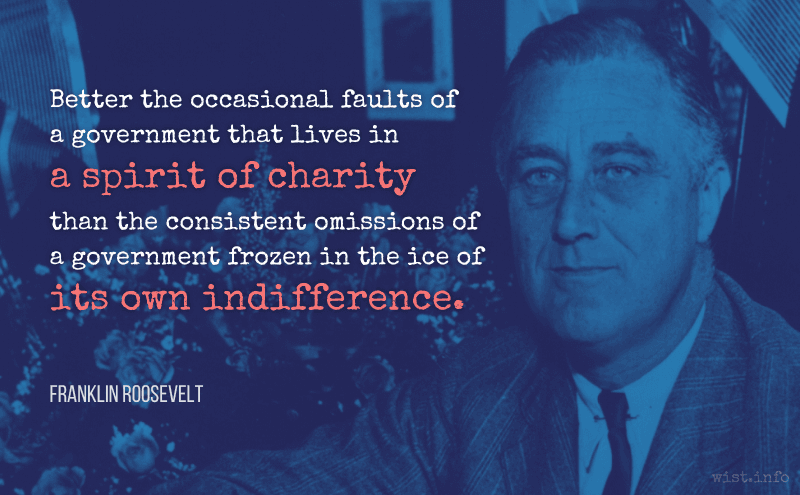
Charity is a virtue of the heart, and not of the hands, says an old writer. Gifts and alms are the expressions, not the essence of this virtue. A man may bestow great sums on the poor and indigent without being charitable, and may be charitable when he is not able to bestow anything. Charity is therefore a habit of good will, or benevolence in the soul, which disposes us to the love, assistance, and relief of mankind, especially of those who stand in need of it.
Joseph Addison (1672-1719) English essayist, poet, statesman
Essay (1713-09-21), The Guardian, No. 166
(Source)
Money is always to be found when men are to be sent to the frontiers to be destroyed: when the object is to preserve them, it is no longer so.
[On en trouve [l’argent] toujours quand il s’agit d’aller faire tuer des hommes sur la frontière: il n’y en a plus quand il faut les sauver.]
Voltaire (1694-1778) French writer [pseud. of Francois-Marie Arouet]
Questions on the Encyclopedia [Questions sur l’Encyclopédie], “Charity [Charité]” (1770) [tr. Fleming]
(Source)
Referring to the scandalous conditions at the Hôtel Dieu charity hospital in Paris.
(Source (French)). Subsequently folded into later editions of the Philosophical Dictionary [Dictionnaire Philosophique].

We don’t have to be “successful,” only valuable. We don’t have to make money, only a difference, and particularly in the lives society counts least and puts last.
William Sloane Coffin, Jr. (1924-2006) American minister, social activist
Credo, “Faith, Hope, Love” (2004)
(Source)

If we are to keep our democracy, there must be one commandment: Thou shalt not ration justice.
Learned Hand (1872-1961) American jurist
Speech, Legal Aid Society of New York (1951-02-16)
(Source)
On ensuring that accused persons did not lack for counsel needed for a fair trial.
He doubly benefits the needy who gives quickly.
[Inopi beneficium bis dat, qui dat celeriter.]
Publilius Syrus (d. 42 BC) Assyrian slave, writer, philosopher [less correctly Publius Syrus]
Sententiae [Moral Sayings], # 6
But how shall we expect charity towards others, when we are uncharitable to our selves? Charity begins at home, is the voyce of the world, yet is every man his greatest enemy, and as it were, his owne executioner.
Thomas Browne (1605-1682) English physician and author
Religio Medici, Part 2, sec. 4 (1643)
(Source)

You cannot live the perfect day without doing something for someone who will never be able to repay you.
John Wooden (1910-2010) American basketball player and coach
They Call Me Coach, ch. 8, epigram (1972)
(Source)
On the necessary points, unity. On the questionable points, liberty. In everything, love.
[In necessariis unites, in non necessariis libertas, in omnibus caritas.]
Rupertus Meldenius (1582-1651) German writer [pseud. of Peter Meiderlin]
Paraenesis Votiva pro Pace Ecclesiae ad Theologos Augustanae Confessionis [Votive Counsel for the Peace of the Church, to the Theologians of the Augustan Confession] (1626)
Also translated as "essentials" and "non-essentials."
Paraphrase of final lines of the work:Verbo dicam: Si nos servaremus IN necesariis Unitatem, IN non-necessariis Libertatem, IN UTRISQUE Charitatem, optimo certe loco essent res nostrae.
[In a word, were we to observe unity in essentials, liberty in incidentals, and in all things charity, our affairs would be certainly in a most happy situation.]
Commonly attributed to St Augustine, but also to John Wesley, Richard Baxter, and several others.
What good is it, my brothers and sisters, if someone claims to have faith but does not have works? Surely that faith cannot save, can it? If a brother or sister is naked and lacks daily food and one of you says to them, “Go in peace; keep warm and eat your fill,” and yet you do not supply their bodily needs, what is the good of that? So faith by itself, if it has no works, is dead.
But someone will say, “You have faith, and I have works.” Show me your faith apart from works, and I by my works will show you faith.[Τί τὸ ὄφελος ἀδελφοί μου ἐὰν πίστιν λέγῃ τις ἔχειν ἔργα δὲ μὴ ἔχῃ μὴ δύναται ἡ πίστις σῶσαι αὐτόν. ἐὰν ἀδελφὸς ἢ ἀδελφὴ γυμνοὶ ὑπάρχωσιν καὶ λειπόμενοι τῆς ἐφημέρου τροφῆς. εἴπῃ δέ τις αὐτοῖς ἐξ ὑμῶν Ὑπάγετε ἐν εἰρήνῃ θερμαίνεσθε καὶ χορτάζεσθε μὴ δῶτε δὲ αὐτοῖς τὰ ἐπιτήδεια τοῦ σώματος τί τὸ ὄφελος. οὕτως καὶ ἡ πίστις ἐὰν μὴ ἔχῃ ἔργα νεκρά ἐστιν καθ’ ἑαυτήν.
Ἀλλ’ ἐρεῖ τις Σὺ πίστιν ἔχεις κἀγὼ ἔργα ἔχω δεῖξόν μοι τὴν πίστιν σου χωρὶς τῶν ἔργων κἀγώ σοι δείξω ἐκ τῶν ἔργων μου τὴν πίστιν.]The Bible (The New Testament) (AD 1st - 2nd C) Christian sacred scripture
James 2:14-18 [NRSV (2021 ed.)]
(Source)
(Source (Greek)). Alternate translations:What doth it profit, my brethren, though a man say he hath faith, and have not works? Can faith save him? If a brother or sister be naked, and destitute of daily food, and one of you say unto them, Depart in peace, be ye warmed and filled; notwithstanding ye give them not those things which are needful to the body; what doth it profit? Even so faith, if it hath not works, is dead, being alone. Yea, a man may say, Thou hast faith, and I have works: shew me thy faith without thy works, and I will shew thee my faith by my works.
[KJV (1611)]Take the case, my brothers, of someone who has never done a single good act but claims that he has faith. Will that faith save him? If one of the brothers or one of the sisters is in need of clothes and has not enough food to live on, and one of you says to them, 'I wish you well; keep yourself warm and eat plenty', without giving them these bare necessities of life, then what good is that? Faith is like that: if good works do not go with it, it is quite dead. This is the way to talk to people of that kind: 'You say you have faith and I have good deeds; I will prove to you that I have faith by showing you my good deeds -- now you prove to me that you have faith without any good deeds to show.'
[JB (1966)]My friends, what good is it for one of you to say that you have faith if your actions do not prove it? Can that faith save you? Suppose there are brothers or sisters who need clothes and don't have enough to eat. What good is there in your saying to them, “God bless you! Keep warm and eat well!”—if you don't give them the necessities of life? So it is with faith: if it is alone and includes no actions, then it is dead.
But someone will say, “One person has faith, another has actions.” My answer is, “Show me how anyone can have faith without actions. I will show you my faith by my actions.”
[GNT (1976)]How does it help, my brothers, when someone who has never done a single good act claims to have faith? Will that faith bring salvation? If one of the brothers or one of the sisters is in need of clothes and has not enough food to live on, and one of you says to them, 'I wish you well; keep yourself warm and eat plenty,' without giving them these bare necessities of life, then what good is that? In the same way faith, if good deeds do not go with it, is quite dead. But someone may say: So you have faith and I have good deeds? Show me this faith of yours without deeds, then! It is by my deeds that I will show you my faith.
[NJB (1985)]My brothers and sisters, what good is it if people say they have faith but do nothing to show it? Claiming to have faith can’t save anyone, can it? Imagine a brother or sister who is naked and never has enough food to eat. What if one of you said, “Go in peace! Stay warm! Have a nice meal!”? What good is it if you don’t actually give them what their body needs? In the same way, faith is dead when it doesn’t result in faithful activity. Someone might claim, “You have faith and I have action.” But how can I see your faith apart from your actions? Instead, I’ll show you my faith by putting it into practice in faithful action.
[CEB (2011)]
Chi-lu asked how the spirits of the dead and the gods should be served. The Master said, “You are not able even to serve man. How can you serve the spirits?”
[季路問事鬼神。子曰、未能事人、焉能事鬼。]
Confucius (c. 551- c. 479 BC) Chinese philosopher, sage, politician [孔夫子 (Kǒng Fūzǐ, K'ung Fu-tzu, K'ung Fu Tse), 孔子 (Kǒngzǐ, Chungni), 孔丘 (Kǒng Qiū, K'ung Ch'iu)]
The Analects [論語, 论语, Lúnyǔ], Book 11, verse 12 (11.12) (6th C. BC – AD 3rd C.) [tr. Lau (1979)]
(Source)
Brooks (below) suggests that this passage was interpolated into Book 11 around the time of Book 16. This analect was originally numbered 11.11 by Legge and other early translators (as noted below). (Source (Chinese)). Alternate translations:Chi Lu asked about serving the spirits of the dead. The Master said, "While you are not able to serve men, how can you serve their spirits?"
[tr. Legge (1861), 11.11]Tszlu propounded a question about ministering to the spirits ((of the departed). The Master replied, "Where there is scarcely the ability to minister to living men, how shall there be ability to minister to the spirits?"
[tr. Jennings (1895), 11.11]A disciple (the intrepid Chung Yu) enquired how one should behave towards the spirits of dead men. Confucius answered, "We cannot as yet do our duties to living men; why should we enquire about our duties to dead men?"
[tr. Ku Hung-Ming (1898), 11.11]When Chi Lu asked about his duty to the spirits the Master replied: "While still unable to do your duty to the living, how can you do your duty to the dead?"
[tr. Soothill (1910), 11.11]Chi Lu asked about the service for ghosts and spirits. Confucius said, You cannot be useful to the living, how can you be useful to (serve) ghosts?
[tr. Pound (1933), 11.11]Tsu-lu asked how one should serve ghosts and spirits. The master said, Till you have learnt to serve men, how can you serve ghosts?
[tr. Waley (1938), 11.11]You can’t treat spirits and divinities properly before you are able to treat your fellow men properly.
[tr. Ware (1950)]Zilu asked about serving ghosts and spirits. The Master said: "If one is not yet capable of serving men, how can one serve ghosts?"
[tr. Dawson (1993)]Zilu asked how to serve the spirits and gods. The Master said: "You are not yet able to serve men, how could you serve the spirits?"
[tr. Leys (1997)]When Ji-lu asked how to serve the spirits and gods, the Master said, "You cannot serve men yet; how can you serve the spirits?"
[tr. Huang (1997)]Jilu asked how to service the gods, Confucius said: "One could not service the human beings yet, how could one service the gods?"
[tr. Cai/Yu (1998), #272]Zilu asked how to serve the spirits and the gods. The master replied, "Not yet being able to serve other people, how would you be able to serve the spirits?"
[tr. Ames/Rosemont (1998)]Jì-Lì asked about serving ghosts and spirits. The Master said, You cannot yet serve men, how could you serve ghosts?
[tr. Brooks/Brooks (1998)]When Adept Lu asked about serving ghosts and spirits, the Master said, "You haven't learned to serve the living, so how could you serve ghosts?"
[tr. Hinton (1998)]Zilu asked about serving ghosts and spirits. The Master said, “You are not yet able to serve people -- how could you be able to serve ghosts and spirits?”
[tr. Slingerland (2003)]Jilu asked how one should serve the gods and spirits. The Master said, "When you don't yet know how to serve human beings, how can you serve the spirits?"
[tr. Watson (2007)]Jilu [Zilu] asked about how to serve the spirits of the dead and the gods. The Master said, "You can't even serve men properly, how can you serve the spirits?"
[tr. Annping Chin (2014)]Ji Lu asked about how to serve and worship gods and spirits. Confucius said, "You still have not served men well. Why do you bother serving gods and spirits?"
[tr. Li (2020)]If you don't know how to serve men, why worry about serving the gods?
[Common translation]

Philanthropy is commendable, but it must not cause the philanthropist to overlook the circumstances of economic injustice which make philanthropy necessary.
Martin Luther King, Jr. (1929-1968) American clergyman, civil rights leader, social activist, preacher
“On Being a Good Neighbor,” sec. 2, sermon, A Gift of Love (1963)
Give as thou wouldest receive, cheerfully and quickly, without hesitation, or bargaining.
Thomas Fuller (1654-1734) English physician, preacher, aphorist, writer
Introductio ad Prudentiam, Vol. 1, # 418 (1725)
(Source)
PEASANT: ‘Tis in such shifts
As these, I care for riches, to make gifts
To friends, or lead a sick man back to health
With ease and plenty. Else small aid is wealth
For daily gladness; once a man be done
With hunger, rich and poor are all as one.[ΑΥΤΟΥΡΓΌΣ: ἐν τοῖς τοιούτοις δ᾽ ἡνίκ᾽ ἂν γνώμης πέσω,
σκοπῶ τὰ χρήμαθ᾽ ὡς ἔχει μέγα σθένος,
ξένοις τε δοῦναι σῶμά τ᾽ ἐς νόσους πεσὸν
δαπάναισι σῷσαι: τῆς δ᾽ ἐφ᾽ ἡμέραν βορᾶς
ἐς σμικρὸν ἥκει: πᾶς γὰρ ἐμπλησθεὶς ἀνὴρ
ὁ πλούσιός τε χὡ πένης ἴσον φέρει.]Euripides (485?-406? BC) Greek tragic dramatist
Electra [Ἠλέκτρα], l. 426ff (c. 420 BC) [tr. Murray (1905)]
(Source)
(Source (Greek)). Alternate translations:When on these matters I reflect, I mark
How great the power of riches, to bestow
Upon the needy stranger, or expend them
To heal our bodies wasting with disease.
But for the diet of one day, is wealth
Of small importance : for the appetites
Of all men, whether rich or poor, demand
An equal share of necessary food.
[tr. Wodhull (1809)]It is in such cases, whenever I fail in my intentions, that I see how wealth has great power, to give to strangers, and to expend in curing the body when it falls sick; but money for our daily food comes to little; for every man when full, rich or poor, gets an equal amount.
[tr. Coleridge (1891)]But when my mind falls upon this subject, I consider how great a power wealth has, botht o bestow on strangers, and by expense to preserve one's body when fallen into sickness; but for one's daily food it comes to little. For every man once filled, rich or poor, bears an equality.
[tr. Buckley (1892)]In such things, when my thoughts turn thitherward,
I mark what mighty vantage substance hath,
To give to guests, to medicine the body
In sickness: but for needs of daily food
Not far it reacheth. Each man, rich and poor,
Can be but filled, when hunger is appeased.
[tr. Way (1896)]When I think of such things then I see what mighty power money has! Not only you help your friends with the stuff but you can also heal yourself from any illness when you have the money to pay. The cost of a normal everyday meal is cheap, because everyone, rich and poor, once he had enough he feels the same joy.
[tr. Theodoridis (2006)]It’s at times like this,
when I have no idea how to manage,
I think of the great power money has
for giving things to strangers and paying
to save someone whenever he falls sick.
The meals we need each day don’t come to much,
for all men, once they have eaten their fill,
feel much the same, whether rich or poor.
[tr. Johnston (2009), l. 515ff][...] whether rich or poor
Everyone is equal when their belly is full.
[tr. @sentantiq (2020)]
In necessary things, unity; in disputed things, liberty; in all things, charity.

Kindness is the mark of faith; and whoever has not kindness has not faith.
Muhammad (AD c. 570-632) Arab religious, military, and political leader; founder of Islam [Mohammed, مُحَمَّد]
The Sayings of Mohammed, #254 [tr. Abdullah Al-Suhrawardy (1941)]
There is no religion without love, and people may talk as much as they like about their religion, but if it does not teach them to be good and kind to man and beast, it is all a sham.
Anna Sewell (1820-1878) English novelist
Black Beauty, Part 1, ch. 13 “The Devil’s Trade-Mark” (1877)
(Source)

It is justice, not charity, that is wanting in the world!
Mary Wollstonecraft (1759-1797) English social philosopher, feminist, writer
A Vindication of the Rights of Women, ch. 4 (1792)
(Source)

It is one of the most beautiful compensations of this life that no man can sincerely try to help another without helping himself.
Charles Dudley Warner (1829–1900) American essayist and novelist
Backlog Studies, Fifth Study, sec. 3 (1872)
(Source)
Originally published in Scribner's Monthly (Apr 1872). Frequently misattributed to Ralph Waldo Emerson.
OLIVER: Kindness, nobler ever than revenge.
William Shakespeare (1564-1616) English dramatist and poet
As You Like It, Act 4, sc. 3, l. 135 (4.3.135) (1599)
(Source)
I became a lesbian out of devout Christian charity. All those women out there are praying for a man and I gave them my share.
Rita Mae Brown (b. 1944) American author, playwright
Venus Envy (1993)
(Source)
Frequently paraphrased as: "My lesbianism is an act of Christian charity. All those women out there are praying for a man, and I'm giving them my share."

So also anybody can become angry — that is easy, and so it is to give and spend money; but to be angry with or give money to the right person, and to the right amount, and at the right time, and for the right purpose, and in the right way — this is not within everybody’s power and is not easy; so that to do these things properly is rare, praiseworthy, and noble.
[οὕτω δὲ καὶ τὸ μὲν ὀργισθῆναι παντὸς καὶ ῥᾴδιον, καὶ τὸ δοῦναι ἀργύριον καὶ δαπανῆσαι: τὸ δ᾽ ᾧ καὶ ὅσον καὶ ὅτε καὶ οὗ ἕνεκα καὶ ὥς, οὐκέτι παντὸς οὐδὲ ῥᾴδιον: διόπερ τὸ εὖ καὶ σπάνιον καὶ ἐπαινετὸν καὶ καλόν.]
Aristotle (384-322 BC) Greek philosopher
Nicomachean Ethics [Ἠθικὰ Νικομάχεια], Book 2, ch. 9 (2.9, 1109a.27) (c. 325 BC) [tr. Rackham (1934)]
(Source)
(Source (Greek)). Alternate translations:Just so to be angry, to give money, and be expensive, is what any man can do, and easy: but to do these to the right person, in due proportion, at the right time, with a right object, and in the right manner, this is not as before what any man can do, nor is it easy; and for this cause goodness is rare, and praiseworthy, and noble.
[tr. Chase (1847)]And so, too, to get angry is an easy matter, and in any man's power; or to give away money or to spend it: but to decide to whom to give it, and how large a sum, and when, and for what purpose, and how, is neither in every many's power, nor an easy matter. And hence it is that excellence herein is rare and praiseworthy and noble.
[tr. Williams (1869), sec. 37]So too anybody can get angry -- that is an easy matter -- and anybody can give or spend money, but to give it to the right persons, to give the right amount of it and to give it at the right time and for the right cause and in the right way, this is not what anybody can do, nor is it easy. That is the reason why it is rare and laudable and noble to do well.
[tr. Welldon (1892)]Thus anyone can be angry -- that is quite easy; anyone can give money away or spend it: but to do these things to the right person, to the right extent, at the right time, with the right object, and in the right manner, is not what everybody can do, and is by no means easy; and that is the reason why right doing is rare and praiseworthy and noble.
[tr. Peters (1893)]So, too, anyone can get angry -- that is easy -- or give or spend money; but to do this to the right person, to the right extent, at the right time, with the right motive, and in the right way, that is not for everyone, nor is it easy; wherefore goodness is both rare and laudable and noble.
[tr. Ross (1908)]In the same way, getting angry is also something everyone can do and something easy, as is giving or spending money. Determining whom to give it to, though, and how much, when, for the sake of what, and in what way -- that is no longer something everyone can do or something easy. That is why doing it well is a rare thing and a praiseworthy and noble one.
[tr. Reeve (1948)]So, too, anyone can get angry or give money or spend it, and it is easy. But to give to the right person, the right amount, at the right time, for the right purpose, and in the right manner, this is not something anyone can do nor is it easy to do; and it is in view of this that excellence is rare and praiseworthy and noble.
[tr. Apostle (1975)]So too it is easy to get angry -- anyone can do that -- or to give and spend money; but to feel or act towards the right person to the right extent at the right time for the right reason in the right way -- that is not easy, and it is not everyone that can do it. Hence to do these things well is a rare, laudable, and fine achievement.
[tr. Thomson/Tredennick (1976)]So too anyone can get angry, or give and spend money -- these are easy, but doing them in relation to the right person, in the right amount, at the right time, with the right aim in view, and in the right way -- that is not something anyone can do, nor is it easy. This is why excellence in these things is rare, praiseworthy, and noble.
[tr. Crisp (2000)]And so too, to become angry belongs to everyone and is an easy thing, as is also giving and spending money; but to whom [one ought to do so], how much, when for the sake fo what, and how -- these no longer belong to everyone nor are easy. Thus in fact acting well is rare, praiseworthy, and noble.
[tr. Bartlett/Collins (2011)]
Note that some translations paraphrase this only to speak of anger, e.g., Edith M. Leonard, et al., The Child: At Home and School (1944):Anybody can become angry, that is easy; but to be angry with the right person, and to the right degree, and at the right time, for the right purpose, and in the right way, that is not within everybody's power and is not easy.
“But you were always a good man of business, Jacob,” faltered Scrooge, who now began to apply this to himself.
“Business!” cried the Ghost, wringing its hands again. “Mankind was my business. The common welfare was my business; charity, mercy, forbearance, and benevolence were, all, my business. The dealings of my trade were but a drop of water in the comprehensive ocean of my business!”
Charles Dickens (1812-1870) English writer and social critic
A Christmas Carol (1843)