Our trouble is that we do not demand enough of the people who represent us. We are responsible for their activities. … We must spur them to more imagination and enterprise in making a push into the unknown; we must make clear that we intend to have responsible and courageous leadership.
Eleanor Roosevelt (1884–1962) American politician, diplomat, activist; First Lady of the US (1933–45)
Tomorrow Is Now (1963)
(Source)
Quotations about:
government
Note not all quotations have been tagged, so Search may find additional quotes on this topic.

Wooden-headedness consists of assessing a situation in terms of preconceived, fixed notions while ignoring or rejecting any contrary signs. It is acting according to wish while not allowing oneself to be confused by the facts.
Barbara W. Tuchman (1912–1989) American historian and author
“An Inquiry into the Persistence of Unwisdom in Government,” Esquire (1980)

In public affairs, stupidity is more dangerous than knavery.
Woodrow Wilson (1856–1924) US President (1913–20), educator, political scientist
The New Freedom, ch. 3 (1913)
A respect for the rights of other people to determine their forms of government and their economy will not weaken our democracy. It will inevitably strengthen it. One of the first things we must get rid of is the idea that democracy is tantamount to capitalism.
Eleanor Roosevelt (1884–1962) American politician, diplomat, activist; First Lady of the US (1933–45)
Tomorrow Is Now (1963)
The Bill of Rights was designed trustfully to prohibit forever two of the favorite crimes of all known governments: the seizure of private property without adequate compensation and the invasion of the citizen’s liberty without justifiable cause and due process.
H. L. Mencken (1880–1956) American writer and journalist [Henry Lewis Mencken]
“On Government,” Prejudices: Fourth Series (1924)
A bill of rights is what the people are entitled to against every government on earth, general or particular, and what no just government should refuse, or rest on inference.
Thomas Jefferson (1743–1826) American political philosopher, polymath, statesman, US President (1801–09)
Letter (1787-12-20) to James Madison
(Source)
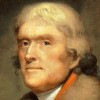
There has been a certain cynical genius to what some of these folks have done in Washington. What they’ve realized is, if we don’t get anything done, then people are going to get cynical about government and its possibilities of doing good for everybody. And since they don’t believe in government, that’s a pretty good thing. And the more cynical people get, the less they vote. And if turnout is low and people don’t vote, that pretty much benefits those who benefit from the status quo.
Barack Obama (b. 1961) American politician, US President (2009–2017)
Speech, Purchase, New York (29 Aug 2014)
(Source)
The rack, or question, to extort a confession from criminals, is a practice of a different nature; […] an engine of the state, not of law.
William Blackstone (1723–1780) British jurist, judge, politician
Commentaries on the Laws of England, Book 4 “Of Public Wrongs,” ch. 25 “Arraignment” (1769)
The aim of every political constitution is, or ought to be, first to obtain for rulers men who possess most wisdom to discern, and most virtue to pursue, the common good of the society; and in the next place, to take the most effectual precautions for keeping them virtuous whilst they continue to hold their public trust.
James Madison (1751–1836) American statesman, political theorist, US President (1809–17)
The Federalist #57 (19 Feb 1788)
Un-American activity cannot be prevented or routed out by employing un-American methods; to preserve freedom we must use the tools that freedom provides.
Dwight David Eisenhower (1890–1969) American general, US President (1953–61)
The White House Years: Mandate for Change: 1953-1956: A Personal Account (1963)
To accomplish almost anything worthwhile, it is necessary to compromise between the ideal and the practical.
Franklin Delano Roosevelt (1882–1945) American lawyer, politician, statesman; US President (1933–45)
Quoted in Drew Pearson and Robert S. Allen, “How the President Works,” Harper’s Monthly Magazine, Vol. 173 (1936-06)
(Source)
An excellent master is always better than an excellent law. Let your laws be ever so good, if the lawmakers are bad, all will come to nothing.
Thomas Brooks (1608–1680) English Puritan divine, writer
Heaven on Earth (1654)
There once was a time in history when the limitation of governmental power meant increasing liberty for the people. In the present day the limitation of governmental power, of governmental action, means the enslavement of the people by the great corporations who can only be held in check through the extension of governmental power.
Theodore Roosevelt (1858–1919) American politician, statesman, conservationist, writer; US President (1901–09)
Speech (1912-09-14), San Francisco
(Source)
That government only can be pronounced consistent with the design of all government, which allows to the governed the liberty of doing what, consistently with the general good, they may desire to do, and which only forbids their doing the contrary. Liberty does not exclude restraint; it only excludes unreasonable restraint. To determine precisely how far personal liberty is compatible with the general good, and of the propriety of social conduct in all cases, is a matter of great extent, and demands the united wisdom of a whole people. And the consent of the whole people, as far as it can be obtained, is indispensably necessary to every law, by which the whole people are to be bound; else the whole people are enslaved to the one, or the few, who frame the laws for them.
James Burgh (1714–1775) British politician and writer
Political Disquisitions, Book 1 “Of Government, briefly” (1774)
(Source)
The only way in which our people can increase their power over the big corporation that does wrong, the only way in which they can protect the working man in his conditions of work and life, the only way in which the people can prevent children working in industry or secure women an eight-hour day in industry, or secure compensation for men killed or crippled in industry, is by extending, instead of limiting, the powers of government.
Theodore Roosevelt (1858–1919) American politician, statesman, conservationist, writer; US President (1901–09)
Speech, San Francisco (14 Sep 1912)
(Source)
But, such is the perverse disposition of man, the most unruly of all animals, that this most useful institution has been generally debauched into an engine of oppression and tyranny over those, whom it was expressly and solely established to defend. And to such a degree has this evil prevailed, that in almost every age and country, the government has been the principal grievance of the people, as appears too dreadfully manifest, from the bloody and deformed pages of history. For what is general history, but a view of the abuses of power committed by those, who have got it into their hands, to the subjugation, and destruction of the human species, to the ruin of the general peace and happiness, and turning the Almighty’s fair and good world into a butchery of its inhabitants, for the gratification of the unbounded ambition of a few, who, in overthrowing the felicity of their fellow-creatures, have confounded their own?
James Burgh (1714–1775) British politician and writer
Political Disquisitions, Book 1 “Of Government, briefly,” ch. 1 (1774)
(Source)
So long as governmental power existed exclusively for the king and not at all for the people, then the history of liberty was a history of the limitation of governmental power. But now the governmental power rests in the people, and the kings who enjoy privilege are the kings of the financial and industrial world; and what they clamor for is the limitation of governmental power, and what the people sorely need is the extension of governmental power.
Theodore Roosevelt (1858–1919) American politician, statesman, conservationist, writer; US President (1901–09)
Speech (1912-09-14), San Francisco
(Source)
Did reason govern mankind, there would be little occasion for any other government, either monarchical, aristocratical, democratical, or mixed. But man, whom we dignify with the honourable title of Rational, being much more frequently influenced, in his proceedings, by supposed interest, by passion, by sensual appetite, by caprice, by any thing, by nothing, than by reason; it has, in all civilized ages and countries, been found proper to frame laws and statutes fortified by sanctions, and to establish orders of men invested with authority to execute those laws, and inflict the deserved punishments upon the violators of them. By such means only has it been found possible to preserve the general peace and tranquility.
James Burgh (1714–1775) British politician and writer
Political Disquisitions, Book 1 “Of Government, briefly,” ch. 1 “Government by Laws and Sanctions, why necessary” (1774)
(Source)
At the foundation of our civil liberty lies the principle which denies to government officials an exceptional position before the law and which subjects them to the same rules of conduct that are commands to the citizen.
Louis Brandeis (1856–1941) American lawyer, jurist, activist; US Supreme Court Justice (1916–39)
Burdeau v. McDowell, 256 U.S. 465, 477 (1921) [dissent]
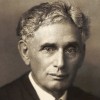
If there be, in any region of the universe, an order of moral agents living in society, whose reason is strong, whose passions and inclinations are moderate, and whose dispositions are turned to virtue, to such an order of happy beings, legislation, administration, and police, with the endlessly various and complicated apparatus of politics, must be in a great measure superfluous.
James Burgh (1714–1775) British politician and writer
Political Disquisitions, Book 1 “Of Government, briefly,” ch. 1 “Government by Laws and Sanctions, why necessary” (1774)
(Source)
I really don’t know what you do about the “taxes are theft” crowd, except possibly enter a gambling pool regarding just how long after their no-tax utopia comes true that their generally white, generally entitled, generally soft and pudgy asses are turned into thin strips of Objectivist Jerky by the sort of pitiless sociopath who is actually prepped and ready to live in the world that logically follows these people’s fondest desires. Sorry, guys. I know you all thought you were going to be one of those paying a nickel for your cigarettes in Galt Gulch. That’ll be a fine last thought for you as the starving remnants of the society of takers closes in with their flensing tools.
John Scalzi (b. 1969) American writer
“Tax Frenzies and How to Hose Them Down,” Whatever blog (26 Sep 2010)
(Source)

Great ideas do not burst upon the world unannounced. They are reached by a gradual development over a length of time usually proportionate to their importance. This is especially true of the principles laid down in the Declaration of Independence. Three very definite propositions were set out in its preamble regarding the nature of mankind and therefore of government. These were the doctrine that all men are created equal, that they are endowed with certain inalienable rights, and that therefore the source of the just powers of government must be derived from the consent of the governed. If no one is to be accounted as born into a superior station, if there is to be no ruling class, and if all possess rights which can neither be bartered away nor taken from them by any earthly power, it follows as a matter of course that the practical authority of the Government has to rest on the consent of the governed. While these principles were not altogether new in political action, and were very far from new in political speculation, they had never been assembled before and declared in such a combination.
Calvin Coolidge (1872–1933) American lawyer, politician, US President (1925–29)
“Speech on the Occasion of the 150th Anniversary of the Declaration of Independence” (5 Jul 1926)
(Source)
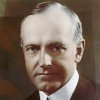
The doctrine of the Declaration of Independence, predicated upon the glory of man, and the corresponding duty of society, is that the rights of citizens are to be protected with every power and resource of the State, and a government that does any less is false to the teachings of that great document, of the name American.
The very word “secrecy” is repugnant in a free and open society; and we are as a people inherently and historically opposed to secret societies, to secret oaths and to secret proceedings. We decided long ago that the dangers of excessive and unwarranted concealment of pertinent facts far outweighed the dangers which are cited to justify it. Even today, there is little value in opposing the threat of a closed society by imitating its arbitrary restrictions. Even today, there is little value in insuring the survival of our nation if our traditions do not survive with it. And there is very grave danger that an announced need for increased security will be seized upon by those anxious to expand its meaning to the very limits of official censorship and concealment. That I do not intend to permit to the extent that it is in my control. And no official of my Administration, whether his rank is high or low, civilian or military, should interpret my words here tonight as an excuse to censor the news, to stifle dissent, to cover up our mistakes or to withhold from the press and the public the facts they deserve to know.
John F. Kennedy (1917–1963) American politician, author, journalist, US President (1961–63)
Speech, American Newspaper Publishers Association (27 Apr 1961)
(Source)
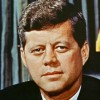
I’m proud that I’m a politician. A politician is a man who understands government, and it takes a politician to run a government. A statesman is a politician who’s been dead 10 or 15 years.
Harry S Truman (1884–1972) US President (1945–1953)
Speech, Reciprocity Club, Washington (11 Apr 1958)
See Thomas Reed.
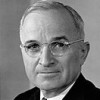
While the earnings of a minority are growing exponentially, so too is the gap separating the majority from the prosperity enjoyed by those happy few. This imbalance is the result of ideologies which defend the absolute autonomy of the marketplace and financial speculation. Consequently, they reject the right of states, charged with vigilance for the common good, to exercise any form of control. A new tyranny is thus born, invisible and often virtual, which unilaterally and relentlessly imposes its own laws and rules.
Francis I (1936–2025) Argentinian Catholic Pope (2013–2025) [b. Jorge Mario Bergoglio]
Evangelii Gaudium, sec. 56 (24 Nov 2013)
(Source)
At a dinner given by Periander, tyrant of Corinth, to the Seven Wise Men, including Anacharsis, the question was asked, What is the ideal state, or most perfect form of popular government? The answers given by the philosophers were as follows:—
Solon: “That in which an injury done to the least of its citizens is an injury done to all.”
Bias: “Where the law has no superior.”
Thales: “Where the rich are neither too rich, nor the poor too poor.”
Anacharsis: “Where virtue is honored, and vice detested.”
Pittacus: “Where dignities are always conferred on the good, never on the bad.”
Cleobulus: “Where the citizens fear blame more than punishment.”
Chilo: “Where the laws are more regarded, and have more authority, than the orators.”
Goethe has asked, “What government is best? That which teaches us to govern ourselves.” At another time he said, “The best government is that which makes itself superfluous.”
“Good government,” says Confucius, “obtains when those who are near are made happy, and those who are far off are attracted.”
Finally, I believe in an America with a government of men devoted solely to the public interests — men of ability and dedication, free from conflict or corruption or other commitment — a responsible government that is efficient and economical, with a balanced budget over the years of the cycle, reducing its debt in prosperous times — a government willing to entrust the people with the facts that they have — not a businessman’s government, with business in the saddle, as the late Secretary McKay described this administration of which he was a member — not a labor government, not a farmer’s government, not a government of one section of the country or another, but a government of, for and by the people.
John F. Kennedy (1917–1963) American politician, author, journalist, US President (1961–63)
Speech, Philadelphia (31 Oct 1960)
(Source)
The first and highest form of the state and of the government and of the law is that which there prevails most widely the ancient saying, that “Friends have all things in common.”
Plato (c.428–347 BC) Greek philosopher
Plato, Laws, 5.739 [tr. Jowett (1894)]
The State exists for man, not man for the State.
Albert Einstein (1879–1955) German-American physicist
“The Road to Peace,” New York Times (22 Nov 1931)
(Source)
In The World As I See It [tr. Harris (1934)], given as "The State is made for man, not man for the State."
If government, or those in positions of power and authority, can silence criticism by the argument that such criticism might be misunderstood somewhere, there is an end to all criticism, and perhaps an end to our kind of political system. For men in authority will always think that criticism of their policies is dangerous. They will always equate their policies with patriotism, and find criticism subversive.
Henry Steele Commager (1902–1998) American historian, writer, activist
Essay (1965-12-18), “The Problem of Dissent,” Saturday Review
(Source)
Reprinted in Freedom and Order, Part 6 (1966). Sections of the essay (including this portion) were read into the Congressional Record, Senate Proceedings (1969-06-26), as part of a speech by former Senator Wayne Morse (D-Oregon) at the commencement of Fairleigh Dickinson University (1969-06-07); Morse's speech was read in by Senator Gary Hart (D-Colo.).
By liberty I mean the assurance that every man shall be protected in doing what he believes his duty against the influence of authority and majorities, custom and opinion. The State is competent to assign duties and draw the line between good and evil only in its immediate sphere. Beyond the limits of things necessary for its well-being, it can only give indirect help to fight the battle of life by promoting the influences which prevail against temptation, — religion, education, and the distribution of wealth.
John Dalberg, Lord Acton (1834–1902) British historian, politician, writer
Speech (1877-02-28), “The History of Freedom in Antiquity,” Bridgenorth Institute
(Source)
For in a democracy, every citizen, regardless of his interest in politics, “holds office”; every one of us is in a position of responsibility; and, in the final analysis, the kind of government we get depends upon how we fulfill those responsibilities. We, the people, are the boss, and we will get the kind of political leadership, be it good or bad, that we demand and deserve.
John F. Kennedy (1917–1963) American politician, author, journalist, US President (1961–63)
Profiles in Courage (1956; 1964 ed.)
We Americans live in a nation where the medical-care system is second to no one in the world, unless you count maybe 25 or 30 little scuzzball countries like Scotland that we could vaporize in seconds if we felt like it.
Dave Barry (b. 1947) American humorist, author, columnist
Stay Fit and Healthy Until You’re Dead (1985)

Whenever a single definite object is made the supreme end of the State, be it the advantage of a class, the safety of the power of the country, the greatest happiness of the greatest number, or the support of any speculative idea, the State becomes for the time inevitably absolute. Liberty alone demands for its realisation the limitation of the public authority, for liberty is the only object which benefits all alike, and provokes no sincere opposition.
John Dalberg, Lord Acton (1834–1902) British historian, politician, writer
“Nationality,” Home and Foreign Review (1862-07)
(Source)
The death of democracy is not likely to be an assassination from ambush. It will be a slow extinction from apathy, indifference, and undernourishment.
Robert M. Hutchins (1899–1977) American educator and educational philosopher
Great Books: The Foundation of a Liberal Education (1954)
(Source)
This Administration has declared unconditional war on poverty and I have come here this morning to ask all of you to enlist as volunteers. Members of all parties are welcome to our tent. Members of all races ought to be there. Members of all religions should come and help us now to strike the hammer of truth against the anvil of public opinion again and again until the ears of this Nation are open, until the hearts of this Nation are touched, and until the conscience of America is awakened.
Lyndon B. Johnson (1908–1973) American politician, educator, US President (1963–69)
Speech (1964-05-09), Convention of Amalgamated Clothing Workers, New York
(Source)
Prudence, indeed, will dictate that Governments long established should not be changed for light and transient causes; and accordingly all experience hath shewn, that mankind are more disposed to suffer, while evils are sufferable, than to right themselves by abolishing the forms to which they are accustomed. But when a long train of abuses and usurpations, pursuing invariably the same Object evinces a design to reduce them under absolute Despotism, it is their right, it is their duty, to throw off such Government, and to provide new Guards for their future security.
Thomas Jefferson (1743–1826) American political philosopher, polymath, statesman, US President (1801–09)
Document (1776-07-02), “Declaration of Independence”
(Source)
As modified and approved by the Continental Congress. Jefferson's "original rough draft" is very similar:Prudence indeed will dictate that governments long established should not be changed for light & transient causes: and accordingly all experience hath shewn that mankind are more disposed to suffer while evils are sufferable, than to right themselves by abolishing the forms to which they are accustomed. but when a long train of abuses & usurpations, begun at a distinguished period, & pursuing invariably the same object, evinces a design to subject them to arbitrary power, it is their right, it is their duty, to throw off such government & to provide new guards for their future security.
In that draft, the word "subject" was changed to "reduce." The phrase "to arbitrary power" was changed by Jefferson in following drafts to "under absolute power," and then edited by Benjamin Franklin to "under absolute Despotism," which was the final form it took.
In political institutions, almost everything we call an abuse was once a remedy.
[Presque tout ce que nous appelons un abus fut un remède dans les institutions politiques.]
Joseph Joubert (1754–1824) French moralist, philosopher, essayist, poet
Pensées [Thoughts], ch. 18 “Du Siècle [On the Age],” ¶ 21 (1850 ed.) [tr. Auster (1983), 1813 entry]
(Source)
(Source (French)). Other translation:In political institutions nearly everything that we now call an abuse, was once a remedy.
[tr. Lyttelton (1899), ch. 17, ¶ 8]
But I do not believe that just because you’re opposed to abortion, that makes you “pro-life.” In fact, I think in many cases, your morality is deeply lacking. If all you want is a child born but not a child fed, not a child educated, not a child housed — and why would I think that you don’t? Because you don’t want any tax money to go there. That’s not “pro-life”. That’s pro-birth. We need a much broader conversation on what the morality of pro-life is.
Joan D. Chittister (b. 1936) American Benedictine nun, author and lecturer
Interview with Bill Moyer, “NOW” (PBS) (12 Nov 2004)
(Source)

Convinced that the republican is the only form of government which is not eternally at open or secret war with the rights of mankind, my prayers & efforts shall be cordially distributed to the support of that we have so happily established.
Thomas Jefferson (1743–1826) American political philosopher, polymath, statesman, US President (1801–09)
Letter (1790-03-11) to William Hunter
(Source)
Wherever the people are well informed they can be trusted with their own government; that whenever things get so far wrong as to attract their notice, they may be relied on to set them to rights.
Thomas Jefferson (1743–1826) American political philosopher, polymath, statesman, US President (1801–09)
Letter (1789-01-08) to Richard Price
(Source)
I must save this government if possible. What I cannot do, of course I will not do; but it may as well be understood, once for all, that I shall not surrender this game leaving any available card unplayed.
Abraham Lincoln (1809–1865) American lawyer, politician, US President (1861–65)
Letter (1862-07-26) to Revardy Johnson
(Source)

There can be no effective control of corporations while their political activity remains. To put an end to it will be neither a short nor an easy task, but it can be done. We must have complete and effective publicity of corporate affairs, so that people may know beyond peradventure whether the corporations obey the law and whether their management entitles them to the confidence of the public. It is necessary that laws should be passed to prohibit the use of corporate funds directly or indirectly for political purposes; it is still more necessary that such laws should be thoroughly enforced. Corporate expenditures for political purposes, and especially such expenditures by public-service corporations, have supplied one of the principal sources of corruption in our political affairs.
Theodore Roosevelt (1858–1919) American politician, statesman, conservationist, writer; US President (1901–09)
Speech (1910-08-31), “The New Nationalism,” John Brown Memorial Park dedication, Osawatomie, Kansas
(Source)

The basis of our governments being the opinion of the people, the very first object should be to keep that right; and were it left to me to decide whether we should have a government without newspapers, or newspapers without a government, I should not hesitate a moment to prefer the latter.
Thomas Jefferson (1743–1826) American political philosopher, polymath, statesman, US President (1801–09)
Letter (1787-01-16) to Edward Carrington
(Source)
Of all forms of tyranny the least attractive and the most vulgar is the tyranny of mere wealth, the tyranny of a plutocracy.
Theodore Roosevelt (1858–1919) American politician, statesman, conservationist, writer; US President (1901–09)
Autobiography, ch. 22 “The Big Stick and the Square Deal” (1913)
(Source)
Money? He will say: “Take my money, since you can, and it is so desirable to you; take it, — and take yourself away with it; and leave me alone to my work here. I am still here; can still work, after all the money you have taken from me!” But if they come to him, and say, “Acknowledge a Lie; pretend to say you are worshipping God, when you are not doing it: believe not the thing that you find true, but the thing that I find, or pretend to find true!” He will answer: “No; by God’s help, no! You may take my purse; but I cannot have my moral Self annihilated. The purse is any Highwayman’s who might meet me with a loaded pistol: but the Self is mine and God my Maker’s; it is not yours; and I will resist you to the death, and revolt against you, and, on the whole, front all manner of extremities, accusations and confusions, in defence of that!”
Thomas Carlyle (1795–1881) Scottish essayist and historian
Lecture (1840-05-22), “The Hero as King,” Home House, Portman Square, London
(Source)
The lecture notes were collected by Carlyle into On Heroes, Hero-Worship, & the Heroic in History, Lecture 6 (1841).
Anarchy is the sure consequence of tyranny.
Thomas Babington Macaulay (1800–1859) English writer and politician
“A Conversation Between Mr. Abraham Cowley and Mr. John Milton,” Knight’s Quarterly Journal (Aug 1824)
I believe in shaping the ends of government to protect property as well as human welfare. Normally, and in the long run, the ends are the same; but whenever the alternative must be faced, I am for men and not for property, as you were in the Civil War. I am far from underestimating the importance of dividends; but I rank dividends below human character.
Theodore Roosevelt (1858–1919) American politician, statesman, conservationist, writer; US President (1901–09)
Speech (1910-08-31), “The New Nationalism,” John Brown Memorial Park dedication, Osawatomie, Kansas
(Source)
But now Nixon has come along and everything I’ve worked for is ruined. There’s a story in the paper every day about him slashing another one of my Great Society programs. I can just see him waking up in the morning, making that victory sign of his and deciding which program to kill. It’s a terrible thing for me to sit by and watch someone else starve my Great Society to death. She’s getting thinner and thinner and uglier and uglier all the time; now her bones are beginning to stick out and her wrinkles are beginning to show. Soon she’ll be so ugly that the American people will refuse to look at her; they’ll stick her in a closet to hide her away and there she’ll die. And when she dies, I, too, will die.
Lyndon B. Johnson (1908–1973) American politician, educator, US President (1963–69)
Comment (1971) to Doris Kearns Goodwin
(Source)
Quoted in Doris Kearns Goodwin, Lyndon Johnson and the American Dream, ch. 10 "Things Go Wrong" (1976). Kearns was an intern and staff member in the Johnson White House, and worked with him on his memoirs.
We hold these truths to be self-evident, that all men are created equal; that they are endowed by their Creator with inherent and inalienable Rights; that among these, are Life, Liberty, and the pursuit of Happiness; that to secure these rights, Governments are instituted among Men, deriving their just powers from the consent of the governed; that whenever any Form of Government becomes destructive of these ends, it is the Right of the people to alter or abolish it, and to institute new Government, laying its foundation on such principles, and organizing its powers in such form, as to them shall seem most likely to effect their Safety and Happiness.
Thomas Jefferson (1743–1826) American political philosopher, polymath, statesman, US President (1801–09)
Document (1776-07-02), “Declaration of Independence”
(Source)
As modified and approved by the Continental Congress. Compare to Jefferson's original draft.
For in a republic, who is “the Country”? Is it the Government which is for the moment in the saddle? Why, the Government is merely a servant — merely a temporary servant; it cannot be its prerogative to determine what is right and what is wrong, and decide who is a patriot and who isn’t. Its function is to obey orders, not originate them. Who, then, is “the country?” Is it the newspaper? Is it the pulpit? Is it the school-superintendent? Why, these are mere parts of the country, not the whole of it; they have not command, they have only their little share in the command. They are but one in the thousand; it is in the thousand that command is lodged; they must determine what is right and what is wrong; they must decide who is a patriot and who isn’t.
Mark Twain (1835–1910) American writer [pseud. of Samuel Clemens]
Papers of the Adams Family, Part 6 “Two Fragments from a Suppressed Book Called ‘Glances at History’ or ‘Outlines of History'” (1939)
On the one hand, security and justice require centralized governmental control, which must extend to the creation of a world government if it is to be effective. Progress, on the contrary, requires the utmost scope for personal initiative that is compatible with social order.
Bertrand Russell (1872–1970) English mathematician and philosopher
Lecture (1949-01-30), “Individual and Social Ethics,” Reith Lecture, “Authority and the Individual” No. 6, BBC Radio
(Source)
This passage was not included in the original broadcast (transcript), but only in the collected and edited version in Authority and the Individual (1949).
Now, this means that our government, national and State, must be freed from the sinister influence or control of special interests. Exactly as the special interests of cotton and slavery threatened our political integrity before the Civil War, so now the great special business interests too often control and corrupt the men and methods of government for their own profit. We must drive the special interests out of politics.
Theodore Roosevelt (1858–1919) American politician, statesman, conservationist, writer; US President (1901–09)
Speech (1910-08-31), “The New Nationalism,” John Brown Memorial Park dedication, Osawatomie, Kansas
(Source)
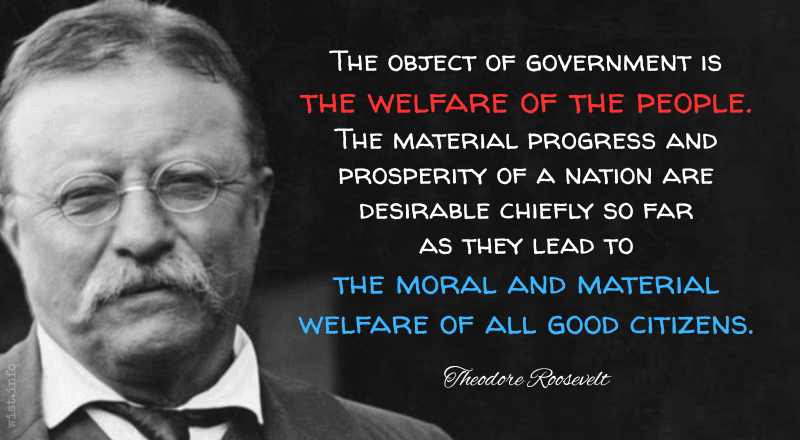
The object of government is the welfare of the people. The material progress and prosperity of a nation are desirable chiefly so far as they lead to the moral and material welfare of all good citizens.
Theodore Roosevelt (1858–1919) American politician, statesman, conservationist, writer; US President (1901–09)
Speech (1910-08-31), “The New Nationalism,” John Brown Memorial Park dedication, Osawatomie, Kansas
(Source)
The clergy, by getting themselves established by law, & ingrafted into the machine of government, have been a very formidable engine against the civil & religious rights of man.
Thomas Jefferson (1743–1826) American political philosopher, polymath, statesman, US President (1801–09)
Letter (1800-08-189) to Jeremiah Moor
(Source)
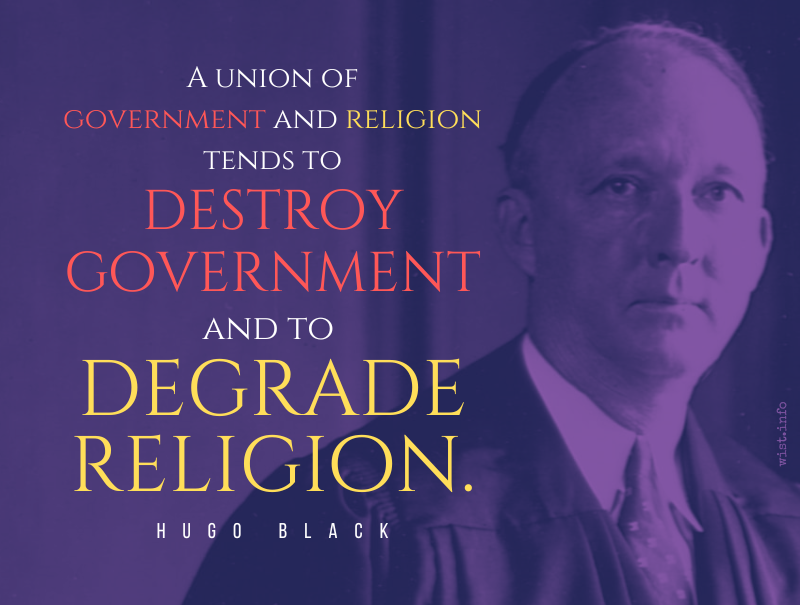
But the purposes underlying the Establishment Clause go much further than that. Its first and most immediate purpose rested on the belief that a union of government and religion tends to destroy government and to degrade religion. The history of governmentally established religion, both in England and in this country, showed that whenever government had allied itself with one particular form of religion, the inevitable result had been that it had incurred the hatred, disrespect and even contempt of those who held contrary beliefs. That same history showed that many people had lost their respect for any religion that had relied upon the support of government to spread its faith.
The Establishment Clause thus stands as an expression of principle on the part of the Founders of our Constitution that religion is too personal, too sacred, too holy, to permit its “unhallowed perversion” by a civil magistrate.
Hugo Black (1886–1971) American politician and jurist; US Supreme Court Justice (1937–71)
Engel v. Vitale, 370 U.S. 421, 431–432 (1962) [majority opinion]
(Source)
That therefore the proscribing any citizen as unworthy the public confidence by laying upon him an incapacity of being called to offices of trust and emolument, unless he profess or renounce this or that religious opinion, is depriving him injuriously of those privileges and advantages to which, in common with his fellow citizens, he has a natural right;
That it tends also to corrupt the principles of that very religion it is meant to encourage, by bribing, with a monopoly of worldly honours and emoluments, those who will externally profess and conform to it;
That though indeed these are criminal who do not withstand such temptation, yet neither are those innocent who lay the bait in their way.
Thomas Jefferson (1743–1826) American political philosopher, polymath, statesman, US President (1801–09)
Document (1776-06-18), “Virginia Statute for Religious Freedom,” Preamble (enacted 1786-01-16)
(Source)
The duty of public men in this Republic is to lead in standards of integrity — both in mind and money.
Dishonor in public life has a double poison. When people are dishonorable in private business, they injure only those with whom they deal or their own chances in the next world. But when there is a lack of honor in Government, the morals of the whole people are poisoned.
Some folks seem to think these are necessary evils in a free government. Or that it is smart politics. Those are deadly sleeping pills. No public man can be just a little crooked.Herbert Hoover (1874–1964) American engineer, bureaucrat, US President (1929–33)
Speech (1951-08-30), “Concerning Honor in Public Life,” Iowa Centennial Celebration, Des Moines, Iowa (radio broadcast)
(Source)
Well aware that the opinions and belief of men depend not on their own will, but follow involuntarily the evidence proposed to their minds; that Almighty God hath created the mind free, and manifested his supreme will that free it shall remain by making it altogether insusceptible of restraint; that all attempts to influence it by temporal punishments, or burthens, or by civil incapacitations, tend only to beget habits of hypocrisy and meanness, and are a departure from the plan of the holy author of our religion, who being lord both of body and mind, yet chose not to propagate it by coercions on either, as was in his Almighty power to do, but to extend it by its influence on reason alone; that the impious presumption of legislators and rulers, civil as well as ecclesiastical, who, being themselves but fallible and uninspired men, have assumed dominion over the faith of others, setting up their own opinions and modes of thinking as the only true and infallible, and as such endeavoring to impose them on others, hath established and maintained false religions over the greatest part of the world and through all time ….
Thomas Jefferson (1743–1826) American political philosopher, polymath, statesman, US President (1801–09)
Document (1776-06-18), “Virginia Statute for Religious Freedom,” Preamble (enacted 1786-01-16)
(Source)
During final debate around the bill's passage:See Jefferson's discussion about a failed amendment to the preamble here.
- the first clause was struck, changing the beginning to "Whereas Almighty God ...."
- the phrase "and manifested his supreme will that free it shall remain by making it altogether insusceptible of restraint" was struck.
- the phrase "but to extend it by its influence on reason alone" was struck.
An upright minister asks, what recommends a man; a corrupt minister, who.
Charles Caleb "C. C." Colton (1780–1832) English cleric, writer, aphorist
Lacon: Or, Many Things in Few Words, Vol. 1, § 9 (1820)
(Source)
Referring to government ministers and office-holders.
In a virtuous community men of sense and principle will always be placed at the head of affairs. In a declining state of public morals men will be so blinded to their true interests as to put the incapable and unworthy at the helm. It is therefore vain to complain of the follies or crimes of a government. We must lay the hands on our own hearts and say, Here is the sin that makes the public sin.
Ralph Waldo Emerson (1803–1882) American essayist, lecturer, poet
“The Individual and the State,” sermon, Second Church of Boston (1830-04-08)
The great principles of right and wrong are legible to every reader; to pursue them requires not the aid of many counsellors. The whole art of government consists in the art of being honest. Only aim to do your duty, and mankind will give you credit where you fail.
Thomas Jefferson (1743–1826) American political philosopher, polymath, statesman, US President (1801–09)
Essay (1774-06), “A Summary View of the Rights of British America”
(Source)
Addressed to King George III.
Nothing discloses real character like the use of power. It is easy for the weak to be gentle. Most people can bear adversity. But if you wish to know what a man really is, give him power. This is the supreme test. It is the glory of Lincoln that, having almost absolute power, he never abused it, except upon the side of mercy.
Robert Green Ingersoll (1833–1899) American lawyer, freethinker, orator
“Abraham Lincoln,” Lecture (1894)
(Source)
Ingersoll used the final phrase here frequently about Lincoln, e.g., in The Liberty of Man, Woman, and Child, an 1877 lecture, he wrote: "Abraham Lincoln was, in my judgment, in many respects, the grandest man ever president of the United States. Upon his monument these words should be written: 'Here sleeps the only man in the history of the world, who, having been clothed with almost absolute power, never abused it, except on the side of mercy.'"
The phrase "But if you wish to know what a man really is, give him power" is often attributed, without citation, to Lincoln.
The second office of the government is honorable & easy, the first is but a splendid misery.
Thomas Jefferson (1743–1826) American political philosopher, polymath, statesman, US President (1801–09)
Letter (1797-05-13) to Elbridge Gerry
(Source)
On the vice-presidency and presidency of the United States. Written after he had lost to John Adams, who became President and him Vice-President.
Power is always gradually stealing away from the many to the few because the few are more vigilant and consistent; it still contracts to a smaller number, till in time it centres in a single person.
Thus all the forms of governments instituted among mankind, perpetually tend towards monarchy; and power, however diffused through the whole community is, by negligence or corruption, commotion or distress, reposed at last in the chief magistrate.Samuel Johnson (1709–1784) English writer, lexicographer, critic
Essay (1753-04-10), The Adventurer, No. 45
(Source)
Private enterprise did not get us atomic energy.
John Kenneth Galbraith (1908–2006) Canadian-American economist, diplomat, author
The Affluent Society, ch. 25, sec. 3 (1958)
It is impossible to think that constitutional government can be suspended in a time of danger, in deference to the greater “efficiency” of centralized power, and then easily or quickly restored. Efficiency may be a political virtue, but only if strictly limited. Our Constitution, by its separation of powers and its system of checks and balances, acts as a restraint upon efficiency by denying exclusive power to any branch of government. The logic of governmental efficiency, unchecked, runs straight on, not only to dictatorship, but also to torture, assassination, and other abominations.
Wendell Berry (b. 1934) American farmer, educator, poet, conservationist
Essay (2003-02-09), “A Citizen’s Response,” sec. 3, Citizenship Papers (2003)
(Source)
This passage did not appear in the original (abridged) full-page ad in the New York Times (2003-02-06) or the Orion Magazine (2003-03/04) publication of the essay.
The only index by which to judge a government or a way of life is by the quality of the people it acts upon. No matter how noble the objectives of a government, if it blurs decency and kindness, cheapens human life, and breeds ill will and suspicion — it is an evil government.
Eric Hoffer (1902–1983) American writer, philosopher, longshoreman
Passionate State of Mind, Aphorism 147 (1955)
(Source)
I have pledged myself and my colleagues in the cabinet to a continuous encouragement of initiative, responsibility and energy in serving the public interest. Let every public servant know, whether his post is high or low, that a man’s rank and reputation in this Administration will be determined by the size of the job he does, and not by the size of his staff, his office or his budget. Let it be clear that this Administration recognizes the value of dissent and daring — that we greet healthy controversy as the hallmark of healthy change. Let the public service be a proud and lively career. And let every man and woman who works in any area of our national government, in any branch, at any level, be able to say with pride and with honor in future years: “I served the United States Government in that hour of our nation’s need.”
John F. Kennedy (1917–1963) American politician, author, journalist, US President (1961–63)
State of the Union address (1961-01-30)
(Source)
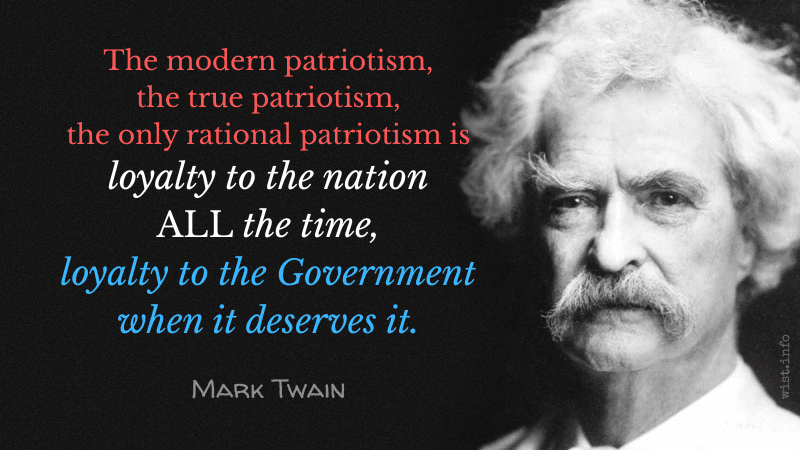
Remember this, take it to heart, live by it, die for it if necessary: that our patriotism is medieval, outworn, obsolete; that the modern patriotism, the true patriotism, the only rational patriotism is loyalty to the nation all the time, loyalty to the Government when it deserves it.
Mark Twain (1835–1910) American writer [pseud. of Samuel Clemens]
Story (1905-02-02), “The Czar’s Soliloquy,” North American Review, Vol. 180, No. 580 (1905-03)
(Source)
Advice that Russian mothers should be giving their children.
Sometimes paraphrased: "Patriotism is supporting your country all the time, and your government when it deserves it."
Me, I think government is a tool, like a hammer. You can use a hammer to build with or you can use a hammer to destroy with. Whether government is good or bad depends on what you use it for and how well you use it. On the whole, it’s a poor idea to put people in charge of government who don’t believe in using it.
Molly Ivins (1944–2007) American writer, political columnist [Mary Tyler Ivins]
Essay (1992-03-01), “Good morning, Fort Worth! Glad to be here,” Fort Worth Star-Telegram
(Source)
Responding to Ronald Reagan's famous quip, "Government is not the solution; government is the problem." Collected in Nothin' But Good Times Ahead (1993).
Ivins used a similar comment in her essay, "Wiggy Republicans," Mother Jones (1992-09/10) (also collected in Nothin' but Good Times Ahead (1993)):Government is just a tool, like a hammer. There’s nothing intrinsically good or evil about the hammer; it all depends on what it’s used for and the skill with which it is used.
She reworked this in the introduction to her book You Got to Dance with Them What Brung You, (1998):Personally, I think government is a tool, like a hammer. You can use a hammer to build or you can use a hammer to destroy; there is nothing intrinsically good or evil about the hammer itself. It is the purposes to which it is put and the skill with which it is used that determine whether the hammer's work is good or bad.


This is a column for everyone in the path of Hurricane Katrina who ever said, “I’m sorry, I’m just not interested in politics,” or, “There’s nothing I can do about it,” or, “Eh, they’re all crooks anyway.”
Look around you this morning. I suppose the NRA would argue, “Government policies don’t kill people, hurricanes kill people.” Actually, hurricanes plus government policies kill people. […] This, my friends, is why we need to pay attention to government policies, not political personalities, and to know whereon we vote. It is about our lives.Molly Ivins (1944–2007) American writer, political columnist [Mary Tyler Ivins]
Essay (2005-09-09), “Katrina and You,” Texas Observer
A close variant of this (and usually quoted, as below, with elisions) ran in as the essay (2005-10), "Policies That Kill," The Progressive, Vol. 69, No. 10:This is a column for everyone who ever said, "I'm sorry, I'm just not interested in politics," or, "There's nothing I can do about it," or, "Hey, they're all crooks anyway." ... I've got one word for all of you: Katrina. ... This, friends, is why we need to pay attention to government policies, not political personalities, and to know whereon we vote. It is about our lives.
This was included in the Progressive's memorial retrospective on Ivins in 2007-02.
If the injustice is part of the necessary friction of the machine of government, let it go, let it go: perchance it will wear smooth, — certainly the machine will wear out. If the injustice has a spring, or a pulley, or a rope, or a crank, exclusively for itself, then perhaps you may consider whether the remedy will not be worse than the evil; but if it is of such a nature that it requires you to be the agent of injustice to another, then, I say, break the law. Let your life be a counter friction to stop the machine. What I have to do is to see, at any rate, that I do not lend myself to the wrong which I condemn.
Henry David Thoreau (1817–1862) American philosopher and writer
Essay (1849-05), “Resistance to Civil Government [On the Duty of Civil Disobedience],” Æsthetic Papers, No. 1, Article 10
(Source)
Based on an 1848 lecture at the Concord Lyceum.
All of you, I am sure, have heard many cries about Government interference with business and about “creeping socialism.” I should like to remind the gentlemen who make these complaints that if events had been allowed to continue as they were going prior to March 4, 1933, most of them would have no businesses left for the Government or for anyone else to interfere with — and almost surely we would have socialism in this country, real socialism, not the kind they define.
No government is perfect. One of the chief virtues of a democracy, however, is that its defects are always visible and under democratic processes can be pointed out and corrected.
Harry S Truman (1884–1972) US President (1945–1953)
Speech, Joint Session of the US Congress (12 Mar 1947)
(Source)
Justice without might is helpless; might without justice is tyrannical.
Blaise Pascal (1623–1662) French scientist and philosopher
Pensées, #298 (1670) [tr. Trotter (1931)]
I hold it, therefore, certain, that to open the doors of truth, and to fortify the habit of testing everything by reason, are the most effectual manacles we can rivet on the hands of our successors to prevent their manacling the people with their own consent.
Thomas Jefferson (1743–1826) American political philosopher, polymath, statesman, US President (1801–09)
Letter (1804-06-28) to John Tyler
(Source)
The firmness with which the people have withstood the late abuses of the press, the discernment they have manifested between truth and falsehood, show that they may safely be trusted to hear everything true and false, and to form a correct judgment between them. As little is it necessary to impose on their senses, or dazzle their minds by pomp, splendor, or forms. Instead of this artificial, how much surer is that real respect, which results from the use of their reason, and the habit of bringing everything to the test of common sense.
Thomas Jefferson (1743–1826) American political philosopher, polymath, statesman, US President (1801–09)
Letter (1804-06-28) to John Tyler
(Source)
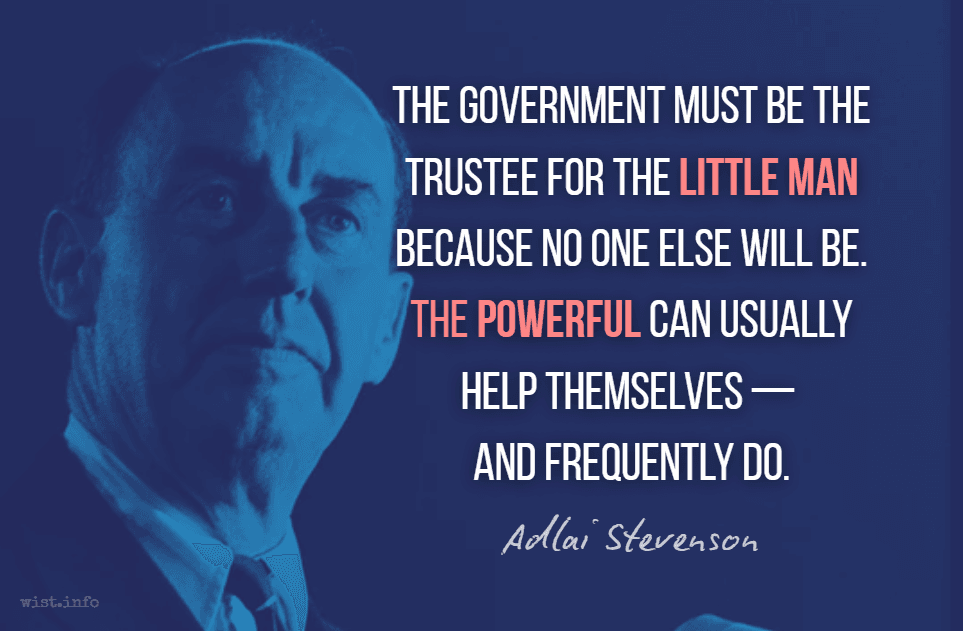
The government must be the trustee for the little man because no one else will be. The powerful can usually help themselves — and frequently do.
Adlai Stevenson II (1900–1965) American politician, diplomat, statesman
Speech (1955-10-29), “The Crisis in Agriculture,” Democratic Rally, Duluth, Minnesota
(Source)
The effect of a good government is to make life more valuable, — of a bad one, to make it less valuable. We can afford that railroad, and all merely material stock, should lose some of its value, for that only compels us to live more simply and economically; but suppose that the value of life itself should be diminished!
Henry David Thoreau (1817–1862) American philosopher and writer
Speech (1854-07-04), “Slavery in Massachusetts,” Anti-Slavery Celebration, Framingham, Massachusetts
(Source)
Remove justice, and what are kingdoms but gangs of criminals on a large scale?
[Remota itaque iustitia quid sunt regna nisi magna latrocinia?]Augustine of Hippo (354–430) Christian church father, philosopher, saint [b. Aurelius Augustinus]
City of God [De Civitate Dei], Book 4, ch. 4 (4.4) (AD 412-416) [tr. Bettenson (1972)]
(Source)
(Source (Latin)). Other translations:Set justice aside, then, and what are kingdoms but fair thievish purchases?
[tr. Healey (1610)]Justice being taken away, then, what are kingdoms but great robberies?
[tr. Dods (1871)]In the absence of justice, what is sovereignty but organized brigandage?
[tr. Zema/Walsh (1950)]And so if justice is left out, what are kingdoms except great robber bands?
[tr. Green (Loeb) (1963)]Justice removed, then, what are kingdoms but great bands of robbers?
[tr. Dyson (1998)]Remove justice, then, and what are kingdoms but large gangs of robbers?
[tr. Babcock (2012)]In the absence of justice, what is sovereignty but organized robbery?
[E.g.]

The aggregate happiness of the society, which is best promoted by the practice of a virtuous policy, is, or ought to be, the end of all government.
George Washington (1732–1799) American military leader, Founding Father, US President (1789–1797)
Letter (1790-11-01) to Comte de Moustier
See Adams (1776).
No experiment can be more interesting than that we are now trying, and which we trust will end in establishing the fact, that man may be governed by reason and truth. Our first object should therefore be, to leave open to him all the avenues to truth. The most effectual hitherto found, is the freedom of the press. It is therefore, the first shut up by those who fear the investigation of their actions.
Thomas Jefferson (1743–1826) American political philosopher, polymath, statesman, US President (1801–09)
Letter (1804-06-28) to John Tyler
(Source)
Society in every state is a blessing, but Government, even in its best state, is but a necessary evil; in its worst state an intolerable one: for when we suffer, or are exposed to the same miseries by a Government, which we might expect in a country without Government, our calamity is heightened by reflecting that we furnish the means by which we suffer.
Thomas Paine (1737–1809) American political philosopher and writer
Common Sense, “On the Origin and Design of Government in General” (14 Feb 1776)
(Source)
The necessity of establishing some form of government [is] to supply the defect of moral virtue.
Thomas Paine (1737–1809) American political philosopher and writer
Common Sense, “On the Origin and Design of Government in General” (14 Feb 1776)
Full text.
We have solved, by fair experiment, the great & interesting question Whether freedom of religion is compatible with order in government and obedience to the laws; & we have experienced the quiet as well as the comfort which results from leaving every one to profess freely & openly those principles of religion which are the inductions of his own reason, & the serious convictions of his own enquiries.
Thomas Jefferson (1743–1826) American political philosopher, polymath, statesman, US President (1801–09)
Letter (1808-11-21) to the Virginia Baptist Associations Meeting in Chesterfield
(Source)
It is as much the duty of government to render prompt justice against itself, in favor of citizens, as it is to administer the same between private individuals.
Abraham Lincoln (1809–1865) American lawyer, politician, US President (1861–65)
Message (1861-12-03) to Congress, Annual Message (State of the Union)
(Source)
If all men were just, there would still be some, though not so much, need of government.
Abraham Lincoln (1809–1865) American lawyer, politician, US President (1861–65)
Speech (1854-07-01?), fragment on government
(Source)
The date was assigned (arbitrarily?) to the fragment by Nicolay and Hay. The speech or lecture it was written for is not recorded.
I believe that the public temper is such that the voters of the land are prepared to support the party which gives the best promise of administering the government in the honest, simple, and plain manner which is consistent with its character and purposes. They have learned that mystery and concealment in the management of their affairs cover tricks and betrayal. The statesmanship they require consists in honesty and frugality, a prompt response to the needs of the people as they arise, and a vigilant protection of all their varied interests.
Grover Cleveland (1837–1908) American President (1885–1889, 1893–1897)
Letter accepting Democratic nomination for President (8 Aug 1884)
(Source)
Must a government, of necessity, be too strong for the liberties of its own people, or too weak to maintain its own existence?
Abraham Lincoln (1809–1865) American lawyer, politician, US President (1861–65)
Message (1861-07-04) to Congress, Special Message, Washington, D. C.
(Source)
Lincoln's Special Message to Congress was to discuss the Civil War that had broken out, its origins, and how it represented this fundamental question about representative government.
Lincoln repeated this phrasing at the beginning of his speech (1864-11-10) responding to serenaders celebrating his re-election.Franklin Roosevelt quoted Lincoln during a pre-WW2 Jackson Day radio address (1941-03-29).
The hand of the people has given the mortal blow to a conspiracy, which, in other countries would have called for an appeal to armies; and has proved that government to be the strongest of which every man feels himself a part.
Thomas Jefferson (1743–1826) American political philosopher, polymath, statesman, US President (1801–09)
Letter (1807-02-02) to H. D. Tiffin
(Source)
As the Happiness of the People is the sole End of Government, So the Consent of the People is the only Foundation of it, in Reason, Morality, and the natural Fitness of things: and therefore every Act of Government, every Exercise of Sovereignty, against, or without, the Consent of the People, is Injustice, Usurpation, and Tyranny.
John Adams (1735–1826) American lawyer, Founder, statesman; US President (1797–1801)
“A Proclamation by the General Court of Massachusetts” (1776-01-19)
(Source)
The document was begun by the House on 1775-12-18 to outline reasons why judicial officers appointed by the Council ought to be accepted by counties (more background here). The proclamation was approved by the House on 1776-01-23, and printed in the Boston Gazette on 1776-02-12.
In Adams' manuscript of the document it reads, "As the Happiness of the People alone."
Any government is in itself an evil insofar as it carries within it the tendency to deteriorate into tyranny. However, except for a very small number of anarchists, everyone of us is convinced that civilized society cannot exist without a government.
Albert Einstein (1879–1955) German-American physicist
“A Reply to the Soviet Scientists” (Dec 1947), Bulletin of Atomic Scientists (Feb 1948)
(Source)
The settled opinion here is, that religion is essentially distinct from Civil Govt., and exempt from its cognizance; that a connexion between them is injurious to both; that there are causes in the human breast which ensure the perpetuity of religion without the aid of the law; that rival sects, with equal rights, exercise mutual censorships in favor of good morals; that if new sects arise with absurd opinions or over-heated imaginations, the proper remedies lie in time, forbearance, and example; that a legal establishment of religion without a toleration could not be thought of, and with a toleration, is no security for public quiet & harmony, but rather a source of discord & animosity; and, finally, that these opinions are supported by experience, which has shewn that every relaxation of the alliance between Law & religion, from the partial example of Holland to its consummation in Pennsylvania, Delaware, New Jersey, &c., has been found as safe in practice as it is sound in theory.
James Madison (1751–1836) American statesman, political theorist, US President (1809–17)
Letter to Edward Everett (18 Mar 1823)
If nothing may be published but what civil authority shall have previously approved, power must always be the standard of truth.
Samuel Johnson (1709–1784) English writer, lexicographer, critic
Lives of the Most Eminent English Poets, “Milton” (1781)
(Source)
Also known as Lives of English Poets and Lives of the Poets.
In the full passage, Johnson notes the dangers of both a censored and uncensored press.
Fear: A club used by priests, presidents, kings and policemen to keep the people from recovering stolen goods.
Elbert Hubbard (1856–1915) American writer, businessman, philosopher
The Roycroft Dictionary (1914)
(Source)
National budgets are a nation’s theology walking.
Joan D. Chittister (b. 1936) American Benedictine nun, author and lecturer
“From Where I Stand,” column, National Catholic Reporter (17 Feb 2005)
(Source)
Taxes are what we pay for civilized society.
Oliver Wendell Holmes, Jr. (1841–1935) American jurist, Supreme Court Justice
Compania General De Tabacos De Filipinas v. Collector of Internal Revenue, 275 U.S. 87, 100 (1927) [Dissent]
(Source)
Full text is "Taxes are what we pay for civilized society, including the chance to insure.
References are also found (without citation) to a 1904 speech, "Taxes are the price we pay for a civilized society" (this variation is quoted by the IRS above the entrance of their headquarters). Bartlett's (1980) cites the above wording, but incorrectly claims it was in 1904.
In Felix Frankfurter, Mr. Justice Holmes and the Supreme Court (1938), Holmes is quoted as rebuking a secretary's query about hating to pay taxes: "No, young feller. I like to pay taxes. With them I buy civilization."
More information here.
Our forefathers found the evils of free thinking more to be endured than the evils of inquest or suppression. They gave the status of almost absolute individual rights to the outward means of expressing belief. I cannot believe that they left open a way for legislation to embarrass or impede the mere intellectual processes by which those expressions of belief are examined and formulated. This is not only because individual thinking presents no danger to society, but because thoughtful, bold and independent minds are essential to wise and considered self-government.
Robert H. Jackson (1892–1954) US Supreme Court Justice (1941–54), lawyer, jurist, politician
American Communications Association v. Douds, 339 U.S. 382, 442 (1950) [concurrence and dissent]
(Source)
In the tragic days of Mussolini, the trains in Italy ran on time as never before and I am told in their way, their horrible way, that the Nazi concentration-camp system in Germany was a model of horrible efficiency. The really basic thing in government is policy. Bad administration, to be sure, can destroy good policy, but good administration can never save bad policy.
Adlai Stevenson II (1900–1965) American politician, diplomat, statesman
Speech (1952-09-11), “On Political Morality,” Town Hall Luncheon, Biltmore Hotel, Los Angeles
(Source)
A popular government without popular information, or the means of acquiring it, is but a prologue to a farce or a tragedy; or, perhaps, both. Knowledge will forever govern ignorance. And a people who mean to be their own governors must arm themselves with the power which knowledge gives.
James Madison (1751–1836) American statesman, political theorist, US President (1809–17)
Letter to W. T. Barry (4 Aug 1822)
The basis of our political systems is the right of the people to make and to alter their Constitutions of Government. But the Constitution which at any time exists, ’till changed by an explicit and authentic act of the whole People, is sacredly obligatory upon all. The very idea of the power and the right of the People to establish Government presupposes the duty of every Individual to obey the established Government.
George Washington (1732–1799) American military leader, Founding Father, US President (1789–1797)
Essay (1796-09-17), “Farewell Address,” Claypoole’s American Daily Advertiser, Philadelphia (1796-09-19)
(Source)
The aim of every political constitution is, or ought to be, first to obtain for rulers men who possess most wisdom to discern, and most virtue to pursue, the common good of the society; and in the next place, to take the most effectual precautions for keeping them virtuous whilst they continue to hold their public trust.
James Madison (1751–1836) American statesman, political theorist, US President (1809–17)
The Federalist #57 “The Alleged Tendency of the New Plan to Elevate the Few at the Expense of the Many” (19 Feb 1788)
A decline in courage may be the most striking feature that an outside observer notices in the West today. The Western world has lost its civic courage, both as a whole and separately, in each country, in each government, in each political party, and, of course, in the United Nations. Such a decline in courage is particularly noticeable among the ruling and intellectual elites, causing an impression of a loss of courage by the entire society. There are many courageous individuals, but they have no determining influence on public life.
Political and intellectual functionaries exhibit this depression, passivity, and perplexity in their actions and in their statements, and even more so in their self-serving rationales as to how realistic, reasonable, and intellectually and even morally justified it is to base state policies on weakness and cowardice. And the decline in courage, at times attaining what could be termed a lack of manhood, is ironically emphasized by occasional outbursts and inflexibility on the part of those same functionaries when dealing with weak governments and with countries that lack support, or with doomed currents which clearly cannot offer resistance. But they get tongue-tied and paralyzed when they deal with powerful governments and threatening forces, with aggressors and international terrorists.
Should one point out that from ancient times decline in courage has been considered the beginning of the end?
Alexander Solzhenitsen (1918–2008) Russian novelist, emigre [Aleksandr Isayevich Solzhenitsyn]
“A World Split Apart,” Commencement Address, Harvard (8 Jun 1978)
(Source)
There’s no credit to being a comedian, when you have the whole Government working for you. All you have to do is report the facts. I don’t even have to exaggerate.
Will Rogers (1879–1935) American humorist
(Attributed)
Quoted in P. J. O'Brien, Will Rogers, Ambassador of Good Will, Prince of Wit and Wisdom, ch. 9 (1935).
The danger is not that a particular class is unfit to govern. Every class is unfit to govern.
John Dalberg, Lord Acton (1834–1902) British historian, politician, writer
Letter (1881-04-24) to Mary Gladstone
In the final result, it mattered not one whit whether the movement was in favor of one class or of another. The outcome was equally fatal, whether the country fell into the hands of a wealthy oligarchy which exploited the poor or whether it fell under the domination of a turbulent mob which plundered the rich. In both cases there resulted violent alternations between tyranny and disorder, and a final complete loss of liberty to all citizens — destruction in the end overtaking the class which had for the moment been victorious as well as that which had momentarily been defeated. The death-knell of the Republic had rung as soon as the active power became lodged in the hands of those who sought, not to do justice to all citizens, rich and poor alike, but to stand for one special class and for its interests as opposed to the interests of others.
Theodore Roosevelt (1858–1919) American politician, statesman, conservationist, writer; US President (1901–09)
Speech (1903-09-07), “The Square Deal,” Labor Day, New York State Agricultural Association, New York State Fair, Syracuse
(Source)
On the fate of historic republics.
It is all-essential to the continuance of our healthy national life that we should recognize this community of interest among our people. The welfare of each of us is dependent fundamentally upon the welfare of all of us, and therefore in public life that man is the best representative of each of us who seeks to do good to each by doing good to all; in other words, whose endeavor it is not to represent any special class and promote merely that class’s selfish interests, but to represent all true and honest men of all sections and all classes and to work for their interests by working for our common country.
Theodore Roosevelt (1858–1919) American politician, statesman, conservationist, writer; US President (1901–09)
Speech (1903-09-07), “The Square Deal,” Labor Day, New York State Agricultural Association, New York State Fair, Syracuse
(Source)
They define a republic to be a government of laws, and not of men.
John Adams (1735–1826) American lawyer, Founder, statesman; US President (1797–1801)
Essay (1775-03-06), “Novanglus,” No. 7, Boston Gazette
(Source)
This series of essays was written by Adams under the pseudonym of "Novanglus" (Latin for "New England") responding to essays from his past friend Daniel Leonard as "Massachusettensis" on colonial leadership and what the proper relationship was between the American colonies and Britain.
Adams credited the concept of the line above to Aristotle, Livy, and specifically to James Harrington (1611-77), who (also crediting Aristotle and Livy) wrote in The Commonwealth of Oceana (1656) of "government [...] is the empire of laws and not of men," "a commonwealth is an empire of laws and not of men," and "a commonwealth is a government of laws and not of men."
Adams later used the term ("government of laws and not of men") in the Massachusetts Constitution, Bill of Rights, Article 30 (1780), enforcing a separation of powers between the executive, judicial, and legislative branches.
The Stoics could only advise the wise man to hold aloof from politics, keeping the unwritten law in his heart. But when Christ said: “Render unto Caesar the things that are Caesar’s, and unto God the things that are God’s,” those words, spoken on His last visit to the Temple, three days before His death, gave to the civil power, under the protection of conscience, a sacredness it had never enjoyed, and bounds it had never acknowledged; and they were the repudiation of absolutism and the inauguration of freedom.
John Dalberg, Lord Acton (1834–1902) British historian, politician, writer
Speech (1877-02-28), “The History of Freedom in Antiquity,” Bridgenorth Institute
No government has the right to decide on the truth of scientific principles, nor to prescribe in any way the character of the questions investigated. Neither may a government determine the aesthetic value of artistic creations, nor limit the forms of literacy or artistic expression. Nor should it pronounce on the validity of economic, historic, religious, or philosophical doctrines. Instead it has a duty to its citizens to maintain the freedom, to let those citizens contribute to the further adventure and the development of the human race.
Richard Feynman (1918–1988) American physicist
The Meaning of It All, “The Uncertainty of Values” (1999)
(Source)
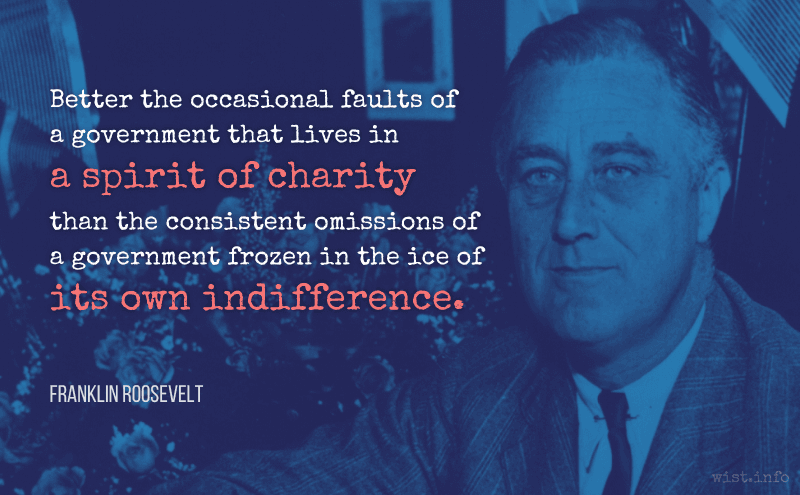
Governments can err, presidents do make mistakes, but the immortal Dante tells us that Divine justice weighs the sins of the cold-blooded and the sins of the warm-hearted on different scales. Better the occasional faults of a government that lives in a spirit of charity than the consistent omissions of a government frozen in the ice of its own indifference.
Franklin Delano Roosevelt (1882–1945) American lawyer, politician, statesman; US President (1933–45)
Speech (1936-06-27), Acceptance, Renomination for President, Democratic National Convention, Philadelphia
(Source)
(Source (Audio), 10:40)
I want to make a policy statement. I am unabashedly in favor of women.
Lyndon B. Johnson (1908–1973) American politician, educator, US President (1963–69)
Speech (1964-03-04), Eleanor Roosevelt Award to Anna Kross
(Source)
Preceding announcing his appointment of ten women to top administration posts. He further commented, after listing them:This should, with the announcements that have preceded this one, and the ones that will follow this one, serve notice that this administration is not running a stag party.
This country has come to feel the same when Congress is in session as we do when the baby gets hold of a hammer. It’s just a question of how much damage he can do with it before you can take it away from him.
Will Rogers (1879–1935) American humorist
Column (1930-07-04), “Daily Telegram: Congress Session, Rogers Says, Is Like Baby Getting a Hammer”
(Source)
Written from Minneapolis. Also collected, in a slightly shorter form, in The Autobiography of Will Rogers, ch. 15 (1949) [ed. Donald Day].
We do not move forward by curtailing people’s liberty because we are afraid of what they may do or say. We move forward by assuring to all people protection in the basic liberties under a democratic form of government, and then making sure that our government serves the real needs of the people.
Eleanor Roosevelt (1884–1962) American politician, diplomat, activist; First Lady of the US (1933–45)
Essay (1940-02-10), “Fear is the Enemy,” The Nation, Vol. 150, No. 6
(Source)
All government is an ugly necessity.
Gilbert Keith Chesterton (1874–1936) English journalist and writer
A Short History of England, ch. 8 (1917)
(Source)
In political life I have never felt that anything really mattered but the satisfaction of knowing that you stood for the things in which you believed, and had done the very best you could.
Eleanor Roosevelt (1884–1962) American politician, diplomat, activist; First Lady of the US (1933–45)
Column (1944-11-08), “My Day”
(Source)
Obsta principiis, nip the shoots of arbitrary power in the bud, is the only maxim which can ever preserve the liberties of any people. When the people give way, their deceivers, betrayers, and destroyers press upon them so fast, that there is no resisting afterwards.
John Adams (1735–1826) American lawyer, Founder, statesman; US President (1797–1801)
Essay (1775-02-06), “Novanglus,” No. 3, Boston Gazette
(Source)
The Latin means to resist the first approaches or encroachments of a problem.
This series of essays was written by Adams under the pseudonym of "Novanglus" (Latin for "New England") responding to essays from his past friend Daniel Leonard as "Massachusettensis" on colonial leadership and what the proper relationship was between the American colonies and Britain.
Cities may be rebuilt, and a People reduced to Poverty, may acquire fresh Property: But a Constitution of Government once changed from Freedom, can never be restored. Liberty once lost is lost forever. When the People once surrender their share in the Legislature, and their Right of defending the Limitations upon the Government, and of resisting every Encroachment upon them, they can never regain it.
John Adams (1735–1826) American lawyer, Founder, statesman; US President (1797–1801)
Letter (1775-07-07) to Abigail Adams
(Source)
On standing up to the British after the burning of Charleston, South Carolina.
For metaphysicians and politicians may dispute forever, but they will never find any other moral principle or foundation of rule or obedience, than the consent of governors and governed.
John Adams (1735–1826) American lawyer, Founder, statesman; US President (1797–1801)
Essay (1775-03-06), “Novanglus,” No. 7, Boston Gazette
(Source)
This series of essays was written by Adams under the pseudonym of "Novanglus" (Latin for "New England"), responding to essays from his past friend Daniel Leonard as "Massachusettensis" on colonial leadership and what the proper relationship was between the American colonies and Britain.
There is Danger from all Men. The only Maxim of a free Government, ought to be to trust no Man living, with Power to endanger the public Liberty.
John Adams (1735–1826) American lawyer, Founder, statesman; US President (1797–1801)
Diary (1772, Spring), “Notes for a Oration Braintree”
(Source)
Be thankful we’re not getting all the government we’re paying for.
Will Rogers (1879–1935) American humorist
(Spurious)
Not found in any of his works. Not attributed to Rogers until the mid-1960s.
For more information on the possible origins of this quotation, see Quote Origin: Thank Goodness We Don’t Get As Much Government As We Pay For – Quote Investigator®.
The only thing that saves us from the bureaucracy is inefficiency. An efficient bureaucracy is the greatest threat to liberty.
Eugene McCarthy (1916–2005) American politician, poet, activist
Quoted (1979-02-12), “People: On the Record” section, Time Magazine
(Source)
Dishonor in public life has a double poison. When people are dishonorable in private business, they injure only those with whom they deal or their own chances in the next world. But when there is a lack of honor in Government, the morals of the whole people are poisoned.
Herbert Hoover (1874–1964) American engineer, bureaucrat, US President (1929–33)
Speech (1951-08-30), “Concerning Honor in Public Life,” Iowa Centennial Celebration, Des Moines, Iowa (radio broadcast)
(Source)
There is surely no contradiction in saying that a certain section of the community may be quite competent to protect the persons and property of the rest, yet quite unfit to direct our opinions, or to superintend our private habits.
Thomas Babington Macaulay (1800–1859) English writer and politician
Southey’s Colloquies on Society (1830)
Nothing is so galling to a people, not broken in from the birth, as a paternal or, in other words, a meddling government, a government which tells them what to read and say and eat and drink and wear.
Thomas Babington Macaulay (1800–1859) English writer and politician
Southey’s Colloquies on Society (1830)
Government has an obligation not to inhibit the collection and dissemination of news…. I’m convinced that if reporters should ever lose the right to protect the confidentiality of their sources then serious investigative reporting will simply dry up. The kind of resourceful, probing journalism that first exposed most of the serious scandals, corruption and injustice in our nation’s history would simply disappear …. And let me tell you, reading about one’s failings in the daily papers is one of the privileges of high office in this free country of ours.
Nelson Rockefeller (1908–1979) American politician
Speech to the Anti-Defamation League, Syracuse, NY (29 Nov 1972)
(Source)

Of the best rulers
The people (only) know that they exist;
The next best they love and praise;
The next they fear;
And the next they revile.
When they do not command the people’s faith,
Some will lose faith in them,
And then they resort to oaths!
But (of the best) when their task is accomplished, their work done,
The people all remark, “We have done it ourselves.”Lao-tzu (604?-531? BC) Chinese philosopher, poet [also Lao-tse, Laozi]
The Wisdom of Laotse, ch 17 (1948) [tr. Lin Yutang]
Alt. trans. [Tao-te Ching tr. Wing-Tsit Chan]:
"The best are those whose existence is merely known by the people.
The next best are those who are loved and praised.
The next are those who are feared.And the next are those who are reviled.
The great rulers accomplish their task; they complete their work.
Nevertheless their people say that they simply follow Nature."
But I go on this great republican principle, that the people will have virtue and intelligence to select men of virtue and wisdom. Is there no virtue among us? If there be not, we are in a wicked situation. No theoretical checks, no form of government, can render us secure. To suppose that any for of government will secure liberty or happiness without any virtue in the people, is a chimerical idea. If there be sufficient virtue and intelligence in the community, it will be exercised in the selection of these men; so that we do not depend on their virtue, or put confidence in our rulers, but in the people who are to choose them.
James Madison (1751–1836) American statesman, political theorist, US President (1809–17)
Speech at the Virginia Convention (20 Jun 1788)
(Source)
As it was 189 years ago, so today the cause of America is a revolutionary cause. And I am proud this morning to salute you as fellow revolutionaries. Neither you nor I are willing to accept the tyranny of poverty, nor the dictatorship of ignorance, nor the despotism of ill health, nor the oppression of bias and prejudice and bigotry. We want change. We want progress. We want it both abroad and at home — and we aim to get it.
Lyndon B. Johnson (1908–1973) American politician, educator, US President (1963–69)
Speech (1965-08-04), “Remarks to College Students Employed by the Government During the Summer,” White House
(Source)
It is important, likewise, that the habits of thinking in a free country should inspire caution in those intrusted with its administration to confine themselves within their respective constitutional spheres, avoiding in the exercise of the powers of one department to encroach upon another. The spirit of encroachment tends to consolidate the powers of all the departments in one, and thus to create, whatever the form of government, a real despotism. A just estimate of that love of power and proneness to abuse it which predominates in the human heart is sufficient to satisfy us of the truth of this position.
George Washington (1732–1799) American military leader, Founding Father, US President (1789–1797)
Essay (1796-09-18), “Farewell Address,” Claypoole’s American Daily Advertiser, Philadelphia
(Source)
The original draft of "The Address of Gen. Washington to the People of America on His Declining the Presidency of the United States" was by James Madison in June 1792. At the end of his second term, Washington, with the help of Alexander Hamilton, revised it for release and publication.
Public confidence in the integrity of the Government is indispensable to faith in democracy; and when we lose faith in the system, we have lost faith in everything we fight and stand for.
Adlai Stevenson II (1900–1965) American politician, diplomat, statesman
Speech (1952-09-11), “On Political Morality,” Town Hall Luncheon, Biltmore Hotel, Los Angeles
(Source)
Yes, Gentlemen; if I am asked why we are free with servitude all around us, why our Habeas Corpus Act has not been suspended, why our press is still subject to no censor, why we still have the liberty of association, why our representative institutions still abide in all their strength, I answer, It is because in the year of revolutions we stood firmly by our government in its peril; and, if I am asked why we stood by our government in its peril, when men all around us were engaged in pulling governments down, I answer, It was because we knew that though our government was not a perfect government, it was a good government, that its faults admitted of peaceable and legal remedies, that it had never inflexibly opposed just demands, that we had obtained concessions of inestimable value, not by beating the drum, not by ringing the tocsin, not by tearing up the pavement, not by running to the gunsmiths’ shops to search for arms, but by the mere force of reason and public opinion.
Thomas Babington Macaulay (1800–1859) English writer and politician
Speech on re-election to Parliament, Edinburgh (2 Nov 1852)
(Source)
On the various revolutions and counter-revolutions in Europe in 1848.
By the frame of the Government under which we live this same people have wisely given their public servants but little power for mischief, and have with equal wisdom provided for the return of that little to their own hands at very short intervals. While the people retain their virtue and vigilance no Administration by any extreme of wickedness or folly can very seriously injure the Government in the short space of four years.
Abraham Lincoln (1809–1865) American lawyer, politician, US President (1861–65)
Speech (1861-03-04), Inaugural Address, Washington, D. C.
(Source)
I believe that the essence of government lies with unceasing concern for the welfare and dignity and decency and innate integrity of life for every individual. I don’t like to say this and wish I didn’t have to add these words to make it clear but I will — regardless of color, creed, ancestry, sex or age.
Lyndon B. Johnson (1908–1973) American politician, educator, US President (1963–69)
Speech (1972-12-12), Civil Rights symposium, LBJ Library, Austin, Texas
(Source)
(Source (Video)). Johnson's last public speech.
The powerful — be they church leaders or politicians — always seem to forget the one lesson of history: everything changes. The party in power today is not going to be the party in power in a decade, or next year. The group you made a gentleman’s agreement with this election cycle is going to be a completely different group, with different demands, next one. And yet, the powerful insist on trying to weaken the rules that keep them from being still more powerful, as if that could fend off the day of their fall — and the rise of others, probably their opponents, who will operate under the same weakened rules and ugly precedents. Unfortunately, in those sorts of payback situations, nobody’s a winner.
Graham Ericsson (b. 1961) American technologist, writer, aphorist
Journal (2007-08-29)

Many forms of Government have been tried, and will be tried in this world of sin and woe. No one pretends that democracy is perfect or all-wise. Indeed, it has been said that democracy is the worst form of Government except all those other forms that have been tried from time to time.
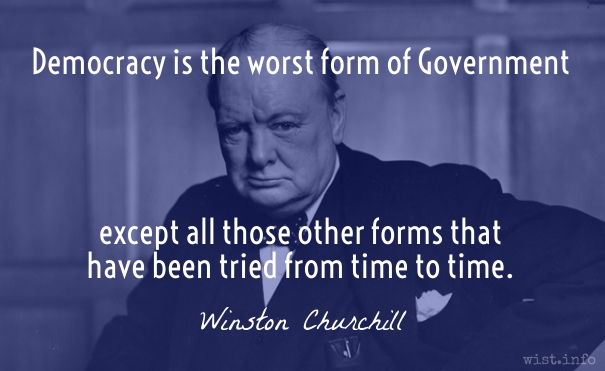
We hold these truths to be sacred & undeniable; that all men are created equal & independant, that from that equal creation they derive rights inherent & inalienable, among which are the preservation of life, & liberty, & the pursuit of happiness; that to secure these ends, governments are instituted among men, deriving their just powers from the consent of the governed; that whenever any form of government shall become destructive of these ends, it is the right of the people to alter or to abolish it, & to institute new government, laying it’s foundation on such principles & organising it’s powers in such form, as to them shall seem most likely to effect their safety & happiness.
Thomas Jefferson (1743–1826) American political philosopher, polymath, statesman, US President (1801–09)
Document (1776-06), “Declaration of Independence” (original rough draft)
(Source)
Compare to the final version, as modified and adopted by the Continental Congress.
Religious leaders too often think that if they just got the government to pay for their programs, they could do so much more good. But they should also know too well from bitter experience that big donors often have strings attached to their donations, and Uncle Sam is the biggest donor of all. Accept his money, even if he seems to be nodding in agreement with you, and sooner or later you’ll find you’ve compromised away your mission and become too dependent on his largesse to get it back. Churches should keep away from the state, not just for the good of the state, but for their own good as well.
Graham Ericsson (b. 1961) American technologist, writer, aphorist
Journal (2007-08-13)
There’s always a temptation for the Church to try and take on the power of the state. There are all those souls to save, don’t you know, and all those rules to pass to make sure they are. But politics, statecraft, lawmaking, power brokering — those engines all run on compromise, and compromise is the worst enemy of principle, which is, after all, what the Church is supposed to be about to be about. It’s hard to be a moral compass when you keep turning from your course.
Graham Ericsson (b. 1961) American technologist, writer, aphorist
Journal (2007-08-13)
Church and state are drawn to each other like moths and flame, and when they are, it’s always about power — power over the population, power over souls. power over votes. But religious and political leaders alike should remember what happens when the moth and flame finally get together.
Graham Ericsson (b. 1961) American technologist, writer, aphorist
Journal (2007-08-13)
It is contended by many that ours is a Christian government, founded upon the Bible, and that all who look upon the book as false or foolish are destroying the foundation of our country. The truth is, our government is not founded upon the rights of gods, but upon the rights of men. Our Constitution was framed, not to declare and uphold the deity of Christ, but the sacredness of humanity. Ours is the first government made by the people and for the people. It is the only nation with which the gods have had nothing to do. And yet there are some judges dishonest and cowardly enough to solemnly decide that this is a Christian country, and that our free institutions are based upon the infamous laws of Jehovah.
Robert Green Ingersoll (1833–1899) American lawyer, freethinker, orator
Lecture (1873-12), “Individuality,” Chicago Free Religious Society
(Source)
Full title "Arraignment of the Church and a Plea for Individuality." Collected in The Gods and Other Lectures (1876)
FIRST STRANGER: Men must learn now with pity to dispense,
For policy sits above conscience.William Shakespeare (1564–1616) English dramatist and poet
Timon of Athens, Act 3, sc. 2, l. 93ff (3.2.93-94) (1606) [with Thomas Middleton]
(Source)

But the future lies with those wise political leaders who realize that the great public is interested more in Government than in politics.
Franklin Delano Roosevelt (1882–1945) American lawyer, politician, statesman; US President (1933–45)
Speech (1940-01-08), Jackson Day Dinner, Mayflower Hotel, Washington, D. C.
(Source)
Quoted by Ronald Reagan, State of the Union (1983-01-25), though he appeared to misattribute the phrase to Roosevelt's second State of the Union message.
Must the citizen ever for a moment, or in the least degree, resign his conscience to the legislator? Why has every man a conscience, then? I think that we should be men first, and subjects afterward.
Henry David Thoreau (1817–1862) American philosopher and writer
Essay (1849-05), “Resistance to Civil Government [On the Duty of Civil Disobedience],” Æsthetic Papers, No. 1, Article 10
(Source)
Based on an 1848 lecture at the Concord Lyceum.

The priceless heritage of our society is the unrestricted constitutional right of each member to think as he will. Thought control is a copyright of totalitarianism, and we have no claim to it. It is not the function of our Government to keep the citizen from falling into error; it is the function of the citizen to keep the Government from falling into error. We could justify any censorship only when the censors are better shielded against error than the censored.
Robert H. Jackson (1892–1954) US Supreme Court Justice (1941–54), lawyer, jurist, politician
American Communications Assn. v. Douds, 339 U.S. 382, 442-443 (1950) [concurrence and dissent]
(Source)
The fundamental Article of my political Creed is, that Despotism, or unlimited Sovereignty, or absolute Power is the Same in a Majority of a popular Assembly, an Aristocratical Counsel, an Oligarchical Junto and a Single Emperor. Equally arbitrary cruel bloody and in every respect, diabolical.
John Adams (1735–1826) American lawyer, Founder, statesman; US President (1797–1801)
Letter (1815-11-13) to Thomas Jefferson
(Source)
What I do say is that no man is good enough to govern another man without that other’s consent. I say this is the leading principle, the sheet-anchor of American republicanism. […] According to our ancient faith, the just powers of governments are derived from the consent of the governed. Now the relation of master and slave is pro tanto a total violation of this principle. The master not only governs the slave without his consent, but he governs him by a set of rules altogether different from those which he prescribes for himself. Allow all the governed an equal voice in the government, and that, and that only, is self-government.
Abraham Lincoln (1809–1865) American lawyer, politician, US President (1861–65)
Speech (1854-10-16), “In Reply to Senator Douglas,” Peoria, Illinois
(Source)
Speaking on the 1854 Kansas-Nebraska Act, which repealed the Missouri Compromise and allowed as "self-government" for residents of those two territories to decide locally whether to allow slavery there.
In the ellipses, Lincoln quotes the beginning of the Declaration of Independence, through "deriving their just powers from the consent of the governed."
I desire to conduct the affairs of this administration that if at the end, when I come to lay down the reins of power, I have lost every other friend on earth, I shall at least have one friend left, and that friend shall be down inside of me.
Abraham Lincoln (1809–1865) American lawyer, politician, US President (1861–65)
Speech (1863-09-30) to the Missouri Committee of Seventy
(Source)
A committee of seventy "Radical Union Men of Missouri," selected by a state convention, visited Lincoln in the White House, demanding immediate abolition of slavery in the border states, the recruitment of Black soldiers to the Union Army, and that action be taken regarding the factional conflicts (Radicals vs Conservatives) stirred up by the state governor and the US military governor overseeing the state militia. This was Lincoln's concluding remark in reply to the committee's petition.
This was not a prepared speech, so there is no "official" version. These words were later reported by Enos Clarke, one of the committee members, as recorded in Ida Tarbell's The Life of Abraham Lincoln (1895). Tarbell's book was a best-seller, and the quotation is usually given as above.
However, Clarke's report as recorded by Walter Stevens in the Missouri State Historical Society book Lincoln and Missouri (1916) is a bit different:It is my ambition and desire to so administer the affairs of the government while I remain President that if at the end I shall have lost every other friend on earth I shall at least have one friend remaining and that one shall be down inside of me.
The difference between the two may be between different instances across the years of Clarke reporting on Lincoln's comments. Neither Tarbell nor Stevens give notes as to when and where their statements from Clarke derive.
I wish men to be free
As much from mobs as kings — from you as me.
The liberty of a democracy is not safe if the people tolerate the growth of private power to a point where it becomes stronger than their democratic state itself. That, in its essence, is Fascism — ownership of Government by an individual, by a group, or by any other controlling private power.
Franklin Delano Roosevelt (1882–1945) American lawyer, politician, statesman; US President (1933–45)
Message (1938-04-29) to Congress, On Curbing Monopolies
(Source)
The first measure of a free society is NOT that its government performs the will of the majority. That’s what we had in 1930s Germany, 1950s Georgia, and 1980s Iran. The FIRST measure of a free society is that its government protects the just freedoms of its minorities AGAINST the preferences, will and caprice of the majority.
Jim Warren (b. 1936) American mathematician, computer scientist, journalist, activist
(Attributed)

POLITICS, n. A strife of interests masquerading as a contest of principles. The conduct of public affairs for private advantage.
Ambrose Bierce (1842–1914?) American writer and journalist
“Politics,” The Devil’s Dictionary (1911)
(Source)
Originally published in the "Cynic's Word Book" column in the New York American (1906-03-16), and the "Cynic's Dictionary" column in the San Francisco Examiner (1906-03-21).

The punishment which the wise suffer who refuse to take part in the government is to live under the government of worse men.
Plato (c.428–347 BC) Greek philosopher
Republic, Book 1, 347c
(Source)
Translation as paraphrased by Ralph Waldo Emerson in his essay (1870) "Eloquence," Society and Solitude, ch. 4.
Other translations:More discussion here.
- "One of the penalties for refusing to participate in politics, is that you end up being governed by your inferiors."
- The Constitution Party (1952-68) used on their letterhead the variant, "The penalty good men pay for indifference to public affairs is to be ruled by evil men."
- "The price of apathy is to be ruled by evil men."
- "Those who are too smart to engage in politics are punished by being governed by those who are dumber."
In context (Plato in Twelve Volumes, Vols. 5 & 6 [tr. Shorey (1969)]):[346e] "Then, Thrasymachus, is not this immediately apparent, that no art or office provides what is beneficial for itself -- but as we said long ago it provides and enjoins what is beneficial to its subject, considering the advantage of that, the weaker, and not the advantage the stronger? That was why, friend Thrasymachus, I was just now saying that no one of his own will chooses to hold rule and office and take other people's troubles in hand to straighten them out, but everybody expects pay for that, [347a] because he who is to exercise the art rightly never does what is best for himself or enjoins it when he gives commands according to the art, but what is best for the subject. That is the reason, it seems, why pay must be provided for those who are to consent to rule, either in form of money or honor or a penalty if they refuse."
"What do you mean by that, Socrates?" said Glaucon. "The two wages I recognize, but the penalty you speak of and described as a form of wage I don't understand."
"Then," said I, "you don't understand the wages of the best men [347b] for the sake of which the finest spirits hold office and rule when they consent to do so. Don't you know that to be covetous of honor and covetous of money is said to be and is a reproach?" "I do," he said. "Well, then," said I, "that is why the good are not willing to rule either for the sake of money or of honor. They do not wish to collect pay openly for their service of rule and be styled hirelings nor to take it by stealth from their office and be called thieves, nor yet for the sake of honor, [347c] for they are not covetous of honor. So there must be imposed some compulsion and penalty to constrain them to rule if they are to consent to hold office. That is perhaps why to seek office oneself and not await compulsion is thought disgraceful. But the chief penalty is to be governed by someone worse if a man will not himself hold office and rule. It is from fear of this, as it appears to me, that the better sort hold office when they do, and then they go to it not in the expectation of enjoyment nor as to a good thing, but as to a necessary evil and because they are unable to turn it over to better men than themselves [347d] or to their like. For we may venture to say that, if there should be a city of good men only, immunity from office-holding would be as eagerly contended for as office is now, and there it would be made plain that in very truth the true ruler does not naturally seek his own advantage but that of the ruled; so that every man of understanding would rather choose to be benefited by another than to be bothered with benefiting him."
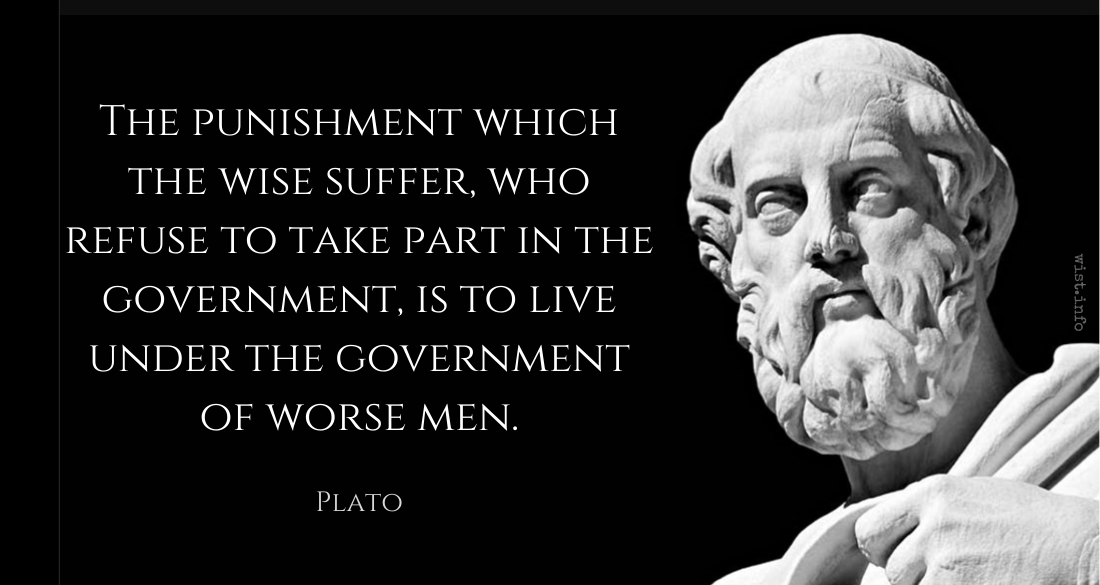
Government is not reason, it is not eloquence, it is force; like fire, a troublesome servant and a fearful master. Never for a moment should it be left to irresponsible action.
George Washington (1732–1799) American military leader, Founding Father, US President (1789–1797)
(Attributed)
Unsourced. First attributed to "The First President of the United States" in "Liberty and Government" by W. M., in The Christian Science Journal (Nov 1902) [ed. Mary Baker Eddy].
Variant: "Government is not reason, it is not eloquence — it is force! Like fire, it is a dangerous servant and a fearful master. Never for a moment should it be left to irresponsible action."
More information on this quotation's origins and inspiration: Quote Origin: Government Is Like Fire, a Dangerous Servant and a Fearful Master – Quote Investigator®.
How long we can hold our ground I do not know. We are not incorruptible; on the contrary, corruption is making a sensible tho’ silent progress. Offices are as acceptable here as elsewhere, and when once a man has cast a longing eye on them, a rottenness begins in his conduct.
Thomas Jefferson (1743–1826) American political philosopher, polymath, statesman, US President (1801–09)
Letter (1799-05-21) to Tench Coxe
(Source)
Under a government which imprisons any unjustly, the true place for a just man is also a prison.
Henry David Thoreau (1817–1862) American philosopher and writer
Essay (1849-05), “Resistance to Civil Government [On the Duty of Civil Disobedience],” Æsthetic Papers, No. 1, Article 10
(Source)
Based on an 1848 lecture at the Concord Lyceum.
The safety of the people is the supreme law.
[Salus populi suprema lex esto.]
Marcus Tullius Cicero (106–43 BC) Roman orator, statesman, philosopher
De Legibus [On the Laws], Book 3, ch. 3 / sec. 8 (3.3/3.8) [Marcus] (c. 51 BC) [tr. Barham (1842)]
(Source)
Cicero gives this in his outline of how government ought to be constituted, in particular how the consuls should have ultimate authority over the law and the army. (Source (Latin)). Other translations:The safety of the people shall be their highest law.
[tr. Keyes (1928)]The safety of the people shall be the highest law.
[tr. Rudd (1998)]For them let the safety of the people be the highest law.
[tr. Zetzel (1999)]Let the safety of the people be the highest law.
[tr. Fott (2013)]
Other, more general translations:The phrase (in Latin) was used frequently during the Enlightenment as a core statement around the purpose of government, most famously in John Locke's Second Treatise,, ch. 13, sec. 158.
- "The good of the people is the chief law."
- "Let the welfare of the people be the ultimate law."
More information about this quote and its uses: Salus populi suprema lex esto - Wikipedia
Since freedom of opinion can only exist when the government thinks itself secure, it is important that the government should have the approval of the great majority of the population and should deal with discontented minorities, wherever possible, in a manner calculated to allay their discontent. A government must possess force, but cannot be a satisfactory government unless force is seldom necessary.
Bertrand Russell (1872–1970) English mathematician and philosopher
“Freedom and Government,” in Ruth Nanda Anshen, ed., Freedom: Its Meaning (1940)
(Source)
What man […] believes the law can hurt him; that is, words and paper, without hands and swords of men?
Thomas Hobbes (1588–1679) English philosopher
Leviathan, Part 4, ch. 46 (1651)
(Source)
Countering the argument in Aristotle's Politics, which asserts that laws should govern, not men.
Often attributed to John Harrington, who quoted Hobbes in his The Commonwealth of Oceana, Part 1 (1656).
Every actual State is corrupt. Good men must not obey the laws too well.
Ralph Waldo Emerson (1803–1882) American essayist, lecturer, poet
“Politics,” Essays: Second Series (1844)
It is error alone which needs the support of government. Truth can stand by itself.
Thomas Jefferson (1743–1826) American political philosopher, polymath, statesman, US President (1801–09)
Notes on the State of Virginia, Query 17 (1782)
(Source)
And can history produce an instance of a rebellion so honourably conducted? I say nothing of it’s motives. They were founded in ignorance, not wickedness. God forbid we should ever be 20. years without such a rebellion. The people can not be all, and always, well informed. The part which is wrong will be discontented in proportion to the importance of the facts they misconceive. If they remain quiet under such misconceptions it is a lethargy, the forerunner of death to the public liberty. We have had 13. states independant 11. years. There has been one rebellion. That comes to one rebellion in a century and a half for each state. What country before ever existed a century and half without a rebellion? And what country can preserve it’s liberties if their rulers are not warned from time to time that their people preserve the spirit of resistance?
Thomas Jefferson (1743–1826) American political philosopher, polymath, statesman, US President (1801–09)
Letter (1787-11-13) to William Stephens Smith
(Source)
Speaking of Shay's Rebellion.
The national budget must be balanced. The public debt must be reduced; the arrogance of the authorities must be moderated and controlled. Payments to foreign governments must be reduced, if the nation doesn’t want to go bankrupt. People must again learn to work, instead of living on public assistance.
Marcus Tullius Cicero (106–43 BC) Roman orator, statesman, philosopher
(Spurious)
(Source)
One of several related paraphrases of this "quote" from Taylor Caldwell's novel about Cicero, A Pillar of Iron, ch. 51 (1965):Antonius heartily agreed with him [sc. Cicero] that the budget should be balanced, that the Treasury should be refilled, that public debt should be reduced, that the arrogance of the generals should be tempered and controlled, that assistance to foreign lands should be curtailed lest Rome become bankrupt, that the mobs should be forced to work and not depend on government for subsistence, and that prudence and frugality should be put into practice as soon as possible.
See here and here for more discussion.
In framing a government which is to be administered by men over men the great difficulty lies in this: You must first enable the government to control the governed, and in the next place, oblige it to control itself.
The legitimate powers of government extend to such acts only as are injurious to others. But it does me no injury for my neighbor to say there are twenty Gods, or no God. It neither picks my pocket nor breaks my leg.
Thomas Jefferson (1743–1826) American political philosopher, polymath, statesman, US President (1801–09)
Notes on the State of Virginia, Query 17 (1782)
(Source)
Which is the best government? That which teaches us to govern ourselves.
[Welche Regierung die beste sei? Diejenige, die uns lehrt, uns selbst zu regieren.]
Johann Wolfgang von Goethe (1749–1832) German poet, statesman, scientist
Sprüche in Prosa: Maximen und Reflexionen [Proverbs in Prose: Maxims and Reflections] (1833) [tr. Saunders (1893), “Life and Characters,” #225]
(Source)
From Art and Antiquity, Vol. 5, #3, Individual Points (1826).
(Source (German)). Other translations:I am asked: which is the best government? That which teaches us to govern ourselves.
[tr. Rönnfeldt (1900)]You ask which form of government is the best? Whichever teaches us to govern ourselves.
[tr. Stopp (1995), #353]
Democracy is a device that ensures we shall be governed no better than we deserve.
George Bernard Shaw (1856–1950) Irish playwright and critic
(Attributed)
Sometimes cited with the Americanized "insures." Also given as "Democracy is a system ensuring that the people are governed no better than they deserve." Frequently quoted, but never sourced.
A majority held in restraint by constitutional checks and limitations, and always changing easily with deliberate changes of popular opinions and sentiments, is the only true sovereign of a free people. Whoever rejects it does of necessity fly to anarchy or to despotism.
Abraham Lincoln (1809–1865) American lawyer, politician, US President (1861–65)
Speech (1861-03-04), Inaugural Address, Washington, D. C.
(Source)
A state without the means of some change is without the means of its conservation.
Edmund Burke (1729–1797) Anglo-Irish statesman, orator, philosopher
Reflections on the Revolution in France (1790)
(Source)
The United States of America have exhibited, perhaps, the first example of governments erected on the simple principles of nature; and if men are now sufficiently enlightened to disabuse themselves of artifice, imposture, hypocrisy, and superstition, they will consider this event as an era in their history. Although the detail of the formation of the American governments is at present little known or regarded either in Europe or in America, it may hereafter become an object of curiosity. It will never be pretended that any persons employed in that service had interviews with the gods, or were in any degree under the inspiration of Heaven, more than those at work upon ships or houses, or laboring in merchandise or agriculture; it will forever be acknowledged that these governments were contrived merely by the use of reason and the sense.
John Adams (1735–1826) American lawyer, Founder, statesman; US President (1797–1801)
A Defence of the Constitutions of Government of The United States of America, Vol. 1, Preface (1787)
(Source)
ARTHUR: I am your king.
WOMAN: Well, I didn’t vote for you.
ARTHUR: You don’t vote for kings.
WOMAN: Well how’d you become king then?
ARTHUR: (angelic music plays) The Lady of the Lake, her arm clad in the purest shimmering samite, held aloft Excalibur from the bosom of the water, signifying by divine providence that I, Arthur, was to carry Excalibur. (angelic music stops) That is why I am your king.
DENNIS: (interrupting) Listen, strange women lying in ponds distributing swords is no basis for a system of government. Supreme executive power derives from a mandate from the masses, not from some farcical aquatic ceremony.
ARTHUR: Be quiet!
DENNIS: You can’t expect to wield supreme executive power just ’cause some watery tart threw a sword at you!
ARTHUR: Shut up!
DENNIS: I mean, if I went around saying I was an emperor just because some moistened bint had lobbed a scimitar at me, they’d put me away!
ARTHUR: (grabbing him by the collar) Shut up! Will you shut up!
Monty Python (b. 1969) British comedy troupe [Graham Chapman, John Cleese, Terry Gilliam, Eric Idle, Terry Jones, Michael Palin]
Monty Python and the Holy Grail, sc. 3 (1975)
(Source)
(Source (Video); dialog verified)
Experience should teach us to be most on our guard to protect liberty when the government’s purposes are beneficial. Men born to freedom are naturally alert to repel invasion of their liberty by evil-minded rulers. The greater dangers to liberty lurk in insidious encroachment by men of zeal, well-meaning but without understanding.
Louis Brandeis (1856–1941) American lawyer, jurist, activist; US Supreme Court Justice (1916–39)
Olmstead v. United States, 277 US 438 (1928) [dissent]
(Source)
It is true, the bill is said to be founded on necessity; but what is this? Is it not necessity, which has always been the plea of every illegal exertion of power, or exercise of oppression? Is not necessity the pretence of every usurpation? Necessity is the plea for every infringement of human freedom. It is the argument of tyrants; it is the creed of slaves.
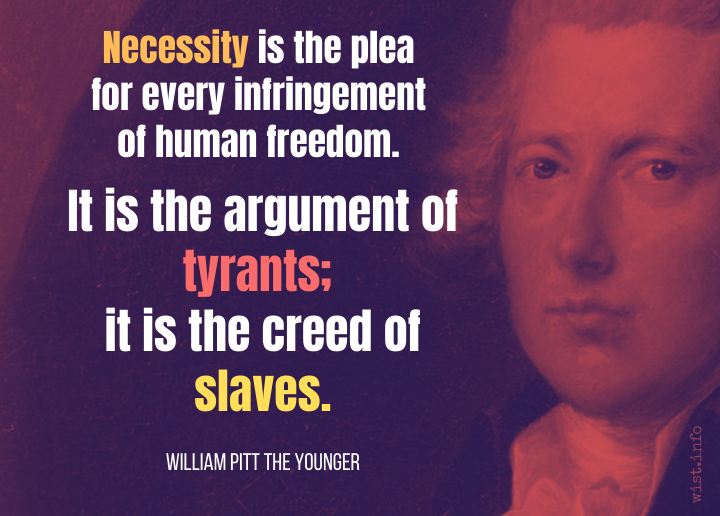
The country needs and, unless I mistake its temper, the country demands bold, persistent experimentation. It is common sense to take a method and try it: If it fails, admit it frankly and try another. But above all, try something.
Franklin Delano Roosevelt (1882–1945) American lawyer, politician, statesman; US President (1933–45)
Speech (1932-05-22), Commencement, Oglethorpe University, Atlanta, Georgia
(Source)
Sometimes it is said that man can not be trusted with the government of himself. Can he, then, be trusted with the government of others? Or have we found angels in the forms of kings to govern him? Let history answer this question.
Thomas Jefferson (1743–1826) American political philosopher, polymath, statesman, US President (1801–09)
Speech (1801-03-14), Inaugural Address, Washington, D. C.
(Source)
The budget is a mythical bean bag. Congress votes mythical beans into it, and then tries to reach in and pull real beans out.
Will Rogers (1879–1935) American humorist
Column (1933-02-24), “Daily Telegram”
(Source)
Written while in Beverly Hills. Collected in The Autobiography of Will Rogers, ch. 18 (1949) [ed. Donald Day].
Patriotism means to stand by the country. It does not mean to stand by the President or any other public official save exactly to the degree in which he himself stands by the country. It is patriotic to support him in so far as he efficiently serves the country. It is unpatriotic not to oppose him to the exact extent that by inefficiency or otherwise he fails in his duty to stand by the country. In either event, it is unpatriotic not to tell the truth — whether about the President or about any one else.
Theodore Roosevelt (1858–1919) American politician, statesman, conservationist, writer; US President (1901–09)
Essay (1918-05), “Lincoln and Free Speech,” Metropolitan Magazine, Vol. 47, No. 6
(Source)
On war-time censorship by the Wilson Administration taken against critics of its handling of war efforts.
Reprinted in Appendix C of his The Great Adventure (1918), and as ch. 7 of that book in Vol. 21 of The Works of Theodore Roosevelt (1925), The Great Adventure.
See also Roosevelt and Roosevelt.
Democracy is the recurrent suspicion that more than half of the people are right more than half of the time.
E. B. White (1899–1985) American author, critic, humorist [Elwyn Brooks White]
“Notes and Comments,” New Yorker (3 Jul 1943)
(Source)
Ours is a practical people, to whom ideals furnish the theory of political action, upon which they want not only firm assurance, but also effective practice. They want programmes, but they want action to flow from them. They want constructive common sense. They want the development of the common will, not the views of a single individual. They are beginning to realize that words without action are the assassins of idealism.
Herbert Hoover (1874–1964) American engineer, bureaucrat, US President (1929–33)
In the New York Tribune (29 Apr 1920)
On the 1920 Presidential campaign.
CALVIN: When I grow up, I’m not going to read the newspaper and I’m not going to follow complex issues and I’m not going to vote. That way I can complain when the government doesn’t represent me. Then, when everything goes down the tubes, I can say the system doesn’t work and justify my further lack of participation.
HOBBES: An ingeniously self-fulfilling plan.
CALVIN: It’s a lot more fun to blame things than to fix them.