One of the effects of safe and civilized life is an immense oversensitiveness which makes all the primary emotions seem somewhat disgusting. Generosity is as painful as meanness, gratitude as hateful as ingratitude.
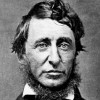
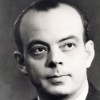
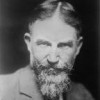
George Orwell (1903-1950) English journalist, essayist, writer [pseud. of Eric Arthur Blair]
Essay (1942-08), “Looking Back on the Spanish War, ch. 3, New Road (1943-06)
(Source)
When I was one-and-twenty I heard a wise man say,
“Give crowns and pounds and guineas But not your heart away;
Give pearls away and rubies, But keep your fancy free.”
But I was one-and-twenty, No use to talk to me.
When I was one-and-twenty I heard him say again,
“The heart out of the bosom Was never given in vain;
‘Tis paid with sighs a plenty And sold for endless rue.”
And I am two-and-twenty, And oh, ’tis true, ’tis true.
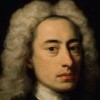
A. E. Housman (1859-1936) English scholar and poet [Alfred Edward Housman] A Shropshire Lad, No. 13 (1896)
(Source)
Sometimes, even if a woman no longer wants you in her arms, she wants you in her heart.
Langston Hughes (1902-1967) American poet, social activist, novelist, playwright
Story (1943), “Sometimes I Wonder” [Narrator], The Best of Simple (1961)
(Source)
My first reaction was to be afraid
This ardor was a snare the Devil had laid;
And I avoided you as a temptation
That might stand in the way of my salvation.
But finally I knew, O gracious beauty,
That passion need not be at odds with duty,
That I can reconcile it with propriety;
And so I yield to it without anxiety.
[D’abord j’appréhendai que cette ardeur secrète
Ne fût du noir esprit une surprise adroite;
Et même à fuir vos yeux mon cœur se résolut,
Vous croyant un obstacle à faire mon salut.
Mais enfin je connus, ô beauté tout aimable!
Que cette passion peut n’être point coupable,
Que je puis l’ajuster avecque la pudeur;
Et c’est ce qui m’y fait abandonner mon cœur.]
Molière (1622-1673) French playwright, actor [stage name for Jean-Baptiste Poquelin] Tartuffe, or the Hypocrite [Le Tartuffe, ou L’Imposteur], Act 3, sc. 3 (1669) [tr. Frame (1967)]
(Source)
Tartuffe plays the "It can't be wrong if it feels so right" seduction card. "Modesty" is used here in many of the translations in its meaning of moderate behavior or avoidance of sexual explicitness.
At first I was under Apprehension lest this secret Flame might be a dexterous Surprize of the foul Fiend; and my Heart even resolv'd to avoid your Eyes, believing you an Obstacle to my future Happiness. But at length I perceiv'd, most lovely Beauty, that my passion could not be blameable, that I could reconcile it with Modesty, and this made me abandon my Heart to it.
[tr. Clitandre (1672)]
At first I feared that this secret ardour might be nothing but a cunning snare of the foul fiend; and my heart even resolved to fly your presence, thinking that you might be an obstacle to my salvation. But at last I found, oh most lovely beauty, that my passion could not be blameable; that I could reconcile it with modesty; and this made me feely indulge it.
[tr. Van Laun (1876)]
At first I feared that this secret tenderness might be a skilful assault of the evil one; I event hought I would avoid your presence, fearing you might prove a stumbling-block to my salvation. But I have learnt, O adorable beauty, that my passion need not be a guilty one; that i can reconcile it with modesty; and I have given up my whole soul to it.
[tr. Wall (1879)]
At first I was afraid lest this secret flame might be a subtle surprise of the evil one; and my heart resolved to avoid your eyes as an obstacle to my future happiness; but at length I perceived, most lovely beauty, that: my passion could not be guilty; that I could reconcile it with the rules of modesty, and this made me yield my heart to it.
[tr. Mathew (1890)]
At first I feared lest this secret tenderness might be but an artful assault of the evil one; and my heart even resolved to flee from your eyes, fearing you might be a stumbling-block in the way of my salvation. But at last I learnt, ah! most entrancing beauty, that this passion need not be a guilty one, that I cuold reconcile it with modesty, and so I have let my heart give way to it.
[tr. Waller (1903)]
At first I trembled lest this secret love
Might be the Evil Spirit's artful snare;
I even schooled my heart to flee your beauty,
Thinking it was a bar to my salvation.
But soon, enlightened, O all lovely one,
I saw how this my passion may be blameless,
How I may make it fit with modesty,
And thus completely yield my heart to it.
[tr. Page (1909)]
At first I trembled, lest my secret flame
Should be a stratagem of the Evil One;
Even, I was resolved to flee your presence,
A possible obstacle to my salvation.
But finally I realized, my fair one,
That there need be no guilt in such a passion.
That I can make it chime with modesty;
And so I let my heart follow its bent.
[tr. Bishop (1957)]
At first, I trembled, lest that love should be
A subtle snare that Hell had laid for me;
I vowed to flee the sight of you, eschewing
A rapture that might prove my soul's undoing;
But soon, fair being, I became aware
That my deep passion could be made to square
With rectitude, and with my bounden duty.
I thereupon surrendered to your beauty.
[tr. Wilbur (1963)]
At first I feared that this secret passion was a clever temptation of the Evil One, and I even tried to avoid you, thinking you might be an obstacle to my salvation. But at last, most adorable beauty, I recognized that such love need not be sinful, that I could reconcile it with decency, and I surrendered to it.
[tr. Steiner (2008)]
FERDINAND: O heaven, O Earth, bear witness to this sound,
And crown what I profess with kind event
If I speak true; if hollowly, invert
What best is boded me to mischief. I,
Beyond all limit of what else i’ th’ world,
Do love, prize, honor you.
William Shakespeare (1564-1616) English dramatist and poet Tempest, Act 3, sc. 1, l. 80ff (3.1.80-86) (1611)
(Source)
When we think what we do not feel, we lie to ourselves. We must always think with our whole being, soul and body.
[Penser ce que l’on ne sent pas, c’est mentir à soi-même. Tout ce qu’on pense, il faut le penser avec son être tout entier, âme et corps.]
Joseph Joubert (1754-1824) French moralist, philosopher, essayist, poet Pensées [Thoughts], ch. 9 “De la Sagesse, de la Vertu, etc. [On Wisdom and Virtue],” ¶ 52, 1798 entry (1850 ed.) [tr. Collins (1928), ch. 8]
(Source)
To think what we do not feel, is to lie to ourselves. Whatever we think, we should think with our whole being, will and body.
[tr. Calvert (1866), ch. 9]
To think what we do not feel is to lie to one's-self. Whatever we think should be thought by our whole being, soul and body.
[tr. Attwell (1896), ¶ 140]
To think what we do not feel, is to lie to ourselves. Everything that we think we must think with our whole being, soul and body
[tr. Lyttelton (1899), ch. 8, ¶ 38]
To think what we do not feel is to lie to ourselves, in the same way that we lie to others when we say what we do not think. Everything we think must be thought with our entire being, body and soul.
[tr. Auster (1983), 1798 entry]
When the old man waggles his head and says, “Ah, so I thought when I was your age,” he has proved the youth’s case. Doubtless, whether from growth of experience or decline of animal heat, he thinks so no longer; but he thought so while he was young; and all men have thought so while they were young, since there was dew in the morning or hawthorn in May; and here is another young man adding his vote to those of previous generations and riveting another link to the chain of testimony.
Ralph Waldo Emerson (1803-1882) American essayist, lecturer, poet
Essay (1878-03), “Crabbed Age and Youth,” Cornhill Magazine, Vol. 37
(Source)
Collected in Virginibus Puerisque and Other Papers, ch. 2 (1881).
There is something irreverent in the speculation, but perhaps the want of power has more to do with the wise resolutions of age than we are always willing to admit. It would be an instructive experiment to make an old man young again and leave him all his savoir. I scarcely think he would put his money in the Savings Bank after all; I doubt if he would be such an admirable son as we are led to expect; and as for his conduct in love, I believe firmly he would out-Herod Herod, and put the whole of his new compeers to the blush.
Robert Louis Stevenson (1850-1894) Scottish essayist, novelist, poet
Essay (1878-03), “Crabbed Age and Youth,” Cornhill Magazine, Vol. 37
(Source)
Collected in Virginibus Puerisque and Other Papers, ch. 2 (1881)
If I were a doe, dear, and you were a brook, Ah, what would I do then, think you?
I would kneel by the bank, in the grasses dank, And drink you, drink you, drink you.
Ella Wheeler Wilcox (1850-1919) American author, poet, temperance advocate, spiritualist
Poem (1897-12), “Songs from the Turret,” part 5, st. 3, Three Women (Source)
Part 5 was later published as a separate poem, "If I Were," The Englishman and Other Poems (1900).
ELMIRE: However high the passion which inflames us,
Still, to confess its power somehow shames us.
[Quelque raison qu’on trouve à l’amour qui nous dompte,
On trouve à l’avouer toujours un peu de honte.]
Molière (1622-1673) French playwright, actor [stage name for Jean-Baptiste Poquelin] Tartuffe, or the Hypocrite [Le Tartuffe, ou L’Imposteur], Act 4, sc. 5 (1669) [tr. Wilbur (1963)]
(Source)
On women modestly protesting against the advances of lovers.
Vehemence is the expression of a blind effort to support and uphold something that can never stand on its own — something rootless, incoherent, and incomplete. Whether it is our own meaningless self we are upholding or some doctrine devoid of evidence, we can do it only in a frenzy of faith.
Eric Hoffer (1902-1983) American writer, philosopher, longshoreman Passionate State of Mind, Aphorism 60 (1955)
(Source)
“He is mad as a hare, poor fellow, And should be in chains” you say,
I haven’t a doubt of your statement, But who isn’t mad, I pray?
Why, the world is a great asylum, And the people are all insane,
Gone daft with pleasure or folly, Or crazed with passion and pain.
Ella Wheeler Wilcox (1850-1919) American author, poet, temperance advocate, spiritualist
Poem (1882), “All Mad,” st. 1, Maurine and Other Poems (1882 ed.)
(Source)
Also collected in Poems of Cheer (1910) and Poems of Life (1919).
The man who does nothing cuts the same sordid figure in the pages of history, whether he be cynic, or fop, or voluptuary. There is little use for the being whose tepid soul knows nothing of the great and generous emotion, of the high pride, the stern belief, the lofty enthusiasm, of the men who quell the storm and ride the thunder.
Theodore Roosevelt (1858-1919) American politician, statesman, conservationist, writer, US President (1901-1909)
Speech (1910-04-23), “Citizenship in a Republic [The Man in the Arena],” Sorbonne, Paris
(Source)
Then I attempt to ease my own malaise, and thus death-pale, fatigued and torn apart, I go to glimpse you, hopeful I’ll be whole. And if I lift my eyes so I can gaze, a seismic shaking starts within my heart that chases from my pulse my very soul.
[Poscia mi sforzo, ché mi voglio atare; e così smorto, d’onne valor voto, vegno a vedervi, credendo guerire: e se io levo li occhi per guardare, nel cor mi si comincia uno tremoto, che fa de’ polsi l’anima partire.]
Dante Alighieri (1265-1321) Italian poet La Vita Nuova [Vita Nova; New Life], ch. 16 / Sonnet 7, ll. 9-14 (c. 1294, pub. 1576) [tr. Frisardi (2012), ch. 9]
(Source)
Dante gets his courage up to approach his beloved Beatrice, only to be gobsmacked by her gaze.
At length I make an effort for relief, And so, all pale and destitute of power, I come to gaze on you, in hope of cure:
And if I raise the eyes that I may look, A trembling at my heart begins, so dread, It makes the soul take flight from every vein.
[tr. Lyell (1845)]
And then if I, whom other aid forsook, Would aid myself, and innocent of art
Would fain have sight of thee as a last hope, No sooner do I lift mine eyes to look Than the blood seems as shaken from my heart,
And all my pulses beat at once and stop.
[tr. Rossetti (c. 1847; 1899 ed.)]
Then I resolve, -- this shall no longer be, And come to seek thee, all amort and pale, Thinking by sight of thee to cure my pain;
But when I lift mine eyes to look on thee, My heart within my bosom begins to quail, And my perturbed soul takes flight from every vein.
[tr. Martin (1862)]
Then to mine aid I summon up my strength, And so, all pale, and empty of defence, I seek thy sight, thinking to be made whole;
And if to look I lift mine eyes at length, Within my heart an earthquake doth commence, Which from my pulses driveth out the soul.
[tr. Norton (1867), ch. 16]
To aid me then my forces I renew And pallid, all my courage drained long since, I come to you to remedy my plight; But if I raise my eyes to look at you So vast a tremor in my heart begins My beating pulses put my soul to flight.
[tr. Reynolds (1969)]
Hoping to help myself, I gather courage
And pale, drawn, lacking all defense
I come to you expecting to be healed;
But if I raise my eyes to look at you
An earthquake starts at once within my heart
And drives life out and stops my pulses' beat.
[tr. Musa (1971)]
With hope of help to come I gather courage, and deathly languid, drained of all defenses,
I come to you expecting to be healed;
and if I raise my eyes to look at you,
within my heart a tremor starts to spread,
driving out life, stopping my pulses’ beat.
[tr. Hollander (1997), sec. 9-10]
I renew my strength, because I wish for help,
and pale like this, all my courage drained,
come to you, believing it will save me:
and if I lift my eyes to gaze at you
my heart begins to tremble so,
that from my pulse the soul departs.
[tr. Kline (2002)]
Then I make an effort, because I want to defend myself: and thus, wan and drained of all strength, I come to see you, thinking I will recover: but if I raise my eyes to look at you, such a great trembling begins in my heart that it makes my soul desert my heartbeats.
[tr. Appelbaum (2006)]
Over and over in my mind preside the dark and somber moods Love puts me through. Self-pity broods, so I have often cried, “Alas, do other people feel this too?”
[Spesse fiate vegnonmi a la mente le oscure qualità ch’Amor mi dona, e venmene pietà, sì che sovente io dico: «Lasso!, avviene elli a persona?»]
Dante Alighieri (1265-1321) Italian poet La Vita Nuova [Vita Nova; New Life], ch. 16 / Sonnet 7, ll. 1-4 (c. 1294, pub. 1576) [tr. Frisardi (2012), ch. 9]
(Source)
Dante in the painful, self-pitying throes of unrequited love for Beatrice. "Nobody has known such tormented love as mine ..."
Many the times that to my memory comes The cheerless state imposed on me by Love; And o’er me comes such sadness then, that oft
I say, alas, was ever fate like mine!
[tr. Lyell (1845)]
At whiles (yea oftentimes) I muse over The quality of anguish that is mine Through Love: then pity makes my voice to pine,
Saying, “Is any else thus, anywhere?”
[tr. Rossetti (c. 1847; 1899 ed.)]
Full many a time I ponder on the drear And heavy hours which Love doth make my doom; And then I cry, "Alas!" in piteous cheer,
"Was ever fate like mine, so wrapt in gloom?"
[tr. Martin (1862)]
The dark condition Love doth on me lay Many a time occurs unto my thought, And then comes pity, so that oft I say, Ah me! to such a pass was man e’er brought?
[tr. Norton (1867), ch. 16]
Many a time the thought returns to me: What sad conditions Love on me bestows! And moved by Pity I say frequently: "Can there be anyone who my state knows?"
[tr. Reynolds (1969)]
So many tmes there comes into my mind
The dark condition Love bestows on me,
That pity comes and often makes me say:
"Could every anyone have felt the same?"
[tr. Musa (1971)]
Time and again the thought comes to my mind of the dark condition Love imparts to me; then the pity of it strikes me, and I ask: "Could ever anyone have felt the same?"
[tr. Hollander (1997) , sec. 7]
Often it is brought home to my mind
the dark quality that Love gives me,
and pity moves me, so that frequently
I say: "Alas! is anyone so afflicted?"
[tr. Kline (2002)]
Frequently there come to my mind the puzzling characteristics Love gives me, and I feel pity for them, so that often I say: "Alas! Does this happen to anyone else?"
[tr. Appelbaum (2006)]
I have admitted that there are very few women who would put their job before every earthly consideration. I will go further and assert that there are very few men who would do it either. In fact, there is perhaps only one human being in a thousand who is passionately interested in his job for the job’s sake. The difference is that if that one person in a thousand is a man, we say, simply, that he is passionately keen on his job; if she is a woman, we say she is a freak.
Dorothy Sayers (1893-1957) English author, translator
“Are Women Human?” speech to a Women’s Society (1938)
(Source)
The moment I saw her I say in all truth that the vital spirit, which dwells in the inmost depths of the heart, began to tremble so violently that I felt the vibration alarmingly in all my pulses, even the weakest of them. As it trembled, it uttered these words: Ecce deus fortior me, qui veniens dominabitur mihi [Behold a god more powerful than I who comes to rule over me].
[In quello punto dico veracemente che lo spirito de la vita, lo quale dimora ne la secretissima camera de lo cuore, cominciò a tremare sì fortemente, che apparia ne li menimi polsi orribilmente; e tremando disse queste parole: «Ecce deus fortior me, qui veniens dominabitur michi»]
Dante Alighieri (1265-1321) Italian poet La Vita Nuova [Vita Nova; New Life], ch. 2 (c. 1294, pub. 1576) [tr. Reynolds (1969)]
(Source)
On first seeing his beloved Beatrice (when both were nine years old). Other body parts that react are his senses, particularly his sight, which will now know "bliss"; and his stomach, which fears it will always be knotted and suffering from indigestion.
At that moment, I say most truly that the spirit of life, which hath its dwelling in the secretest chamber of the heart, began to tremble so violently that the least pulses of my body shook therewith; and in trembling it said these words: Ecce deus fortior me, qui veniens dominabitur mihi [Here is a deity stronger than I; who, coming, shall rule over me].
[tr. Rossetti (c. 1847; 1899 ed.), ch. 1]
At that moment (I speak it in all truth) the spirit of life, which abides in the most secret chamber of the heart, began to trumble with a violence that showed horribly in the minutest pulsations of my fram, and tremulously it spoke these words: -- "Ecce deus fortior me, qui veniens dominabitur mihi! Behold a god stronger than I, who cometh to triumph over me!"
[tr. Martin (1862), ch. 1]
At that instant, I say truly that the spirit of life, which dwells in the most secret chamber of the heart, began to tremble with such violence that it appeared fearfully in the least pulses, and, trembling, said these words: Ecce deus fortior me, qui veniens dominabitur mihi [Behold a god stronger than I, who coming shall rule over me].
[tr. Norton (1867), ch. 2]
At that moment, I say truly that the vital spirit, the one that dwells in the most secret chamber of the heart, began to tremble so violently that even the least pulses of my body were strangely affected; and trembling, it spoke these words: “Here is a god stronger than I, who shall come to rule over me.”
[tr. Musa (1971), ch. 2]
At that very moment, and I speak the truth, the vital spirit, the one that dwells in the most secret chamber of the heart, began to tremble so violently that even the most minute veins of my body were strangely affected; and trembling, it spoke these words: Ecce deus fortior me, qui veniens dominabitur michi.
[tr. Hollander (1997), ch. 2]
At that moment I say truly that the vital spirit, that which lives in the most secret chamber of the heart began to tremble so violently that I felt it fiercely in the least pulsation, and, trembling, it uttered these words: "Ecce deus fortior me, qui veniens dominabitur michi: Behold a god more powerful than I, who, coming, will rule over me."
[tr. Kline (2002), ch. 2]
At that moment, I say truly, the vital spirit, which resides in the most secret chamber of the heart, began to tremble so strongly that it was terribly evident in my slightest heartbeats, and tremblingly it spoke these words: "Behold a god stronger than I, who is coming and will dominate me."
[tr. Appelbaum (2006), ch. 2]
At that time, truly, I say, the vital spirit, which dwells in the innermost chamber of the heart, started to tremble so powerfully that its disturbance reached all the way to the slightest of my pulses. And trembling it spoke these words: “Ecce deus fortior me, qui veniens dominabitur michi” [Here is a god stronger than I, who comes to rule me].
[tr. Frisardi (2012), ch. 1]
Illustrious deeds, of dazzling brilliance, are represented by politicians as the outcome of great aims, whereas they are usually the result of caprice or passion. Thus the war between Augustus and Antony, though ascribed to their rival ambitions to dominate the world, may have been merely a result of jealousy.
[Ces grandes et éclatantes actions qui éblouissent les yeux sont représentées par les politiques comme les effets des grands desseins, au lieu que ce sont d’ordinaire les effets de l’humeur et des passions. Ainsi la guerre d’Auguste et d’Antoine, qu’on rapporte à l’ambition qu’ils avoient de se rendre maîtres du monde, n’étoit peut-être qu’un effet de jalousie.]
François VI, duc de La Rochefoucauld (1613-1680) French epigrammatist, memoirist, noble Réflexions ou sentences et maximes morales [Reflections; or Sentences and Moral Maxims], ¶7 (1665-1678) [tr. Stevens (1939)]
(Source)
A version of this appeared in the 1st edition (1665). Variants in the 1st edition include starting with Les, not Ces, and speaking of des grands intérêts, not desseins. The 1st edition also was much more assertive that it étoit un effet de jalousie (was a result of jealousy).(Source (French)). Alternate translations:
Great and heroick actions which dazle their eyes who consider them, are represented by Politicians, as if they were the effects of great Interests; whereas they are ordinarily the effects of humour and passions. Thus the war between Augustus and Marc Antony, which some imputed to the Ambition they had of aspiring to the Empire of the World, was an effect of their mutual jealousie.
[tr. Davies (1669), ¶104]
Those great and glorious Actions, that even dazle our Eyes with their Lustre, are represented by Politicians as the result of great Wisdom and excellent design; whereas in truth, they are commonly the effects of Passion and Humour. Thus the War between Augustus and Antony, which is usually thought to proceed from Greatness of Soul, and the Ambition each of them had to become Master of the World, was very probably no more than Envy and Emulation.
[tr. Stanhope (1694), ¶8]
Great actions, the lustre of which dazzles us, are represented by politicians as the effects of deep design; whereas they are commonly the effects of caprice and passion. Thus the war between Augustus and Antony, supposed to be owing to their ambition to give a master to the world, arose probably from jealousy.
[pub. Donaldson (1783), ¶10; [ed. Lepoittevin-Lacroix (1797), ¶7]
Great actions, the lustre of which dazzles us, are by politicians represented as the effects of deep design, whereas they are commonly the effects of caprice and passion. Thus the war between Augustus and Anthony, supposed to be owing to the ambition of giving a master to the world, arose probably from jealousy.
[ed. Carvill (1835), ¶7]
Those great and brilliant actions which dazzle our eyes, are represented by politicians as the effects of great designs, instead of which they are commonly the effects of caprice and of the passions. Thus the war between Augustus and Antony, which is attributed to the ambition they had of making themselves masters of the world, was, perhaps, nothing but a result of jealousy.
[ed. Gowens (1851), ¶8]
Great and striking actions which dazzle the eyes are represented by politicians as the effect of great designs, instead of which they are commonly caused by the temper and the passions. Thus the war between Augustus and Anthony, which is set down to the ambition they entertained of making themselves masters of the world, was probably but an effect of jealousy.
[tr. Bund/Friswell (1871), ¶7]
Historians would have us believe that the most dazzling deeds are the results of deep-laid plans; more often they are the reuslts of men's moods and passions. Thus the war that Augustus waged against Antony, caused, we are told, by their ambition to be masters of the world, was, perchance, but the outcome of jealousy.
[tr. Heard (1917), ¶7]
Statesmen will often present those great and striking deeds with which they dazzle our eyes as the outcome of some grand design, whereas in fact they are usually the product of mood and of emotion. Thus the struggle between Augustus and Mark Anthony, portrayed as the result of their conflicting ambition each to become sole master of the world, was perhaps caused simply by mutual jealousy.
[tr. FitzGibbon (1957), ¶7]
Politicians explain great and resplendent deeds that dazzle the eye as born of high purpose, where for the most part they derive from whim or passion. Thus the war between Augustus and Antony, which we ascribe to their equal ambition to rule the world, was no more, perhaps, than the result of jealousy.
[tr. Kronenberger (1959), ¶7]
Great and glorious events which dazzle the beholder are represented by politicians as the outcome of grand designs, whereas they are usually products of temperaments and passions. Thus the war between ‘Augustus and Antony, attributed to their passion to seize the mastery of the world, was probably nothing more than a result of jealousy.
[tr. Tancock (1959), ¶7]
Those great and brilliant actions that dazzle the eyes of men are represented by politicians as being the effects of great designs; but they are usually the results of temper and the passions. Thus the war between Augustus and Antony, which is supposed to be due to the ambition they both had of making themselves the masters of the world, was perhaps nothing more than an effect of jealousy.
[tr. Whichello (2016) ¶7]
There are seasons in human affairs, when qualities fit enough to conduct the common business of life, are feeble and useless; and when men must trust to emotion, for that safety which reason at such times can never give.
Sydney Smith (1771-1845) English clergyman, essayist, wit
Lecture (1804-1806), Moral Philosophy, No. 27 “On Habit, Part 2” Royal Institution, London
(Source)
Collected in Elementary Sketches of Moral Philosophy (1849).
Quoted by Theodore Roosevelt in his speech (1901-09-05), "Brotherhood and the Heroic Virtues," Grand Army of the Republic Veterans Reunion, Burlington, Vermont, collected in Roosevelt's The Strenuous Life (1902).
The history of the world shows us that men are not to be counted by their numbers, but by the fire and vigour of their passions; by their deep sense of injury; by their memory of past glory; by their eagerness for fresh fame; by their clear and steady resolution of ceasing to live, or of achieving a particular object, which, when it is once formed, strikes off a load of manacles and chains, and gives free space to all heavenly and heroic feelings. All great and extraordinary actions come from the heart.
Sydney Smith (1771-1845) English clergyman, essayist, wit
Lecture (1804-1806), Moral Philosophy, No. 27 “On Habit, Part 2,” Royal Institution, London
(Source)
Collected in his Elementary Sketches of Moral Philosophy (1849).
Quoted by Theodore Roosevelt in his speech (1901-09-05), "Brotherhood and the Heroic Virtues," Grand Army of the Republic Veterans Reunion, Burlington, Vermont, collected in Roosevelt's The Strenuous LIfe (1902).
What a mystery this is, desire. The love sickness, the sensitivity, the obsession, the flutter of the heart, the ebb and flow of the blood. There is no drug and no alcohol to equal it.
Anaïs Nin (1903-1977) Catalan-Cuban-French author, diarist
Diary (1943-04)
(Source)
Then kiss me, sweet, while kiss we may.
A thousand kisses, hundreds then. And straightway we’ll begin again —
Another thousand, hundreds more. And still a thousand as before.
Till hundred thousands we shall kiss. And lose all count in drunken bliss,
Lest green-eyed envy, in dull spite, Should steal away our deep delight.
[Da mi basia mille, deinde centum,
dein mille altera, dein secunda centum,
deinde usque altera mille, deinde centum,
dein, cum milia multa fecerimus,
conturbabimus illa, ne sciamus,
aut ne quis malus invidere possit,
cum tantum sciat esse basiorum.]
Catullus (c. 84 BC – c. 54 BC) Latin poet [Gaius Valerius Catullus]
Carmina # 5 “To Lesbia,” ll. 8-14 [tr. Stewart (1915)]
(Source)
One of Catulllus' most popular and widely-translated poems.
Then let amorous kisses dwell On our lips, begin and tell
A thousand, and a Hundred score, An Hundred and a Thousand more,
Till another Thousand smother That, and that wipe off another.
Thus at last when we have numbred Many a Thousand, many a Hundred,
We'll confound the reckoning quite, And lose ourselves in wild delight:
While our joyes so multiply As shall mocke the envious eye.
[tr. Crashaw (1648)]
Give me, then, a thousand kisses, Twice ten thousand more bestow,
Till the sum of boundless blisses Twice ten thousand more bestow,
Neither we nor envy know.
[tr. Langhorne (c. 1765)]
Then first a thousand kisses give,
An hundred let me next receive, Twice ten thousand more bestow,
Another thousand yet;
To these a second hundred join,
Still be another thousand mine, Twice ten thousand more bestow,
An hundred then repeat:
Such countless thousands let there be,
Sweetly confus'd ; that even we Twice ten thousand more bestow,
May know not the amount;
That envy, so immense a store
Beholding, may not have the pow'r Twice ten thousand more bestow,
Each various kiss to count.
[tr. Nott (1795)]
Then come, with whom alone I'll live, A thousand kisses take and give!
Another thousand! to the store Add hundreds -- then a thousand more!
And when they to a million mount, Let confusion take the account, --
That you, the number never knowing, May continue still bestowing
That I for joys may never pine, Which never can again be mine!
[tr. Coleridge (1798)]
Give me kisses thousand-fold, Twice ten thousand more bestow,
Add to them a hundred more;
Other thousands still be told Twice ten thousand more bestow,
Other hundreds o'er and o'er.
But, with thousands when we burn, Twice ten thousand more bestow,
Mix, confuse the sums at last,
That we may not blushing learn Twice ten thousand more bestow,
All that have between us past.
None shall know to what amount Twice ten thousand more bestow,
Envy's due for so much bliss;
None -- for none shall ever count Twice ten thousand more bestow,
All the kisses we will kiss.
[tr. Lamb (1821)]
Give me then a thousand kisses, Add a hundred to my blisses,
Then a thousand more, and then Add a hundred once again.
Crown me with a thousand more, Give a hundred as before,
Then kiss on without cessation, Till we lose all calculation,
And no envy mar our blisses, Hearing of such heaps of kisses.
[tr. T. Martin (1861)]
Then, charmer mine, with lip divine! Twice ten thousand more bestow,
Give me a thousand kisses;
A hundred then, then hundreds ten, Twice ten thousand more bestow,
Then other hundred blisses.
Lip thousands o'er, sip hundreds more Twice ten thousand more bestow,
With panting ardour breathing;
Fill to the brim love's cup, its rim Twice ten thousand more bestow,
With rosy blossoms wreathing.
We'll mix them then, lest to our ken Twice ten thousand more bestow,
Should come our store of blisses,
Or envious wight should know, and blight Twice ten thousand more bestow,
So many honey' d kisses.
[tr. Cranstoun (1867)]
Thousand kisses, anon to these an hundred,
Thousand kisses again, another hundred,
Thousand give me again, another hundred.
Then once heedfully counted all the thousands,
We'll uncount them as idly; so we shall not
Know, nor traitorous eye shall envy, knowing
All those myriad happy many kisses.
[tr. Ellis (1871)]
Kiss me a thousand times, then hundred more,
Then thousand others, then a new five-score, Still other thousand other hundred store.
Last when the sums to many thousands grow, The tale let's trouble till no more we know,
Nor envious wight despiteful shall misween us Knowing how many kisses have been kissed between us.
[tr. Burton (1893)]
Give me a thousand kisses, and then a hundred, then another thousand, then a second hundred, then another thousand without resting, then a hundred. Then, when we have made many thousands, we will confuse the count lest we know the numbering, so that no one can cast an evil eye on us through knowing the number of our kisses.
[tr. Smithers (1894)]
Come, in yonder nook reclining, Twice ten thousand more bestow,
Where the honeysuckle climbs,
Let us mock at Fate's designing, Twice ten thousand more bestow,
Let us kiss a thousand times!
And if they shall prove too few, dear,
When they're kissed we'll start anew, dear!
And should any chance to see us, Twice ten thousand more bestow,
Goodness! how they'll agonize!
How they'll wish that they could be us, Twice ten thousand more bestow,
Kissing in such liberal wise!
Never mind their envious whining;
Come, my Lesbia, no repining!
[tr. Field (1896)]
Give me a thousand kisses, then a hundred, then another thousand, then a second hundred, then yet another thousand, then a hundred. Then, when we have made up many thousands, we will confuse our counting, that we may not know the reckoning, nor any malicious person blight them with evil eye, when he knows that our kisses are so many.
[tr. Warre Cornish (1904)]
Give me then a thousand kisses, then a hundred, then another thousand, then a second hundred, then still another thousand, then one more hundred, then when we have had many a thousand, let us jostle them up, so that we may not keep count and no jealous-eyed person may envy us, knowing the number of our kisses.
[tr. Stuttaford (1912)]
Then oh my Lesbia!
Live and love! Quick to my arms, and quick to my heart!
A thousand kisses!
Ten thousand kisses! Have done with a million! Then start
Again; for I fear Some wretch may envy us, dear,
[tr. Dement (1915)]
Come then , give me of kisses now a hundred,
Then a thousand and then yet hundreds other;
When our kisses their many thousands measure,
Blot the score out and reckon it as nothing,
Lest some evil eye paralyse our pleasure,
Seeing jealously such a wealth of loving.
[tr. Symons-Jeune (1923)]
A thousand kisses, then five score,
A thousand and a hundred more,
Then one for each you gave before.
Then, as the many thousands grow,
We'll wreck the counting lest we know,
Or lest an evil eye prevail
Through knowledge of the kisses' tale.
[tr. MacNaghten (1925)]
Let me a hundred kisses take
And then of them a thousand make,
A hundred and a thousand more
Repeated twice shall swell the score.
But when to thousands we shall get,
We will the reckoning upset;
That none may envy us our bliss
Knowing the number of each kiss.
[tr. Wright (1926)]
Twice ten thousand more bestow,
Give me a thousand kisses,
then a hundred, another thousand,
another hundred Twice ten thousand more bestow,
and in one breath
still kiss another thousand,
another hundred. Twice ten thousand more bestow,
O then with lips and bodies joined
many deep thousands; Twice ten thousand more bestow,
confuse
their number Twice ten thousand more bestow,
so that poor fools and cuckolds (envious
even now) shall never
learn our wealth and curse us
with their
evil eyes.
[tr. Gregory (1931)]
Give me a thousand kisses, then a hundred,
another thousand next, another hundred,
a thousand without pause & then a hundred,
until when we have run up our thousands
we will cry bankrupt, hiding our assets
from ourselves & any who would harm us,
knowing the volume of our trade in kisses.
[tr. C. Martin (1979)]
Give me a thousand kisses, a hundred more,
another thousand, and another hundred,
and, when we’ve counted up the many thousands,
confuse them so as not to know them all,
so that no enemy may cast an evil eye,
by knowing that there were so many kisses.
[tr. Kline (2001)]
Give me a thousand kisses, then another hundred,
then another thousand, then a second hundred,
then yet another thousand more, then another hundred.
Then, when we have made many thousands,
we will mix them all up so that we don't know,
and so that no one can be jealous of us when he finds out
how many kisses we have shared.
[tr. Negenborn (1997)]
Give me a thousand kisses, then a hundred,
then a thousand more, a second hundred,
then yet another thousand then a hundred
then when we've notched up all these many thousands,
shuffle the figures, lose count of the total,
so no maleficent enemy can hex us
knowing the final sum of all our kisses.
[tr. Green (2005)]
So kiss me, Sweet, and kiss me plenty:
First a thousand, then a hundred kisses;
Then catch your breath and kiss me more:
Another thousand, another hundred,
Still thousands yet till we've lost all count
And must begin again, keeping
Envious others guessing the sum
Of how many kisses much we love.
[tr. Hager (2006)]
Give me a thousand kisses and then a hundred,
then another thousand and a second hundred,
And even then another thousand, a hundred more.
When we’ve had so many thousands,
we will mix them together so we don’t know,
so that no wicked man can feel envy
when he knows what a number of kisses there’ve been.
[tr. @sentantiq (2015)]
Give me a thousand kisses, then a hundred,
then a thousand others, then a second hundred,
then up to a thousand others, then a hundred.
Then, when we have made many thousands,
we will mix them up, lest we should know,
--or lest any evil person should be able to envy us
when he knows--how many kisses there are.
[tr. Wikibooks (2017)]
Give me a thousand kisses, then a hundred,
then another thousand, then a second hundred,
then immediately a thousand then a hundred.
then, when we will have made many thousand kisses,
we will throw them into confusion, lest we know,
or lest anyone bad be able to envy
when he knows there to be so many kisses.
[tr. Wikisource (2018)]
We take all things in a minor key as we grow older. There are few majestic passages in the later acts of life’s opera. Ambition takes a less ambitious aim. Honor becomes more reasonable and conveniently adapts itself to circumstances. And love — love dies. “Irreverence for the dreams of youth” soon creeps like a killing frost upon our hearts. The tender shoots and the expanding flowers are nipped and withered, and of a vine that yearned to stretch its tendrils round the world there is left but a sapless stump.
Jerome K. Jerome (1859-1927) English writer, humorist [Jerome Klapka Jerome] Idle Thoughts of an Idle Fellow, “On Being In Love” (1886)
(Source)
The mania afflicting most French people is the desire to be witty, and the mania afflicting those who want to be witty is the desire to write books. However, this is a very bad idea.
[La fureur de la plupart des François, c’est d’avoir de l’esprit ; et la fureur de ceux qui veulent avoir de l’esprit, c’est de faire des livres. Cependant il n’y a rien de si mal imaginé.]
Charles-Lewis de Secondat, Baron de Montesquieu (1689-1755) French political philosopher Persian Letters [Lettres Persanes], Letter 66, Rica to *** (1721) [tr. MacKenzie (2014), No. 64]
(Source)
The Predominant Passion or rather Fury of most of the French is, to be thought Wits; and the Predominant passion of those who would be thought Wits, is to write Books. And yet there is nothing so ill-contrived.
[tr. Ozell (1736 ed.), No. 64]
The passion of most of the French is to be taken for wits, and the passion of thole who would be thought wits, is to write books. And yet there is nothing so badly imagined.
[tr. Floyd (1762)]
The passion of nearly every Frenchman, is to pass for a wit; and the passion of those who wish to be thought wits, is to write books. There never was such an erroneous idea.
[tr. Davidson (1891)]
The passion of most Frenchmen is to be thought wits ; and the passion of those who wish to be thought wits is to write books. It is impossible to imagine a more unfortunate mania.
[tr. Betts (1897)]
The passion of most of the French is to be thought witty, and the passion of those who wish to be considered wits is to write books. A worse misconception cannot be imagined.
[tr. Healy (1964)]
Most Frenchmen are desperately eager to be thought witty and, of those who seek to be witty, most are desperately eager to write a book. No plan, however, could be less well conceived.
[tr. Mauldon (2008), No. 64]
Love should be the vestal fire of some mighty temple — some vast dim fane whose organ music is the rolling of the spheres. Affection will burn cheerily when the white flame of love is flickered out. Affection is a fire that can be fed from day to day, and be piled up ever higher as the winter years draw nigh. Old men and women can sit by it with their thin hands clasped, the little children can nestle down in front, the friend and neighbour has his welcome corner by its side, and even shaggy Fido and sleek Titty can toast their noses at the bars. Let us heap the coals of kindness upon that fire. Throw on your pleasant words, your gentle pressures of the hand, your thoughtful and unselfish deeds. Fan it with good humour, patience, and forbearance. You can let the wind blow and the rain fall unheeded then, for your hearth will be warm and bright, and the faces round it will make sunshine in spite of the clouds without.
Jerome K. Jerome (1859-1927) English writer, humorist [Jerome Klapka Jerome] Idle Thoughts of an Idle Fellow, “On Being in Love” (1886)
(Source)
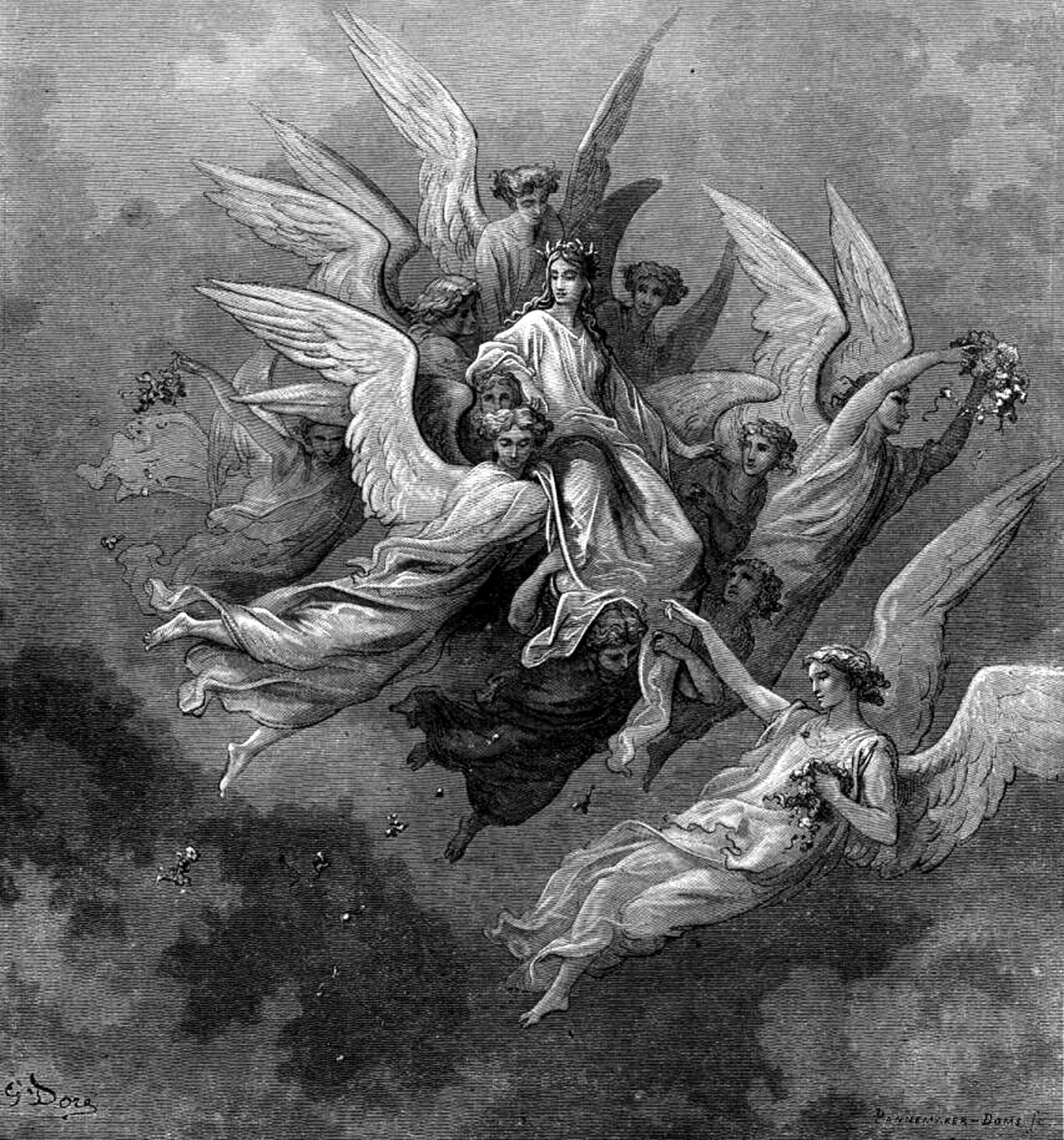
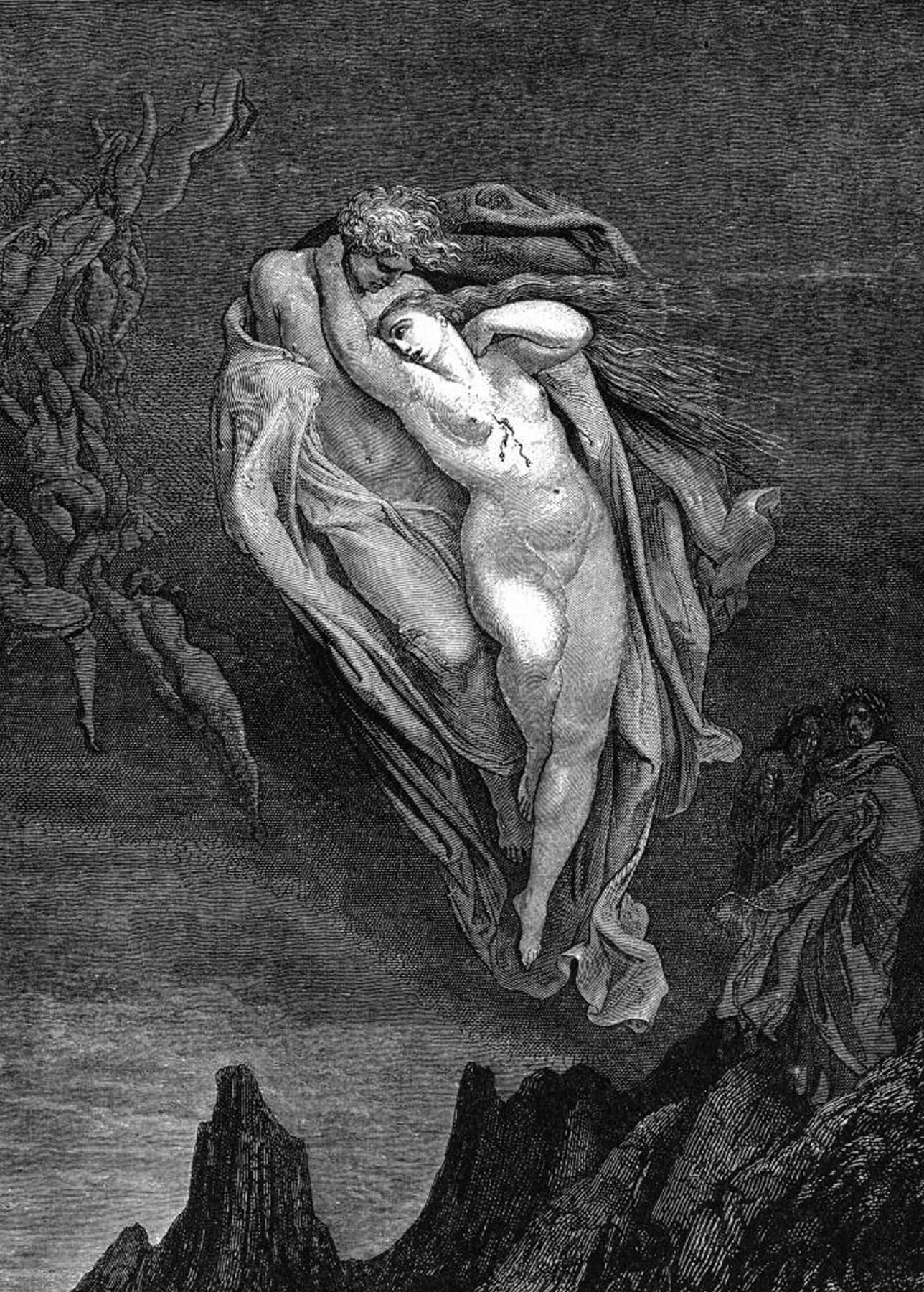
Dore – Purgatorio, Canto 30 – The Arrival of Beatrice
Not one drop of blood
is left inside my veins that does not throb:
I recognize signs of the ancient flame.
[Men che dramma
di sangue m’è rimaso, che non tremi;
conosco i segni de l’antica fiamma.]
Dante Alighieri (1265-1321) Italian poet The Divine Comedy [Divina Commedia], Book 2 “Purgatorio,” Canto 30, l. 46ff (3.46-68) (1314) [tr. Musa (1981)]
(Source)
Dante, on seeing his long-lost love, Beatrice, repeating to Virgil the lines he had given Dido (Aeneid, 4.23) about how she felt the stirring of long-dead passion upon seeing Aeneas: "Agnosco veteris vestigia flammae" ("I know the traces of the ancient flame" [tr. Kline (2002)]).
(Source (Italian)). Alternate translations:
There is no dram of blood,
That doth not quiver in me. The old flame
Throws out clear tokens of reviving fire.
[tr. Cary (1814)]
There is not one drop
Of blood within me trembling but became:
I know the tokens of the ancient fame.
[tr. Bannerman (1850)]
Not a drachm
Of blood remains in me, that does not tremble;
I know the traces of the ancient flame.
[tr. Longfellow (1867)]
Less than a dram of blood remains to me which trembles not; I recognise the signs of the ancient flame.
[tr. Butler (1885)]
Rests within my frame
No dram of blood that does not tremble now;
I know the symptoms of the olden flame.
[tr. Minchin (1885)]
Less than a drachm of blood remains in me that doth not tremble; I recognize the signals of the ancient flame.
[tr. Norton (1892)]
Less than a drachm of blood
is left in me that trembleth not; I recognise
the tokens of the ancient flame.
[tr. Okey (1901)]
Not a drop of blood is left in me that does not tremble; I know the marks of the ancient flame.
[tr. Sinclair (1939)]
Scarce one drop remains
Of blood in me that trembles not: by this
I recognize the old flame within my veins.
[tr. Binyon (1943)]
There is scarce a dram
That does not hammer and throb in all my blood;
I know the embers of the ancient flame.
[tr. Sayers (1955)]
There is not within me
one drop of blood unstirred. I recognize
the tokens of the ancient flame.
[tr. Ciardi (1961)]
Less than a drop of blood
Is left in me, that is not trembling:
I know the signs of the ancient flame.
[tr. Sisson (1981)]
I am left with less
than one drop of blood that does not tremble:
I recognize the signs of the old flame.
[tr. Mandelbaum (1982)]
There is a barely a drop of blood in me that does not tremble: I know the tokens of the ancient flame.
[tr. Kline (2002)]
Less than a dram of blood is left me that is not trembling: I recognize the signs of the ancient flame!
[tr. Durling (2003)]
There is not one gram
of blood in me that does not tremble now.
I recognize the signs of ancient flame.
[tr. Kirkpatrick (2007)]
Not a single drop of blood
remains in me that does not tremble --
I know the signs of the ancient flame.[tr. Hollander/Hollander (2007)]
There isn't a single drop of whatever blood Still flows in my veins that isn't shaking from fear: I recognize the signs of that ancient fire.
[tr. Raffel (2010)]
Oh, God, I know no joy as great as a moment of rushing into a new love, no ecstasy like that of a new love. I swim in the sky; I float; my body is full of flowers, flowers with fingers giving me acute, acute caresses, sparks, jewels, quivers of joy, dizziness, such dizziness. Music inside of one, drunkenness. Only closing the eyes and remembering, and the hunger, the hunger for more, more, the great hunger, the voracious hunger, and thirst.
Anaïs Nin (1903-1977) Catalan-Cuban-French author, diarist
Diary (1934-05)
(Source)
The fable of Tantalus has generally been regarded as symbolizing avarice. It’s at least equally applicable to ambition, love of fame, indeed to almost every passion.
[La fable de Tantale n’a presque jamais servi d’emblème qu’à l’avarice. Mais elle est, pour le moins, autant celui de l’ambition, de l’amour de la gloire, de presque toutes les passions.]
Nicolas Chamfort (1741-1794) French writer, epigrammist (b. Nicolas-Sébastien Roch) Products of Perfected Civilization [Produits de la Civilisation Perfectionée], Part 1 “Maxims and Thoughts [Maximes et Pensées],” ch. 1, ¶ 70 (1795) [tr. Parmée (2003), ¶ 58]
(Source)
The fable of Tantalus is hardly ever applied except to the passion of avarice; but it is at least as applicable to ambition, to the love of glory, and to nearly all the other passions.
[tr. Mathers (1926)]
The fable of Tantalus has been used almost exclusively as an emblem of avarice, but it is at least as applicable to ambition, the love of fame, and virtually all the passions.
[tr. Merwin (1969)]
The fable of Tantalus has almost never served as a precept except in the case of avarice. But it is, at all events, a precept attaching no wit less to ambition, to love of glory, to almost all passions.
[tr. Pearson (1973)]
The fable of Tantalus has nearly only ever served as an emblem of avarice. However, it is at least as much a symbol of ambition, of the love of glory, and of nearly every passion.
[tr. Siniscalchi (1994)]
The great calamity of the passions is not the torments they cause but the wrongs, the base actions that they lead one to commit, and which degrade men. Without these hindrances the advantages of the passions would far outweigh those of cold reason, which renders no one happy. The passions make a man live, wisdom merely makes him last.
[Le grand malheur des passions n’est pas dans les tourmens qu’elles causent, mais dans les fautes, dans les turpitudes qu’elles font commettre, et qui dégradent l’homme. Sans ces inconvéniens, elles auraient trop d’avantage sur la froide raison, qui ne rend point heureux. Les passions font vivre l’homme, la sagesse le fait seulement durer.]
Nicolas Chamfort (1741-1794) French writer, epigrammist (b. Nicolas-Sébastien Roch) Products of Perfected Civilization [Produits de la Civilisation Perfectionée], Part 1 “Maxims and Thoughts [Maximes et Pensées],” ch. 2, ¶ 118 (1795) [tr. Merwin (1969)]
(Source)
The great evil of the passions does not lie in the torments which they bring upon men, but in the faults and shameful actions they cause him to commit. Were it not for this drawback they would have too great an advantage over cold reason, which can never be productive of happiness. His passions make man live, his wisdom only makes him last.
[tr. Mathers (1926)]
The unfortunate thing about passions is not the misery they make one commit, and which degrade man. Without these disadvantages, they would overpower cold reason, which does not in the least a source of happiness. Passions make men live, wisdom only makes the endure.
[tr. Pearson (1973)]
The great disaster of passions is not the torment they cause, but the debasing errors and depravity into which they lead men. Without these drawbacks, passion would enjoy many advantages over cold reason, which never produces happiness. Passions enable men to live, wisdom merely enables them to survive.
[tr. Dusinberre (1992)]
The great misfortune of passions does not come from the torments that they cause, but from the base things they make a person do, and which degrade him. Without these inconveniences, they would have too many advantages over cold reason, which never makes people happy. Passions make a man live, wisdom and facts only make him endure.
[tr. Siniscalchi (1994)]
I turn away reluctant from your light,
And stand irresolute, a mind undone,
A silly, dazzled thing deprived of sight
From having looked too long upon the sun.
Edna St. Vincent Millay (1892-1950) American poet
“When I too long have looked upon your face,” ll. 5-8, Second April, Sonnet 7 (1921)
(Source)
Among the lessons taught by the French Revolution, there is none sadder or more striking than this — that you may make everything else out of the passions of men except a political system that will work, and that there is nothing so pitilessly and unconsciously cruel as sincerity formulated into dogma.
James Russell Lowell (1819-1891) American diplomat, essayist, poet
“Abraham Lincoln” (1864), My Study Windows (1871)
(Source)
Thus every Creature, and of every Kind, The secret Joys of sweet Coition find:
Not only Man’s Imperial Race; but they That wing the liquid Air; or swim the Sea,
Or haunt the Desert, rush into the flame: For Love is Lord of all; and is in all the same.
[Omne adeo genus in terris hominumque ferarumque,
Et genus aequoreum, pecudes, pictaeque volucres,
In furias ignemque ruunt. Amor omnibus idem.]
Virgil (70-19 BC) Roman poet [b. Publius Vergilius Maro; also Vergil] Georgics [Georgica], Book 3, l. 242ff (3.242-244) (29 BC) [tr. Dryden (1709), l. 375ff]
(Source)
All men on earth, and beasts, both wilde and tame, Sea-monsters, gaudy fowle, rush to this flame:
The same love works in all; with love ingag'd.
[tr. Ogilby (1649)]
Nor they alone: but beasts that haunt the woods, The painted birds, the people of the floods,
Cattle, and men, to frenzy and to flame Start wild: Love's empire is in all the same.
[tr. Nevile (1767), l. 289ff]
Thus all that wings the air and cleaves the flood, Herds that or graze the plain or haunt the wood,
Rush to like flames, when kindred passions move, And man and brute obey the power of love.
[tr. Sotheby (1800)]
Indeed every kind on earth, both of men and wild beasts, the fish, the cattle, and painted birds, rush into maddening fires; love is in all the same.
[tr. Davidson (1854)]
So then all kinds on earth of men and herds, The ocean tribes, the beasts, the painted birds,
Rush all alike to frenzy and to flame; Love rules them all, and love is still the same.
[tr. Blackmore (1871), l. 293ff]
Nay, every race on earth, whether of men or beasts, the watery tribes, the herds, the painted birds, rush headlong into this fiery phrenzy; love sways all alike.
[tr. Wilkins (1873)]
Nay, every race on earth of men, and beasts,
And ocean-folk, and flocks, and painted birds,
Rush to the raging fire: love sways them all.
[tr. Rhoades (1881)]
Thus all alike the slaves of love remain, That haunt the woodland, or that graze the plain.
[tr. King (1882)]
In truth, every kind on the earth, both of men and wild beasts, the fish, the cattle, and plumaged birds, rush to the frenzy and the fire of love: in all there is the same love.
[tr. Bryce (1897)]
Yes all on earth, the race of man and beast, the tribes of the sea, cattle and coloured birds break into fury and fire; in all love is the same.
[tr. Mackail (1899)]
Yea, all -- all tribes of earth, all men, all cattle-herds, Wild beasts of the forest, the brood of the sea, plume-painted birds,
Into flames of passion rush' all hearts are in one net taken.
[tr. Way (1912)]
For all terrestrial kinds, or beast or man,
All Ocean's brood and flocks of bright-hued birds
Haste to the same fierce fire. One power of love
Possesses all.
[tr. Williams (1915)]
Every single race on earth, man and beast, the tribes of the sea, cattle and birds brilliant of hue, rush into fires of passion: all feel the same Love.
[tr. Fairclough (Loeb) (1916)]
All manner of life on earth -- men, fauna of land and sea,
Cattle and coloured birds --
Run to this fiery madness: love is alike for all.
[tr. Day-Lewis (1940)]
Thus, every living creature, man and beast,
The ocean’s tribes, the herds, the colorful birds,
Rush toward the furious flames: love levels all.
[tr. Bovie (1956)]
Or, better, make it fire, the tongues of flame
burning like waves in a sunset, while all of life,
birds, fish, beasts of the fields, and men,
maddened, leap like lemmings into the sea,
that searing sea, that terrible tide of lust
to be like -- to become -- each, the fabulolus phoenix,
and rise renewed.
[tr. Slavitt (1971)]
Indeed all species in the world, of men,
Wild beasts and fish, cattle and coloured birds
Rush madly into the furnace: love is common
To all.
[tr. Wilkinson (1982)]
Every species on earth, man and creature, and the species
of the sea, and cattle and bright-feathered birds,
rush about in fire and frenzy: love’s the same for all.
[tr. Kline (2001)]
Every last species on earth, man and beast alike,
the vast schools of the sea, the cattle and bright-colored birds
fall helpless into passion’s fire: love is the same for all.
[tr. Lembke (2004)]
Indeed, all species on the earth, both man and beast,
the kingdom undersea, cattle and painted birds
into this hot lunacy rush: love strikes all the same.
[tr. Johnson (2009)]
All living creatures on earth, no matter whether
It's human beings or other kinds -- fish, cattle,
Beautiful birds -- they all rush into the fire:
Love is the same for all.
[tr. Ferry (2015)]
All passions exaggerate; it is only because they exaggerate that they are passions.
[Toutes les passions sont exagératrices, et elles ne sont des passions que parce qu’elles exagèrent.]
Nicolas Chamfort (1741-1794) French writer, epigrammist (b. Nicolas-Sébastien Roch) Products of Perfected Civilization [Produits de la Civilisation Perfectionée], Part 1 “Maxims and Thoughts [Maximes et Pensées],” ch. 1, ¶ 72 (1795) [tr. Mathers (1926)]
(Source)
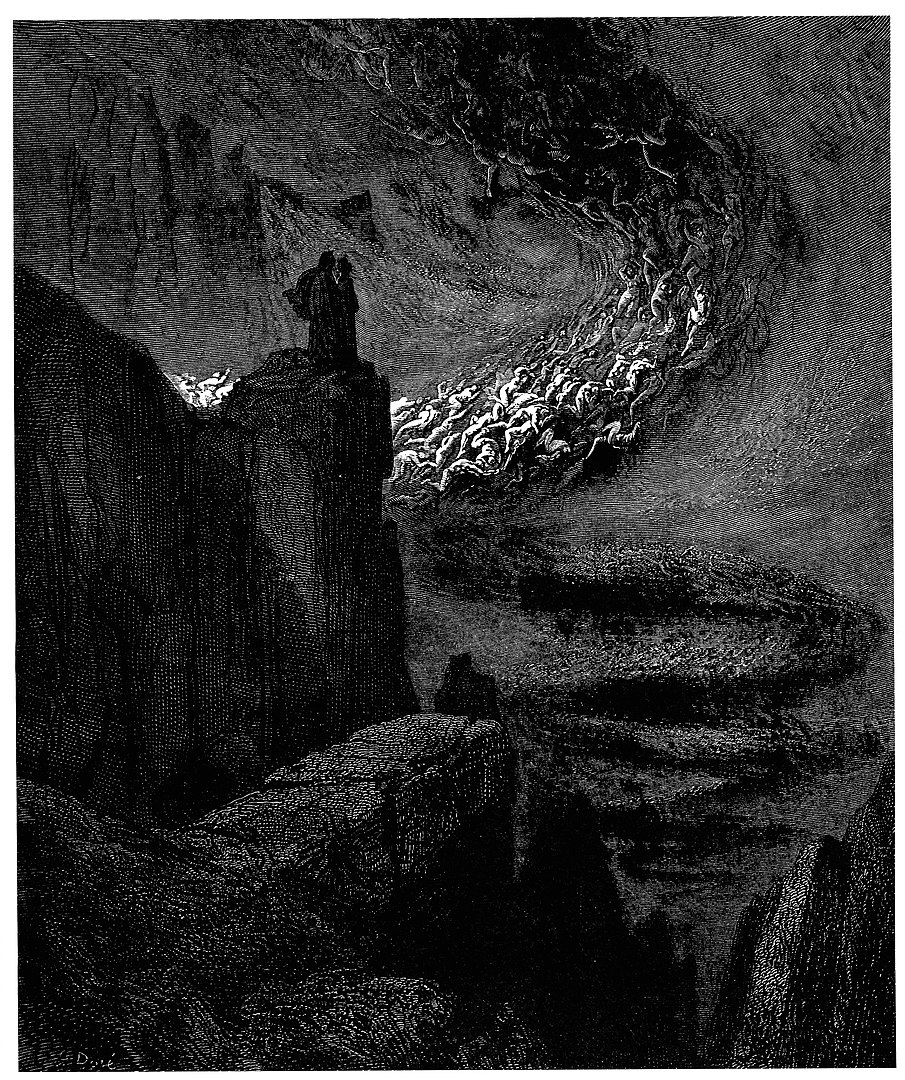
Blind greed! Brainless rage!
In our brief lives they drive us beyond sense And leave us misery for a heritage Throughout eternity!
[Oh cieca cupidigia e ira folle, che sì ci sproni ne la vita corta, e ne l’etterna poi sì mal c’immolle!]
Dante Alighieri (1265-1321) Italian poet The Divine Comedy [Divina Commedia], Book 1 “Inferno,” Canto 12, l. 49ff (12.49-51) (1309) [tr. James (2013)]
(Source)
On seeing Phlegethon, the river of boiling blood, in which those who violently injured others (through greed or wrath) are forced to stand for all eternity.
Some versions have this as something Virgil says; most make it an exclamation of Dante's.
O foolish Rage, O blind desire,
That spurs you on, in the short life above,
To such dire Acts as to eternity
Will keep you in this wretched bath below!
[tr. Rogers (1782), l. 45ff]
O blind lust!
O foolish wrath! who so dost goad us on In the brief life, and in the eternal then Thus miserably o’erwhelm us.
[tr. Cary (1814)]
Oh blinded lust! oh anger void of sense! To spur us o'er the shorter life so bold, So fell to steep us in the life immense!
[tr. Dayman (1843)]
Oh blind cupidity [both wicked and foolish], which so incites us in the short life, and then, in the eternal, steeps us so bitterly!
[tr. Carlyle (1849)]
O blind cupidity! O foolish wrath! Thorough this short life, that spurs them to the sleep, Eternally in tide like this to steep.
[tr. Bannerman (1850), from Virgil]
Oh, blinded greediness! oh, foolish rage! Which spur us so in the short world of life, And then in death so drown us in despair!
[tr. Johnston (1867)]
O blind cupidity, O wrath insane, That spurs us onward so in our short life,
And in the eternal then so badly steeps us!
[tr. Longfellow (1867)]
O blind covetousness! O foolish wrath! that dost so spur us in our short life, and afterward in the life eternal dost in such evil wise steep us!
[tr. Butler (1885)]
O blind cupidity, O foolish ire, Which spurs us on so in our life's short day, And soaks us till Eternity expire!
[tr. Minchin (1885)]
Oh blind cupidity, both guilty and mad, that so spurs us in the brief life, and then, in the eternal, steeps us so ill!
[tr. Norton (1892)]
O sightless greed! O foolish wrath! that dost in our short life, so goad us; and after, in the life that hath no end, dost sink us in such evil plight.
[tr. Sullivan (1893), from Virgil]
Oh, blind cupidity! Oh, senseless anger, Which in the brief life spurs us on so hotly. And in the eternal then so sadly dips us !
[tr. Griffith (1908)]
O blind covetousness and foolish anger, which in the brief life so goad us on and then, in the eternal, steep us in such misery!
[tr. Sinclair (1939)]
O blind greed and mad anger, all astray That in the short life goad us onward so, And in the eternal with such plungings pay!
[tr. Binyon (1943)]
O blind, O rash and wicked lust of spoil, That drives our short life with so keen a goad And steeps our life eternal in such broil!
[tr. Sayers (1949)]
Oh blind!
Oh ignorant, self-seeking cupidity which spurs us so in the short mortal life and steeps us so through all eternity!
[tr. Ciardi (1954)]
O blind cupidity and mad rage, which in the brief life so goad us on, and then, in the eternal, steep us so bitterly!
[tr. Singleton (1970)]
O blind cupidity and insane wrath, spurring us on through our short life on earth to steep us then forever in such misery!
[tr. Musa (1971)]
O blind cupidity and insane anger, which goad us on so much in our short life, then steep us in such grief eternally!
[tr. Mandelbaum (1980)]
O blind cupidity and senseless anger, Which so goads us in our short life here And, in the eternal life, drenches us miserably!
[tr. Sisson (1981)]
O blind desire
Of covetousness, O anger gone insane -- That goad us on through life, which is so brief, to steep in eternal woe when life is done.
[tr. Pinsky (1994)]
Oh blind cupidity and mad rage, that so spur us in this short life, and then in the eternal one cook us so evilly!
[tr. Durling (1996)]
O blind desires, evil and foolish, which so goad us in our brief life, and then, in the eternal one, ruin us so bitterly!
[tr. Kline (2002)]
O blind cupidity, that brew of bile and foolishness, which bubbles our brief lives, before it steeps us in eternal gall!
[tr. Carson (2002)]
What blind cupidity, what crazy rage impels us onwards in our little lives -- then dunks us in this stew to all eternity!
[tr. Kirkpatrick (2006)]
O blind covetousness, insensate wrath, which in this brief life goad us on and then, in the eternal, steep us in such misery!
[tr. Hollander/Hollander (2007)]
O greedy blindness and rage, insane and senseless, Spurring us on in this, our so short life, Then immolating us forever and ever!
[tr. Raffel (2010)]
We come now to the third ground for abusing old age, and that is, that it is devoid of sensual pleasures. O glorious boon of age, if it does indeed free us from youth’s most vicious fault! Now listen, most noble young men, to what that remarkably great and distinguished man, Archytas of Tarentum, said in an ancient speech repeated to me when I was a young man serving with Quintus Maximus at Tarentum: “No more deadly curse,” said he, “has been given by nature to man than carnal pleasure, through eagerness for which the passions are driven recklessly and uncontrollably to its gratification. From it come treason and the overthrow of states; and from it spring secret and corrupt conferences with public foes. In short, there is no criminal purpose and no evil deed which the lust for pleasure will not drive men to undertake. Indeed, rape, adultery, and every like offence are set in motion by the enticements of pleasure and by nothing else; and since nature — or some god, perhaps — has given to man nothing more excellent than his intellect, therefore this divine gift has no deadlier foe than pleasure; for where lust holds despotic sway self-control has no place, and in pleasure’s realm there is not a single spot where virtue can put her foot.”
[Sequitur tertia vituperatio senectutis, quod eam carere dicunt voluptatibus. O praeclarum munus aetatis, si quidem id aufert a nobis, quod est in adulescentia vitiosissimum! Accipite enim, optimi adulescentes, veterem orationem Archytae Tarentini, magni in primis et praeclari viri, quae mihi tradita est cum essem adulescens Tarenti cum Q. Maximo. Nullam capitaliorem pestem quam voluptatem corporis hominibus dicebat a natura datam, cuius voluptatis avidae libidines temere et effrenate ad potiendum incitarentur. Hinc patriae proditiones, hinc rerum publicarum eversiones, hinc cum hostibus clandestina colloquia nasci; nullum denique scelus, nullum malum facinus esse, ad quod suscipiendum non libido voluptatis impelleret; stupra vero et adulteria et omne tale flagitium nullis excitari aliis illecebris nisi voluptatis; cumque homini sive natura sive quis deus nihil mente praestabilius dedisset, huic divino muneri ac dono nihil tam esse inimicum quam voluptatem. Nec enim lubidine dominante temperantiae locum esse, neque omnino in voluptatis regno virtutem posse consistere.]
Marcus Tullius Cicero (106-43 BC) Roman orator, statesman, philosopher De Senectute [Cato Maior; On Old Age], ch. 12 / sec. 39ff (12.39-41) (44 BC) [tr. Falconer (1923)]
(Source)
Nowe folowith the iij vituperacion & defaute by the which yong men seyne that olde age is noiouse myschaunte & wretchid by cause it hath almost no flesshely delectacyons or sensualitees as for to gete with childeren and yssue to encrece and multiplie the world. To whom I answere forwith that it is right a noble gyfte rewarde & the right grete worship of olde age that it be sequestred depryved and dischargid of the delectacyons of sensualitee of the body or flesshely lustis for ys it be so that olde age be pryved and sequestred of such delectacyons It had takin awey from us olde men that thyng whiche is right vicious & right foule in the age of adolescence & yongthe. And neverthelesshe my right good and lovyng yong men Scipion and Lelius an auncyent senatour purposid an oracion that a philosopher callid Archites made whiche was takyn of Haniballe duc of Cartage when he werrid in Ytaile. He was recoverde by Quintus Fabius the noble senatour when he recoverd Tarente, takyn by the said Haniballe. Archites was pryncypally a grete man connyngly lernyd in sciences and in vertues and was right famous and noble. This oracion purposid which Archites made was yeven to me when I adolescent and yong of age was at Tarente with the seid Fabius, and by this oracyon seid Archites that nature which ordeyned to men complexions gave nevir no pestelence peyne nor turment more damageable to yong men than is flesshely delectacyon. The coveitous playsirs of delectacyon moven tyce and steeren men over boldely and withoute bridell of reason or shame or any restraynt to execute and make an ende of their foule lustys. For thought delectacy∣ons ben made and conspired treasons divisions and dissencyons of countrees & the destruccions of their comon profite, and the secretes of parlementys disclosed to our ennemyes and adversarye partye there is noon untrou∣the there is noon evyll werke but pleasyre of delectacyon which shall constrayne men to encline therto, by cause that they enioyen owt of mesure of spousehode brekyng & that so fervently the cause of defoulyng of maydens virgins the anontry of weddyd women & all such corrupte untrew werkys, whiche ben nevir mevid nor undirtakyn but by the insolence & wantownes & wenlacys of flesshely delectacyon. Archites also saide that as nature by power of which god hath yeven to men noth̄yng bettir than is the soule by the which they have undirstondyng & mynde, also to that soule which is an office & a gift dyvine nothyng is so grete ennemye nor so contrary as ben flesshely delectacyons, for sith delectacyon & flesshely pleasir have dominacyon in the regyon of man. That is to witt in the courage of his body, the vertue of attemperance may not be lodgid therin & wthin the regyon of man which is yeven to delectacyon may not abyde any wisedome nor vertue.
[tr. Worcester/Worcester/Scrope (1481)]
Now followeth the third dispraise and fault which is laid in old age, because (say they) it is without pleasure, and must forego voluptuous appetites. O noble and excellent gift, wherewith old age is so blessed, if it take from us that thing, which is in youth most vicious and detestable. But you (noble and virtuous gentlemen, Scipio and Laelius) hear what Archytas, the famous philosopher of Tarentum, was wont to say, whose oration touching on the same matter was lent and delivered to me, when I was a young man and served under Quintus Maximus at the siege of Tarentum. He said that no plague was given by nature so great and pernicious unto men, as the bestial pleasures and voluptuousness of the body: which which pleasures the dissolute and libidinous lusts of men do so much affect and desire, that with all licentious profanation and outrage, their minds be incited and stirred to pursue the same, thinking all things lawful for their unbridled appetites, so that they may enjoy their beastly desires and still wallow in the filthy puddle of their hellish sensuality. Hence (said he_ as from a fountain do spring out all kinds of mischief, as treason, betraying of countries, the ruin and subversion of commonwealths, secret conventicles, and privy conferences with the enemies; finally (he said), there was none so great a villainy, nor any so flagitious and horrible an enormity, which the inordinate desire of pleasure would not egg and prick forward men's froward wills to enterprise: furthermore, that whoredom, adultery, and all such like heinous facts of carnal concupiscency were by none other lures or enticements provoked but by pleasure. And whereas either nature or God hath given unto man nothing of so noble excellency as the mind or reasonable soul, there is nothing so great an enemy until this inestimable and divine gift as pleasure. For where pleasure beareth away and ruleth the roast, there is no mansion or dwelling-place left for temperance and sobriety, and, to be short, virtue cannot remain where pleasure reigneth.
[tr. Newton (1569)]
There followeth the third Objection to age; they say that it wanteth pleasures. Oh excellent gift of age, if it take away that which makes our youth vitious; therefore hear now, O yee excellent young men, the old oration of Architas the Tarentine, a singular and worthy man, which was delivered me when I was a young man with Q. Maximus at Tarentum. He said that there was no deadlier plague given by nature to men, then the pleasure of the body, the greedy lusts whereof are rash and unbrideledly, stirred up to get and gain. From hence are derived treasons, from hence arise the overthrowes of Commonwealths, and the privy conspiracies and whisperings with the enemies. That to conclude, there was no wickednesse, nor no evill deed, to the undertaking of which, the lust of pleasure did not incite a man; and that whoredome, adultery, and all such evill was stirred up by no other bait then pleasure. And forasmuch as nature, or some God, hath given nothing more excellent to a man, then his minde; to this divine gift, there is no greater enemy then pleasure. For lust bearing rule, there is no place for temperance, neither in the Kingdome of pleasure can virtue consist.
[tr. Austin (1648)]
Now must I draw my forces 'gainst that Host
Of Pleasures, which i'th' Sea of age are lost.
Oh, thou most high transcendent gift of age!
Youth from its folly thus to disengage.
And now receive from me that most divine
Oration of that noble Tarentine,
Which at Tarentum I long since did hear;
When I attended the great Fabius there.
Yee Gods, was it man's Nature? or his Fate?
Betray'd him with sweet pleasures poyson'd bait?
Which he, with all designs of art, or power,
Doth with unbridled appetite devour;
And as all poysons seek the noblest part,
Pleasure possesses first the head and heart;
Intoxicating both, by them, she finds,
And burns the Sacred Temples of our Minds.
Furies, which Reasons divine chains had bound,
(That being broken) all the World confound.
Lust, Murder, Treason, Avarice, and Hell
It self broke loose; in Reason's Pallace dwell,
Truth, Honour, Justice, Temperance, are fled,
All her attendants into darkness led.
But why all this discourse? when pleasure's rage
Hath conquer'd reason, we must treat with age.
Age undermines, and will in time surprize
Her strongest Forts, and cut off all supplies.
And joyn'd in league with strong necessity,
Pleasure must flie, or else by famine die.v
[tr. Denham (1669)]
The third Accusation against Old Age is, that it deprives us of the Enjoyments of Pleasure.O glorious Priviledge of Age, if through thy means we can get rid of the most pernicious Bane, to which our You is liable! Give me leave to repeat to you, what a great Orator has said upon this Subject. "Nature has not implanted in Man any more execrable Curse, than that of bodily Pleasures; to the gratification of which we are hurried on, wich such unbounded and licentious Appetites. For to what else is oweing the Subversion of so many States and Kingdoms? What Villainy too daring, what Undertaking too hazardous, which the Desire of satisfying our unbounded Lusts will not instigate us to attempt? To what are Rapes, Adulteries, or such like abominable Enormities owing, but to the gratification of our Appetites? And since the Faculties of Reason, and Judgment, are the most excellent Qualities, which Nature, or Providence, has conferred upon us; it is certain that nothing can be more destructive, more pernicious to this divine Gift, than the Indulging bodily Pleasures? For it is impossible to observe an Degrees of Temperance, while we are under the Dominion of our unruly Passions, nor can Virtue consiste with the pursuit of such Enjoyments."
[tr. Hemming (1716)]
We come now to the Third Objection, which is, That Old Age is deprived of Pleasure. O excellent State! if it deprives us of what is most vitious in You! For, hear ye well-disposed young Men, the old Remark of Architas the Tarentine, a most ingenious Man, which was given to me when I was a young Fellow at Tarentum, with Q. Maximus. He said, "That Nature had not given Mankind a greater Plague than the Pleasure of the body, whose eager Desires for the Enjoyment of it, are altogether loose and unbridled: That from hence arise Conspiracies against our Country, Subversions of the Commonwealth, and treasonable Conferences with the Enemy. In short, that there was no Wickedness nor Capital Crime, but this Lust after Pleasure would put a man upon undertaking; that Whoredom, Adultery, and all such Vices, were excited by no other Allurements than those of Pleasure. That as Nature, or some God, had given to Man nothing more valuable than his Mind, so to that Gift was joined nothing so much its Enemy as Pleasure; for when Lust is predominant, there is no Room for Temperance; nor can Virtue possibly consist in Pleasure's Throne."
[tr. J. D. (1744)]
The third Charge against Old-Age was, That it is (they say) insensible to Pleasure, and the Enjoyments arising from the Gratifications of the Senses. And a most blessed and heavenly Effect it truly is, if it eases of what in Youth was the sorest and cruellest Plague of Life. Pray listen, my good Friends, to an old Discourse of Archytas the Tarentine, a great and excellent Man in his Time, which I learned when I was but young myself, at Tarentum, under Fabius Maximus, at the Time he recovered that Place. The greatest Curse, the heaviest Plague, said he, derived on Man from Nature, is bodily Pleasure, when the Passions are indulged, and strong inordinate Desires are raised and set in Motion for obtaining it. For this have Men betray'd their Country; for this have States and Governments been plunged in Ruin; for this have treacherous Correspondences been held with publick Enemies: In short, there is no Mischief so horrid, no Villany so execrable, that this will not prompt to perpetrate. And as Adultery, and all the Crimes of that Tribe, are the natural Effects of it; so of course are all the fatal Consequences that ensue on them. 'Tis owned, that the most noble and excellent Gift of Heaven to Man, is his Reason: And 'tis as sure, that of all the Enemies Reason has to engage with, Pleasure is the most capital, and the most pernicious: For where its great Incentive, Lust, prevails, Temperance can have no Place; nor under the Dominion of Pleasure, can Virtue possibly subsist.
[tr. Logan (1750)]
Let us now proceed to examine the third article of complaint against old age, as "bereaving us," it seems, "of the sensual gratifications." Happy effect indeed, if it deliver us from those snares which allure youth into some of the worst vices to which that age is addicted. Suffer me upon this occasion, my excellent young friends, to acquaint vou with the substance of a discourse which was held many years since by that illustrious philosopher Archytas, of Tarentum, as it was related to me when I was a young man in the army of Quintus Maximus, at the siege of that city. "Nature," said this illustrious sage, "has not conferred on mankind a more dangerous present than those pleasures which attend the sensual indulgences; as the passions they excite are too apt to run away with reason, in a lawless and unbridled pursuit of their respective enjoyments. It is in order to gratify inclinations of this ensnaring kind that men are tempted to hold clandestine correspondence with the enemies of the state, to subvert governments, and turn traitors to their country. In short, there is no sort of crimes that afiect the public welfare to which an inordinate love of the sensual pleasures may not directly lead. And as to vices of a more private tendency -- rapes, adulteries and every other flagitious violation of the moral duties -- are they not perpetrated solely from this single motive? Reason, on the other hand," continued Archytas," is the noblest gift which God, or nature, has bestowed on the sons of men. Now nothing is so great an enemy to that divine endowment, as the pleasures of sense. For neither temperance, nor any other of the more exalted virtues, can find a place in that breast which is under the dominion of the voluptuous passions."
[tr. Melmoth (1773)]
The third charge against old age comes next, namely, that they say that it is without pleasures. O glorious privilege of old age, if indeed it takes away from us that which in youth is most faulty! For listen, excellent young men, to an ancient discourse of Archytas of Tarentum, a singularly great and renowned man, which was delivered to me when I was a young man with Quintus Maximus: He said, that no deadlier plague than the pleasure of the body was given to men by Nature; of which pleasure the passions being excessively fond, impelled men to enjoy them rashly and precipitously. That hence rose betrayals of country, hence subversions of states, hence clandestine correspondence with enemies. In a word, that there is no atrocity, no wicked deed, to the undertaking of which the lust of pleasure did not incite; and that seductions and adulteries, and every such crime, are called into existence by no other allurements but pleasure; and whereas, whether Nature or some deity had given nothing to man more excellent than the understanding, nothing was more hostile to this divine gift and endowment than pleasure. For neither, when lust bore sway, was there room for temperance, nor could virtue hold any place at all in the reign of pleasure.
[Cornish Bros. ed. (1847)]
Then follows the third topic of blame against old age, that they say it has no pleasures. Oh, noble privilege of age! if indeed it takes from us that which is in youth the greatest defect. For listen, most excellent young men, to the ancient speech of Archytas of Tarentum, a man eminently great and illustrious, which was reported to me when I, a young man, was at Tarentum with Quintus Maximus. He said that no more deadly plague than the pleasure of the body was inflicted on men by nature; for the passions, greedy of that pleasure, were in a rash and unbridled manner incited to possess it; that hence arose treasons against one's country, hence the ruining of states, hence clandestine conferences with enemies: in short, that there was no crime, no wicked act, to the undertaking of which the lust of pleasure did not impel; but that fornications and adulteries and every such crime, were provoked by no other allurements than those of pleasure. And whereas either nature or some god had given to man nothing more excellent than his mind; that to this divine function and gift, nothing was so hostile as pleasure: since where lust bore sway, there was no room for self-restraint; and in the realm of pleasure, virtue could by no possibility exist.
[tr. Edmonds (1874)]
I come now to the third charge against old age, that, as it is alleged, it lacks the pleasures of sense. O admirable service of old age, if indeed it takes from us what in youth is more harmful than all things else! For I would have you hear, young men, an ancient discourse of Archytas of Tarentum, a man of great distinction and celebrity, as it was repeated to me when in my youth I was at Tarentum with Quintus Maximus. "Man has received from nature," said he, "no more fatal scourge than bodily pleasure, by which the passions in their eagerness for gratification are made reckless and are released from all restraint. Hence spring treasons against one's country; hence, overthrows of states; hence, clandestine plottings with enemies. In fine, there is no form of guilt, no atrocity of evil, to the accomplishment of which men are not driven by lust for pleasure. Debaucheries, adulteries, and all enormities of that kind have no other inducing cause than the allurements of pleasure. Still more, while neither Nature nor any god has bestowed upon man aught more noble than mind, nothing is so hostile as pleasure to this divine endowment and gift. Nor while lust bears sway can self-restraint find place, nor under the reign of pleasure can virtue have any foothold whatever."
[tr. Peabody (1884)]
The third charge against old age is that it LACKS SENSUAL PLEASURES. What a splendid service does old age render, if it takes from us the greatest blot of youth! Listen, my dear young friends, to a speech of Archytas of Tarentum, among the greatest and most illustrious of men, which was put into my hands when as a young man I was at Tarentum with Q. Maximus. "No more deadly curse than sensual pleasure has been inflicted on mankind by nature, to gratify which our wanton appetites are roused beyond all prudence or restraint. Fornications and adulteries, and every abomination of that kind, are brought about by the enticements of pleasure and by them alone. Intellect is the best gift of nature or God: to this divine gift and endowment there is nothing so inimical as pleasure. For when appetite is our master, there is no place for self-control; nor where pleasure reigns supreme can virtue hold its ground."
[tr. Shuckburgh (1895)]
Thirdly, it is alleged against old age,
It has no sensual pleasures to enjoy.
Divinest gift of age, to take away sensual pleasures.
What is the greatest blot on youthful years!
Hear, my dear friends, a speech Archytas made
(Who was a very old and famous man),
And told me at Tarentum, where I was
With Quintus Maximus, when quite a youth:
'No greater curse than sensuality
Has Nature given to man: its foul desires
To feed, lust grows unbridled and unwise;
Hence countries are betrayed, states overthrown,
Secret arrangements with our foes are made.
There is no crime, no ill deed to which lust
Cannot entice : abominable vice
Of every kind is due to this alone.
Nature herself, or some kind deity
Has given to man no greater gift than mind:
But to this gift, this faculty divine,
No greater enemy can be than lust.
When that bears sway, all moderation's gone,
And 'neath its rule virtue cannot survive.
[tr. Allison (1916)]
Next we come to the third allegation against old age. This was its deficiency in sensual pleasures. But if age really frees us from youth's most dangerous failing, then we are receiving a most blessed gift. Let me tell you, my dear friends, what was said years ago by that outstandingly distinguished thinker, Archytas of Tarentum, the city at which I heard of his words when I was a young soldier serving under Fabius. "The most fatal curse given by nature to mankind," said Archytas, "is sensual greed: this incites men to gratify their lusts heedlessly and uncontrollably, thus bringing about national betrayals, revolutions, and secret negotiations with the enemy. Lust will drive men to every sin and crime under the sun. Mere lust, without any additiona impulse, is the cause of rape, adultery, and every other sexual outrage. Nature, or a god, has given human beings a mind as their outstanding possession, and this divine gift and endowment has no worse foe than sensuality. For in the realm of the physical passions there can be no room for self-control; where self-indulgence reigns, decent behavior is excluded.
[tr. Grant (1960, 1971 ed.)]
I turn now to the third charge against old age -- one commonly leveled with vehemence: men say that it is cut off from pleasures. What a glorious blessing the years confer if they take away from us the greatest weakness that afflicts our younger days! Let me repeat to you, my dear young friends, what Archytas of Tarentum said many, many years ago. (He was one of the truly great -- a distinguished man -- and his discourse was reported to me when as a young man I visited Tarentum in the company of Quintus Maximus.) Archytas declared that nature had afflicted man with no plague more deadly than physical pleasure, since the hope of pleasure roused men’s desires to fever-pitch and spurred them on, like wild, unbridled beasts, to attainment. Pleasure, he said, was the ultimate source of treason, of riot and rebellion, of clandestine negotiations with an enemy; to sum it up, there was no crime, no foul perversion, which men were not led to commit by the desire for pleasure. As for crimes of passion, adultery, and the like, he declared that pleasure and its blandishments were the sole cause of them "Here is man," said he. "Nature, or if you will, God, has given him nothing more precious and distinctive than his mind, yet nothing is so hostile to this blessing -- this godlike power -- as pleasure." Further, he asserted that when the appetites had the upper hand there was no room left for self-discipline -- in fact, to put it generally, virtue could find no foothold anywhere in the kingdom of pleasure.
[tr. Copley (1967)]
Now I come to the third reason why old age is so strenuously condemned: that when we are old we can’t enjoy sensual pleasures. On the contrary, what a gift it is that age takes away from us the most objectionable vices of the young! When I was a young man in the army, someone quoted to me from a speech -- and it is well worth listening to it today -- that was delivered long ago by a distinguished philosopher, Archytas of Tarentum. “Nature,” he said, “has never visited on man a more virulent pestilence than sex. There is nothing we will not do, however rash and ill-considered, in order to satisfy our desires. Sex has impelled men to treason, to revolution, to collusion with the enemy. Under the influence of sex, there is no criminal enterprise they will not undertake, no sin they will not commit. Infidelity, of course, and then any kind of depraved perversion you can think of -- all are driven by the search for sexual pleasure. Nature -- or perhaps some god -- has given us nothing more valuable than the power to reason; but there is nothing more inimical to reason than sex. Lust will always overcome self-control; there is no moral value that can stand up to the attacks of unbridled desire.”
[tr. Cobbold (2012)]
THEY SAY OLD AGE DEPRIVES US OF ALMOST ALL OF THE PLEASURES. Oh, this is a wonderful gift of old age, if it does indeed relieve us of most of the reasons youth gets itself into trouble. Remember, you young folks, the famous warning from Dr. Johnson, the especially great and famous eighteenth century savant. I came to admire him when I was a young man at Oxford. He said that the body is all vice. The body's avid desire for the pleasures makes it seek them rashly and without control until it finds gratification. Oh the trouble! These things often create traitors of their countries: they ruin governments and cause secret dealings with enemies. The desire for bodily pleasure drives people to commit debauchery, adultery, and crimes of all sorts. Since nature's (or God's) greatest gift to mankind is our reason, nothing is so harmful to God's gift than the desire for pleasure because it makes us act so irrationally. By golly, when we are in hot pursuit of pleasure, there is no place for modration or good sense. If the pleasure is too great and lasts too long, it will blot out any trace of rational thinking.
[tr. Gerberding (2014)]
Again old age is given a third censure.
It is devoid, they say, of sensual pleasure,
But that’s also a wonderful gift without price
Taking from us youth’s most wicked vice!
Listen, my good lads, to the time-honoured advice
Of Archytas from Tarentum, great and blessed,
Who in my young days his thoughts expressed,
While I was in Tarentum with Q. Maximus:
No evildoing can be worse than the voluptuous
Pleasure of the senses was his complaint
Which makes men blind and act with no restraint.
From it descend treason, revolution and
Pacts with the enemies of the Fatherland.
All evil actions and crimes combined
Have an urge for lust not far behind,
And then adultery and lewdness
Are set on fire by voluptuousness.
There must have been some god who gave mankind,
Or maybe it wasn’t a god but nature,
The divine privilege of the mind
Which is the enemy of pleasure.
Indeed under the rule of passion
Temperance has no place at all,
And virtue can be kept in thrall
By sensuality’s enticing coils.
[tr. Bozzi (2015)]
We come now to the third objection to growing older -- that the pleasures of the flesh fade away. But if this is true, I say it is indeed a glorious gift that age frees us from youth's most destructive failing. Now listen, my most noble young friends, to the ancient words of that excellent and most distinguished young man, Archytas of Tarentum, repeated to me when I was serving as a young soldier in that very city with Quintus Maximus. He said the most fatal curse given to men by nature is sexual desire. From it spring passions of uncontrollable and reckless lust seeking gratification. From it come secret plotting with enemies, betrayals of one's country, and teh voer throw of governments. Indeed, there is no evil act, no unscrupulous deed that a man driven by lust will not perform. Uncontrolled sensuality will drive men to rape, adultery, and every other sexual outrage. And since nature -- or perhaps some god -- has given men no finer gift than human intelligence, this divine endowment has no greater foe than naked sensuality. Where lust rules, there is no place for self-control. And in the kingdom of self-indulgence, there is no room for decent behavior.
[tr. Freeman (2016)]
The third typical criticism of old age follows this, and that is that people complain that it lacks [sexual] pleasures. Oh! Glorious wealth of age, if it takes that from us, the most criminal part of youth! Take this from me, most noble young men, this is the ancient speech of Archytas of Tarentum, which was repeated to me when I was a young man working for Quintus Maximus there: “Nature has given man no deadlier a curse than sexual desire.”
[tr. @sentantiq (2019)]
Not sweet son, nor revered old father, nor The long-due love which was to have made glad Penelope for all the pain she bore,
Could conquer the inward hunger that I had To master earth’s experience, and to attain Knowledge of man’s mind, both the good and bad.
[Né dolcezza di figlio, né la pieta del vecchio padre, né ‘l debito amore lo qual dovea Penelopé far lieta,
vincer potero dentro a me l’ardore ch’i’ ebbi a divenir del mondo esperto, e de li vizi umani e del valore.]
Dante Alighieri (1265-1321) Italian poet The Divine Comedy [Divina Commedia], Book 1 “Inferno,” Canto 26, l. 94ff (26.94-99) [Ulysses] (1309) [tr. Binyon (1943)]
(Source)
Ulysses, explaining why he chose to continue exploring over filial piety, leading to his eventual death.
Not the sweet fondness for a Son, nor yet
The pious duty for an ancient Sire,
Nor all the love I ow'd Penelope,
That ardor could subdue which me possest,
In distant climes experience to learn,
And human Vices as well as Virtues know.
[tr. Rogers (1782), l. 90ff]
Yet, after all my toils, nor aged sire,
Nor son, nor spouse, could check the wild desire Again to tempt the feat, with vent'rous oar.
In search of same I measur'd various climes,
Still vers'd in deeper frauds and nameless crimes, With slender band, and solitary sail.
[tr. Boyd (1802), st. 16-17]
Nor fondness for my son, nor reverence Of my old father, nor return of love, That should have crown’d Penelope with joy,
Could overcome in me the zeal I had T’ explore the world, and search the ways of life, Man’s evil and his virtue.
[tr. Cary (1814)]
That name; nor sweet remembrance of my boy, Nor old Laertes' grief, nor debt of love, Which owed Penelope the arrear of joy,
Could quench my burning zeal, that inly strove, And bade the wisdom of the world explore. And human vices, human worth to prove.
[tr. Dayman (1843)]
Neither fondness for my son, nor reverence for my aged father, nor the due love that should have cheered Penelope, could conquer in me the ardour that I had to gain experience of the world, and of human vice and worth.
[tr. Carlyle (1849)]
Nor sweetness of my son, nor piety For aged father, nor arrear of love To glad Penelope, my mind could move,
Could conquer yet the ardour in my breast In the worldly wisdom to become expert -- In every virtue, and in every art.
[tr. Bannerman (1850)]
My son's sweet ways, the sacred duty claim'd By my old father, nor that debt of love Due to Penelope, her source of joy,
Could conquer in my soul the burning thirst To see and know the deep things of the world, To study human worth and human vice.
[tr. Johnston (1867)]
Nor fondness for my son, nor reverence For my old father, nor the due affection Which joyous should have made Penelope,
Could overcome within me the desire I had to be experienced of the world, And of the vice and virtue of mankind.
[tr. Longfellow (1867)]
Neither the sweetness of my son, nor my affection for my old father, nor the due love which ought to have made Penelope happy, could conquer within me the ardour which I had to become experienced in the world, and in the vices of men and in their goodness.
[tr. Butler (1885)]
Not my son's sweetness, nor compassionate fear For my old father, nor the lawful love That should have cheered Penelope so dear.
Could from my mind the ardent wish remove Of the wide world experience to attain, And human vices and man's worth to prove.
[tr. Minchin (1885)]
Neither fondness for my son, nor piety for my old father, nor the due love that should have made Penelope glad, could overcome within me the ardor that I had to gain experience of the world, and of the vices of men, and of their valor.
[tr. Norton (1892)]
Neither affection for my boy, nor reverence for an aged sire, nor even the debt of love that should have filled Penelope with gladness, had power to quell within me the yearning I had nourished to win experience of the world, men's vices and their worth.
[tr. Sullivan (1893)]
Nor sweetness of my son, nor filial duty To my old father, nor the love I owed her That should have made Penelope still happy.
Could overcome within my breast the ardour I had to win experience world-embracing, As well of human vices as of virtue
[tr. Griffith (1908)]
Not fondness for a son, nor duty to an aged father, nor the love I owed Penelope which should have gladdened her, could conquer within me the passion I had to gain experience of the world and of the vices and the worth of men.
[tr. Sinclair (1939)]
No tenderness for my son, nor piety To my old father, nor the wedded love That should have comforted Penelope
Could conquer in me the restless itch to rove And rummage through the world exploring it, All human worth and wickedness to prove.
[tr. Sayers (1949)]
Not fondness for my son, nor reverence for my aged father, nor Penelope's claim
To the joys of love, could drive out of my mind the lust to experience the far-flung world and the failings and felicities of mankind.
[tr. Ciardi (1954), l. 89ff]
Neither fondness for my son, nor reverence for my aged father, nor the due love which would have made Penelope glad, could conquer in me the longing that I had to gain experience of the world, and of human vice and worth.
[tr. Singleton (1970)]
Not sweetness of a son, not reverence for an aging father, not the debt of love I owed Penelope to make her happy,
could quench deep in myself the burning wish to know the world and have experience of all man's vices, of all human worth.
[tr. Musa (1971)]
Neither my fondness for my son nor pity for my old father nor the love I owed Penelope, which would have gladdened her,
was able to defeat in me the longing I had to gain experience of the world and of the vices and the worth of men.
[tr. Mandelbaum (1980)]
Neither affection for my son, nor duty To my old father, nor the proper love Which should have given Penelope happiness,
Could overcome, within me, the desire I had to have experience of the world, And of the vices and virtues of mankind.
[tr. Sisson (1981)]
Not fondness for my son, nor any claim
Of reverence for my father, nor love I owed
Penelope, to please her, could overcome
My longing for experience of the world,
Of human vices and virtue.
[tr. Pinsky (1994), l. 91ff]
Neither the sweetness of a son, nor compassion for my old father, nor the love owed to Penelope, which should have made her glad, could conquer within me the ardor that I had to gain experience of the world and of human vices and worth.
[tr. Durling (1996)]
Not even my fondness for my son, Telemachus, my reverence for my aged father, Laërtes, nor the debt of love that should have made Penelope happy, could restrain in me the desire I had, to gain experience of the world, and of human vice and worth.
[tr. Kline (2002)]
No tenderness for son, no duty owed to ageing fatherhood, no love that should have brought my wife Penelope delight,
could overcome in me my long desire, burning to understand how this world works, and know of human vices, worth and valour.
[tr. Kirkpatrick (2006)]
Not tenderness for a son, nor filial duty toward my agèd father, nor the love I owed Penelope that would have made her glad,
could overcome the fervor that was mine to gain experience of the world and learn about man's vices, and his worth.
[tr. Hollander/Hollander (2007)]
For my young son's sweetness, or any concern About my aged father, or the debt of love I owed Penelope, which would have pleased her,
For nothing could conquer in me the craving to know This world wee live in, learning its nature, and how To deal with either human vice or worth.
[tr. Raffel (2010)]
No love for my son,
No duty to my father, and what's more
No love I owed Penelope -- the one
Who would have been most glad -- could overcome
In me the passion that I had, to gain
Experience of the world, and know the sum
Of virtue, pleasure, wisdom, vice, and pain.
[tr. James (2013), l. 105ff]
But ye — who never felt a single thought
For what our Morals are to be, or ought;
Who wisely wish the charms you view to reap,
Say — would you make those beauties quite so cheap?
Hot from the hands promiscuously applied,
Round the slight waist, or down the glowing side,
Where were the rapture then to clasp the form
From this lewd grasp and lawless contact warm?
George Gordon, Lord Byron (1788-1824) English poet
“The Waltz,” l. 230ff (1813)
(Source)
The new dance was considered something of a scandal, given its contact between male and female dancers. Published anonymously by Byron.
Although reason were intended by Providence to govern our passions; yet it seems that in two points of the greatest moment to the being and continuance of the world, God has intended our passions to prevail over reason. The first is, the propagation of our species; since no wise man ever married from the dictates of reason. The other is, the love of life; which, from the dictates of reason, every man would despise, and wish it at an end, or that it never had a beginning.
Jonathan Swift (1667-1745) English writer and churchman
“Thoughts on Religion” (1726)
(Source)
Do the gods light this fire in our hearts
or does each man’s mad desire become his god?
[Dine hunc ardorem mentibus addunt,
Euryale, an sua cuique deus fit dira cupido?]
Virgil (70-19 BC) Roman poet [b. Publius Vergilius Maro; also Vergil] The Aeneid [Ænē̆is], Book 9, l. 184ff (9.184-185) [Nisus] (29-19 BC) [tr. Fagles (2006)]
(Source)
Doth God our mind inspire,
Or makes each man a god of's own desire?
[tr. Ogilby (1649)]
Or do the gods inspire
This warmth, or make we gods of our desire?
[tr. Dryden (1697)]
Do the gods, Euryalus, infuse this ardour into our minds? or is each one's earnest inclination his god?
[tr. Davidson/Buckley (1854)]
"Can it be Heaven" said Nisus then
"That lends such warmth to hearts of men,
Or passion surging past control
That plays the god to each one's soul?"
[tr. Conington (1866)]
Is it the gods who give
This ardor to our minds, Euryalus?
And must our strong desires be deemed divine?
[tr. Cranch (1872), l. 230ff]
Lend the gods this fervour to the soul, Euryalus? or does fatal passion become a proper god to each?
[tr. Mackail (1885)]
Doth very God so set the heart on fire,
Euryalus, or doth each man make God of his desire?
[tr. Morris (1900)]
Is it that the Gods inspire,
Euryalus, this fever of the breast?
[tr. Taylor (1907), st. 24, l. 208ff]
Is it gods above that breathe
this fever in my soul, Euryalus?
or is the tyrant passion of each breast
the god it serves?
[tr. Williams (1910)]
Do the gods, Euryalus, put this fire in our hearts, or does his own wild longing become to each man a god?
[tr. Fairclough (1918)]
Euryalus, what is it?
Do the gods put this ardor in our hearts
Or does each man’s desire become his god?
[tr. Humphries (1951)]
Is it God that makes one burn to do brave things,
Or does each of us make a god of his own fierce passion to do them?
[tr. Day-Lewis (1952)]
Euryalus, is it
the gods who put this fire in our minds,
or is it that each man's relentless longing
becomes a god to him?
[tr. Mandelbaum (1971), l. 243ff]
This urge to action, do the gods instill it,
Or is each man's desire a god to him,
Euryalus?
[tr. Fitzgerald (1981), l. 252ff]
Is it the gods who put this ardour into our minds, or does every man's irresistible desire become his god?
[tr. West (1990)]
Euryalus, do the gods set this fire in our hearts,
or does each man’s fatal desire become godlike to him?
[tr. Kline (2002)]
Do the gods
Put this fire in our hearts, Euryalus,
Or do our passions become our gods?
[tr. Lombardo (2005)]
Do gods enflame our hearts, Euryalus,
or do our fierce desires become our gods?
[tr. Bartsch (2021)]
One day together, for pastime, we read Of Lancelot, and how Love held him in thrall. We were alone, and without any dread.
Sometimes our eyes, at the word’s secret call, Met, and our cheeks a changing color wore. But it was one page only that did all.
When we read how that smile, so thirsted for, Was kissed by such a lover, he that may Never from me be separated more
All trembling kissed my mouth. The book I say Was a Galahalt to us, and he beside that wrote that book. We read no more that day.
Gustave Dore – Divine Comedy, Inferno, Canto 5 “The Souls of Paolo and Francesca” (1857)
[Noi leggiavamo un giorno per diletto di Lancialotto come amor lo strinse; soli eravamo e sanza alcun sospetto.
Per più fïate li occhi ci sospinse quella lettura, e scolorocci il viso; ma solo un punto fu quel che ci vinse.
Quando leggemmo il disïato riso esser basciato da cotanto amante, questi, che mai da me non fia diviso,
la bocca mi basciò tutto tremante. Galeotto fu ‘l libro e chi lo scrisse: quel giorno più non vi leggemmo avante.]
Dante Alighieri (1265-1321) Italian poet The Divine Comedy [Divina Commedia], Book 1 “Inferno,” Canto 5, l. 127ff (5.127-138) [Francesca] (1309) [tr. Binyon (1943)]
(Source)
In the Old French romance of Lancelot du Lac they were reading, Sir Gallehault (spelled variously) serves as go-between for Lancelot and Guinevere (a couple not able to express their love because of her marriage to King Arthur), and ultimately persuades the Queen to give Lancelot a first, dooming kiss. Similarly, Paolo was the intermediary to arrange the marriage of his brother, Gianciotto, and Francesca. After the marriage, reading together that racy tale of Lancelot seduced Paolo and Francesca into pursuing their carnal affair.
The Italian form of Gallehault -- "Galeotto" or "Galleot" -- became Middle Ages Italian slang for a panderer or pimp, and Francesca draws on this meaning in her chat with the Pilgrim, blaming the book and its writer for her damning sins with Paolo. See also, earlier, here.
Together we, for pleasure, one day read
How strictly Lancelot was bound by love;
We, then alone, without suspicion were:
T'admire each other, often from the book
Our eyes were ta'en, and oft our colour chang'd;
That was the point of time which conqurer'd us,
When, reading that her captivating smile
Was by the Lover the adored kiss'd;
This, my Companion, always with me seen,
Fearful, and trembling, also kiss'd my mouth.
The Writer, Galeotto, nam;d the Book.
But from that day we never read in't more.
[tr. Rogers (1782), l. 113ff]
One day (a day I ever must deplore!)
The gentle youth, to spend a vacant hour,
To me the soft seducing story read,
Of Launcelot and fair Geneura's love,
While fascinating all the quiet grove
Fallacious Peace her snares around us spread.
Too much I found th' insidious volume charm,
And Paulo's mantling blushes rising warm;
Still as he read the guilty secret told:
Soon from the line his eyes began to stray;
Soon did my yielding looks my heart betray,
Nor needed words our wishes to unfold.
Eager to realize the story'd bless,
Trembling he snatch'd the half resented kiss,
To ill soon lesson'd by the pandar-page!
Vile pandar-page! it smooth'd the paths of shame.
[tr. Boyd (1802), st. 24-26]
One day
For our delight we read of Lancelot, How him love thrall’d. Alone we were, and no Suspicion near us. Ofttimes by that reading
Our eyes were drawn together, and the hue Fled from our alter’d cheek. But at one point Alone we fell. When of that smile we read,
The wished smile, rapturously kiss’d By one so deep in love, then he, who ne’er From me shall separate, at once my lips
All trembling kiss’d. The book and writer both Were love’s purveyors. In its leaves that day We read no more.
[tr. Cary (1814)]
'Twas on a day when we for pastime read Of Lancelot, whom love ensnared to ruin: We were alone, nor knew suspicious dread.
That lesson oft, the conscious look renewing, Held us suspense, and turned our cheeks to white; But one sole moment wrought for our undoing:
When of the kiss we read, from smile so bright. So coveted, that such true-lover bore. He, from my side who ne'er may disunite,
Kissed me upon the mouth, trembling all o'er. The broker of our Vows, it was the lay, And he who wrote -- that day we read no more.
[tr. Dayman (1843)]
One day, for pastime, wwe read of Lancelot, how love restrained him; we were alone, and without all suspicion. Several times that reading urged our eyes to meet, and changed the color of our faces; but one moment alone it was that overcame us. When we read how the fond smile was kissed by such a lover, he, who shall never be divided from me, kissed my mouth all trembling: the book, and he who wrote it, was a Galeotto; that day we read in it no farther.
[tr. Carlyle (1849)]
We were reading one day, for our delight,
In Lancilotto, bound in love so strict.
We were alone, and neither could suspect
Suspended were our eyes, and more than once,
In reading, and the visage colorless;
One point it was lone that conquered us.
When we read first of that -- the longed-for smile
At being kissed by one who loved so well;
Galeotti was the book -- he wrote it:
That Day we read not there any farther.
[tr. Bannerman (1850)]
One day we read, to pass a pleasant time, How Lancelot was bound in chains of love; Alone we were and no suspicion knew.
often we sigh'd; and as we read our eyes Each other sought, the color fled our cheeks; But we were vanquish'd by one point alone.
When we had read how the smile long desir'd Was kiss'd by him who lov'd with such deep love, This one, from me no more to be apart,
Trembling all over, kiss'd me on the mouth. Galeotto was the writer and the book; In it we read no further on that day.
[tr. Johnston (1867)]
One day we reading were for our delight Of Launcelot, how Love did him enthrall. Alone we were and without any fear.
Full many a time our eyes together drew That reading, and drove the color from our faces; But one point only was it that o'ercame us.
Whenas we read of the much longed-for smile Being by such a noble lover kissed, This one, who ne'er from me shall be divided,
Kissed me upon the mouth all palpitating. Galeotto was the book and he who wrote it. That day no farther did we read therein.
[tr. Longfellow (1867)]
We were reading one day, for delight, of Lancelot, how Love constrained him; alone were we, and without any suspicion. Many times did that reading impel our eyes, and change the hue of our visages; but one point only was it that overcame us. When we read that the wished-for smile was kissed by such a lover, this one who never from me shall be parted kissed me on the mouth all trembling. A Gallehault was the book, and he who wrote it. That day we read no further in it.
[tr. Butler (1885)]
We read one day for pleasure, in the song Of Launcelot, how Love him captive made; We were alone without one thought of wrong.
Many and many a time our eyes delayed The reading, and our faces paled apart; One point alone it was that us betrayed.
In reading of that worshipt smile o' the heart, Kissed by such lover on her lips' red core. This one, who never more from me must part,
Kissed me upon the mouth, trembling all o'er: For us our Galeotto was that book; That day we did not read it any more.
[tr. Minchin (1885)]
We were reading one day, for delight, of Lancelot, how love constrained him. We were alone and without any suspicion. Many times that reading made us lift our eyes, and took the color from our faces, but only one point was that which overcame us. When we read of the longed-for smile being kissed by such a lover, this one, who never from me shall be divided, kissed my mouth all trembling. Galahaut was the book, and he who wrote it. That day we read in it no farther.
[tr. Norton (1892)]
We read one day, to while the hour, of Lancelot, how love enthralled him: we were alone, with never a thought of harm. And oft and oft that reading brought our eyes together and drave the colour to our cheeks ; but one point, only one, it was that overcame us. When that we came to read of how the smiling lips he loved were kissed by lover such as he, he that no more shall e'er be parted from me, kissed my mouth trembling through. Our Galahad was the book and he that penned it: that day we read in it no more.
[tr. Sullivan (1893)]
One day, by way of pastime, we were reading Of Lancelot, how love in fetters held him: We were alone, and without thought of danger.
Full often did that reading bring together Our glances, and made colourless our visage; But just one point was that which overcame us:
When as we read how that the smile much longed for Was kissed by one so passionately loving, He who from me shall never be divided
Kissed me upon the mouth, all, all a-quiver: -- A Galehalt was the book and he who wrote it: -- Upon that day we read therein no further.
[tr. Griffith (1908)]
We read one day for pastime of Lancelot, how love constrained him. We were alone and had no misgiving. Many times that reading drew our eyes together and changed the color in our faces, but one point alone it was that mastered us; when we read that the longed-fro smile was kissed by so great a lover, he who never shall be parted from me, all trembling, kissed my mouth. A Galeotto was the book and he that wrote it; that day we read in it no farther.
[tr. Sinclair (1939)]
One day we read for pastime how in thrall Lord Lancelot lay to love, who loved the Queen; We were alone -- we thought no harm at all.
As we read on, our eyes met now and then, And to our cheeks the changing color started, But just one moment overcame us -- when
We read of the smile, desired of lips long-thwarted, Such smile, by such a lover kissed away, He that may never more from me be parted
Trembling all over, kissed my mouth. I say The book was Galleot, Galleot the complying Ribald who wrote; we read no more that day.
[tr. Sayers (1949)]
One day for dalliance we read the rhyme of Lancelot, how love had mastered him. We were alone with innocence and dim time.
Pause after pause that high old story drew our eyes together while we blushed and paled; but it was one soft passage overthrew
our caution and our hearts. For when we read how her fond smile was kissed by such a lover, he who is one with me alive and dead
breathed on my lips the tremor of his kiss. That book, and he who wrote it, was a pander. That day we read no further.
[tr. Ciardi (1954), l. 124ff]
One day, for pastime, we reqd of Lancelot, how love constrained him; we were alone, suspecting nothing. Several times that reading urged our eyes to meet and too the color from our faces, but one moment alone it was that overcame us. When we read how the longed-for smile was kissed by so great a lover, this one, who never shll be parted from me, kissed my mouth all trembling. A Gallehault was the book and he who wrote it; that day we read no farther in it.
[tr. Singleton (1970)]
One day we read, to pass the time away, of Lancelot, how he had fallen in love; we were alone, innocent of suspicion.
Time and again our eyes were brought together by the book we read; our faces flushed and paled. To the moment of one line alone we yielded:
it was when we read about those longed-for lips now being kissed by such a famous lover, that this one (who shall never leave my side)
then kissed my mouth, and trembled as he did. The book and its author was our galehot! That day we read no further.
[tr. Musa (1971)]
One day, to pass the time away, we read of Lancelot -- how love had overcome him. We were alone, and we suspected nothing.
And time and time again that reading led our eyes to meet, and made our faces pale, and yet one point alone defeated us.
When we had read how the desired smile was kissed by one who was so true a lover, this one, who never shall be parted from me,
while all his body trembled, kissed my mouth. A Gallehault indeed, that book and he who wrote it, too; that day we read no more.
[tr. Mandelbaum (1980)]
One day, when we were reading, for distraction, How Lancelot was overcome by love -- We were alone, without any suspicion;
Several times, what we were reading forced Our eyes to meet, and then we changed color: But one page only was more than we could bear.
When we read how that smile, so much desired, Was kissed by such a lover, in the book, He, who will never be divided from me,
Kissed my mouth, he was trembling as he did so; The book, the writer played the part of Galahalt: That day we got no further with our reading.
[tr. Sisson (1981)]
One day, for pleasure,
We read of Lancelot, by love constrained:
Alone, suspecting nothing, at our leisure.
Sometimes at what we read our glances joined,
Looking from the book each to the other's eyes,
And then the color in our faces drained.
But one particular moment alone it was
Defeated us: the longed-for smile, it said, Was kissed by that most noble lover: at this,
This one, who now will never leave my side,
Kissed my mouth, trembling. A Galeotto, that book!
And so was he who wrote it; that day we read
No further.
[tr. Pinsky (1994), l. 112ff]
We were reading one day, for pleasure, of Lancelot, how Love beset him; we were alone and without any suspicion. Many times that reading drove our eyes together and turned our faces pale; but one point alone was the one that overpowered us. When we read that the yearned-for smile was kissed by so great a lover, he, who will never be separated from me, kissed my mouth all trembling. Galeotto was the book and he who wrote it: that day we read there no further.
[tr. Durling (1996)]
We read, one day, to our delight, of Lancelot and how love constrained him: we were alone and without suspicion. Often those words urged our eyes to meet, and coloured our cheeks, but it was a single moment that undid us. When we read how that lover kissed the beloved smile, he who will never be separated from me, kissed my mouth all trembling. That book was a Galeotto, a pandar, and he who wrote it: that day we read no more.
[tr. Kline (2002)]
One day, to pass the time, we read of Lancelot, who loved illicitly. Just the two of us; we had not thought of what, as yet, was not.
From time to time that reading urged our eyes to meet. and made our faces flush and pale, but one point in the story changed our lives;
for when we read of how the longed-for smile was kissed by such a noble knight, the one who for eternity is by my side all trembling
kissed my trembling mouth. The man who wrote this was a Galeotto; so was the book. That day the rest of it remained unscanned.
[tr. Carson (2002)]
One day we read together for pure joy how Lancelot was taken in Love's palm. We were alone. We knew no suspicion.
Time after time, the words we read would lift our eyes and drawn all color from our faces. A single point, however, vanquished us.
For when at last we read the longed-for smile of Guinevere -- at last her lover kissed -- he, who from me will never now depart,
touched his kiss, trembling to my open mouth. This book was Galehault -- pander-penned, the pimp! That day we read no further down those lines.
[tr. Kirkpatrick (2006)]
One day, to pass the time in pleasure, we read of Lancelot, how love enthralled him. We were alone, without the least misgiving.
More than once that reading made our eyes meet and drained the color from our faces. Still, it was a single instant overcame us:
When we read how the longed-for smile was kissed by so renowned a lover, this man, who never shall be parted from me,
all trembling, kissed me on my mouth. A Galeotto was the book and he that wrote it. That day we read in it no further.
[tr. Hollander/Hollander (2007)]
One day we read the story of Lancelot And how his love attacked and held him tight. We were alone and unaware of our thoughts.
More than once the story forced our eyes To meet, and as we looked our faces turned pale, But just one single moment hung and decided
Us. We read how a smile we longed for stayed On her lips until the greatest of lovers kissed them, And then this man, who cannot be taken away
From me, kissed my mouth, his body trembling. A famous go-between had written that tale. That day, our time for reading suddenly ended.
[tr. Raffel (2010)]
One day, to amuse ourselves, we were reading The tales of love-struck Lancelot; we were all alone, And naively unaware of what could happen.
More than once, while reading, we looked up And saw the other looking back. We'd blush, then pale, Then look down again. Until a moment did us in.
We were reading about the longed-for kiss The great lover gives his Guinevere, when that one From whom I'll now never be parted,
Trembling, kissed my lips. That author and his book played the part Of Gallehault. We read no more that day.
[tr. Bang (2012)]
Reading together one day for delight
Or Lancelot, caught up in Love's sweet snare,
We were alone, with no thought of what might
Occur to us, although we stopped to stare
Sometimes at what we read, and even paled.
But then the moment came we turned a page
And all our powers of resistance failed:
When we read of that great knight in a rage
To kiss the smile he so desired. Paolo,
This one so quiet now, made my mouth still --
Which, loosened by those words, had trembled so --
With his mouth. And right then we lost the will --
For Love can will will's loss, as well you know --
To read on. But let that man take a bow
Who wrote the book we called our Galahad,
The reason nothing can divide us now.
[tr. James (2013), l. 149ff]
Gustave Dore – Divine Comedy, Plate 14, Inferno, Canto 5 “The infernal hurricane that never rests” (1857)
And this, I learned, was the never ending flight of those who sinned in the flesh, the carnal and lusty who betrayed reason to their appetite.
As the wings of wintering starlings bear them on in their great wheeling flights, just so the blast wherries these evil souls through time foregone.
Here, there, up, down, they whirl, and whirling, strain with never a hope of hope to comfort them, not of release, but even of less pain.
[Intesi ch’a così fatto tormento enno dannati i peccator carnali, che la ragion sommettono al talento.
E come li stornei ne portan l’ali nel freddo tempo, a schiera larga e piena, così quel fiato li spiriti mali
di qua, di là, di giù, di sù li mena; nulla speranza li conforta mai, non che di posa, ma di minor pena.]
Dante Alighieri (1265-1321) Italian poet The Divine Comedy [Divina Commedia], Book 1 “Inferno,” Canto 5, l. 37ff (5.37-45) (1309) [tr. Ciardi (1954)]
(Source)
Those who such torments suffered, I learnt, Were condemn'd to them for their carnal Sins, Their reason by their Passion being subdued.
And as the Birds, who at the first approach Of cold, take wing, and gather in thick clouds, So does the Storm these wretched Spirits drive,
From 'bove, below, and ev'ry side around. They have no hope of ever being releas'd: And e'en of lighter punishments despair.
[tr. Rogers (1782), l. 32ff]
These were the hapless slaves of lawless love,
Soft pleasure's vot'ries in the world above,
Who the still voice of reason held in scorn;
And as a flight of starlings wing their way,
Riding the wintry blast in long array, The phantoms fleet, in airy tumult borne.
Aloft we saw the moody revel ride,
Then, in long eddies, like the swallowing tide,
With its full freight the hurricane descends:
Around the sinner sweep, above, below,
Nor respite of their cares rest they, nor refuge know From the resistless storm that never ends.
[tr. Boyd (1802), st. 8-9]
I understood that to this torment sad The carnal sinners are condemn'd, in whom Reason by lust is sway'd. As in large troops
And multitudinous, when winter reigns, The starlings on their wings are borne abroad; So bears the tyrannous gust those evil souls.
On this side and on that, above, below, It drives them: hope of rest to solace them Is none, nor e'en of milder pang.
[tr. Cary (1814)]
Then understood I of that woe's intent, How framed with sinners in the flesh to deal Who to their passion have their reason bent.
And like as starlings in their aery wheel Some winter's day float wide upon the wing. So doth those guilty souls the whirlwind's reel
Now up, now down, now this, now that way fling; Nor aught to comfort them may soothing hope. If not of rest, of milder sufferance bring.
[tr. Dayman (1843)]
I learnt that to such torment [are] doomed the carnal sinners, who subject reason to lust. And as their wings bear along the starlings, at the cold season, in large and crowded troop: so that blast, the evil spirits; hither, thither, down, up, it leads them. No hope ever comforts them, not of rest, but even of less pain.
[tr. Carlyle (1849)]
Of torment such as this, I understood, Were carnal sinners made to drink their fill, Their reason who subject unto their will.
And as the starlings spread their wings aloft In the cold time, in long and crowded flock, Such are the evil spirits to the shock:
From here to there, from low to high, it leads; Nor hope nor comfort in their breast remain, Not of a pause, but even of lesser pain.
[tr. Bannerman (1850)]
Then I perceiv'd this torment was to those Whose condemnation was for carnal sins, Who made their reason subject to their lusts.
As starlings in their wingèd strength are borne In winter season, flocking wide and deep; So are the wicked spirits by this blast
Upwards and downwards, hither, thither swept, Having to comfort them of no hope of rest From their great woe, nor e'en of lesser pain.
[tr. Johnston (1867)]
I understood that unto such a torment The carnal malefactors were condemned, Who reason subjugate to appetite.
And as the wings of starlings bear them on In the cold season in large band and full, So doth that blast the spirits maledict;
It hither, thither, downward, upward, drives them; No hope doth comfort them forevermore, Not of repose, but even of lesser pain.
[tr. Longfellow (1867)]
I was aware that to a torment thus fashioned are condemned the carnal sinners who made their reason subject to their inclination. And as their wings bear away the starlings in the cold season, in a broad and thick flock, so did that blast the evil spirits. On this side, on that, up and down it sways them; no hope ever comforts them, I say not of rest, but of a lesser penalty.
[tr. Butler (1885)]
Then did I understand that this was pain Reserved for those who sin in carnal things, And over reason their desires maintain.
And, like the summer starlings, stretch their wings In the cold time, in large and ample train, So that wild wind those evil spirits swings
Hither and thither, up and down again; No hope can comfort them of far repose For evermore, nor even of lesser pain.
[tr. Minchin (1885)]
I understood that to such torment are condemned the carnal sinners who subject reason to appetite. And as their wings bear along the starlings in the cold season in a troop large and full, so that blast the evil spirits; hither, thither, down, up it carries them; no hope ever comforts them, not of repose, but even of less pain.
[tr. Norton (1892)]
I came to know that to tortures of such a kind were doomed sinners in the flesh, who make their better judg- ment the thrall of lust. And as in winter time starlings are borne on their wings, in large and crowded flock; even so beareth this blast these sinful spirits. Hither and thither, high and low, it whirleth them, nor ever cometh hope of any rest to cheer them, nor even of lesser punishment.
[tr. Sullivan (1893)]
I understood that unto such like torment Are damned eternally the carnal sinners. Who make their reason subject to their passions.
And as their pinions bear along the starlings, In the chill time, in wide and full battahon, In such wise doth that blast the wicked spirits:
Hither and thither, up and down, it bears them; Nor any hope encourages them ever. Not to say hope of rest, but of less torment.
[tr. Griffith (1908)]
I learned that to such torment are condemned the carnal sinners who subject reason to desire. As in the cold season their wings bear the starlings along in a broad, dense flock, so does that blast the wicked spirits. Hither, thither, downward, upward, it drives them; no hope ever comforts them, not to say of rest, but of less pain.
[tr. Sinclair (1939)]
I learnt that in such restless violence blown This punishment the carnal sinners share Whose reason by desire was over thrown.
And as their beating wings the starlings bear At the cold season, in broad, flocking flight, So those corrupted spirits were rapt in air
To and fro, down, up, driven in helpless plight Comforted by no hope ever to lie At rest, nor even to bear a pain more light.
[tr. Binyon (1943)]
Into this torment carnal sinners are thrust, So I was told -- the sinners who make their reason Bond thrall under the yoke of their lust.
Like as the starlings wheel in the wintry season In wide and clustering flocks wing-borne, wind-borne, Even so they go, the souls who did this treason,
Hither and thither, and up and down, outworn, Hopeless of any rest -- rest, did I say? Of the least minishing of their pangs forlorn.
[tr. Sayers (1949)]
I learned that to such torment are condemned the carnal sinners, who subject reason to desire. And as their wings bear the starlings along in the cold season, in wide, dense flocks, so does that blast the sinful spirits; hither, thither, downward, upward, it drives them. No hope of less pain, not to say of rest, ever comforts them.
[tr. Singleton (1970)]
I learned that to this place of punishment all those who sin in lust have been condemned, those who make reason slave to appetite;
and as the wings of starlings in the winter bear them along in wide-spread crowded flocks, so does that wind propel the evil spirits:
here, then there, and up and down, it sweeps them forever, without hope to comfort them (hope, not of taking rest, but of suffering less).
[tr. Musa (1971)]
I learned that those who undergo this torment are damned because they sinned within the flesh, subjecting reason to the rule of lust.
And as, in the cold season, starlings' wings bear them along in broad and crowded ranks, so does that blast bear on the guilty spirits:
now here, now there, now down, now up, it drives them. There is no hope that ever comforts them -- no hope for rest and none for lesser pain.
[tr. Mandelbaum (1980)]
I understood it is to this torment That are condemned those who sin in the flesh, And let their reason give way to their wishes.
And, as starlings are carried on their wings In the cold weather, in a vast wavering troop, So that breath carries the unfortunate spirits:
It drives them here and there, now down, now up; There is no hope ever to comfort them; They cannot stop, or ever suffer less pain.
[tr. Sisson (1981)]
I learned They suffer here who sinned in carnal things -- Their reason mastered by desire, suborned.
As winter starlings ride on their wings Form crowded flocks, so spirits dip and veer Foundering in the wind's rough buffetings,
Upward or downward, driven here and there With never ease from pain nor hope of rest.
[tr. Pinsky (1994), l. 34ff]
I understood that to this torment were damned the carnal sinners, who subject their reason to their lust. nd as their wings carry off the starlings in the cold season, in large, full flocks, so does that breath carry the evil spirits here, there, down, up; no hope ever comforts them, not of lessened suffering, much less of rest.
[tr. Durling (1996)]
I learnt that the carnal sinners are condemned to these torments, they who subject their reason to their lust. And, as their wings carry the starlings, in a vast, crowded flock, in the cold season, so that wind carries the wicked spirits, and leads them here and there, and up and down. No hope of rest, or even lesser torment, comforts them.
[tr. Kline (2002)]
And then I learned such torments are incurred by those who like to practice carnal sin, when reason is by furtive lust ensnared.
As starlings, when the evenings draw in, assemble in tremendous seething flocks, so are those dark souls gathered by the wind,
and hurtled to and fro in random flecks devoid of hope of rest, or rest from pain to which they are eternally affixed.
[tr. Carson (2002)]
Caught in this torment, as I understood, were those who -- here condemned for carnal sin -- made reason bow to their instinctual bent.
As starlings on the wing in winter chills are borne along in wide and teeming flocks, so on these breathing gusts the evil souls.
This way and that and up and down they're borne. Here is no hope of any comfort ever, neither of respite nor of lesser pain.
[tr. Kirkpatrick (2006)]
I understood that to such torment the carnal sinners are condemned, they who make reason subject to desire.
As, in cold weather, the wings of starlings bear them up in wide, dense flocks, so does that blast propel the wicked spirits.
Here and there, down and up, it drives them. Never are they comforted by hope of rest or even lesser punishment.
[tr. Hollander/Hollander (2007)]
I learned that sinners blown, tormented in bursting Gales, are those condemned by acts of lust, Which melt our reason down in desire and thirst.
Just as their wings, stretched wide, hold starlings up In great, wide flocks fleeing freezing weather, So those windstorms force the wicked souls
This way, that way, down and up together. No hope can ever ease their pain, giver comfort; They never rest, never suffer less.
[tr. Raffel (2010)]
I learned this special kind of torment is reserved For those whose ravenous appetite for carnal knowledge Allowed lust to triumph over reason.
Like wings carry starlings off in crowded flocks When the end of October hints at winter, so the wind Carried these sinners: up, down, and at an angle.
In broad and compact masses. What is there to comfort them? Neither more peace Nor less pain, although they beg for both.
[tr. Bang (2012)]
I understood this was the punishment
For carnal sinners, who let appetite
Rule reason, and who, once drawn, are now sent --
Like winter starlings by their wings in flight --
Across the bleak sky in a broad, thick flock:
Here, there, now up, now down, the winds dictate
Their track. Small hope of pausing to take stock
Of whether anguish might not soon abate
At least a little, and no hope at all
Of peace.
[tr. James (2013), l. 47ff]
Death is an endless night so awful to contemplate that it can make us love life and value it with such passion that it may be the ultimate cause of all joy and all art.
Paul Theroux (b. 1941) American novelist and travel writer
“D is for Death,” Hockney’s Alphabet (1991) [ed. Stephen Spender]
(Source)
Love, you tyrant!
To what extremes won’t you compel our hearts?
[Improbe Amor, quid non mortalia pectora cogis!]
Virgil (70-19 BC) Roman poet [b. Publius Vergilius Maro; also Vergil] The Aeneid [Ænē̆is], Book 4, l. 412 (4.412) (29-19 BC) [tr. Fagles (2006), ll. 518-19]
(Source)
COUNTESS: It is the show and seal of nature’s truth,
Where love’s strong passion is impress’d in youth:
By our remembrances of days foregone,
Such were our faults; — or then we thought them none.
William Shakespeare (1564-1616) English dramatist and poet All’s Well That Ends Well, Act 2, sc. 3, l. 134ff (2.3.134-137) (1602?)
(Source)
But, oh, how little they know, the omniscient seers.
What good are prayers and shrines to a person mad with love?
The flame keeps gnawing into her tender marrow hour by hour
and deep in her heart the silent wound lives on.
Dido burns with love — the tragic queen.
[Heu vatum ignarae mentes! quid vota furentem,
quid delubra iuvant? Est mollis flamma medullas
interea, et tacitum vivit sub pectore volnus.
Uritur infelix Dido ….]
Virgil (70-19 BC) Roman poet [b. Publius Vergilius Maro; also Vergil] The Aeneid [Ænē̆is], Book 4, l. 65ff (4.65-68) (29-19 BC) [tr. Fagles (2006), l. 82ff]
(Source)
Ah ignorant Priests, what availes temples, pray'r,
To ease th'inrag'd! whilst soft fire wastes her veins,
And in her breast, a silent wound remaines.
Unhappy Dido burnes ....
[tr. Ogilby (1649)]
What priestly rites, alas! what pious art,
What vows avail to cure a bleeding heart!
A gentle fire she feeds within her veins,
Where the soft god secure in silence reigns.
[tr. Dryden (1697)]
Alas, how ignorant the minds of seers! what can prayers, what can temples, avail a raging lover? The gentle flame preys all the while upon her vitals and the secret wound rankles in her breast. Unhappy dido burns ....
[tr. Davidson/Buckley (1854)]
Alas! but seers are blind to day:
Can vows, can sacrifice allay
A frantic lover's smart?
The very marrow of her frame
Is turning all the while to flame,
The wound is at her heart.
Unhappy Dido! all ablaze ....
[tr. Conington (1866)]
Alas, the ignorance
Of all prophetic lore! What vows, what shrines
Can help her raging love? The soft flame burns,
Meanwhile, the marrow of her life; the wound
Lives silently, and rankles 'neath her breast.
The unhappy Dido [...] with burning bosom ....
[tr. Cranch (1872), l. 85ff]
Ah, witless souls of soothsayers! how may vows or shrines help her madness? all the while the subtle flame consumes her inly, and deep in her breast the wound is silent and alive.
[tr. Mackail (1885)]
Woe's me! the idle mind of priests! what prayer, what shrine avails
The wild with love!—and all the while the smooth flame never fails
To eat her heart: the silent wound lives on within her breast:
Unhappy Dido burneth up ....
[tr. Morris (1900), l. 65ff]
Blind seers, alas! what art
To calm her frenzy, now hath vow or shrine?
Deep in her marrow feeds the tender smart,
Unseen, the silent wound is festering in her heart.
Poor Dido burns ....
[tr. Taylor (1907), st. 9-10; l. 71ff]
How blind the hearts of prophets be! Alas!
Of what avail be temples and fond prayers
to change a frenzied mind? Devouring ever,
love's fire burns inward to her bones; she feels
quick in her breast the viewless, voiceless wound.
[tr. Williams (1910)]
Ah, blind souls of seers! Of what avail are vows or shrines to one wild with love? All the while the flame devours her tender heart-strings, and deep in her breast lives the silent wound. Unhappy Dido burns ....
[tr. Fairclough (1916)]
Alas, poor blind interpreters! What woman
In love is helped by offerings or altars?
Soft fire consumes the marrow-bones, the silent
Wound grows, deep in the heart.
Unhappy Dido burns ....
[tr. Humphries (1951)]
Ah, little the soothsayers know! What value have vows or shrines
For a woman wild with passion, the while love's flame eats into
Her gentle flesh and love's wound works silently in her breast?
So burns the ill-starred Dido ....
[tr. Day Lewis (1952)]
But oh the ignorance of the augurs! How
can vows and altars help one wild with love?
Meanwhile the supple flame devours her marrow;
within her breast the silent wound lives on.
Unhappy Dido burns ....
[tr. Mandelbaum (1971), l. 86ff]
Alas, what darkened minds have soothsayers!
What good are shrines and vows to maddened lovers?
The inward fire eats the soft marrow away,
And the internal wound bleeds on in silence.
Unlucky Dido, burning ...
[tr. Fitzgerald (1981), l. 91ff]
But priests, as we know, are ignorant. What use are prayers and shrines to a passionate woman? The flame was eating the soft marrow of her bones and the wound lived quietly under her breast. Dido was on fire with love ....
[tr. West (1990)]
Ah, the unknowing minds of seers! What use are prayers
or shrines to the impassioned? Meanwhile her tender marrow
is aflame, and a silent wound is alive in her breast.
Wretched Dido burns ....
[tr. Kline (2002)]
But what do prophets know? How much can vows,
Or shrines, help a raging heart? Meanwhile the flame
Eats her soft marrow, and the wound lives,
Silent beneath her breast. Dido is burning.
[tr. Lombardo (2005)]
But what can prophets know? What use are vows
and shrines to the obsessed? The flame devoured her soft marrow;
the silent wound throbbed in her heart.
Unhappy Dido burned.
[tr. Bartsch (2021)]
Try to remember this: what you project
Is what you will perceive; what you perceive
With any passion, be it love or terror,
May take on whims and powers of its own.
Richard Wilbur (1921-2017) American poet, literary translator
“Walking to Sleep” (1967)
(Source)
Pride is not a wise counselor. People who believe themselves to be the incarnation of good have a distorted view of the world. The absence of any obstacle to the deployment of strength is dangerous for the strong themselves: passion takes precedence over reason. “No power without limit can be legitimate,” as Montesquieu wrote long ago. Political wisdom does not consist in seeking only immediate victory, nor does it require systematic preference of “us” over “them.”
Tzvetan Todorov (1939-2017) Bulgarian-French historian, philosopher, literary critic, sociologist Hope and Memory: Reflections on the Twentieth Century, Preface to the English edition (2003)
(Source)
The first thing to do when you are upset is to notice that you are. You begin by mastering your emotions and determining not to go any further. With this superior sort of caution you can put a quick end to your anger.
[El primer paso del apasionarse es advertir que se apasiona, que es entrar con señorío del afecto, tanteando la necesidad hasta tal punto de enojo, y no más. Con esta superior refleja entre y salga en una ira.]
Baltasar Gracián y Morales (1601-1658) Spanish Jesuit priest, writer, philosopher The Art of Worldly Wisdom [Oráculo Manual y Arte de Prudencia], § 155 (1647) [tr. Maurer (1992)]
(Source)
The first step towards getting into a passion is to announce that you are in a passion. By this means you begin the conflict with command over your temper, for one has to regulate one's passion to the exact point that is necessary and no further. This is the art of arts in falling into and getting out of a rage.
[tr. Jacobs (1892)]
The vulgar ignorance of stubborn people makes them prefer contention to truth and utility. Prudent people are on the side of reason, not passion, whether because they foresaw it from the first, or because they improved their position later.
[Vulgaridad de temáticos, no reparar en la verdad, por contradecir, ni en la utilidad, por litigar. El atento siempre está de parte de la razón, no de la pasión, o anticipándose antes o mejorándose después.]
Baltasar Gracián y Morales (1601-1658) Spanish Jesuit priest, writer, philosopher The Art of Worldly Wisdom [Oráculo Manual y Arte de Prudencia], § 142 (1647) [tr. Maurer (1992)]
(Source)
It is the custome of the head strong to regard neither truth in contradicting; nor profit in disputing. A wise man hath always reason on his side, and never falls into passion. He either prevents or retreats.
[Flesher ed. (1685)]
'Tis the common failing of the obstinate that they lose the true by contradicting it, and the useful by quarrelling with it. The sage never places himself on the side of passion but espouses the cause of right, either discovering it first or improving it later.
[tr. Jacobs (1892)]
The vulgarity of these clowns, that they observe not the truth, because they lie, nor yet their own interest, because on the wrong side. A heedful man stands always on the side of reason, and never that of passion, either because he foresaw it from the first, or found it better afterwards.
[tr. Fischer (1937)]
We were not a latter-day Héloïse and Abelard, Pelléas and Mélisande when we married. For one thing the Héloïse and Abelards, Pelléases and Mélisandes, do not get married and stay married for forty years. A love which depends solely on the combustion of two attracting chemistries, tends to fizzle out. The famous lovers usually end up dead. A long-term marriage has to move beyond chemistry to compatibility, to friendship, to companionship. It is certainly not that passion disappears, but that it is conjoined with other ways of love.
Madeleine L'Engle (1918-2007) American writer Two-Part Invention: The Story of a Marriage (1988)
(Source)
The Intellect engages us in the pursuit of Truth. The Passions impel us to Action.
[Cogitatio in vero exquirendo maxime versatur, appetitus impellit ad agendum.]
Marcus Tullius Cicero (106-43 BC) Roman orator, statesman, philosopher De Officiis [On Duties; On Moral Duty; The Offices], Book 1, ch. 35 (1.35) / sec. 132 (44 BC) [Barnes (1814)]
The truth is sometimes seen, but rarely heard: on the fewest of occasions does it arrive in its elemental purity, especially if it has travelled far, for then it is always soiled by what has happened on the road: for feeling tinges with her colors all that she touches, sometimes happily, sometimes unhappily: she always leaves some kind of mark.
[La verdad ordinariamente se ve, extravagantemente se oye; raras veces llega en su elemento puro, y menos cuando viene de lejos; siempre trae algo de mixta, de los afectos por donde pasa; tiñe de sus colores la pasión cuanto toca, ya odiosa, ya favorable. Tira siempre a impresionar.]
Baltasar Gracián y Morales (1601-1658) Spanish Jesuit priest, writer, philosopher The Art of Worldly Wisdom [Oráculo Manual y Arte de Prudencia], § 80 (1647) [tr. Fischer (1937)]
(Source)
Commonly truth is seen, but it is extraordinary to hear it. It seldom comes pure to our ears, especially when it come from a far. For then it takes some tincture of the passions that it meets by the way. It pleases or displeases, according to the colours that passion or interest give it, which aim always at prepossessing.
[Flesher ed. (1685)]
The truth is generally seen, rarely heard; seldom she comes in elemental purity, especially from afar; there is always some admixture of the moods of those through whom she has passed. The passions tinge her with their colors wherever they touch her, sometimes favorably, sometimes the reverse.
[tr. Jacobs (1892)]
Truth is more often seen than heard. Seldom does it reach us unalloyed, even less so when it comes from afar. It is always blended with the emotions it has passed through. Emotion taints everything it touches, making it odious or favorable. It tries always to impress us one way or another.
[tr. Maurer (1992)]
That person, then, whose mind is quiet through consistency and self-control, who finds contentment in himself, and neither breaks down in adversity nor crumbles in fright, nor burns with any thirsty need nor dissolves into wild and futile excitement, that person is the wise one we are seeking, and that person is happy.
[Ergo hic, quisquis est, qui moderatione et constantia quietus animo est sibique ipse placatus, ut nec tabescat molestiis nec frangatur timore nec sitienter quid expetens ardeat desiderio nec alacritate futtili gestiens deliquescat, is est sapiens quem quaerimus, is est beatus.]
Marcus Tullius Cicero (106-43 BC) Roman orator, statesman, philosopher Tusculan Disputations [Tusculanae Disputationes], Book 4, ch. 17 (4.17) / sec. 37 (45 BC) [tr. Graver (2002)]
(Source)
He therefore, call him by what name you will, who through Moderation and Constancy, hath quiet of mind, and is at Peace with himself; so as neither to fret out of Discontent, nor to be confounded with Fear, who neither is inflam'd with an impatient longing after any thing, nor ravish'd out of himself into the Fools Paradice of an empty Mirth; this is the wise man, after whom we are in quest; this the Happy man.
[tr. Wase (1643)]
Whoever then, through moderation and consistency, is at rest in his mind, and in calm possession of himself, so as neither to pine with care, nor be dejected with fear, neither to be inflamed with desire, nor dissolved by extravagant joy, such a one is the very wise man we enquire after, the happy man.
[tr. Main (1824)]
Therefore the man, whoever he is, who has quiet of mind, through moderation and constancy, and thus at peace with himself, is neither corroded with cares, nor crippled by fear; and, thirsting for nothing impatiently, is exempt from the fires of desire, and, dizzied by the fumes of no futile felicity, reels with no riotous joy: this is the wise man we seek: this man is happy.
[tr. Otis (1839)]
Whoever, then, through moderation and constancy, is at rest in his mind, and in calm possession of himself, so as neither to pine with care, nor be dejected with fear, nor to be inflamed with desire, coveting something greedily, nor relaxed by extravagant mirth, -- such a man is that identical wise man whom we are inquiring for, he is the happy man.
[tr. Yonge (1853)]
Whoever then has his mind kept in repose by moderation and firmness, and is at peace with himself so that he is neither wasted by troubles nor broken down by fear, nor burns with longing in his thirsty quest of some object of desire, nor flows out in the demonstration of empty joy, is the wise man whom we seek; he is the happy man.
[tr. Peabody (1886)]
We therefore say once more that a strong mind is not one that is merely capable of strong emotions, but one that under stress of the strongest emotions keeps its balance, so that in spite for the storms within the breast, judgment and conviction can act with perfect freedom, like the needle of the compass on a storm-tossed ship.
[Wir sagen es also noch einmal: Ein starkes Gemüth ist nicht ein solches, welches bloss starker Regungen fähig ist, sondern dasjenige, welches bei den stärksten Regungen im Gleichgewicht bleibt, so dass trotz den Stürmen in der Brust der Einsicht und Ueberzeugung wie der Nadel des Kompasses auf dem sturmbewegten Schiff das feinste Spiel gestattet ist.]
Karl von Clausewitz (1780-1831) Prussian soldier, historian, military theorist On War [Vom Kriege], Book 1, ch. 3 “On Military Genius [Der Kriegerische Genius],” (1.3) (1832) [tr. Jolles (1943)]
(Source)
We, therefore, say once more a strong mind is not one that is merely susceptible of strong excitement, but one which can maintain its serenity under the most powerful excitement; so that, in spite of the storm in the breast, the perception and judgment can act with perfect freedom, like the needle of the compass in the storm-tossed ship.
[tr. Graham (1873)]
We repeat: strength of character does not consist solely in having powerful feelings, but in maintaining one’s balance in spite of them. Even with the violence of emotion, judgment and principle must still function like a ship’s compass, which records the slightest variations however rough the sea.
[tr. Howard & Paret (1976)]
How do I love thee? Let me count the ways.
I love thee to the depth and breadth and height
My soul can reach, when feeling out of sight
For the ends of being and ideal grace.
I love thee to the level of every day’s
Most quiet need, by sun and candle-light.
I love thee freely, as men strive for right;
I love thee purely, as they turn from praise.
I love thee with the passion put to use
In my old griefs, and with my childhood’s faith.
I love thee with a love I seemed to lose
With my lost saints. I love thee with the breath,
Smiles, tears, of all my life; and, if God choose,
I shall but love thee better after death.
Elizabeth Barrett Browning (1806-1861) English poet Sonnets from the Portuguese, #43 (1850)
(Source)
Such closet politicians never fail to assign the deepest motives for the most trifling actions; instead of often ascribing the greatest actions to the most trifling causes, in which they would be much seldomer mistaken. They read and write of kings, heroes, and statesmen, as never doing any thing but upon the deepest principles of sound policy. But those who see and observe kings, heroes and statesmen, discover that they have headaches, indigestions, humours, and passions, just like other people; every one of which, in their turns, determine their wills, in defiance of their reason.
Lord Chesterfield (1694-1773) English statesman, wit [Philip Dormer Stanhope]
Letter to his son, #205 (5 Dec 1749)
(Source)
And the winner will be desire,
Shining in the eyes of a bride,
An invitation to bed,
A power to sweep across the bounds of what is Right.
For we are only toys in your hands,
Divine, unbeatable Aphrodite.
Triumphantly prevails
The heart-compelling eye of winsome bride,
Compeer of mighty Law
Thronèd, commanding.
Madly thou mockest men, dread Aphrodite.
[tr. Storr (1859)]
But victory belongs to radiant Desire swelling from the eyes of the sweet-bedded bride. Desire sits enthroned in power beside the mighty laws. For in all this divine Aphrodite plays her irresistible game.
[tr. Jebb (1891)]
Victorious is the love-kindling light from the eyes of the fair bride; it is a power enthroned in sway beside the eternal laws; for there the goddess Aphrodite is working her unconquerable will.
[tr. Jebb (1917)]
And none has conquered but Love!
A girl’s glance working the will of heaven:
Pleasure to her alone who mock us,
Merciless Aphrodite.
[tr. Fitts/Fitzgerald (1939), l. 653ff]
For the light that burns in the eyes of a bride of desire
Is a fire that consumes.
At the side of the great gods
Aphrodite immortal
Works her will upon all.
[tr. Watling (1947), l. 687ff]
Desire looks clear from the eyes of a lovely bride:
power as strong as the founded world.
For there is the goddess at play whom no man can fight.
[tr. Wyckoff (1954)]
The kindling light of Love in the soft
Eye of a bride conquers, for Love sits on his
throne, one of the great Powers;
Nought else can prevail against
Invincible Aphrodite.
[tr. Kitto (1962)]
Love alone the victor --
warm glance of the bride triumphant, burning with desire!
Throned in power, side-by-side with the mighty laws!
Irresistible Aphrodite, never conquered --
Love, you mock us for your sport.
[tr. Fagles (1982), l. 890ff]
Desire radiant from the eyelids
of a well-bedded bride prevails,
companion in rule with the gods’ great
ordinances. She against whom none may battle,
the goddess Aphrodite, plays her games.
[tr. Tyrell/Bennett (2002)]
You, Love!
Through the lashes of a lusty bride, Passion, you win the day, scorning the great laws which hold sway over the whole world.
Because Aphrodite is invincible!
[tr. Theodoridis (2004)]
The bride’s desire seen glittering in her eyes --
that conquers everything, its power
enthroned beside eternal laws, for there
the goddess Aphrodite works her will,
whose ways are irresistible.
[tr. Johnston (2005), l. 905ff]
In battle the victory goes to Love;
Prizes and properties fall to Love.
Love dallies the night
On a girl’s soft cheeks,
Ranges across the sea,
Lodges in wild meadows.
O Love, no one can hide from you:
You take gods who live forever,
You take humans who die in a day,
And they take you and go mad.
Love! in the fight invincible:
Love! whose attacks at once enslave:
Who on the young maid's delicate cheeks thy nightly vigils keepest:
Who roamest o'er the main and mid the rustic cots!
None can escape thee, -- neither Gods immortal,
Nor men whose lives are fleeting as the day:
He raves whom thou possessest.
[tr. Donaldson (1848)]
Love resistless in fight, all yield at a glance of thine eye,
Love who pillowed all night on a maiden's cheek dost lie,
Over the upland holds. Shall mortals not yield to thee?
Mad are thy subjects all.
[tr. Campbell (1873)]
Love, never foiled in fight! 1
Warrior Love, that on Wealth workest havoc!
Love, who in ambush of young maid's soft cheek
All night keep'st watch!--Thou roamest over seas.
In lonely forest homes thou harbourest.
Who may avoid thee? None!
Mortal, Immortal,
All are o'erthrown by thee, all feel thy frenzy.
[tr. Storr (1859)]
Love, the unconquered in battle, Love, you who descend upon riches, and watch the night through on a girl's soft cheek, you roam over the sea and among the homes of men in the wilds. Neither can any immortal escape you, nor any man whose life lasts for a day. He who has known you is driven to madness.
[tr. Jebb (1891)]
Love, unconquered in the fight, Love, who makest havoc of wealth, who keepest thy vigil on the soft cheek of a maiden; thou roamest over the sea, and among the homes of dwellers in the wilds; no immortal can escape thee, nor any among men whose life is for a day; and he to whom thou hast come is mad.
[tr. Jebb (1917)]
Love, unconquerable
Waster of rich men, keeper
Of warm lights and all-night vigil
In the soft face of a girl:
Sea-wanderer, forest-visitor!
Even the pure Immortals cannot escape you,
And mortal man, in his one day’s dusk,
Trembles before your glory.
[tr. Fitts/Fitzgerald (1939)]
Where is the equal of Love?
Where is the battle he cannot win,
The power he cannot outmatch?
In the farthest corners of earth, in the midst of the sea,
He is there; he is here
In the bloom of a fair face
Lying in wait;
And the grip of his madness
Spares not god or man.
[tr. Watling (1947), l. 675ff]
Love unconquered in fight, love who falls on our havings.
You rest in the bloom of a girl's unwithered face.
You cross the sea, you are known in the wildest lairs.
Not the immortal gods can fly,
nor men of a day. Who has you within him is mad.
[tr. Wyckoff (1954)]
Invincible, implacable Love,
O Love, that makes havoc of all wealth;
That peacefully keeps his night-watch
On tender cheek of a maiden:
The Sea is no barrier, nor
Mountainous waste to Love's flight; for
No one can escape Love's domination,
Man, no, nor immortal god.
Love's Prey is possessed by madness.
[tr. Kitto (1962)]
Love, never conquered in battle
Love the plunderer laying waste the rich!
Love standing the night-watch
guarding a girl's soft cheek,
you range the seas, the shepherds' steadings off in the wilds --
not even the deathless gods can flee your onset,
nothing human born for a day --
whoever feels your grip is driven mad.
[tr. Fagles (1982), l. 879ff]
Eros, undefeated in battle,
Eros, who falls upon possessions,
who, in the soft cheeks of a young girl,
stays the night vigil,
who traverses over seas
and among pastoral dwellings,
you none of the immortals can escape,
none of the day-long mortals, and
he who has you is maddened.
[tr. Tyrell/Bennett (2002)]
Love! You are beyond wars, beyond any place you fall!
You make nests out of the soft cheeks of young girls for your slumber
and you hover over the oceans and distant lands
and no immortal god, nor mortal man with his measured days escapes you!
And then, you catch and your catch becomes insane!
[tr. Theodoridis (2004)]
O Eros, the conqueror in every fight,
Eros, who squanders all men’s wealth,
who sleeps at night on girls’ soft cheeks,
and roams across the ocean seas
and through the shepherd’s hut --
no immortal god escapes from you,
nor any man, who lives but for a day.
And the one whom you possess goes mad.
[tr. Johnston (2005), l. 894]
Love, unconquered in battle, Love, who attacks wealth, who sleeps on a young girl's soft cheek and wanders beyond the sea and in the wilderness: There is no escape from you for immortals or men who live but for a day; he who has you is mad.
[tr. Thomas (2005)]
Therefore he who bids the law rule may be deemed to bid God and Reason alone rule, but he who bids man rule adds an element of the beast; for desire is a wild beast, and passion perverts the minds of rulers, even when they are the best of men. The law is reason unaffected by desire.
"He, therefore, who wishes Law to govern seems to wish for the rule of God and Intellect alone; he who wishes men to rule bring sin the element of the animal. For appetites are of this lower nature, and anger distorts the judgment of rulers, even of the best. And so Law is Intellect without animal impulses." [tr. Bolland (1877)]
"Moreover, he who would place the supreme power in mind, would place it in God and the laws; but he who entrusts man with it, gives it to a wild beast, for such his appetites sometimes make him; for passion influences those who are in power, even the very best of men: for which reason law is reason without desire." [tr. Ellis (1912)]
"He therefore that recommends that the law shall govern seems to recommend that God and reason alone shall govern, but he that would have man govern adds a wild animal also; for appetite is like a wild animal, and also passion warps the rule even of the best men. Therefore the law is wisdom without desire." [tr. Rackham (1932)]
"One who asks law to rule, therefore, is held to be asking god and intellect alone to rule, while one who asks man adds the beast. Desire is a thing of this sort; and spiritedness perverts rulers and the best men. Hence law is intellect without appetite." [tr. Lord (1984)]
Homer (fl. 7th-8th C. BC) Greek author The Iliad [Ἰλιάς], Book 14, l. 216ff (14.216) (c. 750 BC) [tr. Fagles (1990), l. 259ff]
(Source)
Referring to Venus' girdle (cestus). Original Greek. Alternate translations:
In whose sphere
Were all enticements to delight, all loves, all longings were,
Kind conference, fair speech, whose pow’r the wisest doth inflame.
[tr. Chapman (1611), l. 181ff]
In this was every art, and every charm,
To win the wisest, and the coldest warm:
Fond love, the gentle vow, the gay desire,
The kind deceit, the still reviving fire,
Persuasive speech, and more persuasive sighs,
Silence that spoke, and eloquence of eyes.
[tr. Pope (1715-20)]
It was an ambush of sweet snares, replete
With love, desire, soft intercourse of hearts,
And music of resistless whisper’d sounds
That from the wisest steal their best resolves
[tr. Cowper (1791), l. 256ff]
In it were love, and desire, converse, seductive speech, which steals away the mind even of the very prudent.
[tr. Buckley (1860)]
There Love, there young Desire,
There fond Discourse, and there Persuasion dwelt,
Which oft enthralls the mind of wisest men.
[tr. Derby (1864)]
Therein are love, and desire, and loving converse, that steals the wits even of the wise.
[tr. Leaf/Lang/Myers (1891)]
Love, desire, and that sweet flattery which steals the judgement even of the most prudent.
[tr. Butler (1898)]
Therein is love, therein desire, therein dalliance -- beguilement that steals the wits even of the wise.
[tr. Murray (1924)]
Allurement of the eyes, hunger of longing, and the touch of lips that steals all wisdom from the coolest men.
[tr. Fitzgerald (1974)]
There upon it is affection, upon it desire and seductive dalliance with robs even a sensible person of wisdom.
[tr. Merrill (2007)]
Age puzzles me. I thought it was a quiet time. My seventies were interesting and fairly serene, but my eighties are passionate. I grow more intense as I age.
Florida Scott-Maxwell (1883-1979) American-British playwright, author, psychologist The Measure of My Days (1968)
(Source)
If the artist does not throw himself into his work as Curtius sprang into the gulf, as a soldier leads a forlorn hope without a moment’s thought, and if when he is in the crater he does not dig as a miner does when the earth has fallen in on him; if he contemplates the difficulties before him instead of conquering them one by one, like the lovers in fairy tales, who to win their princesses overcome ever-new enchantments, the work remains incomplete; it perishes in the studio where creativeness becomes impossible, and the artist looks on the suicide of his own talent.
[Si l’artiste ne se précipite pas dans son oeuvre, comme Curtius dans le gouffre, comme le soldat dans la redoute, sans réfléchir; et si, sans ce cratère, il ne travaille pas comme le mineur enfoui sous un éboulement: s’il contemple enfin les difficultés au lieu de las vaincre une à une, à l’example de ces amoureux des féeries, qui pour obtenir leurs princesses, combattaient des enchantements renaissants, l’oeuvre reste inachevée, elle périt au fond de l’atelier où la production devient impossible, et l’artiste assiste au suicide de son talent.]
Honoré de Balzac (1799-1850) French novelist, playwright Cousin Betty [La Cousine Bette] (1846) [tr. Waring (1899)]
(Source)
Curtius is the young Roman patrician, Marcus Curtius. In 362 BC, a chasm opened up in Rome's forum, and soothsayers proclaimed it could only be filled by Rome's greatest treasure. Curtius mounted his horse and leapt into the chasm, which then closed over him.
Alt. trans.:
"If the artist does not throw himself into his work, like Curtius into the gulf beneath the Forum, like a soldier against a fortress, without hesitation, and if, in that crater, he does not work like a miner under a fall of rock, if, in short, he envisages the difficulties instead of conquering them one-by-one, following the examples of lovers in fairy-tales who, to win their princesses, struggle against recurring enchantments, the work remains unfinished, it expires in the studio, wher production remains impossible and the artist looks on at the suicide of his own talent." [tr. Raphael (1992)]
"If the artist does not fling himself, without reflecting, into his work, as Curtius flung himself into the yawning gulf, as the soldier flings himself into the enemy's trenches, and if, once in this crater, he does not work like a miner on whom the walls of his gallery have fallen in; if he contemplates difficulties instead of overcoming them one by one ... he is simply looking on at the suicide of his own talent." [Source]
My feeling about technique in art is that it has about the same value as technique in love-making. That is to say, on the one hand, heartfelt ineptitude has its appeal and, on the other hand, so does heartless skill; but what you want is passionate virtuosity.
John Barth (1930-2024) American writer
“An Interview with John Barth,” by Alan Prince and Ian Carruthers, Prism (Spring 1968)
(Source)
The quotation from the interview (originally credited only to Prince) was also included in the inside dust cover of Barth's short story collection, Lost in the Funhouse (1968), and is sometimes cited to that book.
The longer quote was paraphrased to the form in the graphic above on the dust cover of Charles B. Harris, Passionate Virtuosity: The Fiction of John Barth (1983):
In art as in lovemaking, heartfelt ineptitude has its appeal and so does heartless skill, but what you want is passionate virtuosity.
For some men, the stronger their desire, the more difficult it is for them to act. They are hampered by mistrust of themselves, daunted by the fear of giving offence; besides, deep feelings of affection are like respectable women; they are afraid of being found out and they go through life with downcast eyes.
Gustave Flaubert (1821-1880) French writer, novelist Sentimental Education, Part 2, ch. 3 (1869)
(Source)
The intoxication of anger, like that of the grape, shows us to others, but hides us from ourselves; and we injure our own cause, in the opinion of the world, when we too passionately and eagerly defend it […] Neither will all men be disposed to view our quarrels precisely in the same light that we do; and a man’s blindness to his own defects will ever increase, in proportion as he is angry with others, or pleased with himself.
Charles Caleb "C. C." Colton (1780-1832) English cleric, writer, aphorist Lacon: Or, Many Things in Few Words, Vol. 1, § 240 (1820)
(Source)
The way to avoid evil is not by maiming our passions, but by compelling them to yield their vigor to our moral nature. Thus they become, as in the ancient fable, the harnessed steeds which bear the chariot of the sun.
Henry Ward Beecher (1813-1887) American clergyman and orator Life Thoughts (1858)
(Source)
This is no day for the rabble-rouser, whether he be Negro or white. We must realize that we are grappling with the most weighty social problem of this nation, and in grappling with such a complex problem there is no place for misguided emotionalism. We must work passionately and unrelentingly for the goal of freedom, but we must be sure that our hands are clean in the struggle. We must never struggle with falsehood, hate, or malice. We must never become bitter. I know how we feel sometime. There is the danger that those of us who have been forced so long to stand amid the tragic midnight of oppression—those of us who have been trampled over, those of us who have been kicked about — there is the danger that we will become bitter. But if we will become bitter and indulge in hate campaigns, the new order which is emerging will be nothing but a duplication of the old order.
Martin Luther King, Jr. (1929-1968) American clergyman, civil rights leader, social activist, preacher
“Give Us the Ballot,” Speech, Prayer Pilgrimage for Freedom, Washington, DC (1957)
(Source)
The truth is always in the minority, and the minority is always stronger than the majority, because as a rule the minority is made up of those who actually have an opinion, while the strength of the majority is illusory, formed of that crowd which has no opinion — and which therefore the next moment (when it becomes clear that the minority is the stronger) adopts the latter’s opinion, which now is in the majority, i.e., becomes rubbish by having the whole retinue and numerousness on its side, while the truth is again in a new minority.
Søren Kierkegaard (1813-1855) Danish philosopher, theologian
Journal (1850)
(Source)
Take a book, the poorest one written, but read it with the passion that it is the only book you will read — ultimately you will read everything out of it, that is, as much as there was in yourself, and you could never get more out of reading, even if you read the best of books.
Søren Kierkegaard (1813-1855) Danish philosopher, theologian Stages on Life’s Way (1845)
You must look into people, as well as at them. Almost all people are born with all the passions, to a certain degree; but almost every man has one prevailing one, to which the others are subordinate. Search every one for that ruling passion; pry into the recesses of his heart, and observe the different workings of the same passion in different people; and when you have found out the prevailing passion of any man, remember never to trust him where that passion is concerned. Work upon him by it, if you please; but be upon your guard yourself against it, whatever professions he may make you.
Lord Chesterfield (1694-1773) English statesman, wit [Philip Dormer Stanhope]
Letter to his son, #112 (4 Oct 1746)
(Source)
The profit of books is according to the sensibility of the reader. The profoundest thought or passion sleeps as in a mine, until an equal mind and heart finds and publishes it.
Ralph Waldo Emerson (1803-1882) American essayist, lecturer, poet
“Quotation and Originality,” Letters and Social Aims (1876)
What the tender poetic youth dreams, and prays, and paints to-day, but shuns the ridicule of saying aloud, shall presently be the resolutions of public bodies, then shall be carried as grievance and bill of rights through conflict and war, and then shall be triumphant law and establishment for a hundred years, until it gives place, in turn, to new prayers and pictures.
Ralph Waldo Emerson (1803-1882) American essayist, lecturer, poet
“Politics,” Essays: Second Series (1844)
(Source)
This quotation is more often given as the paraphrase used by another speaker of the era, the abolitionist Wendell Phillips:
What the tender and poetic youth dreams to-day, and conjures up with inarticulate speech, is to-morrow the vociferated result of public opinion, and the day after is the charter of nations.
Phillips used this phrase, prefixed with, "As Emerson says," and in quotation marks, at least twice. First in his lecture "Harper's Ferry" (1 Nov 1859), Brooklyn. Second, in a different context, in "The Scholar in a Republic" (30 Jun 1881), a famous speech at the centennial of the Phi Beta Kappa society at Harvard University.
Reason! reason! … As much as you like; but beware of thinking that it answers to everything, suffices for everything, satisfies everything. This mother loses her child: will reason comfort her? Does cool reason counsel the inspired poet, the heroic warrior, the lover? Reason guides but a small part of man, and that the least interesting. The rest obeys feeling, true or false, and passion, good or bad.
Joseph Roux (1834-1886) French Catholic priest Meditations of a Parish Priest: Thoughts, ch. 4, #95 (1886)
(Source)
Executions, far from being useful examples to the survivors, have, I am persuaded, a quite contrary effect, by hardening the heart they ought to terrify. Besides, the fear of an ignominious death, I believe, never deterred anyone from the commission of a crime, because in committing it the mind is roused to activity about present circumstances.
Mary Wollstonecraft (1759-1797) English social philosopher, feminist, writer Letters Written During a Short Residence in Sweden, Norway, and Denmark, Letter 19 (1796)
It is folly to pretend that one ever wholly recovers from a disappointed passion. Such wounds always leave a scar. There are faces I can never look upon without emotion. There are names I can never hear spoken without almost starting.
Henry Wadsworth Longfellow (1807-1882) American poet Hyperion, Book 2, ch. 3 (1839)
I know I was writing stories when I was five. I don’t know what I did before that. Just loafed, I suppose.
P. G. Wodehouse (1881-1975) Anglo-American humorist, playwright and lyricist [Pelham Grenville Wodehouse]
“The Art of Fiction #60,” interview with Gerald Clarke, The Paris Review (Winter 1975)
(Source)
Write while the heat is in you. When the farmer burns a hole in his yoke, he carries the hot iron quickly from the fire to the wood, for every moment is less effectual to penetrate (pierce) it. It must be used instantly or it is useless. The writer who postpones the recording of his thoughts uses an iron which has cooled to burn a hole with. He cannot inflame the minds of his audience.
Henry David Thoreau (1817-1862) American philosopher and writer
Journal (10 Feb 1852)
If you mean to make your side of the argument appear plausible, do not prejudice the people against what you think truth by your passionate manner of defending it.
James Burgh (1714-1775) British politician and writer The Dignity of Human Nature, Sec. 5 “Miscellaneous Thoughts on Prudence in Conversation” (1754)
(Source)
It is very natural for young men to be vehement, acrimonious and severe. For as they seldom comprehend at once all the consequences of a position, or perceive the difficulties by which cooler and more experienced reasoners are restrained from confidence, they form their conclusions with great precipitance. Seeing nothing that can darken or embarrass the question, they expect to find their own opinion universally prevalent, and are inclined to impute uncertainty and hesitation to want of honesty, rather than of knowledge.
Samuel Johnson (1709-1784) English writer, lexicographer, critic The Rambler, #121 (14 May 1751)
(Source)
Have a Care of Passion. Anger begins with Folly, and ends with Repentance.
Thomas Fuller (1654-1734) English physician, preacher, aphorist, writer Introductio ad Prudentiam, Vol. 2, # 1856 (1727)
(Source)
The second half of this is often attributed to Pythagoras, starting in the late 19th Century quote collections (e.g., 1891), but not in a recognizable form earlier.
Their mistakes are always due to lack of moderation and taking things too far, contrary to Chilon’s saying. That is, they do everything to excess: they love excessively, they hate excessively, and so on and so forth.
Aristotle (384-322 BC) Greek philosopher Rhetoric [Ῥητορική; Ars Rhetorica], Book 2, ch. 12, sec. 14 (2.12.14) / 1389b (350 BC) [tr. Waterfield (2018)]
(Source)
Speaking of youth.
Chilon was one of "the Seven Wise Men" of Greece. His maxim was "Μηδὲν ἄγαν" ["Never go to extremes."] (Diogenes Laertius, Lives of Eminent Philosophers, 1.41)
"And all their errors are on the side of excess, and too much zeal, contrary to Chilo's rule; for they carry every thing too far. For they are extreme in their friendships, and in their hates, and in all other their actions are similarly excessive." [Source (1847)]
"And all their errors are on the side of excess and too great earnestness, in contravention of Chilo's rule; for the young carry everything to an excess; for their friendships are in excess, their hatreds are in excess, and they do everything else with the same degree of earnestness." [tr. Buckley (1850)]
"All their mistakes are on the side of excess or vehemence -- against the maxim of Chilon; they do everything too much; they loe to much, hate too much, and so in all else." [tr. Jebb (1873)]
"All their mistakes are in the direction of doing things excessively and vehemently. They disobey Chilon's precept by overdoing everything, they love too much and hate too much, and the same thing with everything else." [tr. Roberts (1924)]
"All their errors are due to excess and vehemence and their neglect of the maxim of Chilon, for they do everything to excess, love, hate, and everything else." [tr. Freese (1926)]
"And quite all the mistakes they make tend in the direction of excess and vehemence, in violation of the saying of Chilon, for they do all things excessively: they feel friendly affection to excess and hatred to excess, and all else similarly." [tr. Bartlett (2019)]
All love that has not friendship for its base Is like a mansion built upon the sand. Though brave its walls as any in the land,
And its tall turrets lift their heads in grace;
Though skilful and accomplished artists trace Most beautiful designs on every hand, And gleaming statues in dim niches stand,
And fountains play in some flow’r-hidden place:
Yet, when from the frowning east a sudden gust Of adverse fate is blown, or sad rains fall, Day in, day out, against its yielding wall,
Lo! the fair structure crumbles to the dust. Love, to endure life’s sorrow and earth’s woe, Needs friendship’s solid mason-work below.
Ella Wheeler Wilcox (1850-1919) American author, poet, temperance advocate, spiritualist
Poem (1883), “Upon the Sand,” Poems of Passion (Source)
Harriet; I have nothing much in the way of religion, or even morality, but I do recognize a code of behavior of sorts. I do know the worst sin — perhaps the only sin — passion can commit, is to be joyless. It must lie down with laughter or make its bed in hell — there is no middle way.
We are constantly railing against the passions; we ascribe to them all of man’s afflictions, and we forget that they are also the source of all his pleasures.
Alt. trans.: "One declaims endlessly against the passions; one imputes all of man's suffering to them. One forgets that they are also the source of all his pleasures."
Hence a young man is not a proper hearer of lectures on political science; for he is inexperienced in the actions that occur in life, but its discussions start from these and are about these; and, further, since he tends to follow his passions, his study will be vain and unprofitable, because the end aimed at is not knowledge but action.
Hence the young man is not a fit student of Moral Philosophy, for he has no experience in the actions of life, while all that is said presupposes and is concerned with these: and in the next place, since he is apt to follow the impulses of his passions, he will hear as though he heard not, and to no profit, the end in view being practice and not mere knowledge.
[tr. Chase (1847), ch. 1]
And hence it is that a young man is not a fit student of the art political; for he has had no experience in matters of daily life, with which matters our premises are concerned, and of which our conclusions treat. And since, moreover, he is prone to follow his desires, he will listen without purpose, and so without benefit. For the true object of ethical study is not merely the knowledge of what is good, but the application of that knowledge.
[tr. Williams (1869), sec. 3]
Hence the young are not proper students of political science, as they have no experience of the actions of life which form the premises and subjects of the reasonings. Also it may be added that from their tendency to follow their emotions they will not study the subject to any purpose or profit, as its end is not knowledge but action.
[tr. Welldon (1892), ch. 1]
And hence a young man is not qualified to be a student of Politics; for he lacks experience of the affairs of life, which form the data and the subject-matter of Politics. Further, since he is apt to be swayed by his feelings, he will derive no benefit from a study whose aim is not speculative but practical.
[tr. Peters (1893)]
Hence the young are not fit to be students of Political Science. For they have no experience of life and conduct, and it is these that supply the premisses and subject matter of this branch of philosophy. And moreover they are led by their feelings; so that they will study the subject to no purpose or advantage, since the end of this science is not knowledge but action.
[tr. Rackham (1934)]
That is why a young person is not a suitable audience for politics. For he has no experience with the actions of life, and the accounts are in accord with these and concerned with these. Further, since he tends to follow his feelings, it will be pointless and not beneficial to him to be in the audience, since the end is not knowledge but action.
[tr. Reeve (1948)]
In view of this, a young man is not a proper student of [lectures on] politics; for he is inexperienced in actions concerning human life, and discussions proceed from [premisses concerning those actions] and deal with [those actions]. Moreover, being disposed to follow his passions, he will listen in vain and without benefit, since the end of such discussions is not knowledge but actions.
[tr. Apostle (1975), ch. 1]
This is why a young man is not a fit person to attend lectures on political science, because he is not versed in the practical business of life from which politics draws its premisses and subject matter. Besides, he tends to follow his feelings, with the result that he will make no headway and derive no benefit from his course, since the object of it is not knowledge but action.
[tr. Thomson/Tredennick (1976)]
This is why a youth is not a suitable student of political science; for he lacks experience of the actions of life which political science argues from and about. Moreover, since he tends to be guided by his feelings, his study will be futile and useless; for its end is action, not knowledge.
[tr. Irwin/Fine (1995)]
This is why a young person is not fitted to hear lectures on political science, since our discussions begin from and concern the actions of life, and of these he has no experience. Again, because of his tendency to follow his feelings, his studies will be useless and to no purpose, since the end of the study is not knowledge but action.
[tr. Crisp (2000)]
Hence of the political art, a young person is not an appropriate student, for he is inexperienced in the actions pertaining to life, and the arguments are based on these actions and concern them. Further, because he is disposed to follow the passions, he will listen pointlessly and unprofitably, since the end involved is not knowledge but action.
[tr. Bartlett/Collins (2011)]
Note that this passage was the basis for these lines from Shakespeare, Troilus and Cressida, Act 2, sc. 2, l. 165 (1609):
Young men, whom Aristotle thought
Unfit to hear moral philosophy
DON JUAN: I can’t, in short, deny my heart to anything that strikes me as lovable, and the sight of a beautiful face so masters me that, if I had a thousand hearts, I’d give them all. There is, besides, an inexpressible charm in the first stirrings of a new passion, and the whole pleasure of love lies in change.
[DOM JUAN: Quoi qu’il en soit, je ne puis refuser mon cœur à tout ce que je vois d’aimable; et, dès qu’un beau visage me le demande, si j’en avais dix mille, je les donnerais tous. Les inclinations naissantes, après tout, ont des charmes inexplicables, et tout le plaisir de l’amour est dans le changement.]
Molière (1622-1673) French playwright, actor [stage name for Jean-Baptiste Poquelin] Don Juan [Dom Juan], Act 1, sc. 2 (1665) [tr. Wilbur (2001)]
(Source)
However it is, I can't refuse my Heart to any lovely Creature I see, and from the Moment a handsome Face demands it, had I thousand Hearts I'd give 'em all. The rising Inclinations, after all, have inexplicable Charmes in 'em, and all the Pleasure of Love consists in the Variety.
[tr. Clitandre (1672)]
However it may be, I cannot refuse my heart to any lovely creature I behold; and as soon as a handsome face asks it of me, if I had ten thousand hearts, I would give them all. Budding inclinations, after all, have a charm which is indescribable, and all the pleasure of love is in variety.
[tr. Van Laun (1876)]
Whatever may have taken place before, I cannot refuse my love to any of the lovely women I behold; and, as soon as a handsome face asks it of me, if I had ten thousand hearts I would give them all away. The first beginnings of love have, besides, indescribable charms, and the true pleasure of love consists in its variety.
[tr. Wall (1879)]
However it may be, I cannot refuse my heart to any lovely creature I see; and, as soon as a pretty face asks me, had I ten thousand hearts I would give them all. First beginnings, besides, have indescribable charms, and ll the pleasure of love consists in variety.
[tr. Waller (1904)]
I cannot refuse my heart to any lovely creature I behold, and as soon as a fair face asks it, had I ten thousand hearts I'd give them all. Love at its birth hath unexpressible charms, and all the pleasure of it lies in change.
[tr. Page (1908)]
Whatever my situation, I cannot refuse my heart to anyone I see to be lovable; and as soon as a fair face asks me for it, if I had ten thousand hearts I'd give them all. After all, budding inclinations have unaccountable charms, and the whole pleasure of love lies in change.
[tr. Frame (1967)]
I can't withhold my love from everything I find lovable. What happens later -- happens. A beautiful face has only to ask for my heart. If I had ten thousand hearts, I'd give them all. There is something indescribable and thrilling in a fresh affair. The entire pleasure of love lies in how it changes.
[tr. Bermel (1987)]
Love is the magician, the enchanter, that changes worthless things to joy, and makes right royal kings and queens of common clay. It is the perfume of that wondrous flower, the heart, and without that sacred passion, that divine swoon, we are less than beasts; but with it, earth is heaven, and we are gods.
Robert Green Ingersoll (1833-1899) American lawyer, freethinker, orator
Lecture (1884-01-20), “Orthodoxy,” Tabor Opera House, Denver, Colorado
(Source)
Published as its own book in 1884, though this passage is not in it.
Matters of religion should never be matters of controversy. We neither argue with a lover about his taste, not condemn him, if we are just, for knowing so human a passion.
George Santayana (1863-1952) Spanish-American poet and philosopher [Jorge Agustín Nicolás Ruíz de Santayana y Borrás] The Life of Reason or The Phases of Human Progress, Vol. 3 “Reason in Religion,” ch. 6 “The Christian Epic” (1905-06)
(Source)
To be interested in the changing seasons is, in this middling zone, a happier state of mind than to be hopelessly in love with spring.
George Santayana (1863-1952) Spanish-American poet and philosopher [Jorge Agustín Nicolás Ruíz de Santayana y Borrás] The Life of Reason or The Phases of Human Progress, Vol. 4 “Reason in Art,” ch. 9 “Justification of Art” (1905-06)
Those who believe that they believe in God, but without passion in their hearts, without anguish in mind, without uncertainty, without doubt, without an element of despair even in their consolation, believe only in the God idea, not in God Himself.
[Los que sin pasión de ánimo, sin congoja, sin incertidumbre, sin duda, sin la desesperación en el consuelo, creen creer en Dios, no creen sino en la idea de Dios, más no en Dios mismo.]
Miguel de Unamuno (1864-1936) Spanish philosopher and writer [Miguel de Unamuno y Jugo] The Tragic Sense of Life [Del sentimiento trágico de la vida], ch. 9 “Faith, Hope, and Charity” (1912) [tr. Flitch (1921)]
(Source)
Alt. trans. [tr. Kerrigan (1972)]: "Whoever believes he believes in God, but believes without passion, without anguish, without uncertainty, without doubt, without despair-in-consolation, believes only in the God-Idea, not in God Himself."
In Unamuno's earlier, unpublished work Treatise on the Love of God [Tratado del amor de Dios], ch. 3 "What is Faith?" (1905-08) [tr. Orringer], he used this same phrase and surrounding text: "Those without passion in their soul, without anguish, without uncertainty, without doubt, without despair in consolation, think they believe in God; they believe only in the idea of God, but not in God Himself."
Turning and turning in the widening gyre
The falcon cannot hear the falconer;
Things fall apart; the centre cannot hold;
Mere anarchy is loosed upon the world,
The blood-dimmed tide is loosed, and everywhere
The ceremony of innocence is drowned;
The best lack all conviction, while the worst
Are full of passionate intensity.
William Butler Yeats (1865-1939) Irish poet and dramatist
“The Second Coming,” ll.1-8 (1920)
(Source)
There are scarcely any who are not ashamed of having loved, when they love no longer.
[Il n’y a guère de gens qui ne soient honteux de s’être aimés quand ils ne s’aiment plus.]
François VI, duc de La Rochefoucauld (1613-1680) French epigrammatist, memoirist, noble Réflexions ou sentences et maximes morales [Reflections; or Sentences and Moral Maxims], ¶71 (1665-1678) [tr. Stevens (1939)]
(Source)
One will weave the canvas; another will fell a tree by the light of his ax. Yet another will forge nails, and there will be others who observe the stars to learn how to navigate. And yet all will be as one. Building a boat isn’t about weaving canvas, forging nails, or reading the sky. It’s about giving a shared taste for the sea, by the light of which you will see nothing contradictory but rather a community of love.
[Celui-là tissera des toiles, l’autre dans la forêt par l’éclair de sa hache couchera l’arbre. L’autre, encore, forgera des clous, et il en sera quelque part qui observeront les étoiles afin d’apprendre à gouverner. Et tous cependant ne seront qu’un. Créer le navire ce n’est point tisser les toiles, forger les clous, lire les astres, mais bien donner le goût de la mer qui est un, et à la lumière duquel il n’est plus rien qui soit contradictoire mais communauté dans l’amour.]
Antoine de Saint-Exupéry (1900-1944) French writer, aviator Citadelle [The Wisdom of the Sands], ch. 75 (1948)
This looks to be the origin of the following, more common attributions to Saint-Exupery:
"If you wish to build a ship, do not divide the men into teams and send them to the forest to cut wood. Instead, teach them to long for the vast and endless sea."
"If you want to build a ship, don’t drum up people together to collect wood and don’t assign them tasks and work, but rather teach them to long for the endless immensity of the sea."
"If you want to build a ship, don’t drum up the men and women to gather wood, divide the work, and give orders. Instead, teach them to yearn for the vast and endless sea."
"If you want to build a ship, don't drum up the workers to gather wood, don't divide the work and give orders. Instead, teach them to yearn for the vast and endless sea."
This quotation (and variation) are discussed here: Teach Them to Yearn for the Vast and Endless Sea – Quote Investigator. That article may in fact be the source of the English translation above; the standard translation does not translate much of ch. 75 as found in the above French. It includes only:
Instill in a people’s heart the love of sailing ships, and it will draw into itself all that is fervent in your land and transmute it into sails and rigging.
[tr. Gilbert (1950)]
Absence diminishes mediocre passions and increases great ones, as the wind blows out candles and fans flames.
[L’absence diminue les médiocres passions, et augmente les grandes, comme le vent éteint les bougies et allume le feu.]
François VI, duc de La Rochefoucauld (1613-1680) French epigrammatist, memoirist, noble Réflexions ou sentences et maximes morales [Maxims], #276 (1665-1678)
Alt. trans.: "Absence lessens the minor passions and increases the great ones, as the wind douses a candle and kindles a fire."
KEATING: We don’t read and write poetry because it’s cute. We read and write poetry because we are members of the human race. And the human race is filled with passion. And medicine, law, business, engineering, these are noble pursuits and necessary to sustain life. But poetry, beauty, romance, love, these are what we stay alive for.
Tom Schulman (b. 1951) American screenwriter, director Dead Poet’s Society (1989)
(Source)
The lust for comfort, that stealthy thing that enters the house a guest, and then becomes a host, and then a master. […] Verily the lust for comfort murders the passion of the soul, and then walks grinning in the funeral.
This is the true joy in life, the being used up for a purpose recognized by yourself as a mighty one; the being thoroughly worn out before you are thrown on the scrap heap; the being a force of Nature instead of a feverish selfish little clod of ailments and grievances complaining that the world will not devote itself to making you happy.
George Bernard Shaw (1856-1950) Irish playwright and critic Man and Superman, “Epistle Dedicatory” (1903)
(Source)
Absence is to love what wind is to fire;
It extinguishes the small, it enkindles the great.
[L’absence est a l’amour ce qu’est au feu le vent;
Il eteint le petit, il allume le grand.]
Roger de Rabutin, Comte de Bussy (1618-1693) French soldier, libertine, writer [a.k.a. Roger Bussy-Rabutin] Histoire amoureuse des Gaules, “Maximes d’amour [Maxims of Love]” (1660)
I bid you strike at the passions; and if you do, you too will prevail. If you can once engage people’s pride, love, pity, ambition (or whichever is their prevailing passion) on your side, you need not fear what their reason can do against you.
Lord Chesterfield (1694-1773) English statesman, wit [Philip Dormer Stanhope]
Letter to his son, #105 (8 Feb 1746)
(Source)
HOBBES: First, your heart falls into your stomach and splashes your innards. All the moisture makes you sweat profusely. This condensation shorts the circuits to your brain, and you get all woozy. When your brain burns out altogether, your mouth disengages and you babble like a cretin until she leaves.
CALVIN: That’s love?!?
HOBBES: Medically speaking.
CALVIN: Heck, that happened to me once, but I figured it was cooties!!
Bill Watterson (b. 1958) American cartoonist Calvin and Hobbes (1986-02-16)
(Source)
He rather hated the ruling few than loved the suffering many.
Jeremy Bentham (1748-1832) English jurist and philosopher
Comment on James Mill
(Source)
In the journal of Caroline Fox (7 Aug 1840), regarding the father of John Stuart Mill. James Mill was a proponent of Bentham's philosophy. The observation was recalled in conversation with John Bowring, Bentham's executor.
To provide the best experiences, we use technologies like cookies to store and/or access device information. Consenting to these technologies will allow us to process data such as browsing behavior or unique IDs on this site. Not consenting or withdrawing consent, may adversely affect certain features and functions.
Functional
Always active
The technical storage or access is strictly necessary for the legitimate purpose of enabling the use of a specific service explicitly requested by the subscriber or user, or for the sole purpose of carrying out the transmission of a communication over an electronic communications network.
Preferences
The technical storage or access is necessary for the legitimate purpose of storing preferences that are not requested by the subscriber or user.
Statistics
The technical storage or access that is used exclusively for statistical purposes.The technical storage or access that is used exclusively for anonymous statistical purposes. Without a subpoena, voluntary compliance on the part of your Internet Service Provider, or additional records from a third party, information stored or retrieved for this purpose alone cannot usually be used to identify you.
Marketing
The technical storage or access is required to create user profiles to send advertising, or to track the user on a website or across several websites for similar marketing purposes.
To provide the best experiences, we use technologies like cookies to store and/or access device information. Consenting to these technologies will allow us to process data such as browsing behavior or unique IDs on this site. Not consenting or withdrawing consent, may adversely affect certain features and functions.
Functional
Always active
The technical storage or access is strictly necessary for the legitimate purpose of enabling the use of a specific service explicitly requested by the subscriber or user, or for the sole purpose of carrying out the transmission of a communication over an electronic communications network.
Preferences
The technical storage or access is necessary for the legitimate purpose of storing preferences that are not requested by the subscriber or user.
Statistics
The technical storage or access that is used exclusively for statistical purposes.The technical storage or access that is used exclusively for anonymous statistical purposes. Without a subpoena, voluntary compliance on the part of your Internet Service Provider, or additional records from a third party, information stored or retrieved for this purpose alone cannot usually be used to identify you.
Marketing
The technical storage or access is required to create user profiles to send advertising, or to track the user on a website or across several websites for similar marketing purposes.