

However, it is the Part of a great Politician to make the Character of his People; to extinguish among them the Follies and Vices that he sees, and to create in them the Virtues and Abilities which he sees wanting. I wish I was sure that America has one such Politician, but I fear she has not.
John Adams (1735–1826) American lawyer, Founding Father, statesman, US President (1797–1801)
Letter (1776-01-08) to Mercy Otis Warren
(Source)
Quotations about:
progress
Note not all quotations have been tagged, so Search may find additional quotes on this topic.

Progress is the stride of God.
Victor Hugo (1802-1885) French writer
(Attributed)
Widely attributed to Hugo, but I cannot find a primary source for it. In a few places it is cited to his William Shakespeare (1864), but not in the two English translations I could find for it, nor could I identify it in the French.
The earliest attribution to Hugo I found was in Day's Collacon (1884), without citation. If this is a loose paraphrase of something in William Shakespeare, I have not tracked it down.
Variants:
- Progress is the stride of God himself.
- Progress is the stride of God, and God never takes a step backward.

If abuses are destroyed, man must destroy them. If slaves are freed, man must free them. If new truths are discovered, man must discover them. If the naked are clothed; if the hungry are fed; if justice is done; if labor is rewarded; if superstition is driven from the mind; if the defenceless are protected and if the right finally triumphs, all must be the work of man. The grand victories of the future must be won by man, and by man alone.
Robert Green Ingersoll (1833-1899) American lawyer, freethinker, orator
Lecture (1872-01-29), “The Gods,” Fairbury Hall, Fairbury, Illinois
(Source)
On not waiting for divine intervention to solve social ills.
First given on the 135th birthday of Thomas Paine. Collected in The Gods and Other Lectures (1876).
It is the function of the university to preserve what is best in the heritage of the past, and pass this on to the future; what other institution can do this so magisterially? Its function is to inflame the minds of the young with passion to serve society, and to train them for that service; what other institution does this? Its function is to inspire all its acolytes with a sense of the beauty and the dignity of the search for truth, and to make sure that this great task will never be neglected. Its function is to stand aside from its own society and its own time, to exalt those values that are universal and timeless. Its function is to push outward the bounds of knowledge — knowledge of the physical universe, and of the nature and history of man, and thus enable man to confront and perhaps even to triumph over those problems which crowd about him so pitilessly. No other institution can do this.
Henry Steele Commager (1902-1998) American historian, writer, activist
Speech (1971-04-10), “The University and the Community of Learning,” Kent State University, Ohio
(Source)
You are under no obligation to remain the same person you were a year ago, a month ago, or even a day ago. You are here to create yourself, continuously.
Richard Feynman (1918-1988) American physicist
(Spurious)
Not found in his writings, lectures, or speeches. See Who do you think you are kidding, Mr Feynman – Terence Eden’s Blog for more discussion.
It is possibly a misattributed variant of something said by Alan Watts ...You are under no obligation to be the same person you were five minutes ago.
... which may or may not actually be authentic, either.
Hope is the boy, a blind, headlong, pleasant fellow, good to chase swallows with the salt; Faith is the grave, experienced, yet smiling man. Hope lives on ignorance; open-eyed Faith is built upon a knowledge of our life, of the tyranny of circumstance and the frailty of human resolution. Hope looks for unqualified success; but Faith counts certainly on failure, and takes honourable defeat to be a form of victory. Hope is a kind old pagan; but Faith grew up in Christian days, and early learnt humility.
In the one temper, a man is indignant that he cannot spring up in a clap to heights of elegance and virtue; in the other, out of a sense of his infirmities, he is filled with confidence because a year has come and gone, and he has still preserved some rags of honour. In the first, he expects an angel for a wife; in the last, he knows that she is like himself — erring, thoughtless, and untrue; but like himself also, filled with a struggling radiancy of better things, and adorned with ineffective qualities.Robert Louis Stevenson (1850-1894) Scottish essayist, novelist, poet
Essay (1881), “Virginibus Puerisque, Part 2”
(Source)
First published in Virginibus Puerisque and Other Papers, ch. 1, part 2 (1881).
Cannon-balls may aid the truth,
But thought’s a weapon stronger;
We’ll win our battles by its aid; —
Wait a little longer.Charles Mackay (1814-1889) Scottish poet, journalist, song writer
Poem (1846-01-22), “The Good Time Coming,” st. 1 , London Daily News
(Source)
Originally published under the title "Wait a Little Longer." First collected in Voices from the Crowd and Other Poems (1846).
Many voices are heard as we face a great decision. Comfort says, “Tarry a while.” Opportunism says, “This is a good spot.” Timidity asks, “How difficult is the road ahead?” […] If I know aught of the spirit and purpose of our Nation, we will not listen to Comfort, Opportunism, and Timidity. We will carry on.
Franklin Delano Roosevelt (1882-1945) American lawyer, politician, statesman, US President (1933-1945)
Speech (1937-01-20), Inaugural Address, Washington, D.C.
(Source)
The smallest effort is not lost,
Each wavelet on the ocean tost
Aids in the ebb-tide or the flow;
Each rain-drop makes some floweret blow;
Each struggle lessens human woe.Charles Mackay (1814-1889) Scottish poet, journalist, song writer
Poem (1856?), “The Old and the New,” st. 45, Ballads and Lyrical Poems
(Source)
America has not yet changed because so many think it need not change, but this is the illusion of the damned.
Martin Luther King, Jr. (1929-1968) American clergyman, civil rights leader, social activist, preacher
Essay (1968), “A Testament of Hope,” Playboy magazine (1969-01)
(Source)
Collected in James Melvin Washington (ed.), A Testament of Hope: The Essential Writings of Martin Luther King, Jr., Part 3, ch. 48 (1986).
Disobedience, in the eyes of any one who has read history, is man’s original virtue. It is through disobedience that progress has been made, through disobedience and through rebellion.
Oscar Wilde (1854-1900) Irish poet, wit, dramatist
Essay (1891-02), “The Soul of Man Under Socialism,” The Fortnightly Review, Vol. 49
(Source)


However, I do belong in the fullest sense of the word to a large group that is having a vast and ever-increasing effect on the world. It is known as the human race. I am aware that as a member of that group I am in the worst possible company: communists, fascists and totalitarians of all sorts, militarists and tyrants, exploiters, vandals, gluttons, ignoramuses, murderers, thieves, and liars, men for whose birth the creation is worse off and for whose lives other men will still be suffering a hundred years from now. The price of admission to this group is great, and until death not fully known. The cost of getting out is extreme. I find, therefore, no reasonable alternative to membership. But since I am a member on such exacting terms, I will not allow my involvement with this group to remain accidental, but will give my whole allegiance to it and work for its betterment.
Wendell Berry (b. 1934) American farmer, educator, poet, conservationist
Speech (1968-02-10), “A Statement Against the War in Vietnam,” Kentucky Conference on the War and the Draft, University of Kentucky
(Source)
Collected in The Long-Legged House, Part 2 (1971).

Thou never wast so good as thou shouldest be; if thou does not strive to be better. And thou never wilt be better, if thou doest not fear to grow worse.
Thomas Fuller (1654-1734) English physician, preacher, aphorist, writer
Introductio ad Prudentiam, Vol. 2, # 2092 (1727)
(Source)

The very basis of Representative Government is a two‐party system. It is one of the essential checks and balances against inefficiency, dishonesty, and tyranny.
An organized, effective opposition which insists upon disclosure of the facts and submits them to the anvil of debate is the one safety Representative Government has.
Moreover, the people must have alternative programs of action upon which they may decide at the ballot box.
Beyond this, any party in power accumulates barnacles and deadwood which can only be rid by a change in administration.Herbert Hoover (1874-1964) American engineer, bureaucrat, US President (1929-33)
Speech (1951-08-01), “On the Two-Party System,” Utah Republican Outing, Salt Lake City, Utah
(Source)
Education is the most radical thing in the world.
To teach the alphabet is to inaugurate a revolution.
To build a schoolhouse is to construct a fort.
Every library is an arsenal filled with the weapons and ammunition of Progress, and every fact is a monitor with sides of iron and a turret of steel.
In sharpness of vision you’re no match for Lynceus,
but you don’t despise ointment if you have sore eyes;
and though you’ll never match unbeaten Glycon’s strength,
you guard yourself against attacks of crippling gout.
We advance part way even if we can’t go further.[Non possis oculo quantum contendere Lynceus,
non tamen idcirco contemnas lippus inungui;
nec quia desperes invicti membra Glyconis,
nodosa corpus nolis prohibere cheragra.
Est quadam prodire tenus, si non datur ultra.]Horace (65–8 BC) Roman poet, satirist, soldier, politician [Quintus Horatius Flaccus]
Epistles [Epistularum, Letters], Book 1, ep. 1, l. 28ff (1.1.28-32) (20 BC) [tr. Fuchs (1977)]
(Source)
(Source (Latin)). Other translations:Though one cannot lyke Linceus with pearsing eyesight see,
To mende his sighte he maye not grudge inoynted for to be.
Lyke lustie Glyco thou dispayres in lymmes to be so stoute
Yet maye thou exercyse thy selfe to shun the knottie gowte.
A man maye clim a step, or twayne thoughe he goe not beyonde.
[tr. Drant (1567)]Thy eyes will never pierce like Lynceus eye,
Scorn not to noint them though if sore they are:
Nor, of a Wrastlers strength if thou despair,
Neglect to salve the knotted Gout. If more
'S deni'd, 'tis something to have gon thus fur.
[tr. Fanshawe; ed. Brome (1666)]Yours cannot be as good as Lynceus Eyes,
What then, when Sore must I fit Cures despise?
You cannot Hope to have your Limbs as great
As Glyco's, nor so strong and firmly set,
Yet to prevent the Gout hast Thou no care?
What, if of farther progress you despair,
'Tis somewhat surely to have gone thus far.
[tr. Creech (1684)]You cannot hope for Lynceus' piercing eyes:
But will you then a strengthening salve despise?
You wish for matchless Glycon's limbs, in vain,
Yet why not cure the gout's decrepit pain?
Though of exact perfection you despair,
Yet every step to virtue's worth your care.
[tr. Francis (1747)]Though not a Lynceus, one may sure apply
The lenient salve to a distemper'd eye;
Nor would you scorn from chalk-stones to preserve
Joints that despair of Glycon's lion nerve.
Though hopeless to surmount fair virtue's hill,
To climb a certain height is something still.
[tr. Howes (1845)]Your sight is not so piercing as that of Lynceus; you will not however therefore despise being anointed, if you are sore-eyed: nor because you despair of the muscles of the invincible Glycon, will you be careless of preserving your body from the knotty gout. There is some point to which we may reach, if we can go no further.
[tr. Smart/Buckley (1853)]Your eyes will never see like Lynceus'; still
You rub them with an ointment when they're ill.
You cannot hope for Glyco's stalwart frame,
Yet you'd avoid the gout that makes you lame.
Some point of moral progress each may gain,
Though to aspire beyond it should prove vain.
[tr. Conington (1874)]No Lynceus you, yet will you not despise,
Because of that, a salve for aching eyes.
Glycon in thews may beat you out and out,
Shall you not, therefore, keep at bay the gout?
Fair wisdom's goal may not be reached, but you
May on the road advance a stage or two.
[tr. Martin (1881)]You may be unable to see so far as Lyncæus, yet you do not on this account, being a blear-eyed man, despise ointment. You may despair of possessing limbs like those of the unconquered gladiator Glycon, yet you will endeavour to preserve yourself from the hand-crippling gout. It is permitted us to attain a certain point, though denied us beyond it.
[tr. Elgood (1893)]You may not be able, with your eyes, to see as far as Lynceus, yet you would not on that account scorn to anoint them, if sore. Nor, because you may not hope for unconquered Glycon's strength of limb, would you decline to keep your body free from the gnarls of gout. It is worth while to take some steps forward, though we may not go still further.
[tr. Fairclough (Loeb) (1926)]Your eyes aren’t as keen
As Lynceus’, but this doesn’t mean that if they’re inflamed
You shouldn’t put drops in them. Glycon’s muscular limbs
Will never be yours, but still, you ought to take steps
To insure that the gout doesn’t tie your body in knots.
Your strides may be modest: they'll still take you further along.
[tr. Palmer Bovie (1959)]Your eyes will never see as Lynkeus
Saw, riding with Jason, but when your eyes
Hurt, you rub them with slave. Olympic
Winners are stronger, alas, than you
Can ever be, but you too protect
Yourself form the wringing pain of gout.
It pays to go as far as our feet will take us,
Though there's farther to go,
And we can never go that far.
[tr. Raffel (1983)]Suppose you don't have eyes as good as Lynceus;
That doesn't mean that if they're sore you wouldn't
Use salve to make them better; suppose you haen't
A chance int he world of competing with undefeated
Glycon the strongman, that doesn't mean you wouldn't
Try everythihng you could by exercise
To keep away rheumatic aches and pains.
You can't do everything, but you have to do
Everything you can.
[tr. Ferry (2001)]You might not be able to rival Lynceus in length of vision,
but that wouldn’t make you refuse a salve if your eyes were sore.
You'll never enjoy the physique of Glyco the champeon athlete,
but you'd still want to keep your body free from the knots of gout.
We can all make some progress, in spite of our limitations.
[tr. Rudd (2005 ed.)]You mightn’t be able to match Lynceus’ eyesight,
But you wouldn’t not bathe your eyes if they were sore:
And just because you can’t hope to have Glycon’s peerless
Physique, you’d still want your body free of knotty gout.
We should go as far as we can if we can’t go further.
[tr. Kline (2015)]
The Utopia of a modern dreamer must needs differ in one fundamental aspect from the Nowheres and Utopias men planned before Darwin quickened the thought of the world. Those were all perfect and static States, a balance of happiness won for ever against the forces of unrest and disorder that inhere in things. […] But the Modern Utopia must be not static but kinetic, must shape not as a permanent state but as a hopeful stage, leading to a long ascent of stages. Nowadays we do not resist and overcome the great stream of things, but rather float upon it. We build now not citadels, but ships of state.
H. G. Wells (1866-1946) British writer [Herbert George Wells]
A Modern Utopia, ch. 1, § 1 (1905)
(Source)
If you dare to sail first o’er a new thought track,
For a while it will scourge and score you;
Then, coming abreast with a skillful tack,
It will clasp your hand and slap your back,
And vow it was there before you.Ella Wheeler Wilcox (1850-1919) American author, poet, temperance advocate, spiritualist
Poem (1892), “The World” st. 2, Once A Week, Vol. 10, No. 6 (1892-11-19)
(Source)

Because I have reached Paris, I am not ashamed of having passed through Newhaven and Dieppe. They were very good places to pass through, and I am none the less at my destination. All my old opinions were only stages on the way to the one I now hold, as itself is only a stage on the way to something else.
But those who do not welcome the future should consider this: in denying progress it is not the future that they condemn, but themselves. They are inoculating themselves with a fatal disease, the past. There is only one way of denying tomorrow, and that is to die.
[Mais que ceux qui ne veulent pas de l’avenir y réfléchissent. En disant non au progrès, ce n’est point l’avenir qu’ils condamnent, c’est eux—mêmes. Ils se donnent une maladie sombre; ils s’inoculent le passé. Il n’y a qu’une manière de refuser Demain, c’est de mourir.]
Victor Hugo (1802-1885) French writer
Les Misérables, Part 4 “Saint Denis,” Book 7 “Argot,” ch. 4 (4.7.4) (1862) [tr. Denny (1976)]
(Source)
(Source (French)). Alternate translations:But let those who desire not the future, think of it. In saying no to progress, it is not the future which they condemn, but themselves They give themselves a melancholy disease; they inoculate themselves with the past. There is but one way of refusing To-morrow, that is to die.
[tr. Wilbour (1862)]But those who desire no future ought to reflect; by saying no to progress they do not condemn the future, but themselves, and they give themselves a deadly disease by inoculating themselves with the past. There is only one way of refusing to-morrow, and that is by dying.
[tr. Wraxall (1862)]But let those who do not desire a future reflect on this matter. When they say "no" to progress, it is not the future but themselves that they are condemning. They are giving themselves a sad malady; they are inoculating themselves with the past. There is but one way of rejecting To-morrow, and that is to die.
[tr. Hapgood (1887)]But those who do not want the future should think it over. In saying no to progress, it is not the future that they condemn, but themselves. They are giving themselves a melancholy disease; they are inoculating themselves with the past. There is only one way of refusing tomorrow, and that is to die.
[tr. Wilbour/Fahnestock/MacAfee (1987)]

In the conditions of modern life the rule is absolute, the race which does not value trained intelligence is doomed. Not all your heroism, not all your social charm, not all your wit, not all your victories on land or at sea, can move back the finger of fate. To-day we maintain ourselves. To-morrow science will have moved forward yet one more step, and there will be no appeal from the judgment which will then be pronounced on the uneducated.
Alfred North Whitehead (1861-1947) English mathematician and philosopher
Speech (1916-01), “The Aims of Education — a Plea for Reform,” Presidential Address to the Mathematical Association
(Source)
Collected in The Organisation of Thought: Educational and Scientific, ch. 1 (1917).
Nations, like individuals, do not always see alike or think alike, and international cooperation and progress are not helped by any Nation assuming that it has a monopoly of wisdom or of virtue.
Franklin Delano Roosevelt (1882-1945) American lawyer, politician, statesman, US President (1933-1945)
Message (1945-01-06) to Congress, Annual Message (State of the Union)
(Source)
In 1945, Roosevelt delivered the SOTU as a written message to Congress, not as a speech.
Enlighten the people generally, and tyranny and oppressions of body & mind will vanish like evil spirits at the dawn of day. altho’ I do not, with some enthusiasts, believe that the human condition will ever advance to such a state of perfection as that there shall no longer be pain or vice in the world, yet I believe it susceptible of much improvement, and, most of all, in matters of government and religion; and that the diffusion of knolege among the people is to be the instrument by which it is to be effected.
Thomas Jefferson (1743-1826) American political philosopher, polymath, statesman, US President (1801-09)
Letter (1816-04-24) to Pierre Samuel du Pont de Nemours
(Source)
The first sentence is inscribed in Cox Corridor II, a first floor corridor on the House side of the US Capitol, Washington, DC.

The road to hell is paved with works-in-progress.
Philip Roth (1933-2008) American novelist and short-story writer
In “Works in Progress,” The New York Times Book Review (1979-07-15)
(Source)

“Knowledge is what man is all about. People like you have tried to hold back progress since the beginning of time. But they failed, and you failed. Man needs to know.”
“Maybe,” Sanders said, “But is that the only thing man needs? I don’t think so. I think he also needs mystery, and poetry, and romance. I think he needs a few unanswered questions, to make him brood and wonder.”George R. R. Martin (b. 1948) American author and screenwriter [George Raymond Richard Martin]
“With Morning Comes Mistfall,” Analog (1973-05)
(Source)
Collected in Portraits of His Children (1987)

Who climbs the mountain does not always climb.
The winding road slants downward many a time;
Yet each descent is higher than the last.Ella Wheeler Wilcox (1850-1919) American author, poet, temperance advocate, spiritualist
Poem (1901), “Climbing,” ll. 1-3, New Thought Pastels (1906)
(Source)
New ideas cannot be administered successfully by men with old ideas, for the first essential of doing a job well is the wish to see the job done at all.
Franklin Delano Roosevelt (1882-1945) American lawyer, politician, statesman, US President (1933-1945)
Speech (1938-11-04), “The Election of Liberals” (radio broadcast)
(Source)
MALEFACTOR, n. The chief factor in the progress of the human race.
Ambrose Bierce (1842-1914?) American writer and journalist
“Malefactor,” The Devil’s Dictionary (1911)
(Source)
Originally published in the "Cynic's Word Book" column in the New York American (1904-08-06) and the "Cynic's Dictionary" column in the San Francisco Examiner (1904-08-19).

And e’en in this great throe of pain called Life
I find a rapture linked with each despair,
Well worth the price of anguish. I detect
More good than evil in humanity.
Love lights more fires than hate extinguishes,
And men grow better as the world grows old.Ella Wheeler Wilcox (1850-1919) American author, poet, temperance advocate, spiritualist
Poem (1888), “Optimism,” ll. 9-14, Poems of Pleasure
(Source)
Self-respect will keep a man from being abject when he is in the power of enemies, and will enable him to feel that he may be in the right when the world is against him. If a man has not this quality, he will feel that majority opinion, or governmental opinion, is to be treated as infallible, and such a way of feeling, if it is general, makes both moral and intellectual progress impossible.
Bertrand Russell (1872-1970) English mathematician and philosopher
Authority and the Individual, Lecture 4 (1949)
(Source)
Collection, with some edits, of the inaugural Reith Lectures, BBC, "Authority and the Individual," No. 4 "The Conflict of Technique and Human Nature", 27:01 (1949-01-16).
But now persecution is good, because it exists; every law which originated in ignorance and malice, and gratifies the passions from whence it sprang, we call the wisdom of our ancestors: when such laws are repealed, they will be cruelty and madness; till they are repealed, they are policy and caution.
Sydney Smith (1771-1845) English clergyman, essayist, wit
The Letters of Peter Plymley, Letter 5 (1807)
(Source)

To give up the task of reforming society is to give up one’s responsibility as a free man. The task itself is endless, and large parts of it, sometimes the whole of it, must be performed anew by each succeeding generation.
Let us have done with vain regrets and longings for the days that never will be ours again. Our work lies in front, not behind us; and “Forward!” is our motto. Let us not sit with folded hands, gazing upon the past as if it were the building; it is but the foundation. Let us not waste heart and life thinking of what might have been and forgetting the may be that lies before us. Opportunities flit by while we sit regretting the chances we have lost, and the happiness that comes to us we heed not, because of the happiness that is gone.
Jerome K. Jerome (1859-1927) English writer, humorist [Jerome Klapka Jerome]
Idle Thoughts of an Idle Fellow, “On Memory” (1886)
(Source)
First published in Home Chimes (1885-09-26).

Some of my youthful readers are developing wonderful imaginations. This pleases me. Imagination has brought mankind through the Dark Ages to its present state of civilization. Imagination led Columbus to discover America. Imagination led Franklin to discover electricity. Imagination has given us the steam engine, the telephone, the talking-machine, and the automobile, for these things had to be dreamed of before they became realities. So I believe that dreams — day dreams, you know, with your eyes wide open and your brain machinery whizzing — are likely to lead to the betterment of the world. The imaginative child will become the imaginative man or woman most apt to create, to invent, and therefore to foster civilization. A prominent educator tells me that fairy tales are of untold value in developing imagination in the young. I believe it.
L. Frank Baum (1856-1919) American author [Lyman Frank Baum]
The Lost Princess of Oz, Introduction (1917)
(Source)
History is the only consolation left to the peoples, for it teaches them that their ancestors were as unhappy as themselves, or more unhappy.
[En effet, il ne reste guère, pour consoler les peuples, que de leur apprendre que leurs ancêtres ont été aussi malheureux, ou plus malheureux.]Nicolas Chamfort (1741-1794) French writer, epigrammist (b. Nicolas-Sébastien Roch)
Products of Perfected Civilization [Produits de la Civilisation Perfectionée], Part 1 “Maxims and Thoughts [Maximes et Pensées],” ch. 8, ¶ 474 (1795) [tr. Mathers (1926)]
(Source)
(Source (French)). Alternate translations:In fact there is no longer any way of consoling the people except by teaching them that their forebears were as wretched as they are, or more so.
[tr. Merwin (1969)]Indeed, if one is to console the peoples of the world there is little else one can do but teach them that their ancestors were just as wretched, or more so.
[tr. Pearson (1973)]In effect, there is nearly no way to console peoples except to tell them that their ancestors were as unfortunate or more unfortunate than they are.
[tr. Siniscalchi (1994), ¶ 473]

AHASUERAS: I am content.
ESTHER: Content is not the pathway to great deeds.
Ella Wheeler Wilcox (1850-1919) American author, poet, temperance advocate, spiritualist
Poem (1909), “The Drama of Mizpah: Honeymoon Scene,” Poems of Progress
(Source)
Perhaps people with my point of view are in a minority today. But the fact of being in a minority does not, in itself, trouble me, nor do I see anything un-American about being in a minority position. Quite the contrary. The minority views of one day are frequently the majority views of another, and in the possibility of this being so rests all our potentiality for progress.
Jane Jacobs (1916-2006) American-Canadian journalist, author, urban theorist, activist
“No Virtue in Meek Conformity” (1952)
(Source)
Foreword to her response to a State Department Loyalty Security Board interrogatory (1952-03-25). Reprinted in Vital Little Plans (2016).

I’ve come up with a set of rules that describe our reactions to technologies:
- Anything that is in the world when you’re born is normal and ordinary and is just a natural part of the way the world works.
- Anything that’s invented between when you’re fifteen and thirty-five is new and exciting and revolutionary and you can probably get a career in it.
- Anything invented after you’re thirty-five is against the natural order of things.
Douglas Adams (1952-2001) English author, humorist, screenwriter
The Salmon of Doubt, Part 2 “The Universe” (2002) [ed. Peter Guzzardi]
(Source)

I should like to say that you have, through your knowledge, powers which humans have never had before. You can use these powers well or you can use them ill. You will use them well if you realize that humankind is all one family and that we can all be happy or we can all be miserable.
Bertrand Russell (1872-1970) English mathematician and philosopher
Interview by Woodrow Wyatt, BBC TV (1959)
Collected in Bertrand Russell's BBC Interviews (1959) [UK] and Bertrand Russell Speaks His Mind (1960) [US].
I was brought up to believe that there is no virtue in conforming meekly to the dominant opinion of the moment. I was encouraged to believe that simple conformity results in stagnation for a society, and that American progress has been largely owing to the opportunity for experimentation, the leeway given initiative, and to a gusto and a freedom for chewing over odd ideas. I was taught that the American’s right to be a free individual, not at the mercy of the state, was hard-won and that its price was eternal vigilance, and that I too would have to be vigilant. I was made to feel that it would be a disgrace to me, as an individual, if I should not value or should give up rights that were dearly bought.
Jane Jacobs (1916-2006) American-Canadian journalist, author, urban theorist, activist
“No Virtue in Meek Conformity” (1952)
(Source)
Foreword to her response to a State Department Loyalty Security Board interrogatory (1952-03-25). Reprinted in Vital Little Plans (2016).
I must study Politicks and War that my sons may have liberty to study Mathematicks and Philosophy. My sons ought to study Mathematicks and Philosophy, Geography, natural History, Naval Architecture, navigation, Commerce and Agriculture, in order to give their Children a right to study Painting, Poetry, Musick, Architecture, Statuary, Tapestry and Porcelaine.
John Adams (1735–1826) American lawyer, Founding Father, statesman, US President (1797–1801)
Letter (1780-05-12 to 15) to Abigail Adams
(Source)
He who is content with what has been done is an obstacle in the path of progress.
Helen Keller (1880-1968) American author and lecturer
“Our Duties to the Blind,” speech, Massachusetts Assoc. for Promoting the Interests of the Adult Blind, Boston (1904-01-05)
(Source)
Reprinted in Out of the Dark: Essays, Lectures, and Addresses on Physical and Social Vision (1907).

I am among those who think that science has great beauty. A scientist in his laboratory is not only a technician: he is also a child placed before natural phenomena which impress him like a fairy tale. We should not allow it to be believed that all scientific progress can be reduced to mechanisms, machines, gearings, even though such machinery also has its beauty.
Marie Curie (1867-1934) Polish-French physicist and chemist [b. Maria Salomea Skłodowska]
“The Future of Culture [L’Avenir de la Culture]” conference, Madrid (1933-05-03/07)
(Source)
One of Curie's last public addresses. As quoted in Eve Curie Labouisse, Madame Curie: A Biography, ch. 24 (1937) [tr. Sheean (1938)].
Alternate translation:I believe that science has great beauty. A scientist int he laboratory is not a mere technician; he is also a child confronting natural phenomena that impress him as though they were fairy tales. We should not allow it to believed that all scientific progress can be reduced to mechanisms, machines, and gearings, even though such machine also has beauty.
[Source]

Change is certain. Progress is not.
E. H. Carr (1892-1982) British historian, journalist, international relations theorist [Edward Hallett "Ted" Carr]
(Attributed)
This is widely cited to his collection, From Napoleon to Stalin and Other Essays (1980), but I cannot find it there.
Perhaps no other animal is so torn between alternatives. Man might be described fairly adequately, if simply, as a two-legged paradox. He has never become accustomed to the tragic miracle of consciousness. Perhaps, as has been suggested, his species is not set, has not jelled, but is still in a state of becoming, bound by his physical memories to a past of struggle and survival, limited in his futures by the uneasiness of thought and consciousness.
Dissatisfaction with the world in which we live and determination to realize one that shall be better, are the prevailing characteristics of the modern spirit.
G. Lowes Dickinson (1862-1932) British political scientist and philosopher [Goldsworthy "Goldie" Lowes Dickinson]
The Greek View of Life, ch. 5 “Conclusion” (1911)
(Source)
Even within the university world, where the highest calling should be to spark the fires of intellectual exploration and to prepare young minds for engaged and productive participation in our democracy, the mandates of the market have attained prominence. The narrow quest for success crowds out the noble effort to be great — greatness understood as using one’s success to make the world a better place for all.
Cornel West (b. 1953) American philosopher, political activist, social critic
Democracy Matters, ch. 6 (2004)
(Source)

People with new ideas, or those who step out of the popular line of thought, have always been lambasted as crackpots and radicals. Sometimes they have been exactly that, but quite often they have accomplished great things, and certainly none of the advances made in civilization has been due to counterrevolutionaries and advocates of the status quo.
My dear brothers, when you hear the progress of enlightenment extolled, never forget that the devil’s cleverest trick is to persuade you that he does not exist!
[Mes chers frères, n’oubliez jamais, quand vous entendrez vanter le progrès des lumières, que la plus belle des ruses du diable est de vous persuader qu’il n’existe pas!]
Charles Baudelaire (1821-1867) French poet, essayist, art critic
Le Spleen de Paris (Petits Poèmes en Prose), No. 29 “The Generous Gambler [Le Joueur généreux]” (1869) [tr. Kaplan (1989)]
(Source)
A warning by a Parisian preacher, as reported by the Devil himself. Used in movie The Usual Suspects (1995) as "The greatest trick the Devil ever pulled was convincing the world he didn't exist."
(Source (French)). Alternate translations:My dear brethren, never forget, when you hear the progress of wisdom vaunted, that the cleverest ruse of the Devil is to persuade you he does not exist!
[tr. Shipley (<1919) "The Generous Player"]My dear brethren, never forget, when you hear boasts about the progress of enlightenment, that the finest ruse of the devil is to persuade you that he does not exist!
[tr. Hamburger (1946) "The Generous Gamester"]My dear brothers, never forget when you hear people boast of our progress in enlightenment, that one of the devil's best ruses is to persuade you that he does not exist!
[tr. Varèse (1970)]The Devil's subtlest ruse is to convince us that he doesn't exist.
[tr. McGowan (1993)]Dear brethren, never forget that the finest of all the devil's tricks is to persuade you that he doesn't exist.
[tr. Lerner (2003)]My dear brethren, do not ever forget, when you hear the progress of lights praised, that the loveliest trick of the Devil is to persuade you that he does not exist!
[Source]

Life is like a camel: you can make it do anything except back up.
Marcelene Cox (1900-1998) American writer, columnist, aphorist
“Ask Any Woman” column, Ladies’ Home Journal (1945-07)
(Source)

Art followed hard on art. Toil triumphed over every obstacle, unrelenting Toil, and Want that pinches when life is hard.
[Tum variae venere artes. Labor omnia vicit
inprobus et duris urgens in rebus egestas.]Virgil (70-19 BC) Roman poet [b. Publius Vergilius Maro; also Vergil]
Georgics [Georgica], Book 1, l. 145ff (1.145) (29 BC) [tr. Fairclough (Loeb) (1916)]
(Source)
On humanity developing the arts and sciences in response to Jove making life difficult.
Compare this to Labor omnia vincit ("Work conquers all"), Oklahoma's state motto.
(Source (Latin)). Alternate translations:Then came strange arts, fierce labor all subdues.
Inforc'd by bold Necessity, and Want.
[tr. Ogilby (1649)]And various Arts in order did succeed,
(What cannot endless Labour urg'd by need?)
[tr. Dryden (1709), ll. 217-218]Thus by long labour arts to arts succeed,
Such is the force of all-compelling need.
[tr. Nevile (1767)]Thus rous'd by varied wants new arts arose,
And strenuous Labour triumph'd at its close.
[tr. Sotheby (1800)]Then various arts ensued. Incessant labour and want, in hardships pressing, surmounted every obstacle.
[tr. Davidson (1854)]Then came the various arts: oh, grand success
Of reckless toil and resolute distress!
[tr. Blackmore (1871)]Then came the various arts of life. So toil, relentless toil, and the pressure of want in adversity, conquered the world. [tr. Wilkins (1873)]Then divers arts arose; toil conquered all,
Remorseless toil, and poverty's shrewd push
In times of hardship.
[tr. Rhoades (1881)]Thus stern Necessity inventive tried
Fresh arts, which life’s increasing wants supplied.
[tr. King (1882)]Then various arts followed. Unwearying labor overcame every difficulty, and want spurring men on in times of hardship.
[tr. Bryce (1897)]Then arts many in sort; nothing but yielded to unrelenting toil and the hard pressure of poverty.
[tr. Mackail (1899)]Then divers arts arose; toil conquered all,
Remorseless toil, and poverty's shrewd push
In times of hardship.
[tr. Greenough (1900)]Then followed manifold arts: unflinching toil ever one
Triumphs: in hardship's school stern need still drave men on.
[tr. Way (1912)]Then later times
Brought forth of other arts the varied skill.
Work conquered all, relentless, obstinate,
While poverty and hardship urged it on.
[tr. Williams (1915)]Then numerous arts arose. Yes, unremitting labour
And harsh necessity's hand will master anything.
[tr. Day-Lewis (1940)]Then followed all the civilizing arts:
Hard labor conquered all, and pinching need.
[tr. Bovie (1956)]Then all kinds of skills came into being. Toil has overcome all things, runious toil and need, pressing in harsh circumstances.
[tr. Miles (1980)]And last the various arts.
Toil mastered everything, relentless toil
And the pressure of pinching poverty.
[tr. Wilkinson (1982)]Then came the various arts. Hard labour conquered all,
and poverty’s oppression in harsh times.
[tr. Kline (2001)] https://www.poetryintranslation.com/PITBR/Latin/VirgilGeorgicsI.php#anchor_Toc533589845:~:text=then%20came%20the,in%20harsh%20times.Then came the arts in many guises. Relentless work conquered
all difficulties -- work and urgent need when times were hard.
[tr. Lembke (2004)]All this before the knowledge and know-how which ensued. Hard work prevailed, hard work and pressing poverty.
[tr. Fallon (2006)]And then myriad arts. Toil subdued the earth, relentless toil, and the prick of dearth in hardship.
[tr. Johnson (2009)]Then followed other arts; and everything
Was toil, relentless toil, urged on by need.
[tr. Ferry (2015)]
I’d rather be a rising ape than a falling angel.
Terry Pratchett (1948-2015) English author
(Frequent Phrase)
Pratchett used this phrase and variations on it on numerous occasions. Here are a few:Humans need fantasy to be human. To be the place where the falling angel meets the rising ape.
-- Hogfather (1996)Who would not rather be a rising ape than a falling angel.
-- "I create gods all the time," Daily Mail (2008-06-21)"I'd much rather be a rising ape than a fallen angel"
-- Guardian Book Club Q&A video, 7:19 Guardian (2009-12-19)
See also F. H. Knelman's essay, "Probing Man's True Nature" in 1984 And All That, Sec. 3 (1971):In the last few years science has been racked by vexing questions concerning the nature of man. The fallen angel has departed and the rising ape appeared.

Adept Kung said: “I do nothing to others that I wouldn’t want done to me.”
“That’s something you haven’t quite mastered, Kung,” the Master replied.
[子貢曰、我不欲人之加諸我也、吾亦欲無加諸人。
子曰、賜也、非爾所及也。]Confucius (c. 551- c. 479 BC) Chinese philosopher, sage, politician [孔夫子 (Kǒng Fūzǐ, K'ung Fu-tzu, K'ung Fu Tse), 孔子 (Kǒngzǐ, Chungni), 孔丘 (Kǒng Qiū, K'ung Ch'iu)]
The Analects [論語, 论语, Lúnyǔ], Book 5, verse 12 (5.12) (6th C. BC – AD 3rd C.) [tr. Hinton (1998)]
(Source)
The earliest appearance of the "Golden Rule" in world literature. See also 12.2, 15.24, and Matthew 7:12.
Originally numbered 5.11 by Legge and other early sources, as noted.
(Source (Chinese)). Alternate translations:Tsze-kung said, "What I do not wish men to do to me, I also wish not to do to men."
The Master said, "Ts'ze, you have not attained to that."
[tr. Legge (1861), 5.11]Tsz-kung made the remark: ‘That which I do not wish others to put upon me, I also wish not to put upon others.’
‘Nay,’ said the Master, 'you have not got so far as that.’
[tr. Jennings (1895), 5.11]A disciple said to Confucius, "What I do not wish that others should not do unto me, I also do not wish that I should do unto them."
"My friend," answered Confucius, "You have not yet attained to that."
[tr. Ku Hung-Ming (1898), 5.11]Tzŭ Kung said, "What I do not wish others to do to me, that also I wish not to do to them."
"Tzŭ!" observed the Master, "that is a point to which you have not attained."
[tr. Soothill (1910), 5.11]Tze-Kung said: What I don't want done to me, 1 don’t want to do to anyone else.
Confucius said: No, Ts'ze. you haven't got that far yet.
[tr. Pound (1933), 5.11]Tzu-kung said, What I do not want others to do to me, I have no desire to do to others.
The Master said, Oh Ssu! You have not quite got to that point yet.
[tr. Waley (1938), 5.11]Tuan-mu Tz'u said, "What I do not wish others to do unto me I also wish not to do unto others."
"You're not up to that!"
[tr. Ware (1950)]Tzu-kung said, "While I do not wish others to impose on me, I also wish not to impose on others."
The Master said, "Ssu, that is quite beyond you."
[tr. Lau (1979)]Zigong said: "If I do not want others to inflict something on me, I also want to avoid inflicting it on others."
The Master said: "Si, this is not a point you have yet reached."
[tr. Dawson (1993)]Zigong said: "I would not want to do to others what I do not want them to do to me."
The Master said: "Oh, you have not come that far yet!"
[tr. Leys (1997)]Zi-gong said: "What I do not wish others to impose on me, I also do not wish to impose on others."
The Master said: "Ci, this is beyond your reach."
[tr. Huang (1997)]Zigong said: "I do not want others to force anything on me, and I do not want to force anything on others, too."
Confucius said: "Si, it could not be reached by you."
[tr. Cai/Yu (1998), #104]Dž-gùng said, If I do not wish others to do something to me, I wish not to do it to them.
The Master said, Sz', this is not what you can come up to.
[tr. Brooks/Brooks (1998)]>Zigong said, "I do not want others to impose on me, nor do I want to impose on them."
Confucius replied, "Zigong, this is quite beyond your reach."
[tr. Ames/Rosemont (1998)]Zigong said, “What I do not wish others to do unto me, I also wish not to do unto others.”
The Master said, “Ah, Zigong! That is something quite beyond you.”
[tr. Slingerland (2003)]Zigong said, What I don’t want others to do to me, I want to avoid doing to others.
The Master said, Si (Zigong), you haven’t gotten to that stage yet.
[tr. Watson (2007)]Zigong said, "I do not wish others to impose what is unreasonable [jia] on me, and I do also not wish to impose what is unreasonable on others."
The Master said, "Si [Zigong], this is not something that is within your power."
[tr. Chin (2014)]Zi Gong said, "I hope other people will not impose on me against my will. Likewise, I will not impose on other people against their will too."
Confucius said, "Ci, you may not be able to do so all the time."
[tr. Li (2020)]

Race hatred is one of the most cruel and least civilised emotions to which men in the mass are liable, and it is of the utmost importance for human progress that every possible method of diminishing it should be adopted.
Bertrand Russell (1872-1970) English mathematician and philosopher
“On Race Hatred,” New York American (1933-05-24)
(Source)
To build a better world we need to replace the patchwork of lucky breaks and arbitrary advantages that today determine success — the fortunate birth dates and the happy accidents of history — with a society that provides opportunities for all.
Malcolm Gladwell (b. 1963) Anglo-Canadian journalist, author, public speaker
Outliers: The Story of Success, Part 2, ch. 9 (2008)
(Source)

The great question for our time is, how to make sure that the continuing scientific revolution brings benefits to everybody rather than widening the gap between rich and poor. To lift up poor countries, and poor people in rich countries, from poverty, to give them a chance of a decent life, technology is not enough. Technology must be guided and driven by ethics if it is to do more than provide new toys for the rich.
Freeman Dyson (1923-2020) English-American theoretical physicist, mathematician, futurist
“Progress in Religion,” Templeton Prize acceptance speech, Washington National Cathedral (9 May 2000)
(Source)
Somewhere we must come to see that human progress never rolls in on the wheels of inevitability. It comes through the tireless efforts and the persistent work of dedicated individuals who are willing to be coworkers with God. And without this hard work, time itself becomes an ally of the primitive forces of social stagnation. So we must have time and realize that the time is always right to do right.
Martin Luther King, Jr. (1929-1968) American clergyman, civil rights leader, social activist, preacher
“Remaining Awake Through a Great Revolution,” National Cathedral, Washington, DC (31 Mar 1968)
(Source)
All of our exalted technological progress, civilization for that matter, is comparable to an axe in the hand of a pathological criminal.
Albert Einstein (1879-1955) German-American physicist
Letter to Heinrich Zangger (6 Dec 1917), in Collected Papers, Vol. 8, # 403 (1987) [tr. Hentschel]
(Source)
The invention of gunpowder and the constant improvement of firearms are enough in themselves to show that the advance of civilization has done nothing practical to alter or deflect the impulse to destroy the enemy, which is central to the very idea of war.
[Die Erfindung des Pulvers, die immer weiter gehende Ausbildung des Feuergewehrs zeigen schon hinreichend, dase die in dem Begriff des Krieges liegende Tendenz zur Vernichtung des Gegners auch faktisch durch die zunehmende Bildung keineswegs gestört oder abgelenkt worden ist.]
Karl von Clausewitz (1780-1831) Prussian soldier, historian, military theorist
On War [Vom Kriege], Book 1, ch. 1 “What Is War? [Was ist der Krieg?],” § 3 (1.1.3) (1832) [tr. Howard & Paret (1976)]
(Source)
(Source (German)). Alternate translations:The invention of gunpowder, the constant progress of improvements in the construction of firearms are sufficient proofs that the tendency to destroy the adversary which lies at the bottom of the conception of war, is in no way changed or modified through the progress of civilisation.
[tr. Graham (1873)]The invention of gunpowder and the advances continually being made in the development of firearms, in themselves show clearly enough that the demand for the destruction of the enemy, inherent in the theoretical conception of war, has been in no way actually weakened or diverted by the advance of civilization
[tr. Jolles (1943)]

The technologies which have had the most profound effects on human life are usually simple. A good example of a simple technology with profound historical consequences is hay. Nobody knows who invented hay, the idea of cutting grass in the autumn and storing it in large enough quantities to keep horses and cows alive through the winter. All we know is that the technology of hay was unknown to the Roman Empire but was known to every village of medieval Europe. Like many other crucially important technologies, hay emerged anonymously during the so-called Dark Ages. According to the Hay Theory of History, the invention of hay was the decisive event which moved the center of gravity of urban civilization from the Mediterranean basin to Northern and Western Europe. The Roman Empire did not need hay because in a Mediterranean climate the grass grows well enough in winter for animals to graze. North of the Alps, great cities dependent on horses and oxen for motive power could not exist without hay. So it was hay that allowed populations to grow and civilizations to flourish among the forests of Northern Europe. Hay moved the greatness of Rome to Paris and London, and later to Berlin and Moscow and New York.
Freeman Dyson (1923-2020) English-American theoretical physicist, mathematician, futurist
Infinite in All Directions, Part 2, ch. 8 “Quick Is Beautiful” (1988)
Based on his Gifford Lectures, Aberdeen, Scotland (Apr-Nov 1985).
You can’t always come up with the optimal solution, but you can usually come up with a better solution. A good compromise, a good piece of legislation, is like a good sentence. Or a good piece of music. Everybody can recognize it. They say, “Huh. It works. It makes sense.” That doesn’t happen often, of course, but it happens.
Barack Obama (b. 1961) American politician, US President (2009-2017)
Quoted in William Finnegan, “The Candidate,” The New Yorker (31 May 2004)
(Source)
While a state senator in Illinois.

Whenever you take a step forward you are bound to disturb something. You disturb the air as you go forward, you disturb the dust, the ground. You trample upon things. When a whole society moves forward this trampling is on a much bigger scale and each thing that you disturb, each vested interest which you want to remove, stands as an obstacle.
Indira Gandhi (1917-1984) Indian politician
“Poverty: India’s Vital Problem,” speech, Madras University (Jan 1967)
(Source)

Impatience and cutting corners: it’s the primate way. It got us down out of the trees and up to the top of the evolutionary heap as a species, which is a lot more like a slippery, mud-slick game of King of the Hill with stabbing encouraged than any kind of tidy Victorian great chain of being or ladder of creation.
Elizabeth Bear (b. 1971) American author [pseud. for Sarah Bear Elizabeth Wishnevsky]
Ancestral Night (2019)
(Source)

Come, come, my conservative friend, wipe the dew off your spectacles, and see that the world is moving.
Elizabeth Cady Stanton (1815-1902) American social activist, abolitionist, woman's suffragist
The Woman’s Bible, Part 1, Introduction (1895)
(Source)


A Conservative is a man with two perfectly good legs who, however, has never learned to walk forward.
Franklin Delano Roosevelt (1882-1945) American lawyer, politician, statesman, US President (1933-1945)
Speech (1939-10-26), New York Herald Tribune Forum (radio broadcast)
(Source)
The greatest of sages can commit one mistake, but not two; he may fall into error, but he doesn’t lie down and make his home there.
[En un descuido puede caer el mayor sabio, pero en dos no; y de paso, que no de asiento.]
Baltasar Gracián y Morales (1601-1658) Spanish Jesuit priest, writer, philosopher
The Art of Worldly Wisdom [Oráculo Manual y Arte de Prudencia], § 214 (1647) [tr. Maurer (1992)]
(Source)
(Source (Spanish)). Alternate translations:The wisest man may very well fail once, but not twice; transiently, and by inadvertency, but not deliberately.
[Flesher ed. (1685)]A wise man may make one slip but never two, and that only in running, not while standing still.
[tr. Jacobs (1892)]The wisest of men may slip once, but not twice, and that only by chance, and not by design.
[tr. Fischer (1937)]

If we had a reliable way to label our toys good and bad, it would be easy to regulate technology wisely. But we can rarely see far enough ahead to know which road leads to damnation. Whoever concerns himself with big technology, either to push it forward or to stop it, is gambling in human lives.
Freeman Dyson (1923-2020) English-American theoretical physicist, mathematician, futurist
Disturbing the Universe, ch. 1 (1979)
(Source)
Conservatives are always with us, they have been opposing change ever since the days of the cave-man. But, fortunately for mankind, they agitate in vain.

Weep not that the world changes — did it keep
A stable, changeless state, ’twere cause indeed to weep.William Cullen Bryant (1794-1878) American poet and editor
“Sonnet — Mutation,” ll. 13-14 (1824)
(Source)
When you are through changing, you are through.
Bruce Barton (1886-1967) American author, advertising executive, politician
Article Title, The American Magazine (1929?)
(Source)
Barton was a regular contributor to The American Magazine. Both the cited source (from 1929) and this suggest this was an article he contributed no later than 1929.
The saying has been misattributed to a number of more recent consultants, motivational speakers, etc.
Living things tend to change unrecognizably as they grow. Who would deduce the dragonfly from the larva, the iris from the bud, the lawyer from the infant? Flora or fauna, we are all shape-shifters and magic reinventors. Life is really a plural noun, a caravan of selves.
Diane Ackerman (b. 1948) American poet, author, naturalist
Cultivating Delight; A Natural History of My Garden, ch. 6 (2001)
(Source)

What threatens our security is not change but the inability to change; what threatens progress is not revolution but stagnation; what threatens our survival is not novel or dangerous ideas but the absence of ideas.
Henry Steele Commager (1902-1998) American historian, writer, activist
Speech (1971-04-10), “The University and the Community of Learning,” Kent State University, Ohio
(Source)
Governments never lead; they follow progress. When the prison, stake or scaffold can no longer silence the voice of the protesting minority, progress moves on a step, but not until then.
Lucy Parsons (1851-1942) American labor organizer, anarchist, orator [a.k.a. Lucy Gonzalez]
“The Principles of Anarchism,” lecture (1905)
(Source)

Technological advance is rapid. But without progress in charity, technological advance is useless. Indeed, it is worse than useless. Technological progress has merely provided us with more efficient means for going backwards.
Aldous Huxley (1894-1963) English novelist, essayist and critic
Ends and Means: An Inquiry Into the Nature of Ideals, ch. 1 (1937)
(Source)

Democracy will win — because a government’s legitimacy can only come from citizens; because in this age of information and empowerment, people want more control over their lives, not less; and because, more than any other form of government ever devised, only democracy, rooted in the sanctity of the individual, can deliver real progress.
Barack Obama (b. 1961) American politician, US President (2009-2017)
Speech, Nordea Concert Hall, Tallinn, Estonia (3 Sep 2014)
(Source)
To me, good works are more important than theology. We all know that religion has been historically, and still is today, a cause of great evil as well as great good in human affairs. We have seen terrible wars and terrible persecutions conducted in the name of religion. We have also seen large numbers of people inspired by religion to lives of heroic virtue, bringing education and medical care to the poor, helping to abolish slavery and spread peace among nations. Religion amplifies the good and evil tendencies of individual souls. Religion will always remain a powerful force in the history of our species. To me, the meaning of progress in religion is simply this, that as we move from the past to the future the good works inspired by religion should more and more prevail over the evil.
Freeman Dyson (1923-2020) English-American theoretical physicist, mathematician, futurist
“Progress in Religion,” speech accepting the Templeton Prize, Washington National Cathedral (9 May 2000)
(Source)
To arrive at a just estimate of a renowned man’s character one must judge it by the standards of his time, not ours. Judged by the standards of one century, the noblest characters of an earlier one lose much of their luster; judged by the standards of today, there is probably no illustrious man of four or five centuries ago whose character could meet the test at all points.
Mark Twain (1835-1910) American writer [pseud. of Samuel Clemens]
Joan of Arc, “Translator’s Preface” (1860)
(Source)
Progress means getting nearer to the place where you want to be. And if you have taken a wrong turning, then to go forward does not get you any nearer. If you are on the wrong road, progress means doing an about-turn and walking back to the right road; and in that case, the man who turns back soonest is the most progressive.
C. S. Lewis (1898-1963) English writer, literary scholar, lay theologian [Clive Staples Lewis]
Mere Christianity, Book 1, ch. 5 “We Have Cause to be Uneasy” (1952)
(Source)
Originally broadcast on BBC Radio (27 Aug 1941) under the title "What Can We Do About It?" Reprinted first in Broadcast Talks (1943) (US title The Case for Christianity (1944)).
Change does not necessarily assure progress, but progress implacably requires change.
Henry Steele Commager (1902-1998) American historian, writer, activist
Essay (1961-04-30), “We Have Changed — and Must,” The New York Times Magazine
(Source)
Loyalty … is a realization that America was born of revolt, flourished in dissent, became great through experimentation.
Little by little, one travels far.
[Poco a poco se anda lejos.]
Proverbs, Sayings, and Adages
Spanish Proverb
Literally, "Little by little, one goes a long way." Sometimes misattributed to J. R. R. Tolkien.

It’s impossible for men and women who love each other not to hurt each other now and then, but most women would settle happily for a man who tried not to cause the same hurt twice.
Merle Shain (1935-1989) Canadian journalist and author
Some Men Are More Perfect than Others (1973)

Truths are first clouds, then rain, then harvests and food. The philosophy of one century is the common sense of the next. Men are called fools, in one age, for not knowing what they were called fools for averring in the age before.
If the road to social transformation can be paved only by saints who never make mistakes, the road will never be built.
Anthony Kapel "Van" Jones (b. 1968) American news commentator, author, lawyer
In Thomas L. Friedman, “The Green-Collar Solution,” New York Times (17 Oct 2007)
(Source)

Those who are ahead of their time often have to wait for it in uncomfortable quarters.
Stanislaw Lec (1909-1966) Polish aphorist, poet, satirist
(Attributed)

After our ages-long journey from savagery to civility, let’s hope we haven’t bought a round-trip ticket.
Cullen Hightower (1923-2008) American writer, aphorist, salesman.
(Attributed)
Attributed in Forbes magazine (29 Mar 1993).
The key to any progress is to ask the question Why? All the time. Why is that child poor? Why was there a war? Why was he killed? Why is he in power? And of course questions can get you into a lot of trouble, because society is trained by those who run it to accept what goes on. Without questions we won’t make any progress at all.
Tony Benn (1925-2014) British politician, writer, diarist
Interview in Raoul Martinez, Creating Freedom: The Lottery of Birth (2013)
Few match their fathers. Any tongue can tell
The more are worse: yea, almost none their sires excel.[παῦροι γάρ τοι παῖδες ὁμοῖοι πατρὶ πέλονται,
οἱ πλέονες κακίους, παῦροι δέ τε πατρὸς ἀρείους.]Homer (fl. 7th-8th C. BC) Greek author
The Odyssey [Ὀδύσσεια], Book 2, l. 276ff (2.276) [Athena to Telemachus] (c. 700 BC) [tr. Worsley (1861), st. 37]
(Source)
(Source (Greek)). Alternate translations:For few, that rightly bred on both sides stand,
Are like their parents, many that are worse,
And most few better. Those then that the nurse
Or mother call true-born yet are not so,
Like worthy sires much less are like to grow.
[tr. Chapman (1616)]Few sons exceed or reach their father’s might,
But commonly inferior they are.
[tr. Hobbes (1675), l. 257ff]Few sons attain the praise
Of their great sires, and most their sires disgrace.
[tr. Pope (1725)]Few sons their fathers equal; most appear
Degenerate; but we find, though rare, sometimes
A son superior even to his Sire.
[tr. Cowper (1792)]Few be the children equal to their father:
The most be worse: and few be better men.
[tr. Bigge-Wither (1869)]For few children, truly, are like their father; lo, the more part are worse, yet a few are better than the sire.
[tr. Butcher/Lang (1879)]Though not oft is the son meseemeth e'en such an one as his sire.
Worser they be for the more part, and a few may be better forsooth.
[tr. Morris (1887)]Few sons are like their fathers; most are worse, few better than the father.
[tr. Palmer (1891)]Sons are seldom as good men as their fathers; they are generally worse, not better.
[tr. Butler (1898)]Few sons indeed are like their fathers; most are worse, few better than their fathers.
[tr. Murray (1919)]Few are the sons who attain their fathers' stature: and very few surpass them. Most fall short in merit.
[tr. Lawrence (1932)]Few sons, indeed, are like their fathers. Generally they are worse; but just a few are better.
[tr. Rieu (1946)]The son is rare who measures with his father,
and one in a thousand is a better man.
[tr. Fitzgerald (1961)]For few are the children who turn out to be equals of their fathers,
and the greater number are worse; few are better than their father is.
[tr. Lattimore (1965)]Few sons are the equals of their fathers;
most fall short, all too few surpass them.
[tr. Fagles (1996)]You know, few sons turn out to be like their fathers;
Most turn out worse, a few better.
[tr. Lombardo (2000), ll. 300-301]It is a truth that few sons are the equal of their fathers; most are inferior to their father, and few surpass them.
[tr. Verity (2016), l. 276]And it is rare for sons to be like fathers;
only a few are better, most are worse.
[tr. Wilson (2017)]It’s true few men
are like their fathers. Most of them are worse.
Only very few of them are better.
[tr. Johnston (2019), l. 373ff]

Everyone loves the Revolution. We only disagree on whether it has occurred.
James Richardson (b. 1950) American poet
“Vectors: 56 Aphorisms and Ten-second Essays,” Michigan Quarterly Review, # 8 (Spring 1999)
(Source)

Good news goes unnoticed. This is a well-known property of the press in the free world. Improvements are never dramatic. Life improves slowly and goes wrong fast, and only catastrophe is clearly visible.
Edward Teller (1908-2003) Hungarian-American theoretical physicist
The Pursuit of Simplicity (1980)
(Source)
We were born of risen apes, not fallen angels, and the apes were armed killers besides. And so what shall we wonder at? Our murders and massacres and missiles, and our irreconcilable regiments? Or our treaties whatever they may be worth; our symphonies however seldom they may be played; our peaceful acres, however frequently they may be converted to battlefields; our dreams however rarely they may be accomplished. The miracle of man is not how far he has sunk but how magnificently he has risen. We are known among the stars by our poems, not our corpses.
Robert Ardrey (1908-1980) American playwright, screenwriter and science writer
African Genesis: A Personal Investigation into the Animal Origins and Nature of Man (1961)
(Source)

Contumely always falls upon those who break through some custom or convention. Such men, in fact, are called criminals. Everyone who overthrows an existing law is, at the start, regarded as a wicket man. Long afterward, when it is found that this law was bad and so cannot be re-established, the epithet is changed. All history treats almost exclusively of wicked men who, in the course of time, have come to be looked upon as good men. All progress is the result of successful crimes.
Friedrich Nietzsche (1844-1900) German philosopher and poet
The Dawn [Morgenröte], sec. 20 (1881) [Mencken (1907)]
(Source)
Alternate translations:We have to make good a great deal of the contumely which has fallen on all those who, by their actions, have broken through the conventionality of some custom -- such people generally have been called criminals. Everybody who overthrew the existing moral law has hitherto, at least in the beginning, been considered a wicked man; but when afterwards, as sometimes happened, the old law could not be re-established and had to be abandoned, the epithet was gradually changed. History almost exclusively treats of such wicked men who, in the course of time, have been declared good men.
[tr. Volz (1903)]One has to take back much of the defamation which people have cast upon all those who broke through the spell of a custom by means of a deed -- in general, they are called criminals. Whoever has overthrown an existing law of custom has hitherto always first been accounted a bad man: but when, as did happen the laws could not afterwards be reinstated and this fact was accepted, the predicate gradually changed -- history treats almost exclusively of these bad men who subsequently became good men!
[tr. Hollingdale (1997)]
The nation faces forward. It is made and remade every day. If we believe that the nation resides in the orderly recitations of history given to us by our leaders, then our story is over.
Timothy Snyder (b. 1969) American historian, author
The Red Prince, “Orange: European Revolutions” (2008)
(Source)

Were there none who were discontented with what they have, the world would never reach anything better.
Florence Nightingale (1820-1910) English social reformer, statistician, founder of modern nursing
Cassandra (1860)
(Source)

All citizens do have a measure of control, at least in democracies where their votes are counted, of how they belong to their nations. Perhaps they will have more confidence in unconventional choices if they see that each nation’s founders were disobedient and unpredictable, men and women of imagination and ambition. The steel of every national monument was once molten.
Timothy Snyder (b. 1969) American historian, author
The Red Prince, “Orange: European Revolutions” (2008)
(Source)
I am certainly not an advocate for frequent & untried changes in laws and constitutions. I think moderate imperfections had better be borne with; because when once known, we accommodate ourselves to them, and find practical means of correcting their ill effects. but I know also that laws and institutions must go hand in hand with the progress of the human mind. as that becomes more developed, more enlightened, as new discoveries are made, new truths disclosed, and manners and opinions change with the change of circumstances, institutions must advance also, and keep pace with the times. we might as well require a man to wear still the coat which fitted him when a boy, as civilised society to remain ever under the regimen of their barbarous ancestors.
Thomas Jefferson (1743-1826) American political philosopher, polymath, statesman, US President (1801-09)
Letter (1816-07-12) to “Henry Tompkinson” (Samuel Kercheval)
(Source)
Inscribed (elided) on southeast side of the Jefferson Memorial:I am not an advocate for frequent changes in laws and constitutions, but laws and institutions must go hand in hand with the progress of the human mind. As that becomes more developed, more enlightened, as new discoveries are made, new truths discovered and manners and opinions change, with the change of circumstances, institutions must advance also to keep pace with the times. We might as well require a man to wear still the coat which fitted him when a boy as a civilized society to remain ever under the regimen of their barbarous ancestors.
Hence it is that, though in every age everybody knows that up to his own time progressive improvement has been taking place, nobody seems to reckon on any improvement during the next generation. We cannot absolutely prove that those are in error who tell us that society has reached a turning point, that we have seen our best days. But so said all before us, and with just as much apparent reason.
Thomas Babington Macaulay (1800-1859) English writer and politician
“Southey’s Colloquies on Society,” Edinburgh Review (1830)
(Source)
Review of Robert Southey, Sir Thomas More; or, Colloquies on the Progress and Prospects of Society (1829).
As people age, they confuse changes in themselves with changes in the world, and changes in the world with moral decline — the illusion of the good old days. And so every generation believes that the kids today are degrading the language and taking civilization down with it.
Steven Pinker (b. 1954) Canadian-American cognitive psychologist, linguist, author
The Sense of Style, Prologue (2014)
(Source)

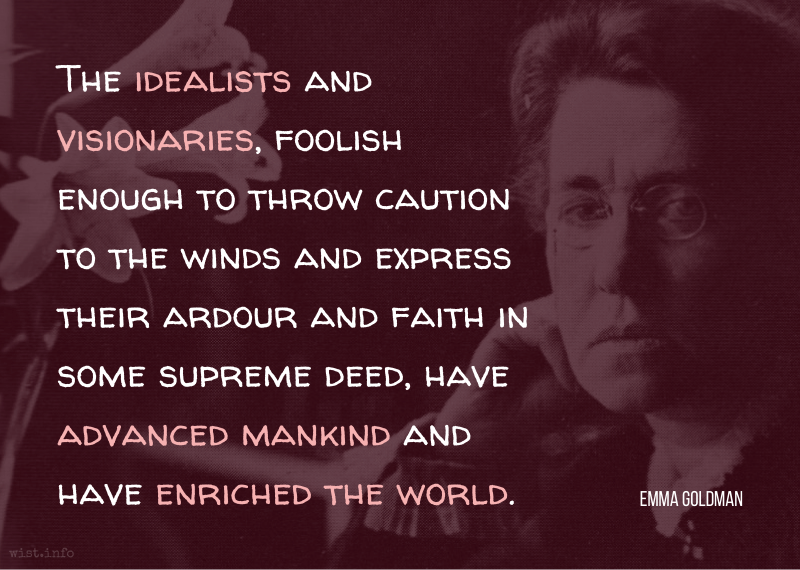
From time immemorial the wise and practical have denounced every heroic spirit. Yet it has not been they who have influenced our lives. The idealists and visionaries, foolish enough to throw caution to the winds and express their ardour and faith in some supreme deed, have advanced mankind and have enriched the world.
Emma Goldman (1869-1940) Lithuanian-American anarchist, activist
Living My Life, Part 2, ch. 39 (1931)
(Source)

I hold it blasphemy to say that a man ought not to fight against authority: there is no great religion and no great freedom that has not done it, in the beginning.
George Eliot (1819-1880) English novelist [pseud. of Mary Ann Evans]
Felix Holt, the Radical, ch. 46 (1866)
(Source)
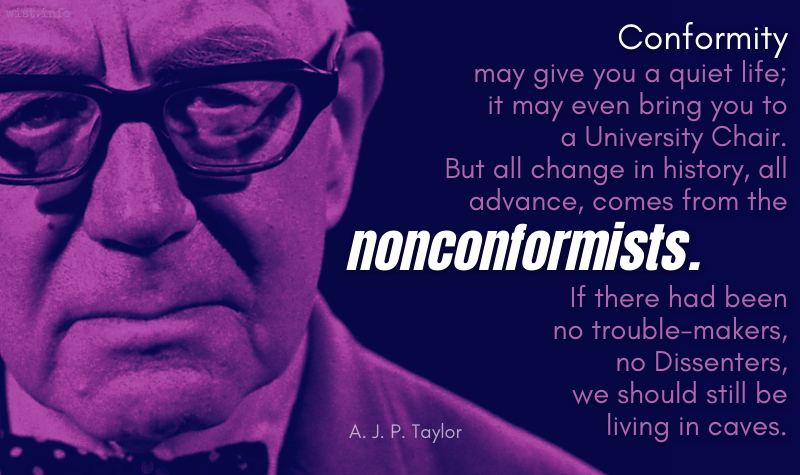
Conformity may give you a quiet life; it may even bring you to a University Chair. But all change in history, all advance, comes from the nonconformists. If there had been no trouble-makers, no Dissenters, we should still be living in caves.
A. J. P. Taylor (1906-1990) British historian, journalist, broadcaster [Alan John Percivale Taylor]
“The Radical Tradition: Fox, Paine, and Cobbett,” The Trouble Makers: Dissent over Foreign Policy, 1792–1939 (1969)
That is, natural selection built the brain to survive in the world and only incidentally to understand it at a depth greater than is needed to survive. The proper task of scientists is to diagnose and correct the misalignment.
E. O. Wilson (1929-2021) American biologist, naturalist, writer [Edward Osborne Wilson]
Consilience, ch. 4 (1998)
(Source)
And speech he has learned, and thought
So swift, and the temper of mind
To dwell within cities, and not to lie bare
Amid the keen, biting frosts
Or cower beneath pelting rain;
Full of resource against all that comes to him
is Man. Against Death alone
He is left with no defence.[καὶ φθέγμα καὶ ἀνεμόεν φρόνημα καὶ ἀστυνόμους
ὀργὰς ἐδιδάξατο καὶ δυσαύλων
πάγων ὑπαίθρεια καὶ δύσομβρα φεύγειν βέλη
παντοπόρος: ἄπορος ἐπ᾽ οὐδὲν ἔρχεται
τὸ μέλλον: Ἅιδα μόνον φεῦξιν οὐκ ἐπάξεται.]Sophocles (496-406 BC) Greek tragic playwright
Antigone, l. 354ff, Stasimon 1, Strophe 2 [Chorus] (441 BC) [tr. Kitto (1962)]
(Source)
Original Greek. Alternate translations:Language and lofty thought,
And dispositions meet for order'd cities,
These he hath taught himself; -- and how to shun
The shafts of comfortless winter, --
Both those which smite when the sky is clear,
And those which fall in showers; --
with plans for all things,
Planless in nothing, meets he the future!
Of death alone the avoidance
No foreign aid will bring.
[tr. Donaldson (1848)]Speech and the wind-swift speed of counsel and civic wit,
He hath learnt for himself all these; and the arrowy rain to fly
And the nipping airs that freeze, 'neath the open winter sky.
He hath provision for all: fell plague he hath learnt to endure;
Safe whate'er may befall: yet for death he hath found no cure.
[tr. Storr (1859)]Wise utterance and wind-swift thought, and city-moulding mind,
And shelter from the clear-eyed power of biting frost,
He hath taught him, and to shun the sharp, roof-penetrating rain, --
Full of resource, without device he meets no coming time;
From Death alone he shall not find reprieve;
No league may gain him that relief.
[tr. Campbell (1873)]Speech and thought fast as the wind and the moods that give order to a city he has taught himself, and how to flee the arrows of the inhospitable frost under clear skies and the arrows of the storming rain. He has resource for everything. Lacking resource in nothing he strides towards what must come. From Death alone he shall procure no escape.
[tr. Jebb (1891)]And speech, and wind-swift thought, and all the moods that mould a state, hath he taught himself; and how to flee the arrows of the frost, when 'tis hard lodging under the clear sky, and the arrows of the rushing rain; yea, he hath resource for all; without resource he meets nothing that must come: only against Death shall he call for aid in vain.
[tr. Jebb (1917)]Words also, and thought as rapid as air,
He fashions to his good use; statecraft is his,
And his the skill that deflects the arrows of snow,
The spears of winter rain: from every wind
He has made himself secure -- from all but one:
In the late wind of death he cannot stand.
[tr. Fitts/Fitzgerald (1939)]The use of language, the wind-swift motion of brain
He learnt; found out the laws of living together
In cities, building him shelter against the rain
And wintry weather.
There is nothing beyond his power. His subtlety
Meeteth all chance, all danger conquereth.
For every ill he hath found its remedy,
Save only death.
[tr. Watling (1947), l. 295ff]Language, and thought like the wind
and the feelings that make the town,
he has taught himself, and shelter against the cold,
refuge from rain. He can always help himself.
He faces no future helpless. There's only death
that he cannot find an escape from.
[tr. Wyckoff (1954)]And speech and thought, quick as the wind
and the mood and mind for law that rules the city --
all these he has taught himself
and shelter from the arrows of the frost
when there's rough lodging under the cold clear sky
and the shafts of lashing rain --
ready, resourceful man!
Never without resources
never an impasse as he marches on the future --
only Death, from Death alone he will find no rescue.
[tr. Fagles (1982)]Language and a mind swift as the wind
For making plans --
These he has taught himself --
And the character to live in cities under law.
He's learned to take cover from a frost
And escape sharp arrows of sleet.
He has the means to handle every need,
Never steps toward the future without the means.
Except for Death: He's got no relief from that.
[tr. Woodruff (2001)]Both language and thought swift as wind
and impulses that govern cities,
he has taught himself, as well as how
to escape the shafts of rain
while encamped beneath open skies.
All resourceful, he approaches no future thing
to come without resource. From Hades alone
he will not contrive escape.
[tr. Tyrell/Bennett (2002)]And man has learnt speech and thought, swifter than the wind he mastered
And learnt to govern his cities well
And this omniscient being has learnt how to avoid the blasts of the wild open air: the arrows of the freezing night, the dreadful wind driven piercing gale!
He’s prepared for all events bar Death and from Death he can find no escape.
[tr. Theodoridis (2004)]He’s taught himself speech and wind-swift thought,
trained his feelings for communal civic life,
learning to escape the icy shafts of frost,
volleys of pelting rain in winter storms,
the harsh life lived under the open sky.
That’s man -- so resourceful in all he does.
There’s no event his skill cannot confront --
other than death -- that alone he cannot shun.
[tr. Johnston (2005), l. 405ff]He taught himself language and wind-like thought and city-ruling urges, how to flee the slings of frost under winter's clear sky and the arrows of stormy rain, ever-resourceful. Against no possibility is he at a loss. For death alone he finds no aid.
[tr. Thomas (2005)]
It is not sufficient that the state of affairs which we seek to promote should be better than the state of affairs which preceded it; it must be sufficiently better to make up for the evils of the transition.
John Maynard Keynes (1883-1946) English economist
“The Political Doctrines of Edmund Burke” (1904)
(Source)
Truths that startled the generation in which they were first announced become in the next age the commonplaces of conversation; as the famous airs of operas which thrilled the first audiences come to be played on hand-organs in the streets.
Two things have always been true about human beings. One, the world is always getting better. Two, the people living at that time think it’s getting worse. It’s because you get older, your responsibilities are different. Now I’m taking care of children instead of being a child. It makes the world look scarier. That happens to everyone.
Penn Jillette (b. 1955) American stage magician, actor, musician, author
“Honest Questions with Penn Jillette,” Interview by Glen Beck, CNN (2 Nov 2007)
(Source)

Human nature, if it changes at all, changes not much faster than the geological face of the earth.
Alexander Solzhenitsen (1918-2008) Russian novelist, emigre [Aleksandr Isayevich Solzhenitsyn]
The Gulag Archipelago, Vol. 1 (1973) [tr. Whitney]
(Source)
Don’t ask a writer what he’s working on. It’s like asking someone with cancer about the progress of his disease.
Jay McInerney (b. 1955) American novelist, screenwriter, editor [John Barrett McInerney, Jr.]
Brightness Falls, ch. 1 (1985)
(Source)

Artists and scientists realize that no solution is ever final, but that each new creative step points the way to the next artistic or scientific problem. In contrast, those who embrace religious revelations and delusional systems tend to see them as unshakeable and permanent.
Anthony Storr (1920-2001) English psychiatrist and author
Feet of Clay: Saints, Sinners and Madmen, Introduction (1996)
(Source)
Religious believers of the world, you are free to continue to debate the simple, narrow question that divides you from atheists, but you have no right, in so doing, to treat the Humanists of the world with contempt. You owe them a deep debt of gratitude, for not only have they shed much light on a naturally dark world but they have very probably helped civilize your own specific religion.
Steve Allen (1922-2000) American composer, entertainer, and wit.
Vulgarians at the Gate (2001)
(Source)
I don’t long for the good old days when there was no servant problem. Back in those days, I’d have been a servant.
Isaac Asimov (1920-1992) Russian-American author, polymath, biochemist
(Attributed)
No,
it’s no disgrace for a man, even a wise man,
to learn many things and not to be too rigid.
You’ve seen trees by a raging winter torrent,
how many sway with the flood and salvage every twig,
but not the stubborn — they’re ripped out, roots and all.[ἀλλ᾽ ἄνδρα, κεἴ τις ᾖ σοφός, τὸ μανθάνειν
πόλλ᾽, αἰσχρὸν οὐδὲν καὶ τὸ μὴ τείνειν ἄγαν.
ὁρᾷς παρὰ ῥείθροισι χειμάρροις ὅσα
δένδρων ὑπείκει, κλῶνας ὡς ἐκσῴζεται,
τὰ δ᾽ ἀντιτείνοντ᾽ αὐτόπρεμν᾽ ἀπόλλυται.]Sophocles (496-406 BC) Greek tragic playwright
Antigone, l. 710ff [Haemon] (441 BC) [tr. Fagles (1982), l. 794ff]
(Source)
Ancient Greek. Alternate translations:But that a man, how wise soe'er, should learn
In many things and slack his stubborn will,
This is no derogation. When the streams
Are swollen by mountain-torrents, thou hast seen
That all the trees wich bend them to the flood
Preserve their branches from the angry current,
While those which stem it perish root and branch.
[tr. Donaldson (1848)]The wisest man will let himself be swayed
By others' wisdom and relax in time.
See how the trees beside a stream in flood
Save, if they yield to force, each spray unharmed,
But by resisting perish root and branch.
[tr. Campbell (1873)]'Tis no disgrace even to the wise to learn
And lend an ear to reason. You may see
The plant that yields where torrent waters flow
Saves every little twig, when the stout tree
Is torn away and dies.
[tr. Storr (1859)]No, even when a man is wise, it brings him no shame to learn many things, and not to be too rigid. You see how the trees that stand beside the torrential streams created by a winter storm yield to it and save their branches, while the stiff and rigid perish root and all?
[tr. Jebb (1891)]True wisdom will be ever glad to learn,
And not too fond of power. Observe the trees,
That bend to wintry torrents, how their boughs
Unhurt remain; while those that brave the storm,
Uprooted torn, shall wither and decay.
[tr. Werner (1892)]No, though a man be wise, 'tis no shame for him to learn many things, and to bend in season. Seest thou, beside the wintry torrent's course, how the trees that yield to it save every twig, while the stiff-necked perish root and branch?
[tr. Jebb (1917)]It is not reason never to yield to reason!
In flood time you can see how some trees bend,
And because they bend, even their twigs are safe,
While stubborn trees are torn up, roots and all
[tr. Fitts/Fitzgerald (1939), l. 570ff]It is no weakness for the wisest man
To learn when he is wrong, know when to yield.
So, on the margin of a flooded river
Trees bending to the torrent live unbroken,
While those that strain against it are snapped off.
[tr. Watling (1947), l. 608ff]A man, though wise, should never be ashamed
of learning more, and must unbend his mind.
Have you not seen the trees beside the torrent,
the ones that bend them saving every leaf,
while the resistant perish root and branch?
[tr. Wyckoff (1954)]There's no disgrace, even if one is wise,
In learning more, and knowing when to yield.
See how the trees that grow beside a torrent
Preserve their branches, if they bend; the others,
Those that resist, are torn out, root and branch.
[tr. Kitto (1962)]But a wise man can learn a lot and never be ashamed;
He knows he does not have to be rigid and close-hauled.
You've seen trees tossed by a torrent in a flash flood:
If they bend, they're saved, and every twig survives,
But if they stiffen up, they're washed out from the roots.
[tr. Woodruff (2001)]But for a man, even if he is wise, to go on learning
many things and not to be drawn too taut is no shame.
You see how along streams swollen from winter floods
some trees yield and save their twigs,
but others resist and perish, root and branch.
[tr. Tyrell/Bennett (2002)]On the contrary, it is no shame for even a wise man to continue learning. Nor should a man be obstinate. One can see the trees on the heavy river-banks. Those that bend with the rushing current, survive, whereas those bent against it are torn, roots and all.
[tr. Theodoridis (2004)]For any man,
even if he’s wise, there’s nothing shameful
in learning many things, staying flexible.
You notice how in winter floods the trees
which bend before the storm preserve their twigs.
The ones who stand against it are destroyed,
root and branch.
[tr. Johnston (2005), l. 804ff]No, it's no disgrace for a man, even a wise man, to learn many things and not to be too rigid. You see how, in the winter storms, the trees yield that save even their twigs, but those who oppose it are destroyed root and branch.
[tr. Thomas (2005)]
Even when laws have been written down, they ought not always to remain unaltered. As in other sciences, so in politics, it is impossible that all things should be precisely set down in writing; for enactments must be universal, but actions are concerned with particulars.
Aristotle (384-322 BC) Greek philosopher
Politics [Πολιτικά], Book 2, ch. 8 / 1269a.9 [tr. Jowett (1885)]
(Source)
Alt. trans.
- "Nor is it, moreover, right to permit written laws always to remain without alteration; for as in all other sciences, so in politics, it is impossible to express everything in writing with perfect exactness; for when we commit anything to writing we must use general terms, but in every action there is something particular to itself, which these may not comprehend." [tr. Ellis (1912)]
- "Moreover even written codes of law may with advantage not be left unaltered. For just as in the other arts as well, so with the structure of the state it is impossible that it should have been framed aright in all its details; for it must of necessity be couched in general terms, but our actions deal with particular things." [tr. Rackham (1932)]
- "In addition t this, it is not best to leave written laws unchanged. For just as in the case of the other arts, so with respect to political arrangements it is impossible for everything to be written down precisely; for it is necessary to write them in universal fashion, while actions concern particulars." [tr. Lord (1984)]
One need not go back two thousand years to the time when those who believed in the gospel of Jesus were thrown into the arena or hunted into dungeons to realize how little great beliefs or earnest believers are understood. The history of progress is written in the blood of men and women who have dared to espouse an unpopular cause, as, for instance, the black man’s right to his body, or woman’s right to her soul. If, then, from time immemorial, the New has met with opposition and condemnation, why should my beliefs be exempt from a crown of thorns?
Emma Goldman (1869-1940) Lithuanian-American anarchist, activist
“What I Believe,” New York World (19 Jul 1908)
(Source)
In a word, enjoy that blessing while you have it: when it is gone, do not lament it; unless, indeed, young men ought to lament the loss of boyhood, and those a little advanced in age the loss of adolescence.
[Denique isto bono utare, dum adsit, cum absit, ne requiras: nisi forte adulescentes pueritiam, paulum aetate progressi adulescentiam debent requirere.]
Marcus Tullius Cicero (106-43 BC) Roman orator, statesman, philosopher
De Senectute [Cato Maior; On Old Age], ch. 10 / sec. 33 (10.33) (44 BC) [tr. Edmonds (1874)]
(Source)
(Source (Latin)). Alternate translations:Finally I tell the thou oughtist use of the bodily strength as whiche is one of the goodys of nature in the meane tyme whan thou hast them. But whan the goodys of bodily strength ben no more in thee thenne thou shuldist not require it nor aske it save that thou maist saye paraventure that the adolescentys which ben in the third age owghten to desyre & aske after the age of pueryce which is seconde age & by that he is the ferthir from deth. Therfor I tell the Scipion that when men ben somwhat entrid & come within adolescence which is an age fructuouse and profitable they to require it and to aske it. And not puerice called Childhode whiche is withoute availe and profite.
[tr. Worcester/Worcester/Scrope (1481), Part 3]In fine, use and take well in worth this gift of bodily strength while thou hast it, and when it is gone do not desire nor seek to have it again, unless peradventure you will say that all young men ought to wish themselves in their infancy and swathing-bands again, or when they be somewhat further stricken in years and in the maturity or best time of their age, to wish themselves again in their adolescency.
[tr. Newton (1569)]To conclude, use that strength which you have while you have it; but when it is gone, require it not, unlesse you thinke it a seemly thing of young men, to require their child-hood againe, and ancient men their youth.
[tr. Austin (1648)]The force which Nature gives with care retain,
But when decay'd, 'tis folly to complain;
In age to wish for youth is full as vain,
As for a youth to turn a child again.
[tr. Denham (1669)]The Faculties of our Bodies are to be made use of, while we possess them, but not to be lamented, when they have left us; unless you would think it reasonable that Boys should be desirous to become Children, and that those, who are become Men, should be wishing to grow Boys again.
[tr. Hemming (1716)]In short, make use of any Good while you have it, and when it's gone look not for it, unless you think young Men would do right to require Childhood again, or Men in Years their Youth.
[tr. J. D. (1744)]In short, while you have Strength, use it; when it leaves you, no more repine for the want of it, than you did when Lads, that your Childhood was past; or at the Years of Manhood, that you were no longer Boys.
[tr. Logan (1750)]In a word, my friends, make a good use of your youthful vigour so long as it remains; but never let it cost you a sign when age shall have withdrawn it from you; as reasonably indeed might youth regret the loss of infancy, or manhood the extinction of youth.
[tr. Melmoth (1773)]In a word, make use of that good thing while it is present; when it is absent do not regret it; unless, perhaps, young men ought to seek to be boys again; those who have made a little advance in years, to be young men again.
[Cornish Bros. ed. (1847)]In fine, I would have you use strength of body while you have it: when it fails, I would not have you complain of its loss, unless you think it fitting for young men to regret their boyhood, or for those who have passed on a little farther in life to want their youth back again.
[tr. Peabody (1884)]In fine, enjoy that blessing when you have it; when it is gone, don't wish it back -- unless we are to think that young men should wish their childhood back, and those somewhat older their youth!
[tr. Shuckburgh (1895)]Use then the gifts you have:
When gone, regret them not: unless as men
You are to ask for boyhood to return,
When older ask for you: there still must be
A certain lapse of years.
[tr. Allison (1916)]In short, enjoy the blessing of strength while you have it and do not bewail it when it is gone, unless, forsooth, you believe that youth must lament the loss of infancy, or early manhood the passing of youth.
[tr. Falconer (1923)]To sum it up: use the advantages you have while you have them; when they are gone, don’t sit around wishing you could get them back. Or do you think, perhaps, that young men ought to mourn their lost boyhood, and those a bit older their younger days?
[tr. Copley (1967)]Use whatever gifts you have while you have them, and don’t mope after them when they are gone -- unless of course you think that young men should regret their childhood and that those who are getting on should regret their youth.
[tr. Cobbold (2012)]So to put it in a nutshell
Use your own strength and use it well
As long as it lasts and when it is spent
Just forget it unless you should
Think that boyhood regrets childhood
Or that manhood may its decline lament.
[tr. Bozzi (2015)]In short, enjoy the blessing of bodily strength while you have it, but don't mourn when it passes away, any more than a young man should lament the end of boyhood, or a mature man the passing of youth.
[tr. Freeman (2016)]
Man’s urge for change and his need for stability have always balanced and checked each other, and our current vocabulary, which distinguishes between two factions, the progressives and the conservatives, indicates a state of affairs in which this balance has been thrown out of order. No civilization — the man-made artifact to house successive generations — would ever have been possible without a framework of stability, to provide the wherein for the flux of change.
Hannah Arendt (1906-1975) German-American philosopher, political theorist
Essay (1969-02-27), “Reflections on Violence,” The New York Review of Books
(Source)
Revised and collected in Crises of the Republic, "On Violence" (1972).

Let me tell you the secret of such so-called successes as there have been in my life, and here I believe I give you really good advice. It was to burn my boats and demolish my bridges behind me. Then one loses no time in looking behind, when one should have quite enough to do in looking ahead — then there is no chance for you or your men but forward. You have to do or die!
Fridtjof Nansen (1861-1930) Norwegian explorer, scientist, diplomat, humanitarian
Speech, St Andrews University (3 Nov 1926)
(Source)
Translated in his Adventure, and Other Papers (1927).

Only in growth, reform, and change, paradoxically enough, is true security to be found.

The test of a democracy is not the magnificence of buildings or the speed of automobiles or the efficiency of air transportation, but rather the care given to the welfare of all the people.
Helen Keller (1880-1968) American author and lecturer
“Try Democracy,” The Home Magazine, Vol. 11, # 4 (Apr 1935)
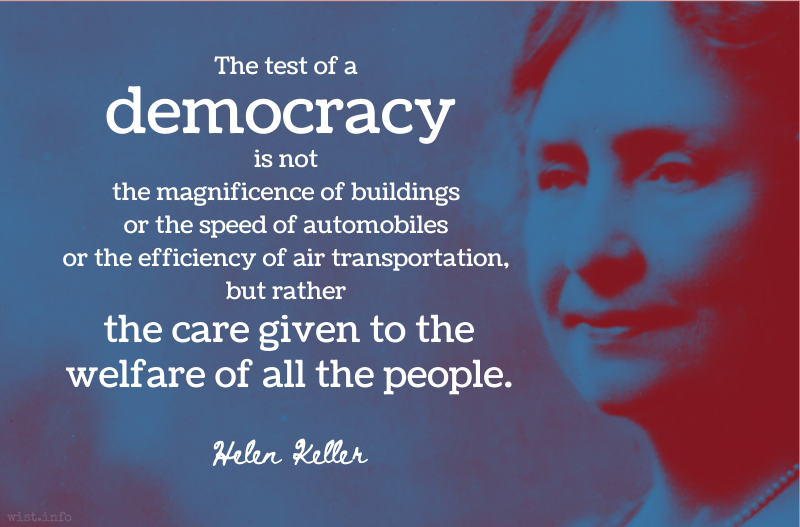
Here’s to the crazy ones — the misfits, the rebels, the troublemakers, the round pegs in the square holes, the ones who see things differently. They’re not fond of rules, and they have no respect for the status quo. You can quote them, disagree with them, glorify or vilify them. About the only thing you can’t do is ignore them, because they change things, they push the human race forward. While some may see them as the crazy ones, we see genius, because the people who are crazy enough to think that they can change the world are the ones who do.
Steve Jobs (1955-2011) American computer inventor, entrepreneur
“To the Crazy Ones,” TV advertisement (1997)
(Source)
Often cited as a quotation from Steve Jobs, this was an Apple advertisement developed by Chiat/Day under the direction of Jobs after his return to the company in 1997, under the campaign "Think Different." The ad and its text was created by Chiat/Day talent like Craig Tanimoto, Rob Siltanen, and Ken Segall. (For more information on the ad's development, see Siltanen's article.)
Jobs did narrate the text at least once, but the original 1997 ad was voiced by Richard Dreyfuss.
Note: nearly all transcripts say, "But the only thing you can't do ..." while the word voiced is "About the only thing you can't do ...."

The supreme crime of the church to-day is that everywhere and in all its operations and influences it is on the side of sloth of mind; that it banishes brains, it sanctifies stupidity, it canonizes incompetence.
Upton Sinclair (1878-1968) American writer, journalist, activist, politician
The Profits of Religion, Book Two: “The Church of Good Society,” “The Canonization of Incompetence” (1917)
(Source)
MORDEN: Think about it, Captain. Look at the long history of human struggle. Six thousand years of recorded wars, bloodshed, atrocities beyond description. But look at what came out of all that. We’ve gone to the stars. Split the atom. Written sonnets. We would never have evolved this far if we hadn’t been at each other’s throats, evolving our way up inch by inch.
J. Michael (Joe) Straczynski (b. 1954) American screenwriter, producer, author [a/k/a "JMS"]
Babylon 5, 3×22 “Z’Ha’Dum” (28 Oct 1996)

A human being is a deracinated caveman, as a caveman was a deracinated nephew of an ape. Everyone gets to be something by starting as something else — either that or he stays unevolved.
John Ciardi (1916-1986) American poet, writer, critic
In Vince Clemente, “‘A Man Is What He Does With His Attention’: A Conversation with John Ciardi,” Poesis, Vol. 7 #2 (1986)
(Source)
To believe that man’s aggressiveness or territoriality is in the nature of the beast is to mistake some men for all men, contemporary society for all possible societies, and, by a remarkable transformation, to justify what is as what needs must be; social repression becomes a response to, rather than a cause of, human violence.
Leon Eisenberg (1922-2009) American psychiatrist and medical educator
“The Human Nature of Human Nature,” Science (14 Apr 1972)
(Source)
Based on an address at Faculty of Medicine Day, McGill University Sesquicentennial Celebration, Montreal, Canada (1 Oct 1971).
It is a measure of the Negro’s circumstance that, in America, the smallest things usually take him so very long, and that, by the time he wins them, they are no longer little things: they are miracles.
Murray Kempton (1917-1997) American journalist.
Part of Our Time: Some Ruins & Monuments of the Thirties, ch. 8 (1955)
(Source)
On the formation of the Pullman Porters union.

He may have gone quite far in our society, but no matter how far one goes, one cannot avoid bringing oneself along.
Peter David (b. 1956) American writer
Babylon 5: Legions of Fire III – Out of the Darkness (2000)

In the end, it is important to remember that we cannot become what we need to be by remaining what we are.
Max De Pree (1924-2017) American businessman and writer
Leadership Is an Art, “Who Owns This Place?” (1987)
(Source)
Sometimes misquoted as "by remaining who we are."

If you said to a bunch of average people two hundred years ago “Would you be happy in a world where medical care is widely available, houses are clean, the world’s music and sights and foods can be brought into your home at small cost, travelling even 100 miles is easy, childbirth is generally not fatal to mother or child, you don’t have to die of dental abcesses and you don’t have to do what the squire tells you” they’d think you were talking about the New Jerusalem and say ‘yes’.
Terry Pratchett (1948-2015) English author
(Attributed)
Usually cited to alt.fan.pratchett, but not found in the repository.
Art — the one achievement of Man which has made the long trip up from all fours seem well advised.
James Thurber (1894-1961) American cartoonist and writer
Forum and Century (Jun 1939)
Also quoted in Clifton Fadiman, I Believe: The Personal Philosophies of Certain Eminent Men and Women of Our Time (1939).
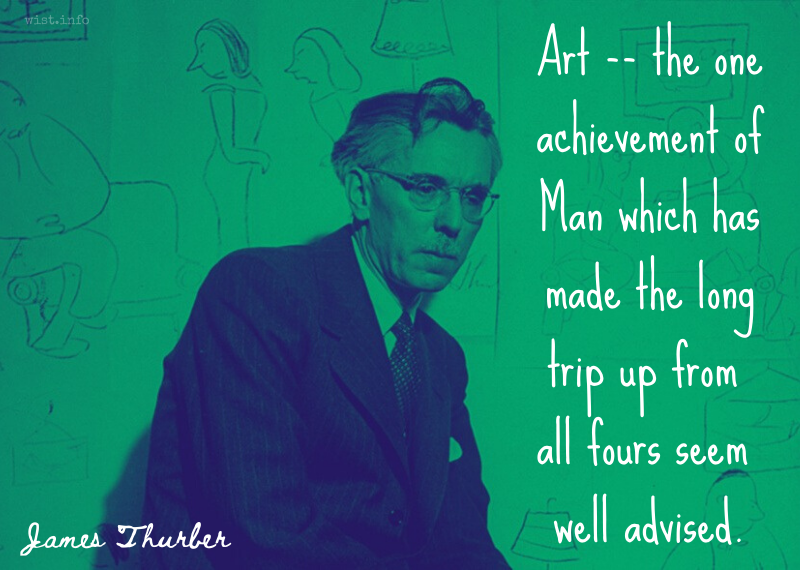
Lead the ideas of your time and they will accompany and support you; fall behind them and they drag you along with them; oppose them and they will overwhelm you.
Napoleon Bonaparte (1769-1821) French emperor, military leader
(Attributed)
(Source)
Quoted, unsourced, in Jules Bertaut, Napoleon: In His Own Words [Virilités, maximes et pensées de Napoléon Bonaparte], ch. 4 (1916) [tr. Law and Rhodes].

Against all appearances the nature of things works for truth and right forever.
Ralph Waldo Emerson (1803-1882) American essayist, lecturer, poet
Essay (1860), “Worship,” The Conduct of Life, ch. 6
(Source)
Based on a course of lectures, "The Conduct of Life," delivered in Pittsburg (1851-03).
Progress, far from consisting in change, depends on retentiveness. When change is absolute there remains no being to improve and no direction is set for possible improvement: and when experience is not retained, as among savages, infancy is perpetual. Those who cannot remember the past are condemned to repeat it.
George Santayana (1863-1952) Spanish-American poet and philosopher [Jorge Agustín Nicolás Ruíz de Santayana y Borrás]
The Life of Reason or The Phases of Human Progress, Vol. 1, “Reason in Common Sense,” ch. 12 (1905-1906)
(Source)
Often given as "Those who do not remember the past ...." Quoted at the Auschwitz Holocaust Museum, via Polish, as: "The one who does not remember history is bound to live through it again."
Often misattributed to Winston Churchill, who paraphrased it in a Commons speech in 1948: "Those who fail to learn from history are condemned to repeat it."
In art as in politics we must deal with people as they are, not as we wish them to be. Only by working with the real can you get closer to the ideal.
Rita Mae Brown (b. 1944) American author, playwright
In Her Day, Preface, “A Note to the Feminist Reader” (1976)
(Source)

Certainly it is presumptuous to say that we cannot improve, and that Man, who has only been in power for a few thousand years, will never learn to make use of his power. All I mean is that, if people continue to kill one another as they do, the world cannot get better than it is, and that, since there are more people than formerly, and their means for destroying one another superior, the world may well get worse. What is good in people — and consequently in the world — is their insistence on creation, their belief in friendship and loyalty for their own sakes; and, though Violence remains and is, indeed, the major partner in this muddled establishment, I believe that creativeness remains too, and will always assume direction when violence sleeps.
E. M. Forster (1879-1970) English novelist, essayist, critic, librettist [Edward Morgan Forster]
“What I Believe,” The Nation (16 Jul 1938)
(Source)
Taft explained that the great issue in this campaign is “creeping socialism.” Now that is the patented trademark of the special interest lobbies. Socialism is a scare word they have hurled at every advance the people have made in the last twenty years. Socialism is what they called public power. Socialism is what they called Social Security. Socialism is what they called farm prices supports. Socialism is what they called bank deposit insurance. Socialism is what they called the growth of free and independent labor organizations. Socialism is their name for almost anything that helps all the people.
Harry S Truman (1884-1972) US President (1945-1953)
Speech (1952-10-10), Syracuse, New York
(Source)
Referring to Sen. Robert A. Taft (R-Ohio).
Audio recording (the quotation is at 6:35 into the speech).
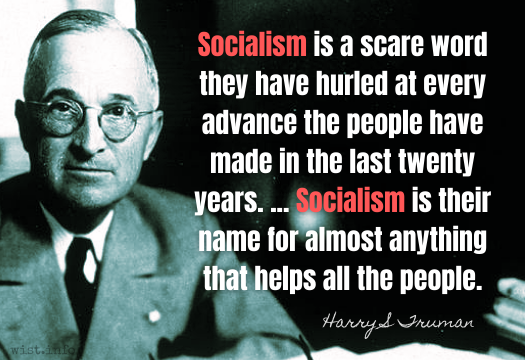
Where men then are free to consult experience they will correct their practice, and make changes for the better. It follows, therefore, that the more free men are, the more changes they will make. In the beginning, possibly, for the worse; but most certainly in time for the better; until their knowledge enlarging by observation, and their judgment strengthening by exercise, they will find themselves in the straight, broad, fair road of improvement. Out of change, therefore, springs improvement; and the people who shall have imagined a peaceable mode of changing their institutions, hold a surety for their melioration. This surety is worth all other excellences. Better were the prospects of a people under the influence of the worst government who should hold the power of changing it, that those of a people under the best who should hold no such power.
Frances "Fanny" Wright (1795-1852) Scottish-American writer, lecturer, social reformer
Independence Day speech, New Harmony, Indiana (4 Jul 1828)
(Source)

The paradox of education is precisely this — that as one begins to become conscious one begins to examine the society in which he is being educated. The purpose of education, finally, is to create in a person the ability to look at the world for himself, to make his own decisions, to say to himself this is black or this is white, to decide for himself whether there is a God in heaven or not. To ask questions of the universe, and then learn to live with those questions, is the way he achieves his own identity. But no society is really anxious to have that kind of person around. What societies really, ideally, want is a citizenry which will simply obey the rules of society. If a society succeeds in this, that society is about to perish. The obligation of anyone who thinks of himself as responsible is to examine society and try to change it and to fight it -– at no matter what risk. This is the only hope society has. This is the only way societies change.
James Baldwin (1924-1987) American novelist, playwright, activist
“The Negro Child — His Self-Image,” speech (16 Oct 1963)
(Source)
Speech to educators, first published as "A Talk to Teachers," The Saturday Review (21 Dec 1963). The thesis above is restatated at the end in these words, more frequently quoted: "I began by saying that one of the paradoxes of education was that precisely at the point when you begin to develop a conscience, you must find yourself at war with your society. It is your responsibility to change society if you think of yourself as an educated person."
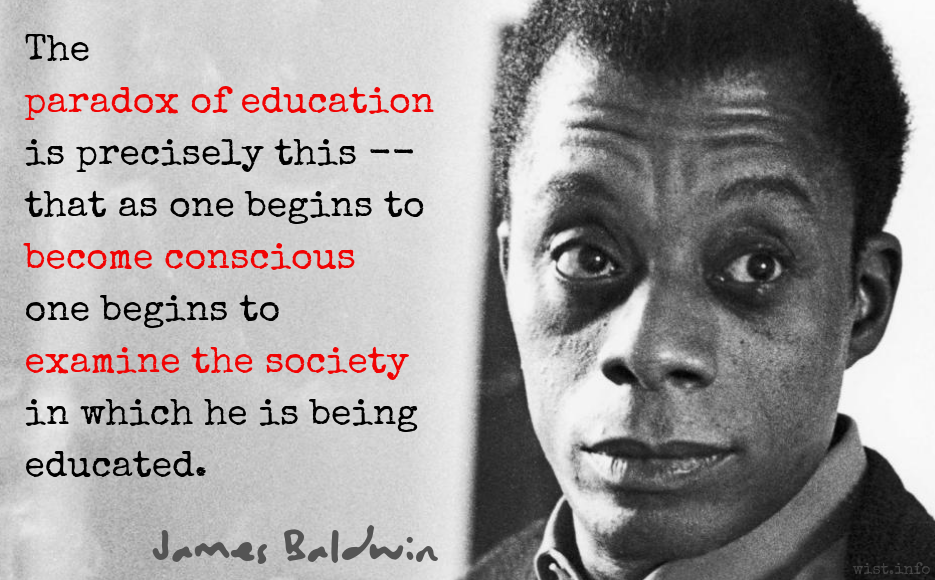
There is, in the institutions of this country, one principle, which, had they no other excellence, would secure to them the preference over those of all other countries. I mean — and some devout patriots will start — I mean the principle of change.
I have used a word to which is attached an obnoxious meaning. Speak of change, and the world is in alarm. And yet where do we not see change? What is there in the physical world but change? And what would there be in the moral world without change?
Frances "Fanny" Wright (1795-1852) Scottish-American writer, lecturer, social reformer
Independence Day speech, New Harmony, Indiana (4 Jul 1828)
(Source)
What is said by great employers of labor against agitators is unquestionably true. Agitators are a set of interfering, meddling people, who come down to some perfectly contented class of the community and sow the seeds of discontent amongst them. That is the reason why agitators are so absolutely necessary. Without them, in our incomplete state, there would be no advance towards civilization.
Oscar Wilde (1854-1900) Irish poet, wit, dramatist
“The Soul of Man Under Socialism” (1891)
(Source)
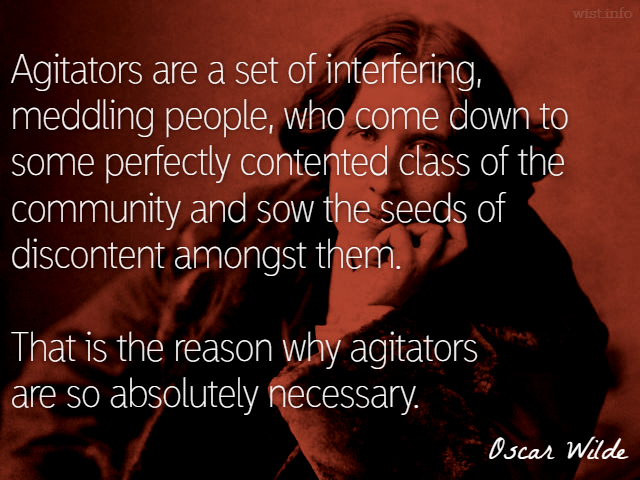
We are called to be architects of the future, not its victims.
Buckminster Fuller (1895-1983) American architect, engineer
(Attributed)
Quoted in L. Steven Sieden, A Fuller View (2012).
The saddest aspect of life right now is that science gathers knowledge faster than society gathers wisdom.
Isaac Asimov (1920-1992) Russian-American author, polymath, biochemist
Isaac Asimov’s Book of Science and Nature Questions (1988) [with Jason A. Schulman]
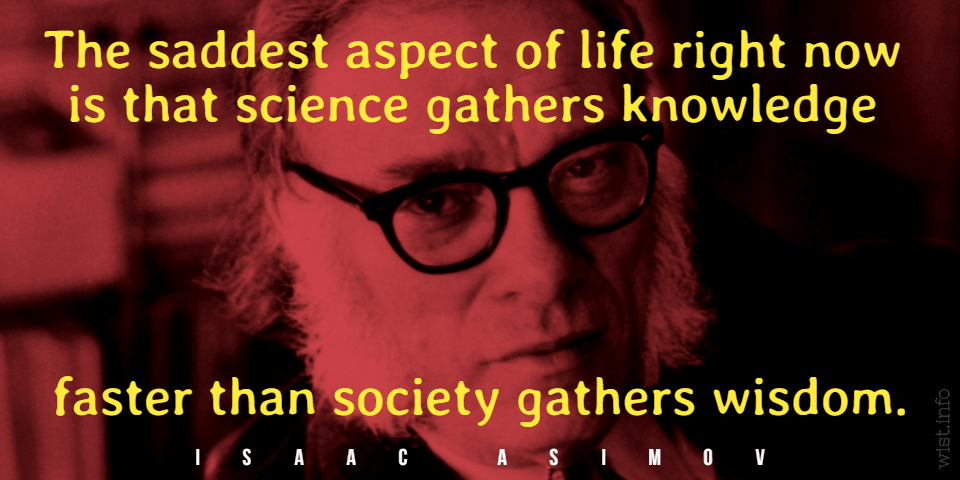
If you attack Stupidity, you attack an entrenched interest with friends in government and every walk of public life, and you will make small progress against it.
Robertson Davies (1913-1995) Canadian author, editor, publisher
The Table Talk of Samuel Marchbanks (1949)
(Source)
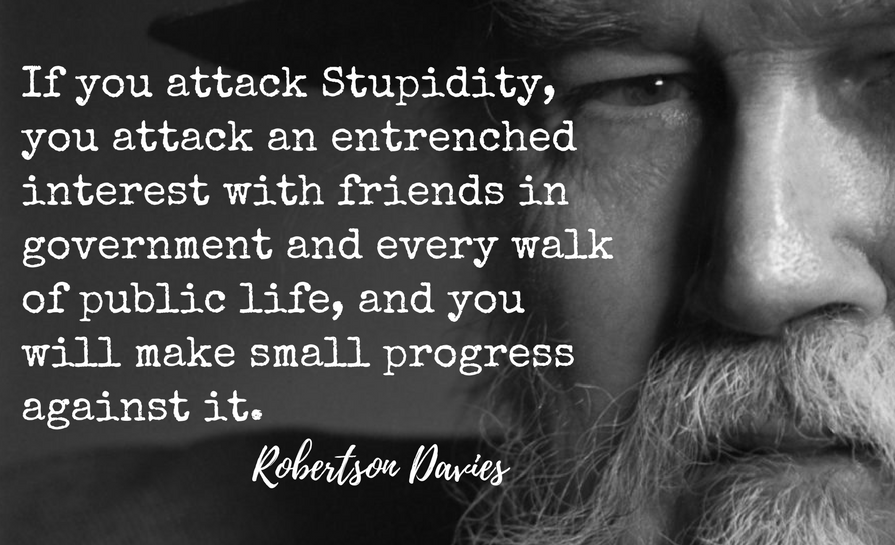

Progress is impossible without change; and those who cannot change their minds, cannot change anything.
George Bernard Shaw (1856-1950) Irish playwright and critic
Everybody’s Political What’s What? (1950 ed.)
(Source)
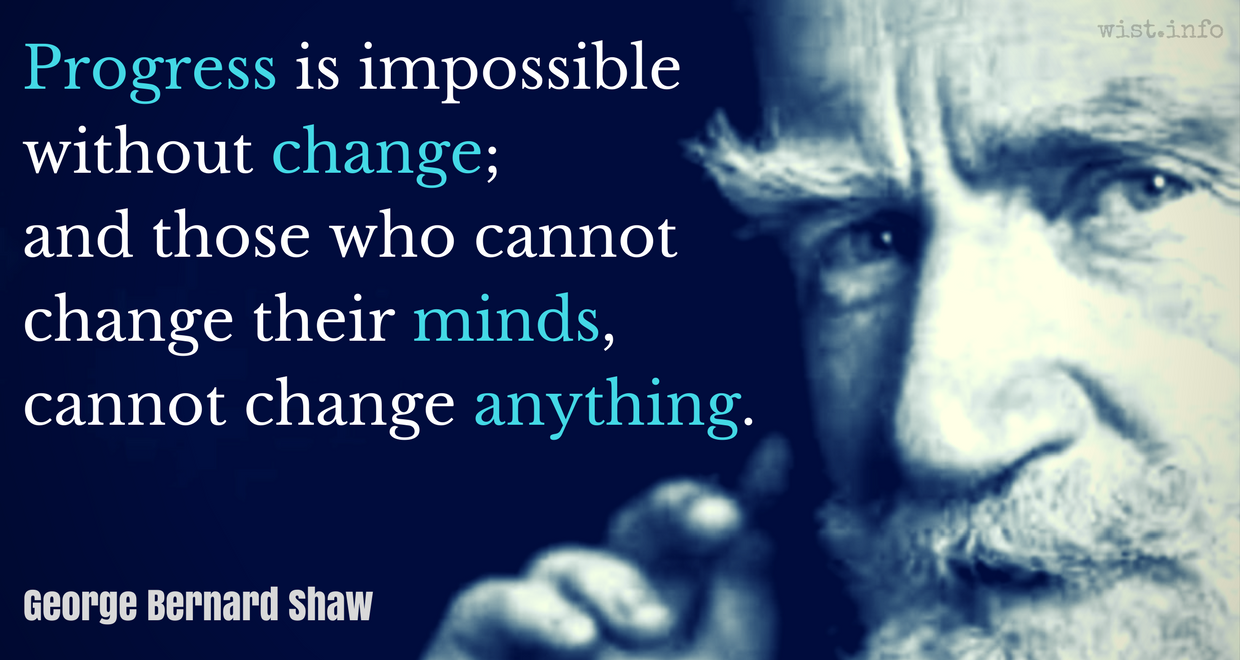
Back in the nineteen-hundreds it was a wonderful experience for a boy to discover H. G. Wells. There you were, in a world of pedants, clergymen and golfers, with your future employers exhorting you to “get on or get out”, your parents systematically warping your sexual life, and your dull-witted schoolmasters sniggering over their Latin tags; and here was this wonderful man who could tell you about the inhabitants of the planets and the bottom of the sea, and who knew that the future was not going to be what respectable people imagined.
George Orwell (1903-1950) English journalist, essayist, writer [pseud. of Eric Arthur Blair]
Essay (1941-08), “Wells, Hitler, and the World State,” Horizon
(Source)
It is common to assume that human progress affects everyone — that even the dullest man, in these bright days, knows more than any man of, say, the Eighteenth Century, and is far more civilized. This assumption is quite erroneous. The men of the educated minority, no doubt, know more than their predecessors, and some of them, perhaps, it may be said that they are more civilized — though I should not like to be put to giving names — but the great masses of men, even in this inspired republic, are precisely where the mob was at the dawn of history. They are ignorant, they are dishonest, they are cowardly, they are ignoble. They know little if anything that is worth knowing, and there is not the slightest sign of a natural desire among them to increase their knowledge.
H. L. Mencken (1880-1956) American writer and journalist [Henry Lewis Mencken]
“Homo Neandertalensis,” Baltimore Evening Sun (29 Jun 1925)
(Source)
We are the highest achievement reached so far by the great constructors of evolution. We are their “latest” but certainly not their last word. The scientist must not regard anything as absolute, not even the laws of pure reason. He must remain aware of the great fact, discovered by Heraclitus, that nothing whatever really remains the same even for one moment, but that everything is perpetually changing. To regard man, the most ephemeral and rapidly evolving of all species, as the final and unsurpassable achievement of creation, especially at his present-day particularly dangerous and disagreeable stage of development, is certainly the most arrogant and dangerous of all untenable doctrines.
Konrad Lorenz (1903-1989) Austrian zoologist, ethologist, ornithologist
On Aggression, ch. 12 “On the Virtue of Scientific Humility” (1963)
(Source)
There is something wrong with our world, something fundamentally and basically wrong. I don’t think we have to look too far to see that. I’m sure that most of you would agree with me in making that assertion. And when we stop to analyze the cause of our world’s ills, many things come to mind. We begin to wonder if it is due to the fact that we don’t know enough. But it can’t be that. Because in terms of accumulated knowledge we know more today than men have known in any period of human history. We have the facts at our disposal. We know more about mathematics, about science, about social science, and philosophy than we’ve ever known in any period of the world’s history. So it can’t be because we don’t know enough. And then we wonder if it is due to the fact that our scientific genius lags behind. That is, if we have not made enough progress scientifically. Well then, it can’t be that. For our scientific progress over the past years has been amazing. Man through his scientific genius has been able to warp distance and place time in chains, so that today it’s possible to eat breakfast in New York City and supper in London, England. Back in about 1753 it took a letter three days to go from New York City to Washington, and today you can go from here to China in less time than that. It can’t be because man is stagnant in his scientific progress. Man’s scientific genius has been amazing. I think we have to look much deeper than that if we are to find the real cause of man’s problems and the real cause of the world’s ills today. If we are to really find it I think we will have to look in the hearts and souls of men.
Martin Luther King, Jr. (1929-1968) American clergyman, civil rights leader, social activist, preacher
“Rediscovering Lost Values,” Sermon, Second Baptist Church, Detroit (28 Feb 1954)
(Source)
Is it progress if a cannibal uses knife and fork?
[Czy jeżeli ludożerca je widelcem i nożem to postęp?]
Stanislaw Lec (1909-1966) Polish aphorist, poet, satirist
Unkempt Thoughts [Myśli nieuczesane] (1957) [tr. Gałązka (1962)]
(Source)
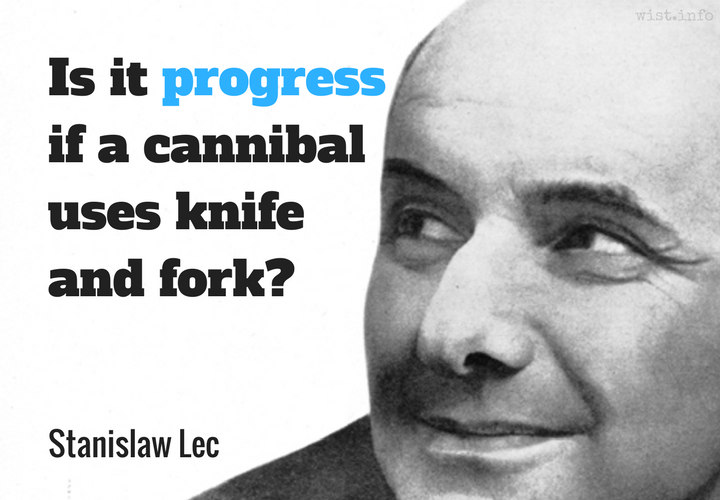
The real problem is that through our scientific genius we’ve made of the world a neighborhood, but through our moral and spiritual genius we’ve failed to make of it a brotherhood.
Martin Luther King, Jr. (1929-1968) American clergyman, civil rights leader, social activist, preacher
“Rediscovering Lost Values,” sermon, Second Baptist Church, Detroit (28 Feb 1954)
(Source)
While all other Sciences have advanced, that of Government is at a stand; little better understood; little better practiced now than three or four thousand years ago.
John Adams (1735–1826) American lawyer, Founding Father, statesman, US President (1797–1801)
Letter to Thomas Jefferson (9 Jul 1813)
When once the forms of civility are violated, there remains little hope of return to kindness or decency.
Samuel Johnson (1709-1784) English writer, lexicographer, critic
The Rambler, #50 (25 Sep 1750)
(Source)
Couched as a letter to the paper from a woman.

The exact measure of the progress of civilization is the degree in which the intelligence of the common mind has prevailed over wealth and brute force.
George Bancroft (1800-1891) American historian, statesman, education reformer
Speech, Adelphi Society, Liamstown College (Aug 1835)
Man masters nature not by force but by understanding. This is why science has succeeded where magic failed: because it has looked for no spell to cast over nature.
Jacob Bronowski (1908-1974) Polish-English humanist and mathematician
Lecture, MIT (26 Feb 1953)
Reprinted in "The Creative Mind," Sec. 4, Science and Human Values (1961).
Comfort and habits let us be ready to forgo, but I am not ready for a creed which does not care how much it destroys the liberty and security of daily life, which uses deliberately the weapons of persecution, destruction and international strife. How can I admire a policy which finds a characteristic expression in spending millions to suborn spies in every family and group at home, and to stir up trouble abroad?
John Maynard Keynes (1883-1946) English economist
“A Short View of Russia” (1925)
It is perfectly true, as the philosophers say, that life must be understood backwards. But they forget the other proposition, that it must be lived forwards.
Søren Kierkegaard (1813-1855) Danish philosopher, theologian
Journals IV.A.164 (1843)
Commonly paraphrased: "Life can only be understood backwards; but it must be lived forwards."

That which seems the height of absurdity in one generation often becomes the height of wisdom in the next.
John Stuart Mill (1806-1873) English philosopher and economist
(Attributed)
(Source)
Often cited from a quote in Adlai Stevenson, Call to Greatness (1954), but appears earlier in, e.g., National Magazine (Nov 1911). Unverified in Mills' writings.
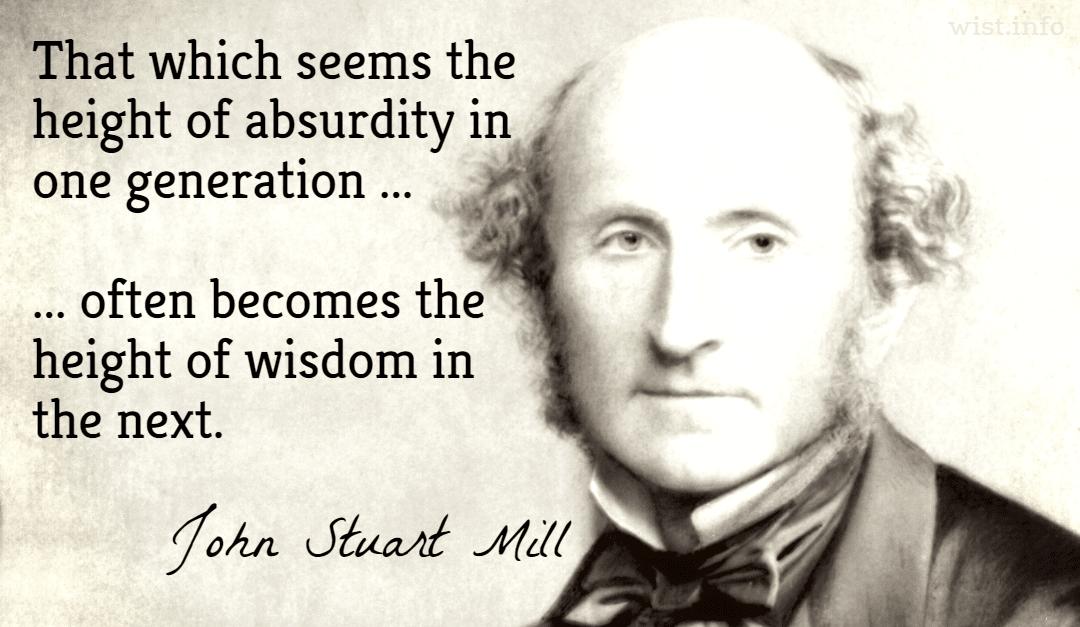
He that is good will infallibly become better, and he that is bad will as certainly become worse; for vice, virtue, and time are three things that never stand still.
Charles Caleb "C. C." Colton (1780-1832) English cleric, writer, aphorist
Lacon: Or, Many Things in Few Words, Vol. 1, § 457 (1820)
(Source)
The envious nature of men, so prompt to blame and so slow to praise, makes the discovery and introduction of any new principles and systems as dangerous as almost the exploration of unknown seas and continents.
Niccolò Machiavelli (1469-1527) Italian politician, philosopher, political scientist
The Discourses on Livy, Book 1, Introduction (1517) [tr. Detmold (1882)]
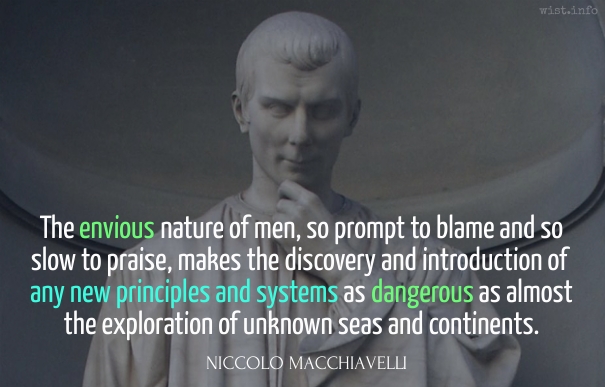

The conflict between the principle of liberty and the fact of slavery is coming gradually to an issue. Slavery has now the power, and falls into convulsions at the approach of freedom. That the fall of slavery is predetermined in the counsels of Omnipotence I cannot doubt; it is a part of the great moral improvement in the condition of man, attested by all the records of history. But the conflict will be terrible, and the progress of improvement perhaps retrograde before its final progress to consummation.
John Quincy Adams (1767-1848) US President (1825-29)
Journal (11 Dec 1838)
Yes, yes, we are taught to fly in the air like birds, and to swim in the water like the fishes; but how to live on the earth we don’t know.
Maxim Gorky (1868-1936) Russian writer [b. Alexei Maximovich Peshkov]
(Attributed)
Quoting a Russian peasant on progress; cited in Lothrop Soddard, Social Classes in Post-War Europe (1925).
Quoted later by Martin Luther King, Jr., in "The Man Who Was a Fool," Strength to Love (1963): "We have learned to fly the air like birds and swim the sea like fish, but we have not learned the simple art of living together as brothers"; he used the same phrase in his Nobel Peace Prize lecture (1964).
Variant: "Now that we have learned to fly the air like birds, swim under water like fish, we lack one thing—to learn to live on earth as human beings."
Sometimes misattributed to George Bernard Shaw. See here for more information.
Change is not always progress. […] A fever of newness has been everywhere confused with the spirit of progress.
Henry Ford (1863-1947) American industrialist
Ford Ideals (1922)
What the tender poetic youth dreams, and prays, and paints to-day, but shuns the ridicule of saying aloud, shall presently be the resolutions of public bodies, then shall be carried as grievance and bill of rights through conflict and war, and then shall be triumphant law and establishment for a hundred years, until it gives place, in turn, to new prayers and pictures.
Ralph Waldo Emerson (1803-1882) American essayist, lecturer, poet
“Politics,” Essays: Second Series (1844)
(Source)
This quotation is more often given as the paraphrase used by another speaker of the era, the abolitionist Wendell Phillips:What the tender and poetic youth dreams to-day, and conjures up with inarticulate speech, is to-morrow the vociferated result of public opinion, and the day after is the charter of nations.
Phillips used this phrase, prefixed with, "As Emerson says," and in quotation marks, at least twice. First in his lecture "Harper's Ferry" (1 Nov 1859), Brooklyn. Second, in a different context, in "The Scholar in a Republic" (30 Jun 1881), a famous speech at the centennial of the Phi Beta Kappa society at Harvard University.
Emerson did not use this shorter phrasing, however, in any of his written works, and frequent attributions of it to him are in error.
So give me the political economist, the sanitary reformer, the engineer; and take your saints and virgins, relics and miracles. The spinning-jenny and the railroad, Cunard’s liners and the electric telegraph, are to me, if not to you, signs that we are, on some points at least, in harmony with the universe; that there is a mighty spirit working among us, who cannot be your anarchic and destroying Devil, and therefore may be the Ordering and Creating God.
Charles Kingsley (1819-1875) English clergyman, historian, essayist, novelist (pseud. "Parson Lot")
Yeast: A Problem, ch. 5 (1848)
(Source)
If you’re walking down the right path, and you’re willing to keep walking, eventually you’ll make progress.
Barack Obama (b. 1961) American politician, US President (2009-2017)
(Attributed)
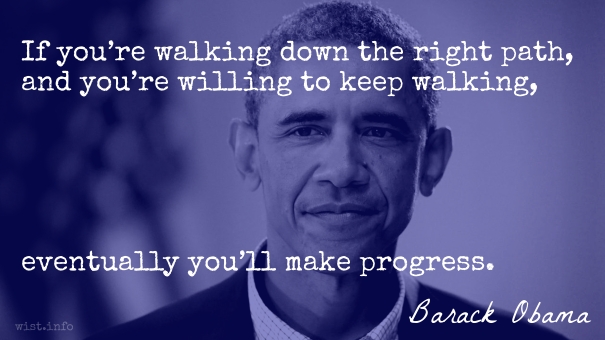
THE DOCTOR: We all change. When you think about it, we’re all different people all through our lives, and that’s okay, that’s good, you gotta keep moving, so long as you remember all the people that you used to be.
Steven Moffat (b. 1961) Scottish television writer, producer
Doctor Who (2005), 07xS2 “The Time of the Doctor” (2013-12-25)
(Source)
(Source (Video)). Special Episode 2 of the season (story 241). The Eleventh Doctor speaking, just before his regeneration.

The most successful men in the end are those whose success is the result of steady accretion. That intellectuality is more vigorous that has attained its strength gradually. It is the man who carefully advances step by step, with his mind becoming wider and wider — and progressively better able to grasp any theme or situation — persevering in what he knows to be practical, and concentrating his thought upon it, who is bound to succeed in the greatest degree.
Alexander Graham Bell (1847-1922) Scottish-American scientist, inventor, engineer
Interview, in Orison Swett Marden, How They Succeeded, ch. 2 (1901)
(Source)
The inventor … looks upon the world and is not contented with things as they are. He wants to improve whatever he sees, he wants to benefit the world; he is haunted by an idea. The spirit of invention possesses him, seeking materialization.
Alexander Graham Bell (1847-1922) Scottish-American scientist, inventor, engineer
Speech (1891)
On a plaque at the entrance to the Alexander Graham Bell Museum in Baddeck, Nova Scotia, Canada.
If we are to believe certain narrow minded people — and what else can we call them? — humanity is confined within a circle of Popilius from which there is no escape, condemned to vegetate upon this globe, never able to venture into interplanetary space! That’s not so! We are going to the moon, we shall go to the planets, we shall travel to the stars just as today we go from Liverpool to New York, easily, rapidly, surely, and the oceans of space will be crossed like the seas of the moon.
[À en croire certains esprits bornés, — c’est le qualificatif qui leur convient, — l’humanité serait renfermée dans un cercle de Popilius qu’elle ne saurait franchir, et condamnée à végéter sur ce globe sans jamais pouvoir s’élancer dans les espaces planétaires! Il n’en est rien! On va aller à la Lune, on ira aux planètes, on ira aux étoiles, comme on va aujourd’hui de Liverpool à New York, facilement, rapidement, sûrement, et l’océan atmosphérique sera bientôt traversé comme les océans de la Lune!]
Jules Verne (1828-1905) French novelist, poet, playwright
From the Earth to the Moon, ch. 19 “A Monster Meeting” (1865) [tr. Miller (1978)]
(Source)
Alt. trans: "In spite of the opinions of certain narrow-minded people, who would shut up the human race upon this globe, as within some magic circle which it must never outstep, we shall one day travel to the moon, the planets, and the stars, with the same facility, rapidity, and certainty as we now make the voyage from Liverpool to New York!" [tr. Scribner's "Uniform Edition" (1890)]
Capitalism is about turning luxuries into necessities.
Andrew Carnegie (1835-1919) American industrialist and philanthropist
(Attributed)
In vast stretches of the earth, men awoke today in hunger. They will spend the day in unceasing toil. And as the sun goes down they will still know hunger. They will see suffering in the eyes of their children. Many despair that their labor will ever decently shelter their families or protect them against disease. So long as this is so, peace and freedom will be in danger throughout our world. For wherever free men lose hope of progress, liberty will be weakened and the seeds of conflict will be sown.
Dwight David Eisenhower (1890-1969) American general, US President (1953-61)
Speech, Tenth Colombo Plan Meeting, Seattle (10 Nov 1958)
What was impossible yesterday is an accomplishment today — while tomorrow heralds the unbelievable.
Percival E. Fansler (1883-1937) American engineer, businessman, entrepreneur
Speech, First Scheduled Commercial Airline Flight, St. Petersburg, Florida (1 Jan 1914)
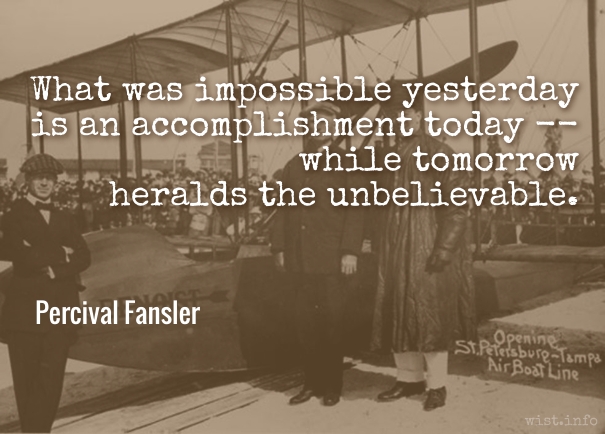
My faith in the future rests squarely on the belief that man, if he doesn’t first destroy himself, will find new answers in the universe, new technologies, new disciplines, which will contribute to a vastly different and better world in the twenty-first century. Recalling what has happened in my short lifetime in the fields of communication and transportation and the life sciences, I marvel at the pessimists who tell us that we have reached the end of our productive capacity, who project a future of primarily dividing up what we now have and making do with less. To my mind the single essential element on which all discoveries will be dependent is human freedom.
Barry Goldwater (1909-1998) American politician
With No Apologies (1979)

When I was younger, I thought I could change this world. Now I no longer think so but for emotional reasons I must keep on fighting a holding action.
Robert A. Heinlein (1907-1988) American writer
Friday [Dr. Baldwin] (1982)
No one really starts anything new, Mrs Nemur. Everyone builds on other men’s failures. There is nothing really original in science. What each man contributes to the sum of knowledge is what counts.
Daniel F. Keyes (1927-2014) American author
Flowers for Algernon (novel) (1966)
Human nature is at once sublime and horrible, holy and satanic. Apart from the accumulation of knowledge and experience, which are external and precarious acquisitions, there is no proof that we have changed much since the first stone age.
William Ralph Inge (1860-1954) English prelate [Dean Inge]
“Our Present Discontents,” Outspoken Essays: First Series (1919)
If I want to stop a research program I can always do it by getting a few experts to sit in on the subject, because they know right away that it was a fool thing to try in the first place.
Charles F. Kettering (1876-1958) American inventor, engineer, researcher, businessman
(Attributed)
The Road goes ever on and on
Down from the door where it began.
Now far ahead the Road has gone,
And I must follow, if I can,
Pursuing it with eager feet,
Until it joins some larger way,
Where many paths and errands meet.
And whither then? I cannot say.J.R.R. Tolkien (1892-1973) English writer, fabulist, philologist, academic [John Ronald Reuel Tolkien]
The Lord of the Rings, Vol. 1: The Fellowship of the Ring, Book 1, ch. 1 “A Long-expected Party” (1954)
(Source)
Sung by Bilbo as he leaves Bag End. Two chapters later, Frodo sings the same song when walking with Sam, Merry, and Pippin, but substitutes "weary" for "eager."
Substantial progress toward better things can rarely be taken without developing new evils requiring new remedies.
William Howard Taft (1857-1930) US President (1909-13) and Chief Justice (1921-1930)
Our Chief Magistrate and His Powers (1916)
You will never stub your toe standing still. The faster you go, the more chance there is of stubbing your toe, but the more chance you have of getting somewhere.
Charles F. Kettering (1876-1958) American inventor, engineer, researcher, businessman
(Attributed)
It’s important to remember that the relationship between different media tends to be complementary. When new media arrive they don’t necessarily replace or eradicate previous types. Though we should perhaps observe a half second silence for the eight-track. — There that’s done. What usually happens is that older media have to shuffle about a bit to make space for the new one and its particular advantages. Radio did not kill books and television did not kill radio or movies — what television did kill was the cinema newsreel.
Douglas Adams (1952-2001) English author, humorist, screenwriter
The Hitchhiker’s Guide to the Future (2001)
The man who sticks to his plan will become what he used to want to be.
James Richardson (b. 1950) American poet
Vectors: Aphorisms and Ten Second Essays, #349 (2001)
The world moves, and ideas that were good once are not always good.
Dwight David Eisenhower (1890-1969) American general, US President (1953-61)
News conference (31 Aug 1956)
The strife of the election is but human-nature practically applied to the facts of the case. What has occurred in this case, must ever recur in similar cases. Human-nature will not change. In any future great national trial, compared with the men of this, we shall have as weak, and as strong; as silly and as wise; as bad and good. Let us, therefore, study the incidents of this, as philosophy to learn wisdom from, and none of them as wrongs to be revenged.
Abraham Lincoln (1809-1865) American lawyer, politician, US President (1861-65)
Speech (1864-11-10), “Response to a Serenade,” Washington, D. C.
(Source)
Discussing the stresses and strains of holding federal elections, including for the Presidency, during the Civil War. Speech given from a White House window to a group of Pennsylvanians celebrating his re-election.

Clinging to the past is the problem. Embracing change is the answer.
Gloria Steinem (b. 1934) American feminist, journalist, activist
“Doing Sixty,” Moving Beyond Words (1994)

Person after person has said to me in these last few days that this new world we face terrifies them. I can understand how that feeling would arise unless one believes that men are capable of greatness beyond their past achievements. The times have usually brought us a leader when we needed him. The times now call for mankind as a whole to rise to great heights.
Eleanor Roosevelt (1884-1962) First Lady of the US (1933-45), politician, diplomat, activist
Column (1945-08-10), “My Day”
(Source)
After the dropping of the atomic bomb.

Man can learn nothing unless he proceeds from the known to the unknown.
Claude Bernard (1813-1878) French physiologist, scientist
Bulletin of New York Academy of Medicine, Vol. 4 (1928)
Bicycles are good exercise. And so is swinging through trees on your tail. Mankind has invested more than four million years of evolution in the attempt to avoid physical exertion. Now a group of backward-thinking atavists mounted on foot-powered pairs of Hula-Hoops would have us pumping our legs, gritting our teeth, and searing our lungs as though we were being chased across the Pleistocene savanna by saber-toothed tigers. Think of the hopes, the dreams, the effort, the brilliance, the pure force of will that, over the eons, has gone into the creation of the Cadillac Coupe de Ville. Bicycle riders would have us throw all this on the ash heap of history.
P. J. O'Rourke (b. 1947) American humorist, editor
“A Cool and Logical Analysis of the Bicycle Menace,” Republican Party Reptile (1987)

The cruelties and the obstacles of this swiftly changing planet will not yield to obsolete dogmas and outworn slogans. It cannot be moved by those who cling to a present which is already dying, who prefer the illusion of security to the excitement and danger which comes with even the most peaceful progress. This world demands the qualities of youth: not a time of life but a state of mind, a temper of the will, a quality of the imagination, a predominance of courage over timidity, of the appetite for adventure over the love of ease.
Robert Francis Kennedy (1925-1968) American politician
“Day of Affirmation,” address, University of Capetown, South Africa (6 Jun 1966)
(Source)
I think the authors of that notable instrument intended to include all men, but they did not mean to declare all men equal in all respects. They did not mean to say all men were equal in color, size, intellect, moral development, or social capacity. They defined with tolerable distinctness in what they did consider all men created equal — equal in “certain inalienable rights, among which are life, liberty, and the pursuit of happiness.” This they said, and this they meant. They did not mean to assert the obvious untruth that all were then actually enjoying that equality, or yet that they were about to confer it immediately upon them. In fact, they had no power to confer such a boon. They meant simply to declare the right, so that the enforcement of it might follow as fast as circumstances should permit. They meant to set up a standard maxim for free society which should be familiar to all, constantly looked to, constantly labored for, and even, though never perfectly attained, constantly approximated, and thereby constantly spreading and deepening its influence, and augmenting the happiness and value of life to all people, of all colors, everywhere.
All do not develop in the same manner, or at the same pace. Nations, like men, often march to the beat of different drummers, and the precise solutions of the United States can neither be dictated nor transplanted to others. What is important is that all nations must march toward increasing freedom; toward justice for all; toward a society strong and flexible enough to meet the demands of all its own people, and a world of immense and dizzying change.
Robert Francis Kennedy (1925-1968) American politician
“Day of Affirmation,” address, University of Capetown, South Africa (6 Jun 1966)
(Source)
That is the question of the New Frontier. That is the choice our nation must make — a choice that lies not merely between two men or two parties, but between the public interest and private comfort — between national greatness and national decline — between the fresh air of progress and the stale, dank atmosphere of “normalcy” — between determined dedication and creeping mediocrity. All mankind waits upon our decision. A whole world looks to see what we will do. We cannot fail their trust, we cannot fail to try.
John F. Kennedy (1917-1963) American politician, author, journalist, US President (1961–63)
“The New Frontier,” Presidential Nomination Acceptance Speech, Democratic National Convention, Los Angeles (15 Jul 1960)
But I tell you the New Frontier is here, whether we seek it or not. Beyond that frontier are the uncharted areas of science and space, unsolved problems of peace and war, unconquered pockets of ignorance and prejudice, unanswered questions of poverty and surplus. It would be easier to shrink back from that frontier, to look to the safe mediocrity of the past, to be lulled by good intentions and high rhetoric — and those who prefer that course should not cast their votes for me, regardless of party. But I believe the times demand new invention, innovation, imagination, decision. I am asking each of you to be pioneers on that New Frontier. My call is to the young in heart, regardless of age — to all who respond to the Scriptural call: “Be strong and of a good courage; be not afraid, neither be thou dismayed.” For courage — not complacency — is our need today — leadership — not salesmanship. And the only valid test of leadership is the ability to lead, and lead vigorously.
John F. Kennedy (1917-1963) American politician, author, journalist, US President (1961–63)
“The New Frontier,” Presidential Nomination Acceptance Speech, Democratic National Convention, Los Angeles (15 Jul 1960)
Do be kind to yourself. Fill pages as quickly as possible; double space, or write on every second line. Regard every new page as a small triumph.
Roddy Doyle (b. 1958) Irish novelist, dramatist, screenwriter
In “Ten Rules for Writing Fiction,” The Guardian (20 Feb 2010)
(Source)

He who is firmly seated in authority soon learns to think security, and not progress, the highest lesson of statecraft.
James Russell Lowell (1819-1891) American diplomat, essayist, poet
New England Two Centuries Ago (1865)
What Des-Cartes did was a good step. You have added much several ways, & especially in taking the colours of thin plates into philosophical consideration. If I have seen further it is by standing on the sholders of Giants.
Isaac Newton (1642-1727) English physicist and mathematician
Letter to Robert Hooke (5 Feb 1676)
In the Gregorian calendar, 15 Feb 1676.See Bernard of Chartres.

There should be no articles of faith in science, unless it be the faith that no discovery, no law, is so absolute that it cannot be superseded.
Anthony Storr (1920-2001) English psychiatrist and author
Feet of Clay: Saints, Sinners and Madmen, ch. 10 (1996)
(Source)
One grows or dies. There is no third possibility.
Oswald Spengler (1880–1936), German author
Aphorisms, #147 [tr. O’Brien (1967)]
But Goethe tells us in his greatest poem that Faust lost the liberty of his soul when he said to the passing moment: “Stay, thou art so fair.” And our liberty, too, is endangered if we pause for the passing moment, if we rest on our achievements, if we resist the pace of progress. Change is the law of life. And those who look only to the past or present are certain to miss the future.
John F. Kennedy (1917-1963) American politician, author, journalist, US President (1961–63)
Speech, Paulskirche, Frankfurt, Germany (25 Jun 1963)
(Source)
Variant in some locations: "... And those who look only to the past are certain to miss the future."
We are like dwarfs on the shoulders of giants, so that we can see more than them and things at a greater distance.
Bernard of Chartres (d. after 1124) French philosopher, scholar, administrator. [a.k.a. Bernardus Carnotensis]
(Attributed)
Attributed in John of Salisbury, The Metalogicon, 3.4 (1159).Paraphrase of this original: "Bernard of Chartres used to say that we [the Moderns] are like dwarves perched on the shoulders of giants [the Ancients], and thus we are able to see more and farther than the latter. And this is not at all because of the acuteness of our sight or the stature of our body, but because we are carried aloft and elevated by the magnitude of the giants."See here for more discussion. See also Isaac Newton.