

CLAUDIO: The miserable have no other medicine
But only hope.William Shakespeare (1564–1616) English dramatist and poet
Measure for Measure, Act 3, sc. 1, l. 2ff (3.1.2-3) (1604)
(Source)
Quotations by:
Shakespeare, William

DUKE:If thou art rich, thou ’rt poor,
For, like an ass whose back with ingots bows,
Thou bear’st thy heavy riches but a journey,
And death unloads thee.William Shakespeare (1564–1616) English dramatist and poet
Measure for Measure, Act 3, sc. 1, l. 26ff (3.1.26-29) (1604)
(Source)
In his guise as a friar.
DUKE: O, what may man within him hide,
Though angel on the outward side!William Shakespeare (1564–1616) English dramatist and poet
Measure for Measure, Act 3, sc. 2, l. 271ff (3.2.271-272) (1604)
(Source)
ISABELLA:Truth is truth
To the very end of reckoning.William Shakespeare (1564–1616) English dramatist and poet
Measure for Measure, Act 5, sc. 1, l. 51ff (5.1.51-52) (1604)
(Source)
ANTONIO: Mark you this, Bassanio,
The devil can cite Scripture for his purpose.
An evil soul, producing holy witness,
Is like a villain with a smiling cheek,
A goodly apple rotten at the heart.
O, what a goodly outside falsehood hath!William Shakespeare (1564–1616) English dramatist and poet
Merchant of Venice, Act 1, sc. 3, l. 106ff (1.3.106-111) (1597)
(Source)
JESSICA: But love is blind, and lovers cannot see
The pretty follies that themselves commit.William Shakespeare (1564–1616) English dramatist and poet
Merchant of Venice, Act 2, sc. 6, l. 37ff (2.6.37-38) (1597)
(Source)
One of several times Shakespeare used the phrase, "Love is blind." He popularized it, but it was first used by Chaucer around 1404 in "The Merchant's Tale" ("For loue is blynd alday ...").
SHYLOCK: He hath disgraced me and
hindered me half a million, laughed at my losses,
mocked at my gains, scorned my nation, thwarted
my bargains, cooled my friends, heated mine enemies —
and what’s his reason? I am a Jew. Hath not
a Jew eyes? Hath not a Jew hands, organs, dimensions,
senses, affections, passions? Fed with the
same food, hurt with the same weapons, subject to
the same diseases, healed by the same means,
warmed and cooled by the same winter and summer
as a Christian is? If you prick us, do we not
bleed? If you tickle us, do we not laugh? If you
poison us, do we not die? And if you wrong us, shall
we not revenge? If we are like you in the rest, we will
resemble you in that. If a Jew wrong a Christian,
what is his humility? Revenge. If a Christian wrong
a Jew, what should his sufferance be by Christian
example? Why, revenge! The villainy you teach me I
will execute, and it shall go hard but I will better the
instruction.William Shakespeare (1564–1616) English dramatist and poet
Merchant of Venice, Act 3, sc. 1, l. 53ff (3.1.53-72) (1597)
(Source)
BASSANIO: In law, what plea so tainted and corrupt
But, being seasoned with a gracious voice,
Obscures the show of evil?William Shakespeare (1564–1616) English dramatist and poet
Merchant of Venice, Act 3, sc. 2, l. 77ff (3.2.77-79) (1597)
(Source)
SHYLOCK: Thou call’dst me dog before thou hadst a cause,
But since I am a dog, beware my fangs.William Shakespeare (1564–1616) English dramatist and poet
Merchant of Venice, Act 3, sc. 3, l. 7ff (3.3.7-8) (1597)
(Source)
PORTIA: The quality of mercy is not strained.
It droppeth as the gentle rain from heaven
Upon the place beneath. It is twice blest:
It blesseth him that gives and him that takes.
’Tis mightiest in the mightiest; it becomes
The thronèd monarch better than his crown.
His scepter shows the force of temporal power,
The attribute to awe and majesty
Wherein doth sit the dread and fear of kings;
But mercy is above this sceptered sway.
It is enthronèd in the hearts of kings;
It is an attribute to God Himself;
And earthly power doth then show likest God’s
When mercy seasons justice.William Shakespeare (1564–1616) English dramatist and poet
Merchant of Venice, Act 4, sc. 1, l. 190ff (4.1.190-203) (1597)
(Source)
PORTIA: Though justice be thy plea, consider this:
That in the course of justice none of us
Should see salvation. We do pray for mercy,
And that same prayer doth teach us all to render
The deeds of mercy.William Shakespeare (1564–1616) English dramatist and poet
Merchant of Venice, Act 4, sc. 1, l. 204ff (4.1.204-208) (1597)
(Source)
LORENZO: The man that hath no music in himself,
Nor is not moved with concord of sweet sounds,
Is fit for treasons, stratagems, and spoils;
The motions of his spirit are dull as night,
And his affections dark as Erebus.
Let no such man be trusted. Mark the music.William Shakespeare (1564–1616) English dramatist and poet
Merchant of Venice, Act 5, sc. 1, l. 92ff (5.1.92-97) (1597)
(Source)
PORTIA: How far that little candle throws his beams!
So shines a good deed in a weary world.
William Shakespeare (1564–1616) English dramatist and poet
Merchant of Venice, Act 5, sc. 1, l. 99ff (5.1.99-100) (1597)
(Source)
In some versions, "So shines a good deed in a naughty world."
Sometimes misattributed to Roald Dahl (or even Gene Wilder); the character Willy Wonka uses the second sentence toward the end of the film Willy Wonka and the Chocolate Factory (1971).

FALSTAFF:Setting the attractions of
my good parts aside, I have no other charms.William Shakespeare (1564–1616) English dramatist and poet
Merry Wives of Windsor, Act 2, sc. 2, l. 105ff (2.2.105-106) (1597)
(Source)
FORD: Better three hours too soon than a minute too late.
William Shakespeare (1564–1616) English dramatist and poet
Merry Wives of Windsor, Act 2, sc. 2, l. 319 (2.2.319) (1597)
(Source)
FALSTAFF:O powerful love,
that in some respects makes a beast a man, in
some other a man a beast!William Shakespeare (1564–1616) English dramatist and poet
Merry Wives of Windsor, Act 5, sc. 5, l. 4ff (5.5.4-6) (1597)
(Source)
FALSTAFF: I think the devil will not have me damned, lest the oil that’s in me should set hell on fire.
William Shakespeare (1564–1616) English dramatist and poet
Merry Wives of Windsor, Act 5, sc. 5, l. 37ff (5.5.37-38) (1597)
(Source)
THESEUS: Lovers and madmen have seething brains,
Such shaping fantasies, that apprehend
More than cool reason ever comprehends.William Shakespeare (1564–1616) English dramatist and poet
Midsummer Night’s Dream, Act 5, sc. 1, l. 4 (5.1.4-6) (1605)
(Source)
HELENA: Things base and vile, holding no quantity,
Love can transpose to form and dignity.
Love looks not with the eyes but with the mind;
And therefore is winged Cupid painted blind.
Nor hath Love’s mind of any judgment taste.
Wings, and no eyes, figure unheedy haste.
And therefore is Love said to be a child
Because in choice he is so oft beguiled.William Shakespeare (1564–1616) English dramatist and poet
Midsummer Night’s Dream, Act 1, sc. 1, ll. 238ff (1.1.238-245) (1605)
(Source)
ROBIN: And those things do best please me
That befall prepost’rously.William Shakespeare (1564–1616) English dramatist and poet
Midsummer Night’s Dream, Act 3, sc. 2, ll. 122ff (3.2.122-123) (1605)
(Source)
THESEUS: Lovers and madmen have such seething brains,
Such shaping fantasies, that apprehend
More than cool reason ever comprehends.
The lunatic, the lover, and the poet
Are of imagination all compact.William Shakespeare (1564–1616) English dramatist and poet
Midsummer Night’s Dream, Act 5, sc. 1, ll. 4ff (5.1.4-8) (1605)
(Source)
THESEUS: The poet’s eye, in a fine frenzy rolling,
Doth glance from heaven to Earth, from Earth to heaven,
And as imagination bodies forth
The forms of things unknown, the poet’s pen
Turns them to shapes and gives to airy nothing
A local habitation and a name.William Shakespeare (1564–1616) English dramatist and poet
Midsummer Night’s Dream, Act 5, sc. 1, ll. 10ff (5.1.10-14) (1605)
(Source)
BEATRICE: He wears his faith but
as the fashion of his hat; it ever changes with the
next block.William Shakespeare (1564–1616) English dramatist and poet
Much Ado About Nothing, Act 1, sc. 1, l. 73ff (1.1.73-75) (1598)
(Source)
MESSENGER: I see, lady, the gentleman is not in your books.
BEATRICE: No. An he were, I would burn my study.
William Shakespeare (1564–1616) English dramatist and poet
Much Ado About Nothing, Act 1, sc. 1, l. 76ff (1.1.76-78) (1598)
(Source)
BENEDICK: What, my dear Lady Disdain! Are you yet living?
BEATRICE: Is it possible disdain should die while she hath such meet food to feed it as Signior Benedick? Courtesy itself must convert to disdain, if you come in her presence.
William Shakespeare (1564–1616) English dramatist and poet
Much Ado About Nothing, Act 1, sc. 1, l. 116ff (1.1.116-121) (1598)
(Source)
BEATRICE: I had rather hear my dog bark at a crow than a man swear he loves me.
William Shakespeare (1564–1616) English dramatist and poet
Much Ado About Nothing, Act 1, sc. 1, l. 129ff (1.1.120-130) (1598)
(Source)
PRINCE: In time the savage bull doth bear the yoke.
BENEDICK The savage bull may, but if ever the sensible Benedick bear it, pluck off the bull’s horns and set them in my forehead, and let me be vilely painted, and in such great letters as they write “Here is good horse to hire” let them signify under my sign “Here you may see Benedick the married man.”
William Shakespeare (1564–1616) English dramatist and poet
Much Ado About Nothing, Act 1, sc. 1, l. 256ff (1.1.256-262) (1598)
(Source)
BEATRICE: He that hath a beard is more than a youth, and he that hath no beard is less than a man.
William Shakespeare (1564–1616) English dramatist and poet
Much Ado About Nothing, Act 2, sc. 1, l. 36ff (2.1.36-37) (1598)
(Source)
PRINCE: Your silence most offends me, and to be merry best becomes you; for, out o’ question, you were born in a merry hour.
BEATRICE: No, sure, my lord, my mother cried, but then there was a star danced, and under that was I born.
William Shakespeare (1564–1616) English dramatist and poet
Much Ado About Nothing, Act 2, sc. 1, l. 324ff (2.1.324-329) (1598)
(Source)
BALTHAZAR: Sigh no more, ladies, sigh no more,
Men were deceivers ever,
One foot in sea and one on shore,
To one thing constant never.
Then sigh not so, but let them go,
And be you blithe and bonny,
Converting all your sounds of woe
Into Hey, nonny nonny.William Shakespeare (1564–1616) English dramatist and poet
Much Ado About Nothing, Act 2, sc. 3, l. 64ff (2.3.64-71) (1598)
"Hey, nonny nonny" was a nonsense refrain popular in English music during the Elizabethan era; in context here, it means stop grieving over the guy that dumped you and put that effort instead into some merry-making and song. Music historian Ross Duffin believes the form of Balthazar's tune fits a popular song of the Tudor period, "The Lusty Gallant."
HERO: If it prove so, then loving goes by haps;
Some Cupid kills with arrows, some with traps.William Shakespeare (1564–1616) English dramatist and poet
Much Ado About Nothing, Act 3, sc. 1, l. 111ff (3.1.111-112) (1598)
(Source)
For "haps" read "happenstance" or "chance." Often elided in the front to "Love goes by haps ...."
BENEDICK: Well, everyone can master a grief but he that has it.
William Shakespeare (1564–1616) English dramatist and poet
Much Ado About Nothing, Act 3, sc. 2, l. 27ff (3.2.27-28) (1598)
(Source)

CONRADE: The fashion wears out more apparel than the man.
William Shakespeare (1564–1616) English dramatist and poet
Much Ado About Nothing, Act 3, sc. 3, l. 139 (3.3.139) (1598)
(Source)
CLAUDIO: O, what men dare do! What men may do!
What men daily do, not knowing what they do!William Shakespeare (1564–1616) English dramatist and poet
Much Ado About Nothing, Act 4, sc. 1, l. 19ff (4.1.19-20) (1598)
(Source)
CLAUDIO: O, what authority and show of truth
Can cunning sin cover itself withal!William Shakespeare (1564–1616) English dramatist and poet
Much Ado About Nothing, Act 4, sc. 1, l. 35ff (4.1.35-36) (1598)
(Source)
FRIAR: For it so falls out
That what we have we prize not to the worth,
Whiles we enjoy it, but being lacked and lost,
Why then we rack the value, then we find
The virtue that possession would not show us
Whiles it was ours.William Shakespeare (1564–1616) English dramatist and poet
Much Ado About Nothing, Act 4, sc. 1, l. 228ff (4.1.228-233) (1598)
(Source)
LEONATO:For, brother, men
Can counsel, and speak comfort to that grief
Which they themselves not feel.William Shakespeare (1564–1616) English dramatist and poet
Much Ado About Nothing, Act 5, sc. 1, l. 22ff (5.1.22-24) (1598)
(Source)
LEONATO: No, no, t’is all men’s office to speak patience
To those that wring under the load of sorrow;
But no man’s virtue nor sufficiency,
To be so moral, when he shall endure
The like himself.William Shakespeare (1564–1616) English dramatist and poet
Much Ado About Nothing, Act 5, sc. 1, l. 29ff (5.1.29-33) (1598)
(Source)
LEONATO: For there was never a philosopher
That could endure the toothache patiently.William Shakespeare (1564–1616) English dramatist and poet
Much Ado About Nothing, Act 5, sc. 1, l. 37ff (5.1.37-38) (1598)
(Source)
IAGO: I am one, sir, that comes to tell you your daughter and the Moor are now making the beast with two backs.
William Shakespeare (1564–1616) English dramatist and poet
Othello, Act 1, sc. 1, l. 129ff (1.1.129-131) (1603)
(Source)
Speaking to Desdemona's father, the senator Brabantio. Earliest recorded use of "beast with two backs" in English; though Rabelais used it in Gargantua and Pantagruel (c. 1532), but that is not known to have been translated to English until the late 17th Century. (More info here).
DUKE: To mourn a mischief that is past and gone
Is the next way to draw new mischief on.William Shakespeare (1564–1616) English dramatist and poet
Othello, Act 1, sc. 3, l. 234ff (1.3.234-235) (1603)
(Source)
DUKE: The robbed that smiles steals something from the thief.
William Shakespeare (1564–1616) English dramatist and poet
Othello, Act 1, sc. 3, l. 238 (1.3.238) (1603)
(Source)
IAGO: Our bodies are our gardens, to the which our wills are gardeners.
William Shakespeare (1564–1616) English dramatist and poet
Othello, Act 1, sc. 3, l. 362ff (1.3.362-363) (1603)
(Source)
IAGO: How poor are they that have not patience!
What wound did ever heal but by degrees?William Shakespeare (1564–1616) English dramatist and poet
Othello, Act 2, sc. 3, l. 391ff (2.3.391-392) (1603)
(Source)
IAGO: Pleasure and action make the hours seem short.
William Shakespeare (1564–1616) English dramatist and poet
Othello, Act 2, sc. 3, l. 400 (2.3.400) (1603)
(Source)
IAGO: Good name in man and woman, dear my lord,
Is the immediate jewel of their souls.
Who steals my purse steals trash. ’Tis something, nothing;
’Twas mine, ’tis his, and has been slave to thousands.
But he that filches from me my good name
Robs me of that which not enriches him
And makes me poor indeed.William Shakespeare (1564–1616) English dramatist and poet
Othello, Act 3, sc. 3, l. 182ff (3.3.182-188) (1603)
(Source)
IAGO: Poor and content is rich, and rich enough;
But riches fineless is as poor as winter
To him that ever fears he shall be poor.William Shakespeare (1564–1616) English dramatist and poet
Othello, Act 3, sc. 3, l. 202ff (3.3.202-204) (1603)
(Source)
IAGO: O, beware, my lord, of jealousy!
It is the green-eyed monster which doth mock
The meat it feeds on.William Shakespeare (1564–1616) English dramatist and poet
Othello, Act 3, sc. 3, ll. 195ff (3.3.195-197) (1603)
(Source)
Probable origin not just of the term "green-eyed monster" for jealousy / envy, but (along with his previous use of "green-eyed jealousy" in The Merchant of Venice, 3.2.113) of the association of the color green with the emotion.
DESDEMONA: Upon my knees, what doth your speech import?
I understand a fury in your words,
But not the words.William Shakespeare (1564–1616) English dramatist and poet
Othello, Act 4, sc. 2, l. 37ff (4.2.37-39) (1603)
(Source)
PERICLES: Few love to hear the sins they love to act.
William Shakespeare (1564–1616) English dramatist and poet
Pericles, Act 1, sc. 1, l. 95 (1.1.95) (1607) [with George Wilkins]
(Source)
PERICLES: Kings are Earth’s gods; in vice their law’s their will;
And if Jove stray, who dares say Jove doth ill?William Shakespeare (1564–1616) English dramatist and poet
Pericles, Act 1, sc. 1, l. 108ff (1.1.108-109) (1607) [with George Wilkins]
(Source)
PERICLES:But thou know’st this:
’Tis time to fear when tyrants seems to kiss.William Shakespeare (1564–1616) English dramatist and poet
Pericles, Act 1, sc. 2, l. 84ff (1.1.84-86) (1607) [with George Wilkins]
(Source)
PERICLES: I knew him tyrannous, and tyrants’ fears
Decrease not but grow faster than the years.William Shakespeare (1564–1616) English dramatist and poet
Pericles, Act 1, sc. 2, l. 91ff (1.2.91-92) (1607) [with George Wilkins]
(Source)
THIRD FISHERMAN: Master, I marvel how the fishes live in the sea.
FIRST FISHERMAN: Why, as men do a-land: the great ones eat up the little ones.William Shakespeare (1564–1616) English dramatist and poet
Pericles, Act 2, sc. 1, l. 28ff (2.1.28-29) [with George Wilkins]
(Source)
PERICLES: I see that Time’s the king of men,
For he’s their parent, and he is their grave,
And gives them what he will, not what they crave.William Shakespeare (1564–1616) English dramatist and poet
Pericles, Act 2, sc. 3, l. 49ff (2.3.49-51) (1607) [with George Wilkins]
(Source)
KING RICHARD: In rage, deaf as the sea, hasty as fire.
William Shakespeare (1564–1616) English dramatist and poet
Richard II, Act 1, sc. 1, l. 20 (1.1.20) (1595)
(Source)
On the disputants coming before him, Bolingbroke and Mowbray.
KING RICHARD: Wrath-kindled gentlemen, be ruled by me.
Let’s purge this choler without letting blood.
This we prescribe, though no physician.
Deep malice makes too deep incision.
Forget, forgive; conclude and be agreed.
Our doctors say this is no month to bleed.William Shakespeare (1564–1616) English dramatist and poet
Richard II, Act 1, sc. 1, l. 156ff (1.1.56) (1595)
(Source)
In one of his more lucid (and early) moments of the play, Richard tries to calm the dispute between Bolingbroke and Mowbray.
BOLINGBROKE: Grief makes one hour ten.
William Shakespeare (1564–1616) English dramatist and poet
Richard II, Act 1, sc. 2, l. 267 (1.2.267) (1595)
(Source)
BOLINGBROKE: How long a time lies in one little word!
Four lagging winters and four wanton springs
End in a word; such is the breath of kings.William Shakespeare (1564–1616) English dramatist and poet
Richard II, Act 1, sc. 3, l. 218ff (1.3.218-220) (1595)
(Source)
After King Richard casually reduces his banishment of Bolingbroke from ten years to six.
KING RICHARD: Why, uncle, thou hast many years to live.
GAUNT: But not a minute, king, that thou canst give.
William Shakespeare (1564–1616) English dramatist and poet
Richard II, Act 1, sc. 3, l. 231ff (1.3.231-232) (1595)
(Source)
GAUNT: What is six winters? They are quickly gone.
BOLINGBROKE: To men in joy; but grief makes one hour ten.
William Shakespeare (1564–1616) English dramatist and poet
Richard II, Act 1, sc. 3, l. 266ff (1.3.266-267) (1595)
(Source)
BOLINGBROKE: O, who can hold a fire in his hand
By thinking on the frosty Caucasus?
Or cloy the hungry edge of appetite
By bare imagination of a feast?
Or wallow naked in December snow
By thinking on fantastic summer’s heat?
O no, the apprehension of the good
Gives but the greater feeling to the worse.
Fell sorrow’s tooth doth never rankle more
Than when he bites but lanceth not the sore.William Shakespeare (1564–1616) English dramatist and poet
Richard II, Act 1, sc. 3, l. 301ff (1.3.301-310) (1595)
(Source)
GAUNT: His rash fierce blaze of riot cannot last,
For violent fires soon burn out themselves;
Small showers last long, but sudden storms are short;
He tires betimes that spurs too fast betimes;
With eager feeding food doth choke the feeder;
Light vanity, insatiate cormorant,
Consuming means, soon preys upon itself.William Shakespeare (1564–1616) English dramatist and poet
Richard II, Act 2, sc. 1, l. 37ff (2.1.37-44) (1595)
(Source)
GAUNT: This royal throne of kings, this sceptered isle,
This earth of majesty, this seat of Mars,
This other Eden, demi-paradise,
This fortress built by Nature for herself
Against infection and the hand of war,
This happy breed of men, this little world,
This precious stone set in the silver sea,
Which serves it in the office of a wall
Or as a moat defensive to a house,
Against the envy of less happier lands,
This blessèd plot, this earth, this realm, this England ….William Shakespeare (1564–1616) English dramatist and poet
Richard II, Act 2, sc. 1, l. 45ff (2.1.45-56) (1595)
(Source)
QUEEN: Uncle, for God’s sake speak comfortable words.
YORK: Should I do so, I should belie my thoughts.
Comfort’s in heaven, and we are on the Earth,
Where nothing lives but crosses, cares, and grief.William Shakespeare (1564–1616) English dramatist and poet
Richard II, Act 2, sc. 2, l. 82ff (2.2.82-83) (1595)
(Source)
YOKE: Things past redress are now with me past care.
William Shakespeare (1564–1616) English dramatist and poet
Richard II, Act 2, sc. 3, l. 175 (2.3.175) (1595)
(Source)
KING RICHARD: Not all the water in the rough rude sea
Can wash the balm off from an anointed king.
The breath of worldly men cannot depose
The deputy elected by the Lord.
For every man that Bolingbroke hath pressed
To lift shrewd steel against our golden crown,
God for His Richard hath in heavenly pay
A glorious angel. Then, if angels fight,
Weak men must fall, for heaven still guards the right.William Shakespeare (1564–1616) English dramatist and poet
Richard II, Act 3, sc. 2, l. 55ff (3.2.55) (1595)
(Source)
Richard makes his case for the Divine Right of Kings. He is then immediately informed that the non-angelic armies he was counting on to fight Bolingbroke aren't coming.
SALISBURY: O, call back yesterday, bid time return ….
William Shakespeare (1564–1616) English dramatist and poet
Richard II, Act 3, sc. 2, l. 70 (3.2.50) (1595)
(Source)
Telling Richard it would have been great if the king had returned from his Irish wars a day earlier, because yesterday his waiting army of Welshmen went over to Bolingbroke's side, having heard a rumor that Richard was dead.
KING RICHARD: For God’s sake, let us sit upon the ground
And tell sad stories of the death of kings —
How some have been deposed, some slain in war,
Some haunted by the ghosts they have deposed,
Some poisoned by their wives, some sleeping killed,
All murdered.William Shakespeare (1564–1616) English dramatist and poet
Richard II, Act 3, sc. 2, l. 160ff (3.2.160-165) (1595)
(Source)
KING RICHARD: For within the hollow crown
That rounds the mortal temples of a king
Keeps Death his court, and there the antic sits,
Scoffing his state and grinning at his pomp,
Allowing him a breath, a little scene,
To monarchize, be feared, and kill with looks,
Infusing him with self and vain conceit,
As if this flesh which walls about our life
Were brass impregnable; and humored thus,
Comes at the last and with a little pin
Bores through his castle wall, and farewell, king!William Shakespeare (1564–1616) English dramatist and poet
Richard II, Act 3, sc. 2, l. 165ff (3.2.165-175) (1595)
(Source)
KING RICHARD: You may my glories and my state depose
But not my griefs; still am I king of those.William Shakespeare (1564–1616) English dramatist and poet
Richard II, Act 4, sc. 1, l. 201ff (4.1.201-202) (1595)
(Source)
When Bolingbroke questions Richard's willingness to abdicate while grieving over the loss.
Go thou and fill another room in hell.
William Shakespeare (1564–1616) English dramatist and poet
Richard II, Act 5, sc. 1, l. 110 (5.1.110) (1595)
(Source)
Killing one of his would-be assassins with the killer's own weapon.
RICHARD: I wasted time, and now doth time waste me.
William Shakespeare (1564–1616) English dramatist and poet
Richard II, Act 5, sc. 5, l. 50 (5.5.50) (1595)
(Source)
In his prison cell.
KING HENRY: Though I did wish him dead,
I hate the murderer, love him murderèd.William Shakespeare (1564–1616) English dramatist and poet
Richard II, Act 5, sc. 6, l. 39ff (5.6.39-40) (1595)
(Source)
RICHARD: And therefore, since I cannot prove a lover
To entertain these fair well-spoken days,
I am determinèd to prove a villain
And hate the idle pleasures of these days.William Shakespeare (1564–1616) English dramatist and poet
Richard III, Act 1, sc. 1, l. 28ff (1.1.28-31) (1592)
(Source)
RICHARD: Plots have I laid, inductions dangerous,
By drunken prophecies, libels, and dreams ….William Shakespeare (1564–1616) English dramatist and poet
Richard III, Act 1, sc. 1, l. 32ff (1.1.32) (1592)
(Source)
RICHARD: But shall I live in hope?
LADY ANNE: All men, I hope, live so.William Shakespeare (1564–1616) English dramatist and poet
Richard III, Act 1, sc. 2, l. 218ff (1.2.218-219) (1592)
(Source)
RICHARD: Shall I be plain? I wish the bastards dead;
And I would have it suddenly performed.William Shakespeare (1564–1616) English dramatist and poet
Richard III, Act 4, sc. 2, l. 20ff (4.2.20-21) (1592)
(Source)
Ordering Buckingham to kill the two Princes in the Tower.
RICHARD: Conscience is but a word that cowards use,
Devised at first to keep the strong in awe:
Our strong arms be our conscience, swords our law.William Shakespeare (1564–1616) English dramatist and poet
Richard III, Act 5, sc. 3, l. 327ff (5.3.327-329) (1592)
(Source)
MERCUTIO:Come, we burn daylight, ho!
ROMEO: Nay, that’s not so.
MERCUTIO:I mean, sir, in delay.
We waste our lights in vain, light lights by day.William Shakespeare (1564–1616) English dramatist and poet
Romeo and Juliet, Act 1, sc. 4, l. 44ff (1.4.44-47) (1595)
(Source)
Other sources give the last line as "... like lamps by day."
Shakespeare is the earliest written source of the phrase "burn(ing) daylight." He used it again two years later in Merry Wives of Windsor (2.1), where Mistress Ford says, "We burn daylight" (without Mercutio's explanation).
FRIAR LAWRENCE: Virtue itself turns vice, being misapplied,
And vice sometime by action dignified.William Shakespeare (1564–1616) English dramatist and poet
Romeo and Juliet, Act 2, sc. 2, l. 21ff (2.2.21-22) (c. 1594)
(Source)
JULIET: What’s in a name? That which we call a rose
By any other word would smell as sweet.William Shakespeare (1564–1616) English dramatist and poet
Romeo and Juliet, Act 2, sc. 2, l. 46ff (2.2.46-47) (c. 1594)
(Source)
JULIET:Although I joy in thee,
I have no joy of this contract tonight.
It is too rash, too unadvised, too sudden,
Too like the lightning, which doth cease to be
Ere one can say “It lightens.”William Shakespeare (1564–1616) English dramatist and poet
Romeo and Juliet, Act 2, sc. 2, l. 123ff (2.2.123-127) (1595)
(Source)
On Romeo swearing his love to her.
JULIET: My bounty is as boundless as the sea,
My love as deep; the more I give to thee,
The more I have, for both are infinite.William Shakespeare (1564–1616) English dramatist and poet
Romeo and Juliet, Act 2, sc. 2, l. 139ff (2.2.139-141) (c. 1594)
(Source)
JULIET: Good night, good night. Parting is such sweet sorrow
That I shall say “Good night” till it be morrow.William Shakespeare (1564–1616) English dramatist and poet
Romeo and Juliet, Act 2, sc. 2, l. 199ff (2.2.199-200) (c. 1594)
(Source)
ROMEO: Sleep dwell upon thine eyes, peace in thy breast.
William Shakespeare (1564–1616) English dramatist and poet
Romeo and Juliet, Act 2, sc. 2, l. 202 (2.2.202) (c. 1594)
(Source)
FRIAR LAWRENCE: These violent delights have violent ends
And in their triumph die, like fire and powder,
Which, as they kiss, consume.William Shakespeare (1564–1616) English dramatist and poet
Romeo and Juliet, Act 2, sc. 6, l. 9ff (2.6.9-11) (1595)
(Source)
Urging Romeo to moderate his reckless passion for Juliet.
SIR THOMAS MORE: Say now the king
(As he is clement, if th’ offender mourn)
Should so much come to short of your great trespass
As but to banish you, whether would you go?
What country, by the nature of your error,
Should give you harbor? Go you to France or Flanders,
To any German province, to Spain or Portugal,
Nay, any where that not adheres to England, —
Why, you must needs be strangers. Would you be pleased
To find a nation of such barbarous temper,
That, breaking out in hideous violence,
Would not afford you an abode on earth,
Whet their detested knives against your throats,
Spurn you like dogs, and like as if that God
Owed not nor made not you, nor that the claimants
Were not all appropriate to your comforts,
But chartered unto them, what would you think
To be thus used? This is the strangers’ case;
And this your mountanish inhumanity.William Shakespeare (1564–1616) English dramatist and poet
Sir Thomas More, Act 2, sc. 4, l. 105ff (c. 1592)
(Source)
Quelling rioting Englishmen who were demanding the expulsion of Flemish immigrants, telling them to consider what they themselves might do, and the conditions they might face, if they were forced to leave England.
The play was written by Anthony Munday and Henry Chettle, with revisions and edits by multiple writers. This particular scene and monologue are in what is considered to be Shakespeare's own hand.
SIR THOMAS MORE: Grant them removed, and grant that this your noise
Hath chid down all the majesty of England;
Imagine that you see the wretched strangers,
Their babies at their backs and their poor luggage,
Plodding tooth ports and costs for transportation,
And that you sit as kings in your desires,
Authority quite silent by your brawl,
And you in ruff of your opinions clothed;
What had you got? I’ll tell you. You had taught
How insolence and strong hand should prevail,
How order should be quelled; and by this pattern
Not one of you should live an aged man,
For other ruffians, as their fancies wrought,
With self same hand, self reasons, and self right,
Would shark on you, and men like ravenous fishes
Would feed on one another.William Shakespeare (1564–1616) English dramatist and poet
Sir Thomas More, Act 2, sc. 4, l. 55ff (c. 1592)
(Source)
Quelling rioting Englishmen who were demanding the expulsion of Flemish immigrants, noting that being part of pitiless mob violence makes one a target for future violence by others.
The play was written by Anthony Munday and Henry Chettle, with revisions and edits by multiple writers. This particular scene and monologue are in what is considered to be Shakespeare's own hand.
HORTENSIO: There’s small choice in rotten apples.
William Shakespeare (1564–1616) English dramatist and poet
Taming of the Shrew, Act 1, sc. 1, l. 136 (1.1.136) (c. 1591))
(Source)
GREMIO:He took the bride about the neck
And kissed her lips with such a clamorous smack
That at the parting all the church did echo.William Shakespeare (1564–1616) English dramatist and poet
Taming of the Shrew, Act 3, sc. 2, l. 179ff (3.2.179-181) (c. 1591))
(Source)
MESSENGER: Frame your mind to mirth and merriment,
Which bars a thousand harms, and lengthens life.William Shakespeare (1564–1616) English dramatist and poet
Taming of the Shrew, Induction, sc. 2, l. 137ff (c. 1591)
(Source)
ARIEL: All hail, great master! Grave sir, hail! I come
To answer thy best pleasure. Be ’t to fly,
To swim, to dive into the fire, to ride
On the curled clouds, to thy strong bidding task
Ariel and all his quality.William Shakespeare (1564–1616) English dramatist and poet
Tempest, Act 1, sc. 2, l. 224ff (1.2.224-228) (1611)
(Source)
ARIEL:Not a soul
But felt a fever of the mad, and played
Some tricks of desperation. All but mariners
Plunged in the foaming brine and quit the vessel,
Then all afire with me. The King’s son, Ferdinand,
With hair up-staring — then like reeds, not hair —
Was the first man that leaped; cried “Hell is empty,
And all the devils are here.”William Shakespeare (1564–1616) English dramatist and poet
Tempest, Act 1, sc. 2, l. 246ff (1.2.246-253) (1611)
(Source)
Ariel telling Prospero of the effects of the conjured tempest, and Ariel's tricks, on the crew of the ship.
ARIEL: Full fathom five thy father lies.
Of his bones are coral made;
Those are pearls that were his eyes.
Nothing of him that doth fade,
But doth suffer a sea change
Into something rich and strange.
Sea-nymphs hourly ring his knell.
Ding dong.
Hark, now I hear them — ding dong, bell.William Shakespeare (1564–1616) English dramatist and poet
Tempest, Act 1, sc. 2, l. 474ff (1.2.474-482) (1611)
(Source)
Mysterious song from the invisible sprite to Ferdinand.
ANTONIO: We all were sea-swallowed, though some cast again,
And by that destiny to perform an act
Whereof what’s past is prologue, what to come
In yours and my discharge.William Shakespeare (1564–1616) English dramatist and poet
Tempest, Act 2, sc. 1, l. 287ff (2.1.287-290) (1611)
(Source)
ARIEL: While you here do snoring lie,
Open-eyed conspiracy
His time doth take.
If of life you keep a care,
Shake off slumber and beware.
Awake, awake!William Shakespeare (1564–1616) English dramatist and poet
Tempest, Act 2, sc. 1, l. 344ff (2.1.344-349) (1611)
(Source)
Warning the sleeping Gonzalo of Antonio and Sebastian's plot to kill Alonso.
MIRANDA: Do you love me?
FERDINAND: O heaven, O Earth, bear witness to this sound,
And crown what I profess with kind event
If I speak true; if hollowly, invert
What best is boded me to mischief. I,
Beyond all limit of what else i’ th’ world,
Do love, prize, honor you.William Shakespeare (1564–1616) English dramatist and poet
Tempest, Act 3, sc. 1, l. 80ff (3.1.80-86) (1611)
(Source)
PROSPERO: Our revels now are ended. These our actors,
As I foretold you, were all spirits and
Are melted into air, into thin air;
And like the baseless fabric of this vision,
The cloud-capped towers, the gorgeous palaces,
The solemn temples, the great globe itself,
Yea, all which it inherit, shall dissolve,
And, like this insubstantial pageant faded,
Leave not a rack behind. We are such stuff
As dreams are made on, and our little life
Is rounded with a sleep.William Shakespeare (1564–1616) English dramatist and poet
Tempest, Act 4, sc. 1, l. 165ff (4.1.165-175) (1611)
(Source)
PROSPERO: Though with their high wrongs I am struck to th’ quick,
Yet with my nobler reason ’gainst my fury
Do I take part. The rarer action is
In virtue than in vengeance.William Shakespeare (1564–1616) English dramatist and poet
Tempest, Act 5, sc. 1, l. 32ff (5.1.32-36) (1611)
(Source)
PROSPERO: As you from crimes would pardoned be,
Let your indulgence set me free.William Shakespeare (1564–1616) English dramatist and poet
Tempest, Epilogue, l. 19ff (1611)
(Source)
Final lines of the play, to the Audience.
PROSPERO:My library
Was dukedom large enough.William Shakespeare (1564–1616) English dramatist and poet
Tempest, Act 1, sc. 2, l. 130ff (1.2.130-131) (1611)
(Source)
GONZALO: Beseech you, sir, be merry. You have cause —
So have we all — of joy, for our escape
Is much beyond our loss. Our hint of woe
Is common; every day some sailor’s wife,
The masters of some merchant, and the merchant
Have just our theme of woe. But for the miracle —
I mean our preservation — few in millions
Can speak like us. Then wisely, good sir, weigh
Our sorrow with our comfort.William Shakespeare (1564–1616) English dramatist and poet
Tempest, Act 2, sc. 1, l. 1ff (2.1.1-9) (1611)
(Source)
TRINCULO: Misery acquaints a man with strange bedfellows.
William Shakespeare (1564–1616) English dramatist and poet
Tempest, Act 3, sc. 2, l. 40 (3.2.40) (1611)
(Source)
MIRANDA: O, wonder!
How many goodly creatures are there here!
How beauteous mankind is! O brave new world,
That has such people in’t!William Shakespeare (1564–1616) English dramatist and poet
Tempest, Act 5, sc. 1, l. 250ff (5.1.250-253) (1611)
(Source)
POET: The fire i’the flint
Shows not till it be struck.William Shakespeare (1564–1616) English dramatist and poet
Timon of Athens, Act 1, sc. 1, l. 28ff (1.1.28-29) (1606) [with Thomas Middleton]
(Source)
TIMON: ‘Tis not enough to help the feeble up,
But to support him after.William Shakespeare (1564–1616) English dramatist and poet
Timon of Athens, Act 1, sc. 1, l. 107ff (1.1.107-108) (1606) [with Thomas Middleton]
(Source)
FIRST STRANGER: Men must learn now with pity to dispense,
For policy sits above conscience.William Shakespeare (1564–1616) English dramatist and poet
Timon of Athens, Act 3, sc. 2, l. 93ff (3.2.93-94) (1606) [with Thomas Middleton]
(Source)
ALCIBIADES: To be in anger is impiety;
But who is man that is not angry?William Shakespeare (1564–1616) English dramatist and poet
Timon of Athens, Act 3, sc. 5, l. 58ff [Alcibiades] (1606) [with Thomas Middleton]
(Source)
MARCUS: Sorrow concealèd, like an oven stopped,
Doth burn the heart to cinders where it is.William Shakespeare (1564–1616) English dramatist and poet
Titus Andronicus, Act 2, sc. 4, l. 36ff (2.4.26-37) (c. 1590)
(Source)
ALEXANDER: They say he is a very man per se
And stands alone.
CRESSIDA: So do all men unless they are drunk, sick,
or have no legs.William Shakespeare (1564–1616) English dramatist and poet
Troilus and Cressida, Act 1, sc. 2, l. 19ff (1.2.19-22) (1602)
(Source)
Speaking of Ajax.
ULYSSES: O, when degree is shaked,
Which is the ladder of all high designs,
The enterprise is sick. How could communities,
Degrees in schools and brotherhoods in cities,
Peaceful commerce from dividable shores,
The primogeneity and due of birth,
Prerogative of age, crowns, scepters, laurels,
But by degree stand in authentic place?
Take but degree away, untune that string,
And hark what discord follows.William Shakespeare (1564–1616) English dramatist and poet
Troilus and Cressida, Act 1, sc. 3, l. 105ff (1.3.105-114) (1602)
(Source)
HECTOR: Modest doubt is called
The beacon of the wise.William Shakespeare (1564–1616) English dramatist and poet
Troilus and Cressida, Act 2, sc. 2, l. 15ff (2,2,15-16) (1602)
(Source)
ULYSSES: Those scraps are good deeds past, which are devoured
As fast as they are made, forgot as soon
As done. Perseverance, dear my lord,
Keeps honor bright. To have done is to hang
Quite out of fashion like a rusty mail
In monumental mock’ry.William Shakespeare (1564–1616) English dramatist and poet
Troilus and Cressida, Act 3, sc. 3, l. 153ff (3.3.153-158) (1602)
(Source)
THERSITES: The devil Luxury, with his fat rump and potato finger …
William Shakespeare (1564–1616) English dramatist and poet
Troilus and Cressida, Act 5, sc. 2, l. 66 (5.2.66) (1602)
(Source)
ORSINO: If music be the food of love, play on.
Give me excess of it, that, surfeiting,
The appetite may sicken and so die.William Shakespeare (1564–1616) English dramatist and poet
Twelfth Night, Act 1, sc. 1, l. 1ff (1.1.1-3) (1601)
(Source)
ORSINO: O, when mine eyes did see Olivia first,
Methought she purged the air of pestilence.
That instant was I turned into a hart,
And my desires, like fell and cruel hounds,
E’er since pursue me.William Shakespeare (1564–1616) English dramatist and poet
Twelfth Night, Act 1, sc. 1, l. 20ff (1.1.20-24) (1601)
(Source)
TOBY: I am sure care’s an enemy to life.
William Shakespeare (1564–1616) English dramatist and poet
Twelfth Night, Act 1, sc. 3, l. 2ff (1.3.2-3) (1601)
(Source)
FOOL: Good madonna, why mourn’st thou?
OLIVIA: Good Fool, for my brother’s death.
FOOL: I think his soul is in hell, madonna.
OLIVIA: I know his soul is in heaven, Fool.
FOOL: The more fool, madonna, to mourn for your brother’s soul, being in heaven. Take away the fool, gentlemen.
William Shakespeare (1564–1616) English dramatist and poet
Twelfth Night, Act 1, sc. 5, l. 64ff (1.5 64-70) (1601)
(Source)
OLIVIA: What’s a drunken man like, Fool?
FOOL: Like a drowned man, a fool, and a madman. One
draught above heat makes him a fool, the second
mads him, and a third drowns him.William Shakespeare (1564–1616) English dramatist and poet
Twelfth Night, Act 1, sc. 5, l. 128ff (1.5.128-131) (1601)
(Source)
VIOLA: Alas, our frailty is the cause, not we!
For such as we are made of, such we be.William Shakespeare (1564–1616) English dramatist and poet
Twelfth Night, Act 2, sc. 2, l. 31ff (2.2.31-32) (1601)
(Source)
Part of Viola's "Ring Soliloqy," with Viola speaking of the inconstant and frail nature of women in particular. Maybe. There is some controversy over the reading and actual verbiage of this line, given its implications.
In the First Folio, the lines read:Alas, O Frailtie is the cause, not wee,
For such as we are made, if such we bee.
By the Second Folio (1632), the "O" had been "corrected" to "our". Thirlby and Tyrwhitt specifically deleted the "if" in the mid-18th Century.
The Folger version acknowledges some of these changes:Alas, [our] frailty is the cause, not we,
For such as we are made [of], such we be.
One further consideration: it has been argued by some that "made" can legitimately be read as "mad" (as in madness), given the orthographical and pronunciation vagaries of Elizabethan England. This creates a reading where Viola condemns such frailty, if present in us (women? humans?), as madness.
VIOLA: O Time, thou must untangle this, not I;
It is too hard a knot for me t’ untie.William Shakespeare (1564–1616) English dramatist and poet
Twelfth Night, Act 2, sc. 2, l. 40ff (2.2.40-41) (1601)
(Source)
ORSINO: These most brisk and giddy-pacèd times.
William Shakespeare (1564–1616) English dramatist and poet
Twelfth Night, Act 2, sc. 4, l. 7 (2.4.7) (1601)
(Source)
FOOL: Come away, come away, death,
And in sad cypress let me be laid.
Fly away, fly away, breath,
I am slain by a fair cruel maid.William Shakespeare (1564–1616) English dramatist and poet
Twelfth Night, Act 2, sc. 4, l. 58ff (2.4.58-61) (1601)
(Source)
ORSINO: … these most brisk and giddy-pacèd times …
William Shakespeare (1564–1616) English dramatist and poet
Twelfth Night, Act 2, sc. 4, l. 7 (2.4.7) (1601)
(Source)
MALVOLIO: In my
stars I am above thee, but be not afraid of greatness.
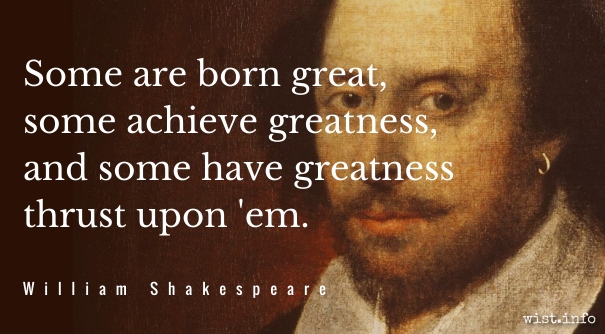
Some are born great, some achieve greatness, and
some have greatness thrust upon ’em.
William Shakespeare (1564–1616) English dramatist and poet
Twelfth Night, Act 2, Sc. 5, l. 147ff (2.5.147–150) (1601)
(Source)
The phrase appears three times in the play:This was parodied in Joseph Heller, Catch-22, ch. 9 (1955), writing regarding Major Major: “Some men are born mediocre, some men achieve mediocrity, and some men have mediocrity thrust upon them.” See also Boorstin.
- As above, Malvolio reading the forged love letter he thinks is from Olivia.
- Act 3, sc. 4, l. 42ff, Malvolio recalling the phrases from the letter.
- Act 5, sc. 1, l. 393ff, the Fool reciting the second half of the phrase.
FABIAN If this were played upon a stage now, I could
condemn it as an improbable fiction.William Shakespeare (1564–1616) English dramatist and poet
Twelfth Night, Act 3, sc. 4, l. 136ff (3.4.136-137) (1601)
(Source)
ANTONIO: In nature there’s no blemish but the mind;
None can be called deformed but the unkind.William Shakespeare (1564–1616) English dramatist and poet
Twelfth Night, Act 3, sc. 4, l. 386ff (3.4.386-387) (1601)
(Source)
FOOL: There is no darkness but ignorance.
William Shakespeare (1564–1616) English dramatist and poet
Twelfth Night, Act 4, sc. 2, l. 44 (4.2.44) (1601)
(Source)
FOOL: And thus the whirligig of time brings in
his revenges.William Shakespeare (1564–1616) English dramatist and poet
Twelfth Night, Act 5, sc. 1, l. 399ff (5.1.399-400) (1601)
(Source)
PROTEUS: Oh, how this spring of love resembleth
The uncertain glory of an April day;
Which now shows all the beauty of the sun,
And by and by a cloud takes all away!William Shakespeare (1564–1616) English dramatist and poet
Two Gentlemen of Verona, Act 1, sc. 3, l. 85ff (1.3.85-88) (c. 1590)
(Source)
JULIA: Didst thou but know the inly touch of love;
Thou wouldst as soon go kindle fire with snow,
As seek to quench the fire of love with words.William Shakespeare (1564–1616) English dramatist and poet
Two Gentlemen of Verona, Act 2, sc. 7, l. 18ff (2.7.18-20) (c. 1590)
(Source)
PROTEUS: ’Tis true. O heaven, were man
But constant, he were perfect; that one error
Fills him with faults, makes him run through all th’ sins;
Inconstancy falls off ere it begins.William Shakespeare (1564–1616) English dramatist and poet
Two Gentlemen of Verona, Act 5, sc. 4, l. 118ff (5.4.118-121) (c. 1590)
CAMILLO:My gracious lord,
I may be negligent, foolish, and fearful.
In every one of these no man is free,
But that his negligence, his folly, fear,
Among the infinite doings of the world,
Sometime puts forth. In your affairs, my lord,
If ever I were willful-negligent,
It was my folly; if industriously
I played the fool, it was my negligence,
Not weighing well the end; if ever fearful
To do a thing where I the issue doubted,
Whereof the execution did cry out
Against the non-performance, ’twas a fear
Which oft infects the wisest. These, my lord,
Are such allowed infirmities that honesty
Is never free of.William Shakespeare (1564–1616) English dramatist and poet
Winter’s Tale, Act 1, sc. 2, l. 310ff (1.2.310-325) (1611)
(Source)
HERMIONE: Since what I am to say must be but that
Which contradicts my accusation, and
The testimony on my part no other
But what comes from myself, it shall scarce boot me
To say “Not guilty.” Mine integrity,
Being counted falsehood, shall, as I express it,
Be so received. But thus: if powers divine
Behold our human actions, as they do,
I doubt not then but innocence shall make
False accusation blush and tyranny
Tremble at patience.William Shakespeare (1564–1616) English dramatist and poet
Winter’s Tale, Act 3, sc. 2, l. 23ff (3.2.23-33) (1611)
(Source)
PAULINA: What’s gone and what’s past help
Should be past grief.William Shakespeare (1564–1616) English dramatist and poet
Winter’s Tale, Act 3, sc. 2, l. 246ff (3.2.246-247) (1611)
(Source)
He exits, pursued by a bear.
William Shakespeare (1564–1616) English dramatist and poet
Winter’s Tale, Act 3, sc. 3, l. 64 (3.3.64) [Stage Direction] (1611)
(Source)
Variant: "Exit, pursued by a Bear."
PERDITA: Daffodils,
That come before the swallow dares, and take
The winds of March with beauty.William Shakespeare (1564–1616) English dramatist and poet
Winter’s Tale, Act 4, sc. 4, l. 141ff (4.4.141-143) (1611)
(Source)
FLORIZELL: But as th’ unthought-on accident is guilty
To what we wildly do, so we profess
Ourselves to be the slaves of chance, and flies
Of every wind that blows.William Shakespeare (1564–1616) English dramatist and poet
Winter’s Tale, Act 4, sc. 4, l. 543ff (4.4.543-546) (1611)
(Source)
SHEPHERD’S SON: He seems to be of
great authority. Close with him, give him gold; and
though authority be a stubborn bear, yet he is oft
led by the nose with gold.William Shakespeare (1564–1616) English dramatist and poet
Winter’s Tale, Act 4, sc. 4, l. 932ff (4.4.932-935) (1611)
(Source)
AUTOLYCUS: I see this is the time that the unjust man doth thrive.
William Shakespeare (1564–1616) English dramatist and poet
Winter’s Tale, Act 4, sc. 4, l. 796ff (4.4.796-797) (1611)
(Source)

Were kisses all the joys in bed,
One woman would another wed.William Shakespeare (1564–1616) English dramatist and poet
In William Jaggard, ed., The Passionate Pilgrim, Part 2 “Sonnets to Sundry Notes of Music,” No. 19 “When as thine eye hath chose the dame,” l. 345-46 (1599)
(Source)
Though Jaggard claimed all the poems in the collection were by Shakespeare, most of them (including this one) are not generally considered to actually be by him.
CASSIUS: Did Cicero say anything?
CASCA: Ay, he spoke Greek.
CASSIUS: To what effect?
CASCA Nay, an I tell you that, I’ll ne’er look you i’ th’ face again. But those that understood him smiled at one another and shook their heads. But for mine own part, it was Greek to me.
William Shakespeare (1564–1616) English dramatist and poet
Julius Caesar, Act 1, sc. 2, l. 289ff (1.2.289-295) (1599)
(Source)
Not origin, but likely popularizer of the phrase, "It's Greek to me." Similar phrases had been around since Roman days, and through the Medieval period. Many languages/cultures have similar idioms.
Like as the waves make towards the pebbl’d shore,
So do our minutes hasten to their end.
For sweetest things turn sourest by their deeds;
Lilies that fester smell far worse than weeds.William Shakespeare (1564–1616) English dramatist and poet
Sonnet 94, ll. 13-14 (pub. 1609)
(Source)
To me, fair friend, you never can be old,
For as you were when first your eye I ey’d,
Such seems your beauty still.
I grant I never saw a goddess go:
My mistress when she walks treads on the ground.
And yet, by heaven, I think my love as rare
As any she belie with false compare.