Speaking of love, one problem that recurs more and more frequently these days, in books and plays and movies, is the inability of people to communicate with the people they love: husbands and wives who can’t communicate, children who can’t communicate with their parents, and so on. And the characters in these books and plays and so on, and in real life, I might add, spend hours bemoaning the fact that they can’t communicate. I feel that if a person can’t communicate, the very least he can do is to shut up.
Tom Lehrer (b. 1928) American mathematician, satirist, songwriter
“Alma,” Afterword, That Was the Year That Was (1965)
(Source)
For the first time in six or seven thousand years, many people of goodwill find themselves confused about art. They want to enjoy it because enjoying art is something they expect of themselves as civilized persons, but they’re unsure how to do so. They aren’t even sure which of the visible objects are art and which are furniture, clothes, hors d’oeuvres, or construction rubble, and whether a pile of dead and decomposing rats is deliberate art or just another pile of decomposing rats.
Barbara Holland (1933–2010) American author
Wasn’t the Grass Greener?: A Curmudgeon’s Fond Memories, “Art” (1999)
(Source)

I somehow always have this idea that as soon as I can get through this work that’s piled up ahead of me, I’ll really write a beautiful thing. But I never do.
Rose Wilder Lane (1886–1968) American journalist, travel writer, novelist, political theorist
Letter to Guy Moyston (1920s)
(Source)
Quoted in William V. Holtz, The Ghost in the Little House, ch. 8, sec. 2 (1993).

PROTEUS: ’Tis true. O heaven, were man
But constant, he were perfect; that one error
Fills him with faults, makes him run through all th’ sins;
Inconstancy falls off ere it begins.William Shakespeare (1564–1616) English dramatist and poet
Two Gentlemen of Verona, Act 5, sc. 4, l. 118ff (5.4.118-121) (c. 1590)

That I ne’er saw thee in a Coach with Man,
Nor thy chaste Name in wanton satire met;
That from thy sex thy liking never ran,
So as to suffer a Male-servant yet;
I thought thee the Lucretia of our time:
But, Bassa, thou the while a Tribas wert,
And clashing — with a prodigious Crime
Didst act of Man th’ inimitable part.
What Oedipus this Riddle can untie?
Without a Male there was Adultery.[Quod numquam maribus iunctam te, Bassa, videbam
Quodque tibi moechum fabula nulla dabat,
Omne sed officium circa te semper obibat
Turba tui sexus, non adeunte viro,
Esse videbaris, fateor, Lucretia nobis:
At tu, pro facinus, Bassa, fututor eras.
Inter se geminos audes committere cunnos
Mentiturque virum prodigiosa Venus.
Commenta es dignum Thebano aenigmate monstrum,
Hic ubi vir non est, ut sit adulterium.]Martial (AD c.39-c.103) Spanish Roman poet, satirist, epigrammatist [Marcus Valerius Martialis]
Epigrams [Epigrammata], Book 1, epigram 90 (1.90) (AD 85-86) [tr. Sedley (1702)]
(Source)
"To Bassa". This epigram is often untranslated or omitted in collections. Martial thought lesbian sexuality perverse, though he enjoyed and wrote highly of pederasty, as any good Roman male would. (Source (Latin)). Alternate translations:That with the males thou ne'er wast known to mix,
Nor e'er gallant did envious slander fix;
That thine officious sex thee homag'd round,
And not a man durst taint the hallow'd ground:
What less than a Lucretia could'st thou be?
Ah! what was found? Th' adulterer in thee,
To make the mounts collide emerg'd they plan,
And monstrous Venus would bely the man.
Thou a new Theban torture could'st explore,
And bid adult'ry need a male no more.
[tr. Hay (1755); Book 6, Part 3, ep. 44]Inasmuch as I never saw you, Bassa, surrounded by a crowd of admirers, and report in no case assigned to you a favoured lover; but every duty about your person was constantly performed by a crowd of your own sex, without the presence of even one man; you seemed to me, I confess it, to be a Lucretia.
[tr. Bohn's Classical (1897), "On Bassa"; the "translation" then shifts to the original Latin.]In that I never saw you, Bassa, intimate with men, and that no scandal assigned you a lover, but every office a throng of your own sex round you performed without the approach of man -- you seemed to me, I confess, a Lucretia; yet, Bassa -- oh, monstrous! -- you are, it seems, a nondescript. You dare things unspeakable, and your portentous lust imitates man. You have invented a prodigy worthy of the Theban riddle, that here, where no man is, should be adultery!
[tr. Ker (1919)]Never having seen you taking a man's arm, Bassa,
realizing that no gossip attaches a lover to you,
noticing how you were always surrounded
by a throng of your own sex doing things for you
and letting no man approach you, I admit I felt
that we had another Lucretia in you.
But you were doing the raping, Bassa,
working out ways for identical twin genitals
to double their fun by pretending that one -- yours --
was the man in this case, a barefaced lie
you've conjured up a riddle only the Sphinx could solve:
Adultery, without any man involved.
[tr. Bovie (1970)]I never saw you close to men, Bassa, and no rumor gave you a lover. You were always surrounded by a crowd of your own sex, performing every office, with no man coming near you. So I confess I thought you a Lucretia; but Bassa, for shame, you were a fornicator. You dare to join two cunts and your monstrous organ feigns masculinity. You have invented a portent worthy of the Theban riddle: where no man is, there is adultery.
[tr. Shackleton Bailey (1993)]I never saw you, Bassa, with a man
No rumor ever spread of an affair.
You seemed as chaste as any woman can,
With Lucrece pure you made a worthy pair.
Belatedly I found I venerated,
A woman who a woman penetrated.
You found an amphisbaenic instrument --
To give cunts simultaneous content.
You pose a riddle Sphinxes never knew,
To be a woman and a woman screw.
[tr. Wills (2007)]Bassa, I never saw you hang with guys --
Nobody whispered that you had a beau.
Girls surrounded you at every turn;
They did your errands, with no attendant males.
And so, I guess I naturally assumed
That you were what you seemed: a chaste Lucretia.
But hell no. Why, you shameless little tramp,
You were an active humper all the time.
You improvised, by rubbing cunts together,
And using that bionic clit of yours
To counterfeit the thrusting of a male.
Unbelievable. You’ve managed to create
A real conundrum, worthy of the Sphinx:
Adultery without a co-respondent.
[tr. Salemi (2008)]Bassa, I never saw you close to men; no gossip linked you to a lover here.
A crowd of your own sex was always with you at every function, no man coming near.
I have to say, I thought you a Lucretia, but you (for shame!) were fucking even then.
You dare link twin cunts and, with your monstrous clitoris, pretend to fuck like men.
You'd suit a Theban riddle perfectly:
where there's no man, there's still adultery.
[tr. McLean (2014)]
KEATING: Now I would like you to step forward over here and peruse some of the faces from the past. You’ve walked past them many times. I don’t think you’ve really looked at them. They’re not that different from you, are they? Same haircuts. Full of hormones, just like you. Invincible, just like you feel. The world is their oyster. They believe they’re destined for great things, just like many of you. Their eyes are full of hope, just like you.
Did they wait until it was too late to make from their lives even one iota of what they were capable? Because, you see gentlemen, these boys are now fertilizing daffodils. But if you listen real close, you can hear them whisper their legacy to you. Go on, lean in. Listen, you hear it?
Carpe. Carpe diem. Seize the day, boys, make your lives extraordinary.

Fascist politics feeds off the sense of aggrieved victimization caused by loss of hierarchal status. Empires in decline are particularly susceptible to fascist politics because of this sense of loss. It is in the very nature of empire to create hierarchy; empires legitimize their colonial enterprises by the myth of their own exceptionalism. In the course of decline, the population is easily led to a sense of national humiliation that can be mobilized in fascist politics to serve various purposes.
Jason Stanley (b. 1969) American philosopher, epistemologist, academic
How Fascism Works: The Politics of Us and Them, ch. 5 (2018)
(Source)

Holden decided that he was okay with not feeling any remorse for them. The moral complexity of the situation had grown past his ability to process it, so he just relaxed in the warm glow of victory instead.
Daniel Abraham (b. 1969) American writer [pseud. James S. A. Corey (with Ty Franck), M. L. N. Hanover]
Leviathan Wakes, ch. 41 (2011) [with Ty Franck]
(Source)

Compassion is probably the only antitoxin of the soul. Where there is compassion even the most poisonous impulses remain relatively harmless. One would rather see the world run by men who set their hearts on toys but are accessible to pity, than by men animated by lofty ideals whose dedication makes them ruthless. In the chemistry of man’s soul, almost all noble attributes — courage, honor, hope, faith, duty, loyalty, etc. — can be transmuted into ruthlessness. Compassion alone stands apart from the continuous traffic between good and evil proceeding within us.
Eric Hoffer (1902–1983) American writer, philosopher, longshoreman
Passionate State of Mind, Aphorism 139 (1955)
(Source)
Civilization is a method of living, an attitude of equal respect for all men.

Our Constitution was not written in the sands to be washed away by each wave of new judges blown in by each successive political wind that brings new political administrations into temporary power.
Hugo Black (1886–1971) American politician and jurist; US Supreme Court Justice (1937–71)
Turner v. United States, 396 U.S. 398, 426 (1970) [dissenting]
(Source)
What’s old age for if not dispensing bullshit and calling it wisdom?

Rumor! What evil can surpass her speed?
In movement she grows mighty, and achieves
strength and dominion as she swifter flies.
small first, because afraid, she soon exalts
her stature skyward, stalking through the lands
and mantling in the clouds her baleful brow.[Fama, malum qua non aliud velocius ullum;
Mobilitate viget, virisque adquirit eundo;
Parva metu primo; mox sese attollit in auras,
Ingrediturque solo, et caput inter nubila condit.]Virgil (70–19 BC) Roman poet [b. Publius Vergilius Maro; also Vergil]
The Aeneid [Ænē̆is], Book 4, l. 174ff (4.174-177) (29-19 BC) [tr. Williams (1910)]
(Source)
(Source (Latin)). Alternate translations:Fame is an evill, none more swift, which gaines
By motion strength, in flying force obtaines,
Small first by feare, to heaven advanc'd now shrowds,
Stalking on earth, her head amongst the clouds.
[tr. Ogilby (1649)]Fame, the great ill, from small beginnings grows:
Swift from the first; and ev'ry moment brings
New vigor to her flights, new pinions to her wings.
Soon grows the pigmy to gigantic size;
Her feet on earth, her forehead in the skies.
[tr. Dryden (1697)]Fame, than whom no pest is more swift, by exerting her agility grows more active, and acquires strength on her way : small at first through fear; soon she shoots up into the skies, and stalks along the ground, while she hides her head among the clouds.
[tr. Davidson/Buckley (1854)]Fame than who never plague that runs
Its way more swiftly wins:
Her very motion lends her power:
She flies and waxes every hour.
At first she shrinks, and cowers for dread:
Ere long she soars on high:
Upon the ground she plants her tread,
Her forehead in the sky.
[tr. Conington (1866)]Rumor, than whom no evil is more swift.
She grows by motion, gathers strength by flight.
Small at the first, through fear, soon to the skies
She lifts herself. She walks upon the ground.
And hides her head in clouds.
[tr. Cranch (1872)]Rumour, than whom none other is more swift to mischief; she thrives on restlessness and gains strength by going: at first small and timorous; soon she lifts herself on high and paces the ground with head hidden among the clouds.
[tr. Mackail (1885)]Rumour, of whom nought swifter is of any evil thing:
She gathereth strength by going on, and bloometh shifting oft!
A little thing, afraid at first, she springeth soon aloft;
Her feet are on the worldly soil, her head the clouds o'erlay.
[tr. Morris (1900)]Fame, far the swiftest of all mischiefs bred;
Speed gives her force; she strengthens as she flies.
Small first through fear, she lifts a loftier head,
Her forehead in the clouds, on earth her tread.
[tr. Taylor (1907), st. 23, ll. 200-204]Rumour of all evils the most swift. Speed lends her strength, and she wins vigour as she goes; small at first through fear, soon she mounts up to heaven, and walks the ground with head hidden in the clouds.
[tr. Fairclough (1916)]Rumor
Than whom no other evil was ever swifter.
She thrives on motion and her own momentum;
Tiny at first in fear, she swells, colossal
In no time, walks on earth, but her head is hidden
Among the clouds.
[tr. Humphries (1951)]Rumour, the swiftest traveller of all the ills on earth,
Thriving on movement, gathering strength as it goes; at the start
A small and cowardly thing, it soon puffs itself up,
And walking upon the ground, buries its head in the cloud-base.
[tr. Day Lewis (1952)]Rumor,
whose life is speed, whose going gives her force.
Timid and small at first, she soon lifts up
her body in the air. She stalks the ground;
her head is hidden in the clouds.
[tr. Mandelbaum (1971), l. 230ff]Rumor
Thrives on motion, stronger for the running,
Lowly at first through fear, then rearing high,
She treads the land and hides her head in cloud.
[tr. Fitzgerald (1981), l. 241ff]Of all the ills there are, Rumour is the swiftest. She thrives on movement and gathers strength as she goes. From small and timorous beginnings she soon lifts herself up into the air, her feet still on the ground and her head hidden in the clouds.
[tr. West (1990)]Rumour, compared with whom no other is as swift.
She flourishes by speed, and gains strength as she goes:
first limited by fear, she soon reaches into the sky,
walks on the ground, and hides her head in the clouds.
[tr. Kline (2002)]Rumor, the swiftest of evils. She thrives on speed
And gains power as she goes. Small and timid at first,
She grows quickly, and though her feet touch the ground
Her head is hidden in the clouds.
[tr. Lombardo (2005), l. 199ff]Rumor, swiftest of all the evils in the world.
She thrives on speed, stronger for every stride,
slight with fear at first, soon soaring into the air
she treads the ground and hides her head in the clouds.
[tr. Fagles (2006), l. 220ff]Rumor, no other evil can move more quickly:
She grows with speed and acquires strength in motion,
At first, she is small from fear, but soon she raises herself to the sky
and walks onto the land hiding her head among the clouds.
[tr. @sentantiq (2015)]Rumor, swiftest of all evil;
she thrives on speed and gains strength as she goes.
At first she's small and scared, but soon she rears to the skies,
her feet still on the ground, her head hidden in the clouds.
[tr. Bartsch (2021)]
When a people are confronted with problems that are both incomprehensible and unbearable, they lash out not at those who contrived the problems but at those who expose them. When they are confronted by moral problems that they find insoluble, or perhaps intolerable, they blame the moralists. The anxieties, tensions, revulsions of our day create an atmosphere in which it is almost impossible to think clearly and dispassionately about just those problems which most imperatively require reason and objectivity — problems of adjustment to fundamental change.
Henry Steele Commager (1902–1998) American historian, writer, activist
Speech (1971-04-10), “The University and the Community of Learning,” Kent State University, Ohio
(Source)
Try to remember this: what you project
Is what you will perceive; what you perceive
With any passion, be it love or terror,
May take on whims and powers of its own.

I felt it myself. The glitter of nuclear weapons. It is irresistible if you come to them as a scientist. To feel it’s there in your hands, to release this energy that fuels the stars, to let it do your bidding. To perform these miracles, to lift a million tons of rock into the sky. It is something that gives people an illusion of illimitable power, and it is, in some ways, responsible for all our troubles — this, what you might call technical arrogance, that overcomes people when they see what they can do with their minds.
Freeman Dyson (1923–2020) English-American theoretical physicist, mathematician, futurist
In Jon Else, dir., The Day After Trinity: J. Robert Oppenheimer and the Atomic Bomb, Part 2 (1981)
(Source)
An interface is humane if it is responsive to human needs and considerate of human frailties.
Jef Raskin (1943–2005) American computer scientist, writer
The Humane Interface, 1-6 (2000)
(Source)

Why weren’t these problems obvious to the Maya kings, who could surely see their forests vanishing and their hills becoming eroded? Part of the reason was that the kings were able to insulate themselves from problems afflicting the rest of society. By extracting wealth from commoners, they could remain well fed while everyone else was slowly starving. What’s more, the kings were occupied with their own power struggles. They had to concentrate on fighting one another and keeping up their images through ostentatious displays of wealth. By insulating themselves in the short run from the problems of society, the elite merely bought themselves the privilege of being among the last to starve.
Jared Diamond (b. 1937) American geographer, historian, ornithologist, author
“The Ends of the World as We Know Them,” New York Times (1 Jan 2005)
(Source)

THE LADY: Shepherd I take thy word,
And trust thy honest offer’d courtesie,
Which oft is sooner found in lowly sheds
With smoaky rafters, then in tapstry Halls
And Courts of Princes, where it first was nam’d,
And yet is most pretended.
Free yourself from common foolishness. This requires a special sort of sanity. Common foolishness is authorized by custom, and some people who resisted the ignorance of individuals were unable to resist that of the multitude.
[Librarse de las necedades comunes. Es cordura bien especial. Están muy validas por lo introducido, y algunos, que no se rindieron a la ignorancia particular, no supieron escaparse de la común.]
Baltasar Gracián y Morales (1601–1658) Spanish Jesuit priest, writer, philosopher
The Art of Worldly Wisdom [Oráculo Manual y Arte de Prudencia], § 209 (1647) [tr. Maurer (1992)]
(Source)
(Source (Spanish)). Alternate translations:Not to imitate the folly of others is an effect of rare wisedome; for whatever is introduced by example and custome, is of great force. Some who have guarded against particular ignorance, have not been able to avoid the general.
[Flesher ed. (1685)]Keep yourself free from common Follies. This is a special stroke of policy. They are of special power because they are general, so that many who would not be led away by any individual folly cannot escape the universal failing.
[tr. Jacobs (1892)]To keep free from the popular inanities, marks especially good sense. They are highly esteemed because so well introduced, and many a man who could not be trapped by some particular stupidity could not except the general.
[tr. Fischer (1937)]

But much I fear, that when this great truth shall be re-established, its votaries will fall into the fatal error of fabricating formulas of creed and confessions of faith, the engines which so soon destroyed the religion of Jesus, and made of Christendom a mere Aceldama; that they will give up morals for mysteries, and Jesus for Plato. How much wiser are the Quakers, who, agreeing in the fundamental doctrines of the gospel, schismatize about no mysteries, and, keeping within the pale of common sense, suffer no speculative differences of opinion, any more than of feature, to impair the love of their brethren. Be this the wisdom of Unitarians, this the holy mantle which shall cover within its charitable circumference all who believe in one God, and who love their neighbor!
Thomas Jefferson (1743–1826) American political philosopher, polymath, statesman, US President (1801–09)
Letter (1822-06-26) to Benjamin Waterhouse
(Source)

Although we have already spoken in the First Part touching the utility of the definition of terms, it is nevertheless so important, that we cannot have it too much impressed on our minds, since we may by it clear up a number of disputes, which have as their subject often only the ambiguity of terms, which one takes in one sense, and another in another. So that some of the greatest controversies would cease in a moment, if one or the other of the disputants took care to make out precisely, and in a few words, what he understands by the terms which are the subject of dispute.
Antoine Arnauld (1612–1694) French theologian, philosopher, mathematician
Logic, or the Art of Thinking [La Logique ou l’art de penser; The Port-Royal Logic], Part 4, ch. 4 (1662) [with Pierre Nicole] [tr. Baynes (1850)]
(Source)
Alternate translation:Although we have already spoken in Part I about the usefulness of defining one's terms, this is, however, so important that we cannot bear it too much in mind, since this is how countless disputes are cleared up whose cause is often merely an ambiguity in terms that one person takes one way and another person another way. Accordingly, some very serious arguments would cease in an instant if either of the disputants took the care to indicate clearly, in a few words, the meanings of the terms that are the subject of dispute.
[tr. Buroker (1996)]
It’s always sort of amused me that mankind has been able to come up with a lot of things, two of them being napalm — which is a jellied substance that burns the skin and kills — and Silly Putty, which is something that you can press onto a comic and see a backwards picture of Popeye. And somewhere between these two extremes lies our truth. And I don’t know how good we are at pursuing it.
George Carlin (1937–2008) American comedian
Interview (2001-07) by Marc Cooper, The Progressive
(Source)
Discussing the title of his new book, Napalm and Silly Putty.
We are all so clumsy, my dear, and words are all we have, poor signals like bonfires and flags trying to express what shipwreck is.
Rose Wilder Lane (1886–1968) American journalist, travel writer, novelist, political theorist
Letter to Dorothy Thompson (Jan 1927)
(Source)
In William Holtz, ed., Dorothy Thompson and Rose Wilder Lane: Forty Years of Friendship (1991)
The usual devastating put-downs imply that a person is basically bad, rather than that he is a person who sometimes does bad things. Obviously, there is a vast difference between a “bad” person and a person who does something bad.
Hilary Hinton "Zig" Ziglar (1926–2012) American author, salesperson, motivational speaker
See You at the Top, Segment 2, ch. 2 “Causes of a Poor Self Image” (1974)
(Source)

However long you have a cat and however plainly he lays his life open before you, there is always something hidden, some name he goes by in a place you never heard of.
I doubt if there is anybody in this hall who really ever sought sobriety. I think we were trying to get away from drunkenness. I don’t think we should despise the negative. I have a feeling that if I ever find myself in Heaven, it will be from backing away from Hell.
Edward Dowling (1898–1960) American Jesuit priest ["Father Ed"]
Address to the Alcoholics Anonymous Twentieth Anniversary Convention, St. Louis, Missouri (Jul 1955)
(Source)
Reprinted in Alcoholics Anonymous Comes of Age (1957). Dowling was spiritual advisor to Bill Wilson, co-founder of AA.
Variants of the final line are also attributed (though they only quoted it) to Mariette Hartley, Carrie Fisher, and Courtney Love.
More discussion about the history of quotation: If I Ever Find Myself in Heaven, It Will Be From Backing Away From Hell – Quote Investigator.

It takes more courage to live than to die; which is proved by the fact that so many more men die well than live well.
William Lyon Phelps (1865–1943) American educator and critic
Representative Plays by J. M. Barrie, Introduction, § 2 (1926)
(Source)
The rich know anger helps the cost of living:
Hating’s more economical than giving.[Genus, Aucte, lucri divites habent iram:
Odisse, quam donare, vilius constat.]Martial (AD c.39-c.103) Spanish Roman poet, satirist, epigrammatist [Marcus Valerius Martialis]
Epigrams [Epigrammata], Book 12, epigram 13 (12.13) (AD 101) [tr. Michie (1972)]
(Source)
"To Auctus." Closely parallel to 3.37, to the point where some translations are cross-applied in error. The general interpretation, from Ker, is that "picking quarrels with clients saves you giving them presents."
(Source (Latin)). Other translations:Anger's a kind of gain that rich men know:
It costs them less to hate than to bestow.
[tr. Fletcher (1656)]Rich men, my friend, by anger know to thrive.
'Tis cheaper much to quarrel, than to give.
[tr. Hay (1755)]From ire can gainmongers elicit ore.
Fell hate is frugal: love might lavish more.
[tr. Elphinston (1782), 12.68]Ask you, last night, why Gripus ill behaved?
A well-timed quarrel is a dinner saved.
[tr. Halhead (1793)]The rich, Auctus, make a species of gain out of anger.
It is cheaper to get into a passion than to give.
[tr. Bohn's Classical (1859)]Rich men, Auctus, regard anger as a kind of profit;
to hate is cheaper than to give!
[tr. Ker (1919)]The rich feign wrath -- a profitable plan;
'Tis cheaper far to hate than help a man.
[tr. Pott & Wright (1921)]Rich men, Auctus, think of anger as a sort of moneymaking:
hating comes cheaper than giving.
[tr. Shackleton Bailey (1993)]The rich pick fights and cause unpleasance:
Hate is cheaper than giving presents.
[tr. Ericsson (1995)]The rich believe it pays to get irate --
to give is costlier, Auctus, than to hate.
[tr. McLean (2014)]
We are obligated to be more scrupulous in fulfilling the commandment of charity than any other positive commandment because charity is the sign of a righteous man, the seed of Abraham our Father.
Maimonides (1135–1204) Spanish Jewish philosopher, scholar, astronomer, physician [Moses ben Maimon, Rambam, רמב״ם]
Mishneh Torah [Repetition of the Torah] / Sefer Yad ha-Hazaka [The Strong Hand], Book 7 “Seeds [Sefer Zeraim],” ch. 10, #1 (1180)
(Source)
As quoted in Isadore Twersky, ed., A Maimonides Reader (1972), and the most common English translation. Another translation:We must be especially careful to observe the mitzvah of tzedakah, more so than any other positive mitzvah, for tzedakah is a sign of the righteous [tzadik] lineage of Abraham, our father.
[tr. Meszler (2003)]
More discussion of the connotations of the Hebrew tzedakah that are not covered by the English charity here: Tzedakah - charity in the Jewish tradition - BJE

KEATING: When you read, don’t just consider what the author thinks, consider what you think.
Oh me! Oh life! of the questions of these recurring,
Of the endless trains of the faithless, of cities fill’d with the foolish,
Of myself forever reproaching myself, (for who more foolish than I, and who more faithless?)
Of eyes that vainly crave the light, of the objects mean, of the struggle ever renew’d,
Of the poor results of all, of the plodding and sordid crowds I see around me,
Of the empty and useless years of the rest, with the rest me intertwined,
The question, O me! so sad, recurring — What good amid these, O me, O life?Answer.
That you are here — that life exists and identity,
That the powerful play goes on, and you may contribute a verse.Walt Whitman (1819–1892) American poet
“O Me! O Life!” Leaves of Grass, Book 20 “By the Roadside” (1867 ed)
(Source)
Common sense is not a gift. It’s a punishment, because you have to deal with everyone who doesn’t have it.
George Bernard Shaw (1856–1950) Irish playwright and critic
(Spurious)
Author unknown. Frequently attributed to Shaw, but not found in his writing.
Politeness is a tacit agreement that people’s miserable defects, whether moral or intellectual, shall on either side be ignored and not made the subject of reproach; and since these defects are thus rendered somewhat less obtrusive, the result is mutually advantageous.
[Sie ist eine stillschweigende Übereinkunft, gegenseitig die moralisch und intellektuell elende Beschaffenheit von einander zu ignoriren und sie sich nicht vorzurücken; – wodurch diese, zu beiderseitigem Vorteil, etwas weniger leicht zutage kommt.]
Arthur Schopenhauer (1788–1860) German philosopher
Parerga and Paralipomena, Vol. 1, “Aphorisms on the Wisdom of Life [Aphorismen zur Lebensweisheit],” ch. 5 “Counsels and Maxims [Paränesen und Maximen],” § 3.36 (1851) [tr. Saunders (1890)]
(Source)
Source (German). Another translation:Politeness is a tacit agreement that we shall mutually ignore and refrain from reproaching one another's miserable defects, both moral and intellectual. In this way, they do not so readily come to light, to the advantage of both sides.
[tr. Payne (1974)]

For there is no more essential duty than that of returning kindness received.
[Nullum enim officium referenda gratia magis necessarium est.]
Marcus Tullius Cicero (106–43 BC) Roman orator, statesman, philosopher
De Officiis [On Duties; On Moral Duty; The Offices], Book 1, ch. 15 (1.15) / sec. 47 (44 BC) [tr. Peabody (1883)]
(Source)
(Source (Latin)). Other translations:For of all the virtues, there is none we are more necessarily obliged to, than gratitude.
[tr. Cockman (1699)]For there is no duty of a more necessary obligation than returning a kindness.
[tr. McCartney (1798)]For there is no duty more indispensable than that of returning a kindness.
[tr. Edmonds (1865)]For no duty is more imperative than gratitude.
[tr. Gardiner (1899)]There is no duty more obligatory than the repayment of a kindness.
[ed. Harbottle (1906)]For no duty is more imperative than that of proving one's gratitude.
[tr. Miller (1913)]No duty is more necessary than to return a favor.
[tr. Edinger (1974)]
“But if you’ll pardon my speaking out, I think my master was right. I wish you’d take his Ring. You’d put things to rights. You’d stop them digging up the Gaffer and turning him adrift. You’d make some folk pay for their dirty work.”
“I would,” she said. “That is how it would begin. But it would not stop with that, alas!”J.R.R. Tolkien (1892–1973) English writer, fabulist, philologist, academic [John Ronald Reuel Tolkien]
The Lord of the Rings, Vol. 1: The Fellowship of the Ring, Book 2, ch. 7 “The Mirror of Galadriel” [Sam and Galadriel] (1954)
(Source)
Why have I always told you that the greatest way to change the world is to secretly commit little acts of compassion? It does not matter that people know what you are doing, but rather that you do it. When a large enough number of people finally do something, or something is done enough times, be it prayer or vegetarianism or whatever, it will then happen everywhere, to everyone. It will suddenly seem just normal. […] You must behave as if your every act, even the smallest, impacted a thousand people for a hundred generations. Because it does.
Thomas "Thom" Hartmann (b. 1951) American broadcaster, psychotherapist, businessman, political commentator
The Prophet’s Way: A Guide to Living in the Now, “The Hundredth Monkey” (1997)
(Source)
Often quoted as:The most powerful way to change the world is to secretly commit little acts of compassion. You must behave as if your every act, even the smallest, impacted a thousand people for a hundred generations. Because it does.

There can be no equal justice where the kind of trial a man gets depends on the amount of money he has.
Hugo Black (1886–1971) American politician and jurist; US Supreme Court Justice (1937–71)
Griffin v. Illinois, 351 US 12, 19 (1956) [majority opinion]
(Source)
On the Constitutional requirement for states to ensure not only that trial defense is available to poor defendants, but that appeals costs be addressed as well.
American society has always exercised a stronger pressure on individual behavior than Western European societies; but in time of war this pressure is notched a few degrees, and starts to become quite alarming.
Tzvetan Todorov (1939–2017) Bulgarian-French historian, philosopher, literary critic, sociologist
The New World Disorder: Reflections of a European, ch. 3 (2005)
(Source)

As far as the customer is concerned, the interface is the product.
Jef Raskin (1943–2005) American computer scientist, writer
The Humane Interface, 1-5 (2000)
(Source)
A blueprint for disaster in any society is when the elite are capable of insulating themselves.
Jared Diamond (b. 1937) American geographer, historian, ornithologist, author
“Choosing Success,” interview by Catherine Sepp, National Review (30 Jun 2005)
(Source)
How sweet and gracious, even in common speech,
Is that fine sense which men call Courtesy!
Wholesome as air and genial as the light,
Welcome in every clime as breath of flowers,
It transmutes aliens into trusting friends,
And gives its owner passport round the globe.
Vices can be elevated, but are always base. Some people see a certain hero with a certain fault, but they don’t realize it wasn’t the fault that made him a hero. An example of people in high places is so persuasive that it makes people imitate even their ugliness. Adulation mimics even an ugly face, without realizing that what is hidden by greatness is abominated when greatness is lacking.
[Bien pueden estar los vicios realzados, pero no son realces. Ven algunos que aquel héroe tuvo aquel accidente, pero no ven que no fue héroe por aquello. Es tan retórico el ejemplo superior, que aun las fealdades persuade; hasta las del rostro afectó tal vez la lisonja, no advirtiendo que, si en la grandeza se disimulan, en la bajeza se abominan.]
Baltasar Gracián y Morales (1601–1658) Spanish Jesuit priest, writer, philosopher
The Art of Worldly Wisdom [Oráculo Manual y Arte de Prudencia], § 186 (1647) [tr. Maurer (1992)]
(Source)
(Source (Spanish)). Another translation:Vices may very well be exalted, but not exalt. Some observe, that such a Heroe hath had such a Vice, but they consider not, that it was not that Vice which made him a Heroe. The example of great men is so good an Oratour, that it persuades one to infamous matters. Sometimes flattery hath affected even bodily defects, without observing, that though they be born with in great men, they are insupportable in the mean.
[Flesher ed. (1685)]Vices may stand in high place, but are low for all that. Men can see that many a great man has great faults, yet they do not see that he is not great because of them. The example of the great is so specious that it even glosses over viciousness, till it may so affect those who flatter it that they do not notice that what they gloss over in the great they abominate in the lower classes.
[tr. Jacobs (1892)]The vices may stand high, but they are not high: some see a great man afflicted with this vice or that; but they do not see, that is great not because of it but in spite of it. The portrait of the man high up is so convincing, that even his deformities persuade, wherefore flattery at times mimics them, not seeing, that if in the great such things are overlooked, in the small, they are looked down upon.
[tr. Fischer (1937)]
Had the doctrines of Jesus been preached always as pure as they came from his lips, the whole civilized world would now have been Christian. I rejoice that in this blessed country of free inquiry and belief, which has surrendered its creed and conscience to neither kings nor priests, the genuine doctrine of one only God is reviving, and I trust that there is not a young man now living in the United States who will not die an Unitarian.
Thomas Jefferson (1743–1826) American political philosopher, polymath, statesman, US President (1801–09)
Letter (1822-06-26) to Benjamin Waterhouse
(Source)
History, we can confidently assert, is useful in the sense that art and music, poetry and flowers, religion and philosophy are useful. Without it — as with these — life would be poorer and meaner; without it we should be denied some of those intellectual and moral experiences which give meaning and richness to life. Surely it is no accident that the study of history has been the solace of many of the noblest minds of every generation.
Henry Steele Commager (1902–1998) American historian, writer, activist
The Nature and Study of History, ch. 5 (1965)
(Source)
I love to see a Man zealous in a good Matter, and especially when his Zeal shews it self for advancing Morality, and promoting the Happiness of Mankind: But when I find the Instruments he works with are Racks and Gibbets, Gallies and Dungeons; when he imprisons Mens Persons, confiscates their Estates, ruins their Families, and burns the Body to save the Soul, I cannot stick to pronounce of such a one, that (whatever he may think of his Faith and Religion) his Faith is vain, and his Religion unprofitable.
Joseph Addison (1672–1719) English essayist, poet, statesman
Essay (1711-10-02), The Spectator, No. 185
(Source)

Character is made by many acts; it may be lost by a single one.
Aristotle (384–322 BC) Greek philosopher
(Spurious)
Frequently attributed to Aristotle, but not found in his works. One of the earliest references is in J. A. Haigh, "Character," Great Thoughts from Master Minds (5 Oct 1907). Haigh does not present it as his own thought ("Character, it has been well said, is made up ...").John Christensen notes that the sentiment of the quote is very non-Aristotelian, feeling more like a Christian teaching about sin than a philosophical commentary. Aristotle generally speaks about developing a habit toward virtue (1, 2, 3), not some sort of all-or-nothing moral imperative.
Bad roads act as filters. They separate those who are sufficiently appreciative of what lies beyond the blacktop to be willing to undergo mild inconvenience from that much larger number of travelers which is not willing. The rougher the road, the finer the filter.
Joseph Wood Krutch (1893–1970) American educator, writer, critic, naturalist
Baja California and the Geography of Hope, Introduction (1967)
(Source)
This was a thought that Krutch adapted and repeated in a number of writings.
In The Forgotten Peninsula, A Naturalist in Baja California, Prologue (1961), Krutch quotes an acquaintance as saying, regarding the peninsula's unspoiled beauty, "Baja is a splendid example of how much bad roads can do for a country." This quotation was often misattributed directly to him, and he adopted the sentiment.
Late in his life (Winter 1967-68), Krutch was interviewed by Edward Abbey for Sage magazine (reprinted in One Life at a Time, Please (1988)), and discussed the proposed development of the new Canyonlands National Park:Too many people use their automobiles not as a means to get to the parks but rather use the parks as a place to take their automobiles. What our national parks need are not more good roads but more bad roads. [...] There’s nothing like a good bad dirt road to screen out the faintly interested and to invite in the genuinely interested.

The river of truth is always splitting up into arms that reunite. Islanded between them, the inhabitants argue for a lifetime as to which is the mainstream.
Cyril Connolly (1903–1974) English intellectual, literary critic and writer.
The Unquiet Grave, Part 3 “La Clé des Chants” (1944)
(Source)
Often misquoted:Truth is a river that is always splitting up into arms that reunite. Islanded between the arms, the inhabitants argue for a lifetime as to which is the main river.
It falls to each of us to be those anxious, jealous guardians of our democracy; to embrace the joyous task we’ve been given to continually try to improve this great nation of ours. Because for all our outward differences, we, in fact, all share the same proud title, the most important office in a democracy: Citizen. Citizen. So, you see, that’s what our democracy demands. It needs you. Not just when there’s an election, not just when your own narrow interest is at stake, but over the full span of a lifetime.
Barack Obama (b. 1961) American politician, US President (2009–2017)
“Farewell Address,” Chicago (10 Jan 2017)
(Source)

But I’d sooner have the depths of earth gape open,
and almighty Father hurl me down to Hades
with his bolt, to the pallid shades and inky night,
before I disobey my conscience or its laws.[Sed mihi vel tellus optem prius ima dehiscat
Vel pater omnipotens adigat me fulmine ad umbras,
Pallentis umbras Erebo noctemque profundam,
Ante, pudor, quam te violo aut tua iura resolvo.]Virgil (70–19 BC) Roman poet [b. Publius Vergilius Maro; also Vergil]
The Aeneid [Ænē̆is], Book 4, l. 24ff (4.24-29) [Dido] (29-19 BC) [tr. Bartsch (2021)]
(Source)
Dido, regarding her loyalty to her dead husband even as she falls in love with Aeneas.
(Source (Latin)). Other translations:But first earth swallow me, or mighty Jove
Shall to the shades with dreadfull thunder smite,
Pale shades of Erebus and deepest night,
Ere shame I violate thee, or wrong thy rites.
[tr. Ogilby (1649)]But first let yawning earth a passage rend,
And let me thro' the dark abyss descend;
First let avenging Jove, with flames from high,
Drive down this body to the nether sky,
Condemn'd with ghosts in endless night to lie,
Before I break the plighted faith I gave!
[tr. Dryden (1697)]But sooner may earth from her lowest depths yawn for me, or the almighty Sire hurl me by his thunder to the shades, the pale shades of Erebus and deep night, than I violate thee, modesty, or break they laws.
[tr. Davidson/Buckley (1854)]But first for me may Earth unseal
The horrors of her womb,
Or Jove with awful thunderpeal
Dismiss me into gloom,
The gloom of Orcus' dim twilight,
Or deeper still, primeval night,
Ere wound I thee, my woman's fame,
Or disallow thy sacred claim.
[tr. Conington (1866)]But I would rather that the steadfast earth
Should yawn beneath me, from its lowest depths,
Or the Omnipotent Father hurl me down
With thunder to the shades, the pallid shades
Of Erebus, and night profound, ere thee,
O sacred shame, I violate, or break
Thy laws.
[tr. Cranch (1872)]But rather, I pray, may earth first yawn deep for me, or the Lord omnipotent hurl me with his thunderbolt into gloom, the pallid gloom and profound night of Erebus, ere I soil thee, mine honour, or unloose thy laws.
[tr. Mackail (1885)]And yet I pray the deeps of earth beneath my feet may yawn,
I pray the Father send me down bolt-smitten to the shades,
The pallid shades of Erebus, the night that never fades,
Before, O Shame, I shame thy face, or loose what thou hast tied!
[tr. Morris (1900)]But O! gape Earth, or may the Sire of might
Hurl me with lightning to the Shades amain,
Pale shades of Erebus and abysmal Night,
Ere, wifely modesty, thy name I stain,
Or dare thy sacred precepts to profane.
[tr. Taylor (1907), st. 4, l. 28ff]But may the earth gape open where I tread,
and may almighty Jove with thunder-scourge
hurl me to Erebus' abysmal shade,
to pallid ghosts and midnight fathomless,
before, O Chastity! I shall offend
thy holy power, or cast thy bonds away!
[tr. Williams (1910)]But rather, I would pray, may earth yawn for me to its depths, or may the Almighty Father hurl me with his bolt to the shades -- the pale shades and abysmal night of Erebus -- before, O Shame, I violate thee or break thy laws!
[tr. Fairclough (1916)]But I pray, rather,
That earth engulf me, lightning strike me down
To the pale shades and everlasting night
Before I break the laws of decency.
[tr. Humphries (1951)]But no, I would rather the earth should open and swallow me
Or the Father of heaven strike me with lightning down to the shades --
The pale shades and deep night of the Underworld -- before
I violate or deny pure widowhood's claim upon me.
[tr. Day Lewis (1952)]But I should call upon the earth to gape
and close above me, or on the almighty
Father to take his thunderbolt, to hurl
me down to the shades, the pallid shadows
and deepest night of Erebus, before
I'd violate you, Shame, or break your laws!
[tr. Mandelbaum (1971)]But O chaste life, before I break your laws,
I pray that Earth may open, gape for me
Down to its depth, or the omnipotent
With one stroke blast me to the shades, pale shades
Of Erebus and the deep world of night!
[tr. Fitzgerald (1981)]But I would pray that the earth open to its depths and swallow me or that the All-powerful Father of the Gods blast me with his thunderbolt and hurl me down to the pale shades of Erebus and its bottomless night before I go against my conscience and rescind its laws.
[tr. West (1990)]But I pray rather that earth might gape wide for me, to its depths,
or the all-powerful father hurl me with his lightning-bolt
down to the shadows, to the pale ghosts, and deepest night
of Erebus, before I violate you, Honour, or break your laws.
[tr. Kline (2002)]But may the earth gape open and swallow me,
May the Father Almighty blast me
Down to the shades of Erebus below
And Night profound, before I violate you,
O Modesty, and break your vows.
[tr. Lombardo (2005)]I pray that the earth gape deep enough to take me down
or the almighty Father blast me with one bolt to the shades,
the pale, glimmering shades in hell, the pit of night,
before I dishonor you, my conscience, break your laws.
[tr. Fagles (2006), l. 30ff]
Cherish what you believe. Don’t job off one single value judgment because it swims upstream against what appears to be a majority. Respect your own logic, your own sense of morality. Death and taxes may be the only absolutes. It’s for you to conjure up the modus operandi of how you live, act, react and hammer out a code of ethics. Certainly listen to arguments; certainly ponder and respect the opinions of your peers. But there’s a point you compromise, and there’s a point all human beings draw a line and say, “Beyond this point it’s not right or just or honest, and beyond this point I don’t move.”
Rod Serling (1924–1975) American screenwriter, playwright, television producer, narrator
Commencement Address, Ithaca College, New York (13 May 1972)
(Source)
Half humanity was here in this lean dark girl beside him, and that half of humanity had its right to reason, determine and meddle, no less than the male half. After all, they were equally responsible for humankind continuing. There was not an archbishop or an abbot in the world who had not had a flesh and blood mother, and come of a passionate coupling.
Ellis Peters (1913–1995) English writer, translator [pseud. of Edith Mary Pargeter, who also wrote under the names John Redfern, Jolyon Carr, Peter Benedict]
Cadfael Chronicles No. 20, The Holy Thief, ch. 11 (1992)
(Source)

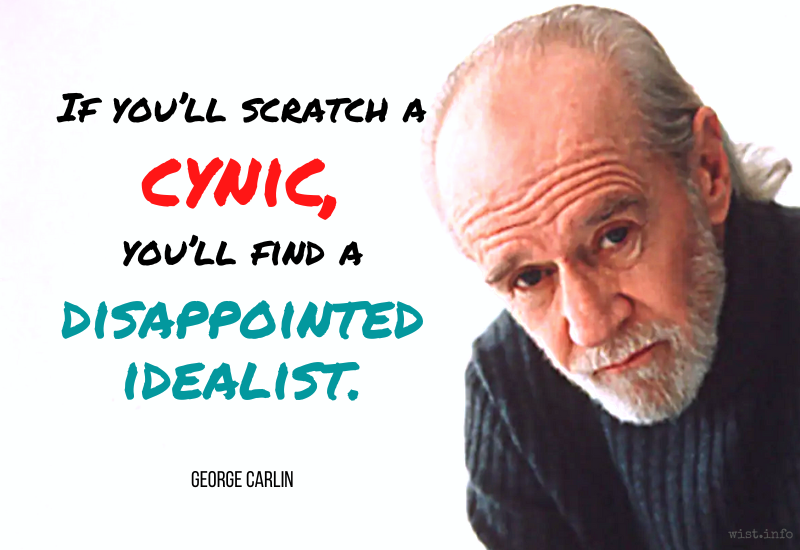
If you’ll scratch a cynic, you’ll find a disappointed idealist.
George Carlin (1937–2008) American comedian
Interview (2001-07) by Marc Cooper, The Progressive
(Source)
A documented case of a trademark phrase Carlin frequently used, though not necessarily original with him.
Often quoted as "Inside every cynical person, there is a disappointed idealist."
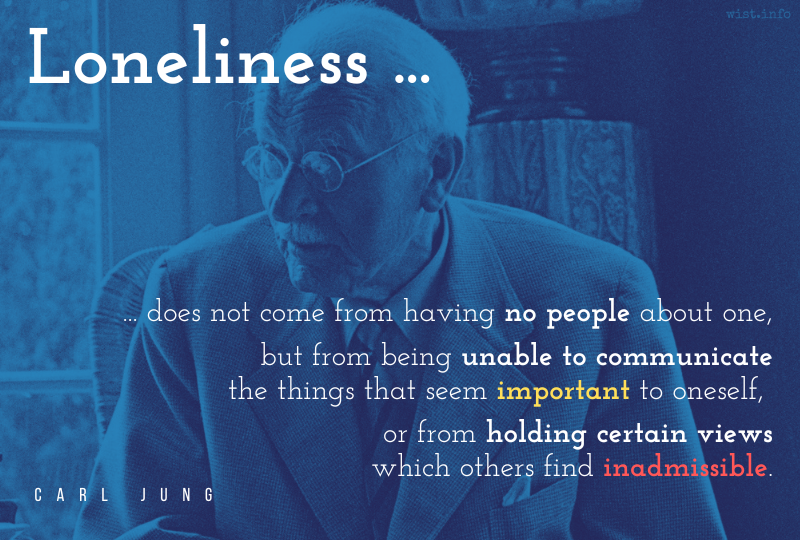
Loneliness does not come from having no people about one, but from being unable to communicate the things that seem important to oneself, or from holding certain views which others find inadmissible.
Carl Jung (1875–1961) Swiss psychologist
Memories, Dreams, Reflections [Erinnerungen, Träume, Gedanken], “Retrospect” (1962) [with Aniela Jaffé; tr. Winston (1963)]
(Source)
In the mirrors of the many judgments, my hands are the color of blood. I am part of the evil that exists in the world and in Shadow. I sometimes fancy myself an evil which exists to oppose other evils […] and on that Great Day of which the prophets speak but in which they do not truly believe, on the day the world is utterly cleansed of evil, then I too will go down into darkness, swallowing curses. Perhaps even sooner than that, I now judge. But whatever … Until then, I will not wash my hands nor let them hang useless.

People who hate cats tend to be proud of the fact, and brag about it as if it proved something honest and straightforward in their natures. Nobody brags about hating dogs. To hate dogs would be meanspirited and peculiarly unpatriotic; dogs are a very American concept, fraternal, hearty, and unpretentious, while cats are inscrutable like the wily Oriental and elitist like the European esthete. In advertising cats turn up selling perfume (wily) and expensive rugs and furniture (elitist) , while dogs sell such solid family values as station wagons, life insurance, and sporting goods.
Wealthy friends, you’re quick to take offene.
It’s not good manners, but it saves expense.[Irasci tantum felices nostis amici.
Non belle facitis, sed iuvat hoc: facite.]Martial (AD c.39-c.103) Spanish Roman poet, satirist, epigrammatist [Marcus Valerius Martialis]
Epigrams [Epigrammata], Book 3, epigram 37 (3.37) (AD 87-88) [tr. McLean (2014)]
(Source)
The commentary by various authors indicates this is about wealthy patrons pretending to offense or other anger at their poorer clientele as an excuse for not being free with gifts. Closely parallel to 12.13.
(Source (Latin)). Other translations:Rich friends 'gainst poor to anger still are prone:
It is not well, but profitably done.
[tr. May (1629); also as Hay (1755)]My rich friends, you know nothing save how to put yourselves into a passion. It is not a nice thing for you to do, but it suits your purpose. Do it.
[tr. Bohn's Classical (1859)]To be angry is all you know, you rich friends.
You do not act prettily, but it pays to do this.
[tr. Ker (1919)]Rich friends, 'tis your fashion to get in a passion
With humble dependents, or feign it.
Though not very nice, 'tis a saving device,
Economy bids you retain it.
[tr. Pott & Wright (1921), "A Mean Trick"]You well-off people are well versed only
in cursing out your inferiors:
Un For Giving bitching is quite enriching.
[tr. Bovie (1970)]You weIl-off friends only know how to take umbrage. It's not a pretty way to behave, but it suits your book.
[tr. Shackleton Bailey (1993)]Not easy, having money, blood so blue,
Lotta gifts expected for all your crew.
Kinda tacky to get angry and just tell 'em all go screw.
But the rich gotta do
What the rich gotta do.
[tr. Ericsson (1995)]The rich feign wrath – a profitable plan;
’Tis cheaper far to hate than help a man.
[tr. Pott]How explain why the conspicuously rich
are so easy to offend? Ask their accountant.
He probably won’t tell you but he’ll know.
[tr. Halsey]
KEATING: No matter what anybody tells you, words and ideas can change the world.
Tom Schulman (b. 1951) American screenwriter, director
Dead Poets Society (1989)
A religious man is a person who holds God and man in one thought at one time, at all times, who suffers in himself harm done to others, whose greatest passion is compassion, whose greatest strength is love and defiance of despair.
Abraham Joshua Heschel (1907–1972) Polish-American rabbi, theologian, philosopher
“What Ecumenism Is” (1963)
(Source)
Collected in Susanna Heschel, ed., Moral Grandeur and Spiritual Audacity (1996). In other essays in the book, he uses the first clause ("a person who holds God and man in one thought, at one time, at all times") as a definition of a "prophet."

The prayer of each man from his soul must be his and his alone. This is the genius of the First Amendment. If there is anything clear in the First Amendment, it is that the right of the people to pray in their own way is not be controlled by the election return.
Hugo Black (1886–1971) American politician and jurist; US Supreme Court Justice (1937–71)
Engel v. Vitale, 370 U.S. 421, 425 (1962) [extemporaneous remarks]
(Source)
Added by Black during his reading of the majority opinion, and not part of the written ruling. The passage follows, "It is no part of the business of government to compose official prayers for any group of the American people to recite as a part of a religious program carried on by government."
‘Tis fear that proves souls base-born.
[Degeneres animos timor arguit.]
Virgil (70–19 BC) Roman poet [b. Publius Vergilius Maro; also Vergil]
The Aeneid [Ænē̆is], Book 4, l. 13 (4.13) [Dido] (29-19 BC) [tr. Fairclough (1916)]
(Source)
Of the bravery shown in Aeneas' tale demonstrating what a great, if not even divine, man he is.
(Source (Latin)). Other translations:Feare shews degenerate minds.
[tr. Ogilby (1649)]Fear ever argues a degenerate kind.
[tr. Dryden (1697)]Fear argues a degenerate mind.
[tr. Davidson/Buckley (1854)]Fear proves a base-born soul.
[tr. Connington (1866)]Fear shows degenerate souls.
[tr. Cranch (1872)]Fear proves the vulgar spirit.
[tr. Mackail (1885)]For fear it is shows base-born souls.
[tr. Morris (1900)]Fear argues souls degenerate and base.
[tr. Taylor (1907), st. 2, l. 14]'Tis cowardice
betrays the base-born soul.
[tr. Williams (1910)]Fear proves a bastard spirit.
[tr. Humphries (1951)]Mean souls convict themselves by cowardice.
[tr. Day Lewis (1952)]For in the face of fear
the mean must fall.
[tr. Mandelbaum (1971)]Tell-tale fear
Betrays inferior souls.
[tr. Fitzgerald (1981), ll. 19-20]If there is any baseness in a man, it shows as cowardice.
[tr. West (1990)]Fear reveals the ignoble spirit.
[tr. Kline (2002)]Fear
Always gives away men of inferior birth.
[tr. Lombardo (2005)]Fear exposes the lowborn man at once.
[tr. Fagles (2006), l. 16]Fear shows up lesser men.
[tr. Bartsch (2021)]
For a people to be without history, or to be ignorant of its history, is as for a man to be without memory — condemned forever to make the same discoveries that have been made in the past, invent the same techniques, wrestle with the same problems, commit the same errors; and condemned, too, to forfeit the rich pleasures of reflection.
Henry Steele Commager (1902–1998) American historian, writer, activist
The Nature and Study of History, ch. 1 (1965)
(Source)
A Man is glad to gain Numbers on his Side, as they serve to strengthen him in his private Opinions. Every Proselyte is like a new Argument for the Establishment of his Faith. It makes him believe that his Principles carry Conviction with them, and are the more likely to be true, when he finds they are conformable to the Reason of others, as well as to his own. And that this Temper of Mind deludes a Man very often into an Opinion of his Zeal, may appear from the common Behaviour of the Atheist, who maintains and spreads his Opinions with as much Heat as those who believe they do it only out of Passion for God’s Glory.
Joseph Addison (1672–1719) English essayist, poet, statesman
Essay (1711-10-02), The Spectator, No. 185
(Source)
“Neither does this please me, nothing in excess;” for we ought to hate in excess those that are bad to excess.
[οὐδὲ τὸ μηδὲν ἄγαν· δεῖ γὰρ τούς γε κακοὺς ἄγαν μισεῖν.]
Aristotle (384–322 BC) Greek philosopher
Rhetoric [Ῥητορική; Ars Rhetorica], Book 2, ch. 21, sec. 14 (2.21.14) / 1395a.33 (350 BC) [Source (1847)]
(Source)
On developing one's own maxims and proverbs, and how to present them. (Source (Greek)). Other translations:Nor again [does this please me], that we ought to carry nothing to excess; since 'tis our duty to hate the wicked at least to the very extreme.
[tr. Buckley (1850)]No do I like the saying, Do nothing excessively. Bad men should be hated excessively.
[tr. Jebb (1873)]Nor do I approve of the saying "nothing in excess": we are bound to hate bad men excessively.
[tr. Rhys Roberts (1924)]Nor do I approve the maxim "Nothing in excess," for one cannot hate the wicked too much."
[tr. Freese (1926)]Neither is "nothing in excess" [satisfying to me]. For one must tate to excess at least those who are evil.
[tr. Bartlett (2019)][I do not] commend the saying “nothing in excess” because one must hate evil men to the extreme.
[tr. @sentantiq (2019)]
All writers are born; they’re never made … I take off and write, out of a sense of desperate compulsion. I always write as if I’d gotten my X-ray back from the doctor on Monday, and I’d best check with the insurance man to see whether or not the house is free and clear.
Rod Serling (1924–1975) American screenwriter, playwright, television producer, narrator
Lecture notes, Creativity Seminar, Ithaca College (c. 1972)
(Source)
“It’s true, now and again my feet itch for the road.” He was looking deep into himself, where old memories survived, and remained, after their fashion, warming and satisfying, but of the past, never to be repeated, no longer desirable. “But when it comes down to it,” said Cadfael, with profound content, “as roads go, the road home is as good as any.”
Ellis Peters (1913–1995) English writer, translator [pseud. of Edith Mary Pargeter, who also wrote under the names John Redfern, Jolyon Carr, Peter Benedict]
Cadfael Chronicles No. 19, The Summer of the Danes, ch. 14 (1991)
(Source)
Concluding words of the book.
To be misunderstood even by those whom one loves is the cross and bitterness of life.
Henri-Frédéric Amiel (1821–1881) Swiss philosopher, poet, critic
Journal Intime (1849-05-27) [tr. Ward (1885)]
(Source)
I believe in evil. It is the property of all those who are certain of truth. Despair and fanaticism are only differing manifestations of evil.
Edward Teller (1908–2003) Hungarian-American theoretical physicist
(Attributed)
(Source)
Attributed in a personal communication from Judith Shoolery, in Istvan Hargittai, The Martians of Science: Five Physicists Who Changed the Twentieth Century (2006).

Very few people have no opinions about cats. Even those who have never known a cat personally, scarcely even spoken to one, feel strongly and sometimes hysterically on the subject.
There are only two roads that lead to something like human happiness. They are marked by the words: love and achievement.
Theodor Reik (1888–1969) Austrian-American psychoanalyst, writer
A Psychologist Looks at Love (1944)
(Source)
Collected (with some modifications) in M. Sherman (ed.), Of Love and Lust Part 1, ch. 14 (1957).
This is frequently paraphrased or misquoted as "Work and love -- these are the basics. Without them there is neurosis." The apparent source of these misquotations is George Seldes, The Great Quotations (1960), where he attributed the passage to Reik and his book. Where Seldes got it from is unknown.
More discussion of this quotation: Ralph Keyes, Nice Guys Finish Seventh (1992).
Courage has need of reason, but it is not reason’s child; it springs from deeper strata.
[Der Mut bedarf der Vernunft, aber er ist nicht ihr Kind, er kommt aus tieferen Schichten.]
Herman Hesse (1877–1962) German-born Swiss poet, novelist, painter
Letter to Herrn K. Sch. (9 Jan 1951)
(Source)
Extracted as an aphorism in Reflections, #129 (1974). The source letter can be foumd in Briefe, Zweite erweiterte Ausgabe [Letters, Second Expanded Edition] (1964).
Sylvia never gives free lays.
It’s never free — because she pays.[Lesbia se iurat gratis numquam esse fututam.
Verum est. Cum futui vult, numerare solet.]Martial (AD c.39-c.103) Spanish Roman poet, satirist, epigrammatist [Marcus Valerius Martialis]
Epigrams [Epigrammata], Book 11, epigram 62 (11.62) (AD 96) [tr. Wills (2007)]
(Source)
(Source (Latin)). Other translations:Lesbia protests that no one has ever obtained her favours without payment.
That is true; when she wants a lover, she herself pays.
[tr. Bohn's Classical (1897)]Lesbia swears she has never granted her favours without a price.
That is true: on those occasions she is wont herself to pay it.
[tr. Ker (1919)]She never gives herself for love? No doubt.
She has to buy her loves or do without!
[tr. Pott & Wright (1921), "Bought Pleasures"]Lesbia swears she's never been had
Gratis. That's true. You see:
When she is in one of her amorous moods,
It's she who pays, not we.
[tr. Marcellino (1968), ]Lesbia claims she's never been laid
Without good money being paid.
That's true enough: when she's on fire
She'll always pay the hose's hire.
[tr. Michie (1972)]Lesbia swears she's never been fucked for free.
True, for when she wants it, she pays the fee.
[tr. Pitt-Kethley (1987)]Lesbia swears she's never screwed for free.
That's true, for when she's fucked, she pays the fee.
[tr. Pitt-Kethley (1992)]Lesbia swears that she has never been fucked free of charge.
It's true. When she wants to be fucked, she is accustomed to pay cash.
[tr. Shackleton-Bailey (1993)]She swears she never puts out for free.
(Though she's the one who pays the fee.)
[tr. Ericsson (1995)]Lesbia swears she’s never been fucked for free.
True. When she wants to be fucked, she has to pay.
[tr. Kline (2006), "On the Nail"]Lesbia swears she never gives free lays.
It's true: when she gets fucked, she always pays.
[tr. Kennelly (2008)]
Technological advance is rapid. But without progress in charity, technological advance is useless. Indeed, it is worse than useless. Technological progress has merely provided us with more efficient means for going backwards.
Aldous Huxley (1894–1963) English novelist, essayist and critic
Ends and Means: An Inquiry Into the Nature of Ideals, ch. 1 (1937)
(Source)

We must constantly look at things in a different way. […] Just when you think you know something, you must look at it in a different way. Even though it may seem silly or wrong, you must try. […] Dare to strike out and find new ground.
I believe that man will not merely endure: he will prevail. He is immortal, not because he alone among creatures has an inexhaustible voice, but because he has a soul, a spirit capable of compassion and sacrifice and endurance. The poet’s, the writer’s, duty is to write about these things. It is his privilege to help man endure by lifting his heart, by reminding him of the courage and honor and hope and pride and compassion and pity and sacrifice which have been the glory of his past. The poet’s voice need not merely be the record of man, it can be one of the props, the pillars to help him endure and prevail.
William Faulkner (1897–1962) American novelist
Speech (1950-12-10), Nobel Prize Banquet, Stockholm
(Source)
Faulkner received the 1949 Nobel Prize for Literature.
In an age where there is much talk about “being yourself” I reserve to myself the right to forget about being myself, since in any case there is very little chance of my being anybody else. Rather it seems to me that when one is too intent on “being himself” he runs the risk of impersonating a shadow.
Thomas Merton (1915–1968) French-American religious and writer [a.k.a. Fr. M. Louis]
“Day of a Stranger,” The Hudson Review (Summer 1967)
(Source)

There can, of course, be no doubt that New York’s program of daily classroom invocation of God’s blessings as prescribed in the Regents’ prayer is a religious activity. […] We think that the constitutional prohibition against laws respecting an establishment of religion must at least mean that, in this country, it is no part of the business of government to compose official prayers for any group of the American people to recite as a part of a religious program carried on by government.
Hugo Black (1886–1971) American politician and jurist; US Supreme Court Justice (1937–71)
Engel v. Vitale, 370 U.S. 421, 424–425 (1962) [majority opinion]
(Source)
This case ruled that organized school prayer was unconstitutional. The prayer in question, to be recited by each class before their teacher each day, read: "Almighty God, we acknowledge our dependence upon Thee, and we beg Thy blessings upon us, our parents, our teachers and our Country."
For nothing can ever be virtuous or creditable that is not just.
[Nihil enim honestum esse potest, quod iustitia vacat.]
Marcus Tullius Cicero (106–43 BC) Roman orator, statesman, philosopher
De Officiis [On Duties; On Moral Duty; The Offices], Book 1, ch. 19 (1.19) / sec. 62 (44 BC) [tr. Cockman (1699)]
(Source)
(Source (Latin)). Other translations:No conduct cannot be honorable which departs from justice.
[tr. McCartney (1798)]For nothing that is devoid of justice can be a virtue.
[tr. Edmonds (1865)]Nothing that is devoid of justice can be honorable.
[tr. Peabody (1883)]There can be no honour without justice.
[tr. Gardiner (1899)]Right cannot be where justice is not.
[ed. Harbottle (1906)]Nothing that lacks justice can be morally right.
[tr. Miller (1913)]Nothing can be morally worthy that lacks justice.
[tr. Edinger (1974)]
‘Those were happier days, when there was still close friendship at times between folk of different races, even between Dwarves and Elves.”
“It was not the fault of the Dwarves that the friendship waned,” said Gimli.
“I have not heard that it was the fault of the Elves,” said Legolas.
“I have heard both,” said Gandalf; “and I will not give judgement now.”J.R.R. Tolkien (1892–1973) English writer, fabulist, philologist, academic [John Ronald Reuel Tolkien]
The Lord of the Rings, Vol. 1: The Fellowship of the Ring, Book 2, ch. 4 “A Journey in the Dark” (1954)
(Source)
“Honesty” without compassion and understanding is not honesty, but subtle hostility.
Rose N. Franzblau (1930–1978) Austrian-American psychologist, author, columnist
Column, New York Post (1966)

The parallels between Easter Island and the whole modern world are chillingly obvious. Thanks to globalization, international trade, jet planes, and the Internet, all countries on Earth today share resources and affect each other, just as did Easter’s dozen clans. Polynesian Easter Island was as isolated in the Pacific Ocean as Earth is today in space. When the Easter Islanders got into difficulties, there was nowhere to which they could flee, nor to which they could turn for help, nor shall we modern Earthlings have recourse elsewhere if our troubles increase. Those are the reasons why people see the collapse of Easter Island society as a metaphor, a worst-case scenario, for what may lie ahead of us in our own future.
Jared Diamond (b. 1937) American geographer, historian, ornithologist, author
Collapse: How Societies Choose to Fail or Succeed, Part 2, ch. 2 (2005)
(Source)
This is the actual full text from Diamond's book. It is almost universally paraphrased (including the bracketed inclusion) as:The metaphor is so obvious. Easter Island isolated in the Pacific Ocean -- once the island got into trouble, there was no way they could get free. There was no other people from whom they could get help. In the same way that we on Planet Earth, if we ruin our own [world], we won't be able to get help.
I speculate that this pared-down phrasing was used by Diamond during a speech or seminar about the subject, or an interview about the book, and was then mistakenly identified (and copied) as a quote from the book. For example, at the ASA, CSSA, and SSSA Annual Meetings, Long Beach, California (2010), for example, Diamond is quoted with this near match:The metaphor is so obvious. Easter Island is isolated in the Pacific Ocean; once the Easter Islanders got into trouble, there was nowhere that they could flee. Just as if, today, we on planet Earth mess up our island planet, there is no other galaxy that we’re going to be able to float off to.
Politeness, however, acts the lady’s-maid to our thoughts; and they are washed, dressed, curled, rouged, and perfumed, before they are presented to the public.
Letitia Elizabeth Landon (1802–1838) English poet and novelist [a/k/a L.E.L.]
Romance and Reality, Vol. 2, ch. 14 (1831)
(Source)

Even when you are right, it is good to make concessions: people will recognize you were right but admire your courtesy. More is lost through holding on than can be won by defeating others. One defends not truth but rudeness.
[Aun en caso de evidencia, es ingenuidad el ceder, que no se ignora la razón que tuvo y se conoce la galantería que tiene. Más se pierde con el arrimamiento que se puede ganar con el vencimiento; no es defender la verdad, sino la grosería.]
Baltasar Gracián y Morales (1601–1658) Spanish Jesuit priest, writer, philosopher
The Art of Worldly Wisdom [Oráculo Manual y Arte de Prudencia], § 183 (1647) [tr. Maurer (1992)]
(Source)
(Source (Spanish)). Other translations:It is civil to yield, even in those things wherein we have greatest reason and certainty: for then all know, who had reason on their side: and besides the reason, Gallantry is also discovered in the procedure. There is more esteem lost, by a wilfull resistence, then there is got by carrying it by open force. For that is not so much a defending of truth, as a demonstration of Clownishness.
[Flesher ed. (1685)]Even in cases of obvious certainty it is fine to yield: our reasons for holding the view cannot escape notice, our courtesy in yielding must be the more recognised. Our obstinacy loses more than our victory yields: that is not to champion truth but rather rudeness.
[tr. Jacobs (1892)]Even with the proof on your side, it is well to make concession, for your reasons are known and your gentlemanliness is recognized; more is lost in contention than can be gained in consummation, for such does not defend the truth, but only exhibits bad manners.
[tr. Fischer (1937)]
Children can be taken occasionally to the country to see what the sun looks like as they are taken now to see a hill or a mountain. Probably many of them will not want to go anyway, for the country will be to them only what it was to the London club man: “A damp sort of place where all sorts of birds fly about uncooked.”
Joseph Wood Krutch (1893–1970) American educator, writer, critic, naturalist
The Twelve Seasons, “June” (1949)
(Source)
The comment at the end is sometimes misattributed to Oscar Wilde. Further discussion of this quotation here: The Country: A Damp Sort of Place Where All Sorts of Birds Fly About Uncooked – Quote Investigator.
Imprisoned in every fat man a thin one is wildly signalling to be let out.
Cyril Connolly (1903–1974) English intellectual, literary critic and writer.
The Unquiet Grave, Part 2 “Te Palinure Petens” (1944)
(Source)
Our democracy is threatened whenever we take it for granted. All of us, regardless of party, should be throwing ourselves into the task of rebuilding our democratic institutions. When voting rates in America are some of the lowest among advanced democracies, we should be making it easier, not harder, to vote. When trust in our institutions is low, we should reduce the corrosive influence of money in our politics, and insist on the principles of transparency and ethics in public service. When Congress is dysfunctional, we should draw our congressional districts to encourage politicians to cater to common sense and not rigid extremes. But remember, none of this happens on its own. All of this depends on our participation; on each of us accepting the responsibility of citizenship, regardless of which way the pendulum of power happens to be swinging.
Barack Obama (b. 1961) American politician, US President (2009–2017)
“Farewell Address,” Chicago (10 Jan 2017)
(Source)
That script taught me never to write about someone who doesn’t go to the bathroom.
Rod Serling (1924–1975) American screenwriter, playwright, television producer, narrator
Comment to Mark Olshaker
(Source)
Regarding his script for The Man (1972), from the novel by Irving Wallace, portraying James Earl Jones as the first Black US president. Serling felt the final product came out with Jones too much as a symbol, not a real human being.
In Anne Serling, As I Knew Him: My Dad, Rod Serling (2013).
There are things in the breast of mankind which are best
In darkness and secrecy hid;
For you never can tell, when you’ve opened a hell,
How soon you can put back the lid.Rudyard Kipling (1865–1936) English writer
“The Sons of the Suburbs” (1916)
(Source)
On bloodthirstiness in war by previously peaceful people.
Originally written for the Christmas 1916 issue of Blighty, a magazine for servicemen. It was rejected, eventually to be published in the Sunday Pictorial (19 Jan 1936). It was never included by Kipling in any of his collections.
It is what you read when you don’t have to that determines what you will be when you can’t help it.
Charles Francis Potter (1885–1962) American Unitarian minister, theologian, humanist, activist
Speech, Dayton, Ohio (Apr 1927)
Often misattributed to Oscar Wilde. More discussion here: What You Read When You Don’t Have To, Determines What You Will Be When You Can’t Help It – Quote Investigator
The task is to throw all those things on the exact same burn pile as the collected works of all the apologists for conservatism, and start fresh. The core proposition of anti-conservatism requires no supplementation and no exegesis. It is as sufficient as it is necessary. What you see is what you get:
The law cannot protect anyone unless it binds everyone; and it cannot bind anyone unless it protects everyone.
Frank Wilhoit (contemp.) American composer and software architect
Crookedtimber.org, “The Travesty of Liberalism,” Comment #26 (22 Mar 2018)
(Source)

There is a road from the eye to the heart that does not go through the intellect. Men do not quarrel about the meaning of sunsets; they never dispute that the hawthorn says the best and wittiest thing about the spring.
Gilbert Keith Chesterton (1874–1936) English journalist and writer
“A Defence of Heraldry,” The Defendant (1901)
(Source)

Smiting enemies has always been so admired that, unlike medicine or archaeology, it entitled its successful practitioners to become kings, emperors, and presidents of the United States like Washington, Jackson, William Henry Harrison, Taylor, Grant, and Eisenhower.
Administrivia: (2022-05-20) On the Road Again
WIST will be on vacation until May 31.
Kiva considered that she might be developing a thing for Fundapellonan, which on one hand would be a very not-Kiva thing to do, but on the other hand who gave a fuck if it was “not-Kiva,” because she wasn’t some fucking fictional character destined to do whatever some goddamn hack wanted her to do.

Clear thinking requires courage rather than intelligence.
Thomas Szasz (1920–2012) Hungarian-American psychiatrist, educator
The Untamed Tongue: A Dissenting Dictionary (1990)
(Source)
Feignlove, half-starved, a rich old hag has wed: —
Poor Feignlove, doom’d to earn his board in bed.[Duxerat esuriens locupletem pauper anumque:
Uxorem pascit Gellius et futuit.]Martial (AD c.39-c.103) Spanish Roman poet, satirist, epigrammatist [Marcus Valerius Martialis]
Epigrams [Epigrammata], Book 9, epigram 80 (9.80) (AD 94) [tr. Halhead (1793)]
(Source)
(Source (Latin)). Other translations:An old rich wife starv'd Gellius, bare and poor,
Did wed: so she cramm'd him and he cramm'd her.
[tr. Fletcher (c. 1650)]Consorted wealth and age has Gellius won:
Now Gellius earns, and eats, and is undone.
[tr. Elphinston (1782), Book 12, ep. 189]The poor and hungry Gellius married a woman old and rich. He eats and enjoys himself.
[tr. Bohn's Classical (1859)]Hungry, and a pauper, Gellius married a rich and old woman. He now feeds and tickles his wife.
[tr. Ker (1919)]Poor John in his youth was so very sharp-set,
He married a grand dame for what he could get.
To-day he discovers there's plenty to do;
For he has both to feed her and fondle her, too.
[tr. Pott & Wright (1921), "A Bad Bargain"]A hungry pauper, Gellius married a rich old woman. He feeds his wife and fucks her.
[tr. Shackleton Bailey (1993)]She was rich and lonely.
A hungry man was he.
Now he dines and gets his fill,
And, later, so does she.
[tr. Ericsson (1995)]A starving pauper wed a wealthy crone.
Gellius feeds his wife and gives her the bone.
[tr. McLean (2014)]
Humility makes us charitable toward our neighbor. Nothing will make us so generous and merciful to the faults of others as seeing our own faults.
François Fénelon (1651–1715) French Catholic archbishop, theologian, poet, writer [François de Salignac de la Mothe-Fénelon]
Letter, Undated [tr. Edmonson / Helms]
(Source)
In Robert J. Edmonson, Hal M. Helms (eds.), The Complete Fénelon, Part 2, ch. 8 (2008). Other translations:Nothing will make us so charitable and tender to the faults of others as by self-examination thoroughly to know our own.
[Source (1895)]Humility renders us charitable towards our neighbor; nothing will make us so tender and indulgent to the faults of others as a view of our own.
[tr. Metcalf (1853)]
Conservatism consists of exactly one proposition, to wit:
There must be in-groups whom the law protects but does not bind, alongside out-groups whom the law binds but does not protect.
There is nothing more or else to it, and there never has been, in any place or time.
Frank Wilhoit (contemp.) American composer and software architect
Crookedtimber.org, “The Travesty of Liberalism,” Comment #26 (22 Mar 2018)
(Source)
Scratch the surface of most cynics and you find a frustrated idealist — someone who made the mistake of converting his ideals into expectations.
Peter Senge (b. 1947) American systems scientist, lecturer, academic
The Fifth Discipline, Part 3, ch. 8 (1990)
(Source)

We should take care also that the punishment shall not be out of proportion to the offence, and that some shall not be chastised for the same fault for which others are not even called to account.
[Cavendum est etiam, ne maior poena quam culpa sit, et ne isdem de causis alii plectantur, alii ne appellentur quidem.]
Marcus Tullius Cicero (106–43 BC) Roman orator, statesman, philosopher
De Officiis [On Duties; On Moral Duty; The Offices], Book 1, ch. 25 (1.25) / sec. 89 (44 BC) [tr. Miller (1913)]
(Source)
(Source (Latin)). Other translations:Diligent care should be taken, in the next place, that the penalty be proportioned to the nature of the crime; and that some do not pass without ever being questioned, while others are punished for the same misdemeanours.
[tr. Cockman (1699)]Great care too must be taken, that the punishment be not greater than the offence; and that some should not be punished for the same offences, for which others are not called to account.
[tr. McCartney (1798)]We ought, likewise, to take care that the punishment be proportioned to the offence, and that some be not punished for doing things for which others are not so much as called to account.
[tr. Edmonds (1865)]Care also must be taken lest the punishment be greater than the fault, and lest for the same cause some be made penally responsible, and others not even called to account.
[tr. Peabody (1883)]Again, we should never impose a penalty disproportioned to the offence or for the same crime punish one and let another go unchallenged.
[tr. Gardiner (1899)]We must take care that the punishment is not in excess of the crime, and that it is not inflicted on some only while others equally guilty are not even brought to trial.
[ed. Harbottle (1906)]One should also be careful that the punishment does not surpass the crime and that some people receive beatings while others do not even receive a reprimand.
[tr. Edinger (1974)]
What do we live for, if it is not to make life less difficult to each other?
George Eliot (1819–1880) English novelist [pseud. of Mary Ann Evans]
Middlemarch, Book 8, ch. 72 [Dorothea] (1871)
(Source)
Success is not final, failure is not fatal: it is the courage to continue that counts.
Winston Churchill (1874–1965) British statesman and author
(Spurious)
(Source)
Variant: "Success is never final and failure never fatal. It’s courage that counts."Not found in Churchill's canon. There are precursors to elements of this quotation, but the earliest version substantially like it is found in a 1938 Budweiser beer print advertisement:
Men with the spirit of youth pioneered our America ... men with vision and sturdy confidence. They found contentment in the thrill of action, knowing that success was never final and failure never fatal. It was courage that counted. Isn’t opportunity in America today greater than it was in the days of our grateful forefathers?
More discussion about this quotation:
Also attributed to Abraham Lincoln and John Wooden. Preacher Robert Schuller used Success is Never Ending, Failure is Never Final as the title of a 1990 book.
There are two tragedies in life. One is not to get your heart’s desire. The other is to get it.
George Bernard Shaw (1856–1950) Irish playwright and critic
Man and Superman, Act 4 [Mendoza] (1903)
(Source)
See Wilde, eleven years earlier. More discussion quote: There Are Only Two Tragedies. One Is Not Getting What One Wants, and the Other Is Getting It – Quote Investigator.
Maybe there really is no satisfaction in revenge, but I can tell you one thing for sure: There’s no satisfaction in letting someone get away with ruining your life, either.
But the Queen, long sick with love,
Nurses her heart’s deep wound
With her pounding blood, and dark flames
Lick at her soul. Thoughts of Aeneas —
The man’s heroic lineage, his noble character —
Flood her mind, his face and words transfix
Her heart, and her desire gives her no rest.[At regina gravi iamdudum saucia cura
volnus alit venis, et caeco carpitur igni.
Multa viri virtus animo, multusque recursat
gentis honos: haerent infixi pectore voltus
verbaque, nec placidam membris dat cura quietem.]Virgil (70–19 BC) Roman poet [b. Publius Vergilius Maro; also Vergil]
The Aeneid [Ænē̆is], Book 4, l. 1ff (4.1-5) (29-19 BC) [tr. Lombardo (2005)]
(Source)
(Source (Latin)). Other translations:But long since Dido, struck with great desire,
Feeds a sad wound, and wastes in hidden fire.
His valour, his high birth run in her mind:
His face, and language, deep impression find,
Nor doth her care grant rest.
[tr. Ogilby (1649)]But anxious cares already seiz'd the queen:
She fed within her veins a flame unseen.
The hero's valor, acts, and birth inspire
Her soul with love, and fan the secret fire.
His words, his looks, imprinted in her heart,
Improve the passion, and increase the smart.
[tr. Dryden (1697)]But the the queen, long since pierced with painful care, feeds the wound in her veins, and is consumed by unseen flames. The many virtues of the hero, the many honors of his race, recur to her thoughts: hjis looks and words dwell fixed in her soul: nor does care allow calm rest to her limbs.
[tr. Davidson/Buckley (1854)]Not so the queen: a deep wound drains
The healthful current of her veins:
Long since the unsuspected flame
Has fastened on her fevered frame:
Much dwells she on the chief divine,
Much on the glories of his line:
Each look is pictured in her breast,
Each word: nor passion lets her rest.
[tr. Conington (1866)]But pierced with grievous pangs long since, the queen
Feeds in her veins the wound, by secret fire
Consumed. The hero's many virtues oft
Recur to her mind, and glories of his race.
Within her heart his looks, his words are fixed;
Her troubled soul allows her limbs no rest.
[tr. Cranch (1872)]But the Queen, long ere now pierced with sore distress, feeds the wound with her life-blood, and catches the fire unseen. Again and again his own valiance and his line's renown flood back upon her spirit; look and accent cling fast in her bosom, and the pain allows not rest or calm to her limbs.
[tr. Mackail (1885)]Meanwhile the Queen, long smitten sore with sting of all desire,
With very heart's blood feeds the wound and wastes with hidden fire.
And still there runneth in her mind the hero's valiancy,
And glorious stock; his words, his face, fast in her heart they lie:
Nor may she give her body peace amid that restless pain.
[tr. Morris (1900)]Long since a prey to passion's torturing pains,
The Queen was wasting with the secret flame,
The cruel wound was feeding on her veins.
Back to the fancy of the lovelorn dame
Came the chief's valour and his country's fame.
His looks, his words still lingered in her breast,
Deep-fixt.
[tr. Taylor (1907), st. 1]Now felt the Queen the sharp, slow-gathering pangs
of love; and out of every pulsing vein
nourished the wound and fed its viewless fire.
Her hero's virtues and his lordly line
keep calling to her soul; his words, his glance,
cling to her heart like lingering, barbed steel,
and rest and peace from her vexed body fly.
[tr. Williams (1910)]But the queen, long since smitten with a grievous love-pang, feeds the wound with her life-blood, and is wasted with fire unseen. Oft to her heart rushes back the chief's valour, oft his glorious stock; his looks and words cling fast within her bosom, and the pang withholds calm rest from her limbs.
[tr. Fairclough (1916)]But the queen finds no rest. Deep in her veins
The wound is fed; she burns with hidden fire.
His manhood, and the glory of his race
Are an obsession with her, like his voice,
Gesture and countenance.
[tr. Humphries (1951)]But now for some while the queen had been growing more grievously love-sick,
Feeding the wound with her life-blood, the fire biting within her.
Much did she mue on the hero's nobility and much
On his family's fame. His look, his words had gone to her heart
And lodged there: she could get no peace from love's disquiet.
[tr. Day Lewis (1952)]Too late. The queen is caught between love's pain
and press. She feeds the wound within her veins;
she is eaten by a secret flame. Aeneas'
high name, all he has done, again, again
come like a flood. His face, his words hold fast
her breath. Care strips her limbs of calm and rest.
[tr. Mandelbaum (1971)]The queen, for her part, all that evening ached
With longing that her heart's blood fed, a wound
Or inward fire eating her away.
The manhood of the man, his pride of birth,
Came home to her time and again; his looks,
His words remained with her to haunt her mind,
And desire for him gave her no rest.
[tr. Fitzgerald (1981)]But the queen had long since been suffering from love's deadly wound, feeding it with her blood and being consumed by its hidden fire. Again and again there rushed into her mind thoughts of the great valour of the man and the high glories of his line. His features and the words he had spoken had pierced her heart and love gave her body no peace or rest.
[tr. West (1990)]But the queen, wounded long since by intense love,
feeds the hurt with her life-blood, weakened by hidden fire.
The hero’s courage often returns to mind, and the nobility
of his race: his features and his words cling fixedly to her heart,
and love will not grant restful calm to her body.
[tr. Kline (2002)]But the queen -- too long she has suffered the pain of love,
hour by hour nursing the wound with her lifeblood,
consumed by the fire buried in her heart.
The man’s courage, the sheer pride of his line,
they all come pressing home to her, over and over.
His looks, his words, they pierce her heart and cling --
no peace, no rest for her body, love will give her none.
[tr. Fagles (2006)]But love's pain had already pierced the queen.
She fed it with her life-blood; the hidden flame consumed her.
Aeneas' courage and his noble birth haunted her thoughts.
His face and words lodged in her heart.
Love let her find no rest in sleep.
[tr. Bartsch (2021)]
Perhaps the most useful lesson the student of history can learn is to avoid oversimplification, and to accept the notion of multiple causation or to resign himself to the fact that as yet we do not know enough to explain the causes of things. To yearn for a single, and usually simple, explanation of the chaotic materials of the past, to search for a single thread in the most tangled of all skeins, is a sign of immaturity.
Henry Steele Commager (1902–1998) American historian, writer, activist
The Nature and the Study of History, ch. 5 (1965)
(Source)
We are told by some of the Jewish Rabbins, that the first Murder was occasioned by a religious Controversy; and if we had the whole History of Zeal from the Days of Cain to our own Times, we should see it filled with so many Scenes of Slaughter and Bloodshed, as would make a wise Man very careful how he suffers himself to be actuated by such a Principle, when it only regards Matters of Opinion and Speculation.
Joseph Addison (1672–1719) English essayist, poet, statesman
Essay (1711-10-02), The Spectator, No. 185
(Source)
If you cannot enjoy reading a book over and over again, there is no use reading it at all.
A stone lies in a river; a piece of wood is jammed against it; dead leaves, drifting logs, and branches caked with mud collect; weeds settle there, and soon birds have made a nest and are feeding their young among the blossoming water plants. Then the river rises and the earth is washed away. The birds depart, the flowers wither, the branches are dislodged and drift downward; no trace is left of the floating island but a stone submerged by the water; — such is our personality.
Cyril Connolly (1903–1974) English intellectual, literary critic and writer.
The Unquiet Grave, Part 1 “Ecce Gubernator” (1944)
(Source)
Democracy can buckle when we give in to fear. So, just as we, as citizens, must remain vigilant against external aggression, we must guard against a weakening of the values that make us who we are.
Barack Obama (b. 1961) American politician, US President (2009–2017)
“Farewell Address,” Chicago (10 Jan 2017)
(Source)
Are you tough enough to face one of the uglier stains upon the fabric of our democracy, prejudice? It’s the basic root of most evil. It’s a part of the sickness of man. And it’s a part of man’s admission, his constant sick admission, that to exist he must find a scapegoat. To explain away his own deficiencies, he must try to find someone who he believes more deficient. If you find yourself thinking words like “Nigger”, or “Kike”, or “Pollock”, or “Wop”, or “Bohunk”, or “Sheenie”, or “Dago”, consign them to the lexicon of race-haters who aren’t fit to breathe the same air as you are. Make your judgment of your fellow-man on what he says and what he believes and the way he acts. Be tough enough, please, to live with prejudice and give battle to it. It warps, it poisons, it distorts and it is self-destructive. It has fallout worse than a bomb … and worst of all it cheapens and demeans anyone who permits himself the luxury of hating.
Rod Serling (1924–1975) American screenwriter, playwright, television producer, narrator
Commencement Address, Binghamton Central High School, Binghamton, New York (28 Jan 1968)
(Source)
Beauty is unbearable, drives us to despair, offering us for a minute the glimpse of an eternity that we should like to stretch out over the whole of time.
Albert Camus (1913–1960) Algerian-French novelist, essayist, playwright
Notebooks: 1935-1942 Notebook 1, May 1935 [tr. Thody (1963)
(Source)
The seeds of evil usually germinated in the footprints of people who knew how everybody else ought to behave and felt the need to tell them so.

If a quick glance back over world history shows us anything, it shows us that war was one of our most universal joys from our earliest beginnings, savored at every possible opportunity and even some quite incomprehensible ones, like the assassination of Archduke Ferdinand, whomever he may have been.
Barbara Holland (1933–2010) American author
“War,” Wasn’t the Grass Greener? (1999)
(Source)
First appeared in Smithsonian (Jun 1992).
Of publishing a book on religion, my dear Sir, I never had an idea. I should as soon think of writing for the reformation of Bedlam, as of the world of religious sects. Of these there must be, at least, ten thousand, every individual of every one of which believes all wrong but his own. To undertake to bring them all right, would be like undertaking, single-handed, to fell the forests of America.
Thomas Jefferson (1743–1826) American political philosopher, polymath, statesman, US President (1801–09)
Letter (1815-01-29) to Charles Clay
(Source)
A maxim for the twenty-first century might well be to start not by fighting evil in the name of good, but by attacking the certainties of people who claim always to know where good and evil are to be found. We should struggle not against the devil himself but what allows the devil to live — Manichaean thinking itself.
Tzvetan Todorov (1939–2017) Bulgarian-French historian, philosopher, literary critic, sociologist
Hope and Memory: Reflections on the Twentieth Century, ch. 5 “The Past in the Present” (2003)
(Source)
Paraphrased variant:We should not be simply fighting evil in the name of good, but struggling against the certainties of people who claim always to know where good and evil are to be found.
Every fool stands convinced; and everyone convinced is a fool; and the faultier a man’s judgment, the firmer his conviction.
[Todo necio es persuadido, y todo persuadido necio; y quanto mas erroneo su dictamen, es mayor su tenacidad.]
Baltasar Gracián y Morales (1601–1658) Spanish Jesuit priest, writer, philosopher
The Art of Worldly Wisdom [Oráculo Manual y Arte de Prudencia], § 183 (1647) [tr. Fischer (1937)]
(Source)
(Source (Spanish)). Another translation:All Fools are Opiniatours, and all Opiniatours are Fools. The more Erroneous their Opinions are, the more they hug them.
[Flesher ed. (1685)]Every fool is fully convinced, and every one fully persuaded is a fool: the more erroneous his judgment the more firmly he holds it.
[tr. Jacobs (1892)]Fools are stubborn, and the stubborn are fools, and the more erroneous their judgment is, the more they hold onto it.
[tr. Maurer (1992)]
Take care never to speak what you have not weighed and pondered beforehand; nor interject your own words on the spur of the moment and in the midst of another’s; for you must listen and converse in turn, with set times for speech and for silence.
Clement of Alexandria (c. AD 150 - c. 215 ) Christian theologian, philosopher, Church Father [Κλήμης ὁ Ἀλεξανδρεύς, Titus Flavius Clemens]
“To the Newly Baptized / Exhortation to Endurance” [tr. Butterworth]
(Source)
Who, pray, are benefiting by all this waste and confusion? The dew, a mere small percentage of the population of the world. All the remainder submit, because they think “it always has been so and it must always be so.” The work of those who have a conception of a true society of the future, must devote all their efforts towards disabusing the people’s minds of the ancient false hoods. It can be done. Many other hoary lies have passed away, so will this one, too.
Lucy Parsons (1851–1942) American labor organizer, anarchist, orator [a.k.a. Lucy Gonzalez]
“Property Rights vs. Human Rights,” The Liberator (22 Nov 1905)
(Source)

Laughter is carbonated holiness.
Anne Lamott (b. 1954) American novelist and non-fiction writer
Plan B, ch. 5 “Holy of Holies 101” (2004)
(Source)

The people who say you are not facing reality actually mean that you are not facing their idea of reality. Reality is above all else a variable, and nobody is qualified to say that he or she knows exactly what it is. As a matter of fact, with a firm enough commitment, you can sometimes create a reality which did not exist before. Protestantism itself is proof of that.

It is typical for fascist politicians to represent a country’s actual history in conspiratorial terms, as a narrative concocted by liberal elites and cosmopolitans to victimize the people of the true “nation.”
Jason Stanley (b. 1969) American philosopher, epistemologist, academic
How Fascism Works: The Politics of Us and Them, ch. 1 (2018)
(Source)
“There’s a right thing to do,” Holden said.
“You don’t have a right thing, friend,” Miller said. “You’ve got a whole plateful of maybe a little less wrong.”
Daniel Abraham (b. 1969) American writer [pseud. James S. A. Corey (with Ty Franck), M. L. N. Hanover]
Leviathan Wakes, ch. 36 (2011) [with Ty Franck]
(Source)
It is very easy for you to call me a happy man: you are only a spectator. I am one of the principals; and I know better.
George Bernard Shaw (1856–1950) Irish playwright and critic
Man and Superman, Act 4 [Tanner] (1903)
(Source)
To heav’n aloft on ridgy waves we ride,
Then down to hell descend, when they divide.[Tollimur in caelum curvato gurgite, et idem
subducta ad Manis imos desedimus unda.]Virgil (70–19 BC) Roman poet [b. Publius Vergilius Maro; also Vergil]
The Aeneid [Ænē̆is], Book 3, l. 564ff (3.564-565) [Aeneus] (29-19 BC) [tr. Dryden (1697)]
(Source)
As the ship passes Charybdis.
(Source (Latin)). Other translations:Thrice she doth drink
Vast floods, which down to hell's darke bottom sinke,
Then belch'd again, lasheth the skie with waves.
[tr. Ogilby (1649)]We mount up to heaven on the arched gulf, and down again we settle to the shades below, the wave having retired.
[tr. Davidson/Buckley (1854)]Now to the sky mounts up the ship,
Now to the very shades we dip.
[tr. Conington (1866)]The curving wave one moment lifts us up
Skyward, then sinks us down as in the shades
Of death.
[tr. Cranch (1872)]We are lifted skyward on the crescent wave, and again sunk deep into the nether world as the water is sucked away.
[tr. Mackail (1885)]Upheaved upon the tossing whirl we fare unto the sky,
Then down unto the nether Gods we sink upon the wave.
[tr. Morris (1900)]Now curls the wave, and lifts us to the sky,
Now sinks and, plunging in the gulf we lie.
[tr. Taylor (1907), st. 72, ll. 643-44]We shot to skyward on the arching surge,
then, as she sank, dropped deeper than the grave.
[tr. Williams (1910)]We mount up to heaven on the arched billow and again, with the receding wave, sink down to the depths of hell.
[tr. Fairclough (1916)]One moment
We were in the clouds, the next in the gulf of Hell.
[tr. Humphries (1951)]We were tossed up high on an arching surge, then down we went
In the trough as the wave fell away, down to the very Pit.
[tr. Day Lewis (1952)]We rise to heaven on the bending wave
and, as the surge slips back, we sink again
down to the deepest Shades.
[tr. Mandelbaum (1971), l. 734ff]On every rolling sea
We rose to heaven, and in the abysmal trough
Sank down into the world of shades.
[tr. Fitzgerald (1981), l. 749ff]A great arching wave came and lifted us to the sky and a moment later as the wave was sucked down we plunged into the abyss of hell.
[tr. West (1990)]We climb to heaven on the curving flood, and again
sink down with the withdrawing waves to the depths of Hades.
[tr. Kline (2002)]Up to the sky an immense billow hoists us, then at once,
as the wave sank down, down we plunge to the pit of hell.
[tr. Fagles (2006), ll. 658-59]A curved wave thrust us to the sky, then sank. As we fell, we plunged down to the depths of Hades.
[tr. Bartsch (2021)]
History is a jangle of accidents, blunders, surprises and absurdities, and so is our knowledge of it, but if we are to report it at all we must impose some order upon it.
Henry Steele Commager (1902–1998) American historian, writer, activist
The Nature and the Study of History, ch. 5 (1965)
(Source)
Insofar as I may be heard by anything, which may or may not care what I say, I ask, if it matters, that you be forgiven for anything you may have done or failed to do which requires forgiveness. Conversely, if not forgiveness but something else may be required to insure any possible benefit for which you may be eligible after the destruction of your body, I ask that this, whatever it may be, be granted or withheld, as the case may be, in such a manner as to insure your receiving said benefit. I ask this in my capacity as your elected intermediary between yourself and that which may not be yourself, but which may have an interest in the matter of your receiving as much as it is possible for you to receive of this thing, and which may in some way be influenced by this ceremony. Amen.
Roger Zelazny (1937–1995) American writer
“Agnostic’s Prayer,” Creatures of Light and Darkness (1969)
(Source)
Used by a character to shrive a person about to commit a public suicide. Also called the "Possibly Proper Death Litany."
There is nothing in which Men more deceive themselves than in what the World calls Zeal. There are so many Passions which hide themselves under it, and so many Mischiefs arising from it, that some have gone so far as to say it would have been for the Benefit of Mankind if it had never been reckoned in the Catalogue of Virtues. It is certain, where it is once Laudable and Prudential, it is an hundred times Criminal and Erroneous; nor can it be otherwise, if we consider that it operates with equal Violence in all Religions, however opposite they may be to one another, and in all the Subdivisions of each Religion in particular.
Joseph Addison (1672–1719) English essayist, poet, statesman
Essay (1711-10-02), The Spectator, No. 185
(Source)
Users do not care about what is inside the box, as long as the box does what they need done.
Jef Raskin (1943–2005) American computer scientist, writer
The Humane Interface, 1-5 (2000)
(Source)
It is true that many Americans find the Commandments in accord with their personal beliefs. But we do not count heads before enforcing the First Amendment.
Sandra Day O'Connor (b. 1930) American attorney, politician, Supreme Court justice (1981–2006)
McCreary County v. American Civil Liberties Union, 545 U.S. 844 (2005) [concurring]
(Source)
Declaring Ten Commandments displays in two Kentucky county courthouses to be unconstitutional.

The societies to which most readers of this book belong represent a narrow slice of human cultural diversity. Societies from that slice achieved world dominance not because of a general superiority, but for specific reasons: their technological, political, and military advantages derived from their early origins of agriculture, due in turn to their productive local wild domesticable plant and animal species. Despite those particular advantages, modern industrial societies didn’t also develop superior approaches to raising children, treating the elderly, settling disputes, avoiding non-communicable diseases, and other societal problems. Thousands of traditional societies developed a wide array of different approaches to those problems.
Jared Diamond (b. 1937) American geographer, historian, ornithologist, author
The World Until Yesterday: What Can We Learn from Traditional Societies?, Epilogue (2012)
(Source)
POLITENESS, n. The most acceptable hypocrisy.
Ambrose Bierce (1842–1914?) American writer and journalist
“Politeness,” The Devil’s Dictionary (1911)
(Source)
Originally published in the "Cynic's Word Book" column in the New York American (1906-03-16) and the "Devil's Dictionary" column in the San Francisco Wasp (1906-03-21).

But many do not know that they do not know, and many think they know when they know nothing. Failings of the intelligence are incorrigible since those who do not know do not know themselves and cannot therefore seek what they lack.
[Pero hay muchos que ignoran que no saben y otros que piensan que saben, no sabiendo. Achaques de necedad son irremediables, que como los ignorantes no se conocen, tampoco buscan lo que les falta.]
Baltasar Gracián y Morales (1601–1658) Spanish Jesuit priest, writer, philosopher
The Art of Worldly Wisdom [Oráculo Manual y Arte de Prudencia], § 176 (1647) [tr. Jacobs (1892)]
(Source)
(Source (Spanish)). Other translations:Yet there are some, who are ignorant that they know nothing; and others, who think they know, though they know nothing at all. The faults that proceed from the want of wit, are incurable. For as ignorants know not themselves, so they take no care to search for that they want.
[Flesher ed. (1685)]But there be many who do not know that they know nothing, and others who think that they know, but know nothing; these deformities of the mind are incurable, whence it is that the ignorant neither know themselves nor yet how to gain what they lack.
[tr. Fischer (1937)]But many people are unaware that they do not know, and others think they know when they do not. Attacks of foolishness have no remedy. Because the ignorant do not know themselves, they never look for what they're lacking.
[tr. Maurer (1992)]
I agree with you likewise in your wishes to keep religion and government independent of each Other. Were it possible for St. Paul to rise from his grave at the present juncture, he would say to the Clergy who are now so active in settling the political Affairs of the World. “Cease from your political labors your kingdom is not of this World. Read my Epistles. In no part of them will you perceive me aiming to depose a pagan Emperor, or to place a Christian upon a throne. Christianity disdains to receive Support from human Governments. From this, it derives its preeminence over all the religions that ever have, or ever Shall exist in the World. Human Governments may receive Support from Christianity but it must be only from the love of justice, and peace which it is calculated to produce in the minds of men. By promoting these, and all the Other Christian Virtues by your precepts, and example, you will much sooner overthrow errors of all kind, and establish our pure and holy religion in the World, than by aiming to produce by your preaching, or pamphlets any change in the political state of mankind.”
Benjamin Rush (1746–1813) American physician, writer, educator, humanitarian
Letter to Thomas Jefferson (6 Oct 1800)
(Source)

In this world there are only two tragedies. One is not getting what one wants, and the other is getting it.
Oscar Wilde (1854–1900) Irish poet, wit, dramatist
Lady Windermere’s Fan, Act 3 [Dumby] (1892)
(Source)
More discussion of this quote: There Are Only Two Tragedies. One Is Not Getting What One Wants, and the Other Is Getting It – Quote Investigator.
Awful as silence. Hark! the rushing snow!
The sun-awakened avalanche! whose mass,
Thrice sifted by the storm, had gathered there
Flake after flake, in heaven-defying minds
As thought by thought is piled, till some great truth
Is loosened, and the nations echo round,
Shaken to their roots, as do the mountains now.

Beauty’s of a fading nature,
Has a season and is gone!
Evil is not a political or scientific category. But, after Auschwitz, who could doubt that it exists, and that it manifested itself in the hate-driven genocide carried out by the Nazi regime?
However, noting this fact does not permit us to circumvent our responsibility by blaming everything on a demonic Hitler. The evil manifested in the Nazi ideology was not without its precursors. There was a tradition behind the rise of this brutal ideology and the accompanying loss of moral inhibition.
Above all, it needs to be said that the Nazi ideology was something that people supported at the time and that they took part in putting into effect.
Gerhard "Gerd" Schröder (b. 1944) German politician, Chancellor (1998–2005), lobbyist
Speech, Sixtieth Anniversary of the Liberation of Auschwitz, Berlin (25 Jan 2005)
(Source)

For ages past, women were defined only in relation to other people, and the definition lingers: a woman may be called a wife and mother for most of her life, while a man is called a husband and father only at his funeral.
Barbara Holland (1933–2010) American author
One’s Company: Reflections on Living Alone, ch. 1 (1992)
(Source)
You see we make our writers into something very strange. […] We destroy them in many ways. First, economically. They make money. It is only by hazard that a writer makes money although good books always make money eventually. Then our writers when they have made some money increase their style of living and are caught. They have to write to keep up their establishment, their wives, and so on, and they write slop. It is slop not on purpose but because it is hurried. Because they are ambitious. Then, once they have betrayed themselves, they justify it and you get more slop. Or else they read the critics. If they believe the critics when they say they are great then they must believe them when they say they are rotten and they lose confidence. At present we have two good writers who cannot write because they have lost confidence through reading the critics. If they wrote, sometimes it would be good and sometimes not so good and sometimes it would be quite bad, but the good would get out. But they have read the critics, and they must write masterpieces. The masterpieces the critics said they wrote. They weren’t masterpieces, of course. They were just quite good books. So now they cannot write at all. The critics have made them impotent.
Ernest Hemingway (1899–1961) American writer
Green Hills of Africa, ch. 1 (1935)
(Source)
Speaking of American writers.

I sometimes think that God in creating man, somewhat over-estimated his ability.
Oscar Wilde (1854–1900) Irish poet, wit, dramatist
(Attributed)
(Source)
The quotation first appears, without much citation, in Francis Douglas, Oscar Wilde and the Black Douglas, ch. 2 (1940), four decades after Wilde's death. Further discussion of the quotation here: God In Creating Man, Somewhat Overestimated His Ability – Quote Investigator
The Church of the Interdependency and other religions found their places of worship jammed, as the faithful, the newly faithful and the not-actually-at-all-faithful-but-this-is-some-weird-shit-and-I’m-hedging-my-bets came in and, depending on experience, prayed, meditated or wondered what it was exactly they were supposed to do now that they were there.
Your verses are full of a sugary grace,
As spotless and pure as a well-powdered face,
Not an atom of salt or suspicion of gall,
So how can they but on an audience pall!
Even food does not please if the cooking’s too simple,
And cheeks lack in charm when they haven’t a dimple.
A child may like apples and figs without savour;
But give me the sort that have got a sharp flavour.[Dulcia cum tantum scribas epigrammata semper
Et cerussata candidiora cute,
Nullaque mica salis nec amari fellis in illis
Gutta sit, o demens, vis tamen illa legi!
Nec cibus ipse iuvat morsu fraudatus aceti,
Nec grata est facies, cui gelasinus abest.
Infanti melimela dato fatuasque mariscas:
Nam mihi, quae novit pungere, Chia sapit.]Martial (AD c.39-c.103) Spanish Roman poet, satirist, epigrammatist [Marcus Valerius Martialis]
Epigrams [Epigrammata], Book 7, epigram 25 (7.25) (AD 92) [tr. Pott & Wright (1921), “To a Rival Poet”]
(Source)
(Source (Latin)). Other translations:Since all your lines are only sweet and fine,
As is the skinn which with white wash doth shine,
Butt nott a corne of salt, of dropp of gall,
In them; yett, foole, though 'dst have me reade them all.
Meate has no gust without sharpe sawce; no face
Without a smiling dimple has a grace:
For children sweete insipid fruits are best;
The quick and poynant only me can feast.
[16th C Manuscript]He writes Satyres; but herein's the fault,
In no one Satyre there's a mite of salt.
[tr. Herrick (1648), "On Poet Prat"]In all the epigrams you write, we trace
The sweetness, and the candour of your face.
Think you, a reader will for verses call,
Without one grain of salt, or drop of gall?
'Tis vinegar gives relish to our food:
A face that cannot smile, is never good.
Smooth tales, like sweet-meats, are for children fit:
High-season'd, like my dishes, be my wit.
[tr. Hay (1755)]While thus thou honey'st thine inscriptions all,
And mak'st them than the whited skin more white;
Thou giv'st no grain of salt, no drop of gall:
Yet madly dream'st, that reading is thy right.
No food can please, of acid if beguil'd:
Without a smile no face can charming be.
Sweet apples, tasteless figs cajole a child:
The Chian smart alone has charmes for me.
[tr. Elphinston (1782), "To Another Poet," Book 3, ep. 57]Although the epigrams which you write are always sweetness itself and more spotless than a white-leaded skin, and although there is in them neither an atom of salt, nor a drop of bitter gall, yet you expect, foolish man, that they will be read. Why, not even food itself is pleasant, if it is wholly destitute of acid seasoning; nor is a face pleasing, which shows no dimples. Give children your honey-apples and luscious figs; the Chian fig, which has sharpness, pleases my taste.
[tr. Bohn's Classical (1859), "To a Bad Epigrammatist"]Although you continually write epigrams that are merely sweet, and more immaculate than a white-enamelled skin, and no grain of salt, nor drop fo bitter gall is in them, yet, O madman! you wish them to be read! Not food itself is pleasant robbed of biting vinegar, nor is a face winning when no dimple is there. To an infant give honey-apples and insipid figs: for me the Chian fig with a tang has savour.
[tr. Ker (1919)]Your verses are insipid, mild and meek,
And white than the lead-beplastered cheek.
There is no tang of salt, no smack of gall,
The more fool you to wish them read at all.
No dish can spare a dash of vinegar;
No face will please without a dimple's scar.
Dull figs and honey-apples give the young;
I like my Chian to be tart and strong.
[tr. Francis & Tatum (1924), ep. 339]A drop of venom, a little bit of gall.
Lacking these, my friend, your epigrams lack all.
[tr. O'Connell (1991), "Critique"]You never write epigrams that are not bland and whiter than a white-leaded skin, without a grain of salt in them, not a drop of bitter gall: and yet, you crazy fellow, you want people to read them. There's no relish even in food deprived of vinegar's bite, and a face without a dimple fails to please. Give honey apples and insipid figs to baby: my taste is for the Chian, that knows how to sting.
[tr. Shackleton Bailey (1993)]Your pale verse simply doesn't sell.
It lacks all spice, all taste, all smell.
You write as though for tiny tots,
And end up sold in discount lots.
You favor bland, or sickly-sweet;
I like a chimichurri meat.
[tr. Ericsson (1995)]Your epigrams are really nice,
With nothing in them to entice.
They burble on as smooth as syrup,
And nothing there to prick the ear up.
They're whiter than a mimic's mask.
So why do you for hearers ask?
Where you should be a vice decrier,
You give a baby's pacifier.
For me, no lullabies I sing.
I want harsh lines that have a sting.
[tr. Wills (2007)]The epigrams you write are always bland
and paler than skin powdered with white lead,
without a grain of wit or drop of bile,
and still, you fool, you want them to be read!
A face without a dimple has no charm;
food is insipid, lacking vinegar's zing.
Give honey apples and bland figs to toddlers;
I savor Chian figs, which know how to sting.
[tr. McLean (2014)]The epigrams you write are full of grace,
More dazzling than a white-enamelled face;
No grain of salt, no drop of bitter gall --
You're mad to think they will be read at all.
Sharp vinegar improves the appetite,
No face without a dimple will delight.
Give children figs and apples without zest
For me strong figs of Chios taste the best.
[tr. Pitt-Kethley]
“Faith, hope, and charity, these three; but the greatest of these is charity.”
There is a deeper meaning in this text than we at first see. Of “these three,” two concern ourselves; the third concerns others. When faith and hope fail, as they do sometimes, we must try charity, which is love in action. We must speculate no more on our duty, but simply do it. When we have done it, however blindly, perhaps Heaven will show us the reason why.
Dinah Craik (1826–1887) English novelist and poet [b. Dinah Maria Mulock]
Christian’s Mistake, ch. 2 (1865)
(Source)
A reference to the Bible, 1 Cor. 13:13, the "Three Theological Virtues."

Life often begins after dark, and I’ve found too much of a good thing can be wonderful.
Mae West (1892–1980) American film actress
Goodness Had Nothing To Do With It, ch. 21 (1959)
(Source)

Fell lust of gold! abhorred, accurst!
What will not men to slake such thirst?[Quid non mortalia pectora cogis,
Auri sacra fames?]Virgil (70–19 BC) Roman poet [b. Publius Vergilius Maro; also Vergil]
The Aeneid [Ænē̆is], Book 3, l. 56ff (3.56-57) [Aeneas] (29-19 BC) [tr. Conington (1866)]
(Source)
Regarding the murder of Polydorus.
(Source (Latin)). Other translations:Dire thirst of gold, what dost not thou constrain
In mortall breasts!
[tr. Ogilby (1649)]O sacred hunger of pernicious gold!
What bands of faith can impious lucre hold?
[tr. Dryden (1697)]Cursed thirst of gold, to what dost thou not drive the hearts of men?
[tr. Davidson/Buckley (1854)]Cursèd thirst for gold,
What crimes dost thou not prompt in mortal breasts!
[tr. Cranch (1872), ll. 70-71]Accursed thirst for gold! what dost thou not compel mortals to do?
[Source (1882)]O accursed hunger of gold, to what dost thou not compel human hearts!
[tr. Mackail (1885)]O thou gold-hunger cursed, and whither driv'st thou not
The hearts of men?
[tr. Morris (1900)]Curst greed of gold, what crimes thy tyrant power attest!
[tr. Taylor (1907), st. 8, l. 72]O, whither at thy will,
curst greed of gold, may mortal hearts be driven?
[tr. Williams (1910)]To what crime do you not drive the hearts of men, O accursed hunger for gold?
[tr. Fairclough (1916)]There is nothing
To which men are not driven by that hunger.
[tr. Humphries (1951)]What lengths is the heart of man driven to
By this cursed craving for gold!
[tr. Day Lewis (1952)]To what, accursed lust for gold, do you
not drive the hearts of men?
[tr. Mandelbaum (1971), ll. 73-74]To what extremes
Will you not drive the hearts of men, accurst
Hunger for gold!
[tr. Fitzgerald (1981), ll. 79-81]Greed for gold is a curse. There is nothing to which it does not drive the minds of men.
[tr. West (1990)]Accursed hunger for gold, to what do you
not drive human hearts!
[tr. Kline (2002)]To what extremes won't you compel our hearts,
you accursed lust for gold?
[tr. Fagles (2006)]Unholy lust for gold! Is there nothing men won't do for you?
[tr. Bartsch (2021)]
“The choice is yours: to go or wait.”
“And it is also said,” answered Frodo: “Go not to the Elves for counsel, for they will say both no and yes.”
“Is it indeed?” laughed Gildor. “Elves seldom give unguarded advice, for advice is a dangerous gift, even from the wise to the wise, and all courses may run ill.”J.R.R. Tolkien (1892–1973) English writer, fabulist, philologist, academic [John Ronald Reuel Tolkien]
The Lord of the Rings, Vol. 1: The Fellowship of the Ring, Book 1, ch. 3 “Three Is Company” (1954)
(Source)
Art for Art’s Sake means, for its adepts, the pursuit of pure beauty — without any other consideration.
[L’art pour l’art signifie, pour les adeptes, un travail dégagé de toute préoccupation autre que celle du beau en lui-même.]
Théophile Gautier (1811–1872) French poet, writer, critic
L’Art Moderne, “Beauty in Art [Du Beau Dans L’Art]” (1856) [tr. Ruckstull (1925)]
(Source)
Can I see another’s woe,
And not be in sorrow too?
Can I see another’s grief,
And not seek for kind relief?William Blake (1757–1827) English poet, mystic, artist
“On Another’s Sorrow,” st. 1, Songs of Innocence and of Experience (1789)
(Source)
It is the ability to choose which makes us human.
Madeleine L'Engle (1918–2007) American writer
Walking on Water: Reflections on Faith and Art, ch. 2 (1980)
(Source)

Remind them that the sword still hangs upon the wall and the heart still beats within the man, and that that sword will be unsheathed again, if necessary, in defense of your rights. Given them to understand that you will not stand patiently by and see your hard earnings squandered by a luxuriating class of idlers. If the American manhood will arouse itself and speak to those fellows in plain language, not to be misunderstood, they can save themselves, their country and their children, from the fate of poverty which awaits them. Will you do it?
Lucy Parsons (1851–1942) American labor organizer, anarchist, orator [a.k.a. Lucy Gonzalez]
“Wage Slaves vs. Corporations,” The Liberator (24 Sep 1905)
(Source)
Laughter is a tranquilizer with no side effects.
Arnold H. Glasow (1905–1998) American publisher, humorist, aphorist
(Attributed (1974))
More discussion of this quotation: The Big Apple: “Laughter is a tranquilizer with no side effects”.
Something must happen — and that explains most human commitments. Something must happen, even loveless slavery, even war or death.
Albert Camus (1913–1960) Algerian-French novelist, essayist, playwright
The Fall [La Chute] (1956) [tr. O’Brien]
(Source)
Fascist politics lures its audiences with the temptation of freedom from democratic norms while masking the fact that the alternative proposed is not a form of freedom that can sustain a stable nation state and can scarcely guarantee liberty.
Jason Stanley (b. 1969) American philosopher, epistemologist, academic
How Fascism Works: The Politics of Us and Them (2018)
When, Miller wondered, does someone stop being human? There had to be a moment, some decision that you made and before it, you were one person, and after it, someone else …Emotionally, it had all been obvious at the time. It was only when he considered it from outside that it seemed dangerous. If he’d seen it in someone else — Muss, Havelock, Sematimba — he wouldn’t have taken more than a minute to realize they’d gone off the rails. Since it was him, he had taken longer to notice. But Holden was right. Somewhere along the line, he’d lost himself.
Daniel Abraham (b. 1969) American writer [pseud. James S. A. Corey (with Ty Franck), M. L. N. Hanover]
Leviathan Wakes, ch. 28 (2011) [with Ty Franck]
(Source)
Anyone who wants to know the human psyche will learn next to nothing from experimental psychology. He would be better advised to [abandon exact science] put away his scholar’s gown, bid farewell to his study, and wander with human heart throughout the world. There in the horrors of prisons, lunatic asylums and hospitals, in drab suburban pubs, in brothels and gambling-hells, in the salons of the elegant, the Stock Exchanges, Socialist meetings, churches, revivalist gatherings and ecstatic sects, through love and hate, through the experience of passion in every form in his own body, he would reap richer stores of knowledge than text-books a foot thick could give him and he will know how to doctor the sick with a real knowledge of the human soul.
No education is worth having that does not teach the lesson of concentration on a task, however unattractive. These lessons, if not learnt early, will be learnt, if at all, with pain and grief in later life.
Cyril Connolly (1903–1974) English intellectual, literary critic and writer.
Enemies of Promise, Part 3, ch. 24 “Vale” (1938)
(Source)
Speaking as a personified Eton College, quoting one of the masters there.
Understand, democracy does not require uniformity. Our founders argued. They quarreled. Eventually they compromised. They expected us to do the same. But they knew that democracy does require a basic sense of solidarity — the idea that for all our outward differences, we’re all in this together; that we rise or fall as one.
Barack Obama (b. 1961) American politician, US President (2009–2017)
“Farewell Address,” Chicago (10 Jan 2017)
(Source)
Too many wars are fought almost as if by rote. Too many wars are fought out of sloganry, out of battle hymns, out of aged, musty appeals to patriotism that went out with knighthood and moats. Love your country because it is eminently worthy of your affection. Respect it because it deserves your respect. Be loyal to it because it cannot survive without your loyalty. But do not accept the shedding of blood as a natural function or a prescribed way of history, even if history points this up by its repetition. That men die for causes does not necessarily sanctify that cause. And that men are maimed and torn to pieces every fifteen and twenty years does not immortalize or deify the act of war.
Rod Serling (1924–1975) American screenwriter, playwright, television producer, narrator
Commencement Address, Binghamton Central High School, Binghamton, New York (28 Jan 1968)
(Source)
The avalanche of the Alps, which carries destruction in its gathering force, and whelms whole districts in its frozen shroud, acquired its tremendous force by UNION — the vast mass of cold destruction was accumulated flake by flake. Compare this figure yourselves — ye are the snow-flakes; gather then instruction from nature, single flakes form the avalanche, single grains of sand form mountains, single drops form the mighty ocean, and supply its resistless power!
(Other Authors and Sources)
Anonymous (“Jack Steadfast”), “To the Wealth Producers of Birmingham and of the Midland Counties,” Birmingham Journal (13 May 1837)
(Source)

Courage is the ladder on which all the other virtues mount.
Clare Boothe Luce (1903–1987) American dramatist, diplomat, politician
“Is the New Morality Destroying America?”, speech, IBM Golden Circle Conference, Honolulu (28 May 1978)
(Source)
The speech was first published in The Human Life Review, Vol. 4 (1978). Then the quotation was extracted in "Quotable Quotes," Reader's Digest (May 1979), which is the most common citation.
More discussion about this quotation: The Big Apple: “Courage is the ladder on which all the other virtues mount”.

Gaurus, you claim that since my poems please by brevity, my talent’s second-rate.
I grant they’re short. But you who write twelve books on Priam’s mighty battles, are you great?
I make small boys of bronze, who live and play;
you, great one, make a giant out of clay.[Ingenium mihi, Gaure, probas sic esse pusillum,
Carmina quod faciam, quae brevitate placent.
Confiteor. Sed tu bis senis grandia libris
Qui scribis Priami proelia, magnus homo es?
5Nos facimus Bruti puerum, nos Langona vivum:
Tu magnus luteum, Gaure, Giganta facis.]Martial (AD c.39-c.103) Spanish Roman poet, satirist, epigrammatist [Marcus Valerius Martialis]
Epigrams [Epigrammata], Book 9, epigram 50 (9.50) (AD 94) [tr. Kennelly (2008)]
(Source)
"To Gaurus." (Source (Latin)). Other translations:Gaurus approves my wit but slenderly,
'Cause I write verse that please for brevity:
But he in twenty volumes drives a trade
Of Priam's wars. Oh, he's a mighty blade!
We give an elegant young pigmy birth,
He makes a dirty giant all of earth.
[tr. Fletcher (c. 1650)]I am no genius, you affirm: and why?
Because my verses please by brevity.
But you, who twice ten ponderous volumes write
Of mighty battles, are a man of might.
Like Prior's bust, my work is neat, but small:
Yours like the dirty giants in Guildhall.
[tr. Hay (1755), ep. 51]My pigmy-genius, you, grand bard, despise;
Because, by brevity, my verses rise.
But you, who Priam's battles dire endite,
In twice ten volumes wax a weighty wight:
We form a Brutus' boy, bid Lagon live;
And you a giant huge, of death-cold clay, do give.
[tr. Elphinston (1782), Book 3, ep. 28]You pretend to consider my talent as small, Gaurus, because I write poems which please by being brief. I confess that it is so; while you, who write the grand wars of Priam in twelve books, are doubtless a great man. I paint the favourite of Brutus, and Langon, to the life. You, great artist, fashion a giant in clay.
[tr. Bohn's Classical (1859)]You declare my genius slight;
Say the songs are short I write
And so the people rush to buy them in a flood.
Think you, Gaurus, yours is great
Since in six tomes you narrate
Old Priam's awful fight 'mid seas of blood?
Though they're boys whom I portray,
They're made boys who live and play.
The Giants you create are made of mud.
[tr. Nixon (1911), "Of the Quality"]You prove to me, Gaurus, that my genius is in this way a purny one, because I make poems that please by their brevity. I confess it. But you, who in twice six books write of Priam's wars in grand style, are you a great man? I make Brutus' boy, I make Langon live: you, great man as you are, Gaurus, make a giant of clay.
[tr. Ker (1920)]But little, Gaurus, you account my wit,
Because with brevity I season it.
Quite true, and you, who of old Priam prate
Though twelve long books, are to be reckoned great.
I make a dwarf of living flesh and blood,
You, great one, make a giant, but of mud.
[tr. Francis & Tatum (1924), ep. 470]You argue that my talent is inconsiderable, Gaurus, because I make poems that please by brevity. I confess it. But you that write of Priam's mighty battles in twice six books, are you a great man? I make a live B rutus' Boy, a live Langon: you, Gaurus, great man that you are, make a giant of clay.
[tr. Shackleton Bailey (1993)]You pontificate my talent is small,
Gaurus, because my epigrams are all
Just puny trifles. Yet they seem to please,
I'll confess. They're a veritable breeze
Compared to your epic tome, which rattles,
In twelve mortal books, o'er Priam's battles.
That makes you big man on campus? Oh no!
As statuettes of master carvers glow
With life, so do my tiny dramas boast
Vital creatures. Your giants? Clay, at most.
[tr. Schmidgall (2001)]
You have to be very careful when you give to others that you don’t tell them how great you are rather than how much you value them.
Merle Shain (1935–1989) Canadian journalist and author
When Lovers Are Friends, ch. 9 (1980)
(Source)

That charity which longs to publish itself ceases to be charity.
Eliza Cook (1818–1889) English author and poet
“Diamond Dust,” Eliza Cook’s Journal, # 90 (18 Jan 1851)
(Source)
We were entrusted to one another, in the days which mattered, Clare thought. Entrusted to one another by chance, not choice. Chance, and its agents time and place. Chance is better than choice; it is more lordly. In its carelessness it is more lordly. Chance is God, choice is man. You — she thought, looking at the bed — chanced not chose to want us again.
Elizabeth Bowen (1899–1973) Irish author
The Little Girls, ch. 7 (1964)
(Source)
Quoted, in abbreviated form, in the foreword to her Pictures and Conversations (1975):Chance is better than choice; it is more lordly. Chance is God, choice is man.

What has ever been granted to the countless millions of workers of Earth without a fight? Czar Nicholas has discovered that he is not all Russia. Will he “let the voice of the people be heard”? Was it argument or force that changed Czar Nicholas’s mind? Well , the Russian people have gotten the thin edge of the wedge in; let them keep striking hard, they will split the throne after a while.
Lucy Parsons (1851–1942) American labor organizer, anarchist, orator [a.k.a. Lucy Gonzalez]
“On Revolution in Russia and Chinese Use of the Boycott,” The Liberator (3 Sep 1905)
(Source)
The person who can bring the spirit of laughter into a room is indeed blessed.
Bennett Cerf (1898–1971) American publisher, humorist
(Attributed)
The uncommitted life is not worth living. We either believe in something or we don’t. Commitment is willingness to stand up and be counted. It is a human must — for young and old, for black and white, for Christian, Moslem and Buddhist. It is skill plus good will. It is a thoughtful decision on the part of an individual to participate passionately in the events of his time. It is the dogged staying-power coupled with the sensible idealism that makes the word go ’round.
Democratic citizenship requires a degree of empathy, insight, and kindness that demands a great deal of all of us. There are easier ways to live.
Jason Stanley (b. 1969) American philosopher, epistemologist, academic
How Fascism Works: The Politics of Us and Them, ch. 10 (2018)
(Source)
It’s the problem with politics. Your enemies are often your allies. And vice versa.
Daniel Abraham (b. 1969) American writer [pseud. James S. A. Corey (with Ty Franck), M. L. N. Hanover]
Leviathan Wakes, ch. 19 (2011) [with Ty Franck]
(Source)
The rules are simple: they lie to us, we know they’re lying, they know we know they’re lying but they keep lying anyway, and we keep pretending to believe them.
Elena Gorokhova (b. 1955) Russo-American novelist, linguist, educator
A Mountain of Crumbs: A Memoir, ch. 13 (2010)
(Source)
On the relationship between the Soviet government and media and the Soviet people. Sometimes attributed to Aleksandr Solzhenitsyn.

There is no sin punished more implacably by nature than the sin of resistance to change. For change is the very essence of living matter. To resist change is to sin against life itself.

Aghast, astonish’d, and struck dumb with fear,
I stood; like bristles rose my stiffen’d hair.[Obstupui, steteruntque comae, et vox faucibus haesit.]
Virgil (70–19 BC) Roman poet [b. Publius Vergilius Maro; also Vergil]
The Aeneid [Ænē̆is], Book 2, l. 774ff (2.774) [Aeneas] (29-19 BC) [tr. Dryden (1697)]
(Source)
Confronting his wife's ghost. (Source (Latin)). Other translations:Amaz'd, struck dumb, erected was my hair.
[tr. Ogilby (1649)]I stood aghast! my hair rose on end, and my voice clung to my jaws.
[tr. Davidson/Buckley (1854)]I stood appall'd, my hair erect,
And fear my tongue-tied utterance checked.
[tr. Conington (1866)]Aghast I stood, with hair
Erect: my voice clung to my throat.
[tr. Cranch (1872), ll. 1041-42]I was motionless; my hair stood up, and the accents faltered on my tongue.
[tr. Mackail (1885)]I stood amazed, my hair rose up, nor from my jaws would pass
My frozen voice.
[tr. Morris (1900)]Aghast I stood, tongue-tied, with stiffening hair.
[tr. Taylor (1907), st. 104, l. 935]I quailed, my hair rose, and I gasped for fear.
[tr. Williams (1910)]I was appalled, my hair stood up, and the voice clave to my throat.
[tr. Fairclough (1916)]I was appalled: my hair stood on end, and my voice struck
In my throat.
[tr. Day Lewis (1952)]I was dismayed;
my hair stood stiff, my voice held fast within
my jaws.
[tr. Mandelbaum (1971), ll. 1043-45]Chilled to the marrow, could feel the hair
On my head rise, the voice clot in my throat.
[tr. Fitzgerald (1981), ll. 1004-5]I was paralyzed. My hair stood on end. My voice stuck in my throat.
[tr. West (1990)]I was dumbfounded, my hair stood on end, and my voice
stuck in my throat.
[tr. Kline (2002)]I was transfixed,
My hair stood on end, and my voice choked.
[tr. Lombardo (2005), ll. 913-14]I froze. My hackles bristled, voice choked in my throat.
[tr. Fagles (2006), l. 960]I was aghast. My hair stood up, my voice stuck in my throat.
[tr. Bartsch (2021)]
If modern technology and all the tendencies of modern society make nationalism illogical, why does it persist?
You might as well ask why racism flourishes in the face of scientific evidence that there are no real differences between the races, or why Protestantism and Catholicism remain separate when the differences between them can be detected only by theologians. Such things are deeply rooted in the psychology of man. When you’re raised to believe in the superiority of your own country, it’s very difficult to rid yourself of the belief. There are, of course, practical advantages to national organization, and out of these loyalties develop. There’s no reason in and of itself why other institutions should not attract comparable loyalties, but so far they have not. I’m not at all sure they’d be any better.
Henry Steele Commager (1902–1998) American historian, writer, activist
Interview (1970-02) by John A. Garraty, “American Nationalism,” Interpreting American History: Conversations with Historians, Part 1, ch. 4 (1970).
(Source)
Excepted in "Conversations with Historians," American Heritage magazine (1970-02).
“What do you think is going on, anyway?”
Some horrible Wagnerian thing, I told him, full of blood, thunder, and death for us all.
“Oh, the usual,” Luke said.
Exactly, I replied.
Roger Zelazny (1937–1995) American writer
“Coming to a Cord,” Pirate Writings, #7 [Frakir] (1995)
(Source)
And that this is the Case very often, we may observe from the Behaviour of some of the most zealous for Orthodoxy, who have often great Friendships and Intimacies with vicious immoral Men, provided they do but agree with them in the same Scheme of Belief.
Joseph Addison (1672–1719) English essayist, poet, statesman
Essay (1711-10-02), The Spectator, No. 185
(Source)
Thinking is difficult, therefore let the herd pronounce judgment!
Carl Jung (1875–1961) Swiss psychologist
Flying Saucers: A Modern Myth of Things Seen in the Skies, ch. 2 (1959) [tr. Hull]
(Source)
The motto of the "relatively unconscious man" who "clings to the commonplace, the obvious, the probable, the collectively valid." Reprinted in the The Collected Works of C.G. Jung - Civilization in Transition, vol. 10, ¶ 653.
Probable source of the frequently-attributed (but unfound) "Thinking is difficult. That's why most people judge."
John Quincy Adams is well, sir; quite well, I thank you. But the house in which he lives at the present time is becoming dilapidated. It’s tottering upon its foundations. Time and the seasons have nearly destroyed it. Its roof is pretty well worn out. Its walls are much shattered and tremble with every wind. The old tenement is becoming almost uninhabitable, and I think John Quincy Adams will have to move out of it soon. But he himself is quite well, sir; quite well.
John Quincy Adams (1767–1848) US President (1825–29)
(Attributed)
(Source)
When, at eighty years old, he was asked by a passer-by on the street, "How is John Quincy Adams today?" The anecdote is found with some frequency c. 1900, about fifty years after Adams' death in 1848, at that age.
You imply our education is of no use to you in after life. But no education is. We are not an employment agency; all we can do is to give you a grounding in the art of mixing with your fellow men, to tell you what to expect from life and give you an outward manner and inward poise, an old prescription from the eighteenth century which we call a classical education, an education which confers the infrequent virtues of good sense and good taste and the benefit of dual nationality, English and Mediterranean, and which, taking into account the difficulties of modern life, we find the philosophy best able to overcome them.
Cyril Connolly (1903–1974) English intellectual, literary critic and writer.
Enemies of Promise, Part 3, ch. 24 “Vale” (1938)
(Source)
Speaking as a personified Eton College.
We’re stronger because we’re democracies. We’re not afraid of free and fair elections, because true legitimacy can only come from one source — and that is the people. We’re not afraid of an independent judiciary, because no one is above the law. We’re not afraid of a free press or vibrant debate or a strong civil society, because leaders must be held accountable. We’re not afraid to let our young people go online to learn and discover and organize , because we know that countries are more successful when citizens are free to think for themselves.
Barack Obama (b. 1961) American politician, US President (2009–2017)
Speech, Nordea Concert Hall, Tallinn, Estonia (3 Sep 2014)
(Source)
If we are to lend credence to our mourning, there are acknowledgements that must be made now, albeit belatedly. We must act on the altogether proper assumption that Martin Luther King asked for nothing but that which was his due. He demanded no special concessions, no favored leg up the ladder for his people, despite our impatience with his lifelong prodding of our collective conscience. He asked only for equality, and it is that which we denied him.
We must look beyond riots in the streets to the essential righteousness of what he asked of us. To do less would make his dying as senseless as our own living would be inconsequential.
Rod Serling (1924–1975) American screenwriter, playwright, television producer, narrator
Letter to the Editor, Los Angeles Times (8 Apr 1968)
(Source)
Reprinted in Anne Serling, As I Knew Him: My Dad, Rod Serling (2013).
Pride is not a wise counselor. People who believe themselves to be the incarnation of good have a distorted view of the world. The absence of any obstacle to the deployment of strength is dangerous for the strong themselves: passion takes precedence over reason. “No power without limit can be legitimate,” as Montesquieu wrote long ago. Political wisdom does not consist in seeking only immediate victory, nor does it require systematic preference of “us” over “them.”
Tzvetan Todorov (1939–2017) Bulgarian-French historian, philosopher, literary critic, sociologist
Hope and Memory: Reflections on the Twentieth Century, Preface to the English edition (2003)
(Source)
Once the product’s task is known, design the interface first; then implement to the interface design.
Jef Raskin (1943–2005) American computer scientist, writer
The Humane Interface, 1-5 (2000)
(Source)
Reasonable minds can disagree about how to apply the Religion Clauses in a given case. But the goal of the Clauses is clear: to carry out the Founders’ plan of preserving religious liberty to the fullest extent possible in a pluralistic society. By enforcing the Clauses, we have kept religion a matter for the individual conscience, not for the prosecutor or bureaucrat. At a time when we see around the world the violent consequences of the assumption of religious authority by government, Americans may count themselves fortunate: Our regard for constitutional boundaries has protected us from similar travails, while allowing private religious exercise to flourish. […] Those who would renegotiate the boundaries between church and state must therefore answer a difficult question: Why would we trade a system that has served us so well for one that has served others so poorly?
Sandra Day O'Connor (b. 1930) American attorney, politician, Supreme Court justice (1981–2006)
McCreary County v. American Civil Liberties Union, 545 U.S. 844 (2005) (concurring)
(Source)
Because we are the cause of our environmental problems, we are the ones in control of them, and we can choose or not choose to stop causing them and start solving them. The future is up for grabs, lying in our own hands. We don’t need new technologies to solve our problems; while new technologies can make some contribution, for the most part we “just” need the political will to apply solutions already available.
Jared Diamond (b. 1937) American geographer, historian, ornithologist, author
Collapse: How Societies Choose to Fail or Succeed, Part 4, ch. 16 (2005)
(Source)
Politeness is prudence and consequently rudeness is folly. To make enemies by being wantonly and unnecessarily rude is as crazy as setting one’s house on fire.
[Höflichkeit ist Klugheit; folglich ist Unhöflichkeit Dummheit: sich mittelst ihrer unnötiger und mutwilliger Weise Feinde machen ist Raserei, wie wenn man sein Haus in Brand steckt.]
Arthur Schopenhauer (1788–1860) German philosopher
Parerga and Paralipomena, Vol. 1, “Aphorisms on the Wisdom of Life [Aphorismen zur Lebensweisheit],” ch. 5 “Counsels and Maxims [Paränesen und Maximen],” § 3.36 (1851) [tr. Payne (1974)]
(Source)
Source (German). Another translation:It is a wise thing to be polite; consequently, it is a stupid thing to be rude. To make enemies by unnecessary and willful incivility, is just as insane a proceeding as to set your house on fire.
[tr. Saunders (1890)]
Only Truth can give true reputation: only reality can be of real profit. One deceit needs many others and so the whole house is built in the air and must soon come to the ground.
[Sola la verdad puede dar reputación verdadera, y la substancia entra en provecho. Un embeleco ha menester otros muchos, y así toda la fábrica es quimera, y como se funda en el aire es preciso venir a tierra.]Baltasar Gracián y Morales (1601–1658) Spanish Jesuit priest, writer, philosopher
The Art of Worldly Wisdom [Oráculo Manual y Arte de Prudencia], § 175 (1647) [tr. Jacobs (1892)]
(Source)
(Source (Spanish)). Other translations:Nothing but truth can give a true Reputation; and nothing but substance turns to account. One cheat stands in need of a great many others, and by consequent, the whole building is but imaginary: and seeing it is founded in the air, it must of necessity fall to the ground.
[Flesher ed. (1685)]Only truth can bestow a true reputation, and only solid character prove profitable; one fraud makes necessary another and more; and so the whole of what is built up is flimsy, and as it rests upon air, it is destined to return to earth.
[tr. Fischer (1937)]Only the truth can give you a true reputation, and only substance is profitable. One act of deceit begets many others, and soon the whole ghastly construction, which is founded in the air, comes tumbling down.
[tr. Maurer (1992)]
The eyes of others our prisons; their thoughts our cages.
Virginia Woolf (1882–1941) English modernist writer [b. Adeline Virginia Stephen]
“An Unwritten Novel” (1920)
(Source)
To me are bedroom joys revealed,
Enjoy at will, my lips are sealed.[Dulcis conscia lectuli lucerna,
Quidquid vis facias licet, tacebo.]Martial (AD c.39-c.103) Spanish Roman poet, satirist, epigrammatist [Marcus Valerius Martialis]
Epigrams [Epigrammata], Book 14, epigram 39 (14.39) (AD 84-85) [tr. Whigham (1987)]
(Source)
"A Bedside Lamp [Lucerna cubicularis]". (Source (Latin)). Other translations:Privy to nocturnal glee;
Nought I say, of all I see.
[tr. Elphinston (1782), "The Chamber-Lamp," Book 11, ep. 17]I am a night-lamp, privy to the pleasures of the couch; do whatever you please, I shall be silent.
[tr. Bohn's Classical (1859), "A Night-Lamp"]I am a lamp, privy to the pleasures of your couch: you may do what you will, I shall be silent.
[tr. Ker (1920), "A Bedroom Lamp"]A lamp am I, aware of your joy in bed:
Do what you will, not one word will be said.
[tr. Bovie (1970)]I am a lamp, confidante of your sweet bed. You may do whatever you will, I shall be silent.
[tr. Shackleton Bailey (1993), "Bedroom Lamp"]I show but do not countenance what you do.
Douse me. The only record is in you.
[tr. Porter (2010), "A Bedside Light"]
The job of a friend is not to decide what should be done, not to run interference or pick up the slack. The job of a friend is to understand, and to supply energy and hope, and in doing so to keep those they value on their feet a little longer, so that they can fight another round and grow strong in themselves.
Merle Shain (1935–1989) Canadian journalist and author
When Lovers Are Friends, ch. 9 (1980)
(Source)
Did universal charity prevail, earth would be a heaven, and hell a fable.
Charles Caleb "C. C." Colton (1780–1832) English cleric, writer, aphorist
Lacon: Or, Many Things in Few Words, Vol. 1, § 160 (1820)
(Source)
To be kind is more important than to be right. Many times, what people need is not a brilliant mind that speaks but a special heart that listens.
F. Scott Fitzgerald (1896–1940) American writer [Francis Scott Key Fitzgerald]
(Attributed)
No actual citation found. Also often attributed (also without citation) to Menachem Mendel Schneerson.
Dignity of character ought to be graced by a house; but from a house it is not wholly derived. A master is not to be honored by a house; but a house by its master.
[Ornanda enim est dignitas domo, non ex domo tota quaerenda, nec domo dominus, sed domino domus honestanda est.]
Marcus Tullius Cicero (106–43 BC) Roman orator, statesman, philosopher
De Officiis [On Duties; On Moral Duty; The Offices], Book 1, ch. 39 (1.39) / sec. 139 (44 BC) [tr. McCartney (1798)]
(Source)
(Source (Latin)). Other translations:It is well if a man can enhance that credit and reputation he has gotten by the splendour of his house; but he must not depend on his house alone for it; for the master ought to bring honour to his fine seat, and not the fine seat bring honour to its master.
[tr. Cockman (1699)]For dignity should be adorned by a palace, but not be wholly sought from it: -- the house ought to be ennobled by the master, and not the master by the house.
[tr. Edmonds (1865)]In truth, high standing in the community should be adorned by a house, not sought wholly from a house; nor should the owner be honored by the house, but the house by the owner.
[tr. Peabody (1883)]The house should not constitute, though it may enhance, the dignity of the master; let the master honour the house, not the house the master.
[tr. Gardiner (1899)]Your house may add lustre to your dignity, but it will not suffice that you should derive all your dignity from your house: the master should ennoble the house, not the house the master.
[ed. Harbottle (1906)]The truth is, a man's dignity may be enhanced by the house he lives in, but not wholly secured by it; the owner should bring honour to his house, not the house to its owner.
[tr. Miller (1913)]A house may enhance a man's dignity, but it should not be the only source of dignity; the house should not glorify its owner, but he should enhance it.
[tr. Edinger (1974)]
He used often to say there was only one Road; that it was like a great river: its springs were at every doorstep, and every path was its tributary. “It’s a dangerous business, Frodo, going out of your door,” he used to say. “You step into the Road, and if you don’t keep your feet, there is no knowing where you might be swept off to.
J.R.R. Tolkien (1892–1973) English writer, fabulist, philologist, academic [John Ronald Reuel Tolkien]
The Lord of the Rings, Vol. 1: The Fellowship of the Ring, Book 1, ch. 3 “Three Is Company” (1954)
(Source)
Frodo, speaking to Pippin of Bilbo.
Reason was an ambiguous tool, because, as we have seen throughout history, it can be used to find a logically sound rationale for actions that violate our humanity. […] If it is not tempered by compassion, and empathy, reason can lead men and women into a moral void.
Karen Armstrong (b. 1944) British author, comparative religion scholar
Twelve Steps To a Compassionate Life, “Empathy” (2010)
(Source)

Chance is the pseudonym of God when he did not want to sign.
[Le hasard, c’est peut-être le pseudonyme de Dieu quand il ne veut pas signer.]
Théophile Gautier (1811–1872) French poet, writer, critic
La Croix de Berny, Letter 3 (1855) [with Jules Sandeau, Émile de Girardin, and Joseph Méry]
Source (French). Another translation:Let [chance] act, for perhaps it is the pseudonym of God.
[tr. Fendall/Holcomb (1873)]
Frequently misattributed to Anatole France.
Before you’ll change, something important must be at risk.
Richard Bach (b. 1936) American writer
Messiah’s Handbook: Reminders for the Advanced Soul (2004)
(Source)