

Terror,
Terror and silence were all I found.[Horror ubique animo, simul ipsa silentia terrent.]
Virgil (70–19 BC) Roman poet [b. Publius Vergilius Maro; also Vergil]
The Aeneid [Ænē̆is], Book 2, l. 755 (2.755) (29-19 BC) [tr. Humphries (1951)]
(Source)
Aeneas recounting searching fallen Troy for his lost wife. (Source (Latin)). Other translations:Horror each where, nay silence strikes a feare.
[tr. Ogilby (1649)]All things were full of horror and affright,
And dreadful even the silence of the night.
[tr. Dryden (1697)]Horror on all sides, and at the same time the very silence affrights my soul.
[tr. Davidson/Buckley (1854)]A shuddering on my spirit falls,
And e'en the silence' self appals.
[tr. Conington (1866)]Everywhere horror fills my soul, and even
The silence terrifies.
[tr. Cranch (1872)]Everywhere my spirit shudders, dismayed at the very silence.
[tr. Mackail (1885)]While on the heart lies weight of fear, and e'en the hush brings dread.
[tr. Morris (1900)]Horror waits
Around; the very silence breeds affright.
[tr. Taylor (1907), st. 102, ll. 912-13]On all sides round
horror spread wide; the very silence breathed
a terror on my soul.
[tr. Williams (1910)]Everywhere dread fills my heart; the very silence, too, dismays.
[tr. Fairclough (1916)]Everywhere
Dread and the sheer silence reduced my courage to nothing.
[tr. Day Lewis (1952)]My spirit is held by horror everywhere;
even the very silence terrifies.
[tr. Mandelbaum (1971), ll. 1017-18]And everywhere my heart misgave me: even
Stillness had its terror.
[tr. Fitzgerald (1981), ll. 983-84]Horror was everywhere and the very silence chilled the blood.
[tr. West (1990)]Everywhere the terror in my heart, and the silence itself,
dismay me.
[tr. Kline (2002)]Everywhere there was fear. The very silence
Was terrifying.
[tr. Lombardo (2005), ll. 890-91]With terror at every turn, the very silence makes me cringe.
[tr. Fagles (2006), l. 937]Horror filled me everywhere, the very silence scared me.
[tr. Bartsch (2021)]
We should not be surprised that the Founding Fathers didn’t foresee everything, when we see that the current Fathers hardly ever foresee anything.
Henry Steele Commager (1902–1998) American historian, writer, activist
Interview (1970-02) by John A. Garraty, “American Nationalism,” Interpreting American History: Conversations with Historians, Part 1, ch. 4 (1970)
(Source)
Excerpted in "Conversations with Historians," American Heritage magazine (1970-02).
That’s life: Trust and you’re betrayed; don’t trust and you betray yourself.

It is the uncompromisingness with which dogma is held and not in the dogma or want of dogma that the danger lies.
Samuel Butler (1835–1902) English novelist, satirist, scholar
The Way of All Flesh, ch. 68 (1903)
(Source)
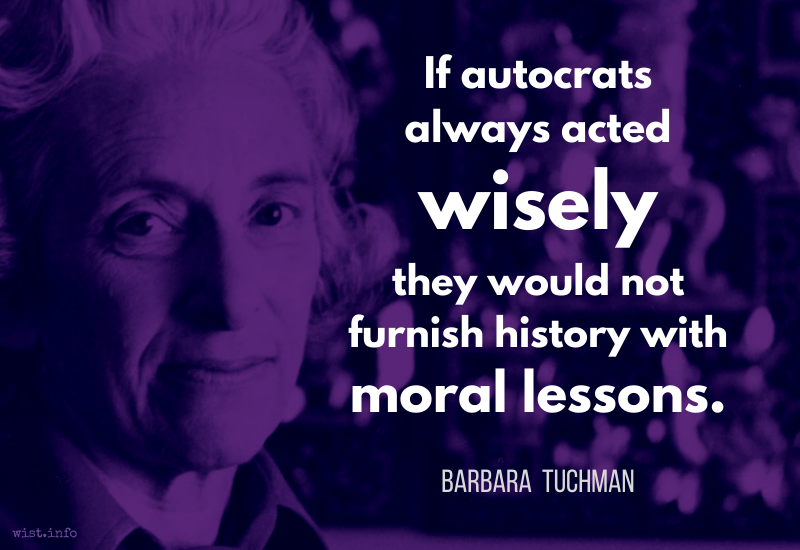
This was unwise, but if autocrats always acted wisely they would not furnish history with moral lessons.
Barbara W. Tuchman (1912–1989) American historian and author
A Distant Mirror, ch. 21 “The Fiction Cracks” (1978)
(Source)
On young King Richard II's giving substantial offices and lands to his friend and mentor, the Earl of Oxford, in so doing making an enemy of the Duke of Gloucester.

You are not a human being having a spiritual experience. You are a spiritual being having a human experience.
Wayne Dyer (1940–2015) American self-help author, motivational speaker
You’ll See It When You Believe It: The Way to Your Personal Transformation, ch. 2, epigraph (1989)
(Source)
A variant of the phrase is also included in the Introduction to the book: "That you are not a human being having a spiritual experience, but rather a spiritual being having a human experience."
Dyer originally used a variation of this ("Can you see yourselves as spiritual beings having a human experience, rather than human beings who may be having a spiritual experience?") the previous year in "A Letter to the Next Generation," an advertisement by Volkswagen.
Also attributed, without citation to Pierre Teilhard de Chardin (incorrectly) and Georges I. Gurdjieff.
More discussion: You Are Not a Human Being Having a Spiritual Experience. You Are a Spiritual Being Having a Human Experience – Quote Investigator.

Popular success is a palace built for a writer by publishers, journalists, admirers and professional reputation makers, in which a silent army of termites, rats, dry rot and death-watch beetles are tunnelling away, till, at the very moment of completion, it is ready to fall down. The one hope for a writer is that although his enemies are often unseen they are seldom unheard. He must listen for the death-watch, listen for the faint toc-toc, the critic’s truth sharpened by envy, the embarrassed praise of a sincere friend, the silence of gifted contemporaries, the implications of the don in the manger, the visitor in the small hours. He must dismiss the builders and contractors, elude the fans with an assumed name and dark glasses, force his way off the moving staircase, subject every thing he writes to a supreme critical court. Would it amuse Horace or Milton or Swift or Leopardi? Could it be read to Flaubert? Would it be chosen by the Infallible Worm, by the discriminating palates of the dead?
Cyril Connolly (1903–1974) English intellectual, literary critic and writer.
Enemies of Promise, Part 2, ch. 15 “The Slimy Mallows” (1938)
(Source)
Democracy will win — because a government’s legitimacy can only come from citizens; because in this age of information and empowerment, people want more control over their lives, not less; and because, more than any other form of government ever devised, only democracy, rooted in the sanctity of the individual, can deliver real progress.
Barack Obama (b. 1961) American politician, US President (2009–2017)
Speech, Nordea Concert Hall, Tallinn, Estonia (3 Sep 2014)
(Source)
There is a bitter sadness and special irony that attends the passing of Martin Luther King. Quickly and with ease, we offer up a chorus of posthumous praise — the ritual dirge so time-honored and comfortable and undemanding of anything but rhetoric. In death, we offer the acknowledgement of the man and his dream that we denied him in life.
In his grave, we praise him for his decency — but when he walked amongst us, we responded with no decency of our own. When he suggested that all men should have a place in the sun — we put a special sanctity on the right of ownership and the privilege of prejudice by maintaining that to deny homes to Negroes was a democratic right.
Now we acknowledge his compassion — but we exercised no compassion of our own. When he asked us to understand that men take to the streets out of anguish and hopelessness and a vision of that dream dying, we bought guns and speculated about roving agitators and subversive conspiracies and demanded law and order.
We felt anger at the effects, but did little to acknowledge the causes. We extol all the virtues of the man — but we chose not to call them virtues before his death. And now, belatedly, we talk of this man’s worth — but the judgment comes late in the day as part of a eulogy when it should have been made a matter of record while he existed as a living force.
Rod Serling (1924–1975) American screenwriter, playwright, television producer, narrator
Letter to the Editor, Los Angeles Times (8 Apr 1968)
(Source)
Quoted in Anne Serling, As I Knew Him: My Dad, Rod Serling (2013).
To me, good works are more important than theology. We all know that religion has been historically, and still is today, a cause of great evil as well as great good in human affairs. We have seen terrible wars and terrible persecutions conducted in the name of religion. We have also seen large numbers of people inspired by religion to lives of heroic virtue, bringing education and medical care to the poor, helping to abolish slavery and spread peace among nations. Religion amplifies the good and evil tendencies of individual souls. Religion will always remain a powerful force in the history of our species. To me, the meaning of progress in religion is simply this, that as we move from the past to the future the good works inspired by religion should more and more prevail over the evil.
Freeman Dyson (1923–2020) English-American theoretical physicist, mathematician, futurist
“Progress in Religion,” speech accepting the Templeton Prize, Washington National Cathedral (9 May 2000)
(Source)
In fact, one of the main lesson to be learned from the collapses of the Maya, Anasazi, Easter Islanders, and those other past societies (as well as from the recent collapse of the Soviet Union) is that a society’s steep decline may begin only a decade or two after the society reaches its peak numbers, wealth, and power. […] The reason is simple: maximum population, wealth, resource consumption, and waste production mean maximum environmental impact, approaching the limit where impact outstrips resources. On reflection, it’s no surprise that declines of societies tend to follow swiftly on their peaks.
Jared Diamond (b. 1937) American geographer, historian, ornithologist, author
Collapse: How Societies Choose to Fail or Succeed, Part 4, ch. 16 (2005)
(Source)

Unfortunately, civility is hard to codify or legislate, but you know it when you see it. It’s possible to disagree without being disagreeable.
Sandra Day O'Connor (b. 1930) American attorney, politician, Supreme Court justice (1981–2006)
Speech, Wake Forest University, North Carolina (3 Apr 1993)
(Source)
At the dedication of the Worrell Professional Center. Quoted in "Justice O'Connor Criticizes Lawyers for 'Rambo' Tactics," Washington Post (4 Apr 1993).

Act like the person you are, not the way they make you act.
[Cada uno ha de obrar como quien es, no como le obligan.]
Baltasar Gracián y Morales (1601–1658) Spanish Jesuit priest, writer, philosopher
The Art of Worldly Wisdom [Oráculo Manual y Arte de Prudencia], § 165 (1647) [tr. Maurer (1992)]
(Source)
On waging war honorably. (Source (Spanish)). Another translation:All men ought to act according to what they themselves are, and not to what others are.
[Flesher ed. (1685)]Every one must needs act as he is, not as others would make him to be.
[tr. Jacobs (1892)]Each must act for what he is, and not for what he is held.
[tr. Fischer (1937)]

Every word which goes from me, whether verbally or in writing, becomes the subject of so much malignant distortion, & perverted construction, that I am obliged to caution my friends against admitting the possibility of my letters getting into the public papers, or a copy of them to be taken under any degree of confidence.
Thomas Jefferson (1743–1826) American political philosopher, polymath, statesman, US President (1801–09)
Letter (1903-04-19) to Edward Dowse
(Source)

Yet, if nothing else, each time a new baby is born there is a possibility of reprieve. Each child is a new being, a potential prophet, a new spiritual prince, a new spark of light precipitated into the outer darkness. Who are we to decide that it is hopeless?
R. D. Laing (1927–1989) Scottish psychiatrist [Ronald David Laing]
The Politics of Experience, ch. 1 (1967)
(Source)

If only men could be depended upon to base their decisions on reason. Alas, there are only three or four of us in the world, and even we will bear watching.

When the bathhouse breaks into loud applause,
you will know that well-hung Mario is the cause.[Audieris in quo, Flacce, balneo plausum,
Maronis illic esse mentulam scito.]Martial (AD c.39-c.103) Spanish Roman poet, satirist, epigrammatist [Marcus Valerius Martialis]
Epigrams [Epigrammata], Book 9, epigram 33 (9.33) (AD 94) [tr. Juster (2016)]
(Source)
(Source (Latin)). Other translations:In whatever bath, Flaccus, you hear sounds resembling applause, know that there Maron's yard is to be found.
[tr. Bohn's Classical (1897); in earlier editions, just the Latin and an Italian translation were given.]In the baths what is now the most pleasing diversion
Is to go and see Maro displaying his person.
[tr. Pott & Wright (1921), "The Wonder"]If you’re passing the baths and you hear,
From within, an uproarious cheer,
You may safely conclude
Maron’s there, in the nude,
With that tool which has nowhere a peer.
[tr. Humphries (1963)]It's easy to tell
by the roar of applause
in which of the baths
Maron is bathing.
[tr. Goertz (1971)]If from the baths you hear a round of applause,
Maron's giant prick is bound to be the cause.
[tr. Michie (1972)]When you hear applause in a bath, Flaccus, you may be sure that Maro's cock is there.
[tr. Shackleton Bailey (1993)]The bath house applauds, with widening eyes,
When Maron reveals his astonishing size.
[tr. Ericsson (1995)]The critics in the Baths rain bravos thick
For Marcus' coup de théâtre, his dick.
[tr. Wills (2007)]If from the baths you hear a round of applause,
The giant prick of Maron is surely the cause.
[tr. Cooper]
Cynicism is a form of cowardice, a failure of courage to hope.
Merle Shain (1935–1989) Canadian journalist and author
Hearts That We Broke Long Ago, ch. 11 (1983)
(Source)

Indeed, the highest exercise of charity is, charity towards the uncharitable.
Joseph S. Buckminster (1784–1812) American Unitarian preacher and Bible scholar
Sermon on 2 Peter 1:5-7
(Source)
Sermon 24 in Sermons by the Late Rev. J. S. Buckminster (1814). Scriptural reference.

You choose, you live the consequences. Every yes, no, maybe, creates the school you call your personal experience.
Women are stripped to the skin in the presence of leering, white-skinned, black-hearted brutes and lashed into insensibility and strangled to death from the limbs of trees. A girl child of fifteen years was lynched recently by these brutal bullies. Where has justice fled? The eloquence of Wendell Phillips is silent now. John Brown’s body lies moldering in the grave. But will his spirit lie there moldering, too? Brutes, inhuman monsters — you heartless brutes — you whom nature forms by molding you in it, deceive not yourselves by thinking that another John Brown will not arise.
Lucy Parsons (1851–1942) American labor organizer, anarchist, orator [a.k.a. Lucy Gonzalez]
“Southern Lynching” (Apr 1892)
(Source)

For me, a hearty “belly laugh” is one of the most beautiful sounds in the world.
Bennett Cerf (1898–1971) American publisher, humorist
An Encyclopedia of Modern American Humor, Foreword (1954)
(Source)
Variant: "For me, one of the most beautiful sounds in the world is a hearty laugh."

Fascist movements have been “draining swamps” for generations. Publicizing false charges of corruption while engaging in corrupt practices is typical of fascist politics, and anti-corruption campaigns are frequently at the heart of fascist political movements. Fascist politicians characteristically decry corruption in the state they seek to take over, which is bizarre, given that fascist politicians themselves are invariably vastly more corrupt than those they seek to supplant or defeat.
Jason Stanley (b. 1969) American philosopher, epistemologist, academic
How Fascism Works: The Politics of Us and Them, ch. 2 (2018)
(Source)

The beautiful thing about losing your illusions, he thought, was that you got to stop pretending.
Daniel Abraham (b. 1969) American writer [pseud. James S. A. Corey (with Ty Franck), M. L. N. Hanover]
Leviathan Wakes, ch. 18 (2011) [with Ty Franck]
(Source)

So much in writing depends on the superficiality of one’s days. One may be preoccupied with shopping and income tax returns and chance conversations, but the stream of the unconscious continues to flow undisturbed, solving problems, planning ahead: one sits down sterile and dispirited at the desk, and suddenly the words come as though from the air: the situations that seemed blocked in a hopeless impasse move forward: the work has been done while one slept or shopped or talked with friends.
Graham Greene (1904–1991) English novelist [Henry Graham Greene]
The End of the Affair, Book 1, ch. 2 (1951)
(Source)

Experience is the name every one gives to their mistakes.
Oscar Wilde (1854–1900) Irish poet, wit, dramatist
Lady Windermere’s Fan, Act 3 [Mr. Dumby] (1892)
(Source)
Also in Wilde's The Picture of Dorian Gray, ch. 4 (1890):Experience was of no ethical value. It was merely the name men gave to their mistakes.
Ripheus fell, a man
Most just of all the Trojans, most fair-minded.
The gods thought otherwise.[Cadit et Rhipeus, iustissimus unus
qui fuit in Teucris et servantissimus aequi:
dis aliter visum.]Virgil (70–19 BC) Roman poet [b. Publius Vergilius Maro; also Vergil]
The Aeneid [Ænē̆is], Book 2, l. 426ff (2.426) [Aeneas] (29-19 BC) [tr. Humphries (1951)]
(Source)
(Source (Latin)). Other translations:Next Ripheus fell, most faithfull to his trust:
Nor in all Troy was known a man more just:
Though by the Gods otherwise look'd upon.
[tr. Ogilby (1649)]Then Ripheus follow'd, in th' unequal fight;
Just of his word, observant of the right:
Heav'n thought not so.
[tr. Dryden (1697)]Ripheus too falls, the most just among the Trojans, and of the strictest integrity; but to the gods it seemed otherwise.
[tr. Davidson/Buckley (1854)]Then Rhipeus dies: no purer son
Troy ever bred, more jealous none
Of sacred right: Heaven's will be done.
[tr. Conington (1866)]Next
Rhipeus, of all Trojans most upright
And just : -- such was the pleasure of the gods!
[tr. Cranch (1872), l. 580ff]Rhipeus falls, the one man who was most righteous and steadfast in justice among the Teucrians: the gods' ways are not as ours.
[tr. Mackail (1885)]Fell Rhipeus there, the heedfullest of right
Of all among the Teucrian folk, the justest man of men;
The Gods deemed otherwise.
[tr. Morris (1900)]Next, Rhipeus dies, the justest, but in vain,
The noblest soul of all the Trojan train.
Heaven deemed him otherwise.
[tr. Taylor (1907), st. 57, l. 508ff]Then Rhipeus fell;
we deemed him of all Trojans the most just,
most scrupulously righteous; but the gods
gave judgment otherwise.
[tr. Williams (1910)]Ripheus, too, falls, foremost in justice among the Trojans, and most zealous for the right -- Heaven's will was otherwise.
[tr. Fairclough (1916)]Then Rhipeus fell, he who of all the Trojans
Was most fair-minded, the one who was most regardful of justice:
God's ways are inscrutable.
[tr. Day Lewis (1952)]Then Ripheus, too, has fallen -- he was first
among the Teucrians for justice and
observing right; the gods thought otherwise.
[tr. Mandelbaum (1971)]And Ripheus fell,
A man uniquely just among the Trojans,
The soul of equity; but the gods would have it
Differently.
[tr. Fitzgerald (1981), l. 560ff]Rhipeus also fell. Of all the Trojans he was the most righteous, the greatest lover of justice. But the gods made their own judgments.
[tr. West (1990)]And Ripheus, who was the most just of all the Trojans,
and keenest for what was right (the gods’ vision was otherwise)
[tr. Kline (2002)]Then Rhipeus,
Of all Teucrians the most righteous (but the gods
Saw otherwise) went down.
[tr. Lombardo (2005), l. 493ff]Rhipeus falls too, the most righteous man in Troy,
the most devoted to justice, true, but the gods
had other plans.
[tr. Fagles (2006)]
Memory, as we all know, is fitful and phantasmagoric. History is organized memory, and the organization is all-important.
Henry Steele Commager (1902–1998) American historian, writer, activist
The Nature and the Study of History, ch. 1 (1965)
(Source)
Sleep is perhaps the only among life’s great pleasures which need not be of short duration.
When will the churches learn that intolerance, personal or ecclesiastical, is an evidence of weakness? The confident can afford to be calm and kindly; only the fearful must defame and exclude.
Harry Emerson Fosdick (1878–1969) American clergyman, author, teacher
“Tolerance,” sec. 3, Adventurous Religion (1926)
(Source)
Books are one of the few things men cherish deeply. And the better the man, the more easily will he part with his most cherished possessions. A book lying idle on a shelf is wasted ammunition. Like money, books must be kept in constant circulation. Lend and borrow to the maximum — of both books and money. But especially books, for books represent infinitely more than money.

A man has more character in his face at forty than at twenty. He has suffered longer, and the more love, the more suffering, the more character.
Mae West (1892–1980) American film actress
Goodness Had Nothing To Do With It, ch. 21 (1959)
(Source)

Whom the gods wish to destroy, they first call promising. Young writers if they are to mature require a period of between three and seven years in which to live down their promise. Promise is like the mediaeval hangman who after settling the noose, pushed his victim off the platform and jumped on his back, his weight acting a drop while his jockeying arms prevented the unfortunate from loosening the rope. When he judged him dead he dropped to the ground.
Cyril Connolly (1903–1974) English intellectual, literary critic and writer.
Enemies of Promise, Part 2, ch. 13 “The Poppies” (1938)
(Source)
But we must recognize that democracies don’t stop just with elections; they also depend on strong institutions and a vibrant civil society, and open political space, and tolerance of people who are different than you. We have to create an environment where the rights of every citizen, regardless of race or gender, or religion or sexual orientation are not only protected, but respected.
Barack Obama (b. 1961) American politician, US President (2009–2017)
Speech, Young Southeast Asian Leaders Initiative Town Hall, University of Malaya, Kuala Lumpur, Malaysia (27 Apr 2014)
(Source)
There is a breed of lay and social scientist who will forever cling to a concept of “defeating by ignoring.” Hence, when out of the muck of their own neuroses rise these self-proclaimed Fuhrers, there is this well-meaning body who tell us that if we turn both eyes and cheeks, the nutsies will disappear simply by lack of exposure.
My guess is that, in this case, exposure is tantamount to education; and education here, is a most salutary instruction into the mentalities, the motives and the modus operandi of an animal pack that is discounted by the aged maxim that “it can’t happen here.” So might have said the Goethes and the Einsteins of a pre-war Germany, who thought then, as we do now, that civilization by itself protects against a public acceptance of the uncivilized.
What is desperately needed to combat any ism is precisely what “Playboy” has given us — an interview in-depth that shows us the facets of the enemy. Yes, gentlemen, you may be knocked for supposedly lending some kind of credence to a brand of lunacy. But my guess is that you should be given a commendation for a public service of infinite value.
Rod Serling (1924–1975) American screenwriter, playwright, television producer, narrator
Letter to Playboy Magazine (Jun 1966)
(Source)
Addressing criticism of the magazine for running in April 1966 an Alex Haley interview of American Nazi Party founder George Lincoln Rockwell. Quoted in Anne Serling, As I Knew Him: My Dad, Rod Serling (2013).
DEAR MISS MANNERS: How about Easter? I suppose you have etiquette rules that apply to Easter Day?
GENTLE READER: Certainly, and when the Day of Judgment comes, Miss Manners will have etiquette rules to apply to that, as well.
Judith Martin (b. 1938) American author, journalist, etiquette expert [a.k.a. Miss Manners]
Miss Manners’ Guide to Excruciatingly Correct Behavior, Part 9 “Advanced Civilization,” “Play” (1983)
(Source)

The first step in rising to anger, is to note that you are angry, for that is to enter master of the situation, having determined the need of it, and its height, and going no further; with this considered judgment let your wrath wax, and wane.
[El primer paso del apasionarse es advertir que se apasiona, que es entrar con señorío del afecto, tanteando la necesidad hasta tal punto de enojo, y no más. Con esta superior refleja entre y salga en una ira.]
Baltasar Gracián y Morales (1601–1658) Spanish Jesuit priest, writer, philosopher
The Art of Worldly Wisdom [Oráculo Manual y Arte de Prudencia], § 155 (1647) [tr. Fischer (1937)]
(Source)
(Source (Spanish)). Other translations:The first step to moderation, is to perceive that we are falling into passion. By that means we enter the lists with a full power over our selves, and may examine how far it is necessary to give way to our resentment. With that swaying reflexion, we may be angry, and put a stop to it as we please.
[Flesher ed. (1685)]The first step towards getting into a passion is to announce that you are in a passion. By this means you begin the conflict with command over your temper, for one has to regulate one's passion to the exact point that is necessary and no further. This is the art of arts in falling into and getting out of a rage.
[tr. Jacobs (1892)]The first thing to do when you are upset is to notice that you are. You begin by mastering your emotions and determining not to go any further. With this superior sort of caution you can put a quick end to your anger.
[tr. Maurer (1992)]
I now return the Sermon you were so kind as to enclose me, having perused it with attention. The reprinting it by me, as you have proposed, would very readily be ascribed to hypocritical affectation, by those who, when they cannot blame our acts, have recourse to the expedient of imputing them to bad motives. This is a resource which can never fail them, because there is no act, however virtuous, for which ingenuity may not find some bad motive.
Thomas Jefferson (1743–1826) American political philosopher, polymath, statesman, US President (1801–09)
Letter (1903-04-19) to Edward Dowse
(Source)
I can resist everything except temptation.
Oscar Wilde (1854–1900) Irish poet, wit, dramatist
Lady Windermere’s Fan, Act 1 [Lord Darlington] (1893)
(Source)
Also attributed to Mark Twain, Mae West, and W. C. Fields. The sentiment may not be original to Wilde, but his use popularized it.
Once divested of missionary virus, the cult of our gods gives no offense. It would be a peaceful age if this were recognized, and religion, Christian, communist or any other, were to rely on practice and not on conversion for her growth.
Freya Stark (1893–1993) Franco-British explorer, travel writer [Freya Madeline Stark]
Ionia: A Quest, ch. 17 (1954)
(Source)

Matho alleges that my book’s uneven.
He compliments my poems, if that’s true.
Calvinus and Umber write consistent books.
Consistent books are lousy through and through.[Iactat inaequalem Matho me fecisse libellum:
Si verum est, laudat carmina nostra Matho.
Aequales scribit libros Calvinus et Umber:
Aequalis liber est, Cretice, qui malus est.]Martial (AD c.39-c.103) Spanish Roman poet, satirist, epigrammatist [Marcus Valerius Martialis]
Epigrams [Epigrammata], Book 7, epigram 90 (7.90) (AD 92) [tr. McLean (2014)]
(Source)
"To Creticus" (Source (Latin)). Other translations:Matho objects, my books unequal are;
If he says true, he praises ere aware.
Calvin and Umber write an equal strain:
Naught is the book that's free from heights, and plain.
[tr. Killigrew (1695)]My book is unequal, a Matho may boast.
So saying, he knows not he cries it up most.
Books equal a Calvin and Umber did write;
But equally penn'd in poor Pallasses spite.
[tr. Elphinston (1782), Book 3, ep. 15]Matho exults that I have produced a book full of inequalities; if this be true, Matho only commends my verses. Books without inequalities are produced by Calvinus and Umber. A book that is all bad, Creticus, may be all equality.
[tr. Bohn's Classical (1859)]I've writ, says Matho, an uneven book:
If that be true, then Matho lauds my verse.
Umber writes evenly, Calvinus too;
For even books, to be sure, are always bad.
[ed. Harbottle (1897)]Matho puts it abroad that I have composed an unequal book; if that is true, Matho praises my poems. Equal books are what Calvinus and Umber write: the equal book, Creticus, is the bad one.
[tr. Ker (1919)]My work's uneven, you protest
And sometimes falls beneath my best;
A compliment, say I:
Dull bards on level planes that grope
Shall never err -- or soar -- with Pope,
Although they shine with Pye.
[tr. Pott & Wright (1921), "The Dull Level"]I write unequal verse, so Matho says;
If it be true his criticism's a praise.
Try Umber, Cluveienus by that test:
No, Creticus; bad's bad; good seldom best.
[tr. Francis & Tatum (1924), #382]Matho exults and crows my book's uneven.
If that is true, he praises me. I'm glad.
Calvinus and Umber write books that are even.
Even books are books that are all bad.
[tr. Marcellino (1968)]Matho's mad,
upset,
says my book
is unfair.
That's good,
I'm glad:
fair books
are dull books.
[tr. Goertz (1971)]Matho spreads the word that I have made an uneven book. If so, Matho praises my poems. Calvinus adn Umber write even books. An even book, Creticus, is a bad book.
[tr. Shackleton Bailey (1993)]Matho says my book's uneven.
He thinks he's quite the joker.
I'd rather have both highs and lows,
Than just be mediocre.
[tr. Ericsson (1995)]Matho's one-word review of my small book:
"Uneven." I'm supposed to get all shook!
The scribblings of Calvinus and Umber
Are very "even" ... yet how they lumber.
I swear to you, Creticus, I thank God
My gift is for being quite frankly "odd."
[tr. Schmidgall (2001)]Dour Matho offers me a "mixed review,"
To which contentedly I answer, "Whew!"
Most poets get reviews that are unmixed,
With every verse and stanza in them nixed.
[tr. Wills (2007)]Smootus says my book is uneven.
I see this as praise of my work.
A bad book is fat with unvarying quality.
[tr. Kennelly (2008)]Matho is crowing that I've "made an inconsistent book." If he's right, he's actually praising my poems. Calvinus and Umber write "consistent" books; if a book's "consistent," Creticus, it's consistently bad.
[tr. Nisbet (2015)]
Anger is a passion, so it makes people feel alive and makes them feel they matter and are in charge of their lives. So people often need to renew their anger a long time after the cause of it has died, because it is a protection against helplessness and emptiness just like howling in the night. And it makes them feel less vulnerable for a little while.
Merle Shain (1935–1989) Canadian journalist and author
Hearts That We Broke Long Ago, ch. 5 (1983)
(Source)
“Some people say we shouldn’t give alms to the poor, Shirley.”
“They are great fools for their pains. For those who are not hungry, it is easy to palaver about the degradation of charity, and so on; but they forget the brevity of life, as well as its bitterness. We have none of us long to live: let us help each other through seasons of want and woe, as well as we can, without heeding in the least the scruples of vain philosophy.”
Charlotte Brontë (1816–1855) British novelist [pseud. Currer Bell]
Shirley, ch. 14 [Lina and Shirley] (1849)
(Source)

But the best inheritance that fathers can give their children, more precious than any patrimony however large, is a reputation for virtue and for worthy deeds, which if the child disgraces, his conduct should be branded as infamous and impious.
[Optima autem hereditas a patribus traditur liberis omnique patrimonio praestantior gloria virtutis rerumque gestarum, cui dedecori esse nefas et vitium iudicandum est.]
Marcus Tullius Cicero (106–43 BC) Roman orator, statesman, philosopher
De Officiis [On Duties; On Moral Duty; The Offices], Book 1, ch. 33 (1.33) / sec. 121 (44 BC) [tr. Peabody (1883)]
(Source)
(Source (Latin)). Another translation:Now the noblest inheritance that can ever be left by a father to his son, and far exceeding that of houses and lands, is the fame of his virtues and glorious actions; and for a son to live so, as is unworthy of the name and reputation of his ancestors, is the basest and most abominable thing in the world.
[tr. Cockman (1699)]The best inheritance left by a father to his children, superior to every other patrimony, is the honor of a virtuous conduct, and the glory of his public transactions. And it is base and criminal by an unworthy conduct, to bring disgrace upon a father's reputation.
[tr. McCartney (1798)]Now, the best inheritance a parent can leave a child -- more excellent than any patrimony -- is the glory of his virtue and his deeds; to bring disgrace on which ought to be regarded as wicked and monstrous.
[tr. Edmonds (1865)]The noblest heritage, the richest patrimony a father can bequeath to his children is a reputation for virtue and noble deeds. To tarnish his good name is a sin and a crime.
[tr. Gardiner (1899)]The best legacy a father can leave to his children, a legacy worth far more than the largest patrimony, is the fame of a virtuous and well-spent life. He who disgraces such a bequest is deserving of infamy.
[ed. Harbottle (1906)]The noblest heritage, however, that is handed down from fathers to children, and one more precious than any inherited wealth, is a reputation for virtue and worthy deeds; and to dishonour this must be branded as a sin and a shame.
[tr. Miller (1913)]The best heritage that descends from fathers to sons is the fame for honesty and great deeds. Such fame surpasses any legacy. We must judge it a crime and a shame to disgrace it.
[tr. Edinger (1974)]
Humanity will ever seek but never attain perfection. Let us at least survive and go on trying.
Dora, Countess Russell (1894–1986) British author, feminist, social activist [Dora Russell, née Black]
The Religion of the Machine Age (1983)
All passes. — Only strong art
Passes to eternity.
The bust
Survives the city.And the austere coin
That a workman finds
Underground
Reveals an emperor.[Tout passe. — L’art robuste
Seul a l’éternité,
Le buste
Survit à la cité.Et la médaille austère
Que trouve un laboureur
Sous terre
Révèle un empereur.]Théophile Gautier (1811–1872) French poet, writer, critic
“L’Art,” l. 41ff, Émaux et Camées (1852)
(Source)
(Source (French)). Other translations:Everything passes. --
Only robust art is eternal.
The bust outlives the city.
And the simple coin
Unearthed by a peasant
Reveals the image of an emperor.
[Source]All passes, Art alone
Enduring stays to us;
The Bust outlasts the throne, --
The Coin, Tiberius.
[Austin Dobson, "Ars Victrix" (1876), in imitation]Everything passes -- Robust art
Alone is eternal.
The bust
Survives the city.
[Source]Everything disappears -- Robust art
alone is eternal:
The Bust survives the city.
[Source]Everything passes away. -- Robust Art
Alone has eternity;
The bust
Survives the city.
[Source]
That is part of the beauty of all literature. You discover that your longings are universal longings, that you’re not lonely and isolated from anyone. You belong.
F. Scott Fitzgerald (1896–1940) American writer [Francis Scott Key Fitzgerald]
Comment to Sheilah Graham (c. 1938)
Quoted in her book, Beloved Infidel: The Education of a Woman, ch. 22 (1958). Variant, in the 1959 film adaptation of the book:The beauty of literature is that it’s ageless. You discover that your longings are universal longings, that you’re not lonely and isolated from anyone. You belong.
See also Baldwin.
More discussion of this quotation: That Is Part of the Beauty of All Literature. You Discover that Your Longings Are Universal Longings – Quote Investigator.
Alas! in naught may one trust the gods against their will!
[Heu nihil invitis fas quemquam fidere divis!]
Virgil (70–19 BC) Roman poet [b. Publius Vergilius Maro; also Vergil]
The Aeneid [Ænē̆is], Book 2, l. 402 (2.402) [Aeneas] (29-19 BC) [tr. Fairclough (1916)]
(Source)
(Source (Latin)). Other translations:Ah, who may hope if by the Gods deni'd!
[tr. Ogilby (1649)]But, ah! what use of valour can be made,
When heav'n's propitious pow'rs refuse their aid!
[tr. Dryden (1697)]Alas! it is right for one to trust to nothing when the gods are adverse.
[tr. Anthon (1843)]Alas! on nothing ought man to presume, while the gods are against him!
[tr. Davidson/Buckley (1854)]Alas! a mortal may not lean
On Heaven, when Heaven averts its mien.
[tr. Conington (1866)]Alas, one ought
To trust in nothing, when the gods oppose.
[tr. Cranch (1872), ll. 549-550]Alas that none may trust at all to estranged gods!
[tr. Mackail (1885)]Alas! what skills it man to trust in Gods compelled to good?
[tr. Morris (1900)]Ah! vain to boast, if Heaven refuse to aid!
[tr. Taylor (1907)]But woe is me! If gods their help withhold,
't is impious to be brave.
[tr. Williams (1910)]Alas! it is not well for anyone to be confident when the gods are adverse.
[Source (1922)]It is not for men to trust unwilling gods.
[tr. Humphries (1951)]Ah, well, there's no trusting the gods for anything, once they're against you!
[tr. Day Lewis (1952)]But oh, it is not right for anyone
to trust reluctant gods!
[tr. Mandelbaum (1971), ll. 540-541]When gods are contrary
They stand by no one.
[tr. Fitzgerald (1981), ll. 532-533]But no man can trust in gods who are opposed to him.
[tr. West (1990)]Ah, put no faith in anything the will of the gods opposes!
[tr. Kline (2008)]Never rely on the gods for anything
Against their will.
[tr. Lombardo (2005), ll. 466-467]But, oh
how wrong to rely on gods dead set against you!
[tr. Fagles (2006), ll. 501-502]How wrong it is to trust the gods against their will!
[tr. Bartsch (2021)]
A nation which, in the name of loyalty or of patriotism or of a sincere and high-sounding idea, discourages criticism and dissent, and puts a premium on acquiescence and conformity, is headed for disaster.

Where shall wisdom be found, and where is the place of understanding? If I knew, I’d walk over and stand there. As it was, I felt as if I stood in the midst of a large map, surrounded by vague areas wherein were penned the visages of particularly nasty-looking random variables. A perfect place for a soliloquy, if one had anything to say.
Being tolerant does not mean that I share another one’s belief. But it does mean I acknowledge another one’s right to believe, and obey, his own conscience.
Viktor Frankl (1905–1997) German-American psychologist, writer
The Will to Meaning, Part 1, ch. 3 (1969)
(Source)
Conquer, but never triumph.
[Siege, aber triumphire nicht.]
Marie von Ebner-Eschenbach (1830–1916) Austrian writer
Aphorisms [Aphorismen], No. 9 (1880) [tr. Wister (1883)]
(Source)

Little men would be discouraged if they could see themselves in their true light. So conceit was sent into the world — God’s great gift to little men.
Bruce Barton (1886–1967) American author, advertising executive, politician
“The Gift to Little Men” (1926)
(Source)
Often paraphrased, "Conceit is God's gift to little men."
Literature is the art of writing something that will be read twice; journalism what will be grasped at once, and they require separate techniques.
Cyril Connolly (1903–1974) English intellectual, literary critic and writer.
Enemies of Promise, Part 1, ch. 3 “The Challenge of the Mandarins” (1938)
(Source)
Democratic institutions are quarantine arrangements to combat that ancient pestilence, lust for tyranny: as such they are very useful and very boring.
[Die demokratischen Einrichtungen sind Quarantäne-Anstalten gegen die alte Pest tyrannenhafter Gelüste: als solche sehr nützlich und sehr langweilig.]
Friedrich Nietzsche (1844–1900) German philosopher and poet
Human, All Too Human [Menschliches, Allzumenschliches], Vol. 2, Part 2 “The Wanderer and His Shadow [Der Wanderer und sein Schatten],” aphorism 289 (1880) [tr. Holingdale (1986)]
(Source)
(Source (German)). Other translations:Democratic institutions are centres of quarantine against the old plague of tyrannical desires. As such they are extremely useful and extremely tedious.
[tr. Cohn (1913)]Democratic institutions are quarantine mechanisms for that old pestilence, tyrannic lust. As such they are very useful and very boring.
Despite everything, despite our controversies and despite what is apparently and tragically a sense of divisiveness that permeates our land, and despite riots and rebellions that go hand-in-hand, mind you, with repression and brutality, one major and fundamental guarantee of protracted freedom is the unfettered right of the man to write as he sees fit, as his conscience indicates, as his mood dictates, as his cause cries out for. The moment you begin to censor the writer — and history bears this out in the ugliest of fashions — so begins a process of decay in the body politic that ultimately leads to disaster. What begins with a blue pencil — for whatever reason — very often ends in a concentration camp.
It has forever been thus: So long as men write what they think, then all of the other freedoms — all of them — may remain intact. And it is then that writing becomes a weapon of truth, an article of faith, an act of courage.
Rod Serling (1924–1975) American screenwriter, playwright, television producer, narrator
“The Challenge of the Mass Media to the 20th Century Writer,” Speech, Library of Congress (15 Jan 1968)
(Source)
Quoted in Anne Serling, As I Knew Him: My Dad, Rod Serling (2013).
Few bothersome things are important enough to bother with. It is folly to take to heart what you should turn your back on. Many things that were something are nothing if left alone, and others that were nothing turn into much because we pay attention to them.
[Pocas cosas de enfado se han de tomar de propósito, que sería empeñarse sin él. Es trocar los puntos tomar a pechos lo que se ha de echar a las espaldas. Muchas cosas que eran algo, dejándolas, fueron nada; y otras que eran nada, por haber hecho caso de ellas, fueron mucho.]Baltasar Gracián y Morales (1601–1658) Spanish Jesuit priest, writer, philosopher
The Art of Worldly Wisdom [Oráculo Manual y Arte de Prudencia], § 121 (1647) [tr. Maurer (1992)]
(Source)
(Source (Spanish)). Other translations:Few of those things that occasion trouble, are to be minded: else we shall torment our selves much in vain. It's to act the clean contrary way, to lay that to heart, which we should throw behind our backs. Many things that were of some consequence, have signified nothing at all, because men troubled not themselves about them; and others which signified nothing, have become matters of importance, because of the value that was put upon them.
[Flesher ed. (1685)][...] Many things which were really of some importance became of none because they were left alone; and other things which were of no importance have become grave because people have occupied themselves about them.
[tr. Duff (1877)]Troublesome things must not be taken too seriously if they can be avoided. It is preposterous to take to heart that which you should throw over your shoulders. Much that would be something has become nothing by being left alone and what was nothing has become of consequence by being made much of.
[tr. Jacobs (1892)]To convert petty annoyances into matters of importance, is to become seriously involved in nothing. It is to miss the point, to carry on the chest what has been cast from the shoulders. Many things which were something, by being left alone became nothing; and others which were nothing, became much because messed into.
[tr. Fischer (1937)]
The mortality of all inanimate things is terrible to me, but that of books most of all.
William Dean Howells (1837–1920) American author, literary critic, and playwright
Letter to Charles Eliot Norton (6 Apr 1903)
(Source)
Many quite nefarious ideologies pass for common sense. For decades of American history, it was common sense in some quarters for white people to own slaves and for women not to vote. If common sense sometimes preserves the social status quo, and that status quo sometimes treats unjust social hierarchies as natural, it makes good sense on such occasions to find ways of challenging common sense.
Judith Butler (b. 1956) American philosopher and gender theorist
“A ‘Bad Writer’ Bites Back,” The New York Times (20 Mar 1999)

Thus, because we are rapidly advancing along this non-sustainable course, the world’s environmental problems will get resolved, in one way or another, within the lifetimes of the children and young adults alive today The only question is whether they will become resolved in pleasant ways of our own choice, or in unpleasant ways not of our choice, such as warfare, genocide, starvation, disease epidemics, and collapses of societies. While all of those grim phenomena have been endemic to humanity throughout our history, their frequency increases with environmental degradation, population pressure, and the resulting poverty and political instability.
Jared Diamond (b. 1937) American geographer, historian, ornithologist, author
Collapse: How Societies Choose to Fail or Succeed, Part 4, ch. 16 (2005)
(Source)
Miss Manners does not subscribe to the notion that merely being present and respectful, when someone else practices their religion, is tantamount to endorsing that religion.
Judith Martin (b. 1938) American author, journalist, etiquette expert [a.k.a. Miss Manners]
Twitter (2011-12-29)
(Source)
Just how Sparks are able to warp the laws of time and motion (among others) has never been successfully analyzed. People who try to carefully watch them report suffering a sort of cognitive dissonance where they simply cannot remember what happened even though it happened right in front of them. These, as it turns out, are the lucky ones, as most people who get too close to a Spark who is happily building something tend to wake up and realize that they have become components.
Phil Foglio (b. 1956) American writer, cartoonist
Agatha H and the Voice of the Castle (2014) [with Kaja Foglio]
(Source)
The vulgar ignorance of stubborn people makes them prefer contention to truth and utility. Prudent people are on the side of reason, not passion, whether because they foresaw it from the first, or because they improved their position later.
[Vulgaridad de temáticos, no reparar en la verdad, por contradecir, ni en la utilidad, por litigar. El atento siempre está de parte de la razón, no de la pasión, o anticipándose antes o mejorándose después.]
Baltasar Gracián y Morales (1601–1658) Spanish Jesuit priest, writer, philosopher
The Art of Worldly Wisdom [Oráculo Manual y Arte de Prudencia], § 142 (1647) [tr. Maurer (1992)]
(Source)
(Source (Spanish)). Other translations:It is the custome of the head strong to regard neither truth in contradicting; nor profit in disputing. A wise man hath always reason on his side, and never falls into passion. He either prevents or retreats.
[Flesher ed. (1685)]'Tis the common failing of the obstinate that they lose the true by contradicting it, and the useful by quarrelling with it. The sage never places himself on the side of passion but espouses the cause of right, either discovering it first or improving it later.
[tr. Jacobs (1892)]The vulgarity of these clowns, that they observe not the truth, because they lie, nor yet their own interest, because on the wrong side. A heedful man stands always on the side of reason, and never that of passion, either because he foresaw it from the first, or found it better afterwards.
[tr. Fischer (1937)]
I learned that speed and simplicity in large affairs are most essential; that severity in preserving an idea is vital; that in a democracy, the public must be informed; and that good will without competence and competence without good will, are both equivalent formulas for political disaster.
Theodore H. White (1915–1986) American political journalist, historian, author
In Search of History: A Personal Adventure, Part 3, ch. 7 (1978)
(Source)
On the factors for the success of the Marshall Plan in Europe.

I should like to save the Shire, if I could — though there have been times when I thought the inhabitants too stupid and dull for words, and have felt that an earthquake or an invasion of dragons might be good for them. But I don’t feel like that now. I feel that as long as the Shire lies behind, safe and comfortable, I shall find wandering more bearable: I shall know that somewhere there is a firm foothold, even if my feet cannot stand there again.
J.R.R. Tolkien (1892–1973) English writer, fabulist, philologist, academic [John Ronald Reuel Tolkien]
The Lord of the Rings, Vol. 1: The Fellowship of the Ring, Book 1, ch. 2 “The Shadow of the Past” [Frodo] (1954)
(Source)
If you stay alive for no other reason at all, please do it for spite.
Maria Bamford (b. 1970) American actress and stand-up comedian
“The Special Special Special!” (2012)
(Source)

Such in the Landes of our world is the poet’s stance;
When he receives no wound, his treasure he’ll retain.
With such deep cut mankind his heart must also lance,
To make him spill his verse, his gold tears’ gushing rain![Le poète est ainsi dans les Landes du monde.
Lorsqu’il est sans blessure, il garde son trésor.
Il faut qu’il ait au cœur une entaille profonde
Pour épancher ses vers, divines larmes d’or!]Théophile Gautier (1811–1872) French poet, writer, critic
“The Pine of Landes [Le Pin des Landes]”, l. 13ff (1840)
(Source)
The metaphor is of a poet as one of the pine trees used in the reforestation of the Landes of Gascogne, having its sap harvested for turpentine. (Source (French)). Another translation:Landes-like, the poet with his poetry,
Unwounded, holds his treasure well controlled.
But he must bear a deep heart-gash if he
Would spread his verses' heavenly tears of gold!
[tr. Shapiro (2011)]
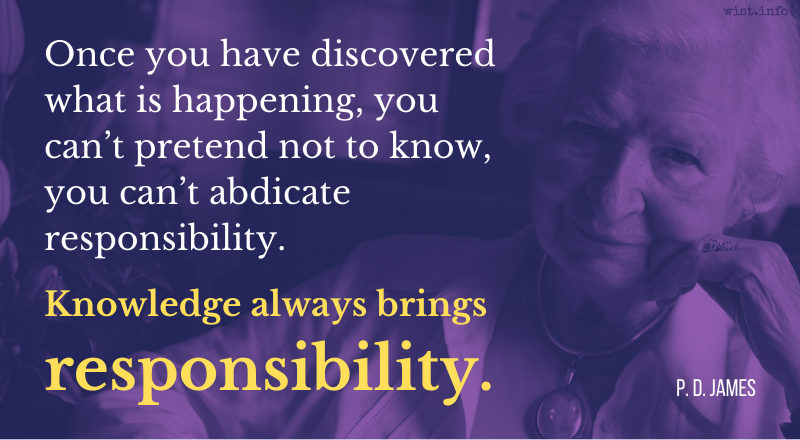
Once you have discovered what is happening, you can’t pretend not to know, you can’t abdicate responsibility. Knowledge always brings responsibility.
P. D. James (1920–2014) British mystery writer [Phyllis Dorothy James White]
Devices and Desires, Book 6, ch. 10 (1990)
(Source)

The crucial disadvantage of aggression, competitiveness, and skepticism as national characteristics is that these qualities cannot be turned off at five o’clock.
Margaret Halsey (1910–1997) American writer
The Folks at Home, “The Five O’Clock Shadow over the United States” (1952)
(Source)

Why don’t I send my book to you
Although you often urge me to?
The reason’s good, for if I did
You’d send me yours — which God forbid![Non donem tibi cur meos libellos
Oranti totiens et exigenti,
Miraris, Theodore? Magna causa est:
Dones tu mihi ne tuos libellos.]Martial (AD c.39-c.103) Spanish Roman poet, satirist, epigrammatist [Marcus Valerius Martialis]
Epigrams [Epigrammata], Book 5, epigram 73 (5.73) (AD 90) [tr. Pott & Wright (1921), “Return Favours”]
(Source)
Compare to Epigram 7.3. (Source (Latin)). Other translations:Thou wonder'st, Theodore, why I
Entreated oft and urgently
Refuse to send my Bookes to thee;
I feare thou 'lt send thine owne to me.
[tr. May (1629), 5.74]Why I dole thee not my pieces,
Theodore, thou may'st devine.
Yet thy wond'ring zeal increases:
Lest thou should'st redole me thine.
[tr. Elphinston (1782), Book 3, ep. 48]"Why ne'er to me," the Laureat cries,
"Are poet Paulo's verses sent?"
"For fear," the tuneful rogue replies,
"You should return the compliment."
[tr. Hodgson (c. 1810)]I give thee, friend, no works of mine,
For fear you should return me thine.
[tr. Lamb (1821)]Do you wonder for what reason, Theodorus, notwithstanding your frequent requests and importunities, I have never presented you with my works? I have an excellent reason; it is lest you should present me with yours.
[tr. Bohn's Classical (1859)]Though it's true, Theodorus, you frequently pray
For my book in a flattering tone,
No wonder I'm slow; I've good cause for delay
In my fear you'd then send me your own.
[tr. Nixon (1911), "Vendetta"]Why don't I give you my works, although so often you beseech me for them, and press me? Do you wonder, Theodorus? There is great reason: that you may not give me your works.
[tr. Ker (1919)]Do you wonder, Theodorus, why I don't give you my little books for all that you beg and demand them so often? For an excellent reason: I don't want you giving me your little books.
[tr. Shackleton Bailey (1993)]Ted, don't give me pleading looks,
And beg I send you all my books,
Your ask comes with a healthy fee:
You'll then send all of yours to me!
[tr. Ericsson (1995)]Why, Theodorus, don't I send my books, though you demand and plead repeatedly? My answer's good: so you won't give me yours to read.
[tr. McLean (2014)]You ask my verse, so here. This evens scores:
I had kept mine in hopes you would keep yours.
[tr. Young]You wonder why I never ask you if you’ve read my book?
I’m not one of those narcissistic bores
who fishes around for praise with such a thinly baited hook.
Besides, I’m worried you’ll ask if I’ve read yours.
[tr. Clark, "A Good Reason"]
I’m not sure there can be loving without commitment, although commitment takes all kinds of forms, and there can be commitment for the moment as well as commitment for all time. The kind that is essential for loving marriages — and love affairs, as well — is a commitment to preserving the essential quality of your partner’s soul, adding to them as a person rather than taking away.
Merle Shain (1935–1989) Canadian journalist and author
Some Men are More Perfect Than Others, ch. 9 “Being True” (1973)
(Source)
We should be sure, when we rebuke a want of charity, to do it with charity.
Christian Nestell Bovee (1820–1904) American epigrammatist, writer, publisher
Intuitions and Summaries of Thought, Vol. 1, “Charity” (1862)
(Source)
Fortunate are those who recognize the divine importance of youth’s cocksureness and conceit, and yet know how, gently and appreciatively, to temper it with the riper judgment of added years.
Bruce Barton (1886–1967) American author, advertising executive, politician
More Power to You, ch. 27 (1917)
(Source)
I love both the way a dog looks up to me and a cat condescends to me.

Everywhere, wrenching grief, everywhere, terror
and a thousand shapes of death.[Crudelis ubique
Luctus, ubique pavor, et plurima mortis imago.]Virgil (70–19 BC) Roman poet [b. Publius Vergilius Maro; also Vergil]
The Aeneid [Ænē̆is], Book 2, l. 368ff (2.368-369) (29-19 BC) [tr. Fagles (2006), ll. 461-462]
(Source)
On the fighting in the streets of Troy. (Source (Latin)). Other translations:In all parts cruell grief, in all parts feare,
And various shapes of death was every where.
[tr. Ogilby (1649)]All parts resound with tumults, plaints, and fears;
And grisly Death in sundry shapes appears.
[tr. Dryden (1697)]Every where is cruel sorrow, every where terror and death in thousand shapes.
[tr. Davidson/Buckley (1854)]Dire agonies, wild terrors swarm,
And Death glares grim in many a form.
[tr. Conington (1866)]And everywhere are sounds of bitter grief,
And terror everywhere, and shapes of death.
[tr. Cranch (1872), l. 506-507]Everywhere is cruel agony, everywhere terror, and the sight of death at every turn.
[tr. Mackail (1885)]Grim grief on every side,
And fear on every side there is, and many-faced is death.
[tr. Morris (1900)]All around
Wailings, and wild affright and shapes of death abound.
[tr. Taylor (1907), st. 49, l. 440-41]Anguish and woe
were everywhere; pale terrors ranged abroad,
and multitudinous death met every eye.
[tr. Williams (1910)]Everywhere sorrow,
Everywhere panic, everywhere the image
Of death, made manifold.
[tr. Humphries (1951)]All over the town you saw
Heart-rending agony, panic, and every shape of death.
[tr. Day Lewis (1952)]And everywhere
are fear, harsh grief, and many shapes of slaughter.
[tr. Mandelbaum (1971), l. 497-98]Grief everywhere,
Everywhere terror, and all shapes of death.
[tr. Fitzgerald (1981)]Bitter grief was everywhere. Everywhere there was fear, and death in many forms.
[tr. West (1990)]Cruel mourning is everywhere,
everywhere there is panic, and many a form of death.
[tr. Kline (2002)]Raw fear
Was everywhere, grief was everywhere,
Everywhere the many masks of death.
[tr. Lombardo (2005)]All around were bitter grief and fear, and different scenes of death.
[tr. Bartsch (2021)]
If we establish a standard of safe thinking, we will end up with no thinking at all. That is the only “safe” way, and that is, needless to say, the most precarious, dangerous, of all ways.
I worked my way back into a stony declivity and settled myself upon a low ledge. I began the troublesome shapeshifting work, which I paced to take me half an hour or so. Changing from something nominally human to something rare and strange — perhaps monstrous to some, perhaps frightening — and then back again is a concept some may find repugnant. They shouldn’t. We all of us do it every day in many different ways, don’t we?
It is the people with secret attractions to various temptations who busy themselves most with removing those temptations from other people; really they are defending themselves under the pretext of defending others, because at heart they fear their own weakness.
Ernest Jones (1879–1958) Welsh neurologist and psychoanalyst
“Criticisms of Psycho-Analytic Treatment,” Speech, Chicago Neurological and Chicago Medical Societies (18 Jan 1911)
Originally published in the American Journal of the Medical Sciences (Jul 1911). Reprinted in Papers on Psycho-Analysis, ch. 12 (1918).
Competition provides spice in life as well as in sports; it’s only when the spice becomes the entire diet that the player gets sick.
George Leonard (1923–2010) American writer, editor, and educator
Mastery: The Keys to Success and Long-Term Fulfillment (1991)
(Source)
Better to write for yourself and have no public, than to write for the public and have no self.
Cyril Connolly (1903–1974) English intellectual, literary critic and writer.
“Miscellany: Last Words,” The New Statesman (25 Feb 1933)
The way people in democracies think of the government as something different from themselves is a real handicap. And, of course, sometimes the government confirms their opinion, unfortunately.
Lewis Mumford (1895–1990) American writer, philosopher, historian, architect
Quoted in Anne Chisholm, Philosophers of the Earth: Conversations with Ecologists (1972)
(Source)
The last word is usually left off in most Internet collections.
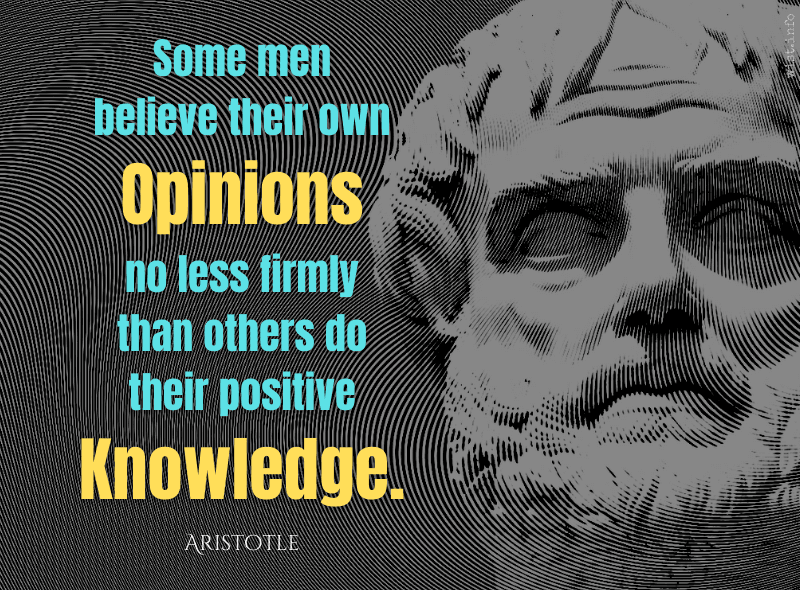
Some men believe their own Opinions no less firmly than others do their positive Knowledge.
Aristotle (384–322 BC) Greek philosopher
Nicomachean Ethics [Ἠθικὰ Νικομάχεια], Book 7, ch. 3 (7.3) (c. 325 BC) [tr. Chase (1847)]
(Source)
Other translations:Some men put no less faith in their own uncertified opinions than do others in the verified truths of science.
[tr. Williams (1869), sec. 127]For some people are as strongly convinced of their opinions as others of their knowledge.
[tr. Welldon (1892)]Some people have just as strong a belief in their mere opinions as others have in what they really know.
[tr. Peters (1893), 7.3.4]Some men are no less convinced of what they think than others of what they know.
[tr. Ross (1908)]Some men are just as firmly convinced of what they opine as others are of what they know.
[tr. Rackham (1934)]Some people have no less conviction about that they believe than others do about what they know scientifically.
[tr. Reeve (1948)]Some men are just as sure of the truth of their opinions as others are of what they know.
[tr. Thomson (1953)]Some men are no less convinced of their opinions about things than others of the things they know.
[tr. Apostle (1975)]There are some people who have no less confidence than others hav ein what they know.
[tr. Thomson/Tredennick (1976)]Some are no less convinced of what they opine about than are other people of what they know.
[tr. Bartlett/Collins (2011)]
I note in a letter forwarded to me by the Famous Writers School that I have “aided the Communist conspiracy.” If this is indeed true, and I mean this with sincerity and respect, I should turn myself in to any local F.B.I. office. It was not my intention to aid and conspire, when I wrote the TV script, “Carol for Another Christmas,” nor was I remotely interested in propagandizing for the United Nations or for any organization. I was deeply interested in conveying what is a deeply felt conviction of my own. This is simply to suggest that human beings must involve themselves in the anguish of other human beings. This, I submit to you, is not a political thesis at all. It is simply an expression of what I would hope might be ultimately a simple humanity for humanity’s sake.
Rod Serling (1924–1975) American screenwriter, playwright, television producer, narrator
Letter to viewer who complained about the TV movie “Carol for Another Christmas” (1964)
(Source)
Quoted in Anne Serling, As I Knew Him: My Dad, Rod Serling (2013).
Satirists, be careful. In the 1931 film by René Clair, Vive la Liberte, a song says, “Work is freedom.” In 1940 the sign on the gates to Auschwitz said: “Arbeit macht frei.”
Stanislaw Lec (1909–1966) Polish aphorist, poet, satirist
Unkempt Thoughts [Myśli nieuczesane] (1957) [tr. Gałązka (1962)]
(Source)

Truth gains more even by the errors of one who, with due study and preparation, thinks for himself, than by the true opinions of those who only hold them because they do not suffer themselves to think.
John Stuart Mill (1806–1873) English philosopher and economist
On Liberty, ch. 2 “Of the Liberty of Thought and Discussion” (1859)
(Source)
The people people have for friends
Your common sense appall,
But the people people marry
Are the queerest folk of all.Charlotte Perkins Gilman (1860–1935) American sociologist, writer, reformer, feminist
“Queer People”
(Source)
Businesses have changed when the public came to expect and require different behavior, to reward businesses for behavior that the public wanted, and to make things difficult for businesses practising behaviors that the public didn’t want. I predict that in the future, just as in the past, changes in public attitudes will be essential for changes in businesses’ environmental practices.
Jared Diamond (b. 1937) American geographer, historian, ornithologist, author
Collapse: How Societies Choose to Fail or Succeed, “Big businesses and the environment” (2005)
(Source)
It would be difficult for anyone with normal powers of observation to believe that there is a link between having money and behaving well.
Judith Martin (b. 1938) American author, journalist, etiquette expert [a.k.a. Miss Manners]
Twitter (2022-01-16)
(Source)
I will accept that sometimes a villain has to die, but I’ll be damned if I’ll take free drinks for doing it.
Phil Foglio (b. 1956) American writer, cartoonist
Agatha H. and the Clockwork Princess [Barry Heterodyne] (2012) [with Kaja Foglio]
(Source)
Never from Obstinacy take the Wrong Side because your Opponent has anticipated you in taking the Right One.
[Nunca por tema seguir el peor partido, porque el contrario se adelantó y escogió el mejor.]Baltasar Gracián y Morales (1601–1658) Spanish Jesuit priest, writer, philosopher
The Art of Worldly Wisdom [Oráculo Manual y Arte de Prudencia], § 142 (1647) [tr. Jacobs (1892)]
(Source)
(Source (Spanish)). Other translations:Never to espouse a bad party in spight to an Adversary, who hath taken the better.
[Flesher ed. (1685)]Never out of obstinancy take the wrong side, because your opponent has got before you and taken the right one.
[tr. Duff (1877)]Never out of stubbornness hold to the wrong side, just because your adversary anticipated you, and chose the right.
[tr. Fischer (1937)]Don’t defend the wrong side out of stubbornness, just because your opponent happened to arrive first and choose the right side.
[tr. Maurer (1992)]
No man shall be compelled to frequent or support any religious worship, place, or ministry whatsoever, nor shall be enforced, restrained, molested, or burthened in his body or goods, nor shall otherwise suffer, on account of his religious opinions or belief; but that all men shall be free to profess, and by argument to maintain, their opinions in matters of religion, and that the same shall in no wise diminish, enlarge, or affect their civil capacities.
Thomas Jefferson (1743–1826) American political philosopher, polymath, statesman, US President (1801–09)
Document (1776-06-18), “Virginia Statute for Religious Freedom,” Preamble (enacted 1786-01-16)
(Source)
To know one’s own limitations is the hallmark of competence.
Dorothy Sayers (1893–1957) English author, translator
Thrones, Dominations, ch. 5 (1998) [with Jill Paton Walsh]
(Source)
Walsh completed the novel left unfinished at Sayers' death.

There is something which makes it more agreeable to condemn ourselves than to be condemned by others.
Abigail Adams (1744–1818) American correspondent, First Lady (1797–1801)
Letter to John Adams (19-20 Apr 1764)
(Source)

The hair she swears is hers Fabulla bought.
So, Paulus, is that perjury or not?[Iurat capillos esse, quos emit, suos
Fabulla: numquid, Paule, peierat?]Martial (AD c.39-c.103) Spanish Roman poet, satirist, epigrammatist [Marcus Valerius Martialis]
Epigrams [Epigrammata], Book 6, epigram 12 (6.12) (AD 91) [tr. McLean (2014)]
(Source)
Perhaps a reference back to Paulus doing something similar with poetry (ep. 2.10). (Source (Latin)). Other translations:You see the goodly hayre that Galla weares,
'Tis certain her own hair, who would have thought it?
She sweares it is her owne: and true she sweares:
For hard by Temple-barre last day she bought it.
[tr. Harington (fl. c. 1600), Ep. 162 - Epigrams Book 2 #66 "Of Galla's goodly Periwigge"]The golden hair that Galla wears
Is hers: who would have thought it?
She swears 'tis hers, and true she swears,
For I know where she bought it.
[tr. Harington (fl. c. 1600), as paraphrased in Bohn, possibly from Anon. below.]Fabulla sweares her haire (which at a rate
She bought) is hers. Is she forsworne in that?
[tr. May (1629)]Shee sweares tis her owne hayre. Who would have thought it?
Shee's nott forsworne though: I know where shee bought it.
[tr. Anon. - British Library MS Add. 27343 (17th C)]Locks Fabby purchas'd, and her own she swore.
Who would not, Paul, the perjury deplore?
[tr. Elphinston (1782), Book 12, ep. 163]Fabulla swears that the hair which she has bought is her own. Does she perjure herself, Paulus?
[tr. Bohn's Classical (1859)]Fabulla swears that the hair she buys is hers.
Does she therefore swear falsely, Paulus?
[tr. Ker (1919)]Those purchased tresses which her head adorn
Fabulla swears are hers -- is she forsworn?
[tr. Pott & Wright (1921), "By Right of Purchase"]That plush hair Fabulla wears?
It's hers, Fabulla swears.
I've no reason to deny it:
I saw Fabulla buy it.
[tr. Matthews (1992)]Fabulla swears that the hair she buys is her own. Is that perjury, Paulus?
[tr. Shackleton Bailey (1993)]Swears Fabby of her hair so fine,
"I purchased it, so, yes, it's mine."
[tr. Ericsson (1995)]The coif she wears she claims she grew.
Does that seem splitting hairs to you?
[tr. Wills (2007)]She swears the hair she bought is her own.
Is she lying? No.
[tr. Kennelly (2008), "No Lie"]Fabulla swears that hair is hers -- the hair she bought; tell me, Paulus, is she lying?
[tr. Nisbet (2015)]
To arrive at a just estimate of a renowned man’s character one must judge it by the standards of his time, not ours. Judged by the standards of one century, the noblest characters of an earlier one lose much of their luster; judged by the standards of today, there is probably no illustrious man of four or five centuries ago whose character could meet the test at all points.
Mark Twain (1835–1910) American writer [pseud. of Samuel Clemens]
Joan of Arc, “Translator’s Preface” (1860)
(Source)
But this I can tell you true — until you divest yourself of the notion that you are a collection of needs, an empty vessel that someone else must fill up, there will be no safe place to harbor yourself, no safe shore to reach. As long as you think mostly of getting, you will have nothing real to give.
Merle Shain (1935–1989) Canadian journalist and author
Hearts That We Broke Long Ago, ch. 8 (1985)
(Source)
The desire of power in excess caused the angels to fall; the desire of knowledge in excess caused man to fall; but in charity there is no excess, neither can angel or man come in danger by it.
Francis Bacon (1561–1626) English philosopher, scientist, author, statesman
“Of Goodness and Goodness of Nature,” Essays, No. 13 (1625)
(Source)
Often trimmed down to "In charity there is no excess."

People are egregiously mistaken if they think they ever can attain to permanent popularity by hypocrisy, by mere outside appearances, and by disguising not only their language but their looks. True popularity takes deep root and spreads itself wide; but the false falls away like blossoms; for nothing that is false can be lasting.
[Quodsi qui simulatione et inani ostentatione et ficto non modo sermone, sed etiam voltu stabilem se gloriam consequi posse rentur, vehementer errant. Vera gloria radices agit atque etiam propagatur, ficta omnia celeriter tamquam flosculi decidunt, nee simulatum potest quicquam esse diuturnum.]
Marcus Tullius Cicero (106–43 BC) Roman orator, statesman, philosopher
De Officiis [On Duties; On Moral Duty; The Offices], Book 2, ch. 12 (2.12) / sec. 43 (44 BC) [tr. Edmonds (1865)]
(Source)
(Source (Latin)). Another translation:Those people therefore are highly mistaken, who think of obtaining a solid reputation by vain shows and hypocritical pretences; by composed countenances and studied forms of words: for true glory takes deep root, and grows and flourishes more and more; but that which is only in show and mere outside, quickly decays and withers like flowers; nor can anything be lasting that is only counterfeit.
[tr. Cockman (1699)]But if any suppose, that they can obtain a stable reputation by pretences, empty ostentation, hypocritical conversation, and even artificial looks, they are extremely mistaken. True fame takes deep root, and extends its shoots. Every counterfeit appearance, like blossoms, quickly falls off; and no pretense can be lasting.
[tr. McCartney (1798)]If there be those who think to obtain enduring fame by dissembling and empty show, and by hypocrisy, not only of speech, but of countenance also, they are utterly mistaken. True fame strikes its roots downward, and sends out fresh shoots; all figments fall speedily, like blossoms, nor can anything feigned be lasting.
[tr. Peabody (1883)]It is a delusion to suppose that glory can be founded on dissimulation, vain ostentation, and studied words and looks. True glory strikes root and spreads, everything unreal soon falls like the blossoms, a lie cannot last.
[tr. Gardiner (1899)]True glory strikes roots, and grows: ill-founded reputations, like flowers, soon wither, nor can anything last long which is based on pretence.
[ed. Harbottle (1906)]For if anyone thinks that he can win lasting glory by pretence, by empty show, by hypocritical talk and looks, he is very much mistaken. True glory strikes deep root and spreads its branches wide; but all pretences soon fall to the ground like fragile flowers, and nothing counterfeit can be lasting.
[tr. Miller (1913)]If anyone thinks he can attain lasting glory by mimicry, by empty shows, by pretense in his looks and his conversation, he is far from correct. Genuine glory puts down roots and even sends out new growth; any pretense dies down quickly, like fragile flowers. Nothing simulated can be long-lasting.
[tr. Edinger (1974)]
“You are wise and powerful. Will you not take the Ring?”
“No!” cried Gandalf, springing to his feet. “With that power I should have power too great and terrible. And over me the Ring would gain a power still greater and more deadly.” His eyes flashed and his face was lit as by a fire within. “Do not tempt me! For I do not wish to become like the Dark Lord himself. Yet the way of the Ring to my heart is by pity, pity for weakness and the desire of strength to do good. Do not tempt me! I dare not take it, not even to keep it safe, unused. The wish to wield it would be too great for my strength. I shall have such need of it. Great perils lie before me.”J.R.R. Tolkien (1892–1973) English writer, fabulist, philologist, academic [John Ronald Reuel Tolkien]
The Lord of the Rings, Vol. 1: The Fellowship of the Ring, Book 1, ch. 2 “The Shadow of the Past” [Frodo and Gandalf] (1954)
(Source)
The very utterness of the crash and ruin, the desperation of the case, might be its hope. On ruins one can begin to build. Anyhow, looking out from ruins one clearly sees; there are no obstructing walls.
Rose Macaulay (1881–1958) English writer
The Valley Captives (1911)
FRIEDAN: There was a masculine mystique, too.
PLAYBOY: What was it?
FRIEDAN: Men had to be supermen: stoic, responsible meal tickets. Dominance is a burden. Most men who are honest will admit that.

The great disadvantage of being in a rat race is that it is humiliating. The competitors in a rat race are, by definition, rodents.
The national unity of a free people depends upon a sufficiently even balance of political power to make it impracticable for the administration to be arbitrary and for the opposition to be revolutionary and irreconcilable. Where that balance no longer exists, democracy perishes. For unless all the citizens of a state are forced by circumstances to compromise, unless they feel that they can affect policy but that no one can wholly dominate it, unless by habit and necessity they have to give and take, freedom cannot be maintained.
Walter Lippmann (1889–1974) American journalist and author
“The Indispensable Opposition,” The Atlantic Monthly (Aug 1939)
(Source)
But let us die, go plunging into the thick of battle.
One hope saves the defeated: they know they can’t be saved![Moriamur et in media arma ruamus.
Una salus victis, nullam sperare salutem.]Virgil (70–19 BC) Roman poet [b. Publius Vergilius Maro; also Vergil]
The Aeneid [Ænē̆is], Book 2, l. 353ff (2.353-354) [Aeneas] (29-19 BC) [tr. Fagles (2006), l. 443ff]
(Source)
(Source (Latin)). Other translations:Then let's incounter death, fall bravely on,
Vanquish'd men's safety is to hope for none.
[tr. Ogilby (1649)]Then let us fall, but fall amidst our foes:
Despair of life the means of living shows.
[tr. Dryden (1697)]Let us meet death, and rush into the thickest of our armed foes. The only safety for the vanquished is to throw away all hopes of safety.
[tr. Davidson/Buckley (1854)]Come -- rush we on our fate.
No safety may the vanquished find
Till hope of safety be resigned.
[tr. Conington (1866)]Let us die,
And plunge into the middle of the fight.
The only safety of the vanquished is
To hope for none.
[tr. Cranch (1872)]Let us die, and rush on their encircling weapons. The conquered have one safety, to hope for none.
[tr. Mackail (1885)]Fall on a very midst the fire and die in press of war!
One hope there is for vanquished men, to cherish hope no more.
[tr. Morris (1900)]Forward, then,
To die and mingle in the tumult's blare.
Sole hope to vanquished men of safety is despair.
[tr. Taylor (1907), st. 47, l. 421ff]Let us fight
unto the death! To arms, my men, to arms!
The single hope and stay of desperate men
is their despair.
[tr. Williams (1910)]Let us die, and rush into the midst of arms. One safety the vanquished have, to hope for none!
[tr. Fairclough (1916)]So let us die,
Rush into arms. One safety for the vanquished
Is to have hope of none.
[tr. Humphries (1951)]Let us die, let us charge into the battle's heart!
Losers have one salvation -- to give up all hope of salvation.
[tr. Day Lewis (1952)]Then let
us rush to arms and die. The lost have only
this one deliverance: to hope for none.
[tr. Mandelbaum (1971), l. 477ff]Come, let us die,
We'll make a rush into the thick of it.
The conquered have one safety: hope for none.
[tr. Fitzgerald (1981), l. 470ff]Let us die. Let us rush into the thick of the fighting. The one safety for the defeated is to have no hope of safety.
[tr. West (1990)]Let us die and rush into battle.
The beaten have one refuge, to have no hope of refuge.
[tr. Kline (2002)]All that is left for us
Is to rush onto swords and die. The only chance
For the conquered is to hope for none.
[tr. Lombardo (2005)]Let us die even as we rush into the thick of the fight. The only safe course for the defeated is to expect no safety.
[Routledge (2005)]Let's die by plunging into war. Our only refuge is to have no hope of refuge.
[tr. Bartsch (2021)]
We cannot have a society half slave and half free; nor can we have thought half slave and half free. If we create an atmosphere in which men fear to think independently, inquire fearlessly, express themselves freely, we will in the end create the kind of society in which men no longer care to think independently or to inquire fearlessly.
Life is full of doors that don’t open when you knock, equally spaced amid those that open when you don’t want them to.
When you tear out a man’s tongue, you are not proving him a liar, you’re only telling the world that you fear what he might say.
George R. R. Martin (b. 1948) American author and screenwriter [George Raymond Richard Martin]
A Clash of Kings [Tyrion] (1998)
(Source)

Nice guys finish last.
Leo Durocher (1905–1991) American professional baseball player, manager, coach ["Leo the Lip"]
(Paraphrase)
The full quote was reported by in the column by Frank Graham, "Leo Doesn't Like Nice Guys," New York Journal-American (6 Jul 1946). When, as Brooklyn Dodgers manager, asked by a reporter if he were a nice guy:Nice guys! Look over there. Do you know a nicer guy than Mel Ott? Or any of the other Giants? Why they’re the nicest guys in the world! And where are they? In seventh place! The nice guys over there are in seventh place. Well let them come and get me. The nice guys are all over there. In seventh place.
As the anecdote was retold (even when Graham's column was reprinted in Baseball Digest in the fall of that year), the references to "seventh place" began morphing into "last place" and "in the second division," eventually settling on the shorter version cited above. While Durocher originally denied he'd said the shorter version, he eventually lay claim to it, and used it as the title of his 1975 autobiography.
More discussion of this quotation:

Every man is bound to bear his own misfortunes rather than to get quit of them by wronging his neighbour.
[Suum cuique incommodum ferendum est potius quam de alterius commodis detrahendum.]
Marcus Tullius Cicero (106–43 BC) Roman orator, statesman, philosopher
De Officiis [On Duties; On Moral Duty; The Offices], Book 3, ch. 5 (3.5) / sec. 30 (44 BC) [tr. Cockman (1699)]
(Source)
(Source (Latin)). Another translation:Every man ought to bear his own evils, rather than wrong another, by stripping him of his comforts.
[tr. McCartney (1798)]It is rather the duty of each to bear his own misfortune, than wrongfully to take from the comforts of others.
[tr. Edmonds (1865)]Each man must bear his own privations rather than take what belongs to another.
[tr. Peabody (1883)]A man should bear his own misfortune rather than trench upon the good fortune of another.
[tr. Gardiner (1899)]It is the duty of each man to bear his own discomforts, rather than diminish the comforts of his neighbor.
[ed. Harbottle (1906)]Each one must bear his own burden of distress rather than rob a neighbour of his rights.
[tr. Miller (1913)]Each man should endure his own suffering rather than reduce the benefits of another person.
[tr. Edinger (1974)]
Frodo drew the Ring out of his pocket again and looked at it. It now appeared plain and smooth, without mark or device that he could see. The gold looked very fair and pure, and Frodo thought how rich and beautiful was its colour, how perfect was its roundness. It was an admirable thing and altogether precious.
J.R.R. Tolkien (1892–1973) English writer, fabulist, philologist, academic [John Ronald Reuel Tolkien]
The Lord of the Rings, Vol. 1: The Fellowship of the Ring, Book 1, ch. 2 “The Shadow of the Past” (1954)
(Source)
One may not reach the dawn save by the path of the night.
Kahlil Gibran (1883–1931) Lebanese-American poet, writer, painter [Gibran Khalil Gibran]
Sand and Foam (1946)
(Source)
A girl should not expect special privileges because of her sex but neither should she “adjust” to prejudice and discrimination. She must learn to compete then, not as a woman, but as a human being.
Betty Friedan (1921–2006) American writer, feminist, activist
The Feminine Mystique, ch. 14 (1963)
(Source)
Fear is a prison. But when you combine it with secrets, it becomes especially toxic, vicious. It puts us all into solitary, unable to hear one another clearly.

Those long chains composed of very simple and easy reasonings, which geometers customarily use to arrive at their most difficult demonstrations, had given me occasion to suppose that all the things which come within the scope of human knowledge are interconnected in the same way. And I thought that, provided we refrain froma ccepting anything as true which is not, and always keep to the order required for deducing one thing from another, there can be nothing too remote to be reached in the end or too well hidden to be discovered.
[Ces longues chaînes de raisons, toutes simples et faciles, dont les géomètres ont coutume de se servir pour parvenir à leurs plus difficiles démonstrations, m’avoient donné occasion de m’imaginer que toutes les choses qui peuvent tomber sous la connoissance des hommes s’entresuivent en même façon, et que, pourvu seulement qu’on s’abstienne d’en recevoir aucune pour vraie qui ne le soit, et qu’on garde toujours l’ordre qu’il faut pour les déduire les unes des autres, il n’y en peut avoir de si éloignées auxquelles enfin on ne parvienne, ni de si cachées qu’on ne découvre.]
René Descartes (1596–1650) French philosopher, mathematician
Discourse on Method [Discours de la méthode], Part 2 (1637) [tr. Cottingham, Stoothoff (1985)]
(Source)
(Source (French)). Other translations:Those long chains of reasons, (though simple and easie) which the Geometricians commonly use to lead us to their most difficult demonstrations, gave me occasion to imagine, That all things which may fall under the knowledge of Men, follow one the other in the same manner, and so we doe only abstain from receiving any one for true, which is not so, and observe always the right order of deducing them one from the other, there can be none so remote, to which at last we shall not attain; nor so hid, which we shall not discover.
[Newcombe ed. (1649)]The long chains of simple and easy reasonings by means of which geometers are accustomed to reach the conclusions of their most difficult demonstrations, had led me to imagine that all things, to the knowledge of which man is competent, are mutually connected in the same way, and that there is nothing so far removed from us as to be beyond our reach, or so hidden that we cannot discover it, provided only we abstain from accepting the false for the true, and always preserve in our thoughts the order necessary for the deduction of one truth from another.
[tr. Veitch (1850)]Those long chains of reasoning, simple and easy as they are of which geometricians make use in order to arrive at the most difficult demonstrations, had caused me to imagine that all those things which fall under the cognizance of man might very likely be mutually related in the same fashion; and that, provided only that we abstain from receiving anything as true which is not so, and always retain the order which is necessary in order to deduce the one conclusion from the other, there can be nothing so remote that we cannot reach to it, nor to recondite that we cannot discover it.
[tr. Haldane & Ross (1911)]These long chains of perfectly simple and easy reasonings by means of which geometers are accustomed to carry out their most difficult demonstrations had led me to fancy that everything that can fall under human knowledge forms a similar sequence; and that so long as we avoid accepting as true what it not so, and always preserve the right order for deduction of one thing from another, there can be nothing too remote to be reached in the end, or too well hidden to be discovered.
[tr. Ascombe & Geach (1971)]
Observe that part of a beautiful woman where she is perhaps the most beautiful, about the neck and breasts; the smoothness; the softness; the easy and insensible swell; the variety of the surface, which is never for the smallest space the same; the deceitful maze, through which the unsteady eye slides giddily, without knowing where to fix, or whither it is carried. Is not this a demonstration of that change of surface continual and yet hardly perceptible at any point which forms one of the great constituents of beauty?
Edmund Burke (1729–1797) Anglo-Irish statesman, orator, philosopher
A Philosophical Inquiry into the Origin of Our Ideas of the Sublime and the Beautiful, 3.15 (1756)
(Source)
You should always choose the lesser of two evils.
[De duobus malis semper minus tamen est eligendum.]
Thomas à Kempis (c. 1380–1471) German-Dutch priest, author
The Imitation of Christ [De Imitatione Christi], Book 3, ch. 12, v. 2 (3.12.2) (c. 1418-27) [tr. Knox-Oakley (1959)]
(Source)
In this context, Thomas is speaking of the evil (suffering) of resisting temptation and losing out on fun times in this world, compared to the evil of eternal damnation, e.g.,If thou say, that thou art not able to suffer much, how then wilt thou endure the fire hereafter? Of two evils the less is always to be chosen. That thou mayest therefore avoid the everlasting punishment, endeavour to endure present evils patiently for God's sake. [Anon. (1901)]
See also Cicero.
(Source (Latin)). Other translations:Of two evils, the less evil is to be taken.
[tr. Whitford/Raynal (1530/1871)]Of two evils, the lesser is to be chosen.
[tr. Whitford/Gardiner (1530/1955)]Of two evils the lesse is alwaies to be chosen.
[tr. Page (1639), 3.12.5]Nature, as well as Religion, teaches Men, of Two Evils to choose the less.
[tr. Stanhope (1696; 1706 ed.), 3.13]Of two evils, the least is to be chosen.
[tr. Payne (1803), 3.9.4]Of two evils the less is alway to be chosen.
[ed. Parker (1841)]Of two evils, the least is to be chosen.
[tr. Dibdin (1851), 3.10.1]Of two evils we ought always to choose the less.
[ed. Bagster (1860)]Of two evils we should always choose the less.
[tr. Benham (1874)]Of two evils the less is always to be chosen.
[tr. Anon. (1901)]Of two evils, the lesser is always to be chosen.
[tr. Croft/Bolton (1940)]Of two evils always choose the less.
[tr. Daplyn (1952)]Of two evils, always choose the lesser.
[tr. Sherley-Price (1952)]One must always choose the lesser of two evils.
[tr. Knott (1962)]You must always choose the lesser of two evils.
[tr. Rooney (1979)]Always choose the lesser of two evils.
[tr. Creasy (1989)]

It’s curious that throughout our history together, with no apparent effort, people have been able to think of the cat simultaneously as the guardian spirit of the hearth and home, and as the emblem of freedom, independence, and rootlessness.

I don’t want to belong to any club that will accept me as a member.
Groucho Marx (1890–1977) American comedian [b. Julius Henry Marx]
Groucho and Me, ch. 26 “Foot in Mouth Disease” (1959)
(Source)
Variant: "I don't want to belong to any club that would have me as a member."
Different confidants of Groucho's attributed this resignation note to different organizations, though most think the resignation from the Friars Club or the Hillcrest Country Club. In his autobiography (the noted source), Grouch referred to it apocryphally as "the Delaney Club."
More discussion of this quotation:
Dad would be mad.
We can only have one.
If we do not choose,
we will end up with NONE.Dr. Seuss (1904–1991) American author, illustrator [pseud. of Theodor Geisel]
What Pet Should I Get? (c. 1960, 2015)
Galla, deny; and render passion strong:
But, prudent Galla, don’t deny too long.[Galla, nega: satiatur amor nisi gaudia torquent:
sed noli nimium, Galla, negare diu.]Martial (AD c.39-c.103) Spanish Roman poet, satirist, epigrammatist [Marcus Valerius Martialis]
Epigrams [Epigrammata], Book 4, epigram 38 (4.38) (AD 89) [tr. Elphinston (1782), Book 12, ep. 195]
(Source)
(Source (Latin)). Other translations:Galla deny, be not too eas'ly gain'd,
For Love will glut with Joys too soon obtain'd.
[tr. Cotton (1686)]Galla, say "No:" love is soon sated, unless our pleasures are mixed with some pain;
but do not continue, Galla, to say "No" too long.
[tr. Bohn's Classical (1859)]Refuse me, Galla; love cloys if its pleasures torture not:
but refuse not, Galla, too long.
[tr. Ker (1919)]Galla, say "no" -- Tease love and you renew it.
But prithee, Galla, do not overdo it.
[tr. Pott & Wright (1921)]Say you won't Galla: For passion cloys
if its joys are not tormenting
But don't take too long in relenting!
[tr. Bovie (1970)]Galla, say no, for love, unless
It teases, cloys with happiness.
Don't take too long, though, to say yes.
[tr. Michie (1972)]Galla, say no. Love palIs, unless its joys are torture. But Galla, don't say no for too long.
[tr. Shackleton Bailey (1993)]A "No" can build love's piquancy,
But don't, too long, say "No" to me.
[tr. Ericsson (1995)]Galla, say no. Love is satiated unless pleasures torment.
But, Galla, do not say no for too long!
[tr. Williams (2004)]"No" is enticing; so is wooing slow.
But nothing works till you stop saying "No."
[tr. Wills (2007)]Galla, say no. Some torment makes love stronger.
But, Galla, don’t keep saying no much longer.
[tr. McLean (2014)]Galla, tell me "No": love stales unless its joys bring pain.
But, Galla, don't say "No" for very long.
[tr. Nisbet (2015)]Without a wait
or some hard trial,
love won’t amuse me.
So hesitate
(just for a while ...)
[tr. Juster (2016)]Galla, say No, for Love will cloy
Without some torments mixed with joy.
But, Galla, do not get me wrong --
Please don’t say No to me too long.
[tr. Barger]
Life is like fording a river, stepping from one slippery stone to another, and you must rejoice every time you don’t lose your balance, and learn to laugh at all the times you do.
Merle Shain (1935–1989) Canadian journalist and author
(Attributed)
You can’t go back and change the beginning, but you can start where you are and change the ending.
C. S. Lewis (1898–1963) English writer, literary scholar, lay theologian [Clive Staples Lewis]
(Spurious)
Not found in Lewis' writings, and not considered authentic. There is some similarity to this Lewis quotation. More discussion here:
Progress means getting nearer to the place where you want to be. And if you have taken a wrong turning, then to go forward does not get you any nearer. If you are on the wrong road, progress means doing an about-turn and walking back to the right road; and in that case, the man who turns back soonest is the most progressive.
C. S. Lewis (1898–1963) English writer, literary scholar, lay theologian [Clive Staples Lewis]
Mere Christianity, Book 1, ch. 5 “We Have Cause to be Uneasy” (1952)
(Source)
Originally broadcast on BBC Radio (27 Aug 1941) under the title "What Can We Do About It?" Reprinted first in Broadcast Talks (1943) (US title The Case for Christianity (1944)).
Others again who say that regard should be had for the rights of fellow-citizens, but not of foreigners, would destroy the universal brotherhood of mankind; and, when this is annihilated, kindness, generosity, goodness, and justice must utterly perish; and those who work all this destruction must be considered as wickedly rebelling against the immortal gods. For they uproot the fellowship which the gods have established between human beings.
[Qui autem civium rationem dicunt habendam, externorum negant, ii dirimunt communem humani generis societatem; qua sublata beneficentia, liberalitas, bonitas, iustitia funditus tollitur; quae qui tollunt, etiam adversus deos immortales impii iudicandi sunt. Ab iis enim constitutam inter homines societatem evertunt.]
Marcus Tullius Cicero (106–43 BC) Roman orator, statesman, philosopher
De Officiis [On Duties; On Moral Duty; The Offices], Book 3, ch. 6 (3.6) / sec. 28 (44 BC) [tr. Miller (1913)]
(Source)
(Source (Latin)). Another translation:Others there are, who are ready to confess that they ought to bear such a regard to fellow-citizens, but by no means allow of it in relation to strangers: now these men destroy that universal society of all mankind, which, if once taken away, kindness, liberality, justice, and humanity must utterly perish; which excellent virtues whoever makes void, is chargeable with impiety towards the immortal gods; for he breaks that society which they have established and settled amongst men.
[tr. Cockman (1699)]They, too, who hold that a regard ought to be paid to our fellow-citizens, but deny it to foreigners, break asunder the common society of mankind, by which beneficence, liberality, goodness, justice, are entirely abolished. They who destroy these virtues, are to be charged with impiety towards the immortal gods. For, by such principles, they subvert established intercourse among men.
[tr. McCartney (1798)]They, again, who say that a regard ought to be had with fellow citizens, but deny that it ought to foreigners, break up the common society of the human race, which being withdrawn, beneficence, liberality, goodness, justice are utterly abolished. But they who tear up these things should be judged impious, even towards the immortal gods; for they overturn the society established by them among men.
[tr. Edmonds (1865)]Those, too, who say that account is to be taken of citizens, but not of foreigners, destroy the common sodality of the human race, which abrogated, beneficence, liberality, kindness, justice, are removed from their very foundations. And those who remove them are to be regarded as impious toward the immortal gods; for they overturn the fellowship established among men by the gods.
[tr. Peabody (1883)]Others again who deny the rights of aliens while respecting those of their countrymen, destroy the universal brotherhood of mankind which involves in its ruin beneficence, liberality, goodness and justice. To destroy these virtues is to sin against the immortal gods. It is to subvert that society which the gods established among men.
[tr. Gardiner (1899)]In the same way, those who say that one standard should be applied to fellow citizens but another to foreigners, destroy the common society of the human race. When that disappears, good deeds, generosity, kindness, and justice are also removed root and branch. We must draw the conclusion that people who do away with these qualities are disrespectful even against the immortal gods. They destroy the cooperation among men which the gods instituted.
[tr. Edinger (1974)]
I do so dearly believe that no half-heartedness and no worldly fear must turn us aside from following the light unflinchingly.
J.R.R. Tolkien (1892–1973) English writer, fabulist, philologist, academic [John Ronald Reuel Tolkien]
Letter to Edith Bratt (1913)
(Source)
Bratt was Tolkien's fiancee, who was apprehensive about the personal and social ramifications of converting to Catholicism. Tolkien's mother's conversion had been similarly difficult.
The Promised Land always lies on the other side of a wilderness.
Havelock Ellis (1859–1939) British sexologist, physician, social reformer [Henry Havelock Ellis]
The Dance of Life, ch. 5 “The Art of Religion,” sec. 4 (1923)
(Source)
It is easier to live through someone else than to become complete yourself.
Betty Friedan (1921–2006) American writer, feminist, activist
The Feminine Mystique, ch. 14 (1963)
(Source)
The comfort of the rich depends upon an abundant supply of the poor.
Voltaire (1694–1778) French writer [pseud. of Francois-Marie Arouet]
(Attributed)

Here lies the noble warrior that never blunted sword;
Here lies the noble courtier that never kept his word;
Here lies his excellency that governed all the state;
Here lies the L. of Leicester that all the world did hate.Walter Raleigh (c. 1552–1618) English statesman, soldier, writer, explorer
“Epitaph on the Earl of Leicester, died September 4, 1588”
(Source)

It was the time when sleep first comes to weary mortals,
creeping over us, the sweetest gift of gods.[Tempus erat quo prima quies mortalibus aegris
incipit et dono divum gratissima serpit.]Virgil (70–19 BC) Roman poet [b. Publius Vergilius Maro; also Vergil]
The Aeneid [Ænē̆is], Book 2, l. 268ff (2.268-269) (29-19 BC) [tr. Bartsch (2021)]
(Source)
(Source (Latin)). Other translations:It was the time, first sleep the weary soule
Possest, and heavens best gift on mortalls stole.
[tr. Ogilby (1649)]'T was in the dead of night, when sleep repairs
Our bodies worn with toils, our minds with cares.
[tr. Dryden (1697)]It was the time when the first sleep invades languid mortals, and steals upon them, by the gift of the gods, most sweet.
[tr. Davidson/Buckley (1854)]It was the hour when Heaven gives rest
To weary man, the first and best.
[tr. Conington (1866)]It was the hour when first their sleep begins
For wretched mortals, and most gratefully
Creeps over them, by bounty of the gods.
[tr. Cranch (1872), l. 271ff]It was the time when by the gift of God rest comes stealing first and sweetest on unhappy men.
[tr. Mackail (1885)]It was the time when that first peace of sick men hath begun,
By very gift of God o'er all in sweetest wise to creep.
[tr. Morris (1900)]'Twas now the time, when on tired mortals crept
First slumber, sweetest that celestials pour.
[tr. Taylor (1907), st. 36, l. 316ff]That hour it was when heaven's first gift of sleep
on weary hearts of men most sweetly steals.
[tr. Williams (1910)]It was the hour when for weary mortals their first rest begins, and by grace of the gods steals over them most sweet.
[tr. Fairclough (1916)]It was the time when the first sleep begins
For weary mortals, heaven’s most welcome gift.
[tr. Humphries (1951)]It was the hour when worn-out men begin to get
Some rest, and by god's grace genial sleep steals over them.
[tr. Day Lewis (1952)]It was the hour when for troubled mortals
rest -- sweetest gift of gods that glides to men --
has just begun.
[tr. Mandelbaum (1971), l. 371ff]That time of night it was when the first sleep,
Gift of the gods, begins for ill mankind,
Arriving gradually, delicious rest.
[tr. Fitzgerald (1981), l. 360ff]It was the time when rest, the most grateful gift of the gods, was first beginning to creep over suffering mortals.
[tr. West (1990)]It was the hour when first sleep begins for weary mortals,
and steals over them as the sweetest gift of the gods.
[tr. Kline (2002)]At that late hour, when sleep begins to drift
Upon fretful humanity as grace from the gods ....
[tr. Lombardo (2005), l. 319ff]This was the hour when rest, that gift of the gods
most heaven-sent, first comes to beleaguered mortals,
creeping over us now.
[tr. Fagles (2006), l. 339ff]
Change does not necessarily assure progress, but progress implacably requires change.
Henry Steele Commager (1902–1998) American historian, writer, activist
Essay (1961-04-30), “We Have Changed — and Must,” The New York Times Magazine
(Source)
When inspiration is silent reason tires quickly.
Roger Zelazny (1937–1995) American writer
Trumps of Doom, ch. 6 (1985)
Then the tyrant dies, and his rule is over; the martyr dies, and his rule begins.
Søren Kierkegaard (1813–1855) Danish philosopher, theologian
Select Entries from Journals and Papers on On My Work as an Author and The Point of View for My Work as an Author, Paper IX B 63:13 373 [tr. Hong/Hong]

Here is the crisis of the times as I see it: We talk about problems, issues, policies, but we don’t talk about what democracy means — what it bestows on us — the revolutionary idea that it isn’t just about the means of governance but the means of dignifying people so they become fully free to claim their moral and political agency.
Bill Moyers (1934–2025) American journalist and public commentator
“The Power of Democracy,” speech, Woodrow Wilson National Fellowship Foundation, New York City (7 Feb 2007)
(Source)
Accepting the Frank E. Taplin, Jr. Public Intellectual Award. Reprinted in Bill Moyers, Moyers on Democracy (2008).

All the Dachaus must remain standing. The Dachaus, the Belsens, the Buchenwalds, the Auschwitzes — all of them. They must remain standing because they are a monument to a moment in time when some men decided to turn the Earth into a graveyard. Into it they shoveled all of their reason, their logic, their knowledge, but worst of all, their conscience. And the moment we forget this, the moment we cease to be haunted by its remembrance, then we become the gravediggers.
Rod Serling (1924–1975) American screenwriter, playwright, television producer, narrator
The Twilight Zone, 3×09 “Deaths-Head Revisited,” Epilogue (10 Nov 1961)
It is the high priests that make demands — not the gods they serve.
Stanislaw Lec (1909–1966) Polish aphorist, poet, satirist
More Unkempt Thoughts [Myśli nieuczesane nowe] (1964) [tr. Gałązka (1969)]
(Source)
There are etiquette rules being spread all over the Internet. They often use new terms for old rudenesses. Flaming is insulting people. Spamming is trying to do business while other people are having a social time. Having spent a lifetime with people who tell me I must be old-fashioned to care about etiquette, I could, if I were not so polite, turn around and say, “Nyah nyah nyah nyah nyah, you’re the one who is old-fashioned if you think that etiquette is old-fashioned — you obviously don’t spend time on the Internet.”
Judith Martin (b. 1938) American author, journalist, etiquette expert [a.k.a. Miss Manners]
In “Polite Company,” interview by Hara Estroff Marano, Psychology Today (1998-03)
(Source)
Cain Mongfish’s masterpiece, A Reasoned Diatribe Regarding thee Methods and Required Madnesses Towards the Manipulation of ye Stuffe of Life and thee Entertaining Consequences Thereof and How Best to Avoid Them is regarded as the seminal work that gathered and codified all of the then-known processes for reanimating, bending, warping, and subjugating life as we know it. Cain died while researching a sequel, which according to his notes was to be entitled How to Promote and Manipulate thee Natural Fealty and Gratitude That Thine Creation Will Express Towards Thou, Their Creator. For some reason, that never works.
—Phil Foglio (b. 1956) American writer, cartoonist
Agatha H and the Voice of the Castle (2014) [with Kaja Foglio]
(Source)
Many see the trees but not the forest, or bark up the wrong tree, speaking endlessly, reasoning uselessly, without getting to the heart of the matter. They go round and round, tiring themselves and us, and never get to what is important. This happens to people with confused minds who do not know how to clear away the brambles. They waste time and patience on what it would be better to leave alone, and later there is no time for what they left.
[Vanse muchos o por las ramas de un inútil discurrir, o por las hojas de una cansada verbosidad, sin topar con la sustancia del caso. Dan cien vueltas rodeando un punto, cansándose y cansando, y nunca llegan al centro de la importancia. Procede de entendimientos confusos, que no se saben desembarazar. Gastan el tiempo y la paciencia en lo que habían de dejar, y después no la hay para lo que dejaron.]
Baltasar Gracián y Morales (1601–1658) Spanish Jesuit priest, writer, philosopher
The Art of Worldly Wisdom [Oráculo Manual y Arte de Prudencia], § 136 (1647) [tr. Maurer (1992)]
(Source)
(Source (Spanish)). Other translations:Many fetch a tedious compass of words, without ever coming to the knot of the business: they make a thousand turnings and windings, that tire themselves and others, without ever arriving at the point of importance. And that proceeds from the confusion of their understanding, which cannot clear it self. They lose time and patience in what ought to be let alone, and then they have no more to bestow upon what they have omitted.
[Flesher ed. (1685)]Many lose their way either in the ramifications of useless discussion or in the brushwood of wearisome verbosity without ever realising the real matter at issue. They go over a single point a hundred times wearying themselves and others and yet never touch the all important centre of affairs. This comes from a confusion of mind from which they cannot extricate themselves. They waste time and patience on matters they should leave alone and cannot spare them afterwards for what they have left alone.
[tr. Jacobs (1892)]Most roam around, in useless millings either about the edge, or in the scrub of a tiresome verbosity, without striking upon the substance of the matter, they make a hundred turns about a point, wearying themselves, and wearying others, yet never arriving at the centre of what is important,- it is the product of a scattered brain that does not know how to get itself together,- they spend time, and exhaust patience, over that which they should leave alone, and afterwards are short of both for what they did leave alone.
[tr. Fischer (1937)]
To suffer the civil magistrate to intrude his powers into the field of opinion and to restrain the profession or propagation of principles, on the supposition of their ill tendency, is a dangerous fallacy, which at once destroys all religious liberty, because he being of course judge of that tendency, will make his opinions the rule of judgment, and approve or condemn the sentiments of others only as they shall square with or differ from his own.
Thomas Jefferson (1743–1826) American political philosopher, polymath, statesman, US President (1801–09)
Document (1776-06-18), “Virginia Statute for Religious Freedom,” Preamble (enacted 1786-01-16)
(Source)
We should strive only to think and speak rightly, without seeking to win others over to our own taste and opinions; that is too great an undertaking.
[Il faut chercher seulement à penser et à parler juste, sans vouloir amener les autres à notre goût et à nos sentiments; c’est une trop grande entreprise.]
Jean de La Bruyère (1645–1696) French essayist, moralist
The Characters [Les Caractères], ch. 1 “Of Works of the Mind [Des Ouvrages de l’Esprit],” § 2 (1.2) (1688) [tr. Stewart (1970), “Of Books”]
(Source)
(Source (French)). Other translations:We must only endeavour to think and speak justly our selves, without aiming to bring others over to our taste and sentiment; We shall find that too great an enterprize.
[Bullord ed. (1696) "Of Polite Learning"]We must only endeavour to think and speak justly our selves, without aiming to bring others over to our Taste and Sentiments; that would be too great an Enterprize.
[Curll ed. (1713), "Of Works of Wit and Eloquence"]We must only endeavour to think and speak justly ourselves, without aiming to bring others over to our Taste and Sentiments; that would be too great an Enterprize.
[Browne ed. (1752), "Of Works of Genius"]We should only endeavor to think and speak correctly ourselves, without wishing to bring others over to our taste and opinions; this would be too great an undertaking.
[tr. Van Laun (1885)]

What we do belongs to what we are; and what we are is what becomes of us.
The whole philosophy of life can be summed up in two little words: be kind.
Exercise caution in your business affairs;
for the world is full of trickery.
But let this not blind you to what virtue there is;
many persons strive for high ideals;
and everywhere life is full of heroism.
“Write shorter epigrams,” is your advice.
Yet you write nothing, Velox. How concise![Scribere me quereris, Velox, epigrammata longa.
Ipse nihil scribis: tu breviora facis.]Martial (AD c.39-c.103) Spanish Roman poet, satirist, epigrammatist [Marcus Valerius Martialis]
Epigrams [Epigrammata], Book 1, epigram 110 (1.110) (AD 85-86) [tr. McLean (2014)]
(Source)
"To Velox." (Source (Latin)). Other translations:Velox complains my epigrams are long,
When he writes none: he sings a shorter song.
[tr. Fletcher (c. 1650)]You say my epigrams, Velox, too long are:
You nothing write; sure yours are shorter far.
[tr. Wright (1663)]Of my long epigrams, you, Swift, complain;
And nothing write: I laud your shorter strain.
[tr. Elphinston (1782), Book 12, ep. 16, "To Velox, or Swift"]You complain, Velox, that the epigrams which I write are long. You yourself write nothing; your attempts are shorter.
[tr. Bohn's Classical (1859)]You complain, Velox, that I write long epigrams, you yourself write nothing. Yours are shorter.
[tr. Ker (1919)]"Such lengthy epigrams," you say, "affright one."
True, yours are shorter, for you never write one.
[tr. Pott & Wright (1921)]Velox, I make my epigrams too long, you snort?
You don't write any: That's making them too short.
[tr. Bovie (1970)]Velox, you complain that I write long epigrams, and yourself write nothing. Do you make shorter ones?
[tr. Shackleton Bailey (1993)]You say I write lines longer than I ought?
It's true your lines are shorter -- they are nought.
[tr. Wills (2007)]You say my epigrams are too long.
Yours are shorter.
You write nothing.
[tr. Kennelly (2008), "Nothing"]Swifty, you moan that I write long epigrams. You aren't writing anything yourself; is that you making shorter ones?
[tr. Nisbet (2015)]My epigrams are word, you've complained;
But you write nothing. Yours are more restrained.
[tr. O'Connell]“Much too long” you say, Velox, censorious,
Of my epigrams -- that’s quite uproarious.
You write none. Your brevity is glorious.
[tr. Schmidgall (2001)]You call my epigrams verbose and lacking in concision
while you yourself write nothing. Wise decision.
[tr. Clark, "Short Enough?"]My epigrams are wordy, you’ve complained;
But you write nothing. Yours are more restrained.
[tr. Oliver]
In this world a man must either be an anvil or a hammer.
Henry Wadsworth Longfellow (1807–1882) American poet
Hyperion, “The Story of Brother Bernardus” (1839)
(Source)
While we do our good works let us not forget that the real solution lies in a world in which charity will have become unnecessary.
Chinua Achebe (1930–2013) Nigerian novelist, poet, professor, critic [Albert Chinualumogu Achebe]
Anthills of the Savannah (1987)
(Source)
It is easy when you’ve been hurt by love to give it up as a bad job and make independence your new god, taking the love you had to give and turning it in upon yourself. And most of us have had to protect ourselves so much at times that we’ve given up the high road and taken the low. But independence carried to the furthest extreme is just loneliness and death, nothing more than another defense, and there is no growth in it, only a safe harbor for a while. The answer doesn’t lie in learning how to protect ourselves from life — it lies in learning how to become strong enough to let a bit more of it in.
Merle Shain (1935–1989) Canadian journalist and author
When Lovers Are Friends, ch. 1 (1978)
(Source)
Any book worth banning is a book worth reading.
Isaac Asimov (1920–1992) Russian-American author, polymath, biochemist
(Attributed)
Men weren’t really the enemy — they were fellow victims suffering from an outmoded masculine mystique that made them feel unnecessarily inadequate when there were no bears to kill.
Betty Friedan (1921–2006) American writer, feminist, activist
The Feminine Mystique, Epilogue (1974 ed.)
(Source)
Sometimes paraphrased: "Man is not the enemy here, but the fellow victim."
For that is an absurd position which is taken by some people, who say that they will not rob a parent or a brother for their own gain, but that their relation to the rest of their fellow-citizens is quite another thing. Such people contend in essence that they are bound to their fellow-citizens by no mutual obligations, social ties, or common interests. This attitude demolishes the whole structure of civil society.
[Nam illud quidem absurdum est, quod quidam dicunt, parenti se aut fratri nihil detracturos sui commodi causa, aliam rationem esse civium reliquorum. Hi sibi nihil iuris, nullam societatem communis utilitatis causa statuunt esse cum civibus, quae sententia omnem societatem distrahit civitatis.]
Marcus Tullius Cicero (106–43 BC) Roman orator, statesman, philosopher
De Officiis [On Duties; On Moral Duty; The Offices], Book 3, ch. 6 (3.6) / sec. 28 (44 BC) [tr. Miller (1913)]
(Source)
(Source (Latin)). Another translation:For as to what is usually said by some men, that they would not take anything away from a father or brother for their own advantage, but that there is not the same reason for their ordinary citizens, it is foolish and absurd: for they thrust themselves out from partaking of any privileges, and from joining in common with the rest of their citizens, for the public good; an opinion that strikes at the very root and foundation of all civil societies.
[tr. Cockman (1699)]That indeed is absurd, which some men avow, that for their own advantage they would take nothing from a parent or a brother; but that the case of other citizens is different. These men, stablish with their fellow-citizens no common right, no society for common advantage; an opinion that unhinges the whole internal intercourse of a state.
[tr. McCartney (1798)]For that which some say, that they would take nothing wrongfully, for the sake of their own advantage, from a parent or brother, but that the case is different with other citizens, is indeed absurd. These establish the principle that they have nothing in the way of right, no society with their fellow citizens, for the sake fo the common interest -- an option which tears asunder the whole social compact.
[tr. Edmonds (1865)]For this is absurd indeed which some say, that they would take nothing from a parent or a brother for their own benefit, but that it is quite another thing with persons outside of one’s own family. These men disclaim all mutual right and partnership with their fellow-citizens for the common benefit, -- a state of feeling which dismembers the fellowship of the community.
[tr. Peabody (1883)]It is absurd for people to say that they will not despoil a father or a brother for their own advantage but that fellow-citizens stand on quite a different footing. That is practically to assert that they are bound to their fellow-citizens neither by mutual obligations, social ties, nor common interests. But such a theory tears in pieces the whole fabric of civil society.
[tr. Gardiner (1899)]The contention that some people advance is absurd, of course: they argue that they would not deprive a parent or brother of anything for their own advantage but that there is another standard applicable to all other citizens. These people do not submit themselves to any law or to any obligation to cooperate with fellow citizens for the common benefit. Their attitude destroys any cooperation within the city.
[tr. Edinger (1974)]
The road must be trod, but it will be very hard. And neither strength nor wisdom will carry us far upon it. This quest may be attempted by the weak with as much hope as the strong. Yet such is oft the course of deeds that move the wheels of the world: small hands do them because they must, while the eyes of the great are elsewhere.
J.R.R. Tolkien (1892–1973) English writer, fabulist, philologist, academic [John Ronald Reuel Tolkien]
The Lord of the Rings, Vol. 1: The Fellowship of the Ring, Book 2, ch. 2 “The Council of Elrond” [Elrond] (1954)
(Source)
Possibly the origin of the spurious "Even the smallest person can change the course of the future." This is said by Galadriel, but only in the film version, The Fellowship of the Ring (2001), screenplay by Fran Wash and Philippa Boyens.
More discussion: Not a Tolkien quote: "Even the smallest person can change the course of the future." - thetolkienist.com.
When religion and politics travel in the same cart, the riders believe nothing can stand in their way. Their movements become headlong — faster and faster and faster. They put aside all thoughts of obstacles and forget the precipice does not show itself to the man in a blind rush until it’s too late.
Frank Herbert (1920–1986) American writer
Dune, Book 3 “The Prophet” (1965)
(Source)
Jessica, quoting a Bene Gesserit proverb.
In Appendix 2, there is reference to another Bene Gesserit teaching: "When religion and politics ride the same cart, when that cart is driven by a living holy man (baraka), nothing can stand in their path."
All through history in every culture we’ve had to make up mythology to explain death to ourselves and to explain life to ourselves.
Ray Bradbury (1920–2012) American writer, futurist, fabulist
“The Fantasy Makers: A Conversation with Ray Bradbury and Chuck Jones,” Interview by Mary Harrington Hall, Psychology Today (Apr 1968)
(Source)
We should measure the prosperity of a nation not by the number of millionaires, but by the absence of poverty, the prevalence of health, the efficiency of the public schools, and the number of people who can and do read worthwhile books.
W. E. B. Du Bois (1868–1963) American writer, historian, social reformer [William Edward Burghardt Du Bois]
“On the Future of the American Negro,” speech (Mar 1953)
(Source)
Hear now the treachery of the Greeks and from one learn the wickedness of all.
[Accipe nunc Danaum insidias, et crimine ab uno
Disce omnes.]Virgil (70–19 BC) Roman poet [b. Publius Vergilius Maro; also Vergil]
The Aeneid [Ænē̆is], Book 2, l. 65ff (2.65-66) [Aeneas] (29-19 BC) [tr. Fairclough (1916)]
(Source)
Regarding Sinon, who posed as a Greek refugee and persuaded the Trojans that the Trojan Horse was harmless. (Source (Latin)). Other translations:Receive Greeks treacheries now; and from one crime
Learn all.
[tr. Ogilby (1649)]Now hear how well the Greeks their wiles disguis'd;
Behold a nation in a man compris'd.
[tr. Dryden (1697)]Now learn the treachery of the Greeks, and from one crime take a specimen of the whole nation.
[tr. Davidson/Buckley (1854), "Literally, 'from one of their tricks learn what they all are.'"]Now listen while my tongue declares
The tale you ask of Danaan snares,
And gather from a single charge
Their catalogue of crimes at large.
[tr. Conington (1866)]Now
Hear what the treachery of the Grecians was,
And from one crime learn all.
[tr. Cranch (1872), l. 89ff]Know now the treachery of the Grecians, and from a single crime learn all.
[tr. Mackail (1885)]Lo now, behold the Danaan guile, and from one wrong they wrought
Learn ye what all are like to be.
[tr. Morris (1900)]Mark now the Danaans' cunning; from one wrong
Learn all.
[tr. Taylor (1907), st. 10, ll. 82-83]Hear now what Greek deception is, and learn
from one dark wickedness the whole.
[tr. Williams (1910)]Listen, and learn Greek trickiness; learn all
Their crimes from one.
[tr. Humphries (1951)]Now hear how the Greeks tricked us; learn from one case of their wickedness
What every Greek is like.
[tr. Day Lewis (1952)]Now listen to the treachery of the Danaans
and learn from one the wickedness of all.
[tr. Mandelbaum (1971), ll. 92-93]Be instructed now
In Greek deceptive arts: one barefaced deed
Can tell you of them all.
[tr. Fitzgerald (1981), l.91ff]Listen now to this story of Greek treachery, and from this one indictment, learn the ways of a whole people.
[tr. West (1990)]Listen now to Greek treachery, and learn of all their crimes
from just this one.
[tr. Kline (2002)]Hear now
The treachery of the Greeks, and from one offense
Learn all their evil.
[tr. Lombardo (2005)]Now, hear the treachery of the Greeks and learn
from a single crime the nature of the beast.
[tr. Fagles (2006)]Now hear how the Greeks baited their trap, and from one act of treachery, understand them all!
[tr. Bartsch (2021)]
It is easier to say what loyalty is not than to say what it is. It is not conformity. It is not passive acquiescence in the status quo. It is not preference for everything American over everything foreign. It is not an ostrich-like ignorance of other countries and other institutions. It is not the indulgence in ceremony — a flag salute, an oath of allegiance, a fervid verbal declaration. It is not a particular creed, a particular version of history, a particular body of economic practices, a particular philosophy.
Power is like money. You can usually get it if you’re competent and it’s the only thing you want in life.
When men are brought face to face with their opponents, forced to listen and learn and mend their ideas, they cease to be children and savages and begin to live like civilized men. Then only is freedom a reality, when men may voice their opinions because they must examine their opinions.
Walter Lippmann (1889–1974) American journalist and author
“The Indispensable Opposition,” The Atlantic Monthly (Aug 1939)
(Source)
“How did you go bankrupt?” Bill asked.
“Two ways,” Mike said. “Gradually and then suddenly.”

A little sin is a big sin when committed by a big man.
Abraham Ibn Ezra (1092–1167) Spanish Jewish poet, philosopher, Biblical exegete [ר׳ אַבְרָהָם בֶּן מֵאִיר אִבְּן עֶזְרָא]
Sefer ha-Yashar (c. 1160)
Commentary on Genesis 32.9. Another translation:Therefore, a minor sin committed by a great personality is considered a major transgression.
[tr. Strickman and Silver (1988)]

If we are to be a great democracy, we must all take an active role in our democracy. We must do democracy. That goes far beyond simply casting your vote. We must all actively champion the causes that ensure the common good.
Martin Luther King III (b. 1957) American human rights advocate and civil rights activist
Speech, Democratic National Convention, Denver, Colorado (28 Aug 2008)
(Source)

Happiness is thought to imply leisure; for we toil in order that we may have leisure, as we make war in order that we may enjoy peace.
[δοκεῖ τε ἡ εὐδαιμονία ἐν τῇ σχολῇ εἶναι, ἀσχολούμεθα γὰρ ἵνα σχολάζωμεν καὶ πολεμοῦμεν ἵν᾽ εἰρήνην ἄγωμεν.]
Aristotle (384–322 BC) Greek philosopher
Nicomachean Ethics [Ἠθικὰ Νικομάχεια], Book 10, ch. 7 (10.7) / 1177b.4 (c. 325 BC) [tr. Peters (1893), 10.7.6]
(Source)
(Source (Greek)). Other translations:Happiness is thought to stand in perfect rest; for we toil that we may rest, and war that we may be at peace.
[tr. Chase (1847), ch. 6]It would seem that happiness is the very antithesis of a busy life, in that it is compatible with perfect leisures. And it is with such leisure in view that a busy life is always led, exactly as war is only waged for the sake of ultimate peace.
[tr. Williams (1869)]The end of labor is to gain leisure.
[in Ballou, Treasury of Thought (1872)]Happiness is thought to depend on leisure; for we are busy that we may have leisure, and make war that we may live in peace.
[tr. Ross (1908)]Happiness is thought to involve leisure; for we do business in order that we may have leisure, and carry on war in order that we may have peace.
[tr. Rackham (1934)]Happiness seems to reside in leisure, since we do unleisured things in order to be at leisure, and wage war in order to live in peace.
[tr. Reeve (1948)]Happiness is thought to depend on leisure; for we toil for the sake of leisurely activity, and we are at war for the sake of peaceful activity.
[tr. Apostle (1975)]Happiness seems to depend on leisure, because we work to have leisure, and wage war to live in peace.
[tr. Crisp (2000)][Because], happiness seems to reside in leisure, we labor [sacrifice leisure] so that we may have leisure.
[tr. @sentantiq (2018)]
A Martian can say things that a Republican or a Democrat can’t.
Rod Serling (1924–1975) American screenwriter, playwright, television producer, narrator
Quoted in Anne Serling, As I Knew Him: My Dad, Rod Serling (2013)
(Source)
On being able to slip more controversial television script ideas past networks and sponsors if done in a science fiction or fantasy setting.
When you jump for joy, beware that no one moves the ground from beneath your feet.
[Gdy z radości podskoczysz do góry, uważaj, by ci ktoś ziemi spod nóg nie usunął.]
Stanislaw Lec (1909–1966) Polish aphorist, poet, satirist
Unkempt Thoughts [Myśli nieuczesane] (1957) [tr. Gałązka (1962)]
(Source)
Common sense is genius dressed in its working clothes.
Ralph Waldo Emerson (1803–1882) American essayist, lecturer, poet
(Spurious)
Not found in Emerson's writings. Author remains unknown.
My views may seem to ignore a moral imperative that businesses should follow virtuous principles, whether or not it is most profitable for them to do so. Instead I prefer to recognize that, throughout human history, in all politically complex human societies in which people encounter other individuals with whom they have no ties of family or clan relationship, government regulation has arisen precisely because it was found to be necessary for the enforcement of moral principles. Invocation of moral principles is a necessary first step for eliciting virtuous behavior, but that alone is not a sufficient step.
Jared Diamond (b. 1937) American geographer, historian, ornithologist, author
Collapse: How Societies Choose to Fail or Succeed, “Big Businesses and the Environment” (2005)
(Source)
The hardest lesson — and this is what child-rearing and perhaps all of manners is about — is that there are other people in the world and you do have to take their feelings into consideration. It doesn’t mean you always have to yield to them, but it does mean that you have to know how to deal with them. A lot of people know that they want to be treated politely, but they don’t make that little leap and say, Well, the other person must feel that way, too.
Judith Martin (b. 1938) American author, journalist, etiquette expert [a.k.a. Miss Manners]
In “Polite Company,” interview by Hara Estroff Marano, Psychology Today (1998-03)
(Source)
Sparks are a secretive lot, and they keep their blasphemous secrets held close to their vests. On average, a good Spark will invest anywhere from one-half to two-thirds of his or her time and energy on the design and hiding of an elaborate lair, as they seem to have an instinctual understanding that people work best in an environment where the controls to all the deathtraps are right at their fingertips. This is a good thing, overall, as time spent digging an elaborate “Maze of Madness” is less time spent trying to find a way to turn the nearest city into a beautiful volcanic moonscape.
Phil Foglio (b. 1956) American writer, cartoonist
Agatha H and the Voice of the Castle (2014) [with Kaja Foglio]
(Source)
If I had been on the hills of Bethlehem in the year one, I do not think I should have heard angels singing because I do not hear them now, & there is no reason to suppose that they have stopped.
Northrop Frye (1912–1991) Canadian literary critic and literary theorist
Notebooks and Lectures on the Bible and Other Religious Texts, Notebook 11f, entry 5 (2003) [ed. Robert D. Denham]
(Source)
A voyage without companionship, that is to say without conversation, is one of the saddest pleasures of life.
Germaine de Staël (1766–1817) Swiss-French writer, woman of letters, critic, salonist [Anne Louise Germaine de Staël-Holstein, Madame de Staël, Madame Necker]
Quoted in Margaret Goldsmith, Madame de Staël (1938)
See also here.

You damn every poem I write,
Yet you won’t publish those of your own.
Now kindly let yours see the light,
Or else leave my damned ones alone.[Cum tua non edas, carpis mea carmina, Laeli.
Carpere vel noli nostra vel ede tua.]Martial (AD c.39-c.103) Spanish Roman poet, satirist, epigrammatist [Marcus Valerius Martialis]
Epigrams [Epigrammata], Book 1, epigram 91 (1.91) (AD 85-86) [tr. Nixon (1911)]
(Source)
"To Lælius". (Source (Latin)). Other translations:Thou blam'st my verses and conceal'st thine own:
Or publish thine, or else let mine alone!
[tr. Killigrew (1695)]You do not publish your own verses, Laelius; you criticise mine. Pray cease to criticise mine, or else publish your own.
[tr. Bohn's Classical (1859)]Although you don't publish your own, you carp at my poems, Laelius. Either do not carp at mine, or publish your own.
[tr. Ker (1919)]You blame my verse; to publish you decline;
Show us your own or cease to carp at mine.
[tr. Pott & Wright (1921)]Although you have not published
Even a single line
Of poetry yourself, you scoff
And sneer and jeer at mine.
Get off my back or publish!
I'd like to hear you whine!
[tr. Marcellino (1968)]Although you don't punish anything, Laelius,
you keep finding fault with my songs. So please,
stop criticizing my stuff, or publish your own.
[tr. Bovie (1970)]Although you don't publish your own poems, Laelius, you carp at mine. Either don't carp at mine or publish your own.
[tr. Shackleton Bailey (1993)]Each poem I publish you loudly bemoan.
Unfair that you never share works of your own.
[tr. Ericsson (1995)]You don’t write poems, Laelius, you criticise mine. Stop criticising me or write your own.
[tr. Kline (2006)]With carpings you my works revile.
Your own you never publish.
Without such works, your carpings I'll
Consider snooty rubbish.
[tr. Wills (2007), "The Critic"]You blast my verses, Laelius; yours aren’t shown.
Either don’t carp at mine or show your own.
[tr. McLean (2014)]You won’t reveal your verse,
but whine that mine is worse.
Just leave me alone
or publish your own.
[tr. Juster (2016)]You never wrote a poem,
yet criticize mine?
Stop abusing me or write something fine
of your own!
[tr. Burch (c. 2017)]
We are never going to have someone who’s perfect [for President]. We have to change our system so that it can operate with flawed people.
Hendrik Hertzberg (b. 1943) American journalist, editor, speech writer, political commentator
Speech, Lyndon Baines Johnson School of Public Affairs (17 Feb 1995)

The conflict between what one is and who one is expected to be touches all of us. And sometimes, rather than reach for what one could be, we choose the comfort of the failed role, preferring to be the victim of circumstance, the person who didn’t have a chance.
Merle Shain (1935–1989) Canadian journalist and author
Hearts That We Broke Long Ago, Part 3, ch. 7 (1983)
(Source)
Justice, the touchstone of worth, is rightly esteemed by the world as the noblest of all the virtues. For no one can be just who fears death, pain, exile and want, or who would sacrifice justice to escape these evils.
[Iustitia, ex qua una virtute viri boni appellantur, mirifica quaedam multitudini videtur, nec iniuria; nemo enim iustus esse potest, qui mortem, qui dolorem, qui exsilium, qui egestatem timet, aut qui ea, quae sunt his contraria, aequitati anteponit.]
Marcus Tullius Cicero (106–43 BC) Roman orator, statesman, philosopher
De Officiis [On Duties; On Moral Duty; The Offices], Book 2, ch. 11 (2.11) / sec. 38 (44 BC) [tr. Gardiner (1899)]
(Source)
(Source (Latin)). Other translation:Justice, which single virtue serves to give men the name and denomination of good, seems much the most admirable to the generality of people; and not without reason, it being impossible for any one to be just who is afraid at the approaches of death, of pain, of banishment, or poverty; or prefers those things which are contrary to these before the great duties of justice and honesty.
[tr. Cockman (1699)]Justice, from which alone good men receive their appellation, appears the most wonderful to the multitude; and with good reason: For no man can be just, who dreads death, pain, exile, want, or prefers to equity whatsoever is contrary to those.
[tr. McCartney (1798)]Justice, from which single virtue men are called good, appears to the multitude as something marvellous. And with good reason' for no man can be just if he is afraid of death, pain, exile, or poverty, or prefers their contraries to justice.
[tr. Edmonds (1865)]Justice, for which one virtue men are called good, seems to the multitude a quality of marvellous excellence, — and not without good reason; for no one can be just, who dreads death, pain, exile, or poverty, or who prefers their opposites to honesty.
[tr. Peabody (1883)]Justice, the possession of which entitles men to be called good, is looked upon by the masses as something miraculous; and rightly so, for no one can be just who fears death, pain, exile, or poverty, or who ranks the opposites of these above equity.
[ed. Harbottle (1906)]Justice, above all, on the basis of which alone men are called “good men,” seems to people generally a quite marvellous virtue -- and not without good reason; for no one can be just who fears death or pain or exile or poverty, or who values their opposites above equity.
[tr. Miller (1913)]And justice in particular seems to the mass of people something amazing, and they are not wrong: good men achieve their reputation for goodness form that one virtue alone, and no man can be just who lives in fear of death, pain, exile, or poverty. If a man shuns fair-dealing in order to avoid these evils, he cannot be considered just.
[tr. Edinger (1974)]
One day you are an apprentice and everybody’s pet; the next you are coldly expected to deliver. There is never sufficient warning that the second day is coming.
Mignon McLaughlin (1913–1983) American journalist and author
The Neurotic’s Notebook, ch. 10 (1963)
(Source)

It’s simply not an adventure worth telling if there aren’t any dragons.
J.R.R. Tolkien (1892–1973) English writer, fabulist, philologist, academic [John Ronald Reuel Tolkien]
(Misattributed)
Variant: "It simply isn’t an adventure worth telling if there aren’t any dragons."
Actually found in Sara Ban Breathnach, Simple Abundance, "February 16: At the End of Our Exploring" (2005). Breathnach quotes an actual Tolkien warning about dragons earlier on the page, apparently leading people to misattribute this phrase of hers to Tolkien.
More discussion: Not a Tolkien quote: It simply isn't an adventure worth telling if there aren't any dragons - thetolkienist.com.
The garb of religion is the best cloak for power.
William Hazlitt (1778–1830) English writer
“On the Clerical Character,” Conclusion (7 Feb 1818)
(Source)

Life is a hard battle anyway. If we laugh and sing a little as we fight the good fight of freedom, it makes it all go easier.
Sojourner Truth (1797–1883) American abolitionist, women's rights activist [b. Isabella Baumfree]
Quoted in Elizabeth Cady Stanton, Letter to the Editor, New York World (13 May 1867)
(Source)
Recorded in Stanton, Anthony, Gage, History of Woman Suffrage, Vol. 2 "1861-76", Appendix to Chapter 18 (1881).
This quote is often given with the following sentence appended to it:I will not allow my life's light to be determined by the darkness around me.
However this is not in the original, and I have been unable to source it.
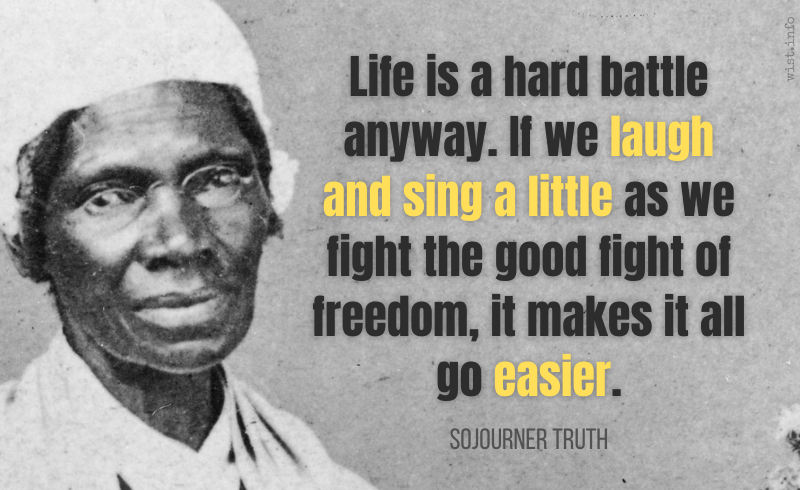
I once met a man who had forgiven an injury. I hope some day to meet the man who has forgiven an insult.
Charles Buxton (1823–1871) English brewer, philanthropist, writer, politician
Notes of Thought, #458 (1873)
(Source)
Or fraud lurks somewhere to destroy:
Mistrust, mistrust it, men of Troy!
Whate’er it be, a Greek I fear,
Though presents in his hand he bear.[Aliquis latet error; equo ne credite, Teucri.
Quidquid id est, timeo Danaos et dona ferentes.]Virgil (70–19 BC) Roman poet [b. Publius Vergilius Maro; also Vergil]
The Aeneid [Ænē̆is], Book 2, l. 48ff (2.48-49) [Laocoön] (29-19 BC) [tr. Conington (1866)]
(Source)
Warning of the Trojan Horse; the origin of the phrase, "Beware Greeks bearing gifts." (Source (Latin)). Other translations:Some deceit lurks, Dardans trust not this Horse, What ere it is, Greeks bringing gifts I feare. [tr. Ogilby (1649)]Somewhat is sure designed, by fraud or force;
Trust not their presents, nor admit the horse.
[tr. Dryden (1697)]Some mischievous design lurks beneath it. Trojans, put no faith in this horse. Whatever it be, I dread the Greeks, even when they bring gifts.
[tr. Davidson/Buckley (1854)]Some other guile
Is lurking. Trojans, do not trust this horse.
Whatever it may be, I fear the Greeks,
Even when they bring us gifts.
[tr. Cranch (1872)]Some delusion lurks there: Trust not the horse, O Trojans. Be it what it may, I fear the Grecians even when they offer gifts.
[tr. Mackail (1885)]Some guile at least therein abides: Teucrians, trust not the horse!
Whatso it is, the Danaan folk, yea gift-bearing I fear.
[tr. Morris (1900)]Some mischief lies behind.
Trust not the horse, ye Teucrians. Whatso'er
This means, I fear the Greeks, for all the gifts they bear.
[tr. Taylor (1907), st. 7; l. 61ff]'T is a snare.
Trust not this horse, O Troy, whate'er it bode!
I fear the Greeks, though gift on gift they bear.
[tr. Williams (1910)]Some trickery lurks therein. Trust not the horse, ye Trojans. Whatever it be, I fear the Greeks, even when bringing gifts.
[tr. Fairclough (1916)]Tricky business
Is hiding in it. Do not trust it, Trojans,
Do not believe this horse. Whatever it may be,
I fear the Greeks, even when bringing presents.
[tr. Humphries (1951)]Sure, some trick
Is there. No, you must never feel safe with the horse, Trojans.
Whatever it is, I distrust the Greeks, even when they are generous.
[tr. Day Lewis (1952)]Some trickery is here. Trojans, do not
trust in the horse. Whatever it may be,
I fear the Greeks, even when they bring gifts.
[tr. Mandelbaum (1971), l. 68ff]Some crookedness
Is in this thing. Have no faith in the horse!
Whatever it is, even when Greeks bring gifts
I fear them, gifts and all.
[tr. Fitzgerald (1981), l. 67ff]There is some other trick we cannot see. Do not trust the horse, Trojans. Whatever it is, I am afraid of Greeks, particularly when they bring gifts.
[tr. West (1990)]Or it hides some other trick: Trojans, don’t trust this horse.
Whatever it is, I’m afraid of Greeks even those bearing gifts.
[tr. Kline (2002)]Some other evil lurks inside. Do not trust the Horse, Trojans! Whatever it is, I fear the Greeks, even when they bring gifts.
[tr. Lombardo (2005)]Some other deception’s lurking deep inside it.
Trojans, never trust that horse. Whatever it is,
I fear the Greeks, especially bearing gifts.
[tr. Fagles (2006), l. 60ff]Some trick lurks here. Citizens, don't trust the horse; fear Greeks, even bringing offerings.
[tr. Bartsch (2021)]
[Loyalty] is a tradition, an ideal, and a principle. It is a willingness to subordinate every private advantage for the larger good. It is an appreciation of the rich and diverse contributions that can come from the most varied sources. It is allegiance to the traditions that have guided our greatest statesmen and inspired our most eloquent poets — the traditions of freedom, equality, democracy, tolerance, the tradition of the higher law, of experimentation, co-operation, and pluralism. It is a realization that America was born of revolt, flourished on dissent, became great through experimentation.
Few people can say of themselves that they are free of the belief that this world which they see around them is in reality the work of their own imagination. Are we pleased with it, proud of it, then?
Isak Dinesen (1885–1962) Danish writer [pseud. of Karen Christence, Countess Blixen]
“The Deluge at Norderney,” Seven Gothic Tales [Kasparson] (1934)
(Source)

The tendency of the casual mind is to pick out or stumble upon a sample which supports or defies its prejudices, and then to make it the representative of a whole class.
Walter Lippmann (1889–1974) American journalist and author
Public Opinion, ch. 10 “The Detection of Stereotypes,” sec. 9 (1922)
(Source)
All things being equal, those who have more power are liable to sin more; no theorem in geometry is more certain than this.
[Caeteris paribus, on trouvera tousjours que ceux qui ont plus de puissance sont sujets à pécher davantage; et il n’y a point de théorème de géométrie qui soit plus asseuré que cette proposition.]
Gottfried Wilhelm Leibniz (1646–1716) German mathematician, philosopher, diplomat, polymath
Letter to Ernst, Landgrave of Hessen-Rheinfels (9 Jul 1688) [tr. Fasnacht (1952)]
(Source)
Quoted by John Dalberg, Lord Acton (and thus often attributed to him).
Acton's quotation was in his Inaugural Lecture on History, Cambridge (11 Jun 1895). In the lecture, after mentioning the academic precept "never be surprised by the crumbling of an idol or the disclosure of a skeleton; judge talent at its best and character at its worst; suspect power more than vice," he footnotes this Leibniz quotation (in its source French, with the Latin introduction). This was in turn translated into English in G. E. Fasnacht, Acton's Political Philosophy, ch. 6 (1952), after which it became erroneously cited by others to Acton.
The source letter (in which Leibniz is discussing the Jesuits) is collected in Gottfried Wilhelm Leibniz, Sämtliche Schriften und Briefe, Series 2, vol. 2, p. 278 (2009), reprinted in Stephen Voss, The Leibniz Arnauld Correspondence (2016) (the Source noted), which offers this alternate translation:Other things being equal, one will always find that those who have more power are subject to sin more. And there is no theorem of Geometry more sure than this proposition.
[tr. Voss (2016)]

But if war continues to absorb and dominate it, or if the itch to rule the world requires large military establishment and appropriation, the freedom of democracy may one by one succumb to the discipline of arms and strife. If race or class war divides us into hostile camps, changing political argument into blind hate, one side or the other may overturn the hustings with the rule of the sword. If our economy of freedom fails to distribute wealth as ably as it has created it, the road to dictatorship will be open to any man who can persuasively promise security to all; and a martial government, under whatever charming phrases, will engulf the democratic world.
William James (Will) Durant (1885–1981) American historian, teacher, philosopher
The Lessons of History, ch. 10 (1968) [with Ariel Durant]
(Source)
Wish they’d let us write about the Little Rock situation. Funny, there were about seven or eight dramatic treatments of the Hungarian uprising but the spectacle of adult whites taunting a couple of defenseless little Negro girls is considered controversial. Wrong? That’s not controversy. If anybody takes the pro side in that particular battle, they’d better change flags.
Rod Serling (1924–1975) American screenwriter, playwright, television producer, narrator
Comment (1957), in Anne Serling, As I Knew Him: My Dad, Rod Serling (2013)
(Source)
Serling frequently complained of TV commercial sponsors (and the networks that depended on them) refusing to allow any TV dramas that might offend viewers, especially Southerners -- in this instance, referring to the controversy over Arkansas school integration.
Politics: a Trojan horse race.
Stanislaw Lec (1909–1966) Polish aphorist, poet, satirist
More Unkempt Thoughts [Myśli nieuczesane nowe] (1964) [tr. Gałązka (1969)]
(Source)
… To divide each of the difficulties under examination into as many parts as possible, and as might be necessary for its adequate solution.
[… De diviser chacune des difficultés que j’examinerais, en autant de parcelles qu’il se pourroit, et qu’il seroit requis pour les mieux résoudre.]
René Descartes (1596–1650) French philosopher, mathematician
Discourse on Method [Discours de la méthode], Part 2 (1637) [tr. Veitch (1850)]
(Source)
(Source (French)). Other translations:... To divide every One of these difficulties, which I was to examine into as many parcels as could be, and, as was requisite the better to resolve them.
[Newcombe ed. (1649)]... To divide up each of the difficulties which I examined into as many parts as possible, and as seemed requisite in order that it might be resolved in the best manner possible.
[tr. Haldane & Ross (1911)]... To divide each problem I examined into as many parts as was feasible, and as was requisite for its better solution.
[tr. Ascombe & Geach (1971)]... To divide each of the difficulties I examined into as many parts as possible, and as may be required in order to resolve them better.
[tr. Cottingham, Stoothoff (1985)]Divide each difficulty into as many parts as is feasible and necessary to resolve it.
As the love increases in thee, so the loveliness increases: for love is itself the beauty of the soul.
Augustine of Hippo (354–430) Christian church father, philosopher, saint [b. Aurelius Augustinus]
Homilies on the 1st Epistle of John [Tractatus in epistulam Ioannis ad Parthos], Homily 9 [tr. Browne (1888)]
Sermon on 1 John 4:17-21. Other translations:Beauty grows in you to the extent that love grows, because charity itself is the soul's beauty.
[tr. Ramsey (1990)]Inasmuch as love grows in you, in so much beauty grows; for love is itself the beauty of the soul.

Of course, there are those who don’t eat lamb chops, for moral reasons. There are also those who rise before daybreak and leap into a cold shower in February; those hwo disapprove of idleness, gin rummy, slang, dancing, unauthorized sex, naps, socialism, and Jacuzzis for moral reasons. They enjoy it; moral indignation is a pleasure, often the only pleasure, in many lives. It’s also one of the few pleasures people feel obliged to force on other people.
I personally measure success in terms of the contributions an individual makes to her or his fellow human beings.

Our secularism is hard-won, the product of centuries of political, intellectual, and sometimes physical courage. Secularism is the institutionalization of doubt, or more precisely of respect for doubt. It is harder to love doubt than to love freedom. So we are grudging about our secularism, and some of us are a little ashamed of it. Maybe it takes Rushdie’s nightmare and Khomeini’s rage to remind us how precious it is, and how fiercely it must be guarded.
Hendrik Hertzberg (b. 1943) American journalist, editor, speech writer, political commentator
“TRB from Washington,” The New Republic (20 Mar 1989)
(Source)
I muse not that your Dog turds oft doth eat;
To a tongue that licks your lips, a turd’s sweet meat.[Os et labra tibi lingit, Manneia, catellus:
Non miror, merdas si libet esse cani.]Martial (AD c.39-c.103) Spanish Roman poet, satirist, epigrammatist [Marcus Valerius Martialis]
Epigrams [Epigrammata], Book 1, epigram 83 (1.83) (AD 85-86) [tr. Davison (1608)]
(Source)
"On Manneia." (Source (Latin)). Other translations:That thy Dog loves to lick thy Lips, th'art pleas'd;
He'll lick that too, of which thy Belly's eas'd;
And not to flatter, and the Truth to smother,
I do believe, he knows not one from t'other.
[tr. Killigrew (1695)]On thy lov'd lips, the whelpling lambent hung.
No wonder if a dog can feed on dung.
[tr. Elphinston (1782), Book 12, ep. 171]Your lap-dog, Manneia, licks your mouth and lips:
I do not wonder at a dog liking to eat ordure.
[tr. Bohn's Classical (1859)]Your face and lips, Manneia, your little dog licks;
I don't wonder that a dog likes to eat filth.
[tr. Ker (1919)]Your dog licks your mouth and you don't push him from it.
But what says the proverb -- "A dog and his vomit"?
[tr. Pott & Wright (1921)]Your puppy licks your face and your lips:
No wonder, considering the way he also dips
into turds.
[tr. Bovie (1970)]Your little dog licks you from head to foot
Am I surprised, Manneia?
Not a bit.
I’m not surprised that dogs like shit.
[tr. O'Connell (1987)]Manneia, your little dog licks your face and lips. Small wonder that a dog likes eating dung.
[tr. Shackleton Bailey (1993)]Manneia, your lapdog licks his lips with his tongue.
It’s no surprise that a dog likes eating dung.
[tr. McLean (2014)]Dear Manneia:
Your lapdog’s licking your lips and chin:
no wonder with that shit-eating grin.
[tr. Juster (2016)]Your little puppy licks your mouth and lips --
Manneia, I no longer find it strange
That dogs are tempted by the smell of turds.
[tr. Salemi]Your puppy licks your mouth and lips
And never wants to quit.
Manneia, I don't wonder why.
All dogs eat their shit.
[tr. Cooper]
I am quite sure I am not a great novelist because I’ve only got down onto paper really three types of people: the person who I think I am, the people who irritate me, and the people I’d like to be. When you get to the really great people like Tolstoy, you find they can get hold of all types, but most novelists, including myself, are much more constricted in their imaginations and their sympathies.
E. M. Forster (1879–1970) English novelist, essayist, critic, librettist [Edward Morgan Forster]
“E. M. Forster,” Modern Writers: Interviews with Remarkable Authors, BBC (21 Dec 1958)
(Source)
There are really only two ways to approach life — as victim or as gallant fighter — and you must decide if you want to act or react, deal your own cards or play with a stacked deck. And if you don’t decide which way to play with life, it always plays with you.
Merle Shain (1935–1989) Canadian journalist and author
(Attributed)
We were not a latter-day Héloïse and Abelard, Pelléas and Mélisande when we married. For one thing the Héloïse and Abelards, Pelléases and Mélisandes, do not get married and stay married for forty years. A love which depends solely on the combustion of two attracting chemistries, tends to fizzle out. The famous lovers usually end up dead. A long-term marriage has to move beyond chemistry to compatibility, to friendship, to companionship. It is certainly not that passion disappears, but that it is conjoined with other ways of love.
Madeleine L'Engle (1918–2007) American writer
Two-Part Invention: The Story of a Marriage (1988)
(Source)

Travelling, whatever may be said of it, is one of the saddest pleasures of life. When you feel yourself settled in some foreign city, it begins to feel, in some degree, like your own country; but to traverse unknown realms, to hear a language spoken which you hardly comprehend, to see human countenances which have no connection either with your past recollections, or future prospects, is solitude and isolation, without dignity and without repose.
[Voyager est, quoi qu’on en puisse dire, un des plus tristes plaisirs de la vie. Lorsque vous vous trouvez bien dans quelque ville étrangère, c’est que vous commencez à vous y faire une patrie; mais traverser des pays inconnus, entendre parler un langage que vous comprenez à peine, voir des visages humains sans relation avec votre passé ni avec votre avenir, c’est de la solitude et de l’isolement sans repos et sans dignité.]
Germaine de Staël (1766–1817) Swiss-French writer, woman of letters, critic, salonist [Anne Louise Germaine de Staël-Holstein, Madame de Staël, Madame Necker]
Corinne, Book 1, ch. 2 (1807) [tr. Lawler]
(Source)
But I have learned from philosophers that among evils one ought not only to choose the least, but also to extract even from these any element of good that they may contain.
[Sed quia sic ab hominibus doctis accepimus, non solum ex malis eligere minima oportere, sed etiam excerpere ex his ipsis, si quid inesset boni ….]
Marcus Tullius Cicero (106–43 BC) Roman orator, statesman, philosopher
De Officiis [On Duties; On Moral Duty; The Offices], Book 3, ch. 1 (3.1) / sec. 3 (44 BC) [tr. Miller (1913)]
(Source)
(Source (Latin)). Other translation:This is given us for a rule by the learned, that when several evils are threatening us at once, we should not only choose to undergo the least, but extract some advantage out of them, if it be possible.
[tr. Cockman (1699)]We have been taught by learned men, not only that we ought to choose the least of evils, but also to extract from them, whatever good they contain.
[tr. McCartney (1798)]We have bene taught by learned men, that out of evils it is fit not only to choose the least, but also from those very evils to gather whatever good is in them.
[tr. Edmonds (1865)]Philosophers say that one ought not only of evils to choose the least, but from even these least evils to extract whatever of good there may be in them.
[tr. Peabody (1883)]Having been taught by philosophers not only to choose the lesser evil but even to extract whatever good is in it.
[tr. Gardiner (1899)]Learned men have taught us that not only with a choice of evils we should choose the least, but that from the evil we should endeavor to extract some good.
[Harbottle, Dictionary of Quotations (Classical) (1906 ed.)]Philosophers have taught me not only that one ought to choose the lesser evils but also that even from them one ought to gather whatever good they might contain.
[tr. Edinger (1974)]
See also Thomas à Kempis.