So everything that slows us down and forces patience, everything that sets us back into the slow circles of nature, is a help. Gardening is an instrument of grace.
May Sarton (1912–1995) Belgian-American poet, novelist, memoirist [pen name of Eleanore Marie Sarton]
Journal of a Solitude (1973)
(Source)

Men will learn eventually, and if they insist on rejecting the received wisdom of generations past, they do not thereby succeed at invalidating it; they merely condemn themselves to learning it, time and again, by ever grimmer experience.
Hilaire Belloc (1870–1953) Franco-British writer, historian [Joseph Hilaire Pierre René Belloc]
(Misattributed)
(Source)
While usually attributed to Belloc, and even further to his essay "The Restoration of Property" (1936), it does not appear in that work, proper. Rather, it is found in the Introduction to the 2002 IHS Press edition the work, signed only by the Directors of the IHS Press.
Never be deceived that the rich will allow you to vote away their wealth.
Lucy Parsons (1851–1942) American labor organizer, anarchist, orator [a.k.a. Lucy Gonzalez]
Speech, Founding Convention of the Industrial Workers of the World (27 Jun 1905)
(Source)
Reprinted in Freedom, Equality and Solidarity: Writings & Speeches, 1878-1937.

And as those are base who are transported with gladness in the enjoyment of sensual pleasure, so are those scandalously vile whose minds are inflamed with desire for such indulgence. Indeed, all of what is commonly called “love” (nor, by Hercules, can I find any other name for it) is so trivial that I can see nothing to be compared with it.
[Et ut turpes sunt qui efferunt se laetitia tum, cum fruuntur Veneriis voluptatibus, sic flagitiosi, qui eas inflammato animo concupiscunt. Totus vero iste, qui vulgo appellatur amor — nec hercule invenio quo nomine alio possit appellari — tantae levitatis est, ut nihil videam quod putem conferendum.]
Marcus Tullius Cicero (106–43 BC) Roman orator, statesman, philosopher
Tusculan Disputations [Tusculanae Disputationes], Book 4, ch. 32 (4.32) / sec. 68 (45 BC) [tr. Peabody (1886)]
(Source)
(Source (Latin)). Other translations:And as those are base who are elevated in Mirth, upon the satisfaction of their Lust, so are they scandalous, who are carried forth after it with an enflamed Concupiscence, and that whole affection commonly called Love (nor in truth do I find by what other name it may be call'd) hath so much of Levity in it, that I know nothing which I can think comparable to it.
[tr. Wase (1643)]And as they are very shameful, who are immoderately delighted with enjoyment of venereal pleasures; so are they very scandalous, who lust vbehemently after them. And all that which is commonly called love (and believe me I can find no other name to call it by) is of such levity that nothing, I think, is to be compared to it.
[tr. Main (1824)]And, as the brand of baseness attaches to those who glory in the shame of forbidden pleasures; so they are flagitious, who covet them with unbridled appetite. And, indeed, the whole of what vulgarly passes under the name of love -- and, by Hercules, I find no other name by which it can be called -- is of a levity which sets all comparison at defiance.
[tr. Otis (1839)]And as they are very shameful who are immoderately delighted with the enjoyment of venereal pleasures, so are they very scandalous who lust vehemently after them. And all that which is commonly called love (and, believe me, I can find out no other name to call it by) is of such a trivial nature that nothing, I think, is to be compared to it.
[tr. Yonge (1853)]Not only is it shameful to be carried away with gladness when enjoying the pleasures of Venus, but it is also disgraceful to have the mind aflame with desire for those pleasures. Indeed, speaking of what is popularly called love (not that I have any other name to call it!), all of it is so frivolous that I scarcely know what to compare with it.
[tr. Graver (2002)]And as those who are carried away with joy when they enjoy Venus’ pleasures are filthy, those who share their desire with a burning spirit are criminal. Indeed, the whole thing which is commonly called "love" -- and by god it is impossible to name it anything else -- is of such meaninglessness that I know of nothing I think is comparable.
[tr. @sentantiq (2019)]
Culture is the name for what people are interested in, their thoughts, their models, the books they read and the speeches they hear, their table-talk, gossip controversies, historical sense and scientific training, the values they appreciate, the quality of life they admire. All communities have a culture. It is the climate of their civilization.
Walter Lippmann (1889–1974) American journalist and author
A Preface to Politics, ch. 9 “Revolution and Culture” (1913)
(Source)
Destroy the seed of evil, or it will grow up to your ruin.
Aesop (620?-560? BC) Legendary Greek storyteller
Fables [Aesopica], “The Swallow and the Other Birds” (6th C BC) [tr. Jacobs (1894)]
(Source)
A catless writer is almost inconceivable. It’s a perverse taste, really, since it would be easier to write with a herd of buffalo in the room than even one cat; they make nests in the notes and bite the end of the pen and walk on the typewriter keys.

A goal without a plan is just a wish.
Antoine de Saint-Exupéry (1900–1944) French writer, aviator
(Spurious)
The earliest version of this quote is found as an anonymous proverb in Joan Horbiak, 50 Ways to Lose Ten Pounds (1995). The earliest association with Saint-Exupéry dates to around 2007. It's sometimes further pinned down to The Little Prince (1943); it does not appear there, but that's Saint-Exupéry's best-known book.
Our country is the world, our countrymen are all mankind. We love the land of our nativity, only as we love all other lands. The interests, rights, and liberties of American citizens are no more dear to us than are those of the whole human race. Hence we can allow no appeal to patriotism, to revenge any national insult or injury.
William Lloyd Garrison (1805–1879) American abolitionist, journalist, suffragist, social reformer
Declaration of Sentiments, Boston Peace Conference ( 28 Sep 1838)
(Source)
I know that the Bible is a special kind of book, but I find it as seductive as any other. If I am not careful, I can begin to mistake the words on the page for the realities they describe. I can begin to love the dried ink marks on the page more than I love the encounters that gave rise to them. If I am not careful, I can decide that I am really much happier reading my Bible than I am entering into what God is doing in my own time and place, since shutting the book to go outside will involve the very great risk of taking part in stories that are still taking shape. Neither I nor anyone else knows how these stories will turn out, since at this point they involve more blood than ink. The whole purpose of the Bible, it seems to me, is to convince people to set the written word down in order to become living words in the world for God’s sake. For me, this willing conversion of ink back to blood is the full substance of faith.

At twenty, men love women; at forty, girls; at fifty, themselves.
Minna Antrim (1861–1950) American epigrammatist, writer
Phases, Mazes, and Crazes of Love (1904)
(Source)

I do not love thee, Sabidius, nor can I say why;
I can only say this, I do not love thee.[Non amo te, Sabidi, nec possum dicere quare:
Hoc tantum possum dicere, non amo te.]Martial (AD c.39-c.103) Spanish Roman poet, satirist, epigrammatist [Marcus Valerius Martialis]
Epigrams [Epigrammata], Book 1, epigram 32 (1.32) (AD 85-86) [tr. Bohn’s (1859)]
(Source)
(Source (Latin)). Other translations:I love thee not, Sabidius; ask you why?
I do not love thee, let that satisfy!
[tr. Wright (1663)]I love thee not, but why, I can't display.
I love thee not, is all that I can say.
[tr. Killigrew (1695)]SABBY, I love thee not, nor can say why.
One thing I can say, SAB: thee love not I.
[tr. Elphinston (1782)]I love you not, Sabidis, I cannot tell why.
This only can I tell, I love you not.
[tr. Amos (1858), 3.86, cited as 1.33]I do not love you, Sabidius, nor can I say why;
I can only say this, I do not love you.
[tr. Bohn's Classical (1897)]I do not love you, Sabidius; and I can't say why.
This only I can say: I do not love you.
[tr. Ker (1919)]I like you not, Sabidius, and I can't tell why. All I can tell is this: I like you not.
[tr. Shackleton Bailey (1993)]I don’t love you, Sabidius, no, I can’t say why:
All I can say is this, that I don’t love you.
[tr. Kline (2006)]Mister Sabidius, you pain me.
I wonder (some) why that should be
And cannot tell -- a mystery.
You inexplicably pain me.
[tr. Wills (2007)]Sabidius, I dislike you, but why this is so true
I can't say, I can only say I don't like you.
[tr. Bovie (1970)]Sabinus, I don’t like you. You know why?
Sabinus, I don’t like you. That is why.
[tr. Cunningham (1971)]Sabidius, I don't like you. Why? No clue.
I just don't like you. That will have to do.
[tr. McLean (2014)]
There are some variations of this epigram of note. The first is from Thomas Forde (b. 1624):I love thee not, Nell,
But why I can't tell;
Yet this I know well,
I love thee not, Nell.
[Letter to Thomas Fuller in Virtus Rediviva (1661)]
This seemingly served as a prototype for a more famous variant, attributed to Thomas Brown (1663-1704) (sometimes ascribed to "an Oxford wit") on Dr. John Fell, the Dean of Christ Church, Oxford, c. 1670:I do not like thee, Dr. Fell,
The reason why I cannot tell;
But this, I'm sure, I know full well,
I do not like thee, Dr. Fell.
[Works, Vol. 4 (1774)]
This is sometimes rendered:I do not love you, Dr. Fell,
But why I cannot tell;
But this I know full well,
I do not love you, Dr. Fell.
Along these same lines:I do not like you, Jesse Helms.
I can’t say why I’m underwhelmed,
but I know one thing sure and true:
Jesse Helms, I don’t like you.
[tr. Matthews (1995)]
The only way to forestall the work of criticism is through censorship, which has the same relation to criticism that lynching has to justice.
Northrop Frye (1912–1991) Canadian literary critic and literary theorist
Anatomy of Criticism, “Polemical Introduction” (1957)
(Source)

We are all such a waste of our potential, like three-way lamps using one-way bulbs.
Mignon McLaughlin (1913–1983) American journalist and author
The Neurotic’s Notebook, ch. 5 (1963)
(Source)

To describe someone as a “criminal” is both to mark that person with a terrifying permanent character trait and simultaneously to place the person outside the circle of “us.” They are criminals. We make mistakes.
Jason Stanley (b. 1969) American philosopher, epistemologist, academic
How Fascism Works: The Politics of Us and Them, ch. 7 (2018)
(Source)

What a comfort one familiar face is in a howling wilderness of strangers!

You’ll never have a quiet world till you knock the patriotism out of the human race.

Stories may well be lies, but they are good lies that say true things, and which can sometimes pay the rent.
Neil Gaiman (b. 1960) British author, screenwriter, fabulist
Blog entry (2004-11-17), “Politics, Portugal and No Gumbo-Limbo Trees”
(Source)

Whoever increases the sum of human joy, is a worshipper.
He who adds to the sum of human misery, is a blasphemer.
Robert Green Ingersoll (1833–1899) American lawyer, freethinker, orator
Speech to the Jury, Trial of C. B. Reynolds for Blasphemy, Morristown, New Jersey (May 1887)
(Source)
If fifty bands of men surrounded us
and every sword sang for your blood,
you could make off still with their cows and sheep.[εἴ περ πεντήκοντα λόχοι μερόπων ἀνθρώπων
νῶϊ περισταῖεν, κτεῖναι μεμαῶτες Ἄρηϊ,
καί κεν τῶν ἐλάσαιο βόας καὶ ἴφια μῆλα.]Homer (fl. 7th-8th C. BC) Greek author
The Odyssey [Ὀδύσσεια], Book 20, l. 49ff (20.49) [Athena to Odysseus] (c. 700 BC) [tr. Fitzgerald (1961)]
(Source (Greek)). Other translations:If there were
Of divers-languag’d men an army here
Of fifty companies, all driving hence
Thy sheep and oxen, and with violence
Offer’d to charge us, and besiege us round,
Thou shouldst their prey reprise, and them confound.
[tr. Chapman (1616)]Though fifty bands of men should us oppose,
You should their herds of cattle drive away.
[tr. Hobbes (1675), l. 37ff]Were we hemm’d around
By fifty troops of shouting warriors bent
To slay thee, thou should’st yet securely drive
The flocks away and cattle of them all.
[tr. Cowper (1792), l. 54ff]Though fifty bands stood threatening thee and me,
All breathing slaughter, their fat kine and sheep
Thou shouldst drive off, and take their wealth in fee.
[tr. Worsley (1861), st. 6]If fifty troops of men, as good as thou
Surround us twain, and strive to slay in battle,
Of their fat kine and sheep should'st thou be captor!
[tr. Bigge-Wither (1869)]Though fifty bands of mortals that in speech
Articulate use their tongues around us rose
In conflict fierce to kill us both intent,
Still should'st though prove the man that all those beeves
And fatten'd flocks should to thye homestall drive.
[tr. Musgrave (1869), l. 70ff]Even should fifty companies of mortal men compass us about eager to slay us in battle, even their kine shouldst thou drive off and their brave flocks.
[tr. Butcher/Lang (1879)]If fifty bands of menfolk, word-speaking wights that are,
Stood round about us, eager for our slaying in the war,
Yet their kine shouldst though be driving and their goodly fatted sheep.
[tr. Morris (1887)]Should fifty troops of mortal men stand round about us, eager in the fight to slay, you still might drive them away from their oxen and sturdy sheep.
[tr. Palmer (1891)]Even though there were fifty bands of men surrounding us and eager to kill us, you should take all their sheep and cattle, and drive them away with you.
[tr. Butler (1898)]If fifty troops of mortal men should stand about us, eager to slay us in battle, even their cattle and goodly sheep shouldest thou drive off.
[tr. Murray (1919)]Though fifty troops of humans hemmed us round, all mad to kill outright, yet shuld you win through to lift their flocks and herds.
[tr. Lawrence (1932)]If you and I were surrounded by fifty companies of men-at-arms, all thirsting for your blood, you could drive away their cows and sheep beneath their very noses.
[tr. Rieu (1946)]Even though there were fifty battalions of mortal people
standing around us, furious to kill in the spirit of battle,
even so you could drive away their cattle and fat sheep.
[tr. Lattimore (1965)]Even if fifty bands of mortal fighters
closed around us, hot to kill us off in battle,
still you could drive away their herds and sleek flocks!
[tr. Fagles (1996)]Even if there were fifty squadrons of armed men
All around us, doing their mortal best to kill us,
You would still be able to run off with their cattle!
[tr. Lombardo (2000)]If in fact there were fifty battalions of men who are mortal
Standing around us, eagerly striving to kill us in battle,
even from them you would drive their cattle away and their fat sheep.
[tr. Merrill (2002)]You and I could be surrounded by fifty companies of men-at-arms, all thirsting for our blood, but you would still drive away their cows and sheep.
[tr. DCH Rieu (2002)]If we were ambushed, surrounded by not one but fifty gangs of men who hoped to murder us -- you would escape, and even poach their sheep and cows.
[tr. Wilson (2017)]If there were fifty troops of mortal men in ambush all around us, firmly determined to kill us, nevertheless even then you'd drive off their cattle and fattened sheep.
[tr. Green (2018)]Even were fifty troops around us, to kill us, you'd end by driving off their cattle!
[tr. Green (2018), summary]If there were fifty groups
of other men standing here around us,
intent on slaughter, even so, I say,
you’d still drive off their cattle and fine sheep.
[tr. Johnston (2019), l. 55ff]

Real loneliness is not necessarily limited to when you are alone.
Charles Bukowski (1920–1994) German-American author, poet
sifting through the madness for the Word, the line, the way, Part 2, epigram (2003)
(Source)
The book was reprinted as New Poems, Book Two (2011).

A Dialogue between two Infants in the womb concerning the state of this world, might handsomely illustrate our ignorance of the next, whereof methinks we yet discourse in Platoes denne, and are but Embryon Philosophers.
Thomas Browne (1605–1682) English physician and author
Hydriotaphia, or Urne-Buriall, ch. 4 (1658)
(Source)

Two people getting together to write a book is like three people getting together to have a baby. One of them is superfluous.
George Bernard Shaw (1856–1950) Irish playwright and critic
(Attributed)
It is in vain to Say that Democracy is less vain, less proud, less selfish, less ambitious or less avaricious than Aristocracy or Monarchy. It is not true in Fact and no where appears in history. Those Passions are the same in all Men under all forms of Simple Government, and when unchecked, produce the same Effects of Fraud Violence and Cruelty. When clear Prospects are opened before Vanity, Pride, Avarice or Ambition, for their easy gratification, it is hard for the most considerate Phylosophers and the most conscientious Moralists to resist the temptation. Individuals have conquered themselves, Nations and large Bodies of Men, never.
John Adams (1735–1826) American lawyer, Founder, statesman; US President (1797–1801)
Letter (1814-12-17) to John Taylor
(Source)

You would think we would envy only what we love, for being loveable. But no, we envy those the world loves, because we care less for being loveable than being loved.
James Richardson (b. 1950) American poet
“Vectors: 56 Aphorisms and Ten-second Essays,” Michigan Quarterly Review, # 37 (Spring 1999)
(Source)

It occurs to me that there is a proper balance between not asking enough of oneself and asking or expecting too much. It may be that I set my sights too high and so repeatedly end a day in depression. Not easy to find the balance, for it one does not have wild dreams of achievement, there is no spur even to get the dishes washed. One must think like a hero to behave like a merely decent human being.
May Sarton (1912–1995) Belgian-American poet, novelist, memoirist [pen name of Eleanore Marie Sarton]
Journal of a Solitude, “February 4th” (1973)
(Source)
For whoever reflects on the nature of things, the various turns of life, and the weakness of human nature, grieves, indeed, at that reflection; but while so grieving he is, above all other times, behaving as a wise man: for he gains these two things by it; one, that while he is considering the state of human nature he is performing the especial duties of philosophy, and is provided with a triple medicine against adversity: in the first place, because he has long reflected that such things might befall him, and this reflection by itself contributes much towards lessening and weakening all misfortunes; and, secondly, because he is persuaded that we should bear all the accidents which can happen to a man, with the feelings and spirit of a man; and lastly, because he considers that what is blameable is the only evil; but it is not your fault that something has happened to you which it was impossible for man to avoid.
[Neque enim qui rerum naturam, qui vitae varietatem, qui imbecillitatem generis humani cogitat, maeret, cum haec cogitat, sed tum vel maxime sapientiae fungitur munere. Utrumque enim consequitur, ut et considerandis rebus humanis proprio philosophiae fruatur officio et adversis casibus triplici consolatione sanetur: primum quod posse accidere diu cogitavit, quae cogitatio una maxime molestias omnes extenuat et diluit; deinde quod humana humane ferenda intelligit; postremo quod videt malum nullum esse nisi culpam, culpam autem nullam esse, cum id, quod ab homine non potuerit praestari, evenerit.]
Marcus Tullius Cicero (106–43 BC) Roman orator, statesman, philosopher
Tusculan Disputations [Tusculanae Disputationes], Book 3, ch. 16 (3.16) / sec. 34 (45 BC) [tr. Yonge (1853)]
(Source)
(Source (Latin)). Other translations:For he that considers the order of Nature, and the Vicissitudes of Life, and the Frailty of Mankind is not melancholly when he considers these things, but is then most principally imploy'd in the exercise of Wisdom, for he reaps a double advantage; both that in the consideration of man's circumstances, he enjoyeth the proper Office of Philosophy; and in case of Adversity, he is supported by a threefold Consolation. First, that he hath long consider'd that such accidents might come; which consideration alone doth most weaken and allay all Afflictions. Then he cometh to learn, that all Tryals common to men, should be born, as such, patiently. Lastly, that he perceiveth there is no Evil, but where is blame; but there is no blame, when that falls out, the Prevention of which, was not in man to warrant.
[tr. Wase (1643)]For whoever reflects on the nature of things, the various turns of life, the weakness of human nature, grieves indeed at that reflection; but that grief becomes him as a wise man, for he gains these two points by it; when he is considering the state of human nature he is enjoying all the advantage of philosophy, and is provided with a triple medicine against adversity. The first is, that he has long reflected that such things might befall him, which reflection alone contributes much towards lessening all misfortunes: the next is, that he is persuaded, that we should submit to the condition of human nature: the last is, that he discovers what is blameable to be the only evil. But it is not your fault that something lights on you, which it was impossible for man to avoid.
[tr. Main (1824)]For neither does he who contemplates the nature of things, the mutations of life, the fragility of man, grieve when he thinks of these matters, but then most especially exercises the office of wisdom. For, by the study of human affairs, he at once pursues the proper aim of philosophy, and provides himself with a triple consolation for adverse events: -- first, that he has long deemed them possible to arrive; which one consideration has the greatest efficacy for the extenuation and mitigation of all misfortune: and, next, he perceives that human accidents are to be borne like a man: and, finally, because he sees there is no evil but fault, and that there is no fault where that has happened which man could not have prevented.
[tr. Otis (1839)]Indeed, he who thinks of the nature of things, of the varying fortune of life, of the weakness of the human race, does not sorrow when these things are on his mind, but he then most truly performs the office of wisdom; for from such thought there are two consequences, -- the one, that he discharges the peculiar function of philosophy; the other, that in adversity he has the curative aid of a threefold consolation: first, because, as he has long thought what may happen, this sole thought is of the greatest power in attenuating and diluting every trouble; next, because he understands that human fortunes are to be borne in a way befitting human nature; -- lastly, because he sees that there is no evil but guilt, while there is no guilt in the happening of what man could not have prevented.
[tr. Peabody (1886)]For the person who reflects on the nature of things, on the variety of life, and the precarity of human existence is not sad in considering these things but is carrying out the duty of wisdom in the fullest way. For they pursue both in enjoying the particular harvest of philosophy by considering what happens in human life and in suffering adverse outcomes by cleansing with a three-part solace. First, by previously accepting the possibility of misfortune—which is the most way of weakening and managing any annoyance and second, by learning that human events must be endured humanely; and third, by recognizing that there is nothing evil except for blame and there is no blame when the event is something against which no human can endure.
[tr. @sentantiq (2021)]
They had all been brought up, as we still are, to believe in “the deterrent.” Firm resolve, a readiness to threaten war, would avert war itself. Some Power would always give way. This usually happened, indeed happened so often that the wisdom of the method seemed sure. In 1914 all the Powers, for different reasons, expected the yielding to come from the other side.
A. J. P. Taylor (1906–1990) British historian, journalist, broadcaster [Alan John Percivale Taylor]
“What Else Indeed?” New York Review of Books (5 Aug 1965)
(Source)
It is all very well to talk about being the captain of your soul. It is hard, and only a few heroes, saints, and geniuses have been the captains of their souls for any extended period of their lives. Most men, after a little freedom, have preferred authority with the consoling assurances and the economy of effort it brings.
Walter Lippmann (1889–1974) American journalist and author
A Preface to Morals, ch. 1, sec. 3 (1929)
(Source)
Vile deeds are vile, no matter whether we know or do not know what, after death, will be the fate of the doer. We know, at least, what his fate is now, namely to be wedded to the vileness.
Felix Adler (1851–1933) German-American educator
Life and Destiny, Lecture 9 “Ethical Outlook” (1903)
(Source)
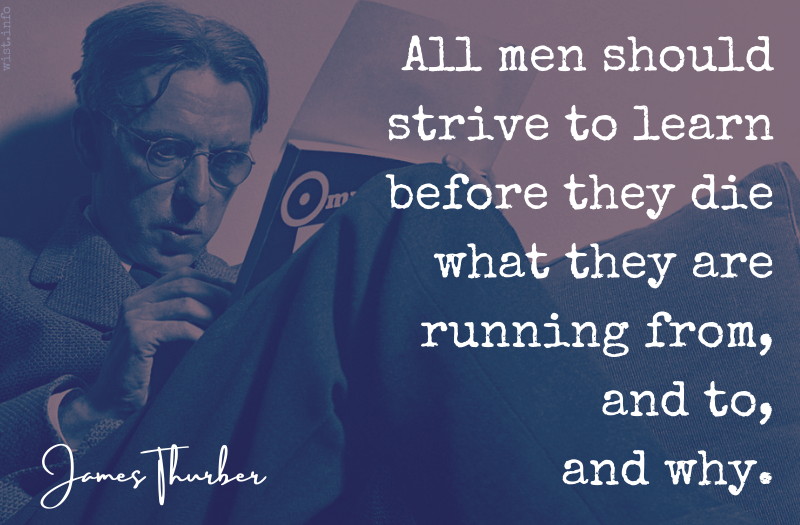
All men should strive to learn before they die what they are running from, and to, and why.
James Thurber (1894–1961) American humorist, cartoonist, writer
“The Shore and the Sea,”, Moral, Further Fables for Our Time (1956)
Never be angry with your neighbor because his religious views differ from your own; for all branches of a tree do not lean the same way.
William Scott Downey (fl. 19th C) American baptist missionary, aphorist
Proverbs, ch. 6 #7 (1853)
(Source)

I praise your body’s beauty. “Quite enough,”
Galla, you say, “it’s better in the buff.”
Let’s go a-bathing then, but you decline.
Galla, are you afraid you won’t like mine?[Cum faciem laudo, cum miror crura manusque,
Dicere, Galla, soles ‘Nuda placebo magis,’
Et semper vitas communia balnea nobis.
Numquid, Galla, times, ne tibi non placeam?]Martial (AD c.39-c.103) Spanish Roman poet, satirist, epigrammatist [Marcus Valerius Martialis]
Epigrams [Epigrammata], Book 3, epigram 51 (3.51) (AD 87-88) [tr. Barger]
(Source)
(Source (Latin)). Other translations:When ore I praise thy face, hand, leg; far more
(Thou sayst) I'd like thee, if all naked ore;
Yet still thou shun'st the common Baths with me;
Fear'st thou that I should not be lik'd by thee?
[tr. May (1629), 3.50]When, Galla, thy face, hands, and legs I admire,
Thou say'st, I, when naked more pleasing shall be.
Yet, one common bath, I full vainly require:
Dost fear that I shall not be pleasing to thee?
[tr. Elphinston (1782), Book 4, Part 3 ep. 38]When I praise your face, when I admire your limbs and hands,
You tell me, Galla, "In nature's garments I shall please you still better."
Yet you always avoid the same baths with myself!
Do you fear, Galla, that I shall not please you?
[tr. Bohn's Classical (1859)]When I compliment your face, when I admire your legs and hands,
You are accustomed to say, Galla: "Naked I shall please you more,"
And yet you continually avoid taking a bath with me.
Surely you are not afraid, Galla, that I shall not please you?
[tr. Ker (1919)]Whene'er I praise your legs and arms,
Your eyes and rosy cheeks admire,
You whisper low -- "My hidden charms
A deeper wonder will inspire."
And yet whenever I suggest
A bath together, you say no,
Perhaps you fear that when undressed
Without my clothes I shall not do.
[tr. Pott & Wright (1921)]When I praise your face and lovely hands
Or to your legs allude,
This is what you always say:
"I'm nicer in the nude."
And yet you constantly decline
To go to the Baths with me.
Are you afraid you'll be displeased
With my own nudity?
[tr. Marcellino (1968)]When I say how I like your face, Galla,
and admire your hands and your legs
you observe "I'm even nicer in the nude."
But you don't go to the baths when I do.
Are you afraid to look at me?
[tr. Bovie (1970)]When I praise your face and admire your legs and hands, Galla, you are apt to say: "You'll like me better naked." And yet you always avoid taking a bath with me. Can it be, Galla, that you are afraid you may not like me?
[tr. Shackleton Bailey (1993)]I praise your face and figure as divine
"But if you saw me nude -- I really shine"
Yet rather than shed clothes you seek distraction
Because a letdown will be my reaction?
[tr. Wills (2007)]When I admire your face and legs and hands,
"You'll like me better nude," you always tease.
Yet, Galla, you won't bathe with me in public.
Am I the one you fear will fail to please?
[tr. McLean (2014)]
If I had to name my disability, I would call it an unwillingness to fall. On the one hand, this is perfectly normal. I do not know anyone who likes to fall. But, on the other hand, this reluctance signals mistrust of the central truth of the Christian gospel: life springs from death, not only at the last but also in the many little deaths along the way. When everything you count on for protection has failed, the Divine Presence does not fail. The hands are still there — not promising to rescue, not promising to intervene — promising only to hold you no matter how far you fall. Ironically, those who try hardest not to fall learn this later than those who topple more easily. The ones who find their lives are the losers, while the winners come in last.
Barbara Brown Taylor (b. 1951) American minister, academic, author
Leaving Church: A Memoir of Faith, Part 3, ch. 17 (2006)
(Source)
Three Failures denote uncommon strength. A weakling has not enough grit to fail thrice.
Minna Antrim (1861–1950) American epigrammatist, writer
At the Sign of the Golden Calf (1905)
(Source)
Both Christianity and alcohol have the power to convince us that what we previously thought deficient in ourselves and the world does not require attention; both weaken our resolve to garden our problems; both deny us the chance to fulfilment.
Alain de Botton (b. 1969) Swiss-British author
The Consolations of Philosophy, ch. 6 “Consolation for Difficulties” (sec. 19) (2000)
(Source)
Sometimes attributed to, but actually summarizing, Friedrich Nietzsche, who himself wrote of "the two great European narcotics, alcohol and Christianity" (Twilight of the Idols, "Things the Germans Lack" (sec. 2) (1888) [tr. Ludovici]).

Don’t use that word [censorship]! How anybody expects a man to stay in business with every two-bit wowser in the country claiming a veto over what we can say and can’t say and what we can show and what we can’t show — it’s enough to make you throw up. The whole principle is wrong; it’s like demanding that grown men live on skim milk because the baby can’t eat steak.
Robert A. Heinlein (1907–1988) American writer
“The Man Who Sold the Moon” (1950)
(Source)
This may be the origin of the spurious Mark Twain quotation, "Censorship is telling a man he can't have a steak just because a baby can't chew it."
A successful marriage requires falling in love many times, always with the same person.
But feeling is so different from knowing. My common sense tells me all you can say, but there are times when common sense has no power over me. Common nonsense takes possession of my soul.
The nature of liberal democracy prevents propagandistic statements from being banned, since among the liberties it permits is the freedom of speech. But since humans have characteristic rational weaknesses and are susceptible to flattery and manipulation, allowing propaganda has a high likelihood of leading to tyranny, and hence to the end of liberal democracy.
Jason Stanley (b. 1969) American philosopher, epistemologist, academic
How Propaganda Works, ch. 1 (2015)
(Source)
I never will believe that our youngest days are our happiest. What a miserable augury for the progress of the race and the destination of the individual, if the more matured and enlightened state is the less happy one! Childhood is only the beautiful and happy time in contemplation and retrospect: to the child it is full of deep sorrows, the meaning of which is unknown.
George Eliot (1819–1880) English novelist [pseud. of Mary Ann Evans]
Letter to Sara Hennell (May 1844)
(Source)
What is blasphemy? I will give you a definition; I will give you my thought upon this subject. What is real blasphemy?
To live on the unpaid labor of other men — that is blasphemy.
To enslave your fellow-man, to put chains upon his body — that is blasphemy.
To enslave the minds of men, to put manacles upon the brain, padlocks upon the lips — that is blasphemy.
To deny what you believe to be true, to admit to be true what you believe to be a lie — that is blasphemy.
To strike the weak and unprotected, in order that you may gain the applause of the ignorant and superstitious mob — that is blasphemy.
To persecute the intelligent few, at the command of the ignorant many — that is blasphemy.
To forge chains, to build dungeons, for your honest fellow-men — that is blasphemy.
To pollute the souls of children with the dogma of eternal pain — that is blasphemy.
To violate your conscience — that is blasphemy.
The jury that gives an unjust verdict, and the judge who pronounces an unjust sentence, are blasphemers.
The man who bows to public opinion against his better judgment and against his honest conviction, is a blasphemer.Robert Green Ingersoll (1833–1899) American lawyer, freethinker, orator
Speech (1887-05) to the Jury, Trial of C. B. Reynolds for Blasphemy, Morristown, New Jersey
(Source)
Come, weave us a scheme so I can pay them back!
Stand beside me, Athena, fire me with daring, fierce
as the day we ripped Troy’s glittering crown of towers down.
Stand by me — furious now as then, my bright-eyed one —
and I would fight three hundred men, great goddess,
with you to brace me, comrade-in-arms in battle![ἀλλ᾽ ἄγε μῆτιν ὕφηνον, ὅπως ἀποτίσομαι αὐτούς:
πὰρ δέ μοι αὐτὴ στῆθι, μένος πολυθαρσὲς ἐνεῖσα,
οἷον ὅτε Τροίης λύομεν λιπαρὰ κρήδεμνα.
αἴ κέ μοι ὣς μεμαυῖα παρασταίης, γλαυκῶπι,
καί κε τριηκοσίοισιν ἐγὼν ἄνδρεσσι μαχοίμην
σὺν σοί, πότνα θεά, ὅτε μοι πρόφρασσ᾽ ἐπαρήγοις]Homer (fl. 7th-8th C. BC) Greek author
The Odyssey [Ὀδύσσεια], Book 13, l. 386ff (13.386) [Odysseus] (c. 700 BC) [tr. Fagles (1996)]
(Source)
(Source (Greek)). Other translations:Advise then means to the reveng’d events
We both resolve on. Be thyself so kind
To stand close to me, and but such a mind
Breathe in my bosom, as when th’ Ilion tow’rs
We tore in cinders. O if equal pow’rs
Thou wouldst enflame amidst my nerves as then,
I could encounter with three hundred men,
Thy only self, great Goddess, had to friend,
In those brave ardors thou wert wont t’ extend!
[tr. Chapman (1616)]But now, O Pallas, find out some device,
How of the suitors best I may be rid,
And by me stand, inspiring courage stout,
As when we pull’d Troy’s head-gear off her head.
For then to master them I should not doubt,
Three hundred though they were.
[tr. Hobbes (1675), l. 347ff]Vouchsafe the means of vengeance to debate,
And plan with all thy arts the scene of fate.
Then, then be present, and my soul inspire,
As when we wrapp'd Troy's heaven-built walls in fire.
Though leagued against me hundred heroes stand.
Hundreds shall fall, if Pallas aid my hand.
[tr. Pope (1725)]Come then -- Devise the means; teach me, thyself,
The way to vengeance, and my soul inspire
With daring fortitude, as when we loos’d
Her radiant frontlet from the brows of Troy.
Would’st thou with equal zeal, O Pallas! aid
Thy servant here, I would encounter thrice
An hundred enemies, let me but perceive
Thy dread divinity my prompt ally.
[tr. Cowper (1792), l. 466]Come, weave me counsel neither void nor vain,
That red vengeance reap till not a man remain!
But stand thou near, and such bold strength inspire
As when we loosed the shining tiars of Troy.
If thou stand near me to inbreathe like fire,
Then with three hundred could I fight with joy!
[tr. Worsley (1861), st. 49-50]Come! weave some plan for my revenge upon them!
Stand by me fast, and inspire with daring courage,
As when from Troy we loosed her glittering tire.
If thou, Eyebright! thus breathing fire stand by me,
I fain would fight 'gainst e'en three hundred men --
With thee, dread goddess, close at hand to aid me!
[tr. Bigge-Wither (1869)]Now let thy mind
The plot contrive which on that hateful crew
May all my vengeance wreak -- and then do thou
Thyself beside me stand, and in my soul
Such dauntless valor rouse as in me wrought
When we the crested pride of Ilion's tow'rs
Cast down in overthrow. If, in that hour,
O, azure-eyed! thou would'st but at my side
Thy presence grant, I, with three hundred men,
By thy prompt succor champion'd to the fight,
Would thou stood'st by, in conflict would engage.
[tr. Musgrave (1869), l. 614ff]Come then, weave some counsel whereby I may requite them; and thyself stand by me, and put great boldness of spirit within me, even as in the day when we loosed the shining coronal of Troy. If but thou wouldest stand by me with such eagerness, thou grey-eyed goddess, I would war even with three hundred men, with thee my lady and goddess, if thou of thy grace didst succour me the while.
[tr. Butcher/Lang (1879)]But I prithee weave and devise it how of these avenged I may be;
And stand by me thyself and set in me that heart for the battle-joy
As wherewith we loosed aforetime the shining coif of Troy.
If thou stand beside me, O Grey-eyed, as battle-glad as then,
Forsooth would I hold the battle 'gainst thrice an hundred men,
With thee, O worshipped Goddess, so kind to bear me aid.
[tr. Morris (1887)]Come then, and frame a plot for me to win revenge. And do you stand beside me, inspiring hardy courage, even so as when we tore the shining crown from Troy. If you would stand as stoutly by me, clear-eyed one, then I would face three hundred men, mat4ed with you, dread goddess, with you for my strong aid.
[tr. Palmer (1891)]Advise me how I shall best avenge myself. Stand by my side and put your courage into my heart as on the day when we loosed Troy's fair diadem from her brow. Help me now as you did then, and I will fight three hundred men, if you, goddess, will be with me.
[tr. Butler (1898)]But come, weave some plan by which I may requite them; and stand thyself by my side, and endue me with dauntless courage, even as when we loosed the bright diadem of Troy. Wouldest thou but stand by my side, thou flashing-eyed one, as eager as thou wast then, I would fight even against three hundred men, with thee, mighty goddess, if with a ready heart thou wouldest give me aid.
[tr. Murray (1919)]Wherefore extend your bounty and disclose how I may avenge myself upon these suitors. Stand by me, Mistress, fanning my valorous rage as on the day we despoiled shining Troy of its pride of towers. With your countenance, august One, I would fight three hundred men together: only buoy me up with your judicious aid, O wise-eyed Goddess.
[tr. Lawrence (1932)]I beseech you to think of some way by which I could pay these miscreants out. And take your stand at my side, filling me with the spirit that dares all, as you did on the day when we pulled down Troy’s shining diadem of towers. Ah, Lady of the bright eyes, if only you would aid me with such vehemence as you did then, I could fight against three hundred, with you beside me, sovran goddess, and with your whole-hearted help to count on!
[tr. Rieu (1946)]Weave me a way to pay them back! And you, too,
take your place with me, breathe valor in me
the way you did that night when we Akhaians
unbound the bright veil from the brow of Troy!
O grey-eyed one, fire my heart and brace me!
I'll take on fighting men three hundred strong
if you fight at my back, immortal lady!
[tr. Fitzgerald (1961)]Come then, weave the design, the way I shall take my vengeance
upon them; stand beside me, inspire me with strength and courage,
as when together we brought down Troy's shining coronal.
For if in your fury, O gray-eyed goddess, you stood beside me,
I would fight, lady and goddess, with your help against three hundred v men if you, freely and in full heart, would help me.
[tr. Lattimore (1965)]Come, goddess, weave some plan
that lets me punish them. Stand at my side;
give me the gift of courage, as you did
when we tore loose Troy's gleaming diadem.
Were you, just as impetuous as then,
to stand beside me, gray-eyed goddess, I
could face even three hundred enemies:
I need your ready heart; I need your help.
[tr. Mandelbaum (1990)]Weave a plan so I can pay them back!
And stand by me yourself, give me the spirit I had
When we ripped down Troy's shining towers!
With you at my side, you reyes glinting
And your mind focused on battle -- I would take on
Three hundred men if your power were with me.
[tr. Lombardo (2000), l. 401ff]But come, devise some ingenious scheme to punish these miscreants. And take your stand at my side, filling me with the spirit that dares all, as you did on the day when we pulled down Troy's shining diadem of towers. Ah, Lady of the Bright Eyes, if only you would waid me with such eagerness as you did then, I could fight against three hundred, with you beside me, gracious goddess, with your whole-hearted support to count on.
[tr. DCH Rieu (2002)]So come now, weave me a scheme of revenge upon these men, and yourself stand by my side, fill me with strength and daring, as when we undid the bright diadem of Troy! Were you, grey-eyed goddess, beside me, hot to fight, I'd take on, with you, three hundred warriors, O my sovereign goddess, given your free and ready support.
[tr. Green (2018)]Come, weave a plan so I can pay them back.
Stand in person by my side, and fill me
with indomitable courage, as you did
when we loosed the bright diadem of Troy.
I pray, goddess with the glittering eyes,
that you are with me now as eagerly
as you were then. If so, then I would fight
three hundred men, if you, mighty goddess,
in your heart are willing to assist me.
[tr. Johnston (2019), l. 473ff]
I was waiting for
something extraordinary to
happenbut as the years wasted on
nothing ever did unless I
caused itCharles Bukowski (1920–1994) German-American author, poet
“two kinds of hell” (c. 1990)
(Source)
While this sounds motivational, in the context of the poem, the "extraordinary" things (bar fights, dalliances) always end up poorly.
First published in Third Lung Review, #8 (1992); collected in an edited version in The People Look Like Flowers at Last (2007).
We vainly accuse the fury of Gunnes, and the new inventions of death; ’tis in the power of every hand to destroy us, and wee are beholding unto every one wee meete hee doth not kill us.
[We vainly accuse the fury of guns, and the new inventions of death; it is in the power of every hand to destroy us, and we are beholden unto every one we meet he doth not kill us.]
Thomas Browne (1605–1682) English physician and author
Religio Medici, Part 1, sec. 43 (1643)
(Source)
“It comes from a very ancient democracy, you see ….”
“You mean, it comes from a world of lizards?”
“No,” said Ford, who by this time was a little more rational and coherent than he had been, having finally had the coffee forced down him, “nothing so simple. Nothing anything like so straightforward. On its world, the people are people. The leaders are lizards. The people hate the lizards and the lizards rule the people.”
“Odd,” said Arthur, “I thought you said it was a democracy.”
“I did,” said Ford. “It is.”
“So,” said Arthur, hoping he wasn’t sounding ridiculously obtuse, “why don’t the people get rid of the lizards?”
“It honestly doesn’t occur to them,” said Ford. “They’ve all got the vote, so they all pretty much assume that the government they’ve voted in more or less approximates to the government they want.”
“You mean they actually vote for the lizards?”
“Oh yes,” said Ford with a shrug, “of course.”
“But,” said Arthur, going for the big one again, “why?”
“Because if they didn’t vote for a lizard,” said Ford, “the wrong lizard might get in.”Douglas Adams (1952–2001) English author, humorist, screenwriter
Hitchhiker’s Guide No. 4, So Long, and Thanks for All the Fish, ch. 36 (1984)
(Source)

Writing a book is like doing a huge jigsaw puzzle, unendurably slow at first, almost self-propelled at the end. Actually, it’s more like doing a puzzle from a box in which several puzzles have been mixed. Starting out, you can’t tell whether a piece belongs to the puzzle at hand, or one you’ve already done, or will do in ten years, or will never do.
James Richardson (b. 1950) American poet
“Vectors: 56 Aphorisms and Ten-second Essays,” Michigan Quarterly Review, # 25 (Spring 1999)
(Source)
Loneliness is the poverty of self; solitude is the richness of self.
That I nor gold nor silver to you send,
I this forbear, for your sake, learned friend.
Who gives great gifts, expects great gifts again;
My cheap ones to return will cause no pain.[Quod non argentum, quod non tibi mittimus aurum,
Hoc facimus causa, Stella diserte, tua.
Quisquis magna dedit, voluit sibi magna remitti;
Fictilibus nostris exoneratus eris.]Martial (AD c.39-c.103) Spanish Roman poet, satirist, epigrammatist [Marcus Valerius Martialis]
Epigrams [Epigrammata], Book 5, epigram 59 (5.59) (AD 90) [tr. Killigrew (1695)]
(Source)
(Source (Latin)). Other translations:That of silver or gold we afford no oblation,
'Tis for they sake, sweet Stella, th' economy's such.
Ample off'rings expect ample remuneration;
A plain service of earth will not gravitate much.
[tr. Elphinston (1782), Book 2, ep. 11]In forbearing to send you either silver or gold, eloquent Stella, I have acted for your interest. Whoever makes great presents, wishes great presents to be made in return. By my present of earthenware vases you will be released from such an obligation.
[tr. Bohn's Classical (1859)]In sending you no silver plate, no gold plate, I act in your interest, eloquent Stella. He who has given great presents has desired great presents in return: your burden will be lightened by my earthenware.
[tr. Ker (1919)]Dear poet friend, desirous to befriend you
It is not gold or silver that I send you,
For costly gifts demand a costly guerdon;
My pretty gift shall free you from a burden.
[tr. Pott & Wright (1921)]If I send you no silver, if I send you no gold, I do so for your sake, eloquent Stella. Whoever gives much, wants much in return. My earthenware will take a load off your shoulders.
[tr. Shackleton Bailey (1993)]Thank me you get no wealthy gifts from me.
It keeps you of reciprocation free.
[tr. Wills (2007)]In sending you no silver and no gold,
my purpose, eloquent Stella, is to please.
A lavish giver wants a big return --
my earthenware will put you at your ease.
[tr. McLean (2014)]
All religions are ultimately cargo cults. Adherents perform required rituals, follow specific rules, and expect to be supernaturally gifted with desired rewards — long life, honor, wisdom, children, good health, wealth, victory over opponents, immortality after death, any desired rewards.

Allegiance to the group identity forged by political party affiliation renders Americans blind to the essential similarities between the agendas of the two parties, similarities that can be expected to be exactly the ones that run counter to public interest, in other words, those interests of the deep-pocketed backers of elections to which any politician must be subservient in order to raise the kind of money necessary to run for national office.
Jason Stanley (b. 1969) American philosopher, epistemologist, academic
How Propaganda Works, Introduction (2015)
(Source)
Nothing I accept about myself can be used against me to diminish me.
Audre Lorde (1934–1992) American writer, feminist, civil rights activist
Essay (1983-10), “Eye to Eye: Black Women, Hatred, and Anger,” Essence Magazine, Vol. 14, No. 6
(Source)
From the expanded version collected in Sister Outsider: Essays and Speeches (1984).
Blasphemy is what an old mistake says of a newly discovered truth.
Blasphemy is what a withered last year’s leaf says to a this year’s bud.
Blasphemy is the bulwark of religious prejudice.
Blasphemy is the breastplate of the heartless.
And let me say now, that the crime of blasphemy, as set out in this statute, is impossible. No man can blaspheme a book. No man can commit blasphemy by telling his honest thought. No man can blaspheme a God, or a Holy Ghost, or a Son of God. The Infinite cannot be blasphemed.Robert Green Ingersoll (1833–1899) American lawyer, freethinker, orator
Speech to the Jury, Trial of C. B. Reynolds for Blasphemy, Morristown, New Jersey (May 1887)
(Source)
Clever Odysseus scowled back and sneered,
“Dogs! So you thought I would not come back home
from Troy? And so you fleeced my house, and raped
my slave girls, and you flirted with my wife
while I am still alive! You did not fear
the gods who live in heaven, and you thought
no man would ever come to take revenge.
Now you are trapped inside the snares of death.”[τοὺς δ᾽ ἄρ᾽ ὑπόδρα ἰδὼν προσέφη πολύμητις Ὀδυσσεύς:
‘ ὦ κύνες, οὔ μ᾽ ἔτ᾽ ἐφάσκεθ᾽ ὑπότροπον οἴκαδ᾽ ἱκέσθαι
δήμου ἄπο Τρώων, ὅτι μοι κατεκείρετε οἶκον,
δμῳῇσιν δὲ γυναιξὶ παρευνάζεσθε βιαίως,
αὐτοῦ τε ζώοντος ὑπεμνάασθε γυναῖκα,
οὔτε θεοὺς δείσαντες, οἳ οὐρανὸν εὐρὺν ἔχουσιν,
οὔτε τιν᾽ ἀνθρώπων νέμεσιν κατόπισθεν ἔσεσθαι:
νῦν ὑμῖν καὶ πᾶσιν ὀλέθρου πείρατ᾽ ἐφῆπται. ’]Homer (fl. 7th-8th C. BC) Greek author
The Odyssey [Ὀδύσσεια], Book 22, l. 34ff (22.34) (c. 700 BC) [tr. Wilson (2017)]
(Source)
Discussion here of πεῖραρ and the metaphor of bonds/snares in this passage (and this preceding one).
(Source (Greek)). Other translations:He, frowning, said: “Dogs, see in me the man
Ye all held dead at Troy. My house it is
That thus ye spoil, and thus your luxuries
File with my women’s rapes; in which ye woo
The wife of one that lives, and no thought show
Of man’s fit fear, or God’s, your present fame,
Or any fair sense of your future name;
And, therefore, present and eternal death
Shall end your base life.”
[tr. Chapman (1616)]Then said Ulysses, with a sullen eye,
Dogs, dead you thought me, and spent my estate;
With you my woman you compell’d to lie;
And would have wedded, whilst I liv’d, my mate.
No fear you had neither of Gods on high,
Nor of revenge from any mortal man;
But now a vengeance to you all is nigh.
[tr. Hobbes (1675), l. 29ff]Then, grimly frowning, with a dreadful look,
That wither'd all their hearts, Ulysses spoke:
"Dogs, ye have had your day! ye fear'd no more
Ulysses vengeful from the Trojan shore;
While, to your lust and spoil a guardless prey,
Our house, our wealth, our helpless handmaids lay:
Not so content, with bolder frenzy fired,
E'en to our bed presumptuous you aspired:
Laws or divine or human fail'd to move,
Or shame of men, or dread of gods above;
Heedless alike of infamy or praise,
Or Fame's eternal voice in future days;
The hour of vengeance, wretches, now is come;
Impending fate is yours, and instant doom."
[tr. Pope (1725)]Then thus Ulysses, louring dark, replied.
O dogs! not fearing aught my safe return
From Ilium, ye have shorn my substance close,
Lain with my women forcibly, and sought,
While yet I lived, to make my consort yours,
Heedless of the inhabitants of heav’n
Alike, and of the just revenge of man.
But death is on the wing; death for you all.
[tr. Cowper (1792), l. 36ff]Whom the king sternly eyed, and to the godless crew:
"Dogs, ye denied that I should e'er come back
From Troia's people to my native land.
Long in your pride my house ye rend and wrack,
Yea, and ye force the women with violent hand,
And my wife claim while I on earth yet stand,
Nor fear the gods who rule in the wide sky,
Nor lest a mortal on the earth demand
Your price of guilt -- and ye are like to die!
Round you Death's fatal toils inextricably lie."
[tr. Worsley (1861), st. 5-6]Then with a scowl addressed many-witted Odysseus:
"Ye dogs! ye thought that I should ne'er return
From Troy-land home: and so my house ye harried;
And forced my maids to be your paramours;
And wooed my wife, while I myself was living! --
Ye feared not the gods, who old broad heaven;
Nor reckoned on coming vengeance from mankind!
Now you -- e'en all -- the goal of death is touching!
[tr. Bigge-Wither (1869)]But, with a grim regard, Ulysses thus
Indignant cried: -- "Ye hounds! Your thought it was
That never more should I, to home restor'd
From Troy return: And therefore all my means
Of Life's subsistence have ye here laid waste --
The handmaids of my household with rude force
Your wont hath been to outrage, and, while I
Myself a living man on earth surviv'd
Ye have as suitors my espoused wife
In marriage sought; the anger of the gods
That rule on high despising, -- and the thought
Of that revenge which, at some future day,
Should overtake you from the hands of men.
A ruin that shall overwhelm you all,
Is now at hand: 'tis here!"
[tr. Musgrave (1869), l. 57ff]Then Odysseus of many counsels looked fiercely on them, and spake: “Ye dogs, ye said in your hearts that I should never more come home from the land of the Trojans, in that ye wasted my house, and lay with the maidservants by force, and traitorously wooed my wife while I was yet alive, and ye had no fear of the gods, that hold the wide heaven, nor of the indignation of men hereafter. But now the bands of death have been made fast upon you one and all.”
[tr. Butcher/Lang (1879)]Unto whom spake the wise Odysseus, scowling from knitted brow:
"O Dogs! And ye were saying that I should come home no more
From the people of the Trojans! So ye wasted my house and my store,
And lay with my women servants perforce and against my will.
And wert wooing my wife from off me when I was living still;
And niether the gods were ye fearing that hold the heavens the wide,
Nor yet the vengeance of menfolk that hereafter should betide.
But now the end of the Death-doom is on you one and all."
[tr. Morris (1887)]But looking sternly on them wise Odysseus said: "Dogs! You have been saying all the time I never should return out of the land of Troy; and therefore you have destroyed my home, outraged my women-servants, and, -- I alive, -- covertly wooed my wife, fearing no gods that hold the open sky, nor that the indignation of mankind would fall on you hereafter. Now for you one and all destruction's cords are knotted!"
[tr. Palmer (1891)]But Ulysses glared at them and said: -- "Dogs, did you think that I should not come back from Troy? You have wasted my substance, have forced my women servants to lie with you, and have wooed my wife while I was still living. You have feared neither God nor man, and now you shall die."
[tr. Butler (1898)]But Odysseus glared at them and said: "Dogs, did you think that I should not come back from the dêmos of the Trojans? You have wasted my substance, have forced my women servants to lie with you, and have wooed my wife while I was still living. You have feared neither the gods nor that there would be future nemesis from men, and now you shall die."
[tr. Butler (1898), rev. Power/Nagy]But resourceful Odysseus glared at them and said: “Dogs, did you think that I should not come back from the district [dēmos] of the Trojans? You have wasted my substance, have forced my women servants to lie with you, and have wooed my wife while I was still living. You have feared neither the gods nor that there would be future nemesis from men, and now you shall die.”
[tr. Butler (1898), rev. Kim/McCray/Nagy/Power (2018)]Then with an angry glance from beneath his brows Odysseus of many wiles answered them: “Ye dogs, ye thought that I should never more come home from the land of the Trojans, seeing that ye wasted my house, and lay with the maidservants by force, and while yet I lived covertly wooed my wife, having no fear of the gods, who hold broad heaven, nor of the indignation of men, that is to be hereafter. Now over you one and all have the cords of destruction been made fast.”
[tr. Murray (1919)]But Odysseus glaring at them cried, "Dogs that you are, you kept harping on your conviction that I would never return from the Troad, and in that strong belief let yourselves ravage my house, ravish my housemaidens and woo my wife, while I was yet alive. You have flouted the Gods of high heaven and the consequent wrath of men: so now you are all trapped in death's toils."
[tr. Lawrence (1932)]The unconquerable Odysseus looked down on them with a scowl. "You curs!" he cried. "You never thought to see me back from Troy. So you ate me out of house and home; you raped my maids; you wooed my wife on the sly though I was alive -- with no more fear of the gods in heaven than of the human vengeance that might come. I tell you, one and all, your doom is sealed!"
[tr. Rieu (1946)]But glaring under his brows Odysseus answered:
"You yellow dogs, you thought I'd never make it
home from the land of Troy. You took my house to plunder,
twisted my maids to serve your beds. You dared
bid for my wife while I was still alive.
Contempt was all you had for the gods who rule wide heaven,
contempt for what men say of you hereafter.
Your last hour has come. You die in blood.”
[tr. Fitzgerald (1961)]But looking darkly upon them resourceful Odysseus answered:
"You dogs, you never thought that I would any more come back
from the land of Troy, and because of that you despoiled my household,
and forcibly took my serving women to sleep beside you,
and sought to win my wife while I was still alive, fearing
neither the immortal gods who hold the wide heaven,
nor any resentment sprung from men to be yours in the future.
Now upon all of you the terms of destruction are fastened."
[tr. Lattimore (1965)]Odysseus of many wiles glared at them and spoke:
"Dogs, you thought I would no longer come home in return
From the land of the Trojans, in that you wore my house away
And slept alongside my serving women by force
And underhandedly courted my wife while I was myself alive,
And you did not fear the gods who possess broad heaven,
Or that there would be any vengeance of men in time to come.
Now the bonds of destruction are fastened on you all."
[tr. Cook (1967)]Odysseus scowled:
"You thought I would never return from Troy;
and so -- you dogs -- you sacked my house, you forced
my women servants to your will and wooed
my wife in secret while I was still alive.
You had no fear of the undying gods,
whose home is spacious heaven, and no fear
of men's revenge, your fate in days to come.
Now all of you are trapped in death's tight thongs."
[tr. Mandelbaum (1990)]With a dark look, the wily fighter Odysseus shouted back,
"You dogs! you never imagined I'd return from Troy --
so cocksure that you bled my house to death,
ravished my serving-women -- wooed my wife
behind my back while 1 was still alive!
No fear of the gods who rule the skies up there,
no fear that men's revenge might arrive someday --
now all your necks are in the noose -- your doom is sealed!"
[tr. Fagles (1996)]Odysseus
Scowled at the whole lot of them, and said:
"You dogs! You thought I would never
Come home from Troy. So you wasted my house,
Forced the women to sleep with you,
And while I was still alive you courted my wife
Without any fear of the gods in high heaven
Or of any retribution from the world of men.
Now the net has been drawn tight around you."
[tr. Lombardo (2000)]Looking from lowering brows said Odysseus of many devices:
"Oh you dogs, you believed I would have no return and would not come
home from the land of the Trojans, and so you have pillaged my household;
so you have taken to bed by force those women, the handmaids;
so though I was alive my wife you illicitly courted;
neither the gods you feared, the immortals who hold the broad heaven,
nor any vengeance that men might bring upon you in the future.
Now on all of you suitors the grim death bindings are fastened!"
[tr. Merrill (2002)]The master-strategist Odysseus gave them a black look. "You dogs!" he cried. "You never thought to see me back from Troy. So you fleeced my household; you raped my maids; you courted my wife behind my back though I was alive -- with no more fear of the gods in heaven than of the human vengeance that might come. One and all, your fate is sealed."
[tr. DCH Rieu (2002)]Looking at them darkly Odysseus of many wiles spoke: "You dogs! You never expected me to return home, back from the land of the Trojans; and so you plundered my house, you brutally forced my women servants to sleep with you, and you courted my wife in stealth while I was still alive, with no fear of the gods who inhabit the broad high sky, nor that the vengeful anger of men would one day follow. Now on every one of you death's ropes are fastened tight."
[tr. Verity (2016)]Then, with an angry glance, resourceful Odysseus replied:
"You dogs, you thought that I'd never come home again
from the Trojans' land, the way you ravaged my house,
and forcibly bedded my women servants, and while
I was still alive, underhandedly courted my wife,
with no fear of the gods who own broad heaven,
or of any human reproof that might come hereafter!
Now over you all the bonds of destruction are set!"
[tr. Green (2018)]Odysseus cried out: You thought I'd never return! You devoured my goods, seduced my maidservants, and came courting my wife while I was still alive! Now your fate's certain!
[tr. Green (2018), summary]Shrewd Odysseus scowled at them
and gave his answer: “You dogs, because you thought
I’d not come back from Troy to my own home,
you’ve been ravaging my house, raping women,
and, in devious ways, wooing my wife,
while I was still alive, with no fear of gods
who hold wide heaven, or of any man
who might take his revenge in days to come.
And now a fatal snare has caught you all.”
[tr. Johnston (2019), l. 41ff]
Each person is only given so many
Evenings
And each wasted evening is
A gross violation against the
Natural course of
Your only
Life ….Charles Bukowski (1920–1994) German-American author, poet
“The Telephone” (c. 1991), The Last Night of the Earth (1992)
(Source)
Men that look no further than their outsides, think health an appurtenance unto life, and quarrel with their constitutions for being sick; but I that have examined the parts of man, and know upon what tender filaments that fabric hangs, do wonder that we are not always so; and considering the thousand doors that lead to death, do thank my God that we can die but once.
[Men that looke no further than their outsides thinke health an appertinance unto life, and quarrell with their constitutions for being sick; but I that have examined the parts of man, and know upon what tender filaments that Fabrick hangs, doe wonder that we are not alwayes so; and considering the thousand dores that lead to death doe thanke my God that we can die but once.]
Thomas Browne (1605–1682) English physician and author
Religio Medici, Part 1, sec. 44 (1643)
(Source)
We must never forget that human motives are generally far more complicated than we are apt to suppose, and that we can very rarely accurately describe the motives of another.
Fyodor Dostoyevsky (1821–1881) Russian novelist
The Idiot, Part 3, ch. 3 (1869) [tr. Martin (1915)]
(Source)
Another translation: "Don't let us forget that the motives of human actions are usually infinitely more complex and varied than we are apt to explain them afterwards, and can rarely be defined with certainty." [tr. Magarshack (1955)]

When the character of a man is not clear to you, look at his friends.
Proverbs, Sayings, and Adages
Japanese proverb

For the old notions of civil liberty and social order did not benefit the masses of the people. Wealth increased, without relieving their wants. The progress of knowledge left them in abject ignorance. Religion flourished, but failed to reach them. Society, whose laws were made by the upper class alone, announced that the best thing for the poor is not to be born, and the next best, to die in childhood, and suffered them to live in misery and crime and pain. As surely as the long reign of the rich has been employed in promoting the accumulation of wealth, the advent of the poor to power will be followed by schemes for diffusing it. Seeing how little was done by the wisdom of former times for education and public health, for insurance, association, and savings, for the protection of labour against the law of self-interest, and how much has been accomplished in this generation, there is reason in the fixed belief that a great change was needed, and that democracy has not striven in vain.
John Dalberg, Lord Acton (1834–1902) British historian, politician, writer
“Review of Sir Erskine May’s Democracy in Europe,” The Quarterly Review (1878-01)
(Source)
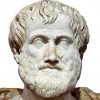
The life of making money is a life people are, as it were, forced into, and wealth is clearly not the good we are seeking, since it is merely useful, for getting something else.
[ὁ δὲ χρηματιστὴς βίαιός τις ἐστίν, καὶ ὁ πλοῦτος δῆλον ὅτι οὐ τὸ ζητούμενον ἀγαθόν.]
Aristotle (384–322 BC) Greek philosopher
Nicomachean Ethics [Ἠθικὰ Νικομάχεια], Book 1, ch. 5 (1.5, 1096a.5) (c. 325 BC) [tr. Crisp (2000)]
(Source)
Rackham notes the term βίαιος (translated under compulsion/constraint) is "literally ‘violent’; the adjective is applied to the strict diet and and laborious exercises of athletes, and to physical phenomena such as motion, in the sense of ‘constrained,’ ‘not natural.’"
(Source (Greek)). Other translations:As for the life of money-making, it is one of constraint, and wealth manifestly is not the good we are seeking, because it is for use, that is, for the sake of something further.
[tr. Chase (1847), ch. 3]As for the money-getting life, it violates the natural fitness of things. Wealth is clearly not the absolute good of which we are in search, for it is a utility, and nonly desirable as a means.
[tr. Williams (1869)]The life of money-making is in a sense a life of constraint, and it is clear that wealth is not the good of which we are in quest; for it is useful in part as a means to something else.
[tr. Welldon (1892), ch. 3]As for the money-making life, it is something quite contrary to nature; and wealth evidently is not the good of which we are in search, for it is merely useful as a means to something else.
[tr. Peters (1893)]The life of money-making is one undertaken under compulsion, and wealth is evidently not the good we are seeking; for it is merely useful and for the sake of something else.
[tr. Ross (1908)]The Life of Money-making is a constrained kind of life, and clearly wealth is not the Good we are in search of, for it is only good as being useful, a means to something else.
[tr. Rackham (1934), 1.5.8]The life of a moneymaker is in a way forced, and wealth is clearly not the good we are looking for, since it was useful and for the sake of something else.
[tr. Reeve (1948), ch. 5]As for the life of a money-maker, it is one of tension; and clearly the good sought is not wealth, for wealth is instrumental and is sought for the sake of something else.
[tr. Apostle (1975), ch. 3]As for the life of the businessman, it does not give him much freedom of action. Besides, wealth is obviously not the good that we are seeking, because it serves only as a means; i.e., for getting something else.
[tr. Thomson/Tredennick (1976)]The moneymaking life is characterized by a certain constraint, and it is clear that wealth is not the good being sought, for it is a useful thing and for the sake of something else.
[tr. Bartlett/Collins (2011)]
The wound hurts less than your desire to wound me.
James Richardson (b. 1950) American poet
“Vectors: 56 Aphorisms and Ten-second Essays,” Michigan Quarterly Review, # 18 (Spring 1999)
(Source)
A garden is always a series of losses set against a few triumphs, like life itself.
May Sarton (1912–1995) Belgian-American poet, novelist, memoirist [pen name of Eleanore Marie Sarton]
At Seventy: A Journal, “Wednesday, June 23rd” (1973)
(Source)
I’m not interested so much in how people survive as in how they avoid humiliation. Chekhov says we must never humiliate one another, and I think avoiding humiliation is the core of tragedy and comedy and probably of our lives.
John Guare (b. 1938) American playwright and screenwriter
The House of Blue Leaves, Introduction (1971)
(Source)
Art’s distillation. Experience is wine, and art is the brandy we distill from it.
Robertson Davies (1913–1995) Canadian author, editor, publisher
A Mixture of Frailties, ch. 1 (1958)
(Source)

No, your seriously steeped-in-madness dabbler in the esoteric sciences usually finds themself taxed with a rag-tag collection of hangers-on, typically consisting of minions, constructs, adventurers, and those unique, unclassifiable, individuals whose raison d’être appears to be to remind us of what a strange world it is.
Phil Foglio (b. 1956) American writer, cartoonist
Agatha H. and the Siege of Mechanicsburg (2020) [with Kaja Foglio]

Teaching literature is impossible; that is why it is difficult.
Northrop Frye (1912–1991) Canadian literary critic and literary theorist
“Criticism, Visible and Invisible,” Lecture, Trinity College, Hartford (1964)
(Source)
Reprinted in College English (Oct 1964), and in The Stubborn Structure, Part 1, ch. 6 (1970).
The wise man would rather see men needing him than thanking him.
[El sagaz más quiere necessitados de sí que agradecidos.]
Baltasar Gracián y Morales (1601–1658) Spanish Jesuit priest, writer, philosopher
The Art of Worldly Wisdom [Oráculo Manual y Arte de Prudencia], § 5 (1647) [tr. Jacobs (1892)]
(Source)
(Source (Spanish)). Other translations:A Man of Parts had rather meet with those who depend upon him, than that are thankfull to him.
[Flesher ed. (1685)]He who knows, desires more that man shall need him than thank him.
[tr. Fischer (1937)]He who is truly shrewd would rather have people need him than thank him.
[tr. Maurer (1992)]

No real belief, however trifling and fragmentary it may seem, is ever truly insignificant; it prepares us to receive more of its like, confirms those which resembled it before, and weakens others; and so gradually it lays a stealthy train in our inmost thoughts, which may someday explode into overt action, and leave its stamp upon our character for ever.
William Kingdon Clifford (1845–1879) English mathematician and philosopher
“The Ethics of Belief,” Part 1 “The Duty of Inquiry,” Lecture, London (11 Apr 1876)
(Source)

Learn what is to be taken seriously and laugh at the rest.
Herman Hesse (1877–1962) German-born Swiss poet, novelist, painter
Steppenwolf (1927) [tr. Creighton, rev. Milleck (1963)]
(Source)
Good work you’ll find, some poor, and much that’s worse,
It takes all sorts to make a book of verse.[Sunt bona, sunt quaedam mediocria, sunt mala plura
quae legis hic: aliter non fit, Avite, liber.]Martial (AD c.39-c.103) Spanish Roman poet, satirist, epigrammatist [Marcus Valerius Martialis]
Epigrams [Epigrammata], Book 1, epigram 16 (1.16) (AD 85-86) [tr. Pott & Wright (1921)]
(Source)
"To Avitus." (Source (Latin)). Other translations:Some things are good, indifferent some, some naught,
You read: a book can't otherwise be wrote.
[tr. Killigrew (1695)]Here's some good things, some middling, more bad, you will see:
Else a book, my Avitus, it never could be.
[tr. Elphinston (1782), 12.6]Some of my epigrams are good, some moderately so, more bad: there is no other way, Avitus, of making a book.
[tr. Amos (1858), 2.23 (cited as 1.17)]Of the epigrams which you read here, some are good, some middling, many bad: a book, Avitus, cannot be made in any other way.
[tr. Bohn's Classical (1859)]Here you will read some few good things, while some
Are mediocre, most are bad: 'tis thus
That every book's compiled.
[ed. Harbottle (1897)]There are good things, there are some indifferent, there are more things bad that you read here. Not otherwise, Avitus, is a book produced.
[tr. Ker (1919)]Good work you’ll find, some poor, and much that’s worse;
It takes all sorts to make a book of verse.
[tr. Pott & Wright (1921)]Some things are good, some fair, but more you'll say
Are bad herein -- all books are made that way!
[tr. Duff (1929)]Some of these epigrams are good,
Some mediocre, many bad.
Otherwise, it is understood,
A bookful of poems cannot be had.
[tr. Marcellino (1968)]Among these lines you'll find a few
that are rather good, more that are only fair,
and a lot that are bad.
From that, Avitus, it may be deduced
just how a book is produced.
[tr. Bovie (1970)]Some good, some middling, and some bad
You’ll find here. They are what I had.
[tr. Cunningham (1971)]Some lines in here are good, some fair,
And most are frankly rotten;
No other kind of book, Avitus,
Can ever be begotten.
[tr. Wender (1980)]There are good things that you read here, and some indifferent, and more bad. Not otherwise, Avitus, is a book made.
[tr. Shackleton Bailey (1993)]Some good things here, and some not worth a look.
For this is that anomaly, a book.
[tr. Wills (2007)]Some of my poems are good, some
not up to scratch, some
bad.
That’s how it is with most books,
if the truth were told.
Who tells the truth about truth, my dear?
Make way for the judge and the jester.
[tr. Kennelly (2008), "How It Is"]You'll read some good things here, some fair, more worse.
There's no way else to make a book of verse.
[tr. McLean (2014)]You're reading good poems here, Avitus -- and a few that are so-so, and a lot that are bad; a book doesn't happen any other way.
[tr. Nisbet (2015)]Some good, some so-so, most of them naught!
Well, if not worse, the book may still be bought.
[Anon.]
All these years later, the way many of us are doing church is broken and we know it, even if we do not know what to do about it. We proclaim the priesthood of all believers while we continue with hierarchical clergy, liturgy, and architecture. We follow a Lord who challenged the religious and political institutions of his time while we fund and defend our own. We speak and sing of divine transformation while we do everything in our power to maintain our equilibrium. If redeeming things continue to happen to us in spite of these deep contradictions in our life together, then I think that is because God is faithful even when we are not.
Barbara Brown Taylor (b. 1951) American minister, academic, author
Leaving Church: A Memoir of Faith (2006)
We cannot judge either of the feelings or of the character of men with perfect accuracy, from their actions or their appearances in public; it is from their careless conversation, their half-finished sentences that we may hope with the greatest probability of success to discover their real character.

To laughter! The bright coinage of the bank of good will.
Minna Antrim (1861–1950) American epigrammatist, writer
Naked Truth and Veiled Allusions (1901)
When a man wantonly destroys one of the works of man we call him Vandal. When he wantonly destroys one of the works of God we call him Sportsman.
Joseph Wood Krutch (1893–1970) American educator, writer, critic, naturalist
The Great Chain of Life, ch. 9 “Reverence for Life” (1956)
(Source)
Often misquoted as "a vandal ... a sportsman."

If Nature had arranged that husbands and wives should have children alternately, there would never be more than three in a family.
Laurence Housman (1865–1959) English playwright, writer, illustrator
(Attributed)
After a certain number of years, our faces become our biographies. We get to be responsible for our faces.
Cynthia Ozick (b. 1928) American writer
Interview by Tom Teicholz, Paris Review, “The Art of Fiction” #95 (Spring 1987)
(Source)
See Camus and Orwell.
Discussion of similar quotations: When You Are Young, You Have the Face Your Parents Gave You. After You Are Forty, You Have the Face You Deserve – Quote Investigator.

To get home you had to end the war. To end the war was the reason you fought it. The only reason.
Paul Fussell (1924–2012) American cultural and literary historian, author, academic
Wartime: Understanding and Behavior in the Second World War, ch. 11 (1989)
(Source)

There seems to be a feeling that anything that is natural is good. Strychnine is natural.
Isaac Asimov (1920–1992) Russian-American author, polymath, biochemist
(Attributed)
Long-protracted suffering is apt to exhaust not only the invalid, but the compassion of others; violent emotions cannot be prolonged endlessly.
Stefan Zweig (1881–1942) Austrian novelist, playwright, journalist, biographer
Beware of Pity (1939)
People who feel safer with a gun than with guaranteed medical insurance don’t yet have a fully adult concept of scary.
William Gibson (b. 1948) American-Canadian speculative fiction novelist and essayist
Twitter (1 Oct 2013)
(Source)

One of the most horrible features of war is that all the war-propaganda, all the screaming and lies and hatred, comes invariably from people who are not fighting.
George Orwell (1903–1950) English journalist, essayist, writer [pseud. of Eric Arthur Blair]
Homage to Catalonia, Appendix 1 (1938)
(Source)

There are thousands of things in the Scriptures that everybody believes. Everybody believes the Scriptures are right when they say, “Thou shalt not steal” — everybody. And when they say “Give good measure, heaped up and running over,” everybody says, “Good!” So when they say “Love your neighbor,” everybody applauds that.
Suppose a man believes that, and practices it, does it make any difference whether he believes in the flood or not? Is that of any importance? Whether a man built an ark or not — does that make the slightest difference? A man might deny it and yet be a very good man. Another might believe it and be a very mean man. Could it now, by any possibility, make a man a good father, a good husband, a good citizen? Does it make any difference whether you believe it or not?
Does it make any difference whether or not you believe that a man was going through town and his hair was a little short, like mine, and some little children laughed at him, and thereupon two bears from the woods came down and tore to pieces about forty of these children? Is it necessary to believe that? Suppose a man should say, “I guess that is a mistake. They did not copy that right. I guess the man that reported that was a little dull of hearing and did not get the story exactly right.” Any harm in saying that? Is a man to be sent to the penitentiary for that? Can you imagine an infinitely good God sending a man to hell because he did not believe the bear story?
Robert Green Ingersoll (1833–1899) American lawyer, freethinker, orator
Speech to the Jury, Trial of C. B. Reynolds for Blasphemy, Morristown, New Jersey (May 1887)
(Source)
Those fools
were not aware that now they all were snared,
that death cords lashed them fast.[τὸ δὲ νήπιοι οὐκ ἐνόησαν,
ὡς δή σφιν καὶ πᾶσιν ὀλέθρου πείρατ᾽ ἐφῆπτο.]Homer (fl. 7th-8th C. BC) Greek author
The Odyssey [Ὀδύσσεια], Book 22, l. 32ff (22.32) (c. 700 BC) [tr. Mandelbaum (1990)]
(Source)
(Source (Greek)). Other translations:O fools, to think
That all their rest had any cup to drink
But what their great Antinous began!
[tr. Chapman (1616)]For, proud and foolish, they perceived not
The fatal hour was to them all arriv’d.
[tr. Hobbes (1675), l. 27ff]Blind as they were: for death e'en now invades
His destined prey, and wraps them all in shades.
[tr. Pope (1725)]Nor saw
Th’ infatuate men fate hov’ring o’er them all.
[tr. Cowper (1792), ll. 34-35]How fatal and how nigh
Death's snares were set, they foolish never knew!
[tr. Worsley (1861), st. 5]Yet this the fools knew not
That now them all the goal of death was touching!
[tr. Bigge-Wither (1869)]Insensate they!
Who felt not in that hour that one and all
Upon the verge of their own ruin stood!
[tr. Musgrave (1869), l. 54ff]But they knew not in their folly that on their own heads, each and all of them, the bands of death had been made fast.
[tr. Butcher/Lang (1879)]And they had no understanding, fools as they were, and vain,
That to all the end of the Death-doom was hard upon them now.
[tr. Morris (1887), ll. 32-33]They foolishly did not see that for them one and all destruction's cords were knotted.
[tr. Palmer (1891)]And did not perceive that death was hanging over the head of every one of them.
[tr. Butler (1898)]In their folly they knew not this, that over themselves one and all the cords of destruction had been made fast.
[tr. Murray (1919)]... their infatuation hiding from them the toils of death that enlaced each and every one.
[tr. Lawrence (1932)]It had not dawned upon the fools that every one of them was marked for slaughter too.
[tr. Rieu (1946)]Fools, not to comprehend
they were already in the grip of death.
[tr. Fitzgerald (1961)]They had not yet realized
how over all of them the terms of death were now hanging.
[tr. Lattimore (1965)]The fools did not perceive
That already the bond of destruction were fastened on them all.
[tr. Cook (1967)]Poor fools, blind to the fact
that all their necks were in the noose, their doom sealed.
[tr. Fagles (1996)]And had no idea of how tightly the net
Had been drawn around them.
[tr. Lombardo (2000)]And the poor fools never suspected how on all of the suitors the grim death bindings were fastened.
[tr. Merrill (2002)]It had not dawned upon the fools that the fate of all of them was sealed.
[tr. DCH Rieu (2002)]Fools, who did not understand that on every one of them death's ropes were now fastened tight.
[tr. Verity (2016)]Those poor fools did not know [...] that the snares of death were round them all.
[tr. Wilson (2017)]Poor fools, they had no notion that over them all the bonds of destruction were set.
[tr. Green (2018)]In their folly,
they did not understand that they were now enmeshed
in destruction’s net.
[tr. Johnston (2019), ll. 39-41]
A man may be in as just possession of Truth as of a City, and yet be forced to surrender.
Thomas Browne (1605–1682) English physician and author
Religio Medici, Part 1, sec. 6 (1643)
(Source)
But the problem is that bad writers tend to have the self-confidence, while the good ones tend to have self-doubt.
Charles Bukowski (1920–1994) German-American author, poet
“Charles Bukowski,” interview by Alden Mills, Arete (Jul/Aug 1989)
This is almost always misquoted in a much broader paraphrase, e.g., "The problem with the world is that the intelligent people are full of doubts, while the stupid ones are full of confidence," perhaps to echo Russell and Yeats.
More examination of this quotation: The Best Lack All Conviction While the Worst Are Full of Passionate Intensity – Quote Investigator.
A painting in a museum probably hears more foolish remarks than anything else in the world .
[Ce qui entend le plus de bêtises dans le monde est peut-être un tableau de musée.]
The Brothers Goncourt - Edmond (1822–96) & Jules (1830–70), French writers [a.k.a. J.E. de Goncourt]
Idées et sensations (1866)
(Source)
Often mis-cited to just Edmond. Other translations:
The true democratic principle, that none shall have power over the people, is taken to mean that none shall be able to restrain or to elude its power. The true democratic principle, that the people shall not be made to do what it does not like, is taken to mean that it shall never be required to tolerate what it does not like. The true democratic principle, that every man’s free will shall be as unfettered as possible, is taken to mean that the free will of the collective people shall be fettered in nothing.
John Dalberg, Lord Acton (1834–1902) British historian, politician, writer
“Review of Sir Erskine May’s Democracy in Europe,” The Quarterly Review (1878-01)
(Source)
Everyone loves the Revolution. We only disagree on whether it has occurred.
James Richardson (b. 1950) American poet
“Vectors: 56 Aphorisms and Ten-second Essays,” Michigan Quarterly Review, # 8 (Spring 1999)
(Source)
I feel like an inadequate machine, a machine that breaks down at crucial moments, grinds to a dreadful halt, “won’t go,” or, even worse, explodes in some innocent person’s face.
May Sarton (1912–1995) Belgian-American poet, novelist, memoirist [pen name of Eleanore Marie Sarton]
Journal of a Solitude, “September 15th” (1973)
(Source)
Ordinary men are intent merely on how to spend their time; a man with any talent is interested in how to use his time.
[Die gewöhnlichen Leute sind bloß darauf bedacht, die Zeit zuzubringen; wer irgend ein Talent hat, — sie zu benutzen.]
Arthur Schopenhauer (1788–1860) German philosopher
Parerga and Paralipomena, Vol. 1, “Aphorisms on the Wisdom of Life [Aphorismen zur Lebensweisheit],” ch. 2 “Of What One Is” [Von dem, was einer ist]” (1851) [tr. Payne (1974)]
(Source)
(Source (German)). Other translation:Ordinary people think merely how they shall spend their time; a man of any talent tries to use it.
[tr. Saunders (1890)]

Kindness is a language the dumb can speak and the deaf can hear and understand.
Christian Nestell Bovee (1820–1904) American epigrammatist, writer, publisher
Thoughts, Feelings, & Fancies (1857)
Slightly revised in Bovee's Intuitions & Summaries of Thought (1862): "Kindness: a language which the dumb can speak, and the deaf can understand."
Since the 2000s, frequently misattributed to Mark Twain. More information: The Apocryphal Twain: "Kindness is language the deaf can hear." - Center for Mark Twain Studies.
Historians can sometimes explain, or at any rate discuss the immediate causes of some great event. Beyond that they can do little more than arrive at the platitude that every generation is, to some extent, responsible for what happened afterwards. In this way, we can finally reach the preposterous conclusion that the ancient Romans were responsible for the First World War, when they failed to civilize the Germans. This is sometimes called learning from history.
A. J. P. Taylor (1906–1990) British historian, journalist, broadcaster [Alan John Percivale Taylor]
“What Else Indeed?” New York Review of Books (5 Aug 1965)
(Source)
When you choose the lesser of two evils, always remember that it is still an evil. You may have to make the choice, but do not fool yourself into thinking it is therefore a good.
Maxwell "Max" Lerner (1902–1992) American journalist, columnist, educator
Actions and Passions (1949)
In this and like communities, public sentiment is everything. With public sentiment, nothing can fail; without it, nothing can succeed. Consequently, he who moulds public sentiment goes deeper than he who enacts statutes or pronounces decisions. He makes statutes and decisions possible or impossible to be executed.

Good news goes unnoticed. This is a well-known property of the press in the free world. Improvements are never dramatic. Life improves slowly and goes wrong fast, and only catastrophe is clearly visible.
Edward Teller (1908–2003) Hungarian-American theoretical physicist
The Pursuit of Simplicity (1980)
(Source)

Though I called you “My lord,” you’ve no reason for pride:
For so to your slaves I have often replied.[Cum voco te dominum, noli tibi, Cinna, placere:
Saepe etiam servum sic resaluto tuum.]Martial (AD c.39-c.103) Spanish Roman poet, satirist, epigrammatist [Marcus Valerius Martialis]
Epigrams [Epigrammata], Book 5, epigram 57 (5.57) (AD 90) [tr. Pott & Wright (1921)]
(Source)
(Source (Latin)). Other translations:When "Sir" I call you, be not pleased; for know,
Cinna, I often call your servant so.
[tr. Wright (1663)]When I call you "My lord," do not be vain, Cinna. I often return your slave's salutation in a similar way.
[tr. Bohn's Classical (1897)]When I call you "master" don't pride yourself, Cinna. I often return even your slave's greeting so.
[tr. Ker (1919)]When I call you "lord," don't get conceited. I often return your slave's greeting too in that way.
[tr. Shackleton Bailey (1993)]I call you "Boss"? Don't show wild joy.
That's what I call my slaves' head boy.
[tr. Wills (2007)]When I call you "lord," don't swagger, Cinna. Why?
I often give your slave the same reply.
[tr. McLean (2014)]When I call you "Boss," Cinna, don't be so pleased with yourself; I often reply that way when your slave says hello, even.
[tr. Nisbet (2015)]Variation:
Though I do "Sir" thee, be not vain, I pray:
I "Sir" my monkey Jacko every day.
-- Cyrus Redding, "N. M. Mag., 1828"
Men who don’t like girls with brains don’t like girls.
Mignon McLaughlin (1913–1983) American journalist and author
The Second Neurotic’s Notebook, ch. 3 (1966)
(Source)
Originally published in McLaughlin's "The Neurotic's Notebook" column in The Atlantic, some time in 1965.
Beware:
All too often,
We say
What we hear others say.
We think
What we’re told that we think.
We see
What we’re permitted to see.
Worse!
We see what we’re told that we see.
Repetition and pride are the keys to this.
To hear and to see
Even an obvious lie
Again
And again and again
May be to say it,
Almost by reflex
Then to defend it
Because we’ve said it
And at last to embrace it
Because we’ve defended it
And because we cannot admit
That we’ve embraced and defended
An obvious lie.Thus, without thought,
Without intent,
We make
Mere echoes
Of ourselves —
And we say
What we hear others say.Octavia Butler (1947–2006) American writer
Parable of the Talents, ch. 18, epigram (1998)
(Source)
Internally cited to the book's scripture, Earthseed: The Books of the Living,, and to a poem, "Warrior," written by the protagonist's uncle, Marcos Duran.
In the popular imagination, the belief persists that history involves little more than reconstruction, a retelling of the past “as it actually was.” But historical understanding involves far more than mere empiricism; it demands a readiness to draw back from the facts to reflect on their significance and their interconnection.
Peter E, Gordon (b. 1966) American intellectual historian
“Why Historical Analogy Matters,” New York Review of Books (7 Jan 2020)
(Source)

Not to oversee Workmen, is to leave them your Purse open.
Benjamin Franklin (1706–1790) American statesman, scientist, philosopher, aphorist
Poor Richard’s Almanack (Nov 1751)
(Source)
The past exudes legend: one can’t make pure clay of time’s mud. There is no life that can be recaptured wholly; as it was. Which is to say that all biography is ultimately fiction.

Little friends may prove great friends.
Aesop (620?-560? BC) Legendary Greek storyteller
Fables [Aesopica], “The Lion and the Mouse” (6th C BC) [tr. Jacobs (1894)]
(Source)
In war, it is not just the weak soldiers, or the sensitive ones, or the highly imaginative or cowardly ones, who will break down. Inevitably, all will break down if in combat long enough.
Paul Fussell (1924–2012) American cultural and literary historian, author, academic
Wartime: Understanding and Behavior in the Second World War, ch. 18 (1989)
(Source)
Maybe happiness is this: not feeling like you should be elsewhere, doing something else, being someone else.
Isaac Asimov (1920–1992) Russian-American author, polymath, biochemist
(Attributed)
Unhappiness makes people vulnerable, incessant suffering unjust. Just as in the relations between a creditor and a debtor there is always an element of the disagreeable that can never be overcome, for the very reason that the one is irrevocably committed to the role of giver and the other to that of receiver, so in a sick person a latent feeling of resentment at every obvious sign of consideration is always ready to burst forth.
Stefan Zweig (1881–1942) Austrian novelist, playwright, journalist, biographer
Beware of Pity (1939)
We were born of risen apes, not fallen angels, and the apes were armed killers besides. And so what shall we wonder at? Our murders and massacres and missiles, and our irreconcilable regiments? Or our treaties whatever they may be worth; our symphonies however seldom they may be played; our peaceful acres, however frequently they may be converted to battlefields; our dreams however rarely they may be accomplished. The miracle of man is not how far he has sunk but how magnificently he has risen. We are known among the stars by our poems, not our corpses.
Robert Ardrey (1908–1980) American playwright, screenwriter and science writer
African Genesis: A Personal Investigation into the Animal Origins and Nature of Man (1961)
(Source)

I don’t believe there is any finer mission on earth than just to make people laugh.
Roscoe "Fatty" Arbuckle (1887–1933) American silent film actor, comedian, director, screenwriter
“Fatty Off Guard,” interview by Elizabeth Sears (1916)
(Source)
By force you can make hypocrites — men who will agree with you from the teeth out, and in their hearts hate you. We want no more hypocrites. We have enough in every community. And how are you going to keep from having more? By having the air free, — by wiping from your statute books such miserable and infamous laws as this.
Robert Green Ingersoll (1833–1899) American lawyer, freethinker, orator
Speech to the Jury, Trial of C. B. Reynolds for Blasphemy, Morristown, New Jersey (May 1887)
(Source)
Poor child, most tried of men, Persephone, daughter of Zeus, is not deceiving you in any way; this is the law that rules all mortals at their death. For just as soon as life has left the white bones, and the sinew no longer hold together bones and flesh, when the erupting force of blazing fire undoes the body, then the spirit wanders: much like a dream, it flits away and hovers, now here, now there.
[‘ὤ μοι, τέκνον ἐμόν, περὶ πάντων κάμμορε φωτῶν,
οὔ τί σε Περσεφόνεια Διὸς θυγάτηρ ἀπαφίσκει,
ἀλλ᾽ αὕτη δίκη ἐστὶ βροτῶν, ὅτε τίς κε θάνῃσιν:
οὐ γὰρ ἔτι σάρκας τε καὶ ὀστέα ἶνες ἔχουσιν,
ἀλλὰ τὰ μέν τε πυρὸς κρατερὸν μένος αἰθομένοιο
δαμνᾷ, ἐπεί κε πρῶτα λίπῃ λεύκ᾽ ὀστέα θυμός,
ψυχὴ δ᾽ ἠύτ᾽ ὄνειρος ἀποπταμένη πεπότηται.]Homer (fl. 7th-8th C. BC) Greek author
The Odyssey [Ὀδύσσεια], Book 11, l. 216ff (11.216) (c. 700 BC) [tr. Mandelbaum (1990)]
(Source)
Anticleia, Odysseus' mother, responding to him when he's unable to embrace her shade in the Underworld. (Source (Greek)). Other translations:O son, she answer’d, of the race of men
The most unhappy, Our most equal Queen
Will mock no solid arms with empty shade,
Nor suffer empty shades again t’ invade
Flesh, bones, and nerves; nor will defraud the fire
Of his last dues, that, soon as spirits expire
And leave the white bone, are his native right,
When, like a dream, the soul assumes her flight.
The light then of the living with most haste,
O son, contend to.
[tr. Chapman (1616)]Oh no, quoth she, my son, she’d no intent
T’ abuse you. ’Tis the nature of the dead.
We are no longer sinews, flesh, and bones,
We are substances incorporeal,
All that ’s consumed i’ th’ fun’ral fire; when once
That’s done, it in itself stands several;
Flies like a dream.
[tr. Hobbes (1675), l. 203ff]O son of woe, the pensive shade rejoin'd;
O most inured to grief of all mankind!
"'Tis not the queen of hell who thee deceives;
All, all are such, when life the body leaves:
No more the substance of the man remains,
Nor bounds the blood along the purple veins:
These the funereal flames in atoms bear,
To wander with the wind in empty air:
While the impassive soul reluctant flies,
Like a vain dream, to these infernal skies.
[tr. Pope (1725)]Ah, son! thou most afflicted of mankind!
On thee, Jove’s daughter, Proserpine, obtrudes
No airy semblance vain; but such the state
And nature is of mortals once deceased.
For they nor muscle have, nor flesh, nor bone;
All those (the spirit from the body once
Divorced) the violence of fire consumes,
And, like a dream, the soul flies swift away.
[tr. Cowper (1792), l. 258ff]O my child,
'Tis not Persephone deludes thee here.
This is their portion who, from light exiled,
Dying descend into these regions drear,
Sinewless, fleshless, boneless. On the bier
All substance was burnt out by force of fie,
When first the spirit, her cold flight to steer,
Left the white bones , and fluttering from the pyre
Straight to these shadowy realms did like a dream retire.
[tr. Worsley (1861), st. 32]Alas! my child! thou most ill-starred of all men!
'Tis not Persephone--Zeus' daughter, fools thee!
But this is the way with mortals, when they're dead.
Their powers no more are clothed with flesh and bones;
But these the mighty strength of the blazing fire
Consumes, when once life's left the calcined bones,
And the soul, like a dream, on wings hath fled away.
[tr. Bigge-Wither (1869), l. 217ff]Ah me, my child, of all men most ill-fated, Persephone, the daughter of Zeus, doth in no wise deceive thee, but even on this wise it is with mortals when they die. For the sinews no more bind together the flesh and the bones, but the great force of burning fire abolishes these, so soon as the life hath left the white bones, and the spirit like a dream flies forth and hovers near.
[tr. Butcher/Lang (1879)]O me, my child, my darling, most hapless man of men,
Persephone, daughter of Zeus, beguileth thee nought hereby,
But this is the lot of mortals when at last they come to die;
For no longer then the sinews hold together flesh and bone,
But they by the might of the fire bright-flaming are undone,
When first from the white bones wendeth the soul and living breath,
And the soul as a dream forth flieth and flitting hovereth.
[tr. Morris (1887)]Ah, my own child, beyond all men ill-fated! In no wise is Persephone, daughter of Zeus, beguiling you, but this is the way of mortals when they die: the sinews no longer hold the flesh and bones together; for these the strong force of the flaming fire destroys, when once the life leaves the white bones, and like a dream the spirit flies away.
[tr. Palmer (1891)]My son, she answered, most ill-fated of all mankind, it is not Proserpine that is beguiling you, but all people are like this when they are dead. The sinews no longer hold the flesh and bones together; these perish in the fierceness of consuming fire as soon as life has left the body, and the soul flits away as though it were a dream. [tr. Butler (1898)]But this is the appointed way with mortals when one dies. For the sinews no longer hold the flesh and the bones together, but the strong might of blazing fire destroys these, as soon as the life leaves the white bones, and the spirit, like a dream, flits away, and hovers to and fro.
[tr. Murray (1919)]Alas my hapless child! Here is no mockery from Persephone, daughter of Zeus: it is the common judgment upon all mortals when they die. Then the nerves will no more bind flesh and frame into one body, for the terrible intensity of the searing fire subdues them till they vanish, as the quickening spirit vanishes from the white bones and the soul flies out, to hover like a dream.
[tr. Lawrence (1932)]My child, my child! came her reply. What man on earth has more to bear than you? This is no trick played on you by Persephone, Daughter of Zeus. You are only witnessing here the law of our mortal nature, when we come to die. We no longer have sinews keeping the bones and flesh together, but once the life-force has departed from our white bones, all is consumed by the fierce heat of the blazing fire, and the soul slips away like a dream and flutters on the air.
[tr. Rieu (1946)]O my child -- alas,
most sorely tried of men -- great Zeus' daughter,
Persephone, knits no illusion for you.
All mortals meet this judgment when they die.
No flesh and bone are here, none bound by sinew,
since the bright-hearted pyre consumed them down --
the white bones long exanimate -- to ash;
dreamlike the soul flies, insubstantial.
[tr. Fitzgerald (1961)]Oh my child, ill-fated beyond all other mortals, this is not Persephone, daughter of Zeus, beguiling you, but it is only what happens, when they die, to all mortals. The sinews no longer hold the flesh and the bones together. The queens of the past and once the spirit has left the white bones, all the rest of the body is made subject to the fire's strong fury, but the soul flitters out like a dream and flies away.
[tr. Lattimore (1965)]My son, my son, the unluckiest man alive!
This is no deception sent by Queen Persephone,
this is just the way of mortals when we die.
Sinews no longer bind the flesh and bones together --
the fire in all its fury burns the body down to ashes
once life slips from the white bones, and the spirit,
rustling, flitters away ... flown like a dream.
[tr. Fagles (1996)]O my child, most ill-fated of men,
It is not that Persephone is deceiving you.
This is the way it is with mortals.
When we die, the sinews no longer hold
Flesh and bones together. The fire destroys these
As soon as the spirit leaves the white bones,
And the ghost flutters off and is gone like a dream.
[tr. Lombardo (2000)]Alas, my child, came my revered mother's reply, ill-fated above all men! This is no trick played on you by Persephone, Daughter of Zeus. It is the law of our mortal nature, when we come to die. We no longer have sinews keeping the bones and flesh together; once life has departed from our white bones, all is consumed by the fierce heat of the blazing fire, and the soul slips away like a dream and goes fluttering on its ways.
[tr. DCH Rieu (2002)]Ah my child, ill-fated beyond all men! It is not that Persephone, daughter of Zeus, is deceiving you, but it is the law that touches all mortal beings when they die: no longer do they have sinews that bind flesh and bone together, for as soon as the spirit departs from their white bones, the fierce heat of the blazing fire destroys everything, and their shade flies off, fluttering like a dream.
[tr. Verity (2016)]Oh, my child! You are the most unlucky man alive. Persephone is not deceiving you. Thsi is the rule for mortals when we die. Our muscles cease to hold the flesh and skeleton together; as soon as life departs our white bones, the force of blazing fire destroys the corpse. The spirit flies away and soon is gone, just like a dream.
[tr. Wilson (2017)]Alas, my child, ill-fated beyond all other mortals, Persephonē, daughter of Zeus, is in no way beguiling you. No, this is the fixed law for mortals, when anyone dies: The sinews no longer keep flesh and bones together, they're destroyed by the powerful force of blazing fire as soon as the spirit departs from the white bones and the soul, like a dream, flies fluttering off, is gone.
[tr. Green (2018)]My child, of all men most unfortunate,
no, dread Persephone, daughter of Zeus,
is not deceiving you. Once mortals die,
this is what’s ordained for them. Their sinews
no longer hold the flesh and bone together.
The mighty power of a blazing fire
destroys them, once our spirit flies from us,
from our white bones. And then it slips away,
and, like a dream, it flutters to and fro.
[tr. Johnston (2019), l. 268ff]
Post-truth is pre-fascism.
Timothy Snyder (b. 1969) American historian, author
On Tyranny: Twenty Lessons from the Twentieth Century (2017)

Things get bad for all of us, almost continually, and what we do under the constant stress reveals who/what we are.
Charles Bukowski (1920–1994) German-American author, poet
What Matters Most is How Well You Walk Through the Fire (1999)
In dreams and in love there are no impossibilities.
[Álomban és szerelemben nincs lehetetlenség.]
János Arany (1817–1882) Hungarian poet, writer, translator, journalist [John Arany]
(Attributed)
(Source)
Quoted in James Wood, Dictionary of Quotations from Ancient and Modern, English and Foreign Sources (1893).
Some of you young folks been saying to me, “Hey Pops, what you mean ‘What a wonderful world’? How about all them wars all over the place? You call them wonderful? And how about hunger and pollution? That ain’t so wonderful either.” Well how about listening to old Pops for a minute. Seems to me, it aint the world that’s so bad but what we’re doin’ to it. And all I’m saying is, see, what a wonderful world it would be if only we’d give it a chance. Love, baby, love. That’s the secret, yeah. If lots more of us loved each other, we’d solve lots more problems. And then this world would be a gasser. That’s wha’ ol’ Pops keeps saying.
Louis "Satchmo" Armstrong (1900–1971) American musician
Spoken introduction to “What a Wonderful World” (1970)
(Source)
Hell, I never vote for anybody. I always vote against.
W. C. Fields (1880–1946) American entertainer [b. William Claude Dukenfield]
Comment to Gene Fowler
(Source)
Quoted in Robert Lewis Taylor, W. C. Fields, ch. 25 (1949). See also Adams.
More discussion about the origins of this quotation: I Never Vote For Anybody. I Always Vote Against – Quote Investigator.
The question was once put to him, how we ought to behave to our friends; and the answer he gave was, “As we should wish our friends to behave to us.”
[ἐρωτηθεὶς πῶς ἂν τοῖς φίλοις προσφεροίμεθα, ἔφη, “ὡς ἂν εὐξαίμεθα αὐτοὺς ἡμῖν προσφέρεσθαι.”]
Aristotle (384–322 BC) Greek philosopher
Attributed in Diogenes Laërtius, Lives and Opinions of Eminent Philosophers [Vitae Philosophorum], Book 5, sec. 11 [tr. Yonge (1853)]
(Source)
(Source (Greek)). Other translations:To the question how we should behave to friends, he answered, "As we should wish them to behave to us."
[tr. Hicks (1925), sec. 21]When asked how we should act towards friends, he said “as we would pray they act towards us!”
[tr. @sentantiq (2016)]When asked how we should behave to friends, he said, "As we would wish them to behave to us."
[tr. Mensch (2018)]
Desire’s most seductive promise is not pleasure but change, not that you might possess your object but that you might become the one who belongs with it.
James Richardson (b. 1950) American poet
“Vectors: 56 Aphorisms and Ten-second Essays,” Michigan Quarterly Review, # 2 (Spring 1999)
(Source)
When I was writing a column for Family Circle, I had planned one in praise of shabbiness. A house that does not have one worn, comfy chair in it is soulless. It all comes back to the fact that we are not asked to be perfect, only human.
May Sarton (1912–1995) Belgian-American poet, novelist, memoirist [pen name of Eleanore Marie Sarton]
Journal of a Solitude (1973)
(Source)
Such is the privilege of genius; it perceives, it seizes relations where vulgar eyes see only isolated facts.
[Tel est le privilége du génie: il aperçoit, il saisit des rapports, là où des yeux vulgaires lie voient que des faits isolés.]
François Arago (1786–1853) French Catalan mathematician, physicist, astronomer, politician
Biographies of Distinguished Scientific Men, “Joseph Fourier” (1859) [tr. Smyth, Powell, Grant]
(Source)

A boo is a lot louder than a cheer. If you have 10 people cheering and one person booing, all you hear is the booing.
Lance Armstrong (b. 1971) American road racing cyclist
In “King of the Hill,” Sports Illustrated (2 Aug 2002)
(Source)

MARCUS: But there are more disorders of the mind than of the body, and they are of a more dangerous nature.
[At et morbi perniciosiores pluresque sunt animi quam corporis; hi enim ipsi odiosi sunt.]
Marcus Tullius Cicero (106–43 BC) Roman orator, statesman, philosopher
Tusculan Disputations [Tusculanae Disputationes], Book 3, ch. 3 (3.3) / sec. 5 (3.5) (45 BC) [tr. Yonge (1853)]
(Source)
(Source (Latin)). Other translations:Whereas, in truth, there are more and more dangerous Diseases of the Soul, than of the Body.
[tr. Wase (1643)]But there are more disorders of the mind than of the body, for the generality, and of a more severe nature.
[tr. Main (1824)]The diseases of the mind are more pernicious, as well as more numerous, than those of the body.
[tr. Otis (1839)]But there are more harmful disorders of the soul than of the body, and more of them.
[tr. Peabody (1886)]The diseases of the mind are more destructive and in greater number than those of the body.
[tr. Taylor/Hunt (1916)]No, the sicknesses of the mind are both more destructive and more numerous than those of the body.
[tr. Graver (2002)]
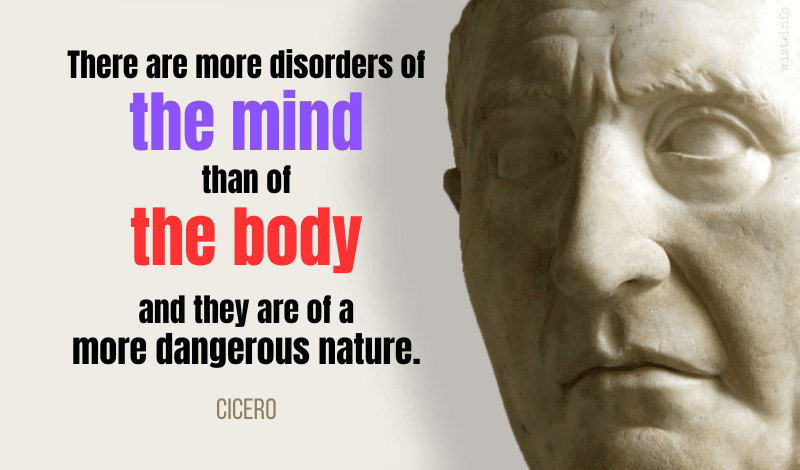
Knowledge breeds doubt, not certainty, and the more we know the more uncertain we become.
A. J. P. Taylor (1906–1990) British historian, journalist, broadcaster [Alan John Percivale Taylor]
“What Else Indeed?” New York Review of Books (5 Aug 1965)
(Source)
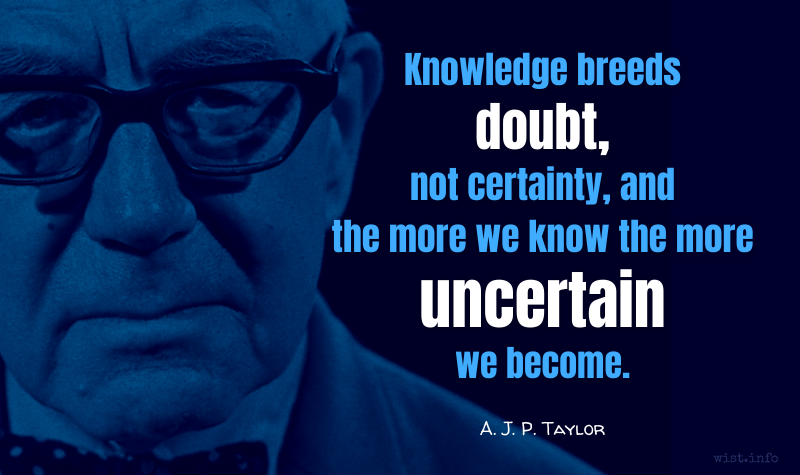
We are all captives of the picture in our head — our belief that the world we have experienced is the world that really exists.
Walter Lippmann (1889–1974) American journalist and author
(Attributed)
Contumely always falls upon those who break through some custom or convention. Such men, in fact, are called criminals. Everyone who overthrows an existing law is, at the start, regarded as a wicket man. Long afterward, when it is found that this law was bad and so cannot be re-established, the epithet is changed. All history treats almost exclusively of wicked men who, in the course of time, have come to be looked upon as good men. All progress is the result of successful crimes.
Friedrich Nietzsche (1844–1900) German philosopher and poet
The Dawn [Morgenröte], sec. 20 (1881) [Mencken (1907)]
(Source)
Other translations:We have to make good a great deal of the contumely which has fallen on all those who, by their actions, have broken through the conventionality of some custom -- such people generally have been called criminals. Everybody who overthrew the existing moral law has hitherto, at least in the beginning, been considered a wicked man; but when afterwards, as sometimes happened, the old law could not be re-established and had to be abandoned, the epithet was gradually changed. History almost exclusively treats of such wicked men who, in the course of time, have been declared good men.
[tr. Volz (1903)]One has to take back much of the defamation which people have cast upon all those who broke through the spell of a custom by means of a deed -- in general, they are called criminals. Whoever has overthrown an existing law of custom has hitherto always first been accounted a bad man: but when, as did happen the laws could not afterwards be reinstated and this fact was accepted, the predicate gradually changed -- history treats almost exclusively of these bad men who subsequently became good men!
[tr. Hollingdale (1997)]
If the desire to write is not accompanied by actual writing, then the desire must be not to write.

Preacher preaching love like vengeance
Preaching love like hate
Calling for large donations
Promising estates
Rolling lawns and angel bands
Behind the pearly gates
You know he will have his in this life
But yours will have to wait
He’s immaculately tax freeJoni Mitchell (b. 1943) Canadian singer-songwriter and painter [b. Roberta Joan Anderson]
“Tax Free” Joni Mitchell (1985)
(Source)

You ask me why I have no verses sent?
For fear you should return the compliment.[Cur non mitto meos tibi, Pontiliane, libellos?
Ne mihi tu mittas, Pontiliane, tuos.]Martial (AD c.39-c.103) Spanish Roman poet, satirist, epigrammatist [Marcus Valerius Martialis]
Epigrams [Epigrammata], Book 7, epigram 3 (7.3) (AD 92) [tr. Hay (1755)]
(Source)
Compare to Epigram 5.73. (Source (Latin)). Other translations:Why send I not to thee these books of mine?
'Cause I, Pontilian, would be free from thine.
[tr. Wright (1663)]Why I send thee, Pontilian, not one of my writings?
It is lest thou, too gen'rous, return thine enditings.
[tr. Elphinston (1782), 12.10]Why do I not send you my books, Pontilianus? Lest you should send me yours, Pontilianus.
[tr. Bohn's Classical (1859)]Why, sir, I don't my verses send you,
Pray, would you have the reason known?
The reason is -- for fear, my friend, you
Should send me, in return, your own.
[tr. Webb (1879)]You ask me why I send you not my books?
Lest you should send me yours, my friend, in turn.
[ed. Harbottle (1897)]I never send my books, it’s true.
Know why? You’d send me your books too.
[tr. West (1912), "Reply"]Why do I not send you my works, Pontilianus? That you, Pontilianus, may not send yours to me.
[tr. Ker (1919)]You ask me why my books were never sent?
For fear you might return the compliment.
[tr. Pott & Wright (1921)]Pontilianus asks why I omit
To send him all the poetry that is mine;
The reason is that in return for it,
Pontilianus, thou might'st send me thine.
[tr. Duff (1929)]You ask me why I do not send you
All my latest publications?
Let in turn you send me, sir,
All your latest lucubrations!
[tr. Marcellino (1968)]Why have I never sent
My works to you, old hack?
For fear the compliment
Comes punishingly back.
[tr. Michie (1972)]Why don't I send you my little books, Pontilianus? Fore fear you might send me yours, Pontilianus.
[tr. Shackleton Bailey (1993)]Why don’t I send you my little books?
Pontilianus, lest you send me yours.
[tr. Kline (2006), "No thanks"]You ask me why I send you not my book?
For fear you'll say, "Here's my work -- take a look."
[tr. Wills (2007)]Why don’t I send my books to you?
For fear you’d send me your books, too.
[tr. McLean (2014)]You wonder why my little book is overdue,
dear Pontilianus?
It’s just that I don’t want to look at one from you.
[tr. Juster (2016)]You ask me why I’ve sent you no new verses?
There might be reverses.
[tr. Burch (c. 2017)]You fret I haven’t sent you, Wade,
My latest book for free;
The fact is that I’m too afraid
You’d send your book to me.
[tr. Mitchell]
The great thing about civility is that it does not require you to agree with or approve of anything. You don’t even have to love your neighbor to be civil. You just have to treat your neighbor the same way you would like your neighbor to treat your grandmother, or your child.
Barbara Brown Taylor (b. 1951) American minister, academic, author
(Attributed)
No man knows his true character until he has run out of gas, purchased something on the installment plan, and raised an adolescent.
Marcelene Cox (1900–1998) American writer, columnist, aphorist
“Ask Any Woman” column, Ladies’ Home Journal (1955-06)
(Source)
Debt is the sort of Bedfellow who is forever pulling all the Covers his way.
Minna Antrim (1861–1950) American epigrammatist, writer
Don’ts for Bachelors and Old Maids (1908)
(Source)
When vision fails
Direction is lost.When direction is lost
Purpose may be forgotten.When purpose is forgotten
Emotion rules alone.When emotion rules alone,
Destruction … destruction.
[Fascism] imagines the masses not as a pluralistic citizenry but as a primal horde whose power can be awakened by playing upon atavistic feelings of hatred and belonging. Its chosen leader must exhibit strength: his refusal to compromise and readiness to attack are seen as signs of tough-mindedness, while any concern for constitutionality or the rule of law are disdained as signs of weakness. The most powerful myth, however, is that of the embattled collective. Critics are branded as traitors, while those who do not fit the criteria for inclusion are vilified as outsiders, terrorists, and criminals.
Peter E, Gordon (b. 1966) American intellectual historian
“Why Historical Analogy Matters,” New York Review of Books (7 Jan 2020)
(Source)
The worst thing about war was the sitting around and wondering what you were doing morally.
Paul Fussell (1924–2012) American cultural and literary historian, author, academic
Times of London (28 Nov 1991)
Those people who think they know everything are a great annoyance to those of us who do.
Isaac Asimov (1920–1992) Russian-American author, polymath, biochemist
(Spurious)
Sometimes quoted without the initial "Those".
The citationless attribution of this quip to Asimov cannot be traced back further than 2001, several years after his death. The earliest version found is a filler item in The Saturday Evening Post (6 May 1961), attributed to humor columnist Harold Coffin: "The fellow who thinks he knows it all is especially annoying to those of us who do."
More discussion here: The Fellow Who Thinks He Knows It All Is Especially Annoying To Those of Us Who Do – Quote Investigator.
It is never until one realizes that one means something to others that one feels there is any point or purpose in one’s own existence.
Stefan Zweig (1881–1942) Austrian novelist, playwright, journalist, biographer
Beware of Pity (1939)
A tradition has now for long been established that cooking and cleaning are woman’s work. As these occupations are among the most tiresome which humanity has to endure, this tradition is very unfortunate for women. But there it is; and the problem is how to get what is needful done as rapidly as possible, so that one can go and do something else, more lucrative, interesting, or amusing.
The general rule is that there must be something to eat at stated intervals, and the house or the flat must be about as clean as the houses and flats of one’s acquaintances. It sounds simple, but actually to secure both these results will often be found to take the entire time. All the time that there is. And that is so tragically little. None left over for reading, writing, walking, sitting in woods, playing games, making love, merely existing without effort. And ever at your back you hear Time’s winged chariot hurrying near … and so the grave yawns, and at the end you will be able to say, not “I have warmed both hands before the fire of life,” but “I have kept house.”
The only solution of this problem which I can suggest — and I almost hesitate to do in these pages — is, Do not keep house. Let the house, or flat, go unkept. Let it go to the devil, and see what happens when it has gone there. At the worst, a house unkempt cannot be so distressing as a life unlived.Rose Macaulay (1881–1958) English writer
“Some Problems of a Woman’s Life,” Good Housekeeping (Aug 1923)
(Source)
All other knowledge is harmful to him who has not the knowledge of goodness.
[Toute autre science, est dommageable à celuy qui n’a la science de la bonté.]
Michel de Montaigne (1533–1592) French essayist
Essays, Book 1, ch. 24 (1.24), “Of Pedantry [Du pedantisme]”(1572-1578) [tr. Ives (1925), ch. 25]
(Source)
While the original essay dates back to 1572-1578 and the first edition, this passage was added 1588–1592 for the 1595 edition. Some translators use the 1588 sequence of chapters, not the 1595, and so identify this as ch. 25.
(Source (French)). Other translations:Each other science is prejudciall unto him that hath not the science of goodnesse.
[tr. Florio (1603)]All other knowledge is detrimental to him who has not the science of becoming a good man.
[tr. Cotton (1686); Friswell (1868)]All other knowledge is hurtful to him who has not the science of goodness.
[tr. Cotton/Hazlitt (1877)]All other learning is hurtful to him who has not the knowledge of honesty and goodness.
[tr. Rector (1899)]Any other knowledge is harmful to a man who has not the knowledge of goodness.
[tr. Frame (1943), ch. 25]All other knowledge is harmful in a man who has no knowledge of what is good.
[tr. Screech (1987), ch. 25]

It seems to me that if there is some infinite being who wants us to think alike, he would have made us alike.
Robert Green Ingersoll (1833–1899) American lawyer, freethinker, orator
Speech to the Jury, Trial of C. B. Reynolds for Blasphemy, Morristown, New Jersey (May 1887)
(Source)
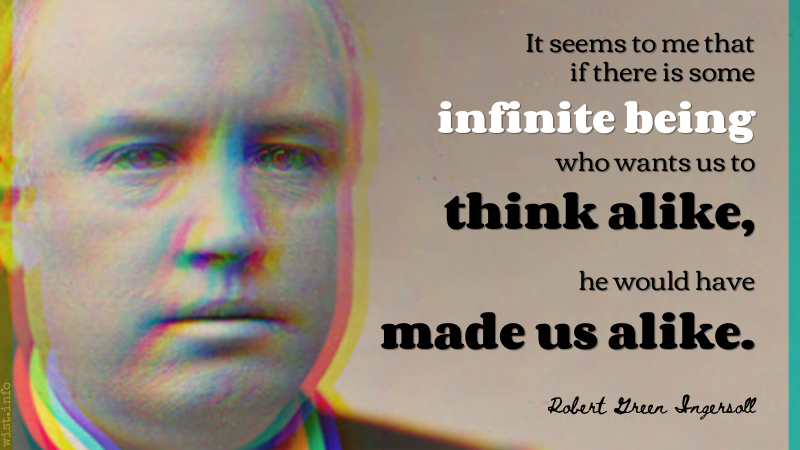
But the great hero himself tossed and turned.
It was like a man roasting a paunch
Stuffed with fat and blood over a fire.
He can’t wait for it to be done
And so keeps turning it over and over.[ἀτὰρ αὐτὸς ἑλίσσετο ἔνθα καὶ ἔνθα.
ὡς δ᾽ ὅτε γαστέρ᾽ ἀνὴρ πολέος πυρὸς αἰθομένοιο,
ἐμπλείην κνίσης τε καὶ αἵματος, ἔνθα καὶ ἔνθα
αἰόλλῃ, μάλα δ᾽ ὦκα λιλαίεται ὀπτηθῆναι,
ὣς ἄρ᾽ ὅ γ᾽ ἔνθα καὶ ἔνθα ἑλίσσετο]Homer (fl. 7th-8th C. BC) Greek author
The Odyssey [Ὀδύσσεια], Book 20, l. 24ff (20.24) (c. 700 BC) [tr. Lombardo (2000)]
(Source)
(Source (Greek)). Other translations:But from side to side
It made him toss apace. You have not tried
A fellow roasting of a pig before
A hasty fire, his belly yielding store
Of fat and blood, turn faster, labour more
To have it roast, and would not have it burn,
Than this and that way his unrest made turn
His thoughts and body ....
[tr. Chapman (1616)]He lay restlessly.
As one that has raw flesh upon the fire,
And hungry is, is ever turning it;
So turneth he himself ....
[tr. Hobbes (1675), l. 20ff]Restless his body rolls, to rage resign'd
As one who long with pale-eyed famine pined,
The savoury cates on glowing embers cast
Incessant turns, impatient for repast.
[tr. Pope (1725)]Yet he turn’d from side to side.
As when some hungry swain turns oft a maw
Unctuous and sav’ry on the burning coals,
Quick expediting his desired repast ....
[tr. Cowper (1792), l. 26ff]But ever he rolled tossing to and fro.
As when a man beside a blazing fire
Turneth a rich fat goat-paunch to and fro,
Over and over, with intense desire
Quickly to roast it ....
[tr. Worsley (1861), st. 4]But himself tossed to and fro.
As when a wight a'front a blazing fire
A savoury haggis full of fat and gravy
Restlessly turns and tumbles to and fro --
In hope right well and quickly for to roast it.
[tr. Bigge-Wither (1869), l. 24ff]But, ev'n as when a man at some fierce fire
A savoury paunch with fat and blood replete
From side to side turns oft, intent with speed
Most prompt to roast it; -- so, from right to left
Ulysses swaying lay.
[tr. Musgrave (1869), l. 36ff]But Odysseus himself lay tossing this way and that. And as when a man by a great fire burning takes a paunch full of fat and blood, and turns it this way and that and longs to have it roasted most speedily, so Odysseus tossed from side to side.
[tr. Butcher/Lang (1879)]But he himself in meanwhile was tossing here and there.
As when a man hath gotten by a great fire blazing out
A paunch of fat and of blood, and turneth it oft about
Hither and thither, all eager to roast it speedily.
[tr. Morris (1887)]Yet he himself kept tossing to and fro. As when a man near a great glowing fire turns to and fro a sausage, full of fat and blood, anxious to have it quickly roast.
[tr. Palmer (1891)]He tossed about as one who turns a paunch full of blood and fat in front of a hot fire, doing it first on one side and then on the other, that he may get it cooked as soon as possible, even so did he turn himself about from side to side ....
[tr. Butler (1898)]But he himself lay tossing this way and that. And as when a man before a great blazing fire turns swiftly this way and that a paunch full of fat and blood, and is very eager to have it roasted quickly, so Odysseus tossed from side to side ....
[tr. Murray (1919)]But the strain tossed his body about, like the basting paunch stuffed with blood and fat that a man who wants it immediately cooked will turn over and over before a blazing fire. In such fashion did Odysseus roll to this side and to that ....
[tr. Lawrence (1932)]Odysseus nevertheless could not help tossing to and fro on his bed, just as a paunch stuffed with fat and blood is tossed this way and that in the blaze of the fire by a cook who wants to get it quickly roasted, twisting and turning thus to one side and the other ....
[tr. Rieu (1946)]He himself rocked, rolling from side to side, as a cook turns a sausage, big with blood and fat, at a scorching blaze, without a pause, to broil it quick.
[tr. Fitzgerald (1961)]The man himself was twisting and turning.
And as a man with a paunch pudding, that has been filled with
blood and fat, tosses it back and forth over a blazing
fire, and the pudding itself strains hard to be cooked quickly;
so he was twisting and turning back and forth.
[tr. Lattimore (1965)]Yet Odysseus' own self thrashed this way and that. Just as a man before a blazing fire who's skewered a paunch that's stuffed with blood and fat will swiftly turn ths spit this way and that, eager to have it roasted fast.
[tr. Mandelbaum (1990)]But he himself kept tossing, turning,
intent as a cook before some white-hot blazing fire
who rolls his sizzling sausage back and forth,
packed with fat and blood -- keen to broil it quickly,
tossing, turning it, this way, that way.
[tr. Fagles (1996)]He himself kept twisting one way and the other. As when a man keeps shifting a paunch that has been stuffed full with suet and blood, in a huge fire's blaze, one way and the other turning it over, and wishes for it to be rapidly roasted, so did he twist one way and the other.
[tr. Merrill (2002)]Nevertheless, he could not help twisting and turning, just as a paunch stuffed with fat and blood is turned this way and that in the blaze of the roaring fire by a man who wants to get it quickly roasted.
[tr. DCH Rieu (2002)]But Odysseus himself kept tossing back and forth. As when a man has stuffed a paunch full of fat and blood, and keeps turning it back and forth on a blazing-hot fire, because he wants it to be cooked as soon as possible, so Odysseus kept turning back and forth ....
[tr. Verity (2016)]He writhed around, as when a man rotates a sausage full of fat and blood; the huge fire blazes, and he longs to have the roasting finished.
[tr. Wilson (2017)]But he himself kept tossing and turning. As a man cooking a paunch chockful of fat and blood on a fierce blazing fire will turn it to and fro, determined to get it cooked through as fast as he can, so Odysseus tossed this way and that.
[tr. Green (2018)]He still tossed and turned, back and forth. Just as a man
eager to roast a stomach stuffed with fat and blood
turns it quickly round and round on a blazing fire,
that is how lord Odysseus tossed and turned ....
[tr. Johnston (2019), l. 25ff]
The nation faces forward. It is made and remade every day. If we believe that the nation resides in the orderly recitations of history given to us by our leaders, then our story is over.
Timothy Snyder (b. 1969) American historian, author
The Red Prince, “Orange: European Revolutions” (2008)
(Source)
… and we are in bed
together
laughing
and we don’t care
about anything …Charles Bukowski (1920–1994) German-American author, poet
“a pleasant afternoon in bed,” It Catches My Heart In Its Hands (1963)
No society can legitimately call itself civilized if a sick person is denied medical aid because of lack of means.
Aneurin "Nye" Bevan (1897–1960) Welsh politician
In Place of Fear (1952)
Bevan was the key politician responsible for the 1946 founding of the UK's National Health Service.
Democracy is two wolves and a lamb voting on what to have for lunch.
Benjamin Franklin (1706–1790) American statesman, scientist, philosopher, aphorist
(Spurious)
Frequently attributed to Franklin, but not found in his writing (and the word "lunch" dates only back to the 1820s). The phrase is only found in sources dating back to the early 1990s, e.g.,
- "Democracy is like two wolves and a lamb deciding on what they want for dinner." [Shelby Foote in Ken Burns, Civil War (1990)]
- "Democracy has been described as four wolves and a lamb voting on what to have for lunch." [Los Angeles Times (25 Nov 1990)]
- "Democracy is not freedom. Democracy is two wolves and a lamb voting on what to eat for lunch. Freedom comes from the recognition of certain rights which may not be taken, not even by a 99% vote." [Marvin Simkin, Los Angeles Times (1992)]
- "Democracy must be something more than two wolves and a sheep voting on what to have for dinner." [James Bovard, Lost Rights, "Conclusion" (1994)]
To a talkative fellow, who poured out a torrent of words and then said, “Let’s hope I haven’t been boring you with my chatter!” he replied, “No, by Zeus, I haven’t been listening.”
[πρὸς τὸν εἰπόντα ἀδολέσχην, ἐπειδὴ αὐτοῦ πολλὰ κατήντλησε, “μήτι σου κατεφλυάρησα;” “μὰ Δί᾽,” εἶπεν: “οὐ γάρ σοι προσεῖχον.]
Aristotle (384–322 BC) Greek philosopher
Attributed in Diogenes Laërtius, Lives and Opinions of Eminent Philosophers [Vitae Philosophorum], Book 5, sec. 11 [tr. Mensch (2018)]
(Source)
(Source (Greek)). Other translations:A chattering fellow, who had been abusing him, said to him, “Have not I been jeering you properly?” “Not that I know of,” said he, “for I have not been listening to you.”
[tr. Yonge (1853)]To the chatterbox who poured out a flood of talk upon him and then inquired, "Have I bored you to death with my chatter?" he replied, "No, indeed; for I was not attending to you."
[tr. Hicks (1925), sec. 20]To the man talking endlessly when he assailed him with words and asked “Have I worn you out with nonsense”, he said “By Zeus, no! I wasn’t listening to you.”
[tr. @sentantiq (2016)]
Our lives get complicated because complexity is so much simpler than simplicity.
James Richardson (b. 1950) American poet
“Vectors: 56 Aphorisms and Ten-second Essays,” Michigan Quarterly Review, # 7 (Spring 1999)
(Source)
In the middle of the night, things well up from the past that are not always cause for rejoicing — the unsolved, the painful encounters, the mistakes, the reasons for shame or woe. But all, good or bad, give me food for thought, food to grow on.
May Sarton (1912–1995) Belgian-American poet, novelist, memoirist [pen name of Eleanore Marie Sarton]
At Seventy (1984)
(Source)
Lord, there’s danger in this land
You get witch-hunts and wars
When church and state hold handsJoni Mitchell (b. 1943) Canadian singer-songwriter and painter [b. Roberta Joan Anderson]
“Tax Free” (1985)
(Source)
We asked a passenger who belonged there what sort of place it was. “Well,” said he, after considering, and with the air of one who wishes to take time and be accurate, “It’s a hell of a place.” A description which was photographic for exactness.
Mark Twain (1835–1910) American writer [pseud. of Samuel Clemens]
Life on the Mississippi, ch. 30 (1883)
(Source)
Describing Arkansas City, Arkansas.
MARCUS: All things are tolerable which others have borne and are bearing.
[Sed significat tolerabilia esse, quae et tulerint et ferant ceteri.]
Marcus Tullius Cicero (106–43 BC) Roman orator, statesman, philosopher
Tusculan Disputations [Tusculanae Disputationes], Book 2, ch. 23 (3.23) / sec. 57 (3.57) (45 BC) [tr. Yonge (1853)]
(Source)
(Source (Latin)). Other translations:Those things are in themselves tolerable, which others have born, and do bear.
[tr. Wase (1643)]All things are tolerable which others have borne and can bear.
[tr. Main (1824)]What others have endured and endure must be tolerable.
[tr. Otis (1839)]Things are tolerable which others have borne and are bearing.
[tr. Peabody (1886)]The circumstances at hand are indeed tolerable, since others have tolerated them and continue to do so.
[tr. Graver (2002)]
History is not a catalogue but a version of events … a convincing version of events. If an historian is any good, he is convinced by his own version of events and then tries to put this conviction across.
A. J. P. Taylor (1906–1990) British historian, journalist, broadcaster [Alan John Percivale Taylor]
“The view from Twisden Rd.”, interview by Duncan Fallowell, The Spectator (28 May 1983)
(Source)
It may be confidently asserted that no man chooses evil, because it is evil; he only mistakes it for happiness, the good he seeks.
Mary Wollstonecraft (1759–1797) English social philosopher, feminist, writer
A Vindication of the Rights of Men (1790)
(Source)
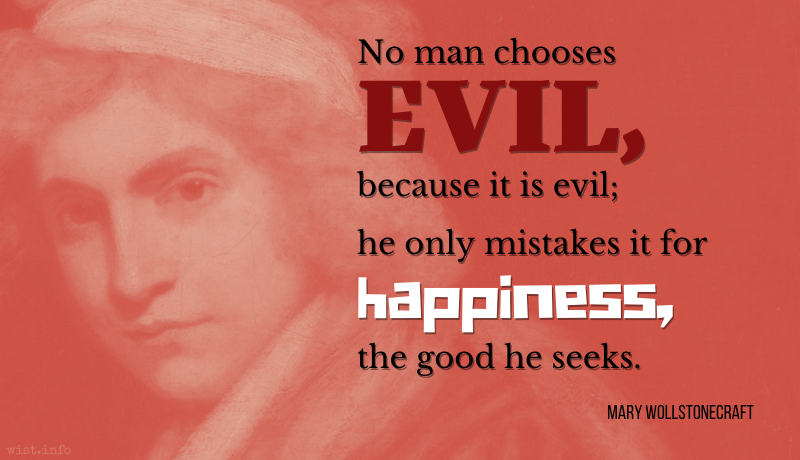

The parliamentary battle of the NSDAP [Nazi Party] had the single purpose of destroying the parliamentary system from within through its own methods. It was necessary above all to make formal use of the possibilities of the party-state system but to refuse real cooperation and thereby to render the parliamentary system, which is by nature dependent upon the responsible cooperation of the opposition, incapable of action.
Ernst Rudolf Huber (1903–1990), German jurist and constitutional historian
Constitutional Law of the Greater German Reich [Verfassungsrecht des Grossdeutschen Reiches] (1939)
(Source)
Reprinted in National Socialism, US State Department (1943).

Religious freedom should work two ways: we should be free to practice the religion of our choice, but we must also be free from having someone else’s religion practiced on us.
John Irving (b. 1942) American-Canadian novelist and screenwriter [b. John Wallace Blunt Jr.]
My Movie Business, ch. 8 (1999)
(Source)

When I would send such trifles as I can;
You stop me short; you arbitrary man!
But I submit. Both may our orders give;
And do what both like best: let me receive.[Natali tibi, Quinte, tuo dare parva volebam
Munera; tu prohibes: inperiosus homo es.
Parendum est monitis, fiat quod uterque volemus
Et quod utrumque iuvat: tu mihi, Quinte, dato.]Martial (AD c.39-c.103) Spanish Roman poet, satirist, epigrammatist [Marcus Valerius Martialis]
Epigrams [Epigrammata], Book 9, epigram 53 (9.53) (AD 94) [tr. Hay (1755), ep. 54]
(Source)
(Source (Latin)). Other translations:On your birth-day, Quintus, I wished to make you a small present: you forbade me; you are imperious. I must obey your injunction: let that be done which we both desire, and which will please us both. Do you, Quintus, make me a present.
[tr. Bohn's Classical (1897)]Your birthday I wished to observe with a gift;
Your forbade and your firmness is known.
Every man to his taste:
I remark with some haste,
May the Third is the date of my own.
[tr. Nixon (1911)]On your birthday, Quintus, I was wishing to give you a small present; you must forbid me; you are an imperious person! I must obey your monition. Let be done what both of us wish, and what pleases both. Do you, Quintus, make me a present!
[tr. Ker (1919), Ep. 53]I wished to send you for your birthday
A gift, a small thing really.
But you said, "No, I want no gift,"
And meant it most sincerely.
Let both our wishes be esteemed.
Why invite a rift
Between us? When my birthday comes,
Please send me a gift.
[tr. Marcellino (1968)]I wished to give you a trifling birthday present, Quintus. You forbid it. you are an imperious fellow; I must obey your admonition. Let it be as both of us will wish, as gives both of us pleasure: you give me something, Quintus.
[tr. Shackleton Bailey (1993)]
The problem is, many of the people in need of saving are in churches, and at least part of what they need saving from is the idea that God sees the world the same way they do.
Barbara Brown Taylor (b. 1951) American minister, academic, author
An Altar in the World, ch. 2 (2009)
(Source)
We therefore say once more that a strong mind is not one that is merely capable of strong emotions, but one that under stress of the strongest emotions keeps its balance, so that in spite for the storms within the breast, judgment and conviction can act with perfect freedom, like the needle of the compass on a storm-tossed ship.
[Wir sagen es also noch einmal: Ein starkes Gemüth ist nicht ein solches, welches bloss starker Regungen fähig ist, sondern dasjenige, welches bei den stärksten Regungen im Gleichgewicht bleibt, so dass trotz den Stürmen in der Brust der Einsicht und Ueberzeugung wie der Nadel des Kompasses auf dem sturmbewegten Schiff das feinste Spiel gestattet ist.]
Karl von Clausewitz (1780–1831) Prussian soldier, historian, military theorist
On War [Vom Kriege], Book 1, ch. 3 “On Military Genius [Der Kriegerische Genius],” (1.3) (1832) [tr. Jolles (1943)]
(Source)
(Source (German)). Other translations:We, therefore, say once more a strong mind is not one that is merely susceptible of strong excitement, but one which can maintain its serenity under the most powerful excitement; so that, in spite of the storm in the breast, the perception and judgment can act with perfect freedom, like the needle of the compass in the storm-tossed ship.
[tr. Graham (1873)]We repeat: strength of character does not consist solely in having powerful feelings, but in maintaining one’s balance in spite of them. Even with the violence of emotion, judgment and principle must still function like a ship’s compass, which records the slightest variations however rough the sea.
[tr. Howard & Paret (1976)]

The very women who object to the morals of a notoriously beautiful actress, grow big with pride when an admirer suggests their marked resemblance to this stage beauty in physique.
Minna Antrim (1861–1950) American epigrammatist, writer
Naked Truth and Veiled Allusions (1901)
The biographer does not trust his witnesses, living or dead. He may drip with the milk of human kindness, believe everything that his wife and his friends and his children tell him, enjoy his neighbors and embrace the universe — but in the workshop he must be as ruthless as a board meeting smelling out embezzlement, as suspicious as a secret agent riding the Simplon-Orient Express, as cold-eyed as a pawnbroker viewing a leaky concertina. With no respect for human dignity, he plays off his witnesses one against the other, snoops for additional information to confront them with, probes their prejudices and their pride, checks their reliability against their self-interest, thinks the worst until he is permitted to think better.
Paul Murray Kendall (1911–1973) American academic and historian
“Walking the Boundaries,” The Art of Biography (1965)
(Source)
The mocking bird is music-mad to-night,
He thinks the stars are notes;
That he must sing each spattered star, and be
A choir of many throats.The earth is his cathedral, and its dome
Is all the light-pricked sky;
The pear-tree is his choir loft, and there
He flings his mad songs high.

Were there none who were discontented with what they have, the world would never reach anything better.
Florence Nightingale (1820–1910) English social reformer, statistician, founder of modern nursing
Cassandra (1860)
(Source)

The past, which as always did not know the future, acted in ways that ask to be imagined before they are condemned. Or even simplified.
Self-education is, I firmly believe, the only kind of education there is. The only function of a school is to make self-education easier; failing that, it does nothing.
Isaac Asimov (1920–1992) Russian-American author, polymath, biochemist
Science Past, Science Future (1975)
(Source)
It always demands a far greater degree of courage for an individual to oppose an organized movement than to let himself be carried along with the stream — individual courage, that is, a variety of courage that is dying out in these times of progressive organization and mechanization. During the war practically the only courage I ran across was mass courage, the courage that comes of being one of a herd, and anyone who examines this phenomenon more closely will find it to be compounded of some very strange elements: a great deal of vanity, a great deal of fear — yes, fear of staying behind, fear of being sneered at fear of independent action, and fear, above all, of taking up a stand against the mass enthusiasm of one’s fellows.
Stefan Zweig (1881–1942) Austrian novelist, playwright, journalist, biographer
Beware of Pity (1939)
A good rule for discussion is to use hard facts and a soft voice.
Dorothy Sarnoff (1914–2008) American opera singer, actress, image consultant
Speech Can Change Your Life (1970)
(Source)

After nine months of familiarity with this panorama, I still think, as I thought in the beginning, that this is the fairest picture on our planet, the most enchanting to look upon, the most satisfying to the eye and the spirit. To see the sun sink down, drowned on his pink and purple and golden floods, and overwhelm Florence with tides of color that make all the sharp lines dim and faint and turn the solid city to a city of dreams, is a sight to stir the coldest nature, and make a sympathetic one drunk with ecstasy.
Mark Twain (1835–1910) American writer [pseud. of Samuel Clemens]
Mark Twain’s Autobiography, “Chapters Added in Florence (1904)” (1924) [ed. Bigelow]
(Source)
Recounting his previous stay in, and view of, Florence, Italy, starting in 26 September 1892; written while again staying there in 1904.
Our worst foes are not belligerent circumstances, but wavering spirits.
Helen Keller (1880–1968) American author and lecturer
“My Future As I See It,” Ladies Home Journal (Nov 1903)
(Source)
Reprinted as an additional chapter in revised editions of The Story of My Life (1904 ed.)

You can stand with the lash over a man, or you can stand by the prison door, or beneath the gallows, or by the stake, and say to this man: “Recant, or the lash descends, the prison door is locked upon you, the rope is put about your neck, or the torch is given to the fagot.” And so the man recants. Is he convinced? Not at all. Have you produced a new argument? Not the slightest. And yet the ignorant bigots of this world have been trying for thousands of years to rule the minds of men by brute force. They have endeavored to improve the mind by torturing the flesh — to spread religion with the sword and torch. They have tried to convince their brothers by putting their feet in iron boots, by putting fathers, mothers, patriots, philosophers and philanthropists in dungeons. And what has been the result? Are we any nearer thinking alike to-day than we were then?
Robert Green Ingersoll (1833–1899) American lawyer, freethinker, orator
Speech to the Jury, Trial of C. B. Reynolds for Blasphemy, Morristown, New Jersey (May 1887)
(Source)
The very presence of a weapon provokes a man to use it.
[αὐτὸς γὰρ ἐφέλκεται ἄνδρα σίδηρος.]
Homer (fl. 7th-8th C. BC) Greek author
The Odyssey [Ὀδύσσεια], Book 16, l. 294 (16.294) [Odysseus] (c. 700 BC) [tr. Rieu (1946)]
(Source)
(Greek (Source)), repeated in 19.13.
In Book 16, Odysseus offers this as part of the argument Telemachus can use to the suitors to explain why he has stripped the hall of weapons -- that, should the weapons remain, they might tempt drunken people to violence. Book 19, back at the hall, Odysseus repeats almost the same instructions to Telemachus. The same Greek is used for this phrase in both passages; some translators use the same language, others make changes to it.
Epigram (and title inspiration) in Joe Abercrombie's The Blade Itself (2006) -- "The blade itself incites to deeds of violence." Abercrombie was a fan of the Rome: Total War game, which included in its load pages the translation, "The blade itself incites to violence.
BOOK 16, l. 294
- "Steel itself, ready, draws a man to blows." [tr. Chapman (1616)]
- "One drawn sword draws another." [tr. Hobbes (1675), l. 276]
- "Oft ready swords in luckless hour incite / The hand of wrath, and arm it for the fight." [tr. Pope (1725)]
- "For the view / Itself of arms incites to their abuse." [tr. Cowper (1792), l. 348]
- "Steel itself oft lures a man to fight." [tr. Worsley (1861), st. 37]
- "Steel itself wooes men to battle!" [tr. Bigge-Wither (1869)]
- "For the steel blade itself lures men to blood." [tr. Musgrave (1869), l. 462]
- "For iron of itself draws a man thereto." [tr. Butcher/Lang (1879)]
- "For this is said aright, / That e'en of himself the iron draws on a man to smite." [tr. Morris (1887)]
- "Steel itself draws men on." [tr. Palmer (1891)]
- "For the sight of arms sometimes tempts people to use them." [tr. Butler (1898)]
- "For of itself does the iron draw a man to it." [tr. Murray (1919)]
- "Iron of itself tempts man's frailty." [tr. Lawrence (1932)]
- "Tempered iron can magnetize a man." [tr. Fitzgerald (1961)]
- "Iron all of itself works on a man and attracts him." [tr. Lattimore (1965)]
- "For iron of itself can tempt a man." [tr. Mandelbaum (1990)]
- "Iron has powers to draw a man to ruin." [tr. Fagles (1996)]
- "There's a force in iron that lures men on." [tr. D. C. H. Rieu (2002)]
- "For iron itself draws a man to employ it." [tr. Merrill (2002)]
- "Iron of itself draws a man on." [tr. Verity (2016)]
- "Weapons themselves can tempt a man to fight." [tr. Wilson (2017)]
- "For iron of itself attracts a man." [tr. Green (2018)]
- "Iron attracts a man all on its own." [tr. Johnston (2019)]
- "And beckoning, the iron itself drags the man." [Source]
BOOK 19, l. 13 -- items in italics are the same as their Book 16 counterparts.
- "As loadstones draw the steel, so steel draws man." [tr. Chapman (1616)]
- "One drawn sword draws another." [tr. Hobbes (1675)]
- "By sight of swords to fury fired." [tr. Pope (1725)]
- "For the view / Itself of arms incites to their abuse." [tr. Cowper (1792)]
- "Steel itself oft lures a man to fight." [tr. Worsley (1861), st. 2]
- "The sight of iron tempts to use it!" [tr. Bigge-Wither (1869)]
- "For the steel blade itself / Lures men to blood." [tr. Musgrave (1869)]
- "For iron of itself draws a man thereto." [tr. Butcher/Lang (1879)]
- "For e'en of himself the Iron to battle draweth men." [tr. Morris (1887)]
- "Steel itself draws men on." [tr. Palmer (1891)]
- "For the sight of arms sometimes tempts people to use them." [tr. Butler (1898)]
- "For of itself does the iron draw a man towards it." [tr. Murray (1919)]
- "Iron has that attraction for men." [tr. Lawrence (1932)]
- "The very presence of a weapon provokes a man to use it." [tr. Rieu (1946)]
- "Iron itself can draw men's hands." [tr. Fitzgerald (1961)]
- "Iron all of itself works on a man and attracts him." [tr. Lattimore (1965)]
- "For iron of itself can tempt a man." [tr. Mandelbaum (1990)]
- "Iron has powers to draw a man to ruin." [tr. Fagles (1996)]
- "Steel has a way of drawing a man to it." [tr. Lombardo (2000)]
- "There's a force in iron that lures men on." [tr. D. C. H. Rieu (2002)]
- "For iron itself draws a man to employ it." [tr. Merrill (2002)]
- "For iron of itself draws a man on." [tr. Verity (2016)]
- "For iron of itself attracts a man." [tr. Green (2018)]
- "For iron by itself / can draw a man to use it." [tr. Johnston (2019)]
All citizens do have a measure of control, at least in democracies where their votes are counted, of how they belong to their nations. Perhaps they will have more confidence in unconventional choices if they see that each nation’s founders were disobedient and unpredictable, men and women of imagination and ambition. The steel of every national monument was once molten.
Timothy Snyder (b. 1969) American historian, author
The Red Prince, “Orange: European Revolutions” (2008)
(Source)
some people never go crazy.
what truly horrible lives
they must lead.
I have no objection to churches so long as they do not interfere with God’s work.
Brooks Atkinson (1894–1984) American drama critic and journalist
Once Around the Sun, “November 10” (1951)
(Source)
As Master Bludtharst once put it: “Kill a man today, and all you get are spare parts — but conquer his village, and you get spare parts plus people who can cook your breakfast tomorrow!”
People who wish to salute the free and independent side of their evolutionary character acquire cats. People who wish to pay homage to their servile and salivating roots own dogs.
Anna Quindlen (b. 1953) American journalist, novelist
Article (1991-04-07), “Mr. Smith Goes to Heaven,” New York Times
(Source)
Part of an obituary for her dog, Jason Oliver C. Smith. Reprinted in Thinking Out Loud (1993).

When a man boasted in his presence that he was a native of an illustrious city, he said, “That is not what one ought to look at, but whether one is worthy of a great city.”
[πρὸς τὸν καυχώμενον ὡς ἀπὸ μεγάλης πόλεως εἴη, “οὐ τοῦτο,” ἔφη, “δεῖ σκοπεῖν, ἀλλ᾽ ὅστις μεγάλης πατρίδος ἄξιός ἐστιν.”]
Aristotle (384–322 BC) Greek philosopher
Attributed in Diogenes Laërtius, Lives and Opinions of Eminent Philosophers [Vitae Philosophorum], Book 5, sec. 11 [tr. Yonge (1853)]
(Source)
(Source (Greek)). Other translations:To one who boasted that he belonged to a great city his reply was, "That is not the point to consider, but who it is that is worthy of a great country."
[tr. Hicks (1925), sec. 19]To a man boasting that he was from a great city, he said “Don’t look at this, but instead who is worthy of a great country.”
[tr. @sentantiq (2016)]To someone who boasted that he came from a great city, he said, "That is not what one should consider, but who it is that is worthy of a great country."
[tr. Mensch (2018)]
All stones are broken stones.
James Richardson (b. 1950) American poet
Vectors: Aphorisms and Ten-Second Essays, # 23 (2001)
(Source)
I can tell you that solitude
Is not all exaltation, inner space
Where the soul breathes and work can be done.
Solitude exposes the nerve,
Raises up ghosts.
The past, never at rest, flows through it.May Sarton (1912–1995) Belgian-American poet, novelist, memoirist [pen name of Eleanore Marie Sarton]
“Gestalt at Sixty,” sec. 1 (1972)
(Source)
I think we’d like life to be a train. And you get on and pick a destination and get off. And it turns out to be a sailboat. And everyday, you have to see where the wind is and check the currents and see if there’s anybody else on the boat you can help out. But it is a sailboat ride. And the weather changes, and the currents change, and the wind changes. It’s not a train ride. That’s the hardest thing I’ve had to accept in my life. I just thought I had to pick the right train.
Barbara Brown Taylor (b. 1951) American minister, academic, author
Interview (2014-11-09), “Why Life Is Like a Sailboat Ride,” by Oprah Winfrey, Super Soul Sunday, 05×522, Oprah Winfrey Network
(Source)
Starts at 0:48 in the linked video. Usually just rendered to as "I think we'd like life to be a train ... but it turns out to be a sailboat."
Out of suffering have emerged the strongest souls; the most massive characters are seared with scars.
Edwin Hubbell Chapin (1814–1880) American clergyman
Discourses on the Beatitudes, ch. 2 “The Blessing of the the Mourners” (1853)
(Source)
Preaching on Matthew 5:4. Frequently misattributed to Kahlil Gibran, after it was incorrectly included in The Treasured Writings of Kahlil Gibran (1995).

Man forgives woman anything save the wit to outwit him.
Minna Antrim (1861–1950) American epigrammatist, writer
Naked Truth and Veiled Allusions (1901)
I have always been among those who believed that the greatest freedom of speech was the greatest safety, because if a man is a fool, the best thing to do is to encourage him to advertise the fact by speaking. It cannot be so easily discovered if you allow him to remain silent and look wise, but if you let him speak, the secret is out, and the world knows that he is a fool. So it is by the exposure of folly that it is defeated, not by the seclusion of folly, and, in this free air of free speech, men get into that sort of communication with one another which constitutes the basis of all common achievement.
Woodrow Wilson (1856–1924) US President (1913–20), educator, political scientist
Speech, Institute of France, Paris (10 May 1919)
(Source)
I am certainly not an advocate for frequent & untried changes in laws and constitutions. I think moderate imperfections had better be borne with; because when once known, we accommodate ourselves to them, and find practical means of correcting their ill effects. but I know also that laws and institutions must go hand in hand with the progress of the human mind. as that becomes more developed, more enlightened, as new discoveries are made, new truths disclosed, and manners and opinions change with the change of circumstances, institutions must advance also, and keep pace with the times. we might as well require a man to wear still the coat which fitted him when a boy, as civilised society to remain ever under the regimen of their barbarous ancestors.
Thomas Jefferson (1743–1826) American political philosopher, polymath, statesman, US President (1801–09)
Letter (1816-07-12) to “Henry Tompkinson” (Samuel Kercheval)
(Source)
Inscribed (elided) on southeast side of the Jefferson Memorial:I am not an advocate for frequent changes in laws and constitutions, but laws and institutions must go hand in hand with the progress of the human mind. As that becomes more developed, more enlightened, as new discoveries are made, new truths discovered and manners and opinions change, with the change of circumstances, institutions must advance also to keep pace with the times. We might as well require a man to wear still the coat which fitted him when a boy as a civilized society to remain ever under the regimen of their barbarous ancestors.

However rationalized it may be, censorship is always an attack on human intelligence and imagination and is always a sign of weakness, not strength, in those who enforce it.
Northrop Frye (1912–1991) Canadian literary critic and literary theorist
“Introduction to Canadian Literature,” #14 (1988)
(Source)
Nobody wants constructive criticism; it’s all we can do to put up with constructive praise.
Mignon McLaughlin (1913–1983) American journalist and author
The Neurotic’s Notebook, ch. 4 (1963)
(Source)
Beware:
Ignorance
Protects itself
Ignorance
Promotes suspicion.
Suspicion
Engenders fear.
Fear quails,
Irrational and blind,
Or fear looms,
Defiant and closed.
Blind, closed,
Suspicious, afraid,
Ignorance
Protects itself,
And protected,
Ignorance grows.
Fascism, after all, is not only a historical term; it describes a modern style of authoritarian rule that seeks to mobilize the masses by appealing to nationalism, xenophobia, and populist resentment. Its trademark is the use of democratic procedure even as it seeks to destroy the substantive values of democracy from within. It disdains the free press and seeks to undermine its credibility in the public sphere.
Peter E, Gordon (b. 1966) American intellectual historian
“Why Historical Analogy Matters,” New York Review of Books (7 Jan 2020)
(Source)
Illusion is the dust the devil throws in the eyes of the foolish.
Minna Antrim (1861–1950) American epigrammatist, writer
Naked Truth and Veiled Allusions (1901)
I tore myself away from the safe comfort of certainties through my love for truth — and truth rewarded me.
Simone de Beauvoir (1908–1986) French author, existentialist philosopher, feminist theorist
All Said and Done (1974)
(Source)

In the arithmetic of love, one plus one equals everything, and two minus one equals nothing.
Mignon McLaughlin (1913–1983) American journalist and author
The Second Neurotic’s Notebook, ch. 4 (1966)
(Source)
Choose your leaders
with wisdom and forethought.
To be led by a coward
is to be controlled
by all that the coward fears.
To be led by a fool
is to be led
by the opportunists
who control the fool.
To be led by a thief
is to offer up
your most precious treasures
to be stolen.
To be led by a liar
is to ask
to be lied to.
To be led by a tyrant
is to sell yourself
and those you love
into slavery.Octavia Butler (1947–2006) American writer
Parable of the Talents, ch. 11, epigraph (1998)
(Source)
The epigraph is cited to the in-fiction Earthseed: The Books of the Living.
Like common law, the moral imagination works by precedent and example. We are all equipped with an inherited archive of historical events that serves as the background for everything that occurs. Especially when we are confronted with new events that test the limits of moral comprehension, we call upon what is most familiar in historical memory to regain our sense of moral orientation. We require this archive not only for political judgment, but as the necessary horizon for human experience.
Peter E, Gordon (b. 1966) American intellectual historian
“Why Historical Analogy Matters,” New York Review of Books (7 Jan 2020)
(Source)
For thousands of years people have been trying to force other people to think their way. Did they succeed? No. Will they succeed? No. Why? Because brute force is not an argument.
Robert Green Ingersoll (1833–1899) American lawyer, freethinker, orator
Speech to the Jury, Trial of C. B. Reynolds for Blasphemy, Morristown, New Jersey (May 1887)
(Source)
If none of us is prepared to die for freedom, then all of us will die under tyranny.
Timothy Snyder (b. 1969) American historian, author
On Tyranny: Twenty Lessons from the Twentieth Century (2017)
(Source)
boss there is always
a comforting thought
in time of trouble when
it is not our trouble.Don Marquis (1878–1937) American journalist and humorist
“comforting thoughts,” archy does his part (1935)
(Source)

Strength is the capacity to break a chocolate bar into four pieces with your bare hands — and then eat just one of the pieces.
Judith Viorst (b. 1931) American writer, journalist, psychoanalysis researcher
Redbook Magazine (mid-1970s)
Attributed in many places. More information: The Big Apple: “Strength is breaking a chocolate bar into four pieces with your hands — and then eating just one”

Bad writing is almost always a love poem addressed by the self to the self. The person who will admire it first and last and most is the writer herself.
Toby Litt (b. 1968) English writer and academic
“What makes bad writing bad?” The Guardian (20 May 2016)
(Source)

The dog may be wonderful prose, but only the cat is poetry.
Proverbs, Sayings, and Adages
French proverb
Being asked how the educated differ from the uneducated, “As much,” he said, “as the living from the dead.”
[ἐρωτηθεὶς τίνι διαφέρουσιν οἱ πεπαιδευμένοι τῶν ἀπαιδεύτων, “ὅσῳ,” εἶπεν, “οἱ ζῶντες τῶν τεθνεώτων.”]
Aristotle (384–322 BC) Greek philosopher
Attributed in Diogenes Laërtius, Lives and Opinions of Eminent Philosophers [Vitae Philosophorum], Book 5, sec. 11 [tr. Hicks (1925), sec. 19]
(Source)
(Source (Greek)). Other translations:On one occasion he was asked how much educated men were superior to those uneducated; “As much,” said he, “as the living are to the dead.”
[tr. Yonge (1853)]When asked what the difference was between those who were educated and those who were not, Aristotle said "as great as between the living and the dead."
[tr. @sentantiq (2016)]When asked how the educated differ from the uneducated, he said, "as much as the living from the dead."
[tr. Mensch (2018)]
Of all the ways to avoid living, perfect discipline is the most admired.
James Richardson (b. 1950) American poet
Vectors: Aphorisms and Ten-Second Essays, # 24 (2001)
(Source)
Without darkness, nothing comes to birth,
As without light, nothing flowers.May Sarton (1912–1995) Belgian-American poet, novelist, memoirist [pen name of Eleanore Marie Sarton]
“The Invocation to Kali,” Part 5, Poetry (Feb 1971)
(Source)
It is good to have an end to journey towards; but it is the journey that matters, in the end.

Perhaps the safest thing to do at the outset, if technology permits, is to send music. This language may be the best we have for explaining what we are like to others in space, with least ambiguity. I would vote for Bach, all of Bach, streamed out into space, over and over again. We would be bragging of course, but surely it is excusable for us to put the best possible face on at the beginning of such an acquaintance. We can tell the harder truths later.
Lewis Thomas (1913–1993) American physician, poet, essayist, researcher
“Ceti,” New England Journal of Medicine (10 Feb 1972)
(Source)
On sending messages to extraterrestrial civilizations on other worlds, e.g. Tau Ceti. Citation N Engl J Med 1972; 286:306-307. Reprinted in The Lives of a Cell: Notes of a Biology Watcher (1974).