

Don’t be yourself — be someone a little nicer.
Mignon McLaughlin (1913–1983) American journalist and author
The Second Neurotic’s Notebook, ch. 4 (1966)
(Source)

I been readin’ ’bout how maybe they is planets peopled by folks with ad-vanced brains. On the other hand, maybe we got the most brains … maybe our intellects is the universe’s most ad-vanced. Either way, it’s a mighty soberin’ thought.
Walt Kelly (1913–1973) American animator and cartoonist [Walter Crawford Kelly, Jr.]
“Pogo” [Porky Pine] (20 Jun 1959)
Often paraphrased: "Thar’s only two possibilities: Thar is life out there in the universe which is smarter than we are, or we’re the most intelligent life in the universe. Either way, it’s a mighty sobering thought."
More information:


Be calm when the unthinkable arrives. Modern tyranny is terror management. When the terrorist attack comes, remember that authoritarians exploit such events in order to consolidate power. The sudden disaster that requires the end of checks and balances, the dissolution of political parties, the suspension of freedom of expression, the right to a fair trial, and so on, is the oldest trick in the Hitlerian book. DO NOT FALL FOR IT.
Timothy Snyder (b. 1969) American historian, author
On Tyranny: Twenty Lessons from the Twentieth Century (2017)
(Source)

In realism you get down to facts on which the world is based; that sudden reality which smashes romanticism into a pulp. What makes most people’s lives unhappy is some disappointed romanticism, some unrealizable or misconceived ideal. In fact you may say that idealism is the ruin of man, and if we lived down to fact, as primitive man had to do, we would be better off. That is what we were made for. Nature is quite unromantic. It is we who put romance into her, which is a false attitude, an egotism, absurd like all egotism.
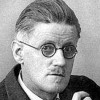
James Joyce (1882–1941) Irish writer, poet
In Arthur Power, Conversations with James Joyce (1974)
I said something which gave you to think I hated cats. But gad, sir, I am one of the most fanatical cat lovers in the business. If you hate them, I may learn to hate you. If your allergies hate them, I will tolerate the situation to the best of my ability.
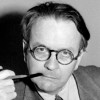
The truth isn’t easily pinned to a page. In the bathtub of history the truth is harder to hold than the soap and much more difficult to find.
Terry Pratchett (1948–2015) English author
Discworld No. 5, Sourcery (1988)

It is better to be praised by another than by oneself.
[βέλτερον ὑφ’ ἑτέρου ἢ ὑφ’ ἑαυτοῦ ἐπαινέεσθαι.]
Democritus (c. 460 BC - c. 370 BC) Greek philosopher
Frag. 114 (Diels) [tr. Freeman (1948)]
(Source)
Original Greek. Diels citation "114. (117 N.) DEMOKRATES. 82." Freeman notes this as one of the Gnômae, from a collection called "Maxims of Democratês," but because Stobaeus quotes many of these as "Maxims of Democritus," they are generally attributed to the latter. The same translation is made by @sentantiq (2016).
Another translation: "It is better to be praised by others than by oneself." [tr. Barnes (1987)]
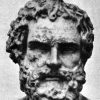
The formula for prison is a lack of space counterbalanced by a surplus of time. This is what really bothers you, that you can’t win. Prison is lack of alternatives, and the telescopic predictability of the future is what drives you crazy.
Joseph Brodsky (1940–1996) Russian-American poet, essayist, Nobel laureate, US Poet Laureate [Iosif Aleksandrovič Brodskij]
“Less Than One,” Less Than One: Selected Essays (1986)
(Source)

The human mind seldom arrives at truth upon any subject till it has first reached the extremity of error.
Benjamin Rush (1746–1813) American physician, writer, educator, humanitarian
“Effects of Public Punishments Upon Criminals, and Upon Society” (1787)
(Source)

Nothing predicts future behavior as much as past impunity.
Darius Rejali (b. c. 1959) Iranian-American academic, political scientist
In Jane Mayer, “Torture and the Truth,” New Yorker (14 Dec 2014)
(Source)

To laugh often and much; to win the respect of intelligent people and the affection of children; to earn the appreciation of honest critics and endure the betrayal of false friends; to appreciate beauty, to find the best in others; to leave the world a bit better, whether by a healthy child, a garden patch, or a redeemed social condition, to know even one life has breathed easier because you have lived. This is to have succeeded.
Ralph Waldo Emerson (1803–1882) American essayist, lecturer, poet
(Misattributed)
This is regularly attributed to Emerson, but has not been found in his work. The original appears to be a contest essay written by Bessie A. Stanley of Lincoln, Nebraska in 1905:He has achieved success who has lived well, laughed often and loved much; who has gained the respect of intelligent men and the love of little children; who has filled his niche and accomplished his task; who has left the world better than he found it, whether by an improved poppy, a perfect poem, or a rescued soul; who has never lacked appreciation of earth’s beauty or failed to express it; who has always looked for the best in others and given the best he had; whose life was an inspiration; whose memory a benediction.
In 1951, Albert E. Wiggam, a newspaper columnist, wrote this similar passage, claiming it was an abridged version of something Emerson wrote:To laugh often and love much; to win the respect of intelligent persons and the affection of children; to earn the approbation of honest critics and endure the betrayal of false friends; to appreciate beauty. To find the best in others; to give one’s self; to leave the world a bit better, whether by a healthy child, a garden patch or a redeemed social condition; to have played and laughed with enthusiasm and sung with exaltation; to know even one life has breathed easier because you have lived -- this is to have succeeded.
Variations of both quotations exist, but Wiggam seems to be the source of the Emerson reference. This was later cemented by Ann Landers producing the variation at the top of this post, citing Emerson but not Wiggam. She also at other times attributed it to Harry Emerson Fosdick and Bessie A. Stanley.
More information here:
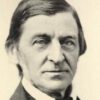
You must make up your mind to act decidedly and take the consequences. No good is ever done in this world by hesitation.
T. H. Huxley (1825–1895) English biologist [Thomas Henry Huxley]
Letter to Anton Dohrn (1873-10-17)
(Source)
If a man should ascend alone into heaven and behold clearly the structure of the universe and the beauty of the stars, there would be no pleasure for him in the awe-inspiring sight, which would have filled him with delight if he had had someone to whom he could describe what he had seen.
[Si quis in coelum ascendisset, naturamque mundi, et pulchritudinem siderum perspexisset, insuavem illam admirationem ei fore; quae jucudissima fuisset, si aliquem, cui narraret, habuisset.]
Marcus Tullius Cicero (106–43 BC) Roman orator, statesman, philosopher
Laelius De Amicitia [Laelius on Friendship], ch. 23 / sec. 88 (44 BC) [tr. Falconer (1923)]
(Source)
Original Latin. Cicero attributes this as a paraphrase of Archytas of Tarentum (d. 394 BC), a Pythagorean philosopher and astronomer. Other translations:If any one could have ascended to the sky, and surveyed the structure of the universe, and the beauty of the stars, that such admiration would be insipid to him; and yet it would be most delightful if he had someone to whom he might describe it.
[tr. Edmonds (1871)]If one had ascended to heaven, and had obtained a full view of the nature of the universe and the beauty of the stars, yet his admiration would be without delight, if there were no one to whom he could tell what he had seen.
[tr. Peabody (1887)]If a man could ascend to heaven and get a clear view of the natural order of the universe, and the beauty of the heavenly bodies, that wonderful spectacle would give him small pleasure, though nothing could be conceived more delightful if he had but had some one to whom to tell what he had seen.
[tr. Shuckburgh (1909)]If a man could mount to heaven and survey the mighty universe with all the planetary orbs, his admiration of its beauties would be much diminished, unless he had someone to share in his pleasure.
[Source]
The greatest problem about old age is the fear that it may go on too long.
A. J. P. Taylor (1906–1990) British historian, journalist, broadcaster [Alan John Percivale Taylor]
An Old Man’s Diary, entry from 1981 (1984)
Happiness does not come from doing easy work but from the afterglow of satisfaction that comes after the achievement of a difficult task that demanded our best.
Wilferd A. Peterson (1900–1995) American writer, magazine editor
“The Art of Happiness,” This Week Magazine (1961-02-04)
(Source)
Collected in The Art of Living (1961).
Almost universally credited, without citation, to Theodore Isaac Rubin, but I've been unable to find the phrase in Rubin's works or credited to him earlier than Peterson's essay.

Throughout our nervous history, we have constructed pyramidic towers of evil, ofttimes in the name of good. Our greed, fear and lasciviousness have enabled us to murder our poets, who are ourselves, to castigate our priests, who are ourselves. The lists of our subversions of the good stretch from before recorded history to this moment. We drop our eyes at the mention of the bloody, torturous Inquisition. Our shoulders sag at the thoughts of African slaves lying spoon-fashion in the filthy hatches of slave-ships, and the subsequent auction blocks upon which were built great fortunes in our country. We turn our heads in bitter shame at the remembrance of Dachau and the other gas ovens, where millions of ourselves were murdered by millions of ourselves. As soon as we are reminded of our actions, more often than not we spend incredible energy trying to forget what we’ve just been reminded of.
Maya Angelou (1928–2014) American poet, memoirist, activist [b. Marguerite Ann Johnson]
“Facing Evil,” Interview by Bill Moyers (1982)
(Source)

Learning and living. But they are really the same thing, aren’t they? There is no experience from which you can’t learn something. … And the purpose of life, after all, is to live it, to taste experience to the utmost, to reach out eagerly and without fear for newer and richer experience.
Eleanor Roosevelt (1884–1962) American politician, diplomat, activist; First Lady of the US (1933–45)
You Learn By Living, Introduction (1960)

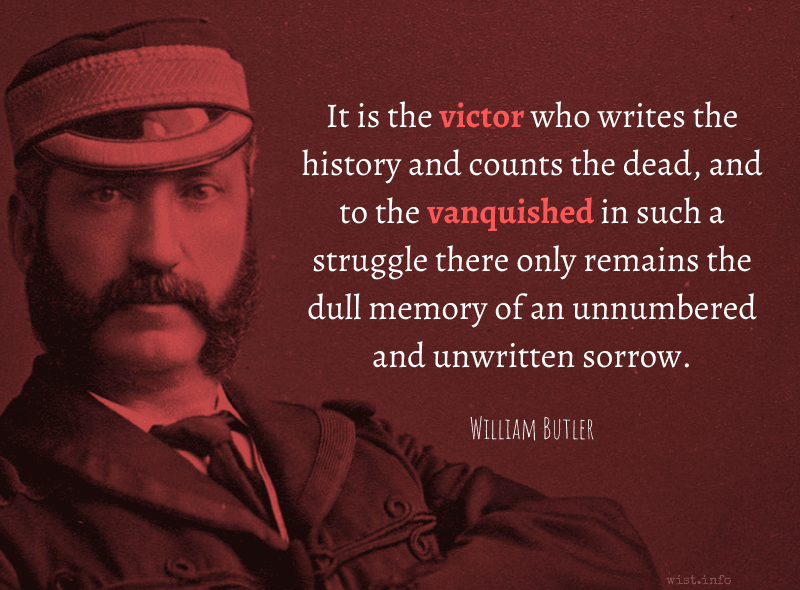
It is the victor who writes the history and counts the dead, and to the vanquished in such a struggle there only remains the dull memory of an unnumbered and unwritten sorrow.
William Butler (1838–1910) Irish British Army officer, writer, adventurer
Charles George Gordon, ch. 1 (1891)
(Source)
My life so far has been a long series of things I wasn’t ready for.
Ashleigh Brilliant (b. 1933) Anglo-American epigramist, aphorist, cartoonist
Pot-Shots, #3237

The same distinction marks off Tragedy from Comedy; for Comedy aims at representing men as worse, Tragedy as better than in actual life.
[ἐν αὐτῇ δὲ τῇ διαφορᾷ καὶ ἡ τραγῳδία πρὸς τὴν κωμῳδίαν διέστηκεν: ἡ μὲν γὰρ χείρους ἡ δὲ βελτίους μιμεῖσθαι βούλεται τῶν νῦν.]
Aristotle (384–322 BC) Greek philosopher
Poetics [Περὶ ποιητικῆς, De Poetica], ch. 2, sec. 4 / 1448a (c. 335 BC) [tr. Butcher (1895)]
(Source)
Original Greek. Other translations:This difference it is that distinguishes Tragedy and Comedy also; the one would make its personages worse, and the other better, than the men of the present day.
[tr. Bywater (1909)]Tragedy and Comedy are at the Poles: for the former means to portray a superior, the latter an inferior being to modern man.
[tr. Margoliouth (1911)]It is just in this respect that tragedy differs from comedy. The latter sets out to represent people as worse than they are to-day, the former as better.
[tr. Fyfe (1932)]Tragedy too is distinguished from comedy by precisely this difference; comedy prefers to represent people who are worse than those who exist, tragedy people who are better.
[tr. Janko (1987), 1.3]And tragedy stands in the same relation of difference to comedy; for the one tends to take as subjects men worse than the general run, and the other takes men better than we are.
[tr. Whalley (1997)]And by this very difference tragedy stands apart in relation to comedy, for the latter intends to imitate those who are worse, and the former better, than people are now.
[tr. Sachs (2006)]The very same difference makes the distinction between tragedy and comedy: the latter aims to represent people as worse, and the former as better, than people nowadays are.
[tr. Kenny (2013)]
There are but few thinkers in the world but a great many people who think they think.
That is, natural selection built the brain to survive in the world and only incidentally to understand it at a depth greater than is needed to survive. The proper task of scientists is to diagnose and correct the misalignment.
E. O. Wilson (1929–2021) American biologist, naturalist, writer [Edward Osborne Wilson]
Consilience, ch. 4 (1998)
(Source)
A censor is a man who has read about Joshua and forgotten about Canute. The censor believes that he can hold back the mighty traffic of life with a tin whistle and a raised right hand. For, after all, it is life with which he quarrels.
And I’ve always said, you know, that I don’t respect people that don’t proselytize. I don’t respect that at all. If you believe that there’s a heaven and hell, and people could be going to hell — or not getting eternal life, or whatever — and you think that, “Well, it’s not really worth tellin’ ’em this, because it would make it socially awkward.” And atheists who think that people shouldn’t proselytize, “Just leave me alone. Keep your religion to yourself.” How much do you have to hate somebody to not proselytize? How much do you have to hate somebody to believe that everlasting life is possible and not tell them that?
I mean, if I believe, beyond a shadow of a doubt, that a truck was coming at you and you didn’t believe it, that a truck was bearing down on you, there’s a certain point where I tackle you — and this is more important than that.
Penn Jillette (b. 1955) American stage magician, actor, musician, author
“A Gift of a Bible,” Penn Says, ep. 192 (9 Dec 2008)
(Source)

Every day of our lives we are on the verge of making those changes that would make all the difference.
Mignon McLaughlin (1913–1983) American journalist and author
The Neurotic’s Notebook, ch. 4 (1963)
(Source)
And speech he has learned, and thought
So swift, and the temper of mind
To dwell within cities, and not to lie bare
Amid the keen, biting frosts
Or cower beneath pelting rain;
Full of resource against all that comes to him
is Man. Against Death alone
He is left with no defence.[καὶ φθέγμα καὶ ἀνεμόεν φρόνημα καὶ ἀστυνόμους
ὀργὰς ἐδιδάξατο καὶ δυσαύλων
πάγων ὑπαίθρεια καὶ δύσομβρα φεύγειν βέλη
παντοπόρος: ἄπορος ἐπ᾽ οὐδὲν ἔρχεται
τὸ μέλλον: Ἅιδα μόνον φεῦξιν οὐκ ἐπάξεται.]Sophocles (496–406 BC) Greek tragic playwright
Antigone, l. 354ff, Stasimon 1, Strophe 2 [Chorus] (441 BC) [tr. Kitto (1962)]
(Source)
Original Greek. Other translations:Language and lofty thought,
And dispositions meet for order'd cities,
These he hath taught himself; -- and how to shun
The shafts of comfortless winter, --
Both those which smite when the sky is clear,
And those which fall in showers; --
with plans for all things,
Planless in nothing, meets he the future!
Of death alone the avoidance
No foreign aid will bring.
[tr. Donaldson (1848)]Speech and the wind-swift speed of counsel and civic wit,
He hath learnt for himself all these; and the arrowy rain to fly
And the nipping airs that freeze, 'neath the open winter sky.
He hath provision for all: fell plague he hath learnt to endure;
Safe whate'er may befall: yet for death he hath found no cure.
[tr. Storr (1859)]Wise utterance and wind-swift thought, and city-moulding mind,
And shelter from the clear-eyed power of biting frost,
He hath taught him, and to shun the sharp, roof-penetrating rain, --
Full of resource, without device he meets no coming time;
From Death alone he shall not find reprieve;
No league may gain him that relief.
[tr. Campbell (1873)]Speech and thought fast as the wind and the moods that give order to a city he has taught himself, and how to flee the arrows of the inhospitable frost under clear skies and the arrows of the storming rain. He has resource for everything. Lacking resource in nothing he strides towards what must come. From Death alone he shall procure no escape.
[tr. Jebb (1891)]And speech, and wind-swift thought, and all the moods that mould a state, hath he taught himself; and how to flee the arrows of the frost, when 'tis hard lodging under the clear sky, and the arrows of the rushing rain; yea, he hath resource for all; without resource he meets nothing that must come: only against Death shall he call for aid in vain.
[tr. Jebb (1917)]Words also, and thought as rapid as air,
He fashions to his good use; statecraft is his,
And his the skill that deflects the arrows of snow,
The spears of winter rain: from every wind
He has made himself secure -- from all but one:
In the late wind of death he cannot stand.
[tr. Fitts/Fitzgerald (1939)]The use of language, the wind-swift motion of brain
He learnt; found out the laws of living together
In cities, building him shelter against the rain
And wintry weather.
There is nothing beyond his power. His subtlety
Meeteth all chance, all danger conquereth.
For every ill he hath found its remedy,
Save only death.
[tr. Watling (1947), l. 295ff]Language, and thought like the wind
and the feelings that make the town,
he has taught himself, and shelter against the cold,
refuge from rain. He can always help himself.
He faces no future helpless. There's only death
that he cannot find an escape from.
[tr. Wyckoff (1954)]And speech and thought, quick as the wind
and the mood and mind for law that rules the city --
all these he has taught himself
and shelter from the arrows of the frost
when there's rough lodging under the cold clear sky
and the shafts of lashing rain --
ready, resourceful man!
Never without resources
never an impasse as he marches on the future --
only Death, from Death alone he will find no rescue.
[tr. Fagles (1982)]Language and a mind swift as the wind
For making plans --
These he has taught himself --
And the character to live in cities under law.
He's learned to take cover from a frost
And escape sharp arrows of sleet.
He has the means to handle every need,
Never steps toward the future without the means.
Except for Death: He's got no relief from that.
[tr. Woodruff (2001)]Both language and thought swift as wind
and impulses that govern cities,
he has taught himself, as well as how
to escape the shafts of rain
while encamped beneath open skies.
All resourceful, he approaches no future thing
to come without resource. From Hades alone
he will not contrive escape.
[tr. Tyrell/Bennett (2002)]And man has learnt speech and thought, swifter than the wind he mastered
And learnt to govern his cities well
And this omniscient being has learnt how to avoid the blasts of the wild open air: the arrows of the freezing night, the dreadful wind driven piercing gale!
He’s prepared for all events bar Death and from Death he can find no escape.
[tr. Theodoridis (2004)]He’s taught himself speech and wind-swift thought,
trained his feelings for communal civic life,
learning to escape the icy shafts of frost,
volleys of pelting rain in winter storms,
the harsh life lived under the open sky.
That’s man -- so resourceful in all he does.
There’s no event his skill cannot confront --
other than death -- that alone he cannot shun.
[tr. Johnston (2005), l. 405ff]He taught himself language and wind-like thought and city-ruling urges, how to flee the slings of frost under winter's clear sky and the arrows of stormy rain, ever-resourceful. Against no possibility is he at a loss. For death alone he finds no aid.
[tr. Thomas (2005)]
But don’t you know, there are some things that can beat smartness and foresight? Awkwardness and stupidity can. The best swordsman in the world doesn’t need to fear the second best swordsman in the world; no, the person for him to be afraid of is some ignorant antagonist who has never had a sword in his hand before; he doesn’t do the thing he ought to do, and so the expert isn’t prepared for him; he does the thing he ought not to do: and often it catches the expert out and ends him on the spot.
Mark Twain (1835–1910) American writer [pseud. of Samuel Clemens]
A Connecticut Yankee in King Arthur’s Court, ch. 34 (1889)
(Source)
Origin of more simplified versions of the phrase. More discussion: The Best Swordsman in the World Doesn’t Need To Fear the Second Best Swordsman – Quote Investigator.
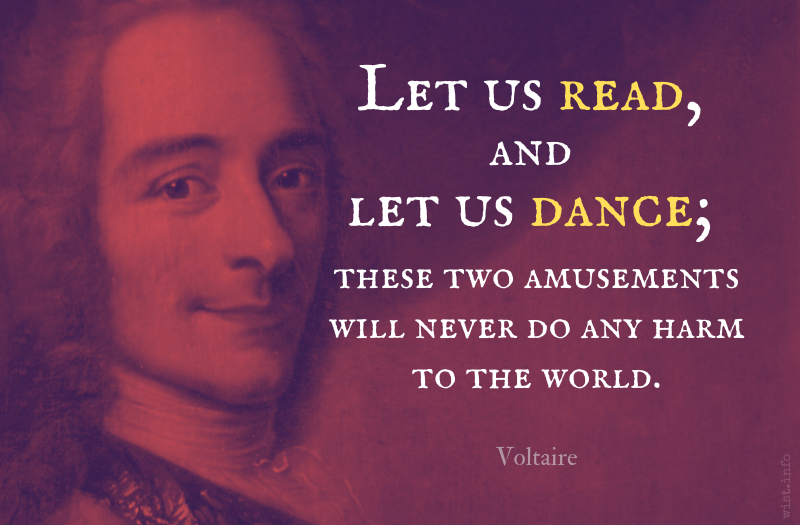
Let us read, and let us dance; these two amusements will never do any harm to the world.
Voltaire (1694–1778) French writer [pseud. of Francois-Marie Arouet]
Philosophical Dictionary [Dictionnaire Philosophique], “Liberty of the Press” (1764)
(Source)

A bore: Someone who persists in holding to his own views after we have enlightened him with ours.
Malcolm Forbes (1919–1990) American billionaire
(Attributed)
Quoted in Ted Goodman, ed., The Forbes Book of Business Quotations (1997).

Spent with fatigue, and shrunk with pining fast,
My craving bowels still require repast.
Howe’er the noble, suffering mind may grieve
Its load of anguish, and disdain to live,
Necessity demands our daily bread;
Hunger is insolent, and will be fed.[ἀλλ᾽ ἐμὲ μὲν δορπῆσαι ἐάσατε κηδόμενόν περ:
οὐ γάρ τι στυγερῇ ἐπὶ γαστέρι κύντερον ἄλλο
ἔπλετο, ἥ τ᾽ ἐκέλευσεν ἕο μνήσασθαι ἀνάγκῃ
καὶ μάλα τειρόμενον καὶ ἐνὶ φρεσὶ πένθος ἔχοντα,
ὡς καὶ ἐγὼ πένθος μὲν ἔχω φρεσίν, ἡ δὲ μάλ᾽ αἰεὶ
ἐσθέμεναι κέλεται καὶ πινέμεν, ἐκ δέ με πάντων
ληθάνει ὅσσ᾽ ἔπαθον, καὶ ἐνιπλησθῆναι ἀνώγει.]Homer (fl. 7th-8th C. BC) Greek author
The Odyssey [Ὀδύσσεια], Book 7, l. 215ff (7.215) [Odysseus to Alcinous] (c. 700 BC) [tr. Pope (1725)]
(Source)
Original Greek. Other translations:Worse than an envious belly nothing is.
It will command his strict necessities,
Of men most griev’d in body or in mind,
That are in health, and will not give their kind
A desp’rate wound. When most with cause I grieve,
It bids me still, Eat, man, and drink, and live;
And this makes all forgot. Whatever ill
I ever bear, it ever bids me fill.
[tr. Chapman (1616)]No creature is so fierce as is the gut,
And so loud barketh when it is forgot,
That out of mind it never can be put,
But will be heard whether one will or not.
So ’tis with me, that am afflicted sore,
Yet still my belly bids me eat and drink,
And forget all I had endured before,
And on my misery no more to think.
[tr. Hobbes (1675), l. 201ff]But let me eat, comfortless as I am,
Uninterrupted; for no call is loud
As that of hunger in the ears of man;
Importunate, unreas’nable, it constrains
His notice, more than all his woes beside.
So, I much sorrow feel, yet not the less
Hear I the blatant appetite demand
Due sustenance, and with a voice that drowns
E’en all my suff’rings, till itself be fill’d.
[tr. Cowper (1792), l. 266ff]But let me feed in peace, though sore distressed.
Nothing more shameless is than Appetite,
Who still, whatever anguish load our breast,
Makes us remember in our own despite
Both food and drink. Thus I, thrice wretched wight,
Carry of inward grief surpassing store,
Yet she constrains me with superior might,
Wipes clean away the memory-written score,
And takes whate'er I give, and taking craveth more.
[tr. Worsley (1861), st. 29]But let me now eat on, tho' sick at heart:
Nought is more shameless than a craving stomach,
Which bids remembrance of herself by force,
Tho' sorely worn the limbs, and sad the heart!
So I am sad at heart: but she for ever
Is bidding me eat and drink; and making forget
All I have borne; and still to gorge compels me!
[tr. Bigge-Wither (1869)]But as for me, suffer me to sup, afflicted as I am; for nought is there more shameless than a ravening belly, which biddeth a man perforce be mindful of him, though one be worn and sorrowful in spirit, even as I have sorrow of heart; yet evermore he biddeth me eat and drink and maketh me utterly to forget all my sufferings, and commandeth me to take my fill.
[tr. Butcher/Lang (1879)]But I pray you amidst of my sorrow that ye suffer me supper to eat,
For nought indeed more shameless than the belly-beast may ye meet,
When need and he are bidding that we mind us of his part,
Although we be worn and wasted and have sorrow in the heart.
Thus I in my my heart have sorry, but the belly evermore
Will bid me to eat and to drink and forget my sorrow sore,
Whatso my soul may have suffered, and to filling forceth me.
[tr. Morris (1887), l. 215ff]But let me now, though sick of heart, take supper; for nothing is more brutal than an angry belly. Perforce it bids a man attend, sadly though he be worn, though grief be on his mind. Even so, I too have grief upon my mind, and yet this ever more calls me to eat and drink; all I have borne it makes me quite forget, and bid me take my fill.
[tr. Palmer (1891)]Nevertheless, let me sup in spite of sorrow, for an empty stomach is a very importunate thing, and thrusts itself on a man's notice no matter how dire is his distress. I am in great trouble, yet it insists that I shall eat and drink, bids me lay aside all memory of my sorrows and dwell only on the due replenishing of itself.
[tr. Butler (1898)]But as for me, suffer me now to eat, despite my grief; for there is nothing more shameless than a hateful belly, which bids a man perforce take thought thereof, be he never so sore distressed and laden with grief at heart, even as I, too, am laden with grief at heart, yet ever does my belly bid me eat and drink, and makes me forget all that I have suffered, and commands me to eat my fill.
[tr. Murray (1919)]But instead I will ask leave to obey my instincts and fall upon this supper, as I would do despite my burden of woe. See now, there is not anything so exigent as a man's ravening belly, which will not leave him alone to feel even so sore a grief as this grief in my heart, but prefers to overwhelm his misery with its needs for meat and drink, forcibly and shamelessly compelling him to put its replenishment above his soul's agony.
[tr. Lawrence (1932)]But all I ask of you now is your leave to eat my supper, in spite of all my troubles. For nothing in the world is so incontinent as a man’s accursed appetite. However afflicted he may be and sick at heart, it calls for attention so loudly that he is bound to obey it. Such is my case: my heart is sick with grief, yet my hunger insists that I shall eat and drink. It makes me forget all I have suffered and forces me to take my fill.
[tr. Rieu (1946)]You will indulge me if I finish dinner--?
grieved though I am to say it. There's no part
of man more like a dog than brazen Belly,
crying to be remembered -- and it must be --
when we are mortal weary and sick at heart;
and that is my condition. Yet my hunger
drives me to take this food, and think no more
of my afflictions. Belly must be filled.
[tr. Fitzgerald (1961)]But leave me now to eat my dinner, for all my sorrow,
for there is no other thing so shameless as to be set over
the belly, but when she rather uses constraint and makes me think of her,
even when sadly worn, when in my heart I have sorrow
as now I have sorrow in my heart, eyt still forever
she tells me to eat and drink and forces me to forgetfulness
of all I have suffered, and still she is urgent that I must fill her.
[tr. Lattimore (1965)]But let me, even in my sorrow, eat.
There is no thing more shameless than the belly;
however tried we are, whatever pain
assails our heart, the hateful stomach claims
its right to be remember: it constrains
us always, forcing us to eat and drink,
even as I, though sick at heart, am now
compelled to set aside my long ordeal:
my belly bids me see that it be filled.
[tr. Mandelbaum (1990)]But despite my misery, let me finish dinner.
The belly’s a shameless dog, there’s nothing worse.
Always insisting, pressing, it never lets us forget --
destroyed as I am, my heart racked with sadness,
sick with anguish, still it keeps demanding,
"Eat, drink!" It blots out all the memory
of my pain, commanding, "Fill me up!"
[tr. Fagles (1996)]But all I want now is to be allowed to eat,
Despite my grief. There is nothing more shameless
Than this belly of ours, which forces a man
To pay attention to it, no matter how many
Troubles he has, how much pain is in his heart.
I have pain my heart, but my belly always
Makes me eat and drink and forget my troubles,
Pestering me to keep it filled.
[tr. Lombardo (2000), l. 228ff]But instead let me eat my dinner in spite of my grieving; since there is not one thing more shameless or gross than the hateful belly, which orders a man to remember it by a compulsion, even if he is exhausted and feels in his heart great sorrow. So even though I have great sorrow of heart, it is always ordering me to devour and to drink, and of all those woes which I have endured it makes me forgetful and bids me to fill up.
[tr. Merrill (2002)]But, in spite of all my troubles, give me leave to eat my supper. For nothing in the world is so shamelessly demanding as a man's confounded stomach. However afflicted he may be and sick at heart, it calls for attention so loudly that he is bound to obey it. such is my case: my heart is sick with grief, yet my stomach insists that I eat and drink. It makes me forget all I have suffered and forces me to eat my fill.
[tr. DCH Rieu (2002)]But despite my grief, let me eat, since there is nothing more shameful than the wretched stomach that demands a man’s attention however deep his distress, or heavy his heart, and my heart is heavy now, yet my stomach goes on insisting I eat and drink, making me forget what I suffered, demanding its fill.
[tr. Kline (2004)]But leave me now to eat my supper, distressed though I am; there is nothing more shameless than a man's wretched belly, which lays him under necessity to be mindful of it even when he is sorely troubled and nursing grief in his heart. This is my case: I am nursing grief in my heart, and yet it is forever urging me to eat and drink, making me forget all that I have suffered, always telling me to eat my fill.
[tr. Verity (2016)]But let me have my meal, despite my grief.
The belly is just like a whining dog:
it begs and forces one to notice it,
despite exhaustion or depths of sorry.
My heart is full of sorrow, but my stomach
is always telling me to eat and drink.
It tells me to forget what I have suffered,
and fill it up.
[tr. Wilson (2017)]But first let me eat some dinner, grieving though I am: for nothing exists more shameless than one's loathsome belly, that forces a man to take notice of it at need, however distressed he may be and stricken by grief at heart, as I am grief-stricken now; yet still unremittingly it commands me to eat and drink, forces me to forget everything I have suffered, insists on being refilled!
[tr. Green (2018)]But let me eat my dinner,
though I’m in great distress. For there’s nothing
more shameless than an unhappy stomach,
which bids a man to think about its needs,
even if he’s sad or many troubles
sit heavy on his heart, the way my spirit
is now full of sorrow, yet my belly
is always telling me to eat and drink,
forgetting everything I’ve had to bear,
and forcing me to gorge myself with food.
[tr. Johnston (2019)]

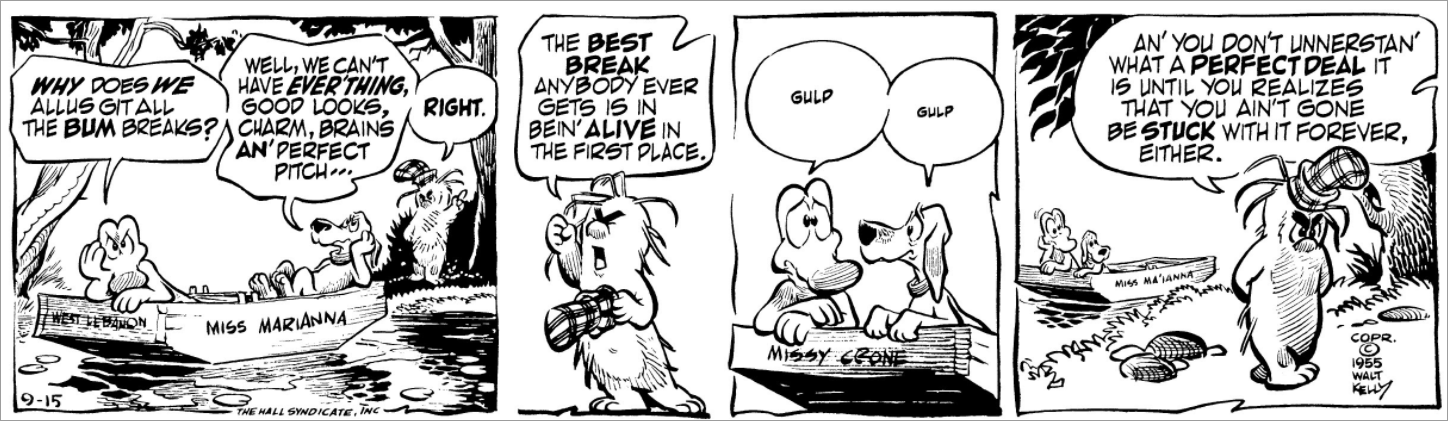
The best break anybody ever gets is in bein’ alive in the first place. An’ you don’t unnerstan’ what a perfect deal it is until you realizes that you ain’t gone be stuck with it forever, either.
Walt Kelly (1913–1973) American animator and cartoonist [Walter Crawford Kelly, Jr.]
“Pogo” [Porky Pine] (15 Sep 1955)
You submit to tyranny when you renounce the difference between what you want to hear and what is actually the case. This renunciation of reality can feel natural and pleasant, but the result is your demise as an individual — and thus the collapse of any political system that depends upon individualism.
Timothy Snyder (b. 1969) American historian, author
On Tyranny: Twenty Lessons from the Twentieth Century (2017)
(Source)
It was the fixation of businessmen that the W.P.A. did nothing but lean on shovels. I had an uncle who was particularly irritated at shovel-leaning. When he pooh-poohed my contention that shovel leaning was necessary, I bet him five dollars, which I didn’t have, that he couldn’t shovel sand for fifteen timed minutes without stopping. He said a man should give a good day’s work and grabbed a shovel. At the end of three minutes his face was red, at six he was staggering and before eight minutes were up his wife stopped him to save him from apoplexy. And he never mentioned shovel-leaning again. I’ve always been amused at the contention that brain work is harder than manual labor. I never knew a man to leave a desk for a muck-stick if he could avoid it.
We are all at a wonderful ball where the champagne sparkles in every glass and soft laughter falls upon the summer air. We know, by the rules, that at some moment the Black Horsemen will come shattering through the great terrace doors, wreaking vengeance and scattering the survivors. Those who leave early are saved, but the ball is so splendid no one wants to leave while there is still time, so that everyone keeps asking, “What time is it? What time is it?” but none of the clocks have any hands.
George Goodman (1930–2014) American author, economics broadcast commentator [pseud. Adam Smith]
Supermoney, Part 3, ch. 2 (1972)
(Source)
An explanation he gave to a "mass-circulation magazine" about the stock bubble in 1968. He later incorporated a variation of the story in a republication of his 1968 The Money Game:We are all at a wonderful party, and by the rules of the game we know that at some point in time the Black Horsemen will burst through the great terrace doors to cut down the revelers; those who leave early may be saved, but the music and wines are so seductive that we do not want to leave, but we do ask, "What time is it? What time is it?" Only none of the clocks have any hands.

Authors like cats because they are such quiet, lovable, wise creatures, and cats like authors for the same reasons.
Robertson Davies (1913–1995) Canadian author, editor, publisher
“Mehitabel,” Toronto Daily Star (21 Nov 1959)
Reprinted in The Enthusiasms of Robertson Davies (1990).

Something Vimes had learned as a young guard drifted up from memory. If you have to look along the shaft of an arrow from the wrong end, if a man has you entirely at his mercy, then hope like hell that man is an evil man. Because the evil like power, power over people, and they want to see you in fear. They want you to know you’re going to die. So they’ll talk. They’ll gloat.
They’ll watch you squirm. They’ll put off the moment of murder like another man will put off a good cigar.
So hope like hell your captor is an evil man. A good man will kill you with hardly a word.
It is not pointless to acquire wealth but it is more evil than anything to get it from injustice.
[Χρήματα πορίζειν μὲν οὐκ ἀχρεῖον, ἐξ ἀδικίης δὲ πάντων κάκιον.]
Democritus (c. 460 BC - c. 370 BC) Greek philosopher
Frag. 78 (Diels) [tr. @sententiq (2018)]
(Source)
Original Greek. Diels citation "78. (74 N.) DEMOKRATES. 43."; collected in Joannes Stobaeus (Stobaios) Anthologium 4, 31, 21. Bakewell lists this under "The Golden Sayings of Democritus." Freeman notes this as one of the Gnômae, from a collection called "Maxims of Democratês," but because Stobaeus quotes many of these as "Maxims of Democritus," they are generally attributed to the latter. Other translations:
The surest defense against Evil is extreme individualism, originality of thinking, whimsicality, even — if you will — eccentricity. That is, something that can’t be feigned, faked, imitated; something even a seasoned imposter couldn’t be happy with. Something, in other words, that can’t be shared, like your own skin: not even by a minority. Evil is a sucker for solidity. It always goes for big numbers, for confident granite, for ideological purity, for drilled armies and balanced sheets. Its proclivity for such things has to do with its innate insecurity, but this realization, again, is of small comfort when Evil triumphs.
Joseph Brodsky (1940–1996) Russian-American poet, essayist, Nobel laureate, US Poet Laureate [Iosif Aleksandrovič Brodskij]
Commencement Address, Williams College (24 May 1984)
(Source)
It is not sufficient that the state of affairs which we seek to promote should be better than the state of affairs which preceded it; it must be sufficiently better to make up for the evils of the transition.
John Maynard Keynes (1883–1946) English economist
“The Political Doctrines of Edmund Burke” (1904)
(Source)
Failure isn’t about a lack of “natural intelligence,” whatever that is. Instead, failure is born from a messy combination of bad circumstances: high anxiety, low motivation, gaps in background knowledge. Most of all, we fail because, when the moment comes to confront our shortcomings and open ourselves up to teachers and peers, we panic and deploy our defenses instead.
Ben Orlin (b. c. 1988) American math teacher, author
“What It Feels Like to Be Bad at Math,” Slate (29 Apr 2013)
(Source)
Originally posted on his blog: What It Feels Like to Be Bad at Math – Math with Bad Drawings.

I see only one danger about all this — that you might be led to take too many precautions. To take precautions, that, I find, is really dangerous. Courage is the only precaution a human being needs!
Alfred Adler (1870–1937) Austrian psychologist
(Attributed)
(Source)
Comment to a patient who chronically overworked herself. In Phyllis Bottome, Alfred Adler: A Biography, ch. 4 (1939). Often paraphrased, "The chief danger in life is that you may take too many precautions."
We may then lay down this rule of friendship — neither ask nor consent to do what is wrong. For the plea “for friendship’s sake” is a discreditable one, and not to be admitted for a moment. This rule holds good for all wrong-doing, but more especially in such as involves disloyalty to the republic.
[Haec igitur lex in amicitia sanciatur, ut neque rogemus res turpes nec faciamus rogati. Turpis enim excusatio est et minime accipienda cum in ceteris peccatis, tum si quis contra rem publicam se amici causa fecisse fateatur.]
Marcus Tullius Cicero (106–43 BC) Roman orator, statesman, philosopher
Laelius De Amicitia [Laelius on Friendship], ch. 12 / sec. 40 (44 BC) [tr. Shuckburgh (1909)]
(Source)
Original Latin. Other translations:Let this law therefore be established in friendship, viz., that we should neither ask things that are improper, nor grant them when asked; for it is a disgraceful apology, and by no means to be admitted, as well in the case of other offenses, as when any one avows he has acted against the state for the sake of a friend.
[tr. Edmonds (1871)]As to friendship, then, let this law be enacted, that we neither ask of a friend what is wrong, nor do what is wrong at a friend’s request. The plea that it was for a friend’s sake is a base apology, -- one that should never be admitted with regard to other forms of guilt, and certainly not as to crimes against the State.
[tr. Peabody (1887)]Therefore let this law be established in friendship: neither ask dishonourable things, nor do them, if asked. And dishonourable it certainly is, and not to be allowed, for anyone to plead in defence of sins in general and especially of those against the State, that he committed them for the sake of a friend.
[tr. Falconer (1923)]Therefore, let this law be established for friendship: that we should neither ask for foul things nor fulfill requests for them. For this is a foul excuse and ought not be accepted for any crime, but especially not if someone is shown to have placed themselves against the Republic for the sake of a friend.
[Source]
Christ by his crucifixion demonstrated exactly what the assault of cruelty on the innocent means; and the subsequent services devised by the early church commemorated the beauty of the virtue that was slain and the beastliness shown by the slayer, and reiterated the warning that this was the kind of crime man was inherently likely to commit unless he watched himself. There could be no more proper medicine for the human disease. But the church has poured as much of the draft as possible down the drain by its attempts to account for the crucifixion of Christ as an atonement for the sins of man instead of a demonstration of them.
Rebecca West (1892–1983) British author, journalist, literary critic, travel writer [pseud. for Cicily Isabel Fairfield]
“Pleasure Be Your Guide,” The Nation, “Living Philosophies” series #10 (25 Feb 1939)
(Source)
Adapted into Clifton Fadiman, I Believe: The Personal Philosophies of Certain Eminent Men and Women of Our Time (1952).

History gets thicker as it approaches recent times: more people, more events, and more books written about them. More evidence is preserved, often, one is tempted to say, too much. Decay and destruction have hardly begun their beneficent work.
A. J. P. Taylor (1906–1990) British historian, journalist, broadcaster [Alan John Percivale Taylor]
English History 1914-1945, “Revised Bibliography” (1965)
(Source)
If you are a person who looks at the funny side of things, then sometimes when you are lowest, when everything seems totally hopeless, you will come up with some of your best ideas. Happiness does not create humor. There’s nothing funny about being happy. Sadness creates humor.
Charles Schulz (1922–2000) American cartoonist
“On Staying Power,” My Life with Charlie Brown (2010) [ed. Inge]
(Source)

The history is right perhaps, but let us not forget, it was written by the victors.
[L’histoire est juste peut-être, mais qu’on ne l’oublie pas, elle a été écrite par les vainqueurs.]
Alexis Guignard, comte de Saint-Priest (1805–1851) French diplomat and historian
History of Royalty [Histoire de la Royauté] (1842)
(Source)

More books have resulted from somebody’s need to write than from anybody’s need to read.
Ashleigh Brilliant (b. 1933) Anglo-American epigramist, aphorist, cartoonist
Pot-Shots, #3273
(Source)
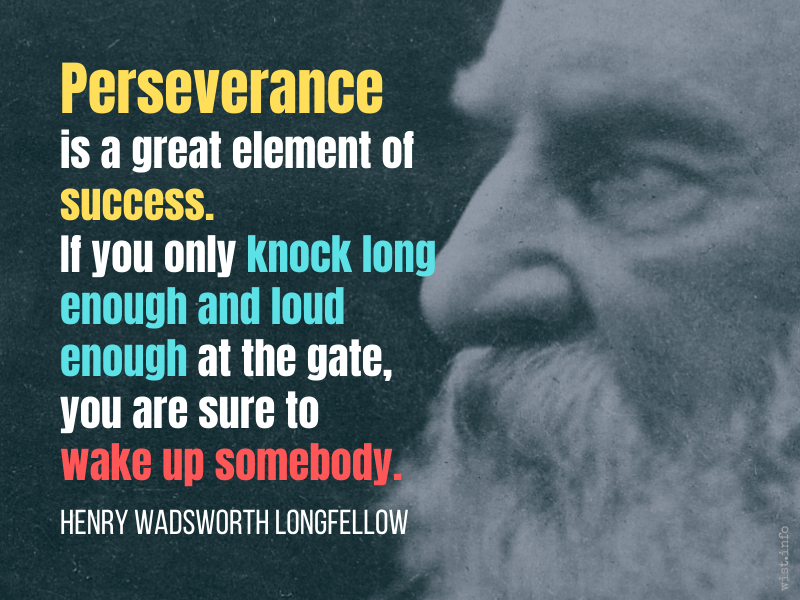
Perseverance is a great element of success. If you only knock long enough and loud enough at the gate, you are sure to wake up somebody.
Sex addiction and porn addiction crusaders complain that porn is terrible sex education. I agree, just as watching a car chase in an action movie is a terrible way to learn to drive.
Marty Klein (b. 1950) American sex therapist, author, public policy analyst
“You’re Addicted to What?” The Humanist (Jul/Aug 2012)
(Source)

When public men indulge themselves in abuse, when they deny others a fair trial, when they resort to innuendo and insinuation, to libel, scandal, and suspicion, then our democratic society is outraged, and democracy is baffled. It has no apparatus to deal with the boor, the liar, the lout, and the antidemocrat in general.
J. William Fulbright (1905–1995) American politician
Speech, US Senate (2 Feb 1954)
(Source)
In the Congressional Record, Vol. 100, p. 1105.

People say we ought not to allow ourselves to be drawn into a theoretical antagonism between Nazidom and democracy; but the antagonism is here now. It is this very conflict of spiritual and moral ideas which gives the free countries a great part of their strength. You see these dictators on their pedestals, surrounded by the bayonets of their soldiers and the truncheons of their police. On all sides they are guarded by masses of armed men, cannons, aeroplanes, fortifications, and the like — they boast and vaunt themselves before the world, yet in their hearts there is unspoken fear. They are afraid of words and thoughts; words spoken abroad, thoughts stirring at home — all the more powerful because forbidden — terrify them. A little mouse of thought appears in the room, and even the mightiest potentates are thrown into panic. They make frantic efforts to bar our thoughts and words; they are afraid of the workings of the human mind. Cannons, airplanes, they can manufacture in large quantities; but how are they to quell the natural promptings of human nature, which after all these centuries of trial and progress has inherited a whole armoury of potent and indestructible knowledge?
Winston Churchill (1874–1965) British statesman and author
“The Defence of Freedom and Peace (The Lights are Going Out),” radio broadcast (16 Oct 1938)
(Source)
Freedom only means the freedom to be stupid. Because you don’t need freedom to do what everybody thinks you should.
Penn Jillette (b. 1955) American stage magician, actor, musician, author
“Honest Questions with Penn Jillette,” Interview by Glen Beck, CNN (2 Nov 2007)
(Source)
Because society would rather we always wore a pretty face, women have been trained to cut off anger.

Many wonders, many terrors,
But none more wonderful than the human race
Or more dangerous.
This creature travels on a winter gale
Across the silver sea,
Shadowed by high-surging waves,
While on Earth, grandest of the gods,
He grinds the deathless, tireless land away,
Turning and turning the plow
From year to year, behind driven horses.[πολλὰ τὰ δεινὰ κοὐδὲν ἀνθρώπου δεινότερον πέλει.
τοῦτο καὶ πολιοῦ πέραν πόντου χειμερίῳ νότῳ
χωρεῖ, περιβρυχίοισιν
περῶν ὑπ᾽ οἴδμασιν.
θεῶν τε τὰν ὑπερτάταν, Γᾶν
ἄφθιτον, ἀκαμάταν, ἀποτρύεται
ἰλλομένων ἀρότρων ἔτος εἰς ἔτος
ἱππείῳ γένει πολεύων.]Sophocles (496–406 BC) Greek tragic playwright
Antigone, l. 332ff, Stasimon 1, Strophe 1 [Chorus] (441 BC) [tr. Woodruff (2001)]
(Source)
Original Greek. Other translations:Many the things that mighty be,
And nought is more might than -- MAN.
For he can cross the foaming ocean,
What time the stormy South is blowing,
Steering amid the mantling waves that roar around him.
And for his uses he wearieth
Earth, the highest Deity,
The immortal, the untiring one,
As year by year the ploughs are drawn
Up and down the furrow'd field,
To and fro his harness'd teams --
The seed of horses -- driving.
[tr. Donaldson (1848)]Many wonders there be, but naught more wondrous than man;
Over the surging sea, with a whitening south wind wan,
Through the foam of the firth, man makes his perilous way;
And the eldest of deities Earth that knows not toil nor decay
Ever he furrows and scores, as his team, year in year out,
With breed of the yoked horse, the ploughshare turneth about.
[tr. Storr (1859)]Many a wonder lives and moves, but the wonder of all is man,
That courseth over the grey ocean, carried of Southern gale,
Faring amidst high-swelling seas that rudely surge around,
And Earth, supreme of mighty Gods, eldest, imperishable,
Eternal, he with patient furrow wears and wears away
As year by year the plough-shares turn and turn, --
Subduing her unwearied strength with children of the steed.
[tr. Campbell (1873)]Wonders are many, and none is more wonderful than man. This power spans the sea, even when it surges white before the gales of the south-wind, and makes a path under swells that threaten to engulf him. Earth, too, the eldest of the gods, the immortal, the unwearied, he wears away to his own ends, turning the soil with the offspring of horses as the plows weave to and fro year after year.
[tr. Jebb (1891)]Wonders are many, and none is more wonderful than man; the power that crosses the white sea, driven by the stormy south-wind, making a path under surges that threaten to engulf him; and Earth, the eldest of the gods, the immortal, the unwearied, doth he wear, turning the soil with the offspring of horses,as the ploughs go to and fro from year to year.
[tr. Jebb (1917)]Numberless are the world’s wonders, but none
More wonderful than man; the stormgray sea
Yields to his prows, the huge crests bear him high;
Earth, holy and inexhaustible, is graven
With shining furrows where his plows have gone
Year after year, the timeless labor of stallions.
[tr. Fitts/Fitzgerald (1939)]Wonders are many on earth, and the greatest of these
Is man, who rides the ocean and takes his way
Through the deeps, though wide-swept valleys of perilous seas
That surge and sway.
He is master of ageless Earth, to his own will bending
The immortal mother of gods by the sweat of his brow,
As year succeeds to year, with toil unending
Of mule and plough.
[tr. Watling (1947), l. 279ff]Many the wonders, but nothing walks stranger than man.
This thing crosses the sea in the winter's storm,
making his path through the roaring waves.
And she, the greatest of gods, the earth --
ageless she is, and unwearied -- he wars her away
as the ploughts go up and down from year to year
and his mules turn up the soil.
[tr. Wyckoff (1954)]Wonders are many, yet of all
Things is Man the most wonderful.
He can sail on the stormy sea
Through tempest rage, and the loud
Waves roar around, as he makes his
Path amid the towering surge.
Earth inexhaustible, ageless, he wearies, as
Backwards and forwards, from season to season, his
Ox-team drives along the ploughshare.
[tr. Kitto (1962)]Numberless wonders
terrible wonders walk the world but none the match for man --
that great wonder crossing the heaving gray sea,
driven on by the blasts of winter
on through breakers crashing left and right,
holds his steady course
and the oldest of the gods he wears away --
the Earth, the immortal, the inexhaustible --
as his plows go back and forth, year in, year out
with the breed of stallions turning up the furrows.
[tr. Fagles (1982), l. 376ff]Many things cause terror and wonder, yet nothing
is more terrifying and wonderful than man.
This thing goes across the gray
sea on the blasts of winter
storms, passing beneath
waters towering ’round him. The Earth,
eldest of the gods,
unwithering and untiring, this thing wears down
as his plows go back and forth year after year
furrowing her with the issue of horses.
[tr. Tyrell/Bennett (2002)]Wonders abound in this world yet no wonder is greater than man. None!
Through the wild white of a frenzied sea and through the screaming northerlies beneath him and through all the furious storms around him, through all this, man can pass!
And Gods’ most glorious Earth, the imperishable, untiring Earth, this man works with his horses and ploughs, year in, year out.
[tr. Theodoridis (2004)]There are many strange and wonderful things,
but nothing more strangely wonderful than man.
He moves across the white-capped ocean seas
blasted by winter storms, carving his way
under the surging waves engulfing him.
With his teams of horses he wears down
the unwearied and immortal earth,
the oldest of the gods, harassing her,
as year by year his ploughs move back and forth.
[tr. Johnston (2005), l. 388ff]This world has many wonders, but nothing is more wondrous than humanity. It crosses even the grey sea with a stormy south wind, passing under churning waves in open water; and the oldest of the gods, immortal, inexhaustible Earth, it wears away. With ploughs it winds back and forth, year after year, turning up the soil with the offspring of horses.
[tr. Thomas (2005)]There are many wonders and none
is more surprising than humanity.
This thing that crosses the sea
as it whorls under a stormy wind
finding a path on enveloping waves.
It wears down imperishable Earth, too,
the oldest of the gods, a tireless deity,
as the plows trace lives from year to year
drawn by the race of horses.
[tr. @sentantiq (2019)]
The entrepreneur, in the classic image, was supposed to have taken a risk, not only with his money but with his very career; but once the founder of a business has taken the big jump he does not usually take serious risks as he comes to enjoy the accumulation of advantages that lead him into great fortune. If there is any risk, someone else is usually taking it. Of late, that someone else […] has been the government of the United States. If a middle-class businessman is in debt for $50,000, he may well be in trouble. But if a man manages to get into debt for $2 million, his creditors, if they can, may well find it convenient to produce chances for his making money in order to repay them.
C. Wright Mills (1916–1962) American sociologist, academic, author [Charles Wright Mills]
The Power Elite (1956)
(Source)
As President of our country and Commander-in-Chief of our military, I accept that people are going to call me awful things every day, and I will always defend their right to do so.
Barack Obama (b. 1961) American politician, US President (2009–2017)
Speech, United Nations (25 Sep 2012)
(Source)

We pay for security with boredom, for adventure with bother.
Peter De Vries (1910–1993) American editor, novelist, satirist
Comfort Me With Apples (1956)
(Source)

Some of the words you’ll find within yourself,
the rest some power will inspire you to say.
You least of all — I know —
were born and reared without the gods’ good will.[τὸν δ᾽ αὖτε προσέειπε θεά, γλαυκῶπις Ἀθήνη:
‘Τηλέμαχ᾽, ἄλλα μὲν αὐτὸς ἐνὶ φρεσὶ σῇσι νοήσεις,
ἄλλα δὲ καὶ δαίμων ὑποθήσεται: οὐ γὰρ ὀίω
οὔ σε θεῶν ἀέκητι γενέσθαι τε τραφέμεν τε.’]Homer (fl. 7th-8th C. BC) Greek author
The Odyssey [Ὀδύσσεια], Book 3, l. 25ff (3.25) [Athena to Telemachus] (c. 700 BC) [tr. Fagles (1996)]
(Source)
Athena (disguised as Mentor) reassuring Telemachus he can go up to Nestor and talk with him without embarrassing himself.
Original Greek. Other translations:Thy mind will some conceit impress,
And something God will prompt thy towardness;
For, I suppose, thy birth, and breeding too,
Were not in spite of what the Gods could do.
[tr. Chapman (1616)]Telemachus, said Pallas, do not fear,
You’ll somewhat prompted be by your own breast
(You never by the Gods neglected were),
The God that loves you will supply the rest.
[tr. Hobbes (1675)]To whom the martial goddess thus rejoin'd:
"Search, for some thoughts, thy own suggesting mind;
And others, dictated by heavenly power,
Shall rise spontaneous in the needful hour.
For nought unprosperous shall thy ways attend,
Born with good omens, and with heaven thy friend."
[tr. Pope (1725)]Thou wilt, in part, thyself
Fit speech devise, and heav’n will give the rest;
For thou wast neither born, nor hast been train’d
To manhood, under unpropitious Pow’rs.
[tr. Cowper (1792), l. 33ff]Thou shalt bethink thee of somewhat in thine own breast, and somewhat the god will give thee to say. For thou, methinks, of all men wert not born and bred without the will of the gods.
[tr. Butcher/Lang (1879)]Some words surely the thought in thine heart shall make,
And some the Gods shall give thee: for this of thee I wot,
That against the will of the Godfolk thy birth and thy life were not.
[tr. Morris (1887)]Some promptings you will find in your own breast, and Heaven will send still more; for, certainly, not unbefriended of the gods have you been born and bred.
[tr. Palmer (1891)]Some things, will be suggested to you by your own instinct, and heaven will prompt you further; for I am assured that the gods have been with you from the time of your birth until now.
[tr. Butler (1898)]"Some things, Telemachus," answered owl-vision Athena, “will be suggested to you by your own instinct, and some superhuman force will prompt you further; for I am assured that the gods have been with you from the time of your birth until now."
[tr. Butler (1898), rev. Kim/McCray/Nagy/Power (2018)]Somewhat thou wilt of thyself devise in thy breast, and somewhat heaven too will prompt thee. For, methinks, not without the favour of the gods hast thou been born and reared.
[tr. Murray (1919)]Your heart will prompt you in part: and other things the spirit will teach you to say. I think if ever anyone was conceived and grew to manhood with the fostering care of the gods, it was yourself.
[tr. Rieu (1946)]Reason and heart will give you words, Telémakhos;
and a spirit will counsel others. I should say
the gods were never indifferent to your life.
[tr. Fitzgerald (1961)]Telemachos, some of it you yourself will see in your own heart,
and some the divinity will put in your mind. I do not
think you could have been born and reared without the gods’ will.
[tr. Lattimore (1965)]You'll come up with some things yourself, Telemachus,
And a god will suggest others. I do not think
You were born and bred without the gods' good will.
[tr. Lombardo (2000)]Some things, Telémachos, you will discover yourself, in your own mind;
others again some god will suggest: I cannot imagine
it was against the gods' wills you received such birth and upbringing.
[tr. Merill (2002)]Telemachus [...], where your own intelligence fails, a god will inspire you. For I think the gods ahve blessed both your birth and your progress to manhood.
[tr. DCH Rieu (2002)]Telemachus, part your own mind will devise, and heaven will prompt the rest. You were not born or reared, I think, without divine favour.
[tr. Kline (2004)]Telemachus, some words you will think of yourself in your mind,
and others some divinity will prompt you to -- for I do not think
it was without the gods' purpose that you were born and raised.
[tr. Verity (2016)]You will work out what to do,
through your own wits and with divine assistance.
The gods have blessed you in your life so far.
[tr. Wilson (2017)]Telemachos, there are some things you'll figure out for yourself, and for others you'll have divine guidance -- I don't think you were born and raised without the gods' good favor.
[tr. Green (2018)]Telemachus, your heart will think of something,
and power from heaven will provide the rest.
For I don’t think that you were born and raised
without being favoured by the gods.
[tr. Johnston (2019)]
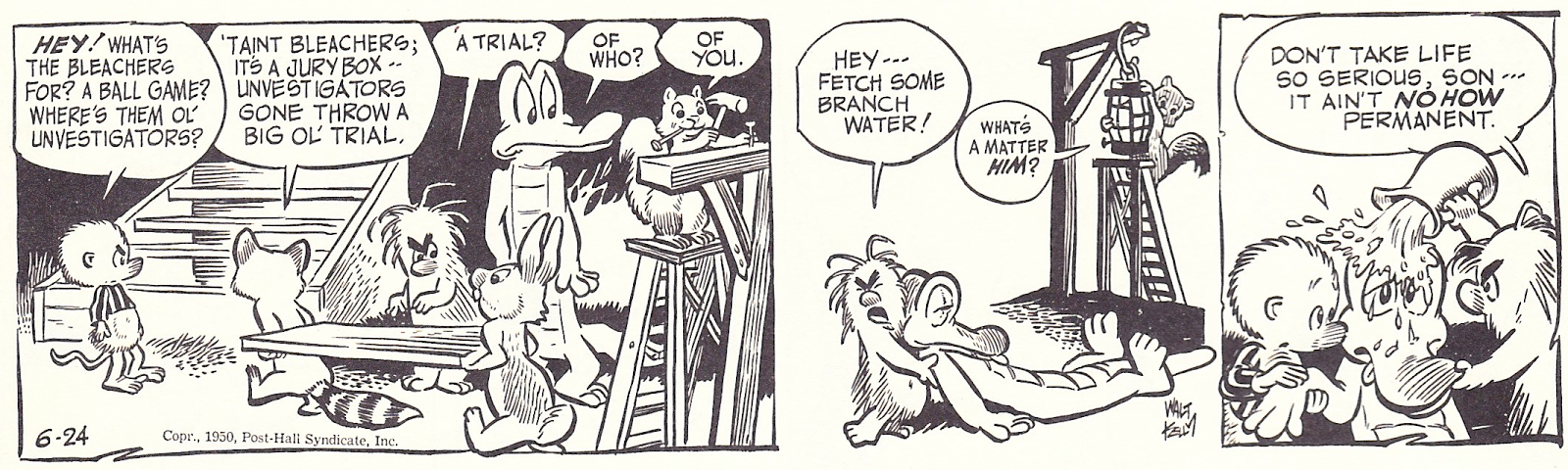
Don’t take life so serious, son … it ain’t no how permanent.
Walt Kelly (1913–1973) American animator and cartoonist [Walter Crawford Kelly, Jr.]
“Pogo” [Porky Pine] (24 Jun 1950)
More discussion about this quotation: Don’t Take Life So Serious, Son … It Ain’t Nohow Permanent – Quote Investigator.
A nationalist encourages us to be our worst, and then tells us that we are the best. A nationalist, “although endlessly brooding on power, victory, defeat, revenge,” wrote Orwell, tends to be “uninterested in what happens in the real world.” Nationalism is relativist, since the only truth is the resentment we feel when we contemplate others. As the novelist Danilo Kiš put it, nationalism “has no universal values, aesthetic or ethical.” A patriot, by contrast, wants the nation to live up to its ideals, which means asking us to be our best selves. A patriot must be concerned with the real world, which is the only place where his country can be loved and sustained. A patriot has universal values, standards by which he judges his nation, always wishing it well — and wishing that it would do better.
Why then should I give my Readers bad Lines of my own, when good Ones of other People’s are so plenty? ‘Tis methinks a poor Excuse for the bad Entertainment of Guests, that the Food we set before them, tho’ coarse and ordinary, is of one’s own Raising, off one’s own Plantation, &c. when there is Plenty of what is ten times better, to be had in the Market. — On the contrary, I assure ye, my Friends, that I have procur’d the best I could for ye, and much Good may’t do ye.
Benjamin Franklin (1706–1790) American statesman, scientist, philosopher, aphorist
Poor Richard (1747 ed.)
(Source)
On his (uncredited) borrowing of poetry and aphorisms from others for his almanac.
Be warned against all “good” advice because “good” advice is necessarily “safe” advice, and though it will undoubtedly follow a sane pattern, it will very likely lead one into total sterility — one of the crushing problems of our time.
Jules Feiffer (b. 1929) American cartoonist, authork, satirist
Interview by Roy Newquist, Counterpoint (1964)
(Source)

Lat take a cat, and fostre him wel with milk,
And tendre flesh, and make his couche of silk,
And lat him seen a mous go by the wal;
Anon he weyveth milk, and flesh, and al,
And every deyntee that is in that hous,
Swich appetyt hath he to ete a mous.
Lo, here hath lust his dominacioun,
And appetyt flemeth discrecioun.[Let’s take a cat, and foster him well with milk
And tender meat, and make his couch of silk,
And let him see a mouse go by the wall,
Right then he refuses milk and meat and all,
And every dainty that is in that house,
Such appetite has he to eat a mouse.
Lo, here has lust his domination,
And appetite drives away discretion.]Geoffrey Chaucer (c. 1343–1400) English poet, philosopher, astronomer, diplomat
The Canterbury Tales, “The Manciple’s Tale,” l. 175ff (c. 1400)
(Source)
Modern English. Alternate modernizations:Let take a cat, and foster her with milk
And tender flesh, and make her couch of silk,
And let her see a mouse go by the wall,
Anon she weiveth milk, and flesh, and all,
And every dainty that is in that house,
Such appetite hath she to eat the mouse.
Lo, here hath kind her domination,
And appetite flemeth discretion.
[Source]Let take a cat, and foster her with milk
And tender flesh, and make her couch of silk,
And let her see a mouse go by the wall,
Anon she forsaketh milk, and flesh, and all,
And every dainty that is in that house,
Such appetite hath she to eat the mouse.
Lo, here hath nature her domination,
And appetite drives out discretion.
[Source]

She heard him mutter, “Can you take away this grief?”
“I’m sorry,” she replied. “Everyone asks me. And I would not do so even if I knew how. It belongs to you. Only time and tears take away grief; that is what they are for.”Terry Pratchett (1948–2015) English author
Discworld No. 38, I Shall Wear Midnight (2010)
(Source)
Roland and Tiffany.
Fame and wealth without understanding are not stable possessions.
[Δόξα καὶ πλοῦτος ἄνευ ξυνέσιος οὐκ ἀσφαλέα κτήματα.]
Democritus (c. 460 BC - c. 370 BC) Greek philosopher
Frag. 77 (Diels) [tr. @sententiq (2018)]
(Source)
Original Greek. Diels citation "77. (78 N.) DEMOKRATES. 42."; collected in Joannes Stobaeus (Stobaios) Anthologium 3, 4, 82. Bakewell lists this under "The Golden Sayings of Democritus." Freeman notes this as one of the Gnômae, from a collection called "Maxims of Democratês," but because Stobaeus quotes many of these as "Maxims of Democritus," they are generally attributed to the latter. Other translations:
- "Fame and wealth without wisdom are unsafe possessions." [tr. Bakewell (1907)]
- "Fame and wealth without intelligence are dangerous possessions." [tr. Freeman (1948)]
- "Reputation and wealth without intelligence are unsafe possessions." [tr. Taylor]
- "Fame and wealth without understanding are not secure possessions." [Source]
A stands for atom; it is so small
No one has ever seen it at all.B stands for bombs; the bombs are much bigger.
So, brother, do not be too fast on the trigger.F stands for fission; that is what things do
When they get wobbly and big and must split in two.
And just to confound the atomic confusion
What fission has done may be undone by fusion.H has become a most ominous letter;
It means something bigger, if not something better.S stands for secret; you can keep it forever —
Provided there’s no one abroad who is clever.Edward Teller (1908–2003) Hungarian-American theoretical physicist
“Atom Alphabet,” Alamogordo Daily News (14 Nov 1957)
(Source)
Attributed to Teller, as composed for his children. More discussion and sources: Edward Teller's "Atom Alphabet" (<=1946) : unsong.

Diplomacy mostly consists of managing crazies who are making unreasonable demands in impossible situations with no solutions. And those are just our allies.
Nicholas Kristof (b. 1959) American journalist and political commentator
“The Foreign Relations Fumbler,” New York Times (16 Sep 2012)
(Source)

Envy is the gasoline on which American capitalism runs.
John Lahr (b. 1941) British-based American theater critic, author
“Lives in Limbo,” The New Yorker (26 Mar 2012)
(Source)

A common fallacy in much of the adverse criticism to which science is subjected today is that it claims certainty, infallibility and complete emotional objectivity. It would be more nearly true to say that it is based upon wonder, adventure and hope.
Cyril Norman Hinshelwood (1897–1967) British chemist and Nobel laureate
“Classics among the intellectual disciplines,” Presidential Address to the Classical Association, Hull, UK (1959-04-09)
Quoted in the Sunday Times (1959-05-17), and in E. J. Bowen's obituary of Hinshelwood, in Chemistry in Britain, Vol. 3 (1967), p. 534.

Those who so act and so live as to give proof of loyalty and uprightness, of fairness and generosity; who are free from all passion, caprice, and insolence, and have great strength of character — men like those just mentioned — such men let us consider good, as they were accounted good in life, and also entitled to be called by that term because, in as far as that is possible for man, they follow Nature, who is the best guide to good living.
[Qui ita se gerunt, ita vivunt, ut eorum probetur fides integritas aequitas1 liberalitas, nec sit in eis ulla cupiditas libido audacia, sintque magna constantia, ut ei fuerunt, modo quos nominavi, hos viros bonos, ut habiti sunt, sic etiam appellandos putemus, quia sequantur, quantum homines possunt, naturam optimam bene vivendi ducem.]
Marcus Tullius Cicero (106–43 BC) Roman orator, statesman, philosopher
Laelius De Amicitia [Laelius on Friendship], ch. 5, part 3 (5.3) / sec. 19 (44 BC) [tr. Falconer (1923)]
(Source)
Original Latin. Other translations:Those who so conduct themselves, and so live that their honor, their integrity, their justice, and liberality are approved; so that there is not in them any covetousness, or licentiousness, or boldness; and that they are of great consistency, as those men whom I have mentioned above; -- let us consider these worthy of the appellation of good men, as they have been accounted such because they follow (as far as men are able) nature, which is the best guide of a good life.
[tr. Edmonds (1871)]Those who so conduct themselves, so live, that their good faith, integrity, equity, and kindness win approval, who are entirely free from avarice, lust, and the infirmities of a hasty temper, and in whom there is perfect consistency of character; in fine, men like those whom I have named, while they are regarded as good, ought to be so called, because to the utmost of human capacity they follow Nature, who is the best guide in living well.
[tr. Peabody (1887)]We mean then by the "good" those whose actions and lives leave no question as to their honour, purity, equity, and liberality; who are free from greed, lust, and violence; and who have the courage of their convictions. The men I have just named may serve as examples. Such men as these being generally accounted “good,” let us agree to call them so, on the ground that to the best of human ability they follow nature as the most perfect guide to a good life.
[tr. Shuckburgh (1909)]Those who comport themselves in such a way, who live in such a way that their loyalty, integrity, fairness and generosity are proven, such that there is no desire, lust, and insolence in them, and such that they have great steadfastness of character (like those whom I named just before), we consider ought indeed to be called good men (as is customary), because they follow (as much as humans can) nature -- the best leader in proper living.
[Source]
Out of instinct for self-preservation, and logically enough, [the mind] asks, “If it is a good and holy thing to be punished, must it not also be a good and holy thing to punish?” It answers that it is; and our earth becomes the hell it is. Thus we human beings plant in ourselves the perennial blossom of cruelty — the conviction that if we hurt other people we are doing good to ourselves and to life in general.
Rebecca West (1892–1983) British author, journalist, literary critic, travel writer [pseud. for Cicily Isabel Fairfield]
“Pleasure Be Your Guide,” The Nation, “Living Philosophies” series #10 (25 Feb 1939)
(Source)
Adapted into Clifton Fadiman, I Believe: The Personal Philosophies of Certain Eminent Men and Women of Our Time (1952).
He [Napoleon III] was what I often think is a dangerous thing for a statesman to be — a student of history, and like most of those who study history, he learned from the mistakes of the past how to make new ones.
A. J. P. Taylor (1906–1990) British historian, journalist, broadcaster [Alan John Percivale Taylor]
“Mistaken Lessons from the Past,” The Listener (6 Jun 1963)
(Source)
No matter how many times I do my work, it never stays done for long.
Ashleigh Brilliant (b. 1933) Anglo-American epigramist, aphorist, cartoonist
Pot-Shots, #2847
Using maxims is appropriate for those who are older in age when uttered about things for which they have some experience. Using maxims before one is this age lacks propriety as does story-telling: to speak about what one has no experience in is foolish and uneducated. A sufficient sign of this is that bumpkins especially tend to make up maxims and they easily show them off.
[ἁρμόττει δὲ γνωμολογεῖν ἡλικίᾳ μὲν πρεσβυτέροις, περὶ δὲ τούτων ὧν ἔμπειρός τις ἐστί, ὡς τὸ μὲν μὴ τηλικοῦτον ὄντα γνωμολογεῖν ἀπρεπὲς ὥσπερ καὶ τὸ μυθολογεῖν, περὶ δ᾿ ὧν ἄπειρος, ἠλίθιον καὶ ἀπαίδευτον. σημεῖον δ᾿ ἱκανόν· οἱ γὰρ ἀγροῖκοι μάλιστα γνωμοτύποι εἰσὶ καὶ ῥᾳδίως ἀποφαίνονται.]
Aristotle (384–322 BC) Greek philosopher
Rhetoric [Ῥητορική; Ars Rhetorica], Book 2, ch. 21, sec. 9 (2.21.9) / 1395a.9 (350 BC) [tr. @sentantiq (2018)]
(Source)
(Source (Greek)). Other translations:In point of age, the use of maxims befit the old, and should be on those matters of which they have particular experience; so that for one who has not arrived at that stage of life, to use maxims is unbecoming; just it is for him to use fables; and if it be on matters whereof he has no experience, it is absurd, and a mark of ignorance. And the following is a sufficient proof of it, for that the rustics most of all are proverb-mongers, and are ready at uttering them.
[Source (1847)]The employment of maxims becomes him who is rather advanced in life; and particularly as respects subjects about which each happens to be well informed. Since for one not so advanced in age to sport maxims is bad taste, just as it is for him to have recourse to fables: and the ue of them on subjects about which one is ignorant is silly, and argues a want of education. There is a sufficient sign of the truth of this; for the boors of the country are of all other people most fond of hammering out maxims, and set them forth with great volubility.
[tr. Buckley (1850)]The use of maxims is suitable to elderly men, and in regard to subjects with which one is conversant; for sententiousness, like story-telling, is unbecoming in a younger man; while, in regard to subjects with which one is not conversant, it is stupid and shows want of culture. It is token enough of this that rustics are the greatest coiners of maxims, and the readiest to set forth their views.
[tr. Jebb (1873)]The use of maxims is suitable for one who is advanced in years, and in regard to things in which one has experience; since the use of maxims before such an age is unseemly, as also is story-telling; and to speak about things of which one has no experience shows foolishness and lack of education. A sufficient proof of this is that rustics especially are fond of coining maxims and ready to make display of them.
[tr. Freese (1924)]The use of Maxims is appropriate only to elderly men, and in handling subjects in which the speaker is experienced. For a young man to use them is -- like telling stories -- unbecoming; to use them in handling things in which one has no experience is silly and ill-bred: a fact sufficiently proved by the special fondness of country fellows for striking out maxims, and their readiness to air them.
[tr. Roberts (1924)]The use of maxims is suitable for one who is advanced in years, and in regard to things in which one has experience; since the use of maxims before such an age is unseemly, as also is story-telling; and to speak about things of which one has no experience shows foolishness and lack of education. A sufficient proof of this is that rustics especially are fond of coining maxims and ready to make display of them.
[tr. Freese (1926)]It is fitting for someone more advanced in age to speak in maxims, and about things he has experience of, since it is inappropriate for someone not of that age to speak in maxims, just as it also to tell myths, and to do so about things he is inexperienced in, this being a mark of foolishness and lack of education. There is a sufficient sign of this: country bumpkins are the ones most given to uttering maxims ....
[tr. Bartlett (2019)]
Truths that startled the generation in which they were first announced become in the next age the commonplaces of conversation; as the famous airs of operas which thrilled the first audiences come to be played on hand-organs in the streets.
Teaching takes skill and education and dedication. Home schooling as an idea is on a par with home dentistry.
Dick Cavett (b. 1936) American writer and critic
“Schooling Santorum,”New York Times (24 Feb 2012)
(Source)
Alcohol is not likely to bring out any impulse that is not already potential in a personality, nor is it likely to cast behavior into patterns for which there is not already significant subsurface predilection. The alcohol merely facilitates expression by narcotizing inhibitory processes. […] The oil which lubricates the engine of an automobile neither furnishes the energy for its progress nor directs it.
There is more than one way to burn a book. And the world is full of people running about with lit matches. Every minority, be it Baptist/Unitarian, Irish/Italian/Octogenarian/Zen Buddhist, Zionist/Seventh-day Adventist, Women’s Lib/Republican, Mattachine/Four Square Gospel feels it has the will, the right, the duty to douse the kerosene, light the fuse. Every dimwit editor who sees himself as the source of all dreary blanc-mange plain-porridge unleavened literature licks his guillotine and eyes the neck of any author who dares to speak above a whisper or write above a nursery rhyme.
Ray Bradbury (1920–2012) American writer, futurist, fabulist
Fahrenheit 451, “Coda” Afterword (1979 ed.)
(Source)
Bradbury wrote the coda to his dystopian 1953 novel about censorship when he found out that "offensive" phrases had been deleted from high school editions of the book.
Two things have always been true about human beings. One, the world is always getting better. Two, the people living at that time think it’s getting worse. It’s because you get older, your responsibilities are different. Now I’m taking care of children instead of being a child. It makes the world look scarier. That happens to everyone.
Penn Jillette (b. 1955) American stage magician, actor, musician, author
“Honest Questions with Penn Jillette,” Interview by Glen Beck, CNN (2 Nov 2007)
(Source)
WATCHMAN:
Sir, I am here. I can’t say I am out of breath.
I have not exactly been “running on light feet.”
I halted many times along the road so I could think,
And I almost turned around and marched right back.
My mind kept talking to me. It said, “You poor guy,
Why are you going there? You’ll just get your ass kicked.”
Then it said, “Are you stopping again, you damn fool?
If Creon hears this from another man, he’ll give you hell.”
Well, I turned this idea up and down like that,
And I hurried along, real slow. Made a short trip long.[Φύλαξ:
ἄναξ, ἐρῶ μὲν οὐχ ὅπως τάχους ὕπο
δύσπνους ἱκάνω κοῦφον ἐξάρας πόδα.
πολλὰς γὰρ ἔσχον φροντίδων ἐπιστάσεις,
ὁδοῖς κυκλῶν ἐμαυτὸν εἰς ἀναστροφήν:
ψυχὴ γὰρ ηὔδα πολλά μοι μυθουμένη:
τάλας, τί χωρεῖς οἷ μολὼν δώσεις δίκην;
τλήμων, μενεῖς αὖ; κεἰ τάδ᾽ εἴσεται Κρέων
ἄλλου παρ᾽ ἀνδρός; πῶς σὺ δῆτ᾽ οὐκ ἀλγύνει;
τοιαῦθ᾽ ἑλίσσων ἤνυτον σχολῇ βραδύς.]Sophocles (496–406 BC) Greek tragic playwright
Antigone, l. 223ff (441 BC) [tr. Woodruff (2001)]
(Source)
Original Greek. Other translations:SENTINEL:
My liege, I cannot say that from very haste I come panting for breath, having stept out with nimble paces. Troth: I have had many half-way houses of cogitation, wheeling about after every fresh start as though I would return. In fact, my soul often addressed me with some such tale as this: Why goest, simpleton, where to be come is to be punished?" then again: "What! wilt not away, poor wretch? and if Kreon shall learn these tidings from some one else, how then wilt thou escape the penalty?" While thus my mind revolved, the speed I made was tardy in its swiftness: and so a short road is made long.
[tr. Donaldson (1848)]GUARD:
My lord, I will not make pretense to pant
And puff as some light-footed messenger.
In sooth my soul beneath its pack of thought
Made many a halt and turned and turned again;
For conscience plied her spur and curb by turns.
"Why hurry headlong to thy fate, poor fool?"
She whispered. Then again, "If Creon learn
This from another, thou wilt rue it worse."
Thus leisurely I hastened on my road;
Much thought extends a furlong to a league.
[tr. Storr (1859)]WATCHMAN:
My lord, I am out of breath, but not with speed.
I will not say my foot was fleet. My thoughts
Cried halt unto me ever as I came
And wheeled me to return. My mind discoursed
Most volubly within my breast, and said--
Fond wretch! why go where thou wilt find thy bane?
Unhappy wight! say, wilt thou bide aloof?
Then if the king shall hear this from another,
How shalt thou 'scape for 't? Winding thus about
I hasted, but I could not speed, and so
Made a long journey of a little way.
[tr. Campbell (1873)]GUARD:
My king, I will not say that I arrive breathless because of speed, or from the action of a swift foot. For often I brought myself to a stop because of my thoughts, and wheeled round in my path to return. My mind was telling me many things: “Fool, why do you go to where your arrival will mean your punishment?” “Idiot, are you dallying again? If Creon learns it from another, must you not suffer for it?” So debating, I made my way unhurriedly, slow, and thus a short road was made long.
[tr. Jebb (1891)]MESSENGER:
O King, I cannot boast that, hither sent,
I came with speed, for oft my troubled thoughts
Have driven me back; oft to myself I said,
Why dost thou seek destruction?
With doubts like these oppressed, slowly I came,
And the short way seemed like a tedious journey.
[tr. Werner (1892)]GUARD:
My liege, I will not say that I come breathless from speed, or that I have plied a nimble foot; for often did my thoughts make me pause, and wheel round in my path, to return. My mind was holding large discourse with me; "Fool, why goest thou to thy certain doom?" "Wretch, tarrying again? And if Creon hears this from another, must not thou smart for it?" So debating, I went on my way with lagging steps, and thus a short road was made long.
[tr. Jebb (1917)]SENTRY:
I'll not say that I'm out of breath from running, King, because every time I stopped to think about what I have to tell you, I felt like going back. And all the time a voice kept saying, "You fool, don't you know you're walking straight into trouble?"; and then another voice: "Yes, but if you let somebody else get the news to Creon first, it will be even worse than that for you!"
[tr. Fitts/Fitzgerald (1939)]SENTRY:
My lord: if I am out of breath, it is not from haste.
I have not been running. On the contrary, many a time
I stopped to think and loitered on the way,
Saying to myself “Why hurry to your doom,
Poor fool?” and then I said, “Hurry, you fool.
If Creon hears this from another man,
Your head’s as good as off.” So here I am,
As quick as my unwilling haste could bring me;
In no great hurry, in fact.
[tr. Watling (1947), l. 183ff]GUARD:
Lord, I can't claim that I am out of breath
from rushing here with light and hasty step,
for I had many haltings in my thought
making me double back upon my road.
My mind kept saying many things to me:
"Why go where you will surely pay the price?"
"Fool, are you halting? And if Creon learns
from someone else, how shall you not be hurt?"
Turning this over, on I dilly-dallied.
And so a short trip turns itself to long.
[tr. Wyckoff (1954)]GUARD:
My lord: I cannot say that I am come
All out of breath with running. More than once
I stopped and thought and turned round in my path
And started to go back. My mind had much
To say to me. One time it said "You fool!
Why do you go to certain punishment?"
Another time "What? Standing still, you wretch?
You'll smart for it, if Creon comes to hear
From someone else." And so I went along
Debating with myself, not swift nor sure.
This way, a short road soon becomes a long one.
[tr. Kitto (1962)]SENTRY:
My lord,
I can't say I'm winded from running, or set out
with any spring in my legs either -- no sir,
I was lost in thought, and it made me stop, often,
dead in my tracks, wheeling, turning back,
and all the time a voice inside me muttering,
"Idiot, why? You're going straight to your death."
Then muttering, "Stopped again, poor fool?
If somebody gets the news to Creon first,
what's to save your neck?" And so,
mulling it over, on I trudged, dragging my feet,
you can make a short road take forever ...
[tr. Fagles (1982), l. 248ff]WATCHMAN:
Lord, I cannot say that I arrive breathless
from quickly lifting nimble feet.
In fact, I stopped many times to think,
whirling around on the roads to turn back.
My spirit kept talking to me and saying:
“Poor fool, why are you going to a place where
you will pay the penalty when you arrive? Wretch, are you
dawdling along again? If Creon learns about this
from someone else, how then will you not feel pain?”
As I rolled around such thoughts, I was gradually and
slowly completing the journey, and so a short road
became a long one.
[tr. Tyrell/Bennett (2002)]GUARD: My King, I can’t really say that I’ve lost my breath by running my feet to the ground so as to get here as quickly as I could! No, I tarried. God knows I’ve stopped myself often enough, on the way here and I’ve almost turned back many times.
My soul, you see, was talking to me all the while and all the while it kept changing its mind: “poor man,” it would say one minute, “Why are you rushing to your suffering?” Or again, “Stupid man,” it would say, “why are you hanging about like this? What if the king hears it from someone else? What a mess you’d get yourself into then!”
Stuff like that was spinning about in my head and it made this small road so much longer!
[tr. Theodoridis (2004)]GUARD:
My lord, I can’t say I’ve come out of breath
by running here, making my feet move fast.
Many times I stopped to think things over --
and then I’d turn around, retrace my steps.
My mind was saying many things to me,
“You fool, why go to where you know for sure
your punishment awaits?” -- “And now, poor man,
why are you hesitating yet again?
If Creon finds this out from someone else,
how will you escape being hurt?” Such matters
kept my mind preoccupied. And so I went,
slowly and reluctantly, and thus made
a short road turn into a lengthy one.
[tr. Johnston (2005), l. 256ff]GUARD:
My lord, I will not say that I come breathless
from rushing or quickly moving my feet,
for often my thoughts stopped me in my place,
and I'd wheel around on the road back where I came.
My heart kept talking to me, telling me,
"Poor fool, why are you going where you're sure
to be punished?" "Idiot, you stopping
again? If Creon hears it from someone else,
then you'll really pay for it!" Twisting like this
I made my way, the opposite of hate,
and thus a short road became a long one.
[tr. Thomas (2005), l. 226ff]
Administrivia: (2021-04-15) Notice to email subscribers
I just learned that Google is sunsetting its Feedburner email setup in July, which is what I use here to send out daily email collections of the quotations here. At present, about three dozen people are using this service for WIST.
I’ve removed the link for that mode of subscribing, and I’ll be looking at alternatives to provide that service, and will let you know what that looks like. In the meantime …
- If you don’t want the email feed any more, please unsubscribe via the links that Feedburner sends. My intent is to transfer the email addresses of subscribers over to whatever new, different thing I do.
- Check out the feeds/subscription page for WIST, which will show you alternate ways to get your WIST updates.
- Using an RSS reader, Twitter, or my Diaspora mirror (currently down due to a data center issue, but returning Real Soon Now) are all ways to get notifications.
- There are a number of services that will do a daily email from an RSS feed. (That’s essentially what Feedburner is doing.) One of my alternatives may just be to provide other recommendations for that, but if you have a favorite, this would be a fine time to switch over (but do let me know what your recommendation is).
One issue I have is that, while there are plugins that will allow email subscriptions pretty easily, they tend not to do so as a digest, but as different emails for each post. That might be annoying to folks. At the same time, I’d just as soon not work with a mail service like MailChimp to set up something elaborate.
Leave any questions or comments in the comments. I’ll be communicating further with you on this before I make any changes.
Except for the field organizers of strikes, who were pretty tough monkeys and devoted, most of the so-called Communists I met were middle-class, middle-aged people playing a game of dreams. I remember a woman in easy circumstances saying to another even more affluent: “After the revolution even we will have more, won’t we, dear?” Then there was another lover of proletarians who used to raise hell with Sunday picnickers on her property.
I guess the trouble was that we didn’t have any self-admitted proletarians. Everyone was a temporarily embarrassed capitalist. Maybe the Communists so closely questioned by the investigation committees were a danger to America, but the ones I knew — at least they claimed to be Communists — couldn’t have disrupted a Sunday-school picnic. Besides they were too busy fighting among themselves.
John Steinbeck (1902–1968) American writer
Essay (1960-06-01), “A Primer on the Thirties,” Esquire
(Source)
Collected in Esquire: The Best of Forty Years (1973).
A portion of this was paraphrased in Ronald Wright, A Short History of Progress, ch. 5 "The Rebellion of the Tools" (2004):John Steinbeck once said that socialism never took root in America because the poor see themselves not as an exploited proletariat but as temporarily embarrassed millionaires.
That paraphrase has, in turn, been frequently given as a direct quotation of Steinbeck.
How can we account for our present situation unless we believe that men high in this government are concerting to deliver us to disaster? This must be the product of a great conspiracy, a conspiracy on a scale so immense as to dwarf any previous such venture in the history of man. A conspiracy of infamy so black that when it is finally exposed, its principals shall forever be deserving of the maledictions of all.
Joseph McCarthy (1908–1957) American politician, attorney
“America’s Retreat from Victory: The Story of Gen. George C. Marshall,” speech, US Senate (14 Jun 1951)
(Source)
Part of a 65,000 word speech given by McCarthy, attacking Sec. of Defense George C. Marshall (and, by proxy, Harry Truman), alleging a string of sinister post-WW2 US diplomatic and military failures, culminating in Truman's firing of Douglas MacArthur.

Boredom therefore can arise from the cessation of habitual functions, even though these may be boring too. It is also the shriek of unused capacities, the doom of serving no great end or design, or contributing to no master force.

My word, how mortals take the gods to task!
All their afflictions come from us, we hear.
And what of their own failings? Greed and folly
double the suffering in the lot of man.[ὢ πόποι, οἷον δή νυ θεοὺς βροτοὶ αἰτιόωνται.
ἐξ ἡμέων γάρ φασι κάκ’ ἔμμεναι· οἱ δὲ καὶ αὐτοὶ
σφῇσιν ἀτασθαλίῃσιν ὑπὲρ μόρον ἄλγε’ ἔχουσιν.]Homer (fl. 7th-8th C. BC) Greek author
The Odyssey [Ὀδύσσεια], Book 1, l. 32ff (1.32) [Zeus] (c. 700 BC) [tr. Fitzgerald (1961)]
(Source)
Original Greek. Other translations:O how falsely men
Accuse us Gods as authors of their ill!
When, by the bane their own bad lives instill,
They suffer all the mis’ries of their states,
Past our inflictions, and beyond their fates.
[tr. Chapman (1616)]Ha! how dare mortals tax the Gods, and say,
Their harms do all proceed from our decree,
And by our setting; when by their crimes they
Against our wills make their own destiny?
[tr. Hobbes (1675), l. 37ff]Perverse mankind! whose wills, created free,
Charge all their woes on absolute degree;
All to the dooming gods their guilt translate,
And follies are miscall'd the crimes of fate.
[tr. Pope (1725)]Alas! how prone are human-kind to blame
The Pow’rs of Heav’n! From us, they say, proceed
The ills which they endure, yet more than Fate
Herself inflicts, by their own crimes incur.
[tr. Cowper (1792), l. 41ff]Mortals, ye Powers, upbraid us with their voice,
And brand us for the fount of all their ill,
Who, of their own acts, not of fate but choice,
Heap to themselves much toil and sorrow still.
[tr. Worsley (1861), st. 6]Why! what reproach,
Ye gods! do mortals cast on deities!
To us all their calamities they trace,
While they, themselves, through their own senseless acts,
Feel pangs their destiny had ne'er decreed.
[tr. Musgrave (1869)]Oh heavens! how mortals now to blame the gods!
From us they say spring ills! but they themselves
By their own folly bring unfated woes.
[tr. Bigge-Wither (1869)]Lo you now, how vainly mortal men do blame the gods! For of us they say comes evil, whereas they even of themselves, through the blindness of their own hearts, have sorrows beyond that which is ordained.
[tr. Butcher/Lang (1879)]Lo, how men blame the gods! From us, they say, spring troubles. But through their own perversity and more than is their due they meet with sorrow.
[tr. Palmer (1891)]See now, how men lay blame upon us gods for what is after all nothing but their own folly.
[tr. Butler (1898)]Oh my, how mortals hold us gods responsible! For they say that their misfortunes come from us. But they get their sufferings, beyond what is fated, by way of their own acts of recklessness.
[tr. Butler (1898), rev. Kim/McCray/Nagy/Power (2018)]Look you now, how ready mortals are to blame the gods. It is from us, they say, that evils come, but they even of themselves, through their own blind folly, have sorrows beyond that which is ordained.
[tr. Murray (1919)]It vexes me to see how mean are these creatures of a day towards us Gods, when they charge against us the evils (far beyond our worst dooming) which their own exceeding wantonness has heaped upon themselves.
[tr. Lawrence (1932)]What a lamentable thing it is that men should blame the gods and regard us as the source of their troubles, when it is their own wickedness that brings them sufferings worse than any which Destiny allots them.
[tr. Rieu (1946)]Oh for shame, how the mortals put the blame upon us
gods, for they say evils come from us, but it is they, rather,
who by their own recklessness win sorrow beyond what is given.
[tr. Lattimore (1965)]Men are so quick to blame the gods: they say
that we devise their misery. But they
themselves -- in their depravity -- design
grief greater than the griefs that fate assigns.
[tr. Mandelbaum (1990)]Ah how shameless -- the way these mortals blame the gods.
From us alone, they say, come all their miseries, yes,
but they themselves, with their own reckless ways,
compound their pains beyond their proper share.
[tr. Fagles (1996)]Mortals! They are always blaming the gods
For their troubles, when their own witlessness
Causes them more than they were destined for!
[tr. Lombardo (2000), l. 37ff]Strange to behold, what blame these mortals can bring against godhead! For their ills, they assert, are from us, when they themselves by their mad recklessness have pain far past what is fated.
[tr. Merrill (2002)]How surprising that men blame the gods, and say their troubles come from us, though they, through their own un-wisdom, find suffering beyond what is fated.
[tr. Kline (2004)]What a lamentable thing it is that men should blame the gods and regard us as the source of their troubles, when it is their own transgressions which bring them suffering that was not their destiny.
[tr. DCH Rieu (2002)]This is not good! See how mortals find fault with us gods!
They say it is from us that all evil things come, yet it is by their
own recklessness that they suffer hardship beyond their destiny.
[tr. Verity (2016)]This is absurd,
that mortals blame the gods! They say we cause
their suffering, but they themselves increase it
by folly.
[tr. Wilson (2017)]My oh my, the way mortals will fasten blame on the gods!
From us, they say, evils come, yet they themselves
through their own blind recklessness have ills beyond
their fated lot.
[tr. Green (2018)]It’s disgraceful how humans blame the gods.
They say their tribulations come from us,
when they themselves, through their own foolishness,
bring hardships which are not decreed by Fate.
[tr. Johnston (2019), l. 41ff]
Looking back on things, the view always improves.
Walt Kelly (1913–1973) American animator and cartoonist [Walter Crawford Kelly, Jr.]
Impollutable Pogo (1970)
(Source)
To do evil a human being must first of all believe that what he’s doing is good, or else that it’s a well-considered act in conformity with natural law. Fortunately, it is in the nature of the human being to seek a justification for his actions.
Alexander Solzhenitsen (1918–2008) Russian novelist, emigre [Aleksandr Isayevich Solzhenitsyn]
The Gulag Archipelago, Vol. 1, Part 1, ch. 4 (1973) [tr. Whitney]
(Source)
When I hear scientists say, “The data speak for themselves,” I cringe. Data never speak.
Andrew J. Hoffman (b. 1961) American environmental scientist, sustainable enterprise scholar
“Taking On Climate Skepticism as a Field of Study,” Interview by Felicity Barringer, New York Times (9 Apr 2011)
(Source)

The new constitution has put at rest, forever, all the agitating questions relating to our peculiar institution — African slavery as it exists amongst us — the proper status of the negro in our form of civilization. This was the immediate cause of the late rupture and present revolution. […] The prevailing ideas entertained by [Jefferson] and most of the leading statesmen at the time of the formation of the old constitution, were that the enslavement of the African was in violation of the laws of nature; that it was wrong in principle, socially, morally, and politically. It was an evil they knew not well how to deal with, but the general opinion of the men of that day was that, somehow or other in the order of Providence, the institution would be evanescent and pass away. […] Our new government is founded upon exactly the opposite idea; its foundations are laid, its corner-stone rests upon the great truth, that the negro is not equal to the white man; that slavery — subordination to the superior race — is his natural and normal condition. This, our new government, is the first, in the history of the world, based upon this great physical, philosophical, and moral truth.
Alexander Stephens (1812–1883) American lawyer, politician, Confederate States Vice-President (1861–65)
“Cornerstone Speech,” Savannah (21 Mar 1861)
(Source)
On the foundation of the government of the Confederate States of America.

The cat is, above all things, a dramatist; its life is lived in an endless romance, though the drama is played out on quite another stage than our own, and we only enter into it as subordinate characters, as stage managers, or rather stage carpenters.
Margaret Benson (1865–1916) English author and Egyptologist
The Soul of a Cat and Other Stories, “Epilogue,” sec. 2 (1901)
(Source)

Goodness is about what you do. Not who you pray to.
Terry Pratchett (1948–2015) English author
Discworld No. 39, Snuff (2011)
Virtuous love consists in decorous desire for the beautiful.
[Δίκαιος ἔρως ἀνυβρίστως ἐφίεσθαι τῶν καλῶν]
Democritus (c. 460 BC - c. 370 BC) Greek philosopher
Frag. 73 (Diels) [tr. Freeman (1948)]
(Source)
Diels citation "73. (87 N.) DEMOKRATES. 38."; collected in Joannes Stobaeus (Stobaios) Anthologium III, 5, 23. Freeman notes this as one of the Gnômae, from a collection called "Maxims of Democratês," but because Stobaeus quotes many of these as "Maxims of Democritus," they are generally attributed to the latter. Other translations:
- "Rightful love is longing without violence for the noble." [tr. Barnes (1987)]
- "Just lust is longing for noble things without arrogance." [tr. @sententiq (2018)]
I believe that no endeavor that is worthwhile is simple in prospect; if it is right, it will be simple in retrospect.
Edward Teller (1908–2003) Hungarian-American theoretical physicist
Quoted by Judith Shoolery, personal communication (2004)
(Source)
Quoted in István Hargittai, The Martians of Science: Five Physicists Who Changed the Twentieth Century (2006).
To write in plain, vigorous language one has to think fearlessly, and if one thinks fearlessly one cannot be politically orthodox.
George Orwell (1903–1950) English journalist, essayist, writer [pseud. of Eric Arthur Blair]
Essay (1946-01), “The Prevention of Literature,” Polemic Magazine
(Source)
On why, in authoritarian regimes, literature suffers.

The professional celebrity, male and female, is the crowning result of the star system of a society that makes a fetish of competition.
C. Wright Mills (1916–1962) American sociologist, academic, author [Charles Wright Mills]
The Power Elite (1956)
(Source)
Imagination continually frustrates tradition; that is its function.
John Pfeiffer (1914–1999) American anthropologist, author
“Nature, the Radical Conservative,” New York Times (29 Apr 1979)
(Source)
Book review of Gregory Bateson, Mind and Nature. This quotation is frequently misattributed to Jules Feiffer.
This is an extraordinarily irritating book, written by one of those people who smugly believe that, having lost their faith, they must ipso facto have found their reason.
Christopher Hitchens (1949–2011) English intellectual, polemicist, socio-political critic
“David Mamet’s Right-Wing Conversion,” New York Times (17 Jun 2011)
(Source)
Reviewing David Mamet’s The Secret Knowledge.

But I must at the very beginning lay down this principle — friendship can only exist between good men.
[Sed hoc primum sentio, nisi in bonis amicitiam esse non posse]
Marcus Tullius Cicero (106–43 BC) Roman orator, statesman, philosopher
Laelius De Amicitia [Laelius on Friendship], ch. 5 / sec. 18 (44 BC) [tr. Shuckburgh (1909)]
(Source)
Original Latin. Other translations:
- "But first of all, I am of opinion, that except among the virtuous, friendship cannot exist." [tr. Edmonds (1871)]
- "But I consider this as a first principle, -- that friendship can exist only between good men." [tr. Peabody (1887)]
- "This, however, I do feel first of all -- that friendship cannot exist except among good men." [tr. Falconer (1923)]
- "But first of all, I think this: except among good people, friendship cannot exist." [Source]
But indeed we need no further argument in favor of taking pleasure as a standard when we consider the only alternative that faces us. If we do not live for pleasure we shall soon find ourselves living for pain. If we do not regard as sacred our own joys and the joys of others, we open the door and let into life the ugliest attribute of the human race, which is cruelty.
Rebecca West (1892–1983) British author, journalist, literary critic, travel writer [pseud. for Cicily Isabel Fairfield]
“Pleasure Be Your Guide,” The Nation, “Living Philosophies” series #10 (25 Feb 1939)
(Source)
Adapted into Clifton Fadiman, I Believe: The Personal Philosophies of Certain Eminent Men and Women of Our Time (1952).
There is nothing more agreeable in life than to make peace with the Establishment — and nothing more corrupting.
A. J. P. Taylor (1906–1990) British historian, journalist, broadcaster [Alan John Percivale Taylor]
“William Cobbett” (1953), Essays in English History (1976)
Anybody who likes writing a book is an idiot. Because it’s impossible, it’s like having a homework assignment every stinking day until it’s done.
Lewis Black (b. 1948) American comedian
Interview by Amelie Gillette, The Onion A.V. Club (7 Jun 2006)
(Source)

One thing travel teaches is why living at home is so popular.
Ashleigh Brilliant (b. 1933) Anglo-American epigramist, aphorist, cartoonist
Pot-Shots, #2701
Whatever creates or increases happiness or some part of happiness, we ought to do; whatever destroys or hampers happiness, or gives rise to its opposite, we ought not to do.
[τὰ μὲν γὰρ παρασκευάζοντα ταύτην ἢ τῶν μορίων τι, ἢ μεῖζον ἀντ᾽ ἐλάττονος ποιοῦντα, δεῖ πράττειν, τὰ δὲ φθείροντα ἢ ἐμποδίζοντα ἢ τὰ ἐναντία ποιοῦντα μὴ πράττειν.]
Aristotle (384–322 BC) Greek philosopher
Rhetoric [Ῥητορική; Ars Rhetorica], Book 1, ch. 5, sec. 2 (1.5.2) / 1360b.11 (350 BC) [tr. Roberts (1924)]
(Source)
(Source (Greek)). Other translations:For it behoves us to perform those acts which procure [happiness], or any one of its constituent parts, or which, when it is little, render it greater; but not to perform those which destroy, or obstruct it, or produce its contraries.
[Source (1847)]We needs do the things which procure [happiness] or any of its constituents, or which render it greater from having been less, and refrain from doing the things which destroy or impede it, or produce its opposites.
[tr. Buckley (1850)]Since we ought to do those things which tend to create [Happiness] or any one of its parts, or to increase that part; but we ought not do those things which corrupt, or hinder it, or produce its opposite.
[tr. Jebb (1873)]For one should do the things which procure happiness or one of its parts, or increase instead of diminishing it, and avoid doing those things which destroy or hinder it or bring about what is contrary to it.
[tr. Freese (1926)]After all, we are bound to act in a way that creates the conditions for happiness or one of its constituents, or at any rate increases rather than diminishes it, and to avoid doing things that destroy or hinder it or have outcomes that oppose it.
[tr. Waterfield (2018)]
Life is too short to drink bad wine.
Johann Wolfgang von Goethe (1749–1832) German poet, statesman, scientist
(Misattributed)
Often attributed to him, but not found in Goethe's works. The attribution, though, may come from translators' commentary on Goethe's West–Eastern Diwan, "The Book of the Cup-Bearer" (1819/1827), that refers to a poetic passage as deriving from Diez's 1811 translation of the Book of Kabus (Qabus):It comes to this, that it is a sin to drink wine. If though, then committest sin, commit it at least for the best wine, for otherwise wouldst though on one part commit sin, and on another drink bad wine. By God! that would be the most sorrowful among sorrowful things. [tr. Rogers (1890)]It so happens that wine-drinking is a sin. Hence, if you do commit this sin, do it at least with the best wine; otherwise, you'll commit the sin, on the one hand, and on the other, you'll drink bad wine. By God! That would be the sorriest of all sorry things. [tr. Ormsby (2019)]
More information: The Big Apple: “Life is too short to drink cheap wine”

In a predatory economy, the rules imagined by the law and economics crowd don’t apply. There’s no market discipline. Predators compete not by following the rules but by breaking them. They take the business-school view of law: Rules are not designed to guide behavior but laid down to define the limits of unpunished conduct. Once one gets close to the line, stepping over it is easy. A predatory economy is criminogenic: It fosters and rewards criminal behavior.
John Kenneth Galbraith (1908–2006) Canadian-American economist, diplomat, author
“The Predator State,” Mother Jones (May/Jun 2006)
(Source)
Censors don’t want children exposed to ideas different from their own. If every individual with an agenda had his/her way, the shelves in the school library would be close to empty.

That’s the beauty of the Web: You can roll around in a stranger’s obsession without having to smell his or her house. You can amscray whenever you want without being rude. The site gets its “hit” and you know more about our species’ diversity.
Penn Jillette (b. 1955) American stage magician, actor, musician, author
“Free Celebrity Nudes!” Penn’s Columns (15 Oct 1997)
(Source)
Caution in handling generally accepted opinions that claim to explain whole trends of history is especially important for the historian of modern times, because the last century has produced an abundance of ideologies that pretend to be keys to history but are actually nothing but desperate efforts to escape responsibility.
Hannah Arendt (1906–1975) German-American philosopher, political theorist
The Origins of Totalitarianism, Part 1, ch. 1 “Antisemitism as an Outrage to Common Sense” (1951)
(Source)

And in return may the gods grant you your heart’s desire; may they give you a husband and a home, and the harmony that is so much to be desired, since there is nothing nobler or more admirable than when two people who see eye to eye keep house as man and wife, confounding their enemies and delighting their friends, as they themselves know better than anyone.
[Σοὶ δὲ θεοὶ τόσα δοῖεν, ὅσα φρεσὶ σῇσι μενοινᾷς,
ἄνδρα τε καὶ οἶκον, καὶ ὁμοφροσύνην ὀπάσειαν
ἐσθλήν· οὐ μὲν γὰρ τοῦ γε κρεῖσσον καὶ ἄρειον,
ἢ ὅθ’ ὁμοφρονέοντε νοήμασιν οἶκον ἔχητον
ἀνὴρ ἠδὲ γυνή· πόλλ’ ἄλγεα δυσμενέεσσι,
χάρματα δ’ εὐμενέτῃσι· μάλιστα δέ τ’ ἔκλυον αὐτοί.]
Homer (fl. 7th-8th C. BC) Greek author
The Odyssey [Ὀδύσσεια], Book 6, l. 180ff (6.180) [Odysseus to Nausicaa] (c. 700 BC) [tr. Rieu (1946)]
(Source)
Original Greek. The passage uses variations on the Greek term ὁμοφροσύνην (homophrosynê, likemindedness). Other translations:God give you, in requital, all th’ amends
Your heart can wish, a husband, family,
And good agreement. Nought beneath the sky
More sweet, more worthy is, than firm consent
Of man and wife in household government.
It joys their wishers-well, their enemies wounds,
But to themselves the special good redounds.
[tr. Chapman (1616)]And may Jove you with all you wish for bless,
A husband and a house, and concord good;
For man and wife to live in unity
Is the great’st blessing can be understood:
It joys your friend, and grieves your enemy.
[tr. Hobbes (1675), l. 172ff]So may the gods, who heaven and earth control,
Crown the chaste wishes of thy virtuous soul,
On thy soft hours their choicest blessings shed;
Blest with a husband be thy bridal bed;
Blest be thy husband with a blooming race,
And lasting union crown your blissful days.
The gods, when they supremely bless, bestow
Firm union on their favourites below;
Then envy grieves, with inly-pining hate;
The good exult, and heaven is in our state.
[tr. Pope (1725)]And may the Gods thy largest wishes grant,
House, husband, concord! for of all the gifts
Of heav’n, more precious none I deem, than peace
’Twixt wedded pair, and union undissolved;
Envy torments their enemies, but joy
Fills ev’ry virtuous breast, and most their own.
[tr. Cowper (1792), l. 226ff]And unto thee the heavenly gods make flow
Whate'er of happiness thy mind forecast,
Husband and home and spirit-union fast!
Since nought is lovelier on the earth than this,
When in the house one-minded to the last
Dwell man and wife -- a pain to foes, I wis,
And joy ot friends -- but most themselves know their own bliss.
[tr. Worsley (1861), st. 24]But, to thyself may the immortal gods
The largest wishes of thy heart fulfil!
A consort, home, and perfect peace therein
May they bestow! For nought in nobleness,
Nought in all virtue can the good surpass
Of perfect concord in the married pair
Whose blended counsels rightly rule their home:
Their foes with pain behold it! but, to all
Who wish them well, it is a joyful sight!
Joy, which themselves, 'bove all, can well discern!" [tr. Musgrave (1869), ll. 277ff]To thee the gods give all thy heart's desire!
A husband and home and loving hearts beside --
That best of gifts: for nought is better and braver
Than this, when man and wife unanimous
Hold their own home -- a sorrow they to foes --
A joy to friends -- and chiefest to themselves!
[tr. Bigge-Wither (1869)]And may the gods grant thee all thy heart’s desire: a husband and a home, and a mind at one with his may they give -- a good gift, for there is nothing mightier and nobler than when man and wife are of one heart and mind in a house, a grief to their foes, and to their friends great joy, but their own hearts know it best.
[tr. Butcher/Lang (1879)]And so may the high Gods give thee whatso thine heart holds dear,
A husband and a homestead, and concord whole and sound.
For nothing sure more goodly or better may be found
Than man and woman holding one house with one goodwill.
Thuis many a grief are they giving to those that wish them ill,
But great joy to their well-willers; and they wot it best of all.
[tr. Morris (1887)]And may the gods grant all that in your thoughts you long for: husband and home and true accord may they bestow; for a better and higher gift than this there cannot be, when with accordant aims man and wife have a home. Great grief is it to foes and joy to friends; but they themselves best know its meaning.
[tr. Palmer (1891)]May heaven grant you in all things your heart's desire -- husband, house, and a happy, peaceful home; for there is nothing better in this world than that man and wife should be of one mind in a house. It discomfits their enemies, makes the hearts of their friends glad, and they themselves know more about it than any one.
[tr. Butler (1898)]And for thyself, may the gods grant thee all that thy heart desires; a husband and a home may they grant thee, and oneness of heart -- a goodly gift. For nothing is greater or better than this, when man and wife dwell in a home in one accord, a great grief to their foes and a joy to their friends; but they know it best themselves.
[tr. Murray (1919)]And to you may the Gods requite all your heart's desire; husband, house, and especially ingenious accord within that house: for there is nothing so good and lovely as when man and wife in their home dwell together in unity of mind and disposition. A great vexation it is to their enemies and a feast of gladness to their friends: surest of all do they, within themselves, feel all the good it means.
[tr. Lawrence (1932)]And may the gods accomplish your desire:
a home, a husband, and harmonious
converse with him -- the best thing in the world
being a strong house held in serenity
where man and wife agree. Woe to their enemies,
joy to their friends! But all this they know best.
[tr. Fitzgerald (1961)]And then may the gods give you everything that your heart longs for;
may they grant you a husband and a house and sweet agreement
in all things, for nothing is better than this, more steadfast
than when two people, a man and his wife, keep a harmonious
household; a thing that brings much distress to the people who hate them
and pleasure to their well-wishers, and for them the best reputation.
[tr. Lattimore (1965)]And may the gods grant you what your heart wants most,
a husband and a home, and may there be
accord between you both: there is no gift
more solid and precious than such trust:
a man and woman who conduct their house
with minds in deep accord, to enemies
bring grief, but to their friends bring gladness, and --
above all -- gaine a good name for themselves.
[tr. Mendelbaum (1990)]And may the good gods give you all your heart desires:
husband, and house, and lasting harmony too.
No finer, greater gift in the world than that ...
when man and woman possess their home, two minds,
two hearts that work as one. Despair to their enemies,
joy to all their friends. Their own best claim to glory.
[tr. Fagles (1996)]And for yourself, may the gods grant you
Your heart's desire, a husband and a home,
And the blessing of a harmonious life.
For nothing is greater or finer than this,
When a man and woman live together
With one heart and mind, bringing joy
To their friends and grief to their foes.
[tr. Lombardo (2000), l. 183ff]Then may the gods grant you what you in your spirit are wishing; may they endow you with blessings, a husband and house, and a noble concord of mind: for than this there is no gift better or greater, when both husband and wife in concord of mind and of counsel peacefully dwell in a house -- to their enemies greatest affliction, joy to benevolent friends, but especially known to their own hearts.
[tr. Merrill (2002)]And may the gods grant you your heart's desire; may they give you a husband and a home, and the blessing of harmony so much to be desired, since there is nothing better or finer than when two people of one heart and mind keep house as man and wife, a grief to their enemies and a joy to their friends, and their reputation spreads far and wide.
[tr. DCH Rieu (2002)]And may the gods grant you all your heart’s desire, a husband and a home, and mutual harmony, in all its beauty. Since nothing is finer or better than when a man and a woman of one heart and mind stay together, a joy to their friends, a sorrow to their enemies: their own reputation of the very highest.
[tr. Kline (2004)]Then may the gods grant you all that you desire in your heart, and may they bestow on you a husband, a house, and a good harmony of minds; there is nothing better or more powerful than this, when a man and his wife keep house in sympathy of mind -- a great grief to their enemies, but a joy to those who wish them well; and they themselves are highly esteemed.
[tr. Verity (2016)]So may the gods grant all your heart's desires, a home and husband, somebody like-minded. For nothing could be better than when two live in their minds in harmony, husband and wife. Their enemies are jealous, their friends delighted, and they have great honor.
[tr. Wilson (2018)]May the gods grant as much as you desire in your thoughts,
A husband and home, and may they give you fine likemindness,
For nothing is better and stronger than this
When two people who are likeminded in their thoughts share a home,
A man and a wife — this brings many pains for their enemies
And joys to their friends. And the gods listen to them especially.
[tr. @sentantiq (2018)]And may the gods grant you all that your heart desires, husband, home, and like-mindedness -- a precious gift, for there's nothing greater or better, ever, than when two like-minded people are keeping house together, a man and his wife: much frustration for their ill-wishers, much joy for their friends, but they two know it the best.
[tr. Green (2018)]As for you, may gods grant
everything your heart desires -- may they give
a husband, home, and mutual harmony,
a noble gift -- for there is nothing better
or a stronger bond than when man and wife
live in a home sharing each other’s thoughts.
That brings such pain upon their enemies
and such delight to those who wish them well.
They know that too, more so than anyone.
[tr. Johnston (2019)]
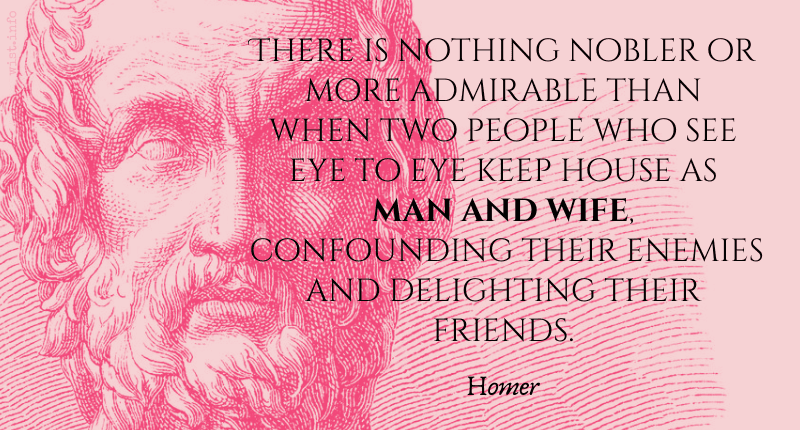
The recklessness of their ways destroyed them all.
[Αὐτῶν γὰρ σφετέρῃσιν ἀτασθαλίῃσιν ὄλοντο.]
Homer (fl. 7th-8th C. BC) Greek author
The Odyssey [Ὀδύσσεια], Book 1, l. 7ff (1.7) (c. 700 BC) [tr. Fagles (1996)]
(Source)
Original Greek. Other translations:
- "O men unwise, / They perish’d by their own impieties!" [tr. Chapman (1616)]
- "They lost themselves by their own insolence." [tr. Hobbes (1675), l. 9]
- "They perish’d self-destroy’d / By their own fault." [tr. Cowper (1792)]
- "For they were slain in their own foolishness." [tr. Worsley (1861), st. 2]
- "Destin'd as they were / In their mad arrogance to perish; fools!" [tr. Musgrave (1869)]
- "For they in their own wilful folly perished." [tr. Bigge-Wither (1869)]
- "For through the blindness of their own hearts they perished." [tr. Butcher/Lang (1879)]
- "They died of their own souls' folly." [tr. Morris (1887)]
- "For through their own perversity they perished." [tr. Palmer (1891)]
- "For they perished through their own sheer folly." [tr. Butler (1898)]
- "For they perished through their own deeds of sheer recklessness." [tr. Butler (1898), rev. Kim/McCray/Nagy/Power (2018)]
- "For through their own blind folly they perished." [tr. Murray (1919)]
- "For their own recklessness destroyed them all." [tr. Fitzgerald (1961)]
- "They were destroyed by their own wild recklessness, / fools." [tr. Lattimore (1965)]
- "Fools, they foiled themselves." [tr. Mendelbaum (1990)]
- "The fools -- destroyed by their own recklessness." [tr. Lombardo (2000)]
- "By their own mad recklessness they were brought to destruction, / childish fools." [tr. Merrill (2002)]
- "It was their own transgression that brought them to their doom." [tr. DCH Rieu (2002)]
- "... their own un-wisdom, foolishly ..." [tr. Kline (2004)]
- "They perished by reason of their own recklessness / the fools." [tr. Verity (2016)]
- "... poor fools ..." [tr. Wilson (2018)]
- "It was through their own blind recklessness that they perished, / the fools." [tr. Green (2018)]
- "They all died from their own stupidity, the fools." [tr. Johnston (2019)]
Perhaps if we saw what was ahead of us, and glimpsed the crimes, follies, and misfortunes that would befall us later on, we would all stay in our mother’s wombs, and there would be nobody in the world but a great number of very fat, very irritated women.
Lemony Snicket (b. 1970) American author, screenwriter, musician (pseud. for Daniel Handler)
The End (2006)

Macbeth’s self-justifications were feeble — and his conscience devoured him. Yes, even Iago was a little lamb, too. The imagination and spiritual strength of Shakespeare’s evildoers stopped short at a dozen corpses. Because they had no ideology.
Ideology — that is what gives evildoing its long-sought justification and gives the evildoer the necessary steadfastness and determination. That is the social theory which helps to make his acts seem good instead of bad in his own and others’ eyes, so that he won’t hear reproaches and curses but will receive praise and honors. That was how the agents of the Inquisition fortified their wills: by invoking Christianity; the conquerors of foreign lands, by extolling the grandeur of their Motherland; the colonizers, by civilization; the Nazis, by race; and the Jacobins (early and late), by equality, brotherhood, and the happiness of future generations.
Alexander Solzhenitsen (1918–2008) Russian novelist, emigre [Aleksandr Isayevich Solzhenitsyn]
The Gulag Archipelago, Vol. 1, Part 1, ch. 4 (1973) [tr. Whitney]
(Source)
From the simple observation that mental illness is marked by odd behavior flows a host of problems. For nothing seems clearer than that we are responsible for our behavior; from there, it seems only a small step to the conclusion that a disease characterized by strange behavior must be a disease under our control. And so we appeal to willpower in the devout belief that we can think our way to mental health. We advise the victim of depression to look on the bright side; we tell the person in the midst of a sky-high manic episode to take a deep breath and calm down. When it comes to mental illness, we are all Christian Scientists.

If you try and take a cat apart to see how it works, the first thing you have on your hands is a non-working cat.
Douglas Adams (1952–2001) English author, humorist, screenwriter
Speech, Digital Biota 2 conference, Cambridge, UK (Sep 1998)
(Source)
Segments of this impromptu speech are quoted in Richard Dawkins, "Eulogy for Douglas Adams," Church of Saint Martin in the Fields, London (27 Sep 2001). A variant of the quotation ("If you try and take a cat apart to see how it works, you end up with a non-working cat. Do not try this.") is often attributed to that article, but the Dawkins eulogy contains the correct form of the quote.

And the funny thing was that people who weren’t entirely certain they were right always argued much louder than other people, as if the main person they were trying to convince were themselves.
Violent desire for one thing blinds the soul to all others.
[αἱ περί τι σφοδραὶ ὀρέξεις τυφλοῦσιν εἰς τἆλλα τὴν ψυχήν.]
Democritus (c. 460 BC - c. 370 BC) Greek philosopher
Frag. 72 (Diels) [tr. Freeman (1948)]
(Source)
Diels citation "72. (58 N.) DEMOKRATES. 37." Freeman notes this as one of the Gnômae, from a collection called "Maxims of Democratês," but because Stobaeus quotes many of these as "Maxims of Democritus," they are generally attributed to the latter. Other translations:
- "Extreme desires about one thing blind the soul to others." [tr. @sententiq (2018)]
- "Violent desire for one thing blinds the soul to everything else." [Source]
I hate doubt, yet I am certain that doubt is the only way to approach anything worth believing in.
Edward Teller (1908–2003) Hungarian-American theoretical physicist
In Phillip Berman, The Courage of Conviction (1985)
(Source)
I think one must engage in politics — using the word in a wide sense — and that one must have preferences: that is, one must recognise that some causes are objectively better than others, even if they are advanced by equally bad means. As for the nationalistic loves and hatreds that I have spoken of, they are part of the make-up of most of us, whether we like it or not. Whether it is possible to get rid of them I do not know, but I do believe that it is possible to struggle against them, and that this is essentially a moral effort. It is a question first of all of discovering what one really is, what one’s own feelings really are, and then of making allowance for the inevitable bias.
George Orwell (1903–1950) English journalist, essayist, writer [pseud. of Eric Arthur Blair]
Essay (1945-05), “Notes on Nationalism,” Polemic Magazine (1945-10)
(Source)
There is no such thing as a self-made man. Every businessman has used the vast American infrastructure, which the taxpayers paid for, to make his money. He did not make his money alone.
George Lakoff (b. 1941) American cognitive linguist and philosopher
Don’t Think of an Elephant! (2004)
(Source)

The problem is that the philosopher of today has lost his wonder, because wonder, in modern philosophy, is something you must not have; it is like enthusiasm in eighteenth-century England — it is very bad form.
Alan Watts (1915–1973) Anglo-American philosopher, writer
“The Relevance of Oriental Philosophy” (c. 1964)
(Source)
Collected in Eastern Wisdom, Modern Life, ch. 6 (2006).

It must be remembered that evidence is never complete, that knowledge of truth is always partial, and that to await certainty is to await eternity.
John Bowlby 1907–1990) British psychologist, psychiatrist, psychoanalyst
Maternal Care and Mental Health (1951)
(Source)
The last phrase is often attributed to Jonas Salk, who used it ("It is said to await certainty is to await eternity") in a telegram to Basil O'Connor (8 Nov 1954). But as Salk himself noted, it was not original to him.

What can be more delightful than to have someone to whom you can say everything with the same absolute confidence as to yourself? Is not prosperity robbed of half its value if you have no one to share your joy?
[Quid dulcius quam habere quicum omnia audeas sic loqui ut tecum? Qui esset tantus fructus in prosperis rebus, nisi haberes, qui illis aeque ac tu ipse gauderet?]
Marcus Tullius Cicero (106–43 BC) Roman orator, statesman, philosopher
Laelius De Amicitia [Laelius on Friendship], ch. 6 / sec. 22 (44 BC) [tr. Shuckburgh (1909)]
(Source)
Original Latin. Peabody (below) attributes the first sentence here to Ennius, whom Cicero quotes in the previous sentence, but nobody else does. Other translations:What can be more delightful than to have one to whom you can speak on all subjects just as to yourself? Where would be the great enjoyment in prosperity if you had not one to rejoice in it equally with yourself?
[tr. Edmonds (1871)]What sweeter joy than in the kindred soul, whose converse differs not from self-communion? How could you have full enjoyment of prosperity, unless with one whose pleasure in it was equal to your own?
[tr. Peabody (1887)]What is sweeter than to have someone with whom you may dare discuss anything as if you were communing with yourself? How could your enjoyment in times of prosperity be so great if you did not have someone whose joy in them would be equal to your own?
[tr. Falconer (1923)]What is sweeter than to have someone with whom you dare to discuss everything, as if with yourself? How could there be great joy in prosperous things, if you did not have someone who would enjoy them equally much as you yourself?
[Source]
The belief that all higher life is governed by the idea of renunciation poisons our moral life by engendering vanity and egotism. But if we take gratification as our ideal we thereby impose on ourselves a program of self-restraint; for if we claim that we are under the necessity of learning all that we can about reality, and that we learn most through pleasure, we must also admit that we are under the necessity of hearing what our fellow-creatures learn about it and of working out a system by which we will curb our pleasures so that they do not interfere with those of others. If, however, we claim that it is by renunciation that we achieve wisdom, we have no logical reason for feeling any disapproval of conditions that thrust pain and deprivation on others.
Rebecca West (1892–1983) British author, journalist, literary critic, travel writer [pseud. for Cicily Isabel Fairfield]
“Pleasure Be Your Guide,” The Nation, “Living Philosophies” series #10 (25 Feb 1939)
(Source)
Adapted into Clifton Fadiman, I Believe: The Personal Philosophies of Certain Eminent Men and Women of Our Time (1952).
A society is most vigorous, and appealing, when both partisan and critic are legitimate voices in the permanent dialogue that is the testing of ideas and experience. One can be a critic of one’s country without being an enemy of its promise.
Daniel Bell (1919–2011) American sociologist, writer, editor, academic
The End of Ideology, Introduction (1961 ed.)
(Source)
When you’re downed by this affliction, if there were a curative magic wand on the table eight feet away, it would be too much trouble to go over and pick it up. […] In the depths of the malady, getting a stamp on a letter is a day’s work.
Dick Cavett (b. 1936) American writer and critic
“Smiling Through,” New York Times (27 Jun 2008)
(Source)
Regarding depression.
Only puny secrets need protection. Big discoveries are protected by public incredulity.
Marshall McLuhan (1911–1980) Canadian philosopher, communication theorist, educator
Take Today: The Executive as Dropout, ch. 2 (1972)
(Source)

People think that you have these things called ideas and that writing is a matter of imposing them on the subject material, whereas it’s only in the writing that I discover what it is that I think.
Anthony Lane (b. 1962) British journalist, film critic
“A Writer’s Life,” interview by Will Cohu, The Telegraph (14 Dec 2003)
(Source)

I too have known joy and sadness, and, on the whole, I prefer joy.
Ashleigh Brilliant (b. 1933) Anglo-American epigramist, aphorist, cartoonist
Pot-Shots, #2053
It might be argued that a man who employs this kind of skill with words for immoral purposes can do great harm, but the same goes for everything good except for virtue, and it goes above all for the most valuable things, such as strength, health, and generalship. After all, moral use of these things can do the greatest good, and immoral use the greatest harm.
[εἰ δ᾽ ὅτι μεγάλα βλάψειεν ἂν ὁ χρώμενος ἀδίκως τῇ τοιαύτῃ δυνάμει τῶν λόγων, τοῦτό γε κοινόν ἐστι κατὰ πάντων τῶν ἀγαθῶν πλὴν ἀρετῆς, καὶ μάλιστα κατὰ τῶν χρησιμωτάτων, οἷον ἰσχύος ὑγιείας πλούτου στρατηγίας: τούτοις γὰρ ἄν τις ὠφελήσειεν τὰ μέγιστα χρώμενος δικαίως καὶ βλάψειεν ἀδίκως.]
Aristotle (384–322 BC) Greek philosopher
Rhetoric [Ῥητορική; Ars Rhetorica], Book 1, ch. 1, sec. 13 (1.1.13) / 1355b (350 BC) [tr. Waterfield (2018)]
(Source)
(Source (Greek)). Other translations:But if it be urged that a man, using such a power of words for an unjust purpose, would do much harm, this is common to all the goods, with the exception of virtue; and especially in the case of the most useful, as for instance strength, health, wealth, and command: for by the right use of these a man may do very much good, and by the wrong very much harm.
[Source (1847)]If, however, any one should object that a person, unfairly availing himself of such powers of speaking, may be, in a very high degree, injurious; this is an objection which will like in some degree against every good indiscriminately, except virtue; and with especial force against those which are most advantageous, as strength, health, wealth, and generalship. Because employing these fairly, a person may be beneficial in points of the highest importance; and by employing them unfairly may be equally injurious.
[tr. Buckley (1850)]If it is objected that the abuser of the rhetorical faculty can do great mischief, this, at any rate, applies to all good things except virtue, and especially to the most useful things, as strength, health, wealth, generalship. By the right use of these things a man may do the greatest good, and by the unjust use, the greatest mischief.
[tr. Jebb (1873)]And if it be objected that one who uses such power of speech unjustly might do great harm, that is a charge which may be made in common against all good things except virtue, and above all against the things that are most useful, as strength, health, wealth, generalship. A man can confer the greatest of benefits by a right use of these, and inflict the greatest of injuries by using them wrongly.
[tr. Roberts (1924)]If it is argued that one who makes an unfair use of such faculty of speech may do a great deal of harm, this objection applies equally to all good things except virtue, and above all to those things which are most useful, such as strength, health, wealth, generalship; for as these, rightly used, may be of the greatest benefit, so, wrongly used, they may do an equal amount of harm.
[tr. Freese (1926)]And if someone using such a capacity for argument should do great harm, this at least, is common to all good things -- except virtue -- and especially so in the case of the most useful things, such as strength, health, wealth, and generalship. For someone using these things justly would perform the greatest benefits -- and unjustly, the greatest harm.
[tr. Bartlett (2019)]
Here’s a comforting thought for you, Peter. However long you may live, the world will never lose its ability to surprise you with its beauty.

Christ died for our sins. Dare we make his martyrdom meaningless by not committing them?
Jules Feiffer (b. 1929) American cartoonist, authork, satirist
Little Murders, Act 1 (1967)
(Source)
Motto of "The First Existential Church."
When day comes we step out of the shade,
aflame and unafraid.
The new dawn blooms as we free it,
For there is always light,
if only we’re brave enough to see it,
If only we’re brave enough to be it.Amanda Gorman (b. 1998) American poet and activist
“The Hill We Climb” (2021)
(Source)
Read at the Presidential Inauguration (20 Jan 2021).

A Reverend Donald Wildmon in Mississippi heard something on the radio that he didn’t like. Well, Reverend, did anyone ever tell you there are two knobs on the radio? Two. Knobs. On the radio.
Of course, I’m sure the reverend isn’t that comfortable with anything that has two knobs on it.
But hey, Reverend, there are two knobs on the radio! One of them turns the radio off, and the other one changes the station! Imagine that, Reverend, you can actually change the station! It’s called freedom of choice, and it’s one of the principles this country was founded upon.
Look it up in the library, Reverend, if you have any of them left when you’ve finished burning all the books.George Carlin (1937–2008) American comedian
Show (1988-08-15), What Am I Doing in New Jersey?, Park Performing Arts Center, Union City, New Jersey (HBO)

We must not suppose that, because a man is a rational animal, he will, therefore, always act rationally; or, because he has such or such a predominant passion, that he will act invariably and consequentially in the pursuit of it. No, we are complicated machines; and though we have one main spring that gives motion to the whole, we have an infinity of little wheels, which, in their turns, retard, precipitate, and sometimes stop that motion.
Lord Chesterfield (1694–1773) English statesman, wit [Philip Dormer Stanhope]
Letter to his son, #209 (19 Dec 1749)
(Source)
A functionary, when he really is nothing more than a functionary, is really a very dangerous gentleman.
Hannah Arendt (1906–1975) German-American philosopher, political theorist
Interview with Joachim Fest, Das Thema, SWR TV, Germany (9 Nov 1964)
(Source)
There is always someone ready to be lured to ruin by hope of gain.
[ἀλλ᾽ ὑπ᾽ ἐλπίδων ἄνδρας τὸ κέρδος πολλάκις διώλεσεν.]
Sophocles (496–406 BC) Greek tragic playwright
Antigone, l. 221ff [Creon] (441 BC) [tr. Watling (1947)]
(Source)
Original Greek. Other translations:
- "But backed by hope, lucre has ruined many." [tr. Donaldson (1848)]
- "Yet hope of gain hath lured men to their ruin oftentimes." [tr. Storr (1859)]
- "But hope of gain full oft ere now hath been the ruin of men." [tr. Campbell (1873)]
- "Yet by just the hope of it, money has many times corrupted men." [tr. Jebb (1891)]
- "Yet lucre hath oft ruined men through their hopes." [tr. Jebb (1917)]
- "Yet money talks, and the wisest have sometimes been known to count a few coins too many." [tr. Fitts/Fitzgerald (1939)]
- "But often we have known men to be ruined by the hope of profit." [tr. Wyckoff (1954)]
- "But love of gain has often lured a man to his destruction." [tr. Kitto (1962)]
- "But all too often the mere hope of money has ruined many men." [tr. Fagles (1982)]
- "But hope -- and bribery -- often have led men to destruction." [tr. Woodruff (2001)]
- "But profit with its hopes often destroys men." [tr. Tyrell/Bennett (2002)] https://diotima-doctafemina.org/translations/greek/sophocles-antigone/#post-1273:~:text=But%20profit,with%20its%20hopes%20often%20destroys%20men.
- "Yet there are men who the mere hope of winning has killed them." [tr. Theodoridis (2004)]
- "And yet men have often been destroyed because they hoped to profit in some way." [tr. Johnston (2005)]
- "But often profit has destroyed men through their hopes." [tr. Thomas (2005)]
- "But the profit-motive has destroyed many people in their hope for gain." [tr. @sentantiq (2018)]
In all your actions, words, and thoughts, be aware that it is possible that you may depart from life at any time. But leaving the human race is nothing to be afraid of, if the gods exist; they would not involve you in anything bad. And if they do not exist or have no concern for human affairs, why should I live in a universe empty of gods and empty of providence? But the gods do exist and have concern for human affairs and have placed it wholly in the power of human beings never to meet what is truly bad.
[Ὡς ἤδη δυνατοῦ ὄντος ἐξιέναι τοῦ βίου, οὕτως ἕκαστα ποιεῖν καὶ λέγειν καὶ διανοεῖσθαι. τὸ δὲ ἐξ ἀνθρώπων ἀπελθεῖν, εἰ μὲν θεοὶ εἰσίν, οὐδὲν δεινόν: κακῷ γάρ σε οὐκ ἂν περιβάλοιεν: εἰ δὲ ἤτοι οὐκ εἰσὶν ἢ οὐ μέλει αὐτοῖς τῶν ἀνθρωπείων, τί μοι ζῆν ἐν κόσμῳ κενῷ θεῶν ἢ προνοίας κενῷ; ἀλλὰ καὶ εἰσὶ καὶ μέλει αὐτοῖς τῶν ἀνθρωπείων καὶ τοῖς μὲν κατ̓ ἀλήθειαν κακοῖς ἵνα μὴ περιπίπτῃ ὁ ἄνθρωπος, ἐπ̓ αὐτῷ τὸ πᾶν ἔθεντο.]
Marcus Aurelius (AD 121–180) Roman emperor (161–180), Stoic philosopher
Meditations, Book 2, #11 [tr. Gill (2014)]
(Source)
Original Greek. Other translations:Whatsoever thou dost affect, whatsoever thou dost project, so do, and so project all, as one who, for aught thou knowest, may at this very present depart out of this life. And as for death, if there be any gods, it is no grievous thing to leave the society of men. The gods will do thee no hurt, thou mayest be sure. But if it be so that there be no gods, or that they take no care of the world, why should I desire to live in a world void of gods, and of all divine providence? But gods there be certainly, and they take care for the world; and as for those things which be truly evil, as vice and. wickedness, such things they have put in a man's own power, that he might avoid them if he would.
[tr. Casaubon (1634), #8]Manage all your Actions and Thoughts in such a Manner as if you were just going to step into the Grave. And what great matter is the Business of Dying; if the Gods are in Being you can suffer nothing, for they'll do you no Harm, and if they are not, or take no Care of us Mortals, why then I must tell you, that a World without either Gods, or Providence is not worth a Man's while to live in. But there's no need of this Supposition; The Being of the Gods, and their Concern in Human Affairs is beyond Dispute. And as an Instance of this, They have put it in his Power not to fall into any Calamity properly so called.
[tr. Collier (1701)]Since it is possible that thou mayest depart from life this very moment, regulate every act and thought accordingly. But to go away from among men, if there are gods, is not a thing to be afraid of, for the gods will not involve thee in evil; but if indeed they do not exist, or if they have no concern about human affairs, what is it to me to live in a universe devoid of gods or devoid of providence? But in truth they do exist, and they do care for human things, and they have put all the means in man's power to enable him not to fall into real evils.
[tr. Long (1873 ed.)]Manage all your actions, words, and thoughts accordingly , since you may at any moment quit life. And what great matter is the business of dying? If the gods are in being, you can suffer nothing, for they will do you no har. And if they are not, or take no care of us mortals -- why, then a world without either gods or Providence is not worth a man's while ot live in. But, in truth, the being of the gods, and their concern in human affairs, is beyond dispute. And they have put it entirely in a man's power not to fall into any calamity properly so-called.
[tr. Zimmern (1887)]Whatever you do or say or think, it is in your power, remember, to take leave of life. In departing from this world, if indeed there are gods, there is nothing to be afraid of; for gods will not let you fall into evil. But if there are no gods, or if they do not concern themsleves with men, why live on in a world devoid of gods, or devoid of providence? But there do exist gods, who do concern themselves with men. And they have put it wholly in the power of man not to fall into any true evil.
[tr. Rendall (1898 ed.)]Let thine every deed and word and thought be those of a man who can depart from life this moment.[16] But to go away from among men, if there are Gods, is nothing dreadful ; for they would not involve thee in evil. But if indeed there are no Gods, or if they do not concern themselves with the affairs of men, what boots it for me to live in a Universe where there are no Gods, where Providence is not? Nay, but there are Gods, and they do concern themselves with human things;[17] and they have put it wholly in man's power not to fall into evils that are truly such.
[tr. Haines (1916)]In the conviction that it is possible you may depart from life at once, act and speak and think in every case accordingly. But to leave the company of men is nothing to fear, if gods exist; for they would not involve you in ill. If, however, they do not exist or if they take no care for man's affairs, why should I go on living in a world void of gods, or void of providence? But they do exist, and they do care for men's lives, and they have put it entirely in a man's power not to fall into real ills.
[tr. Farquharson (1944)]In all you do or say or think, recollect that at any time the power of withdrawal from life is in your hands. If gods exist, you have nothing to fear in taking leave of mankind, for they will not let you come to harm. But if there are no gods, or if they have no concern with mortal affairs, what is life to me, in a world devoid of gods or devoid of Providence? Gods, however, do exist, and do concern themselves with the world of men. They have given us full power not to fall into any of the absolute evils.
[tr. Staniforth (1964)]You could leave life right now. Let that determine what you do and say and think. If the gods exist, then to abandon human beings is not frightening; the gods would never subject you to harm. And if they don't exist, or don't care what happens to us, what would be the point of living in a world without gods or Providence? But they do exist, they do care what happens to us, and everything a person needs to avoid real harm they have placed within him.
[tr. Hays (2003)]Do, say, and think each thing as if it is possible to die right now. To leave the discussion of human affairs, if there are gods, it is nothing terrible -- for they would not ensnare you in evil. If, moreover, there are no gods -- or if the realms of men are not their concern -- why would I live in a universe emptied of gods or their foresight? No, there are gods and they are concerned with the affairs of men. And they have completely arranged it that the human race many not fall into evils that are truly evil.
[tr. @sentantiq (2017)]
It’s better to be boldly decisive and risk being wrong than to agonize at length and be right too late.
Marilyn Moats Kennedy (1943–2017) American educator, business and career consultant, writer
“The Case Against Performance Appraisals,” Across the Board (Jan 1999)

Sing to me of the man, Muse, the man of twists and turns …
driven time and again off course, once he had plundered
the hallowed heights of Troy.
Many cities of men he saw and learned their minds,
many pains he suffered, heartsick on the open sea,
fighting to save his life and bring his comrades home.[Ἄνδρα μοι ἔννεπε, Μοῦσα, πολύτροπον, ὃς μάλα πολλὰ
πλάγχθη, ἐπεὶ Τροίης ἱερὸν πτολίεθρον ἔπερσε·
πολλῶν δ’ ἀνθρώπων ἴδεν ἄστεα καὶ νόον ἔγνω,
πολλὰ δ’ ὅ γ’ ἐν πόντῳ πάθεν ἄλγεα ὃν κατὰ θυμόν,
ἀρνύμενος ἥν τε ψυχὴν καὶ νόστον ἑταίρων.]Homer (fl. 7th-8th C. BC) Greek author
The Odyssey [Ὀδύσσεια], Book 1, l. 1ff (1.1-5) (c. 700 BC) [tr. Fagles (1996)]
(Source)
Original Greek. Other translations:The man, O Muse, inform, that many a way
Wound with his wisdom to his wished stay;
That wander’d wondrous far, when he the town
Of sacred Troy had sack’d and shiver’d down;
The cities of a world of nations,
With all their manners, minds, and fashions,
He saw and knew; at sea felt many woes,
Much care sustain’d, to save from overthrows
Himself and friends in their retreat for home;
But so their fates he could not overcome.
[tr. Chapman (1616)]Tell me, O Muse, th’ adventures of the man
That having sack’d the sacred town of Troy,
Wander’d so long at sea; what course he ran
By winds and tempests driven from his way:
That saw the cities, and the fashions knew
Of many men, but suffer’d grievous pain
To save his own life, and bring home his crew.
[tr. Hobbes (1675)]The man for wisdom's various arts renown'd,
Long exercised in woes, O Muse! resound;
Who, when his arms had wrought the destined fall
Of sacred Troy, and razed her heaven-built wall,
Wandering from clime to clime, observant stray'd,
Their manners noted, and their states survey'd,
On stormy seas unnumber'd toils he bore,
Safe with his friends to gain his natal shore.
[tr. Pope (1725)]Muse make the man thy theme, for shrewdness famed
And genius versatile, who far and wide
A Wand’rer, after Ilium overthrown,
Discover’d various cities, and the mind
And manners learn’d of men, in lands remote.
He num’rous woes on Ocean toss’d, endured,
Anxious to save himself, and to conduct
His followers to their home.
[tr. Cowper (1792)]Sing me, O Muse, that hero wandering
Who of men's minds did much experience reap,
And knew the citied realms of many a king,
Even from the hour he smote the Trojan keep.
Also a weight of sorrows in the deep
Brooding he bore, in earnest hope to save,
'Mid hard emprise and labour all too steep,
Himself and comrades from a watery grave --
Whom yet he rescued not with zeal nor yearnings brave.
[tr. Worsley (1861), st. 1]Tell me, O Muse, declare to me that man
Tost too and fro by fate, who, when his arms
Had laid Troy's holy city in the dust,
Far wand'ring roam'd on many a tribe of men
To bend his gaze, their minds and thoughts to learn.
Grief upon grief encounter'd he, when, borne
On ocean-waves, his life he carried off
A prize from perils rescued, and would fain
Have homeward led his brethren in arms.
[tr. Musgrave (1869)]Tell me, oh Muse, of the many-sided man,
Who wandered far and wide full sore bestead,
When had razed the mighty town of Troy:
And of many a race of human-kind he saw
The cities; and he learned their mind and ways:
And on the deep fully many a woe he bore
In his own bosom, while he strove to save
His proper life, and his comrades' home-return.
[tr. Bigge-Wither (1869)]Tell me, Muse, of that man, so ready at need, who wandered far and wide, after he had sacked the sacred citadel of Troy, and many were the men whose towns he saw and whose mind he learnt, yea, and many the woes he suffered in his heart upon the deep, striving to win his own life and the return of his company. Nay, but even so he saved not his company, though he desired it sore.
[tr. Butcher/Lang (1879)]Tell me, O Muse, of the Shifty, the man who wandered afar,
After the Holy burg, Troy-town, he had wasted with war:
He saw the towns of menfolk, and the mind of men did he learn;
As he warded his life in the world, and his fellow-farers' return,
Many a grief of heart on the deep-sea flood he bore,
Nor yet might he save his fellows, for all that he longed for it sore.
[tr. Morris (1887)]Speak to me, Muse, of the adventurous man who wandered long after he sacked the sacred citadel of Troy. Many the men whose towns he saw, whose ways he proved; and many a pang he bore in his breast at sea while struggling for his life and his men's safe return.
[tr. Palmer (1891)]Tell me, oh Muse, of that ingenious hero who travelled far and wide after he had sacked the famous town of Troy. Many cities did he visit, and many were the nations with whose manners and customs he was acquainted; moreover he suffered much by sea while trying to save his own life and bring his men safely home.
[tr. Butler (1898)]Tell me, O Muse, of that many-sided hero who traveled far and wide after he had sacked the famous town of Troy. Many cities did he visit, and many were the people with whose customs and thinking he was acquainted; many things he suffered at sea while seeking to save his own life and to achieve the safe homecoming of his companions.
[tr. Butler (1898), rev. Power/Nagy]That man, tell me O Muse the song of that man, that versatile man, who in very many ways veered from his path and wandered off far and wide, after he had destroyed the sacred citadel of Troy. Many different cities of many different people did he see, getting to know different ways of thinking. Many were the pains he suffered in his heart while crossing the sea struggling to merit the saving of his own life and his own homecoming as well as the homecoming of his comrades.
[tr. Butler (1898), rev. Kim/McCray/Nagy/Power (2018)]Tell me, O Muse, of the man of many devices, who wandered full many ways after he had sacked the sacred citadel of Troy. Many were the men whose cities he saw and whose mind he learned, aye, and many the woes he suffered in his heart upon the sea, seeking to win his own life and the return of his comrades.
[tr. Murray (1919)]O Divine Poesy,
Goddess-daughter of Zeus,
Sustain for me
This song of the various-minded man,
Who after he had plundered
The innermost citadel of hallowed Troy
Was made to stray grievously
About the coasts of men,
The sport of their customs good or bad,
While his heart
Through all the seafaring
Ached in an agony to redeem himself
And bring his company safe home.
[tr. Lawrence (1932)]Sing in me, Muse, and through me tell the story
of that man skilled in all ways of contending,
the wandering, harried for years on end after he plundered the stronghold
on the proud height of Troy.
He saw the townlands
and learned the minds of many distant men,
and weathered many bitter nights and days
in his deep heart at sea, while he fought only
to save his life, to bring his shipmates home.
[tr. Fitzgerald (1961)]Tell me, Muse, of the man of many ways, who was driven
far journeys after he had sacked Troy's sacred citadel.
Many were they whose cities he saw, whose minds he learned of,
many the pains he suffered in his spirit on the wide sea,
struggling for his own life and the homecoming of his companions.
[tr. Lattimore (1965)]Muse, tell me of the man of many wiles,
the man who wandered many paths of exile
after he sacked Troy's sacred citadel.
He saw the cities -- mapped the minds -- of many;
and on the sea, his spirit suffered every
adversity -- to keep his life intact;
to bring his comrades back.
[tr. Mandelbaum (1990)]Speak, Memory -- Of the cunning hero,
The wanderer, blown off course time and again
After he plundered Troy's sacred heights. Speak
Of all the cities he saw , the minds he grasped,
The suffering deep in his heart at sea
As he struggled to survive and bring his men home.
[tr. Lombardo (2000)]Tell me, Muse, of the man versatile and resourceful, who wandered many a sea-mile afer he ransacked Troy's holy city. Many the men whose towns he observed, whose minds he discovered, many the pains in his heart he suffered, traversing the seaway, fighting for his own life and a way back home for his comrades.
[tr. Merrill (2002)]Tell me, Muse, the story of that resourceful man who was driven to wander far and wide after he had sacked the holy citadel of Troy. He saw the cities of many people and he learnt their ways. He suffered great anguish on the high seas in his struggles to preserve his life and bring his comrades home.
[tr. DCH Rieu (2002)]Tell me, Muse, of that man of many resources, who wandered far and wide, after sacking the holy citadel of Troy. Many the men whose cities he saw, whose ways he learned. Many the sorrows he suffered at sea, while trying to bring himself and his friends back alive.
[tr. Kline (2004)]Tell me, Muse, of the man of many turns, who was driven
far and wide after he had sacked the sacred city of Troy.
Many were the men whose cities he saw, and learnt their minds,
many the sufferings on the open sea he endured in his heart,
struggling for his own life and his companions' homecoming.
[tr. Verity (2016)]Tell me about a complicated man.
Muse, tell me how he wandered and was lost
when he had wrecked the holy town of Troy,
and where he went, and who he met, the pain
he suffered in the storms at sea, and how
he worked to save his life and bring his men
back home.
[tr. Wilson (2018)]The man, Muse -- tell me about that resourceful man, who wandered
far and wide, when he'd sacked Troy's sacred citadel:
many men's townships he saw, and learned their ways of thinking,
many the griefs he suffered at heart on the open sea,
battling for his own life and his comrades' homecoming.
[tr. Green (2018)]Muse, speak to me now of that resourceful man
who wandered far and wide after ravaging
the sacred citadel of Troy. He came to see
many people’s cities, where he learned their customs,
while on the sea his spirit suffered many torments,
as he fought to save his life and lead his comrades home.
[tr. Johnston (2019)]
This is love, and the trouble with it: it can make you embarrassed. Love is really liking someone a whole lot and not wanting to screw that up. Everybody’s chewed over this. This unites us, this part of love.
Lemony Snicket (b. 1970) American author, screenwriter, musician (pseud. for Daniel Handler)
Adverbs, “Collectively” (2006)
But, however tardily, I nonetheless caught myself and realized I had always devoted my time and attention to people who fascinated me and were pleasant, who engaged my sympathy, and that as a result I was seeing society like the Moon, always from one side.
Alexander Solzhenitsen (1918–2008) Russian novelist, emigre [Aleksandr Isayevich Solzhenitsyn]
The Gulag Archipelago, Vol. 2 (1974) [tr. Whitney]
(Source)
A society which reverences the attainment of riches as the supreme felicity will naturally be disposed to regard the poor as damned in the next world, if only to justify making their life a hell in this.
R. H. Tawney (1880–1962) English writer, economist, historian, social critic [Richard Henry Tawney]
Religion and the Rise of Capitalism, ch. 4: The Puritan Movement, sec. 4 “The New Medicine for Poverty” (1926)
(Source)
Originally delivered as Holland Lectures, Kings College (Feb-Mar 1922).
A man does as he is when he can do what he wants.
Proverbs, Sayings, and Adages
English proverb

We own a dog — he is with us as a slave and inferior because we wish him to be. But we entertain a cat — he adorns our hearth as a guest, fellow-lodger, and equal because he wishes to be there. It is no compliment to be the stupidly idolised master of a dog whose instinct it is to idolise, but it is a very distinct tribute to be chosen as the friend and confidant of a philosophic cat who is wholly his own master and could easily choose another companion if he found such an one more agreeable and interesting.
H. P. Lovecraft (1890–1937) American fabulist [Howard Phillips Lovecraft]
“Cats and Dogs” (23 Nov 1926), Leaves (Summer 1937)
(Source)
Reprinted as "Something about Cats" in Something About Cats: And Other Pieces (1949) [ed. Derleth].
A marriage is always made up of two people who are prepared to swear that only the other one snores.
It is the mark of a child not an adult to desire without measure.
[Παιδός, οὐκ ἀνδρὸς τὸ ἀμέτρως ἐπιθυμεῖν.]
Democritus (c. 460 BC - c. 370 BC) Greek philosopher
Frag. 70 (Diels) [tr. @sententiq (2018), fr. 69]
(Source)
There is no case where ignorance should be preferred to knowledge — especially if the knowledge is terrible.
Edward Teller (1908–2003) Hungarian-American theoretical physicist
Interview (1994)
Recalling the debate over the development of the hydrogen bomb. Quoted in Roger Shattuck, Forbidden Knowledge (1996).
The primary aim of propaganda is, of course, to influence contemporary opinion, but those who rewrite history do probably believe with part of their minds that they are actually thrusting facts into the past. When one considers the elaborate forgeries that have been committed in order to show that Trotsky did not play a valuable part in the Russian civil war, it is difficult to feel that the people responsible are merely lying. More probably they feel that their own version was what happened in the sight of God, and that one is justified in rearranging the records accordingly.
George Orwell (1903–1950) English journalist, essayist, writer [pseud. of Eric Arthur Blair]
Essay (1945-05), “Notes on Nationalism,” Polemic Magazine (1945-10)
(Source)
Having a large audience does not, of course, prove that something is necessarily good. I subscribe to the theory that only a creation that speaks to succeeding generations can truly be labeled art.
Charles Schulz (1922–2000) American cartoonist
“My Life and Art with Charlie Brown and Others,” My Life with Charlie Brown (2010) [ed. Inge]
(Source)
We remark with pain that the indecent foreign dance called the Waltz was introduced (we believe, for the first time) at the English Court on Friday last. This is a circumstance which ought not to be passed over in silence. National morals depend on national habits: and it is quite sufficient to cast one’s eyes on the voluptuous intertwining of the limbs, and close compressure of the bodies, in this dance, to see that it is far indeed removed from the modest reserve which has hitherto been considered distinctive of English females. So long as this obscene display was confined to prostitutes and adulteresses, we did not think it deserving of notice; but now that it is attempted to be forced on the respectable classes of society by the evil example of their superiors, we feel it a duty to warn every parent against exposing his daughter to so foul a contagion. Amicus Plato sed mogis amica veritas. We pay a due deference to our superiors in rank, but we owe a higher duty to morality. We know not how it has happened (probably by the recommendation of some worthless and ignorant French dancing-master) that so indecent a dance now has for the first time been exhibited at the English court; but the novelty is one deserving of severe reprobation, and we trust it will never again be tolerated in any moral English society.
(Other Authors and Sources)
“Dance Called the Waltz,” The Times of London, 2nd printing (16 Jul 1816)
(Source)
After the "introduction" of the waltz at a London Ball given by the Prince Regent. The dance had actually been present in London dance studios since 1812, and waltz music had come across from Europe earlier than that.
The Latin means "Plato I love, but I love Truth more," attributed to Aristotle, Nicomachean Ethics, 1096a.15.

Since we can never know anything for sure, it is simply not worth searching for certainty; but it is well worth searching for truth; and we do this chiefly by searching for mistakes, so that we have to correct them.
Sir Karl Popper (1902–1994) Austrian-British philosopher
“Knowledge and the Shaping of Reality,” lecture, Alpbach (Aug 1982)
(Source)
Reprinted in In Search of a Better World, ch. 1 (1994).
For my part, I prefer a man without money to money without a man.
[Ego vero, malo virum, qui pecunia egeat, quam pecuniam, quae viro.]
Themistocles (c. 524–459 BC) Athenian politician and general
Quoted in Cicero, De Officiis [On Duties; On Moral Duty; The Offices], Book 2, ch. 20 / sec. 71 (44 BC) [tr. Miller (1913)]
(Source)
Original Latin (of Cicero). When asked whether he would choose for his daughter a poor but honest husband or a wealthy but disreputable one.
Other translations:The comment is also recorded in Plutarch, Parallel Lives, "Themistocles," ch. 18, sec. 5 [tr. Dryden (1653), rev. Clough (1859)]:
- "I had rather have a man without an estate, than to have an estate without a man." [tr. Cockman (1699)]
- "I would rather have a man without money, than money without a man." [tr. McCartney (1798)]
- "I certainly would rather she married a man without money, than money without a man." [tr. Edmonds (1865)]
- "I, indeed, prefer the man who lacks money to the money that lacks a man." [tr. Peabody (1883)]
Of two who made love to his daughter, he preferred the man of worth to the one who was rich, saying he desired a man without riches, rather than riches without a man.
Original Greek: τῶν δὲ μνωμένων αὐτοῦ τὴν θυγατέρα τὸν ἐπιεικῆ τοῦ πλουσίου προκρίνας ἔφη ζητεῖν ἄνδρα χρημάτων δεόμενον μᾶλλον ἢ χρήματα ἀνδρός.
Other translations:
- "When two men paid their addresses to his daughter, he chose the more agreeable instead of the richer of the two, saying that he preferred a man without money to money without a man." [tr. Stewart/Long (1894)]
- "Of two suitors for his daughter's hand, he chose the likely man in preference to the rich man, saying that he wanted a man without money rather than money without a man." [tr. Perrin (1914)]
These women were fatuous with a fatuity which had threatened her all her life, as it threatened all people of means, and which was of mournful significance for humanity in general, since it proved the emptiness of one of man’s most reasonable expectations. No more sensible form of government could be imagined than aristocracy. If certain able stocks in the community were able to amass enough wealth to give their descendants beautiful houses to grow up in, the widest opportunities of education, complete economic security, so that they need never be influenced by mercenary considerations, and easy access to any public form of work they chose to undertake — why, then, the community had a race of perfect governors ready made.
Only, as the Lauristons showed, the process worked out wholly different in practice. There came to these selected stocks a deadly, ungrateful complacence, which made them count these opportunities as their achievements, and belittle everybody else’s achievements unless they were similarly confused with opportunities; and which did worse than this, by abolishing all standards from their minds except what they themselves were and did.
Rebecca West (1892–1983) British author, journalist, literary critic, travel writer [pseud. for Cicily Isabel Fairfield]
The Thinking Reed, ch. 7 (1936)
I am too weary to listen, too angry to hear.
Daniel Bell (1919–2011) American sociologist, writer, editor, academic
“First Love and Early Sorrows,” Partisan Review (Dec 1981)
(Source)
If we could learn to look, instead of gawking,
We’d see the horror in the heart of farce.
If only we could act, instead of talking,
We wouldn’t always end up on our arse.
This is the thing that nearly had us mastered;
Don’t yet rejoice in his defeat, you men!
Although the world has stood up and stopped the bastard,
The bitch that bore him is in heat again.[Ihr aber lernet, wie man sieht statt stiert
Und handelt, statt zu reden noch und noch.
So was hätt einmal fast die Welt regiert!
Die Völker wurden seiner Herr, jedoch
Dass keiner uns zu früh da triumphiert —
Der Schoß ist fruchtbar noch, aus dem das kroch.]Bertolt Brecht (1898–1956) German poet, playwright, director, dramaturgist
The Resistible Rise of Arturo Ui [Der Aufhaltsame Aufstieg des Arturo Ui], Epilogue (1941) [tr. Tabori (1963)]
(Source)
Original German. The end of the play, after the violent death of the gangster Ui, modeled after the rise of Hitler. It was not performed until 1958 (German), 1960 (English). The above is the translation first used on Broadway (1963).
The last three lines are in the credits of the Sam Peckinpah (dir.) film Cross of Iron (1977).
Other translations:Therefore we learn how to see and not to gape.
To act instead of talking all day long.
The world was almost won by such an ape!
The nations put him where his kind belong.
But don't rejoice too soon at your escape --
The womb he crawled from is still going strong.
[tr. Manheim (1981)]
The last four lines of Manheim's version were quoted by a vampire in the final episode of the first series (UK) of Being Human (2008).Learn how to face the facts you tried to shun.
And how to act, where once you idly slept.
That's how the world was going to be run!
The nations duly mastered it, except
(In case you think the battle has been won) --
The womb is fertile still from which that crept.
[tr. Willett]
That was similar to the quatrain Willett translated (1998) from the portion of that that Brecht used in his War Primer [Kriegsfibel] (1947):That’s how the world was going to be run!
The other nations mastered him, except
(In case you think the battle has been won) --
The womb is fertile still from which that crept.Something like that almost governed the world.
Yet the people mastered him. But
I wish you'd hold your triumph:
The womb is fertile still from which that crawled.
[Another Kriegsfibel trans.]Let none of us exult too soon: the womb is fertile still from which this monster crawled.
[Notes from Brecht in the notes for José Limón's unfinished memoir]Do not applaud quite so soon, for the womb is fertile still from where this one crawled.
[Source]
Because as writers we’ll do anything — organize the closet, clean the garage — to avoid writing.
Lynn Vincent (b. 1962) American author, journalist
In The New Yorker, “Lives of the Saints” (15 Oct 2012)
(Source)

My life is already complicated enough, without trying to introduce organization into it.
Ashleigh Brilliant (b. 1933) Anglo-American epigramist, aphorist, cartoonist
Pot-Shots, #1960
It is absurd to hold that a man ought to be ashamed of being unable to defend himself with his limbs but not of being unable to defend himself with reason when the use of reason is more distinctive of a human being than the use of his limbs.
[πρὸς δὲ τούτοις ἄτοπον εἰ τῷ σώματι μὲν αἰσχρὸν μὴ δύνασθαι βοηθεῖν ἑαυτῷ, λόγῳ δ᾽ οὐκ αἰσχρόν: ὃ μᾶλλον ἴδιόν ἐστιν ἀνθρώπου τῆς τοῦ σώματος χρείας.]
Aristotle (384–322 BC) Greek philosopher
Rhetoric [Ῥητορική; Ars Rhetorica], Book 1, ch. 1, sec. 12 (1.1.12) / 1355b.1 (350 BC) [tr. Roberts (1924)]
(Source)
(Source (Greek)). Other translations:Absurd were it, if inability to defend oneself, in the case of the body be disgraceful, but in the case of the reason, which is more peculiarly the characteristic of man than the use of his body, be not disgraceful.
[Source (1847)]It were absurd, if, while it is disgraceful for a man not to be able to assist himself by his person, it were not disgraceful to be unable to do this by his speech, which is more a peculiarity of man than the exercise of the body.
[tr. Buckley (1850)]It would be absurd that, while incapacity for physical self-defence is a reproach, incapacity for mental defence should be none; mental effort being more distinctive of man than bodily effort.
[tr. Jebb (1873)]It would be absurd if it were considered disgraceful not to be able to defend oneself with the help of the body, but not disgraceful as far as speech is concerned, whose use is more characteristic of man than that of the body.
[tr. Freese (1926)]It would make no sense for an inability to defend oneself by physical means to be a source of shame, while an inability to defend oneself by verbal means was not, since the use of words is more specifically human than the use of the body.
[tr. Waterfield (2018)]It is strange if it is a shameful thing not to be able to come to one's own aid with one's body but not a shameful thing to be unable to do so by means of argument, which is to a greater degree a human being's own than is the use of the body.
[tr. Bartlett (2019)]
“What have we got to lose?” I said.
Nightingale looked up and gave me a strange, sad smile. “Oh, everything, Peter,” he said. “But then, such is life.”
I believe that censorship grows out of fear, and because fear is contagious, some parents are easily swayed. Book banning satisfies their need to feel in control of their children’s lives. This fear is often disguised as moral outrage. They want to believe that if their children don’t read about it, their children won’t know about it. And if they don’t know about it, it won’t happen.
Such closet politicians never fail to assign the deepest motives for the most trifling actions; instead of often ascribing the greatest actions to the most trifling causes, in which they would be much seldomer mistaken. They read and write of kings, heroes, and statesmen, as never doing any thing but upon the deepest principles of sound policy. But those who see and observe kings, heroes and statesmen, discover that they have headaches, indigestions, humours, and passions, just like other people; every one of which, in their turns, determine their wills, in defiance of their reason.
Lord Chesterfield (1694–1773) English statesman, wit [Philip Dormer Stanhope]
Letter to his son, #205 (5 Dec 1749)
(Source)
As citizens, we must prevent wrongdoing because the world in which we all live, wrong-doer, wrong sufferer and spectator, is at stake.
Hannah Arendt (1906–1975) German-American philosopher, political theorist
The Life of the Mind, Part 1, sec. 3, ch. 18 (1977)
(Source)
For life without life’s joys
Is living death; and such a life is his.
Riches and rank and show of majesty
And state, where no joy is, are empty, vain
And unsubstantial shadows, of no weight
To be compared with happiness of heart.[τὰς γὰρ ἡδονὰς
ὅταν προδῶσιν ἄνδρες, οὐ τίθημ᾽ ἐγὼ
ζῆν τοῦτον, ἀλλ᾽ ἔμψυχον ἡγοῦμαι νεκρόν.
πλούτει τε γὰρ κατ᾽ οἶκον, εἰ βούλει, μέγα
καὶ ζῆ τύραννον σχῆμ᾽ ἔχων: ἐὰν δ᾽ ἀπῇ
τούτων τὸ χαίρειν, τἄλλ᾽ ἐγὼ καπνοῦ σκιᾶς
οὐκ ἂν πριαίμην ἀνδρὶ πρὸς τὴν ἡδονήν]Sophocles (496–406 BC) Greek tragic playwright
Antigone, l. 1165ff [Messenger] (441 BC) [tr. Watling (1947), Epilogos, l. 977ff]
(Source)
Original Greek. Other translations:For him I reckon but
An animate corpse, and not a living man,
Whose life's delights are cast away. Thy house,
I grant thee, may be richly stored with wealth;
And thou may'st live in royal pomp: but if
Joy is not there the while, and I must lose
All happiness thereby, I would not give
Smoke's shadow as the price of all the rest.
[tr. Donaldson (1848)]For a life
Without life's joys I count a living death.
You'll tell me he has ample store of wealth,
The pomp and circumstance of kings; but if
These give no pleasure, all the rest I count
The shadow of a shade, nor would I weigh
His wealth and power 'gainst a dram of joy.
[tr. Storr (1859)]For when a man is lost to joy,
I count him not to live, but reckon him
A living corse. Riches belike are his,
Great riches and the appearance of a King;
But if no gladness come to him, all else
Is shadow of a vapour, weighed with joy.
[tr. Campbell (1873)]When a man has forfeited his pleasures, I do not reckon his existence as life, but consider him just a breathing corpse. Heap up riches in your house, if you wish! Live with a tyrant's pomp! But if there is no joy along with all of that, I would not pay even the shadow of smoke for all the rest, compared with joy.
[tr. Jebb (1891)]For when a man hath forfeited his pleasures, I count him not as living, -- I hold him but a breathing corpse. Heap up riches in thy house, if thou wilt; live in kingly state; yet, if there be no gladness therewith, I would not give the shadow of a vapour for all the rest, compared with joy.
[tr. Jebb (1917)]Who can say
That a man is still alive when his life’s joy fails?
He is a walking dead man. Grant him rich,
Let him live like a king in his great house:
If his pleasure is gone, I would not give
So much as the shadow of smoke for all he owns.
[tr. Fitts/Fitzgerald (1939), l. 910ff]Yes, when a man has lost all happiness,
he's not alive. Call him a breathing corpse.
Be very rich at home. Live as a king.
But once your joy has gone, though these are left
they are smoke's shadow to lost happiness.
[tr. Wyckoff (1954)]He who forfeits joy
Forfeits his life; he is a breathing corpse.
Heap treasures in your palace, if you will,
And wear the pomp of royalty; but if
You have no happiness, I would not give
A straw for all of it, compared with joy.
[tr. Kitto (1962)]Believe me,
when a man has squandered his true joys,
he's good as dead, I tell you, a living corpse.
Pile up riches in your house, as much as you like --
live like a king with a huge show of pomp,
but if real delight is missing from the lot,
I wouldn't give you a wisp of smoke for it,
not compared to joy. [tr. Fagles (1982), l. 1284ff]When every source of joy deserts a man,
I don't call him alive: he's an animated corpse.
For my money, you can get rich as you want,
You can wear the face of a tyrant,
But if you have no joy in this,
Your life's not worth the shadow of a puff of smoke.
[tr. Woodruff (2001)]Whenever men forfeit their pleasures, I do not regard
such a man as alive, but I consider him a living corpse.
Be very wealthy in your household, if you wish, and live
the style of absolute rulers, but should the enjoyment of these
depart, what is left, compared to pleasure,
I would not buy from a man for a shadow of smoke.
[tr. Tyrell/Bennett (2002)]When a man’s body has lost all sense of joy, you can say he’s not alive any more. He is a living corpse. You can have as much wealth in your house as you like and you can live like a king but when joy is missing then all those other things I wouldn’t exchange for the price of the shadow of smoke -- not against the sweetness of joy!
[tr. Theodoridis (2004), "Herald"]For when a man has lost
what gives him pleasure, I don’t include him
among the living -- he’s a breathing corpse.
Pile up a massive fortune in your home,
if that’s what you want -- live like a king.
If there’s no pleasure in it, I’d not give
to any man a vapour’s shadow for it,
not compared to human joy.
[tr. Johnston (2005), l. 1296ff]But when people lose their pleasures, I do not consider this life -- rather, it is just a corpse with a soul.
[tr. @sentantiq (2018)]
Others, as most legislators, politicians, lawyers, ministers, and office-holders, serve the state chiefly with their heads; and, as they rarely make any moral distinctions, they are as likely to serve the devil, without intending it, as God.
Henry David Thoreau (1817–1862) American philosopher and writer
Essay (1849-05), “Resistance to Civil Government [On the Duty of Civil Disobedience],” Æsthetic Papers, No. 1, Article 10
(Source)
Based on an 1848 lecture at the Concord Lyceum.
You see, a philosopher is a sort of intellectual yokel who gawks at things that sensible people take for granted.
Alan Watts (1915–1973) Anglo-American philosopher, writer
“The Relevance of Oriental Philosophy” (c. 1964)
(Source)
Collected in Eastern Wisdom, Modern Life, ch. 6 (2006). Variant: "A philosopher is a sort of intellectual yokel who gawks at things, like existence, that ordinary people take for granted."
Then welcome fate!
‘Tis true I perish, yet I perish great:
Yet in a mighty deed I shall expire,
Let future ages hear it, and admire![νῦν αὖτέ με μοῖρα κιχάνει.
μὴ μὰν ἀσπουδί γε καὶ ἀκλειῶς ἀπολοίμην,
ἀλλὰ μέγα ῥέξας τι καὶ ἐσσομένοισι πυθέσθαι.]
Homer (fl. 7th-8th C. BC) Greek author
The Iliad [Ἰλιάς], Book 22, l. 303ff (22.303) [Hector] (c. 750 BC) [tr. Pope (1715-20), l. 385ff]
(Source)
Original Greek. Other translations:But Fate now conquers; I am hers; and yet not she shall share
In my renown; that life is left to every noble spirit,
And that some great deed shall beget that all lives shall inherit.
[tr. Chapman (1611), l. 266ff]But I will not fall
Inglorious; I will act some great exploit
That shall be celebrated ages hence.
[tr. Cowper (1791), l. 347ff]Fate overtakes me. Nevertheless I will not perish cowardly and ingloriously at least, but having done some great deed to be heard of even by posterity.
[tr. Buckley (1860)]My fate hath found me now.
Yet not without a struggle let me die,
Nor all inglorious; but let some great act,
Which future days may hear of, mark my fall.
[tr. Derby (1864)]Now my fate hath found me. At least let me not die without a struggle or ingloriously, but in some great deed of arms whereof men yet to be born shall hear.
[tr. Leaf/Lang/Myers (1891)]My doom has come upon me; let me not then die ingloriously and without a struggle, but let me first do some great thing that shall be told among men hereafter.
[tr. Butler (1898)]Now again is my doom come upon me. Nay, but not without a struggle let me die, neither ingloriously, but in the working of some great deed for the hearing of men that are yet to be.
[tr. Murray (1924)]But now my death is upon me. Let me at least not die without a struggle, inglorious, but do some big thing first, that men to come shall know of it.
[tr. Lattimore (1951)]Now the appointed time's upon me. Still, I would not die without delivering a stroke, or die ingloriously, but in some action memorable to men in days to come.
[tr. Fitzgerald (1974)]So now I meet my doom. Well let me die --
but not without struggle, not without glory, no,
in some great clash of arms that even men to come
will hear of down the years!
[tr. Fagles (1990), l. 359ff]But now has my doom overcome me. But let me at least not die without making a fight, without glory, but a great deed having done for the men of the future to hear of.
[tr. Merrill (2007)]May I not die without a fight and without glory
but after doing something big for men to come to learn about.
[tr. @Sentantiq (2011)]
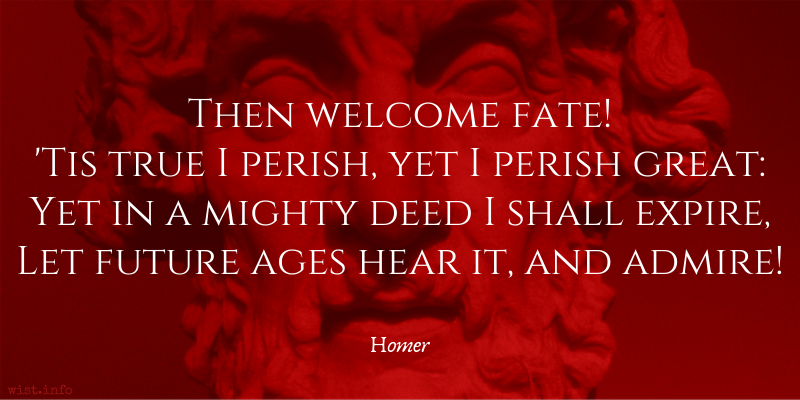
I never want to be away from you again, except at work, in the restroom, or when one of us is at a movie the other does not want to see.
Lemony Snicket (b. 1970) American author, screenwriter, musician (pseud. for Daniel Handler)
The Beatrice Letters (2006)
Every man always has handy a dozen glib little reasons why he is right not to sacrifice himself.
Alexander Solzhenitsen (1918–2008) Russian novelist, emigre [Aleksandr Isayevich Solzhenitsyn]
The Gulag Archipelago, Vol. 1, Part 1, ch. 1 (1973) [tr. Whitney]
(Source)
To ridicule philosophy, that is really to act the philosopher.
[Se moquer de la philosophie c’est vraiment philosophe.]
Blaise Pascal (1623–1662) French scientist and philosopher
Thoughts [Pensées], Article 7, #35 (1670)
Pascal's works are sorted and classified by translators in a variety of ways, so numbering is inconsistent. Other translations:
- "To have no time for philosophy is to be a true philosopher." [tr. Krailsheimer (2003); Series 22, #513]
- "To make light of philosophy is to be a true philosopher." [tr. Paul (1885), "Various Thoughts"; also Trotter (1958), Sec. 1, #4]
- "To ridicule philosophy is really to philosophize." [#430]
- "To ridicule philosophy is truly philosophical."
- "To mock philosophy is to philosophize truly"
- "To mock philosophy is to be a true philosopher."

If we merge mercy with might,
and might with right,
then love becomes our legacy
and change our children’s birthright.Amanda Gorman (b. 1998) American poet and activist
“The Hill We Climb” (2021)
(Source)
Read at the Presidential Inauguration (20 Jan 2021).
You must have three essentials for the investigation of Chan [Zen]. The first is that you must have the foundation of great faith. The second is that you must have a zealous determination. The third is that you must have the feeling of great doubt. If you omit one of these it is like breaking off the leg of a tripod, which ends up becoming a useless vessel.
高峰云、叅禪須具三要 一有大信根
二有大憤志 三有大疑情 苟闕其一
如折足之鼎 終成廢器。Hyujeong (1520–1604) Korean Seon (Sŏn, Zen) Master [Sosan Taesa, Seosan Daesa, Dae Seonsa]
Mirror of Zen [Samga Gwigam; Samga Kwigom; Seonga Gwigam], ch. 14 [tr. Jorgensen (2012)]
(Source)
Other translations:For the study of Seon, there are three requirements: (1) having the great root of faith; (2) having great determination, and (3) having great doubt. If you lack one of these, it is like a broken like on a tripod sacrificial vessel. In the end you will discard it.
[tr. Miller (2017)]There are three essentials to Sŏn meditation. First of all, you must be rooted in Great Faith and Great Confidence. Secondly, one must have Great Anger -- a strong, inwardly-directed, ardent determination to practice. Thirdly, one must have Great Doubt. If one of these is missing, it is like a tripod vessel with one leg cut off -- in the end, it will be of no use.
[Source]It is well known that Ganhwaseon practitioners must have three things of essential importance: The first is a Foundation of Great Faith (大信根) for the practice which is possible; the second is Great Zealous Determination (大憤志) of practice to attain enlightenment; the third is a Great Feeling of Doubt (大疑情) on the Hwadu. If one of these is lacking, then it is like a tripod pot with a broken foot and is useless.
[Source]

There are two kinds of injustice — the one, on the part of those who inflict wrong, the other on the part of those who, when they can, do not shield from wrong those upon whom it is being inflicted. For he who, under the influence of anger or some other passion, wrongfully assaults another seems, as it were, to be laying violent hands upon a comrade; but he who does not prevent or oppose wrong, if he can, is just as guilty of wrong as if he deserted his parents or his friends or his country.
[Sed iniustitiae genera duo sunt, unum eorum, qui inferunt, alterum eorum, qui ab iis, quibus infertur, si possunt, non propulsant iniuriam. Nam qui iniuste impetum in quempiam facit aut ira aut aliqua perturbatione incitatus, is quasi manus afferre videtur socio; qui autem non defendit nec obsistit, si potest, iniuriae, tam est in vitio, quam si parentes aut amicos aut patriam deserat.]
Marcus Tullius Cicero (106–43 BC) Roman orator, statesman, philosopher
De Officiis [On Duties; On Moral Duty; The Offices], Book 1, ch. 7 (1.7) / sec. 23 (44 BC) [tr. Miller (1913)]
(Source)
Original Latin. Other translations:The vice that is opposite to justice is injustice, of which there are two sorts: the first consists in the actual doing an injury to another; the second, in tamely looking on while he is injured, and not helping and defending him though we are able: for he that injuriously falls on another, whether prompted by rage or other violent passion, does as it were leap at the throat of his companion; and he that refuses to help him when injured, and to ward off the wrong if it lies in his power, is as plainly guilty of baseness and and injustice as though he had deserted his father, his friends, or his native country.
[tr. Cockman (1699)]There are two kinds of injustice: Of the one, they are guilty who do an injury; of the other, they who, if they are able, do not defend those from injury to whom it is offered. For he who urged on by anger, or some violent passion, attempts to injure any man, lifts his hand against his brother' and he who interferes not to resist or repel the attempt, is as guilty as if he had deserted his parents, his friends, or his country.
[tr. McCartney (1798)]But there are two kinds of injustice; the first of those who offer an injury, the second of those who have in their power to avert an injury from those to whom it is offered, and yet do it not. For if a man, prompted either by anger or any sudden perturbation, unjustly assaults another man, such a one seems as it were to lay violent hands on one's ally; and the man who does not repel or withstand the injury, if he can, is as much to blame as if he deserted the cause of his parents, his friends, or his country.
[tr. Edmonds (1865)]Of injustice there are two kinds, -- one, that of those who inflict injury; the other, that of those who do not, if they can, repel injury from those on whom it is inflicted. Moreover, he who, moved by anger or by some disturbance of mind, makes an unjust assault on any person, is as one who lays violent hands on a casual companion; while he who does not, if he can, ward off or resist the injury offered to another, is as much in fault as if he were to desert his parents, or his friends, or his country.
[tr. Peabody (1883)]There are two kinds of injustice: the positive injustice of the aggressor, and the negative injustice of neglecting to defend those who are wronged. To attack a man unjustly under the influence of anger or some other passion is to lay hands upon a comrade; not to defend the oppressed and shield them from injustice, is as great a crime as to desert our parents, friends, or country.
[tr. Gardiner (1899)]There are two classifications of injustice. One part includes those who act unjustly. The other part includes men who, even if they have the power to do so, fail to protect from abuse those people against whom other men commit violence. The man who unjustly does harm to someone else, either in anger or because some other passion arounds him, acts as if he were striking a companion. But the man who does not avert an act of violence, or offer resistance if he has the power, is just as much at fault as if he betrayed his parents, or friends, or his fatherland.
[tr. Edinger (1974)]
There is no such thing as conversation. It is an illusion. There are intersecting monologues, that is all. We speak; we spread round us with sounds, with words, an emanation from ourselves. Sometimes they overlap the circles that others are spreading round themselves. Then they are affected by these other circles, to be sure, but not because of any real communication that has taken place — merely as a scarf of blue chiffon lying on a woman’s dressing table will change color if she casts down on it a scarf of red chiffon.
Rebecca West (1892–1983) British author, journalist, literary critic, travel writer [pseud. for Cicily Isabel Fairfield]
“There Is No Conversation,” The Saturday Evening Post (1928-12-08)
(Source)
In the initial magazine appearance, the third sentence read, "There are interesting monologues." When reprinted in The Harsh Voice: Four Short Novels (1935), and subsequently, interesting was replaced with intersecting.
More discussion about this quotation: There Is No Such Thing as Conversation. It Is an Illusion. There Are Intersecting Monologues, That Is All – Quote Investigator®.
Economics is the art of allocating scarce goods among competing demands. The conceit of Marxism was the thought that in Communism, economics would be “abolished”; this was why one did not have to think about the questions of relative privilege and social justice. But the point is that we still have to think about economics, and probably always will. The question, then, is whether we can arrive at a set of normative rules which seek to protect liberty, reward achievement and enhance the social good, within the constraints of “economics”.
Daniel Bell (1919–2011) American sociologist, writer, editor, academic
The Cultural Contradictions of Capitalism (1976)
I don’t know whether my life has been a success or a failure But not having any anxiety about becoming one instead of the other, and just taking things as they come along, I’ve had a lot of extra time to enjoy life.
Arthur "Harpo" Marx (1888–1964) American comedian, actor, mime, musician [b. Adolph Marx]
Harpo Speaks!, ch. 1, opening words (1961) [with Rowland Barber]
(Source)

There has only been one Christian. They caught Him and crucified Him early.
Mark Twain (1835–1910) American writer [pseud. of Samuel Clemens]
Note (1898-07-04), Mark Twain’s Notebook, ch. 21 “In Vienna” (1935) [ed. Albert Bigelow Paine]
(Source)
While summering in Kaltenleutgeben, Austria.
JERRY: Writing is also one of those things like … I’d rather fill in all the “o”s in the phone book. [Laughs]. You know what I mean? Anything is more fun than trying to write songs.
BOB: I’d rather be in the dentist’s chair. The blank page is the most frightening, most horrifying, the most toothy, snarling, god-awful thing I can imagine.
JERRY: Any excuse to not do it is good enough.
BOB: Man, look at those dishes mounting up. How can I work in this pigsty?
Jerry Garcia (1942–1995) American singer-songwriter and guitarist
Interview of Jerry Garcia and Bob Weir by Jon Sievert, Guitar Player Magazine (1993-05-20)
The interview was reprinted in Best of Guitar Player - Grateful Dead (1993-09). (Many thanks to Ryan Curry for sharing the photo.)

Inside every older person there’s a younger person wondering what happened.
Ashleigh Brilliant (b. 1933) Anglo-American epigramist, aphorist, cartoonist
Pot-Shots, #1390
A friend is one who rejoices in our good and grieves for our pain, and this purely on our own account.
[τούτων δὲ ὑποκειμένων ἀνάγκη φίλον εἶναι τὸν συνηδόμενον τοῖς ἀγαθοῖς καὶ συναλγοῦντα τοῖς λυπηροῖς μὴ διά τι ἕτερον ἀλλὰ δι᾽ ἐκεῖνον.]
Aristotle (384–322 BC) Greek philosopher
Rhetoric [Ῥητορική; Ars Rhetorica], Book 2, ch. 4, sec. 3 (2.4.3) / 1381a (350 BC) [tr. Jebb (1873)]
(Source)
(Source (Greek)). Other translations:
- "He who rejoices with one in prosperity, and sympathises with one in pain, not with a view to anything else but for his friend's sake, is a friend." [Source (1847)]
- "One who participates in another's joy at good fortune, and in his sorry at what aggrieves him, not from any other motive, but simply for his sake, is his friend." [tr. Buckley (1850)]
- "Your friend is the sort of man who shares your pleasure in what is good and your pain in what is unpleasant, for your sake and for no other reason." [tr. Roberts (1924)]
- "He is a friend who shares our joy in good fortune and our sorrow in affliction, for our own sake and not for any other reason." [tr. Freese (1926)]
- "The following people are our friends: those who share our pleasure when good things happen and our distress when bad things happen for no other reason than for our sake." [tr. Waterfield (2018)]
- "A friend is one who shares in the other fellow's pleasure at the good things and his pain at what is grievous, for no other reason than that fellow's sake." [tr. Bartlett (2019)]
- "A friend is someone who is a partner in our happiness and a partner in our sorrow not for any other reason but for friendship." [tr. @sentantiq (2019)]
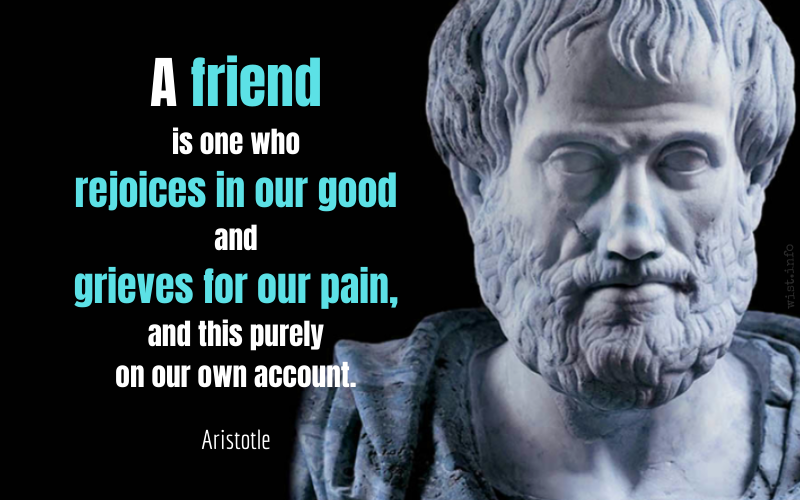
But everyone assumes causation when they should be thinking coincidence, and correlation when they should be asking whether Twitter is really a reliable source of information.
Hell is not in torture.
Hell is in an empty heart.Kahlil Gibran (1883–1931) Lebanese-American poet, writer, painter [Gibran Khalil Gibran]
“The Sayings of the Brook [Ma Taqul al-Saqiyah]” [tr. Sheban]
(Source)
To the wrong that needs resistance
To the right that needs assistance
To the future in the distance
Give yourself!Carrie Chapman Catt (1859–1947) American women's suffrage activist
Personal Motto
(Source)
Conveyed in a letter from Catt to Aletta Jacobs, after the death of Jacobs' husband.

As to the evil which results from a censorship, it is impossible to measure it, because it is impossible to tell where it ends.
Jeremy Bentham (1748–1832) English jurist and philosopher
“Principles of the Penal Code,” ch. 3, Theory of Legislation (1802)
(Source)
I will leave it for the present, as this letter is already pretty long. Such is my desire, my anxiety for your perfection, that I never think I have said enough, though you may possibly think I have said too much; and though, in truth, if your own good sense is not sufficient to direct you, in many of these plain points, all that I or anybody else can say will be insufficient.
Lord Chesterfield (1694–1773) English statesman, wit [Philip Dormer Stanhope]
Letter to his son, #168 (18 Nov 1748)
(Source)
Chesterfield repeats the sentiment in a later letter, #194 (22 Sep 1749):This letter is a very long, and so possibly a very tedious one; but my anxiety for your perfection is so great, and particularly at this critical and decisive period of your life, that I am only afraid of omitting, but never of repeating or dwelling too long upon anything that I think may be of the least use to you.
Clichés, stock phrases, adherence to conventional, standardized codes of expression and conduct have the socially recognized function of protecting us against reality, that is, against the claim on our thinking attention that all events and facts make by virtue of their existence.
Hannah Arendt (1906–1975) German-American philosopher, political theorist
Lecture (1971), “Thinking and Moral Considerations,” Social Research (1971 Fall)
(Source)
Referring to Adolf Eichmann's use of "cliché-ridden language" as a sign of his "thoughtlessness."
Collected in The Life of the Mind, Part 1 "Thinking," Introduction (1974).
Oh, but I hate it more
when a traitor, caught red-handed,
tries to glorify his crimes.[μισῶ γε μέντοι χὤταν ἐν κακοῖσί τις
ἁλοὺς ἔπειτα τοῦτο καλλύνειν θέλῃ.]
Sophocles (496–406 BC) Greek tragic playwright
Antigone, l. 495ff [Creon] (441 BC) [tr. Fagles (1982), l. 552ff]
(Source)
Original Greek. Other translations:Howbeit, to me it is no less abhorrent,
When, caught in criminality, the culprit
Seeks with fine words to beautify his deed.
[tr. Donaldson (1848)]More hateful still the miscreant who seeks
When caught, to make a virtue of a crime.
[tr. Storr (1859)]But not less hateful
Seems it to me, when one that hath been caught
In wickedness would give it a brave show.
[tr. Campbell (1873)]But, truly, I detest it, too, when one who has been caught in treachery then seeks to make the crime a glory.
[tr. Jebb (1891)]I cannot bear to see the guilty stand
Convicted of their crimes, and yet pretend
To gloss them o'er with specious names of virtue.
[tr. Werner (1892)]But verily this, too, is hateful, -- when one who hath been caught in wickedness then seeks to make the crime a glory.
[tr. Jebb (1917)]But now much worse than this
Is brazen boasting of barefaced anarchy.
[tr. Fitts/Fitzgerald (1939), l. 390ff]The criminal who being caught still tries.
To make a fair excuse , is damned indeed.
[tr. Watling (1947), l. 414ff]I hate it too when someone caught in crime
then wants to make it seem a lovely thing.
[tr. Wyckoff (1954)]But this is worst of all: to be convicted
And then to glorify the name as virtue.
[tr. Kitto (1962)]But how I hate it when she's caught in the act, And the criminal still glories in her crime. [tr. Woodruff (2001)]I hate it when someone, caught in ugliness, afterwards wants to make it look pretty. [tr. Tyrell/Bennett (2002)]And there’s nothing I hate more than when someone is caught committing a crime and tries to hide it by embellishing it with sweet words.
[tr. Theodoridis (2004)]How I despise
a person caught committing evil acts
who then desires to glorify the crime.
[tr. Johnston (2005), l. 562ff]I, for my part, hate anyone caught in the act who tries to beautify his crimes thereupon.
[tr. Thomas (2005)]I hate it when someone is caught in the midst of their evil deeds and tries to gloss over them.
[tr. @sentantiq (2020)]
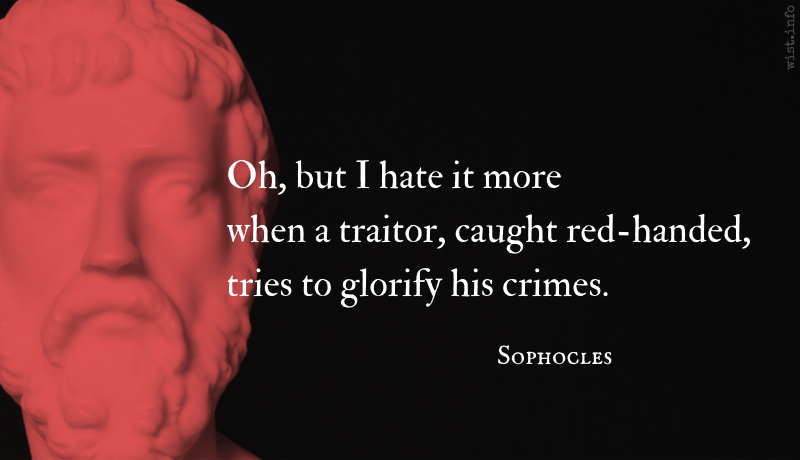
We will lead not merely by the example of our power but by the power of our example.
Joe Biden (b. 1942) American politician, US President (2021- ) [Joseph Robinette Biden Jr.]
Inaugural Address (20 Jan 2021)
(Source)
Regarding American foreign relations.

We should take comfort that while we may have more still to endure, better days will return: we will be with our friends again; we will be with our families again; we will meet again.
Elizabeth II (b. 1926) Queen of the United Kingdom and the Commonwealth realms
Address to the Nation (5 Apr 2020)
(Source)
On the COVID-19 Pandemic. The last line is an allusion to the famous WWII song.

No object is so ugly that, under certain conditions of light and shade, or proximity to other things, it will not look beautiful; no object is so beautiful that, under certain conditions, it will not look ugly.
Oscar Wilde (1854–1900) Irish poet, wit, dramatist
Lecture to Art Students, Royal Academy, London (30 Jun 1883)
(Source)
Down the Trojans came like a squall of brawling gale-winds
blasting down with the Father’s thunder, loosed on earth
and a superhuman uproar bursts as they pound the heavy seas,
the giant breakers seething, battle lines of them roaring,
shoulders rearing, exploding foam, waves in the vanguard,
waves rolling in from the rear. So on the Trojans came,
waves in the vanguard, waves from the rear, closing,
bronze men glittering, following captains, closing.[οἳ δ᾽ ἴσαν ἀργαλέων ἀνέμων ἀτάλαντοι ἀέλλῃ,
ἥ ῥά θ᾽ ὑπὸ βροντῆς πατρὸς Διὸς εἶσι πέδον δέ,
θεσπεσίῳ δ᾽ ὁμάδῳ ἁλὶ μίσγεται, ἐν δέ τε πολλὰ
κύματα παφλάζοντα πολυφλοίσβοιο θαλάσσης
κυρτὰ φαληριόωντα, πρὸ μέν τ᾽ ἄλλ᾽, αὐτὰρ ἐπ᾽ ἄλλα:
800ὣς Τρῶες πρὸ μὲν ἄλλοι ἀρηρότες, αὐτὰρ ἐπ᾽ ἄλλοι,
χαλκῷ μαρμαίροντες ἅμ᾽ ἡγεμόνεσσιν ἕποντο.]Homer (fl. 7th-8th C. BC) Greek author
The Iliad [Ἰλιάς], Book 13, l. 795ff (13.795) (c. 750 BC) [tr. Fagles (1990), l. 920ff]
(Source)
Original Greek. Other translations:And as the floods of troubled air to pitchy storms increase
That after thunder sweeps the fields, and ravish up the seas,
Encount’ring with abhorréd roars, when the engrosséd waves
Boil into foam, and endlessly one after other raves;
So rank’d and guarded th’ Ilians march’d; some now, more now, and then
More upon more, in shining steel; now captains, then their men.
[tr. Chapman (1611), l. 711ff]As when from gloomy clouds a whirlwind springs,
That bears Jove’s thunder on its dreadful wings,
Wide o’er the blasted fields the tempest sweeps;
Then, gather’d, settles on the hoary deeps;
The afflicted deeps tumultuous mix and roar;
The waves behind impel the waves before,
Wide rolling, foaming high, and tumbling to the shore:
Thus rank on rank, the thick battalions throng,
Chief urged on chief, and man drove man along:
Far o'er the plains in dreadful order bright,
The brazen arms reflect a beamy light.
[tr. Pope (1715-20)]The march of these at once, was as the sound
Of mighty winds from deep-hung thunder-clouds
Descending; clamorous the blast and wild
With ocean mingles; many a billow, then,
Upridged rides turbulent the sounding flood,
Foam-crested billow after billow driven,
So moved the host of Troy, rank after rank
Behind their Chiefs, all dazzling bright in arms.
[tr. Cowper (1791), l. 964ff]But they marched like unto the blast of boisterous winds, which rushes down to the plain, urged by the thunder of father Jove, and with a dreadful tumult is mingled with the ocean; and in it rise many boiling billows of the much-resounding sea, swollen, whitened with foam, first indeed some and then others following. So the Trojans, first indeed some in battle array, and then others glittering in brass, followed along with their leaders.
[tr. Buckley (1860)]Onward they dash’d, impetuous as the rush
Of the fierce whirlwind, which with lightning charg’d,
From Father Jove sweeps downward o’er the plain:
As with loud roar it mingles with the sea,
The many-dashing ocean’s billows boil,
Upheaving, foam-white-crested, wave on wave;
So, rank on rank, the Trojans, closely mass’d,
In arms all glitt’ring, with their chiefs advanc’d.
[tr. Derby (1864)]And these set forth like the blast of violent winds, that rushes earthward beneath the thunder of Zeus, and with marvellous din doth mingle with the salt sea, and therein are many swelling waves of the loud roaring sea, arched over and white with foam, some vanward, others in the rear; even so the Trojans arrayed in van and rear and shining with bronze, followed after their leaders.
[tr. Leaf/Lang/Myers (1891)]They flew forth like the blasts of some fierce wind that strike earth in the van of a thunderstorm -- they buffet the salt sea into an uproar; many and mighty are the great waves that come crashing in one after the other upon the shore with their arching heads all crested with foam -- even so did rank behind rank of Trojans arrayed in gleaming armour follow their leaders onward.
[tr. Butler (1898)]And they came on like the blast of direful winds that rusheth upon the earth beneath the thunder of father Zeus, and with wondrous din mingleth with the sea, and in its track are many surging waves of the loud-resounding sea, high-arched and white with foam, some in the van and after them others; even so the Trojans, in close array, some in the van and after them others, flashing with bronze, followed with their leaders.
[tr. Murray (1924)]They went on, as out of the racking winds the stormblast
that underneath the thunderstroke of Zeus-Father drives downward
and with gigantic clamour hits the sea, and the numerous
boiling waves along the length of the roaring water
bend and whiten to foam in ranks, one upon another;
so the Trojans closing in ranks, some leading and others
after them, in the glare of bronze armor followed their leaders.
[tr. Lattimore (1951)]Men charged like rough winds in a storm launched on Earth in thunder of Father Zeus, when roaring high the wind and ocean rise together; swell on swell of clamorous foaming see goes forward, snowy-crested, curling, ranked ahead and ranked behind: so line by compact line advanced the Trojans, glittering in bronze behind their captains.
[tr. Fitzgerald (1974)]The Trojans attacked like a blast of a sudden squall
that swoops down to earth with lightning and thunder, churning
the dark sea into a fury, and countless waves
surge and toss on its surface, high-arched and white-capped,
and crash down onto the seashore in endless ranks:
just so did the Trojans charge in their ranks, each battalion
packed close together.
[tr. Mitchell (2011)]And they went in like a maelstrom of quarrelsome winds
that goes earthward beneath Father Zeus’ thunderbolt
and with an inhuman din churns with the salt sea, the many
roiling waves of the greatly-roaring ocean
cresting, flecked with white, some before, and others hard behind;
So too the Trojans were packed together, some before, others hard behind.
[tr. Mendelsohn (2011)]
When you are invited to dine, particularly with people you do not know very well, it always helps to have a conversational opener, a phrase which here means “an interesting sentence to say out loud in order to get people talking.” Although lately, it has become more and more difficult to attend dinner parties without the evening ending in gunfire or tapioca, I keep a list of good and bad conversational openers in my commonplace book in order to avoid awkward pauses at the dinner table. “Who would like to see an assortment of photographs taken while I was on vacation?” for instance, is a very poor conversational opener because it is likely to make your fellow diners shudder instead of talk, whereas good conversational openers are sentences such as “What would drive a man to commit arson?,” “Why do so many stories of true love end in tragedy and despair?,” and “Madam DeLustrio, I believe I’ve discovered your true identity!” all of which are likely to provoke discussions, arguments, and accusations, thus making the dinner party much more entertaining.
Lemony Snicket (b. 1970) American author, screenwriter, musician (pseud. for Daniel Handler)
The Grim Grotto (2004)
Human nature, if it changes at all, changes not much faster than the geological face of the earth.
Alexander Solzhenitsen (1918–2008) Russian novelist, emigre [Aleksandr Isayevich Solzhenitsyn]
The Gulag Archipelago, Vol. 1 (1973) [tr. Whitney]
(Source)
Let us believe that the whole of truth can never do harm to the whole of virtue. Trust it. And remember, that, in order to get the whole of truth, you must allow every man, right or wrong, freely to utter his conscience, and protect him in so doing.
Wendell Phillips (1811–1884) American abolitionist, orator, social activist
“The Boston Mob,” speech, Antislavery Meeting, Boston (21 Oct 1855)
(Source)
"On the Twentieth Anniversary of the Mob of October 21, 1835."
Truth and goodness are the same for all people. But pleasure varies from one to another.
Ἀνθρώποις πᾶσι τωὐτὸν ἀγαθὸν καὶ ἀληθές· ἡδὺ δὲ ἄλλωι ἄλλο.
Democritus (c. 460 BC - c. 370 BC) Greek philosopher
Frag. 69 (Diels) [tr. @sententiq (2018), fr. 68]
(Source)
Diels citation "69. (6 N.) DEMOKRATES. 34.". Freeman notes this as one of the Gnômae, from a collection called "Maxims of Democratês," but because Stobaeus quotes many of these as "Maxims of Democritus," they are generally attributed to the latter. Other translations:
- "For all men, good and true are the same; but pleasant differs for different men." [tr. Freeman (1948)]
- "The same thing is good and true for all men. But what is pleasant differs from one to another." [Warren (2008)]
- "Goodness and truth are the same for all men: but pleasure differs from man to man." [Source]
The idea of God that I absorbed was that it would be wonderful if He existed: We needed Him desperately but had not seen Him in many thousands of years.
In nationalist thought there are facts which are both true and untrue, known and unknown. A known fact may be so unbearable that it is habitually pushed aside and not allowed to enter into logical processes, or on the other hand it may enter into every calculation and yet never be admitted as a fact, even in one’s own mind.
George Orwell (1903–1950) English journalist, essayist, writer [pseud. of Eric Arthur Blair]
Essay (1945-05), “Notes on Nationalism,” Polemic Magazine (1945-10)
(Source)
It was one Sunday evening early in September of the year 1903 that I received one of Holmes’s laconic messages: “Come at once if convenient — if inconvenient come all the same. S.H.'”
Arthur Conan Doyle (1859–1930) British writer and physician
“The Adventure of the Creeping Man,” Strand Magazine (Mar 1923)
(Source)
Reprinted in The Case-Book of Sherlock Holmes (1927).
“So, Jeeves!”
“Yes, sir.”
“What do you mean, Yes, sir?”
“I was endeavouring to convey my appreciation of the fact that your position is in many respects somewhat difficult, sir. But I wonder if I might call your attention to an observation of the Emperor Marcus Aurelius. He said: ‘Does aught befall you? It is good. It is part of the destiny of the Universe ordained for you from the beginning. All that befalls you is part of the great web.'”
I breathed a bit stertorously.
“He said that, did he?”
“Yes, sir.”
“Well, you can tell him from me he’s an ass.”P. G. Wodehouse (1881–1975) Anglo-American humorist, playwright and lyricist [Pelham Grenville Wodehouse]
The Mating Season, ch. 4 (1949)
(Source)
Adapted from Marcus Aurelius, Meditations, Book 4, #26 [tr. Rendall (1901)].
Wodehouse uses in "Ordeal by Golf" (1919) a similar sentiment from Meditations, Book 10, #5, to suggest Marcus Aurelius was a golfer.Imitate the spirit of Marcus Aurelius. "Whatever may befall thee," says that great man in his "Meditations," "it was preordained for thee from everlasting. Nothing happens to anybody which he is not fitted by nature to bear." I like to think that this noble thought came to him after he had sliced a couple of new balls into the woods, and that he jotted it down on the back of his score-card.
Let children read whatever they want and then talk about it with them. If parents and kids can talk together, we won’t have as much censorship because we won’t have as much fear. The fear that children’s values will change because they are exposed to other values isn’t valid if there is communication between parent and child.
Judy Blume (b. 1938) American writer
“Blume Speaks Out on Speaking Out,” Interview with Barbara Karlin, Los Angeles Times (18 Oct 1981)
(Source)