

It is good to have an end to journey towards; but it is the journey that matters, in the end.

Perhaps the safest thing to do at the outset, if technology permits, is to send music. This language may be the best we have for explaining what we are like to others in space, with least ambiguity. I would vote for Bach, all of Bach, streamed out into space, over and over again. We would be bragging of course, but surely it is excusable for us to put the best possible face on at the beginning of such an acquaintance. We can tell the harder truths later.
Lewis Thomas (1913–1993) American physician, poet, essayist, researcher
“Ceti,” New England Journal of Medicine (10 Feb 1972)
(Source)
On sending messages to extraterrestrial civilizations on other worlds, e.g. Tau Ceti. Citation N Engl J Med 1972; 286:306-307. Reprinted in The Lives of a Cell: Notes of a Biology Watcher (1974).
For he says that evils are neither diminished by time nor lightened by being premeditated; that meditation on evil to come, or, it may be, on that which will never come, is foolish; that every evil is sufficiently annoying when it comes; that to him who has always thought that something adverse may happen to him that very thought is a perpetual evil; that if the expected evil should not happen, he would have incurred voluntary misery in vain; that thus one would be always in distress, either in suffering evil or in thinking of it.
[Nam neque vetustate minui mala nec fieri praemeditata leviora, stultamque etiam esse meditationem futuri mali aut fortasse ne futuri quidem: satis esse odiosum malum omne, cum venisset; qui autem semper cogitavisset accidere posse aliquid adversi, ei fieri illud sempiternum malum; si vero ne futurum quidem sit, frustra suscipi miseriam voluntariam; ita semper angi aut accipiendo aut cogitando malo.]
Marcus Tullius Cicero (106–43 BC) Roman orator, statesman, philosopher
Tusculan Disputations [Tusculanae Disputationes], Book 3, ch. 15 (3.15) / sec. 32 (45 BC) [tr. Peabody (1886)]
(Source)
Discussing the teachings of Epicurus (fr. U444). Source (Latin). Other translations:For that neither are Evils abated by long time, nor yet alleviated by foresight of them; and that the poring on Evils not yet come, and perhaps that never will come, is foolish. For that all Evil is Vexation enough, when it is come; but he that is always thinking that some Adversity may possibly befall him, to him it becometh an everlasting Evil; but if it shall never actually come upon him, a voluntary Disquiet is taken up on false grounds; so the mind is always vex'd, either with enduring, or expecting Evil.
[tr. Wase (1643)]Evils are not the less by reason of their continuance, nor the oighter for having been foreseen; and it is folly to ruminate on evils to come, or that, perhaps, may never come; every evil is disagreeable enough when it doth come: but he who is constantly considering that some evil may befall him, charges himself with a perpetual evil, for should such eve never light on him, he voluntarily takes to himself unnecessary misery, so that he is under constant uneasiness, whether he meets any evil or only thinks of it.
[tr. Main (1824)]For evil ls not diminished by time, nor alleviated by premeditation: that it is folly itself to brood upon evil that is future, or indeed, perhaps, is not to be at all: that evil is hateful enough when it comes: that, to the man, who is always musing upon that which is to come, his meditation itself becomes an eternal evil; and, should it prove that his apprehensions have been groundless, he burdens himself with a voluntary misery; and thus, between the encounter and contemplation of evil, he is always in trouble.
[tr. Otis (1839)]Evils are not the less by reason of their continuance, nor the lighter for having been foreseen; and it is folly to ruminate on evils to come, or such as, perhaps, never may come; every evil is disagreeable enough when it does come; but he who is constantly considering that some evil may befall him, is loading himself with a perpetual evil, and even should such evil never light on him, he voluntarily takes upon himself unnecessary misery, so that he is under constant uneasiness, whether he actually suffers any evil, or only thinks of it.
[tr. Yonge (1853)]Evils are not diminished by the passage of time, nor made easier by pre-rehearsal. In fact it is foolish to rehearse misfortunes which have not yet happened and which may not happen at all. Each of our misfortunes is distasteful enough, he says, when it is already here: those who have constantly been thinking about what disagreeable things are on the way simply make their evils perpetual. And those things may not happen at all, in which case all their voluntary misery goes for nothing. The result is that they are always in anxiety, either from the evils they undergo or from those they anticipate.
[tr. Graver (2002)]
Our task as historians is to make past conflicts live again; not to lament the verdict or to wish for a different one. It bewildered me when my old master A. F. Pribram, a very great historian, said in the nineteen-thirties: “It is still not decided whether the Habsburg monarchy could have found a solution for its national problems.” How can we decide about something that did not happen? Heaven knows, we have difficulty enough in deciding what did happen. Events decided that the Habsburgs had not found a solution for their national problems; that is all we know or need to know. Whenever I read the phrase: “whether so-and-so acted rightly must be left for historians to decide,” I close the book; the writer has moved from history to make-believe.
A. J. P. Taylor (1906–1990) British historian, journalist, broadcaster [Alan John Percivale Taylor]
Trouble Makers: Dissent Over Foreign Policy 1792-1939 (1957)
(Source)
The radical novelty of modern science lies precisely in the rejection of the belief, which is at the heart of all popular religion, that the forces which move the stars and atoms are contingent upon the preferences of the human heart.
Walter Lippmann (1889–1974) American journalist and author
A Preface to Morals, Part 1, ch. 7 (1929)
(Source)
Evil when we are in its power is not felt as evil but as a necessity, or even a duty.

However you disguise novels, they are always biographies.
William Golding (1911–1983) British novelist, playwright, poet
“Universal Pessimist, Cosmic Optimist,” Interview by MaryLynn Scott, Aurora Online (1990)
(Source)
“What, did St. Francis preach to the birds?” asked Kate. “Whatever for? If he really liked birds he would have done better to preach to cats.”
Rebecca West (1892–1983) British author, journalist, literary critic, travel writer [pseud. for Cicily Isabel Fairfield]
This Real Night (1984)
(Source)

Perhaps it is not true to speak of God as a judge at all, or of his judgements. There does not seem to be really any evidence that His worlds are places of trial but rather schools, place of training, or that He is a judge but rather a Teacher, a Trainer, not in the imperfect sense in which men are teachers, but in the sense of His contriving and adapting His whole universe for one purpose of training every intelligent being to be perfect.
Florence Nightingale (1820–1910) English social reformer, statistician, founder of modern nursing
“Note on God and judgment”
(Source)
In Lynn McDonald, Ed., Florence Nightingale's Theology: Essays, Letters, and Journal Notes (2002), noted as "ADD MSS 45783 ff65-67".

Sitting in stunned silence, we remembered our dead. So many dead. So many maimed. So many bright futures consigned to the ashes of the past. So many dreams lost in the madness that had engulfed us. Except for a few widely scattered shouts of joy, the survivors of the abyss sat hollow-eyed and silent, trying to comprehend a world without war.
E. B. Sledge (1923–2001) American soldier, biologist, academic, memoirist [Eugene Bondurant Sledge]
With the Old Breed at Peleliu and Okinawa (1981)
On the reaction of his fellow Marines to the announcement of the Japanese surrender in WWII.
Paul Fussell quotes this passage in his essay "Thank God for the Atom Bomb," The New Republic (26 Aug 1981), and it is sometimes misattributed to him.

Once, when a religionist denounced me in unmeasured terms, I sent him a card saying, “I am sure you believe that I will go to hell when I die, and that once there I will suffer all the pains and tortures the sadistic ingenuity of your deity can devise and that this torture will continue forever. Isn’t that enough for you? Do you have to call me bad names in addition?”
Isaac Asimov (1920–1992) Russian-American author, polymath, biochemist
I, Asimov, ch. 73 “Letters” (1979)
(Source)
The instinct for self-deception in human beings makes them try to banish from their minds dangers of which at bottom they are perfectly aware by declaring them non-existent.
Stefan Zweig (1881–1942) Austrian novelist, playwright, journalist, biographer
Beware of Pity (1939)
The liberty of man is not safe in the hands of any church. Wherever the Bible and sword are in partnership, man is a slave.
Robert Green Ingersoll (1833–1899) American lawyer, freethinker, orator
Some Mistakes of Moses, ch. 3 “The Politicians” (1879)
(Source)
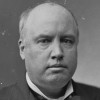
You go on inside. Be bold, nothing to fear.
In every venture the bold man comes off best,
even the wanderer, bound from distant shores.[σὺ δ᾽ ἔσω κίε, μηδέ τι θυμῷ
τάρβει: θαρσαλέος γὰρ ἀνὴρ ἐν πᾶσιν ἀμείνων
ἔργοισιν τελέθει, εἰ καί ποθεν ἄλλοθεν ἔλθοι.]Homer (fl. 7th-8th C. BC) Greek author
The Odyssey [Ὀδύσσεια], Book 7, l. 50ff (7.50) (c. 700 BC) [tr. Fagles (1996)]
(Source)
Athena to Odysseus, outside the palace of King Alkinoös.
(Source (Greek)). Other translations:Enter amongst them, nor admit a fear.
More bold a man is, he prevails the more,
Though man nor place he ever saw before.
[tr. Chapman (1616)]Though you a stranger be, fear not, go in;
The bold than fearful always better speed.
[tr. Hobbes (1675), ll. 45-46]Fear not, but be bold:
A decent boldness ever meets with friends,
Succeeds, and even a stranger recommends.
[tr. Pope (1725)]But enter fearing nought, for boldest men
Speed ever best, come whencesoe’er they may.
[tr. Cowper (1792), ll. 60-61]Now enter, and all fear forego,
Since it is always on the bold in mind,
Strange though his stock, that fortune shines most kind.
[tr. Worsley (1861), st. 8]Go in! with no faint heart: --
The bold man ever wins the best success
In all his works, e'en tho' from far he come!
[tr. Bigge-Wither (1869)]Enter then, and fear not in thine heart, for the dauntless man is the best in every adventure, even though he come from a strange land.
[tr. Butcher/Lang (1879)]Go in and have no dread:
For the man that is stout and hardy drives all things better home,
Whatever of deeds be toward; yea, e'en if from far he come.
[tr. Morris (1887)]But enter, and have no misgivings in your heart; for the courageous man in all affairs better attains his head, come he from where he may.
[tr. Palmer (1891)]But do not be afraid; go straight in, for the bolder a man is the more likely he is to carry his point, even though he is a stranger.
[tr. Butler (1898)]Go thou within, and let thy heart fear nothing; for a bold man is better in all things, though he be a stranger from another land.
[tr. Murray (1919)]Thrust in fearlessly: however foreign a man may be, in every crisis it is the high face which will carry him through.
[tr. Lawrence (1932)]Go straight in and have no qualms. For it is the bold man who every time does best, at home or abroad.
[tr. Rieu (1946)]You must not be dismayed; go in to them. A cheerful man does best in every enterprise -- even a stranger.
[tr. Fitzgerald (1961)]You go in with a spirit that fears nothing.
The bold man proes the better for every action
in the end, even though he is a stranger coming from elsewhere.
[tr. Lattimore (1965)]When you go in, forget your fear: far better
to be a bold man, though a stranger here.
[tr. Mandelbaum (1990)]Go inside and don't be afraid of anything.
Things turn out better for a man who is bold,
Especially if he's a stranger from a distant land.
[tr. Lombardo (2000)]Go in and have no fear. For a man is best to be bold, even a stranger from a foreign land.
[tr. Kline (2004)]Go in and have no fear in your heart; in every kind of action the dauntless man always proves the better, even if he hails from some distant country.
[tr. Verity (2016)]Do not be scared; go in. The brave succeed in all adventures, even those who come from countries far away.
[tr. Wilson (2017)]Go in and don't let your heart show alarm: a man whose every move speaks boldness does better, even supposing he comes form some other country.
[tr. Green (2018)]But go inside, and do not be afraid.
In a man, boldness is always better
at getting good results, even in the case
where he’s a stranger from another land.
[tr. Johnston (2019)]
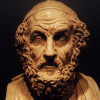
Yet if states were destroyed, local institutions corrupted, and economic incentives directed towards murder, few of us would behave well. There is little reason to think that we are ethically superior to the Europeans of the 1930s and 1940s, or for that matter less vulnerable to the kind of ideas that Hitler so successfully promulgated and realized.
Timothy Snyder (b. 1969) American historian, author
Black Earth: The Holocaust as History and Warning, “Conclusion” (2015)
(Source)

but whotthehell archy whotthehell
jamais triste archy jamais triste
that is my motto.Don Marquis (1878–1937) American journalist and humorist
archy and mehitabel, “mehitabel sees paris” (1927)
(Source)
"Jamais triste" means "never sad" in French.
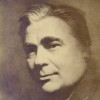
The ability to play is one of the principal criteria of mental health.
Ashley Montagu (1905–1999) British-American anthropologist and humanist [b. Israel Ehrenberg, a/k/a Montague Francis Ashley-Montagu]
Growing Young (1981)
(Source)
In the 2nd edition (1989), Montagu rephrased this a bit less prosaically: "Play is, of course, among the clearest of neotenous behavioral traits; it is the neoteny of the intellect, a principal criterion of mental health." Montagu uses the term "neoteny" to mean "growing young."
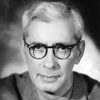
When democracy granted democratic methods for us in the times of opposition, this was bound to happen in a democratic system. However, we National Socialists never asserted that we represented a democratic point of view, but we have declared openly that we used democratic methods only in order to gain the power and that, after assuming the power, we would deny to our adversaries without any consideration the means which were granted to us in the times of opposition.
Joseph Goebbels (1897–1945) German Nazi politician, propagandist, bureaucrat
Nature and Form of National Socialism [Wesen und Gestalt des Nationalsozialismus], Pamphlet (1935)
(Source)
Quoted in Office of the United States, Chief Counsel for Prosecution of Axis Criminality, Nazi Conspiracy and Aggression, Vol. 1, ch. 7, doc. 2412-PS (1946)

That must be why some people like dogs; they can be made to feel guilty about anything, including the sins of their owners. Cats refuse to take the blame for anything — including their own sins.
Elizabeth Peters (1927–2013) American author [pseud. of Barbara Mertz, who also wrote as Barbara Michaels]
Trojan Gold (1987)
(Source)

On hearing that someone had reviled him, he said, “As long as I’m not in his presence, let him flog me as well.”
[ἀκούσας ὑπό τινος λοιδορεῖσθαι, “ἀπόντα με,” ἔφη, “καὶ μαστιγούτω.”]
Aristotle (384–322 BC) Greek philosopher
Attributed in Diogenes Laërtius, Lives and Opinions of Eminent Philosophers [Vitae Philosophorum], Book 5, sec. 11 [tr. Mensch (2018)]
(Source)
(Source (Greek)). Other translations:Having heard that he was abused by some one, he said, “He may beat me too, if he likes, in my absence.”
[tr. Yonge (1853), sec. 11]On hearing that someone abused him, he rejoined, "He may even scourge me so it be in my absence."
[tr. Hicks (1925), sec. 18]After he heard that he was mocked by someone, he said, “Let him insult me when I am absent.”
[tr. @sentantiq (2016)]
The best way to know our faults is to notice which ones you accuse others of.
James Richardson (b. 1950) American poet
Vectors: Aphorisms and Ten-Second Essays, #195 (2001)
(Source)

There is no doubt that solitude is a challenge and to maintain balance within it a precarious business. But I must not forget that, for me, being with people or even with one beloved person for any length of time without solitude is even worse. I lose my center. I feel dispersed, scattered, in pieces. I must have time alone in which to mull over my encounter, and to extract its juice, its essence, to understand what has really happened to me as a consequence of it.
May Sarton (1912–1995) Belgian-American poet, novelist, memoirist [pen name of Eleanore Marie Sarton]
Journal of a Solitude (1973)
(Source)

On Venice Beach, Alice and the girls and I once saw a man blowing truly spectacular soap bubbles the size of watermelons — still the symbol for me of the tendency of people in Southern California to become awfully good at something that isn’t terribly important.
Calvin Trillin (b. 1935) American journalist, humorist, novelist
Travels with Alice, ch. 10 (1989)
(Source)
This communicating of a man’s self to his friend worketh two contrary effects; for it redoubleth joys and cutteth griefs in Halves. For there is no man that imparteth his joys to his friend, but he joyeth the more; and no man that imparteth his griefs to his friend, but that he grieveth the less.
Francis Bacon (1561–1626) English philosopher, scientist, author, statesman
“Of Friendship,” Essays, No. 27 (1625)
(Source)

Now, do you think this could possibly happen to a wise person, to be subject to distress in this way? That is, to misery? For every emotion is a misery, but distress is a very torture-chamber. Desire scalds us; wild delight makes us giddy; fear degrades us, but the effects of distress are worse: gauntness, pain, depression, disfigurement. It eats away at the mind and, in a word, destroys it. This we must shed; this we must cast away, or else remain in misery.
[Hoc tu igitur censes sapienti accidere posse, ut aegritudine opprimatur, id est miseria? nam cum omnis perturbatio miseria est, tum carnificina est aegritudo. habet ardorem libido, levitatem laetitia gestiens, humilitatem metus, sed aegritudo maiora quaedam, tabem cruciatum adflictationem foeditatem, lacerat exest animum planeque conficit. hanc nisi exuimus sic ut abiciamus, miseria carere non possumus.]
Marcus Tullius Cicero (106–43 BC) Roman orator, statesman, philosopher
Tusculan Disputations [Tusculanae Disputationes], Book 3, ch. 13 (3.13) / sec. 27 (45 BC) [tr. Graver (2002)]
(Source)
(Source (Latin)). Other translations:Now do you think this possible to befall a wise man, to be overwhelm'd with Discontent, that is, with Misery? For whereas every Passion is Misery, Discontent is a Rack. Lust hath its Scorching; Fond Pleasure its Levity; Fear a meanness of Spirit; but Discontent carrieth along with it more destructive Evils; a Consumption, Torture, Vexation, Deformity. It tears, it frets the Soul like a Canker, and utterly brings it to Destruction. Unless we put off this, so as to cast it away, we can never want for Misery.
[tr. Wase (1643)]Do you then think it can befall a wise man to be oppressed with grief, i.e., with misery? For, as all perturbation is misery, grief is the rack itself; lust is attended with heat; exulting joy with levity; fear with a meanness; but grief is something greater than these; it consumes, torments, afflicts, and disgraces a man; it tears him, preys upon him, and quite puts an end to him. If we do not divest ourselves so of it, as to throw it quite off, we cannot be free from misery.
[tr. Main (1824)]then, dost think this may occur to the wise man, that he should be oppressed with sorrow, -- that is, with misery? For, while every perturbation is misery, sorrow is misery in torture. Cupidity has ardour, exulting joy levity, fear humiliation; but sorrow implies something greater, -- infection, torment, prostration, pollution; it lacerates, it gnaws the mind, and consumes it utterly. Unless we strip it off, so as to cast it from us, we cannot escape misery.
[tr. Otis (1839)]Do you, then, think that it can befall a wise man to be oppressed with grief, that is to say, with misery? for, as all perturbation is misery, grief is the rack itself. Lust is attended with heat, exulting joy with levity, fear with meanness, but grief with something greater than these; it consumes, torments, afflicts, and disgraces a man; it tears him, preys upon his mind, and utterly destroys him: if we do not so divest ourselves of it as to throw it completely off, we cannot be free from misery.
[tr. Yonge (1853)]Do you then think that it can happen to a wise man to be overcome by grief, that is, by misery ? Nay more, while every perturbation of the soul is misery, grief is torture. Lust is attended by ardor, ecstatic joy by levity, fear by abjectness; but grief has, worse than all these, wasting, torment, distress, noisomeness. It lacerates, corrodes and utterly consumes the soul. Unless we so divest ourselves of it as to throw it entirely away, we cannot be otherwise than miserable.
[tr. Peabody (1886)]
Men write history for the same reason they write poetry, study the properties of numbers, or play football — for the joy of creation; men read history for the same reason they listen to music or watch cricket — for the joy of appreciation.
A. J. P. Taylor (1906–1990) British historian, journalist, broadcaster [Alan John Percivale Taylor]
“The Historian,” Manchester Guardian (5 Aug 1938)
(Source)
There can be no liberty for a community which lacks the means by which to detect lies.
Walter Lippmann (1889–1974) American journalist and author
“What Modern Liberty Means,” Liberty and the News (1920)
(Source)

In all men is evil sleeping; the good man is he who will not awaken it, in himself or in other men.

Tut, man, decide promptly, but never give any reasons for your decisions. Your decisions may be right, but your reasons are sure to be wrong.
William Murray, 1st Earl of Mansfield (1705–1793) British barrister, politician, judge, legal reformer
Quoted in John Cordy Jeaffreson, A Book About Lawyers, Vol. 1, ch. 12 (1867)
(Source)
When asked by the new governor of a West Indies island how to apply the law.
To go from being a competent writer to being a great writer, I think you have to risk being — or risk being seen as — a bad writer. Competence is deadly because it prevents the writer risking the humiliation that they will need to risk before they pass beyond competence. To write competently is to do a few magic tricks for friends and family; to write well is to run away to join the circus. Your friends and family will love your tricks, because they love you. But try busking those tricks on the street. Try busking them alongside a magician who has been doing it for 10 years, earning their living. When they are watching a magician, people don’t want to say, “Well done.” They want to say, “Wow.”
Toby Litt (b. 1968) English writer and academic
“What makes bad writing bad?” The Guardian (20 May 2016)
(Source)

You’ll “start living tomorrow”? Start living today already, Postumus, you’re running out of time. Anyone with sense started living yesterday.
[Cras vives? hodie iam vivere, Postume, serum est:
Ille sapit, quisquis, Postume, vixit heri.]Martial (AD c.39-c.103) Spanish Roman poet, satirist, epigrammatist [Marcus Valerius Martialis]
Epigrams [Epigrammata], Book 5, epigram 58 (5.58.7-8) (AD 90) [tr. Nisbet (2015)]
(Source)
(Source (Latin)). See a related sentiment by Martial in 1.15. Other translations:Thou'lt live to morrow? -- 'tis too late to day:
Hee's wise who yesterday, I liv'd, can say.
[tr. Sherburne (1651)]Thou'lt live tomorrow? -- this day's life's too late:
He's wise that lived before the present date.
[tr. Fletcher (1656)]Tomorrow will I live, the fool does say;
Today itself's too late; the wise lived yesterday.
[tr. Cowley (1668), in Hay, "Appendix," ep. 59]Today to live, ev'n that's too late I say.
The wiseman, Posthumus, liv'd Yesterday.
[tr. Oldmixon (1728)]You will live, you say, tomorrow; it is late, Posthumus, to live today; he is wise who lived yesterday.
[tr. Amos (1858), ch. 3, ep. 46, noted as Martial Book 5, ep. 59]You will live tomorrow: even today it is too late to begin to live. He is the wise man, Postumus, who lived yesterday.
[tr. Bohn's Classical (1859)]To live today, Postumus, is already too late. He is wise, whoever he be, Postumus, who "lived" yesterday.
[tr. Ker (1919)]"Tomorrow": -- nay, do not this moment delay.
The wise man is he who has lived yesterday.
[tr. Pott & Wright (1921)]You'll live tomorrow? Now's too late, I say.
He's wise, my Postumus, who lived yesterday.
[tr. Francis & Tatum (1924), #255]Yes, this is what wise Martial says,
Though in another way:
"It's much too late today to live!
The wise lived yesterday!"
[tr. Marcellino (1968), "To a Crass Procrastinator"]"Tomorrow"? -- Postumus, today's too late.
The wise man, Postumus, lived yesterday.
[tr. Whigham (1987)]Will you live tomorrow? It's already overlate, Postumus, to live today. He is wise, Postumus, who lived yesterday.
[tr. Shackleton Bailey (1993)]Tomorrow? It’s already too late to live today:
He who lived yesterday, Postumus, he is wise.
[tr. Kline (2006)]Forget tomorrow's teasing long delay.
To make life pleasant, dwell on yesterday.
[tr. Wills (2007)]Will you live then? Today is late already.
He's wise who did his living yesterday.
[tr. McLean (2014)]Believe me, wise men don’t say “I shall live to do that,”
Tomorrow’s life is too late; live today.
Wisdom is not gained by knowing what is right. Wisdom is gained by practicing what is right, and noticing what happens when that practice succeeds and when it fails.
Barbara Brown Taylor (b. 1951) American minister, academic, author
An Altar in the World, ch. 2 (2009)
(Source)

Golf puts a man’s character on the anvil and his richest qualities — patience, poise, restraint — to the flame. Golf doesn’t build character, it only reveals it.
Billy Casper (1931–2015) American professional golfer
(Attibuted)

Your body is not a temple, it’s an amusement park. Enjoy the ride.
Anthony Bourdain (1956–2018) American chef, author, travel documentarian
Kitchen Confidential, “Second Course” (2000)
(Source)
While often framed around Bourdain's self-destructive lifestyle, in this context he's discussing being adventuresome when selecting places to dine, including taking some risks in order to gain new food experiences.

Biography is a very definite region, bounded on the north by history, on the south by fiction, on the east by obituary, and on the west by tedium.
Philip Guedalla (1889–1944) English barrister, epigrammatist, writer, biographer
“Literary Biography,” speech, quoted in The Observer (3 Mar 1929)
(Source)
I walked in the woods and looked at the birds, and I thought: How dreadful that people shut up birds in cages. If only I could so live and so serve the world that after me there should never again be birds in cages, they should all be free —
Isak Dinesen (1885–1962) Danish writer [pseud. of Karen Christence, Countess Blixen]
“The Deluge at Norderney,” Seven Gothic Tales [Miss Malin] (1934)
(Source)

How very little can be done under the spirit of fear; it is the very sentence pronounced upon the serpent, “Upon they belly shalt thou go all the days of thy life.”
Florence Nightingale (1820–1910) English social reformer, statistician, founder of modern nursing
Letter to Hannah Nicholson (May 1846)
(Source)
The middles cleave to euphemisms not just because they’re an aid in avoiding facts. They like them also because they assist their social yearnings towards pomposity. This is possible because most euphemisms permit the speaker to multiply syllables, and the middle class confuses sheer numerousness with weight and value.
Paul Fussell (1924–2012) American cultural and literary historian, author, academic
Class (1983)
(Source)
It is no defense of superstition and pseudoscience to say that it brings solace and comfort to people, and that therefore we “elitists” should not claim to know better and to take it away from the less sophisticated. If solace and comfort are how we judge the worth of something, then consider that tobacco brings solace and comfort to smokers; alcohol brings it to drinkers; drugs of all kinds bring it to addicts; the fall of cards and the run of horses bring it to gamblers; cruelty and violence bring it to sociopaths. Judge by solace and comfort only and there is no behavior we ought to interfere with.
Isaac Asimov (1920–1992) Russian-American author, polymath, biochemist
“The Never-ending Fight,” The Humanist (Mar/Apr 1989)
(Source)
Lightly, caressingly, Marie Antoinette picked up the crown as a gift. She was still too young to know that life never gives anything for nothing, and that a price is always exacted for what fate bestows. She did not think she would have to pay a price. She simply accepted the rights of her royal position and performed no duties in exchange. She wanted to combine two things which are, in actual human experience, incompatible; she wanted to reign and at the same time to enjoy.
Stefan Zweig (1881–1942) Austrian novelist, playwright, journalist, biographer
Marie Antoinette (1932)
(Source)
Like all music, the figured bass should have no other end and aim than the glory of God and the recreation of the soul; where this is not kept in mind there is no true music, but only an infernal clamour and ranting.
[Und soll wie aller Musik also auch des Generalbasses Finis und Endursache anders nicht als nur zu Gottes Ehre und Recreation des Gemütes sein. Wo dieses nicht in acht genommen wird, ists keine eigentliche Musik, sondern ein Teuflisches Geplerr und Geleier.]
Justice? — You get justice in the next world, in this world you have the law.

All laws for the purpose of making man worship God, are born of the same spirit that kindled the fires of the auto da fe, and lovingly built the dungeons of the Inquisition. All laws defining and punishing blasphemy — making it a crime to give your honest ideas about the Bible, or to laugh at the ignorance of the ancient Jews, or to enjoy yourself on the Sabbath, or to give your opinion of Jehovah, were passed by impudent bigots, and should be at once repealed by honest men.
Robert Green Ingersoll (1833–1899) American lawyer, freethinker, orator
Some Mistakes of Moses, Sec. 3 “The Politicians” (1879)
(Source)
We two will keep to the shelter here, eat and drink
and take some joy in each other’s heartbreaking sorrows,
sharing each other’s memories. Over the years, you know,
a man finds solace even in old sorrows, true, a man
who’s weathered many blows and wandered many miles.[νῶϊ δ᾽ ἐνὶ κλισίῃ πίνοντέ τε δαινυμένω τε
κήδεσιν ἀλλήλων τερπώμεθα λευγαλέοισι,
400μνωομένω: μετὰ γάρ τε καὶ ἄλγεσι τέρπεται ἀνήρ,
ὅς τις δὴ μάλα πολλὰ πάθῃ καὶ πόλλ᾽ ἐπαληθῇ.]Homer (fl. 7th-8th C. BC) Greek author
The Odyssey [Ὀδύσσεια], Book 15, l. 397ff (15.397) [Eumæus] (c. 700 BC) [tr. Fagles (1996)]
(Source)
(Source (Greek)). Other translations:We two, still in our tabernacle here
Drinking and eating, will our bosoms cheer
With memories and tales of our annoys.
Betwixt his sorrows ev’ry human joys,
He most, who most hath felt and furthest err’d.
[tr. Chapman (1616)]Meanwhile let us sit here, and drink and chat,
And stories of our sad adventures tell;
For much contentment there is ev’n in that,
To them that suffer’d have and come off well.
[tr. Hobbes (1675), l. 357ff]Here let us feast, and to the feast be joined
Discourse, the sweeter banquet of the mind;
Review the series of our lives, and taste
The melancholy joy of evils passed:
For he who much has suffered, much will know,
And pleased remembrance builds delight on woe.
[tr. Pope (1725)]But we with wine and a well-furnish’d board
Supplied, will solace mutually derive
From recollection of our sufferings past;
For who hath much endured, and wander’d far,
Finds the recital ev’n of sorrow sweet.
[tr. Cowper (1792), l. 483ff]But we two, drinking wine and eating bread,
Will charm our dear hearts each with other's pain.
Past sorrow, and the tears a man hath shed,
Who far hath wandered over earth and main,
Yield comfort.
[tr. Worsley (1861), st. 55]Let us, meanwhile,
Within this hut potations free enjoy,
And to our full contentment eat, while each
The mem'ry wakens of his own past griefs;
For, let but time enough elapse, the man
Who has sharp trials brook'd, and through the world
A wand'rer rov'd, will on his by-gone woe
Exulting dwell.
[tr. Musgrave (1869), l. 651ff]We two in the hut a' drinking and a' feasting,
We'll soothe each other with our doleful cares
Recounting them! for even sorrows bring
An after pleasure to the wight, I ween, --
His many woes and many wandrings past.
[tr. Bigge-Wither (1869)]But let us twain drink and feast within the steading, and each in his neighbour’s sorrows take delight, recalling them, for even the memory of griefs is a joy to a man who hath been sore tried and wandered far.
[tr. Butcher/Lang (1879)]But here in the booth we twain at the drink and the banqueting
Shall be merry with the memory of each other's weary woe.
For very grief shall gladden the man that to and fro
Hath wandered wide the world, and suffered sorrow sore.
[tr. Morris (1887)]But let us drink and feast within the lodge, and please ourselves with telling one another tales of piteous ill; for afterwards a man finds pleasure in his pains, when he has suffered logn and wandered long.
[tr. Palmer (1891)]We too will sit here eating and drinking in the hut, and telling one another stories about our misfortunes; for when a man has suffered much, and been buffeted about in the world, he takes pleasure in recalling the memory of sorrows that have long gone by.
[tr. Butler (1898)]But we two will drink and feast in the hut, and will take delight each in the other's grievous woes, as we recall them to mind. For in after time a man finds joy even in woes, whosoever has suffered much, and wandered much.
[tr. Murray (1919)]But we two snugly indoors here may drink and eat and revel in an interchange of sorrows-- sorrows that are memories, I mean; for when a man has endured deeply and strayed far from home he can cull solace from the rehearsal of old griefs.
[tr. Lawrence (1932)]Meanwhile let us two, here in the hut, over our food and wine, regale ourselves with the unhappy memories that each can recall. For a man who has been through bitter experiences and travelled far can enjoy even his sufferings after a time.
[tr. Rieu (1946)]Here's a tight roof; we'll drink on, you and I, and ease our hearts of hardships we remember, sharing old times. In later days a man can find a charm in old adversity, exile and pain.
[tr. Fitzgerald (1961)]But we two, sitting here in the shelter, eating and drinking,
shall entertain each other remembering and retelling
our sad sorrows. For afterwards a man who has suffered
much and wandered much has pleasure out of his sorrows.
[tr. Lattimore (1965)]Meanwhile let us two have the satisfaction of sharing our unhappy memories over our food and wine here in the hut. For a man who has been through bitter experiences and travelled far enjoys even his sufferings after a time.
[tr. DCH Rieu (2002)]We two will have our food and drink here in the hut and find pleasure in each other's sad troubles, as we call them to mind; for it is man's way to get enjoyment even from affliction, after the event, if he is a man who has suffered much and roamed far.
[tr. Verity (2016)]Now let us dine and drink in my home
And take pleasure while we recall to one another
Our grievous pains. For a man may take pleasure even in pain,
Later, when he has suffered and come through so many things.
[tr. @sentantiq (2016)]But let us, you and I, sit in my cottage over food and wine, and take some joy in hearing how much pain we each have suffered. After many years of agony and absence from one's home, a person can begin enjoying grief.
[tr. Wilson (2017)]But we two will drink and feast in the hut, and enjoy hearing about each other's wretched misfortunes as we recall them. A man looking back can find pleasure even in grief, one who's suffered and wandered much.
[tr. Green (2018)]But we two will drink and enjoy each other's sad stories.
[tr. Green (2018), summary version]We two will drink and feast here in the hut
and enjoy each other’s wretched troubles,
as we recall them. For once they’re over,
a man who’s done a lot of wandering
and suffered much gets pleasure from his woes.
[tr. Johnston (2019), l. 509ff]As we two drink and dine in this shelter
Let us take pleasure as we recall one another’s terrible pains.
For a man finds pleasure even in pains later on
After he has suffered so very many and survived many too.
[tr. @sentantiq [Joel] (2019)]Let us take pleasure in calling to mind each other’s terrible pains
while we drink and dine in my home.
For someone may even find pleasure among pains
when they have suffered many and gone through much.
[tr. @sentantiq (2020)]
Set a good example of what America means for the generations to come. They will need it.
Timothy Snyder (b. 1969) American historian, author
On Tyranny: Twenty Lessons from the Twentieth Century, ch. 18 (2017)
(Source)
it s cheerio
my deario
that pulls a lady throughDon Marquis (1878–1937) American journalist and humorist
archy and mehitabel, “cheerio, my deario” (1927)
(Source)
Everything that needs to be said has already been said. But since no one was listening, everything must be said again.
André Gide (1869–1951) French author, Nobel laureate
Treatise on Narcissus [Le Traité du Narcisse] (1891)
People who love to eat are always the best people.
Julia Child (1912–2004) American chef and writer
(Attributed)
(Source)
Quoted in and title of a 2020 book of Child quotations, collected by the Julia Child Foundation for Gastronomy. Further source unknown.

Dogs want only love but cats demand worship.

On another occasion the question was put to him, what hope is? and his answer was, “The dream of a waking man.”
[ἐρωτηθεὶς τί ἐστιν ἐλπίς, “ἐγρηγορότος,” εἶπεν, “ἐνύπνιον.”]
Aristotle (384–322 BC) Greek philosopher
Attributed in Diogenes Laërtius, Lives and Opinions of Eminent Philosophers [Vitae Philosophorum], Book 5, sec. 11 [tr. Yonge (1853)]
(Source)
(Source (Greek)). Other translations:He was asked to define hope, and he replied, "It is a waking dream."
[tr. Hicks (1925), sec. 18]When asked what hope is, he said “It is dreaming while awake.”
[tr. @sentantiq (2016), 5.21]When asked to define hope, he said, "It is a waking dream."
[tr. Mensch (2018)]
Why would we worry what others think of us if their opinions did not change us?
James Richardson (b. 1950) American poet
Vectors: Aphorisms and Ten-Second Essays, #387 (2001)
Does anything in nature despair except man? An animal with a foot caught in a trap does not seem to despair. It is too busy trying to survive. It is all closed in, to a kind of still, intense waiting. Is this a key? Keep busy with survival. Imitate the trees. Learn to lose in order to recover, and remember that nothing stays the same for long, not even pain, psychic pain. Sit it out. Let it all pass. Let it go.
May Sarton (1912–1995) Belgian-American poet, novelist, memoirist [pen name of Eleanore Marie Sarton]
Journal of a Solitude, “October 6th” (1973)
(Source)
It is among the evils of slavery that it taints the very sources of moral principle. It establishes false estimates of virtue and vice: for what can be more false and heartless than this doctrine which makes the first and holiest rights of humanity to depend upon the color of the skin?
John Quincy Adams (1767–1848) US President (1825–29)
Journal (3 Mar 1820)
(Source)
Discussing the debate over the Missouri Compromise.
Basically, gum is an adult pacifier.
(Other Authors and Sources)
Comment, P. K. Wrigley (1894-1977)
P.K. Wrigley was the son of William Wrigley, Jr., the founder of the chewing gum company. His own son, William Wrigley, used the phrase in a 1988 issue of Forbes, which is what is commonly cited, but there is reference to it being from P. K., in E. Darby The Fortune Builders: Chicago's Famous Families (1986). The phrase also shows up (unattributed) in a 1962 Newsweek article about the company.

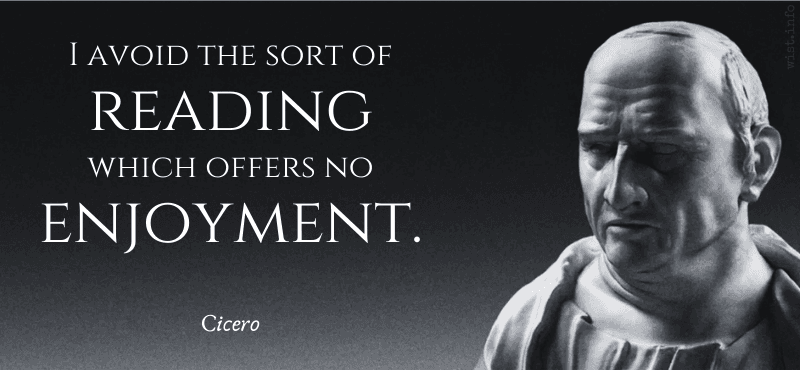
There is a class of people wanting to be called philosophers, who are said to have produced many books actually in Latin. For my part I don’t despise them — I’ve never read them. But since those selfsame writers proclaim that what they write is neither systematic nor properly subdivided nor correct nor polished in style, I pass by reading what would bring no pleasure.
[Est enim quoddam genus eorum qui se philosophos appellari volunt, quorum dicuntur esse Latini sane multi libri; quos non contemno equidem, quippe quos numquam legerim; sed quia profitentur ipsi illi qui eos scribunt se neque distincte neque distribute neque eleganter neque ornate scribere, lectionem sine ulla delectatione neglego.]
Marcus Tullius Cicero (106–43 BC) Roman orator, statesman, philosopher
Tusculan Disputations [Tusculanae Disputationes], Book 2, ch. 3 (2.3) / sec. 7 (45 BC) [tr. Douglas (1990)]
(Source)
(Source (Latin)). Other translations:For there is a certain Set of such as assume to themselves the name of Philosophers, who are said to have Books enough in Latin, which I do not despise, for I have never read them; but because the Authors profess themselves, that they write neither with distinction of Terms, nor distribution of Parts, nor elegancy of Language, nor any Ornaments; I neglect to give that reading which is no ways delightful
[tr. Wase (1643)]For there is a farther certain tribe who would willingly be called philosophers, whose books in our language are said to be numerous, which I do not despise, for indeed I never read the: but because the authors themselves declare that they write without any regularity or method, without elegance or ornament: I do not choose to read what is so void of entertainment.
[tr. Main (1824)]For there is a certain race, who wish to be called philosophers, whose Latin books, indeed, are said to be numerous, which I have no contempt for, really, because I never read them; but, since their authors themselves profess to write without either order or method, ornament or elegance, I neglect a reading which affords me no delight.
[tr. Otis (1839)]For there is a certain class of them who would willingly be called philosophers, whose books in our language are said to be numerous, and which I do not despise, for indeed I never read them: but still because the authors themselves declare that they write without any regularity, or method, or elegance, or ornament, I do not care to read what must be so void of entertainment.
[tr. Yonge (1853)]There is, indeed, a certain class of men who want to be called philosophers, who are said to have written many Latin books, which I do not despise, because I have never read them; but inasmuch as their authors profess to write with neither precision, nor system, nor elegance, nor ornament, I omit reading what can give me no pleasure.
[tr. Peabody (1886)]There is a certain class of authors, who wish to be called philosophers, and who have apparently published many books in Latin. I do not, indeed, condemn them, because I never read them, but because they themselves confess that they have not written their books clearly or in a well-arranged manner, nor elegantly or with any ornament. I avoid the sort of reading which offers no enjoyment.
[tr. @sentantiq (2015)]There exists a class of men who lay claim to the title of philosophers and are said to be authors of a great many books in Latin. These I personally do not despise, for the reason that I have never read them; but as the writers of these books on their own admission avoid in what they write a systematic approach, due subdivision, correctness, or a polished style. I have no interest in reading what brings no pleasure.
[tr. Davie (2017)]
With exceptions so rare they are regarded as miracles of nature, successful democratic politicians are insecure and intimidated men. They advance politically only as they placate, appease, bribe, seduce, bamboozle, or otherwise manage to manipulate the demanding and threatening elements in their constituencies. The decisive consideration is not whether the proposition is good but whether it is popular — not whether it will work well and prove itself but whether the active talking constituents like it immediately. Politicians rationalize this servitude by saying that in a democracy public men are the servants of the people.
Walter Lippmann (1889–1974) American journalist and author
“The Democratic Malady,” The Public Philosophy (1955)
(Source)
When the weak want to give an impression of strength they hint meaningfully at their capacity for evil. It is by its promise of a sense of power that evil often attracts the weak.
Eric Hoffer (1902–1983) American writer, philosopher, longshoreman
Passionate State of Mind, Aphorism 91 (1955)
(Source)
A thief can rifle any till,
A fire with ash your home can fill,
A creditor calls in your debt.
Bad harvest does your farm upset,
An impish mistress robs your dwelling,
Storm shatters ships with water swelling.
But gifts to friends your friendships save.
You keep thus always what you gave.[Callidus effracta nummos fur auferet arca,
Prosternet patrios impia flamma lares:
Debitor usuram pariter sortemque negabit,
Non reddet sterilis semina iacta seges:
Dispensatorem fallax spoliabit amica,
Mercibus extructas obruet unda rates.
Extra fortunam est, quidquid donatur amicis:
Quas dederis, solas semper habebis opes.]Martial (AD c.39-c.103) Spanish Roman poet, satirist, epigrammatist [Marcus Valerius Martialis]
Epigrams [Epigrammata], Book 5, epigram 42 (5.42) (AD 90) [tr. Wills (2007)]
(Source)
(Source(Latin)). Other translations:The crafty thefe from battered chest,
doth filch thy coine awaie:
The debter nor the interest,
nor principall will pay.
The fearefull flame destroies the goods,
and letteth nought remaine:
The barren ground for seede recevd,
restoreth naught again.
The subtle harlot naked strips
her lover to the skin:
If thou commit thy self to seas,
great danger art thou in.
Not that thou gevest to thy frend,
can fortune take away:
That onely that thou givst thy friend,
thou shalt posses for ay.
[tr. Kendall (1577)]Thieves may thy Coffers breake, steale coyne or plate;
Thy house a sudden fire may ruinate.
Debtors may Use, and Principall deny,
And dead thy seedes in barren Grounds may lye:
Thy Steward may be cheated by a Whore;
Thy Merchandise the Ocean may devour.
But what thou giv'st thy friends, from chance is free.
Thy gifts alone shall thine for ever be.
[tr. May (1629)]Some felon-hand may steal thy gold away;
Or flames destructive on thy mansion prey.
The fraudful debtor may thy loan deny;
Or blasted fields no more their fruits supply.
The am'rous steward to adorn his dear,
With spoils may deck her from thy plunder'd year.
Thy freighted vessels, ere the port they gain,
O'erwhelm'd by storms may sink beneath the main:
But what thou giv'st a friend for friendship's sake,
Is the sole wealth which fortune n'er can take.
[tr. Melmoth (c. 1750)]Thieves may break locks, and with your cash retire;
Your ancient seat may be consumed by fire;
Debtors refuse to pay you what they owe;
Or your ungrateful field the seed you sow;
You may be plundered by a jilting whore;
Your ships may sink at sea with all their store:
Who gives to friends, so much from Fate secures;
That is the only wealth for ever yours.
[tr. Hay (1755), ep. 43]The thief shall burst thy box, and slyly go:
The impious flame shall lay thy Lares low.
Thy dettor shall deny both use and sum:
Thy seed deposited may never come.
A faithless female shall they steward spoil:
They ships are swallow'd, while thy billow boil.
Whate'er is bountied, quit vain fortune's road:
Thine is alone the wealth thou has bestow'd.
[tr. Elphinston (1782), Book 5, ep. 82]A crafty thief may purloin money from a chest;
an impious flame may destroy paternal Lares;
a debtor may deny both principal and interest;
land may not yield crops in return for the seed scattered upon it;
frauds may be practices on a steward entrusted with your household purse;
the sea may overwhelm ships laden with merchandise.
Whatever is given to friends is beyond the reach of Fortune;
the wealth you have bestowed is the only wealth you can keep.
[tr. Amos (1858), ch. 3, ep. 77]A cunning thief may burst open your coffers, and steal your coin;
an impious fire may lay waste your ancestral home;
your debtor may refuse you both principal and interest;
your corn-field may prove barren, and not repay the seed you have scattered upon it;
a crafty mistress may rob your steward;
the waves may engulf your ships laden with merchandise.
But what is bestowed on your friends is beyond the reach of fortune;
the riches you give away are the only riches you will possess for ever.
[tr. Bohn's Classical (1859)]A present to a friend's beyond the reach of fortune:
That wealth alone you always will possess
Which you have given away.
[ed. Harbottle (1897)]A cunning thief will break your money-box and carry off your coin,
cruel fire will lay low your ancestral home;
your debtor will repudiate interest alike and principal,
your sterile crop will not return you the seed you have sown;
a false mistress will despoil your treasurer,
the wave will overwhelm your ships stored with merchandise.
Beyond Fortune's power is any gift made to your friends;
only wealth bestowed will you possess always.
[tr. Ker (1919)]Some thief may steal your wealth away,
Although by massive walls surrounded;
Or ruthless fire in ashes lay
The ancient home your fathers founded;
A debtor may withhold your dues,
Deny perhaps a debt is owing,
Or sullen ploughlands may refuse
To yield a harvest to your sowing.
A cunning trollop of the town
May make your agent rob his master,
Or waters of the ocean drown
Your goods and ship in one disaster.
But give to friends whate'er you may,
'Tis safe from fortune's worst endeavor:
The riches that you give away,
These only shall be yours for ever.
[tr. Pott & Wright (1921)]Some cunning burglar will abstract your plate,
A godless fire your roof will devastate,
A debtor steal both interest and loan,
A barren field will turn your seed to stone.
A wily wench will strip your steward bare,
The greedy sea engulf your galleon's ware.
Give to a friend and fortune is checkmated;
Such wealth will ever as your own be rated.
[tr. Francis & Tatum (1924), #247]A cunning thief may rob your money-chest,
And cruel fire lay low an ancient home;
Debtors may keep both loan and interest;
Good seed may fruitless rot in barren loam.
A guileful mistress may your agent cheat,
And waves engulf your laden argosies;
But boons to friends can fortune's slings defeat:
The wealth you give away will never cease.
[tr. Duff (1929)]A cunning thief will break open your coffer and carry off your money, ruthless fire will lay low your family horne, your debtor will repudiate interest and principal alike, your barren fields will not return the scattered seed, a tricky mistress will rob your steward, the wave ,will overwhelm your ships piled high with merchandise: hut whatever is given to friends is beyond the grasp of Fortune. Only the wealth you give away will always be yours.
[tr. Shackleton Bailey (1993)]Deft thieves can break your locks and carry off your savings,
fire consume your home,
debtors default on principal and interest,
failed crops return not even the seed you'd sown,
cheating women run up your charge accounts,
storm overwhelm ships freighted with all your goods.
Fortune can't take away what you give your friends:
that wealth stays yours forever.
[tr. Powell (c. 2000)]The only wealth that's yours forever
is the wealth you give away.
[tr. Kennelly (2008), "Forever"]Sly thieves will smash your coffer and steal your cash;
impious flames will wreck your family home;
your debtor won't repay your loan or interest;
your barren fields will yield less than you've sown;
a crafty mistress will despoil your steward;
a wave will swamp your ships piled high with stores.
But what you give to friends is safe from Fortune:
only the wealth you give away is yours.
[tr. McLean (2014)]Savings -- the cunning thief will crack your safe and steal them;
ancestral home -- the fires don't care, they'll trash it;
the guy who owes you money -- won't pay the interest, won't pay at all.
Your field -- it's barren, sow seed and you'll get no return;
your girlfriend -- she'll con your accountant and leave you penniless;
your shipping line -- the waves will swamp your stacks of cargo.
But what you give to friends is out of fortune's reach.
The wealth you give away is the only wealth you'll never lose.
[tr. Nisbet (2015)]
What if people were invited to come tell what they already know of God instead of to learn what they are supposed to believe? What if they were blessed for what they are doing in the world instead of chastened for not doing more at church? What if church felt more like a way station than a destination? What if the church’s job were to move people out the door instead of trying to keep them in, by convincing them that God needed them more in the world than in the church?
Barbara Brown Taylor (b. 1951) American minister, academic, author
Leaving Church: A Memoir of Faith, Part 3 (2006)
(Source)
Sport strips away personality, letting the white bone of character shine through. Sport gives players an opportunity to know and test themselves.

I’m extremely skeptical of the “language of addiction.” I never saw heroin or cocaine as “my illness.” I saw them as some very bad choices that I walked knowingly into. I fucked myself — and, eventually, had to work hard to get myself un-fucked.
And I’m not going to tell you here how to live your life.
I’m just saying, I guess, that I got very lucky.
And luck is not a business model.
Anthony Bourdain (1956–2018) American chef, author, travel documentarian
Medium Raw, ch. 5 (2010)
(Source)
Birds! Birds! Ye are beautiful things,
With your earth-treading feet and your cloud-cleaving wings!Eliza Cook (1818–1889) English author and poet
“Birds,” The Poetical Works of Eliza Cook (1848)
(Source)
A pessimist looks at his glass and says it is half empty; an optimist looks at it and says it is half full.
Josiah Stamp (1880–1941) English industrialist, economist, statistician, banker
Comment (1935)
There is substantial evidence that Stamp used this now-cliched phrase, or variations of it, on multiple spoken occasions in 1935, the earliest references I could find.
- The Railway Service Journal (later Transport Salaried Staff Journal) mentions 1935 after-dinner remarks by Stamp: "After dinner, Sir Josiah Stamp defined an optimist as 'the man who looks at his glass and says it is half full,' and the pessimist as 'the man who looks at it and says it is half empty.'" [Source]
- Similarly, the Bristol Chamber of Commerce Journal mentions a 1935 speech: "A pessimist is a man who looks at the glass and describes it as half empty, and an optimist is a man who describes it as half full. It is all a question of the point of view." [Source]
- A New York Times article (12 Nov 1935) includes "I came recently upon a graphic distinction drawn by Sir Josiah Stamp between an optimist and a pessimist," followed by the phrasing noted at the top. [Source, Source]
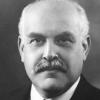
He is free to make the wrong choice, but not free to succeed with it. He is free to evade reality, he is free to unfocus his mind and stumble blindly down any road he pleases, but not free to avoid the abyss he refuses to see. Knowledge, for any conscious organism, is the means of survival; to a living consciousness, every “is” implies an “ought.” Man is free to choose not to be conscious, but not free to escape the penalty of unconsciousness: destruction. Man is the only living species that has the power to act as his own destroyer — and that is the way he has acted through most of his history.
Ayn Rand (1905–1982) Russian-American writer, philosopher
“The Objectivist Ethics,” University of Wisconsin Symposium on “Ethics in Our Time” (9 Feb 1961)
(Source)

I agree as to the doubtful value of competitive examination. The qualities which you really want, viz., self-control, self-reliance, habits of accurate thought, integrity and what you generally call trustworthiness, are not decided by competitive examination, which test little else than the memory.
Florence Nightingale (1820–1910) English social reformer, statistician, founder of modern nursing
Letter to Lord Edward Geoffrey Stanley (17 May 1857)
(Source)
Regarding selection processes for military officers. This was undergoing reform during the period, including the radical proposal to prevent people from buying their way into lower officer ranks.
I made up my mind long ago to follow one cardinal rule in all my writing — to be clear. I have given up all thought of writing poetically or symbolically or experimentally, or in any of the other modes that might (if I were good enough) get me a Pulitzer prize. I would write merely clearly and in this way establish a warm relationship between myself and my readers, and the professional critics — Well, they can do whatever they wish.
Isaac Asimov (1920–1992) Russian-American author, polymath, biochemist
Nemesis, “Author’s Note” (1989)
(Source)
Only ambition is fired by the coincidences of success and easy accomplishment but nothing is quite as splendidly uplifting to the heart as the defeat of a human being who battles against the invincible superiority of fate. This is always the most grandiose of all tragedies, one sometimes created by a dramatist but created thousands of times by life.
Stefan Zweig (1881–1942) Austrian novelist, playwright, journalist, biographer
Stellar Moments in Human History [Sternstunden der Menschheit] (1953) [tr. Sonnenfeld]
Chickenshit refers to behavior that makes military life worse than it need be: petty harassment of the weak by the strong; open scrimmage for power and authority and prestige; sadism thinly disguised as necessary discipline; a constant “paying off of old scores”; and insistence on the letter rather than the spirit of ordinances. Chickenshit is so called — instead of horse- or bull- or elephant-shit — because it is small-minded and ignoble and takes the trivial seriously. Chickenshit can be recognized instantly because it never has anything to do with winning the war.
Paul Fussell (1924–2012) American cultural and literary historian, author, academic
“Chickenshit: An Anatomy,” Wartime: Understanding and Behavior in the Second World War (1989)
(Source)
Sometimes misattributed to historian Stephen Ambrose, who used part of it (with attribution) in his Band of Brothers (1992).
Why, it is the prohibition that makes anything precious. There is a charm about the forbidden that makes it unspeakably desirable.
Mark Twain (1835–1910) American writer [pseud. of Samuel Clemens]
Note (1896-02), Mark Twain’s Notebook, ch. 24 “Ceylon and India” (1935) [ed. Albert Bigelow Paine]
(Source)
Speaking of Adam and the original Forbidden Fruit. Written while in Bombay, India.
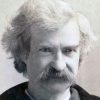
To make sure that my blasphemy is thoroughly expressed, I hereby state my opinion that the notion of a god is a basic superstition, that there is no evidence for the existence of any god(s), that devils, demons, angels and saints are myths, that there is no life after death, heaven nor hell, that the Pope is a dangerous, bigoted, medieval dinosaur, and that the Holy Ghost is a comic-book character worthy of laughter and derision. I accuse the Christian god of murder by allowing the Holocaust to take place — not to mention the “ethnic cleansing” presently being performed by Christians in our world — and I condemn and vilify this mythical deity for encouraging racial prejudice and commanding the degradation of women. (This comprehensive statement was arrived at by examining the statutes of those seven states that have remained in the Dark Ages, so that I might satisfy their definitions of blasphemy.)
James Randi (1928–2020) Canadian-American stage magician ("The Amazing Randi") and scientific skeptic. [b. Randall James Hamilton Zwinge]
Skeptic Magazine (1995)
Written in an unsuccessful attempt to garner an official charge of blasphemy from any of those seven states that still had such laws on the books.
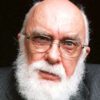
This man who has fetched up here is some unlucky wanderer; we must now look after him, because all strangers and beggars are under Zeus’ protection, and any gift, though small, is welcome.
[ἀλλ’ ὅδε τις δύστηνος ἀλώμενος ἐνθάδ’ ἱκάνει,
τὸν νῦν χρὴ κομέειν· πρὸς γὰρ Διός εἰσιν ἅπαντες
ξεῖνοί τε πτωχοί τε, δόσις δ’ ὀλίγη τε φίλη τε.]Homer (fl. 7th-8th C. BC) Greek author
The Odyssey [Ὀδύσσεια], Book 6, l. 206ff (6.206) [Nausicaa] (c. 700 BC) [tr. Verity (2016)]
(Source)
(Source (Greek)). This is later echoed by Eumæus in Book 14. Other translations:This man, minding nought
But his relief, a poor unhappy wretch,
Wrack’d here, and hath no other land to fetch,
Him now we must provide for. From Jove come
All strangers, and the needy of a home,
Who any gift, though ne’er so small it be,
Esteem as great, and take it gratefully.
[tr. Chapman (1616)]But by evil weather
To come to land this man hath forced been;
Let’s do him good. From Jove come beggars all,
And welcome to them is whate’er they get;
Our givings to him will be very small.
[tr. Hobbes (1675), l. 195ff]'Tis ours this son of sorrow to relieve,
Cheer the sad heart, nor let affliction grieve.
By Jove the stranger and the poor are sent;
And what to those we give to Jove is lent.
[tr. Pope (1725)]This man, a miserable wand’rer comes,
Whom we are bound to cherish, for the poor
And stranger are from Jove, and trivial gifts
To such are welcome.
[tr. Cowper (1792)]Now comes this wanderer -- let us treat him well;
All strangers and all poor by Zeus are sent,
And love can make a little gift excel.
[tr. Worsley (1861), st. 27]But, he,
This wand'ring outcast, is before us come
For whom it well beseems us to take thought;
For not without the warrant of great Jove
Appeal the strangers and the abject poor.
However small the boon, 'tis dearly priz'd!
[tr. Musgrave (1869), l. 315ff]But this -- some hapless wanderer -- hither comes:
Him it behoves us care for: since from Zeus
Come strangers all, and poor men: and a gift
Small to the giver -- blesses him that takes it.
[tr. Bigge-Wither (1869)]Nay, but this man is some helpless one come hither in his wanderings, whom now we must kindly entreat, for all strangers and beggars are from Zeus, and a little gift is dear.
[tr. Butcher/Lang (1879)]But this man, a hapless wanderer, to usward now is sent,
And him is it meet to cherish; since from Zeus come guestfolk all
And suppliants; and full welcome is the gift, albeit but small.
[tr. Morris (1887)]But this poor man has come here having lost his way, and we should give him aid; for in the charge of Zeus all strangers and beggars stand, and a small gift is welcome.
[tr. Palmer (1891)]This is only some poor man who has lost his way, and we must be kind to him, for strangers and foreigners in distress are under Jove's protection, and will take what they can get and be thankful.
[tr. Butler (1898)]This is some hapless wanderer that has come hither. Him must we now tend; for from Zeus are all strangers and beggars, and a gift, though small, is welcome.
[tr. Murray (1919)]This man appeals as a luckless wanderer whom we must now kindly entertain. Homeless and broken men are all of them in the sight of Zeus, and it is a good deed to make them some small alms.
[tr. Lawrence (1932)]The man you see is an unfortunate wanderer who has strayed here, and now commands our care, since all strangers and beggars come under the protection of Zeus, and the charity that is a trifle to us can be precious to others.
[tr. Rieu (1946)]This man is a castaway, poor fellow; we must take care of him. Strangers and beggars come from Zeus: a small gift, then, is friendly.
[tr. Fitzgerald (1961)]But, since this is some poor wanderer who has come to us,
we must now take care of him, since all strangers and wanderers
are sacred in the sight of Zeus, and the gift is a light and a dear one.
[tr. Lattimore (1965)]But this man is a luckless fellow, one
who wandered here, and he deserves our care;
the stranger and the beggar -- both are sent
by Zeus, and even small gifts win their thanks.
[tr. Mandelbaum (1990)]But here's an unlucky wanderer strayed our way
and we must tend him well. Every stranger and beggar
comes from Zeus, and whatever scrap we give him
he'll be glad to get.
[tr. Fagles (1996)]This poor man comes here as a wanderer,
And we must take care of him now. All strangers,
All beggars, are under the protection of Zeus,
And even small gifts are welcome.
[tr. Lombardo (2000)]No, this man is a luckless wanderer who has arrived here; we must now give him succor, for every stranger and beggar has the protection of Zeus, and a gift though little is welcome.
[tr. Merrill (2002)]This man is an unfortunate wanderer who has strayed here, and we must look after him, since all strangers and beggars come under the protection of Zeus, and to such people a small gift can mean much.
[tr. DCH Rieu (2002)]This man must instead be some luckless wanderer, landed here. We must care for him, since all strangers and beggars come from Zeus, and even a little gift is welcome.
[tr. Kline (2004)]But this man is lost, poor thing. We must look after him. All foreigners and beggars come from Zeus, and any act of kindness is a blessing.
[tr. Wilson (2017)]No, this is some ill-starred drifter who's ended up here, and we must now take of, since from Zeus are all strangers and beggars: any gift, though small, is welcome.
[tr. Green (2018)]So this man
is some poor wanderer who’s just come here.
We must look after him, for every stranger,
every beggar, comes from Zeus, and any gift,
even something small, is to be cherished.
[tr. Johnston (2019), l. 264]But this man who has wandered here, who is so ill-starred,
It is right to care for him now. For all are from Zeus,
The strangers and the beggars, and our gift is small but dear to them.
[tr. @sentantiq (2020)]
Life is political, not because the world cares about how you feel, but because the world reacts to what you do.
Timothy Snyder (b. 1969) American historian, author
On Tyranny: Twenty Lessons from the Twentieth Century (2017)
(Source)
an optimist is a guy
that has never had
much experienceDon Marquis (1878–1937) American journalist and humorist
archy and mehitabel, “certain maxims of archy” (1927)
(Source)
There is in the soul of every man, something naturally soft, low, enervated in a manner, and languid. Were there nothing besides this, men would be the greatest of monsters; but there is present to every man reason, which presides over, and gives laws to all; which, by improving itself, and making continual advances, becomes perfect virtue.
[Est in animis omnium fere natura molle quiddam, demissum, humile, enervatum quodam modo et languidum. Si nihil esset aliud, nihil esset homine deformius. sed praesto est domina omnium et regina ratio, quae conixa per se et progressa longius fit perfecta virtus.]
Marcus Tullius Cicero (106–43 BC) Roman orator, statesman, philosopher
Tusculan Disputations [Tusculanae Disputationes], Book 2, ch. 21 (2.21) / sec. 47 (45 BC) [tr. Yonge (1853)]
(Source)
(Source (Latin)). Other translations:There is in the Souls of all men, in a manner, naturally somewhat lasche, mean, low-spirited, in a sort emasculate and feeble; were there nothing else, man would be the most deformed thing in the World; but Reason the Lady and Empress of all things, is at hand to help; which bearing up on her own strength, and advancing farther, becometh, at length, accomplish'd Vertue
[tr. Wase (1643)]Every soul of man has naturally something soft, low, enervated in a manner, and languid. Were there nothing besides this, men would be the greatest of monsters; but there is present to every man reason, which presides and gives law to all, which by improving itself, and making continual advances, becomes perfect virtue.
[tr. Main (1824)]There is, in the minds of nearly all men, by nature, something soft, abject, low, enervated somehow, and languid, doting. If this were all, nothing were more disgusting than man. But there is also the mistress and queen of all things, reason, who, supported by herself, and after long progress, becomes perfect virtue.
[tr. Otis (1839)]There is naturally in the soul of almost every man something soft, low, earthy, in a certain degree nerveless and feeble. But reason is at hand, mistress and queen of all, which by its own force striving and advancing upward, becomes perfect virtue.
[tr. Peabody (1886)]There is in practically everybody's souls by nature something soft, lowly, abject, nerveless so to speak, and feeble. If there were nothing else, a human being would be the ugliest thing that exists. But at hand is the mistress and queen of all, Reason, which through its own strivings advances forward and becomes perfected virtue.
[tr. Douglas (1990)]Nature has seen to it that there is in the souls of virtually all people an element of softness, of lowliness, of the abject, of, as it were, what is nerveless and feeble. If he possessed nothing beyond this, man would be the most hideous of all creatures; but at his side stands reason, the mistress and queen of all, who through striving by her own strength and forging onward becomes perfected virtue.
[tr. Davie (2017)]
When asked what ages quickly, he replied, “Gratitude.”
[ἐρωτηθεὶς τί γηράσκει ταχύ, “χάρις,” ἔφη.]
Aristotle (384–322 BC) Greek philosopher
Attributed in Diogenes Laërtius, Lives and Opinions of Eminent Philosophers [Vitae Philosophorum], Book 5, sec. 18 [tr. Mensch (2018)]
(Source)
(Source (Greek)). Other translations:Once he was asked what grew old most speedily, and he replied, “Gratitude.”
[tr. Yonge (1853), sec. 11]Being asked, "What is it that soon grows old?" he answered, "Gratitude."
[tr. Hicks (1925)]When he was asked what grows old quickly, he said "thanks."
[tr. @sentantiq (2016)]
Administrivia: (2021-08-03) Server snafu
 An emergency change in servers has meant I lost a couple of days of quotations, which I am now re-posting to get them back into the database. So if you have a case of déjà vu, you’re not imagining things.
After the game, the King and the Pawn go into the same box.
Proverbs, Sayings, and Adages
Italian proverb
Phrased as such (and noted as an Italian proverb) in H. L. Mencken, A New Dictionary of Quotations (1942). The sentiment can be found in literature back to the 17th Century. See also Omar Khayyám.
More discussion: When the Chess Game Is Over, the King and the Pawn Go Back in the Same Box – Quote Investigator.

Charming villains have always had a decided social advantage over well-meaning people who chew with their mouths open.

If animals could speak, the dog would be a blundering outspoken fellow; but the cat would have the rare grace of never saying a word too much.
Mark Twain (1835–1910) American writer [pseud. of Samuel Clemens]
(Misattributed)
This quote is frequently attributed to Twain, but is instead a light paraphrase of the work Philip Gilbert Hamerton, who wrote in his essay "Cats":If animals could speak as fabulists have feigned, the dog would be a blunt, blundering, outspoken, honest fellow, but the cat would have the rare talent of never saying a word too much.
There are silences harder to take back than words.
James Richardson (b. 1950) American poet
“Vectors: 56 Aphorisms and Ten-second Essays,” Michigan Quarterly Review, # 3 (Spring 1999)
(Source)
We have to dare to be ourselves, however frightening or strange that self may prove to be.
May Sarton (1912–1995) Belgian-American poet, novelist, memoirist [pen name of Eleanore Marie Sarton]
Mrs. Stevens Hears the Mermaids Singing (1965)
How do I love thee? Let me count the ways.
I love thee to the depth and breadth and height
My soul can reach, when feeling out of sight
For the ends of being and ideal grace.
I love thee to the level of every day’s
Most quiet need, by sun and candle-light.
I love thee freely, as men strive for right;
I love thee purely, as they turn from praise.
I love thee with the passion put to use
In my old griefs, and with my childhood’s faith.
I love thee with a love I seemed to lose
With my lost saints. I love thee with the breath,
Smiles, tears, of all my life; and, if God choose,
I shall but love thee better after death.Elizabeth Barrett Browning (1806–1861) English poet
Sonnets from the Portuguese, #43 (1850)
(Source)
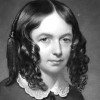
For the world, I count it not an Inne, but an Hospitall, and a place, not to live, but to die in.
Thomas Browne (1605–1682) English physician and author
Religio Medici, Part 2, sec. 11 (1643)
(Source)

Freedom does not always win. This is one of the bitterest lessons of history.
A. J. P. Taylor (1906–1990) British historian, journalist, broadcaster [Alan John Percivale Taylor]
(Attributed)
Whether or not birth control is eugenic, hygienic, and economic, it is the most revolutionary practice in the history of sexual morals.
Walter Lippmann (1889–1974) American journalist and author
A Preface To Morals, ch. 19 (1929)
(Source)
In the face of evil, detachment is a dubious virtue.
Barbara Grizzuti Harrison (1934–2002) American journalist, essayist, memoirist
“Budapest, Winter 1989,” The Astonishing World (1992)
(Source)

My parents in the underworld! I send
This servant girl — take care and gently tend.
Conduct her past the terrifying shade.
Keep her of circling horrors unafraid,
For she, alas, was only six days shy
Of six years when too soon she came to die.
Protect her as she plays her childhood games,
And lisps, as shyly she was wont, our names.
Earth, sadly mounded on this gravesite new,
Press lightly on her, as she did on you.[Hanc tibi, Fronto pater, genetrix Flaccilla, puellam
Oscula commendo deliciasque meas,
Parvula ne nigras horrescat Erotion umbras
Oraque Tartarei prodigiosa canis.
Impletura fuit sextae modo frigora brumae,
Vixisset totidem ni minus illa dies.
Inter tam veteres ludat lasciva patronos
Et nomen blaeso garriat ore meum.
Mollia non rigidus caespes tegat ossa nec illi,
Terra, gravis fueris: non fuit illa tibi.]Martial (AD c.39-c.103) Spanish Roman poet, satirist, epigrammatist [Marcus Valerius Martialis]
Epigrams [Epigrammata], Book 5, epigram 34 (5.34) (AD 90) [tr. Wills (2007)]
(Source)
Erotion was a slave child in Martial's household, per other epigrams. The identity of Fronto and Flaccilla -- whether they are the names of Martial's parents or Erotion's -- is ambiguous in the Original Latin, and a subject of debate. See also 10.61.
Other translations:Ye parents Fronto and Flaccilla here,
To you I do commend my girl, my dear,
Lest pale Erotion tremble at the shades,
And the foul dog of hell's prodigious heads.
Her age fulfilling just six winters was,
Had she but known so many days to pass.
'Mongst you, old patrons, may she sport and play,
And with her lisping tongue my name oft say.
May the smooth turf her soft bones hide, and be,
O earth, as light to her as she to thee!
[tr. Fletcher (1656)]Fronto, to thee, to thee, Flaccilla mild,
My darling I commend, your lively child.
Oh! may no sable shades make her more pale,
Nor the Tartarean dog the Love assail.
Six times the rig'rous solstice had the run,
Has she survey'd six times another sun.
Mid her old patrons, may the prattler play;
And lisp my name, as in the realms of day.
To her soft bones no turf oppressive be:
O earth lie light on her, who lay so light on thee.
[tr. Elphinston (1782), Book 9, ep. 18]O my father, Fronto! and my mother, Flacilla! I commend to you, in the realm below, this damsel, my delight and the object of my kisses, lest Erotion be terrified at the dark shades, and at the enormous mouth of the dog of Tartarus. She would have completed her sixth winter if she had lived six days longer. May she continue her sportive ways under your reverend patronage, and may she garrulously stammer forth my name! May the turf lie lightly on her delicate bones; you ought not, O earth, to be heavy to her; she was not so to thee!
[tr. Amos (1858) ep. 35]To you, O Fronto my father, and to you, O Flaccilla my mother, I commend this child, the little Erotion, my joy and my delight, that she may not be terrified at the dark shades and at the monstrous mouth of the dog of Tartarus. She would just have passed the cold of a sixth winter, had she lived but six days longer. Between protectors so venerable may she sport and play, and with lisping speech babble my name. Let no rude turf cover her tender bones, and press not heavy on her, O earth; she pressed but lightly on thee.
[tr. Bohn's Classical (1859)]To you -- dun spectres to forefend
And yon Tartarean monster dread --
This little maiden I commend,
Dead parents of my darling dead!
Had only my Erotion's span
While just so many days were told,
Been lengthened out to dwell with man,
She had been then six winters old.
Still sportive may she spend her days,
And lisp my name with prattling tongue;
Nor chide her little wanton ways,
Mid friends so old, and she so young.
Soft be the turf that shrouds her bed,
For delicate and soft was she.
And, Earth, lie lightly o'er her head,
For light the steps she laid on thee.
[tr. Webb (1879)]Mother and sire, to you do I commend
Tiny Erotion, who must now descend,
A child, among the shadows, and appear
Before hell's bandog and hell's gondolier.
Of six hoar winters she had felt the cold,
But lacked six days of being six years old.
Now she must come, all playful, to that place
Where the great ancients sit with reverend face;
Now lisping, as she used, of whence she came,
Perchance she names and stumbles at my name.
O'er these so fragile bones, let there be laid
A plaything for a turf; and for that maid
That ran so lightly footed in her mirth
Upon thy breast -- lie lightly, mother earth!
[tr. Stevenson (1884)]To thee, father Fronto, to thee, mother Flacilla, commend this maid, my sweetheart and my darling, that tiny Erotion may not shudder at the dark shades and the Tartarean hound's stupendous jaws. She would have completed only her sixth cold winter had she not lived as many days too few. Beside protectors so aged let her lightly play, and prattle my name with lisping tongue. And let not hard clods cover her tender bones, nor be though heavy upon her, O earth: she was not so to thee!
[tr. Ker (1919)]Thou Mother dear and thou my Father's shade,
To you I now commit the gentle maid,
Erotion, my little love, my sweet;
Let not her shuddering spirit fear to meet
The ghosts, but soothe her lest she be afraid.
How should a baby heart be undismayed
To pass the lair where Cerberus is laid?
The little six-year maiden gently greet.
Dear reverend spirits, give her kindly aid
And let her play in some Elysian glade,
Lisping my name sometimes -- and, I entreat
Lie on her softly, kind earth; her feet,
Such tiny feet, on thee were lightly laid.
[tr. Pott & Wright (1921)]Flaccilla, Fronto, take her as I write,
My precious darling and my soul's delight,
Let not Erotion fear the shades around
And the fell jaws of the Tartarean hound.
Had she but lived till six more days were told,
She had survived six winters and their cold.
There let her play amidst our fellowship
And lisp my name with dainty stammering lip.
Her gentle head, Earth, with soft mosses dress,
And as her footstep light be thy caress.
[tr. Francis & Tatum (1924), #240]Mother Flaccilla, Fronto sire that's gone,
This darling pet of mine, Erotion,
I pray ye greet, that nor the Land of Shade
Nor Hell-hound's maw shall fright my little maid.
Full six chill winters would the child have seen
Had her life only six days longer been.
Sweet child, with our lost friends to guard thee, play,
And lisp my name in thine own prattling way.
Soft be the turf that shrouds her! Tenderly
Rest on her, earth, for she trod light on thee.
[tr. Duff (1929)]To thee, my father, and to thee, my mother,
I recommend this darling little maid.
Shield her from the dreadful hound of Hades,
Shield her from the dark infernal shades.
She would have known the chill of six cold winters
Had she lived only six more little days.
Amid such old defenders let her frolic
And babble my name as was her childish way.
Lie lightly on her, earth, O lie not heavy
Upon her bones, for she was light on thee.
[tr. Marcellino (1968)]Fronto, father, and mother Flaccilla,
hold my darling Erotion firm in your memory:
Don't let her diminutive soul shiver
at the dusky shades of Hell
or flinch at the monstrous mouth
of the watchdog Tartarus.
Had she lived six days longer,
she would have seen her sixth winter solstice.
She was always happy,
always at ease
in the company of older people.
I hope she will still, down there,
be gaily lisping my name, in her afterlife.
Oh green earth, rest lightly on her! Do not
bear down too hard on her there, who was
never a trouble or burden to you, here.
[tr. Bovie (1970), "Erotion (1)"]To you, my parents, I send on
This little girl Erotion,
The slave I loved, that by your side
Her ghost need not be terrified
Of the pitch darkness underground
Or the great jaws of Hades' hound.
This winter she would have completed
Her sixth year had she not been cheated
By just six days. Lisping my name,
May she continue the sweet game
Of childhood happily down there
In two such good, old spirits' care.
Lie lightly on her, turf and dew;
She put so little weight on you.
[tr. Michie (1972)]To you, the shades of my begetters, Fronto
and Flacilla, where you lie in sweet
decay, I commend with love the body
of my darling child Erotion.
A home-
bred slave yet tender as a golden dormouse,
rarer than the Phoenix, whiter than
an unsmudged lily --
guide her spirit home
so she may look for lights in Tartarus
and miss the snapping jaws of hell-hound
Cerberus. She’d have lived six shivering winters
if she hadn’t died that many days before
the anniversary.
Now let her play
light-heartedly in the ever-darkened house
beside such sure protectors.
May my name
be burbling on her tongue, the childish gift
of sorrow spent on age.
And monumental earth,
draw back eternal weight from her
small bones;
don’t be severe and tread
on her with gravity: she never did on you.
[tr. Porter (1972)]Fronto, Father, Flacilla, Mother, extend
your protection from the Stygian shadows.
The small Erotion (my household Iris)
has changed my house for yours. See that the hell-
hound's horrid jaws don't scare her, who was no
more than six years old (less six days) on the
Winter day she died. She'll play beside you
gossiping about me in child's language.
Weigh lightly on her small bones, gentle earth,
as she, when living, lightly trod on you.
[tr. Whigham (1987)]To you, father Fronto and mother Flaccilla, I commend this girl, my pet and darling. Little Erotion must not be frightened by the dark shades and the monstrous mouths of Tartarus' hound. She was due to complete the chills of a sixth midwinter, no more, if she had not lived that many days too few. Let her now play and frolic with her old patrons and lispingly chatter my name. Not hard be the turf that covers her soft bones, be not heavy upon her, earth; she was not heavy upon you.
[tr. Shackleton Bailey (1993)]To your shades Fronto, and Flaccilla, this child
I commend: she was my sweet and my delight.
Little Erotion shall not fear the darkened shades
nor the vast mouths of the Tartarean hound.
She’d have completed her sixth chill winter,
if she’d not lived a mere six days too few.
Now let her frisk and play among old friends
now let her chatter, and so lisp my name.
And let the soft turf cover her brittle bones:
earth, lie lightly on her: she lay lightly on you.
[tr. Kline (2006)]To you, my parents Fronto and Flaccilla,
I commend this girl, my darling and delight,
Don't let the dark shades and the huge-mouthed hellhound
fill my small Erotion with fright.
She would have known the chill of six midwinters
had she survived by just as many days.
Now let her lisping mouth prattle my name
to her old patrons, and she romps and plays.
Let no hard turf hide her soft bones. Earth, do
not press her harshly; she was light on you.
[tr. McLean (2014)]This girl, father Fronto and mother Flaccilla, I commit to your care, so that little Erotion, my pet and darling, may not tremble at the dark shades and at the monstrous mouths of the hound of Tartarus. She would have just seen out the frosts of her sixth midwinter, had her life not fallen that many days short. I hope she plays and skips now in her former patrons' keeping; I hope her hare-lip mumbles my name. Please let the turf that covers her bones not be hard, and, earth, be not heavy upon her, she was no weight on you.
[tr. Nisbet (2015)]I commend you this slave girl, father Fronto, mother Flaccilla, as she was my delight and the object of my kisses. May little Erotion not fear the dark shades nor the vast mouths of the Tartarean dog. She would have completed her sixth cold winter if she'd not lived as many days too few. Now, let her play amid old friends, let her chatter and lisp my name. May the soft turf cover her brittle bones: earth, lie lightly on her, as she was not heavy on you.
[Source]To you, my departed parents, dear mother and father,
I commend my little lost angel, Erotion, love’s daughter.
She fell a mere six days short of outliving her sixth frigid winter.
Protect her now, I pray, should the chilling dark shades appear;
muzzle hell’s three-headed hound, lest her heart be dismayed!
Lead her to romp in some sunny Elysian glade,
her devoted patrons. Watch her play childish games
as she excitedly babbles and lisps my name.
Let no hard turf smother her softening bones; and do
rest lightly upon her, earth, she was surely no burden to you!
[tr. Burch]
One of the many things this story tells us is that Jesus was not brought down by atheism and anarchy. He was brought down by law and order allied with religion, which is always a deadly mix. Beware of those who claim to know the mind of God and who are prepared to use force, if necessary, to make others conform. Beware of those who cannot tell God’s will from their own. Temple police are always a bad sign. When chaplains start wearing guns and hanging out at the sheriff’s office, watch out. Someone is about to have no king but Caesar.
Barbara Brown Taylor (b. 1951) American minister, academic, author
Essay (1998-03-18), “The Perfect Mirror,” Christian Century
(Source)
Much misconstruction of character arises out of our habit of assigning a motive for every action — whereas a good many of our acts are performed without any motive.
Christian Nestell Bovee (1820–1904) American epigrammatist, writer, publisher
Intuitions and Summaries of Thought, Vol. 2 (1862)
(Source)
I understand there’s a guy inside me who wants to lay in bed, smoke weed all day, and watch cartoons and old movies. My whole life is a series of stratagems to avoid, and outwit, that guy.
Anthony Bourdain (1956–2018) American chef, author, travel documentarian
(Attributed)
At fifteen you had the radiance of early morning, at twenty you will begin to have the melancholy brilliance of the moon, and when you are my age you will give out, as I do, the genial golden warmth of 4 P.M.
F. Scott Fitzgerald (1896–1940) American writer [Francis Scott Key Fitzgerald]
This Side of Paradise, Book 1, ch. 3 [Darcy] (1920)
(Source)
Dogma thinks it knows. Belief knows it does not. Dogma is credulous. Belief is sceptical, but forever open-minded.
Graham Dunstan Martin (1932–2021) British author, translator, philologist
Shadows in the Cave (1990)
Any test that turns on what is offensive to the community’s standards is too loose, too capricious, too destructive of freedom of expression to be squared with the First Amendment. Under that test, juries can censor, suppress, and punish what they don’t like, provided the matter relates to “sexual impurity” or has a tendency “to excite lustful thoughts”. This is community censorship in one of its worst forms. It creates a regime where in the battle between the literati and the Philistines, the Philistines are certain to win.
William O. Douglas (1898–1980) American jurist; US Supreme Court Justice (1939–75)
Roth v. United States, 354 U.S. 476, 512 (1957) [dissent]
(Source)
What you have become is the price you paid to get what you used to want.
Mignon McLaughlin (1913–1983) American journalist and author
The Neurotic’s Notebook, ch. 5 (1963)
(Source)

“When it comes to strangers with guns,” I told her, “I think suspicion is more likely to keep you alive than trust.”

It’s that moment, that brief epiphany when the universe opens up and shows us something, and in that instant we get just a sense of an order greater than Heaven and, as yet at least, beyond the grasp of Stephen Hawking. It doesn’t require worship, but, I think, rewards intelligence, observation and enquiring minds. I don’t think I’ve found God, but I may have seen where gods come from.
Terry Pratchett (1948–2015) English author
“I create gods all the time — now I think one might exist,” Daily Mail (21 Jun 2008)
(Source)

People say if you legalize drugs, you’re going to have a lot more junkies. And then the other side says, Oh no, no, no, we will have fewer junkies [and] they’ll be treated better. I don’t know! I just know that if you don’t have the right to put whatever you want into your own body, you’re not living in a free fucking country. Simple.
Penn Jillette (b. 1955) American stage magician, actor, musician, author
Interview by Katherine Mangu-Ward, Reason (Jan 2017)
(Source)

A little government and a little luck are necessary in life, but only a fool trusts either of them.

Heresy is only another word for freedom of thought.
Graham Greene (1904–1991) English novelist [Henry Graham Greene]
“Freedom of Thought,” speech accepting the Jerusalem Prize (6 Apr 1981)
(Source)
If then my fortunes can delight my friend,
A story fruitful of events attend:
Another’s sorrow may thy ears enjoy,
And wine the lengthen’d intervals employ.
Long nights the now declining year bestows;
A part we consecrate to soft repose,
A part in pleasing talk we entertain;
For too much rest itself becomes a pain.[ξεῖν᾽, ἐπεὶ ἂρ δὴ ταῦτά μ᾽ ἀνείρεαι ἠδὲ μεταλλᾷς,
σιγῇ νῦν ξυνίει καὶ τέρπεο, πῖνέ τε οἶνον
ἥμενος. αἵδε δὲ νύκτες ἀθέσφατοι: ἔστι μὲν εὕδειν,
ἔστι δὲ τερπομένοισιν ἀκούειν: οὐδέ τί σε χρή,
πρὶν ὥρη, καταλέχθαι: ἀνίη καὶ πολὺς ὕπνος.]Homer (fl. 7th-8th C. BC) Greek author
The Odyssey [Ὀδύσσεια], Book 15, l. 390ff (15.390) [Eumæus] (c. 700 BC) [tr. Pope (1725)]
(Source)
(Source (Greek)). Other translations:Since thou enquir’st of that, my guest, said he,
Hear and be silent, and, mean space, sit free
In use of these cups to thy most delights;
Unspeakable in length now are the nights.
Those that affect sleep yet, to sleep have leave,
Those that affect to hear, their hearers give.
But sleep not ere your hour; much sleep doth grieve.
[tr. Chapman (1616)]Since to hear the story
Of how I hither came it is your pleasure,
Sit patiently, the wine there stands before ye;
For sleep and joy the long nights give us leisure,
It is not good too soon to go to bed;
For too much sleep is but a weariness.
[tr. Hobbes (1675), l. 349ff]Stranger! since thou art curious to be told
My story, silent listen, and thy wine
At leisure quaff. The nights are longest now,
And such as time for sleep afford, and time
For pleasant conf’rence; neither were it good
That thou should’st to thy couch before thy hour,
Since even sleep is hurtful, in excess.
[tr. Cowper (1792)]Since of these things thou askest, O my friend.
Sit here at ease delighted and drink wine,
And silently on this my tale attend.
For now the nights move slowly and scarce end;
Yeah, there is room for slumber, and to keep
Watch, and a listening ear to sweet words lend.
Needs not at all unto thy couch to creep
For some while yet. Harm comes from even too much sleep.
[tr. Worsley (1861), st. 54]Stranger! since thus thou questionest, and fain
So much from me would'st learn, remain thou mute,
And, thy seat here maintaining, take thine ease
And drink that wine: The nights are lengthsome, now,
And we to slumber may betake ourselves,
As we may equally with raptur'd ears
To some recital listen. 'Tis not well
That thou before thy wonted hour the couch
Of rest should'st seek: for, slumber in excess
A hurt becomes.
[tr. Musgrave (1869), l. 638ff]Sir guest! since you thus ask and question me,
List to me now, and take your pleasure sitting
There at the wine: the nights are long; there's time
For sleep; and listening with delight to tales!
No need to lay thee down before the time;
And too much sleeping is a mere annoyance.
[tr. Bigge-Wither (1869), l. 389ff]Stranger, since thou askest and questionest me hereof, give heed now in silence and make merry, and abide here drinking wine. Lo, the nights now are of length untold. Time is there to sleep, and time to listen and be glad; thou needest not turn to bed before the hour; even too much sleep is vexation of spirit.
[tr. Butcher/Lang (1879)]O guest, since of these matters thou askest and seekest of me,
Sit on and drink and be merry, and hush thy voice, and heed:
For measureless long is the night-tide, and time is for sleep indeed,
And time too for the merry hearkening; nor before the hour is come
Is need to wend us bedward; and much sleep is wearisome.
[tr. Morris (1887), l. 390ff]Stranger, since now you ask of this and question me, quietly listen; take your ease, and sit and drink your wine. These nights are vastly long. there is time enough to sleep, and time to cheer ourselves with hearing stories. You must not go to bed till bed-time; too much sleeping harms.
[tr. Palmer (1891)]Stranger, replied Eumæus, as regards your question. Sit still, make yourself comfortable, drink your wine, and listen to me. The nights are now at their longest; there is plenty of time both for sleeping and sitting up talking together; you ought not to go to bed till bed time, too much sleep is as bad as too little.
[tr. Butler (1898), l. 389ff]Stranger, replied Eumaios, the swineherd and leader of men, as regards your question: sit still, make yourself comfortable, drink your wine, and listen to me. The nights are now at their longest; there is plenty of time both for sleeping and sitting up talking together; you ought not to go to bed till it is time [hōrā], too much sleep is as bad as too little.
[tr. Butler (1898), rev. Kim/McCray/Nagy/Power (2018), ll. 390-95]Stranger, since thou dost ask and question me of this, hearken now in silence, and take thy joy, and drink thy wine, as thou sittest here. These nights are wondrous long. There is time for sleep, and there is time to take joy in hearing tales; thou needest not lay thee down till it be time; there is weariness even in too much sleep.
[tr. Murray (1919), ll. 390-94]Stranger, if you will open up that topic, settle yourself comfortably into your seat, refill your cup and listen to me closely. These nights are inordinately long and afford us time for diverting tales and for sleep too. Nor is there point in sleeping over soon: that way lies boredom.
[tr. Lawrence (1932)]My friend, replied the admirable swineherd, you have asked for the story of my capture. Very well, give me your ear and enjoy the tale as you sit there and drink your wine. There’s no end to these nights. They give one time to listen and be entertained as well as time to sleep. Nor is there any need for you to go early to bed. Even where sleep is concerned, too much is a bad thing.
[tr. Rieu (1946)]Friend, now that you shown an interest in that matter, attend me quietly, be at your ease, and drink your wine. These autumn nights are long, ample for story-telling and sleep. You need not go to bed before the hour; sleeping from dusk to dawn's a dull affair.
[tr. Fitzgerald (1961)]My guest, since indeed you are asking me all these questions,
listen in silence and take your pleasure, and sit there drinking
your wine. These nights are endless, and a man can sleep through them.
or he can enjoy listening to stories, and you have no need
to go to bed before it is time. Too much sleep is only
a bore.
[tr. Lattimore (1965)]Stranger, since you insist on asking this. Be silent as I tell my tale, just sip your wine and sit at ease. These are long nights: there's time for sleep and time to take delight in listening to tales; it is not right to shut one's eyes too early: there's fatigue even in too much sleep.
[tr. Mandelbaum (1990)]My friend, the swineherd answered, foreman of men,
you really want my story? So many questions -- well,
listen in quiet, then, and take your ease, sit back
and drink your wine. The nights are endless now.
We've plenty of time to sleep or savor a long tale.
No need, you know, to turn in before the hour.
Even too much sleep can be a bore.
[tr. Fagles (1996)]My friend, you have asked for my story. Very well, listen quietly and enjoy the tale as you sit there and drink your wine. These nights are very long. They give one time to listen and be entertained as well as time to sleep. Nor is there any need for you to go early to bed. Too much sleep is a bad thing.
[tr. DCH Rieu (2002)]Guest, you ask the question and seek to know all about this; so now be silent, listen and enjoy the tale, as you sit there and drink your wine. The nights are now very long; there is time enough to sleep, and to enjoy hearing a story. You do not need to go to bed before time; and too much sleep does you no good.
[tr. Verity (2016)]Since you have asked this question, stranger, listen; enjoy my store, sitting quietly, drinking your wine. These nights are magical, with time enough to sleep and to enjoy hearing a tale. You need not sleep too early; it is unhealthy.
[tr. Wilson (2017)]Stranger, since you're questioning me about these matters, listen in silence now, at your ease, and drink your wine while you sit here. These nights are endless: you can sleep, you can also listen for pleasure. No need to bed down before the time comes.
[tr. Green (2018)]Stranger, since you ask questions about this,
stay quiet, enjoy yourself, drink your wine,
as you sit there, and listen to my tale.
These nights go on forever. There’s a time
to sleep, and there’s a time to take delight
in hearing stories. You don’t need to rest
before you’re ready, and excessive sleep
can leave one weary.
[tr. Johnston (2019), l. 498ff]
When states are absent, rights — by any definition — are impossible to sustain. States are not structures to be taken for granted, exploited, or discarded, but are fruits of long and quiet effort.
Timothy Snyder (b. 1969) American historian, author
Black Earth: The Holocaust as History and Warning, “Conclusion: Our World” (2015)
(Source)
procrastination is the
art of keeping
up with yesterdayDon Marquis (1878–1937) American journalist and humorist
archy and mehitabel, ch. 12 “certain maxims of archy” (1927)
(Source)
Now, every time I witness a strong person, I want to know: What darkness did you conquer in your story? Mountains do not rise without earthquakes.
Katherine MacKenett (b. c. 1984) American writer, editor
(Attributed)

When there was room on the ledge outside of the pots and boxes for a cat, the cat was there — in sunny weather — stretched at full length, asleep and blissful, with her furry belly to the sun and a paw curved over her nose. Then that house was complete, and its contentment and peace were made manifest to the world by this symbol, whose testimony is infallible. A home without a cat — and a well-fed, well-petted, and properly revered cat — may be a perfect home, perhaps, but how can it prove title?
Mark Twain (1835–1910) American writer [pseud. of Samuel Clemens]
The Tragedy of Pudd’nhead Wilson, ch. 1 (1894)
(Source)
A man on one occasion reproached him for having given a contribution to one who was not a good man (for the story which I have mentioned before is also quoted in this way), and his answer was, “I gave not to the man, but to humanity.”
[πρὸς τὸν αἰτιασάμενον ὡς εἴη μὴ ἀγαθῷ ἔρανον δεδωκώσ–φέρεται γὰρ καὶ οὕτωσ–“οὐ τῷ ἀνθρώπῳ,” φησίν, “ἔδωκα, ἀλλὰ τῷ ἀνθρωπίνῳ.”]
Aristotle (384–322 BC) Greek philosopher
Attributed in Diogenes Laërtius, Lives and Opinions of Eminent Philosophers [Vitae Philosophorum], Book 5, sec. 11 [tr. Yonge (1853)]
(Source)
(Source (Greek)). The previously mentioned story is here. Other translations:When someone accused him of having given a subscription to a dishonest man -- for the story is also told in this form -- "It was not the man," said he, "that I assisted, but humanity."
[tr. Hicks (1925), sec. 21]When someone blamed him for giving membership to a base man, he said, “I didn’t give it to a man, but to humanity.”
[tr. @sentantiq (2016)]To someone who faulted him for having made a loan to a dishonest man -- for the story is also told in this way -- he said, "It was not the man that I assisted, but mankind."
[tr. Mensch (2018)]
The mind is like a well-endowed museum, only a small fraction of its holdings on view at any one time.
James Richardson (b. 1950) American poet
Vectors: Aphorisms and Ten-Second Essays, #407 (2001)
(Source)
Since we all need reproving and rebuking, and since we all know that we need reproving and rebuking, we ought — if we were logical — to be extremely grateful to those who reprove and rebuke us. And I suppose that, sooner or later, we are; but almost invariably later.
Frank W. Boreham (1871–1959) Anglo-Australian preacher
The Fiery Crags (1929)
“Supposing a tree fell down, Pooh, when we were underneath it?”
“Supposing it didn’t,” said Pooh after careful thought.
Piglet was comforted by this.A. A. Milne (1882–1956) English poet and playwright [Alan Alexander Milne]
House at Pooh Corner, ch. 8 “Piglet Does a Very Grand Thing” (1928)
(Source)
Hence it is that, though in every age everybody knows that up to his own time progressive improvement has been taking place, nobody seems to reckon on any improvement during the next generation. We cannot absolutely prove that those are in error who tell us that society has reached a turning point, that we have seen our best days. But so said all before us, and with just as much apparent reason.
Thomas Babington Macaulay (1800–1859) English writer and politician
“Southey’s Colloquies on Society,” Edinburgh Review (1830)
(Source)
Review of Robert Southey, Sir Thomas More; or, Colloquies on the Progress and Prospects of Society (1829).
But aren’t we, the living, wretched since we must die? What pleasure can there be in life, when day and night we must reflect that we have to die, and at any moment?
[Qui vivimus, cum moriendum sit, nonne miseri sumus? quae enim potest in vita esse iucunditas, cum dies et noctes cogitandum sit iam iamque esse moriendum?]
Marcus Tullius Cicero (106–43 BC) Roman orator, statesman, philosopher
Tusculan Disputations [Tusculanae Disputationes], Book 1, ch. 7 (1.7) / sec. 14 [Auditor] (45 BC) [tr. Douglas (1985)]
(Source)
(Source (Latin)). Other translations:What say you of us that are alive, can we be other than miserable, since we must die? for what enjoyment can there be in life, when we are to think day and night that die we must of a certain, and it is uncertain whether this or the next Moment?
[tr. Wase (1643)]What then? we that are alive, are we not wretched, seeing we must die? for what is there agreeable in life, when we must night and day reflect that we may instantly die?
[tr. Main (1824)]But what? as to us who are alive, are we not miserable? For, what pleasantness can there be in life, when, by night and by day, we have to reflect already, even already, we are to die?
[tr. Otis (1839)]What then? we that are alive, are we not wretched, seeing we must die? for what is there agreeable in life, when we must night and day reflect that, at some time or other, we must die?
[tr. Yonge (1853)]Yet are not we who live miserable, seeing that we must die? For what pleasure can there be in life, while by day and by night we cannot but think that we may die at any moment?
[tr. Peabody (1886)]But how then? Are not we, who live, miserable, seeing that we must die? For what pleasure can there be in life when, night and day, the thought cannot fail to haunt us, that at any moment we must die?
[tr. Black (1889)]Aren't the living miserable, since we have to die? What joy can there be in life if day and night we are forced to consider the inevitable approach of death?
[tr. Habinek (1996)]Are we not wretched, we who live though we must die? What joy can there be in life, when we must think day and night that we must at some time die?
[tr. @sententiq (2016)]
The great armies, accumulated to provide security and preserve the peace, carried the nations to war by their own weight.
A. J. P. Taylor (1906–1990) British historian, journalist, broadcaster [Alan John Percivale Taylor]
The First World War: A Illustrated History, ch. 1 (1963)
(Source)
Ours is a problem in which deception has become organized and strong; where truth is poisoned at its source; one in which the skill of the shrewdest brains is devoted to misleading a bewildered people.
Walter Lippmann (1889–1974) American journalist and author
A Preface to Politics, ch. 4 (1913)
(Source)
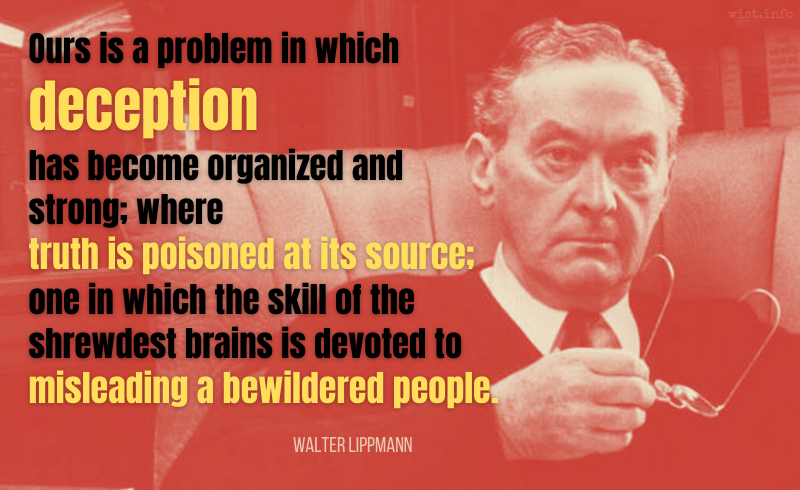
No evil dooms us hopelessly except the evil we love, and desire to continue in, and make no effort to escape from.
George Eliot (1819–1880) English novelist [pseud. of Mary Ann Evans]
Daniel Deronda, Book 5, ch. 8 (1876)
(Source)
Talking about music is like dancing about architecture.
Martin Mull (b. 1943) American actor, comedian
(Attributed)
Many people have put many hours into determining the origin of this quotation, but the best evidence at present points to Mull, in or before early 1979. See:

You seem a youth to look upon.
You dyed your hair — and lo,
The locks once whiter than a swan
Are blacker than a crow.
Not everyone can you deceive
And, though you hide the grey,
Yet Proserpine will not believe
But snatch the mask away.[Mentiris iuvenem tinctis, Laetine, capillis,
Tam subito corvus, qui modo sygnus eras.
Non omnes fallis; scit te Proserpina canum
Personam capiti detrahet illa tuo.]Martial (AD c.39-c.103) Spanish Roman poet, satirist, epigrammatist [Marcus Valerius Martialis]
Epigrams [Epigrammata], Book 3, epigram 43 (3.43) (AD 87-88) [tr. Pott & Wright (1921)]
(Source)
Proserpina (the Roman version of Persephone) was the goddess / Queen of the Underworld.
(Source (Latin)). Other translations:Thou dy'st thy haire to seeme a younger man,
And turn'st a Crow, that lately wert a Swan.
All are not cousen'd; hels queene knows thee grey.
She'll take the vizor from thy head away.
[tr. May (1629)]Lentinus counterfeits his youth
With periwigs, I trow,
But art thou changed so soon, in truth,
From a swan to a crow?
Though canst not all the world deceive:
Proserpine knows thee gray;
And she'll make bold, without your leave,
To take your cap away.
[tr. Fletcher (1656)]Thou that not many months ago
Wast white as Swan, or driven Snow,
Now blacker far than Aesop's Crow,
Thanks to thy Wig, set’st up for Beau.
Faith Harry, thou'rt i'the wrong box,
Old Age these vain endeavours mocks
And time that knows thou'st hoary locks,
Will pluck thy Mask off with a pox.
[tr. Brown (1699)]Why should’st thou try to hide thy self in youth?
Impartial Proserpine beholds the truth,
And laughing at so find and vain a task,
Will strip thy hoary noddle of its mask.
[tr. Addison (fl. early 18th C)]With tinctur'd locks the dotard youth puts on:
Behold a raven, from but now a swan!
Though cheat'st not all; not her, who rules the dead:
She soon shall pull the mask from off thy head.
[tr. Elphinston (1782), Part 2, ep. 21]Before a swan, behind a crow,
Such self-deceit ne'er did I know.
Ah! cease your arts-- death knows you're grey,
And spite of all will keep his day.
[tr. Hoadley (fl. 18th C) §240]You simulate youth, Lentinus, with your dyed hairs; so suddenly a crow, who were so lately a swan. You do not deceive everyone: Proserpina knows you for a greybeard, she will tear off the masque from your head.
[tr. Amos (1858), ch. 4, ep. 140]Letinus, fain to cheat men's eyes,
You smear your head with umber dyes;
And, late a swan as white as snow,
You've suddenly become a crow.
Is everyone deceived by you?
No, one can tell the genuine hue.
Proserpine knows your hair is grey,
And she will tear that mask away.
[tr. Webb (1879)]You ape youth, Laetinus, with your dyed hair; and you, who were but now a swan, are suddenly become a crow! You will not deceive everyone: Proserpine knows that you are hoary, and will snatch the mask from your head.
[tr. Bohn's Classical (1897)]You pretend you're still youthful by dyeing your hair --
Now a crow, though a swan just of late --
But you don't fool us all, for Proserpina knows,
She'll show up the sham of your pate.
[tr. Nixon (1911)]You falsely ape youth, Laetinus, with dyed hair, so suddenly a raven who were but now a swan. You don't deceive all; Proserpine knows you are hoary: she shall pluck the mask from off your head.
[tr. Ker (1919)]You play the youth with raven hue assumed
But yesterday like swan of Leda plumed.
Not all you cheat; Proserpine knows you grey.
Some day she'll pluck your silly mask away.
[tr. Francis & Tatum (1924)]You wish, Lætinus, to be thought a youth,
And so you dye your hair.
You're suddenly a crow, forsooth:
Of late a swan you were!
You can't cheat all: there is a Lady dread
Who knows your hair is grey:
Proserpina will pounce upon your head,
And tear the mask away.
[tr. Duff (1929)]It's artificial for you to look like a young man
with your dyed hair, suddenly turning into a crow
when just a while ago you were a swan. You won't fool
everyone: Proserpina knows you are white-haired
and she will make you take your mask off.
[tr. Bovie (1970)]You've dyed your hair to mimic youth,
Laetinus. Not so long ago
You were a swan; now you're a crow.
You can't fool everyone. One day
Proserpina, who knows the truth,
Will rip that actor's wig away.
[tr. Michie (1972)]You were a swan, you’re now a crow.
Laetinus, why deceive us so,
With borrowed plumage trying?
The Queen of Shades will surely know
When she slips off your mask below,
In Death there's no more dyeing.
[tr. Pitt-Kethley (1987)]You simulate youth, Laetinus, by dying your hair; so suddenly a raven, who were but now a swan. You don't fool everybody. Proserpina knows your hair is white. She will drag the mask from your head.
[tr. Shackleton Bailey (1993)]You dye your hair, Laetinus, to feign youth --
a swan before, a raven now instead.
You don't fool all. Proserpina can tell
you're gray. She'll pull that mask right off your head.
[tr. McLean (2014)]You counterfeit youth with hair-dye, Laetinus: all of a sudden you're a raven, when just now you were a swan. You don't fool everyone: Proserpina knows you are grey; she will drag the mask from your head.
[tr. Nisbet (2015)]Thou, that not a month ago
Wast white as swan or driven snow,
Now blacker far than Aesop's crow,
Thanks to thy wig, sett'st up for beau:
Faith, Harry, thou'rt i' the wrong box;
Old age these vain endeavours mocks,
And time, that knows thou 'st hoary locks,
Will pluck thy mask off with a pox.
[tr. Browne]Before a swan, behind a crow,
Such self-deceit I ne'er did know.
Ah, cease your arts! Death knows you're grey,
And, spite of all, will have his way.
[tr. Hoadley]
Divine reality is not way up in the sky somewhere; it is readily available in the encounters of everyday life, which make hash of my illusions that I can control the ways God comes to me.
Barbara Brown Taylor (b. 1951) American minister, academic, author
Interview (2013-12-19), “Material Faith,” by Meghan Larissa Good, The Other Journal, No. 23
(Source)
It is only an error of judgment to make a mistake, but it argues an infirmity of character to adhere to it when discovered.
Christian Nestell Bovee (1820–1904) American epigrammatist, writer, publisher
Intuitions and Summaries of Thought, Vol. 2 (1862)
(Source)
If you’re a cheap tipper, by the way, or rude to your server, you are dead to me. You are lower than whale feces.
Anthony Bourdain (1956–2018) American chef, author, travel documentarian
(Attributed)
Over increasingly large areas of the United States, spring now comes unheralded by the return of the birds, and the early mornings are strangely silent where once they were filled with the beauty of bird song.
Rachel Carson (1907–1964) American marine biologist, author, conservationist
Silent Spring, ch. 8 “And No Birds Sing” (1962)
(Source)
This passage served as inspiration for the book title.

It is easy to dodge our responsibilities, but we cannot dodge the consequences of dodging our responsibilities.
Josiah Stamp (1880–1941) English industrialist, economist, statistician, banker
(Attributed)
First attributed to Stamp in "Gems of Thought," Kingston Daily Freeman [New York] (3 Jan 1928). More discussion here.
What the horrors of war are, no one can imagine — they are not wounds & blood & fever, spotted & low, or dysentery chronic & acute, cold & heat & famine. They are intoxication, drunken brutality, demoralization & disorder on the part of the inferior — jealousies, meanness, indifference, selfish brutality on the part of the superior.
Florence Nightingale (1820–1910) English social reformer, statistician, founder of modern nursing
Letter to her family (5 May 1855)
(Source)
Today the Somme is a peaceful but sullen place, unforgetting and unforgiving. The people, who work largely at raising vegetables and grains, are “correct” but not friendly. To wander now over the fields destined to extrude their rusty metal fragments for centuries is to appreciate in the most intimate way the permanent reverberations of July, 1916. When the air is damp you can smell rusted iron everywhere, even though you only see wheat and barley.
Paul Fussell (1924–2012) American cultural and literary historian, author, academic
The Great War and Modern Memory, ch. 2 “The Troglodyte World” (1975)
(Source)
At odd and unpredictable times, we cling in fright to the past.
Isaac Asimov (1920–1992) Russian-American author, polymath, biochemist
Foundation’s Edge, Part 1, ch. 1 (1982)
(Source)
All the livid steeds of the Apocalypse have stormed through my life — revolution and famine, inflation and terror, epidemics and emigration. I have seen the great mass ideologies grow and spread before my eyes — Fascism in Italy, National Socialism in Germany, Bolshevism in Russia, and above all else that arch-plague nationalism which has poisoned the flower of our European culture.
Stefan Zweig (1881–1942) Austrian novelist, playwright, journalist, biographer
The World of Yesterday [Die Welt von Gestern], Preface (1942)
(Source)
Other translation [Sonnenfeld]:All the pale horses of the apocalypse have stormed through my life, revolution, starvation, devaluation of currency and terror, epidemics, emigration; I have seen the great ideologies of the masses grow and spread out before my eyes. Fascism in Italy, National Socialism in Germany, Bolshevism in Russia, and, above all, that arch-pestilence, nationalism, which poisoned our flourishing European culture.
The secret language of statistics, so appealing in a fact-minded culture, is employed to sensationalize, inflate, confuse, and oversimplify. Statistical methods and statistical terms are necessary in reporting the mass data of social and economic trends, business conditions, “opinion” polls, the census. But without writers who use the words with honesty and understanding and readers who know what they mean, the result can only be semantic nonsense.
Darrell Huff (1913–2001) American writer
How to Lie with Statistics, Introduction (1954)
I am the world’s original gradualist. I just think ninety-odd years is gradual enough.
Thurgood Marshall (1908–1993) American lawyer, US Supreme Court Justice (1967–1991)
Quoted in I. F. Stone’s Weekly (19 May 1958)
(Source)
In response to Eisenhower's speech to the National Newspaper Publishers Association, where the President called for "patience and forbearance" on civil rights reform.
Also that year, during the effort by Autherine Lucy to be admitted to the segregated University of Alabama, Marshall similarly quipped, "Maybe you can't override prejudice overnight, but the Emancipation Proclamation was issued in 1864, ninety-odd years ago. I believe in gradualism, and I also believe that ninety-odd years is pretty gradual."
People may see hypocrisy and cynicism all around them, but in my experience, almost without exception, they believe their own views and actions — even when contradictory, even when private motivations differ from public explanations — are righteous and principled.
John F. Harris (b. c. 1963) American political journalist, editor
“‘He Is Our O.J.'” Politico (9 Jan 2020)
(Source)

‘But people, the ordinary faithful, are offended by crude comic blasphemies,’ voices are raised to tell me. Yes indeed. But what of my religion? I am a lover of truth, a worshipper of freedom, a celebrant at the altar of language and purity and tolerance. That is my religion, and every day I am sorely, grossly, heinously and deeply offended, wounded, mortified and injured by a thousand different blasphemies against it. When the fundamental canons of truth, honesty, compassion and decency are hourly assaulted by fatuous bishops, pompous, illiberal and ignorant priests, politicians and prelates, sanctimonious censors, self-appointed moralists and busy-bodies, what recourse of ancient laws have I? None whatever. Nor would I ask for any. For unlike these blistering imbeciles my belief in my religion is strong and I know that lies will always fail and indecency and intolerance will always perish.
Stephen Fry (b. 1957) British actor, writer, comedian
“Trefusis Blasphemes,” Loose Ends, BBC Radio 4 (1986)
(Source)
Reprinted in Paperweight (1992).

For a guest remembers all his days the hospitable man who showed him kindness.
[Τοῦ γάρ τε ξεῖνος μιμνῄσκεται ἤματα πάντα
ἀνδρὸς ξεινοδόκου, ὅς κεν φιλότητα παράσχῃ.]Homer (fl. 7th-8th C. BC) Greek author
The Odyssey [Ὀδύσσεια], Book 15, l. 54ff (15.54) [Pisistratus] (c. 700 BC) [tr. Palmer (1891)]
(Source)
(Greek Source). Other translations:Not a guest
Shall touch at his house, but shall store his breast
With fit mind of an hospitable man,
To last as long as any daylight can
His eyes recomfort, in such gifts as he
Will proofs make of his hearty royalty.
[tr. Chapman (1616)]For guests use always to remember those
By whom they have been entertain’d with love.
[tr. Hobbes (1675), ll. 49-50]For the guest in mem’ry holds
Through life, the host who treats him as a friend.
[tr. Cowper (1792), l. 64-65]For when a host with friendship void of blame
Gives of his choicest, men observe his name,
And hold it all their lives exceeding dear.
[tr. Worsley (1861), st. 7]Throughout his life,
A guest the gen'rous man should keep in mind
Who to is home hath welcom'd him.
[tr. Musgrave (1869), l. 88ff]A guest remembers thro' life's livelong days
That host, who gives him sterling proofs of love!
[tr. Bigge-Wither (1869)]For of him a guest is mindful all the days of his life, even of the host that shows him loving-kindness.
[tr. Butcher/Lang (1879)]Since forsooth the guest remembereth that man for all his days
Who giveth him good guesting in friendly wise and dear.
[tr. Morris (1887)]So long as he lives a guest should never forget a host who has shown him kindness.
[tr. Butler (1898)]For a guest remembers all his days the host who shews him kindness.
[tr. Murray (1919)]A guest never forgets the host who has treated him kindly.
[tr. Rieu (1946)]A guest remembers all his days that hose who makes provision for him kindly.
[tr. Fitzgerald (1961)]For a guest remembers all his days the man who received him as a host receives a guest, and gave him the gifts of friendship.
[tr. Lattimore (1965)]A guest will keep in memory, held close, the gift of friendship given by his host.
[tr. Mandelbaum (1990)]That’s the man a guest will remember all his days:
the lavish host who showers him with kindness.
[tr. Fagles (1996)]A guest remembers
A host's hospitality for as long as he lives.
[tr. Lombardo (2000)]As you know, a guest remembers for all his days the man who has welcomed him hospitably and shown friendship towards him.
[tr. Verity (2016)]For a guest remembers with gratitude all his days the man who was his host, who showed him kindness.
[tr. Green (2018)]A guest remembers all his life the man
who gave him hospitality and kindness.
[tr. Johnston (2019), l. 74-85]
The ideal capitalism envisioned by advocates of the free market depends upon social virtues and wise policies that it does not itself generate.
Timothy Snyder (b. 1969) American historian, author
Black Earth: The Holocaust as History and Warning, “Conclusion: Our World” (2015)
(Source)
Language is not a protocol legislated by an authority, but rather a wiki that pools the contributions of millions of writers and speakers, who ceaselessly bend the language to their needs and who inexorably age, die, and get replaced by their children, who adapt the language in their turn.
Steven Pinker (b. 1954) Canadian-American cognitive psychologist, linguist, author
The Sense of Style, Prologue (2014)
(Source)

The way you win as a creative person is to learn to love the work and not the applause.
Bob Dylan (b. 1941) American singer, songwriter
(Misattributed)
Attributed to Dylan, but it actually appears to be from an article by Brian Herzog, "Don't Write for Applause" (28 May 2015), which touched on Dylan.

A person, an individual being, has a thousand ways of conveying his feelings and thoughts. He is riches without end, he is a world in which we can always discover something new. A crowd, on the other hand, reduces the individuality of the person; a man in a crowd limits himself to a few forms of elementary behavior. The forms through which a crowd can express its yearnings are extraordinarily meager and continually repeat themselves: the demonstration, the strike, the rally, the barricades. That is why you can write a novel about a man, but about a crowd — never.
Ryszard Kapuściński (1932–2007) Polish journalist, photographer, poet, author
Shah of Shahs, Part 3 “The Dead Flame” (1982)
(Source)

For I will consider my Cat Jeoffry.
For he is the servant of the Living God duly and daily serving him.
For at the first glance of the glory of God in the East he worships in his way.
For this is done by wreathing his body seven times round with elegant quickness.
Reproached one day because he gave alms to a good-for-nothing, he said, “It was the man that I pitied, not his conduct.”
[ὀνειδιζόμενός ποτε ὅτι πονηρῷ ἀνθρώπῳ ἐλεημοσύνην ἔδωκεν, “οὐ τὸν τρόπον,” εἶπεν, “ἀλλὰ τὸν ἄνθρωπον ἠλέησα.”]
Aristotle (384–322 BC) Greek philosopher
Attributed in Diogenes Laërtius, Lives and Opinions of Eminent Philosophers [Vitae Philosophorum], Book 5, sec. 11 [tr. Mensch (2018)]
(Source)
(Greek Source). Other translations:On one occasion he was blamed for giving alms to a worthless man, and he replied, “I did not pity the man, but his condition.”
[tr. Yonge (1853)]Being once reproached for giving alms to a bad man, he rejoined, "It was the man and not his character that I pitied."
[tr. Hicks (1925), sec. 17]After he was reproached for giving money to a wretched man, he said, “It wasn’t the character, but the man I pitied.”
[tr. @sentantiq [2016)]Once, he was reproached because he gave charity to a lowly person, so he said, "I gave charity to a man, not a way of life."
[Source, sec. 17]
I sell my time to get enough money to buy it back.
James Richardson (b. 1950) American poet
Vectors: Aphorisms and Ten-Second Essays (2001) #151
(Source)
Men are willing to keep their evil characters if they can but get rid of their evil reputations. They are scrupulously studious of appearances.
Frank W. Boreham (1871–1959) Anglo-Australian preacher
“The Leopard’s Skin,” sec. 4, The Three Half-Moons (1929)
(Source)
Why is austerity in a depressed economy a bad idea? Because an economy is not like a household, whose income and spending are separate things. In the economy as a whole, my spending is your income and your spending is my income. What happens if everyone tries to cut spending at the same time, as was the case in the aftermath of the financial crisis? Everyone’s income falls.
Paul Krugman (b. 1953) American economist, author
“The Legacy of Destructive Austerity,” New York Times (20 Dec 2019)
(Source)

A man can’t help his feelings sometime. He don’t even understand his damn self half the time and there the trouble starts.

Evil always wins through the strength of its splendid dupes.
Gilbert Keith Chesterton (1874–1936) English journalist and writer
Eugenics and Other Evils, ch. 1 (1922)
(Source)
For indeed it is possible that a man may think well, and yet not be able to express his thoughts elegantly; but for any one to publish thoughts which he can neither arrange skillfully nor illustrate so as to entertain his reader, is an unpardonable abuse of letters and retirement: they, therefore, read their books to one another, and no one ever takes them up but those who wish to have the same license for careless writing allowed to themselves.
[Fieri autem potest, ut recte quis sentiat et id quod sentit polite eloqui non possit; sed mandare quemquam litteris cogitationes suas, qui eas nec disponere nec inlustrare possit nec delectatione aliqua allicere lectorem, hominis est intemperanter abutentis et otio et litteris. Itaque suos libros ipsi legunt cum suis, nec quisquam attingit praeter eos, qui eandem licentiam scribendi sibi permitti volunt.]
Marcus Tullius Cicero (106–43 BC) Roman orator, statesman, philosopher
Tusculan Disputations [Tusculanae Disputationes], Book 1, ch. 3 (1.3) / sec. 6 (1.6) (45 BC) [tr. Yonge (1853)]
(Source)
Source (Latin). Other translations:Now it is possible, that one may have true Conceptions, and yet not be able to express his Notions in proper Terms; but for a man to commit his thoughts to writing for the publick, who can neither put them in due method, nor illustrate them with clear Proofs, nor by any delightful Ornaments entertain his Reader, is the part of one that at no rate abuses his own time, and the benefit of Writing. Hereupon they read their own Books among themselves, nor doth any one else meddle with them, but they that expect allowance to write after the same loose fashion.
[tr. Wase (1643)]For indeed it may be that a man may think well, and yet not be able to express his thoughts elegant; but for any one to publish thoughts which he can neither methodize, nor illustrate nor entertain his reader, is an unpardonable abuse of letters and retirement: they, therefore, read their books to one another, which were never taken up by any but those who claimed the same privilege of writing.
[tr. Main (1824)]For it may very well happen, that a man may think rightly, and yet be unable to give utterance to his sentiments with sufficient elegance. But, for any one to consign his thoughts to letters, who can neither arrange them with method, nor make them intelligible by illustration, nor attract the reader with any delight, is the part of a man who rashly abuses both his leisure and literature. And, therefore, let them read their books themselves with their friends; nor let them be touched by any, except by those who are like to need the same indulgence for the same license in writing.
[tr. Otis (1839)]One may think correctly, yet be unable to give elegant expression to what he thinks; and in that case for a man to commit his thoughts to writing when he can neither arrange them, nor illustrate them, nor attract readers by anything that can give them delight, is the part of a man who outrageously abuses both leisure and letters. Such writers read their own books with their intimate friends, nor does any one else touch them except those who crave for themselves like liberty of writing.
[tr. Peabody (1886)]It may happen that a man may think rightly, but cannot express elegantly what he thinks. But that anyone should commit his thoughts to writing who can neither arrange nor explain them nor amuse the reader is the part of a man which unreasonably abuses both his leisure and learning.
[tr. Taylor/Hunt (1916)]Even when they have their arguments in order, they don't express them with any flair. They waste their free time -- and do a discredit to literature -- when they commit thoughts to writing without knowing how to arrange or enliven them or give any pleasure to the reader. And so they just end up reading each other's books! No one pays attention to them except people who hope to qualify for the same writer's license.
[tr. Habinek (1996)]But it can happen that someone may have a good thought which he cannot express well.
[tr. @sentantiq (2016)]It is possible for a man to hold the right views but be incapable of expressing these with any elegance; but that anyone should entrust his thoughts to writing, without the ability to arrange them or to express them with clarity, or to attract the reader by offering him some pleasure, is characteristic of a man who is making an ill-disciplined misuse of both leisure and writing. The result is these fellows read their own books to their own circle and no one touches them except those who wish to be permitted the same freedom in writing.
[tr. Davie (2017)]
“Inevitability” is a magic word with which to mesmerize the unwary. Only death is inevitable. Short of that, nothing is inevitable until it happens, and everything is inevitable once it has happened. The historian deals with past events and therefore to him all history is inevitable. But these past events were once in the future, and then they were not inevitable.
Few men, indeed, are so mad that they do not know when they are doing wrong. But so avid is their pursuit of goods that wrongdoing has become an element of all they do. To protest that fact is idle. Our politics, our business — little and big, our professions, our labor, are smitten in every facet with a corruption occasioned by reckless determination to make not just a reasonable profit but all the profit that can be wrung from every enterprise. Our commonest man, emulating his superiors, forges ahead with a brick on the safety valve of his conscience. Think over your morning paper in that light.
Cultures are cunning tailors. They cut garments from convenience and then work hard to reshape individuals to fit them.
Charles King (b. 1967) American historian, political scientist, academic, author
Gods of the Upper Air (2019)
(Source)

No one on his deathbed ever said, “I wish I had spent more time on my business.”
Paul Tsongas (1941–1997) American politician
Heading Home (1984), quoting Arnold Zack
(Source)
Often misattributed directly to Tsongas, this was quoted from a letter from Zack, a Massachusetts lawyer and old friend, during Tsongas' battle with cancer.

The best you can do is grant my demand,
Your second-best course to refuse it off-hand;
I welcome assent and denial excuse —
But, Cinna, you neither consent nor refuse.[Primum est ut praestes, si quid te, Cinna, rogabo;
illud deinde sequens, ut cito, Cinna, neges.
Diligo praestantem; no odi, Cinna, negantem:
sed tu nec praestas nec cito, Cinna, negas.]Martial (AD c.39-c.103) Spanish Roman poet, satirist, epigrammatist [Marcus Valerius Martialis]
Epigrams [Epigrammata], Book 7, epigram 43 (7.43) (AD 92) [tr. Pott & Wright (1921)]
(Source)
Source (Latin). Other translations:My iust demands soone graunt or soone deny,
Th' one friendship showes, and th' other curtesie.
But who nor soon doth graunt, nor soone say noe,
Doth not true friendship, nor good manners know.
[tr. Davison (1602)]The first love, Cinna, is to grant what I
Request; the second quickly to deny.
I love the one, the other hate not I;
But thou nor grant'st, nor quickly dost deny.
[tr. May (1629), 7.42]The kindest thing of all is to comply;
The next kind thing is quickly to deny:
I love performance; nor denial hate:
Your "Shall I, Shall I?" is the cursed state.
[tr. Hay (1755)]To grant must doubtless be the primal boon:
The next, my Cinna, to deny me soon.
I love the former, nor the latter hate:
But thou not grantest, and deniest late.
[tr. Elphinston (1782), Book 5, ep. 53]The greatest favour that you can do me, Cinna, if I ask anything of you, is to give it me; the next, Cinna, to refuse it at once. I love one who gives, Cinna; I do not hate one who refuses; but you, Cinna, neither give nor refuse.
[tr. Bohn's Classical (1859)]Cinna, grant me my request:
(I warmly hope you'll choose to!)
Or do what I think second best,
In haste refuse to.
Patrons I esteem, nor hate
The man I can't bamboozle:
But you give naught, yet make me wait
A slow refusal.
[tr. Nixon (1911)]The first thing is that you should hand it over if I ask anything of you, Cinna; the next thing after that, Cinna, is that you should refuse quickly. I like a man who hands over; I do not hate, Cinna, a man who refuses; but you neither hand over, nor do you, Cinna, quickly refuse.
[tr. Ker (1919)]'Tis best to grant me, Cinna, what I crave;
And next best, Cinna, is refusal straight.
Givers I like: refusal I can brave;
But you don't give -- you only hesitate!
[tr. Duff (1929)]Cinna, the best thing would be if you lent
Me anything I asked for. The next best
Would be for you to say no then and there.
I like good givers, and I don't resent
A straight refusal of a small request.
It's ditherers like you that I can't bear.
[tr. Michie (1972)]Best is that you give me anything I ask, Cinna; next best, Cinna, is that you refuse promptly. I like a man who gives; I don't hate a man who refuses, Cinna. But you, Cinna, neither give nor promptly refuse.
[tr. Shackleton Bailey (1993)]Cinna, to give me what I ask is best;
next best is to refuse without delay.
I love a giver, don't resent refusers.
You neither give nor tell me no straightway.
[tr. McLean (2014)]
With many readers, brilliancy of style passes for affluence of thought; they mistake buttercups in the grass for immeasurable gold mines under the ground.
Something of a person’s character may be discovered by observing when and how he smiles. Some people never smile; they grin.
Christian Nestell Bovee (1820–1904) American epigrammatist, writer, publisher
Intuitions and Summaries of Thought, vol. 2 (1862)
(Source)
Once you’ve been to Cambodia, you’ll never stop wanting to beat Henry Kissinger to death with your bare hands. You will never again be able to open a newspaper and read about that treacherous, prevaricating, murderous scumbag sitting down for a nice chat with Charlie Rose or attending attending some black-tie affair for a new glossy magazine without choking. Witness what Henry did in Cambodia — the fruits of his genius for statesmanship — and you will never understand why he’s not sitting in the dock at The Hague next to Milošević. While Henry continues to nibble nori rolls and remaki at A-list parties, Cambodia, the neutral nation he secretly and illegally bombed, invaded, undermined, and then threw to the dogs, is still trying raise itself up on its one remaining leg.
Anthony Bourdain (1956–2018) American chef, author, travel documentarian
A Cook’s Tour, ch. 9 “Road to Pailin” (2001)
(Source)
The reward of art is not fame or success but intoxication: that is why so many bad artists are unable to give it up.
Cyril Connolly (1903–1974) English intellectual, literary critic and writer.
The Unquiet Grave (1944)
If we do not redefine manhood, war is inevitable.
Paul Fussell (1924–2012) American cultural and literary historian, author, academic
(Attributed)
Make sure you have finished speaking before your audience has finished listening.
Dorothy Sarnoff (1914–2008) American opera singer, actress, image consultant
Speech Can Change Your Life (1970)
(Source)

If the natural tendencies of mankind are so bad that it is not safe to permit people to be free, how is it that the tendencies of these organizers are always good? Do not the legislators and their appointed agents also belong to the human race? Or do they believe that they themselves are made of a finer clay than the rest of mankind?
[Puisque les tendances naturelles de l’humanité sont assez mauvaises pour qu’on doive lui ôter sa liberté, comment se fait-il que les tendances des organisateurs soient bonnes ? Les Législateurs et leurs agents ne font-ils pas partie du genre humain ? Se croient-ils pétris d’un autre limon que le reste des hommes?]
Frédéric Bastiat (1801–1850) French philosopher, economist, politician
The Law [La Loi] (1850) [tr. Russell]
(Source)
For if justice be a virtue, it must be free from the imputation of crime, and not return evil for evil. For what kind of virtue is it for you to do yourself what you punish in another? This is merely to propagate iniquity, not to punish it; and the character of the person whom you injure, whether he be just or unjust, makes no difference, for you ought not to have done evil.
Ambrose of Milan (339–397) Roman theologian, statesman, Christian prelate, saint, Doctor of the Church [Aurelius Ambrosius]
Letter to the Church of Vercellae, para. 83
(Source)
There was a price to be paid; the dominion of the seas was not given freely by destiny. The Channel Fleet paid in blood, in lives, as well as in the sacrifice of the freedom and leisure of every officer and man on board. There was a constant petty drain. Ordinary sickness took only small toll; among men in the prime of life isolated from the rest of the world illnesses were few, although it was noticeable that after the arrival of victualling ships from England epidemics of colds would sweep through the fleet, while rheumatism — the sailor’s disease — was always present. The losses were mainly due to other causes. There were men who, in a moment of carelessness or inattention, fell from the yard. There were the men who ruptured themselves, and they were many, for despite the ingenuity of blocks and tackles there were heavy weights to haul about by sheer manpower. There were crushed fingers and crushed feet when ponderous casks of salted provisions were lowered into boats from the storeships and hauled up on to the decks of the fighting ships. And frequently a lacerated limb would end — despite all the care of the surgeons — in gangrene, in amputation, and death. There were the careless men who, during target practice with the cannon, lost their arms by ramming a cartridge into an improperly sponged gun, or who did not remove themselves from the line of recoil. Three times that year there were men who died in quarrels, when boredom changed to hysteria and knives were drawn; and on each of those occasions another life was lost, a life for a life, a hanging with the other ships clustered round and the crews lining the sides to learn what happened when a man lost his temper. And once the crews manned the sides to see what happened when a wretched young seaman paid the price for a crime worse even than murder — for raising his fist to his superior officer. Incidents of that sort were inevitable as the ships beat back and forth monotonously, over the eternal grey inhospitable sea.
C. S. Forester (1899–1966) English novelist [Cecil Scott Forester, pen name for Cecil Louis Troughton Smith]
Hornblower and the Hotspur (1962)
(Source)
One can only blaspheme if one believes.
W. H. Auden (1907–1973) Anglo-American poet [Wystan Hugh Auden]
“Concerning the Unpredictable,” Forewords and Afterwords (1973)
(Source)
Listen to me, Eumaeus and all of you.
I am going to boast and tell you a story. This is the effect of wine —
it makes people do crazy things; it sets the wisest man
singing and giggling stupidly; it lures him on to dance
and it makes him blurt out what’s better left unsaid.[κέκλυθι νῦν, Εὔμαιε καὶ ἄλλοι πάντες ἑταῖροι,
εὐξάμενός τι ἔπος ἐρέω: οἶνος γὰρ ἀνώγει
ἠλεός, ὅς τ᾽ ἐφέηκε πολύφρονά περ μάλ᾽ ἀεῖσαι
καί θ᾽ ἁπαλὸν γελάσαι, καί τ᾽ ὀρχήσασθαι ἀνῆκε,
καί τι ἔπος προέηκεν ὅ περ τ᾽ ἄρρητον ἄμεινον.]Homer (fl. 7th-8th C. BC) Greek author
The Odyssey [Ὀδύσσεια], Book 14, l. 462ff (14.462) [Odysseus] (c. 700 BC) [tr. DCH Rieu (2002)]
(Source)
(Source (Greek)). Other translations:Hear me, Eumæus, and my other friends,
I’ll use a speech that to my glory tends,
Since I have drunk wine past my usual guise.
Strong wine commands the fool and moves the wise,
Moves and impels him too to sing and dance,
And break in pleasant laughters, and, perchance,
Prefer a speech too that were better in.
[tr. Chapman (1616)]Hear me, Eumæus, says he, and you folk,
I have a tale to tell. This foolish wine
To laugh and dance is able to provoke
Grave men sometimes that have no such design,
And to speak that which better were unspoke.
[tr. Hobbes (1675), l. 448ff]Hear me, my friends! who this good banquet grace;
'Tis sweet to play the fool in time and place,
And wine can of their wits the wise beguile,
Make the sage frolic, and the serious smile,
The grave in merry measures frisk about,
And many a long-repented word bring out.
[tr. Pope (1725)]Hear now, Eumæus, and ye other swains
His fellow-lab’rers! I shall somewhat boast,
By wine befool’d, which forces ev’n the wise
To carol loud, to titter and to dance,
And words to utter, oft, better suppress’d.
[tr. Cowper (1792), l. 567ff]Hear now, Eumæus, and thy comrades all!
I speak for glory, since by wine made bold
Often to singing even the wise will fall,
Light laughter and the dance, nor can withhold
Words that in sooth were better far untold.
[tr. Worsley (1861), st. 59]Hear, now, the words,
Eumaeus! and all you who with him serve!
To which, although to vaunt I may appear,
I must give utt'rance; for that crazing wine
Has set me on, which oft the wisest man
Ere now hat stirr'd up into noisy song,
or into burst of friv'lous laughter thrown,
Nay, even rous'd to dancing, or some speech
Impulsive prompted, which 'twere better far
Had ne'er been utter'd.
[tr. Musgrave (1869), l. 772ff]Now list! Eumæus! and ye comrades all!
I'll glory somewhat in the tale I'll tell you;
For crazy wine urges me on to speak,
Which e'en a sage hat set to noisy singing;
And urged the shy to laughter loud and dancing;
And uttered words far better left unsaid!
[tr. Bigge-Wither (1869)]Listen now, Eumaeus, and all of you his companions, with a prayer will I utter my word; so bids me witless wine, which drives even the wisest to sing and to laugh softly, and rouses him to dance, yea and makes him to speak out a word which were better unspoken.
[tr. Butcher/Lang (1879)]Now hearken ye, Eumæus, and all our fellows here,
And a boasting word will I say; for befooling wine is strong
Within me: he who eggeth e'en the wise to raise the song
And laugh out softly, and dance for very lustihead,
And to say the word, it may be, that were better left unsaid.
[tr. Morris (1887)]Hearken, Eumaeus, and all you other men, and I will boast a bit and tell a story; for crazy wine so bids, which sets a man, even if wise, to skinging loud and laughing lightly, and makes him dance and brings out stories really better left untold.
[tr. Palmer (1891)]Listen to me, Eumæus and the rest of you; when I have said a prayer I will tell you something. It is the wine that makes me talk in this way; wine will make even a wise man fall to singing; it will make him chuckle and dance and say many a word that he had better leave unspoken
[tr. Butler (1898)]Listen to me now, Eumaios and all you other companions [hetairoi]! Speaking proudly, I will tell you a wording [epos]. The wine, which sets me loose, is telling me to do so. Wine impels even the thinking man to sing and to laugh softly. And it urges him on to dance. It even prompts an epos that may be better left unsaid.
[tr. Butler (1898), rev. Kim/McCray/Nagy/Power (2018)]Hear me now, Eumaeus and all the rest of you, his men, with a wish in my heart will I tell a tale; for the wine bids me, befooling wine, which sets one, even though he be right wise, to singing and laughing softly, and makes him stand up and dance, aye, and brings forth a word which were better unspoken.
[tr. Murray (1919)]Hear me now, O Eumaeus and you others, while I let myself go as your wine's intoxication tempts me. Drink will set the most solid man singing or giggling with laughter; if indeed it does not push him forward to dance or make him blurt out something better left unsaid.
[tr. Lawrence (1932)]Listen to me, Eumaeus and you men of his. I am going to put a wish of mine into the form of a story. This is the effect of your wine -- for wine is a crazy thing. It sets the wisest man singing and giggling like a girl; it lures him on to dance and it makes him blurt out what were better left unsaid.
[tr. Rieu (1946)]Eumaios, and you others, here's a wishful
tale I shall tell. The wine's behind it,
vaporing wine, that makes a serious man
break down and sing, kick up his heels and clown,
or tell some story that were best untold.
[tr. Fitzgerald (1961)]Hear me now, Eumaios and all you other companions.
What I say will be a bit of boasting. The mad wine tells me
to do it. Wine sets even a thoughtful man to singing,
or sets him into softly laughing, sets him to dancing.
Sometimes it tosses out a word that was better unspoken.
[tr. Lattimore (1965)]Listen, Eumaeus, and all you comrades here,
allow me to sing my praises for a moment.
Say it's the wine that leads me on, the wild wine
that sets the wisest man to sing at the top of his lungs,
laugh like a fool -- it drives the man to dancing ... it even
tempts him to blurt out stories better never told.
[tr. Fagles (1996)]Hear me now, Eumaeus, and the rest of you men,
While I boast a little. It must be the wine
Befuddling me, which gets even sensible men
Singing and laughing and up to dance,
And sometimes say things better left unsaid.
[tr. Lombardo (2000), l. 500ff]Eumaeus and you others, all of you, I want to brag a little. I am dizzy, under the influence fo wine, which makes even the wisest people sing and giggle, and dance, and say things best not spoken.
[tr. Wilson (2017), l. 461ff]Hear me out now, Eumaios, and you, all his other comrades, while I tell you a boastful story. It's the wine that's urging me -- mind-crazing stuff, that sets on even the quick-witted to singing and gentle laughter, drives him to get up and dance, or make some remark better left unspoken.
[tr. Green (2018)]Eumaeus and you others, his work mates,
hear me now -- I wish to tell a story,
prompted by this wine, which addles our wits.
Wine can make a man, even though he’s wise,
sing out loud, or laugh softly to himself,
or leap up and dance. It can bring out words
which were better left unspoken.
[tr. Johnston (2019), l. 601ff]
If the main pillar of the system is living a lie, then it is not surprising that the fundamental threat to it is living in truth. This is why it must be suppressed more severely than anything else.
Václav Havel (1936–2011) Czech playwright, essayist, dissident, politician
Essay (1978-10), “The Power of the Powerless,” ch. 7 [tr. Wilson], The Power of the Powerless [ed. John Keane] (1985)
(Source)
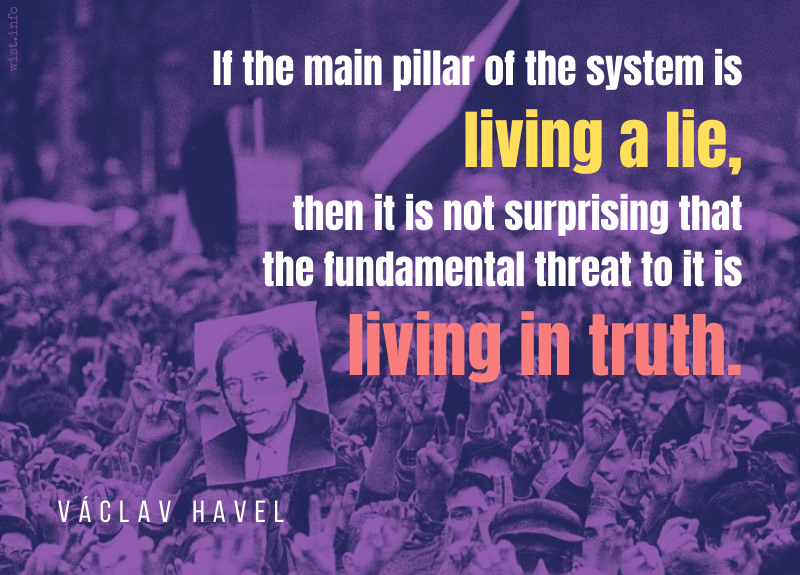
As people age, they confuse changes in themselves with changes in the world, and changes in the world with moral decline — the illusion of the good old days. And so every generation believes that the kids today are degrading the language and taking civilization down with it.
Steven Pinker (b. 1954) Canadian-American cognitive psychologist, linguist, author
The Sense of Style, Prologue (2014)
(Source)
You don’t get the power you ask for, you get the power you take.


Unlike a human smile, purring cannot be, as far as anyone knows, faked.
Jeffrey Moussaieff Masson (b. 1941) American author
The Nine Emotional Lives of Cats, ch. 3 (2002)
(Source)

I don’t have much truck with the “religion is the cause of most of our wars” school of thought because that is manifestly done by mad, manipulative and power-hungry men who cloak their ambition in God.
Terry Pratchett (1948–2015) English author
“I create gods all the time — now I think one might exist,” Daily Mail (21 Jun 2008)
(Source)
There are crimes I don’t commit mainly because I don’t want to find out I could.
James Richardson (b. 1950) American poet
Vectors: Aphorisms and Ten-Second Essays #124 (2001)
(Source)
We make religion a drudgery, a grind, a slavery when it should be a revelry, a festival, an everlasting song.
Frank W. Boreham (1871–1959) Anglo-Australian preacher
The Drums of Dawn, “The Tower of Babel” (1933)
(Source)
The mass of men serve the State thus, not as men mainly, but as machines, with their bodies. They are the standing army, and the militia, gaolers, constables, posse comitatus, etc. In most cases there is no free exercise whatever of the judgment or of the moral sense; but they put themselves on a level with wood and earth and stones; and wooden men can perhaps be manufactured that will serve the purpose as well. Such command no more respect than men of straw or a lump of dirt. They have the same sort of worth only as horses and dogs. Yet such as these even are commonly esteemed good citizens.
Henry David Thoreau (1817–1862) American philosopher and writer
Essay (1849-05), “Resistance to Civil Government [On the Duty of Civil Disobedience],” Æsthetic Papers, No. 1, Article 10
(Source)
Based on an 1848 lecture at the Concord Lyceum.
Doubts are not the enemy of belief, they are its companion.
Malcolm Gladwell (b. 1963) Anglo-Canadian journalist, author, public speaker
Talking to Strangers (2019)
(Source)

The Catholic Church is an institution I am bound to hold divine — but for unbelievers a proof of its divinity might be found in the fact that no merely human institution conducted with such knavish imbecility would have lasted a fortnight.
Hilaire Belloc (1870–1953) Franco-British writer, historian [Joseph Hilaire Pierre René Belloc]
Remark to William Temple
(Source)
Quoted in Robert Speaight, The Life of Hilaire Belloc (1957). Variant: "The Catholic Church is an institution I am bound to hold divine, but for unbelievers, here is proof of its divinity, that no merely human institution run with such knavish imbecility would have lasted a fortnight."
MARCUS: Nothing could be less worthy of you than to think anything worse than dishonor, infamous behavior, and wickedness. To escape these, any pain is not so much as to be avoided as to be sought voluntarily, undergone, and welcomed.
[Quid enim minus est dignum quam tibi peius quicquam videri dedecore flagitio turpitudine? Quae ut effugias, quis est non modo recusandus, sed non ultro adpetendus subeundus excipiendus dolor?]
Marcus Tullius Cicero (106–43 BC) Roman orator, statesman, philosopher
Tusculan Disputations [Tusculanae Disputationes], Book 2, ch. 5 (2.5) / sec. 14 (2.14) (45 BC) [tr. Douglas (1990)]
(Source)
Original Latin. Other translations:For what is more unsuitable to that high Character, than for you to think any thing worse, than dishonour, scandal, baseness? to avoid which, what Pain would not only not be declin'd, but also be eagerly pursu'd, undergone, encounter'd?
[tr. Wase (1643)]For what is so unbecoming? What can appear worse to you, than disgrace, wickedness, immorality? To avoid which, what pain should we not only not refuse, but willingly take on ourselves?
[tr. Main (1824)]For what is less worthy than for anything to appear worse to you than disgrace, turpitude, wickedness? which to escape, what pain is to be refused, or rather not to be welcomed, sought for, embraced?
[tr. Otis (1839)]For what is so unbecoming -- what can appear worse to you, than disgrace, wickedness, immorality? To avoid which, what pain is there which we ought not (I will not say to avoid shirking, but even) of our own accord to encounter, and undergo, and even to court?
[tr. Yonge (1853)]For what is more unworthy than that anything should seem to you worse than disgrace, crime, baseness? To escape these what pain should be not only not shunned, but voluntarily sought, endured, welcomed?
[tr. Peabody (1886)]There is nothing more unworthy than for you to think anything worse than disgrace, criminal behavior, and infamous conduct. In order to escape these, any pain is not so to be rejected, as to be actively sought out, undergone, welcomed.
[tr. Davie (2017)]
No war is inevitable until it breaks out.
A. J. P. Taylor (1906–1990) British historian, journalist, broadcaster [Alan John Percivale Taylor]
The Struggle for Mastery in Europe 1848-1918, ch. 22 (1954)
(Source)
The church has stood, a rock colossus of bigotry, in the path of ten thousand proposed reforms. Sane efforts to legalize birth control information, the manufacture of proper birth control appliances, appliances for the inhibition of the spread of venereal disease, public instruction in sex hygiene, free clinics for the treatment of venereal disease, the inspection and treatment of prostitutes, controlled prostitution itself, the publication of psychological and physical sex information, aid for unwed mothers –myriad attempts by sane men acting sanely on real problems -— have been fought down by church-frightened legislatures and church-dominated courts.
The past is the only dead thing that smells sweet.
Edward Thomas (1878–1917) British poet, essayist, novelist
“Early One Morning,” Poems (1917)
(Source)
Sometimes misattributed to Cyril Connolly.

A middle-aged white male wearing a tie and saying anything with some conviction will be believed by at least 55 percent of people, especially if they already want to believe it. (Sixty-five percent if he has a classy accent.)
Bill Oakley (b. 1966) American television writer and producer
“One of the defenses of Trump is — literally — a TV-cartoon joke,” Washington Post (14 Nov 2019)
(Source)

Fabius buries all his wives:
Chrestilla ends her husbands’ lives.
The torch which from the marriage-bed
They brandish soon attends the dead.
O Venus, link this conquering pair!
Their match will meet with issue fair,
Whereby for such a dangerous two
A single funeral will do![Effert uxores Fabius, Chrestilla maritos,
funereamque toris quassat uterque facem.
Victores committe, Venus: quos iste manebit
exitus, una duos ut Libitina ferat.]Martial (AD c.39-c.103) Spanish Roman poet, satirist, epigrammatist [Marcus Valerius Martialis]
Epigrams [Epigrammata], Book 8, epigram 43 (8.43) (AD 94) [tr. Duff (1929)]
(Source)
Original Latin. Other translations:Five wives hath he dispatch'd, she husbands five:
By both alike the undertakers thrive.
Venus assist! let them join hands in troth!
One common funeral, then, would serve them both.
[tr. Hay (1755)]While Tom and Dolly many mates
Do carry off ('tis said)
Each shakes by turns (so will the Fates)
The Fun'ral torch in bed.
Oh fie, ma'am, Venus, end this rout,
Commit them to the Fleet,
And grant they may be carried out,
Both buried in one sheet.
[tr. Scott (1773)]Both Fabby and Chrestil know well how to bury
A consort, and with sable torch to make merry.
Yoke, Venus, the victors; and, mutually loath,
Let one Libitana lay hold of them both.
[tr. Elphinston (1782), Book 6, Part 2, ep. 47]Fabius buries his wives, Chrestilla her husbands; each shakes a funeral torch over the nuptial couch. Unite these conquerers, Venus, and the result will then be that Libitina will carry them both off together.
[tr. Bohn's Classical (1860)]Fabius has buried all his wives;
Short are Chrestilla's husbands' lives.
And 'tis a funeral torch this pair
Do, at their nuptials, wave in air.
These conquerors, Venus, sure 'twere fit
Against each other now to pit:
So shall such end await the two,
That for them both one bier may do.
[tr. Webb (1879)]Chrestilla has buried her husbands,
While Fabius has buried his wives;
Since they're both sure to make
Every marriage a wake,
Pray, Venus, unite their two lives.
[tr. Nixon (1911)]Fabius buried his wives, Chrestilla her husbands, and each of them waves the funeral torch over a marriage-bed. Match the victors, Venus; this is the end that will await them -- one funeral to convey the pair.
[tr. Ker (1920)]He poisons wives, she husbands by the dozen,
With Pluto's torch the marriage-bed they cozen.
Unite them, Venus, in the marriage tether,
So death shall carry off the two together.
[tr. Pott & Wright (1921)]Chrestilla lays her lords to rest, his ladies
Fabius, and ushers them with pomp to Hades.
Kind Venus, match the winners. Then, I trust,
One funeral pyre will turn the pair to dust.
[tr. Francis & Tatum (1924) #420]Chrestilla digs her husbands' graves,
Fabius buries his wives. Each waves,
As bride or groom, the torch of doom
Over the marriage bed. Now pair
These finalists, Venus: let them share
Victory in a single tomb.
[tr. Michie (1972)]Fabius buries his wives, Chrestilla her husbands; each of them brandishes a funeral torch over the marriage bed. Venus, match the winners; the end awaiting them will be one bier to carry the pair.
[tr. Shackleton Bailey (1993)]They each took separate spouses to their bed,
Then swiftly to the graveyard each they led.
Conjoining both their marriage feats,
They'll serve each other funeral meats.
[tr. Wills (2007)]Fabius buries his wives; Christella, her husbands.
Each waves the funeral torch over the marriage bed.
Dear Venus, arrange that this pair be engaged.
One coffin will be enough to contain the dead.
[tr. Kennelly (2008), "Partners"]Chrestilla buries husbands; Fabius wives.
Each waves the funeral torch at the marriage bed.
Pair up the winners, Venus. The result
will be that both will share a bier instead.
[tr. McLean (2014)]
The difference between a man of genius seen in his works and in person, is like that of a lighthouse seen by night and by day, — in the one case only a great fiery brain, in the other only a white tower.
There is a pleasure unknown to the landsman in reading at sea.
These are times in which a Genious would wish to live. It is not in the still calm of life, or the repose of a pacific station, that great characters are formed. Would Cicero have shone so distinguished an orater, if he had not been roused, kindled and enflamed by the Tyranny of Catiline, Millo, Verres and Mark Anthony. The Habits of a vigorous mind are formed in contending with difficulties. All History will convince you of this, and that wisdom and penetration are the fruits of experience, not the Lessons of retirement and leisure. Great necessities call out great virtues. When a mind is raised, and animated by scenes that engage the Heart, then those qualities which would otherways lay dormant, wake into Life, and form the Character of the Hero and the Statesman.
Abigail Adams (1744–1818) American correspondent, First Lady (1797–1801)
Letter to John Quincy Adams (19 Jan 1780)
(Source)
Written when John Quincy was twelve, in Paris with his father for the peace negotiations with Britain.

The individual source of the statistics may easily be the weakest link. Harold Cox tells a story of his life as a young man in India. He quoted some statistics to a Judge, an Englishman, and a very good fellow. His friend said, “Cox, when you are a bit older, you will not quote Indian statistics with that assurance. The Government are very keen on amassing statistics — they collect them, add them, raise them to the nth power, take the cube root and prepare wonderful diagrams. But what you must never forget is that every one of those figures comes in the first instance from the chowty dar (village watchman), who just puts down what he damn pleases.”
Josiah Stamp (1880–1941) English industrialist, economist, statistician, banker
Some Economic Factors in Modern Life (1929)
(Source)
Quoting Harold Cox (1859-1936), English economist and politician.
Every work of art is one half of a secret handshake, a challenge that seeks the password, a heliograph flashed from a tower window, an act of hopeless optimism in the service of bottomless longing. Every great novel or comic book convenes the first meeting of a fan club whose membership stands forever at one but which maintains chapters in every city — in every cranium — in the world. Art, like fandom, asserts the possibility of fellowship in a world built entirely from the materials of solitude.

Good conversation can leave you more exhilarated than alcohol; more refreshed than the theater or a concert. It can bring you entertainment and pleasure; it can help you get ahead, solve problems, spark the imagination of others. It can increase your knowledge and education. It can erase misunderstandings, and bring you closer to those you love.
Dorothy Sarnoff (1914–2008) American opera singer, actress, image consultant
Speech Can Change Your Life (1971)
(Source)
No society can exist unless the laws are respected to a certain degree. The safest way to make laws respected is to make them respectable. When law and morality contradict each other, the citizen has the cruel alternative of either losing his moral sense or losing his respect for the law.
[Aucune société ne peut exister si le respect des Lois n’y règne à quelque degré ; mais le plus sûr, pour que les lois soient respectées, c’est qu’elles soient respectables. Quand la Loi et la Morale sont en contradiction, le citoyen se trouve dans la cruelle alternative ou de perdre la notion de Morale ou de perdre le respect de la Loi.]
Frédéric Bastiat (1801–1850) French philosopher, economist, politician
The Law [La Loi] (1850) [tr. Russell]
(Source)
I suggest that the real objective of Socialism is not happiness. Happiness hitherto has been a by-product, and for all we know it may always remain so. The real objective of Socialism is human brotherhood. This is widely felt to be the case, though it is not usually said, or not said loudly enough. Men use up their lives in heart-breaking political struggles, or get themselves killed in civil wars, or tortured in the secret prisons of the Gestapo, not in order to establish some central-heated, air-conditioned, strip-lighted Paradise, but because they want a world in which human beings love one another instead of swindling and murdering one another. And they want that world as a first step. Where they go from there is not so certain, and the attempt to foresee it in detail merely confuses the issue.
George Orwell (1903–1950) English journalist, essayist, writer [pseud. of Eric Arthur Blair]
Essay (1943-12-20), “Can Socialists Be Happy?” Tribune Newspaper [as John Freeman]
(Source)
The date given for this article varies: the issue of Tribune it was published in was 1943-12-24, but Orwell apparently received a check for the work on 1943-12-20. Note this was not the regular "As I Please" column Blair (Orwell) did for Tribune, which he also wrote for that issue, but a special article written under a different alias for unconfirmed reasons.
The title is sometimes given as "Why Socialists Don't Believe in Fun."

We can’t function as a society unless we have norms of how to behave. You can’t pass enough laws to take care of every human interaction.
Jerry Springer (b. 1944) Anglo-American broadcaster, actor, producer, politician
Interview by Stephanie Ruhle, MSNBC, @1:12 (1 Nov 2019)
(Source)

FAUSTUS: Blasphemy and prayer are one. Both assert the existence of a superior power. The first, however, with conviction.

It’s wrong, my friend, to send any stranger packing —
even one who arrives in worse shape than you.
Every stranger and beggar comes from Zeus
and whatever scrap they get from the likes of us,
they’ll find it welcome.[Ξεῖν’, οὔ μοι θέμις ἔστ’, οὐδ’ εἰ κακίων σέθεν ἔλθοι,
ξεῖνον ἀτιμῆσαι· πρὸς γὰρ Διός εἰσιν ἅπαντες
ξεῖνοί τε πτωχοί τε. δόσις δ’ ὀλίγη τε φίλη τε
γίνεται ἡμετέρη.]Homer (fl. 7th-8th C. BC) Greek author
The Odyssey [Ὀδύσσεια], Book 14, l. 56ff (14.56) [Eumæus/Eumaios] (c. 700 BC) [tr. Fagles (1996)]
(Source)
(Source (Greek)). The language is an echo of Nausicaa in Book 6. Other translations:Guest! If one much worse
Arriv’d here than thyself, it were a curse
To my poor means, to let a stranger taste
Contempt for fit food. Poor men, and unplac’d
In free seats of their own, are all from Jove
Commended to our entertaining love.
But poor is th’ entertainment I can give,
Yet free and loving.
[tr. Chapman (1616)]Stranger, then said Eumæus, it was never
My custom any stranger to neglect;
The poor and stranger are in God’s hand ever.
Few are my gifts, and but of small effect.
[tr. Hobbes (1675)]It never was our guise
To slight the poor, or aught humane despise:
For Jove unfold our hospitable door,
'Tis Jove that sends the stranger and the poor.
[tr. Pope (1725)]My guest! I should offend, treating with scorn
The stranger, though a poorer should arrive
Than ev’n thyself; for all the poor that are,
And all the strangers are the care of Jove.
Little, and with good will, is all that lies
Within my scope.
[tr. Cowper (1792), l. 68ff]O friend, I dare not, though a worse man sought
These doors, a stranger use discourteously.
All strangers and all poor by Zeus are brought;
Sweet is our gift, yet small.
[tr. Worsley (1862), st. 7]O stranger! 'Twere a wrongful act of mine,
Ev'n should a wretch more hapless than thyself
Before me come, on such a stranger's claim
To cast contempt: for ev'ry one Unknown
And ev'ry Mendicant from Jove Himself
His claim prefers. But, small, indeed, though kind
Are our donations all.
[tr. Musgrave (1869), l. 90ff]Sir guest, 'tis not my wont, not e'en should come
A worser man than thou, to slight a guest.
From Zeus are strangers all, and begger-men:
My gift is small, tho' proof of kindliness.
[tr. Bigge-Wither (1869)]Guest of mine, it were an impious thing for me to slight a stranger, even if there came a meaner man than thou; for from Zeus are all strangers and beggars; and a little gift from such as we, is dear.
[tr. Butcher/Lang (1879)]O guest, it were not rightful, though e'en worser than thou he were sped,
To put shame upon a stranger; since guest and bedesman all,
From Zeus they are; and our giving, although it be but small,
Is dear.
[tr. Morris (1887)]Stranger, it is not right for me to slight a stranger, not even one in poorer plight than you; for in the charge of Zeus all strangers and beggars stand, and our small gift is welcome.
[tr. Palmer (1891)]Stranger, though a still poorer man should come here, it would not be right for me to insult him, for all strangers and beggars are from Jove. You must take what you can get and be thankful.
[tr. Butler (1898)]Nay, stranger, it were not right for me, even though one meaner than thou were to come, to slight a stranger: for from Zeus are all strangers and beggars, and a gift, though small, is welcome from such as we.
[tr. Murray (1919)]My guest, I should sin if I failed in attention to any stranger, even one poorer than yourself. The needy and the strangers are all from Zeus; and with the likes of us a quite slender gift can convey goodwill.
[tr. Lawrence (1932)]"Sir," said the swineherd Eumaeus, "my conscience would not let me turn away a stranger in a worse state even than yourself, for strangers and beggars all come in Zeus’ name, and a gift from folk like us is none the less welcome for being small."
[tr. Rieu (1946)]Tush, friend,
rudeness to a stranger is not decency,
poor though he may be, poorer than you.
All wanderers
and beggars come from Zeus. What we can give
is slight but well-meant.
[tr. Fitzgerald (1961)]Stranger, I have no right to deny the stranger, not
even if one came to me who was meaner than you. All vagabonds
and strangers are under Zeus, and the gift is a light and a dear one
that comes from us.
[tr. Lattimore (1965)]Dear guest. I'd never slight the least of strangers. Not even one more wretched than you are; for it is Zeus who sends to us all beggars and strangers; and a gift, however small, means much when given by a man like me.
[tr. Mandelbaum (1990)]Stranger, for me it would not be right to dishonor a stranger, though one baser than you came, for every stranger and beggar has the protection of Zeus; and a gift, though little, but welcome, lies in our power to give.
[tr. Merrill (2002)]Stranger, it is not right for me to turn away any stranger, even one in a worse state than you are, for strangers and beggars all come in Zeus' name, and a gift from folk like us is none the less welcome for being small.
[tr. DCH Rieu (2002)]Stranger, it is not right for me to treat a guest dishonorably, not even one in a worse state than you; all strangers and beggars are under the protection of Zeus. What I can offer is small, but you are welcome to it.
[tr. Verity (2016)]One must honor guests and foreigners and strangers, even those much poorer than oneself. Zeus watches over beggars and guests and strangers. What I have to give is small, but I will give it gladly.
[tr. Wilson (2017)]Stranger, were one even meaner than you than you to come here, I'd still have no right to reject him, for all strangers and beggars are from Zeus, and a gift, however small, is friendly from folk such as us.
[tr. Green (2018)]It would be wrong,
stranger, for me to disrespect a guest,
even if one worse off than you arrived,
for every guest and beggar comes from Zeus,
and any gift from people like ourselves,
though small, is welcome.
[tr. Johnston (2019)]
It is tempting to say that a Nazi murderer is beyond the pale of understanding. […] Yet to deny a human being his human character is to render ethics impossible. To yield to this temptation, to find other people inhuman, is to take a step toward, not away from, the Nazi position. To find other people incomprehensible is to abandon the search for understanding, and thus to abandon history.
Timothy Snyder (b. 1969) American historian, author
Bloodlands: Europe Between Hitler and Stalin, “Conclusion” (2010)
(Source)
Violence is often caused by a surfeit of morality and justice, at least as they are conceived in the minds of the perpetrators.
Steven Pinker (b. 1954) Canadian-American cognitive psychologist, linguist, author
The Better Angels of our Nature, ch. 3 (2011)
(Source)
Act as the wisest have acted before you, and do not commence your exercises in philosophy in those regions where an error can deliver you over to the executioner.
Georg C. Lichtenberg (1742–1799) German physicist, writer
Aphorisms, Notebook C, #16 [142] (1772-73) [tr. Hollingdale (1960)]
(Source)
Another translation: "Act as the wisest before you have acted, and do not begin your philosophical exercises where an error can deliver you into the hands of the executioner." [tr. Tester (2012)]
MARCUS: I do not deny that pain is painful — otherwise, why would bravery be desired? But I do say that it is suppressed through patience, if we possess any amount at all. If we have none, then why do we raise philosophy on high and robe ourselves in its glory?
[Non ego dolorem dolorem esse nego — cur enim fortitudo desideraretur? — sed eum opprimi dico patientia, si modo est aliqua patientia: si nulla est, quid exornamus philosophiam aut quid eius nomine gloriosi sumus?]
Marcus Tullius Cicero (106–43 BC) Roman orator, statesman, philosopher
Tusculan Disputations [Tusculanae Disputationes], Book 2, ch. 14 (2.14) / sec. 33 (2.33) (45 BC) [tr. @sentantiq (2020)]
(Source)
Original Latin. Other translations:I do not deny Pain to be Pain, for what need else were there of Fortitude? but I say it may be suppress'd by Patience, if there be any such Virtue as Patience; if there be none, why do we magnifie Philosophy? or why do we value our selves in being denominated from her?
[tr. Wase (1643)]I do not deny pain to be pain, for were that the case, in what would courage consist? but I say it should be assuaged by patience, if there be such a thing as patience: if there be no such thing, then why do we speak so in praise of philosophy? or why do we glory in its name?
[tr. Main (1824)]That pain is pain, I do not deny; for why should fortitude be desired? but I say it is kept under by patience: -- if, at least, there be any patience. If there be no such thing, why do we extol philosophy? or why do we glory in her name?
[tr. Otis (1839)]I do not deny pain to be pain; for were that the case, in what would courage consist? but I say it should be assuaged by patience, if there be such a thing as patience: if there be no such thing, why do we speak so in praise of philosophy? or why do we glory in its name?
[tr. Yonge (1853)]I do not deny that pain is pain; else where were the need of fortitude? But I do say that pain is subdued by patience, if patience be a real quality; and if it be not, why do we lavish praises on philosophy? Or what is there to boast of in its name?
[tr. Peabody (1886)]I don't deny that pain is pain -- otherwise why should there be felt a need for courage? But I say that it is overcome by endurance if only there is such a thing as endurance: if there isn't, why do we sing the praises of philosophy, or why are we boastful on its behalf?
[tr. Douglas (1990)]
In my opinion, most of the great men of the past were only there for the beer — the wealth, prestige and grandeur that went with the power.
A. J. P. Taylor (1906–1990) British historian, journalist, broadcaster [Alan John Percivale Taylor]
“Fiction in History,” Times Literary Supplement (23 Mar 1973)
Reprinted in his Essays in English History (1976).
Ignorance is not bliss — it is oblivion. Determined ignorance is the hastiest kind of oblivion.
The moral case for intervention is only as strong as the practicality of the mission itself. There is no moral case for doing something you’re not capable of doing.
Dexter Filkins (b. 1961) American journalist
“The Moral Logic of Humanitarian Intervention,” New Yorker (16 Sep 2019)
(Source)

Rules like these don’t honor your wife. They just presume that your marriage vows are so flimsy that you can’t be trusted to uphold them unless a babysitter monitors you. It’s rather like a thief sanctimoniously announcing that he brings a parole officer every time he goes to the bank to make sure he doesn’t rob it. Good for you, dude, for knowing your own limitations — but it doesn’t make you better than the rest of us, who manage to regularly not steal things even when we’re completely alone.
Monica Hesse (b. c. 1981) American author, journalist, columnist
“The ‘Billy Graham rule’ doesn’t honor your wife,” Washington Post (11 Jul 2019)
(Source)

Experts are never right or wrong; they win or lose. Right and wrong are decided by proof; winning and losing are decided by who is doing the talking or talks the loudest, has the last, latest, or only word, and is quoted by reporters.
(Other Authors and Sources)
M. A. Zeidner, “Experts: A Definition” Quarterly Review of Doublespeak (Oct 1988)
You ask me how my farm can pay,
Since little it will bear;
It pays me thus — ‘Tis far away
And you are never there.[Quid mini reddat ager quaeris, Line, Nomentanus?
Hoc mini reddit ager: te, Line, non video.]Martial (AD c.39-c.103) Spanish Roman poet, satirist, epigrammatist [Marcus Valerius Martialis]
Epigrams [Epigrammata], Book 2, epigram 38 (2.38) (AD 86) [tr. Pott & Wright (1921)]
(Source)
Original Latin. Other translations:Linus, dost ask what my field yields to me?
Even this profit, that I ne'er see thee.
[tr. Fletcher (1656)]What my farm yields me, doest thou urge to know?
This, that I see not thee, when there I go.
[tr. Killigrew (1695)]Do you ask what profit my Nomentan estate brings me, Linus? My estate brings me this profit, that I do not see you, Linus.
[tr. Bohn's Classical (1860)]Ask you what my Nomentane fields
Can yield me, Linus, bleak and few?
For me my farm this, Linus, yields;--
That, when I'm there, I'm rid of you.
[tr. Webb (1879)]You ask what I grow on my Sabine estate.
A reliable answer is due.
I grow on that soil --
Far from urban turmoil --
Very happy at not seeing you.
[tr. Nixon (1911)]Do you ask, Linus, what my Nomentan farm returns me? This my land returns me: I don't see you, Linus.
[tr. Ker (1919)]You ask of my Nomentan farm
How such a barren waste can charm.
One reason is, I find no trace
There, Linus, of your ugly face.
[tr. Francis & Tatum (1924), #83]Linus, you mock my distant farm,
And ask what good it is to me?
Well, it has got at least one charm --
When there, from Linus I am free!
[tr. Duff (1929)]You don't see what I see, you say,
In living here so far away?
What I see, Linus, is a view
In which I see no sign of you.
[tr. Marcellino (1968)]What return on my real estate at Nomentum?
Up there i get out of seeing you, Linus.
That's what I get out of it.
[tr. Bovie (1970)]You ask me what I get
Out of my country place.
The profit, gross or net,
Is never seeing your face.
[tr. Michie (1972)]Linus, you ask me what I get out of my land near Nomentum. This is what I get out of the land: I don't see you, Linus.
[tr. Shackleton Bailey (1993)]You ask what my estate at Nomentum produces for me? It produces this: that I don't see you, Linus.
[tr. Williams (2003)]You ask me why I like the country air.
I never meet you there.
[tr. Kennelly (2004), "The Reason"]You ask what I see in my farm near Nomentum, Linus?
What I see in it, Linus, is: from there I can’t see you.
[tr. Kline (2006)]What, Linus, can my farm be minus
When it successfully lacks Linus?
[tr. Wills (2007)]You ask me why I like the country air.
I never meet you there.
[tr. Kennelly (2008)]What yield does my Nomentan farmstead bear?
Linus, I don’t see you when I am there.
[tr. McLean (2014)]You're wondering what the yield is from my farm at Nomentum, Linus? Here's the yield form my farm: Linus, I don't have to look at you.
[tr. Nisbet (2015)]You ask me why I love fresh country air?
You’re not befouling it there.
[tr. Burch (c. 2017)]You ask me why I choose to live elsewhere? You're not there.
[tr. Burch (c. 2017)]Ask you what my Nomentane field brings me?
This, Linus, 'mongst the rest, I ne'er see thee.
[tr. Wright]You wonder if my farm pays me its share?
It pays me this: I do not see you there.
[tr. Oliver]You ask me, Roger, what I gain
By living on this barren plain.
This credit to the spot is due,
I live there without seeing you.
[tr. Cowper]
Silence is a great peacemaker.
Fear, born of that stern matron, Responsibility, sits on one’s shoulders like some heavy imp of darkness, and one is preoccupied and, possibly, cantankerous.
The true foundation of theology is to ascertain the character of God. It is by the aid of Statistics that law in the social sphere can be ascertained and codified, and certain aspects of the character of God thereby revealed. The study of statistics is thus a religious service.
Florence Nightingale (1820–1910) English social reformer, statistician, founder of modern nursing
(Attributed)
Attributed in F.N. David in Games, Gods, and Gambling: A History of Probability and Statistical Ideas (1962).
There is a related variant of this quote: "To understand God's thoughts we must study statistics, for these are the measure of his purpose." This appears to be a paraphrase by Francis Galton of her beliefs (in full in Karl Pearson, Life of Francis Galton, Vol. 2, ch. 13, sec. 1 (1924)). While Galton is describing her beliefs, the quotation is often rewritten from third to first person, as though it were something she said.
Art and Religion are, then, two roads by which men escape from circumstance to ecstasy.
Americans are the only people in the world known to me whose status anxiety prompts them to advertise their college and university affiliations in the rear window of their automobiles.
Paul Fussell (1924–2012) American cultural and literary historian, author, academic
Class: A Guide Through the American Status System, ch. 4 (1983)
(Source)