Our law affords constitutional protection to personal decisions relating to marriage, procreation, contraception, family relationships, child rearing, and education. Our cases recognize “the right of the individual, married or single, to be free from unwarranted governmental intrusion into matters so fundamentally affecting a person as the decision whether to bear or beget a child.” Our precedents “have respected the private realm of family life which the state cannot enter.” These matters, involving the most intimate and personal choices a person may make in a lifetime, choices central to personal dignity and autonomy, are central to the liberty protected by the Fourteenth Amendment. At the heart of liberty is the right to define one’s own concept of existence, of meaning, of the universe, and of the mystery of human life. Beliefs about these matters could not define the attributes of personhood were they formed under compulsion of the State.
Anthony Kennedy (b. 1936) US Supreme Court Justice
Planned Parenthood v. Casey (91-744), 505 U.S. 833 (29 Jun 1992) [Majority Opinion]
(Source)
Citations removed.

One odd thing about foreign-policy professionals is that for all their sophistication, they tend to think the way to communicate with allies and potential allies is to compliment and sooth, compliment and soothe. But that isn’t polite, it’s patronizing, and to patronize is to insult. Candor is a compliment; it implies equality. It’s how true friends talk.

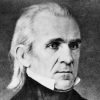
I am heartily rejoiced that my term is so near its close. I will soon cease to be a servant and will become a sovereign.
James K. Polk (1795–1849) American lawyer, politician, US President (1845–1849)
Diary (1849-02-13)
(Source)
As stars in the night sky glittering
round the moon’s brilliance blaze in all their glory
when the air falls to a sudden, windless calm …
all the lookout peaks stand out and the jutting cliffs
and the steep ravines and down from the high heavens bursts
the boundless, bright air and all the stars shine clear
and the shepherd’s heart exults.[Ὡς δ’ ὅτ’ ἐν οὐρανῷ ἄστρα φαεινὴν ἀμφὶ σελήνην
φαίνετ’ ἀριπρεπέα, ὅτε τ’ ἔπλετο νήνεμος αἰθήρ·
ἔκ τ’ ἔφανεν πᾶσαι σκοπιαὶ καὶ πρώονες ἄκροι
καὶ νάπαι· οὐρανόθεν δ’ ἄρ’ ὑπεῤῥάγη ἄσπετος αἰθήρ,
πάντα δὲ εἴδεται ἄστρα, γέγηθε δέ τε φρένα ποιμήν.]Homer (fl. 7th-8th C. BC) Greek author
The Iliad [Ἰλιάς], Book 8, l. 551ff (8.551-555) (c. 750 BC) [tr. Fagles (1990), ll. 641-47]
Used as a metaphor for the campfires of the Trojan troops before Ilium. Other translations:As when about the silver moon, when air is free from wind,
And stars shine clear, to whose sweet beams, high prospects, and the brows
Of all steep hills and pinnacles, thrust up themselves for shows,
And ev’n the lowly valleys joy to glitter in their sight,
When the unmeasur’d firmament bursts to disclose her light,
And all the signs in heav’n are seen, that glad the shepherd’s heart.
[tr. Chapman (1611), l. 486ff]As when the moon, refulgent lamp of night,
O'er heaven's clear azure spreads her sacred light,
When not a breath disturbs the deep serene,
And not a cloud o'ercasts the solemn scene;
Around her throne the vivid planets roll,
And stars unnumbered gild the glowing pole,
O'er the dark trees a yellower verdure shed,
And tip with silver every mountain's head;
Then shine the vales, the rocks in prospect rise,
A flood of glory bursts from all the skies:
The conscious swains, rejoicing in the sight,
Eye the blue vault, and bless the useful light.
[tr. Pope (1715-20)]As when around the clear bright moon, the stars
Shine in full splendor, and the winds are hush’d,
The groves, the mountain-tops, the headland-heights
Stand all apparent, not a vapor streaks
The boundless blue, but ether open’d wide
All glitters, and the shepherd’s heart is cheer’d.
[tr. Cowper (1791), l. 643ff]As when in heaven the stars appear very conspicuous around the lucid moon, when the æther is wont to be without a breeze, and all the pointed rocks and lofty summits and groves appear, but in heaven the immense æther is disclosed, and all the stars are seen, and the shepherd rejoices in his soul.
[tr. Buckley (1860)]As when in Heav'n, around the glitt'ring moon
The stars shine bright amid the breathless air;
And ev'ry crag and ev'ry jutting peak
Stands boldly forth, and ev'ry forest glade;
Ev'n to the gates of Heav'n is open'd wide
The boundless sky; shines each particular star
Distinct; joy fills the gazing shepherd's heart.
[tr. Derby (1864), ll. 629-35]Even as when in heaven the stars about the bright moon shine clear to see, when the air is windless, and all the peaks appear and the tall headlands and glades, and from heaven breaketh open the infinite air, and all stars are seen, and the shepherd’s heart is glad.
[tr. Leaf/Lang/Myers (1891)]As when the stars shine clear, and the moon is bright -- there is not a breath of air, not a peak nor glade nor jutting headland but it stands out in the ineffable radiance that breaks from the serene of heaven; the stars can all of them be told and the heart of the shepherd is glad.
[tr. Butler (1898)]Even as in heaven about the gleaming moon the stars shine clear, when the air is windless, and forth to view appear all mountain peaks and high headlands and glades, and from heaven breaketh open the infinite air, and all stars are seen, and the shepherd joyeth in his heart.
[tr. Murray (1924)]As when in heaven principal stars shine out around the moon when the night sky is limpid, with no wind, and all the lookout points, headlands, and mountain clearings are distinctly seen, as though pure space had broken through, downward from heaven, and all the stars are out, and in his heart the shepherd sings.
[tr. Fitzgerald (1974)]

The case against intellect is founded upon a set of fictional and wholly abstract antagonisms. Intellect is pitted against feeling, on the ground it is somehow inconsistent with warm emotion. It is pitted against character, because it is widely believed that intellect stands for mere cleverness, which transmutes easily into the sly or the diabolical. It is pitted against practicality, since theory is held to be opposed to practice, and the “purely” theoretical mind is so much disesteemed. It is pitted against democracy, since intellect is felt to be a form of distinction that defies egalitarianism. Once the validity of these antagonisms is accepted, then the case for intellect, and by extension for the intellectual, is lost. Who cares to risk sacrificing warmth of emotion, solidity of character, practical capacity, or democratic sentiment in order to pay deference to a type of man who at best is deemed to be merely clever and at worst may even be dangerous?
Richard Hofstadter (1916–1970) American historian and intellectual
Anti-Intellectualism in American Life, Part 1, ch. 2 “On the Unpopularity of Intellect” (1962)
(Source)
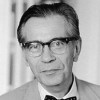
The best way to get the right answer on the Internet is not to ask a question; it’s to post the wrong answer.
Howard G. "Ward" Cunningham (b. 1949) American computer scientist
“Cunningham’s Law”
(Source)
Cunningham himself denies having said this. It was attributed to him (and so named) by Steven McGeady in the early 1980s.

The cat is not in the long run anxious to please.
Thomas Owen (T. O.) Beachcroft (1902–1988) English writer
Just Cats (1936)
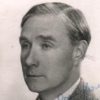
An old belief is like an old shoe. We so value its comfort that we fail to notice the hole in it.
Robert Brault (b. c. 1945) American aphorist, programmer
(Attributed)

For I have promised to do the battle to the uttermost, by faith of my body, while me lasteth the life, and therefore I had liefer to die with honour than to live with shame; and if it were possible for me to die an hundred times, I had liefer to die oft than yield me to thee; for though I lack weapon, I shall lack no worship, and if thou slay me weaponless that shall be thy shame.”

He’d noticed that sex bore some resemblance to cookery: it fascinated people, they sometimes bought books full of complicated recipes and interesting pictures, and sometimes when they were really hungry they created vast banquets in their imagination — but at the end of the day they’d settle quite happily for egg and chips. If it was well done and maybe had a slice of tomato.
Terry Pratchett (1948–2015) English author
Discworld Series No. 24, The Fifth Elephant [footnote] (1999)
(Source)

Avarice, on the other hand, implies a zeal for money, an object for which no philosopher ever yearned. Tainting the body and mind of the strong, it weakens them as by some deadly poison; it is always boundless, always insatiable; plenty and want alike fail to lessen it.
[Avaritia pecuniae studium habet, quam nemo sapiens concupivit; ea quasi venenis malis imbuta corpus animumque virilem effeminat, semper infinita, insatiabilis est, neque copia neque inopia minuitur.]
Sallust (c. 86–35 BC) Roman historian and politician [Gaius Sallustius Crispus]
Bellum Catilinae [The War of Cateline; The Conspiracy of Catiline], ch. 11, sent. 3 [tr. Pollard (1882)]
(Source)
Other translations:
- "Avarice, on the other hand, aims at an accumulation of riches; a passion unknown in liberal minds. It may be called a compound of poisonous ingredeients; it has power to enervate the body, and debauch the best understanding; always unbounded; never satisfied; in plenty and in want equally craving and rapacious." [tr. Murphy (1807)]
- "Avarice has money for its object, which no wise man ever coveted. This vice, as if impregnated with deadly poison, enervated both soul and body; is always boundless and insatiable; nor are its cravings lessened by plenty or want." [tr. Rose (1831)]
- "Avarice has a longing for money, which no wise man ever desired. This passion, as if it were imbued with deadly poisons, enervates the body and mind of man. It is always boundless, insatiable, is neither diminished by plenty nor want." [Source (1841)]
- "But avarice has merely money for its object, which no wise man has ever immoderately desired. It is a vice which, as if imbued with deadly poison, enervates whatever is manly in body or mind. It is always unbounded and insatiable, and is abated neither by abundance nor by want." [tr. Watson (1867)]
- "Avarice implies a desire for money, which no wise man covets; steeped as it were with noxious poisons, it renders the most manly body and soul effeminate; it is ever unbounded and insatiable, nor can either plenty or want make it less." [tr. Rolfe (1931)]
- "Avarice involves an enthusiasm for money (which no wise man has ever desired): as if saturated with a harmful poison, it feminizes the manly body and mind, knows neither limit nor surfeit, and lessened by neither sufficiency nor insufficiency." [tr. Woodman (2007)]
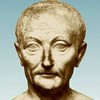
Queerly shaped pieces of flat silver, contrived for purposes known only to their designers, have no place on a well appointed table. So if you use one of these implements for a purpose not intended, it cannot be a breach of etiquette, since etiquette is founded on tradition, and has no rules concerning eccentricities.
Emily Post (1872–1960) American author, columnist [née Price]
Etiquette: The Blue Book of Social Usage, ch. 37 “Flat Silver” (1922; 1927 ed.)
(Source)

And I say to you, I have also decided to stick to love. For I know that love is ultimately the only answer to mankind’s problems. […] And I have seen too much hate. I’ve seen too much hate on the faces of sheriffs in the South. I’ve seen hate on the faces of too many Klansmen and too many White Citizens Councilors in the South to want to hate myself, because every time I see it, I know that it does something to their faces and their personalities and I say to myself that hate is too great a burden to bear.
Martin Luther King, Jr. (1929–1968) American clergyman, civil rights leader, social activist, preacher
“Where Do We Go From Here?” Southern Christian Leadership Conference Presidential Address (16 Aug 1967)
(Source)
I am seeking to rescue the poor stockinger, the Luddite cropper, the “obsolete” hand-loom weaver, the “utopian” artisan, and even the deluded follower of Joanna Southcott, from the enormous condescension of posterity. Their crafts and traditions may have been dying. Their hostility to the new industrialism may have been backward-looking. Their communitarian ideals may have been fantasies. Their insurrectionary conspiracies may have been foolhardy. But they lived through these times of acute social disturbance, and we did not. Their aspirations were valid in terms of their own experience; and, if they were casualties of history, they remain, condemned in their own lives, as casualties.
E. P. Thompson (1924–1993) British historian, writer, activist [Edward Palmer Thompson]
The Making of the English Working Class, Preface (1963)
(Source)

Life does not accommodate you, it shatters you. It is meant to, and it couldn’t do it better. Every seed destroys its container or else there would be no fruition.
Florida Scott-Maxwell (1883–1979) American-British playwright, author, psychologist
The Measure of My Days (1968)
(Source)
One does not go to the theater to see life and nature; one goes to see the particular way in which life and nature happen to look to a cultivated, imaginative and entertaining man who happens, in turn, to be a playwright.
George Jean Nathan (1892–1958) American editor and critic
The Critic and the Drama, ch. 2 (1922)
(Source)
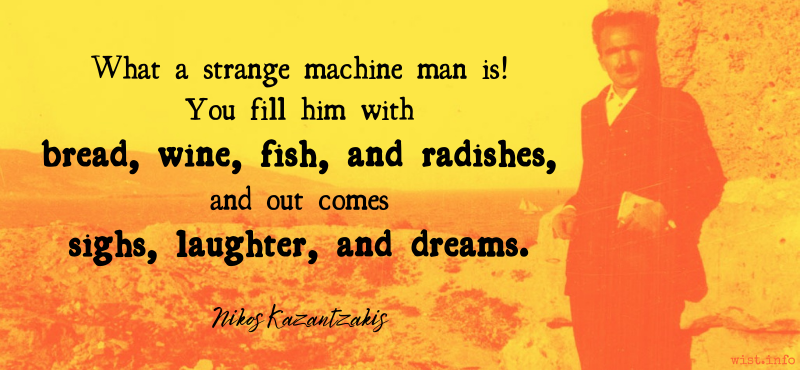
What a strange machine man is! You fill him with bread, wine, fish, and radishes, and out comes sighs, laughter, and dreams.
Nikos Kazantzakis (1883–1957) Greek writer and philosopher
Zorba the Greek, ch. 23 (1946)
What is it you want to change? Your hair, your face, your body? Why? For God is in love with all those things and he might weep when they are gone.
Catherine of Siena (1347–1380) Italian Catholic mystic, activist, author
(Attributed)

Ignorance of remote causes disposeth men to attribute all events to the causes immediate and instrumental: for these are all the causes they perceive.
I find it rather easy to portray a businessman. Being bland, rather cruel, and incompetent comes naturally to me.
John Cleese (b. 1939) English comedian, actor, screenwriter, producer
In Newsweek (15 Jun 1997)

Life has a tendency to obfuscate and bewilder,
Such as fating us to spend the first part of our lives being embarrassed by our parents and the last part being embarrassed by our childer.

It is necessary that we too should see the beam in our own eyes, and learn to distinguish between the Christianity of the nineteenth century and the religion of Christ. If we find that the Christianity of the nineteenth century does not win as many hearts in India and China as it ought, let us remember that it was the Christianity of the first century in all its dogmatic simplicity, but with its overpowering love of God and man, that conquered the world and superseded religions and philosophies, more difficult to conquer than the religious and philosophical systems of Hindus and Buddhists.
Max Müller (1823–1900) German-British philologist, Orientalist, religious studies founder
Chips from a German Workshop, Preface (1866)
(Source)
If you aren’t at the table, you’re on the menu.
Ann Richards (1933–2006) American politician [Dorothy Ann Willis Richards]
(Attributed)
Richards regularly used the phrase, but it's unclear if she originated it. See here for more discussion.

Silence is the bluntest of blunt instruments. It seems to hammer you into the ground. It drives you deeper and deeper into your own guilt. It makes the voices inside your head accuse you more viciously than any outside voices ever could.

A bad cause seldom fails to betray itself.
James Madison (1751–1836) American statesman, political theorist, US President (1809–17)
The Federalist Papers, #41 (19 Jan 1788)
(Source)
It was only when the whole ham was spoiled that it came into the department of Elzbieta. Cut up by the two-thousand-revolutions-a-minute flyers, and mixed with half a ton of other meat, no odor that ever was in a ham could make any difference. There was never the least attention paid to what was cut up for sausage; there would come all the way back from Europe old sausage that had been rejected, and that was moldy and white — it would be dosed with borax and glycerine, and dumped into the hoppers, and made over again for home consumption. There would be meat that had tumbled out on the floor, in the dirt and sawdust, where the workers had tramped and spit uncounted billions of consumption germs. There would be meat stored in great piles in rooms; and the water from leaky roofs would drip over it, and thousands of rats would race about on it. It was too dark in these storage places to see well, but a man could run his hand over these piles of meat and sweep off handfuls of the dried dung of rats. These rats were nuisances, and the packers would put poisoned bread out for them; they would die, and then rats, bread, and meat would go into the hoppers together. This is no fairy story and no joke; the meat would be shoveled into carts, and the man who did the shoveling would not trouble to lift out a rat even when he saw one — there were things that went into the sausage in comparison with which a poisoned rat was a tidbit. There was no place for the men to wash their hands before they ate their dinner, and so they made a practice of washing them in the water that was to be ladled into the sausage. There were the butt-ends of smoked meat, and the scraps of corned beef, and all the odds and ends of the waste of the plants, that would be dumped into old barrels in the cellar and left there. Under the system of rigid economy which the packers enforced, there were some jobs that it only paid to do once in a long time, and among these was the cleaning out of the waste barrels. Every spring they did it; and in the barrels would be dirt and rust and old nails and stale water — and cartload after cartload of it would be taken up and dumped into the hoppers with fresh meat, and sent out to the public’s breakfast. Some of it they would make into “smoked” sausage but as the smoking took time, and was therefore expensive, they would call upon their chemistry department, and preserve it with borax and color it with gelatine to make it brown. All of their sausage came out of the same bowl, but when they came to wrap it they would stamp some of it “special,” and for this they would charge two cents more a pound.
Upton Sinclair (1878–1968) American writer, journalist, activist, politician
The Jungle, ch. 14 (1906)
(Source)
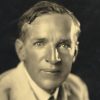
If we look back into history for the character of the present sects in Christianity, we shall find few that have not in their turns been persecutors, and complainers of persecution. The primitive Christians thought persecution extremely wrong in the Pagans, but practised it on one another. The first Protestants of the Church of England blamed persecution in the Romish Church, but practised it against the Puritans. These found it wrong in the bishops, but fell into the same practice themselves, both here and in New England.
Benjamin Franklin (1706–1790) American statesman, scientist, philosopher, aphorist
Letter in The London Packet (3 Jun 1772)
(Source)
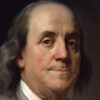
It is impossible to divide the past into distinct, clearly defined periods and prove that one age ended and another began in a particular year, such as 476, or 1453, or 1789. Men do not and cannot change their habits and ways of doing things all at once, no matter what happens.
James Harvey Robinson (1863–1936) American historian and educator
An Introduction to the History of Western Europe, ch. 1 “The Historical Point of View” (1902)
(Source)
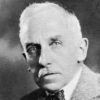
Our responsibility is not discharged by an announcement of virtuous ends. Our responsibility is to achieve these objectives with social invention, with political skill, and executive vigor. I believe for these reasons, that liberalism is our best and our only hope in the world today.
John F. Kennedy (1917–1963) American politician, author, journalist, US President (1961–63)
Speech, Liberal Party Nomination, New York (14 Sep 1960)
(Source)
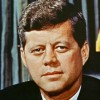
Candor is always a double-edged sword; it may heal or it may separate.
Wilhelm Stekel (1868–1940) Austrian physician, psychologist
Marriage at the Crossroads (1931)
(Source)
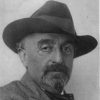
I attended to some of the business on my table to-day. Many matters of minor importance and of detail remain on my table to be attended to. The public have no idea of the constant accumulation of business requiring the President’s attention. No President who performs his duties faithfully and conscientiously can have any leisure. If he entrusts the details and smaller matters to subordinates constant errors will occur. I prefer to supervise the whole operations of the government myself rather than entrust the public business to subordinates, and this makes my duties very great.
James K. Polk (1795–1849) American lawyer, politician, US President (1845–1849)
Diary (1848-12-29)
(Source)
Who dares think one thing, and another tell,
My heart detests him as the gates of hell.[Ἐχθρὸς γάρ μοι κεῖνος ὁμῶς Ἀΐδαο πύλῃσιν
ὅς χ’ ἕτερον μὲν κεύθῃ ἐνὶ φρεσίν, ἄλλο δὲ εἴπῃ.]Homer (fl. 7th-8th C. BC) Greek author
The Iliad [Ἰλιάς], Book 9, l. 312ff (9.312-313) [Achilles to Odysseus] (c. 750 BC) [tr. Pope (1715-20)]
(Source)
Original Greek. Other translations:For, like hell mouth I loath, Who holds not in his words and thoughts one indistinguish’d troth. [tr. Chapman (1611), ll. 300-01]For I abhor the man, not more the gates Of hell itself, whose words belie his heart. [tr. Cowper (1791), ll. 385-86]Hateful to me as the gates of Hades is he who conceals one thing in his mind and utters another. [tr. Buckley (1860)]Him as the gates of hell my soul abhors,
Whose outward words his inmost thoughts conceal.
[tr. Derby (1864), ll. 373-74]For hateful to me even as the gates of hell is he that hideth one thing in his heart and uttereth another. [tr. Leaf/Lang/Myers (1891)]Him do I hate even as the gates of hell who says one thing while he hides another in his heart.
[tr. Butler (1898)]I hate
as I hate Hell's own gate that man who hides
one thought within him while he speaks another.
[tr. Fitzgerald (1974), l. 381ff]I hate that man like the very Gates of Death
who says one thing but hides another in his heart.
[tr. Fagles (1990), ll. 378-79]
[The right wing] believe that their prestige in the community, even indeed their self-esteem, depends on having these values honored in public. Besides their economic expectations, people have deep emotional commitments in other spheres — religion, morals, culture, race relations — which they also hope to see realized in political action. Status politics seeks not to advance perceived material interests but to express grievances and resentments about such matters, to press claims upon society to give deference to non-economic values.
Douglas R. Hofstadter (b. 1945) American academic, cognitive scientist, author
“Pseudo-Conservatism Revisited — 1965,” sec. 4 (1965)
(Source)

Administrivia: (2020-11-03) WIST Election Day Special (kind of)
No quotations added to WIST today, but I have gathered up a couple of WIST quotation collections over on my regular blog:
- Quotations on an Election Day
- Quotations about the Presidency (WARNING: my political opinions may be expressed in the margins)
ORESTES: A terrible thing is the mob, whenever it has villains to lead it.
PYLADES: But with honest leaders its counsels are always honest.[Ὀρέστης: δεινὸν οἱ πολλοί, κακούργους ὅταν ἔχωσι προστάτας.
Πυλάδης: ἀλλ᾽ ὅταν χρηστοὺς λάβωσι, χρηστὰ βουλεύουσ᾽ ἀεί.]Euripides (485?-406? BC) Greek tragic dramatist
Orestes, ll. 772-773 [Orestes] (408 BC) [tr. Coleridge (1938)]
(Source)
Original Greek. Other translations:ORESTES: Ah, my friend! When mobs have rotten leaders they are likely to do all sorts of nasty things.
PYLADES: It's a very different story when their leaders are wise, though ....
[tr. Theodoridis (2010)]ORESTES: The mob is frightening when their leaders are criminal.
PYLADES: But when they have good one, their decisions are good.
[tr. Luschnig (2013)]ORESTES:
The mob is nasty, when it has leaders
bent on doing wrong.
PYLADES:
But when it’s controlled
by decent men, the decisions they make
are always good.
[tr. Johnston (2020), ll. 938-940]The masses are terrible whenever they have scoundrels as leaders.
[tr. @sententiq (2020)]
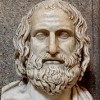
Long ago, there was a noble word, “liberal,” which derives from the word “free.” Now a strange thing happened to that word. A man named Hitler made it a term of abuse, a matter of suspicion, because those who were not with him were against him, and liberals had no use for Hitler. And then another man named McCarthy cast the same opprobrium on the word. Indeed, there was a time — a short but dismaying time — when many Americans began to distrust the word which derived from “free.”
One thing we must all do. We must cherish and honor the word “free” or it will cease to apply to us. And that would be an inconceivable situation.
Eleanor Roosevelt (1884–1962) American politician, diplomat, activist; First Lady of the US (1933–45)
Tomorrow is Now (1963)
(Source)

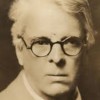
The pain others give passes away in their later kindness, but that of our own blunders, especially when they hurt our vanity, never passes away.
William Butler Yeats (1865–1939) Irish poet and dramatist
Journal entry #105 (18 Mar 1909)
(Source)
See also "Vacillation."
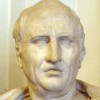
For virtue, not secrecy, is sought by good men.
[Honesta enim bonis viris, non occulta quaeruntur.]
Marcus Tullius Cicero (106–43 BC) Roman orator, statesman, philosopher
De Officiis [On Duties; On Moral Duty; The Offices], Book 3, ch. 9 (3.9) / sec. 38 (44 BC) [tr. Edmonds (1865)]
(Source)
(Source (Latin)). Other translations:For good men desire to be virtuous and honest, and not to be secret, that so they may sin without danger.
[tr. Cockman (1699)]What is honorable, and not what is concealed, is the object of pursuit with wise men.
[tr. McCartney (1798)]For it is right things, not hidden things, that are sought by good men.
[tr. Peabody (1883)]The good man seeks to do what is right, not to hide what he does.
[tr. Gardiner (1899)]For good men aim to secure not secrecy but the right.
[tr. Miller (1913)]Good men seek right conduct, not conduct that has to remain concealed.
[tr. Edinger (1974)]Honorable things, not secretive things, are sought by good men.
You shouldn’t speak glibly about God. In Judaism you may not speak God’s name as a reminder that any human expression of the divine is likely to be so limited as to be blasphemous. But God should challenge your assumptions — you shouldn’t imagine you’ve got Him in your pocket.
Karen Armstrong (b. 1944) British author, comparative religion scholar
Interview with Bill Moyers, “NOW,” PBS (9 Apr 2004)
(Source)

Three kinds of souls, three prayers:
1) I am a bow in your hands, Lord. Draw me, lest I rot.
2) Do not overdraw me, Lord. I shall break.
3) Overdraw me, Lord, and who cares if I break.Nikos Kazantzakis (1883–1957) Greek writer and philosopher
Report to Greco, Epigraph (1965) [tr. Bien (1973)]
(Source)
In the Epilogue, this is repeated: "There are three kinds of souls, three kinds of prayers. One: I am a bow in your hands, Lord. Draw me lest I rot. Two: Do not overdraw me, Lord. I shall break. Three: Overdraw me, and who cares if I break!"
I believe in human dignity as the source of national purpose, in human liberty as the source of national action, and the human heart as the source of national compassion, and in the human mind as the source of our invention and our ideas. It is, I believe, this faith in our fellow citizens as individuals and as people that lies at the heart of the liberal faith, for liberalism is not so much a party creed or a set of fixed platform promises as it is an attitude of mind and heart, a faith in man’s ability through the experiences of his reason and judgment to increase for himself and his fellow men the amount of justice and freedom and brotherhood which all human life deserves.
John F. Kennedy (1917–1963) American politician, author, journalist, US President (1961–63)
Speech, Liberal Party Nomination, New York (14 Sep 1960)
(Source)
More businesses die of indigestion than starvation.
David Packard (1912–1996) American electrical engineer, businessman, government official
(Misattributed)
The quote is frequently attributed to Packard, but actually he (anonymously) quoted in his book, The HP Way: How Bill Hewlett and I Built Our Company (1995): "Wells Fargo sent a retired engineer to visit us. I spent a full afternoon with him and I have remembered ever since some advice he gave me. He said that more businesses die of indigestion than starvation. I have observed the truth of that advice many times since then."
Variants of the saying include "entrepreneurs," "companies," and "start-ups" in place of "businesses." See here for more information.

Being a father
Is quite a bother,
But I like it, rather.Ogden Nash (1902–1971) American poet
“Soliloquy in Circles,” New Yorker (27 Mar 1948)
(Source)
Reprinted in Versus (1949).
There can be no permanent disfranchised peasantry in the United States. Freedom can never yield its fullness of blessings so long as the law or its administration places the smallest obstacle in the pathway of any virtuous citizen.
James A. Garfield (1831–1881) US President (1881), lawyer, lay preacher, educator
Inaugural address (4 Mar 1881)
(Source)
All truth is safe, and nothing else is safe; and he who keeps back the truth, or withholds it from men, from motives of expediency, is either a coward or a criminal, or both.
Max Müller (1823–1900) German-British philologist, Orientalist, religious studies founder
(Attributed)
(Source)
This is frequently cited to Muller's The Science of Religion (1872), a collection of lectures, but does not appear there. The earliest reference seems to be in the Introduction and advertisements of T. W. Doane, Bible Myths and their Parallels in Other Religions (1882). While most of the block of text Doane attributes to Muller can be found in Muller's Lecture 1, this phrase does not.
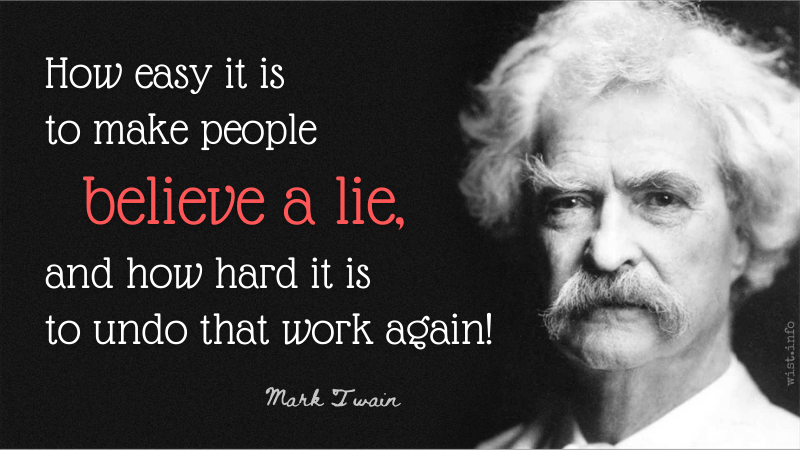
How easy it is to make people believe a lie, and how hard it is to undo that work again!
Mark Twain (1835–1910) American writer [pseud. of Samuel Clemens]
Dictation (1906-12-02), The Autobiography of Mark Twain, Vol. 2 (2013)
(Source)
A phrase that may be the origin the spurious Twain quotation, "It's easier to fool people than to convince them that they have been fooled."
Sometimes, carrying on, just carrying on, is the superhuman achievement.
Albert Camus (1913–1960) Algerian-French novelist, essayist, playwright
The Fall [La Chute] (1956)
(Source)

We are all ready to be savage in some cause. The difference between a good man and a bad one is the choice of the cause.
William James (1842–1910) American psychologist and philosopher
Letter to E. L. Godkin (24 Dec 1895)
(Source)

Their frail human nature was subjected to a strain greater than it was made for; the fires of greed had been lighted in their hearts, and fanned to a white heat that melted every principle and every law.
Upton Sinclair (1878–1968) American writer, journalist, activist, politician
Oil!, ch. 2 (1927)
(Source)
Strive to be the greatest Man in your Country, and you may be disappointed; Strive to be the best, and you may succeed: He may well win the race that runs by himself.
Benjamin Franklin (1706–1790) American statesman, scientist, philosopher, aphorist
Poor Richard (1747 ed.)
(Source)
For behind the unwillingness to judge lurks the suspicion that no one is a free agent, and hence the doubt that anyone is responsible or could be expected to answer for what he has done. The moment moral issues are raised, even in passing, he who raises them will be confronted with this frightful lack of self-confidence and hence of pride, and also with a kind of mock-modesty that in saying, Who am I to judge? actually means We’re all alike, equally bad, and those who try, or pretend that they try, to remain halfway decent are either saints or hypocrites, and in either case should leave us alone.

From the totalitarian point of view history is something to be created rather than learned. A totalitarian state is in effect a theocracy, and its ruling caste, in order to keep its position, has to be thought of as infallible. But since, in practice, no one is infallible, it is frequently necessary to rearrange past events in order to show that this or that mistake was not made, or that this or that imaginary triumph actually happened. Then again, every major change in policy demands a corresponding change of doctrine and a revelation of prominent historical figures.
This kind of thing happens everywhere, but is clearly likelier to lead to outright falsification in societies where only one opinion is permissible at any given moment. Totalitarianism demands, in fact, the continuous alteration of the past, and in the long run probably demands a disbelief in the very existence of objective truth.George Orwell (1903–1950) English journalist, essayist, writer [pseud. of Eric Arthur Blair]
Essay (1946-01), “The Prevention of Literature,” Polemic Magazine
(Source)

A critical, strong speech made by a man is “blunt” or “outspoken” or “pulls no punches.” A speech of similar force and candor made by a woman is “waspish,” “sarcastic,” or “cutting.” A man of strong opinions is defined as having “deep convictions.” A woman so constituted is merely “opinionated,” and always “aggressive.”

Necessity may well be called the mother of invention — but calamity is the test of integrity.
Samuel Richardson (1689–1761) English writer and printer
Clarissa, or, The History of a Young Lady, Letter 47 (1748)
(Source)
If the more aged and experienced men who have filled the office of President of the United States even in the infancy of the Republic distrusted their ability to discharge the duties of that exalted station, what ought not to be the apprehensions of one so much younger and less endowed now that our domain extends from ocean to ocean, that our people have so greatly increased in numbers, and at a time when so great diversity of opinion prevails in regard to the principles and policy which should characterize the administration of our Government? Well may the boldest fear and the wisest tremble when incurring responsibilities on which may depend our country’s peace and prosperity, and in some degree the hopes and happiness of the whole human family.
James K. Polk (1795–1849) American lawyer, politician, US President (1845–1849)
Inaugural Address (4 Mar 1845)
(Source)
Cursed is the man, and void of law and right,
Unworthy property, unworthy light,
Unfit for public rule, or private care,
That wretch, that monster, that delights in war:
Whose lust is murder, and whose horrid joy
To tear his country, and his kind destroy![Ἀφρήτωρ ἀθέμιστος ἀνέστιός ἐστιν ἐκεῖνος
ὃς πολέμου ἔραται ἐπιδημίου ὀκρυόεντος.]Homer (fl. 7th-8th C. BC) Greek author
The Iliad [Ἰλιάς], Book 9, l. 63ff (9.63-64) [Nestor] (c. 750 BC) [tr. Pope (1715-20)]
(Source)
Other translations:A hater of society, unjust, and wild, is he
That loves intestine war, being stuff’d with manless cruelty.
[tr. Chapman (1611), ll. 63-64]He is a wretch, insensible and dead
To all the charities of social life,
Whose pleasure is in civil broils alone.
[tr. Cowper (1791), ll. 75-77]Tribeless, lawless, homeless is he, who loves horrid civil war.
[tr. Buckley (1860)]Religious, social, and domestic ties
Alike he violates, who willingly
Would court the horrors of internal strife.
[tr. Derby (1864), ll. 72-74]He that foments civil discord is a clanless, hearthless outlaw
[tr. Butler (1898)]A clanless, lawless, hearthless man is he that loveth dread strife among his own folk.
[tr. Murray (1924)]Alien to clam and custom and hearth fire is he who longs for war -- heartbreaking war with his own people.
[tr. Fitzgerald (1974)]Lost to the clan,
lost to the hearth, lost to the old ways, that one
who lusts for all the horrors of war with his own people.
[Fagles (1990), ll. 73-75]
He [the pseudo-conservative] sees his own country as being so weak that it is constantly about to fall victim to subversion; and yet he feels that it is so all-powerful that any failure it may experience in getting its own way in the world … cannot possibly be due to its limitations but must be attributed to its having been betrayed.
Richard Hofstadter (1916–1970) American historian and intellectual
“The Pseudo-Conservative Revolt” (1954)
(Source)
It comes as a great shock around the age of 5, or 6, or 7, to discover that the flag to which you have pledged allegiance, along with everybody else, has not pledged allegiance to you.
James Baldwin (1924–1987) American novelist, playwright, activist
Speech (1965-02-17), Opening Comments, “The American Dream is at the Expense of the American Negro,” debate with William F. Buckley, Jr., Cambridge University, England
(Source)

I have no faith in the sense of comforting beliefs which persuade me that all my troubles are blessings in disguise.
Rebecca West (1892–1983) British author, journalist, literary critic, travel writer [pseud. for Cicily Isabel Fairfield]
“Pleasure Be Your Guide,” The Nation, “Living Philosophies” series #10 (25 Feb 1939)
(Source)
Adapted into Clifton Fadiman, I Believe: The Personal Philosophies of Certain Eminent Men and Women of Our Time (1952)

How often in life we complete a task that was beyond the capability of the person we were when we started it.
Robert Brault (b. c. 1945) American aphorist, programmer
(Attributed)
For herein may be seen noble chivalry, courtesy, humanity, friendliness, hardiness, love, friendship, cowardice, murder, hate, virtue, and sin. Do after the good and leave the evil, and it shall bring you to good fame and renown.
William Caxton (c. 1422-c. 1491) English merchant, printer, bookseller, writer
Preface to the first edition of Thomas Malory, Le Morte d’Arthur (1485)

The universe contains any amount of horrible ways to be woken up, such as the noise of the mob breaking down the front door, the scream of fire engines, or the realization that today is the Monday which on Friday night was a comfortably long way off. A dog’s wet nose is not strictly speaking the worst of the bunch, but it has its own peculiar dreadfulness which connoisseurs of the ghastly and dog owners everywhere have come to know and dread. It’s like having a small piece of defrosting liver pressed lovingly against you.
In this decline of all public virtue, ambition, and not avarice, was the passion that first possessed the minds of men; and this was natural. Ambition is a vice that borders on the confines of virtue; it implies a love of glory, of power, and pre-eminence; and these are objects that glitter alike in the eyes of the man of honour, and the most unprincipled: but the former pursues them by fair and honourable means, while the latter, who finds within himself no resources of talent, depends altogether upon intrigue and fallacy for his success.
[Sed primo magis ambitio quam avaritia animos hominum exercebat, quod tamen vitium propius virtutem erat. Nam gloriam, honorem, imperium bonus et ignavus aeque sibi exoptant; sed ille vera via nititur, huic quia bonae artes desunt, dolis atque fallaciis contendit.]
Sallust (c. 86–35 BC) Roman historian and politician [Gaius Sallustius Crispus]
Bellum Catilinae [The War of Cateline], ch. 11, sent. 1-2 [tr. Murphy (1807)]
(Source)
Also known as Catilinae Coniuratio [The Conspiracy of Cateline]. (Source (Latin)). Other translations:At first, indeed, the minds of men were less influenced by avarice than ambition, a vice which has some affinity to virtue; for the desire of glory, power, and preferment is common to the worthy and the worthless; with this difference, that the one pursues them by direct means; the other, being void of merit, has recourse to fraud and subtlety.
[tr. Rose (1831)]But at first ambition more than avarice influenced the minds of the Romans. Which vice however was the nearer to virtue. For glory, honour, command, the good and slothful equally wish for themselves. But the former strives by the right course; to the latter because good qualities are wanting, he works by tricks and deceits.
[Source (1841)]At first, however, it was ambition, rather than avarice, that influenced the minds of men; a vice which approaches nearer to virtue than the other. For of glory, honor, and power, the worthy is as desirous as the worthless; but the one pursues them by just methods; the other, being destitute of honorable qualities, works with fraud and deceit.
[tr. Watson (1867)]At first it was not so much avarice as ambition which spurred men's minds, a vice, indeed, but one akin to virtue. Glory, distinction, and power in the state are equally desired by good and bad, though the first strives to reach his goal by the path of honor, the second, in the lack of honest arts, uses the weapons of falsehood and deceit.
[tr. Pollard (1882)]But at first men’s souls were actuated less by avarice than by ambitions -- a fault, it is true, but not so far removed from virtue; for the noble and the base alike long for glory, honour, and power, but the former mount by the true path, whereas the latter, being destitute of noble qualities, rely upon craft and deception.
[tr. Rolfe (1931)]At first people's minds were taxed less by avarice than by ambition, which, though a fault, was nevertheless closer to prowess: for the good man and the base man have a similar personal craving for glory, honour, and command, but the former strives along the truth path, whereas the latter, because he lacks good qualities, presses forward by cunning and falsity.
[tr. Woodman (2007)]
Planning for the future without a sense of history is like planting cut flowers.
Daniel J. Boorstin (1914–2004) American historian, professor, attorney, writer
(Attributed)
Occasionally quoted with "... and hoping for the best" added to the end.
I swear to the Lord
I still can’t see
Why Democracy means
Everybody but me.Langston Hughes (1902–1967) American poet, social activist, novelist, playwright
“The Black Man Speaks,” Jim Crow’s Last Stand (1943)
(Source)

And however dark the skies may appear,
And however souls may blunder,
I tell you it all will work out clear,
For good lies over and under.
Ella Wheeler Wilcox (1850–1919) American author, poet, temperance advocate, spiritualist
Poem (1892), “Insight,” An Erring Woman’s Love
(Source)


Injustice often arises also through chicanery, that is, through an over-subtle and even fraudulent construction of the law. This it is that gave rise to the now familiar saw, “More law, less justice.”
[Existunt etiam saepe iniuriae calumnia quadam et nimis callida sed malitiosa iuris interpretatione. Ex quo illud “summum ius summa iniuria” factum est iam tritum sermone proverbium.]
Marcus Tullius Cicero (106–43 BC) Roman orator, statesman, philosopher
De Officiis [On Duties; On Moral Duty; The Offices], Book 1, ch. 10 (1.10) / sec. 33 (44 BC) [tr. Miller (1913)]
(Source)
(Source (Latin)). Other translations:
But another great spring from which injuries arise, is some quirk or cavil, and an oversubtle and malicious interpretation of the laws; from whence that saying, "The height of justice is the height of roguery," is now become a daily and common proverb among us.
[tr. Cockman (1699)]Injustice is often done by artful evasions, and from a too shrewd, but malicious interpretation of the laws. Hence the proverb, "the strictest justice is the greatest injury," has become quite familiar in conversation.
[tr. McCartney (1798)]Very often wrongs arise through a quirk, and through a too artful but fraudulent construction of the law. Hence, "the rigour of law is the rigour of injustice," is a saying that has now passed into a proverb.
[tr. Edmonds (1865)]There are, also, wrongs committed by a sort of chicanery, which consists in a too subtle, and thus fraudulent, interpretation of the right. Hence comes the saying: The extreme of right is the extreme of wrong.
[tr. Peabody (1883)]A common form of injustice is chicanery, that is, an over-subtle, in fact a fraudulent construction of the law. Hence the hackneyed proverb: "The greatest right is the greatest wrong."
[tr. Gardiner (1899)]A perversion of justice, some extremely clever but harmful interpretation of a statute, also is a frequent cause of wrongdoing. Hence we have the saying, "Extreme legality is the worst law," a proverb become a cliche by daily use.
[tr. Edinger (1974)]
See Terence.
Newton and Descartes started to try and prove that God existed in the same way as they would try and prove something in the laboratory or with their mathematics … And when you try and mix science and religion you get bad science and bad religion. The two are doing two different things. … Science can give you a diagnosis of cancer. It can even cure your disease, but it cannot touch your grief and disappointment, nor can it help you to die well.
Karen Armstrong (b. 1944) British author, comparative religion scholar
“The Reason of Faith,” Interview with Michael Brunton, Ode (Sep-Oct 2009)
(Source)
In religions which have lost their creative spark, the gods eventually become no more than poetic motifs or ornaments for decorating human solitude and walls.
One thing more dangerous than getting between a grizzly sow and her cub is getting between a businessman and a dollar bill.
Edward Abbey (1927–1989) American anarchist, writer, environmentalist
A Voice Crying in the Wilderness (1989)
Hence the lust for money first, then for power, grew upon them; these were, I may say, the root of all evils. For avarice destroyed honour, integrity, and all the other noble qualities; taught in their place insolence, cruelty, to neglect the gods, to set a price on everything. Ambition drove many men to become false; to have one thought locked in the breast, another ready on the tongue; to value friendships and enmities not on their merits but by the standard of self-interest, and to show a good front rather than a good heart. At first these vices grew slowly, from time to time they were punished; finally, when the disease had spread like a deadly plague, the state was changed and a government second to none in equity and excellence became cruel and intolerable.
[Igitur primo imperi, deinde pecuniae cupido crevit: ea quasi materies omnium malorum fuere. Namque avaritia fidem, probitatem ceterasque artis bonas subvortit; pro his superbiam, crudelitatem, deos neglegere, omnia venalia habere edocuit. Ambitio multos mortalis falsos fieri subegit, aliud clausum in pectore, aliud in lingua promptum habere, amicitias inimicitiasque non ex re, sed ex commodo aestumare magisque voltum quam ingenium bonum habere. Haec primo paulatim crescere, interdum vindicari; post, ubi contagio quasi pestilentia invasit, civitas inmutata, imperium ex iustissumo atque optumo crudele intolerandumque factum.]
Sallust (c. 86–35 BC) Roman historian and politician [Gaius Sallustius Crispus]
Bellum Catilinae [The War of Catiline; The Conspiracy of Catiline], ch. 10, sent. 3-6 [tr. Rolfe (1931)]
(Source)
Discussing the corruption of Rome in the years after the final defeat of Carthage.
Other translations:"A love of money, and a lust for power, took possession of every mind. These hateful passions were the source of innumerable evils. Good faith, integrity, and every virtuous principle, gave way to avarice; and in the room of moral honesty, pride, cruelty, and contempt of the gods succeeded. Corruption and venality were introduced; and everything had its price. Such were the effects of avarice. Ambition was followed by an equal train of evils; it taught men to be false and deceitful; to think one thing, and to say another; to make friendship or enmity a mere traffic for private advantage, and to set the features to a semblance of virtue, while malignity lay lurking in the heart. But at first these vices sapped their way by slow degrees, and were often checked in their progress; but spreading at length like an epidemic contagious, morals and the liberal arts went to ruin; and the government, which was before a model of justice, became the most profligate and oppressive." [tr. Murphy (1807)]"First a love of money possessed their minds; then a passion for power; and these were the seeds of all the evils that followed. For avarice rooted out faith, probity, and every worthy principle; and, in their stead, substituted insolence, inhumanity, contempt of the gods, and a mercenary spirit. Ambition obliged many to be deceitful; to belie with their tongues the sentiments of their hearts; to value friendship and enmity, not according to their real worth, but as they conduced to interest; and to have a specious countenance, rather than an honest heart. These corruptions at first grew by degrees, and were sometimes checked by correction. At last, the infection spreading like a plague, the state was entirely changed, and the government, from being the most righteous and equitable, became cruel and insupportable." [tr. Rose (1831)]"Therefore at first the love of money, then that of power increased. These things became as it were the foundation of all evils. For avarice overthrew faith, honesty, and all the other good acts; and instead of them it taught men pride, cruelty, to neglect the gods, and to consider everything venal. Ambition forced many men to become false, to have one thing hidden in their hearts, another ready on their tongue, to value friendships and enmities, not accordingly to reality, but interest, and rather to have a good appearance than a good disposition. These things at first began to increase by degrees, sometimes to be punished. Afterwards when the infection swept on like a pestilence, the state was changed, the government from the most just and best, became cruel and intolerable." [Source (1841)]"At first the love of money, and then that of power, began to prevail, and these became, as it were, the sources of every evil. For avarice subverted honesty, integrity, and other honorable principles, and, in their stead, inculcated pride, inhumanity, contempt of religion, and general venality. Ambition prompted many to become deceitful; to keep one thing concealed in the breast, and another ready on the tongue; to estimate friendships and enmities, not by their worth, but according to interest; and to carry rather a specious countenance than an honest heart. These vices at first advanced but slowly, and were sometimes restrained by correction; but afterwards, when their infection had spread like a pestilence, the state was entirely changed, and the government, from being the most equitable and praiseworthy, became rapacious and insupportable." [tr. Watson (1867)]"At first the lust of money increased, then that of power, and these, it may be said, were the sources of every evil. Avarice subverted loyalty, uprightness, and every other good quality, and in their stead taught men to be proud and cruel, to neglect the gods, and to hold all things venal. Ambition compelled many to become deceitful; they had one thought buried in their breast, another ready on their tongue; their friendships and enmities they valued not at their real worth, but at the advantage they could bring, and they maintained the look rather than the nature of honest men. These evils at first grew gradually, and were occasionally punished; later, when the contagion advanced like some plague, the state was revolutionized, and the government, from being one of the justest and best, became cruel and unbearable." [tr. Pollard (1882)]"Hence it was the desire for money first of all, and then for empire, which grew; and these factors were the kindling (so to speak) of every wickedness. For avarice undermined trust, probity, and all other good qualities; instead it taught men haughtiness, cruelty, to neglect the gods, to regard everything as for sale. Ambition reduced many mortals to becoming false, having one sentiment shut away in the heart and another ready on the tongue, assessing friendships and antagonisms in terms not of reality but of advantage, and having a good demeanour rather than a good disposition. At first these things grew gradually; sometimes they were punished; but after, when the contamination had attacked like a plague, the community changed and the exercise of command, from being the best and most just, became cruel and intolerable." [tr. Woodman (2007)]"At first the desire of power, then the desire of money increased; these were effectively the material of all evils, because avarice overturned faith, probity, and all other noble arts; in their place, it taught men to be arrogant and cruel, to neglect the gods, and to consider all things for sale. Ambition compelled many men to become liars; to hold one thing hidden in the heart, and the opposite thing at the tip of one’s tongue; to judge friends and enemies not in objective terms, but by reference to personal gain; and finally, to make a good appearance rather than to have a good mind. As these vices first began to increase, they were occasionally punished; but afterward, once the contagion had spread like a plague, the state as a whole was altered, and the government, once the noblest and most just, was made cruel and intolerable." [tr. @sententiq (2017)]That it is the nature of ambition, to make men liars and cheaters; to hide the truth in their breasts, and show, like jugglers, another thing in their mouths; to cut all friendships and enmities to the measure of their own interest, and to make a good countenance without the help of good will. [tr. Cowley? (17th C)]
FIRST …
Let the rockets flash and the cannon thunder,
This child is a marvel, a matchless wonder.
A staggering child, a child astounding,
Dazzling, diaperless, dumbfounding,
Stupendous, miraculous, unsurpassed,
A child to stagger and flabbergast,
Bright as a button, sharp as a thorn,
And the only perfect one ever born.SECOND
Arrived this evening at half-past nine.
Everybody is doing fine.
Is it a boy, or quite the reverse?
You can call in the morning and ask the nurse.
All free governments are managed by the combined wisdom and folly of the people.
James A. Garfield (1831–1881) US President (1881), lawyer, lay preacher, educator
Letter to B. A. Hinsdale (21 Apr 1880)
(Source)
If there is one thing which a comparative study of religions places in the clearest light, it is the inevitable decay to which every religion is exposed. It may seem almost like a truism, that no religion can continue to be what it was during the lifetime of its founder and its first apostles. Yet it is but seldom borne in mind that without constant reformation, i.e. without a constant return to its fountain-head, every religion, even the most perfect, nay the most perfect on account of its very perfection, more even than others, suffers from its contact with the world, as the purest air suffers from the mere fact of its being breathed.
Max Müller (1823–1900) German-British philologist, Orientalist, religious studies founder
Chips from a German Workshop, Preface (1866)
(Source)
One would expect people to remember the past and to imagine the future. But in fact, when discoursing or writing about history, they imagine it in terms of their own experience, and when trying to gauge the future they cite supposed analogies from the past: till, by a double process of repetition, they imagine the past and remember the future.
Lewis B. Namier (1888–1960) Polish-British historian
“Symmetry and Repetition” (1941), Conflicts: Studies in Contemporary History (1942)

Good government makes everything well ordered and fit,
And at the same time it throws shackles on the unjust.
It levels out the rough, stops insolence, and weakens arrogance.
It causes the growing blossoms of blindness to wither.
It straightens crooked judgments and it levels out over-reaching deeds.
It stops the acts of civil conflict and
It stops the anger of grievous strife and because of it
Everything among men is wisely and appropriately done.[Εὐνομίη δ’ εὔκοσμα καὶ ἄρτια πάντ’ ἀποφαίνει,
καὶ θαμὰ τοῖς ἀδίκοις ἀμφιτίθησι πέδας·
τραχέα λειαίνει, παύει κόρον, ὕβριν ἀμαυροῖ,
αὑαίνει δ’ ἄτης ἄνθεα φυόμενα,
εὐθύνει δὲ δίκας σκολιάς, ὑπερήφανά τ’ ἔργα
πραΰνει· παύει δ’ ἔργα διχοστασίης,
παύει δ’ ἀργαλέης ἔριδος χόλον, ἔστι δ’ ὑπ’ αὐτῆς
πάντα κατ’ ἀνθρώπους ἄρτια καὶ πινυτά.]Solon (c. 638 BC - 558 BC) Athenian statesman, lawmaker, poet
Fragment 4.32-39 W [tr. @sententiq (2015)]
(Source)
Solon's description of eunomiē (lawfulness). Other translations:Lawfulness, puts all things into good order and makes them sound,
And often places shackles about those who are unjust.
She smooths what is rough, puts an end to excess, enfeebles arrogance;
She withers the flowers of ruin as they spring up;
She straightens crooked judgments, and overbearing acts she turns to gentleness;
She puts an end to acts of dissension,
Puts an end to the bitterness of painful strife:
Beneath her hand all things among mankind are sound and prudent.
[tr. Miller (1996)]Good Government displays all neatness and order,
And many times she must put shackles on the breakers of laws
She levels rough places, stops Glut and Greed, takes the force from Violence:
She dries up the growing flowers of Despair as they grow;
She straightens out crooked judgments given, gentles the swollen ambitions,
And puts an end to acts of divisional strife;
She stills the gall of wearisome Hate,
And under her influence all life among mankind is harmonious and does well.
[tr. Lattimore]
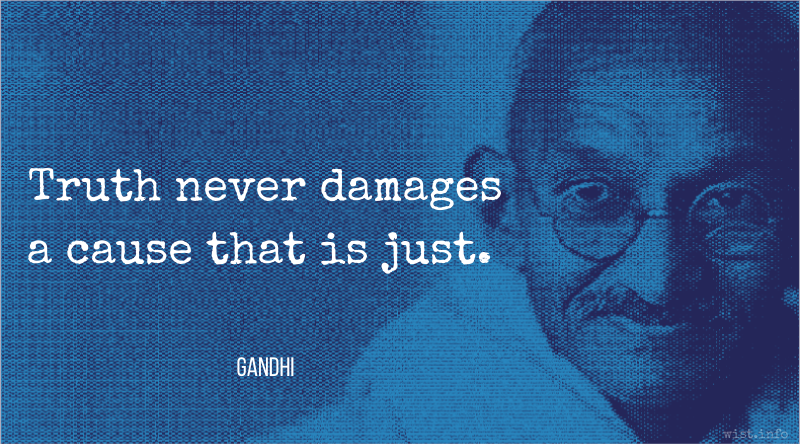
Truth never damages a cause that is just.
Mohandas Gandhi (1869–1948) Indian lawyer, anti-colonial nationalist, political ethicist [Mahatma Gandhi]
Non-Violence in Peace and War, Vol. 2 (1949)
(Source)
There is no wilderness where I can hide from these things, there is no haven where I can escape them; though I travel to the ends of the earth, I find the same accursed system — I find that all the fair and noble impulses of humanity, the dreams of poets and the agonies of martyrs, are shackled and bound in the service of organized and predatory Greed! And therefore I cannot rest, I cannot be silent; therefore I cast aside comfort and happiness, health and good repute — and go out into the world and cry out the pain of my spirit!
Upton Sinclair (1878–1968) American writer, journalist, activist, politician
The Jungle, ch. 28 (1906)
(Source)
The worship of God is a Duty; the hearing and reading of Sermons may be useful; but, if Men rest in Hearing and Praying, as too many do, it is as if a Tree should Value itself on being water’d and putting forth Leaves, tho’ it never produc’d any Fruit.
Benjamin Franklin (1706–1790) American statesman, scientist, philosopher, aphorist
Letter to Joseph Huey (6 Jun 1753)
(Source)
Let me tell you the secret of such so-called successes as there have been in my life, and here I believe I give you really good advice. It was to burn my boats and demolish my bridges behind me. Then one loses no time in looking behind, when one should have quite enough to do in looking ahead — then there is no chance for you or your men but forward. You have to do or die!
Fridtjof Nansen (1861–1930) Norwegian explorer, scientist, diplomat, humanitarian
Speech, St Andrews University (3 Nov 1926)
(Source)
Translated in his Adventure, and Other Papers (1927).

“People aren’t either wicked or noble,” the hook-handed man said. “They’re like chef salads, with good things and bad things chopped and mixed together in a vinaigrette of confusion and conflict.”
Lemony Snicket (b. 1970) American author, screenwriter, musician (pseud. for Daniel Handler)
The Grim Grotto (2004)

Another point of disagreement [over Lesser Evil Voting] is not factual but involves the ethical/moral principle […] sometimes referred to as the “politics of moral witness.” Generally associated with the religious left, secular leftists implicitly invoke it when they reject LEV on the grounds that “a lesser of two evils is still evil.” Leaving aside the obvious rejoinder that this is exactly the point of lesser evil voting — i.e. to do less evil, what needs to be challenged is the assumption that voting should be seen a form of individual self-expression rather than as an act to be judged on its likely consequences. […] The basic moral principle at stake is simple: not only must we take responsibility for our actions, but the consequences of our actions for others are a far more important consideration than feeling good about ourselves.
Noam Chomsky (b. 1928) American linguist and activist
“An Eight Point Brief for LEV (Lesser Evil Voting)” (2016-06-15) [with John Halle]
(Source)

Everybody needs beauty as well as bread, places to play in and pray in, where Nature may heal and cheer and give strength to body and soul alike. This natural beauty-hunger is made manifest in the little window-sill gardens of the poor, though perhaps only a geranium slip in a broken cup, as well as in the carefully tended rose and lily gardens of the rich, the thousands of spacious city parks and botanical gardens, and in our magnificent National parks.
John Muir (1838–1914) Scottish-American naturalist
The Yosemite, ch. 15 “Hetch Hetchy Valley” (1912)
(Source)
By the theory of our Government majorities rule, but this right is not an arbitrary or unlimited one. It is a right to be exercised in subordination to the Constitution and in conformity to it. One great object of the Constitution was to restrain majorities from oppressing minorities or encroaching upon their just rights. Minorities have a right to appeal to the Constitution as a shield against such oppression.
James K. Polk (1795–1849) American lawyer, politician, US President (1845–1849)
Inaugural Address (4 Mar 1845)
(Source)
Now down in the Ocean sank the fiery light of day,
drawing the dark night across the grain-giving earth.[Ἐν δ’ ἔπεσ’ Ὠκεανῷ λαμπρὸν φάος ἠελίοιο
ἕλκον νύκτα μέλαιναν ἐπὶ ζείδωρον ἄρουραν.]Homer (fl. 7th-8th C. BC) Greek author
The Iliad [Ἰλιάς], Book 8, l. 485ff (8.485-486) (c. 750 BC) [tr. Fagles (1990)]
(Source (Greek)). Other translations:And now Sol’s glorious light
Fell to the sea, and to the land drew up the drowsy night.
[tr. Chapman (1611), ll. 426-27]Now deep in ocean sunk the lamp of light,
And drew behind the cloudy veil of night.
[tr. Pope (1715-20)]And now the radiant Sun in Ocean sank,
Drawing night after him o’er all the earth.
[tr. Cowper (1791)]And the bright light of the sun fell into the ocean, drawing dark night over the fruitful earth.
[tr. Buckley (1860)]The sun, now sunk beneath the ocean wave,
Drew o’er the teeming earth the veil of night.
[tr. Derby (1864)]And the sul’s bright light dropped into Ocean, drawing black night across Earth the grain-giver.
[tr. Leaf/Lang/Myers (1891)]The sun's glorious orb now sank into Oceanus and drew down night over the land.
[tr. Butler (1898)]Then into Oceanus fell the bright light of the sun
drawing black night over the face of the earth, the giver of grain.
[tr. Murray (1924)]And now the shining light of the sun was dipped in the Ocean trailing black night across the grain-giving land.
[tr. Lattimore (1951)]Now in the western Ocean the shining sun dipped,
drawing dark night on over the kind grainbearing earth.
[tr. Fitzgerald (1974)]Helios' radiant sunlight then fell into the Ocean,
drawing the black night over the grain-giving land.
[tr. Merrill (2007)]
CHARLIE ANDERSON: There’s nothing much I can tell you about this war. It’s like all wars, I suppose. The undertakers are winning it. Oh, the politicians will talk a lot about the “glory” of it, and the old men’ll talk about the “need” of it — the soldiers, they just want to go home.

Often have I marvelled how each one of us loves himself above all men, yet sets less store by his own opinion of himself than by that of everyone else.
[Πολλάκις ἐθαύμασα πῶς ἑαυτὸν μὲν ἕκαστος μᾶλλον πάντων φιλεῖ, τὴν δὲ ἑαυτοῦ περὶ αὑτοῦ ὑπόληψιν ἐν ἐλάττονι λόγῳ τίθεται ἢ τὴν τῶν ἄλλων.]
Marcus Aurelius (AD 121–180) Roman emperor (161–180), Stoic philosopher
Meditations [To Himself; Τὰ εἰς ἑαυτόν], Book 12, ch. 4 (12.4) (AD 161-180) [tr. Haines (Loeb) (1916)]
(Source)
(Source (Greek)). Other translations:I have often wondered how it should come to pass, that every man loving himself best, should more regard other men's opinions concerning himself than his own.
[tr. Casaubon (1634), 12.3]I have often wonder'd how it comes to pass, that every Body should love themselves best, and yet value their Neighbours Opinion about themselves, more than their own.
[tr. Collier (1701)]I have often wondered how each man should love himself more than any other; and yet make less account of his own opinion concerning himself, than of the opinions of others.
[tr. Hutcheson/Moor (1742)]I have often wondered, whence it comes to pass, that although every one loves himself more than he does any other man, he should yet pay a greater regard to the opinion of other people concerning him than to his own.
[tr. Graves (1792)]I have often wondered how it is that every man loves himself more than all the rest of men, but yet sets less value on his own opinion of himself than on the opinion of others.
[tr. Long (1862)]I have often wondered how it comes to pass that everybody should love themselves best, and yet value their neighbor's opinion about themselves more than their own.
[tr. Collier/Zimmern (1887)]How strange it is, that every one loves himself above all others, yet attaches less weight to his own view of himself, than to that of other men.
[tr. Rendall (1898)]I have wondered often how it comes that, while every man loves himself beyond all others, yet he holds his own opinion of himself in less esteem than the opinion of others.
[tr. Hutcheson/Chrystal (1902)]I often wonder how it is that every one loves himself more than all the world and yet takes less account of his own judgement of himself than of the judgement of the world.
[tr. Farquharson (1944)]I often marvel how it is that though each man loves himself beyond all else, he should yet value his own opinion of himself less than that of others.
[tr. Staniforth (1964)]I have often marvelled at how everyone loves himself above all others, yet places less value on his own opinion of himself than that of everyone else.
[tr. Hard (1997 ed.); Hard (2011 ed.)]It never ceases to amaze me: we all love ourselves more than other people, but care more about their opinion than our own.
[tr. Hays (2003)]I have often wondered how it is that everyone loves himself more than anyone else, but rates his own judgement of himself below that of others.
[tr. Hammond (2006)]I have often been amazed at how every person loves himself more than he loves others yet places less value on his own judgment of himself than of the judgments of others concerning him.
[tr. Needleman/Piazza (2008)]How is it that every person loves themselves more than any other person, yet still gives more value to the opinions of others than the opinion they hold of themselves?
[tr. McNeill (2019)]

Blaming mother is just a negative way of clinging to her still.

Few of us take the pains to study the origin of our cherished convictions; indeed, we have a natural repugnance to so doing. We like to continue to believe what we have been accustomed to accept as true, and the resentment aroused when doubt is cast upon any of our assumptions leads us to seek every manner of excuse for clinging to them. The result is that most of our so-called reasoning consists in finding arguments for going on believing as we already do.
James Harvey Robinson (1863–1936) American historian and educator
The Mind in the Making, ch. 4 “Rationalizing” (1921)
(Source)
What we find in a soulmate is not something wild to tame, but something wild to run with.
Robert Brault (b. c. 1945) American aphorist, programmer
(Attributed)
Thou Sir Launcelot, there thou liest, that thou were never matched of earthly knight’s hand. And thou were the courtiest knight that ever bare shield. And thou were the truest friend to thy lover that ever bestrad horse. And thou were the truest lover of a sinful man that ever loved woman. And thou were the kindest man that ever struck with sword. And thou were the goodliest person that ever came among press of knights. And thou were the meekest man and the gentlest that ever ate in hall among ladies. And thou were the sternest knight to thy mortal foe that ever put spear in the rest.
Sometimes it’s better to light a flamethrower than to curse the darkness.
We are all more blind to what we have than to what we have not.
Audre Lorde (1934–1992) American writer, feminist, civil rights activist
“Notes from a Trip to Russia,” Sister Outsider (1984)
(Source)
Of course I vote! If you’re a woman, or a person of color, or a person who doesn’t own property, or even a white male who doesn’t belong to the nobility, centuries of struggle and many deaths have bought you the right to vote. I vote to keep faith with peasant rebels and suffragist hunger strikers and civil rights workers braving the lynch mobs of the South, if for no other reason. But there is another reason — because who we vote for has an enormous impact on real peoples’ lives.
Starhawk (b. 1951) American writer, activist, feminist theologian [b. Miriam Simos]
Blog post (2016-11-07), “Pre-Election Day Thoughts”
(Source)

Back of every mistaken venture and defeat is the laughter of wisdom, if you listen. We go forward by failure. Every blunder behind us is giving a cheer for us and only those who are willing to fail shall taste the dangers and splendors of life. To be a good loser is to learn how to win. The real coward is he who sees no glory in failure.
Carl Sandburg (1878–1967) American poet, biographer
Incidentals (1904)
For the man who rules efficiently must have obeyed others in the past, and the man who obeys dutifully appears fit at some later time to be a ruler.
[Nam et qui bene imperat, paruerit aliquando necesse est, et qui modeste paret, videtur qui aliquando imperet dignus esse.]
Marcus Tullius Cicero (106–43 BC) Roman orator, statesman, philosopher
De Legibus [On the Laws], Book 3, ch. 2 / sec. 5 (3.2/3.5) [Marcus] (c. 51 BC) [tr. Keyes (1928)]
(Source)
(Source (Latin)). Other translations:For in order to command well, we should know how to submit; and he who submits with a good grace will some time become worthy of commanding.
[tr. Barham (1842)]For he who commands well, must at some time or other have obeyed; and he who obeys with modesty appears worthy of some day or other being allowed to command.
[tr. Barham/Yonge (1878)]A man who exercises power effectively will at some stage have to obey others, and one who quietly executes orders shows that he deserves, eventually, to wield power himself.
[tr. Rudd (1998)]For the good commander must necessarily at some time be obedient, and the person who is properly obedient seems like someone worthy at some time of commanding.
[tr. Zetzel (1999)]For it is necessary that he who commands well should obey at some time, and he who temperately obeys seems to be worthy of commanding at some time.
[tr. Fott (2013)]
A lot of the arguments about religion going on at the moment spring from a rather inept understanding of religious truth. Our notion changed during the early modern period when we became convinced that the only path to any kind of truth was reason. That works beautifully for science but doesn’t work so well for the humanities. Religion is really an art form and a struggle to find value and meaning amid the ghastly tragedy of human life.
Karen Armstrong (b. 1944) British author, comparative religion scholar
“The Reason of Faith,” Interview with Michael Brunton, Ode (Sep-Oct 2009)
(Source)
I am a weak, ephemeral creature made of mud and dream. But I feel all the powers of the universe whirling within me.
Nikos Kazantzakis (1883–1957) Greek writer and philosopher
The Saviors of God [Salvatores Dei], “The Preparation: Second Duty,” #22 (1923) [tr. Friar [1960])
(Source)
At the very least, comsats and personalized transceivers will banish forever the exasperation of waiting on a corner for a friend while he mistakenly waits for you on another.
Arthur C. Clarke (1917–2008) British writer
“Man and Space,” Life Science Library (1964)
When after the destruction of Brutus and Cassius there was no longer any army of the Commonwealth, when Pompeius was crushed in Sicily, and when, with Lepidus pushed aside and Antonius slain, even the Julian faction had only Cæsar left to lead it, then, dropping the title of triumvir, and giving out that he was a Consul, and was satisfied with a tribune’s authority for the protection of the people, Augustus won over the soldiers with gifts, the populace with cheap corn, and all men with the sweets of repose, and so grew greater by degrees, while he concentrated in himself the functions of the Senate, the magistrates, and the laws.
He was wholly unopposed, for the boldest spirits had fallen in battle, or in the proscription, while the remaining nobles, the readier they were to be slaves, were raised the higher by wealth and promotion, so that, aggrandised by revolution, they preferred the safety of the present to the dangerous past.
Nor did the provinces dislike that condition of affairs, for they distrusted the government of the Senate and the people, because of the rivalries between the leading men and the rapacity of the officials, while the protection of the laws was unavailing, as they were continually deranged by violence, intrigue, and finally by corruption.
[Postquam Bruto et Cassio caesis nulla iam publica arma, Pompeius apud Siciliam oppressus, exutoque Lepido, interfecto Antonio, ne Iulianis quidem partibus nisi Caesar dux reliquus, posito triumviri nomine, consulem se ferens et ad tuendam plebem tribunicio iure contentum, ubi militem donis, populum annona, cunctos dulcedine otii pellexit, insurgere paulatim, munia senatus, magistratuum, legum in se trahere, nullo adversante, cum ferocissimi per acies aut proscriptione cecidissent, ceteri nobilium, quanto quis servitio promptior, opibus et honoribus extollerentur ac novis ex rebus aucti, tuta et praesentia quam vetera et periculosa mallent. Neque provinciae illum rerum statum abnuebant, suspecto senatus populique imperio ob certamina potentium et avaritiam magistratuum, invalido legum auxilio, quae vi, ambitu, postremo pecunia turbabantur.]
Tacitus (c.56-c.120) Roman historian, orator, politician [Publius or Gaius Cornelius Tacitus]
Annals Book 1, ch. 2 [tr. Church & Brodribb (1876)]
(Source)
Other translations:After the deaths of Brutus and Cassius had disarmed the people, with Sextus Pompeius crushed off Sicily (in the naval defeat off Pelorum, 36BC), with Lepidus discarded and Antony’s life ended, the Julian faction itself would have been leaderless but for Octavian. Relinquishing his title of triumvir, he professed himself a plain consul, content to wield only a tribune’s authority in safeguarding the commons.
Seducing the military with gifts, the people with cheap grain, the world with the delights of peace, he gradually gained power, taking to himself the duties of the senate, the magistracy and the law, unopposed. The boldest had fallen in the field or been proscribed, the remaining nobility, raised to wealth and high office by their propensity for servitude, profiting from the turn of events, preferred security and their present situation to the dangers of the old order.
Nor did the provinces oppose this state of affairs, the power of the senate and people having been discredited by the quarrels among the great and the magistrates’ avarice, there being no help from a legal system skewed by force, favouritism and in the end bribery.
[tr. Kline (2017)]When the killing of Brutus and Cassius had disarmed the Republic; when Pompey had been crushed in Sicily, and, with Lepidus thrown aside and Antony slain, even the Julian party was leaderless but for the Caesar; after laying down his triumviral title and proclaiming himself a simple consul content with tribunician authority to safeguard the commons, he first conciliated the army by gratuities, the populace by cheapened corn, the world by the amenities of peace, then step by step began to make his ascent and to unite in his own person the functions of the senate, the magistracy, and the legislature.
Opposition there was none: the boldest spirits had succumbed on stricken fields or by proscription-lists; while the rest of the nobility found a cheerful acceptance of slavery the smoothest road to wealth and office, and, as they had thriven on revolution, stood now for the new order and safety in preference to the old order and adventure.
Nor was the state of affairs unpopular in the provinces, where administration by the Senate and People had been discredited by the feuds of the magnates and the greed of the officials, against which there was but frail protection in a legal system for ever deranged by force, by favouritism, or (in the last resort) by gold.
[tr. Jackson [Loeb (1931)]]After the public was disarmed by the murders of Brutus and Cassius, when Pompey had been defeated in Sicily, Lepidus discarded, and Antony had been killed, even the Julian party had Caesar as the remaining leader. Once he gave up the name of triumvir and was declaring himself a consul, happy to safeguard the common people with tribunal powers, he won over the army with payments, the people with food grants, and everyone else with pleasing peace.
Then, bit by bit, he began to arrogate to himself the duties of the senate, the executive offices, and the law because there was no one opposing him since the boldest men had died either in battle or by proscription. The remaining nobles discovered themselves increased by honors and wealth as soon as they accepted servitude: they preferred the present safety to ancient dangers.
The provinces too were not opposed to this state of affairs because the rule of the Senate and People there had been undermined by the struggles of the powerful and avarice of the officers against which there was the weak defense of laws which were corrupted by force, by nepotism and, finally, bribery.
[tr. @sententiq (2020)]
It’s a terrible thing to be alone — yes it is — it is — but don’t lower your mask until you have another mask prepared beneath — As terrible as you like — but a mask.
Katherine Mansfield (1888–1923) New Zealander writer, poet [pen name of Kathleen Mansfield Murry (née Beauchamp)]
Letter to John Middleton Murry (Jul 1917)
(Source)

Oh, progeny playing by itself
Is a lonely little elf,
But progeny in roistering batches
Would drive St. Francis from here to Natchez.
I can hardly believe that any person can be found who will not admit that every one of these provisions is just. They are all asserted, in some form or other, in our Declaration or organic law. But the Constitution limits only the action of Congress, and is not a limitation on the States. This amendment supplies that defect, and allows Congress to correct the unjust legislation of the States, so far that the law which operates upon one man shall operate equally upon all. Whatever law punishes a white man for a crime shall punish the black man precisely in the same way and to the same degree. Whatever law protects the white man shall afford equal protection to the black man. Whatever means of redress is afforded to one shall be afforded to all. Whatever law allows the white man to testify in court shall allow the man of color to do the same. These are great advantages over their present codes.
James A. Garfield (1831–1881) US President (1881), lawyer, lay preacher, educator
Speech, House of Representatives (4 Apr 1871)
(Source)
On the proposed 14th Amendment to the US Constitution, which forbade to each state the ability to "deny to any person within its jurisdiction the equal protection of the laws."
The position which believers and unbelievers occupy with regard to their various forms of faith is very much the same all over the world. The difficulties which trouble us, have troubled the hearts and minds of men as far back as we can trace the beginnings of religious life. The great problems touching the relation of the Finite to the Infinite, of the human mind as the recipient, and of the Divine Spirit as the source of truth, are old problems indeed; and while watching their appearance in different countries, and their treatment under varying circumstances, we shall be able, I believe, to profit ourselves, both by the errors which others committed before us, and by the truth which they discovered. We shall know the rocks that threaten every religion in this changing and shifting world of ours, and having watched many a storm of religious controversy and many a shipwreck in distant seas, we shall face with greater calmness and prudence the troubled waters at home.
Max Müller (1823–1900) German-British philologist, Orientalist, religious studies founder
Chips from a German Workshop, Vol. 1, Preface (1866)
(Source)
If a law commands me to sin I will break it; if it calls me to suffer, I will let it take its course unresistingly. The doctrine of blind obedience and unqualified submission to any human power, whether civil or ecclesiastical, is the doctrine of despotism, and ought to have no place among Republicans and Christians.
Angelina Grimké Weld (1805–1879) American abolitionist, women's rights activist
“Appeal to the Christian Women of the South,” Anti-Slavery Examiner (Sep 1836)
(Source)
Being a star has made it possible for me to get insulted in places where the average Negro could never hope to go and get insulted.
Sammy Davis, Jr. (1925–1990) American singer, dancer, actor, comedian
Yes I Can, Part 3, ch. 3 (1965)
(Source)

Great causes are never tried on their merits; but the cause is reduced to particulars to suit the size of the partisans, and the contention is ever hottest on minor matters.
Ralph Waldo Emerson (1803–1882) American essayist, lecturer, poet
“Nature,” Essays: Second Series (1844)
(Source)
The evangelist was preaching “sin and redemption,” the infinite grace of God and His pardon for human frailty. He was very much in earnest, and he meant well, but Jurgis, as he listened, found his soul filled with hatred. What did he know about sin and suffering — with his smooth, black coat and his neatly starched collar, his body warm, and his belly full, and money in his pocket — and lecturing men who were struggling for their lives, men at the death grapple with the demon powers of hunger and cold! — This, of course, was unfair; but Jurgis felt that these men were out of touch with the life they discussed, that they were unfitted to solve its problems; nay, they themselves were part of the problem — they were part of the order established that was crushing men down and beating them! They were of the triumphant and insolent possessors; they had a hall, and a fire, and food and clothing and money, and so they might preach to hungry men, and the hungry men must be humble and listen! They were trying to save their souls — and who but a fool could fail to see that all that was the matter with their souls was that they had not been able to get a decent existence for their bodies?
Upton Sinclair (1878–1968) American writer, journalist, activist, politician
The Jungle, ch. 23 (1906)
(Source)
The Faith you mention has doubtless its use in the World. I do not desire to see it diminished, nor would I endeavour to lessen it in any Man. But I wish it were more productive of good Works, than I have generally seen it: I mean real good Works, Works of Kindness, Charity, Mercy, and Publick Spirit; not Holiday-keeping, Sermon-Reading or Hearing; performing Church Ceremonies, or making long Prayers, filled with Flatteries and Compliments, despis’d even by wise Men, and much less capable of pleasing the Deity.
Benjamin Franklin (1706–1790) American statesman, scientist, philosopher, aphorist
Letter to Joseph Huey (6 Jun 1753)
(Source)
The difficult is what takes a little time; the impossible is what takes a little longer.
Fridtjof Nansen (1861–1930) Norwegian explorer, scientist, diplomat, humanitarian
Quoted in Listener (14 Dec 1939)
(Source)
Build movements. Vote with your values, but vote strategically. Voting isn’t a Valentine. It’s a chess move.
Rebecca Solnit (b. 1961) American writer, historian, activist
Facebook (17 Oct 2016)
(Source)
Solnit is credited with the core message of the last two sentences. She indicates (including from that Facebook post) that it was something she had said that was extracted and perhaps tweaked by May Boeve. E.g., "That 2016 aphorism that I sort of said and May Boeve made into this stand-alone slogan." (1 Nov 2018) "I said that off the cuff in 2016 and May Boeve caught it and it went on to have a nice life. It's also not the only chess move you get." (11 Aug 2020).
Variants:
- "Voting is a chess move, not a valentine. And here's the joy of being politically engaged all year round every year; you get to work with a whole lot of chess pieces and players and strategies and long-term visions, so you don't agonize over whether this little hop with a pawn we call voting defines you. You get to define yourself by what you're passionately committed to, by who you align with, by your dreams and your visions, you get to move a lot of pieces a lot of times, you get heroic allies, and you play to win above, beyond, around elections. But you vote, because you know it matters too." (7 Nov 2016)
- "I think of voting as a chess move, not a valentine. It’s just a little part of the picture of how we make the world." ("The 2000 Election Unleashed Disaster on the World. We Can’t Let that Happen Again in 2016," The Nation (3 Nov 2016))
- "A vote is not a valentine. You are not confessing your love for the candidate. It's a chess move for the world you want to live in."
- "Voting isn't a valentine, it's a chess move. Just one of many with one of your many pieces, if you're using what you've been given."
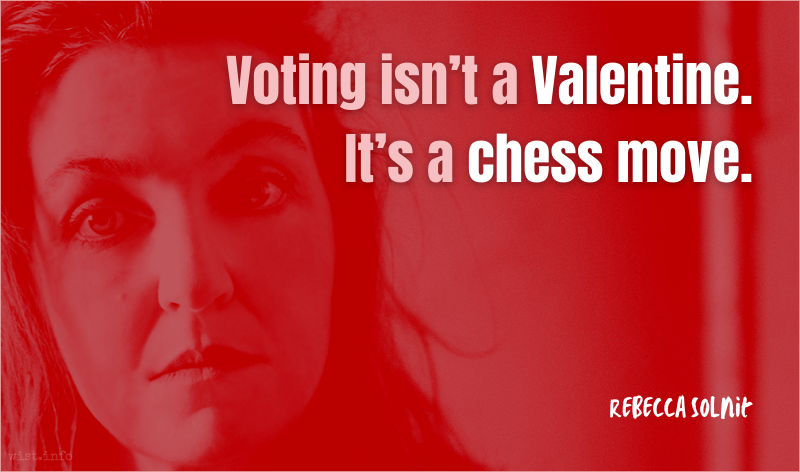

[A man who] counts the pain of the state as his own glory; as if, indeed, your consulate were not the reason for that conspiracy and through which the republic was torn apart when it possessed you as its protector.”
[… qui civitatis incommodum in gloriam suam ponit. Quasi vero non illius coniurationis causa fuerit consulatus tuus et idcirco res publica disiecta eo tempore quo te custodem habebat.]
Sallust (c. 86–35 BC) Roman historian and politician [Gaius Sallustius Crispus]
Invectiva in Ciceronem [Invective Against Cicero], sec. 3 [tr. @setentiq (2020)] (Spurious)
(Source)
In reference to the Catiline conspiracy. Most scholars believe this was not Sallust's work, but that of a 1st Century rhetorician, likely the one who penned the provoking Invective against Sallust, ostensibly by Cicero.
Other translations:
- "[He] who caused the state injury to augment his own glory. As though your consulship were not the cause of that conspiracy! That is the reason the state was torn apart at that time with you as its guardian." [tr. Novokhatko (2009)]
- "[A] man who makes disaster to his country the means of his own glorification, was sent as a protector to this city and its citizens, and not as its executioner. As if, forsooth, your consulship was not the cause of that conspiracy, and as if the reason why the commonwealth was not rent asunder at that time was because it had you for a protector." [tr. Loeb ed. (1921), sec. 2]
The most beautiful people we have known are those who have known defeat, known suffering, known struggle, known loss, and have found their way out of the depths. These persons have an appreciation, a sensitivity, and an understanding of life that fills them with compassion, gentleness, and a deep loving concern. Beautiful people do not just happen.
Elisabeth Kübler-Ross (1926–2004) Swiss-American psychiatrist, author
Death: The Final Stage of Growth (1975)
(Source)

Although in our country the Chief Magistrate must almost of necessity be chosen by a party and stand pledged to its principles and measures, yet in his official action he should not be the President of a part only, but of the whole people of the United States. While he executes the laws with an impartial hand, shrinks from no proper responsibility, and faithfully carries out in the executive department of the Government the principles and policy of those who have chosen him, he should not be unmindful that our fellow-citizens who have differed with him in opinion are entitled to the full and free exercise of their opinions and judgments, and that the rights of all are entitled to respect and regard.
James K. Polk (1795–1849) American lawyer, politician, US President (1845–1849)
Inaugural Address (4 Mar 1845)
(Source)
He bent drooping his head to one side, as a garden poppy
bends beneath the weight of its yield and the rains of springtime;
so his head bent slack to one side beneath the helm’s weight.[Μήκων δ’ ὡς ἑτέρωσε κάρη βάλεν, ἥ τ’ ἐνὶ κήπῳ
καρπῷ βριθομένη νοτίῃσί τε εἰαρινῇσιν,
ὣς ἑτέρωσ’ ἤμυσε κάρη πήληκι βαρυνθέν.]Homer (fl. 7th-8th C. BC) Greek author
The Iliad [Ἰλιάς], Book 8, l. 306ff (8.306-308) (c. 750 BC) [tr. Lattimore (1951)]
(Source)
Describing the death of Gorgythion, son of Priam.
Other translations:And, as a crimson poppy flow’r, surchargéd with his seed,
And vernal humours falling thick, declines his heavy brow,
So, of one side, his helmet’s weight his fainting head did bow.
[tr. Chapman (1611), ll. 265-67]As full-blown poppies, overcharged with rain,
Decline the head, and drooping kiss the plain, --
So sinks the youth; his beauteous head, depressed
Beneath his helmet, drops upon his breast.
[tr. Pope (1715-20)]As in the garden, with the weight surcharged
Of its own fruit, and drench’d by vernal rains
The poppy falls oblique, so he his head
Hung languid, by his helmet’s weight depress’d.
[tr. Cowper (1791), l. 351ff]And as a poppy, which in the garden is weighed down with fruit and vernal showers, droops its head to one side, so did his head incline aside, depressed by the helmet.
[tr. Buckley (1860)]Down sank his head, as in a garden sinks
A ripen'd poppy charg'd with vernal rains;
So sank his head beneath his helmet's weight.
[tr. Derby (1864), ll. 349-51]Now he bowed his head as a garden poppy in full bloom when it is weighed down by showers in spring -- even thus heavy bowed his head beneath the weight of his helmet.
[tr. Butler (1898)]And he bowed his head to one side like a poppy that in a garden is laden with its fruit and the rains of spring; so bowed he to one side his head, laden with his helmet.
[tr. Murray (1924)]Fallen on one side, as on the stalk a poppy falls, weighed down by showring spring, beneath his helmet's weight his head sank down.
[tr. Fitzgerald (1974)]As a garden poppy, burst into red bloom, bends
by its full seeds and a sudden spring shower,
so Gorgythion's head fell limp over one shoulder,
weighed down by his helmet.
[tr. Fagles (1990), ll. 349-53]Off to one side his head he let drop, like a poppy that in some
garden is heavy with its own seed and the showers of springtime --
so to one side did his head incline, weighed down by his helmet.
[tr. Merrill (2007), ll. 306-08]
CHARLIE ANDERSON: I wanna say somethin’. I’ve known since the train that we weren’t liable to find him. It was just a hair of a chance that we got Sam back. I knew that. Maybe I knew even before we left home, but somehow I just had to try! And if we don’t try, we don’t do. And if we don’t do, why are we here on this earth?
I do so wish sometimes, that I could just pop home for an hour or two as easily in the flesh as in the spirit. No doubt the explorers of 2015, if there is anything left to explore, will not only carry their pocket wireless telephones fitted with wireless telescopes but will also receive their nourishment and warmth by wireless means & also their power to drive their motor sledges, but, of course, there will be an aerial daily excursion to both Poles then & it will be the bottom of the Atlantic, if not the centre of the earth, that will form the goal in those days.
Thomas Orde-Lees (1877–1948) British naval officer, arctic explorer, mountaineer, writer
Diary, aboard HMS Endurance (1915-01-10)
Written while the ship was trapped in the ice during Ernest Shackleton's ill-fated Imperial Trans-Antarctic Expedition. Some versions of the quotation refer to "2012," rather than 2015.
While the reference to "pocket wireless telephones" makes this quotation suspect, Orde-Lees has extensive diary material published, and this appears to be genuine.
It would never come into their [the masses’] heads to fabricate colossal untruths, and they would not believe that others could have the impudence to distort the truth so infamously. Even though the facts which prove this to be so may be brought clearly to their minds, they will still doubt and waver and will continue to think that there may be some other explanation. For the grossly impudent lie always leaves traces behind it, even after it has been nailed down, a fact which is known to all expert liars in this world and to all who conspire together in the art of lying.
Adolph Hitler (1889–1945) German leader
Mein Kampf [My Struggle], Vol. 1, ch. 10 (1925)
A set of beliefs is at once a way of seeing the world more clearly while, at the same time, foreclosing an alternative vision.
Lillian Rubin (1924–2014) American writer, professor, psychotherapist, sociologist
Intimate Strangers: Men and Women Together (1983)
(Source)
Section reprinted as "The Sexual Dilemma" in Roberta Satow, Gender and Social Life (2000).

Administrivia: (2020-10-13) Random Quote!
I have added a new button at the top of the sidebar, letting you pull up a random quotation from the bowels of WIST. Give it a try!
I nod to a passing stranger, and the stranger nods back, and two human beings go off feeling a little less anonymous.
Robert Brault (b. c. 1945) American aphorist, programmer
(Attributed)
But nowadays men can not love seven night but they must have all their desires: that love may not endure by reason; for where they be soon accorded and hasty, heat soon it cooleth. Right so fareth love nowadays, soon hot soon cold: this is no stability. But the old love was not so; men and women could love together seven years, and no lycours lusts were between them, and then was love, truth, and faithfulness: and lo, in likewise was used love in King Arthur’s days.
He’d been wrong, there was a light at the end of the tunnel, and it was a flamethrower.
At the root of the American Negro problem is the necessity of the American White man to find a way of living with the Negro in order to be able to live with himself.
James Baldwin (1924–1987) American novelist, playwright, activist
“Stranger in a Village,” Harper’s Magazine (Oct 1953)
(Source)
Reprinted in Notes of a Native Son (1955).
Only in growth, reform, and change, paradoxically enough, is true security to be found.

Which is it? Is man one of God’s blunders? Or is God one of man’s blunders?
[Wie? ist der Mensch nur ein Fehlgriff Gottes? Oder Gott nur ein Fehlgriff des Menschen?]
Friedrich Nietzsche (1844–1900) German philosopher and poet
Twilight of the Idols [Die Götzen-Dämmerung], “Apophthegms and Darts [Sprüche und Pfeile]” #7 (1889)
Other translations:
- "How is it? Is man only a mistake of God? Or God only a mistake of man? --" [tr. Common (1896)]
- "What? Is man just one of God's mistakes? Or is God just one of man's? --" [tr. Large (1998),"Maxims and Barbs"]
- "What? Is man just God's mistake? Or is God just man's mistake?" [tr. Norman (2005), "Arrows and Epigrams"]
- "What? Is man merely a mistake of God's? Or God merely a mistake of man's?" [tr. Hollingdale (1968)]
- "Which is it? Is man only a blunder of God? Or is God only a blunder of man?" [tr. Ludovici (1911), "Maxims and Missiles"]
If you have a garden in your library, we shall have all we want.
[Si hortum in bibliotheca habes, deerit nihil.]Marcus Tullius Cicero (106–43 BC) Roman orator, statesman, philosopher
Epistulae ad Familiares [Letters to Friends], Book 9, Letter 4, sec. 1 (9.4.1), to Marcus Terentius Varro (46 BC) [tr. Williams (Loeb) (1928)]
(Source)
In context, this is about Cicero discussing visiting Varro, and that he'll be happy to do so if the latter has a garden and a library, either to provide for body (vegetables) and mind, or else a garden library to have a pleasant place to think and talk during his visit.
The phrase, out of context and in more popular usage, changes the pronouns a bit, and is usually presented as a broad suggestion that all a person needs at their house to meet their mental and emotional needs is a garden and a library, e.g., the ubiquitous "If you have a garden and a library, you have everything you need."
(Source (Latin)). Other translations:Let there be a garden in your Librarie, it is no matter for the rest.
[tr. Webbe (1620)]As your library is situated in your garden, I shall want nothing to complete my two favorite amusements; reading and walking.
[tr. Melmoth (1753), 8.14]If you have a garden in your library, everything will be complete.
[tr. Shuckburgh (1899), # 464]If you have a kitchen garden in your library we shall lack for nothing.
[tr. Shackleton Bailey (1978), # 180]If you have a garden in your library, you’ve got it all.
[tr. @sentantiq (2011)]
The one and only test of a valid religious idea, doctrinal statement, spiritual experience, or devotional practice was that it must lead directly to practical compassion. If your understanding of the divine made you kinder, more empathetic, and impelled you to express this sympathy in concrete acts of loving-kindness, this was good theology. But if your notion of God made you unkind, belligerent, cruel, or self-righteous, or if it led you to kill in God’s name, it was bad theology. Compassion was the litmus test for the prophets of Israel, for the rabbis of the Talmud, for Jesus, for Paul, and for Muhammad, not to mention Confucius, Lao-tsu, the Buddha, or the sages of the Upanishads.
Karen Armstrong (b. 1944) British author, comparative religion scholar
The Spiral Staircase: My Climb Out of Darkness (2004)
(Source)
A person needs a little madness, or else they never dare cut the rope and be free.
Nikos Kazantzakis (1883–1957) Greek writer and philosopher
Zorba the Greek (1946)
Adapted in the 1964 screenplay by Mihalis Kakogiannis as:ZORBA: Boss, I like you too much not to say it. You've got everything except one thing: madness! A man needs a little madness, or else.
BASIL: Or else?
ZORBA: Or else, he never dares cut the rope and be free.
The mind sins, not the body; if there is no intention, there is no blame.
[Mentem peccare, non corpus, et unde consilium abfuerit, culpam abesse.]
Livy (59 BC-AD 17) Roman historian [Titus Livius]
Ab Urbe Condita [From the Founding of the City; The History of Rome], Book 1, ch. 58 (27-9 BC)
Reassurances given to Lucretia, wife of Collatinus, after her rape by Sextus Tarquin. She still kills herself.
Different sources use abfuerit or afuerit. Restated as a legal term, it's usually given as Mens peccat, non corpus, et unde consilium abfuit, culpa abest.
Other translations:
- "That it is the mind sins, not the body; and that where intention was wanting guilt could not be." [tr. Spillan (1896)]
- "The mind sins, not the body, and there is no guilt when intent is absent." [tr. Luce]
- "The mind sins, not the body; and where the power of judgment has been absent, guilt is absent." [Source]
- "The mind alone was capable of sinning, not the body, and that where there was no such intention, there could be no guilt." [tr. Baker (1823)]
- "It is the mind that sins, not the body, and where there has been no consent there is no guilt." [tr. Roberts (1905)]
- "It is the mind that sins, not the body; and that where purpose has been wanting there is no guilt." [tr. Foster (1919)]
- "It is the will only that is capable of sinning, not the body; and where there is no intention, there can be no guilt." [Source]
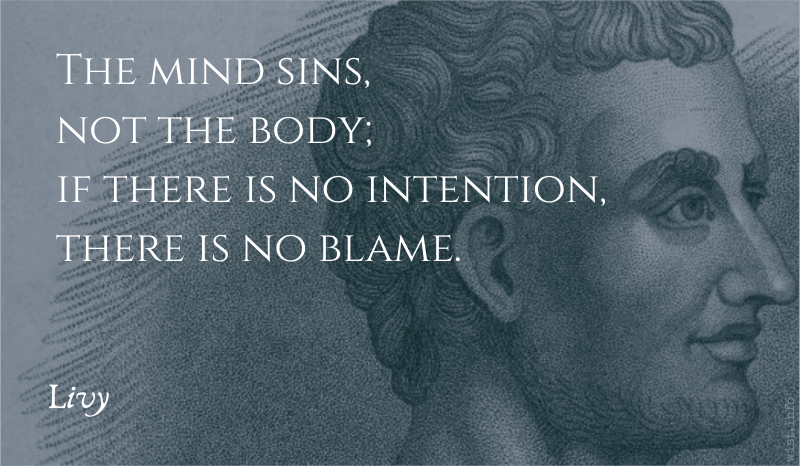
Perhaps indeed the possession of wealth is constantly distressing,
But I should be quite willing to assume every curse of wealth if I could at the same time assume every blessing.
The only incurable troubles of the rich are the troubles that money can’t cure,
Which is a kind of trouble that is even more troublesome if you are poor.
Certainly there are lots of things in life that money won’t buy, but it’s very funny —
Have you ever tried to buy them without money?
Ogden Nash (1902–1971) American poet
“The Terrible People,” New Yorker (11 Feb 1933)
(Source)
Reprinted in Many Long Years Ago (1945).
Nobody but radicals have ever accomplished anything in a great crisis. Conservatives have their place in the piping times of peace; but in emergencies only rugged issue men amount to much.
James A. Garfield (1831–1881) US President (1881), lawyer, lay preacher, educator
Diary (1876)
(Source)
He must be a man of little faith, who would fear to subject his own religion to the same critical tests to which the historian subjects all other religions. We need not surely crave a tender or merciful treatment for that faith which we hold to be the only true one. We should rather challenge it for the severest tests and trials, as the sailor would for the good ship to which he trusts his own life, and the lives of those who are dear to him. In the Science of Religion, we can decline no comparisons, nor claim any immunities for Christianity, as little as the missionary can, when wrestling with the subtle Brahmin, or the fanatical Mussulman, or the plain speaking Zulu.
Max Müller (1823–1900) German-British philologist, Orientalist, religious studies founder
Chips from a German Workshop, vol. 1, Preface (1866)
(Source)
How wonderful to have someone to blame! How wonderful to live with one’s nemesis! You may be miserable, but you feel forever in the right. You may be fragmented, but you feel absolved of all the blame for it. Take your life in your own hands, and what happens? A terrible thing: no one to blame.
Erica Jong (b. 1942) American writer, poet
How To Save Your Own Life, “Intuition, extuition …” (1977)
TECMESSA: Kindness gives birth to kindness.
Sophocles (496–406 BC) Greek tragic playwright
Ajax
Other translations:
- "For it is always kindness which breeds kindness." [tr. Garvie (1998), ll. 522-23]
- "Kindness begets kindness." [tr. Golder & Pevear (1999), l. 584]
- "'Tis kindness that still begets kindness." [tr. Jebb (1917), ll. 521-22]
- "For kindness begets kindness evermore." [tr. Trevelyan (1919)]

When great causes are on the move in the world, stirring all men’s souls, drawing them from their firesides, casting aside comfort, wealth, and the pursuit of happiness in response to impulses at once awe-striking and irresistible, we learn that we are spirits, not animals, and that something is going on in space and time, and beyond space and time, which, whether we like it or not, spells duty.
Winston Churchill (1874–1965) British statesman and author
BBC Radio broadcast (16 Jun 1941)
(Source)
First published in the Imperial Review (28 Jun 1941).
One could not stand and watch very long without becoming philosophical, without beginning to deal in symbols and similes, and to hear the hog squeal of the universe. Was it permitted to believe that there was nowhere upon the earth, or above the earth, a heaven for hogs, where they were requited for all this suffering? Each one of these hogs was a separate creature. Some were white hogs, some were black; some were brown, some were spotted; some were old, some young; some were long and lean, some were monstrous. And each of them had an individuality of his own, a will of his own, a hope and a heart’s desire; each was full of self-confidence, of self-importance, and a sense of dignity. And trusting and strong in faith he had gone about his business, the while a black shadow hung over him and a horrid Fate waited in his pathway.
Now suddenly it had swooped upon him, and had seized him by the leg. Relentless, remorseless, it was; all his protests, his screams, were nothing to it — it did its cruel will with him, as if his wishes, his feelings, had simply no existence at all; it cut his throat and watched him gasp out his life. And now was one to believe that there was nowhere a god of hogs, to whom this hog personality was precious, to whom these hog squeals and agonies had a meaning? Who would take this hog into his arms and comfort him, reward him for his work well done, and show him the meaning of his sacrifice?
Perhaps some glimpse of all this was in the thoughts of our humble-minded Jurgis, as he turned to go on with the rest of the party, and muttered: “Dieve — but I’m glad I’m not a hog!”
Upton Sinclair (1878–1968) American writer, journalist, activist, politician
The Jungle, ch. 3 (1906)
(Source)
From such Considerations as these it follows, that I ought never to be angry with any one for differing in Judgment from me. For how know I but the Point in dispute between us, is one of those Errors that I have embrac’d as Truth. If I am in the Wrong, I should not be displeas’d that another is in the Right. If I am in the Right, ’tis my Happiness; and I should rather pity than blame him who is unfortunately in the Wrong.
Benjamin Franklin (1706–1790) American statesman, scientist, philosopher, aphorist
Letter to Josiah Franklin (Apr 1738) [draft]
(Source)
His father.
It is better to go skiing and think of God, than to go to church and think of sport.
Fridtjof Nansen (1861–1930) Norwegian explorer, scientist, diplomat, humanitarian
(Attributed)
If you are what you ought to be, you will set fire to all Italy, and not only yonder.
[Se sarete quello che dovete essere, metterete fuoco in tutta Italia, non tanto costì.]
Catherine of Siena (1347–1380) Italian Catholic mystic, activist, author
Letter 368 to Stefano Maconi
(Source)
Other translations:Original Italian.
- "Be who God meant you to be and you will set the world on fire." [Quoted by Bishop Richard Chartres, sermon, Royal Wedding, Westminster Abbey (29 Apr 2011)]
- "If you are what you should be, you will set the whole world ablaze!" [Quoted by Pope John Paul II, Closing Homily at World Youth Day, Tor Vergata (20 Aug 2000)]
- "If you are what you should be, you will set the world on fire."
- "Become who God intended you to be and you will set the world on fire."
- "If you are what you should be, you will set the whole world on fire!"
If a predatory enemy to our species can’t unite everyone on Earth to fight it, I’m left wondering what hope remains for Civilization.
Neil deGrasse Tyson (b. 1958) American astrophysicist, author, orator
Twitter (19 Apr 2020)
(Source)
Regarding the COVID-19 pandemic.

To emphasize only the beautiful seems to me to be like a mathematical system that only concerns itself with positive numbers.

Every man of every color and description has a natural right to freedom.
John Jay (1745–1829) American statesman, diplomat, abolitionist, politician, Chief Justice (1789–1795)
Letter to J. C. Dongan (27 Feb 1792)
(Source)
And fate? No one alive has ever escaped it,
neither brave man nor coward, I tell you —
it’s born with us the day that we are born.[Μοῖραν δ’ οὔ τινά φημι πεφυγμένον ἔμμεναι ἀνδρῶν,
οὐ κακὸν οὐδὲ μὲν ἐσθλόν, ἐπὴν τὰ πρῶτα γένηται.]Homer (fl. 7th-8th C. BC) Greek author
The Iliad [Ἰλιάς], Book 6, l. 488ff (6.488-489) (c. 750 BC) [tr. Fagles (1990), ll. 582-84]
Hector bidding his wife farewell. Other translations:And fate, whose wings can fly?
Noble, ignoble, fate controls. Once born, the best must die.
[tr. Chapman (1611), ll. 528-29]Fixed is the term to all the race of earth,
And such the hard condition of our birth.
No force can then resist, no flight can save;
All sink alike, the fearful and the brave.
[tr. Pope (1715-20)]Nor lives he who can overpass the date
By heaven assign’d him, be he base or brave
[tr. Cowper (1791), ll. 595-96]But I think there is no one of men who has escaped fate, neither the coward nor the brave man, after he has once been born.
[tr. Buckley (1860)]If a man's hour is come, be he brave or be he coward, there is no escape for him when he has once been born.
[tr. Butler (1898)]Only his doom, methinks, no man hath ever escaped, be he coward or valiant, when once he hath been born.
[tr. Murray (1924)]No mortal, either, can escape his fate, coward or brave man, once he comes to be.
[tr. Fitzgerald (1974)]
CHARLIE ANDERSON: I’m not going to kill you. I want you to live. I want you to live to be an old man, and I want you to have many, many, many children, and I want you to feel about your children then the way I feel about mine now. And someday, when a man comes along and kills one of ’em, I want you to remember! Okay? I want you to remember.
James Lee Barrett (1929–1989) American author, producer, screenwriter
Shenandoah (1965)
When a man points a finger at someone else, he should remember that four of his fingers are pointing to himself.

The person who is sick in the body needs a doctor;
someone who is sick in the mind needs a friend
For a well-meaning friend knows how to treat grief.[Τῷ μὲν τὸ σῶμα διατεθειμένῳ κακῶς
χρεία ‘στ’ ἰατροῦ, τῷ δὲ τὴν ψυχὴν φίλου·
λύπην γὰρ εὔνους οἶδε θεραπεύειν φίλος.]Menander (c. 341 - c. 290 BC) Greek comedic dramatist
Fragment 591 K., in Stobaeus, Anthology [tr. @sentantiq]
(Source)
Other translations:
- "For him who is ill at ease in his body there is need of a physician, but need of a friend for him whose soul is ill. For loyal words have the secret of healing grief." [tr. Allinson (1921)]
- "Sick bodies need a doctor, minds a friend; / Kind words have skill the mourner's pain to mend." [tr. Edmonds]
We sometimes find ourselves changing our minds without any resistance or heavy emotion, but if we are told that we are wrong we resent the imputation and harden our hearts. We are incredibly heedless in the formation of our beliefs, but find ourselves filled with an illicit passion for them when anyone proposes to rob us of their companionship. It is obviously not the ideas themselves that are dear to us, but our self-esteem which is threatened.
James Harvey Robinson (1863–1936) American historian and educator
The Mind in the Making, ch. 4 “Rationalizing” (1921)
(Source)
Do something every day that makes you feel guilty for wasting your time.
Robert Brault (b. c. 1945) American aphorist, programmer
(Attributed)
And thus it passed on from Candlemass until after Easter, that the month of May was come, when every lusty heart beginneth to blossom, and to bring forth fruit; for like as herbs and trees bring forth fruit and flourish in May, in likewise every lusty heart that is in any manner a lover, springeth and flourisheth in lusty deeds. For it giveth unto all lovers courage, that lusty month of May ….
What is betrayal? They talk of a man betraying his country, his friends, his sweetheart. There must be a moral bond first. All a man can betray is his conscience.
Joseph Conrad (1857–1924) Polish-English novelist [b. Teodor Josef Konrad Korzeniowski]
Under Western Eyes, Part 1, ch. 2 (1911)
(Source)

I can only say that politics, like misery, “bring a man acquainted with strange bedfellows.”
William Gifford (1756–1826) English critic, editor, poet, satirist
The Baviad, and Mæviad (1797)
(Source)
First recorded connection between Shakespeare's quote on misery and politics, leading to the eventual "Politics makes for strange bedfellows."

Success covers a multitude of blunders, and the want of it hides the greatest gallantry and good conduct.
Horatio Nelson (1758–1805) British admiral
Letter to Andrew Hamond (1797)
(Source)
Often misattributed to George Bernard Shaw.

Let none of us delude himself by supposing that honesty is always the best policy. It is not.
William Ralph Inge (1860–1954) English prelate [Dean Inge]
Speculum Animae, Part 2, “Sunday Morning,” address, Cambridge (15 Jan 1911)
(Source)
Inge's argument is not that honesty is not the most virtuous course, but that it is not always the most secularly advantageous course, and that such disadvantage is one of the costs of maintaining Christian virtue.
What then, is the object proposed to themselves by these directors of the republic, which they are bound to keep their eyes fixed upon, and towards which they ought to direct their course? That which is most excellent and most desirable to all men in their senses, and to all good and happy men, — ease conjoined with duty.
[Quid est igitur propositum his rei publicae gubernatoribus quod intueri et quo cursum suum derigere debeant? Id quod est praestantissimum maximeque optabile omnibus sanis et bonis et beatis, cum dignitate otium.]
Marcus Tullius Cicero (106–43 BC) Roman orator, statesman, philosopher
Pro Sestio [For Publius Sestius], ch. 45 / sec. 98 (56-03 BC) [tr. Yonge (1891)]
(Source)
The discussion of otium cum dignitate, coined by Cicero, is a key point in Pro Sestio. It is also translated as "leisure with dignity," "peace with dignity," "peace with honor," "fruitful leisure." Socially, it means an active, studious, useful private life or retirement after public service -- as distinguished from idleness, sloth, and indolence. Politically, Cicero used it to reference a secure, stable, peaceful, but still vigorous state, led by the "best men" (aristocrats or optimates).
(Source (Latin)). Other translations:What, therefore, is the aim of these conductors of the affairs of the state, which they ought to keep their eyes upon, and towards which they ought to direct their course? That which is most excellent and most to be desired by all sane and good and well-to-do citizens, tranquillity with freedom.
[tr. Hickie (1888)][...] That which stands first, and is most to be desired by all happy, honest, and healthy-minded men, is ease with dignity.
[ed. Harbottle (1897)]What then is the mark set before those who guide the helm of state, upon which they ought to keep their eyes and towards which they ought to direct their course? It is that which is far the best and the most desirable for all who are sound and good and prosperous; it is "peace with dignity."
[tr. Gardner (Loeb) (1958)]What then are the ideals and objectives towards which these men ought to steer the res publica? They are the finest, the noblest aims of all men of wisdom, integrity, and substance: civil peace for Rome and honour for those who deserve it.
[tr. Wilson/Lacey (1978)][...] What is desired the most, by those who are healthy, good, and blessed, is leisure with honor.
[in Jasper (2008)][...] The thing that is the most outstanding, and chiefly to be desired by all healthy and good and well-off persons, is leisure with honor.
[ed. Stone (2013)]
Compassion is not a popular virtue. Very often when I talk to religious people, and mention how important it is that compassion is the key, that it’s the sine qua non of religion, people look kind of balked, and stubborn sometimes, as much to say, “What’s the point of having religion if you can’t disapprove of other people?”
Karen Armstrong (b. 1944) British author, comparative religion scholar
NOW Interview with Bill Moyers, PBS (1 Mar 2002)
(Source)
The power of bacon seems to know no bounds. It’s not just the taste, which is like eating pure joy. The frying of bacon even sounds like applause.
Jim Gaffigan (b. 1966) American comedian, actor, writer, producer.
Food: A Love Story, “Bacon: The Candy of Meat” (2014)
(Source)

If you have abandoned one faith, do not abandon all faith. There is always an alternative to the faith we lose. Or is it the same faith under another mask?
Graham Greene (1904–1991) English novelist [Henry Graham Greene]
The Comedians [Dr. Magiot] (1966)
(Source)
Another good thing about gossip is that it is within everybody’s reach,
And it is much more interesting than any other form of speech,
Because suppose you eschew gossip and just say
Mr. Smith is in love with his wife.
Why that disposes the Smiths as a topic of conversation for the rest of their life,
But suppose you say with a smile, that poor little Mrs. Smith thinks her husband is in love with her, he must be very clever,
Why then you can enjoyably talk about the Smiths forever.
Ogden Nash (1902–1971) American poet
“I Have It On Good Authority,” New York American (3 Sep 1935)
(Source)
The divorce between the church and the state ought to be absolute. It ought to be so absolute that no church property anywhere in any State or in the nation should be exempt from equal taxation; for if you exempt the property of any church organization, to that extent you impose a church tax upon the whole community.
James A. Garfield (1831–1881) US President (1881), lawyer, lay preacher, educator
Debate, House Appropriations Committee (22 Jun 1874)
(Source)
In the Congressional Record, 2(6):538 (1874).
There is no happiness in life, there is no misery, like that growing out of the dispositions which consecrate or desecrate a home.

A just cause is not ruined by a few mistakes.
Fyodor Dostoyevsky (1821–1881) Russian novelist
“Critical Articles: Introduction,” Complete Collected Works (1895)

The history of the human race is a continual struggle from darkness towards light. It is, therefore, to no purpose to discuss the use of knowledge; man wants to know, and when he ceases to do so, he is no longer man.
Fridtjof Nansen (1861–1930) Norwegian explorer, scientist, diplomat, humanitarian
“A New Route to the North Pole,” The Forum (Aug 1891)
(Source)
Meantime, heedless of all these things, the men upon the floor were going about their work. Neither squeals of hogs nor tears of visitors made any difference to them; one by one they hooked up the hogs, and one by one with a swift stroke they slit their throats. There was a long line of hogs, with squeals and lifeblood ebbing away together; until at last each started again, and vanished with a splash into a huge vat of boiling water.
It was all so very businesslike that one watched it fascinated. It was porkmaking by machinery, porkmaking by applied mathematics. And yet somehow the most matter-of-fact person could not help thinking of the hogs; they were so innocent, they came so very trustingly; and they were so very human in their protests — and so perfectly within their rights! They had done nothing to deserve it; and it was adding insult to injury, as the thing was done here, swinging them up in this cold-blooded, impersonal way, without a pretense of apology, without the homage of a tear. Now and then a visitor wept, to be sure; but this slaughtering machine ran on, visitors or no visitors. It was like some horrible crime committed in a dungeon, all unseen and unheeded, buried out of sight and of memory.
Upton Sinclair (1878–1968) American writer, journalist, activist, politician
The Jungle, ch. 3 (1906)
(Source)
I think vital Religion has always suffer’d, when Orthodoxy is more regarded than Virtue. And the Scripture assures me, that at the last Day, we shall not be examin’d what we thought, but what we did; and our Recommendation will not be that we said Lord, Lord, but that we did GOOD to our Fellow Creatures.
Benjamin Franklin (1706–1790) American statesman, scientist, philosopher, aphorist
Letter to Josiah and Abiah Franklin (13 Apr 1738)
(Source)
His parents. Franklin cites Matt. 26 in the letter, but it should be Matt. 25:31-46.
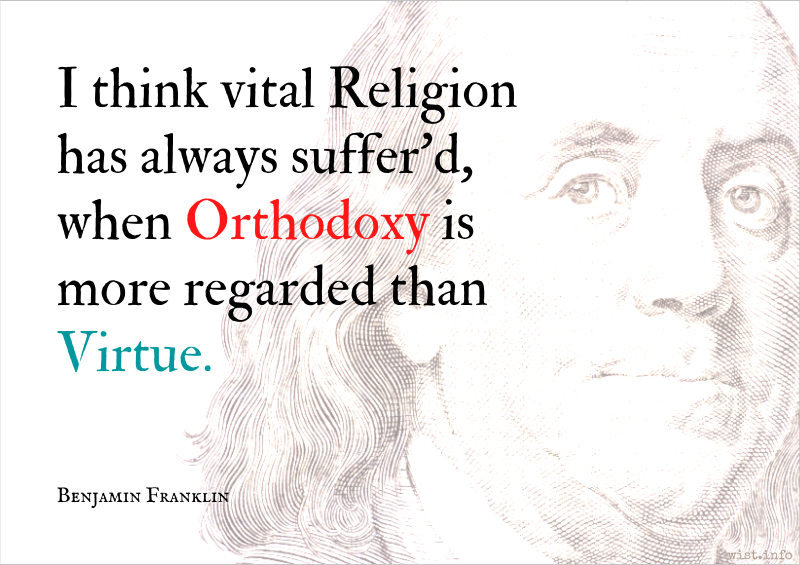
Belligerence is the hallmark of insecurity — the secure nation does not need threat to maintain its position.
Dwight David Eisenhower (1890–1969) American general, US President (1953–61)
Speech, American Newspaper Publishers Assoc, New York City (25 Apr 1946)
(Source)
The first part of the above was a common phrase of Eisenhower's.
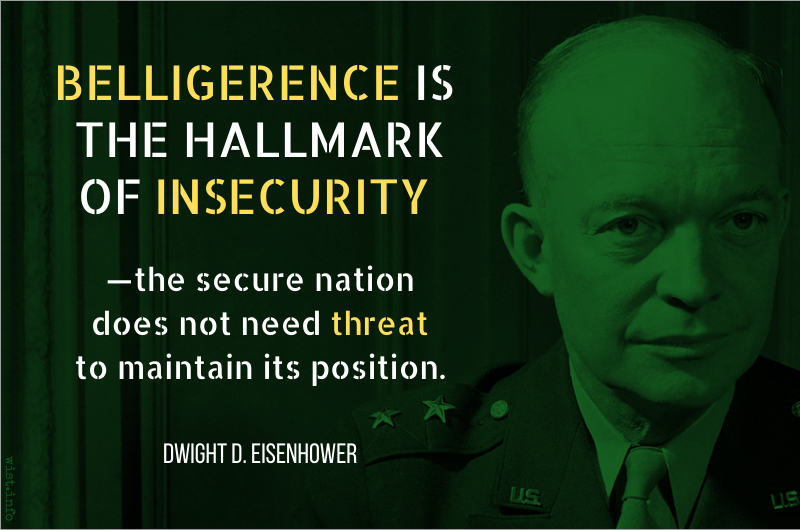
Code is like humor. When you have to explain it, it’s bad.

Youth is full of sunshine and life. Youth is happy, because it has the ability to see beauty. When this ability is lost, wretched old age begins, decay, unhappiness. […] Anyone who keeps the ability to see beauty never grows old.
Franz Kafka (1883–1924) Czech-Austrian Jewish writer
In Gustav Janouch, Conversations with Kafka (1951; 1971 ed.)
It is too true, however disgraceful it may be to human nature, that nations in general will make war whenever they have a prospect of getting anything by it; nay, absolute monarchs will often make war when their nations are to get nothing by it, but for the purposes and objects merely personal, such as thirst for military glory, revenge for personal affronts, ambition, or private compacts to aggrandize or support their particular families or partisans. These and a variety of other motives, which affect only the mind of the sovereign, often lead him to engage in wars not sanctified by justice or the voice and interests of his people.
John Jay (1745–1829) American statesman, diplomat, abolitionist, politician, Chief Justice (1789–1795)
The Federalist #4 (7 Nov 1787)
(Source)
When a Man’s exhausted, wine will build his strength.
[Ἀνδρὶ δὲ κεκμηῶτι μένος μέγα οἶνος ἀέξει.]
Homer (fl. 7th-8th C. BC) Greek author
The Iliad [Ἰλιάς], Book 6, l. 261 (6.261) (c. 750 BC) [tr. Fagles (1990), l. 310]
Other translationsFor to a man dismay’d
With careful spirits, or too much with labour overlaid,
Wine brings much rescue, strength'ning much the body and the mind.
[tr. Chapman (1611), ll. 274-76]Then with a plenteous draught refresh thy soul,
And draw new spirits from the generous bowl.
[tr. Pope (1715-20)]For wine is mighty to renew the strength
Of weary man.
[tr. Cowper (1791), ll. 318-19]For to a wearied man wine greatly increases strength.
[tr. Buckley (1860)]For great the strength
Which gen'rous wine imparts to men who toil.
[tr. Derby (1864), ll. 306-07]When a man is awearied wine greatly maketh his strength to wax.
[tr. Leaf/Lang/Myers (1891)]Wine gives a man fresh strength when he is wearied.
[tr. Butler (1898)]When a man is spent with toil wine greatly maketh his strength to wax.
[tr. Murray (1924)]In a tired man, wine will bring back his strength to its bigness.
[tr. Lattimore (1951)]Wine will restore a man when he is weary as you are.
[tr. Fitzgerald (1974)]When someone is fatigued, wine greatly increases his power.
[tr. Merrill (2007)]
LT. JOHNSON: When are you going to take this war seriously, Anderson?
CHARLIE ANDERSON: Now let me tell you something, Johnson, before you get on my wrong side. My corn I take serious because it’s my corn, and my potatoes and my tomatoes and fences I take note of because they’re mine. But this war is not mine and I take no note of it!
Coaches and headmasters praise sport as a preparation for the great game of life, but this is absurd. Nothing could be more different from life. For one thing sports, unlike life, are played according to rules. Indeed, the rules are the sport: life may behave bizarrely and still be life, but if the runner circles the bases clockwise it’s no longer baseball.
Barbara Holland (1933–2010) American author
Endangered Pleasures (1995)

One of the saddest lessons of history is this: If we’ve been bamboozled long enough, we tend to reject any evidence of the bamboozle. We’re no longer interested in finding out the truth. The bamboozle has captured us. It’s simply too painful to acknowledge, even to ourselves, that we’ve been taken. Once you give a charlatan power over you, you almost never get it back.
Carl Sagan (1934–1996) American scientist and writer
The Demon-Haunted World, ch. 13 (1995)
(Source)
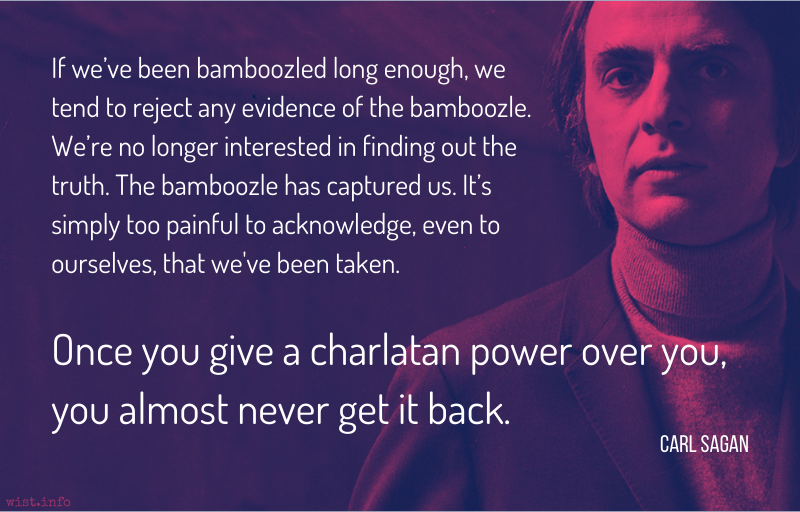

The less depth a belief system has, the greater the fervency with which its adherents embrace it. The most vociferous, the most fanatical are those whose cobbled faith is founded on the shakiest grounds.
Dean Koontz (b. 1945) American writer [also writes as Leigh Nichols]
Forever Odd, ch. 33 (2005)
(Source)

We are each the star of our own situation comedy, and, with luck, the screwball friend in someone else’s.
Robert Brault (b. c. 1945) American aphorist, programmer
(Attributed)
The joy of love is too short, and the sorrow thereof, and what cometh thereof, dureth over long.
“Inside every sane person there’s a madman struggling to get out,” said the shopkeeper. “That’s what I’ve always thought. No one goes mad quicker than a totally sane person.”
The crucial task of age is balance, a veritable tightrope of balance; keeping just well enough, just brave enough, just gay and interested and starkly honest enough to remain a sentient human being.
Florida Scott-Maxwell (1883–1979) American-British playwright, author, psychologist
The Measure of My Days (1968)
(Source)
Never grow a wishbone, daughter, where your backbone ought to be.
Clementine Paddleford (1898–1967) American food writer
A Flower for My Mother (1958)
(Source)
Quoting her mother.

For the wonderful thing about saints is that they were human. They lost their tempers, got hungry, scolded God, were egotistical or testy or impatient in their turns, made mistakes and regretted them. Still they went on doggedly blundering toward heaven.
Phyllis McGinley (1905–1978) American author, poet
Saint-Watching, “Running to Paradise” (1969)

Faith, in the Gospels, does not mean believing something: it is an inherent quality in the mind. It is a kind of courage; an attitude which favours adventure and is not afraid to run risks. Its opposite is not intellectual scepticism, but worry, cowardice, or despair. It can remove mountains — not literal mountains, but the obstacles which sloth and cowardice have put in our path.
William Ralph Inge (1860–1954) English prelate [Dean Inge]
Assessments and Anticipations, ch. 7 “Faith” (1929)
(Source)
For laws are silent when arms are raised.
[Silent enim leges inter arma.]
Marcus Tullius Cicero (106–43 BC) Roman orator, statesman, philosopher
Pro Milone, ch. 4, sec. 11 [tr. Yonge (1891)]
(Source)
In context, Cicero is asserting that self-defense is a valid defense for killing, even though that principle was not written into Roman law. It has been extended in legal terms to times of war being exempt from normal laws regarding killing.
Other translations:Original Latin.
- "For laws are silent among arms."
- "In a time of war, the law falls silent."
- "Laws are silent in time of war."
- "The laws are silent in warfare."
- "For among arms, the laws fall mute."
- "The power of law is suspended during war."
There are some forms of religion that must make God weep. There are some forms of religion that are bad, just as there’s bad cooking or bad art or bad sex, you have bad religion too. Religion that has concentrated on egotism, that’s concentrated on belligerence rather than compassion.
Karen Armstrong (b. 1944) British author, comparative religion scholar
NOW Interview with Bill Moyers, PBS (1 Mar 2002)
(Source)
TRINCULO: Misery acquaints a man with strange bedfellows.
William Shakespeare (1564–1616) English dramatist and poet
Tempest, Act 3, sc. 2, l. 40 (3.2.40) (1611)
(Source)

Bacon is so good by itself that to put it in any other food is an admission of failure. You’re basically saying, “I can’t make this other food taste good, so I’ll throw in bacon.”
Penn Jillette (b. 1955) American stage magician, actor, musician, author
Quoted in Adam Boult, “Why We Love Eating Meat,” Telegraph (13 Jun 2016)
(Source)

Young people, who are still uncertain of their identity, often try on a succession of masks in the hope of finding the one which suits them — the one, in fact, which is not a mask.
W. H. Auden (1907–1973) Anglo-American poet [Wystan Hugh Auden]
“One of the Family” (1965), Forewords and Afterwords (1973)
(Source)

Most bankers dwell in marble halls,
Which they get to dwell in because they encourage deposits and discourage withdrawals,
And particularly because they all observe one rule which woe betides the banker who fails to heed it,
Which is you must never lend any money to anybody unless they don’t need it.
Ogden Nash (1902–1971) American poet
“Bankers Are Just Like Anybody Else, Except Richer,” New Yorker (7 Dec 1935)
(Source)
Resolutions cannot nullify the truths of the multiplication table.
James A. Garfield (1831–1881) US President (1881), lawyer, lay preacher, educator
“The Currency,” Speech, House of Representatives (15 May 1868)
(Source)
A favorite phrase of Garfield's regarding the dangers of inflation, e.g., "I will not vote against the truths of the multiplication table" (Letter to Harmon Austin (4 Feb 1874)).
Never does the human soul appear so strong as when it foregoes revenge, and dares to forgive an injury.
I give it as my firmest conviction that service to a just cause rewards the worker with more real happiness and satisfaction than any other venture of life.
Carrie Chapman Catt (1859–1947) American women's suffrage activist
“The Making of A Pioneer Suffragette,” in The American Scrap Book (1928)
(Source)

I have regarded you, not as a novelist, but as an historian; for it is my considered opinion, unshaken at 85, that records of fact are not history. They are only annals, which cannot become historical until the artist-poet-philosopher rescues them from the unintelligible chaos of their actual occurrence and arranges them in works of art.
When people ask me what has happened in my long lifetime I do not refer them to the newspaper files and to the authorities, but to your novels. They object that the people in your books never existed; that their deeds were never done and their sayings never uttered. I assure them that they were, except that Upton Sinclair individualized and expressed them better than they could have done, and arranged their experiences, which as they actually occurred were as unintelligible as pied type, in significant and intelligible order.
George Bernard Shaw (1856–1950) Irish playwright and critic
Letter to Upton Sinclair (12 Dec 1941)

But since it is no more in a Man’s Power to think than to look like another, methinks all that should be expected from me is to keep my Mind open to Conviction, to hear patiently and examine attentively whatever is offered me for that end; and if after all I continue in the same Errors, I believe your usual Charity will induce you rather to pity and excuse than blame me.
Benjamin Franklin (1706–1790) American statesman, scientist, philosopher, aphorist
Letter to Josiah and Abiah Franklin (13 Apr 1738)
(Source)
His parents.
Society is only incidentally and in certain cases regulative, and law is no equivalent to the social order. […] Even in our civilization the law is never more than a crude implement of society, and one it is often enough necessary to check in its arrogant career. It is never to be read off as if it were the equivalent of the social order.
Ruth Benedict (1887–1947) American anthropologist
Patterns of Culture, ch. 8 “The Individual and Culture” (1934)
(Source)

If the hive be disturbed by rash and stupid hands, instead of honey, it will yield us bees.
Ralph Waldo Emerson (1803–1882) American essayist, lecturer, poet
Essay (1841), “Prudence,” Essays: First Series, No. 7
(Source)
Based on a lecture (winter 1837–1838), Boston, the seventh in his course on "Human Culture."

That men should pray and fight for their own freedom, and yet keep others in slavery, is certainly acting a very inconsistent, as well as unjust and, perhaps, impious part, but the history of mankind is filled with instances of human improprieties.
John Jay (1745–1829) American statesman, diplomat, abolitionist, politician, Chief Justice (1789–1795)
Letter to Rev. Doctor Price (27 Sep 1785)
(Source)
He sent me off to Troy …
And I hear his urgings ringing in my ears:
“Always be the best, my boy, the bravest,
and hold your head up high above the others.
Never disgrace the generation of your fathers.
They were the bravest champions born in Corinth,
In Lycia far and wide.Homer (fl. 7th-8th C. BC) Greek author
The Iliad [Ἰλιάς], Book 6, l. 245ff (6.245-251) (c. 750 BC) [tr. Fagles (1990)]
This is the first appearance of the Greek "Αἰὲν ἀριστεύειν καὶ ὑπείροχον ἔμμεναι ἄλλων" ["Always strive for excellence and prevail over others"] in the Illiad, Glaucus telling of his father's command to him. Peleus urges Achilles with the same words in Book 11. The two passages are sometimes confused.
Other translations:By his decree I sought the Trojan town,
By his instructions learn to win renown;
To stand the first in worth as in command,
To add new honours to my native land;
Before my eyes my mighty sires to place,
And emulate the glories of our race."
[tr. Pope (1715-20)]He sent me forth
To fight for Troy, charging me much and oft
That I should outstrip always all mankind
In worth and valor, nor the house disgrace
Of my forefathers, heroes without peer
In Ephyra, and in Lycia’s wide domain.
[tr. Cowper (1791), l. 254ff]Me he sent to Troy, and gave me very many commands, always to fight bravely, and to be superior to others; and not to disgrace the race of my fathers, who were by far the bravest in Ephyra, and ample Lycia.
[tr. Buckley (1860)]To Troy he sent me, and enjoin'd me oft
To aim at highest honours, and surpass
My comrades all; nor on my father's name
Discredit bring, who held the foremost place
In Ephyre, and Lycia's wide domain.
[tr. Derby (1864), ll. 245-249]He sent me to Troy and bade me very instantly to be ever the best and to excel all other men, nor put to shame the lineage of my fathers that were of noblest blood in Ephyre and in wide Lykia.
[tr. Leaf/Lang/Myers (1891)]When he sent me to Troy he urged me again and again to fight ever among the foremost and outvie my peers, so as not to shame the blood of my fathers who were the noblest in Ephyra and in all Lycia.
[tr. Butler (1898)]He sent me to Troy and straitly charged me ever to be bravest and pre-eminent above all, and not bring shame upon the race of my fathers, that were far the noblest in Ephyre and in wide Lycia.
[tr. Murray (1924)]He sent me here to Troy, commanding me to act always with valour, always to be the most noble, never to shame the line of my progenitors, great men first in Ephyra, then in Lycia.
[tr. Fitzgerald (1974)]
ANN ANDERSON: Here’s something else you must remember: husbands like to be alone once in awhile.
JENNIE ANDERSON: Why?
ANN ANDERSON: You never know why, but I can always tell when James wants to be alone. A mood comes over him. I can always see it in his eyes before it gets there. I don’t know where the mood comes from or why, but that’s when I leave him alone. It seems sometimes things get so fickle in a man that he comes to feel that everything is closing in on him — and that’s when he wants to be left alone. You understand, don’t you?
JENNIE ANDERSON: No!
One must not always think so much about what one should do, but rather what one should be. Our works do not ennoble us; but we must ennoble our works.
Meister Eckhart (c. 1260–1328?) German theologian, philosopher, mystic [a.k.a. Johannes Eckhart von Hochheim; Eckhart; Eckehart]
Work and Being (14th C.)
Note: I haven't found a text by that name in Eckhart's bibliography, nor this quotation anywhere connected with anything but that title or none at all.