

Out of the mouths of babes comes a lot of what they should have swallowed.
Franklin P. Jones (1908–1980) American journalist, humorist, public relations executive
(Attributed)
A take-off from the Biblical aphorism, "Out of the mouths of babes comes wisdom" (Ps. 8:2).
Mass propaganda discovered that its audience was ready at all times to believe the worst, no matter how absurd, and did not particularly object to being deceived because it held every statement to be a lie anyhow. The totalitarian mass leaders based their propaganda on the correct psychological assumption that, under such conditions, one could make people believe the most fantastic statements one day, and trust if the next day they were given irrefutable proof of their falsehood, they would take refuge in cynicism; instead of deserting the leaders who had lied to them, they would protest that they had known all along the statement was a lie and would admire the leaders for their superior tactical cleverness.
Hannah Arendt (1906–1975) German-American philosopher, political theorist
Origins of Totalitarianism, Part 3, ch. 11 “The Totalitarian Movement,” sec. 2 (1951)
(Source)

Let the reader find that he cannot afford to omit any line of your writing because you have omitted every word that he can spare.
What you don’t understand you can make mean anything.
Chuck Palahniuk (b. 1962) American novelist and freelance journalist
Diary (2003)

Shake was a dramatist of note:
He lived by writing things to quote.H. C. Bunner (1855–1896) American novelist and poet [Henry Cuyler Bunner]
“Shake, Mulleary and Go-ethe”
(Source)
Referring to Shakespeare, who is quite quotable (and, in the rest of the poem, referencing Molière and Goethe, the last of which he rhymes with "teeth"). More information on the poem at the Source link.
Sometimes paraphrased, "Shakespeare was a dramatist of note / Who lived by writing things to quote."

CHARLIE MCCARTHY: Ambition is a poor excuse for not having sense enough to be lazy.
Edgar Bergen (1903–1978) American actor, radio performer, ventriloquist
(Attributed)
God created man and, finding him not sufficiently alone, gave him a companion to make him feel his solitude more keenly.
Paul Valéry (1871–1945) French poet, critic, author, polymath
“Moralités” (1932), Tel Quel 1 (1941)
Faith is, on the practical side, just the resolution to stand or fall by the noblest hypothesis; and, on the intellectual side, it is a progressive initiation, by experiment which ends in experience, into the unity of the good, the true, and the beautiful, founded on the inner assurance that these three attributes of the divine nature have one source and conduct to one goal.
William Ralph Inge (1860–1954) English prelate [Dean Inge]
“Roman Catholic Modernism” (1909), Outspoken Essays: First Series (1911)
(Source)
From history’s examples we conclude,
And modern instances teach us the same:
Good follows Evil, Evil follows Good,
Shame ends in glory, glory ends in shame.
Thus it is evident that no man should
Put trust in victories or wealth or fame,
Nor yet despair if Fortune is adverse:
She turns her wheel for better, as for worse.Si vede per gli esempi di che piene
Sono l’antiche e le moderne istorie,
Che ‘l ben va dietro al male, e ‘l male al bene,
E fin son l’un de l’altro e biasmi e glorie;
E che fidarsi a l’uom non si conviene
In suo tesor, suo regno e sue vittorie,
Né disperarsi per Fortuna avversa,
Che sempre la sua ruota in giro versa.Ludovico Ariosto (1474–1533) Italian poet
Orlando Furioso, Canto 45, st. 4 (1532) [tr. Reynolds (1973)]
Alt. trans. [Rose (1831)]:'Tis plain to sight, through instances that fill
The page of ancient and of modern story,
That ill succeeds to good, and good to ill;
That glory ends in shame, and shame in glory;
And that man should not trust, deluded still,
In riches, realm, or field of battle, gory
With hostile blood, nor yet despair, for spurns
Of Fortune; since her wheel for ever turns.

If I should labor through daylight and dark,
Consecrate, valorous, serious, true,
Then on the world I may blazon my mark;
And what if I don’t, and what if I do?

Policies are judged by their consequences but crusades are judged by how good they make the crusaders feel.
Thomas Sowell (b. 1930) American economist, economic historian, social theorist, political commentator
Compassion vs. Guilt, and Other Essays (1987)
(Source)

What are you pretending not to know?
Sig Lines
~

A rich man cannot enjoy a sound mind nor a sound body without exercise and abstinence; and yet these are truly the worst ingredients of poverty.
Henry Home, Lord Kames (1696–1782) Scottish jurist, agriculturalist, philosopher, writer
Introduction to the Art of Thinking, ch. 2 (1761)
(Source)

One does not become fully human painlessly.
Rollo May (1909–1994) American psychotherapist
Foreword to Ronald S. Valle and Mark King, Existential-Phenomenological Alternatives for Psychology (1978)

A political convention is just not a place where you come away with any trace of faith in human nature.
Murray Kempton (1917–1997) American journalist.
Column on the 1960 Republican National Convention, Chicago (28 Jul 1960)
(Source)

I prefer to interact with people one-on-one. Any more than that, and the dynamic becomes competitive and then I get bored easily when I’m not directly participating in the exchange.
Laurie Helgoe (b. 1960) American psychologist and author
Introvert Power (2008)
(Source)
Quoting "Suzanne".

PHILINTE: A gentleman may be respected still,
Whether he writes a sonnet well or ill.
That I dislike his verse should not offend him;
In all that touches honor, I commend him;
He’s noble, brave, and virtuous — but I fear
He can’t in truth be called a sonneteer.On peut être honnête homme, et faire mal des vers,
Ce n’est point à l’honneur que touchent ces matières,
Je le tiens galant homme en toutes les manières,
Homme de qualité, de mérite et de cœur,
Tout ce qu’il vous plaira, mais fort méchant auteur.Molière (1622–1673) French playwright, actor [stage name for Jean-Baptiste Poquelin]
Le Misanthrope, Act 4, sc. 1 (1666) [tr. Wilbur (1954)]
(Source)
(Source (French)). Other translations:One may be a perfect gentleman, and write bad verses; those things have nothing to do with honour. I take him to be a gallant man in every way; a man of standing, of merit, and courage, anything you like, but he is a wretched author.
[tr. Van Laun (1878)]One may be an excellent man, and yet write bad verses. Honour is not affected by such things. I esteem him a gallant man in all respects, a man of quality, merit, and courage; all you please, but he is a very bad author.
[tr. Mathew (1890)]A man can be a gentleman and make bad verses. Such matters do not touch his honor, and I hold him to be a gallant man in every other way; a man of quality, of courage, deserving of anything you please, but -- a bad writer.
[tr. Wormeley (1894)]One may be a perfect gentleman and yet write bad verses; these things have no concern with honolur. I believe him to be an honourable man in every way; a man of standing, of merit, of courage, anything you like, but he is a miserable author.
[tr. Waller (1903)]A man may be
A perfect gentleman, and write poor verse.
These matters do not raise the point of honor.
I hold him a true man in all respects,
Brave, worthy, noble, anything you will,
But still, a wretched writer.
[tr. Page (1913)]One can be virtuous and a wretched poet;
That's not a matter to affect one's honor.
I think him an accomplished gentleman,
A man of rank, merit, and character,
Whatever you like; but he's a dreadful author.
[tr. Bishop (1957)]Even a gentleman can write bad verse.
These things concern our honor not a whit.
That he's a gentleman I do admit,
A man of quality, merit, and heart,
All that you like -- his authorship apart.
[tr. Frame (1967)]Anyone may be an honorable man, and yet write verse badly.
[ed. Bartlett (1992)]

Administrivia: (2020-05-15) RSS Problems solved (hopefully)
A helpful correspondent (waves at Mardy) noted that the Feedburner emails were not including any citations as to who actually said the quotation in question. This appears to have been the case since 5 May, when I last updated WordPress for WIST; the RSS files are customized due to my non-standard way of using the data elements in WP for this blog (e.g., using the title for citation, using the category for author information, etc.). Long story short, when I update WordPress, I have to manually restore those custom files, and I didn’t, thus losing the “who” part of the quotations in RSS feeds, including the one that generates the Feedburner emails.
This appears to be now working properly, so future emails should go out correctly. Sorry for the snafu.

Lesbian: Any uppity woman, regardless of sexual preference. If they don’t call you a lesbian, you’re probably not accomplishing anything.
Marie Shear (1940–2017) American writer and feminist activist
“Media Watch: Celebrating Women’s Words,” New Directions for Women (May/Jun 1986)
(Source)

The one pervading evil of democracy is the tyranny of the majority, or rather of that party, not always the majority, that succeeds, by force or fraud, in carrying elections.
John Dalberg, Lord Acton (1834–1902) British historian, politician, writer
“Review of Sir Erskine May’s Democracy in Europe,” The Quarterly Review (1878-01)
(Source)
I don’t kno as i want tew bet enny money, and giv odds, on the man, who iz alwus anxious tew pray out loud, every chance he kan git.
[I don’t know as I want to bet any money, and give odds, on the man who is always anxious to pray out loud, every chance he can get.]
Josh Billings (1818–1885) American humorist, aphorist [pseud. of Henry Wheeler Shaw]
Everybody’s Friend, Or; Josh Billing’s Encyclopedia and Proverbial Philosophy of Wit and Humor, “Mollassis Kandy” (1874)
(Source)

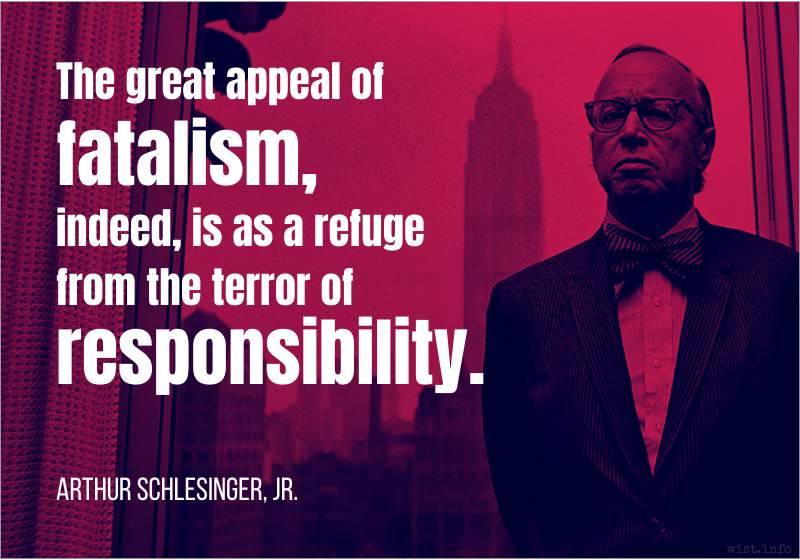
The great appeal of fatalism, indeed, is as a refuge from the terror of responsibility.
Arthur M. Schlesinger, Jr. (1917–2007) American historian, author, social critic
“The Decline of Greatness,” Saturday Evening Post (1 Nov 1958)
(Source)
The same phrase is used in the successor essay, "On Heroic Leadership," sec. 2. (1960)

The art of holding onto power is the American system’s special grace. The trick is to make reform seem so tantalizingly close as to dull the edge of militancy and force the purest revolutionaries into the peripheries of political action.
Andrew Kopkind (1935–1994) American journalist
“Are We in the Middle of a Revolution?” New York Times Magazine (10 Nov 1968)
(Source)

JACK BURTON: I don’t get this at all. I thought Lo Pan —
LO PAN: Shut up, Mr. Burton! You are not brought upon this world to “get it”!W. D. Richter (b. 1945) American screenwriter, producer, director [Walter Duch Richter]
Big Trouble in Little China (1986) [with Gary Goldman, David Z Weinstein]

We may be through with the past, but the past is not through with us. Ideas of the Stone Age exist side by side with the latest scientific thought. Only a fraction of mankind has emerged from the Dark Ages, and in the most lucid brains, as Logan Pearsall Smith has said, we come upon “nests of woolly caterpillars.”
Bergen Evans (1904–1978) American educator, writer, lexicographer
The Natural History of Nonsense, ch. 1 “Adam’s Navel” (1946)
If you go through life trading on your good looks, there’ll come a time when no one wants to trade.
(Other Authors and Sources)
Lynne Alpern & Esther Blumenfeld, Oh, Lord, I Sound Just Like Mama (1986)

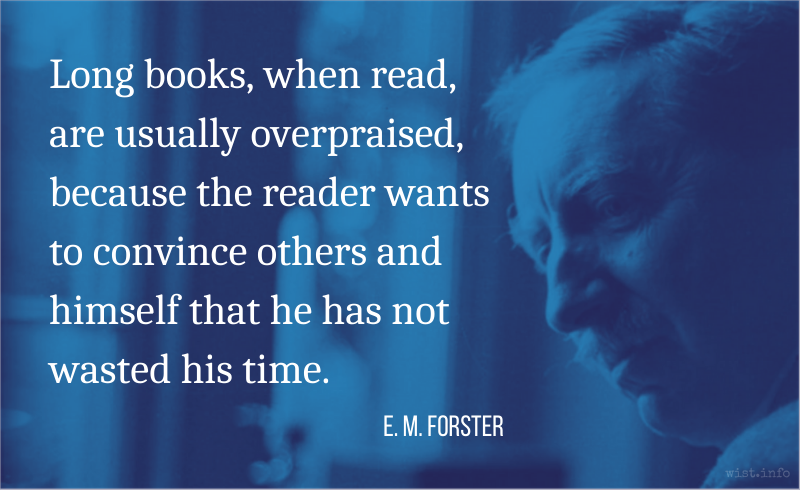
Long books, when read, are usually overpraised, because the reader wants to convince others and himself that he has not wasted his time.
E. M. Forster (1879–1970) English novelist, essayist, critic, librettist [Edward Morgan Forster]
Commonplace Book (1985) [ed. Gardner]
(Source)
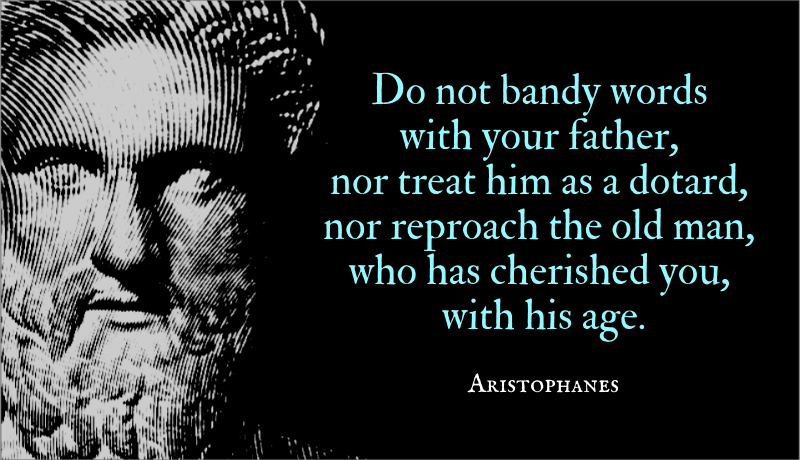
JUST DISCOURSE: Do not bandy words with your father, nor treat him as a dotard, nor reproach the old man, who has cherished you, with his age.
Aristophanes (c. 450-c. 388 BC) Athenian comedic playwright
Clouds, ll. 998-999 (423 BC) [tr. Athenian Soc. (1912)]
(Source)
Alt. trans.:
- JUST ΛΟΓΟΣ: "[Learn] not to contradict your father in any thing; nor by calling him Iapetus, to reproach him with the ills of age, by which you were reared in your infancy." [tr. Hickie (1853)]
- RIGHT LOGIC: "Nor dare to reply when your Father is nigh, nor 'musty old Japhet' to call / In your malice and rage that Sacred Old Age which lovingly cherished your youth." [tr. Rogers (1924)]

What some call health, if purchased by perpetual anxiety about diet, isn’t much better than tedious disease.
Babies are such a nice way to start people.
Don Herold (1889–1966) American humorist, cartoonist, author
There Ought To Be A Law (1926)
(Source)
The ideal subject of totalitarian rule is not the convinced Nazi or the convinced Communist, but people for whom the distinction between fact and fiction (i.e., the reality of experience) and the distinction between true and false (i.e., the standards of thought) no longer exist.
Hannah Arendt (1906–1975) German-American philosopher, political theorist
Origins of Totalitarianism, Part 3, ch. 13 “Ideology and Terror” (1951)
(Source)
Ideas must work through the brains and the arms of good and brave men, or they are no better than dreams.
Ralph Waldo Emerson (1803–1882) American essayist, lecturer, poet
Lecture (1862-01-31), “American Civilization,” Smithsonian Institution, Washington, D. C.
(Source)
Leonardo’s Mona Lisa is just a thousand thousand smears of paint. Michelangelo’s David is just a million hits with a hammer. We’re all of us a million bits put together the right way.
Chuck Palahniuk (b. 1962) American novelist and freelance journalist
Diary (2003)
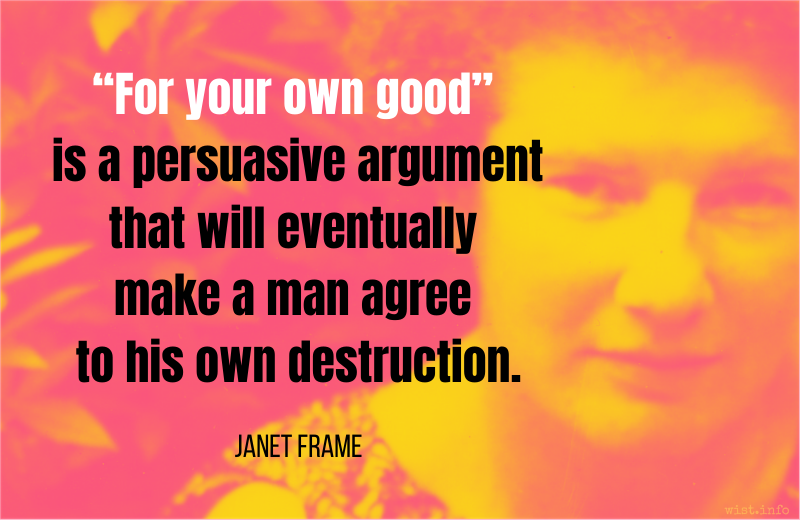
“For your own good” is a persuasive argument that will eventually make a man agree to his own destruction.
Janet Frame (1924–2004) New Zealand author [pen name of Nene Janet Paterson Clutha]
Faces in the Water, ch. 4 (1961)

Sometimes I get the feeling the whole world is against me, but deep down I know that’s not true. Some smaller countries are neutral.
Robert Orben (1927–2023) American comedy writer, magician, speechwriter
(Attributed)
THE SERGEANT: When men and women pick one another up for just a bit of fun, they find they’ve picked up more than they bargained for, because men and women have a top story as well as a ground floor, and you can’t have the one without the other.
George Bernard Shaw (1856–1950) Irish playwright and critic
Too True to Be Good, Act 3 (1932)
(Source)

The craving for signs and wonders — that broad road which attracts so many converts and wins so rapid a success — leads religion at last to its destruction, as Christ seems to have warned His own disciples.
William Ralph Inge (1860–1954) English prelate [Dean Inge]
“Roman Catholic Modernism” (1909), Outspoken Essays: First Series (1911)
(Source)
Want is a master which can sometimes make
A man the gravest sacrilege commit.[Perché il bisogno a dispogliar gli altari
ra’ l’uom talvolta, che sel trova avere.]Ludovico Ariosto (1474–1533) Italian poet
Orlando Furioso, Canto 43, st. 90 (1532) [tr. Reynolds (1973)]
Alt. trans.: "For man, alas, will sometimes disarray / The altar, when he finds himself in need ...." [tr. Rose (1831)]
Travel, trouble, music, art,
A kiss, a frock, a rhyme —
I never said they feed my heart,
But still they pass my time.Dorothy Parker (1893–1967) American writer, poet, wit
“Faute de Mieux,” Enough Rope (1926)
Faute de mieux means "for lack of something better or more desirable."
And so these men of Indostan
Disputed loud and long,
Each in his own opinion
Exceeding stiff and strong.
Though each was partly in the right
And all were in the wrong!So oft in theologic wars,
The disputants, I ween,
Rail on in utter ignorance
Of what each other mean,
And prate about an Elephant
Not one of them has seen!John Godfrey Saxe (1816–1887) American poet and satirist
“The Blind Men and the Elephant,” st. 8 and “Moral” (c. 1861; publ. 1872)
(Source)
Saxe introduced the parable, which dates back to India (c. 500 BC) to American audiences. He wrote the poem originally against what he felt was extremism on both sides that led the the American Civil War.
Every time it rains, it rains
Pennies from heaven.
Don’t you know each cloud contains
Pennies from heaven?You’ll find your fortune falling
All over town
Be sure that your umbrella
Is upside down.Johnny Burke (1908–1964) American lyricist [John Francis Burke]
“Pennies from Heaven” (1936)
(Source)

Every fellow is really two men — what he is and what he might be; and you’re never absolutely sure which you’re going to bury till he’s dead.
George Horace Lorimer (1867–1937) American journalist, author, magazine editor
Old Gorgon Graham: More Letters from a Self-Made Merchant to His Son, ch. 12 (1904)
(Source)
People are very romantic about these guys, but the only thing I’ve ever learned is that if you talk to gangsters long enough, you’ll find out they’re just as bad as respectable people.
Murray Kempton (1917–1997) American journalist.
In Ron Rosenbaum, The Secret Parts of Fortune, “The Connoisseur of Scoundrels” (2000)
(Source)
Solitude is not lack.
Laurie Helgoe (b. 1960) American psychologist and author
Introvert Power, ch. 2 (2008)
(Source)
Sometimes misquoted "Solitude is not a lack."
ALCESTE: This is a subject on which, no matter what is learned, doubts are more cruel than the worst of truths.
[Mais sur ce sujet quoi que l’on nous expose,
Les doutes sont fâcheux plus que toute autre chose.]Molière (1622–1673) French playwright, actor [stage name for Jean-Baptiste Poquelin]
Le Misanthrope, Act 3, sc. 7 (1666) [tr. Wormeley (1894)]
(Source)
On being told by Arsinoé that he is betrayed by Célimène.
(Source (French)). Other translations:But whatever may be openly said on this subject is not half so annoying as hints thrown out.
[tr. Van Laun (1878), 3.7]But on this subject, whatever we may be told, doubts are of all things the most tormenting.
[tr. Mathew (1890) 3.4]But whatever we may be told on this subject is not half so disturbing as hints and innuendoes.
[tr. Waller (1903), 3.5]In such a case, whatever we may learn,
Doubts are more torturing than any truth.
[tr. Page (1913), 3.7]Madam, you know that doubt and vague suspicion
Are painful to a man in my position.
[tr. Wilbur (1954), 3.7]No matter what one says on such a theme,
It's doubt which is the most distressing thing.
[tr. Bishop (1957)]Whatever we are told in this domain,
Doubt is the thing that gives the greatest pain.
[tr. Frame (1967), 3.5]
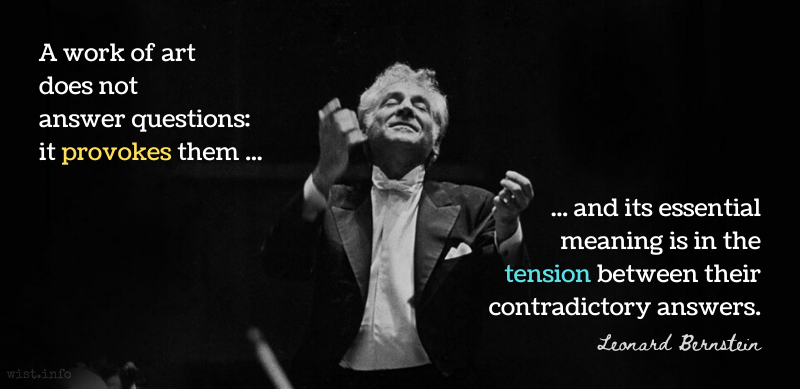
A work of art does not answer questions: it provokes them; and its essential meaning is in the tension between their contradictory answers.
Leonard Bernstein (1918–1990) American conductor, composer, author, music lecturer, pianist
“A Sabbatical Report,” sec. 1, New York Times (24 Oct 1965)
(Source)
Reprinted in The Infinite Variety of Music (1966)

Male supremacy: Doctrine built upon three forms of superiority: the ability to grow a handlebar mustache, the ability to answer most of Nature’s calls efficiently, and the possession of pockets.
Marie Shear (1940–2017) American writer and feminist activist
“Media Watch: Celebrating Women’s Words,” New Directions for Women (May/Jun 1986)
(Source)
Men cannot be made good by the state, but they can easily be made bad. Morality depends on liberty.
John Dalberg, Lord Acton (1834–1902) British historian, politician, writer
Note #10, in George Watson, Lord Acton’s History of Liberty (1994)
(Source)
Advice iz a drug in the market; the supply alwus exceeds the demand.
[Advice is a drag on the market; the supply always exceeds the demand.]
Josh Billings (1818–1885) American humorist, aphorist [pseud. of Henry Wheeler Shaw]
Everybody’s Friend, Or; Josh Billing’s Encyclopedia and Proverbial Philosophy of Wit and Humor, “Lobstir Sallad” (1874)
(Source)
Brave men earn the right to shape their own destiny.
Arthur M. Schlesinger, Jr. (1917–2007) American historian, author, social critic
“The Decline of Greatness,” Saturday Evening Post (1 Nov 1958)
(Source)
Reprinted in The Politics of Hope, ch. 2 (1963)
I have no time to scold, and I learned thirty years ago it was foolish to scold. I have enough trouble overcoming my own limitations without fretting over the fact God has not seen fit to distribute evenly the gift of intelligence.
John Wanamaker (1838–1922) American merchant, marketer, philanthropist, Postmaster General
Quoted in Herbert Adams Gibbons, John Wanamaker, Vol. 2 (1926)
(Source)
Variant paraphrase: "It's foolish to scold people. I have enough trouble overcoming my own limitations without fretting over the fact that God didn't see fit to distribute brains equally."
The human baby, the human being, is a mosaic of animal and angel.
Jacob Bronowski (1908–1974) Polish-English humanist and mathematician
The Ascent of Man, ch. 1 (1973)
(Source)
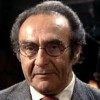
The only man for whom Hitler had “unqualified respect” was “Stalin the genius,” and while in the case of Stalin and the Russian regime we do not have (and presumably never will have) the rich documentary material that is available for Germany, we nevertheless know since Khrushchev’s speech before the Twentieth Party Congress that Stalin trusted only one man and that was Hitler.
Hannah Arendt (1906–1975) German-American philosopher, political theorist
Origins of Totalitarianism, Part 3, ch. 10 “A Classless Society,” sec. 1 (1951)
(Source)
In time the Rockies may crumble,
Gibraltar may tumble
(They’re only made of clay),
But — our love is here to stay.Ira Gershwin (1896–1983) American lyricist [b. Israel Gershowitz]
“Love Is Here to Stay”, The Goldwyn Follies (1938)
(Source)
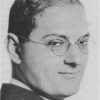
The way of Providence is a little rude. The habit of snake and spider, the snap of the tiger and other leapers and bloody jumpers, the crackle of the bones of his prey in the coil of the anaconda, — these are in the system, and our habits are like theirs. You have just dined, and however scrupulously the slaughter-house is concealed in the graceful distance of miles, there is complicity, expensive races, — race living at the expense of race.
Ralph Waldo Emerson (1803–1882) American essayist, lecturer, poet
Essay (1860), “Fate,” The Conduct of Life, ch. 1
(Source)
Based on a course of lectures by that name first delivered in Pittsburg (1851-03).
Since the natural tendencies of mankind are so bad that it is not safe to allow them liberty, how comes it to pass that the tendencies of organizers are always good? Do not the legislators and their agents form a part of the human race? Do they consider that they are composed of different materials from the rest of mankind? They say that society, when left to itself, rushes to inevitable destruction, because its instincts are perverse. They presume to stop it in its downward course, and to give it a better direction. They have, therefore, received from heaven, intelligence and virtues that place them beyond and above mankind: let them show their title to this superiority.
Frédéric Bastiat (1801–1850) French philosopher, economist, politician
The Law (1850)
(Source)
Alt. trans.: "If the natural tendencies of mankind are so bad that it is not safe to permit people to be free, how is it that the tendencies of these organizers are always good? Do not the legislators and their appointed agents also belong to the human race? Or do they believe that they themselves are made of a finer clay than the rest of mankind? The organizers maintain that society, when left undirected, rushes headlong to its inevitable destruction because the instincts of the people are so perverse. The legislators claim to stop this suicidal course and to give it a saner direction. Apparently, then, the legislators and the organizers have received from Heaven an intelligence and virtue that place them beyond and above mankind; it so, let them show their titles to this superiority." [Source]
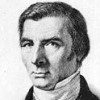
I divide my officers into four classes: the clever, the lazy, the industrious, and the stupid. Each officer possesses at least two of these qualities. Those who are clever and industrious are fitted for the highest staff appointments. Use can be made of those who are stupid and lazy. The man who is clever and lazy however is for the very highest command; he has the temperament and nerves to deal with all situations. But whoever is stupid and industrious is a menace and must be removed immediately!
Kurt von Hammerstein-Equord (1878–1943) German general
(Attributed)
Possibly apocryphal. Quoted (unconfirmed) in Horst Poller, Bewältigte Vergangenheit. Das 20. Jahrhundert, erlebt, erlitten, gestaltet [Conquered Past. The 20th century, witnessed, endured, shaped] (2010). Sometimes cited to Truppenführung [Troop Leading] (1933), the German Army Field Manual, but not found there. Also attributed to Erich von Manstein.

There is no joy on this earth like falling in love with a woman and managing at the same time the trick of keeping just enough perspective to see her fall in love too, to see her begin to see you in a different way, to see her color change, eyes soften, her hand of itself reach for you. … And there is no pain on this earth like seeing the same woman look at another man the way she once looked at you.
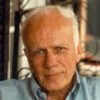
Jesus Christ chose to be born of poor and humble parents, in a land remote from the centre of political or intellectual influence, and in the circle of labouring men. He chose to belong to the class of the respectable artisan, and most of the twelve Apostles came from the same social level. In His teaching He plainly associated blessedness with the lot of poverty, and extreme danger with the lot of wealth. All through the New Testament the assumption is that God is on the side of the poor against the rich. As Jowett once said, there is more in the New Testament against being rich, and in favour of being poor, than we like to recognise.
William Ralph Inge (1860–1954) English prelate [Dean Inge]
“Bishop Gore and the Church of England,” Edinburgh Review (Jan 1908)
(Source)
Reprinted in Outspoken Essays: First Series (1911).
Ill doers in the end shall ill receive.
[Chi mal opra, male al fine aspetta.]
Ludovico Ariosto (1474–1533) Italian poet
Orlando Furioso, Canto 37, st. 106, l. 6 (1532) [tr. Rose (1831)]
(Source)
In youth, it was a way I had
To do my best to please,
And change, with every passing lad,
To suit his theories.But now I know the things I know,
And do the things I do;
And if you do not like me so,
To hell, my love, with you!
Many journalists have fallen for the conspiracy theory of government. I do assure you that they would produce more accurate work if they adhered to the cock-up theory.
Bernard Ingham (b. 1932) British journalist, civil servant, press secretary
Quoted in The Observer (17 Mar 1985)
Often paraphrased, "Cock-up before conspiracy." Cf. Hanlon.

In the end, it is important to remember that we cannot become what we need to be by remaining what we are.
Max De Pree (1924–2017) American businessman and writer
Leadership Is an Art, “Who Owns This Place?” (1987)
(Source)
Sometimes misquoted as "by remaining who we are."

To say that an idea is fashionable is to say, I think, that it has been adulterated to a point where it is hardly an idea at all.
Murray Kempton (1917–1997) American journalist.
Part of Our Time, ch. 6 “The Day of the Locust” (1955)
(Source)
There are years that ask questions and years that answer.
Zora Neale Hurston (1891–1960) American writer, folklorist, anthropologist
Their Eyes Were Watching God, ch. 3 (1937)
(Source)

DORINE: Those who have the greatest cause for guilt and shame
Are quickest to besmirch a neighbor’s name.[Ceux de qui la conduite offre le plus à rire
Sont toujours sur autrui les premiers à médire.]
Molière (1622–1673) French playwright, actor [stage name for Jean-Baptiste Poquelin]
Tartuffe, or the Hypocrite [Le Tartuffe, ou L’Imposteur], Act 1, sc. 1 (1669) [tr. Wilbur (1963)]
(Source)
(Source (French)). Other translations:People, whose own Conduct is the most ridiculous, are always readiest to detract from that of others.
[tr. Clitandre (1672)]They whose own conduct is the most ridiculous are always the first to slander others.
[tr. Van Laun (1876)]The people whose conduct offers the greatest hold to ridicule are always the first to speak unkindly of others.
[tr. Wall (1879)]People whose conduct is the most ridiculous, are always the readiest to run down that of others.
[tr. Mathew (1890)]Those who are the most ridiculous in their own conduct are always the first to libel others.
[tr. Waller (1903)]Those whose own conduct's most ridiculous,
Are always quickest to speak ill of others.
[tr. Page (1909)]Those whose behavior is ridiculous
Always are first to see the faults of others.
[tr. Bishop (1957)]Those whose behavior is most asinine
Are always more than ready to malign.
[tr. Frame (1967)]Since they are always talked about,
They're sniffing other scandal out.
[tr. Bolt (2002)]It's always the most ridiculous people who are the first to slander others.
[tr. Steiner (2008)]People with the most to hide are always the worst.
Always the first to criticize others.
[tr. Campbell (2013)]Those whose conduct gives room for talk
Are always the first to attack their neighbors.
[Bartlett's]
Good authors, too, who once knew better words
Now only use four-letter words
Writing prose.
Anything goes!Cole Porter (1891–1964) American composer and songwriter
“Anything Goes” (1934)
There is not a soul who does not have to beg alms of another, either a smile, a handshake, or a fond eye.
John Dalberg, Lord Acton (1834–1902) British historian, politician, writer
(Attributed)
Ridicule: After rape, the second most powerful method of controlling women.
Marie Shear (1940–2017) American writer and feminist activist
“Media Watch: Celebrating Women’s Words,” New Directions for Women (May/Jun 1986)
(Source)
Experience makes more timid men than it duz wise ones.
[Experience makes more timid men than it does wise ones.]
Josh Billings (1818–1885) American humorist, aphorist [pseud. of Henry Wheeler Shaw]
Everybody’s Friend, Or; Josh Billing’s Encyclopedia and Proverbial Philosophy of Wit and Humor, “Lobstir Sallad” (1874)
(Source)
Political campaigns tend to be exercises in progressive degeneration. The steady increase, week after week, in excitement and strain and weariness produces an oversimplification of issues, an over dramatization of alternatives, a growing susceptibility to extreme and catastrophic statements. Candidates find themselves shouting things in the fall that they would never dream of whispering in the summer.
Arthur M. Schlesinger, Jr. (1917–2007) American historian, author, social critic
The Age of Roosevelt, ch. 33, sec. 8 (1960)
(Source)
What really knocks me out is a book that, when you’re all done reading it, you wish the author that wrote it was a terrific friend of yours and you could call him up on the phone whenever you felt like it. That doesn’t happen much, though.
J. D. Salinger (1919–2010) American writer [Jerome David Salinger]
The Catcher in the Rye, ch. 3 (1951)

Every now and then, in the course of great events, the elements of tradition and innovation ally themselves and each one’s weakness supplements the other and together they achieve the perfect debacle.
Murray Kempton (1917–1997) American journalist.
“The Genius of Mussolini,” New York Review of Books (7 Oct 1982)
(Source)
Reprinted in Rebellions, Perversities, and Main Events (1994).
Beauty is as summer fruits, which are easy to corrupt, and cannot last.
Francis Bacon (1561–1626) English philosopher, scientist, author, statesman
“Of Beauty,” Essays, No. 43 (1625)
(Source)

The newspapers still talk about glory but the average man, thank God, has got rid of that illusion. It is a damned bore, with a stalemate as the most probable outcome, but one has to see it through, and see it through with the knowledge that whichever side wins, civilisation in Europe will be pipped for the next 30 years. Don’t indulge in Romance here, Malcolm, or suppose that an era of jolly little nationalities is dawning. We shall be much too much occupied with pestilence and poverty to reconstruct.
E. M. Forster (1879–1970) English novelist, essayist, critic, librettist [Edward Morgan Forster]
Letter to Malcolm Darling (6 Nov 1914)
(Source)
EPOPS: Come let me see, what shall the name be for our city? […]
EUELPIDES: Hence, from the clouds, and these meteoric regions, some all-swelling name.
PISTHETAERUS: Would you “Cloud-cuckoo-land?”Aristophanes (c. 450-c. 388 BC) Athenian comedic playwright
The Birds, ll. 812, 817-819 (414 BC) [tr. Warter (1830)]
(Source)
Alt. trans. [Hickie (1853)]
EPOPS: Come, let me see, what shall the name of our city be? [...]
EUEL.: Something very grand, from hence, from the clouds and elevated regions.
PISTH.: Would you "Cloud-cuckoo-town?"
Alt. trans. [Rogers (1906)]
CH.: Then let's consider what the name shall be.
CH.: Invent some fine
Magniloquent name, drawn from these upper spaces
And clouds.
PEI.: What think you of Cloudcuckoobury?
Alt. trans. [O'Neill (1938)]
LEADER OF THE CHORUS: Let's see. What shall our city be called? [...]
EUELPIDES: Some name borrowed from the clouds, from these lofty regions in which we dwell -- in short, some well-known name.
PISTHETAERUS: Do you like Nephelococcygia?
RESPECTABILITY, n. The social status of people whose sins haven’t quite caught up with them.
Edmund H. Volkart (1919–1992) American sociologist, researcher, editor
The Angel’s Dictionary: A Modern Tribute to Ambrose Bierce (1986)
business business business
grind grind grind
what a life for a man
that might have been a poetDon Marquis (1878–1937) American journalist and humorist
“pete the parrot and shakespeare,” archy and mehtabel (1927)
(Source)
A babe is nothing but a bundle of possibilities.
Henry Ward Beecher (1813–1887) American clergyman and orator
Proverbs from Plymouth Pulpit, “Children” (1887) [ed. William Drysdale]
(Source)
For the propaganda of totalitarian movements which precede and accompany totalitarian regimes is invariably as frank as it is mendacious, and would-be totalitarian rulers usually start their careers by boasting of their past crimes and carefully outlining their future ones. The Nazis were “convinced that evil-doing in our time has a morbid force of attraction,” Bolshevik assurances inside and outside Russia that they do not recognize ordinary moral standards have become a mainstay of Communist propaganda, and experience has proven time and again that the propaganda value of evil deeds and general contempt for moral standards is independent of mere self-interest, supposedly the most powerful psychological factor in politics.
Hannah Arendt (1906–1975) German-American philosopher, political theorist
Origins of Totalitarianism, Part 3, ch. 10 “A Classless Society,” sec. 1 (1951)
(Source)
The way you wear your hat,
The way you sip your tea,
The mem’ry of all that —
No, no! They can’t take that away from me!Ira Gershwin (1896–1983) American lyricist [b. Israel Gershowitz]
“They Can’t Take That Away from Me”, Shall We Dance (1937)
(Source)
The real and lasting victories are those of peace and not of war.
Ralph Waldo Emerson (1803–1882) American essayist, lecturer, poet
Essay (1860), “Worship,” The Conduct of Life, ch. 6
(Source)
Based on a course of lectures, "The Conduct of Life," delivered in Pittsburg (1851-03).
After all, the saddest thing that can happen to a man is to carry no burden. To be bent under too great a load is bad; to be crushed by it is lamentable, but even in that there are possibilities that are glorious. But to carry no load at all — there is nothing in that. No one seems to arrive at any goal really worth reaching in this world who does not come to it heavy laden.
Edward Sandford Martin (1856–1939) American writer and editor
In a New Century, ch. 21 “Deafness” (1903)
Quoted by Theodore Roosevelt, Speech, New York State Agricultural Association, Syracuse (7 Sep 1903).
Men of all degrees should form this prudent habit:
Never serve a rabbit stew before you catch the rabbit.James Thurber (1894–1961) American humorist, cartoonist, writer
“Ivory, Apes, and People,” Further Fables for Our Time (1956)
Love makes you go all in. Love makes you voluntarily stupid. Love robs you of the humor you use to protect yourself and leaves you speechless. Love makes your soul crawl out from its hiding place. And then it strips you down, and leaves you fully nude for all to see.
Zora Neale Hurston (1891–1960) American writer, folklorist, anthropologist
(Attributed)
This was originally cited here (without link to a source) as from Hurston's Their Eyes Were Watching God, ch. 13 (1937). Per the comment below, I dug deeper to find an online copy of the book, and discovered the quotation was not there. The closest bits were in the final words of ch. 13:He drifted off into sleep and Janie looked down on him and felt a self-crushing love. So her soul crawled out from its hiding place.
I cannot find any other citation for it, no work of Hurston that includes it (or any other fractions of it), and only one online book (beyond books of uncited quotations) that includes this full passage (and finishes it off with "... fully nude for all to see, / That's why it's so downright terrifying, / Falsely Yours, Zora Neale Hurston").
Because of that, I am changing the citation to a more ambiguous "(Attributed)". If anyone has more information, I'd be happy to update this entry.
CLEANTHES: To gossip seems to be a human need;
Our best protection is to pay no heed.
Let’s live in innocence as best we may,
And let the gossipmongers have their say.[Contre la médisance il n’est point de rempart.
À tous les sots caquets n’ayons donc nul égard;
Efforçons-nous de vivre avec toute innocence,
Et laissons aux causeurs une pleine licence.]Molière (1622–1673) French playwright, actor [stage name for Jean-Baptiste Poquelin]
Tartuffe, or the Hypocrite [Le Tartuffe, ou L’Imposteur], Act 1, sc. 1 (1669) [tr. Frame (1967)]
(Source)
(Source (French)). Other translations:There's no guarding against Calumny: Let us therefore not mind silly tittle-tattle, and let's endeavour to live innocently our selves, and leave the gossiping part of Mankind to say what they please.
[tr. Clitandre (1672)]There is no protection against slander. Let us, therefore, pay no regard to all this silly tittle-tattle; let us endeavour to live honestly, and leave the gossips to say what they please.
[tr. Van Laun (1876)]There is no safeguard against calumny. Let us, therefore, not mind all that foolish gossip, but only endeavour to lead a virtuous life, and leave full licence to the scandal-mongers.
[tr. Wall (1879)]There is no defence against calumny. So let us not mind foolish tittle-tattle, and let us endeavour to live innocently, and leave the gossips to say what they please.
[tr. Mathew (1890)]There is not any protection against slander. Do not let us pay any attention to foolish gossip, but endeavour to live honestly and leave the scandal-mongers to say what they will.
[tr. Waller (1903)]Against backbiting there is no defence
So let us try to live in innocence,
To silly tattle pay no heed at all,
And leave the gossips free to vent their gall.
[tr. Page (1909)]There is no wall so high it shuts out slander.
So let's not give a thought to silly gossip,
And let us try to live in innocence,
And let the talkers talk just as they please.
[tr. Bishop (1957)]One can't fight slander; it's a losing battle;
Let us instead ignore their tittle-tattle.
Let's strive to live by conscience' clear decrees,
And let the gossips gossip as they please.
[tr. Wilbur (1963)]There is nothing that can hold back gossip.
Let's give no attention to fools who chatter mean things;
Let's try to live in all innocence,
And leave it to other people to say what they will.
[tr. Siniscalchi (c. 1994)]Tongues would still wag, it's what tongues do,
Scandal will find a passage through
No matter how secure a wall
We built against it -- hang them all!
Their talk won't bother us a bit
As long as there's no grounds for it.
Provided we've done nothing wrong
They're free to babble all day long.
[tr. Bolt (2002)]There's no defense against slander.
Let's pay no attention to their cackling;
we'll try to live virtuously and
let busybodies have their way.
[tr. Steiner (2008)]There is no defence against malicious gossip.
Let's just concentrate on living a good and decent life
And let people talk all they please.
[tr. Campbell (2013)]There is no rampart that will hold out against malice.
[Bartlett's]
Oh dear, I’m feeling political today. It’s just that it’s dawned on me that “zero tolerance” only seems to mean putting extra police in poor, run-down areas, and not in the Stock Exchange.

Our children give us the opportunity to become the parents we always wished we’d had.
Louise Hart (contemp.) American educator, psychologist, author, speaker
The Winning Family, ch. 1, epigraph (1987)

That city [is best to live in,] in which those who are not wronged, no less than those who are wronged, exert themselves to punish the wrongdoers.
Solon (c. 638 BC - 558 BC) Athenian statesman, lawmaker, poet
Quoted in Plutarch, Parallel Lives, “The Life of Solon,” sec. 18.5 [tr. Perrin (1914)]
(Source)
Alt. trans.:
- "That [city is best managed] in which those who are not wronged espouse the cause of those who are, and punish their oppressors." [tr. Stewart, Long (1894)]
- "That [city is best modeled] where those that are not injured try and punish the unjust as much as those that are." [Source]
- "That [city is best modeled] where those who are not injured, are as ready to prosecute and punish offenders, as those who are." [tr. Langhorne, Langhorne (1819)]
- "The city [is best governed of all] where those who have not been wronged show themselves just as ready to punish the offender as thouse who have been." [tr. Scott-Kilvert (1960)]
- Paraphrased as "Justice can be secured in Athens if those who are not injured feel as indignant as those who are," in Earl Warren, "The Law and the Future," Fortune (Nov 1955).

There are some places so beautiful they can make a grown man break down and weep.
Edward Abbey (1927–1989) American anarchist, writer, environmentalist
“TV Show: Out There On the Rocks,” One Life at a Time, Please (1988)
(Source)
It is only hypocrites who cannot forgive hypocrisy, whereas those who search for truth are too conscious of the maze to be hard on others.
E. M. Forster (1879–1970) English novelist, essayist, critic, librettist [Edward Morgan Forster]
“Albergo Empedocle” (1903)
(Source)
CHORUS [LEADER]:
Ye Children of Man! whose life is a span,
Protracted with sorrow from day to day,
Naked and featherless, feeble and querulous,
Sickly, calamitous creatures of clay![ἄγε δὴ φύσιν ἄνδρες ἀμαυρόβιοι, φύλλων γενεᾷ προσόμοιοι,
ὀλιγοδρανέες, πλάσματα πηλοῦ, σκιοειδέα φῦλ᾽ ἀμενηνά,
ἀπτῆνες ἐφημέριοι ταλαοὶ βροτοὶ ἀνέρες εἰκελόνειροι]Aristophanes (c. 450-c. 388 BC) Athenian comedic playwright
The Birds, ll. 685-687 (414 BC) [tr. Frere (1839)]
(Source)
Alt. trans.:
- "Come now, ye men, in nature darkling, like to the race of leaves, of little might, figures of clay, shadowy feeble tribes, wingless creatures of a day, miserable mortals, dream-like men." [tr. Hickie (1853)]
- "Weak mortals, chained to the earth, creatures of clay as frail as the foliage of the woods, you unfortunate race, whose life is but darkness, as unreal as a shadow, the illusion of a dream." [tr. O'Neill (1938)]
- "Come, ye of mortal mould, whose life is spent in darkness, ye who are like to the race of leaves, ye that are weak in action, ye images of clay, ye feeble shadowy tribes, ye wingless creatures of a day, ye miserable mortals, ye men like unto the stuff which dreams are made of ...." [tr. Warter (1830)]
- "Now then, ye men by nature just faintly alive, like to the race of leaves, do-littles, artefacts of clay, tribes shadowy and feeble, wingless ephemerals, suffering mortals, dreamlike people ...." [tr. Henderson (1998)]
- "Ye men who are dimly existing below, who perish and fade as the leaf, / Pale, woebegone, shadowlike, spiritless folk, life feeble and wingless and brief, / Frail castings in clay, who are gone in a day, like a dream full of sorrow and sighing ...." [tr. Rogers (1906)]
Justice is indiscriminately due to all, without regard to numbers, wealth, or rank.
John Jay (1745–1829) American statesman, diplomat, abolitionist, politician, Chief Justice (1789–1795)
Georgia v. Brailsford, 3 US 1 (1794) [unanimous opinion]
(Source)

Father asked us what was God’s noblest work. Anna said men, but I said babies. Men are often bad; babies never are.
Louisa May Alcott (1832–1888) American writer
Diary (1843-09-01)
(Source)
Quoted in Edna D. Cheney, ed., Louisa May Alcott: Her Life, Letters, and Journals (1889)
You like potato and I like po-tah-to,
You like tomato and I like to-mah-to;
Potato, po-tah-to, tomato, to-mah-to —
Let’s call the whole thing off!Ira Gershwin (1896–1983) American lyricist [b. Israel Gershowitz]
“Let’s Call the Whole Thing Off,” Shall We Dance (1937)
(Source)
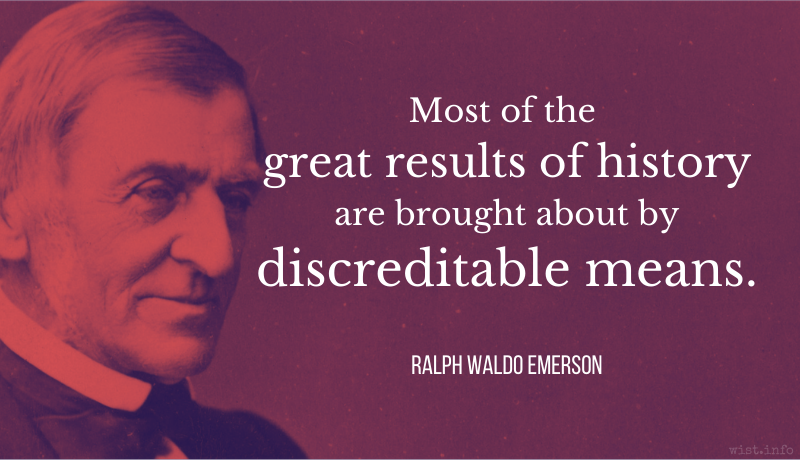
Most of the great results of history are brought about by discreditable means.
Ralph Waldo Emerson (1803–1882) American essayist, lecturer, poet
Essay (1860), “Considerations by the Way,” The Conduct of Life, ch. 7
(Source)
Based on a course of lectures by that name first delivered in Pittsburg (1851-03).
As a carpenter can make a gibbet as well as an altar, a writer can describe the world as trivial or exquisite, as material or as idea, as senseless or as purposeful. Words are wood.

We are never so certain of our knowledge as when we’re dead wrong.
Adair Lara (b. 1952) American writer, columnist, teacher
“A Lot of Knowledge Is Dangerous, Too,” San Francisco Chronicle (9 Oct 1997)
(Source)

The allurement that women hold out to men is precisely the allurement that Cape Hatteras holds out to sailors: they are enormously dangerous and hence enormously fascinating.
H. L. Mencken (1880–1956) American writer and journalist [Henry Lewis Mencken]
“The Incomparable Buzz-Saw,” The Smart Set (May 1919)
(Source)
When the heavy-handed dogmatist requires a categorical assent to the literal truth of the miraculous, in exactly the same sense in which physical facts are true, a tension between faith and reason cannot be avoided.
William Ralph Inge (1860–1954) English prelate [Dean Inge]
“Bishop Gore and the Church of England” (1908), Outspoken Essays: First Series (1911)
(Source)
As nought good endures beneath the skies,
So ill endures no more.[Come cosa buona non si trova
Che duri sempre, così ancor né ria.]
Drink and dance and laugh and lie,
Love, the reeling midnight through,
For tomorrow we shall die!
(But, alas, we never do.)Dorothy Parker (1893–1967) American writer, poet, wit
“The Flaw in Paganism,” Death and Taxes (1931)
(Source)
The certainties of one age are the problems of the next.
R. H. Tawney (1880–1962) English writer, economist, historian, social critic [Richard Henry Tawney]
Religion and the Rise of Capitalism, ch. 5 (1926)
(Source)
What is not good for the swarm is not good for the bee.
[Τὸ τῷ σμήνει μὴ συμφέρον οὐδὲ τῇ μελίσσῃ συμφέρει.]
Marcus Aurelius (AD 121–180) Roman emperor (161–180), Stoic philosopher
Meditations [To Himself; Τὰ εἰς ἑαυτόν], Book 6, ch. 54 (6.54) (AD 161-180) [tr. Rendall (1898)]
(Source)
(Source (Greek)). Other translations:That which is not good for the beehive, cannot be good for the bee.
[tr. Casaubon (1634), 6.49]That which is not for the Interest of the whole Swarm, is not for the Interest of a single Bee.
[tr. Collier (1701); Collier/Zimmern (1887)]What is not the interest of the hive, is not the interest of the bee.
[tr. Hutcheson/Moor (1742)]That which is not for the interest of the whole hive, cannot be so for any single bee.
[tr. Graves (1792), 6.48]That which is not good for the swarm, neither is it good for the bee.
[tr. Long (1862)]What profits not the swarm profits not the bee.
[tr. Hutcheson/Chrystal (1902)]That which is not in the interests of the hive cannot be in the interests of the bee.
[tr. Haines (Loeb) (1916)]What does not benefit the hive is no benefit to the bee.
[tr. Farquharson (1944)]What is no good for the hive is no good for the bee.
[tr. Staniforth (1964)]What brings no benefit to the hive brings none to the bee.
[tr. Hard (1997 ed.)]What injures the hive injures the bee.
[tr. Hays (2003)]What does not benefit the hive does not benefit the bee either.
[tr. Hammond (2006)]What brings no benefit to the hive brings none to the bee.
[tr. Hard (2011 ed.)]What does not benefit the hive does not benefit the bee.
[tr. Gill (2013)]


To expose vices to everyone’s laughter is to deal them a mighty blow. People easily endure reproofs, but they cannot at all endure being made fun of. People have no objection to being considered wicked, but they are not willing to be considered ridiculous.
[C’est une grande atteinte aux vices que de les exposer à la risée de tout le monde. On souffre aisément des répréhensions, mais on ne souffre point la raillerie. On veut bien être méchant, mais on ne veut point être ridicule.]
Molière (1622–1673) French playwright, actor [stage name for Jean-Baptiste Poquelin]
Tartuffe, or the Hypocrite [Le Tartuffe, ou L’Imposteur], Preface (1669-03) [tr. Kerr]
(Source)
Moliere's preface explained once more the history of attacks on and suppression of his play, following up on the several petitions he had made to King Louis XIV. While the play had been first performed in 1664, it was only in 1669 that its final version was removed from the ban placed on it by Church officials.
(Source (French)). Other translations:To expose vices to the ridicule of all the world is a severe blow to them. Reprehensions are easily suffered, but not so ridicule. People do not mind being wicked; but they object to being made ridiculous.
[tr. Van Laun (1876)]Displaying vice to mockery of men deals it a great blow. Men will put up with admonition but are loath to be mocked. One might be willing to be wicked; one cannot bear to appear foolish.
[tr. Steiner (2008)]
If you said to a bunch of average people two hundred years ago “Would you be happy in a world where medical care is widely available, houses are clean, the world’s music and sights and foods can be brought into your home at small cost, travelling even 100 miles is easy, childbirth is generally not fatal to mother or child, you don’t have to die of dental abcesses and you don’t have to do what the squire tells you” they’d think you were talking about the New Jerusalem and say ‘yes’.
Terry Pratchett (1948–2015) English author
(Attributed)
Usually cited to alt.fan.pratchett, but not found in the repository.
Human blunders, however, usually do more to shape history than human wickedness.
A. J. P. Taylor (1906–1990) British historian, journalist, broadcaster [Alan John Percivale Taylor]
The Origins of the Second World War, ch. 10 “The War of Nerves” (1961)
He who would acquire fame must not show himself afraid of censure. The dread of censure is the death of genius.
William G. Simms (1806–1870) American writer and politician
Egeria, Or Voices of Thought and Counsel, for the Woods and Wayside, “Ambition” (1853)
(Source)

Architecture in general is frozen music.
Friedrich von Schelling (1775–1854) German philosopher
Philosophie der Kunst (1809)
Often attributed to Johann von Goethe, who used a similar description ("frozen music" or "petrified music") in an 1829 letter.

The humanist has four leading characteristics — curiosity, a free mind, belief in good taste, and belief in the human race.
E. M. Forster (1879–1970) English novelist, essayist, critic, librettist [Edward Morgan Forster]
“George and Gide” Two Cheers for Democracy (1951)
(Source)
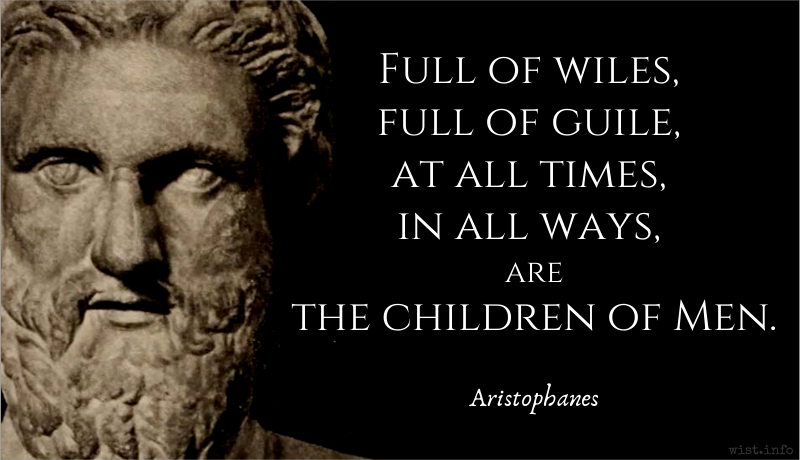
CHORUS: Full of wiles, full of guile, at all times, in all ways, are the children of Men.
[δολερὸν μὲν ἀεὶ κατὰ πάντα δὴ τρόπον / πέφυκεν ἄνθρωπος]
Aristophanes (c. 450-c. 388 BC) Athenian comedic playwright
The Birds, ll. 451-2 (414 BC) [tr. Rogers (1906)]
(Source)
Alt. trans.:
- "Man naturally is deceitful, ever indeed, and always, in every one thing." [tr. Warter (1830)]
- "Man is naturally deceitful ever, in every way!" [tr. Hickie (1853)]
- "Man is a truly cunning creature." [abridged tr. O'Neill (1938)]
- "A treacherous thing always in every way is human nature." [tr. Henderson (1998)]
And as she looked about, she did behold
How over that same door was likewise writ,
Be bold, be bold, and everywhere Be bold,
That much she mused, yet could not construe it
By any riddling skill or common wit.
At last she spied at that room’s upper end
Another iron door, on which was writ,
Be not too bold.Edmund Spenser (c. 1552–1599) English poet
The Faerie Queen, Book 3, Canto 11, st. 54 (1590-96)
(Source)

I like handling newborn animals. Fallen into life from an unmappable world, they are the ultimate immigrants, full of wonder and confusion.
Diane Ackerman (b. 1948) American poet, author, naturalist
The Moon by Whale Light, ch. 4 “White Lanterns” (1991)
(Source)

I got rhythm, I got music,
I got my man
Who could ask for anything more?Ira Gershwin (1896–1983) American lyricist [b. Israel Gershowitz]
“I Got Rhythm”, Girl Crazy, Act 1 (1930)
(Source)
Good luck is another name for tenacity of purpose.
Ralph Waldo Emerson (1803–1882) American essayist, lecturer, poet
Essay (1860), “Wealth,” The Conduct of Life, ch. 3
(Source)
Based on a course of lectures, "The Conduct of Life," delivered in Pittsburg (1851-03).
You want to cry aloud for your
mistakes. But to tell the truth the world
doesn’t need any more of that sound.Mary Oliver (1935–2019) American poet
“The Poet With His Face in His Hands,” New Yorker (4 Apr 2005)
(Source)
Collected in New and Selected Poems, Vol. 2 (2005), and The Best American Poetry, 2006.
Things are beautiful if you love them.
Jean Anouilh (1910–1987) French dramatist
Mademoiselle Colombe, Act 2, sc. 2 (1950) [tr. Kronenberger (1954)]
(Source)

… “[F]uture shock” [is] the shattering stress and disorientation that we induce in individuals by subjecting them to too much change in too short a time.

My mother said it was simple to keep a man, you must be a maid in the living room, a cook in the kitchen, and a whore in the bedroom. I said I’d hire the other two and take care of the bedroom bit.
(Other Authors and Sources)
Jerry Hall (b. 1952), quoted in The Observer (6 Oct 1985)
On her relationship with Mick Jagger.
A love of order, seemliness, and good taste has led the Anglican Church along a middle path between what a seventeenth-century divine called “the meretricious gaudiness of the Church of Rome and the squalid sluttery of fanatic conventicles.”
William Ralph Inge (1860–1954) English prelate [Dean Inge]
“Bishop Gore and the Church of England” (1908), Outspoken Essays, First Series (1919)
(Source)
The reference is to "S. P. of Cambridge," believed to be the later Bishop Simon Patrick, who published in 1662 the pamphlet "A Brief Account of the new Sect of Latitude-men," lauding "that virtuous mediocrity which our Church observes between" the alternatives quoted by Inge. Reprinted in John Dunton, The Phenix, Vol. 2, ch. 4 (1707).
Of ladies, knights, of passions and of wars,
of courtliness, and of valiant deeds I sing.[Le donne i cavallier, l’arme, gli amori,
Le cortesie, l’audaci imprese io canto.]Ludovico Ariosto (1474–1533) Italian poet
Orlando Furioso, Canto 1, st. 1 (1532) [tr. Slavitt]
If I didn’t care for fun and such,
I’d probably amount to much.
But I shall stay the way I am,
Because I do not give a damn.Dorothy Parker (1893–1967) American writer, poet, wit
“Observation,” New York World (16 Aug 1925)
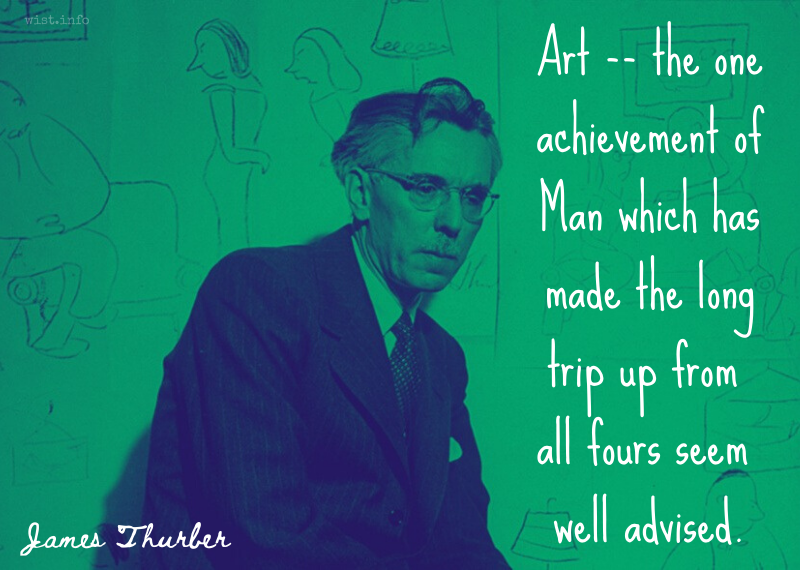
Art — the one achievement of Man which has made the long trip up from all fours seem well advised.
James Thurber (1894–1961) American humorist, cartoonist, writer
Forum and Century (Jun 1939)
Also quoted in Clifton Fadiman, I Believe: The Personal Philosophies of Certain Eminent Men and Women of Our Time (1939).
Lead the ideas of your time and they will accompany and support you; fall behind them and they drag you along with them; oppose them and they will overwhelm you.
Napoleon Bonaparte (1769–1821) French emperor, military leader
(Attributed)
(Source)
Quoted, unsourced, in Jules Bertaut, Napoleon: In His Own Words [Virilités, maximes et pensées de Napoléon Bonaparte], ch. 4 (1916) [tr. Law and Rhodes].

Natur iz a kind mother. She couldn’t well afford to make us perfekt, and so she made us blind to our failings.
[Nature is a kind mother. She couldn’t well afford to make us perfect, and so she made us blind to our failings.]
Josh Billings (1818–1885) American humorist, aphorist [pseud. of Henry Wheeler Shaw]
Everybody’s Friend, Or; Josh Billing’s Encyclopedia and Proverbial Philosophy of Wit and Humor, “Lobstir Sallad” (1874)
(Source)
Everyone is a bore to someone. That is unimportant. The thing to avoid is being a bore to oneself.
Gerald Brenan (1894–1987) British writer and Hispanist [Edward FitzGerald Brenan]
Thoughts in a Dry Season, “Life” (1978)
There are two kinds of people in one’s life — people whom one keeps waiting — and the people for whom one waits.
S. N. Behrman (1893–1973) American playwright, screenwriter, biographer, writer [Samuel Nathaniel Behrman]
Biography, Act 1 [Feydak] (1933)
(Source)
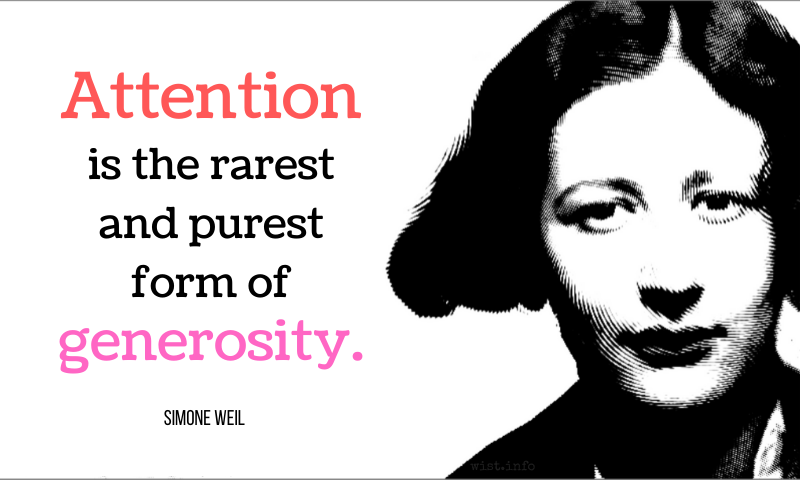
Attention is the rarest and purest form of generosity.
Simone Weil (1909–1943) French philosopher
Letter to Joë Bousquet (13 Apr 1942)
Quoted in Simone Pétrement, Simone Weil: A Life (1976) [tr. Rosenthal].

Every man is a consumer, and ought to be a producer. He fails to make his place good in the world, unless he not only pays his debt, but also adds something to the common wealth.
Ralph Waldo Emerson (1803–1882) American essayist, lecturer, poet
Essay (1860), “Wealth,” The Conduct of Life, ch. 3
(Source)
Based on a course of lectures, "The Conduct of Life," delivered in Pittsburg (1851-03).
I don’t want to end up simply having visited this world.
Mary Oliver (1935–2019) American poet
“When Death Comes” New and Selected Poems, Vol. 2 (2005)
There is nothing more common than to hear of men losing their energy on being raised to a higher position, to which they do not feel themselves equal.
[Nichts gewöhnlicher ist als Beispiele von Männern, die ihre Thätigkeit verlieren, sobald sie zu höheren Stellen gelangen, denen ihre Einsichten nicht mehr gewachsen sind.]
Karl von Clausewitz (1780–1831) Prussian soldier, historian, military theorist
On War [Vom Kriege], Book 1, ch. 3 “On Military Genius [Der Kriegerishe Genius],” (1.3) (1832) [tr. Graham (1873)]
(Source)
(Source (German)). Other translations:There is nothing more common than to hear of men losing their energy on being raised to a higher position, to which their abilities are no longer equal.
[tr. Jolles (1943)]No case is more common than that of the officer whose energy declines as he rises in rank and fills positions that are beyond his abilities.
[tr. Howard & Paret (1976)]

The most merciful thing in the world, I think, is the inability of the human mind to correlate all its contents. We live on a placid island of ignorance in the midst of black seas of infinity, and it was not meant that we should voyage far. The sciences, each straining in its own direction, have hitherto harmed us little; but some day the piecing together of dissociated knowledge will open up such terrifying vistas of reality, and of our frightful position therein, that we shall either go mad from the revelation or flee from the deadly light into the peace and safety of a new dark age.
H. P. Lovecraft (1890–1937) American fabulist [Howard Phillips Lovecraft]
“The Call of Cthulhu,” ch. 1, opening words (1928)
(Source)

Slavery is doomed, and that within a few years. Even Judge Douglas admits it to be an evil, and an evil can’t stand discussion. In discussing it we have taught a great many thousands of people to hate it who had never given it a thought before. What kills the skunk is the publicity it gives itself. What a skunk wants to do is to keep snug under the barn in daytime, when men are around with shotguns.
Abraham Lincoln (1809–1865) American lawyer, politician, US President (1861–65)
Interview (1859-09-17?) with David R. Locke, Columbus, Ohio
(Source)
After his speech in Columbus (1859-09-16), discussing the effect of drawing attention to the problem of slavery through his speech-making. Recounted by Locke in A. T. Rice (ed.), Reminiscences of Abraham Lincoln by Distinguished Men of His Time, ch. 25 (1883).

You are right in assuming that I am indifferent to the pattern of things. I am. I have never liked stale phrases and bodyless courage. I have the nerve to walk my own way, however hard, in my search for reality, rather than climb upon the rattling wagon of wishful illusions.
Zora Neale Hurston (1891–1960) American writer, folklorist, anthropologist
Letter to Countee Cullen (5 Mar 1943)
(Source)
I always make the first Verse well, but I’m perplex’d about the rest.
[Je fais toujours bien le premier vers: mais j’ai peine à faire les autres.]
Molière (1622–1673) French playwright, actor [stage name for Jean-Baptiste Poquelin]
The Romantick Ladies [Les Précieuses Ridicules], Act 1, sc. 11 (1659)
(Source)
Alt. trans.: "I always make the first verse well, but I have trouble making the others."
That seems to point up a significant difference between Europeans and Americans:
A European says: I can’t understand this, what’s wrong with me?
An American says: I can’t understand this, what’s wrong with him?
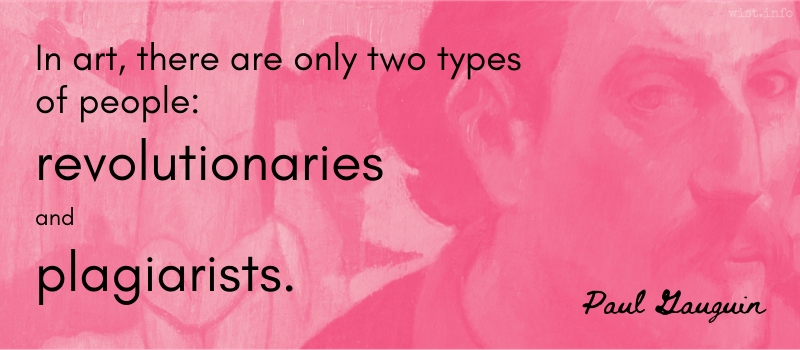
In art, there are only two types of people: revolutionaries and plagiarists. And in the end, doesn’t the revolutionary’s work become official, once the State takes it over?
Paul Gauguin (1848–1903) French painter [Eugène Henri Paul Gauguin]
Letter in Le Soir (25 Apr 1895)
Collected in Daniel Guérin, ed., The Writings of a Savage (1996) [tr. Levieux].
Often given as "Art is either plagiarism or revolution," or sometimes "Art is either a revolutionist or a plagiarist." This is often cited from James Huneker, The Pathos of Distance (1913), but there it is given as a paraphrase: "Paul Gauguin has said that in art one is either a plagiarist or a revolutionary."
(Huneker's book elsewhere contains the parallel paraphrase, "Paul Gauguin has said that all artists are either revolutionists or reactionists.")

Pocket Envy: Women’s unfulfilled yearning for practical clothes
Marie Shear (1940–2017) American writer and feminist activist
“Media Watch: Celebrating Women’s Words,” New Directions for Women (May/Jun 1986)
(Source)
I do not see in religion the mystery of the incarnation, but the mystery of the social order; religion attaches to heaven an idea of equality that stops the rich from being massacred by the poor.
[Quant à moi, je ne vois pas dans la religion le mystère de l’incarnation, mais le mystère de l’ordre social; elle rattache au ciel une idée d’égalité qui empêche que le riche ne soit massacré par le pauvre.]
Napoleon Bonaparte (1769–1821) French emperor, military leader
Statement (4 Mar 1806)
(Source)
Quoted in Opinions de Napoléon sur divers sujets de politique et d'administration, recueillies par un membre de son conseil d'état (1833).
I make this distinkshun between charakter and reputashun — reputashun iz what the world thinks ov us, charakter is what the world knows of us.
[I make this distinction between character and reputation — reputation is what the world thinks of us, character is what the world knows of us.]
Josh Billings (1818–1885) American humorist, aphorist [pseud. of Henry Wheeler Shaw]
Everybody’s Friend, Or; Josh Billing’s Encyclopedia and Proverbial Philosophy of Wit and Humor, “Lobstir Sallad” (1874)
(Source)
It was easier for me to think of a world without a creator than of a creator loaded with all of the contradictions of the world.
Simone de Beauvoir (1908–1986) French author, existentialist philosopher, feminist theorist
Quoted in “Toward a Hidden God,” Time (8 Apr 1966)
(Source)

But in view of the Constitution, in the eye of the law, there is in this country no superior, dominant, ruling class of citizens. There is no caste here. Our Constitution is color-blind, and neither knows nor tolerates classes among citizens. In respect of civil rights, all citizens are equal before the law. The humblest is the peer of the most powerful. The law regards man as man, and takes no account of his surroundings or of his color when his civil rights as guaranteed by the supreme law of the land are involved.
John Marshall Harlan (1833–1911) American lawyer, politician, Supreme Court Justice (1877–1911)
Plessy v. Ferguson 163 U.S. 537, 559 (1896) [dissent]
(Source)
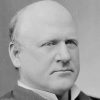
We shape our buildings, and afterwards our buildings shape us.
Winston Churchill (1874–1965) British statesman and author
Speech, House of Commons (28 Oct 1943)
(Source)
During the debate over rebuilding the House of Commons, which had been destroyed during a German bombing.
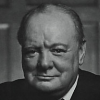
To make us feel small in the right way is a function of art; men can only make us feel small in the wrong way.
E. M. Forster (1879–1970) English novelist, essayist, critic, librettist [Edward Morgan Forster]
“A Book That Influenced Me,” Two Cheers for Democracy (1951)
(Source)
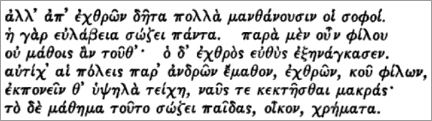
EPOPS: You’re mistaken: men of sense often learn from their enemies. Prudence is the best safeguard. This principle cannot be learned from a friend, but an enemy extorts it immediately. It is from their foes, not their friends, that cities learn the lesson of building high walls and ships of war. And this lesson saves their children, their homes, and their properties.
CHORUS [LEADER]: It appears then that it will be better for us to hear what they have to say first; for one may learn something at times even from one’s enemies.
Aristophanes (c. 450-c. 388 BC) Athenian comedic playwright
The Birds, l. 375ff (414 BC) [tr. Anon. (1812), Ramage (1864)]
(Source)
Alt. trans. [Hickie (1853)]:
EPOPS: Yet, certainly, the wise learn many things from their enemies; for caution preserves all things. From a friend you could not learn this, but your foe immediately obliges you to learn it. For example, the states have learned from enemies, and not from friends, to build lofty walls, and to possess ships of war. And this lesson preserves children, house, and possessions.
CHORUS [LEADER]: It is useful, as it appears to me, to hear their arguments first; for one might learn some wisdom even from one's foes.
Alt. trans. [O'Neill (1938)]:
EPOPS: The wise can often profit by the lessons of a foe, for caution is the mother of safety. It is just such a thing as one will not learn from a friend and which an enemy compels you to know. To begin with, it's the foe and not the friend that taught cities to build high walls, to equip long vessels of war; and it's this knowledge that protects our children, our slaves and our wealth.
LEADER OF THE CHORUS: Well then, I agree, let us first hear them, for that is best; one can even learn something in an enemy's school.
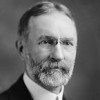
Arbitrary power and the rule of the Constitution cannot both exist. They are antagonistic and incompatible forces; and one or the other must of necessity perish whenever they are brought in conflict.
George Sutherland (1862–1942) Anglo-American jurist, Supreme Court Justice (1922–1938)
Jones v. Securities & Exchange Commission 298 U.S. 1 (1936) [majority opinion]
(Source)
It ain’t necessarily so,
It ain’t necessarily so —
De t’ings dat you li’ble
To read in de Bible —
It ain’t necessarily so.Ira Gershwin (1896–1983) American lyricist [b. Israel Gershowitz]
“It Ain’t Necessarily So,” Porgy and Bess, Act 2, sc. 2 (1935)
(Source)
The moment one gives close attention to anything, even a blade of grass, it becomes a mysterious, awesome, indescribably magnified world in itself.
Henry Miller (1891–1980) American novelist
Plexus, ch. 2 (1953)
(Source)
Sometimes misquoted as "magnificent world".
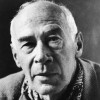
Concentration is the secret of strength in politics, in war, in trade, in short, in all management of human affairs.
Ralph Waldo Emerson (1803–1882) American essayist, lecturer, poet
Essay (1860), “Power,” The Conduct of Life, ch. 2
(Source)
Based on a course of lectures by that name first delivered in Pittsburg (1851-03).
But also I say this: that light
is an invitation
to happiness,
and that happiness,
when it’s done right,
is a kind of holiness,
palpable and redemptive.
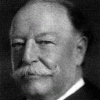
No honest, clear-headed man, however great a lover of popular government, can deny that the unbridled expression of the majority of a community converted hastily into law or action would sometimes make a government tyrannical and cruel. Constitutions are checks upon the hasty action of the majority. They are the self-imposed restraints of a whole people upon a majority of them to secure sober action and a respect for the rights of the minority.
William Howard Taft (1857–1930) US President (1909–13) and Chief Justice (1921–1930)
Veto Statement for the Arizona Enabling Act (15 Aug 1911)
(Source)
Taft vetoed the admission of Arizona to the US with a state constitution that allowed popular recall of judges.
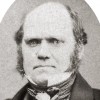
We thus learn that Man is descended from a hairy, tailed quadruped, probably arboreal in its habits, and an inhabitant of the Old World.
Things never turn out either so well or so badly as they logically ought to do.
William Ralph Inge (1860–1954) English prelate [Dean Inge]
“The Future of the English Race,” Galton Lecture (1919), Outspoken Essays: First Series (1920)
(Source)
Do not only look
For gentlefolk in castles: everywhere,
In humble dwellings and in haylofts, too,
The hearts of men are often kind and true.[Che non pur per cittadi e per castella,
Ma per tuguri ancora e per fenili
Spesso si trovan gli uomini gentili.]Ludovico Ariosto (1474–1533) Italian poet
Orlando Furioso, Canto 14, st. 62 (1532) [tr. Reynolds (1973)]
(Source)
Other translations: "For not alone dwells Hospitality / In court and city; but ofttimes we find / In loft and cottage men of gentle kind." [tr. Rose (1831)]
Oh, let it be a night of lyric rain
And singing breezes, when my bell is tolled.
I have so loved the rain that I would hold
Last in my ears its friendly, dim refrain.Dorothy Parker (1893–1967) American writer, poet, wit
“Testament,” Not So Deep as a Well (1936)
(Source)
Life is so sweet! One can die but once, and it is for such a long time!
[Il est si doux de vivre: On ne meurt qu’une fois; et c’est pour si long-tems (longtemps)!]
Molière (1622–1673) French playwright, actor [stage name for Jean-Baptiste Poquelin]
The Love-Tiff [Le Dépit Amoureux], Act 5, sc. 4 (1656) [tr. Van Laun (1875)]
(Source)
Other translations: "Life is so sweet! We die only once, and for such a long time!" [Lovers' Quarrels, tr. Wall (1879)]
Original French text.
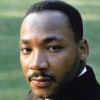
One of the sure signs of maturity is the ability to rise to the point of self criticism.
Martin Luther King, Jr. (1929–1968) American clergyman, civil rights leader, social activist, preacher
“The Rising Tide of Racial Consciousness,” Speech, National Urban League, New York (6 Sep 1960)
(Source)
However, you do need rules. Driving on the left (or the right or, in parts of Europe, on the left and the right as the mood takes you) is a rule which works, since following it means you’re more likely to reach your intended rather than your final destination.
Ye knowe ek that, in forme of speche is chaunge
Withinne a thowsand yere, and words tho
That hadden prys, now wonder nyce and straunge
Us thynketh hem, and yet thai spake hm so,
And spedde as wele in love, as men now do ….[You know that the form of speech will change within a thousand years, and words that were once apt, we now regard as quaint and strange; and yet they spoke them thus, and succeeded as well in love as men do now.]
Geoffrey Chaucer (c. 1343–1400) English poet, philosopher, astronomer, diplomat
Troilus and Criseyde, Book 2, st. 4, ll. 22-26 (1385)
(Source)
Note that the spelling varied between different editions of this same text.
Other translations:
"Remember in the forms of speech comes change
Within a thousand years, and words that then
Were well esteemed, seem foolish now and strange;
And yet they spake them so, time and again,
And thrived in love as well as any men." [tr. Krapp (2006)]

For a man of sensitivity and compassion to exercise great powers in a time of crisis is a grim and agonizing thing.
Richard Hofstadter (1916–1970) American historian and intellectual
The American Political Tradition: And the Men Who Made It, Part 5, ch. 7 (1958)
(Source)
Referring to Abraham Lincoln and the Civil War.
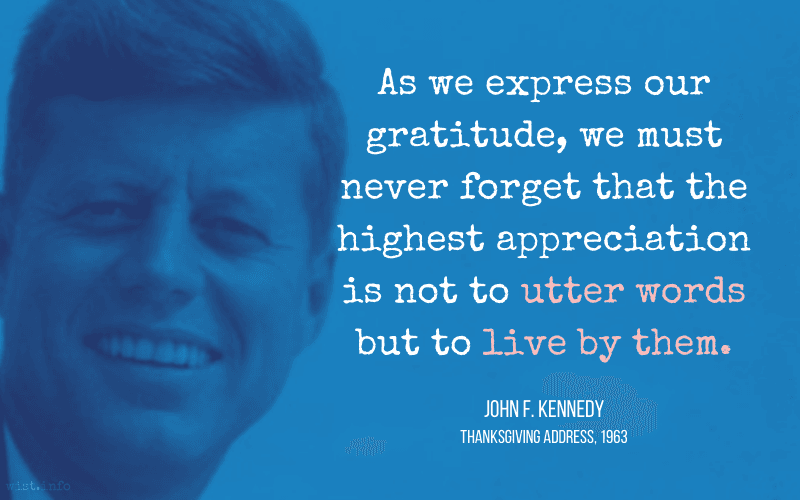
Today we give our thanks, most of all, for the ideals of honor and faith we inherit from our forefathers — for the decency of purpose, steadfastness of resolve and strength of will, for the courage and the humility, which they possessed and which we must seek every day to emulate. As we express our gratitude, we must never forget that the highest appreciation is not to utter words but to live by them.
John F. Kennedy (1917–1963) American politician, author, journalist, US President (1961–63)
Thanksgiving Day Proclamation (4 Nov 1963)
(Source)
The 1963 Proclamation was written, finalized, and distributed prior to Kennedy's assassination, six days before Thanksgiving.
Against all appearances the nature of things works for truth and right forever.
Ralph Waldo Emerson (1803–1882) American essayist, lecturer, poet
Essay (1860), “Worship,” The Conduct of Life, ch. 6
(Source)
Based on a course of lectures, "The Conduct of Life," delivered in Pittsburg (1851-03).
There is no possibility of being witty without a little ill-nature; the malice in a good thing is the barb that makes it stick.
Richard Brinsley Sheridan (1751–1816) Irish dramatist, satirist, politician
The School for Scandal, Act 1 (1777)
(Source)
Most men resemble great deserted palaces: the owner occupies only a few rooms and has closed-off wings where he never ventures.
[Presque tous les hommes ressemblent à ces grands palais déserts dont le propriétaire n’habite que quelques pièces; et il ne pénètre jamais dans les ailes condamnées.]
François Mauriac (1885–1970) French author, critic, journalist
Second Thoughts: Reflections on Literature and on Life (1961) [tr. Foulke]

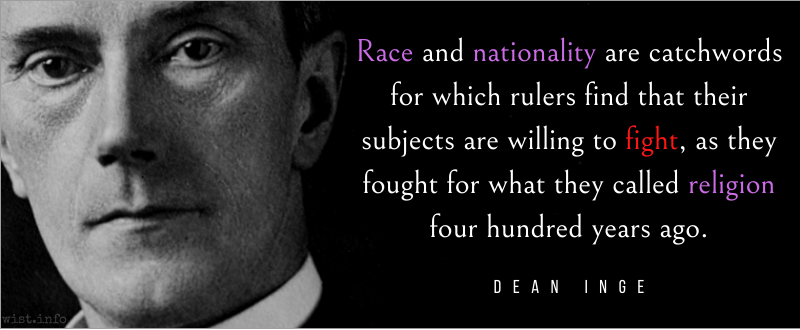
Race and nationality are catchwords for which rulers find that their subjects are willing to fight, as they fought for what they called religion four hundred years ago.
William Ralph Inge (1860–1954) English prelate [Dean Inge]
“The Future of the English Race,” Galton Lecture (1919), Outspoken Essays: First Series (1920)
(Source)
What a man sees, Love can make invisible —
And what is invisible, that can Love make him see.[Quel che l’huom vede Amor gli fa invisibile
E l’invisibil fa vedere Amore.]Ludovico Ariosto (1474–1533) Italian poet
Orlando Furioso, Canto 1, st. 56 [ll. 396-97] (1532) [tr. Waldman]
Four be the things I am wiser to know:
Idleness, sorrow, a friend, and a foe.Four be the things I’d been better without:
Love, curiosity, freckles, and doubt.Three be the things I shall never attain:
Envy, content, and sufficient champagne.Three be the things I shall have till I die:
Laughter and hope and a sock in the eye.Dorothy Parker (1893–1967) American writer, poet, wit
“Inventory,” Life (11 Nov 1926)
(Source)
Reprinted in Enough Rope (1926).
The very act of trying to run counter to the culture is what creates the next wave of culture people will in turn attempt to counter.
David McRaney (contemp.) American journalist, author, lecturer
You Are Not So Smart, ch. 27 “Selling Out” (2011)
(Source)

When the eagles are silent, the parrots begin to jabber.
Winston Churchill (1874–1965) British statesman and author
Comment (16 May 1945)
(Source)
Churchill used this phrase on multiple occasions over the years. This one, quoted by Field Marshal Alan Brooke, War Diaries (2001), was directed at the post-war complaints of Tito and DeGaulle.
But if physical death is the price that a man must pay to free his children and his white brethren from a permanent death of the spirit, then nothing could be more redemptive. This is the type of soul force that I am convinced will triumph over the physical force of the oppressor.
Martin Luther King, Jr. (1929–1968) American clergyman, civil rights leader, social activist, preacher
“The Rising Tide of Racial Consciousness,” Speech, National Urban League, New York (6 Sep 1960)
(Source)
I think perhaps the most important problem is that we are trying to understand the fundamental workings of the universe via a language devised for telling one another when the best fruit is.
TANNER: The true artist will let his wife starve, his children go barefoot, his mother drudge for his living at seventy, sooner than work at anything but his art.
Feminism: The radical notion that women are people.
Marie Shear (1940–2017) American writer and feminist activist
“Media Watch: Celebrating Women’s Words,” New Directions for Women (May/Jun 1986)
(Source)
Often misattributed to Cheris Kramarae and Paula Treichler, A Feminist Dictionary (1985), which was the subject of Shear's review.
The barbarous custom of having men beaten who are suspected of having important secrets to reveal must be abolished. It has always been recognized that this way of interrogating men, by putting them to torture, produces nothing worthwhile. The poor wretches say anything that comes into their mind and what they think the interrogator wishes to know.
Napoleon Bonaparte (1769–1821) French emperor, military leader
Letter to Louis Alexandre Berthier (11 Nov 1798), in Correspondence Napoleon, Vol 5, #3605 [ed. Henri Plon (1861)]
(Source)
The world is not respectable; it is mortal, tormented, confused, deluded forever; but it is shot through with beauty, with love, with glints of courage and laughter; and in these, the spirit blooms timidly, and struggles to be a light amid the thorns.
George Santayana (1863–1952) Spanish-American poet and philosopher [Jorge Agustín Nicolás Ruíz de Santayana y Borrás]
Platonism and the Spiritual Life (1927)
(Source)
One must not always think that feeling is everything. Art is nothing without form.
No sooner said than done — so acts your man of worth.
[Dictum factumque facit frux.]
Ennius (239–169 BC) Roman poet, writer [Quintus Ennius]
Fragment 315 [tr. Warmington]
(Source)
Quoted in Priscianus, Ars Prisciani, Book 6.

A slander iz like a hornet, if you kant kill it dead the fus blo, you better not strike at it.
[A slander is like a hornet, if you can’t kill it dead the first blow, you better not strike at it.]
Josh Billings (1818–1885) American humorist, aphorist [pseud. of Henry Wheeler Shaw]
Everybody’s Friend, Or; Josh Billing’s Encyclopedia and Proverbial Philosophy of Wit and Humor, “Lobstir Sallad” (1874)
(Source)
I carry you with me into the world, into the smell of rain & the words that dance between people
& for me, it will always be this way,
walking in the light,
remembering being alive togetherBrian Andreas (b. 1956) American writer, artist, publisher [birth and pen name of Kai Andreas Skye]
“Living Memory,” StoryPeople

Architecture is inhabited sculpture.
(Other Authors and Sources)
Constantin Brâncuși (1876-1957) Romanian sculptor, painter, photographer
Quoted in Igor Stravinsky and Robert Craft, Themes and Episodes (1966).
We are willing enough to praise freedom when she is safely tucked away in the past and cannot be a nuisance. In the present, amidst dangers whose outcome we cannot foresee, we get nervous about her, and admit censorship.
E. M. Forster (1879–1970) English novelist, essayist, critic, librettist [Edward Morgan Forster]
“The Tercentenary of the Areopagitica,” Two Cheers for Democracy (1951)
(Source)
DICAEPOLIS: Comedy too can sometimes discern what is right. I shall not please, but I shall say what is true.
Aristophanes (c. 450-c. 388 BC) Athenian comedic playwright
Acharnians, ll. 500-501 (425 BC) [tr. Athenian Society (1912)]
(Source)
One looks back with appreciation to the brilliant teachers, but with gratitude to those who touched our human feelings. The curriculum is so much necessary raw material, but warmth is the vital element for the growing plant and for the soul of the child.
Carl Jung (1875–1961) Swiss psychologist
Lecture (1942-12), “The Gifted Child [Der Begabte],” Basel School Council, Switzerland [tr. Hull (1954)]
(Source)
Reprinted in Schweitzer Erziehungs Rundschau, 16 (1943) and Psychologie und Erziehung (1946), finally collected in The Development of Personality, ch. 5 (1954) [tr. Hull].
A great part of courage is the courage of having done the thing before.
Ralph Waldo Emerson (1803–1882) American essayist, lecturer, poet
Essay (1860), “Culture,” The Conduct of Life, ch. 4
(Source)
Based on a course of lectures by that name first delivered in Pittsburg (1851-03).
You can have the other words — chance, luck, coincidence, serendipity. I’ll take grace. I don’t know what it is exactly, but I’ll take it.
To array a man’s will against his sickness is the supreme art of medicine.
Henry Ward Beecher (1813–1887) American clergyman and orator
Norwood; or, Village Life in New England, Vol. 1, ch. 6 (1867)
(Source)
Malice is of a low Stature, but it hath very long Arms.
George Savile, Marquis of Halifax (1633–1695) English politician and essayist
“Of Malice and Envy,” Political, Moral, and Miscellaneous Thoughts and Reflections (1750)
(Source)

Just for the record, darling, not all positive change feels positive in the beginning.
(Other Authors and Sources)
S. C. Lourie
It is worse than useless to try to put down by law a practice which a very large number of people believes to be innocent, and which must be left to the taste and conscience of the individual.
William Ralph Inge (1860–1954) English prelate [Dean Inge]
“The Birth-Rate” (1917), Outspoken Essays: First Series (1919)
(Source)
Speaking of birth control.
For when the water is up to your neck you must be truly stubborn not to cry for help.
[Che chi ne l’acqua sta fin’alla gola
Ben’e ostinato se merce non grida.]Ludovico Ariosto (1474–1533) Italian poet
Orlando Furioso, Canto 1, st. 50, l. 353 (1532) [tr. Waldman]
Other translations:
- "For who, when circling waters round him spread / And menace present death, impores not aid?" [tr. Hoole (1807)]
- "For the poor drowning caitiff, who, chin-deep, / Implores not help, is obstinate indeed." [tr. Rose (1831)]
- "The drowning man who waits to be exhorted / To cry for help must be a man of pride!" [tr. Reynolds (2006)]
I hate writing. I love having written.
Dorothy Parker (1893–1967) American writer, poet, wit
(Spurious)
Not found in any of Parker's works, and not attributed to her until several years after her death. The earliest rendition of a thought like this ("Don't like to write, but like having written") comes from novelist Frank Norris in a posthumous letter published in "The Bellman's Book Plate: The Writing Grind," The Bellman (4 Dec 1915).
More discussion here: Don’t Like to Write, But Like Having Written – Quote Investigator.
See also Pratchett.
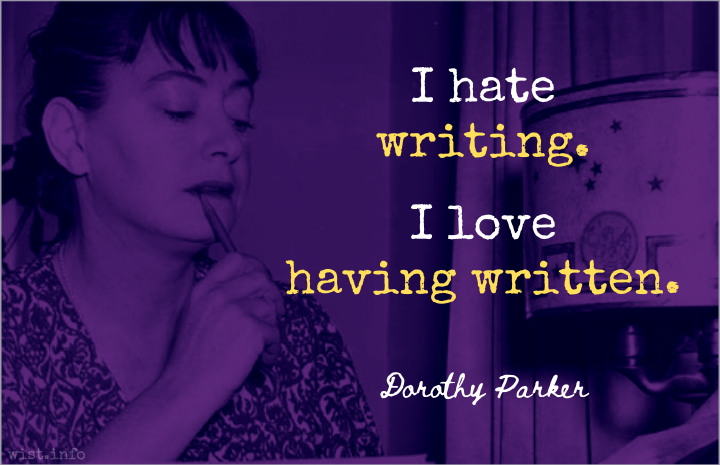
My definition of Man is “a Cooking animal.” The beasts have memory, judgment, and all the faculties and passions of our mind, in a certain degree; but no beast is a cook. … Man alone can dress a good dish; and every man whatever is more or less a cook, in seasoning what he himself eats.
James Boswell (1740–1795) Scottish biographer, diarist, lawyer
The Journal of a Tour to the Hebrides with Samuel Johnson, Sunday, 15 Aug, footnote (1785)
(Source)
Unlike most quoted Boswell, this is his own thought, not that of Samuel Johnson, recounting a conversation he had with Edmund Burke.

Making money ain’t nothing exciting to me. … You might be able to buy a little better booze than some wino on the corner. But you get sick just like the next cat, and when you die you’re just as graveyard dead as he is.
A guy walks up to me and asks “What’s Punk?”
So I kick over a garbage can and say “That’s Punk!”
So he kicks over the garbage can and says “That’s Punk?”
And I say “No that’s trendy!”Billie Joe Armstrong (b. 1972) American singer, songwriter, musician
In Matt Doeden, Green Day: Keeping Their Edge (2006)
(Source)

I had time after time watched the progression across the plain of the Giraffe, in their queer, inimitable, vegetative gracefulness, as if it were not a herd of animals but a family of rare, long-stemmed, speckled gigantic flowers slowly advancing.
Isak Dinesen (1885–1962) Danish writer [pseud. of Karen Christence, Countess Blixen]
Out of Africa, Part 1 (1937)
(Source)

Satchelmouth was by no means averse to the finger-foxtrot and the skull fandango, but he’d never murdered anyone, at least on purpose. Satchelmouth had been made aware that he had a soul and, though it had a few holes in it and was a little ragged around the edges, he cherished the hope that some day the god Reg would find him a place in a celestial combo. You didn’t get the best gigs if you were a murderer. You probably had to play the viola.
Terry Pratchett (1948–2015) English author
Discworld No. 16, Soul Music (1994)