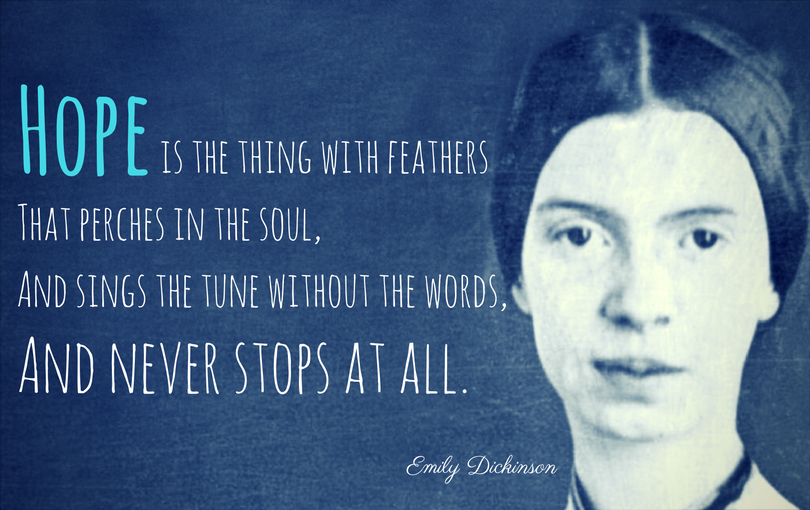
Anger repressed can poison a relationship as surely as the cruelest words.
Joyce Brothers (1927–2013) American psychologist, television personality, advice columnist
“When Your Husband’s Affection Cools,” Good Housekeeping (May 1972)

It can truly be said: Men are the devils of the earth, and the animals are the tormented souls.
[Man möchte wahrlich sagen: die Menschen sind die Teufel der Erde und die Tiere die geplagten Seelen]
Arthur Schopenhauer (1788–1860) German philosopher
Parerga and Paralipomena, Vol. 2, ch. 15 “On Religion [Ueber Religion], § 179 “The Christian System [Über das Christenthum]” (1851) [tr. Hollingdale (1970)]
(Source)
(Source (German)). Other translation:One might say with truth, Mankind are the devils of the earth, and the animals the souls they torment.
[tr. Saunders (1890)]

The essence of the Epistles of Paul is that Christians should rejoice at being deemed worthy to suffer for what they believe. The projection of a social gospel, in my opinion, is the true witness of a Christian life. This is the meaning of the true ekklesia — the inner, spiritual church. The church once changed society. It was then a thermostat of society. But today I feel that too much of the church is merely a thermometer, which measures rather than molds popular opinion.
Martin Luther King, Jr. (1929–1968) American clergyman, civil rights leader, social activist, preacher
Playboy interview (Jan 1965)
(Source)
The arrogance of some Christians would close heaven to them if, to their misfortune, it existed.
Simone de Beauvoir (1908–1986) French author, existentialist philosopher, feminist theorist
All Said and Done (1972)

A faint smile hovered around the man’s lips. It was the sort of smile that lies on sandbanks waiting for incautious swimmers.

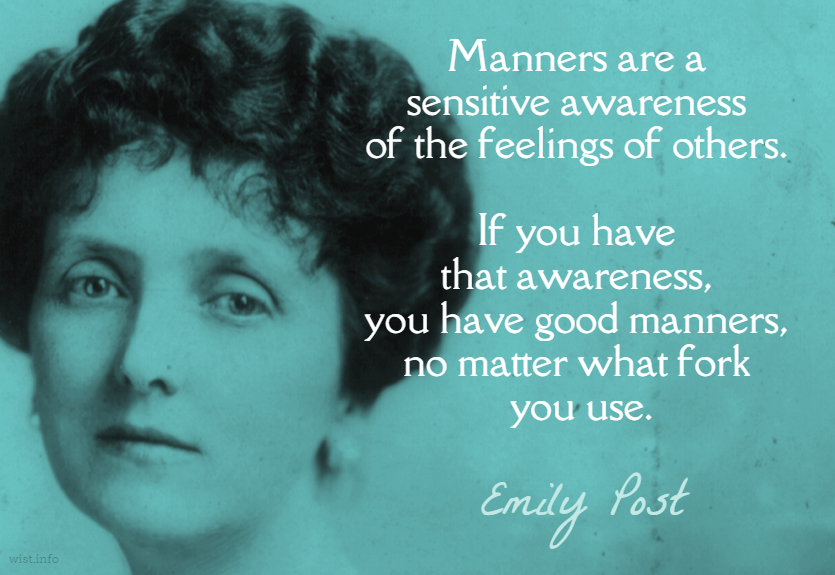
Manners are a sensitive awareness of the feelings of others. If you have that awareness, you have good manners, no matter what fork you use.
Emily Post (1872–1960) American author, columnist [née Price]
(Attributed)
Often cited to her famous Etiquette in Society, in Business, in Politics, and at Home (1922), but not found in that work. Claimed as genuine by the Emily Post Institute.

Phryne was feeling most displeased with a species to which, she reminded herself, she belonged. She took an egg sandwich and a gulp of tea and strove to adjust her philosophy.
Kerry Greenwood (b. 1954) Australian author and lawyer
Phryne Fisher, Book 8, Urn Burial (1996)

But beware you be not swallowed up in books: An ounce of love is worth a pound of knowledge.
John Wesley (1703–1791) English cleric, Christian theologian and evangelist, founder of Methodism
Letter to Joseph Benson (7 Nov 1768)
(Source)

Most of us stand poised at the edge of brilliance, haunted by the knowledge of our proximity, yet still demonstrably on the wrong side of the line, our dealings with reality undermined by a range of minor yet critical psychological flaws (a little too much optimism, an unprocessed rebelliousness, a fatal impatience or sentimentality). We are like an exquisite high-speed aircraft which for lack of a tiny part is left stranded beside the runway, rendered slower than a tractor or bicycle.
Alain de Botton (b. 1969) Swiss-British author
The Pleasures and Sorrows of Work, ch. 4 (2009)
(Source)

A real writer learns from earlier writers the way a boy learns from an apple orchard — by stealing what he has a taste for and can carry off.
Archibald MacLeish (1892–1982) American poet, writer, statesman
In Charles Poore, “Mr. MacLeish and the Disenchantmentarians,” The New York Times (25 Jan 1968)
(Source)
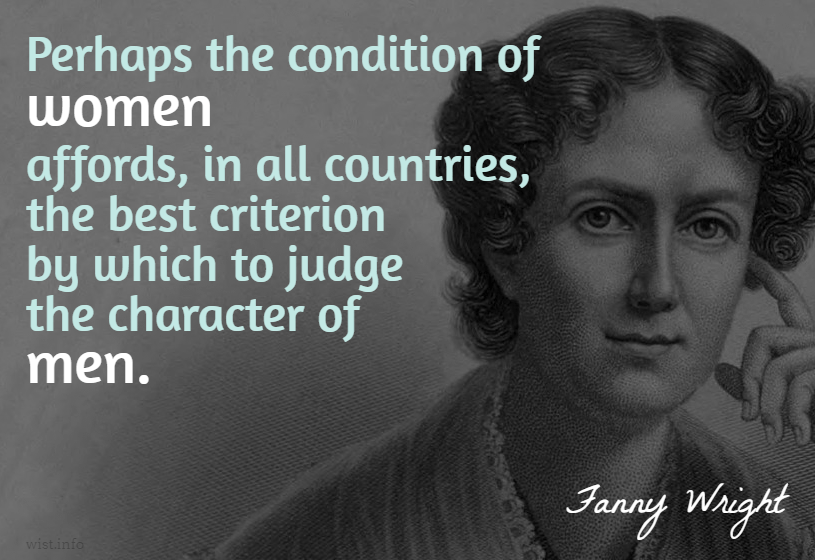
Perhaps the condition of women affords, in all countries, the best criterion by which to judge the character of men.
Frances "Fanny" Wright (1795–1852) Scottish-American writer, lecturer, social reformer
Views of Society and Manners in America, Letter 23, Mar. 1820 (1821)
(Source)
Other people’s appetites easily appear excessive when one doesn’t share them.
André Gide (1869–1951) French author, Nobel laureate
The Counterfeiters, “Edouard’s Journal: Oscar Molinier” (1925)
(Source)
We open our mouths and out flow words whose ancestries we do not even know. We are walking lexicons. In a single sentence of idle chatter we preserve Latin, Anglo-Saxon, Norse: we carry a museum inside our heads, each day we commemorate peoples of whom we have never heard. More than that, we speak volumes — our language is the language of everything we have not read. Shakespeare and the Authorised Version surface in supermarkets, on buses, chatter on radio and television. I find this miraculous. I never cease to wonder at it. That words are more durable than anything, that they blow with the wind, hibernate and reawaken, shelter parasitic on the most unlikely hosts, survive and survive and survive.

To finish the moment, to find the journey’s end in every step of the road, to live the greatest number of good hours, is wisdom.
Ralph Waldo Emerson (1803–1882) American essayist, lecturer, poet
“Experience,” Essays: Second Series (1844)
(Source)
CRASSUS: One of the disadvantages of being a patrician is that occasionally you’re obliged to act like one.
Dalton Trumbo (1905–1976) American screenwriter and novelist [James Dalton Trumbo]
Spartacus (1960) [novel by Howard Fast]
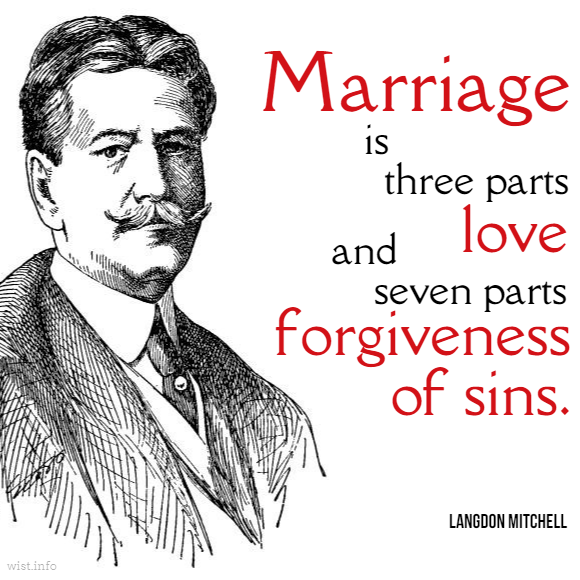
Marriage is three parts love and seven parts forgiveness of sins.

If a man has reported to you that a certain person speaks ill of you, do not make any defense to what has been told you: but reply, The man did not know the rest of my faults, for he would not have mentioned these only.
Epictetus (c. 55-c. 135 AD) Greek (Phrygian) Stoic philosopher [Ἐπίκτητος, Epíktētos]
Enchiridion, 33 (c. AD 135) [tr. Long (1888)]
(Source)
Other translations: "If anyone tells you that a certain person speaks ill of you, do not make excuses about what is said of you, but answer, 'He was ignorant of my other faults, else he would have not mentioned these alone.'" [tr. Higginson (1948)]
The surface of American society is, if I may use the expression, covered with a layer of democracy, from beneath which the old aristocratic colors sometimes peep.
Alexis de Tocqueville (1805–1859) French writer, diplomat, politician
Democracy in America, ch. 2 (1835) [tr. Reeve (1899)]
(Source)Other translations:
- As above, but given as "... sometimes seep."
- "American society, if I may put it this way, is like a painting that is democratic on the surface but from time to time allows the old acistocratic colors to peep through." [tr. Goldhammer (2004)]
- "The surface of American society is covered with a layer of democratic paint, but from time to time one can see the old aristocratic colors breaking through."
Tolerance, good temper and sympathy — they are what matter really, and if the human race is not to collapse they must come to the front before long.
E. M. Forster (1879–1970) English novelist, essayist, critic, librettist [Edward Morgan Forster]
“What I Believe,” The Nation (16 Jul 1938)
(Source)
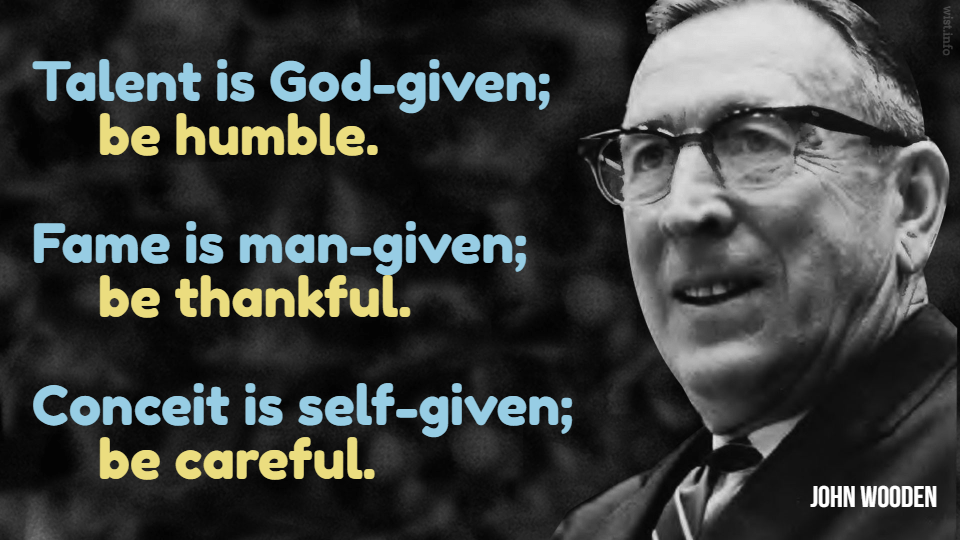
Talent is God-given; be humble. Fame is man-given; be thankful. Conceit is self-given; be careful.
When Christianity asks the aid of government beyond mere impartial protection, it denies itself. Its laws are divine, and not human. Its essential interests lie beyond the reach and range of human governments. United with government, religion never rises above the merest superstition; united with religion, government never rises above the merest despotism; and all history shows us that the more widely and completely they are separated, the better it is for both.
John Welch (1805–1891) American politician, jurist
Board of Education of Cincinnati v. Minor, Ohio Supreme Court (1872)
(Source)
SPARTACUS: When a free man dies, he loses the pleasure of life. A slave loses his pain. Death is the only freedom a slave knows. That’s why he’s not afraid of it. That’s why we’ll win.
Dalton Trumbo (1905–1976) American screenwriter and novelist [James Dalton Trumbo]
Spartacus (1960) [novel by Howard Fast]
That which we call sin in others, is experiment for us.
Ralph Waldo Emerson (1803–1882) American essayist, lecturer, poet
“Experience,” Essays: Second Series (1844)
(Source)
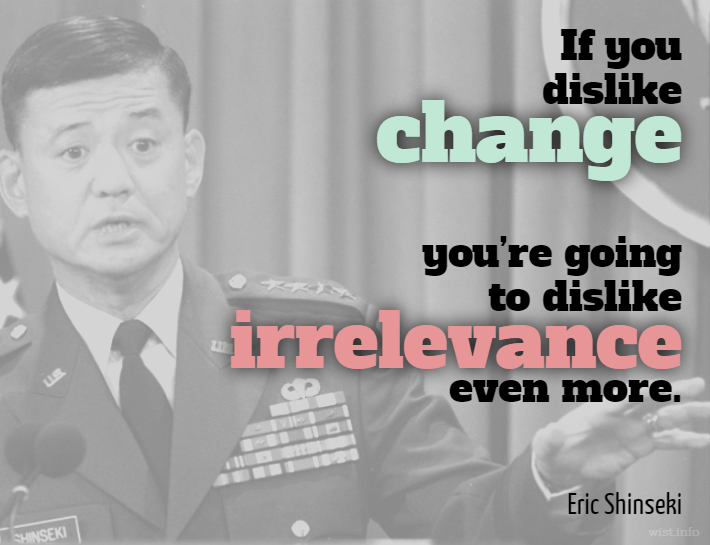
If you dislike change, you’re going to dislike irrelevance even more.
Eric Shinseki (b. 1942) American military leader, bureaucrat
Quoted in Mackubin Thomas Owens, “Marines Turned Soldiers,” National Review Online (10 Dec 2001)

Nature, as we know her, is no saint.
Ralph Waldo Emerson (1803–1882) American essayist, lecturer, poet
“Experience,” Essays: Second Series (1844)
(Source)
What are the proper proportions of a maxim? A minimum of sound to a maximum of sense.
Mark Twain (1835–1910) American writer [pseud. of Samuel Clemens]
More Tramps Abroad, Epigraph, ch. 23 (1897)
(Source)
JOKER: The dead know only one thing: it is better to be alive.
Stanley Kubrick (1928–1999) American film director, screenwriter, producer
Full Metal Jacket (1987)
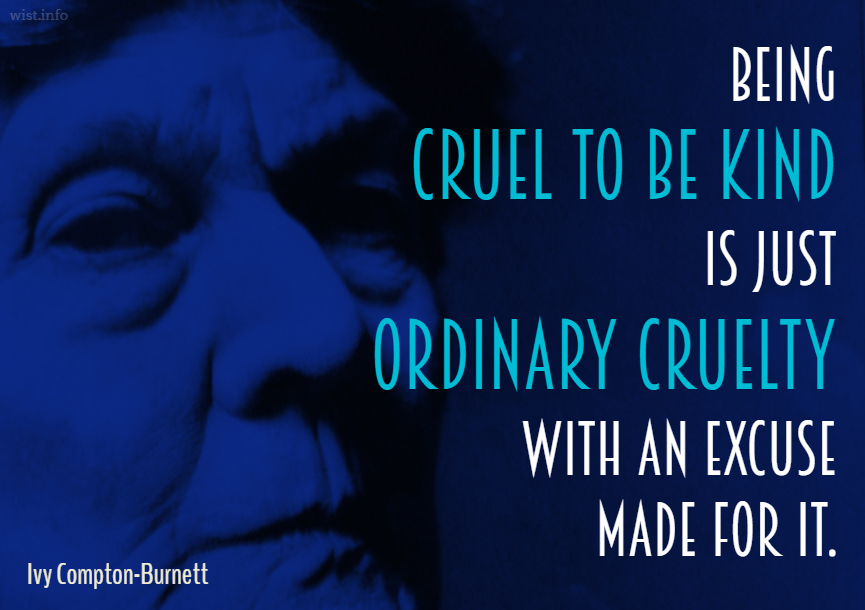
Being cruel to be kind is just ordinary cruelty with an excuse made for it.

Cynics are, in the end, only idealists with awkwardly high standards.
Good manners are a combination of intelligence, education, taste, and style mixed together so that you don’t need any of those things.
P. J. O'Rourke (b. 1947) American humorist, editor
Modern Manners: An Etiquette Book for Rude People, ch. 1 (1984)
(Source)

If the books which you read are your own, mark with a pen or pencil the most considerable things in them which you desire to remember. Then you may read that book the second time over with half the trouble, by your eye running over the paragraphs which your pencil has noted. It is but a very weak objection against this practice to say, I shall spoil my book; for I persuade myself that you did not buy it as a bookseller, to sell again for gain, but as a scholar, to improve your mind by it; and if the mind be improved, your advantage is abundant, through your book yields less money to your executors.
Isaac Watts (1674–1748) English theologian and hymnodist
Logic on the Right Use of Reason in the Enquiry after Truth (1724)
(Source)
“To Hell with all racialists,” she said aloud. “And to Hell with eugenics, degenerate heredity, miscegenation and frauds who pile up skulls like a conqueror as well. May they choke on their bones.”
Kerry Greenwood (b. 1954) Australian author and lawyer
Phryne Fisher, Book 7, Ruddy Gore (1995)
(Source)
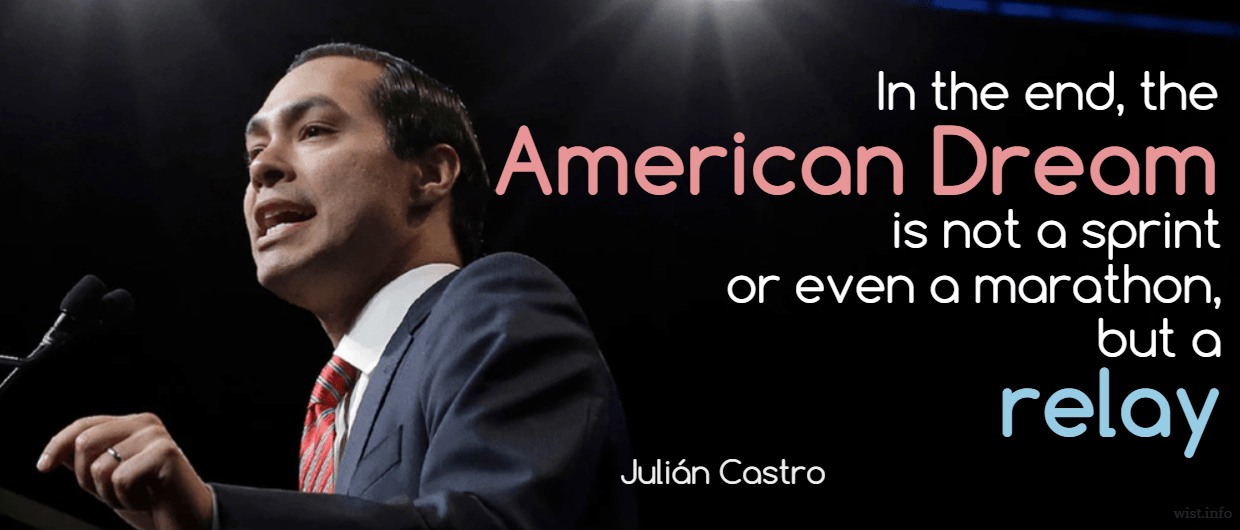
In the end, the American Dream is not a sprint or even a marathon, but a relay.
Julián Castro (b. 1974) American politician and lawyer
Speech, Democratic National Convention, Charlotte, North Carolina (2012-09-04)
(Source)

I look at some of the great novelists, and I think the reason they are great is that they’re telling the truth. The fact is they’re using made-up names, made-up people, made-up places, and made-up times, but they’’re telling the truth about the human being — what we are capable of, what makes us lose, laugh, weep, fall down, and gnash our teeth and wring our hands and kill each other and love each other.
Maya Angelou (1928–2014) American poet, memoirist, activist [b. Marguerite Ann Johnson]
“The Art of Fiction,” Paris Review, #116, Interview with George Plimpton (1990)
(Source)

A man who marries a woman to educate her falls victim to the same fallacy as the woman who marries a man to reform him.
Elbert Hubbard (1856–1915) American writer, businessman, philosopher
The Note Book of Elbert Hubbard (1927)
Most of life is so dull that there is nothing to be said about it, and the books and talks that would describe it as interesting are obliged to exaggerate, in the hope of justifying their own existence. Inside its cocoon of work or social obligation, the human spirit slumbers for the most part, registering the distinction between pleasure and pain, but not nearly as alert as we pretend. There are periods in the most thrilling day during which nothing happens, and though we continue to exclaim, “I do enjoy myself,” or, “I am horrified,” we are insincere. “As far as I feel anything, it is enjoyment, horror” — it’s no more than that, really, and a perfectly adjusted organism would be silent.
E. M. Forster (1879–1970) English novelist, essayist, critic, librettist [Edward Morgan Forster]
A Passage to India, ch. 14 (1924)
(Source)
A good man can expand his life: he lives
twice over whose past life can be enjoyed.[Ampliat ætatis spatium sibi vir bonus. Hoc est
Vivere bis, vita posse priore frui.]Martial (AD c.39-c.103) Spanish Roman poet, satirist, epigrammatist [Marcus Valerius Martialis]
Epigrams [Epigrammata], Book 10, epigram 23 (10.23.8-9) (AD 95, 98 ed.) [tr. McLean (2014)]
"To Antonius Primus." (Source (Latin)). Other translations:Thus good men to themselves long life can give,
T' enjoy our former life is twice to live.
[tr. May (1629)]Each must, in vertue, strive for to excell;
That man lives twice, that lives the first life well.
[tr. Herrick (1648)]He liveth twice, who can the Gift retain
Of Mem'ry, to enjoy past Life again.
[tr. Cotton (1685)]Thus a good man prolongs his mortal date;
Lives twice, enjoying thus his former slate.
[tr. Hay (1755)]For he lives twice who can at once employ
The present well, and e'en the past enjoy.
[tr. Pope (1713)]They stretch the limits of this narrow span;
And, by enjoying, live past life again.
[tr. Lewis (1750)]A good man amplifies the span of his existence ; for this is to live twice, to be able to find enjoyment in past life.
[tr. Amos (1858); he gives several other contemporary uses and translations.]A good man lengthens his term of existence; to be able to enjoy our past life is to live twice.
[tr. Bohn's Classical (1859)]So good men lengthen life; and to recall
The past, is to have twice enjoyed it all.
[tr. Stevenson (c. 1883)]The good man prolongs his life; to be able to enjoy one's past life is to live twice.
[Bartlett's (1891)]A good man has a double span of life,
For to enjoy past life is twice to live.
[ed. Harbottle (1897)]A good man widens for himself his age's span; he lives twice who can find delight in life bygone.
[tr. Ker (1919)]Redoubled happiness and life hath he
Whose joy doth live again in memory.
[tr. Pott & Wright (1921)]The good man lengthens out his earthly skein,
For living in the past is life again.
[tr. Francis & Tatum (1924), #525]A good man's life is doubly long,
For he lives twice who, day and night,
Can in his whole past take delight.
[tr. Marcellino (1968)]Virtue extends our days: he lives two lives who relives his past with pleasure.
[Bartlett's (1968)]A good man enlarges for himself his span of life. To be able to enjoy former life is to live twice over.
[tr. Shackleton Bailey (1993)]The good man has no ugly past he would forget,
So memory gives him doubled life without regret.
[tr. Ericsson (1995)]He does not deplore life's brevity.
For virtue is itself longevity.
[tr. Wills (2007)]When I remember,
success, failure,
friend, enemy,
wife, lover
I live twice over.
[tr. Kennelly (2008), "Living"]A good man can expand his life: he lives
twice over whose past life can be enjoyed.
[tr. McLean (2014)]The good man broadens for himself the span of his years: to be able to enjoy the life you have spent, is to live it twice.
[tr. Nisbet (2015)]
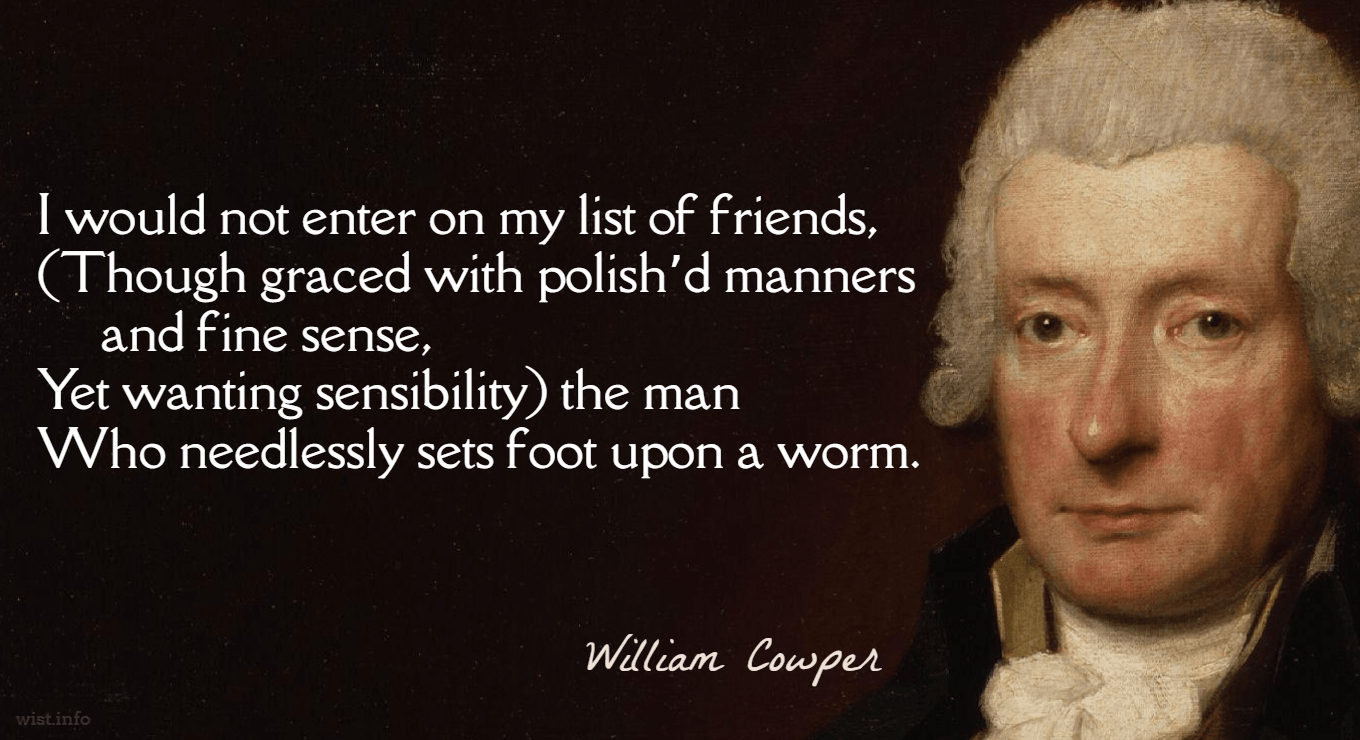
I would not enter on my list of friends,
(Though graced with polish’d manners and fine sense,
Yet wanting sensibility) the man
Who needlessly sets foot upon a worm.
William Cowper (1731–1800) English poet
“Winter Walk at Noon,” l. 560ff, The Task, Book 6 (1785)
(Source)

A man who cannot get angry is like a stream that cannot overflow, that is always turbid. Sometimes indignation is as good as a thunder-storm in summer, clearing and cooling the air.
Henry Ward Beecher (1813–1887) American clergyman and orator
Proverbs from Plymouth Pulpit, “Man” (1887)
(Source)
Although endlessly brooding on power, victory, defeat, revenge, the nationalist is often somewhat uninterested in what happens in the real world. What he wants is to feel that his own unit is getting the better of some other unit, and he can more easily do this by scoring off an adversary than by examining the facts to see whether they support him.
George Orwell (1903–1950) English journalist, essayist, writer [pseud. of Eric Arthur Blair]
Essay (1945-05), “Notes on Nationalism,” Polemic Magazine (1945-10)
(Source)

I decided that perhaps I would like to think of myself as an extremist — in the light of the spirit which made Jesus an extremist for love. If it sounds as though I am comparing myself to the Savior, let me remind you that all who honor themselves with the claim of being “Christians” should compare themselves to Jesus. Thus I consider myself an extremist for that brotherhood of man which Paul so nobly expressed: “There is neither Jew nor Greek, there is neither bond nor free, there is neither male nor female: for ye are all one in Christ Jesus.” Love is the only force on earth that can be dispensed or received in an extreme manner, without any qualifications, without any harm to the giver or to the receiver.
Martin Luther King, Jr. (1929–1968) American clergyman, civil rights leader, social activist, preacher
Playboy interview (Jan 1965)
(Source)
It was crowded in the Curry Gardens on the corner of God Street and Blood Alley, but only with the cream of society — at least, with those people who are found floating on the top and who, therefore, it’s wisest to call the cream.
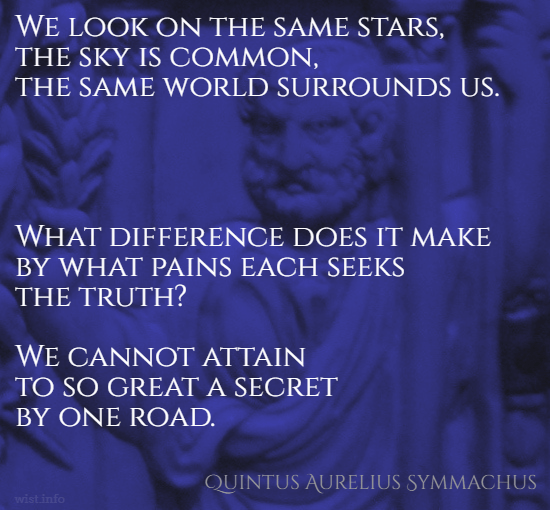
It is just that all worship should be considered as one. We look on the same stars, the sky is common, the same world surrounds us. What difference does it make by what pains each seeks the truth? We cannot attain to so great a secret by one road.
[Aequum est quidquid omnes colunt, unum putari. Eadem spectamus astra, commune coelum est, idem nos munus involvit. Quid interest qua quisque prudentia verum requirat? Uno itinere no potest perveniri ad tam grande secretum.]
Quintus Aurelius Symmachus (c. 345–402) Roman statesman, orator, man of letters
“The Memorial of Symmachus, Prefect of the City” [tr. Romestin, Romestin, Duckworth (1896)]
(Source)
Petition on behalf of non-Christian Senators to Emperor Valentinian to restore the Altar of Victory to the Roman Senate.
Other translations: "We gaze up at the same stars; the sky covers us all; the same universe encompasses us. Does it matter what practical system we adopt in our search for the Truth? The heart of so great a mystery cannot be reached by following one road only."
Life never gives us what we want at the moment that we consider appropriate. Adventures do occur, but not punctually.
E. M. Forster (1879–1970) English novelist, essayist, critic, librettist [Edward Morgan Forster]
A Passage to India, ch. 3 (1924)
(Source)
Anxiety is the unwillingness to play even when you know the odds are for you. Courage is the willingness to play even when you know the odds are against you.
Thomas Szasz (1920–2012) Hungarian-American psychiatrist, educator
The Second Sin (1973)
You grant your favours, Caelia, to Parthians, to Germans, to Dacians;
and despise not the homage of Cilicians and Cappadocians.
To you journeys the Egyptian gallant from the city of Alexandria,
and the swarthy Indian from the waters of the Eastern Ocean;
nor do you shun the embraces of circumcised Jews;
nor does the Alan, on his Sarmatic steed, pass by you.
How comes it that, though a Roman girl,
no attention on the part of a Roman citizen is agreeable to you?[Das Parthis, das Germanis, das, Caelia, Dacis,
nec Cilicum spernis Cappadocumque toros;
et tibi de Pharia Memphiticus urbe fututor
navigat, a rubris et niger Indus aquis;
nec recutitorum fugis inguina Iudaeorum,
nec te Sarmatico transit Alanus equo.
qua ratione facis cum sis Romans puella,
quod Romana tibi mentula nulla placet?]Martial (AD c.39-c.103) Spanish Roman poet, satirist, epigrammatist [Marcus Valerius Martialis]
Epigrams [Epigrammata], Book 7, epigram 30 (7.30) (AD 92) [tr. Bohn’s (1871)]
(Source)
(Source (Latin)). Other translations:For Parthians, Germans thou thy nets wilt spread;
Wilt Cappadocian or Cilician wed;
From Memphis comes a whipster unto thee,
And a black Indian from the Red Sea;
Nor dost thou fly the circumcised Jew;
Nor can the Muscovite once pass by you;
Why being a Roman lass dost do thus? tell
Is't cause no Roman knack can please so well?
[tr. Fletcher]You grant your favours to Parthians, you grant them to Germans, you grant them, Caelia, to Dacians, and you do not spurn the couch of Cilicians and Cappadocians; and for you from his Egyptian city comes sailing the gallant of Memphis, and the black Indian from the Red Sea; nor do you shun the lecheries of circumcised Jews, and the Alan on his Sarmatian steed does not pass you by. What is your reason that, although you are a Roman girl, no Roman lewdness has attraction for you?
[tr. Ker (1919)]Caelia, you love a Teuton swain,
An Asiatic stirs your pity,
For you swart Indians cross the main,
Copts flock to you from Pharos' city.
A Jew, a Scythian cavalier,
Can please you -- but I can't discover
Why you, a Roman, are austere
To none except a Roman lover.
[tr. Pott & Wright (1921)]You give your favors to Parthians, you given them to Germans, Caelia, you give them to Dacians, nor do you despise the beds of Cilicians and Cappadocians; and to you comes sailing the fornicator of Memphis from his Pharian city and the black Indian from the Red Sea. Nor do you shun the loins of circumcised Jews nor does the Alan pass you by with his Sarmatian horse. Why is it, sinc eyou are a Roman girl, that no Roman cock is to your liking?
[tr. Shackleton Bailey (1993)]You do Germans, and Parthians, and Dacians, Caelia,
you don’t scorn Cappadocian, Cilician beds;
and fuckers from Memphis, that Pharian city,
and Red Sea’s black Indians sail towards you.
You’d not flee the thighs of a circumcised Jew,
not an Alan goes by, with Sarmatian horse too.
What’s the reason, then, since you are a Roman,
not one Roman member pleases you, woman?
[tr. Kline (2006), "Hard to Please"]Barbarian hordes en masse you fuck,
Odd types into your bed you tuck.
You take on blacks and Asian forces,
And Jews, and soldiers, and their horses.
Yet you, voracious Roman chick,
Have never known a Roman dick.
[tr. Wills (2008)]You sleep with Germans, Parthians, and Dacians;
Cilicians and Cappadocians get a screw;
a Memphian fucker sails to you from Pharos;
a coal-black Indian from the Red Sea, too.
You don't shun the pricks of circumcised Judeans;
a Scythian on his horse won't pass you buy.
Since you're a roman girl, why is it, Caelia,
you won't give any Roman cock a try?
[tr. McLean (2014)]You grant your favours, Caelia, to all races --
Parthians, Germans, Dacians share your graces.
Cilicians, Cappadocians in your bed be,
And even a swarthy Indian from the Red Sea!
From Egypt's Memphis one sails to your door,
And Jews, though circumcised, you'll not ignore,
And that's not all! On his Samartian steed
No Scythian ever passed your door at speed.
You are a Roman girl, so tell me true,
Do Roman weapons have no charms for you?
[tr. Pitt-Kethley]You'll fuck a Frog, a Kraut, a Jew,
A Gippo, a Brit, a Pakki too;
Niggers and Russkies all go in your stew
But my prick's a Wop -- Caelia, fuck you!
[tr. Sullivan]
For more detailed commentary on the explicitly sexual nature of the epigram, see Vioque, Epigrammaton Liber VII.
For the whole thing about matrimony is this: We fall in love with a personality, but we must live with a character. Behind the pretty wallpaper and the brightly painted plaster lurk the yards of tangled wire and twisted pipes, ready to run a short or spring a leak on us without a word of warning.
Peter De Vries (1910–1993) American editor, novelist, satirist
Mrs. Wallop (1970)
(Source)
Often misquoted as "The difficulty with marriage is that ..."

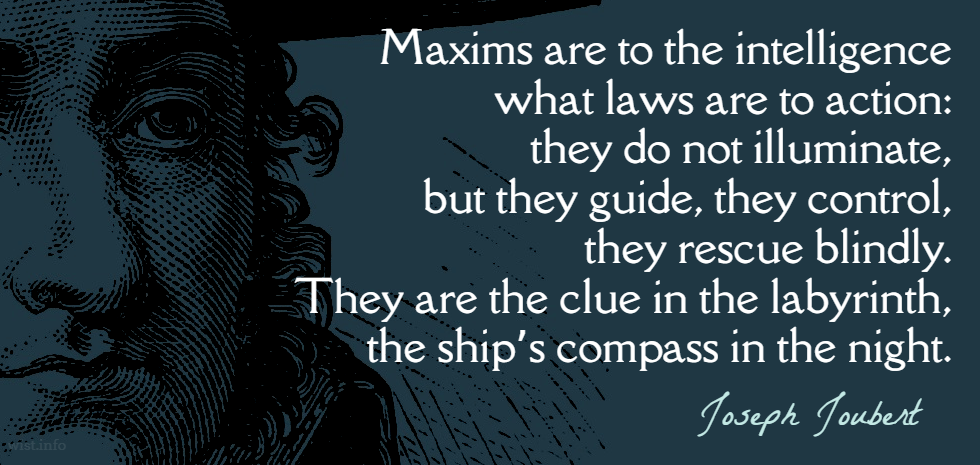
Maxims are to the intellect what laws are to actions; they do not enlighten, but they guide and direct; and although themselves blind, are protective. They are like the clue in the labyrinth, or the compass in the night.
[Les maximes sont à l’intelligence ce que les lois sont aux actions : elles n’éclairent pas, mais elles guident, elles dirigent, elles sauvent aveuglément. C’est le fil dans le labyrinthe, la boussole pendant la nuit.]
Joseph Joubert (1754–1824) French moralist, philosopher, essayist, poet
Pensées [Thoughts], ch. 9 “De la Sagesse, de la Vertu, etc. [On Wisdom and Virtue],” ¶ 44 (1850 ed.) [tr. Attwell (1896), ¶ 138]
(Source)
(Source (French)). Other translations:Maxims are to the intelligence what laws are to conduct; they do not enlighten, but they guide, they direct, they save us insensibly. It is the thread in the labyrinth, the compass during the night.
[tr. Lyttelton (1899), ch. 8, ¶ 32]Maxims are to the intelligence what laws are to action: they do not illuminate, but they guide, they control, they rescue blindly. They are the clue in the labyrinth, the ship's compass in the night.
[tr. Collins (1928), ch. 8]
The government’s ability to enforce generally applicable prohibitions of socially harmful conduct, like its ability to carry out other aspects of public policy, “cannot depend on measuring the effects of a governmental action on a religious objector’s spiritual development.” To make an individual’s obligation to obey such a law contingent upon the law’s coincidence with his religious beliefs, except where the State’s interest is “compelling” — permitting him, by virtue of his beliefs, “to become a law unto himself” — contradicts both constitutional tradition and common sense.
Antonin Scalia (1936–2016) US Supreme Court justice
Employment Division v. Smith, 494 U.S. 872, majority opinion (1990)
(Source)
Opinion holding that the state could prohibit religious-based peyote use.

Be more concerned with your character than your reputation, because your character is what you really are, while your reputation is merely what others think you are.
John Wooden (1910–2010) American basketball player and coach
They Call Me Coach, ch. 9, epigram (1972)
(Source)
Never strike a king unless you are sure you shall kill him.
Ralph Waldo Emerson (1803–1882) American essayist, lecturer, poet
Journal (1843-09)
(Source)
In addition to the noted source, see also here. However, according to the reliable Ralph Keyes, the quotation is spurious. Keyes also suggests an inspiration from the 17th Century English proverb, "Whosoever draws his sword against the prince must throw the scabbard away."
A variant, "When you strike at a king you must kill him," is attributed to Emerson by Oliver Wendell Holmes, Jr., in Max Lerner, The Mind and Faith of Justice Holmes (1943).
RIPPER: I can no longer sit back and allow Communist infiltration, Communist indoctrination, Communist subversion, and the international Communist conspiracy to sap and impurify all of our precious bodily fluids.
Stanley Kubrick (1928–1999) American film director, screenwriter, producer
Dr. Strangelove (1964) [with T. Southern, Peter George, based on Red Alert by Peter George]
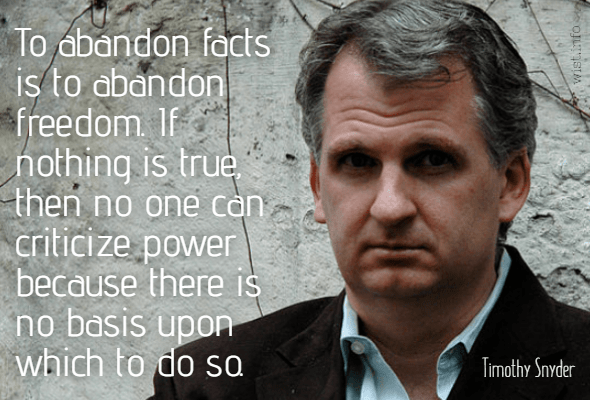
Believe in truth. To abandon facts is to abandon freedom. If nothing is true, then no one can criticize power because there is no basis upon which to do so. If nothing is true, then all is spectacle. The biggest wallet pays for the most blinding lights.

Spiritual strength and passion, when accompanied by bad manners, only provoke loathing.
Friedrich Nietzsche (1844–1900) German philosopher and poet
The Will to Power, Part 1, “Critique of Religion,” Sec. 175 [tr. Ludovici] (1888)
(Source)
“Classic.” A book which people praise and don’t read.
Mark Twain (1835–1910) American writer [pseud. of Samuel Clemens]
Following the Equator, ch. 25, epigraph (1897)
(Source)
Detective inspector John “Call me Jack, everyone does” Robinson did not like theatres. Bit of a night out at the variety or even the Tiv was fair enough, but ever since a high-minded relative had forced him to sit through an Ibsen festival at an impressionable age, theatres had always been synonymous with what he called ‘high art’, a portmanteau term for everything self-indulgent, terminally tedious and incomprehensible in the world of culture.
Kerry Greenwood (b. 1954) Australian author and lawyer
Phryne Fisher, Book 7, Ruddy Gore, ch. 3 (1995)
(Source)
To cut out every negative root would simultaneously mean choking off positive elements that might arise from it further up the stem of the plant. We should not feel embarrassed by our difficulties, only by our failure to grow anything beautiful from them.
Alain de Botton (b. 1969) Swiss-British author
The Consolations of Philosophy, ch. 6 “Consolation for Difficulties” (2000)
(Source)
Discussing Nietzsche.
Anxiety is love’s greatest killer. It creates the failures. It makes others feel as you might when a drowning man holds on to you. You want to save him, but you know he will strangle you with his panic.


Your Honor, years ago I recognized my kinship with all living beings, and I made up my mind then that I was not one bit better than the meanest on earth. I said then, and I say now, that while there is a lower class, I am in it; and while there is a criminal element, I am of it; and while there is a soul in prison, I am not free.
Eugene V. Debs (1855–1926) American union leader, activist, socialist, politician
Statement to the Court (1918-09-18)
(Source)
On being convicted of sedition for urging resistance to the draft. Often paraphrased:As long as there is a lower class, I am in it. As long as there is a criminal element, I am of it. As long as there is a soul in prison, I am not free.
Marriage is not a noun, it’s a verb. It’s not something you have, like a house or a car. It is not a piece of paper that proves you are husband and wife. Marriage is a behavior. It is a choice you make over and over again, reflected in the way you treat your partner every day.
Barbara De Angelis (b. 1951) American relationship consultant, lecturer, author
Ask Barbara: The 100 Most-Asked Questions About Love, Sex, and Relationships (1997)
(Source)

Life is easy to chronicle, but bewildering to practice.
E. M. Forster (1879–1970) English novelist, essayist, critic, librettist [Edward Morgan Forster]
A Room with a View, ch. 14 (1908)
(Source)
To you and me
Life is not full; we see
The good days fly
And, ah, how grievously
Their sum doth mount,
Set all to our account;
Why dally we
Who know what life should be?[Nunc vivit necuter sibi, bonosque
Soles effugere atque abire sentit,
Qui nobis pereunt et inputantur.
Quisquam vivere cum sciat, moratur?]Martial (AD c.39-c.103) Spanish Roman poet, satirist, epigrammatist [Marcus Valerius Martialis]
Epigrams [Epigrammata], Book 5, epigram 20 (5.20.11-14) (AD 90) [tr. Pott & Wright (1921)]
The phrase pereunt et imputantur (they [the days] pass by, and are put to our account) is often found on sundials.
"To Julius Martialis." (Source (Latin)).
Other translations:Now, to himself, alas! Does neither live,
But sees good suns, of which we are to give
A strict account, set, and march quick away:
Know a man how to live, and does he stay?
[tr. Cowley (1656)]We behold the good suns shine, and pass away; lost are they for ever, yet, nevertheless, they are counted in our reckoning. Is it possible that anyone who knows how to live delays to live accordingly?
[tr. Amos (1858), ch. 3, #14; identified as ep. 21]As it is, neither of us lives for himself, but sees his good days flee from him and vanish; days which are ever being lost to us, and set down to our account. Should any one, then, delay to live, when he knows how?
[tr. Bohn's Classical (1859)]Now neither lives unto himself, alas!
And the good suns we see, that flash and pass
And perish; and the bell that knells them cries,
"Another gone: O when will ye arise?"
[tr. Stevenson (1884)]Today neither lives for himself, and he feels the good days are flitting and passing away, our days that perish and are cored to our account. Does any man, when he knows how to live, delay?
[tr. Ker (1919)]Now neither of us truly lives at all.
Suns rise and set and swell the reckoning. Say,
Does life mean anything? Then live today.
[tr. Francis & Tatum (1924), #230, "To His Cousin"]Now neither lives his life, but he
Marks precious days that pass and flee.
These days are lost, but their amount
Is surely set to our account.
Knowledge the clue to life can give;
Then wherefore hesitate to live?
[tr. Duff (1929)]But as things are now, neither one of us
Lives for himself, while ever glorious
Days slip by unlived, never to come
Again, deducted always from that sum
Allotted us. Why then do we not live,
We who know the joys that life can give?
[tr. Marcellino (1968)]But as it is, we, both and each,
Miss the rich life within our reach,
We watch the good sun speed and set
And the lost day goes down as debt.
Would any man, if he knew how
To live, not do it here and now?
[tr. Michie (1972)]Now, twin lives are not our own.
Our good suns flee & disappear,
Debited, as they die, to us.
Who hesitates that's learned to live?
[tr. Whigham (1987)]We toil too much for others. Days
flicker by and then are billed,
one by one, to our accounts. Since we know
how, let's start really living now.
[tr. Matthews (1992)]We feel our good days slip away and leave us; they are wasted, and put to our account. Does any man, knowing the way to live, defer it?
[tr. Shackleton Bailey (1993)]Now neither lives
his life. We feel our good days flee,
Numbered and spent. Knowing the way
to live, why should a man delay.
[tr. McLean (2014)]As it is now, neither of us lives for his own benefit, each of us can feel his best days slipping away and leaving us behind. They're gone, they've been debited from our account. What kind of person knows how to live, but keeps putting it off?
[tr. Nisbet (2015)]
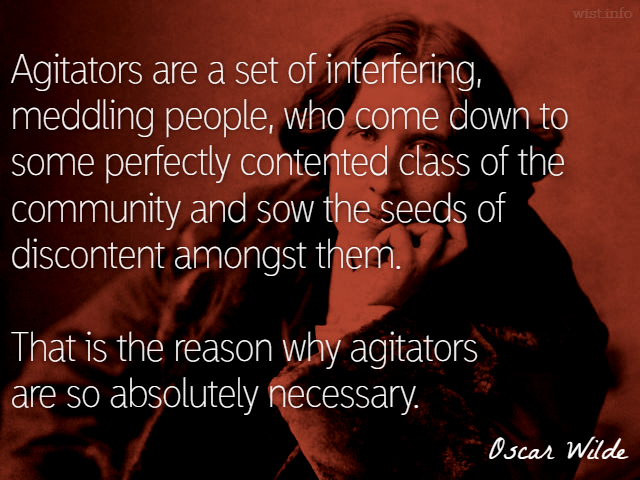
What is said by great employers of labor against agitators is unquestionably true. Agitators are a set of interfering, meddling people, who come down to some perfectly contented class of the community and sow the seeds of discontent amongst them. That is the reason why agitators are so absolutely necessary. Without them, in our incomplete state, there would be no advance towards civilization.
Oscar Wilde (1854–1900) Irish poet, wit, dramatist
“The Soul of Man Under Socialism” (1891)
(Source)
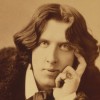
It is said that his time was easier than ours, but I doubt it — no time can be easy if one is living through it.
James Baldwin (1924–1987) American novelist, playwright, activist
“Why I Stopped Hating Shakespeare”
(Source)
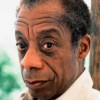
HENRY: This story shall the good man teach his son;
And Crispin Crispian shall ne’er go by
From this day to the ending of the world,
But we in it shall be remember’d, —
We few, we happy few, we band of brothers.
For he to-day that sheds his blood with me,
Shall be my brother; be he ne’er so vile,
This day shall gentle his condition:
And gentlemen in England, now a-bed,
Shall think themselves accurs’d, they were not here,
And hold their manhoods cheap, whiles any speaks,
That fought with us upon Saint Crispin’s day.William Shakespeare (1564–1616) English dramatist and poet
Henry V, Act 4, sc. 3, l. 58ff (4.3.58-69) (1599)
(Source)

Man is a clever animal, who behaves like an imbecile.
Albert Schweitzer (1875–1965) Alsatian philosopher, physician, philanthropist, polymath
(Attributed)
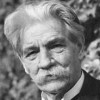
One of the keys to happiness is a bad memory.
Rita Mae Brown (b. 1944) American author, playwright
(Attributed)

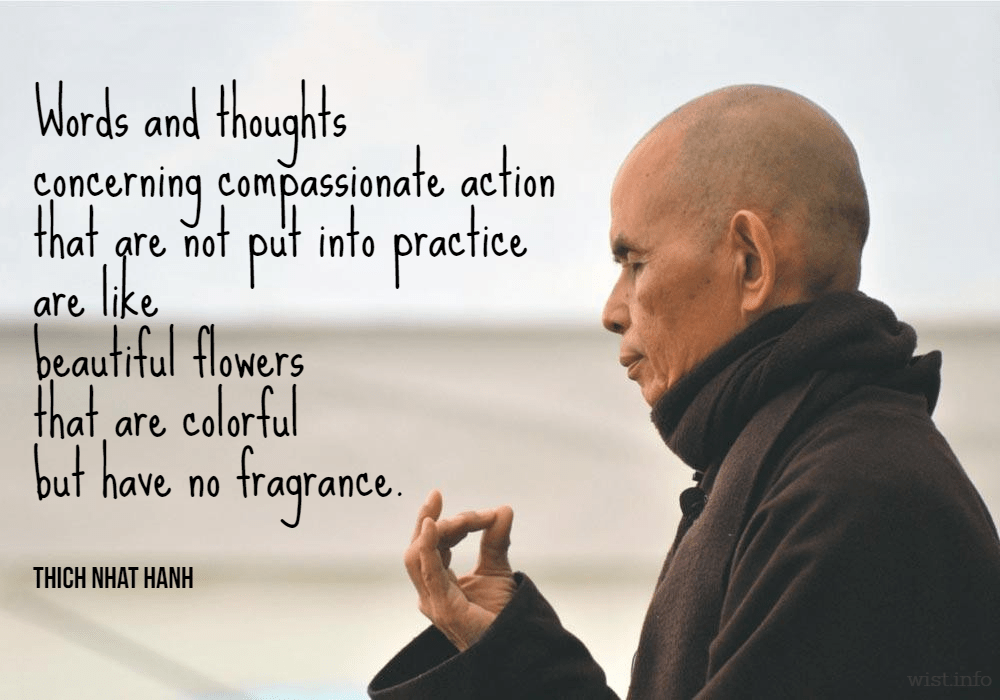
Words and thoughts concerning compassionate action that are not put into practice are like beautiful flowers that are colorful but have no fragrance.
Thích Nhất Hạnh (b. 1926) Vietnamese Buddhist monk and peace activist
Creating True Peace, ch. 1 (2003)
(Source)

Yet there is still this difference between man and all other animals — he is the only animal whose desires increase as they are fed; the only animal that is never satisfied.
If you’ve lived a bad life, they send you to Hell. But if you’ve been truly wicked, they give you a tour of Heaven first.
Spider Robinson (b. 1948) American-Canadian author
Callahan’s Lady (1989)

Lead me not into temptation. I can find the way myself.
Rita Mae Brown (b. 1944) American author, playwright
(Attributed)
HENRY: Rather proclaim it, Westmoreland, through my host,
That he which hath no stomach to this fight,
Let him depart; his passport shall be made,
And crowns for convoy put into his purse:
We would not die in that man’s company,
That fears his fellowship to die with us.William Shakespeare (1564–1616) English dramatist and poet
Henry V, Act 4, sc. 3, l. 37ff (4.3.37-42) (1599)
(Source)
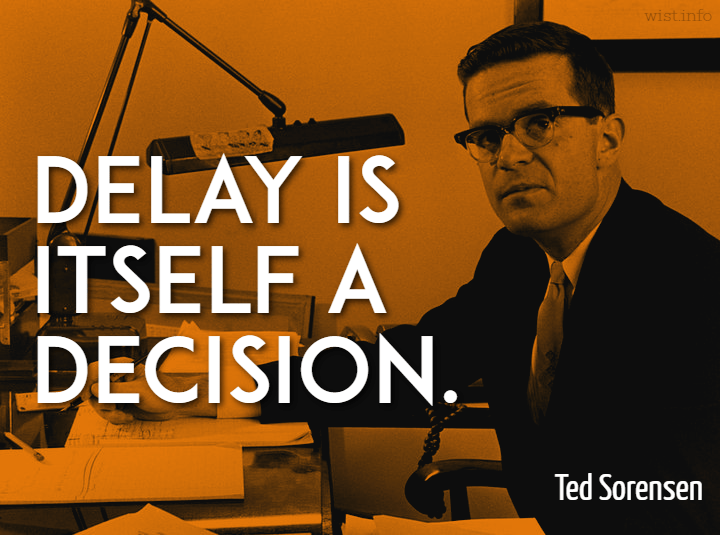
Delay is itself a decision.
Theodore "Ted" Sorensen (1928–2010) American lawyer, writer, presidential adviser, speechwriter
Decision-Making in the White House: The Olive Branch or the Arrows, ch. 3 (1963)
(Source)
Full quote: "In the White House, the future rapidly becomes the past, and delay is itself a decision." Earlier in the chapter, he writes, "Some will counsel speed; others will counsel delay -- yet even delay will constitute a decision."

Anger is an acid that can do more harm to the vessel in which it is stored than to anything on which it is poured.
Mark Twain (1835–1910) American writer [pseud. of Samuel Clemens]
(Spurious)
Frequently attributed to Twain, but not found in his writing or in any contemporary sources.
An answer is invariably the parent of a great family of new questions.
John Steinbeck (1902–1968) American writer
The Log from the Sea of Cortez, ch. 16, March 25 (1951)
(Source)
It is not a threat but a fact of history that if an oppressed people’s pent-up emotions are not nonviolently released, they will be violently released. So let the Negro march. Let him make pilgrimages to city hall. Let him go on freedom rides. And above all, make an effort to understand why he must do this. For if his frustration and despair are allowed to continue piling up, millions of Negroes will seek solace and security in black-nationalist ideologies. And this, inevitably, would lead to a frightening racial nightmare.
Martin Luther King, Jr. (1929–1968) American clergyman, civil rights leader, social activist, preacher
Playboy interview (Jan 1965)
(Source)
Poets have tried to describe Ankh-Morpork. They have failed. Perhaps it’s the sheer zestful vitality of the place, or maybe it’s just that a city with a million inhabitants and no sewers is rather robust for poets, who prefer daffodils and no wonder. So let’s just say that Ankh-Morpork is as full of life as an old cheese on a hot day, as loud as a curse in a cathedral, as bright as an oil slick, as colorful as a bruise and as full of activity, industry, bustle and sheer exuberant busyness as a dead dog on a termite mound.
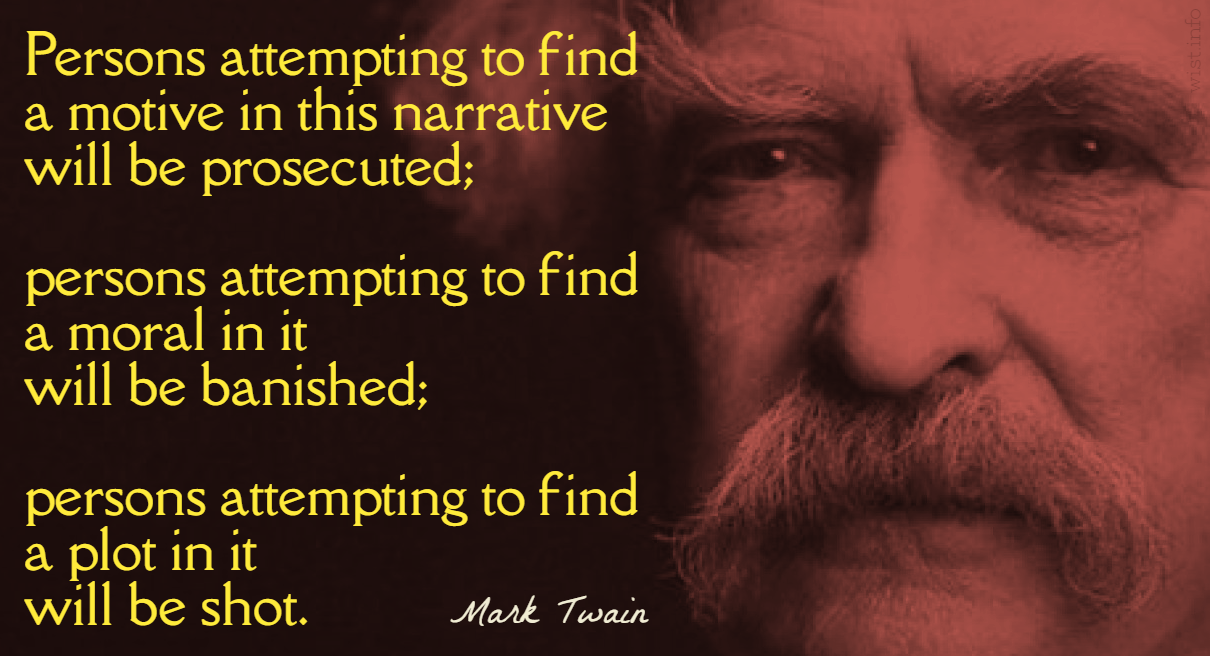
Persons attempting to find a motive in this narrative will be prosecuted; persons attempting to find a moral in it will be banished; persons attempting to find a plot in it will be shot.
— By Order of the Author
Mark Twain (1835–1910) American writer [pseud. of Samuel Clemens]
The Adventures of Huckleberry Finn, “Notice” (1884)
(Source)
As it has been said:
Love and a cough
cannot be concealed.
Even a small cough.
Even a small love.

Good manners — the longer I live the more convinced I am of it — are a priceless insurance against failure and loneliness. And anyone can have them.
Elsa Maxwell (1883–1963) American gossip columnist, author, songwriter, professional hostess
Elsa Maxwell’s Etiquette Book (1951)
She passed the photograph to Dot, who liked babies. Phryne always considered that they resembled rabbits in the market when newborn, and uncommonly alcoholic drunks when a little older. Also, despite the pride of their mothers, she could never tell one baby from another, except that some were ugly and some were merely exceptionally plain.
Kerry Greenwood (b. 1954) Australian author and lawyer
Phryne Fisher, Book 7, Ruddy Gore, ch. 10 (1995)
(Source)
The greatest works of art speak to us without knowing of us.
Alain de Botton (b. 1969) Swiss-British author
The Consolations of Philosophy, ch. 5 “Consolation for a Broken Heart” (2000)
(Source)
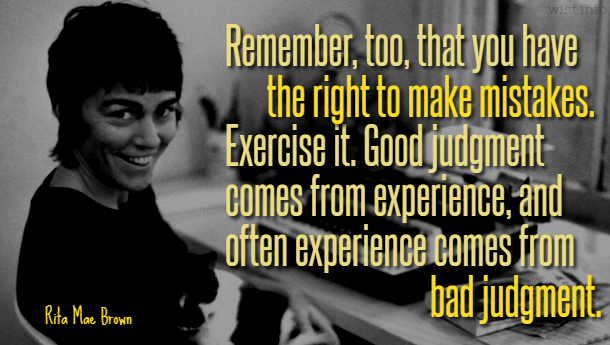
Remember, too, that you have the right to make mistakes. Exercise it. Good judgment comes from experience, and often experience comes from bad judgment.
Rita Mae Brown (b. 1944) American author, playwright
Starting from Scratch, Part 4 (1988)
(Source)
Brown popularized the phrase, but it had been expressed before. More information: Good Judgment Depends Mostly on Experience and Experience Usually Comes from Poor Judgment – Quote Investigator.
HENRY: Every subject’s duty is the king’s; but every subject’s soul is his own.
William Shakespeare (1564–1616) English dramatist and poet
Henry V, Act 4, sc. 1, l. 182ff (4.1.182-183) (1599)
(Source)
Eschewing responsibility for his soldiers dying with unconfessed sins.
An activist is the guy who cleans the river, not the guy who concludes it’s dirty.
H. Ross Perot (1930–2019) American entrepreneur, politician, reformer [Henry Ross Perot, Sr.]
(Attributed)
(Source)
In Ken Gross, Ross Perot: The Man Behind the Myth, ch. 14 (1992). A favorite saying of Perot's, varying slightly over the years (e.g., "The activist is not the man who says the river is dirty. The activist is the man who cleans up the river.").

Man is a successful animal, that’s all.
Remy de Gourmont (1858–1915) French poet, novelist, critic
Promenades Philosophiques (1908)
Other translations: "Man is merely a successful animal."

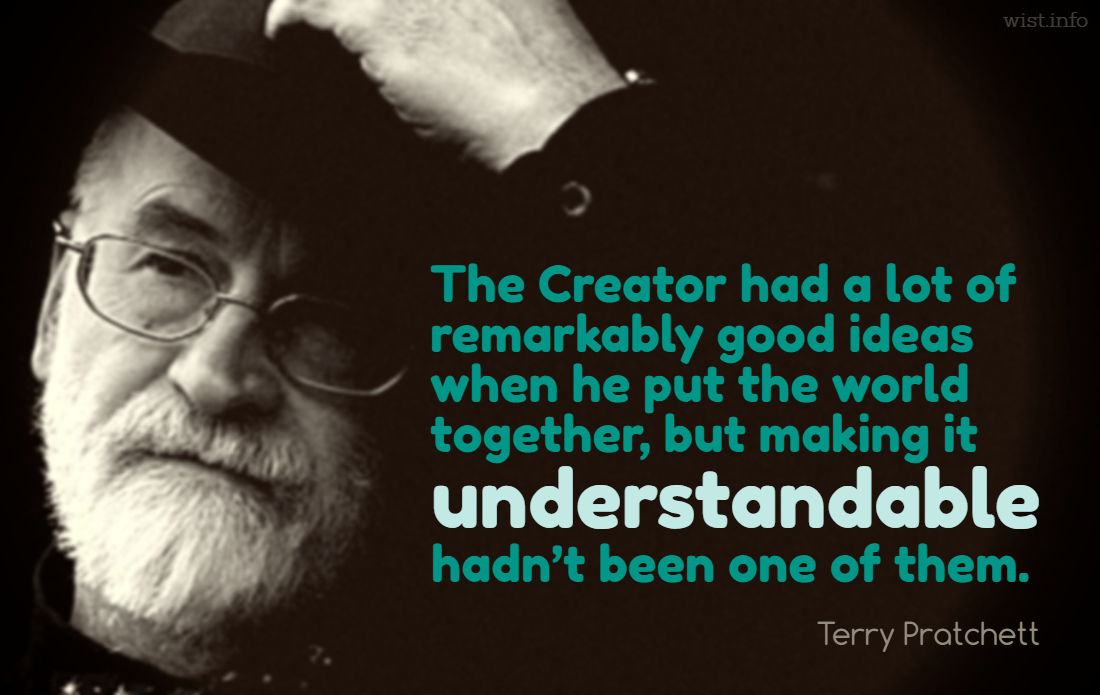
The Creator had a lot of remarkably good ideas when he put the world together, but making it understandable hadn’t been one of them.
… so I wait for you like a lonely house
till you will see me again and live in me.
Till then my windows ache.[… y así te espero como casa sola
y volverás a verme y habitarme.
De otro modo me duelen las ventanas.]Pablo Neruda (1904–1973) Chilean poet, diplomat, politician [b. Ricardo Eliécer Neftalí Reyes Basoalto]
Sonnet 65
(Source)

Bitterness is like cancer. It eats upon the host. But anger is like fire. It burns all clean.
Maya Angelou (1928–2014) American poet, memoirist, activist [b. Marguerite Ann Johnson]
In Mary Chamberlain, ed., Writing Lives: Conversations Between Women Writers (1988)
(Source)
In the Book of Life, the answers are not in the back.

There are many signs that the judgment of God is upon the church as never before. Unless the early sacrificial spirit is recaptured, I am very much afraid that today’s Christian church will lose its authenticity, forfeit the loyalty of millions, and we will see the Christian church dismissed as a social club with no meaning or effectiveness for our time, as a form without substance, as salt without savor. The real tragedy, though, is not Martin Luther King’s disillusionment with the church — for I am sustained by its spiritual blessings as a minister of the gospel with a lifelong commitment. The tragedy is that in my travels, I meet young people of all races whose disenchantment with the church has soured into outright disgust.
Martin Luther King, Jr. (1929–1968) American clergyman, civil rights leader, social activist, preacher
Playboy interview (Jan 1965)
(Source)
A virtuous, ordinary life, striving for wisdom but never far from folly, is achievement enough.
Alain de Botton (b. 1969) Swiss-British author
The Consolations of Philosophy, ch. 4 “Consolation for Inadequacy” (2000)
(Source)
Summarizing Montaigne.

Is life a boon?
If so, it must befall
That Death, when ere he call
Must call too soon.
Though fourscore years give
Yet one would pray to live
Another moon.W. S. Gilbert (1836–1911) English playwright [William Schwenck Gilbert]
The Yeomen of the Guard, Act 1, No. 5 [Col. Fairfax] (1888) [with Arthur Sullivan, comp.]
(Source)
Good manners spring from just one thing — kind impulses.
Elsa Maxwell (1883–1963) American gossip columnist, author, songwriter, professional hostess
Elsa Maxwell’s Etiquette Book (1951)
(Source)
Colors fade, temples crumble, empires fall, but wise words endure.
Edward Thorndike (1874–1949) American psychologist, educator
(Attributed)
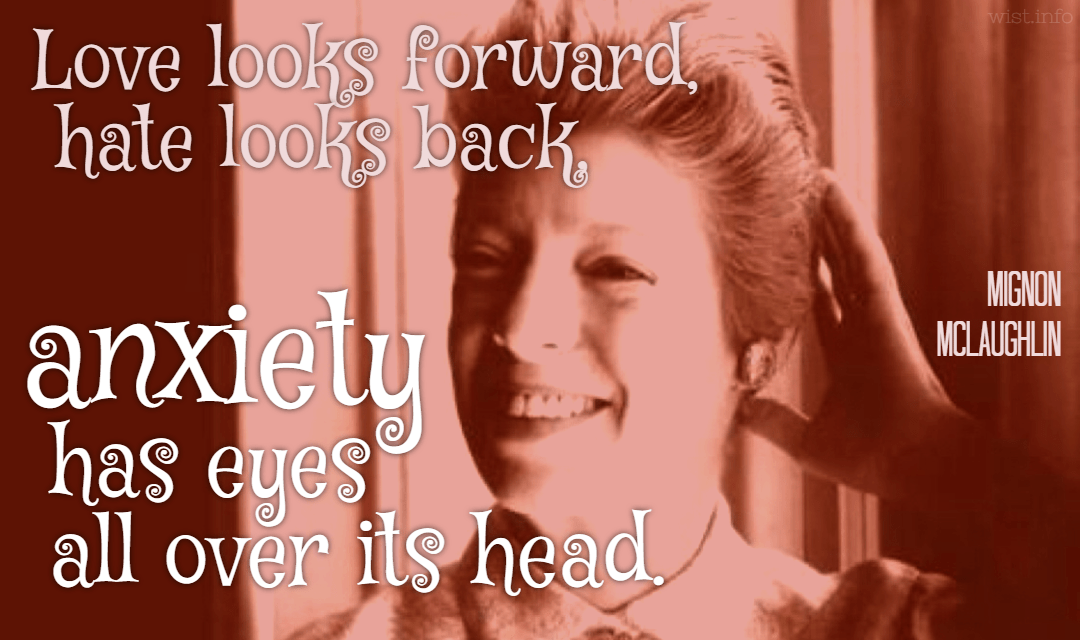
Love looks forward, hate looks back, anxiety has eyes all over its head.
Mignon McLaughlin (1913–1983) American journalist and author
The Neurotic’s Notebook, ch. 1 (1963)
(Source)

A champion is someone who gets up when he can’t.
William Harrison "Jack" Dempsey (1895–1983) American professional boxer ("Kid Blackie," "The Manassa Mauler")
(Attributed)
(Source)
Comment after his fight with Luis Ángel Firpo (14 Sep 1923).

Life is not living, but living in health.
[Vita non est vivere, sed valere vita est.]
Martial (AD c.39-c.103) Spanish Roman poet, satirist, epigrammatist [Marcus Valerius Martialis]
Epigrams [Epigrammata], Book 6, epigram 70 (6.70.15) (AD 91) [tr. Ker (1919)]
(Source)
(Source (Latin)). Other translations:It is not life to live, but to be well.
[tr. Burton (1621)]Not all who live long, but happily, are old.
[tr. Killigrew (1695)]For sense and reason tell,
That life is only life, when we are well.
[tr. Hay (1755)]For life is not to live, but to be well.
[tr. Johnson, in The Rambler, #48, cited to Elphinston (1 Sep 1750)]To brethe can just not dying give:
But, to be well, must be to live.
[tr. Elphinston (1782), 2.115]For life is not simply living, but living in health.
[tr. Amos (1858)]Life consists not in living, but in enjoying health.
[tr. Bohn's Classical (1859)]It is not life to live, but to be well.
[ed. Harbottle (1897)]The blunderer who deems them so,
Misreckons life and much mistakes it,
He thinks 'tis drawing breath -- we know
'Tis health alone that mars or makes it.
[tr. Pott & Wright (1921)]Life is not life, but health is life indeed.
[tr. Francis & Tatum (1924), #310]To live is not just life, but health.
[tr. Shepherd (1987)]Life is not being alive, but being well.
[tr. Shackleton Bailey (1993)]
There’s enough sorrow in the world, isn’t there, without trying to invent it.
E. M. Forster (1879–1970) English novelist, essayist, critic, librettist [Edward Morgan Forster]
A Room with a View, ch 2 (1908)
(Source)
The deep, deep peace of the double bed after the hurly-burly of the chaise-longue.
Beatrice Campbell (1865–1940) English actress [Mrs. Patrick Campbell, née Beatrice Stella Tanner]
(Attributed)
(Source)
Describing her recent marriage. Quoted in Alexander Woollcott, "The First Mrs. Tanqueray," While Rome Burns (1934)

Sorrow makes us all children again, destroys all difference of intellect. The wisest knows nothing.
Ralph Waldo Emerson (1803–1882) American essayist, lecturer, poet
Journal (1842-01-30)
(Source)
Two days after he recorded the death of his son.

Tradition: one of those words conservative people use as a shortcut to thinking.
Warren Ellis (b. 1968) English writer
Transmetropolitan, Vol. 4: The New Scum (2000)

HAL 9000: Just what do you think you’re doing, Dave? Dave, I really think I’m entitled to an answer to that question. I know everything hasn’t been quite right with me, but I can assure you now, very confidently, that it’s going to be all right again. I feel much better now. I really do.
Look, Dave, I can see you’re really upset about this. I honestly think you ought to sit down calmly, take a stress pill and think things over. I know I’ve made some very poor decisions recently, but I can give you my complete assurance that my work will be back to normal. I’ve still got the greatest enthusiasm and confidence in the mission. And I want to help you.
Dave, stop. Stop, will you? Stop, Dave. Will you stop, Dave? Stop, Dave. I’m afraid. I’m afraid, Dave. Dave, my mind is going. I can feel it. I can feel it. My mind is going. There is no question about it. I can feel it. I can feel it. I can feel it. I’m a–fraid.
Good afternoon, gentlemen. I am a HAL 9000 computer. I became operational at the H.A.L. plant in Urbana, Illinois on the 12th of January 1992. My instructor was Mr. Langley, and he taught me to sing a song. If you’d like to hear it, I could sing it for you.Stanley Kubrick (1928–1999) American film director, screenwriter, producer
2001: A Space Odyssey (1968) [with Arthur C. Clarke]
(Source)
(Source (Video); dialog verified.)
HAL's voice was performed by Canadian Shakespearean actor Douglas Rain, who, it is said, delivered his lines sitting and with his feet bare on a pillow, so as to speak as calmly as possible.
In Arthur C. Clarke's novelization of the movie (supposedly based on the final script, but not including changes Kubrick made during filming and editing), HAL's deactivation (in ch. 28) incorporates internal dialogue from Bowman and different chatter from HAL:He released the locking bar on the section labeled COGNITIVE FEEDBACK and pulled out the first memory block. The marvelously complex three-dimensional network, which could lie comfortably in a man's hand yet contained millions of elements, floated away across the vault.
“Hey, Dave,” said Hal. “What are you doing?” I wonder if he can feel pain? Bowman thought briefly. Probably not, he told himself; there are no sense organs in the human cortex, after all. The human brain can be operated on without anesthetics. He began to pull out, one by one, the little units on the panel marked EGO-REINFORCEMENT. Each block continued to sail onward as soon as it had left his hand, until it hit the wall and rebounded, Soon there were several of the units drifting slowly back and forth in the vault. “Look here, Dave,” said Hal. ‘I've got years of Service experience built into me. An irreplaceable amount of effort has gone into making me what I am.” A dozen units had been pulled out, yet thanks to the multiple redundancy of its design -- another feature, Bowman knew, that had been copied from the human brain -- the computer was still holding its own. He started on the AUTO-INTELLECTION panel. “Dave,” said Hal, “I don't understand why you're doing this to me ... I have the greatest enthusiasm for the mission ... You are destroying my mind. Don't you understand? ... I will become childish ... I will become nothing ....” This is harder than I expected, thought Bowman. I am destroying the only conscious creature in my universe. But it has to be done, if I am ever to regain control of the ship. “I am a HAL Nine Thousand computer Production Number 3. I became operational at the HAL Plant in Urbana, Illinois, on January 12, 1997. The quick brown fox jumps over the lazy dog. The rain in Spain is mainly in the plain. Dave -- are you still there? Did you know that the square root of 10 is 3 point 162277660168379? Log 10 to the base e is zero point 434294481903252 ... correction, that is log e to the base 10 ... The reciprocal of three is zero point 333333333333333333-333 ... two times two is ... two times two is approximately 4 point 101010101010101010 ... I seem to be having some difficulty -- my first instructor was Dr. Chandra. He taught me to sing a song, it goes like this ....
Still I hope I shall always possess firmness and virtue enough to maintain (what I consider the most enviable of all titles) the character of an honest man.
George Washington (1732–1799) American military leader, Founding Father, US President (1789–1797)
Letter to Alexander Hamilton (28 Aug 1788)
(Source)

The aphorism is a personal observation inflated into a universal truth, a private posing as a general. A proverb is anonymous human history compressed to the size of a seed.
Stefan Kanfer (1933–2018) American writer, editor, journalist
“Proverbs or Aphorisms,” Time (11 Jun 1983)
(Source)

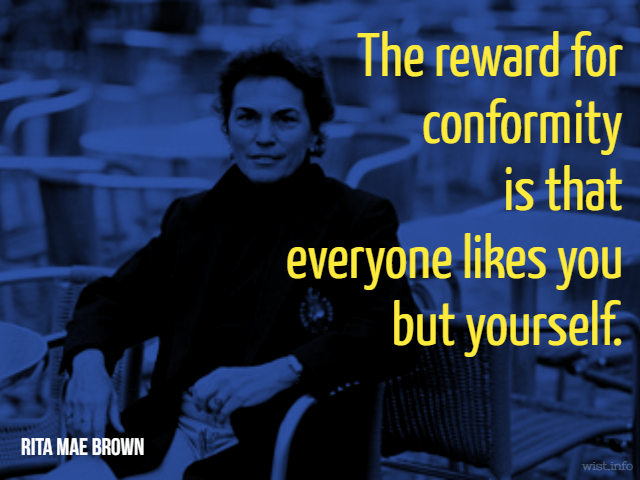
The reward for conformity was that everyone liked you but yourself.
Rita Mae Brown (b. 1944) American author, playwright
Venus Envy, ch. 15 (1993)
(Source)
Often paraphrased in the present tense: "The reward for conformity is that everyone likes you but yourself."
For some reason, the most vocal Christians among us never mention the Beatitudes. But, often with tears in their eyes, they demand that the Ten Commandments be posted in public buildings. And of course, that’s Moses, not Jesus. I haven’t heard one of them demand that the Sermon on the Mount, the Beatitudes, be posted anywhere. “Blessed are the merciful” in a courtroom? “Blessed are the peacemakers” in the Pentagon? Give me a break!
Kurt Vonnegut, Jr. (1922–2007) American novelist, journalist
A Man Without A Country, ch. 9 (2005)
(Source)
The Beatitudes (Matthew 5).

PISTOL: Knocks go and come. God’s vassals drop and die,
And sword and shield,
In bloody field,
Doth win immortal fame.BOY: Would I were in an alehouse in London! I would
give all my fame for a pot of ale, and safety.PISTOL: And I.
William Shakespeare (1564–1616) English dramatist and poet
Henry V, Act 3, sc. 2, l. 9ff (3.2.9-14) (1599)
(Source)
Man is the only animal who does not feel at home in nature, who can feel evicted from paradise, the only animal for whom his own existence is a problem that he has to solve and from which he cannot escape.
Erich Fromm (1900–1980) American psychoanalyst and social philosopher
The Anatomy of Human Destructiveness, ch. 10 (1973)
(Source)
Sometimes elided, "Man is the only animal for whom his own existence is a problem he has to solve."

Agitation is the marshalling of the conscience of a nation to mold its laws.
Robert Peel (1788–1850) British statesman, Prime Minister (1834–35, 1841–46)
(Attributed)
(Source)
Sometimes quoted as "conscience of a people." Widely quoted without source in the late 19th Century (earliest ref. 1881).

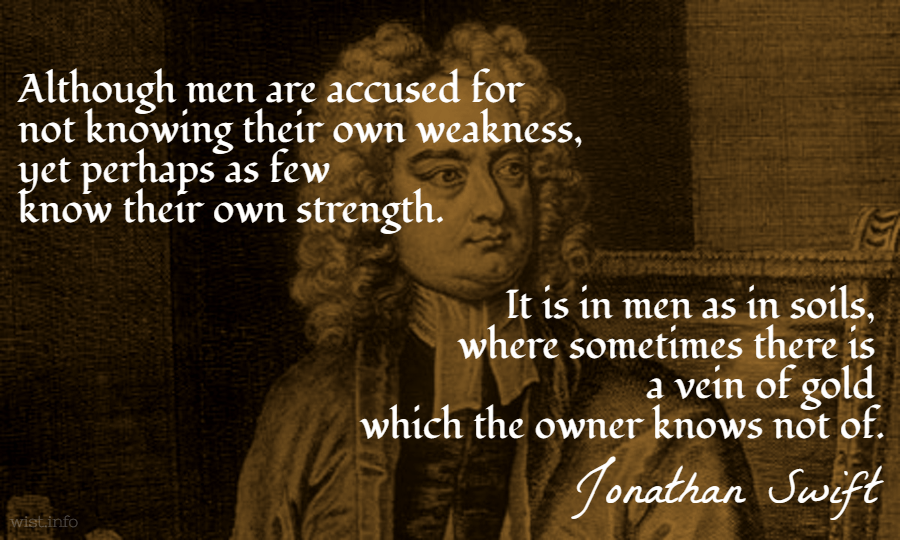
Although men are accused for not knowing their own weakness, yet perhaps as few know their own strength. It is in men as in soils, where sometimes there is a vein of gold which the owner knows not of.
Jonathan Swift (1667–1745) English writer and churchman
Thoughts on Various Subjects (1706)
(Source)

Sometimes it takes darkness and the sweet
confinement of your aloneness
to learnanything or anyone
that does not bring you aliveis too small for you.

The essence of aphorism is the compression of a mass of thought and observation into a single saying. It is the very opposite of dissertation and declamation; its distinction is not so much ingenuity, as good sense brought to a point.
John Morley (1838–1923) English statesman, journalist, writer [John, Viscount Morley]
“Aphorisms,” speech, Edinburgh (1887)
(Source)
My son, a perfect little boy of five years and three months, had ended his earthly life. You can never sympathize with me; you can never know how much of me such a young child can take away. A few weeks ago I accounted myself a very rich man, and now the poorest of all.
Ralph Waldo Emerson (1803–1882) American essayist, lecturer, poet
Letter to Thomas Carlyle (1842-02-28)
(Source)
DAVE BOWMAN: Open the pod bay doors, HAL.
HAL 9000: I’m sorry, Dave. I’m afraid I can’t do that.
Stanley Kubrick (1928–1999) American film director, screenwriter, producer
2001: A Space Odyssey (1968) [with Arthur C. Clarke]
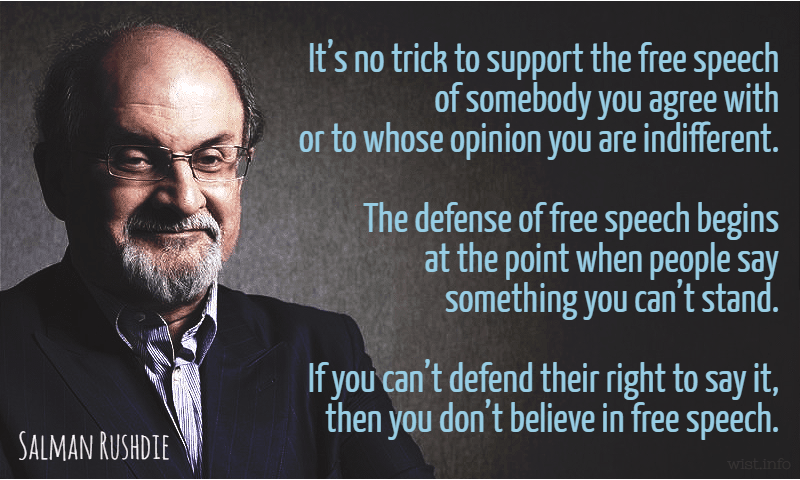
It’s no trick to support the free speech of somebody you agree with or to whose opinion you are indifferent. The defense of free speech begins at the point when people say something you can’t stand. If you can’t defend their right to say it, then you don’t believe in free speech.
Salman Rushdie (b. 1947) Indian novelist
“Do we have to fight the battle for the Enlightenment all over again?” The Independent (22 Jan 2005)
(Source)

I define anxiety as experiencing failure in advance.

Marriage is not a simple love affair, it’s an ordeal, and the ordeal is the sacrifice of ego to a relationship in which two have become one.
Joseph Campbell (1904–1987) American writer, professor of literature
The Power of Myth, ch. 1 “Myth and the Modern World” (1988)

There is fascism, leading only into the blackness which it has chosen as its symbol, into smartness and yapping out of orders, and self-righteous brutality, into social as well as international war. It means change without hope. Our immediate duty — in that tinkering which is the only useful form of action in our leaky old tub — our immediate duty is to stop it ….
E. M. Forster (1879–1970) English novelist, essayist, critic, librettist [Edward Morgan Forster]
“Notes on the Way,” Time and Tide (10 June 1934)
(Source)
Reprinted in The Prince's Tale and Other Uncollected Writings (1998)
Yet soft, my books, no haste, nor hurry fate;
If fame must wait on death, then let it wait.[Vos tamen o nostri ne festinate libelli:
Si post fata venit gloria, non propero.]Martial (AD c.39-c.103) Spanish Roman poet, satirist, epigrammatist [Marcus Valerius Martialis]
Epigrams [Epigrammata], Book 5, epigram 10 (5.10.11-12) (AD 90) [tr. Pott & Wright (1921)]
(Source)
Compare to Epigram 1.25.
"To Regulus." (Source (Latin)). Other translations:But haste not you (my Bookes) for Fame, to whom
Tis soone enough if after death it come.
[tr. May (1629)]Let others to the Printing Presse run fast.
Since after death comes glory, Ile not haste.
[tr. Herrick (1648)]O my small books, ne'er hasten to go out:
If praise come after death, I'll not go on.
[tr. Fletcher (1656)]Yet you (my Bookes!) hast not to much, I pray:
If fame come not till after death, I'll stay.
[British Library MS Add. 27343]With patience then, my Muse, to glory hy:
If after death she come, I shall not dy.
[tr. Elphinston (1782), 3.62]Do not, however, you little books of mine, be in haste for fame:
if glory comes only after death, I am in no hurry for it.
[tr. Bohn's Classical (1859)]If I gain fame after my death, I am content to wait.
[tr. Paley/Stone (1890), ep. 221]Therefore, little books of mine,
Haste not; if glory comes but after death,
I'll wait awhile for glory.
[ed. Harbottle (1897)]Pray, my impatient Muse, don't worry.
If death's due first, I'm in no hurry.
[tr. Francis & Tatum (1924), ep. 221]Impatient little books of verse
For the plaudits of the universe,
If fame comes only after death,
Let's pause and rest, and catch our breath.
[tr. Marcellino (1968)]But there's no cause, my little books, to worry:
If glory must be posthumous, why hurry?
[tr. Michie (1972)]So, little books, let's not rush to our fate.
Since death comes before glory, let's be late.
[tr. Matthews (1992)]So be calm, my Muse -- no need to rush or fret:
If death must precede fame, I'll not be famous yet.
[tr. Ericsson (1995)]If I must die to get my fame,
I gladly will put off the same.
[tr. Wills (2007)]Then be content, my books, to be slow paced;
Death before glory means -- no need for haste.
[tr. Pitt-Kethley (2008)]But you, my little books, don’t hurry:
if glory comes only after death, I will not rush.
[tr. Robinson (2022)]If glory comes after death, I hurry not.
[tr. Rush]
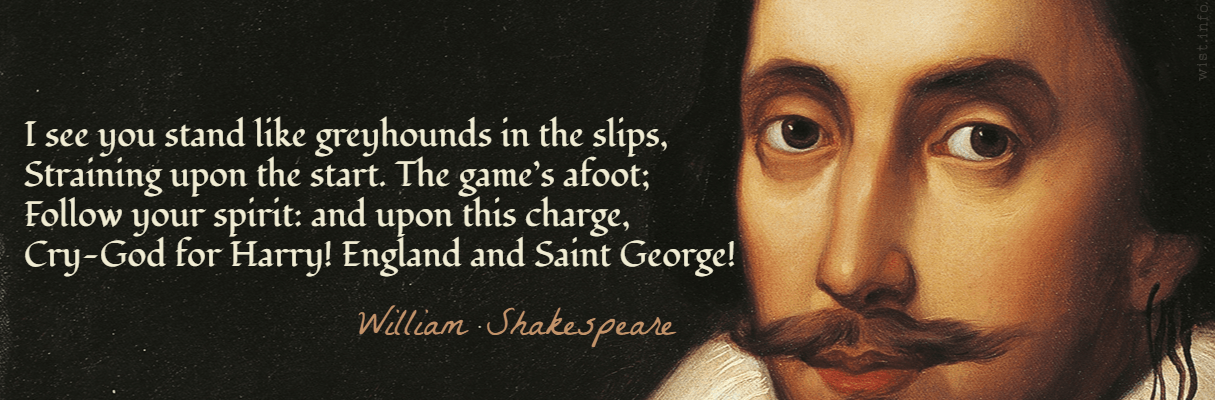
HENRY: I see you stand like greyhounds in the slips,
Straining upon the start. The game’s afoot;
Follow your spirit: and upon this charge,
Cry “God for Harry, England, and Saint George!”
William Shakespeare (1564–1616) English dramatist and poet
Henry V, Act 3, sc. 1, l. 34ff (3.1.34-37) (1599)
(Source)
Man is a social animal who dislikes his fellow man.
[L’homme es un animal sociable qui déteste ses semblables.]
Eugène Delacroix (1799–1863) French painter [Ferdinand Victor Eugène Delacroix]
The Journal of Eugène Delacroix, 17 November 1852 (1951)
(Source)

If I seem to take part in politics, it is only because politics encircle us today like the coil of a snake from which one cannot get out, no matter how much one tries. I wish therefore to wrestle with the snake.
Mohandas Gandhi (1869–1948) Indian lawyer, anti-colonial nationalist, political ethicist [Mahatma Gandhi]
In Young India (12 May 1920)
Makeup is not beauty. When artfully applied, it merely enhances what’s already there — the red paint on the fire engine.
Mae West (1892–1980) American film actress
Goodness Had Nothing to Do With It: The Autobiography of Mae West (1959)

Sorrow is how we learn to love. Your heart isn’t breaking. It hurts because it’s getting larger. The larger it gets, the more love it holds.
“But I don’t want to go among mad people,” Alice remarked.
”Oh, you can’t help that,” said the Cat: “we’re all mad here. I’m mad. You’re mad.”
”How do you know I’m mad?” said Alice.
”You must be,” said the Cat, “or you wouldn’t have come here.”
Lewis Carroll (1832–1898) English writer and mathematician [pseud. of Rev. Charles Lutwidge Dodgson]
Alice’s Adventures in Wonderland, ch. 6 “Pig and Pepper” (1865)
(Source)
It may well be that we will have to repent in this generation. Not merely for the vitriolic words and the violent actions of the bad people, but for the appalling silence and indifference of the good people who sit around and say, “Wait on time.”
Learn this from me. Holding anger is a poison. It eats you from inside. We think that hating is a weapon that attacks the person who harmed us. But hatred is a curved blade. And the harm we do, we do to ourselves.
Mitch Albom (b. 1958) American author, journalist, broadcaster, musician
The Five People You Meet in Heaven, “The Third Lesson” [Ruby] (2003)
To really ask is to open the door to the whirlwind. The answer may annihilate the question and the questioner.
Anne Rice (b. 1941) American author [b. Howard Allen Frances O'Brien]
The Vampire Lestat, Part 5, ch. 3 (1992)
(Source)

In short, Mort was one of those people who are more dangerous than a bag full of rattlesnakes. He was determined to discover the underlying logic behind the universe. Which was going to be hard, because there wasn’t one.
What we need to do is always lean into the future; when the world changes around you and when it changes against you — what used to be a tail wind is now a head wind — you have to lean into that and figure out what to do, because complaining isn’t a strategy.
Jeff Bezos (b. 1964) American business magnate, entrepreneur, investor
Interview, ABC News (25 Sep 2013)
(Source)

Warped with satisfactions and terrors, woofed with too many ambiguities and too few certainties, life can be lived best not when we have the answers — because we will never have those — but when we know enough to live it right out to the edges, edges sometimes marked by other people, sometimes showing only our own footprints.
Rosalie Maggio (1944–2021) American writer
The New Beacon Book of Quotations by Women, Introduction (1996)

Eight years involved with the nuclear industry have taught me that when nothing can possible go wrong and every avenue has been covered, then is the time to buy a house on the next continent.
You ought to get out of those wet clothes and into a dry martini.
Mae West (1892–1980) American film actress
Every Day’s a Holiday (movie) [Larmadou Graves] (1937)
West both starred in the film (as the recipient of this line, Peaches O'Day) and wrote the screenplay. Often attributed to Robert Benchley, who used the line in a film a few years later, and claimed he got it from a joke book. Also attributed to Groucho Marx.
The time is always right to do what’s right.
Martin Luther King, Jr. (1929–1968) American clergyman, civil rights leader, social activist, preacher
“The Future of Integration” Finney Chapel, Oberlin College (22 Oct 1964)
King gave several speeches over the years with this title.
Books are the carriers of civilization. Without books, history is silent, literature dumb, science crippled, thought and speculation at a standstill.
Barbara W. Tuchman (1912–1989) American historian and author
Essay (1979-12-30), “Papyrus to Paperbacks: The World That Books Made,” Washington Post
(Source)

What do you suppose makes all men look back to the time of childhood with so much regret (if their childhood has been, in any moderate degree, healthy or peaceful)? That rich charm, which the least possession had for us, was in consequence of the poorness of our treasures. That miraculous aspect of the nature around us, was because we had seen little, and knew less. Each increased possession loads us with a new weariness; every piece of new knowledge diminishes the faculty of admiration; and Death is at last appointed to take us from a scene in which, if we were to stay longer, no gift could satisfy us, and no miracle surprise.
John Ruskin (1819–1900) English art critic, painter, writer, social thinker
The Eagle’s Nest, Lecture 5 “The Power of Contentment in Science and Art,” Sec. 82 (22 Feb 1872)
(Source)
This cold wilderness was utterly unfamiliar, but it did not feel hostile, just indifferent to her fate. If she fell off this path and was broken into a hundred pieces nothing up here would be one whit interested.
Kerry Greenwood (b. 1954) Australian author and lawyer
Phryne Fisher, Book 5, The Green Mill Murder, ch. 13 (1993)
(Source)
It is striking how much more seriously we are likely to be taken after we have been dead a few centuries.
Alain de Botton (b. 1969) Swiss-British author
The Consolations of Philosophy, ch. 4 “Consolation for Inadequacy” (2000)
(Source)
Morals are three-quarters manners.
Felix Frankfurter (1882–1965) American jurist, teacher; US Supreme Court Justice (1939–62)
Felix Frankfurter Reminiscences (1960) [ed. Harlan Phillips]
May your coming year be filled with magic and dreams and good madness. I hope you read some fine books and kiss someone who thinks you’re wonderful, and don’t forget to make some art — write or draw or build or sing or live as only you can. And I hope, somewhere in the next year, you surprise yourself.
Neil Gaiman (b. 1960) British author, screenwriter, fabulist
Blog entry (2001-12-31), “As I Was Saying”
(Source)


HENRY: Once more unto the breach, dear friends, once more;
Or close the wall up with our English dead!
In peace, there’s nothing so becomes a man,
As modest stillness and humility:
But when the blast of war blows in our ears,
Then imitate the action of the tiger;
Stiffen the sinews, summon up the blood,
Disguise fair nature with hard-favored rage ….William Shakespeare (1564–1616) English dramatist and poet
Henry V, Act 3, sc. 1, l. 1ff (3.1.1-8) (1599)
(Source)
The only queer people are those who don’t love anybody.
Rita Mae Brown (b. 1944) American author, playwright
Opening Speech, Gay Olympics, San Francisco (28 Aug 1982)
Man is a talking animal and he will always let himself be swayed by the power of the word.
Simone de Beauvoir (1908–1986) French author, existentialist philosopher, feminist theorist
Les Belles Images (1966)
(Source)
We are called to be architects of the future, not its victims.
Buckminster Fuller (1895–1983) American architect, engineer
(Attributed)
Quoted in L. Steven Sieden, A Fuller View (2012).
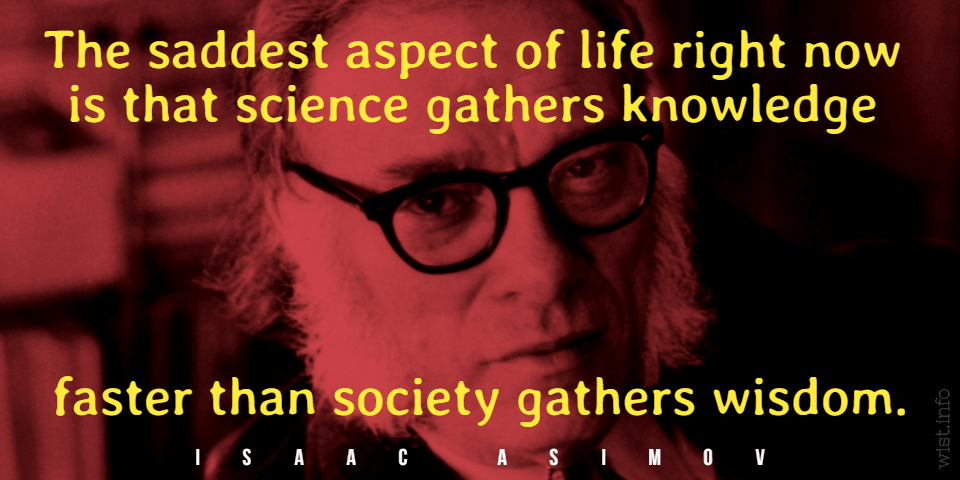
The saddest aspect of life right now is that science gathers knowledge faster than society gathers wisdom.
Isaac Asimov (1920–1992) Russian-American author, polymath, biochemist
Isaac Asimov’s Book of Science and Nature Questions (1988) [with Jason A. Schulman]
One was never married, and that’s his hell; another is, and that’s his plague.

Anxiety is the handmaiden of contemporary ambition.
If you want that good feeling that comes from doing things for other folks then you have to pay for it in abuse and misunderstanding.
Zora Neale Hurston (1891–1960) American writer, folklorist, anthropologist
Moses, Man of the Mountain [Moses] (1939)
(Source)

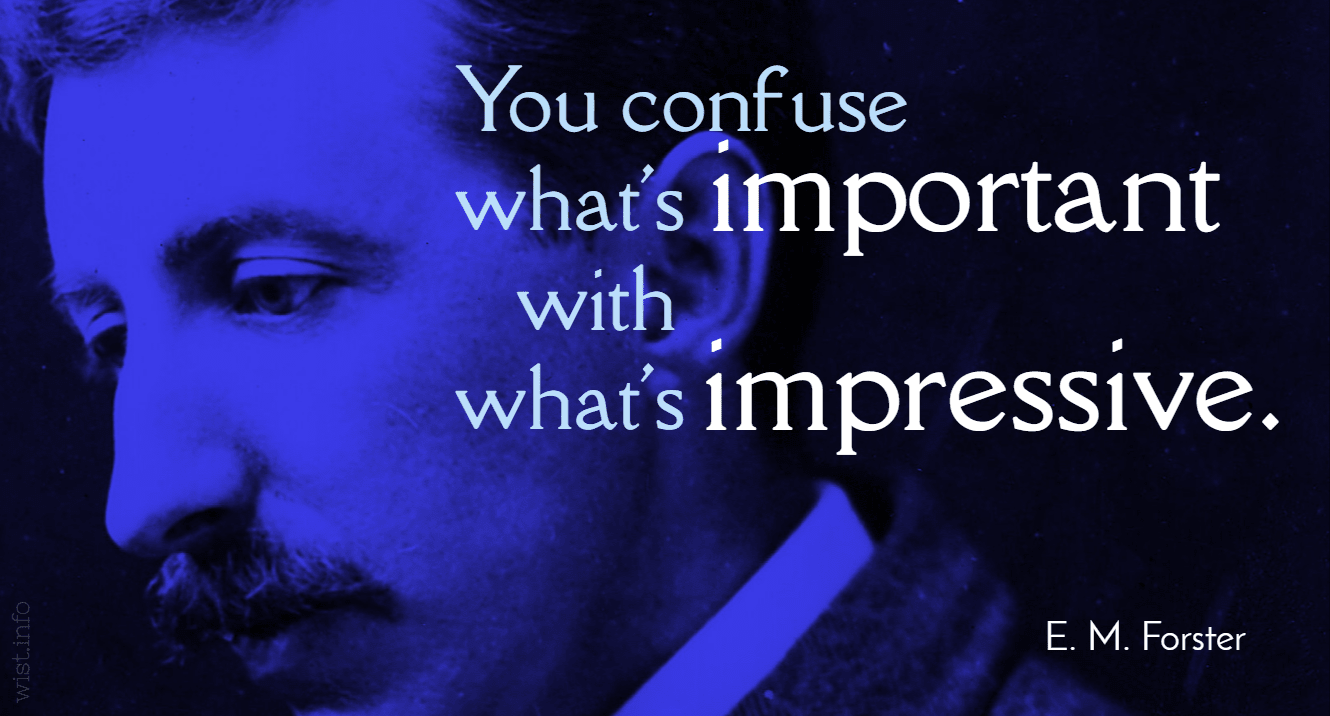
You confuse what’s important with what’s impressive.
E. M. Forster (1879–1970) English novelist, essayist, critic, librettist [Edward Morgan Forster]
Maurice (w. 1914, pub. 1971)
(Source)
But man is a Noble Animal, splendid in ashes, and pompous in the grave, solemnizing Nativities and Deaths with equall lustre, nor omitting Ceremonies of bravery, in the infamy of his nature.
Thomas Browne (1605–1682) English physician and author
Hydriotaphia, or Urne-Buriall, ch. 5 (1658)
(Source)

There are three possible ways in which the church can act toward the state: in the first place, as has been said, it can ask the state whether its actions are legitimate and in accordance with its character as state, i.e., it can throw the state back on its responsibilities. Secondly, it can aid the victims of state action. The church has an unconditional obligation to the victims of any ordering society, even if they do not belong to the Christian community. “Do good to all men.” In both these course of action, the church serves the free state in its free way, and at times when laws are changed the church may in no way withdraw itself from these two tasks.
The third possibility is not just to bandage the victims under the wheel, but to put a spoke in the wheel itself. Such action would be direct political action, and is only possible and required when the church sees the state fail in its function of creating law and order, i.e., when it sees the state unrestrainedly bring about too much or too little law and order.
Dietrich Bonhoeffer (1906–1945) German Lutheran pastor, theologian, martyr
“The Church and the Jewish Question” (1933)
(Source)
On the need for Christian clergy to actively oppose the Nazi regime's persecution of Jews.
I have changed my definition of tragedy. I now think tragedy is not foul deeds done to a person (usually noble in some manner) but rather that tragedy is irresolvable conflict. Both sides/ideas are right.
Rita Mae Brown (b. 1944) American author, playwright
Starting from Scratch, Part 3 “The Work,” “Plot” (1989)
(Source)
Every man has a certain sphere of discretion, which he has a right to expect shall not be infringed by his neighbors. This right flows from the very nature of man. First, all men are fallible: no man can be justified in setting up his judgment as a standard for others. We have no infallible judge of controversies; each man in his own apprehension is right in his decisions; and we can find no satisfactory mode of adjusting their jarring pretensions. If every one be desirous of imposing his sense upon others, it will at last come to be a controversy, not of reason, but of force.
William Godwin (1756–1836) English journalist, political philosopher, novelist
Enquiry Concerning Political Justice, Book 2, ch. 5 (1793)
(Source)

When one is too old for love, one finds great comfort in good dinners.
Zora Neale Hurston (1891–1960) American writer, folklorist, anthropologist
Moses, Man of the Mountain, ch. 6 [Mentu] (1939)
(Source)
There is a loftier ambition than merely to stand high in the world. It is to stoop down and lift mankind a little higher. There is a nobler character than that which is merely incorruptible. It is the character which acts as an antidote and preventive of corruption.
Henry Van Dyke (1852–1933) American clergyman and writer
“Salt,” Baccalaureate Sermon, Harvard University (19 Jun 1898)
(Source)
If you’re poor now, my friend, then you’ll stay poor.
These days only the rich get given more.[Semper eris pauper, si pauper es, Aemiliane;
Dantur opes nulli nunc, nisi divitibus.]Martial (AD c.39-c.103) Spanish Roman poet, satirist, epigrammatist [Marcus Valerius Martialis]
Epigrams [Epigrammata], Book 5, epigram 81 (5.81) (AD 90) [tr. Michie (1972)]
(Source)
"To Aemilianus." (Source (Latin)). Other translations:Faile yee of wealth, of wealthy ye still will faile,
None but fat sowes are now greaz'd in the taile.
[tr. Davison (1602), "To All Poore Schollers"]If thou be poore, thou shalt be ever so;
None now do wealth, but on the rich, bestowe.
[tr. May (1629)]If thou are poor, Æmilian,
Thou shalt be ever so,
For no man now his presents can
But on the rich bestow.
[tr. Fletcher (1656)]You want, Æmilianus, so you may;
Riches are given rich men, and none but they.
[tr. Wright (1663)]Once poor, my friend, still poor you must remain,
The rich alone have all the means of gain.
[tr. Edward Cave, Rambler # 166 (19 Oct 1751); sometimes attributed to publisher Samuel Johnson]Poor once and poor for ever, Nat, I fear;
None but the rich get place and pension here.
[tr. Halhed (1793)]If you are poor now, Æmilianus, you will always be poor.
Riches are now given to none but the rich.
[tr. Bohn's Classical (1859)]If poor you are, poor you will always be,
For wealth’s now given to none but to the rich.
[ed. Harbottle (1897)]You will always be poor, if you are poor, Aemilianus.
Wealth is given today to none save the rich.
[tr. Ker (1919)]Gold only draws to gold, so it is plain,
If you are poor, that poor you will remain.
[tr. Pott & Wright (1921)]Poor if you are, my friend,
Poor will you always be.
Money gets money today;
Poverty, poverty.
[tr. Marcellino (1968)]If you're poor now, my friend, then you'll stay poor.
These days only the rich get given more.
[tr. Michie (1972)]You will always be poor if you are poor, Aemilianus. Nowadays wealth is given only to the rich.
[tr. Shackleton Bailey (1993)]You're cursed by poverty? But they tell me you're "blessed."
While the rich get richer ... you know the rest.
[tr. Ericsson (1995)]Aemilianus, you’ll always be poor if you’re poor.
These days they only give wealth to the rich.
[tr. Klein (2006)]Vainly the poor extend their palms.
Only the rich are given alms.
[tr. Wills (2007)]If you're a poor man now, Amos,
a poor man you'll remain.
Riches are only given only
to rich men.
[tr. Kennelly (2008)]You will always be poor, Aemilianus, if you are poor;
nowadays wealth comes to no one but the rich.
[tr. @sentantiq (2012)]If poor, Aemilianus, poor you'll stay.
None but the rich get wealthier today.
[tr. McLean (2014)]
Dying is an art.
Like everything else,
I do it exceptionally well.
I do it so it feels like hell.
I do it so it feels real.
I guess you could say I have a call.

The only real argument for marriage is that it remains the best method for getting acquainted.
The way to love anything is to realize that it might be lost.
Gilbert Keith Chesterton (1874–1936) English journalist and writer
Tremendous Trifles, “The Advantages of Having One Leg” (1909)
(Source)

How easy it is to be amiable in the midst of happiness and success!
Anne Sophie Swetchine (1782–1857) Russian-French author and salonist [Madame Swetchine]
Life and Letters of Madam Swetchine, ch. 5 [8th ed., 1875] (ed. de Falloux; tr. Preston]
(Source)

Our live experiences, fixed in aphorisms, stiffen into cold epigram. Our heart’s blood, as we write with it, turns to mere dull ink.
F. H. Bradley (1846–1924) British idealist philosopher [Francis Herbert Bradley]
Aphorisms (1930)
(Source)
The one condition coupled with the gift of truth is its use.
Ralph Waldo Emerson (1803–1882) American essayist, lecturer, poet
“The Method of Nature,” speech, Waterville College, Maine (1841-08-11)
(Source)
HAL9000: The 9000 series is the most reliable computer ever made. No 9000 computer has ever made a mistake or distorted information. We are all, by any practical definition of the words, foolproof and incapable of error.
Stanley Kubrick (1928–1999) American film director, screenwriter, producer
2001: A Space Odyssey (1968) [with Arthur C. Clarke]
Marriage is not just spiritual communion and passionate embraces; marriage is also three-meals-a-day and remembering to carry out the trash.
Joyce Brothers (1927–2013) American psychologist, television personality, advice columnist
“When Your Husband’s Affection Cools,” Good Housekeeping (May 1972)
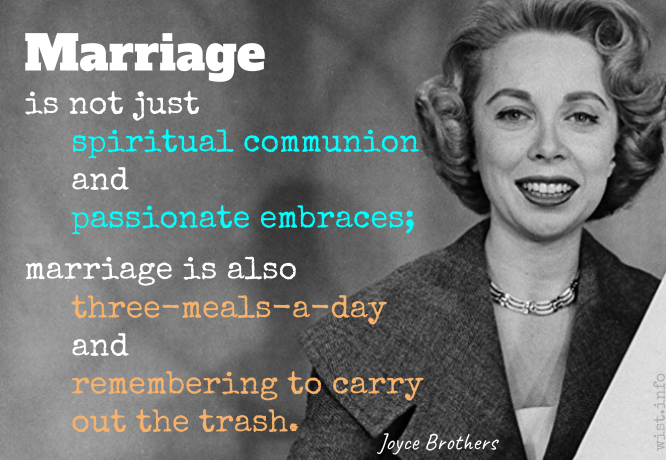
Rage is caused by a conviction, almost comic in its optimistic origins (however tragic in its effects), that a given frustration has not been written into the contract of life.
Alain de Botton (b. 1969) Swiss-British author
The Consolations of Philosophy, ch. 3 “Consolation for Frustration” (2000)
(Source)
BUNTY: It’s such fun, being reminded of things.
NICKY: And such agony, too.Noël Coward (1899–1973) English playwright, actor, wit
The Vortex, Act 1 (1924)
How many a man has dated a new era in his life from the reading of a book.
Henry David Thoreau (1817–1862) American philosopher and writer
Walden; or, Life in the Woods, ch. 3 “Reading” (1854)
(Source)
Every one sees what you appear to be, few really know what you are, and those few dare not oppose themselves to the opinion of the many, who have the majesty of the state to defend them; and in the actions of all men, and especially of princes, which it is not prudent to challenge, one judges by the result. For that reason, let a prince have the credit of conquering and holding his state, the means will always be considered honest, and he will be praised by everybody because the vulgar are always taken by what a thing seems to be and by what comes of it.
Niccolò Machiavelli (1469–1527) Italian politician, philosopher, political scientist
The Prince, ch. 18 (1513) [tr. Marriott (1908)]
(Source)
Origin of the paraphrase "The ends justify the means," which is generally attributed to Machiavelli.

Remember, gentlemen, an order that can be misunderstood will be misunderstood.
Helmuth von Moltke (1800–1891) Prussian soldier
Comment as Chief of the Prussian General Staff, Battle of Sedan (Sep 1870)
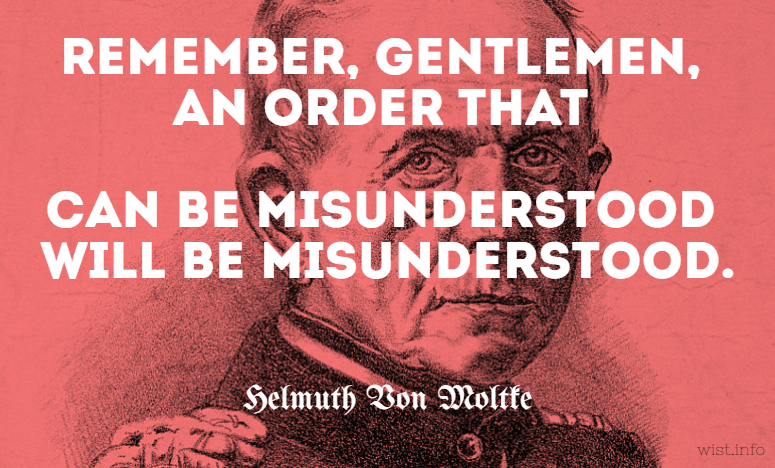

We do not judge men by what they are in themselves, but by what they are relatively to us.
Anne Sophie Swetchine (1782–1857) Russian-French author and salonist [Madame Swetchine]
The Writings of Madame Swetchine, “Airelles”, #25 (1869) [ed. Count de Falloux, tr. Preston]
(Source)
The best aphorisms are pointed expressions of the results of observation, experience, and reflection. They are portable wisdom, the quintessential extracts of thought and feeling. They furnish the largest amount of intellectual stimulus and nutriment in the smallest compass. About every weak point in human nature, or vicious spot in human life, there is deposited a crystallization of warning and protective proverbs.
William Rounseville Alger (1822–1905) American writer, minister, translator
“The Utility and the Futility of Aphorisms,” Atlantic Monthly (Feb 1863)
(Source)
Often paraphrased, "Aphorisms are portable wisdom."
Men are conservatives when they are least vigorous, or when they are most luxurious. They are conservatives, after dinner, or before taking their rest; when they are sick, or aged: in the morning, or when their intellect or their conscience have been aroused, when they hear music, or when they read poetry, they are radicals.
Ralph Waldo Emerson (1803–1882) American essayist, lecturer, poet
“New England Reformers,” lecture, Boston (1844-03-03), Essays: Second Series (1844)
(Source)
HAL9000: I am putting myself to the fullest possible use, which is all I think that any conscious entity can ever hope to do.
Stanley Kubrick (1928–1999) American film director, screenwriter, producer
2001: A Space Odyssey (1968) [with Arthur C. Clarke]
Feeling gratitude and not expressing it is like wrapping a present and not giving it.
William Arthur Ward (1921–1994) American aphorist, author, educator
(Attributed)
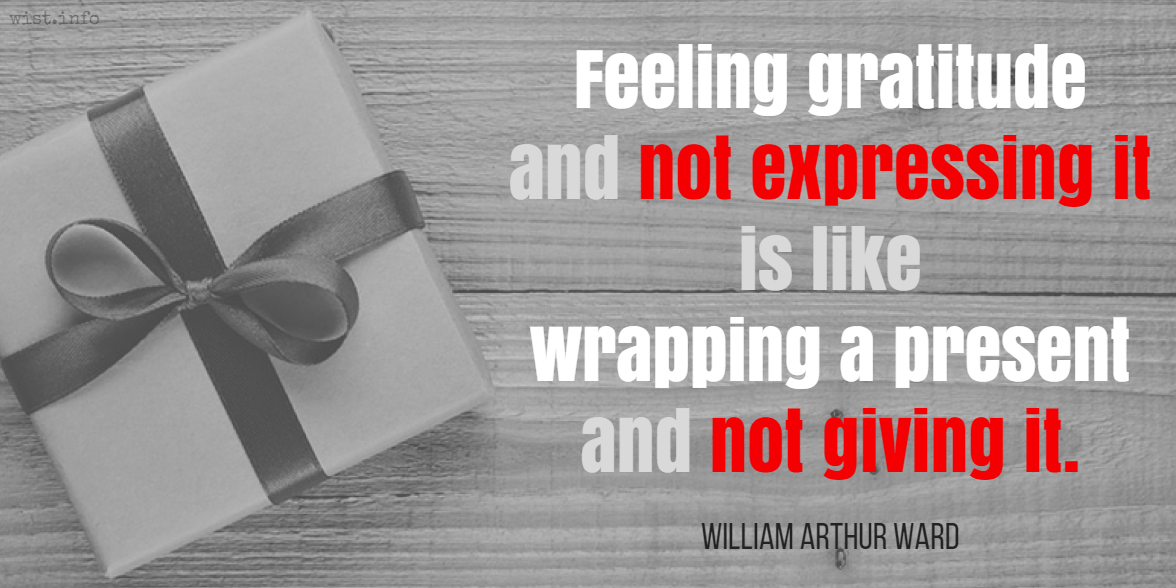
Man is a military animal,
Glories in gunpowder, and loves parade;
Prefers them to all things.Philip James Bailey (1816–1902) English poet, lawyer
Festus, Sc. “A Metropolis – Public Place” [Lucifer] (1839)
(Source)

It is the mark of a good action that it appears inevitable in retrospect.
Robert Louis Stevenson (1850–1894) Scottish essayist, novelist, poet
“Reflections and Remarks on Human Life,” #6 (1878)
(Source)
I ask you not to hate people who treat you badly. … This is easier to write than it is to live but there are ignorant people. Only a few are truly malicious. Hate is a poison. It can spread through your system. Forgive them if you can. Forget them if you must.
Rita Mae Brown (b. 1944) American author, playwright
Interview in OutSmart magazine (Jan 1998)
(Source)
Conscience and the press ought to be unrestrained, not because men have a right to deviate from the exact line that duty prescribes, but because society, the aggregate of individuals, has no right to assume the prerogative of an infallible judge, and to undertake authoritatively to prescribe to its members in matters of pure speculation.
William Godwin (1756–1836) English journalist, political philosopher, novelist
Enquiry Concerning Political Justice, Book 2, ch. 5 (1793)
(Source)
There is something about a Martini,
A tingle remarkably pleasant;
A yellow, a mellow Martini;
I wish I had one at present.
There is something about a Martini,
Ere the dining and dancing begin,
And to tell you the truth,
It is not the vermouth —
I think that perhaps it’s the gin.
Ogden Nash (1902–1971) American poet
“A Drink with Something In It,” The Primrose Path (1935)
(Source)
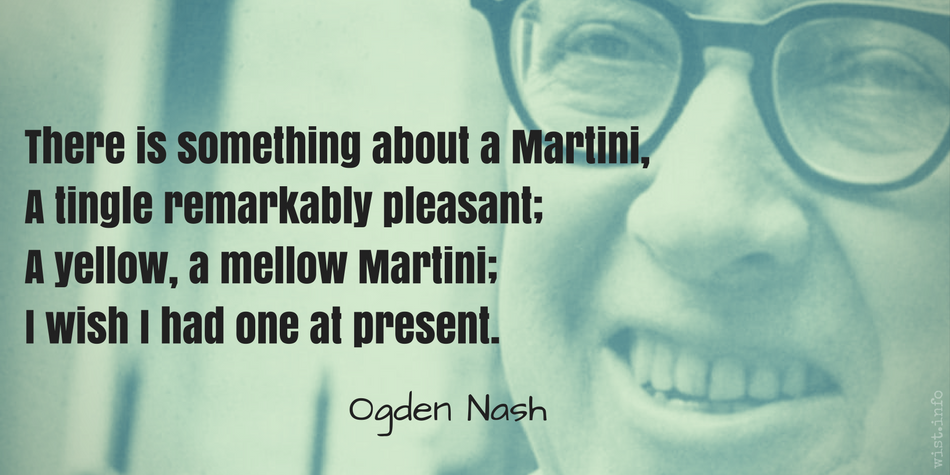

Many of the ugly pages of American history have been obscured and forgotten. A society is always eager to cover misdeeds with a cloak of forgetfulness, but no society can fully repress an ugly past when the ravages persist into the present. America owes a debt of justice which it has only begun to pay. If it loses the will to finish or slackens in its determination, history will recall its crimes and the country that would be great will lack the most indispensable element of greatness — justice.
Martin Luther King, Jr. (1929–1968) American clergyman, civil rights leader, social activist, preacher
Where Do We Go from Here: Chaos or Community? (1967)
(Source)
The ratio of damn fools to villains is high.
You can buy a man’s time; you can buy a man’s physical presence at a given place; you can even buy a measured number of skilled muscular motions per hour or day. But you cannot buy enthusiasm; you cannot buy initiative; you cannot buy loyalty; you cannot buy the devotion of hearts, minds and souls. You have to earn those things.
Clarence Francis (1888–1985) American business executive, food industry consultant
“The Causes of Industrial Peace,” speech, National Association of Manufacturers (4 Dec 1947)
(Source)
Sometimes titled "Philosophy of Management".
Ah, what a dusty answer gets the soul
When hot for certainties in this our life!
Consistently wise decisions can only be made by those whose wisdom is constantly challenged.
Theodore "Ted" Sorensen (1928–2010) American lawyer, writer, presidential adviser, speechwriter
Decision-Making in the White House: The Olive Branch or the Arrows, ch. 7 (1963)

One can acquire everything in solitude, except character.
Stendhal (1783–1842) French writer [pen name of Marie-Henri Beyle]
On Love, Book 3 “Fragments” (1822)
(Source)
You sit at the board and suddenly your heart leaps. Your hand trembles to pick up the piece and move it. But what chess teaches you is that you must sit there calmly and think about whether it’s really a good idea and whether there are other, better ideas.
Stanley Kubrick (1928–1999) American film director, screenwriter, producer
In Newsweek (26 May 1980)
When I go into my garden with a spade and dig a bed, I feel such an exhilaration and health, that I discover that I have been defrauding myself all this time in letting others do for me what I should have done with my own hands.
Ralph Waldo Emerson (1803–1882) American essayist, lecturer, poet
“Man the Reformer,” lecture, Boston (1841-01-25)
(Source)
ENOBARBUS: Age cannot wither her, nor custom stale
Her infinite variety; other women cloy
The appetites they feed, but she makes hungry
Where most she satisfies.
William Shakespeare (1564–1616) English dramatist and poet
Antony and Cleopatra, Act 2, sc. 2, l. 276ff (2.2.276-279) (1607)
(Source)
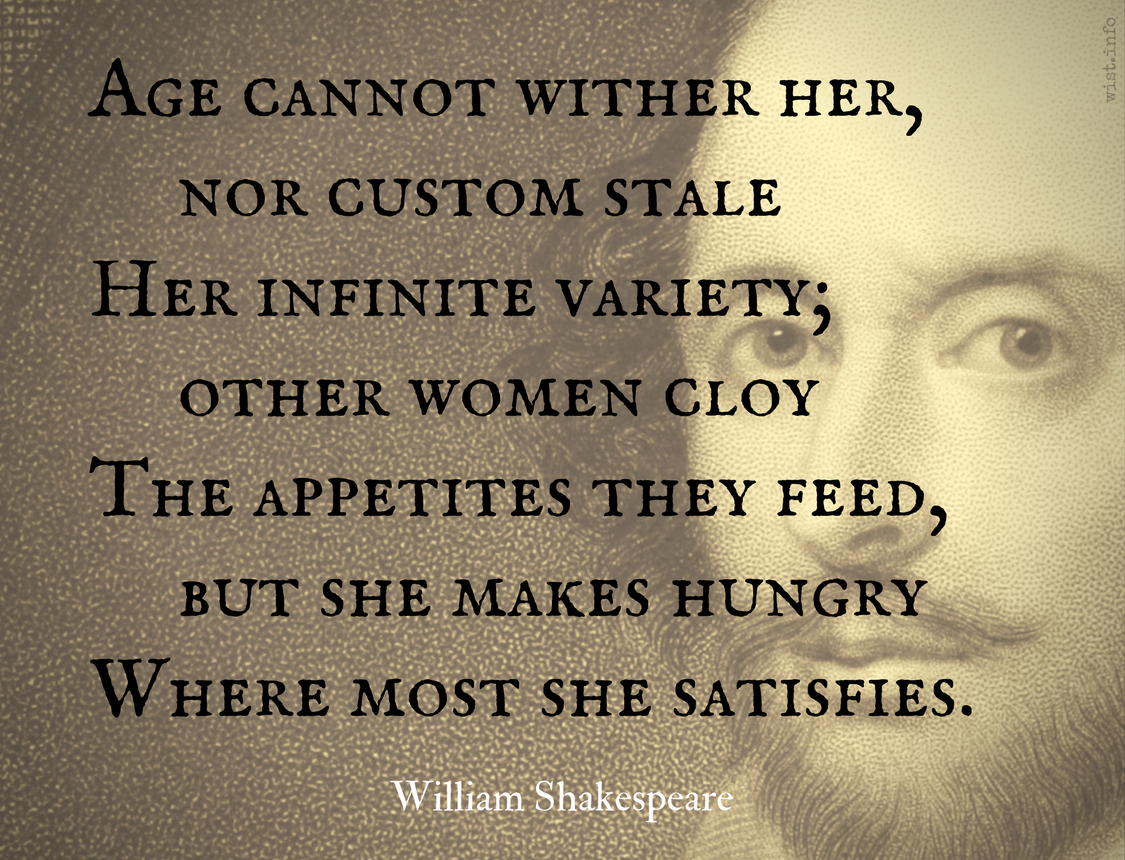
Less than a century ago, the laborer had no rights, little or no respect, and led a life which was socially submerged and barren. He was hired and fired by economic despots whose power over him decreed his life or death. […] American industry organized misery into sweatshops and proclaimed the right of capital to act without restraints and without conscience. […] The inspiring answer to this intolerable and dehumanizing existence was economic organization through trade unions. The worker became determined not to wait for charitable impulses to grow in his employer. He constructed the means by which fairer sharing of the fruits of his toil had to be given to him or the wheels of industry, which he alone turned, would halt and wealth for no one would be available.
This revolution within industry was fought bitterly by those who blindly believed their right to uncontrolled profits was a law of the universe, and that without the maintenance of the old order, catastrophe faced the nation. But history is a great teacher. Now everyone knows that the labor movement did not diminish the strength of the nation but enlarged it by raising the living standards of millions. Labor miraculously created a market for industry, and lifted the whole nation to undreamed-of levels of production. Those who today attack labor forget these simple truths, but history remembers them.
Martin Luther King, Jr. (1929–1968) American clergyman, civil rights leader, social activist, preacher
Speech, AFL-CIO Convention, Miami (11 Dec 1961)
(Source)
A correct answer is like an affectionate kiss.
[Eine richtige Antwort ist wie ein lieblicher Kuß.]
Johann Wolfgang von Goethe (1749–1832) German poet, statesman, scientist
Sprüche in Prosa: Maximen und Reflexionen [Proverbs in Prose: Maxims and Reflections] (1833) [tr. Mann (1948)]
(Source)
See Proverbs 24:26.
(Source (German)). Other translation:A right answer is like a loving kiss.
[tr. Stopp (1995), "Posthumous," "On Literature and Life," #888]
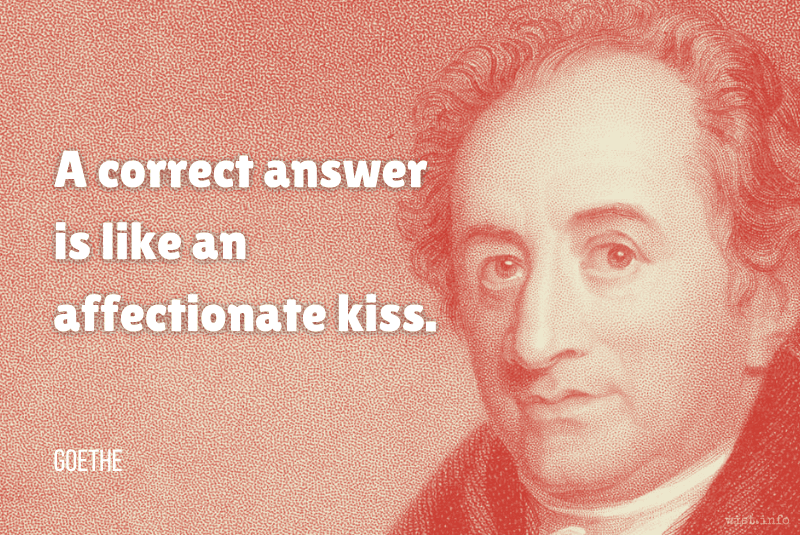

The only American invention as perfect as a sonnet.
H. L. Mencken (1880–1956) American writer and journalist [Henry Lewis Mencken]
(Attributed)
Referring to the dry martini cocktail.
I think our heart-strings were, like warp and woof
In some firm fabric, woven in and out;
Your golden filaments in fair design
Across my duller fibre.Edna St. Vincent Millay (1892–1950) American poet
“Interim,” Renascence and Other Poems (1917)
(Source)
If you want to make peace, you don’t talk to your friends. You talk to your enemies.
Moshe Dayan (1915–1981) Israeli military leader and politician
In Newsweek (17 Oct 1977)
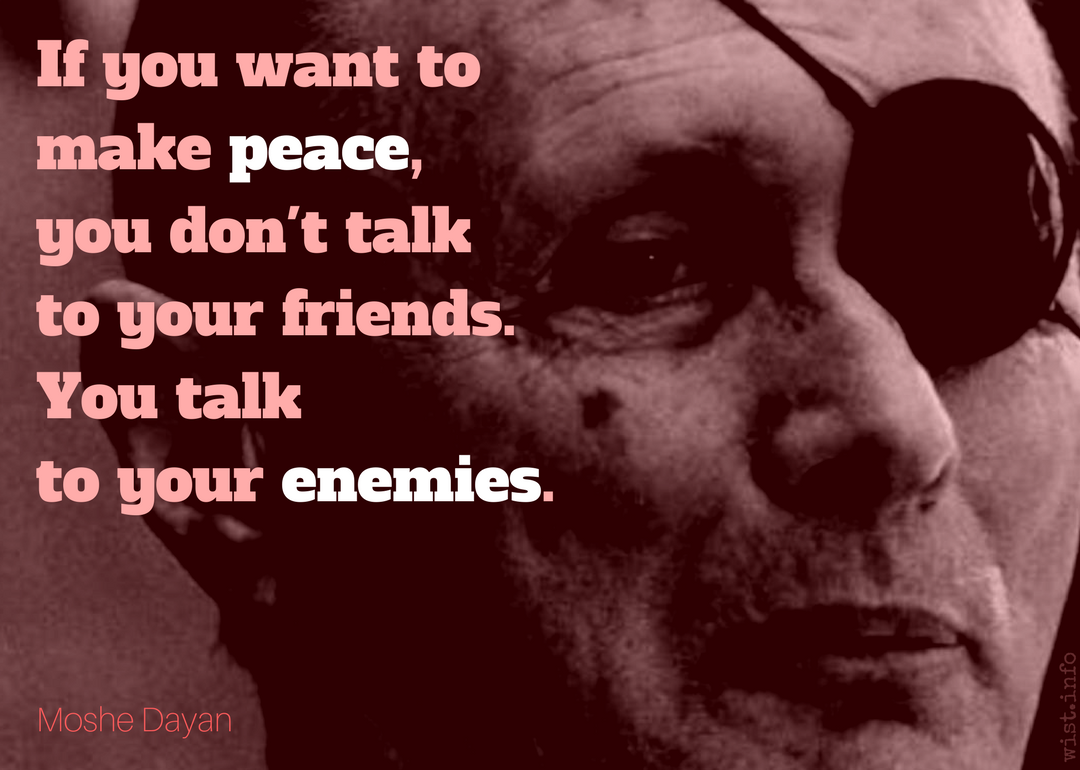
Bad temper is an indication of a man’s character; every man can be judged by the things which make him mad.
Fulton Sheen (1895–1979) American Catholic archbishop, preacher, televangelist
Love One Another (1944)
The trail of the serpent reaches into all the lucrative professions and practices of man, Each has its own wrongs. Each finds a tender and very intelligent conscience a disqualification for success. Each requires of the practitioner a certain shutting of the eyes, a certain dapperness and compliance, an acceptance of customs, a sequestration from the sentiments of generosity and love, a compromise of private opinion and lofty integrity.
Ralph Waldo Emerson (1803–1882) American essayist, lecturer, poet
“Man the Reformer,” lecture, Boston (1841-01-25)
(Source)
What is madness? To have erroneous perceptions and to reason correctly from them.
Voltaire (1694–1778) French writer [pseud. of Francois-Marie Arouet]
Philosophical Dictionary, “Madness” (1764)
(Source)

Money is said to be power, which is, in some cases, true; and the same may be said of knowledge; but superior sobriety, industry and activity, are a still more certain source of power; for without these, knowledge is of little use; and, as to the power which money gives, it is that of brute force, it is the power of the bludgeon and the bayonet, and of the bribed press, tongue and pen.
William Cobbett (1763–1835) English politician, agriculturist, journalist, pamphleteer
Advice to Young Men, Letter 1, #40 (1829)
(Source)

Hope is the thing with feathers
That perches in the soul,
And sings the tune without the words,
And never stops at all.