Of various admirals I could tell you a great deal: of them and their flags, and the gradation of their pay, and their bickerings and jealousies. But, in general, I can assure you that they are all passed over, and all very ill used. Certainly, my home at my uncle’s brought me acquainted with a circle of admirals. Of Rears and Vices I saw enough. Now, do not be suspecting me of a pun, I entreat.
Jane Austen (1775–1817) English author Mansfield Park, ch. 6 [Fanny Price] (1814)
(Source)
But if my forces
are not enough, I am hardly the one to relent,
I’ll plead for the help I need, wherever it may be —
If I cannot sway the heavens, I’ll wake the powers of hell!
[Quod si mea numina non sunt
magna satis, dubitem haud equidem implorare quod usquam est:
flectere si nequeo superos, Acheronta movebo.]
Virgil (70–19 BC) Roman poet [b. Publius Vergilius Maro; also Vergil] The Aeneid [Ænē̆is], Book 7, l. 310ff (7.310-312) [Juno] (29-19 BC) [tr. Fagles (2006)]
(Source)
But if my own power not sufficient be,
Undaunted, aydes I'le seek where ere they dwell;
Will heaven not grant my sute, I'le raise up hell.
[tr. Ogilby (1649)]
If native pow'r prevail not, shall I doubt
To seek for needful succor from without?
If Jove and Heav'n my just desires deny,
Hell shall the pow'r of Heav'n and Jove supply.
[tr. Dryden (1697)]
But if my own divinity is not powerful enough, surely I need not hesitate to implore whatever deity any where subsists: if I cannot move the powers above, I will solicit those of hell.
[tr. Davidson/Buckley (1854)]
If strength like mine be yet too weak,
I care not whose the aid I seek:
What choice 'twixt under and above?
If Heaven be firm, the shades shall move.
[tr. Conington (1866)]
But if not enough my power,
I shall not pause to ask what aid I may.
And if I cannot bend the gods above,
Then Acheron I'll move.
[tr. Cranch (1872), l. 388ff]
If my deity is not great enough, I will not assuredly falter to seek succour where it may be; if the powers of heaven are inflexible, I will stir up Acheron.
[tr. Mackail (1885)]
But if of no avail
My godhead be, I will not spare to pray what is of might,
Since Heaven I move not, needs must I let loose the Nether Night.
[tr. Morris (1900), l. 310ff]
If too weak
Myself, some other godhead will I try,
And Hell shall hear, if Heaven its aid deny.
[tr. Taylor (1907), st. 42, l. 372ff]
If so weak
my own prerogative of godhead be,
let me seek strength in war, come whence it will!
If Heaven I may not move, on Hell I call.
[tr. Williams (1910)]
But if my powers be not strong enough, surely I need not be slow to seek succour wherever it may be; if Heaven I can not bend, then Hell I will arouse!
[tr. Fairclough (1918)]
So, if my power
Falls short of greatness, I must try another’s,
Seek aid where I can find it. If I cannot
Bend Heaven, I can raise Hell.
[tr. Humphries (1951)]
Well, if my powers are not great enough,
I shall not hesitate -- that's sure -- to ask help wherever
Help may be found. If the gods above are no use to me, then I'll
Move all hell.
[tr. Day-Lewis (1952)]
If my power
is not enough, I shall not hesitate
to plead for more, from anywhere; if I
cannot bend High Ones, then I shall move hell.
[tr. Mandelbaum (1971), l. 410ff]
Well, if my powers fall short,
I need not falter over asking help
Wherever help may lie. If I can sway
No heavenly hearts I'll rouse the world below.
[tr. Fitzgerald (1981), l. 423ff]
But if my own resources as a goddess are not enough, I am not the one to hesitate. I shall appeal to whatever powers there are. If I cannot prevail upon the gods above, I shall move hell.
[tr. West (1990)]
But if my divine strength is not
enough, I won’t hesitate to seek help wherever it might be:
if I cannot sway the gods, I’ll stir the Acheron.
[tr. Kline (2002)]
But if my powers
Are not great enough, why should I hesitate
To seek help from any source whatever?
If I cannot sway Heaven, I will awaken Hell!
[tr. Lombardo (2005)]
If I cannot bend the gods, I will move Acheron.
[tr. @sentantiq (2012)]
If my powers aren't enough, why not stoop to begging anyone? If I can't move the gods above, then I'll move Acheron.
[tr. Bartsch (2021)]
If I cannot bend Heaven, I shall move Hell.
[Bartlett's]
“Educate women like men,” says Rousseau, “and the more they resemble our sex the less power will they have over us.” This is the very point I aim at. I do not wish them to have power over men; but over themselves.
Mary Wollstonecraft (1759–1797) English social philosopher, feminist, writer A Vindication of the Rights of Woman, ch. 4 (1792)
(Source)
Usually elided to "I do not wish women to have power over men; but over themselves."
Profound ignorance makes a man dogmatical; he who knows nothing thinks he can teach others what he just now has learned himself.
[C’est la profonde ignorance qui inspire le ton dogmatique. Celui qui ne sait rien croit enseigner aux autres ce qu’il vient d’apprendre lui-même.]
Jean de La Bruyère (1645–1696) French essayist, moralist The Characters [Les Caractères], ch. 5 “Of Society and Conversation [De la Société et de la Conversation],” § 76 (5.76) (1688) [tr. Van Laun (1885)]
(Source)
Profound Ignorance makes a Man dogmatick. If he knows nothing, he thinks he can teach others what he is to learn himself.
[Bullord ed. (1696)]
Profound Ignorance makes a Man dogmatick; he who knows nothing, thinks he can teach others what he just now has learn'd himself.
[Curll ed. (1713)]
A dogmatic tone is generally inspired by abysmal ignorance. The man who knows nothing thinks he is informing others of something which he has that moment learnt.
[tr. Stewart (1970)]
Cleverness is not wisdom,
nor is thinking thoughts that are not mortal.
Life is short; this being so,
who would pursue great things
and not bear with what is at hand? These
are the ways of madmen and
men of evil counsel, at least
in my judgment.
The chorus of Bacchantes is playing with the similarly-rooted sophon (cleverness) and sophia (wisdom). (Source (Greek)). Other translation:
That science which beyond the scope
Of frail humanity aspires.
Haunts not the bosom of the Sage.
Short is life, and they who follow
Ambition's splendid treacherous lure
Taste not the blessings of the present hour:
I deem their conduct frantic and unwise.
[tr. Wodhull (1809)]
But cleverness is not wisdom, nor is thinking on things unfit for mortals. Life is short, and on this account the one who pursues great things does not achieve that which is present. In my opinion, these are the ways of mad and ill-advised men.
[tr. Buckley (1850)]
Beyond the range of mortal eyes
'Tis not wisdom to be wise.
Life is brief, the present clasp,
Nor after some bright future grasp.
Such were the wisdom, as I ween,
Only of frantic and ill-counseled men.
[tr. Milman (1865)]
That wisdom is not wise Which aims beyond man’s power.
Short is our life; to grasp at much is but to lose the present good, --
And this to me seems like the deed of frenzied and of foolish men.
[tr. Rogers (1872), l. 378ff]
Ah, not with knowledge is Wisdom bought;
And the spirit that soareth too high for mortals
Shall see few days: whosoever hath caught
At the things too great for a man's attaining,
Even blessings assured shall he lose in the gaining.
Such paths as this, meseemeth, be sought
Of the witless folly that roves distraught.
[tr. Way (1898)]
But the world's Wise are not wise,
Claiming more than mortal may.
Life is such a little thing;
Lo, their present is departed,
And the dreams to which they cling
Come not. Mad imagining
Theirs, I ween, and empty-hearted!
[tr. Murray (1902)]
Sophistry is not wisdom, and to indulge in thoughts beyond man’s ken is to shorten life; and if a man on such poor terms should aim too high, he may miss the pleasures in his reach. These, to my mind, are the ways of madmen and idiots.
[tr. Coleridge (1907)]
And what passes for wisdom is not;
unwise are those who aspire,
who outrange the limits of man.
Briefly, we live. Briefly,
then die. Wherefore, I say,
he who hunts a glory, he who tracks
some boundless, superhuman dream,
may lose his harvest here and now
and garner death. Such men are mad,
their counsels evil.
[tr. Arrowsmith (1960)]
To know much is not to be wise.
Pride more than mortal hastens life to its end;
And they who in pride pretend
Beyond man's limit, will lose what lay
Close to their hand and sure.
I count it madness, and know no cure can mend
The evil man and his evil way.
[tr. Vellacott (1973)]
Wisdom is not what is wise,
nor to think non-mortal thoughts.
Life is fleeting; can it be, then, that one seeks after what is greater,
not accepting circumstance?
These are the manners of a madman and, to me, of evil counsel'd persons.
[tr. Neuburg (1988)]
A knowing mind that ignores its own limits
has a very short span. And the man
who aims too high
never reaps what lies within his grasp.
Such is the folly --
and I know none worse --
of perversely ambitious, fanatical men.
[tr. Cacoyannis (1982)]
But shallow wisdom is untrue.
To think beyond this life
Cuts short our life. He who
Pursues the great, forfeits
What lies at hand. Such temperaments
According to my thought, belong
To madmen and the ill-advised.
[tr. Blessington (1993)]
So cleverness is not wisdom
nor is it wise to think thoughts unfit for mortals.
Life is short. Given such brevity
who would pursue ambitious ends
And lose what lies at hand?
These, in my opinion at least,
are the ways of madmen and evil counsellors.
[tr. Esposito (1998)]
Wisdom? It's not wise
to lift our thoughts too high;
we are human, and our time is short.
A man who aims at greatness
will not live to own what he has now.
That, I believe, is the belief of men
whose judgment is foul.
They are insane.
[tr. Woodruff (1999)]
Intellect is not wisdom.
And to think in a manner
not right for mortals means
Life will be short. Who
Would pursue great things
If doing so meant losing what
Is already his?
That is the way, as I see it,
And bad counsel, of madmen.
[tr. Gibbons/Segal (2000), l. 469ff]
Cleverness is not wisdom
nor is it wise to think thoughts not mortal.
Our life is short: this being so,
a man who pursues great things
may miss what lies at hand. To live thus
is to be, in my judgment
a madman and a fool.
[tr. Kovacs (2002)]
The wise are not wise if they don’t consider a human’s lot.
Life is short.
He who constantly pursues great achievements in this life, won’t have time to enjoy those he already has achieved.
So far as I can tell, these are the doings of madmen and evil minds.
[tr. Theodoridis (2005)]
Cleverness is not wisdom;
Thinking heavenly
Thoughts, short life; in that case,
Who, in hunting greater things,
Would not be content with present fortune?
These are ways of men insane, with-
out understanding, so it seems to me.
[tr. Valerie (2005)]
But being clever isn't wisdom.
And thinking deeply about things
isn't suitable for mortal men.
Our life is brief -- that's why
the man who chases greatness
fails to grasp what's near at hand.
That's what madmen do,
men who've lost their wits.
That's what I believe.
[tr. Johnston (2008), l. 497ff]
Cleverness is not wisdom,
that over-reaching mortals
simply shorten their lives.
Life is brief enough as it is,
so hold it all to hand.
Wild ambition is a kind of madness:
stretch too hard for the summit
and you will fail and fall
and plummet back to land.
[tr. Robertson (2014)]
Cleverness is not wisdom,
and neither is reaching beyond thoughts meant for mortals.
Our lives are short.
Spend all your time reaching
and you miss what’s in front of you.
This is the madman’s way.
Or at least the ill-counseled.
But that’s just my opinion.
[tr. Pauly (2019)]
Cleverness is not wisdom, and those who'd seem wise as the gods -- their live will be short. Those who seek greatness will not see the snake at their feet. Mad ways set all on the road to disaster.
[tr. Behr/Foster (2019)]
It is not wisdom [sophiā] to be overly sophos, and to think things unbefitting mortal men. Life is short, and in it he who pursues great things does not achieve that which is present. In my opinion, these are the ways of mad and ill-counseling men.
[tr. Buckley/Sens/Nagy (2020)]
Wisdom is not wit;
Nor is thinking thoughts which belong not to mortals.
Life is brief. And because of this
Whoever seeks out great accomplishments
May not grasp the things at hand.
These are the ways of madmen
And wicked fools, I think.
[tr. @sentantiq (2021)]
Strength of character leads us to a degenerate form of it — obstinacy. It is often very difficult in concrete case to say where the one ends and the other begins; on the other hand, it does not seem difficult to determine the difference in the abstract. Obstinacy is not a fault of the intellect; we use the term as denoting resistance to our better judgment, and that cannot be located, without involving us in a contradiction, in the intellect, which is the capacity of judgment. Obstinacy is a fault of temperament. This inflexibility of will and impatience of contradiction find their origin only in a particular kind of egotism, which sets above every other pleasure that of governing itself and others solely by its own caprice.
[Die Charakterstärke führt uns zu einer Abart derselben, dem Eigensinn. Sehr schwer ist es oft, im konkreten Falle zu sagen, wo die eine aufhört und der andere anfängt, dagegen scheint es nicht schwer, den Unterschied im Begriffe festzustellen. Eigensinn ist kein Fehler des Verstandes; wir bezeichnen damit das Widerstreben gegen bessere Einsicht, und dieses kann nicht ohne Widerspruch in den Verstand als dem Vermögen der Einsicht gesetzt werden. Der Eigensinn ist ein Fehler des Gemütes. Die Unbeugsamkeit des Willens, diese Reizbarkeit gegen fremde Einrede haben ihren Grund nur in einer besonderen Art von Selbstsucht, welche höher als alles andere das Vergnügen stellt, über sich und andere nur mit eigener Geistestätigkeit zu gebieten.]
Karl von Clausewitz (1780–1831) Prussian soldier, historian, military theorist On War [Vom Kriege], Book 1, ch. 3 “On Military Genius [Der Kriegerische Genius],” (1.3) (1832) [tr. Jolles (1943)]
(Source)
Force of character leads us to a spurious variety of it -- obstinacy. It is often very difficult in concrete cases to say where the one ends and the other begins; on the other hand, it does not seem difficult to determine the difference in idea. Obstinacy is no fault of the understanding; we use the term as denoting a resistance against our better judgment, and it would be inconsistent to charge that to the understanding, as the understanding is the power of judgment. Obstinacy is a fault of the feelings or heart. This inflexibility of will, this impatience of contradiction, have their origin only in a particular kind of egotism, which sets above every other pleasure that of governing both self and others by its own mind alone.
[tr. Graham (1873)]
Strength of character can degenerate into obstinacy.. The line between them is often hard to draw in a specific case; but surelyi it is seasy to distinguish them in theory. Obstinacy is not an intellectual defect; it comes from reluctance to admit that one is wrong. To impute this to the mind would be illogical, for the mind is the seat of judgment. Obstinacy is a fault of temperament.. Stubbornness and intolerance of contradiction result from a special kind of egotism, which elevates above everything else the pleasure of its autonomous intellect, to which others must bow.
[tr. Howard & Paret (1976)]
Atoms in the laboratory are weird stuff, behaving like active agents rather than inert substances. They make unpredictable choices between alternative possibilities according to the laws of quantum mechanics. It appears that mind, as manifested by the capacity to make choices, is to some extent inherent in every atom.
Freeman Dyson (1923–2020) English-American theoretical physicist, mathematician, futurist
“Progress in Religion,” Templeton Prize acceptance speech, Washington National Cathedral (9 May 2000)
(Source)
When people are ready to, they change. They never do it before then, and sometimes they die before they get around to it. You can’t make them change if they don’t want to, just like when they do want to, you can’t stop them.
Andy Warhol (1928–1987) American artist, author POPism: The Warhol Sixties, “1965” (1980) [with Pat Hackett]
(Source)
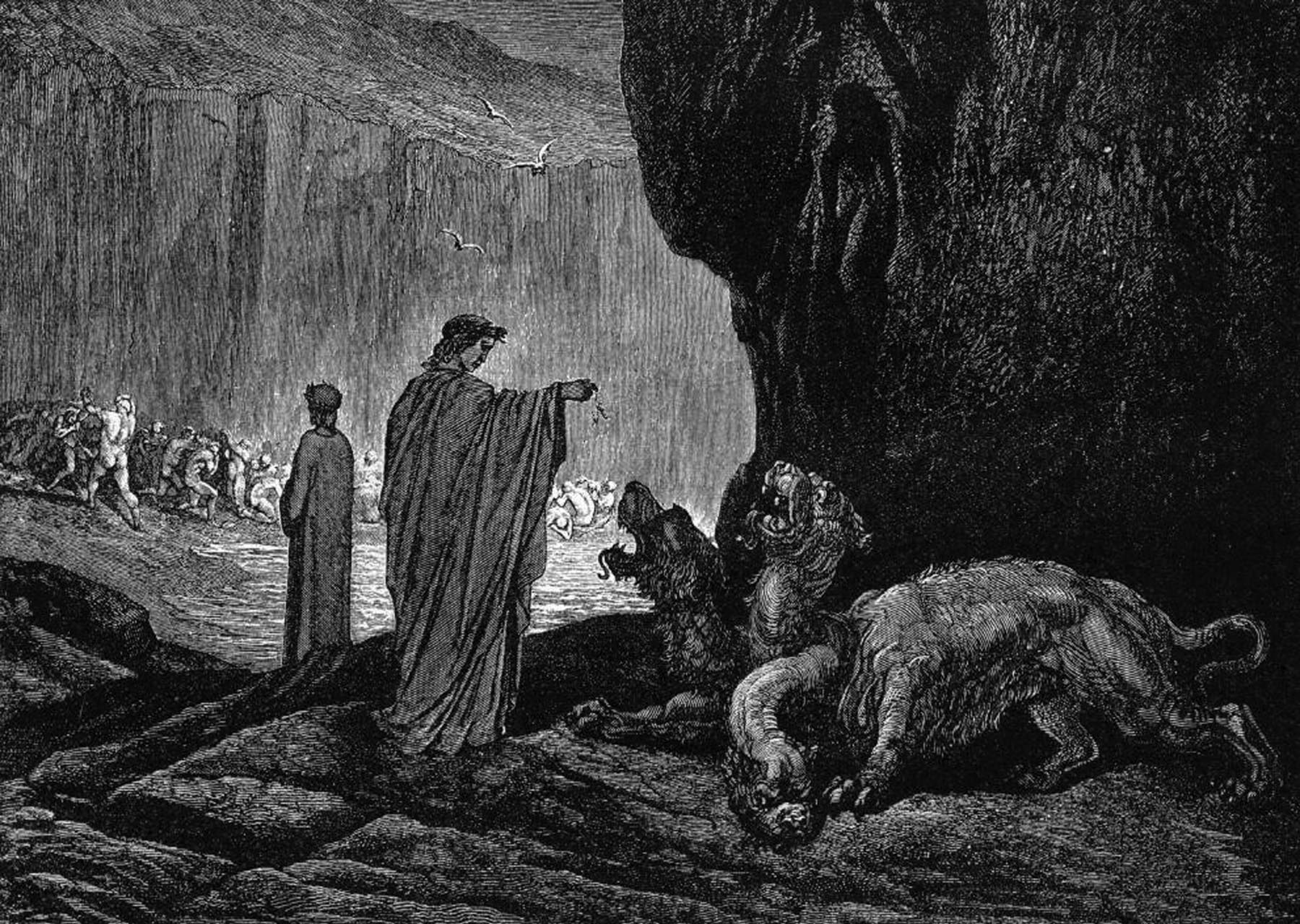
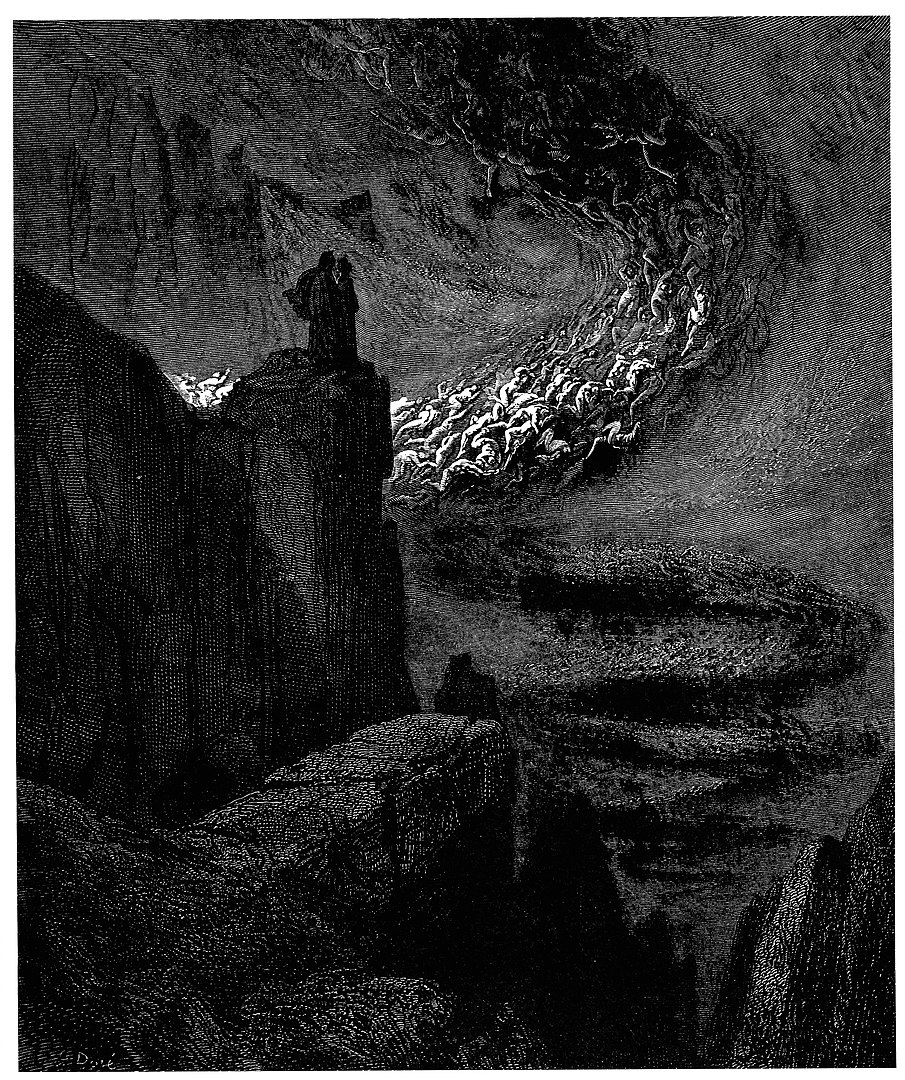
Cerberus, cruel and uncouth monster, there Stretches his three throats out and hound-like bays Over the people embogged about his lair.
His beard is slobbered black, his red eyes blaze, His belly is big, his hands clawed; and with growl The spirits he clutches, rends piecemeal and flays.
[Cerbero, fiera crudele e diversa, con tre gole caninamente latra sovra la gente che quivi è sommersa.
Li occhi ha vermigli, la barba unta e atra, e ’l ventre largo, e unghiate le mani; graffia li spirti ed iscoia ed isquatra.]
Dante Alighieri (1265–1321) Italian poet The Divine Comedy [Divina Commedia], Book 1 “Inferno,” Canto 6, l. 13ff (6.13-18) (1309) [tr. Binyon (1943)]
(Source)
Inspired by Virgil's description of Cerberus in Aeneid, Book 6, l. 417ff, colored by the beast's role over the Gluttonous in this circle of Hell. (
Cerb'rus, a beast implacable and fierce,
Incessant's barking with his triple throat
At the poor wretches who are here confin'd.
His eyes are fiery read, his greasy Beard
Is black and nasty, and his Belly's swoln.
He the Sprites scratches with his hooked claws,
Flays off their skins, and into quarters tears.
[tr. Rogers (1782), l. 12ff]
Hell's bloodhound there his triple form extends. And ever and anon the savage rends Some wand'ring wretch, and dyes his fangs in gore;
His flaming eyes the troubled deep survey. Loud gnash his teeth and hold the damn'd at bay, Whose captive bands in vain his rage deplore.
[tr. Boyd (1802), st. 3]
Cerberus, cruel monster, fierce and strange, Through his wide threefold throat barks as a dog Over the multitude immers’d beneath.
His eyes glare crimson, black his unctuous beard, His belly large, and claw’d the hands, with which He tears the spirits, flays them, and their limbs
Piecemeal disparts.
[tr. Cary (1814)]
Cerberus, a ruthless beast of uncouth mould, Barks hell-hound like, with triple gorge and grim, O'er those whom yonder slough engulphed doth hold.
Red are his eyes, black and of greasy trim His beard, and huge his paunch ; his clawed hands quell The mangled sprites; he flays, and limb from limb
Rends them.
[tr. Dayman (1843)]
Cerberus, a monster fierce and strange, with three throats, barks dog-like over those that are immersed in it. His eyes are red, his beard [greasy] and black, his belly wide, and clawed his hands; he clutches the spirits, flalys, and piecemeal rends them.
[tr. Carlyle (1849)]
Cerberus -- wild beast, cruel, monstrous -- While as three throats the dog of famine urge, To bark o'er those the waters thus submerge:
His eyes vermilion, unctuous beard and black; His belly large, and claws upon each hand -- Cuts, flays, and quarters spirits at command.
[tr. Bannerman (1850)]
The monster Cerberus, cruel, fierce and strange, Barks like a dog from out his triple throat over the multitude sumergèd there.
With eyes vermilion, black and filthy beard, With belly large, with sharp and piercing claws He tears those spirits, flays, dismembers them.
[tr. Johnston (1867)]
Cerberus, monster cruel and uncouth,
With his three gullets like a dog is barking Over the people that are there submerged.
Red eyes he has, and unctuous beard and black, And belly large, and armed with claws his hands; He rends the spirits, flays, and quarters them.
[tr. Longfellow (1867)]
Cerberus, beast cruel and uncouth, with three throats barks in dog-wise over the folk that there is submerged. Scarlet eyes has he, and his beard greasy and black, and his belly large, and his paws armed with nails. He claws the spirits, mouths them and tears them up.
[tr. Butler (1885)]
Wild Cerberus, of twofold nature rare. With three throats hurleth out the doglike bark Upon the people that are cowering there.
His eyes are red, his greasy beard is dark. His belly large and fingers armed with nails; He tears, and flays, and rends the spirits stark.
[tr. Minchin (1885)]
Cerberus, a beast cruel and monstrous, with three throats barks doglike above the people that are here submerged. He has vermilion eyes, and a greasy and black beard, and a big belly, and hands armed with claws: he tears the spirits, flays them, and rends them.
[tr. Norton (1892)]
Cerberus, the pitiless and outlandish beast, barks in dog-like fashion through triple throat above the souls that lie immersed there. Red are the eyes he hath, his beard foul and black, his belly gross, and his paws armed with talons. He claws the shades, he flayeth and he teareth them.
[tr. Sullivan (1893)]
Cerberus, cruel and misshapen monster, Barketh with triple throat in doglike fashion Over the folk which in that place is sunken.
Vermilion eyes he hath, beard black and greasy. And belly wide, and hands arrayed with talons. The spirits he doth scratch, and flay and quarter.
[tr. Griffith (1908)]
Cerberus, a beast fierce and hideous, with three throats barks like a dog over the people that are immersed there; he has red eyes, a beard greasy and black, a great belly, and clawed hands, and he scars and flays and rends the spirits.
[tr. Sinclair (1939)]
Cerberus, the cruel, misshapen monster, there Bays in his triple gullet and doglike growls Over the wallowing shades; his eyeballs glare
A bloodshot crimson, and his bearded jowls Are greasy and black; pot-bellied, talon-heeled, He clutches and flays and rips and rends the souls.
[tr. Sayers (1949)]
Here monstrous Cerberus, the ravening beast, howls through his triple throats like a mad dog over the spirits sunk in that foul paste.
His eyes are red, his beard is greased with phlegm, His belly is swollen, and his hands are claws to rip the wretches and flay and mangle them.
[tr. Ciardi (1954)]
Cerberus, monstrous beast and cruel, with three throats barks doglike over the people who are here submerged. His eyes are red, his beard greasy and black, his belly wide and his hands taloned; he claws the spirits, flays and quarters them.
[tr. Singleton (1970)]
Cerberus, a ruthless and fantastic beast, with all three throats howls out his dog-like sounds above the drowning sinners of this place.
His eyes are red, his beard is slobbered black, his belly swollen, and he has claws for hands; he rips the spirits, flays and mangles them.
[tr. Musa (1971)]
Over the souls of those submerged beneath that mess, is an outlandish, vicious beast, his three throats barking, doglike: Cerberus.
His eyes are blood red; greasy, black, his beard; his belly bulges, and his hands are claws; his talons tear and flay and rend the shades.
[tr. Mandelbaum (1980)]
Cerberus, a cruel and outlandish beast, Barks like a dog, from his three throats, at those Who, under that downpour, are there submerged.
His eyes are red, his beard greasy and black, His belly huge, and his fingers are clawed. He scratches the spirits, skins them, pulls them to bits.
[tr. Sisson (1981)]
Three-headed Cerberus, monstrous and cruel,
Barks doglike at the souls immersed here, louder For his triple throat. His eyes are red, his beard Grease-black, he has the belly of a meat-feeder
And talons on his hands: he claws the horde Of spirits, he flays and quarters them in the rain.
[tr. Pinsky (1994)]
Cerberus, cruel, monstrous beast, with three throats barks doglike over the people submerged there. His eyes are red, his beard greasy and black, his belly large, and his hands have talons; he claws the spirits, flays and quarters them.
[tr. Durling (1996)]
Cerberus, the fierce and strange monster, triple-throated, barks dog-like over the people submerged in it. His eyes are crimson, his beard is foul and black, his belly vast, and his limbs are clawed: he snatches the spirits, flays, and quarters them.
[tr. Kline (2002)]
Here Cerberus conducts his strange assize: with all three throats he barks and slabbers at the muck-bound prisoners he triple-tries.
His eyes are red, his jowls black, his belly fat; he takes each soul and skins it with his claws then rips it into little bits thereat.
[tr. Carson (2002)]
Cerberus, weird and monstrously cruel, barks from his triple throats in cur-like yowls over the heads of those who lie here, drowned.
His eyes vermilion, beard a greasy black, his belly broad, his fingers all sharp-nailed, he mauls and skins, then hacks in four, these souls.
[tr. Kirkpatrick (2006)]
Cerberus, fierce and monstrous beast, barks from three gullets like a dog over the people underneath that muck.
His eyes are red, his beard a greasy black, his belly swollen. With his taloned hands he claws the spirits, flays and quarters them.
[tr. Hollander/Hollander (2007)]
Three-headed Cerberus, monstrous beast, roams here; A cruel creature who barks, dog-like, out Of each of his mouths, at people half-drowned, submerged.
His eyes are red, his beard is black and foul, His belly broad, there are talons on his hands; He claws the spirits, rips at their skin, bites holes.
[tr. Raffel (2010)]
Savage and bestial Cerberus, three-headed freak, Barks like a Doberman -- through each of his three throats -- Over those who are forced to wallow in the slop.
Red eyes, filthy bilious whiskers, swollen belly; With his claws hge excoriates the ghosts -- Then rips their skin off and quarters them.
[tr. Bang (2012)]
The people stuck in it have Cerberus
To guard them. Overhead, that creature shrieks
In anger with three mouths, each hideous
As a mad dog's. Beards greasy black, eyes red,
Big belly, fingers well supplied with nails,
Hed scores and scrapes and tears them to a shred.
[tr. James (2013), l. 14ff]
When an ox enters a palace, it doesn’t become a king but the palace turns into a barn.
[Öküz saraya çıkınca kral olmaz. Ama saray ahır olur.]
Proverbs, Sayings, and Adages
Circassian proverb
This "Turkish" (properly Circassian or Adyghe) proverb (source) can be found with a variety of forms and choice of livestock. It was famously used by journalist Sedef Kabaş in early 2022:
A bull does not become king just by entering the palace, but the palace becomes a barn.
Kabas was jailed for supposedly insulting Turkish President Erdoğan with the reference.
Based on Kabas' usage, it was reworked on 23 January 2022 by Elizabeth Bangs, a British academic consultant, with British Prime Minister Boris Johnson in mind, and posted on Twitter into a more viral form:
When a clown moves into a palace he does not become a king. The palace becomes a circus.
The clown version is now widely misattributed as a Turkish proverb.
But you, Roman, remember, rule with all your power
the peoples of the earth — these will be your arts:
to put your stamp on the works and ways of peace,
to spare the defeated, break the proud in war.
[Tu regere imperio populos, Romane, memento
(Hae tibi erunt artes), pacique imponere morem,
Parcere subjectis et debellare superbos.]
Virgil (70–19 BC) Roman poet [b. Publius Vergilius Maro; also Vergil] The Aeneid [Ænē̆is], Book 6, l. 851ff (6.851-53) [Anchises] (29-19 BC) [tr. Fagles (2006), l. 981ff]
(Source)
Comparing the Roman "arts" to the arts at which other nations excel (metalwork, sculpture, oratory, astronomy).
Be thou ambitious how to govern best,
In these arts, Roman, thou must be profest.
That we a peace well grounded may injoy,
Subjects to spare, and Rebels to destroy.
[tr. Ogilby (1649)]
But, Rome, 'tis thine alone, with awful sway,
To rule mankind, and make the world obey,
Disposing peace and war by thy own majestic way;
To tame the proud, the fetter'd slave to free:
These are imperial arts, and worthy thee.
[tr. Dryden (1697)]
To rule the nations with imperial sway be thy care, O Romans: these shall be thy arts; to impose terms of peace, to spare the humbled, and crush the proud.
[tr. Davidson/Buckley (1854)]
But ye, my Romans, still control
The nations far and wide:
Be this your genius -- to impose
The rule of peace on vanquished foes,
Show pity to the humbled soul,
And crush the sons of pride
[tr. Conington (1866)]
But thou, O Roman, bend thy mind to rule
With strength thy people. This shall be thy art;
And to impose the terms and rules of peace;
To spare the vanquished, and subdue the proud.
[tr. Cranch (1872), l. 1069ff]
Be thy charge, O Roman, to rule the nations in thine empire; this shall be thine art, to lay down the law of peace, to be merciful to the conquered and beat the haughty down.
[tr. Mackail (1885)]
But thou, O Roman, look to it the folks of earth to sway;
For this shall be thine handicraft, peace on the world to lay,
To spare the weak, to wear the proud by constant weight of war.
[tr. Morris (1900), l. 850ff]
Thou, Roman, rule, and o'er the world proclaim
The ways of peace. Be these thy victories,
To spare the vanquished and the proud to tame.
These are imperial arts, and worthy of thy name.
[tr. Taylor (1907), st. 114, l. 1023ff.]
But thou, O Roman, learn with sovereign sway
To rule the nations. Thy great art shall be
To keep the world in lasting peace, to spare
humbled foe, and crush to earth the proud.
[tr. Williams (1910)]
Remember thou, O Roman, to rule the nations with thy sway -- these shall be thine arts -- to crown Peace with Law, to spare the humbled, and to tame in war the proud!
[tr. Fairclough (1916)]
Remember, Roman,
To rule the people under law, to establish
The way of peace, to battle down the haughty,
To spare the meek. Our fine arts, these, forever.
[tr. Humphries (1951)]
But, Romans, never forget that government is your medium!
Be this your art: -- to practise men in the habit of peace,
Generosity to the conquered, and firmness against aggressors.
[tr. Day-Lewis (1952)]
But yours will be the rulership of nations,
remember, Roman, these will be your arts:
to teach the ways of peace to those you conquer,
to spare defeated peoples, tame the proud.
[tr. Mandelbaum (1971), l. 1134ff]
Roman, remember by your strength to rule
Earth's peoples -- for your arts are to be these:
To pacify, to impose the rule of law,
To spare the conquered, battle down the proud.
[tr. Fitzgerald (1981), l. 1151ff]
Your task, Roman, and do not forget it, will be to govern the peoples of the world in your empire. These will be your arts -- and to impose a settle pattern upon peace, to pardon the defeated and war down the proud.
[tr. West (1990)]
Remember, Roman, it is for you to rule the nations with your power,
(that will be your skill) to crown peace with law,
to spare the conquered, and subdue the proud.
[tr. Kline (2002)]
Your mission, Roman, is to rule the world.
These will be your arts: to establish peace,
To spare the humbled, and to conquer the proud.
[tr. Lombardo (2005), l. 1012ff]
Roman, remember that your arts are to rule
The nations with your empire, to enforce the custom of peace,
To spare the conquered and to subjugate the proud.
[tr. @sentantiq (2018)]
You, Roman, remember your own arts: to rule the world with law, impose your ways on peace, grant the conquered clemency, and crush the proud in war.
[tr. Bartsch (2021)]
See also Bob Dylan, "Lonesome Day Blues", Love and Theft (2001):
I'm gonna spare the defeated --
I'm gonna speak to the crowd.
I'm gonna spare the defeated, boys,
I'm going to speak to the crowd.
I am goin' to teach peace to the conquered,
I'm gonna tame the proud.
I think the health of our civilization, the depth of our awareness about the underpinnings of our culture, and our concern for the future can all be tested by how well we support our libraries.
Carl Sagan (1934–1996) American scientist and writer Cosmos, ch. 11 “The Persistence of Memory” (1980)
(Source)
There are no vices more dangerous than those which simulate virtue.
Desiderius Erasmus (1465–1536) Dutch humanist philosopher and scholar The Handbook of the Christian Soldier [Enchiridion Militis Christiani], sec. 32b (1501) [tr. Fantazzi (1989)]
(Source)
Other translation:
No sins are more dangerous than those which have the appearance of virtue.
[tr. Himelick (1963), ch. 14]
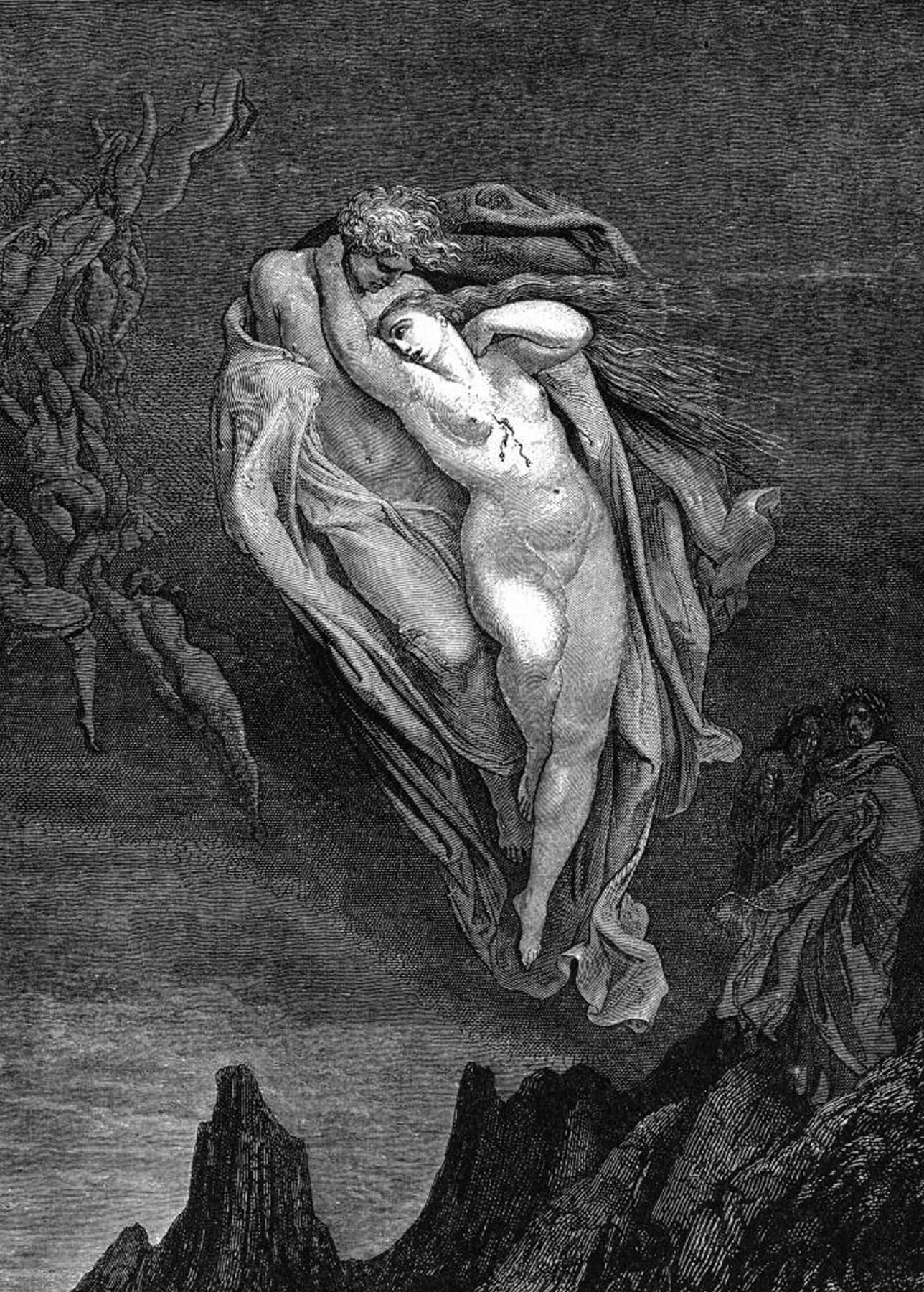
One day together, for pastime, we read Of Lancelot, and how Love held him in thrall. We were alone, and without any dread.
Sometimes our eyes, at the word’s secret call, Met, and our cheeks a changing color wore. But it was one page only that did all.
When we read how that smile, so thirsted for, Was kissed by such a lover, he that may Never from me be separated more
All trembling kissed my mouth. The book I say Was a Galahalt to us, and he beside that wrote that book. We read no more that day.
Gustave Dore – Divine Comedy, Inferno, Canto 5 “The Souls of Paolo and Francesca” (1857)
[Noi leggiavamo un giorno per diletto di Lancialotto come amor lo strinse; soli eravamo e sanza alcun sospetto.
Per più fïate li occhi ci sospinse quella lettura, e scolorocci il viso; ma solo un punto fu quel che ci vinse.
Quando leggemmo il disïato riso esser basciato da cotanto amante, questi, che mai da me non fia diviso,
la bocca mi basciò tutto tremante. Galeotto fu ‘l libro e chi lo scrisse: quel giorno più non vi leggemmo avante.]
Dante Alighieri (1265–1321) Italian poet The Divine Comedy [Divina Commedia], Book 1 “Inferno,” Canto 5, l. 127ff (5.127-138) [Francesca] (1309) [tr. Binyon (1943)]
(Source)
In the Old French romance of Lancelot du Lac they were reading, Sir Gallehault (spelled variously) serves as go-between for Lancelot and Guinevere (a couple not able to express their love because of her marriage to King Arthur), and ultimately persuades the Queen to give Lancelot a first, dooming kiss. Similarly, Paolo was the intermediary to arrange the marriage of his brother, Gianciotto, and Francesca. After the marriage, reading together that racy tale of Lancelot seduced Paolo and Francesca into pursuing their carnal affair.
The Italian form of Gallehault -- "Galeotto" or "Galleot" -- became Middle Ages Italian slang for a panderer or pimp, and Francesca draws on this meaning in her chat with the Pilgrim, blaming the book and its writer for her damning sins with Paolo. See also, earlier, here.
Together we, for pleasure, one day read
How strictly Lancelot was bound by love;
We, then alone, without suspicion were:
T'admire each other, often from the book
Our eyes were ta'en, and oft our colour chang'd;
That was the point of time which conqurer'd us,
When, reading that her captivating smile
Was by the Lover the adored kiss'd;
This, my Companion, always with me seen,
Fearful, and trembling, also kiss'd my mouth.
The Writer, Galeotto, nam;d the Book.
But from that day we never read in't more.
[tr. Rogers (1782), l. 113ff]
One day (a day I ever must deplore!)
The gentle youth, to spend a vacant hour,
To me the soft seducing story read,
Of Launcelot and fair Geneura's love,
While fascinating all the quiet grove
Fallacious Peace her snares around us spread.
Too much I found th' insidious volume charm,
And Paulo's mantling blushes rising warm;
Still as he read the guilty secret told:
Soon from the line his eyes began to stray;
Soon did my yielding looks my heart betray,
Nor needed words our wishes to unfold.
Eager to realize the story'd bless,
Trembling he snatch'd the half resented kiss,
To ill soon lesson'd by the pandar-page!
Vile pandar-page! it smooth'd the paths of shame.
[tr. Boyd (1802), st. 24-26]
One day
For our delight we read of Lancelot, How him love thrall’d. Alone we were, and no Suspicion near us. Ofttimes by that reading
Our eyes were drawn together, and the hue Fled from our alter’d cheek. But at one point Alone we fell. When of that smile we read,
The wished smile, rapturously kiss’d By one so deep in love, then he, who ne’er From me shall separate, at once my lips
All trembling kiss’d. The book and writer both Were love’s purveyors. In its leaves that day We read no more.
[tr. Cary (1814)]
'Twas on a day when we for pastime read Of Lancelot, whom love ensnared to ruin: We were alone, nor knew suspicious dread.
That lesson oft, the conscious look renewing, Held us suspense, and turned our cheeks to white; But one sole moment wrought for our undoing:
When of the kiss we read, from smile so bright. So coveted, that such true-lover bore. He, from my side who ne'er may disunite,
Kissed me upon the mouth, trembling all o'er. The broker of our Vows, it was the lay, And he who wrote -- that day we read no more.
[tr. Dayman (1843)]
One day, for pastime, wwe read of Lancelot, how love restrained him; we were alone, and without all suspicion. Several times that reading urged our eyes to meet, and changed the color of our faces; but one moment alone it was that overcame us. When we read how the fond smile was kissed by such a lover, he, who shall never be divided from me, kissed my mouth all trembling: the book, and he who wrote it, was a Galeotto; that day we read in it no farther.
[tr. Carlyle (1849)]
We were reading one day, for our delight,
In Lancilotto, bound in love so strict.
We were alone, and neither could suspect
Suspended were our eyes, and more than once,
In reading, and the visage colorless;
One point it was lone that conquered us.
When we read first of that -- the longed-for smile
At being kissed by one who loved so well;
Galeotti was the book -- he wrote it:
That Day we read not there any farther.
[tr. Bannerman (1850)]
One day we read, to pass a pleasant time, How Lancelot was bound in chains of love; Alone we were and no suspicion knew.
often we sigh'd; and as we read our eyes Each other sought, the color fled our cheeks; But we were vanquish'd by one point alone.
When we had read how the smile long desir'd Was kiss'd by him who lov'd with such deep love, This one, from me no more to be apart,
Trembling all over, kiss'd me on the mouth. Galeotto was the writer and the book; In it we read no further on that day.
[tr. Johnston (1867)]
One day we reading were for our delight Of Launcelot, how Love did him enthrall. Alone we were and without any fear.
Full many a time our eyes together drew That reading, and drove the color from our faces; But one point only was it that o'ercame us.
Whenas we read of the much longed-for smile Being by such a noble lover kissed, This one, who ne'er from me shall be divided,
Kissed me upon the mouth all palpitating. Galeotto was the book and he who wrote it. That day no farther did we read therein.
[tr. Longfellow (1867)]
We were reading one day, for delight, of Lancelot, how Love constrained him; alone were we, and without any suspicion. Many times did that reading impel our eyes, and change the hue of our visages; but one point only was it that overcame us. When we read that the wished-for smile was kissed by such a lover, this one who never from me shall be parted kissed me on the mouth all trembling. A Gallehault was the book, and he who wrote it. That day we read no further in it.
[tr. Butler (1885)]
We read one day for pleasure, in the song Of Launcelot, how Love him captive made; We were alone without one thought of wrong.
Many and many a time our eyes delayed The reading, and our faces paled apart; One point alone it was that us betrayed.
In reading of that worshipt smile o' the heart, Kissed by such lover on her lips' red core. This one, who never more from me must part,
Kissed me upon the mouth, trembling all o'er: For us our Galeotto was that book; That day we did not read it any more.
[tr. Minchin (1885)]
We were reading one day, for delight, of Lancelot, how love constrained him. We were alone and without any suspicion. Many times that reading made us lift our eyes, and took the color from our faces, but only one point was that which overcame us. When we read of the longed-for smile being kissed by such a lover, this one, who never from me shall be divided, kissed my mouth all trembling. Galahaut was the book, and he who wrote it. That day we read in it no farther.
[tr. Norton (1892)]
We read one day, to while the hour, of Lancelot, how love enthralled him: we were alone, with never a thought of harm. And oft and oft that reading brought our eyes together and drave the colour to our cheeks ; but one point, only one, it was that overcame us. When that we came to read of how the smiling lips he loved were kissed by lover such as he, he that no more shall e'er be parted from me, kissed my mouth trembling through. Our Galahad was the book and he that penned it: that day we read in it no more.
[tr. Sullivan (1893)]
One day, by way of pastime, we were reading Of Lancelot, how love in fetters held him: We were alone, and without thought of danger.
Full often did that reading bring together Our glances, and made colourless our visage; But just one point was that which overcame us:
When as we read how that the smile much longed for Was kissed by one so passionately loving, He who from me shall never be divided
Kissed me upon the mouth, all, all a-quiver: -- A Galehalt was the book and he who wrote it: -- Upon that day we read therein no further.
[tr. Griffith (1908)]
We read one day for pastime of Lancelot, how love constrained him. We were alone and had no misgiving. Many times that reading drew our eyes together and changed the color in our faces, but one point alone it was that mastered us; when we read that the longed-fro smile was kissed by so great a lover, he who never shall be parted from me, all trembling, kissed my mouth. A Galeotto was the book and he that wrote it; that day we read in it no farther.
[tr. Sinclair (1939)]
One day we read for pastime how in thrall Lord Lancelot lay to love, who loved the Queen; We were alone -- we thought no harm at all.
As we read on, our eyes met now and then, And to our cheeks the changing color started, But just one moment overcame us -- when
We read of the smile, desired of lips long-thwarted, Such smile, by such a lover kissed away, He that may never more from me be parted
Trembling all over, kissed my mouth. I say The book was Galleot, Galleot the complying Ribald who wrote; we read no more that day.
[tr. Sayers (1949)]
One day for dalliance we read the rhyme of Lancelot, how love had mastered him. We were alone with innocence and dim time.
Pause after pause that high old story drew our eyes together while we blushed and paled; but it was one soft passage overthrew
our caution and our hearts. For when we read how her fond smile was kissed by such a lover, he who is one with me alive and dead
breathed on my lips the tremor of his kiss. That book, and he who wrote it, was a pander. That day we read no further.
[tr. Ciardi (1954), l. 124ff]
One day, for pastime, we reqd of Lancelot, how love constrained him; we were alone, suspecting nothing. Several times that reading urged our eyes to meet and too the color from our faces, but one moment alone it was that overcame us. When we read how the longed-for smile was kissed by so great a lover, this one, who never shll be parted from me, kissed my mouth all trembling. A Gallehault was the book and he who wrote it; that day we read no farther in it.
[tr. Singleton (1970)]
One day we read, to pass the time away, of Lancelot, how he had fallen in love; we were alone, innocent of suspicion.
Time and again our eyes were brought together by the book we read; our faces flushed and paled. To the moment of one line alone we yielded:
it was when we read about those longed-for lips now being kissed by such a famous lover, that this one (who shall never leave my side)
then kissed my mouth, and trembled as he did. The book and its author was our galehot! That day we read no further.
[tr. Musa (1971)]
One day, to pass the time away, we read of Lancelot -- how love had overcome him. We were alone, and we suspected nothing.
And time and time again that reading led our eyes to meet, and made our faces pale, and yet one point alone defeated us.
When we had read how the desired smile was kissed by one who was so true a lover, this one, who never shall be parted from me,
while all his body trembled, kissed my mouth. A Gallehault indeed, that book and he who wrote it, too; that day we read no more.
[tr. Mandelbaum (1980)]
One day, when we were reading, for distraction, How Lancelot was overcome by love -- We were alone, without any suspicion;
Several times, what we were reading forced Our eyes to meet, and then we changed color: But one page only was more than we could bear.
When we read how that smile, so much desired, Was kissed by such a lover, in the book, He, who will never be divided from me,
Kissed my mouth, he was trembling as he did so; The book, the writer played the part of Galahalt: That day we got no further with our reading.
[tr. Sisson (1981)]
One day, for pleasure,
We read of Lancelot, by love constrained:
Alone, suspecting nothing, at our leisure.
Sometimes at what we read our glances joined,
Looking from the book each to the other's eyes,
And then the color in our faces drained.
But one particular moment alone it was
Defeated us: the longed-for smile, it said, Was kissed by that most noble lover: at this,
This one, who now will never leave my side,
Kissed my mouth, trembling. A Galeotto, that book!
And so was he who wrote it; that day we read
No further.
[tr. Pinsky (1994), l. 112ff]
We were reading one day, for pleasure, of Lancelot, how Love beset him; we were alone and without any suspicion. Many times that reading drove our eyes together and turned our faces pale; but one point alone was the one that overpowered us. When we read that the yearned-for smile was kissed by so great a lover, he, who will never be separated from me, kissed my mouth all trembling. Galeotto was the book and he who wrote it: that day we read there no further.
[tr. Durling (1996)]
We read, one day, to our delight, of Lancelot and how love constrained him: we were alone and without suspicion. Often those words urged our eyes to meet, and coloured our cheeks, but it was a single moment that undid us. When we read how that lover kissed the beloved smile, he who will never be separated from me, kissed my mouth all trembling. That book was a Galeotto, a pandar, and he who wrote it: that day we read no more.
[tr. Kline (2002)]
One day, to pass the time, we read of Lancelot, who loved illicitly. Just the two of us; we had not thought of what, as yet, was not.
From time to time that reading urged our eyes to meet. and made our faces flush and pale, but one point in the story changed our lives;
for when we read of how the longed-for smile was kissed by such a noble knight, the one who for eternity is by my side all trembling
kissed my trembling mouth. The man who wrote this was a Galeotto; so was the book. That day the rest of it remained unscanned.
[tr. Carson (2002)]
One day we read together for pure joy how Lancelot was taken in Love's palm. We were alone. We knew no suspicion.
Time after time, the words we read would lift our eyes and drawn all color from our faces. A single point, however, vanquished us.
For when at last we read the longed-for smile of Guinevere -- at last her lover kissed -- he, who from me will never now depart,
touched his kiss, trembling to my open mouth. This book was Galehault -- pander-penned, the pimp! That day we read no further down those lines.
[tr. Kirkpatrick (2006)]
One day, to pass the time in pleasure, we read of Lancelot, how love enthralled him. We were alone, without the least misgiving.
More than once that reading made our eyes meet and drained the color from our faces. Still, it was a single instant overcame us:
When we read how the longed-for smile was kissed by so renowned a lover, this man, who never shall be parted from me,
all trembling, kissed me on my mouth. A Galeotto was the book and he that wrote it. That day we read in it no further.
[tr. Hollander/Hollander (2007)]
One day we read the story of Lancelot And how his love attacked and held him tight. We were alone and unaware of our thoughts.
More than once the story forced our eyes To meet, and as we looked our faces turned pale, But just one single moment hung and decided
Us. We read how a smile we longed for stayed On her lips until the greatest of lovers kissed them, And then this man, who cannot be taken away
From me, kissed my mouth, his body trembling. A famous go-between had written that tale. That day, our time for reading suddenly ended.
[tr. Raffel (2010)]
One day, to amuse ourselves, we were reading The tales of love-struck Lancelot; we were all alone, And naively unaware of what could happen.
More than once, while reading, we looked up And saw the other looking back. We'd blush, then pale, Then look down again. Until a moment did us in.
We were reading about the longed-for kiss The great lover gives his Guinevere, when that one From whom I'll now never be parted,
Trembling, kissed my lips. That author and his book played the part Of Gallehault. We read no more that day.
[tr. Bang (2012)]
Reading together one day for delight
Or Lancelot, caught up in Love's sweet snare,
We were alone, with no thought of what might
Occur to us, although we stopped to stare
Sometimes at what we read, and even paled.
But then the moment came we turned a page
And all our powers of resistance failed:
When we read of that great knight in a rage
To kiss the smile he so desired. Paolo,
This one so quiet now, made my mouth still --
Which, loosened by those words, had trembled so --
With his mouth. And right then we lost the will --
For Love can will will's loss, as well you know --
To read on. But let that man take a bow
Who wrote the book we called our Galahad,
The reason nothing can divide us now.
[tr. James (2013), l. 149ff]
When it gets down to having to use violence, then you are playing the system’s game. The establishment will irritate you — pull your beard, flick your face — to make you fight. Because once they’ve got you violent, then they know how to handle you. The only thing they don’t know how to handle is non-violence and humor.
John Lennon (1940–1980) English rock musician, singer, songwriter
Interview, Bed-Ins for Peace, Montreal, Canada (1 Jun 1969)
(Source)
This Sir, was a time in which you clearly saw into the injustice of a State of Slavery, and in which you had just apprehensions of the horrors of its condition, it was now Sir, that your abhorrence thereof was so excited, that you publickly held forth this true and invaluable doctrine, which is worthy to be recorded and remember’d in all Succeeding ages. “We hold these truths to be Self evident, that all men are created equal, and that they are endowed by their creator with certain unalienable rights, that among these are life, liberty, and the pursuit of happyness.” Here Sir, was a time in which your tender feelings for your selves had engaged you thus to declare, you were then impressed with proper ideas of the great valuation of liberty, and the free possession of those blessings to which you were entitled by nature; but Sir how pitiable is it to reflect, that altho you were so fully convinced of the benevolence of the Father of mankind, and of his equal and impartial distribution of those rights and privileges which he had conferred upon them, that you should at the Same time counteract his mercies, in detaining by fraud and violence so numerous a part of my brethren under groaning captivity and cruel oppression, that you should at the Same time be found guilty of that most criminal act, which you professedly detested in others, with respect to yourselves.
Benjamin Banneker (1731–1806) American naturalist, surveyor, almanac author, mathematician
Letter (1791-08-19) to Thomas Jefferson
(Source)
True law is correct reason congruent with nature, spread among all persons, constant, everlasting. It calls to duty by ordering; it deters from mischief by forbidding. Nevertheless, it does not order or forbid upright persons in vain, nor does it move the wicked by ordering or forbidding. It is not holy to circumvent this law, nor is it permitted to modify any part of it, nor can it be entirely repealed. In fact we cannot be released from this law by either the senate or the people. No Sextus Aelius should be sought as expositor or interpreter. There will not be one law at Rome, another at Athens, one now, another later, but one law both everlasting and unchangeable will encompass all nations and for all time. And one god will be the common teacher and general, so to speak, of all persons. He will be the author, empire, and provider of this law. The person who will not obey it will flee from himself, and, defying human nature, he will suffer the greatest penalties by this very fact, even if he escapes other things that are thought to be punishments.
[Est quidem vera lex recta ratio naturae congruens, diffusa in omnes, constans, sempiterna, quae vocet ad officium iubendo, vetando a fraude deterreat; quae tamen neque probos frustra iubet aut vetat nec improbos iubendo aut vetando movet. Huic legi nec obrogari fas est neque derogari ex hac aliquid licet neque tota abrogari potest, nec vero aut per senatum aut per populum solvi hac lege possumus, neque est quaerendus explanator aut interpres eius alius, nec erit alia lex Romae, alia Athenis, alia nunc, alia posthac, sed et omnes gentes et omni tempore una lex et sempiterna et immutabilis continebit, unusque erit communis quasi magister et imperator omnium deus, ille legis huius inventor, disceptator, lator; cui qui non parebit, ipse se fugiet ac naturam hominis aspernatus hoc ipso luet maximas poenas, etiamsi cetera supplicia, quae putantur, effugerit.]
Marcus Tullius Cicero (106–43 BC) Roman orator, statesman, philosopher De Re Publica [On the Republic, On the Commonwealth], Book 3, ch. 22 / sec. 33 (3.33) (54-51 BC) [tr. Fott (2014)]
(Source)
Stoic definition of the law. Fragment, quoted by Lactantius, Divinae Institutiones, 6.8.6-9. (Source (Latin)). Other translations:
There is indeed a law, right reason, which is in accordance with nature; existing in all, unchangeable, eternal. Commanding us to do what is right, forbidding us to do what is wrong. It has dominion over good men, but possesses no influence over bad ones. No other law can be substituted for it, no part of it can be taken away, nor can it be abrogated altogether. Neither the people or the senate can absolve us from 38it. It wants no commentator or interpreter. It is not one thing at Rome, and another thing at Athens: one thing to-day, and another thing to-morrow; but it is a law eternal and immutable for all nations and for all time. God, the sole Ruler, and universal Lord, has framed and proclaimed this law. He who does not obey it, renounces himself, and is false to his own nature: he brings upon himself the direst tortures, even when he escapes human punishments.
[tr. Featherstonhaugh (1829)]
There is a true law, a right reason, conformable to nature, universal, unchangeable, eternal, whose commands urge us to duty, and whose prohibitions restrain us from evil. Whether it enjoins or forbids, the good respect its injunctions, and the wicked treat them with indifference. This law cannot be contradicted by any other law, and is not liable either to derogation or abrogation. Neither the senate nor the people can give us any dispensation for not obeying this universal law of justice. It needs no other expositor and interpreter than our own conscience. It is not one thing at Rome and another at Athens; one thing to–day and another to–morrow; but in all times and nations this universal law must for ever reign, eternal and imperishable. It is the sovereign master and emperor of all beings. God himself is its author, -- its promulgator, -- its enforcer. He who obeys it not, flies from himself, and does violence to the very nature of man. For his crime he must endure the severest penalties hereafter, even if he avoid the usual misfortunes of the present life.
[tr. Barham (1841)]
True law is right reason conformable to nature, universal, unchangeable, eternal, whose commands urge us to duty, and whose prohibitions restrain us from evil. Whether it enjoins or forbids, the good respect its injunctions, and the wicked treat them with indifference. This law cannot be contradicted by any other law, and is not liable either to derogation or abrogation. Neither the senate nor the people can give us any dispensation for not obeying this universal law of justice. It needs no other expositor and interpreter than our own conscience. It is not one thing at Rome, and another at Athens; one thing to-day, and another to-morrow; but in all times and nations this universal law must forever reign, eternal and imperishable. It is the sovereign master and emperor of all beings. God himself is its author, its promulgator, its enforcer. And he who does not obey it flies from himself, and does violence to the very nature of man. And by so doing he will endure the severest penalties even if he avoid the other evils which are usually accounted punishments.
[tr. Yonge (1853)]
True law is right reason in agreement with nature; it is of universal application, unchanging and everlasting; it summons to duty by its commands, and averts from wrongdoing by its prohibitions. And it does not lay its commands or prohibitions upon good men in vain, though neither have any effect on the wicked. It is a sin to try to alter this law, nor is it allowable to attempt to repeal any part of it, and it is impossible to abolish it entirely. We cannot be freed from its obligations by senate or people, and we need not look outside ourselves for an expounder or interpreter of it. And there will not be different laws at Rome and at Athens, or different laws now and in the future, but one eternal and unchangeable law will be valid for all nations and all times, and there will be one master and ruler, that is, God, over us all, for he is the author of this law, its promulgator, and its enforcing judge. Whoever is disobedient is fleeing from himself and denying his human nature, and by reason of this very fact he will suffer the worst penalties, even if he escapes what is commonly considered punishment.
[tr. Keyes (1928)]
There is in fact a true law -- namely, right reason -- which is in accordance with nature, applies to all men, and is unchangeable and eternal. By its commands this law summons men to the performance of their duties; by its prohibitions it restrains them from doing wrong. Its commands and prohibitions always influence good men, but are without effect upon the bad. To invalidate this law by human legislation is never morally right, nor is it permissible ever to restrict its operation, and to annul it wholly is impossible. Neither the senate nor the people can absolve us from our obligation to obey this law, and it requires no Sextus Aelius to expound and interpret it. It will not lay down one rule at Rome and another at Athens, nor will it be one rule today and another tomorrow. But there will be one law, eternal and unchangeable, binding at all times upon all peoples; and there will be, as it were, one common master and ruler of men, namely God, who is the author of this law, its interpreter, and its sponsor. The man who will not obey it will abandon his better self, and, in denying the true nature of a man, will thereby suffer the severest of penalties, though he has escaped all the other consequences which men call punishment.
[tr. Sabine/Smith (1929)]
... law in the proper sense is right reason in harmony with nature. It is spread through the whole human community, unchanging and eternal, calling people to their duty by its commands and deterring them from wrong-doing by its prohibitions. When it addresses a good man, its commands and prohibitions are never in vain; but those same commands and prohibitions have no effect on the wicked. This law cannot be countermanded, nor can it be in any way amended, nor can it be totally rescinded. We cannot be exempted from this law by any decree of the Senate or the people, nor do we need anyone else to expound or explain it. There will not be one such law in Rome and another in Athens, one now and another in the future, but all peoples at all times will be embraced by a single eternal and unchangeable law; and there will be, as it were, one lord and master of us all -- the god who is the author, proposer, and interpreter of that law. Whoever refuses to obey it will be turning his back on himiself. Because he has denied his nature as a human being he will face the gravest penalties for this alone, even if he succeeds in avoiding all the other things that are regarded as punishments ...
[tr. Rudd (1998)]
True law is right reason, consistent with nature, spread through all people. It is constant and eternal; it summons to duty by its orders, it deters crime by its prohibitions. Its orders and prohibitions to good people are never given in vain; but it does not move the wicked by these orders or prohibitions. It is wrong to pass laws obviating this law; it is not permitted to abrogate any of it; it cannot be totally repealed. We cannot be released from this law by the senate or the people, and it needs no exegete or interpreter like Sextus Aelius. There will not be one law at Rome and another at Athens, one now and another later; but all nations at all times will be bound by this one eternal and unchangeable law, and the god will be the one common master and general (so to speak) of all people. He is the author, expounder, and mover of this law; and the person who does not obey it will be in exile from h imself. Insofar as he scorns his nature as a human being, but his very fact he will pay the greatest penalty, even if he escapes all the other things that are generally regarded as punishments.
[tr. Zetzel (1999)]
When you think of the long and gloomy history of man, you will find that far more, and far more hideous, crimes have been committed in the name of obedience than have ever been committed in the name of rebellion.
C. P. Snow (1905–1980) English novelist, physical chemist, bureaucrat [Charles Percy Snow]
“The Moral Un-Neutrality of Science,” speech, American Association for the Advancement of Science, New York City (27 Dec 1960)
(Source)
These, when a thousand rolling years are o’er,
Called by the God, to Lethe’s waves repair;
There, reft of memory, to yearn once more
For mortal bodies and the upper air.
[Has omnis, ubi mille rotam volvere per annos,
Lethaeum ad fluvium deus evocat agmine magno,
Scilicet immemores supera et convexa revisant
Bursus et incipiant in corpora velle reverti.]
Virgil (70–19 BC) Roman poet [b. Publius Vergilius Maro; also Vergil] The Aeneid [Ænē̆is], Book 6, l. 748ff (6.748-751) [Anchises] (29-19 BC) [tr. Taylor (1907), st. 99, l. 883ff]
(Source)
On the reincarnation of most souls, other than those punished in Tartarus or rewarded in Elysium.
When thousand yeares have fil'd their period,
All these God calls in troups to Lethe's flood,
To th end that they forgetfull of what's past,
May reascend, and bodies take at last.
[tr. Ogilby (1649)]
But, when a thousand rolling years are past,
(So long their punishments and penance last,)
Whole droves of minds are, by the driving god,
Compell'd to drink the deep Lethaean flood,
In large forgetful draughts to steep the cares
Of their past labors, and their irksome years,
That, unrememb'ring of its former pain,
The soul may suffer mortal flesh again.
[tr. Dryden (1697)]
All these, after they have rolled away a thousand years, are summoned forth by the god in a great body to the river Lethe; to the intent that, losing memory, they may revisit the vaulted realms above, and again become willing to return into bodies.
[tr. Davidson/Buckley (1854)]
All these, when centuries ten times told
The wheel of destiny have rolled,
The voice divine from far and wide
Calls up to Lethe's river-side,
That earthward they may pass once more
Remembering not the things before,
And with a blind propension yearn
To fleshly bodies to return.
[tr. Conington (1866)]
All these, when for a thousand years the wheel
Of fate has turned, the Deity calls forth
To Lethe's stream, a mighty multitude;
That they, forgetful of the past, may see
Once more the vaulted sky, and may begin
To wish return into corporeal frames.
[tr. Cranch (1872), l. 933ff]
All these before thee, when the wheel of a thousand years hath come fully round, a God summons in vast train to the river of Lethe, that so they may regain in forgetfulness the slopes of upper earth, and begin to desire to return again into the body.
[tr. Mackail (1885)]
All these who now have turned the wheel for many and many a year
God calleth unto Lethe's flood in mighty company,
That they, remembering nought indeed, the upper air may see
Once more, and long to turn aback to worldly life anew.
[tr. Morris (1900)]
At last, when the millennial aeon strikes,
God calls them forth to yon Lethaean stream,
In numerous host, that thence, oblivious all,
They may behold once more the vaulted sky,
And willingly to shapes of flesh return.
[tr. Williams (1910), l. 747ff]
A thousand years pass over
And the god calls the countless host to Lethe
Where memory is annulled, and souls are willing
Once more to enter into mortal bodies.
[tr. Humphries (1951)]
All these souls, when they have finished their thousand-year cycle,
God sends for, and they come in crowds to the river of Lethe,
So that, you see, with memory washed out, they may revisit
The earth above and begin to wish to be born again.
[tr. Day-Lewis (1952)]
But all the rest, when they have passed time's circle
for a millennium, arfe summoned by
the god to Lethe in a great assembly
that, free of memory, they may return
beneath the curve of the upper world, that they
may once again begin to wish for bodies.
[tr. Mandelbaum (1971), l. 988ff]
These other souls,
When they have turned Time's wheel a thousand years,
The god calls in a crowd to Lethe stream,
There there unmemoried they may see again
The heavens and wish re-entry into bodies.
[tr. Fitzgerald (1981), l. 1004ff]
All these others whom you see, when they have rolled the wheel for a thousand years, are called out by God to come in great columns to the river of Lethe, so that they may duly go back and see the vault of heaven again remembering nothing, and begin to be willing to return to bodies.
[tr. West (1990)]
All these others the god calls in a great crowd to the river Lethe,
after they have turned the wheel for a thousand years,
so that, truly forgetting, they can revisit the vault above,
and begin with a desire to return to the flesh.
[tr. Kline (2002)]
All these,
When they have rolled the wheel of time
Through a thousand years, will be called by God
In a great assembly to the river Lethe,
So that they return to the vaulted world
With no memory and may begin again
To desire rebirth in a human body.
[tr. Lombardo (2005)]
All the rest, once they have turned the wheel of time
for a thousand years: God calls them forth to the Lethe,
great armies of souls, their memories blank so that
they may revisit the overarching world once more
and begin to long to return to bodies yet again.
[tr. Fagles (2006), l. 865ff]
When the rest have cycled through a thousand years, the god calls them in clusters to the river Lethe. These forgetful spirits hope for resurrection into bodies. They start to want to see the sky.
[tr. Bartsch (2021)]
FIRST SERVINGMAN: Let me have war, say I. It exceeds peace as far as day does night. It’s sprightly walking, audible, and full of vent. Peace is a very apoplexy, lethargy; mulled, deaf, sleepy, insensible; a getter of more bastard children than war’s a destroyer of men.
William Shakespeare (1564–1616) English dramatist and poet Coriolanus, Act 4, sc. 5, l. 244ff (4.5.244-249) (c. 1608)
(Source)
Make your choice, adventurous Stranger,
Strike the bell and bide the danger,
Or wonder, till it drives you mad,
What would have followed if you had.
C. S. Lewis (1898–1963) English writer, literary scholar, lay theologian [Clive Staples Lewis]
The Magician’s Nephew, ch. 4 “The Bell and the Hammer” (1955)
(Source)
Barnes frag. 11, Musgrave frag. 5. (Source (Greek)). Other translation:
It is neither reasonable to rule, nor ought there to be a king [law].
It is folly for a man even to want [...]
who wishes to hold sole power over his peers.
[Source]
The vices of which we are full we carefully hide from others, and we flatter ourselves with the notion that they are small and trivial; we sometimes even embrace them as virtues.
John Calvin (1509–1564) French theologian and reformer The Institutes of Christian Religion [Institutio Christianae Religionis], Book 3, ch. 7, sec. 4 (1541) [tr. Van Andel (1952)]
(Source)
Also reprinted in an extract as The Christian Life [De Vita Hominis Christiani], or, in the case of the Van Andel translation, Golden Booklet of the True Christian Life, ch. 2, sec. 4, subsec. 2.
The vices in which we abound, we sedulously conceal from others, and flatter ourselves with the pretence that they are diminutive and trivial, and even sometimes embrace them as virtues.
[Source (1813)]
The very vices that infest us we take pains to hide from others, while we flatter ourselves with the pretense that they are slight and insignificant, and even sometimes embrace them as virtues.
[Source (1984)]
The vices with which we abound we both carefully conceal from others, and flatteringly represent to ourselves as minute and trivial, no, sometimes hug them as virtues.
[tr. Beveridge (2008)]
Forgiveness is not easy. Forgiveness is a train with many stops, and it takes forever to get where you are going. And you cover a lot of territory along the way, not necessarily by the most direct route, either. That’s why forgiveness is a process, and as much a blessing for the person who was wronged as for the person who did the wronging. And it’s hardest when the person you most need to forgive is yourself.
Elizabeth Bear (b. 1971) American author [pseud. for Sarah Bear Elizabeth Wishnevsky] Ancestral Night (2019)
(Source)
Neither should one live in the past, as if to him there was no future; as if he had done with all the rest of life. Keep young. Many men talk about being born again. Every man should be born again on the first day of January. Start with a fresh page. Take up one more hole in the buckle, if necessary, or let down one, according to circumstances; but, on the first of January let every man gird himself once more, with his face to the front, and take interest in the things that are and are to be, and not in the things that were and are past.
Henry Ward Beecher (1813–1887) American clergyman and orator
“A Completed Year,” sermon, Plymouth Pulpit #379 (10 Jan 1883)
Men do change, and change comes like a little wind that ruffles the curtains at dawn, and it comes like the stealthy perfume of wildflowers hidden in the grass. Change may be announced by a small ache, so that you think you’re catching cold. Or you may feel a faint disgust for something you loved yesterday. It may even take the form of a hunger that peanuts won’t satisfy.
John Steinbeck (1902–1968) American writer Sweet Thursday, ch. 3, sec. 1 (1954)
(Source)
Life brings no greater grief
Than happiness remembered in a time
Of sorrow.
[Nessun maggior dolore
Che ricordarsi del tempo felice
Ne la miseria.]
Dante Alighieri (1265–1321) Italian poet The Divine Comedy [Divina Commedia], Book 1 “Inferno,” Canto 5, l. 121ff (5.121-123) [Francesca] (1309) [tr. James (2013), l. 141ff]
(Source)
Francesca de Rimini is responding to Dante's request to speak of her love affair while in the middle of being punished for it. It is a true (if slanted) tale that occurred when Dante was a young man. Francesca da Polenta wed the crippled Giovanni Malatesta de Rimini, but fell in adulterous love with his brother, Paolo. Upon discovery of their affair, Giovanni killed them both. This was a local scandal, and would have been lost to time if Dante had not recorded it here. He relegates the lovers to the "least" eternal punishment in Hell, in the circle of carnal sins -- while Giovanni (who was still alive when this was written) is doomed to a lower circle for the murder (treachery to kindred). (Moreinfo.)
Inspiration for this particular phrase has been credited to many sources: Wisdom 11:11-12, Boethius (Consolation of Philosophy, 2.4.3-6), and Pindar (Pythian 4.510-512) are the most common. Augustine (Confessions 10.14) and Thomas Aquinas have also been cited.
But merely to possess virtue as you would an art is not enough, unless you apply it. For an art, even if unused, can still be retained in the form of theoretical knowledge, but virtue depends entirely upon its use.
[Nec vero habere virtutem satis est quasi artem aliquam, nisi utare; etsi ars quidem, cum ea non utare, scientia tamen ipsa teneri potest, virtus in usu sui tota posita est.]
Marcus Tullius Cicero (106–43 BC) Roman orator, statesman, philosopher De Re Publica [On the Republic, On the Commonwealth], Book 1, ch. 2 / sec. 2 (1.2) (54-51 BC) [tr. Sabine/Smith (1929)]
(Source)
Yet to possess virtue, like some art, without exercising it, is insufficient. Art indeed, when not effective, is still comprehended in science. The efficacy of all virtue consists in its use.
[tr. Featherstonhaugh (1829)]
Nor is it sufficient to possess this virtue as if it were some kind of art, unless we put it in practice. An art, indeed, though not exercised, may still be retained in knowledge; but virtue consists wholly in its proper use and action.
[tr. Yonge (1853)]
It is not enough to possess virtue, as though it were an art, unless we use it. For although, if you do not practice an art, you may yet retain it theoretically, the whole of virtue is centered in the exercise of virtue.
[ed. Harbottle (1906)]
But it is not enough to possess virtue, as if it were an art of some sort, unless you make use of it. Though it is true that an art, even if you never use it, can still remain in your possession by the very fact of your knowledge of it, yet the existence of virtue depends entirely upon its use.
[tr. Keyes (1928)]
Yet it is not enough to possess moral excellence as a kind of skill, unless you put it into practice. You can have a skill simply by knowing how to practise it, even if you never do; whereas moral excellence is entirely a matter of practice.
[tr. Rudd (1998)]
Furthermore, virtue is not some kind of knowledge to be possessed without using it: even if the intellectual possession of knowledge can be maintained without use, virtue consists entirely in its employment.
[tr. Zetzel (1999)]
Truly it is not enough to have virtue, as if it wer some sort of art, unless you use it. In fact, even if an art can be grasped by knowledge itself without using it, virtue depends wholly upon its use.
[tr. Fott (2014)]
It is not enough simply to possess virtue, as though it were a skill, unless you use it. Even a skill can be maintained through disuse by knowledge itself, but the entirety of virtue consists of its use.
[tr. Robinson (2016)]
Expect of the young the very best of which they are capable, and you will get it. Expect less, and it is only too likely that you will get no more than you expect.
Bertrand Russell (1872–1970) English mathematician and philosopher
“On National Greatness,” New York American (1932-01-20)
(Source)
Not living in fear is a great gift, because certainly these days we do it so much. And do you know what I like about comedy? You can’t laugh and be afraid at the same time — of anything. If you’re laughing, I defy you to be afraid.
Stephen Colbert (b. 1964) American political satirist, writer, comedian
“After tragedy, TV funnyman Stephen Colbert says: ‘If you are laughing, you can’t be afraid,'” interview by James Kaplan, Parade (23 Sep 2007)
And even when life is over, all the evil
Ingrained so long, the adulterated mixture,
The plagues and pestilences of the body
Remain, persist. So there must be a cleansing,
By penalty, by punishment, by fire,
By sweep of wind, by water’s absolution,
Before the guilt is gone. Each of us suffers
His own peculiar ghost.
[Quin et supremo cum lumine vita reliquit,
non tamen omne malum miseris nec funditus omnes
corporeae excedunt pestes, penitusque necesse est
multa diu concreta modis inolescere miris.
Ergo exercentur poenis, veterumque malorum
supplicia expendunt: aliae panduntur inanes
suspensae ad ventos; aliis sub gurgite vasto
infectum eluitur scelus, aut exuritur igni;
quisque suos patimur Manes.]
Virgil (70–19 BC) Roman poet [b. Publius Vergilius Maro; also Vergil] The Aeneid [Ænē̆is], Book 6, l. 735ff (6.735-743) [Anchises] (29-19 BC) [tr. Humphries (1951)]
(Source)
Souls in the underworld purging their spirits so that they can enter Elysium. The Manes were minor underworld deities and/or the spirits of deceased ancestors.
But when their latest light and life is set,
Not all woes leave them, nor all tortures quite
Forsake the wretches there; and 'tis but right;
Things strangely grown by custome into crimes,
They must be punish'd for their mispent times,
And tortures feele; some in the winds are hung,
Others to clense their spotted sins are flung
In a vast gulph, or purg'd in fire they are:
We all have our own tortures.
[tr. Ogilby (1649)]
Nor can the groveling mind,
In the dark dungeon of the limbs confin'd,
Assert the native skies, or own its heav'nly kind:
Nor death itself can wholly wash their stains;
But long-contracted filth ev'n in the soul remains.
The relics of inveterate vice they wear,
And spots of sin obscene in ev'ry face appear.
For this are various penances enjoin'd;
And some are hung to bleach upon the wind,
Some plung'd in waters, others purg'd in fires,
Till all the dregs are drain'd, and all the rust expires
All have their manes, and those manes bear.
[tr. Dryden (1697)]
Even when with the last beams of light their life is gone, yet not every ill, nor all corporeal stains, are quite removed from the unhappy beings; and it is absolutely necessary that many imperfections which have long been joined to the soul should be in marvelous ways increased and riveted therin. Therefore are they afflicted with punishments, and pay the penalties of their former ills. Some, hung on high, are spread out to the empty winds; in others the guilt not done away is washed out ina vast watery abyss, or burned away in fire. We each endure his own manes.
[tr. Davidson/Buckley (1854)]
Nay, when at last the life has fled,
And left the body cold and dead,
E'en then there passes not away
The painful heritage of clay;
Full many a long contracted stain
Perforce must linger deep in grain.
So penal sufferings they endure
For ancient crime, to make them pure:
Some hang aloft in open view
For winds to pierce them through and through,
While others purge their guilt deep-dyed
In burning fire or whelming tide.
Each for himself, we all sustain
The durance of our ghostly pain.
[tr. Conington (1866)]
Nor e'en when life's last ray
Has fled, does every ill depart, nor all
Corporeal taints quite leave their unhappy frames,
And needs must be that many a hardened fault
Inheres in wondrous ways. Therefore the pains
Of punishment they undergo, for sins
Of former times. Some in the winds are hung
Suspended and exposed. Others beneath
A waste of waters from their guilt are cleansed,
Or purified by fire. We all endure
Our ghostly retribution.
[tr. Cranch (1872), l. 918ff]
Nay, and when the last ray of life is gone, not yet, alas! does all their woe, nor do all the plagues of the body wholly leave them free; and needs must be that many a long ingrained evil should take root marvellously deep. Therefore they are schooled in punishment, and pay all the forfeit of a lifelong ill; some are hung stretched to the viewless winds; some have the taint of guilt washed out beneath the dreary deep, or burned away in fire. We suffer, each a several ghost.
[tr. Mackail (1885)]
Yea, e'en when out of upper day their life at last is borne,
Not all the ill of wretched men is utterly outworn,
Not all the bane their bodies bred; and sure in wondrous wise
The plenteous ill they bore so long engrained in them it lies:
So therefore are they worn by woes and pay for ancient wrong:
And some of them are hung aloft the empty winds among;
And some, their stain of wickedness amidst the water's heart
Is washed away; amidst the fire some leave their worser part;
And each his proper death must bear.
[tr. Morris (1900), l. 734ff]
Nor can the soul, in darkness and in chains,
Assert the skies, and claim celestial birth.
Nay, after death, the traces it retains
Of fleshly grossness, and corporeal stains,
Since much must needs by long concretion grow
Inherent. Therefore are they racked with pains,
And schooled in all the discipline of woe;
Each pays for ancient sin with punishment below.
Some hang before the viewless winds to bleach;
Some purge in fire or flood the deep decay
And taint of wickedness. We suffer each
Our ghostly penance.
[tr. Taylor (1907), st. 97-98, l. 866ff]
Nor when to life's last beam they bid farewell
May sufferers cease from pain, nor quite be freed
From all their fleshly plagues; but by fixed law,
The strange, inveterate taint works deeply in.
For this, the chastisement of evils past
Is suffered here, and full requital paid.
Some hang on high, outstretched to viewless winds;
For some their sin's contagion must be purged
In vast ablution of deep-rolling seas,
Or burned away in fire. Each man receives
His ghostly portion in the world of dark.
[tr. Williams (1910)]
Nay, when at their last day life is fled, still not all the evil, alas! not all the plagues of the body quit them utterly; and it must needs be that many a taint, long linked in growth, should in wondrous wise become deeply ingrained. Therefore are they schooled with penalties, and for olden sins pay punishment: some are hung stretched out to the empty winds; from some the stain of guilt is washed away under swirling floods or burned out in fire. Each of us suffers his own spirit.
[tr. Fairclough (1916)]
Yes, not even when the last flicker of life has left us,
Does evil, or the ills that flesh is heir to, quite
Relinquish our souls; it must be that many a taint grows deeply,
Mysteriously grained in their being from long contact with the body.
Therefore the dead are disciplined in purgatory, and pay
The penalty of old evil: some hang, stretched ot the blast of
Vacuum winds; for others, the stain of sin is washed
Away in a vast whirlpool or cauterized with fire.
Each of us finds in the next world his own level.
[tr. Day-Lewis (1952)]
And when the final day of life deserts them,
then, even then, not every ill, not all
the plagues of body quit them utterly;
and this must be, for taints so long congealed
cling fast and deep in extraordinary
ways. Therefore they are schooled by punishment
and pay with torments for their own misdeeds:
some there are purified by air, suspended
and stretched before the empty winds; for some
the stain of guilt is washed away beneath
a mighty whirlpool or consumed by fire.
First each of us must suffer his own Shade.
[tr. Mandelbaum (1971), l. 970ff]
In fact
Even when life departs on the last day
Not all the scourges of the body pass
From the poor souls, not all distress of life.
Inevitably, many malformations,
Growing together in mysterious ways,
Become inveterate. Therefore they undergo
The discipline of punishments and pay
In penance for old sins: some hang full length
To the empty winds, for some the stain of wrong
Is washed by floods or burned away by fire.
We suffer each his own shade.
[tr. Fitzgerald (1981), l. 988ff]
Even when life leaves them on their last day of light, they are not wholly freed from all the many ills and miseries of the body which must harden in them over the long years and become ingrained in ways we cannot understand. And so they are put to punishment, to pay the penalty for all their ancient sins. Some are stretched and hung out empty to dry in the winds. Some have the stain of evil washed out of them under a vast tide of water or scorched out by fire. Each of us suffers his own fate in the after-life.
[tr. West (1990)]
Why, when life leaves them at the final hour,
still all of the evil, all the plagues of the flesh, alas,
have not completely vanished, and many things, long hardened
deep within, must of necessity be ingrained, in strange ways.
So they are scourged by torments, and pay the price
for former sins: some are hung, stretched out,
to the hollow winds, the taint of wickedness is cleansed
for others in vast gulfs, or burned away with fire:
each spirit suffers its own.
[tr. Kline (2002)]
Nor, when the last gleam
Of life flickers out, are all the ills
That flesh is heir to completely uprooted.
But many corporal taints remain,
Ingrained in the soul in myriad ways.
And so we are disciplined and expiate
Our bygone sins. Some souls are hung
Spread to the winds; others are cleansed
Under swirling waters or purged by fire.
We each suffer our own ghosts.
[tr. Lombardo (2005)]
True,
but even on that last day, when the light of life departs,
the wretches are not completely purged of all the taints,
nor are they wholly freed of all the body’s plagues.
Down deep they harden fast -- they must, so long engrained
in the flesh -- in strange, uncanny ways. And so the souls
are drilled in punishments, they must pay for their old offenses.
Some are hung splayed out, exposed to the empty winds,
some are plunged in the rushing floods -- their stains,
their crimes scoured off or scorched away by fire.
Each of us must suffer his own demanding ghost.
[tr. Fagles (2006), l. 849ff]
Poor things, even when life leaves them on the day of death, not every sin or canker of the flesh fully recedes. Many habits harden over time, and in this way become ingrained. So they pay for former crimes by torment: exposed to hollow winds by crucifixion, washed clean of infection in a whirling flood, or cauterized by fire -- we all suffer our soul's cure.
[tr. Bartsch (2021)]
Few people remember having been young, and how hard they found it to be chaste and sober.
[Peu de gens se souviennent d’avoir été jeunes, et combien il leur était difficile d’être chastes et tempérants.]
Jean de La Bruyère (1645–1696) French essayist, moralist The Characters [Les Caractères], ch. 11 “Of Mankind [De l’Homme],” § 112 (11.112) (1688) [tr. Stewart (1970)]
(Source)
A poor man defended himself when charged with stealing food to appease the cravings of hunger, saying, the cries of the stomach silenced those of the conscience.
Marguerite Gardiner, Countess of Blessington (1789–1849) Irish novelist [Lady Blessington, b. Margaret Power]
(Attributed)
(Source)
Quoted, without citation, in R. R. Madden, The Literary Life and Correspondence of the Countess of Blessington, Vol. 1 (1855).
I am content to be one of the multitude of Christians who do not care much about the doctrine of the Trinity or the historical truth of the gospels. Both as a scientist and as a religious person, I am accustomed to living with uncertainty. Science is exciting because it is full of unsolved mysteries, and religion is exciting for the same reason.
Freeman Dyson (1923–2020) English-American theoretical physicist, mathematician, futurist
“Progress in Religion,” Templeton Prize acceptance speech, Washington National Cathedral (9 May 2000)
(Source)
Who talked you into cutting off the guy’s nose, When some other part clearly curls your wife’s toes?
You dolt, she’s not lost what makes Deiphobus dear: It’s his dick that made your wife holler and cheer.
[Quis tibi persuasit naris abscidere moecho?
Non hac peccatum est parte, marite, tibi.
Stulte, quid egisti? nihil hic tibi perdidit uxor,
Cum sit salva tui mentula Deiphobi.]
Martial (AD c.39-c.103) Spanish Roman poet, satirist, epigrammatist [Marcus Valerius Martialis] Epigrams [Epigrammata], Book 3, epigram 85 (3.85) (AD 87-88) [tr. Ericsson (2005)]
The name Deiphobus is used here metaphorically. In myth he was son of Priam, and wed Helen after Paris. Menelaus, Helen's first husband, mutilated him. He is referenced in accounts of the Trojan Wars, as well as the Aenead.
Offended lord, what could thee discompose, So cruelly to lop th' offender's nose?
That suff'ring limb, as thine, was innocent: Nor feels the paramour the punishment.
Ne'er canst thou hope t' extingish either fire, While the incendiary remains entire.
[tr. Elphinston (1782), Book 6, Part 2, ep. 35]
Who persuaded you to cut off the nose of your wife's gallant? Wretched husband, that was not the part which outraged you. Fool, what have you done? Your wife has lost nothing by the operation, since that which pleased her in your friend Deiphobus is still safe.
[tr. Bohn's Classical (1859)]
Who induced you to cut off the adulterer's nose? It was not by this party, husband, you were sinned against. You fool, what have you done? Your wife has lost nothing in this quarter, seeing the organ of your Deiphobus is safe and sound.
[tr. Ker (1919)]
What ailed you to cut off the young gallant’s nose,
And leave all unscathed the prime source of your woes?
[tr. Pott & Wright (1921)]
Good husband, who persuaded you
to cut off the adulterer's nose? What good did that do, you fool?
Your wife loses nothing at all as long as the man keeps his tool.
[tr. Bovie (1970)]
Who persuaded you to cut off the adulterer's nose?
No offence against you has been committed by this part, my good husband.
Idiot, what have you done? Your wife has lost nothing here,
Since your Deiphobus's cock is safe and sound.
[tr. Shackleton Bailey (1993)]
Sometimes change came all at once, with a sound like a fire taking hold of dry wood and paper, with a roar that rose around you so you couldn’t hear yourself think. And then, when the roar died down, even when the fires were damped, everything was different.
Anna Quindlen (b. 1953) American journalist, novelist Object Lessons, ch. 1 (1991)
(Source)
Gustave Dore – Divine Comedy, Plate 14, Inferno, Canto 5 “The infernal hurricane that never rests” (1857)
And this, I learned, was the never ending flight of those who sinned in the flesh, the carnal and lusty who betrayed reason to their appetite.
As the wings of wintering starlings bear them on in their great wheeling flights, just so the blast wherries these evil souls through time foregone.
Here, there, up, down, they whirl, and whirling, strain with never a hope of hope to comfort them, not of release, but even of less pain.
[Intesi ch’a così fatto tormento enno dannati i peccator carnali, che la ragion sommettono al talento.
E come li stornei ne portan l’ali nel freddo tempo, a schiera larga e piena, così quel fiato li spiriti mali
di qua, di là, di giù, di sù li mena; nulla speranza li conforta mai, non che di posa, ma di minor pena.]
Dante Alighieri (1265–1321) Italian poet The Divine Comedy [Divina Commedia], Book 1 “Inferno,” Canto 5, l. 37ff (5.37-45) (1309) [tr. Ciardi (1954)]
(Source)
Those who such torments suffered, I learnt, Were condemn'd to them for their carnal Sins, Their reason by their Passion being subdued.
And as the Birds, who at the first approach Of cold, take wing, and gather in thick clouds, So does the Storm these wretched Spirits drive,
From 'bove, below, and ev'ry side around. They have no hope of ever being releas'd: And e'en of lighter punishments despair.
[tr. Rogers (1782), l. 32ff]
These were the hapless slaves of lawless love,
Soft pleasure's vot'ries in the world above,
Who the still voice of reason held in scorn;
And as a flight of starlings wing their way,
Riding the wintry blast in long array, The phantoms fleet, in airy tumult borne.
Aloft we saw the moody revel ride,
Then, in long eddies, like the swallowing tide,
With its full freight the hurricane descends:
Around the sinner sweep, above, below,
Nor respite of their cares rest they, nor refuge know From the resistless storm that never ends.
[tr. Boyd (1802), st. 8-9]
I understood that to this torment sad The carnal sinners are condemn'd, in whom Reason by lust is sway'd. As in large troops
And multitudinous, when winter reigns, The starlings on their wings are borne abroad; So bears the tyrannous gust those evil souls.
On this side and on that, above, below, It drives them: hope of rest to solace them Is none, nor e'en of milder pang.
[tr. Cary (1814)]
Then understood I of that woe's intent, How framed with sinners in the flesh to deal Who to their passion have their reason bent.
And like as starlings in their aery wheel Some winter's day float wide upon the wing. So doth those guilty souls the whirlwind's reel
Now up, now down, now this, now that way fling; Nor aught to comfort them may soothing hope. If not of rest, of milder sufferance bring.
[tr. Dayman (1843)]
I learnt that to such torment [are] doomed the carnal sinners, who subject reason to lust. And as their wings bear along the starlings, at the cold season, in large and crowded troop: so that blast, the evil spirits; hither, thither, down, up, it leads them. No hope ever comforts them, not of rest, but even of less pain.
[tr. Carlyle (1849)]
Of torment such as this, I understood, Were carnal sinners made to drink their fill, Their reason who subject unto their will.
And as the starlings spread their wings aloft In the cold time, in long and crowded flock, Such are the evil spirits to the shock:
From here to there, from low to high, it leads; Nor hope nor comfort in their breast remain, Not of a pause, but even of lesser pain.
[tr. Bannerman (1850)]
Then I perceiv'd this torment was to those Whose condemnation was for carnal sins, Who made their reason subject to their lusts.
As starlings in their wingèd strength are borne In winter season, flocking wide and deep; So are the wicked spirits by this blast
Upwards and downwards, hither, thither swept, Having to comfort them of no hope of rest From their great woe, nor e'en of lesser pain.
[tr. Johnston (1867)]
I understood that unto such a torment The carnal malefactors were condemned, Who reason subjugate to appetite.
And as the wings of starlings bear them on In the cold season in large band and full, So doth that blast the spirits maledict;
It hither, thither, downward, upward, drives them; No hope doth comfort them forevermore, Not of repose, but even of lesser pain.
[tr. Longfellow (1867)]
I was aware that to a torment thus fashioned are condemned the carnal sinners who made their reason subject to their inclination. And as their wings bear away the starlings in the cold season, in a broad and thick flock, so did that blast the evil spirits. On this side, on that, up and down it sways them; no hope ever comforts them, I say not of rest, but of a lesser penalty.
[tr. Butler (1885)]
Then did I understand that this was pain Reserved for those who sin in carnal things, And over reason their desires maintain.
And, like the summer starlings, stretch their wings In the cold time, in large and ample train, So that wild wind those evil spirits swings
Hither and thither, up and down again; No hope can comfort them of far repose For evermore, nor even of lesser pain.
[tr. Minchin (1885)]
I understood that to such torment are condemned the carnal sinners who subject reason to appetite. And as their wings bear along the starlings in the cold season in a troop large and full, so that blast the evil spirits; hither, thither, down, up it carries them; no hope ever comforts them, not of repose, but even of less pain.
[tr. Norton (1892)]
I came to know that to tortures of such a kind were doomed sinners in the flesh, who make their better judg- ment the thrall of lust. And as in winter time starlings are borne on their wings, in large and crowded flock; even so beareth this blast these sinful spirits. Hither and thither, high and low, it whirleth them, nor ever cometh hope of any rest to cheer them, nor even of lesser punishment.
[tr. Sullivan (1893)]
I understood that unto such like torment Are damned eternally the carnal sinners. Who make their reason subject to their passions.
And as their pinions bear along the starlings, In the chill time, in wide and full battahon, In such wise doth that blast the wicked spirits:
Hither and thither, up and down, it bears them; Nor any hope encourages them ever. Not to say hope of rest, but of less torment.
[tr. Griffith (1908)]
I learned that to such torment are condemned the carnal sinners who subject reason to desire. As in the cold season their wings bear the starlings along in a broad, dense flock, so does that blast the wicked spirits. Hither, thither, downward, upward, it drives them; no hope ever comforts them, not to say of rest, but of less pain.
[tr. Sinclair (1939)]
I learnt that in such restless violence blown This punishment the carnal sinners share Whose reason by desire was over thrown.
And as their beating wings the starlings bear At the cold season, in broad, flocking flight, So those corrupted spirits were rapt in air
To and fro, down, up, driven in helpless plight Comforted by no hope ever to lie At rest, nor even to bear a pain more light.
[tr. Binyon (1943)]
Into this torment carnal sinners are thrust, So I was told -- the sinners who make their reason Bond thrall under the yoke of their lust.
Like as the starlings wheel in the wintry season In wide and clustering flocks wing-borne, wind-borne, Even so they go, the souls who did this treason,
Hither and thither, and up and down, outworn, Hopeless of any rest -- rest, did I say? Of the least minishing of their pangs forlorn.
[tr. Sayers (1949)]
I learned that to such torment are condemned the carnal sinners, who subject reason to desire. And as their wings bear the starlings along in the cold season, in wide, dense flocks, so does that blast the sinful spirits; hither, thither, downward, upward, it drives them. No hope of less pain, not to say of rest, ever comforts them.
[tr. Singleton (1970)]
I learned that to this place of punishment all those who sin in lust have been condemned, those who make reason slave to appetite;
and as the wings of starlings in the winter bear them along in wide-spread crowded flocks, so does that wind propel the evil spirits:
here, then there, and up and down, it sweeps them forever, without hope to comfort them (hope, not of taking rest, but of suffering less).
[tr. Musa (1971)]
I learned that those who undergo this torment are damned because they sinned within the flesh, subjecting reason to the rule of lust.
And as, in the cold season, starlings' wings bear them along in broad and crowded ranks, so does that blast bear on the guilty spirits:
now here, now there, now down, now up, it drives them. There is no hope that ever comforts them -- no hope for rest and none for lesser pain.
[tr. Mandelbaum (1980)]
I understood it is to this torment That are condemned those who sin in the flesh, And let their reason give way to their wishes.
And, as starlings are carried on their wings In the cold weather, in a vast wavering troop, So that breath carries the unfortunate spirits:
It drives them here and there, now down, now up; There is no hope ever to comfort them; They cannot stop, or ever suffer less pain.
[tr. Sisson (1981)]
I learned They suffer here who sinned in carnal things -- Their reason mastered by desire, suborned.
As winter starlings ride on their wings Form crowded flocks, so spirits dip and veer Foundering in the wind's rough buffetings,
Upward or downward, driven here and there With never ease from pain nor hope of rest.
[tr. Pinsky (1994), l. 34ff]
I understood that to this torment were damned the carnal sinners, who subject their reason to their lust. nd as their wings carry off the starlings in the cold season, in large, full flocks, so does that breath carry the evil spirits here, there, down, up; no hope ever comforts them, not of lessened suffering, much less of rest.
[tr. Durling (1996)]
I learnt that the carnal sinners are condemned to these torments, they who subject their reason to their lust. And, as their wings carry the starlings, in a vast, crowded flock, in the cold season, so that wind carries the wicked spirits, and leads them here and there, and up and down. No hope of rest, or even lesser torment, comforts them.
[tr. Kline (2002)]
And then I learned such torments are incurred by those who like to practice carnal sin, when reason is by furtive lust ensnared.
As starlings, when the evenings draw in, assemble in tremendous seething flocks, so are those dark souls gathered by the wind,
and hurtled to and fro in random flecks devoid of hope of rest, or rest from pain to which they are eternally affixed.
[tr. Carson (2002)]
Caught in this torment, as I understood, were those who -- here condemned for carnal sin -- made reason bow to their instinctual bent.
As starlings on the wing in winter chills are borne along in wide and teeming flocks, so on these breathing gusts the evil souls.
This way and that and up and down they're borne. Here is no hope of any comfort ever, neither of respite nor of lesser pain.
[tr. Kirkpatrick (2006)]
I understood that to such torment the carnal sinners are condemned, they who make reason subject to desire.
As, in cold weather, the wings of starlings bear them up in wide, dense flocks, so does that blast propel the wicked spirits.
Here and there, down and up, it drives them. Never are they comforted by hope of rest or even lesser punishment.
[tr. Hollander/Hollander (2007)]
I learned that sinners blown, tormented in bursting Gales, are those condemned by acts of lust, Which melt our reason down in desire and thirst.
Just as their wings, stretched wide, hold starlings up In great, wide flocks fleeing freezing weather, So those windstorms force the wicked souls
This way, that way, down and up together. No hope can ever ease their pain, giver comfort; They never rest, never suffer less.
[tr. Raffel (2010)]
I learned this special kind of torment is reserved For those whose ravenous appetite for carnal knowledge Allowed lust to triumph over reason.
Like wings carry starlings off in crowded flocks When the end of October hints at winter, so the wind Carried these sinners: up, down, and at an angle.
In broad and compact masses. What is there to comfort them? Neither more peace Nor less pain, although they beg for both.
[tr. Bang (2012)]
I understood this was the punishment
For carnal sinners, who let appetite
Rule reason, and who, once drawn, are now sent --
Like winter starlings by their wings in flight --
Across the bleak sky in a broad, thick flock:
Here, there, now up, now down, the winds dictate
Their track. Small hope of pausing to take stock
Of whether anguish might not soon abate
At least a little, and no hope at all
Of peace.
[tr. James (2013), l. 47ff]
But justice commands us to have mercy upon all men, to consult the interests of the whole human race, to give to every one his due, and injure no sacred, public, or foreign rights, and to forbear touching what does not belong to us.
[Iustitia autem praecipit parcere omnibus, consulere generi hominum, suum cuique reddere, sacra, publica, aliena non tangere.]
Marcus Tullius Cicero (106–43 BC) Roman orator, statesman, philosopher De Re Publica [On the Republic, On the Commonwealth], Book 3, ch. 15 / sec. 24 (3.24) [Philus] (54-51 BC) [tr. Yonge (1853), ch. 12]
(Source)
Contrasting the dictates of justice, vs the wisdom/prudence of conquest. Earlier sources arrange the fragments to make this ch. 12, as noted. (Source (Latin)). Other translations:
But justice orders us to spare all, to consult the welfare of mankind, to give to every one his own, and to abstain from every thing that is sacred, every thing that is public, every thing which is not our own.
[tr. Featherstonhaugh (1829), ch. 12]
But justice commands us to have mercy upon all men, to consult the interests of the whole human race, to give to every one his due, and injure no sacred, public, or foreign rights, and to forbear touching what does not belong to us.
[tr. Barham (1841), ch. 12]
Justice, on the other hand, instructs us to spare all men, to consider the interests of the whole human race, to give everyone his due, and not to touch the sacred or public property, or that which belongs to others.
[tr. Keyes (1928)]
Justice, on the other hand, teaches you to spare all men, to consider the interests of the human race, to render to each his own, and not to tamper with that which is sacred, that which is public, and that which belongs to another.
[tr. Sabine/Smith (1929)]
Justice, on the other hand, teaches us to spare all men, take thought for the interests of mankind, give everyone his due, and not lay hands on the things belonging to the gods, the state, or somebody else.
[tr. Rudd (1998)]
Justice instructs us to spare everyone, to look after the interests of the human race, to render to each his own, to keep hands off things that are sacred or public or belong to someone else.
[tr. Zetzel (1999), ch. 24b]
But justice instructs [us] to spare everyone, to take care of the human race, to render to each his own, not to touch sacred things, public things, another's things.
[tr. Fott (2014)]
Unless a thing is dignified, it cannot be undignified. Why is it funny that a man should sit down suddenly in the street? There is only one possible or intelligent reason: that man is the image of God. It is not funny that anything else should fall down; only that a man should fall down. No one sees anything funny in a tree falling down. No one sees a delicate absurdity in a stone falling down. No man stops in the road and roars with laughter at the sight of the snow coming down. The fall of thunderbolts is treated with some gravity. The fall of roofs and high buildings is taken seriously. It is only when a man tumbles down that we laugh. Why do we laugh? Because it is a grave religious matter: it is the Fall of Man. Only man can be absurd: for only man can be dignified.
Gilbert Keith Chesterton (1874–1936) English journalist and writer
“Spiritualism,” All Things Considered (1908)
(Source)
Now of a sudden Aeneas looked and saw
To the left, under a cliff, wide buildings girt
By a triple wall round which a torrent rushed
With scorching flames and boulders tossed in thunder,
The abyss’s Fiery River. A massive gate
With adamantine pillars faced the stream,
So strong no force of men or gods in war
May ever avail to crack and bring it down,
And high in air an iron tower stands
On which Tisiphone, her bloody robe
Pulled up about her, has her seat and keeps
Unsleeping watch over the entrance way
By day and night. From the interior, groans
Are heard, and thud of lashes, clanking iron,
Dragging chains.
[Respicit Aeneas subito, et sub rupe sinistra
moenia lata videt, triplici circumdata muro,
quae rapidus flammis ambit torrentibus amnis,
Tartareus Phlegethon, torquetque sonantia saxa.
Porta adversa ingens, solidoque adamante columnae,
vis ut nulla virum, non ipsi exscindere bello
caelicolae valeant; stat ferrea turris ad auras,
Tisiphoneque sedens, palla succincta cruenta,
vestibulum exsomnis servat noctesque diesque,
Hinc exaudiri gemitus, et saeva sonare
verbera; tum stridor ferri, tractaeque catenae.]
Virgil (70–19 BC) Roman poet [b. Publius Vergilius Maro; also Vergil] The Aeneid [Ænē̆is], Book 6, l. 548ff (6.548-560) (29-19 BC) [tr. Fitzgerald (1981), l. 735ff]
(Source)
Tartarus, the Underworld place of punishment for the damned.
On his left side,
Aeneas then under a Rock espide
A mighty fort surrounded with three walls,
Where Phlegeton with a swift current falls
Of flaming waves: rowling huge stones along,
The gates on adamatine pillars hung;
No strength of men, of steel, nor gods, has power
This to destroy, high stands the brazen towre.
Girt in a bloody robe Tisiphone keeps
The entrance night and day, and never sleeps.
Hence cruel lashes sound and groaning pains,
Clashing of steel, and ratling of huge chains.
[tr. Ogilby (1649)]
The hero, looking on the left, espied
A lofty tow'r, and strong on ev'ry side
With treble walls, which Phlegethon surrounds,
Whose fiery flood the burning empire bounds;
And, press'd betwixt the rocks, the bellowing noise resounds
Wide is the fronting gate, and, rais'd on high
With adamantine columns, threats the sky.
Vain is the force of man, and Heav'n's as vain,
To crush the pillars which the pile sustain.
Sublime on these a tow'r of steel is rear'd;
And dire Tisiphone there keeps the ward,
Girt in her sanguine gown, by night and day,
Observant of the souls that pass the downward way.
From hence are heard the groans of ghosts, the pains
Of sounding lashes and of dragging chains.
[tr. Dryden (1697)]
Aeneas on a sudden looks back, and under a rock on the left sees vast prisons enclosed with a triple wall, which Tartarean Phlegethon's rapid flood environs with torrents of flame, and whirls roaring rocks along. Fronting is a huge gate, with columns of solid adamant, that no strength of men, nor the gods themselves, can with steel demolish. An iron tower rises aloft; and there wakeful Tisiphone, with ehr bloody robe tucked up around her, sits to watch the vestibule both night and day. Hence groans are heard; the grating too of iron, and clank of dragging chains.
[tr. Davidson/Buckley (1854)]
Sudden Æneas turns his eyes,
When 'neath the left-hand cliff he spies
The bastions of a broad stronghold,
Engirt with walls of triple fold:
Fierce Phlegethon surrounds the same,
Foaming aloft with torrent flame, And whirls his roaring rocks:
In front a portal stands displayed,
On adamantine columns stayed:
Nor mortal nor immortal foe
Those massy gates could overthrow With battle's direst shocks.
An iron tower of equal might In air uprises steep:
Tisiphone, in red robes dight,
Sits on the threshold day and night With eyes that know not sleep.
Hark! from within there issue groans, The cracking of the thong,
The clank of iron o'er the stones Dragged heavily along.
[tr. Conington (1866)]
Then suddenly Aeneas, looking back,
Beneath a cliff upon the left beholds
A prison vast with triple ramparts girt,
Bound which Tartarean Phlegethon, with surge
Of foaming torrents, raves, and thundering whirl
Of rocks. A gateway huge in front is seen,
With columns of the solid adamant.
No strength of man, or even of gods, avails
Against it. Rising in the air a tower
Of iron appears: there sits Tisiphone,
Tucked in her blood-stained robes, and night and day
Guarding the entrance with her sleepless eyes.
Groans from within were heard; the cruel lash.
Then clank of iron, and of dragging chains.
[tr. Cranch (1872), l. 680ff]
Aeneas looks swiftly back, and sees beneath the cliff on the left hand a wide city, girt with a triple wall and encircled by a racing river of boiling flame, Tartarean Phlegethon, that echoes over its rolling rocks. In front is the gate, huge and pillared with solid adamant, that no warring force of men nor the very habitants of heaven may avail to overthrow; it stands up a tower of iron, and Tisiphone sitting girt in bloodstained pall keeps sleepless watch at the entry by night and day. Hence moans are heard and fierce lashes resound, with the clank of iron and dragging chains.
[tr. Mackail (1885)]
But suddenly Æneas turned, and lo, a city lay
Wide-spread 'neath crags upon the left, girt with a wall threefold;
And round about in hurrying flood a flaming river rolled,
E'en Phlegethon of Tartarus, with rattling, stony roar:
In face with adamantine posts was wrought the mighty door,
Such as no force of men nor might of heaven-abiders high
May cleave with steel; an iron tower thence riseth to the sky:
And there is set Tisiphone, with girded blood-stained gown,
Who, sleepless, holdeth night and day the doorway of the town.
Great wail and cruel sound of stripes that city sendeth out,
And iron clanking therewithal of fetters dragged about.
[tr. Morris (1900), l. 548ff]
Back looked Æneas, and espied
Broad bastions, girt with triple wall, that frowned
Beneath a rock to leftward, and the tide
Of torrent Phlegethon, that flamed around,
And made the beaten rocks rebellow with the sound.
In front, a massive gateway threats the sky,
And posts of solid adamant upstay
An iron tower, firm-planted to defy
All force, divine or human. Night and day,
Sleepless Tisiphone defends the way,
Girt up with bloody garments. From within
Loud groans are heard, and wailings of dismay,
The whistling scourge, the fetter's clank and din,
Shrieks, as of tortured fiends, and all the sounds of sin.
[tr. Taylor (1907), st. 72-73; l. 644ff]
Aeneas straightway by the leftward cliff
Beheld a spreading rampart, high begirt
With triple wall, and circling round it ran
A raging river of swift floods of flame,
Infernal Phlegethon, which whirls along
Loud-thundering rocks. A mighty gate is there
Columned in adamant; no human power,
Nor even the gods, against this gate prevail.
Tall tower of steel it has; and seated there
Tisiphone, in blood-flecked pall arrayed,
Sleepless forever, guards the entering way.
Hence groans are heard, fierce cracks of lash and scourge,
Loud-clanking iron links and trailing chains.
[tr. Williams (1910)]
Suddenly Aeneas looks back, and under a cliff on the left sees a broad castle, girt with triple wall and encircled with a rushing flood of torrent flames -- Tartarean Phlegethon, that rolls along thundering rocks. In front stands the huge gate, and pillars of solid adamant, that no might of man, nay, not even the sons of heaven, may uproot in war; there stands the iron tower, soaring high, and Tisiphone, sitting girt with bloody pall, keeps sleepless watch o'er the portal night and day. Therefrom are heard groans and the sound of the savage lash; withal, the clank of iron and dragging of chains.
[tr. Fairclough (1916)]
As he looked back, Aeneas saw, to his left,
Wide walls beneath a cliff, a triple rampart,
A river running fire, Phlegethon’s torrent,
Rocks roaring in its course, a gate, tremendous,
Pillars of adamant, a tower of iron,
Too strong for men, too strong for even gods
To batter down in warfare, and behind them
A Fury, sentinel in bloody garments,
Always on watch, by day, by night. He heard
Sobbing and groaning there, the crack of the lash,
The clank of iron, the sound of dragging shackles.
[tr. Humphries (1951)]
Aeneas looked back on a sudden: he saw to his left a cliff
Overhanging with a spread of battlements, a threefold wall about them,
Girdled too by a swift-running stream, a flaming torrent --
Hell's river of fire, whose current rolls clashing rocks along.
In front, an enormous portal, the door-posts columns of adamant,
So strong that no mortal violence nor even the heaven-dwellers
Can broach it: an iron tower stands sheer and soaring above it,
Whereupon Tisiphone sits, wrapped in a bloodstained robe,
Sleeplessly, day-long, night-long, guarding the forecourt there.
From within can be heard the sounds of groaning and brutal lashing,
Sounds of clanking iron, of chains being dragged along.
[tr. Day-Lewis (1952)]
Aeneas suddenly looks back; beneath
a rock upon his left he sees a broad
fortress encircled by a triple wall
and girdled by a rapid flood of flames
that rage: Tartarean Phlegethon whirling
resounding rocks. A giant gateway stands
in front, with solid adamantine pillars --
no force of man, not even heaven's sons,
enough to level these in war; a tower
of iron rises in the air; there sits
Tisiphone, who wears a bloody mantle.
She guards the entrance, sleepless night and day.
Both groans and savage scourgings echo there,
and then the clang of iron and dragging chains.
[tr. Mandelbaum (1971), l. 725ff]
Aeneas looked back suddenly and saw under a cliff on his left hand a broad city encircled by a triple wall and washed all round by Phlegethon, one of the rivers of Tartarus, a torrent of fire and flame, rolling and grinding great boulders in its current. There before him stood a huge gate with columns of solid adamant so strong that neither the violence of men nor the heavenly gods themselves could ever uproot them in war, and an iron tower rose into the air where Tisiphone sat with her blood-soaked dress girt up, guarding the entreance and never sleeping, night or day. They could hear the groands from the city, the cruel crack of the lash, the dragging and clanking of iron chains.
[tr. West (1990)]
Aeneas suddenly looked back, and, below the left hand cliff,
he saw wide battlements, surrounded by a triple wall,
and encircled by a swift river of red-hot flames,
the Tartarean Phlegethon, churning with echoing rocks.
A gate fronts it, vast, with pillars of solid steel,
that no human force, not the heavenly gods themselves,
can overturn by war: an iron tower rises into the air,
and seated before it, Tisiphone, clothed in a blood-wet dress,
keeps guard of the doorway, sleeplessly, night and day.
Groans came from there, and the cruel sound of the lash,
then the clank of iron, and dragging chains.
[tr. Kline (2002)]
Aeneas
suddenly glances back and beneath a cliff to the left
he sees an enormous fortress ringed with triple walls
and raging around it all, a blazing flood of lava,
Tartarus’ River of Fire, whirling thunderous boulders.
Before it rears a giant gate, its columns solid adamant,
so no power of man, not even the gods themselves
can root it out in war. An iron tower looms on high
where Tisiphone, crouching with bloody shroud girt up,
never sleeping, keeps her watch at the entrance night and day.
Groans resound from the depths, the savage crack of the lash,
the grating creak of iron, the clank of dragging chains.
[tr. Fagles (2006), l. 637ff]
Aeneas stole a quick glance back. To the left, under a cliff, was a massive fortress ringed with triple walls and a raging moat of fire: Phlegethon, hurling thunderous rocks. In front, a giant gate and adamantine pillars. No human force, not even warring gods, could rip them out. An iron tower reached the sky. There Tisiphone crouched wakefully, her bloody cloak hitched high. She watched the entrance day and night. You could hear groans and savage lash-strokes, irons clanking, chains being dragged.
[tr. Bartsch (2021)]
If we spent half an hour every day in silent immobility, I am convinced that we should conduct all our affairs, personal, national, and international, far more sanely than we do at present.
Bertrand Russell (1872–1970) English mathematician and philosopher
“The Decay of Meditation,” New York American (1931-11-04)
(Source)
What is destructive is impatience, haste, expecting too much too fast.
May Sarton (1912–1995) Belgian-American poet, novelist, memoirist [pen name of Eleanore Marie Sarton] Journal of a Solitude, “February 4th” (1973)
(Source)
By a pompous parade of words, some learned men have so managed it, that an unjust cause has often gained the victory, and reason submitted to sophistry and chicane.
[Gli uomini letterati, per pompa di parlare, fanno ben spesso che il torto vince, e che la ragione perde.]
Giovanni della Casa (1503–1556) Florentine poet, author, diplomat, bishop Galateo: Or, A Treatise on Politeness and Delicacy of Manners [Il Galateo overo de’ costumi], ch. 29 (1558) [tr. Graves (1774)]
(Source)
But, we see that Learned men have suche art and cunning to persuade, and such filed wordes to serve their turne: that wrong doth carry the cause away, and Reason cannot prevaile.
[tr. Peterson (1576)]
Men of letters, with their parade of high-flown language, very often make the wrong to prevail and the right to succumb.
[ed. Harbottle (1897)]
We find that learned men, through their grandiose talk, very often manage to have the wrong side win and reason lose.
[tr. Eisenbichler/Bartlett (1986)]
Hey, you know something people?
I’m not black
but there’s a whole lots a times
I wish I could say I’m not white.
Frank Zappa (1940–1993) American singer-songwriter
“Trouble Every Day” (1965)
(Source)
Zappa wrote the song during the Watts Riots of August 1966. It was released (as "Trouble Comin' Every Day") by Zappa's group, "The Mothers of Invention," on their debut album, Freak Out! in 1966.
Oh child, words well spoken might be false,
and with the beauty of words, might conquer truth;
yet this is not the surest test, that is character
and right; he who conquers with his fluency,
he is clever, but I hold facts mightier than words, always.
So all fathers took all sons out for walks in the woods one Sunday afternoon. The next day, Monday, we were playing in the fields and this boy said to me, “See that bird standing on the stump there? What’s the name of it?”
I said, “I haven’t got the slightest idea.” He said, ‘It’s a brown-throated thrush. Your father doesn’t teach you much about science.”
I smiled to myself, because my father had already taught me that [the name] doesn’t tell me anything about the bird. He taught me “See that bird? It’s a brown-throated thrush, but in Germany it’s called a halsenflugel, and in Chinese they call it a chung ling and even if you know all those names for it, you still know nothing about the bird — you only know something about people; what they call that bird. Now that thrush sings, and teaches its young to fly, and flies so many miles away during the summer across the country, and nobody knows how it finds its way,” and so forth. There is a difference between the name of the thing and what goes on.
Richard Feynman (1918–1988) American physicist
“What is Science?” speech, National Science Teachers Association, New York City (1966)
(Source)
Reprinted in The Physics Teacher, Vol. 7, issue 6 (Sep 1969)
Feynman spoke often about his father, Melvin, and the early science education he got from him. The final phrase above shows up frequently in Feynman's writings and lectures. Variations of the overall story show up in biographies and references, including this version from his autobiographical What Do You Care What Other People Think?, ch. 1 (1988) [with Ralph Leighton]:
So it ended up that the other fathers had to take their children for walks the next weekend. The next Monday, when the fathers were all back at work, we kids were playing in a field. One kids says to me, "See that bird? What kind of bird is that?"
I said, "I haven't the slightest idea of what kind of bird it is." He says, "It's a brown-throated thrush. Your father doesn't teach you anything."
But it was the opposite. He had already taught me: "See that bird?" he said. "It's a Spencer's warbler." (I knew he didn't know the real name.) "Well, in Italian, it's a Chutto Lapittida. In Portuguese, it's a Bom da Peida. In Chinese, it's a Chung-long-tah, and in Japanese it's a Katano Tekeda. You can know the name of that bird in all the languages of the world, but when you're finished, you'll know absolutely nothing whatever about the bird. You'll only know about humans in different places, and what they call the bird. So let's look at the bird and see what it's doing -- that's what counts." (I learned very early the difference between knowing the name of something and knowing something.)
Every other sin hath some pleasure annexed to it, or will admit of an excuse; envy alone wants both. Other sins last but for awhile; the gut may be satisfied, anger remits, hatred hath an end, envy never ceaseth.
[Omne peccatum aut excusationem secum habet, aut voluptatem, sola invidia utraque caret, reliqua vitia finem habent, ira defervescit, gala satiatur, odium finem habet, invidia nunquam quiescit.]
Robert Burton (1577–1640) English scholar The Anatomy of Melancholy, 1.2.3.7 (1621-51)
(Source)
Anger is an inoculant. It gets your immune system working against bullshit. But anger can also make you sick, if you’re exposed to it for too long. That same caustic anger that can inspire you to action, to defend yourself, to make powerful and risky choices … can eat away at you. Consume your self, vulnerabilities, flesh, heart, future if you stay under the drip for too long. The anger itself can become your reason for living, and feeding it can be your only goal. In the end, you’ll feed yourself to it to keep the flame alive, along with everyone around you. Anger is selfish, like any flame. And so, like any flame, it must be shielded, contained, husbanded while it is useful and banked or extinguished when it is not. But flames don’t want to die, and they are crafty — an ember hidden here, a hot spot unexpectedly lurking over there. Sure, you can turn the feelings off, and I had done that before. But turning off the anger doesn’t lead to dealing with the problems that caused the anger.
Elizabeth Bear (b. 1971) American author [pseud. for Sarah Bear Elizabeth Wishnevsky] Ancestral Night (2019)
(Source)
I am a recovering narcissist. I thought narcissism was about self-love till someone told me there is a flip side to it. It is actually drearier than self-love; it is unrequited self-love.
Emily Levine (1944–2019) American humorist, writer, actress, speaker
“A Theory of Everything,” TED Talk, Monterey, California (Feb 2002)
(Source)
You have robbed the young gallant of nostrils and ears, And his face now of both is bereft.
But your vengeance remains incomplete it appears; He has still got another part left.
[Foedasti miserum, marite, moechum,
Et se, qui fuerant prius, requirunt
Trunci naribus auribusque voltus.
Credis te satis esse vindicatum?
Erras: iste potest et irrumare.]
Martial (AD c.39-c.103) Spanish Roman poet, satirist, epigrammatist [Marcus Valerius Martialis] Epigrams [Epigrammata], Book 2, epigram 83 (2.83) (AD 86) [tr. Pott & Wright (1921)]
(Source)
Thou hast deform'd the poor gallant; Nor could they justice mercy grant.
His nose so slit and ear so tore, Now seek in vain the grace they wore.
Now vengeance boasts her ample due. Fool! mayn't the foe the charge renew?
[tr. Elphinston (1782), 6.2.34]
Husband, you have disfigured the wretched gallant, and his countenance, deprived of nose and ears, regrets the loss of its original form. Do you think that you are sufficiently avenged? You are mistaken: something still remains.
[tr. Bohn's Classical (1859)]
You have disfigured, O' husband, the wretched adulterer, and his face, shorn of nose and ears, misses its former self. Do you believe you are still sufficiently avenged? You mistake; he still has other activities.
[tr. Ker (1919)]
The cuckold finally caught the culprit,
Boxed his ears and broke his jaw.
But hasn't he missed the point?
[tr. Murray (1967)]
Oh husband, you have disfigured your wife's
unhappy seducer; with his nose and ears your knife's
satisfied its user. How his face misses
its familiar features! This revenge, it meets your
requirements? He can still ram it up their asses.
[tr. Bovie (1970)]
You took a dire revenge, one hears, On him who stole your wife,
By cutting off his nose and ears -- It's marred his social life.
Still there's one thing you didn't get And that could cause you trouble yet.
[tr. O. Pitt-Kethley (1987)]
Husband, you mutilated your wife's unhappy lover, and his face, maimed of nose and ears, misses its former self. Do you suppose you are sufficiently avenged? You err. He can also give suck.
[tr. Shackleton Bailey (1993)]
You have disfigured your wife's unfortunate lover, O husband: his face, deprived of nose and ears, vainly seeks its former state. Do you think you have sufficiently taken revenge? You're wrong. The man can also fuck in the mouth.
[tr. Williams (2004)]
The man gave you the cuckold's horn? His ears and nose your knife has shorn.
Have you deprived him of a screw? Just ask his mouth what it can do.
[tr. Wills (2007)]
Husband, you maimed your wife's poor lover.
Shorn of its nose and ears, his face
looks vainly for its former grace.
Do you believe you've done enough?
You're wrong. He still can be sucked off.
[tr. McLean (2014)]
Ignorance is always afraid of change. It fears the unknown and sticks to its rut, however miserable it may be there. In its blindness it stumbles on anyhow.
Jawaharlal Nehru (1889–1964) Indian nationalist leader, politician, statesman, author Glimpses of World History, Letter 82, 4 Aug 1932 (1934)
(Source)
In despair
they blasphemed God, their parents, their time on earth, the race of Adam, and the day and the hour and the place and the seed and the womb that gave them birth.
But all together they drew to that grim shore where all must come who lose the fear of God. Weeping and cursing they come for evermore.
[Bestemmiavano Dio e lor parenti, l’umana spezie e ’l loco e ’l tempo e ’l seme di lor semenza e di lor nascimenti.
Poi si ritrasser tutte quante insieme, forte piangendo, a la riva malvagia ch’attende ciascun uom che Dio non teme.]
Dante Alighieri (1265–1321) Italian poet The Divine Comedy [Divina Commedia], Book 1 “Inferno,” Canto 3, l. 103ff (3.103-108) (1309) [tr. Ciardi (1954), l. 100ff]
(Source)
The damned at Charon's boat, waiting to cross the Acheron. (Source (Italian)). Other translations:
God and their parents they alike blasphem'd,
Cursing all human kind, the time, the seed
From when they sprang, and of their birth the place.
They crouded then, with horrid yells and loud,
Close to the cursed shore of bliss devoid:
Where ev'ry Mortal waits who fears not God.
[tr. Rogers (1782), l. 87ff]
Loud they began to curse their natal star,
Their parent-clime, their lineage, and their God; Then to the ferry took the downward road With lamentable cries of loud despair.
Then o'er the fatal flood, in horror hung
Collected, stood the Heav'abandon'd throng.
[tr. Boyd (1802), st. 22-23]
God and their parents they blasphem'd,
The human kind, the place, the time, and seed
That did engender them and give them birth.
Then all together sorely wailing drew
To the curs'd strand, that every man must pass
Who fears not God.
[tr. Cary (1814)]
God they blasphemed, their parents and their kind, The place, the time, the seed prolifical, That embryo sowed them, and to life consigned.
Then wailing loud, their troop they gathered all, And back recoiled them to the baleful verge, Ordained to men from godliness who fall.
[tr. Dayman (1843)]
They blasphemed God and their parents; the human kind; the place, the time, and origin of their seed, and of their birth. Then all of them together, sorely weeping, drew to the accursed shore, which awaits every man that fears not God.
[tr. Carlyle (1849)]
Blasphemed their God, their parents, human kind;
The time when, the hour, the natal earth,
The seed of their begetting, and their birth.
Then all withdrew, who there together were,
Loudly lamenting, to the wicked shore,
Awaiting those who feared not God before.
[tr. Bannerman (1850)]
God they blasphem'd, their parents they blasphem'd, The human race, the place, the time, the seed Of their conception and nativity.
Then by one impulse driv'n they onwards rush'd With bitter weeping to th' accursèd shore; The doom of all who have not God in fear.
[tr. Johnston (1867)]
God they blasphemed and their progenitors, The human race, the place, the time, the seed Of their engendering and of their birth!
Thereafter all together they drew back, Bitterly weeping, to the accursed shore, Which waiteth every man who fears not God.
[tr. Longfellow (1867)]
They fell to blaspheming God and their parents, the human kind, the place, the time, and the seed of their begetting and of their birth. Then they dragged them all together, wailing loud, to the baleful bank, which awaits every man that fears not God.
[tr. Butler (1885)]
They cursed at God and at their parentage, The human race, the place, the time, the seed Of their begetting, and their earliest age.
Then all of them together on proceed. Wailing aloud, to the evil bank that stays For every one of God who takes no heed.
[tr. Minchin (1885)]
They blasphemed God and their parents, the human race, the place, the time and the seed of their sowing and of their birth. Then, bitterly weeping, they drew back all of them together to the evil bank, that waits for every man who fears not God.
[tr. Norton (1892)]
They fell to blaspheming God and their parents, the human race, the place, the time, the seed of their sowing and of their births. Then in all their thronging crowds, the while they loudly wailed, they gathered them back together to the accursed shore, that awaiteth everyone that hath no fear of God.
[tr. Sullivan (1893)]
Blasphemed they God himself and their own parents. The human race, the place, the time, the sowing O' the seed they sprang from, and their own beginnings.
Then they retreated, one and all together, Bitterly weeping, to the brink accursèd Which for all men who fear not God is waiting.
[tr. Griffith (1908)]
They blasphemed God and their parents, the human kind, the place, the time, and the seed of their begetting and of their birth, then, weeping bitterly, they drew all together to the accursed shore which awaits every man that fears not God.
[tr. Sinclair (1939)]
They blasphemed God, blasphemed their mother's womb, The human kind, the place, the time, the seed Of their engendering, and their birth and doom;
Then weeping all together in their sad need Betook themselves to the accursed shore Which awaits each who of God takes no heed.
[tr. Binyon (1943)]
God they blaspheme, blaspheme their parents' bed, The human race, the place, the time, the blood The seed that got them, and the womb that bred;
Then, huddling hugger-mugger, down they scud, Dismally wailing, to the accursed strand Which waits for every man that fears not God.
[tr. Sayers (1949)]
They cursed God, their parents, the human race, the place, the time, the seed of their begetting and of their birth. Then, weeping loudly, all drew to the evil shore that awaits every man who fears not God.
[tr. Singleton (1970)]
They were cursing God, cursing their mother and father, the human race, and the time, the place, the seed of their beginning, and their day of birth.
Then all together, weeping bitterly, they packed themselves along the wicked shore that waits for everyman who fears not God.
[tr. Musa (1971)]
They execrated God and their own parents and humankind, and then the place and time of their conception's seed and of their birth.
Then they forgathered, huddled in one throng, weeping aloud along that wretched shore which waits for all who have no fear of God.
[tr. Mandelbaum (1980)]
Then they blasphemed God and cursed their parents, The human race, the place and time, the seed, The land that it was sown in, and their birth.
And then they gatehred, all of them together, Weeping aloud, upon the evil shore Which awaits every man who does not fear God.
[tr. Sisson (1981)]
... cursing the human race,
God and their parents. Teeth chattering in their skulls, They called curses on the seed, the place, the hour Of their own begetting and their birth. With wails
And tears they gaterhed on the evil shore That waits for all who don't fear God.
[tr. Pinsky (1994)]
They cursed God and their parents, the human race and the place and the time and the seed of their sowing and of their birth. Then all of them together, weeping loudly, drew near the evil shore that awaits each one who does not fear God.
[tr. Durling (1996)]
They blasphemed against God, and their parents, the human species, the place, time, and seed of their conception, and of their birth. Then, all together, weeping bitterly, they neared the cursed shore that waits for every one who has no fear of God.
[tr. Kline (2002)]
And they cursed God, and cursed the human race; they cursed their parents=, and their kith and kin; they cursed their birth; they cursed its time and place.
Weeping and gnashing their teeth they all drew in to that accursèd shore, which is the ate of everyone who brings his soul to ruin.
[tr. Carson (2002)]
They raged, blaspheming God and their own kin, the human race, the place and time, the seed from which they'd sprung, the day that they'd been born.
And then they came together all as one, wailing aloud along the evil margin that waits for all who have no fear of God.
[tr. Kirkpatrick (2006)]
They blasphemed God, their parents, the human race, the place, the time, the seed of their begetting and their birth.
Then weeping bitterly, they drew together to the accursèd shore that waits for every man who fears not God.
[tr. Hollander/Hollander (2007)]
They cursed at God, the human race, their parents, The place where they'd been born, and the time, and the seed That gave them life and brought about their birth.
Then they crowded, all of them loudly weeping, Down to the cursed, ever-barren shore That waits for men who live as if God were sleeping.
[tr. Raffel (2010)]
They cursed their parents, God, the human race,
The time, the temperature, their place of birth,
Their mother's father's brother's stupid face,
And everything of worth or nothing worth
That they could think of. Then they squeezed up tight
Together, sobbing, on the ragged edge
That waits for all who hold God in despite.
[tr. James (2013), l. 136ff]
Here are troops of men
who had suffered wounds, fighting to save their country,
and those who had been pure priests while still alive,
and the faithful poets whose songs were fit for Phoebus;
those who enriched our lives with the newfound arts they forged
and those we remember well for the good they did mankind.
[Hic manus, ob patriam pugnando vulnera passi,
Quique sacerdotes casti, dum vita manebat,
Quique pii vates, et Phoebo digna locuti,
Inventas aut qui vitam excoluere per artes,
Quique sui memores alios fecere merendo.]
Virgil (70–19 BC) Roman poet [b. Publius Vergilius Maro; also Vergil] The Aeneid [Ænē̆is], Book 6, l. 660ff (6.660-664) (29-19 BC) [tr. Fagles (2006), l. 764ff]
(Source)
Some of the blessed in Elysium.
Fairclough (below) suggests that the "arts" (artes) refers not so much to material inventions as to philosophical principles. Note that the Nobel prize medals for Physics, Chemistry, Medicine, and Literature include the similar "Inventas vitam juvat excoluisse per artes."
And here were those did for their countrey die,
With Priests who in their lives vow'd chastitie;
And sacred Poets who pleas'd Phoebus best,
Or by invented arts man's life assist,
And others in their memories renown'd,
Their temples all with snowie garlands bound.
[tr. Ogilby (1649)]
Here patriots live, who, for their country's good,
In fighting fields, were prodigal of blood:
Priests of unblemish'd lives here make abode,
And poets worthy their inspiring god;
And searching wits, of more mechanic parts,
Who grac'd their age with new-invented arts:
Those who to worth their bounty did extend,
And those who knew that bounty to commend.
[tr. Dryden (1697)]
Here is a band of those who sustained wounds in fighting for their country; priests who preserved themselves pure and holy, while life remained; pious poets, who sung in strains worthy of Apollo; those who improved life by the invention of arts, and who by their worthy deeds made others remember them.
[tr. Davidson/Buckley (1854)]
Here sees he the illustrious dead
Who fighting for their country bled;
Priests, who while earthly life remained
Preserved that life unsoiled, unstained;
Blest bards, transparent souls and clear,
Whose song was worthy Phœbus' ear;
Inventors, who by arts refined
The common life of human kind,
With all who grateful memory won
By services to others done.
[tr. Conington (1866)]
Here the bands are seen,
Of those who for their country fought and bled;
The chaste and holy priests; the reverent bards
Whose words were worthy of Apollo; those
Who enriched life with the inventive arts;
And all who by deserving deeds had made
Their names remembered.
[tr. Cranch (1872), l. 821ff]
Here is the band of them who bore wounds in fighting for their country, and they who were pure in priesthood while life endured, and the good poets whose speech abased not Apollo; and they who made life beautiful by the arts of their invention, and who won by service a memory among men.
[tr. Mackail (1885)]
Lo, they who in their country's fight sword-wounded bodies bore;
Lo, priests of holy life and chaste, while they in life had part;
Lo, God-loved poets, men who spake things worthy Phœbus' heart:
And they who bettered life on earth by new-found mastery;
And they whose good deeds left a tale for men to name them by.
[tr. Morris (1900)]
There, the slain patriot, and the spotless sage,
And pious poets, worthy of the God;
There he, whose arts improved a rugged age,
And those who, labouring for their country's good,
Lived long-remembered.
[tr. Taylor (1907), st. 88, l. 784ff]
Here dwell the brave who for their native land
Fell wounded on the field; here holy priests
Who kept them undefiled their mortal day;
And poets, of whom the true-inspired song
Deserved Apollo's name; and all who found
New arts, to make man's life more blest or fair;
Yea! here dwell all those dead whose deeds bequeath
Deserved and grateful memory to their kind.
[tr. Williams (1910), l. 669ff]
Here is the band of those who suffered wounds, fighting for fatherland ; those who in lifetime were priests and pure, good bards, whose songs were meet for Phoebus; or they who ennobled life by truths discovered and they who by service have won remembrance among men.
[tr. Fairclough (1916)]
The band of heroes
Dwell here, all those whose mortal wounds were suffered
In fighting for the fatherland; and poets,
The good, the pure, the worthy of Apollo;
Those who discovered truth and made life nobler;
Those who served others.
[tr. Humphries (1951)]
Here were assembled those who had suffered wounds in defence of
Their country; those who had lived pure lives as priests; and poets
Who had not disgraced Apollo, poets of true integrity;
Men who civilised life by the skills they discovered, and men whose
Kindness to others has kept their memories green.
[tr. Day-Lewis (1952)]
Here was the company of those who suffered
wounds, fighting for their homeland; and of those
who, while they lived their lives, served as pure priests;
and then the pious poets, those whose songs
were worthy of Apollo; those who had
made life more civilized with newfound arts;
and those whose merits won the memory
of all men.
[tr. Mandelbaum (1971), l. 874ff]
This was the company of those who suffered
Wounds in battle for their country; those
Who i their lives were holy men and chaste
Or worthy of Phoebus in prophetic song;
Or those who betted life, by finding out
New truths and skills; or those who to some folk
By benefactions made themselves remembered.
[tr. Fitzgerald (1981), l. 883ff]
Here were armies of men bearing wounds received while fighting for their native land, priests who had been chaste unto death and true prophets whose words were worthy of Apollo; then those who have raised human life to new heights by the skills they have discovered and those whom men remember for what they have done for men.
[tr. West (1990)]
Here is the company of those who suffered wounds fighting
for their country: and those who were pure priests, while they lived,
and those who were faithful poets, singers worthy of Apollo,
and those who improved life, with discoveries in Art or Science,
and those who by merit caused others to remember them.
[tr. Kline (2002)]
Here were legions wounded fighting for their country, priests who'd led pure lives, pious poets with songs worthy of Apollo, men who bettered life by new inventions, and those whose merit set them down in memory.
[tr. Bartsch (2021)]
NOTE FOR YOUNG PEOPLE AND AMERICANS: One shilling = Five Pee. It helps to understand the antique finances of the Witchfinder Army if you know the original British monetary system: Two Farthings = One Ha’penny. Two Ha’pennies = One Penny. Three Pennies = A Thrupenny Bit. Two Thrupences = A Sixpence. Two Sixpences = One Shilling, or Bob. Two Bob = A Florin. One Florin and One Sixpence = Half a Crown. Four Half Crowns = Ten Bob Note. Two Ten Bob Notes = One Pound (or 240 pennies). One Pound and One Shilling = One Guinea. The British resisted decimalized currency for a long time because they thought it was too complicated.
Terry Pratchett (1948–2015) English author Good Omens, 6. “Saturday” (1990) [with Neil Gaiman]
(Source)
Since law constitutes the bond of civil society, and the authority of the law is equal, how can the society of citizens be maintained when their condition is not equal? If it be not pleasing to place their wealth on equal footing, and if everyone is endowed with unequal abilities, certainly all of those who are citizens of the same republic ought to have equal rights. For, what is the state but the shared rights of its citizens?
[Quare cum lex sit civilis societatis vinculum, ius autem legis aequale, quo iure societas civium teneri potest, cum par non sit condicio civium? Si enim pecunias aequari non placet, si ingenia omnium paria esse non possunt, iura certe paria debent esse eorum inter se, qui sunt cives in eadem re publica. Quid est enim civitas nisi iuris societas?]
Marcus Tullius Cicero (106–43 BC) Roman orator, statesman, philosopher De Re Publica [On the Republic, On the Commonwealth], Book 1, ch. 32 / sec. 49 (1.49) (54-51 BC) [tr. @sentantiq (2017)]
(Source)
Wherefore as the law is the bond of civil society, and equal rights form that of the law, by what power can a community of citizens be maintained, where their condition is not an equal one? If therefore it is not expedient to equalize fortunes; if the powers of mind cannot be equalized in all, certainly then an equality of rights ought to exist, among those who are citizens of the same republic. For what is a state but a community of rights?
[tr. Featherstonhaugh (1829)]
Wherefore, since the law is the bond of civil society, and the justice of the law equal, by what rule can the association of citizens be held together, if the condition of the citizens be not equal? For if the fortunes of men cannot be reduced to this equality—if genius cannot be equally the property of all—rights, at least, should be equal among those who are citizens of the same republic. For what is a republic but an association of rights?
[tr. Barham (1841)]
Wherefore, since the law is the bond of civil society, and the justice of the law equal, by what rule can the association of citizens be held together, if the condition of the citizens be not equal? For if the fortunes of men cannot be reduced to this equality -- if genius cannot be equally the property of all -- rights, at least, should be equal among those who are citizens of the same republic. For what is a republic but an association of rights?
[tr. Yonge (1853)]
Therefore, since law is the bond which unites the civic association, and the justice enforced by law is the same for all, by what justice can an association of citizens be held together when there is no equality among the citizens? For if we cannot agree to equalize men’s wealth, and equality of innate ability is impossible, the legal rights at least of those who are citizens of the same commonwealth ought to be equal. For what is a State except an association or partnership in justice?
[tr. Keyes (1928)]
Since, then, law is the bond that holds political society together, and since equality of rights is a part of law, by what principle of right can an association of citizens be held together, when the status of these citizens is not equal? For, if it is not thought desirable that property should be equally distributed, and if the natural capacities of all men cannot possibly be equal, yet certainly all who are citizens of the same commonwealth ought to enjoy equal rights in their mutual relations. What, indeed, is a state, if it is not an association of citizens united by law?
[tr. Sabine/Smith (1929)]
Since, then, law is the bond which holds together a community of citizens, and the justice embodied in the law is the same for everyone, by what right can a community of citizens be held together when their status is unequal? If the equalization of wealth is rejected, and the equalization of everybody’s abilities is impossible, legal rights at least must be equal among those who live as fellow-citizens in the same state. For what is a state other than an equal partnership in justice?
[tr. Rudd (1998)]
And therefore, since law is the bond of civil society, and rights under law are equal, then by what right can a society of citizens be held together when the status of citizens is not the same? Even if equality of property is not appealing, and if the mental abilities of all cannot be equal, certainly the rights of all who are citizens of the same commonwealth ought to be equal. What is a state if not the association of citizens under the law?
[tr. Zetzel (1999)]
The voodoo priest and all his powers were as nothing compared to espresso, cappuccino, and mocha, which are stronger than all the religions of the world combined, and perhaps stronger than the human soul itself.
Mark Helprin (b. 1947) American novelist, journalist, commentator Memoir from Antproof Case, “The First Man I Killed” (1995)
(Source)
But to give one’s advice to others, unasked, is, in effect, to declare that we are much wiser than those to whom we give it; and is a kind of reproaching them with their ignorance and inexperience.
[Il proferire il tuo consiglio non richiesto niuna altra cosa è che un dire di esser più savio di colui cui tu consigli, anzi un rimproverargli il suo poco sapere e la sua ignoranza.]
Giovanni della Casa (1503–1556) Florentine poet, author, diplomat, bishop Galateo: Or, A Treatise on Politeness and Delicacy of Manners [Il Galateo overo de’ costumi], ch. 18 (1558) [tr. Graves (1774)]
(Source)
To offer advise, unrequested: what is it els but to vaunt youre selfe wiser then he is, whom you do counsell : nay rather it is a plaine checke to him, for his Ignoraunce and folly.
[tr. Peterson (1576)]
To offer your advice unasked, is nothing else than to assert that you are wiser than he to whom you offer it.
[Source (1909)]
To offer your advice without having been asked is nothing else but a way of saying that you are wiser than the man to whom you are giving advice, and even a way of reprimanding him for his limited knowledge and his ignorance.
[tr. Eisenbichler/Bartlett (1986)]
We think of forgiveness as a thing. An incident. A choice. But forgiveness is a process. A long, exhausting process. A series of choices that we have to make over, and over, and over again. Because the anger at having been wronged — the rage, the fury, the desire to lash out and cut back — doesn’t just vanish because you say to someone, “I forgive you.” Rather, forgiveness is an obligation you take on not to act punitively on your anger. To interrogate it when it arises, and accept that you have made the choice to be constructive rather than destructive. Not that you have made the choice never to be angry again.
Elizabeth Bear (b. 1971) American author [pseud. for Sarah Bear Elizabeth Wishnevsky] Ancestral Night (2019)
(Source)
There are certain people who so ardently and so passionately desire a thing, that from dread of losing it they leave nothing undone to make them lose it.
[Il y a de certaines gens qui veulent si ardemment et si déterminément une certaine chose, que de peur de la manquer, ils n’oublient rien de ce qu’il faut faire pour la manquer.]
Jean de La Bruyère (1645–1696) French essayist, moralist The Characters [Les Caractères], ch. 4 “Of the Heart [Du Coeur],” § 61 (4.61) (1688) [tr. Van Laun (1885)]
(Source)
There are those People, who so ardently and passionately desire a thing, that for fear they shall lose it, they leave nothing undone that may surely make 'em lose it.
[Bullord ed. (1696)]
There are certain People, who so ardently and passionately desire a thing, that out of fear of losing it, they leave nothing undone to make 'em lose it.
[Curll ed. (1713)]
Some so ardently and passionately desire a thing, that out of fear of losing it, they run into Measures which infallibly makes them lose it.
[Browne ed. (1752)]
There are some people who are so ardently and resolutely bent on gaining a certain thing that, for fear of losing it, they do everything that is likely to lose it for them.
[tr. Stewart (1970)]
For those who live neither with religious consolations about death nor with a sense of death (or of anything else ) as natural, death is the obscene mystery, the ultimate affront, the thing that cannot be controlled. It can only be denied.
Susan Sontag (1933–2004) American essayist, novelist, activist Illness As Metaphor, ch. 7 (1978)
(Source)
Politeness and honour have this advantage, that they remain with him who displays them to others.
[La galantería y la honra tienen esta ventaja, que se quedan: aquélla en quien la usa, ésta en quien la hace.]
Baltasar Gracián y Morales (1601–1658) Spanish Jesuit priest, writer, philosopher The Art of Worldly Wisdom [Oráculo Manual y Arte de Prudencia], § 118 (1647) [tr. Jacobs (1892)]
(Source)
Charon, bite back your spleen:
this has been willed where what is willed must be,
and is not yours to ask what it may mean.
[Caron, non ti crucciare:
vuolsi così colà dove si puote
ciò che si vuole, e più non dimandare]
Dante Alighieri (1265–1321) Italian poet The Divine Comedy [Divina Commedia], Book 1 “Inferno,” Canto 3, l. 94ff (3.94-96) [Virgil] (1309) [tr. Ciardi (1954), l. 91ff]
(Source)
Replying to Charon who complains that he cannot ferry a living person. (Source (Italian)). Other translations:
Caron, do not torment
Yourself, nor trouble us with asking more;
For who would this, can do whate'er he wills.
[tr. Rogers (1782), l. 78ff]
Cease, sullen Pilot of th' Infernal Tide!
Comission'd from above he seeks the shore,
And pleads the will of Heav'n's immortal Sire!
[tr. Boyd (1802), st. 21]
Charon! thyself torment not: so 't is will'd,
Where will and power are one: ask thou no more.
[tr. Cary (1814)]
Rest, angry Charon, rest:
So is it willed to be, where might and will
Go hand in hand, and brook no farther quest.
[tr. Dayman (1843)]
Charon, vex not thyself: thus it is willed there, where what is willed can be done; and ask no more.
[tr. Carlyle (1849)]
Vex not thyself:
Such is the will of Him, whose dwelling's where
He can do what he wills. Questions forbear.
[tr. Bannerman (1850)]
"Charon," -- the Leader said -- "cease from thy rage;
There it is will'd, where is the pow'r to do
That which is will'd; so question thou no more."
[tr. Johnston (1867)]
Vex thee not, Charon;
It is so willed there where is power to do
That which is willed; and farther question not.
[tr. Longfellow (1867)]
Charon, vex not thyself; thus is it willed in that place where what is willed can be; and ask no more.
[tr. Butler (1885)]
Charon, be not sore;
So is it willed above, where will can do
That which it pleases; do not question more.
[tr. Minchin (1885)]
Charon, vex not thyself, it is thus willed there where is power to do that which is willed; and farther ask not.
[tr. Norton (1892)]
Charon, trouble not thyself: thus is it willed, where what is willed hath power to be accomplished; and ask no more.
[tr. Sullivan (1893)]
Charon, restrain thy fury;
Thus is it willed there where can be accomplished
Whatever is willed -- and further ask no question.
[tr. Griffith (1908)]
Charon, do not torment thyself. It is so willed where will and power are one, and ask no more.
[tr. Sinclair (1939)]
Charon, thy frowns forbear.
Thus is this thing willed there, where what is willed
Can be accomplished. Further question spare.
[tr. Binyon (1943)]
Charon, why wilt thou roar
And chafe in vain? Thus it is willed where power
And will are one; enough; ask thou no more.
[tr. Sayers (1949)]
Charon, do not rage. Thus it is willed there where that can be done which is willed; and ask no more.
[tr. Singleton (1970)]
Charon, this is no time for anger!
It is so willed, there where the power is
for what is willed; that's all you need to know.
[tr. Musa (1971)]
Charon, don't torment yourself:
our passage has been willed above, where One
can do what He has willed; and ask no more.
[tr. Mandelbaum (1980)]
Charon, don't torment yourself:
It is willed there, where anything can be done
If it is willed: no need for further questions.
[tr. Sisson (1981)]
Charon, do not rage:
Thus it is willed where everything may be
Simply if it is willed. Therefore, oblige,
And ask no more,
[tr. Pinsky (1994), l. 77ff]
Charon, do not torture yourself with anger: this is willed where what is willed can be done, so ask no more.
[tr. Durling (1996)]
Charon, do not vex yourself: it is willed there, where what is willed is done: ask no more.
[tr. Kline (2002)]
Charon, to protest is useless.
What is willed is what will be, because
it can be done; so leave the matter thus.
[tr. Carson (2002)]
"Charon," my leader, "don't torment yourself.
For this is willed where all is possible
that is willed there. And so demand no more."
[tr. Kirkpatrick (2006)]
Charon, do not torment yourself.
It is willed where will and power are one,
and ask no more.
[tr. Hollander/Hollander (2007)]
Charon, this nonsense won't do.
These things were decided by those forever able
To make decisions and see them done. Not you.
[tr. Raffel (2010)]
Charon, never fear:
All this is wanted there where what is willed
Is said and done, so more than that don't ask.
[tr. James (2013)]
All we hear is “What’s the matter with the country?” “What’s the matter with the world?” There ain’t but one thing wrong with every one of us in the world, and that’s selfishness.
Will Rogers (1879–1935) American humorist
Column (1935-03-10), “Daily Telegram”
(Source)
She’d stopped reading the kind of women’s magazine that talks about romance and knitting and started reading the kind of women’s magazine that talks about orgasms, but apart from making a mental note to have one if ever the occasion presented itself she dismissed them as only romance and knitting in a new form.
Terry Pratchett (1948–2015) English author Good Omens, 3. “Wednesday” (1990) [with Neil Gaiman]
(Source)
Neither his inability to speak, who understands his subject but cannot set it forth in words, nor his ignorance, to whom substance is lacking though words abound, can merit commendation; and if I had to choose one of the two, I should prefer uneloquent good sense to loquacious folly.
[Neque infantiam eius, qui rem norit, sed eam explicare dicendo non queat, neque inscientiam illius, cui res non suppetat, verba non desint, esse laudandam; quorum si alterum sit optandum, malim equidem indisertam prudentiam quam stultitiam loquacem]
Marcus Tullius Cicero (106–43 BC) Roman orator, statesman, philosopher De Oratore [On the Orator, On Oratory], Book 3, ch. 35 (3.35) / sec. 142 (55 BC) [tr. Watson (1860)]
(Source)
A Knowledge of Things, without an Ability of expressing them, no more deserves the Name of Eloquence, than a Fluency of Words, join'd to an Ignorance of Things: For my part, were I to take my Choice, I should prefer good Sense, tho' uneloquent, to Nonsense, let it be ever so flowing.
[tr. Guthrie (1755)]
Neither a knowledge of things, without ability to express them, nor a fluency fo words, without ideas, be considered as deserving the name of eloquence: for my part, were I to take my choice, I should prefer good sense, though ineloquent, to nonsense, however flowing.
[Source (1808)]
Neither the ineloquence which cannot impart what it knows, nor the ignorance that is fluent without knowledge, be deemed a subject for commendation; though, if the alternative be unavoidable, I should very much prefer ineloquent information to ignorant loquacity.
[tr. Calvert (1870)]
If have to choose between the two, I would rather have sound common sense without eloquence, than folly with a fine flow of language.
[ed. Harbottle (1906)]
Neither the tongue-tied silence of the man who knows the facts but cannot explain them in language, nor the ignorance of the person who is deficient in facts but has no lack of words, is deserving of praise. And if one had to choose between them, for my part I should prefer wisdom lacking power of expression to talkative folly.
[tr. Rackham (1942)]
No praise is due to the dumbness of the person who has mastered the matter but cannot unfold it in speech, nor, conversely, to the ignorance of the one who does not have the subject matter at his command, but has no lack of words. If we must choose between these alternatives, I myself would prefer inarticulate wisdom to babbling stupidity.
[tr. May/Wisse (2001)]
The world is not to be confined (as hitherto) within the straits of the intellect, but the intellect is to be enlarged to receive the image of the world, such as it is.
[Neque enim arctandus est mundus ad angustias intellectus (quod adhue factum est), sed expandendus intellectus et laxandus ad mundi imaginem recipiendam, qualis invenitur.]
Francis Bacon (1561–1626) English philosopher, scientist, author, statesman Instauratio Magna [The Great Instauration], Part 3 “Parsceve ad Historiam Naturalem [Preparatory for Natural History],” “Aphorisms on the Composition of the Primary History,” # 4 (1622) [tr. Oxenford (1857)]
(Source)
For the World ought not to be tyed into the straightness of the understanding (which hitherto hath been done) but our Intellect should be stretched and widened, so as to be capable of the Image of the World, such as we find it.
[Source (1670)]
For the world is not to be narrowed till it will go into the understanding (which has been done hitherto), but the understanding to be expanded and opened till it can take in the image of the world, as it is in fact.
[tr. Spedding/Ellis/Heath (c. 1900)]
No, not if I had a hundred tongues and a hundred mouths
and a voice of iron too — I could never capture
all the crimes or run through all the torments,
doom by doom.
[Non, mihi si linguae centum sunt oraque centum
Ferrea vox, omnis scelerum comprendere formas,
Omnia poenarum percurrere nomina possim.]
Virgil (70–19 BC) Roman poet [b. Publius Vergilius Maro; also Vergil] The Aeneid [Ænē̆is], Book 6, l. 625ff (6.625-627) [The Sybil] (29-19 BC) [tr. Fagles (2006), l. 724ff]
(Source)
The punishments in Tartarus. Virgil uses a similar metaphor in Georgics 2.43.
Had I a hundred mouths, as many tongues,
A voice of iron, to these had brazen lungs;
Their crimes and tortures ne're could be displaid.
[tr. Ogilby (1649)]
Had I a hundred mouths, a hundred tongues,
And throats of brass, inspired with iron lungs,
I could not half those horrid crimes repeat,
Nor half the punishments those crimes have met.
[tr. Dryden (1697)]
Had I a hundred tongues, and a hundred mouths, and a voice of iron, I could not comprehend all the species of their crimes, nor enumerate the names of all their punishments.
[tr. Davidson/Buckley (1854)]
No -- had I e'en a hundred tongues
A hundred mouths, and iron lungs,
Those types of guilt I could not show,
Nor tell the forms of penal woe.
[tr. Conington (1866)]
Not if I had a hundred tongues, a voice
Of iron, could I tell thee all the forms
Of guilt, or number all their penalties.
[tr. Cranch (1872), l. 780ff]
Not had I an hundred tongues, an hundred mouths, and a voice of iron, could I sum up all the shapes of crime or name over all their punishments.
[tr. Mackail (1885)]
Nor, had I now an hundred mouths, an hundred tongues at need,
An iron voice, might I tell o'er all guise of evil deed,
Or run adown the names of woe those evil deeds are worth.
[tr. Morris (1900)]
Ne'er had a hundred mouths, if such were mine,
Nor hundred tongues their endless sins declared,
Nor iron voice their torments could define,
Or tell what doom to each the avenging gods assign.
[tr. Taylor (1907), st. 83, l. 744ff]
&I could not tell,
Not with a hundred mouths, a hundred tongues,
Or iron voice, their divers shapes of sin,
Nor call by name the myriad pangs they bear.
[tr. Williams (1910)]
Nay, had I a hundred tongues, a hundred mouths, and voice of iron, I could not sum up all the forms of crime, or rehearse all the tale of torments.
[tr. Fairclough (1916)]
If I had a hundred tongues,
A hundred iron throats, I could not tell
The fullness of their crime and punishment.
[tr. Humphries (1951)]
No, not if I had a hundred tongues, a hundred mouths
And a voice of iron, could I describe all the shapes of wickedness,
Catalogue all the retributions inflicted here.
[tr. Day-Lewis (1952)]
A hundred tongues,
a hundred mouths, an iron voice were not
enough for me to gather all the forms
of crime or tell the names of all the torments.
[tr. Mandelbaum (1971), l. 829ff]
If I had
A hundred tongues, a hundred mouths, a voice
Of iron, I could not tell of all the shapes
Their crimes had taken, or their punishments.
[tr. Fitzgerald (1981)]
If I had a hundred tongues, a hundred mouths and a voice of iron, I could not encompass all their different crimes or speak the names of all their different punishments.
[tr. West (1990)]
Not if I had a hundred tongues, a hundred mouths,
a voice of iron, could I tell all the forms of wickedness
or spell out the names of every torment.
[tr. Kline (2002)]
Not if I had a hundred mouths, a hundred tongues,
And a voice of iron, could I recount
All the crimes or tell all their punishments.
[tr. Lombardo (2005)]
A hundred tongues and mouths, an iron voice, wouldn't let me cover the varieties of evil, nor all the names for punishments.
[tr. Bartsch (2021)]
MENENIUS: His nature is too noble for the world.
He would not flatter Neptune for his trident
Or Jove for ‘s power to thunder. His heart’s his mouth;
What his breast forges, that his tongue must vent,
And, being angry, does forget that ever
He heard the name of death.
William Shakespeare (1564–1616) English dramatist and poet Coriolanus, Act 3, sc. 1, l. 326ff (3.1.326-331) (c. 1608)
(Source)
All of our exalted technological progress, civilization for that matter, is comparable to an axe in the hand of a pathological criminal.
Albert Einstein (1879–1955) German-American physicist
Letter to Heinrich Zangger (6 Dec 1917), in Collected Papers, Vol. 8, # 403 (1987) [tr. Hentschel]
(Source)
At court, far from regarding ambition as a sin, people regard it as a virtue, or if it passes for a vice, then it is regarded as the vice of great souls, and the vices of great souls are preferred to the virtues of the simple and the small.
[A la cour, bien loin de faire un crime de l’ambition, on s’en fait une vertue; ou si elle y passe pour un vice, du reste on la regarde comme le vice des grandes âmes, et l’on aime mieux les vices des grandes âmes que les vertus des simples et des petits.]
Louis Bourdaloue (1632–1704) French Jesuit priest, preacher
Quoted in Bernart Gorethuysen, The Bourgeois: Catholicism vs. Capitalism in Eighteenth-Century France (1927) [tr. Ilford (1968)]
(Source)
We should laugh before being happy, for fear of dying without having laughed.
[Il faut rire avant que d’être heureux, de peur de mourir sans avoir ri.]
Jean de La Bruyère (1645–1696) French essayist, moralist The Characters [Les Caractères], ch. 4 “Of the Heart [Du Coeur],” § 63 (4.63) (1688) [tr. Stewart (1970)]
(Source)
There is surfeit in everything. I have seen
men abandon beautiful women for ugly ones,
and someone sated with rich meals return
with pleasure to inferior fare.
But all things satiate; oft have I beheld
The faithless Husband quit his beauteous Wife,
Lur'd by some vile amour: thus pall'd with dainties
The appetite regales on coarser food.
[tr. Wodhall (1809)]
There is a surfeit of all things; for I have seen men
drive away a beautiful wife for an ugly one,
and full from banquet someone glad to sit and crack
his teeth against poor fare.
[tr. Will (2015)]
Not anything is more responsible for the good old days than the fact that the grownups of one generation always remember the world as it looked to them in their young days, not as it looked to their elders.
Marcelene Cox (1900–1998) American writer, columnist, aphorist
“Ask Any Woman” column, Ladies’ Home Journal (1960-05)
(Source)
One of the great but less famous heroes of World War Two was Andre Trocme, the Protestant pastor of the village of Le Chambon sur Lignon in France, which sheltered and saved the lives of five thousand Jews under the noses of the Gestapo. Forty years later Pierre Sauvage, one of the Jews who was saved, recorded the story of the village in a magnificent documentary film with the title, “Weapons of the Spirit”. The villagers proved that civil disobedience and passive resistance could be effective weapons, even against Hitler. Their religion gave them the courage and the discipline to stand firm. Progress in religion means that, as time goes on, religion more and more takes the side of the victims against the oppressors.
Freeman Dyson (1923–2020) English-American theoretical physicist, mathematician, futurist
“Progress in Religion,” Templeton Prize acceptance speech, Washington National Cathedral (9 May 2000)
(Source)
One half of the world laughs at the other, and fools are they all.
[La mitad del mundo se está riendo de la otra mitad, con necedad de todos.]
Baltasar Gracián y Morales (1601–1658) Spanish Jesuit priest, writer, philosopher The Art of Worldly Wisdom [Oráculo Manual y Arte de Prudencia], § 101 (1647) [tr. Jacobs (1892)]
(Source)
Politeness is the art of choosing among one’s real thoughts.
Germaine de Staël (1766–1817) Swiss-French writer, woman of letters, critic, salonist [Anne Louise Germaine de Staël-Holstein, Madame de Staël, Madame Necker]
Quoted in Abel Stevens, Madame de Staël, Vol. 1, ch. 4 “Early Character” (1880)
(Source)
Stated as a possible paraphrase: "It was a maxim with her that politeness is the art of choosing among one's real thoughts."
No longer dream that human prayer
The will of Fate can overbear.
[Desine fata deum flecti sperare precando.]
Virgil (70–19 BC) Roman poet [b. Publius Vergilius Maro; also Vergil] The Aeneid [Ænē̆is], Book 6, l. 176ff (6.176) [The Sybil] (29-19 BC) [tr. Conington (1866)]
(Source)
FIRST OFFICER: That’s a brave fellow, but he’s vengeance proud and loves not the common people.
SECOND OFFICER: ’Faith, there hath been many great men that have flattered the people who ne’er loved them; and there be many that they have loved they know not wherefore; so that, if they love they know not why, they hate upon no better a ground. Therefore, for Coriolanus neither to care whether they love or hate him manifests the true knowledge he has in their disposition and, out of his noble carelessness, lets them plainly see ’t.
William Shakespeare (1564–1616) English dramatist and poet Coriolanus, Act 2, sc. 2, l. 5ff (2.2.5-15) (c. 1608)
(Source)
‘Tis unbecoming not to shed a tear
Over the wretched; he too is devoid
Of virtue, who abounds in wealth, yet scruples
Thro’ sordid avarice to relieve their wants.
The invention of gunpowder and the constant improvement of firearms are enough in themselves to show that the advance of civilization has done nothing practical to alter or deflect the impulse to destroy the enemy, which is central to the very idea of war.
[Die Erfindung des Pulvers, die immer weiter gehende Ausbildung des Feuergewehrs zeigen schon hinreichend, dase die in dem Begriff des Krieges liegende Tendenz zur Vernichtung des Gegners auch faktisch durch die zunehmende Bildung keineswegs gestört oder abgelenkt worden ist.]
Karl von Clausewitz (1780–1831) Prussian soldier, historian, military theorist On War [Vom Kriege], Book 1, ch. 1 “What Is War? [Was ist der Krieg?],” § 3 (1.1.3) (1832) [tr. Howard & Paret (1976)]
(Source)
The invention of gunpowder, the constant progress of improvements in the construction of firearms are sufficient proofs that the tendency to destroy the adversary which lies at the bottom of the conception of war, is in no way changed or modified through the progress of civilisation.
[tr. Graham (1873)]
The invention of gunpowder and the advances continually being made in the development of firearms, in themselves show clearly enough that the demand for the destruction of the enemy, inherent in the theoretical conception of war, has been in no way actually weakened or diverted by the advance of civilization
[tr. Jolles (1943)]
In a time of drastic change it is the learners who inherit the future. The learned usually find themselves equipped to live in a world that no longer exists.
Eric Hoffer (1902–1983) American writer, philosopher, longshoreman Reflections on the Human Condition, ch. 1, § 32 (1973)
(Source)
SIR HUMPHREY: If local authorities don’t send us statistics, Government figures will be a nonsense.
HACKER: Why?
SIR HUMPHREY: They’ll be incomplete.
HACKER: Government figures are a nonsense, anyway.
BERNARD: I think Sir Humphrey wants to ensure they’re a complete nonsense.
Jonathan Lynn (b. 1943) English actor, comedy writer, director Yes Minister, 03×03 “The Skeleton in the Cupboard” (BBC2 Television) (1982-11-25) [with Anthony Jay]
(Source)
What television does is rent us friends and relatives who are quite satisfactory. The child watching TV loves these people, you know — they’re in color, and they’re talking to the child. Why wouldn’t a child relate to these people? And you know, if you can’t sleep at 3 o’clock in the morning, you can turn on a switch, and there are your friends and relatives, and they obviously like you. And they’re charming. Who wouldn’t want Peter Jennings for a relative? This is quite something, to rent artificial friends and relatives right inside the house.
Kurt Vonnegut, Jr. (1922–2007) American novelist, journalist
“The Salon Interview: Kurt Vonnegut,” interview by Frank Houston, Salon (8 Oct 1999)
(Source)
I was stunned to realize that it was possible to make up things that had never happened but which felt as if they’d happened. The church had tried to convince me that there was only truth and falsehood and nothing in between, but the nuns and priests were wrong; the story in front of me was false, but in the reading of it my heart accepted it as true. I turned over the book to reveal the writer’s name. I hadn’t previously paid much attention to the names on book covers, but by god somebody sat down and wrote that story. Wouldn’t it be amazing if I could do that? I thought. And with an electric thrill I felt a key turn deep inside me.
J. Michael (Joe) Straczynski (b. 1954) American screenwriter, producer, author [a/k/a "JMS"] Becoming Superman (2019)
As per your specific question in regard to masturbation, I think that is something that is a part of human sexuality and it’s a part of something that perhaps should be taught. But we’ve not even taught our children the very basics. And I feel that we have tried ignorance for a very long time and it’s time we try education.
Joycelyn Elders (b. 1933) American pediatrician, public health administrator, academic
Comment, United Nations AIDS conference, New York City (1 Dec 1994)
(Source)
When asked if it would be appropriate to discuss or promote masturbation as a means of getting younger people to avoid riskier forms of sexual activity. She was fired as Surgeon General for the Clinton Administration for that and earlier comments on controversial issues.
For a liberal arts education is not a tool like a hoe or a blueprint or an electric mixer. It is a true and precious stone which can glow just as wholesomely on a kitchen table as when it is put on exhibition in a jeweler’s window or bartered for bread and butter. Learning is a boon, a personal good. It is a light in the mind, a pleasure for the spirit, an object to be enjoyed. It is refreshment, warmth, illumination, a window from which we get a view of the world. To what barbarian plane are we descending when we demand that it serve only the economy?
Phyllis McGinley (1905–1978) American author, poet
“A Jewel in the Pocket,” Sixpence in Her Shoe (1964)
(Source)
It was pleasant to me to get a letter from you the other day. Perhaps I should have found it pleasanter if I had been able to decipher it. I don’t think that I mastered anything beyond the date (which I knew) and the signature (which I guessed at).
Thomas Bailey Aldrich (1836–1907) American writer, poet, critic, editor
Letter to Professor E.S. Morse (c. 1889)
(Source)
In any country, regardless of what its laws say, wherever people act upon the idea that the disadvantage of one man is the good of another, there slavery exists. Wherever, in any country the whole people feel that the happiness of all is dependent upon the happiness of the weakest, there freedom exists.
Booker T. Washington (1856–1915) American educator, writer
Speech, Republican Club, New York City (12 Feb 1909)
(Source)
A Man that is of Copernicus’s Opinion, that this Earth of ours is a Planet, carry’d round and enlighten’d by the Sun, like the rest of the Planets, cannot but sometimes think, that it’s not improbable that the rest of the Planets have their Dress and Furniture, and perhaps their Inhabitants too as well as this Earth of ours.
The truly innosent are thoze who not only are guiltless themselfes, but who think others are.
[The truly innocent are those who not only are guiltless themselves, but who think others are.]
Josh Billings (1818–1885) American humorist, aphorist [pseud. of Henry Wheeler Shaw] Everybody’s Friend, Or; Josh Billing’s Encyclopedia and Proverbial Philosophy of Wit and Humor, “Plum Pits” (1874)
(Source)
The time spent in praying to God, might be better employed in deserving well from him. Men think praying the easier Task of the two, and therefore choose it.
George Savile, Marquis of Halifax (1633–1695) English politician and essayist
“Religion,” Political, Moral, and Miscellaneous Thoughts and Reflections (1750)
(Source)
VOLUMNIA: Hear me profess sincerely: had I a dozen sons, each in my love alike and none less dear than thine and my good Martius, I had rather had eleven die nobly for their country than one voluptuously surfeit out of action.
William Shakespeare (1564–1616) English dramatist and poet Coriolanus, Act 1, sc. 3, l. 21ff. (1.3.21) (c. 1608)
(Source)
"Voluptuously surfeit out of action" = to die indulgent, idle, and lazy
The truth is often painful and disturbing. Hence if you stick to unalloyed reality, few people will follow you. An American presidential candidate who tells the American public the truth, the whole truth and nothing but the truth about American history has a 100 percent guarantee of losing the elections. The same goes for candidates in all other countries. How many Israelis, Italians or Indians can stomach the unblemished truth about their nations? An uncompromising adherence to the truth is an admirable spiritual practice, but it is not a winning political strategy.
Yuval Noah Harari (b. 1976) Israeli public intellectual, historian, academic, writer [יובל נח הררי]
“Why Fiction Trumps Truth,” New York Times (24 May 2019)
(Source)
Tolerance, I believe, will be imperative after the establishment of peace. It’s always useful to take a concrete instance: and I have been asking myself how I should behave if, after peace was signed, I met Germans who had been fighting against us. I shouldn’t try to love them: I shouldn’t feel inclined. They have broken a window in my little ugly flat for one thing, and they have done other things which I need not specify. But I shall try to tolerate them, because it is common-sense, because in the post-war world we shall have to live with Germans […] not for any lofty reason, but because it is the next thing that will have to be done.
E. M. Forster (1879–1970) English novelist, essayist, critic, librettist [Edward Morgan Forster]
“The Unsung Virtue of Tolerance,” radio broadcast, BBC (Jul 1941)
(Source)
Published as "Tolerance," Two Cheers for Democracy (1951).
BROTHER MAYNARD: Armaments, chapter two, verses nine through twenty-one.
CLERIC: [reading] And Saint Attila raised the hand grenade up on high, saying, “O Lord, bless this thy hand grenade, that with it thou mayst blow thine enemies to tiny bits, in thy mercy.” And the Lord did grin. And the people did feast upon the lambs, and sloths, and carp, and anchovies, and orangutans, and breakfast cereals, and fruit bats, and large chu–“
BROTHER MAYNARD: Skip a bit, Brother.
CLERIC: And the Lord spake, saying, “First shalt thou take out the Holy Pin. Then shalt thou count to three, no more, no less. Three shall be the number thou shalt count, and the number of the counting shall be three. Four shalt thou not count, neither count thou two, excepting that thou then proceed to three. Five is right out. Once the number three, being the third number, be reached, then lobbest thou thy Holy Hand Grenade of Antioch towards thy foe, who, being naughty in My sight, shall snuff it.”
BROTHER MAYNARD: Amen.
ALL: Amen.
KING ARTHUR: Right. [pulls pin] One … two … five!
GALAHAD: Three, sir.
KING ARTHUR: Three! [throws grenade]
Monty Python (b. 1969) British comedy troupe [Graham Chapman, John Cleese, Terry Gilliam, Eric Idle, Terry Jones, Michael Palin] Monty Python and the Holy Grail (1975)
(Source)
We are so much accustomed to the humanitarian outlook that we forget how little it counted in earlier ages of civilisation. Ask any decent person in England or America what he thinks matters most in human conduct: five to one his answer will be “kindness.” It’s not a word that would have crossed the lips of any of the earlier heroes of this series. If you had asked St. Francis what mattered in life, he would, we know, have answered “chastity, obedience and poverty”; if you had asked Dante or Michelangelo, they might have answered “disdain of baseness and injustice”; if you had asked Goethe, he would have said “to live in the whole and the beautiful.” But kindness, never. Our ancestors didn’t use the word, and they did not greatly value the quality — except perhaps insofar as they valued compassion.
Kenneth Clark (1903–1983) British art historian, museum director, broadcaster Civilisation, A Personal View, ch. 13 “Heroic Materialism” (1969)
(Source)
Ruling is hard. This was maybe my answer to Tolkien, whom, as much as I admire him, I do quibble with. Lord of the Rings had a very medieval philosophy: that if the king was a good man, the land would prosper. We look at real history and it’s not that simple. Tolkien can say that Aragorn became king and reigned for a hundred years, and he was wise and good. But Tolkien doesn’t ask the question: What was Aragorn’s tax policy? Did he maintain a standing army? What did he do in times of flood and famine? And what about all these orcs? By the end of the war, Sauron is gone but all of the orcs aren’t gone — they’re in the mountains. Did Aragorn pursue a policy of systematic genocide and kill them? Even the little baby orcs, in their little orc cradles?
George R. R. Martin (b. 1948) American author and screenwriter [George Raymond Richard Martin]
Interview (2014-04-23) by Mikal Gilmore, “The Rolling Stone Interview,” Rolling Stone (Source)
Worthy work carries with it the hope of pleasure in rest, the hope of the pleasure in our using what it makes, and the hope of pleasure in our daily creative skill. All other work but this is worthless; it is slaves’ work — mere toiling to live, that we may live to toil.
William Morris (1834–1896) British textile designer, writer, socialist activist Signs of Change, ch. 6 (1888)
(Source)
And now I understand
something so frightening, and wonderful —
how the mind clings to the road it knows, rushing
through crossroads, sticking
like lint to the familiar.
Mary Oliver (1935–2019) American poet
“Robert Schumann,” Dream Work, Part 1 (1986)
(Source)
Education is more than information, or skill, or propaganda. In each age education must take into account the conditions of that age. But the educated mind is not a mere creature of its own time. Education is emancipation from herd opinion, self-mastery, capacity for self-criticism, suspended judgment, and urbanity.
Everett Dean Martin (1880–1941) American educator, minister, writer, lecturer The Meaning of a Liberal Education, Preface (1926)
(Source)
If you make a great number of predictions, the ones that were wrong will soon be forgotten, and the ones that turn out to be true will make you famous.
Malcolm Gladwell (b. 1963) Anglo-Canadian journalist, author, public speaker
“Dangerous Minds: Criminal Profiling Made Easy,” The New Yorker (12 Nov 2007)
(Source)
Unreason is now ascendant in the United States — in our schools, in our courts, and in each branch of the federal government. Only 28 percent of Americans believe in evolution; 68 percent believe in Satan. Ignorance in this degree, concentrated in both the head and belly of a lumbering superpower, is now a problem for the entire world.
Sam Harris (b. 1967) American author, philosopher, neuroscientist
“The Politics of Ignorance,” Huffington Post (2 Aug 2005)
(Source)
Anyway, one of the first things you learn in space is not to thrash. If you have nothing constructive to do, the most constructive thing you can do is often nothing at all. In a mindful sense, I mean. Thrashing is the thing that gets people killed. Not sitting still.
Elizabeth Bear (b. 1971) American author [pseud. for Sarah Bear Elizabeth Wishnevsky] Ancestral Night (2019)
(Source)
It is supposed to be true that those who do not know history are doomed to repeat it. I don’t believe knowing can save us. What is constant in history is greed and foolishness and a love of blood, and this is a thing that even God — who knows all that can be known — seems powerless to change.
Cormac McCarthy (1933–2023) American novelist, playwright, screenwriter All the Pretty Horses, ch. 4 (1992)
(Source)
Dying is a troublesome business: there is pain to be suffered, and it wrings one’s heart; but death is a splendid thing — a warfare accomplished, a beginning all over again, a triumph. You can always see that in their faces. And come and close my eyes too, when I die; and see me as I really was.
George Bernard Shaw (1856–1950) Irish playwright and critic
Letter to Edith Lyttelton (5 Jul 1913)
(Source)
The technologies which have had the most profound effects on human life are usually simple. A good example of a simple technology with profound historical consequences is hay. Nobody knows who invented hay, the idea of cutting grass in the autumn and storing it in large enough quantities to keep horses and cows alive through the winter. All we know is that the technology of hay was unknown to the Roman Empire but was known to every village of medieval Europe. Like many other crucially important technologies, hay emerged anonymously during the so-called Dark Ages. According to the Hay Theory of History, the invention of hay was the decisive event which moved the center of gravity of urban civilization from the Mediterranean basin to Northern and Western Europe. The Roman Empire did not need hay because in a Mediterranean climate the grass grows well enough in winter for animals to graze. North of the Alps, great cities dependent on horses and oxen for motive power could not exist without hay. So it was hay that allowed populations to grow and civilizations to flourish among the forests of Northern Europe. Hay moved the greatness of Rome to Paris and London, and later to Berlin and Moscow and New York.
Freeman Dyson (1923–2020) English-American theoretical physicist, mathematician, futurist Infinite in All Directions, Part 2, ch. 8 “Quick Is Beautiful” (1988)
Based on his Gifford Lectures, Aberdeen, Scotland (Apr-Nov 1985).
Freedom is more precious than any gifts for which you may be tempted to give it up.
[Más preciosa es la libertad que la dádiva, porque se pierde.]
Baltasar Gracián y Morales (1601–1658) Spanish Jesuit priest, writer, philosopher The Art of Worldly Wisdom [Oráculo Manual y Arte de Prudencia], § 286 (1647) [tr. Jacobs (1892)]
(Source)
Manners consist in pretending that we think as well of others as of ourselves. Manners are necessary because, as a rule, there is a pretence; when our good opinion of others is genuine, manners look after themselves. Perhaps instead of teaching manners, parents should teach the statistical probability that the person you are speaking to is just as good as you are. It is difficult to believe this; very few of us do, in our instincts, believe it. One’s own ego seems so incomparably more sensitive, more perceptive, wiser and more profound than other people’s. Yet there must be very few of whom this is true, and it is not likely that oneself is one of those few. There is nothing like viewing oneself statistically as a means both to good manners and to good morals.
Bertrand Russell (1872–1970) English mathematician and philosopher
“On Being Insulting,” New York American (1934-12-21)
(Source)
The difference between narcissism and self-love is a matter of depth. Narcissus falls in love not with the self, but with an image or reflection of the self — with the persona, the mask. The narcissist sees himself through the eyes of another, changes his lifestyle to conform with what is admired by others, tailors his behavior and expression of feelings to what will please others. Narcissism is eye trouble, voluntary blindness, an agreement to keep up appearances (hence the importance of “style”) and not to look beneath the surface.
Sam Keen (b. 1931) American author, professor, philosopher The Passionate Life, ch. 8 (1983)
(Source)
We used to think that revolution is the cause of change. Actually, it is the other way around: revolution is a by-product of change. Change comes first, and it is the difficulties and irritations inherent in change that set the stage for revolution. To say that revolution is the cause of change is like saying juvenile delinquency is the cause of the change from boyhood to manhood.
Eric Hoffer (1902–1983) American writer, philosopher, longshoreman
“The Madhouse of Change,” Playboy (Dec 1968)
(Source)
Reprinted in Voices of Concern: The Playboy College Reader (1971).
There, steering toward us in an ancient ferry came an old man with a white bush of hair, bellowing: “Woe to you depraved souls! Bury
here and forever all hope of Paradise: I come to lead you to the other shore, into eternal dark, into fire and ice.”
[Ed ecco verso noi venir per nave un vecchio, bianco per antico pelo, gridando: “Guai a voi, anime prave!
Non isperate mai veder lo cielo: i’ vegno per menarvi a l’altra riva ne le tenebre etterne, in caldo e ’n gelo.]
Dante Alighieri (1265–1321) Italian poet The Divine Comedy [Divina Commedia], Book 1 “Inferno,” Canto 3, l. 82ff (3.82-87) [Charon] (1309) [tr. Ciardi (1954), l. 79ff]
(Source)
Lo, rowing tow'rds us was one white with age,
And bawling out, "woe do you Souls deprav'd, Heaven expects you not e'er more to see; I come to waft you to another coast, Where are eternal Darkness, Heat, and Frost."
[tr. Rogers (1782), l. 68ff]
Far off exclaim'd the grizzly mariner,
"Hither, ye Denizens of Hell, repair! The Stygian barque her wonted load requires;
For you diurnal stars beignant beam,
Prepare ye now to feel the fierce extreme Of frost corrosive, and outrageous fire."
[tr. Boyd (1802), st. 19]
And lo! toward us in a bark
Comes on an old man hoary white with eld,
Crying, "Woe to you wicked spirits! hope not
Ever to see the sky again. I come
To take you to the other shore across,
Into eternal darkness, there to dwell
In fierce heat and in ice.
[tr. Cary (1814)]
When lo! to meet us came An ancient boatman, hoar with many a year. Crying, "Woe to you, souls of evil name!
Ne'er hope to see the bright celestial sphere: I come to waft you to another shore, Where, cold or heat, still endless night is near.
[tr. Dayman (1843)]
And lo! an old man, white with ancient hair, comes towards us in a bark, shouting, "Woe to you, depraved spirits! hope not ever to see Heaven: I come to lead you to the other shore; into the eternal darkness; into fire and into ice."
[tr. Carlyle (1849)]
And lo! towards us came one in a bark,
Whose head with hoar antiquity was white,
Cried, "Wow! Ye wicked souls, no more for heaven,
I come to lead you to yon other hold --
Darkness eternal, and to hot and cold!
[tr. Bannerman (1850)]
And lo! towards us in a bark approach'd An aged man and white with hoary hair Crying -- "Woe, woe to you, ye wicked souls!
Hope not that you can ever Heaven behold; I come to guide you to the other shore, To night eternal, endless cold and heat.
[tr. Johnston (1867), l. 92ff]
And lo! towards us coming in a boat An old man, hoary with the hair of eld, Crying: "Woe unto you, ye souls depraved!
Hope nevermore to look upon the heavens; I come to lead you to the other shore, To the eternal shades in heat and frost."
[tr. Longfellow (1867)]
And behold came towards us in a boat an old man white by reason of ancient hair, crying, ‘Woe to you, perverse souls! Hope not again to see the sky; I come to bring you to the other bank, among the eternal gloom, to heat and to cold."
[tr. Butler (1885)]
When lo! upon a bark there towards us came A very old man, with age-whitened hair. Crying aloud, "Ah, woe, ye souls of shame!
Hope not again to see the sky so fair. I come to take ye to the other side. To shades eterne of heat and freezing there."
[tr. Minchin (1885)]
And lo! coming toward us in a boat, an old man, white with ancient hair, crying, “Woe to you, wicked souls! hope not ever to see Heaven! I come to carry you to the other bank, into eternal darkness, to heat and frost.
[tr. Norton (1892)]
And lo! an old man, hoary with ancient locks, draweth towards us in a boat, crying out: "Curse on you, sinful souls! Never hope to see the sky! I am coming to ferry you to the other shore, into the darkness that is for ever, into flame and into frost."
[tr. Sullivan (1893)]
And lo! towards us coming in a vessel An old man, whom his ancient locks made hoary, Crying out : "Woe to you, ye souls unrighteous;
Cherish not hope of ever seeing heaven; Unto the other bank I come to take you, To heat and frost, in the eternal darkness."
[tr. Griffith (1908)]
And lo, coming towards us in a boat, an old man, his hair white with age, crying: "Woe to you, wicked souls, hope not ever to see the sky. I am come to bring you to the other bank, into the eternal shades, into fire and frost."
[tr. Sinclair (1939)]
And toward us lo! arriving in a boat An Ancient, white with hair upon him old, Crying, "Woe to you, ye spirits misbegot!
Hope not that heaven ye ever shall behold. I come to carry you to yon shore, and lead Into the eternal darkness, heat and cold."
[tr. Binyon (1943)]
When from the far bank lo! A boat shot forth, whose white-haired boatman old Bawled as he came: "Woe to the wicked! Woe!
Never you hope to look on Heaven -- behold! I come to ferry you hence across the tide To endless night, fierce fires and shramming cold."
[tr. Sayers (1949)]
And behold, an old man, his hair white with age, coming towards us in a boat and shouting, "Woe to you, wicked souls! Do not hope to see Heaven ever! I come to carry you to the other shore, into eternal darkness, into fire and cold."
[tr. Singleton (1970)]
And suddenly, coming towards us in a boat, a man of years who ancient hair was white screamed at us, "Woe to you, perverted souls!
Give up all hope of every seeing heaven: I come to lead you to the other shore, into eternal darkness, ice and fire."
[tr. Musa (1971)]
And here, advancing toward us, in a boat, an aged man -- his hair was white with years -- was shouting: "Woe to you, corrupted souls!
Forget your hope of ever seeing Heaven: I come to lead you to the other shore, to the eternal dark, to fire and frost."
[tr. Mandelbaum (1980)]
And then, there came towards us in a boat An old man who was white with brittle hair, Calling out: "Woe to you, perverse spirits!
You need not hope that you will ever see heaven; I have come to take you to the other side, Into eternal darkness, fire and ice."
[tr. Sisson (1981)]
Then, at the river -- an old man in a boat: White-haired, as he drew closer, shouting at us, "Woe to you, wicked souls! Give up the thought
Of Heaven! I come to ferry you across Into eternal dark on the opposite side, Into fire and ice!"
[tr. Pinsky (1994), l. 67ff]
And behold coming toward us in a boat an old man, white with the hairs of age, crying, "Woe to you, wicked souls! Never hope to see the sky: I come to lead you to the other shore, to the eternal shadows, to heat and freezing."
[tr. Durling (1996)]
And see, an old man, with white hoary locks, came towards us in a boat, shouting: "Woe to you, wicked spirits! Never hope to see heaven: I come to carry you to the other shore, into eternal darkness, into fire and ice."
[tr. Kline (2002)]
Then lo! as we approached the place, a boat materialized, manned by a hoary boatman. "Woe to ye!" he roared, "abandon hope!
I come to lead you to the dark dominion of the other shore: into eternal shades of ice and fire, where no pain is forgotten."
[tr. Carson (2002)]
Look now! Towards us in a boat there came an old man, yelling, hair all white and aged, "Degenerates! Your fate is sealed! Cry woe!
Don't hope you'll ever see the skies again! I'm here to lead you to the farther shore, into eternal shadow, heat and chill."
[tr. Kirkpatrick (2006)]
And now, coming toward us in a boat, an old man, his hair white with age, cried out: "Woe unto you, you wicked souls,
give up all hope of ever seeing Heaven. I come to take you to the other shore, into eternal darkness, into heat and chill."
[tr. Hollander/Hollander (2007)]
And suddenly a boat, and an old man in it, Came gliding through the misty air, approaching The shore. "Ah!" he shouted, "All you wicked
Souls! Don't wish for a Heaven you have no hope Of ever seeing! I'm here to take you over The river, to eternal darkness, to fire and cold."
[tr. Raffel (2010)]
Where suddenly an old man in a boat
Headed towards us, tossing his white hair
As he cried, "Woe to you and to your souls!
Give up your hopes of Heaven! I have come
To take you to the other side. Hot coals
And ice await, to brand you and benumb
In everlasting shadow."
[tr. James (2013), l. 114ff]
I remind young people everywhere I go, one of the worst things the older generation did was to tell them for twenty-five years “Be successful, be successful, be successful” as opposed to “Be great, be great, be great”. There’s a qualitative difference.
Cornel West (b. 1953) American philosopher, political activist, social critic
“Democracy Matters,” speech, San Francisco (1 Oct 2004)
A book read by a thousand different people is a thousand different books.
Andrei Tarkovsky (1932–1986) Russian film director, screenwriter, film theorist [Андрей Арсеньевич Тарковский] Sculpting in Time (1986) [tr. Hunter-Blair]
(Source)
People sometimes tell me that they prefer barbarism to civilisation. I doubt if they have given it a long enough trial. Like the people of Alexandria, they are bored by civilisation; but all the evidence suggests that the boredom of barbarism is infinitely greater. Quite apart from the discomforts and privations, there was no escape from it.
Kenneth Clark (1903–1983) British art historian, museum director, broadcaster Civilisation, A Personal View, ch. 1 “The Skin of Our Teeth” (1969)
(Source)
There is one illusion that has much to do with most of our happiness, and still more to do with most of our unhappiness. It may be told in a word. We expect too much.
Joseph Farrell (1841–1885) Irish Jesuit priest, lecturer, preacher
“About Happiness,” The Lectures of a Certain Professor (1877)
(Source)
It is therefore not true that against nature there is neither rein nor master. On the contrary, there are two of them: one is good manners, the other reason.
[Non è adunque vero che incontro alla natura non abbia freno né maestro: anzi ve ne ha due, ché l’uno è il costume e l’altro è la ragione.]
Giovanni della Casa (1503–1556) Florentine poet, author, diplomat, bishop Galateo: Or, A Treatise on Politeness and Delicacy of Manners [Il Galateo overo de’ costumi], ch. 25 (1558) [tr. Eisnbichler/Bartlett (1986)]
(Source)
It is not then true, that there is not a bridell and Master for Nature, Nay, she is guided and ruled by twaine: Custome I meane, and Reason.
[tr. Peterson (1576)]
Which being so, it is not true, that we are not furnished with reins, or a proper guide against the impetuosity of our nature: for we have two; one of which is Experience, and the other right Reason.
[tr. Graves (1774)]
A man who parades his piety is one who, under an atheist king, would be an atheist.
[Un dévot est celui qui, sous un roi athée, serait athée.]
Jean de La Bruyère (1645–1696) French essayist, moralist The Characters [Les Caractères], ch. 13 “Of the Fashion [De la Mode],” § 21 (13.21) (1688)
(Source)
La Bruyère notes in the original this refers to a "faux dévot."
A good conscience is to the Soul what health is to the body; it preserves constant ease and serenity within us; and more than countervails all the calamities and afflictions which can befall us from without.
Joseph Addison (1672–1719) English essayist, poet, statesman
Essay (1713-08-15), The Guardian, No. 135
(Source)
The mind is formed by the knowledge and the direction of ideas it receives and the guidance it is given. Great things alone can make a great mind, and petty things will make a petty mind unless a man rejects them as completely alien.
[Weil der menschliche Geist durch die ihm mitgetheilten Kenntnisse und Ideenrichtungen erzogen wild. Nor das Grosse kann ihn grostartig, das Kleine nur kleinlich machen, wenn er et nicht wie elwas ganz Fremdes ganz von sich stösst.]
Karl von Clausewitz (1780–1831) Prussian soldier, historian, military theorist On War [Vom Kriege], Book 2, ch. 2 “On the Theory of War [Über die Theorie des Krieges],” § 40 (2.2.40) (1832) [tr. Howard & Paret (1976)]
(Source)
The human mind is trained by the knowledge imparted to it, and the direction given to its ideas. Only what is great can make it great; the little can only make it little, if the mind itself does not reject it as something repugnant.
[tr. Graham (1873)]
The human mind is formed by the kinds of knowledge imparted to it and the direction given to its ideas. Only what is great can make it great; the little can only make it little, if the mind itself does not reject it as something repugnant to it.
[tr. Jolles (1943)]
You can’t always come up with the optimal solution, but you can usually come up with a better solution. A good compromise, a good piece of legislation, is like a good sentence. Or a good piece of music. Everybody can recognize it. They say, “Huh. It works. It makes sense.” That doesn’t happen often, of course, but it happens.
Barack Obama (b. 1961) American politician, US President (2009–2017)
Quoted in William Finnegan, “The Candidate,” The New Yorker (31 May 2004)
(Source)
The thing to remember is that children are temporary. As soon as they develop a sense of humor and get to be good company, maybe even remember to take the trash out and close the refrigerator door, they pack up their electronic equipment and their clothes, and some of your clothes, and leave in a U-Haul, to return only at Thanksgiving. They were just passing through; they were always just passing through on their way to their own lives.
Barbara Holland (1933–2010) American author One’s Company: Reflections on Living Alone, ch. 4 “Children” (1996)
(Source)
MALCOLM: Nothing in his life
Became him like the leaving it. He died
As one that had been studied in his death
To throw away the dearest thing he owed
As ’twere a careless trifle.
William Shakespeare (1564–1616) English dramatist and poet Macbeth, Act 1, sc. 4, l. 8ff (1.4.8-12) (1606)
(Source)
I hope that the notion of a final statement of the laws of physics will prove as illusory as the notion of a formal decision process for all mathematics. If it should turn out that the whole of physical reality can be described by a finite set of equations, I would be disappointed, I would feel that the Creator had been uncharacteristically lacking in imagination.
Freeman Dyson (1923–2020) English-American theoretical physicist, mathematician, futurist Infinite in All Directions, Part 1, ch. 3 “Manchester and Athens” (1988)
(Source)
Based on his Gifford Lectures, Aberdeen, Scotland (Apr-Nov 1985).
Many pleasant things are better when they belong to someone else. You can enjoy them more that way. The first day, pleasure belongs to the owner; after that, to others. When things belong to others, we enjoy them twice as much, without the risk of losing them, and with the pleasure of novelty. Everything tastes better when we are deprived of it.
[Muchas cosas de gusto no se han de poseer en propiedad. Más se goza de ellas ajenas que propias. El primer día es lo bueno para su dueño, los demás para los extraños. Gózanse las cosas ajenas con doblada fruición, esto es, sin el riesgo del daño y con el gusto de la novedad. Sabe todo mejor a privación.]
Baltasar Gracián y Morales (1601–1658) Spanish Jesuit priest, writer, philosopher The Art of Worldly Wisdom [Oráculo Manual y Arte de Prudencia], § 264 (1647) [tr. Maurer (1992)]
(Source)
Many things that serve for pleasure, ought not to be peculiar. One enjoys more of what is another's, than of what belongs to himself. The first day is for the Master, and all the rest for Strangers. One doubly enjoys what belongs to others, that's to say, not only without fear of loss, but also with the pleasure of Novelty. Privation makes every thing better.
[Flesher ed. (1685), §263]
Many things of Taste one should not possess oneself. One enjoys them better if another's than if one's own. The owner has the good of them the first day, for all the rest of the time they are for others. You take a double enjoyment in other men's property, being without fear of spoiling it and with the pleasure of novelty. Everything tastes better for having been without it.
[tr. Jacobs (1892)]
Many of the things that bring delight should not be owned. They are more enjoyed if another's, than if yours; the first day they give pleasure to the owner, but in all the rest to the others: what belongs to another rejoices doubly, because without the risk of going stale, and with the satisfaction of freshness; everything tastes better after fasting.
[tr. Fischer (1937)]
We have no right to prejudice another in his civil enjoiments because he is of another church. If any man err from the right way, it is his own misfortune, no injury to thee; nor therefore art thou to punish him in the things of this life because thou supposeth he will be miserable in that which is to come — on the contrary accdg to the spirit of the gospel, charity, bounty, liberality is due to him.
Thomas Jefferson (1743–1826) American political philosopher, polymath, statesman, US President (1801–09)
Essay (1776-10), “Notes on Religion” (fragment)
(Source)
Labeled by Jefferson "Scraps Early in the Revolution."
Perhaps the meaning of all human activity lies in the artistic consciousness, in the pointless and selfless creative act? Perhaps our capacity to create is evidence that we ourselves were created in the image and likeness of God?
Andrei Tarkovsky (1932–1986) Russian film director, screenwriter, film theorist [Андрей Арсеньевич Тарковский] Sculpting in Time (1986) [tr. Hunter-Blair]
(Source)
Nor ought you ever to laugh at any joke or smart saying of your own; for you will be thought to applaud your own wit. It belongs to the company, and not to him who says a good thing, to express their approbation by a laugh.
[Né de’ tuoi medesimi motti voglio che tu ti rida, che è un lodarti da te stesso: egli tocca di ridere a chi ode, e non a chi dice.]
Giovanni della Casa (1503–1556) Florentine poet, author, diplomat, bishop Galateo: Or, A Treatise on Politeness and Delicacy of Manners [Il Galateo overo de’ costumi], ch. 30 (1558) [tr. Graves (1774)]
(Source)
But a man must beware he doe not laughe at his owne gestes, and his doings. For that makes men weene hee woulde faine praise him selfe. It is for other men to laughe that heare, and not for him that telles the tale.
[tr. Peterson (1576)]
And I do not want you to laugh at your own jokes, for it is a type of self-praise. It is the hearer who should laugh, not the speaker.
[tr. Eisenbichler/Bartlett (1986)]
The question of laughter lies with the hearer, not with the narrator.
[Source]
We cannot, by total reliance on law, escape the duty to judge right and wrong [….] There are good laws and there are occasionally bad laws, and it conforms to the highest traditions of a free society to offer resistance to bad laws, and to disobey them.
Alexander M. Bickel (1924–1974) Romanian-American law professor, constitutional scholar Politics and the Warren Court, Part 3, ch. 5 “Civil Rights and Civil Disobedience” (1965)
(Source)
Charon is here,
The guardian of these mingling waters, Charon,
Uncouth and filthy, on whose chin the hair
Is a tangled mat, whose eyes protrude, are burning,
Whose dirty cloak is knotted at the shoulder.
He poles a boat, tends to the sail, unaided,
Ferrying bodies in his rust-hued vessel.
Old, but a god’s senility is awful
In its raw greenness.
[Portitor has horrendus aquas et flumina servat
terribili squalore Charon, cui plurima mento
canities inculta iacet; stant lumina flamma,
sordidus ex umeris nodo dependet amictus.
Ipse ratem conto subigit, velisque ministrat,
et ferruginea subvectat corpora cymba,
iam senior, sed cruda deo viridisque senectus.]
Virgil (70–19 BC) Roman poet [b. Publius Vergilius Maro; also Vergil] The Aeneid [Ænē̆is], Book 6, l. 298ff (6.298-304) (29-19 BC) [tr. Humphries (1951)]
(Source)
Charon the horrid ferry-man these deeps,
With dreadful squallidnesse, and river keeps.
His untrim'd cheeks were rough with hoary hair,
Knotty his beard, his fiery eyes did stare,
Tye'd on his shoulders hung a sordid coat;
He trims his sails, drives with a pole his boat,
And in his rusty bark wafts Passengers;
The God was youthful still, though struck in years.
[tr. Ogilby (1649)]
There Charon stands, who rules the dreary coast --
A sordid god: down from his hoary chin
A length of beard descends, uncomb'd, unclean;
His eyes, like hollow furnaces on fire;
A girdle, foul with grease, binds his obscene attire.
He spreads his canvas; with his pole he steers;
The freights of flitting ghosts in his thin bottom bears.
He look'd in years; yet in his years were seen
A youthful vigor and autumnal green.
[tr. Dryden (1697)]
A grim ferryman guards these floods and rivers, Charon, of frightful slovenliness; on whose chin a load of grey hair neglected lies; his eyes are flame: his vestments hang from his shoulders by a knot, with filth overgrown. Himself thrust on the barge with a pole, and tends the sails, and wafts over the bodies in his iron-coloured boat, now in years: but the god is of fresh and green old age.
[tr. Davidson/Buckley (1854)]
Grim, squalid, foul, with aspect dire,
His eye-balls each a globe of fire,
The watery passage Charon keeps,
Sole warden of those murky deeps:
A sordid mantle round him thrown
Girds breast and shoulder like a zone.
He plies the pole with dexterous ease,
Or sets the sail to catch the breeze,
Ferrying the legions of the dead
In bark of dusky iron-red,
Now marked with age; but heavenly powers
Have fresher, greener eld than ours.
[tr. Conington (1866)]
By these dread rivers waits the ferryman
Squalid and grim, Charon, his grisly beard
Uncombed and thick ; his eyes are flaming lamps;
A filthy garment from his shoulders hangs.
He tends his sails, and with his pole propels
His barge of dusky iron hue, that bears
The dead across the river. Old he seems,
But with a green old age.
[tr. Cranch (1872)]
Charon, the dread ferryman, guards these flowing streams, ragged and awful, his chin covered with untrimmed masses of hoary hair, and his glassy eyes aflame; his soiled raiment hangs knotted from his shoulders. Himself he plies the pole and trims the sails of his vessel, the steel-blue galley with freight of dead; stricken now in years, but a god's old age is lusty and green.
[tr. Mackail (1885)]
This flood and river's ferrying doth Charon take in hand,
Dread in his squalor: on his chin untrimmed the hoar hair lies
Most plenteous; and unchanging flame bides in his staring eyes:
Down from his shoulders hangs his gear in filthy knot upknit;
And he himself poles on his ship, and tends the sails of it,
And crawls with load of bodies lost in bark all iron-grey,
Grown old by now: but fresh and green is godhead's latter day.
[tr. Morris (1900), l. 298ff]
Charon there,
Grim ferryman, stands sentry. Mean his guise,
His chin a wilderness of hoary hair,
And like a flaming furnace stare his eyes.
Hung in a loop around his shoulders lies
A filthy gaberdine. He trims the sail,
And, pole in hand, across the water plies
His steel-grey shallop with the corpses pale,
Old, but a god's old age has left him green and hale.
[tr. Taylor (1907), st. 41, l. 361ff]
A ferryman of gruesome guise keeps ward
Upon these waters, -- Charon, foully garbed,
With unkempt, thick gray beard upon his chin,
And staring eyes of flame; a mantle coarse,
All stained and knotted, from his shoulder falls,
As with a pole he guides his craft, tends sail,
And in the black boat ferries o'er his dead; --
Old, but a god's old age looks fresh and strong.
[tr. Williams (1910)]
A grim warden guards these waters and streams, terrible in his squalor -- Charon, on whose chin lies a mass of unkempt, hoary hair; his eyes are staring orbs of flame; his squalid garb hangs by a knot from his shoulders. Unaided, he poles the boat, tends the sails, and in his murky craft convoys the dead -- now aged, but a god's old age is hardy and green.
[tr. Fairclough (1916)]
A dreadful ferryman looks after the river crossing,
Charon: appallingly filthy he is, with a bush of unkempt
White beard upon his chin, with eyes like jets of fire;
And a dirty cloak draggles down, knotted about his shoulders.
He poles the boat, he looks after the sails, he is all the crew
Of that rust-coloured wherry which takes the dead across --
An ancient now, but a god's old age is green and sappy.
[tr. Day-Lewis (1952)]
Grim Charon is the squalid ferryman,
is guardian of these streams, these rivers; his
white hairs lie thick, disheveled on his chin;
his eyes are firest that stare, a filthy mantle
hangs down his shoulder by a knot. Alone,
he poles the boat and tends the sails and carries
the dead in his dark ship, old as he is;
but old age in a god is tough and green.
[tr. Mandelbaum (1971), l. 394ff.]
Here the ferryman,
A figure of fright, keeper of waters and streams,
Is Charon, fowl and terrible, his beard
Grown wild and hoar, his staring eyes all flame,
His sordid cloak hung from a shoulder knot.
Alone he poles his craft and trims the sail
And in his rusty hull ferries the dead,
Old now -- but old age in the gods is green.
[tr. Fitzgerald (1981), l. 407ff]
These are the rivers and waters guarded by the terrible Charon in his filthy rags. On his chin there grows a thick grey beard, never trimmed. His glaring eyes are lit with fire and a foul cloak hangs from a knot at his shoulder. With his own hands he plies the pole and sees to the sails as he ferries the dead in a boat the colour of burnt iron. He is no longer young but, being a god, enjoys rude strength and a green old age.
[tr. West (1990)]
A grim ferryman watches over the rivers and streams,
Charon, dreadful in his squalor, with a mass of unkempt
white hair straggling from his chin: flames glow in his eyes,
a dirty garment hangs, knotted from his shoulders.
He poles the boat and trims the sails himself,
and ferries the dead in his dark skiff,
old now, but a god’s old age is fresh and green.
[tr. Kline (2002)]
The keeper of these waters
Was Charon, the grim ferryman, frightening
In his squalor. Unkempt hoary whiskers
Bristled on his chin,m his eyes like flares
Were sunk in flame, and a filhy cloak hung
By a knot from his shoulder. He poled the boat
Himself, and trimmed the sails, hauling the dead
In his rusty barge. He was already old,
But a god's old age is green and raw.
[tr. Lombardo (2005), l. 367ff]
And here the dreaded ferryman guards the flood,
grisly in his squalor -- Charon ...
his scraggly beard a tangled mat of white, his eyes
fixed in a fiery stare, and his grimy rags hang down
from his shoulders by a knot. But all on his own
he punts his craft with a pole and hoists sail
as he ferries the dead souls in his rust-red skiff.
He’s on in years, but a god’s old age is hale and green.
[tr. Fagles (2006), l. 340ff]
Filthy Charon, wearing rags, ferried ghosts across the sxtream. His lengthy beard was matted stiff, his eyes stared fixed and fierce. A dirty wrap was tied around his neck. He poled the boat himself, tending to the sails, toting bodies in the dingy raft. He was old, but it was the green and raw old age of gods.
[tr. Bartsch (2021)]
Many clever men like you have trusted to civilization. Many clever Babylonians, many clever Egyptians, many clever men at the end of Rome. Can you tell me, in a world that is flagrant with the failures of civilisation, what there is particularly immortal about yours?
Gilbert Keith Chesterton (1874–1936) English journalist and writer The Napoleon of Notting Hill, Book 1, ch. 2 (1904)
(Source)
You injure yourself by your own vindictiveness, and give your enemies too great an advantage, if you accuse them of things that are not true, and tell lies in order to disparage them.
[C’est se venger contre soi-même, et donner un trop grand avantage à ses ennemis, que de leur imputer de choses qui ne sont pas vraies, et de mentir pour les décrier.]
Jean de La Bruyère (1645–1696) French essayist, moralist The Characters [Les Caractères], ch. 11 “Of Mankind [De l’Homme],” § 150 (11.150) (1688) [tr. Stewart (1970)]
(Source)
We are reveng'd on our selves, and give our Enemies too much advantage over us, when we say things of them which are not true, and lie to reproach 'em.
[Bullord ed. (1696)]
'Tis reproaching our selves, and giving our Enemies too much advantage over us, to say things of them which are not true, and lie to disparage them.
[Curll ed. (1713)]
We are vindictive to our own loss, and give the Staff into our Enemies Hands, when we say things of them which are not true, and lie to defame them.
[Browne ed. (1752)]
To say things of our enemies which are not true, and to lie to defame them, is to avenge ourselves on ourselves, and give them too great an advantage over us.
[tr. Van Laun (1885)]
Determination in a single instance is an expression of courage; if it becomes characteristic, a mental habit. But here we are referring not to physical courage but to courage to accept responsibility, courage in the face of a moral danger. This has often been called courage d’esprit, because it is created by the intellect. That, however, does not make it an act of the intellect: it is an act of temperament. Intelligence alone is not courage; we often see that the most intelligent people are irresolute. Since in the rush of events a man is governed by feelings rather than by thought, the intellect needs to arouse the quality of courage, which then supports and sustains it in action.
Looked at in this way, the role of determination is to limit the agonies of doubt and the perils of hesitation when the motives for action are inadequate.
[Die Entschlossenheit ist ein Akt des Muthes in dem einzelnen Fall, und wenn sie zum Charakterzug wird, eine Gewohnheit der Seele. Aber hier ist nicht der Muth gegen körperliche Gefahr, sondern der gegen die Verantwortung, also gewissermassen gegen Seelengefahr gemeint. Man hat diesen oft courage d’esprit genannt, weil er aus dem Verstande entspringt, aber er ist darum kein Akt des Verstandes, sondern des Gemüths. Blosser Verstand ist noch kein Muth, denn wir sehen oft die gescheitesten Leute ohne Entschluss. Der Verstand muss also erst das Gefühl des Muthes erwecken, um von ihm gehalten und getragen zu werden, weil im Drange des Augenblicks Gefühle den Menschen stärker beherrschen als Gedanken.
Wir haben Uer der Entschlossenheit diejenige Stelle angewiesen, wo sie bei nicht hinrechenden Motiven die Qualen der Zweifel, die Gefahren des Zauderns heben soll.]
Karl von Clausewitz (1780–1831) Prussian soldier, historian, military theorist On War [Vom Kriege], Book 1, ch. 3 “On Military Genius [Der Kriegerische Genius],” (1.3) (1832) [tr. Howard & Paret (1976)]
(Source)
Resolution is an act of courage in single instances, and if it becomes a characteristic trait, it is a habit of the mind. But here we do not mean courage in face of bodily danger, but in face of responsibility, therefore to a certain extent against moral danger. This has been often called courage d'esprit, on the ground that it springs from the understanding; nevertheless, it is no act of the understanding on that account it is an act of feeling. Mere intelligence is still not courage, for we often see the cleverest people devoid of resolution. The mind must, therefore, first awaken the feeling of courage, and then be guided and supported by it, because in momentary emergencies the man is swayed more by his feelings than his thoughts.
We have assigned to resolution the office of removing the torments of doubt, and the dangers of delay, when there are no sufficient motives for guidance
[tr. Graham (1873)]
Resolution is an act of courage in a single instance, and, if it becomes a characteristic trait, a habit of the mind. But here we do not mean courage in facing physical danger, butr courage in facing responsiblity, therefore to a certain extent in facing moral danger. This has often been called courage d'esprit, on the ground that it springs from the intellect, but it is not on that account for an act of the intellect but one of feeling. Mere intellect is not quite courage, for we often see the cleverest people devoid of resolution. The intellect must first, therefore, awaken the feeling of courage to be maintained and supported by it, because in emergencies of the moment man is governed more by his feelings than by his thoughts.
We have assigned to resolution the office of removing the torments of doubt and the dangers of hesitation when there are no sufficient motives for guidance.
[tr. Jolles (1943)]
We learned once for all that compromise makes a good umbrella, but a poor roof. It is a temporary expedient, often wise in party politics, almost sure to be unwise in statesmanship.
James Russell Lowell (1819–1891) American diplomat, essayist, poet
“Democracy,” speech, Birmingham, England (6 Oct 1884)
(Source)
On becoming President of the Birmingham and Midland Institute. Speaking of the years leading up to the US Civil War, with the unsuccessful application of compromise "to a question of fundamental morals" (slavery).
Today the WIST.info site hit 20,000 quotations, all individually curated over the last (mumblety-mumble) years (and, in many instances, re-worked, re-researched, re-fleshed-out, etc.). It appears this quote from Thomas Jefferson turned the odometer.
Here’s to the next 20K!
Added on 31-Oct-22; last updated 29-Mar-26 Link to this post | No comments More ~~Admin posts
The noble-minded worry about their lack of ability, not about people’s failure to recognize their ability.
[君子病無能焉、不病人之不己知也]
Confucius (c. 551- c. 479 BC) Chinese philosopher, sage, politician [孔夫子 (Kǒng Fūzǐ, K'ung Fu-tzu, K'ung Fu Tse), 孔子 (Kǒngzǐ, Chungni), 孔丘 (Kǒng Qiū, K'ung Ch'iu)] The Analects [論語, 论语, Lúnyǔ], Book 15, verse 19 (15.19) (6th C. BC – AD 3rd C.) [tr. Hinton (1998)]
(Source)
(Source (Chinese)). See also 1.16, 4.14, 14.30. Legge and other early translators numbered this, as shown below, 15.18. Other translations:
The superior man is distressed by his want of ability. He is not distressed by men's not knowing him.
[tr. Legge (1861), 15.18]
The trouble of the superior man will be his own want of ability: it will be no trouble to him that others do not know him.
[tr. Jennings (1895), 15.18]
A wise and good man should be distressed that he has no ability ; he should never be distressed that men do not take notice of him.
[tr. Ku Hung-Ming (1898), 15.18]
The noble man is pained over his own incompetency, he is not pained that others ignore him.
[tr. Soothill (1910), 15.18]
The proper man is irritated by his incapacities, not irritated by other people not recognizing him.
[tr. Pound (1933), 15.18]
A gentleman is distressed by his own lack of capacity; he is never distressed at the failure of others to recognize his merits.
[tr. Waley (1938), 15.18]
The perfect gentleman complains about his own inabilities; not about people’s ignorance of himself.
[tr. Ware (1950)]
The gentleman is troubled by his own lack of ability, not by the failure of others to appreciate him.
[tr. Lau (1979)]
The gentleman is pained at the lack of ability within himself; he is not pained at the fact that others do not appreciate him.
[tr. Dawson (1993)]
A gentleman resents his incompetence; he does not resent his obscurity.
[tr. Leys (1997)]
The gentleman worries about his incapability; he does not worry about men not knowing him.
[tr. Huang (1997)]
A gentleman worries about that he does not have the ability, does not worry about that others do not understand him.
[tr. Cai/Yu (1998), #403]
Exemplary persons (junzi) are distressed by their own lack of ability, not by the failure of others to acknowledge them.
[tr. Ames/Rosemont (1998)]
The gentleman takes it as a fault if he is incapable of something; he does not take it as a fault if others do not know him.
[tr. Brooks/Brooks (1998)]
The gentleman is distressed by his own inability, rather than the failure of others to recognize him.
[tr. Slingerland (2003)]
The gentleman is troubled by his own lack of ability. He is not troubled by the fact that others do not understand him.
[tr. Watson (2007)]
The gentleman is worried about his own lack of ability and not about the fact that others do not appreciate him.
[tr. Chin (2014)]
A Jun Zi is disappointed about his own incompetency. He is not distressed that he is not known by others.
[tr. Li (2020)]
But what is all this fear of and opposition to Oblivion? What is the matter with the soft Darkness, the Dreamless Sleep?
James Thurber (1894–1961) American humorist, cartoonist, writer
In Clifton Fadiman, I Believe: The Personal Philosophies of Twenty-Three Eminent Men and Women of Our Time (1940)
(Source)
Also published in Forum and Century (Jun 1939). Words spoken by Sylvester Blougram, the title character from Robert Browning's "Bishop Blougram's Apology" (1855).
Scientifically speaking, a butterfly is at least as mysterious as a superstring. When something ceases to be mysterious it ceases to be of absorbing interest to scientists. Almost all things scientists think and dream about are mysterious.
Freeman Dyson (1923–2020) English-American theoretical physicist, mathematician, futurist Infinite in All Directions, Part 1, ch. 2 “Butterflies and Superstrings” (1988)
(Source)
Based on his Gifford Lectures, Aberdeen, Scotland (Apr-Nov 1985).
Do not persist in folly. Some make a duty of failure and having started down the wrong road, think it a badge of character to continue.
[No proseguir la necedad. Hacen algunos empeño del desacierto, y porque comenzaron a errar, les parece que es constancia el proseguir.]
Baltasar Gracián y Morales (1601–1658) Spanish Jesuit priest, writer, philosopher The Art of Worldly Wisdom [Oráculo Manual y Arte de Prudencia], § 261 (1647) [tr. Fischer (1937)]
(Source)
Not to continue a Foppery. Some make an engagement of their mistakes: when they have once begun to fail, they think they are concerned in honour to continue.
[Flesher ed. (1685)]
Do not follow up a Folly. Many make an obligation out of a blunder, and because they have entered the wrong path thinks it proves their strength of character to go in it.
[tr. Jacobs (1892)]
Don’t persist in folly. Some people commit themselves to their errors. They act mistakenly and consider it constancy to go on that way.
[tr. Maurer (1992)]
It was one of the rules which above all others made Doctr. Franklin the most amiable of men in society, “never to contradict any body.” if he was urged to announce an opinion, he did it rather by asking questions, as if for information, or by suggesting doubts.
Thomas Jefferson (1743–1826) American political philosopher, polymath, statesman, US President (1801–09)
Letter (1808-11-24) to Thomas Jefferson Randolph
(Source)