Slavery is not good in itself: it is neither useful to the master nor to the slave, because the slave can do nothing from virtuous motives; nor to the master, because he contracts amongst his slaves all sorts of bad habits — he becomes haughty, passionate, obdurate, vindictive, voluptuous, and cruel.
[Il n’est pas bon par sa nature; il n’est utile ni au maître ni à l’esclave: à celui-ci, parce qu’il ne peut rien faire par vertu; à celui-là, parce qu’il contracte avec ses esclaves toutes sortes de mauvaises habitudes, qu’il s’accoutume insensiblement à manquer à toutes les vertus morales, qu’il devient fier, prompt, dur, colère, voluptueux, cruel.]
Charles-Lewis de Secondat, Baron de Montesquieu (1689–1755) French political philosopher Spirit of Laws [The Spirit of the Laws; De l’esprit des lois], Book 15, ch. 1 (1748)
Common translation used by English and American abolitionists (e.g., 1812).(Source (French)). Other translations:
The state of slavery is in its own nature bad. It is neither useful to the master nor to the slave; not to the slave, because he can do nothing through a motive of virtue; not to the master, because by having an unlimited authority over his slaves, he insensibly accustoms himself to the want of all moral virtues, and from thence grows fierce, hasty, severe, choleric, voluptuous, and cruel.
[tr. Nugent (1758 ed.)]
[Slavery] is not good by its nature; it is useful neither to the master nor to the slave: not to the slave, because he can do nothing from virtue; not to the master, because he contracts all sorts of bad habits from his slaves, because he imperceptibly grows accustomed to failing in all the moral virtues, because he grows proud, curt, harsh, angry, voluptuous, and cruel.
[tr. Cohler/Miller/Stone (1989)]
[Slavery] is not good by its nature; it is useful neither to the master nor to the slave: to the slave, because he can do nothing out of virtue; to the master, because he contracts all sorts of bad habits with his slaves, because he accustoms himself little by little to failing in all the moral virtues, and because he becomes proud, impetuous, mean, contentious, sensuous, and cruel.
[tr. Stewart (2018)]
A computer is a stupid machine with the ability to do incredibly smart things, while computer programmers are smart people with the ability to do incredibly stupid things. They are, in short, a dangerously perfect match.
Bill Bryson (b. 1951) American–British journalist and author. [William McGuire Bryson] Notes From a Big Country, “Lost in Cyber Land” (1998)
(Source)
Only by fleeing did we avoid
being torn to pieces by the Bacchae,
but they attacked our grazing calves and not with swords in their hands.
You could have seen one of them, apart from the others, mauling with both hands
a young heifer with swelling udders, bellowing all the while;
and other women were ripping apart mature cows, shredding them up.
You could have seen ribs or a cleft hoof
being tossed up and down. Hanging from the fir trees
the ribs and hooves dripped bloody gore.
Bulls previously aggressive and tossing their horns in rage
now tumbled to the ground, their bodies dragged down
by the myriad hands of young women.
Their garments of flesh were ripped off
faster than you could have winked your royal eyes.
Telling Pentheus of how the Bacchantes, led by his mother, Agave, slew a herd of cattle. (Source (Greek)). Other translations:
By hasty flight
From these infuriate Bacchanalian dames
We scap'd; but they our grazing herds invaded,
Tho' in their hands no steely weapon gleam'd:
You might have seen one seize and firmly hold
A fatted heifer, others rent the limbs
Of steers asunder; ribs and cloven hoofs
Were toss'd around, from branching pine distill'd
Morsels of flesh and intermingled gore.
The raging bulls , who menac'd with their horns,
Were in a moment stretch'd upon the ground
Assail'd by many a blooming maid: the Daughters
Of royal Cadmus from the flesh tore off
The hides, ere you could close your eyes.
[tr. Wodhull (1809)]
We fled and escaped from being torn apart by the Bacchae, but they, with unarmed hands, sprang on the heifers browsing the grass. and you might see one rending asunder a fatted lowing calf, while others tore apart cows. You might see ribs or cloven hooves tossed here and there; caught in the trees they dripped, dabbled in gore. Bulls who before were fierce, and showed their fury with their horns, stumbled to the ground, dragged down by countless young hands. The garment of flesh was torn apart faster then you could blink your royal eyes.
[tr. Buckley (1850)]
We fled amain, or by the Bacchanals
We had been torn in pieces. They, with hands
Unarmed with iron, rushed on the browsing steers.
One ye might see a young and vigorous heifer
Hold, lowing in her grasp, like prize of war.
And some were tearing asunder the young calves;
And ye might see the ribs or cloven hoofs
Hurled wildly up and down, and mangled skins
Were hanging from the ash boughs, dropping blood.
The wanton bulls, proud of their tossing horns
Of yore, fell stumbling, staggering to the ground,
Dragged down by the strong hands of thousand maidens.
And swifter were the entrails torn away
Than drop the lids over your royal eyeballs.
[tr. Milman (1865)]
In hurried flight we hardly could escape
The Bacchants' clutch. and then they wreaked their rage
Albeit unarmed, upon the browsing herds.
Here might one see the fatling heifer seized,
And lowing, torn to pieces in their hands,
While others rent the kids to fragments there.
There hurled about, the ribs and cloven hoofs
Lay scattered; others cast into the pines
The gory gobbets dripping down with blood.
The wanton bulls, striving in vain to butt,
Were thrust perforce and headlong on the ground,
Driven by the myriad force of girling hands.
More quickly they tore off the flesh than though
Could'st close thine eyelids on thy royal eyes.
[tr. Rogers (1872), l. 694ff]
Thereat we fled, to escape being torn in pieces by the Bacchantes; but they, with hands that bore no weapon of steel, attacked our cattle as they browsed. Then wouldst thou have seen Agave mastering some sleek lowing calf, while others rent the heifers limb from limb. Before thy eyes there would have been hurling of ribs and hoofs this way and that; and strips of flesh, all blood-bedabbled, dripped as they hung from the pine-branches. Wild bulls, that glared but now with rage along their horns, found themselves tripped up, dragged down to earth by countless maidens’ hands. The flesh upon their limbs was stripped therefrom quicker than thou couldst have closed thy royal eye-lids.
[tr. Coleridge (1891)]
O then we fled, and fleeing scantly 'scaped
The Bacchanals' rending grasp. Down swooped they then
Upon our pasturing kine with swordless hand.
Then hadst thou seen thy mother in her grip
Clutch a deep-uddered heifer bellowing loud:
And others rent the calves in crimson shreds.
Ribs hadst thou seen and cloven hoofs far hurled
This way and that, and flakes of flesh that hung
And dripped all blood-bedabbled 'neath the pines.
Bulls, chafing, lowering fiercely along the horn
Erewhile, were tripped and hurled unto the earth,
Dragged down by countless-clutching maiden hands.
More swiftly was the flesh that lapped their bones
Stripped, than thou couldst have closed thy kingly eyes.
[tr. Way (1898)]
Thereat, for fear they tear us, all we fled
Amazed; and on, with hand unweaponèd
They swept toward our herds that browsed the green
Hill grass. Great uddered kine then hadst thou seen
Bellowing in sword-like hands that cleave and tear,
A live steer riven asunder, and the air
Tossed with rent ribs or limbs of cloven tread,
And flesh upon the branches, and a red
Rain from the deep green pines. Yea, bulls of pride,
Horns swift to rage, were fronted and aside
Flung stumbling, by those multitudinous hands
Dragged pitilessly. And swifter were the bands
Of garbèd flesh and bone unbound withal
Than on thy royal eyes the lids may fall.
[tr. Murray (1902)]
At this we fled
and barely missed being torn to pieces by the women.
Unarmed, they swooped down, upon the herds of cattle
grazing there on the green of the meadow. And then
you could have seen a single woman with bare hands
tear a fat calf, still bellowing with fright,
in two, while others clawed the heifers to pieces.
There were ribs and cloven hooves scattered everywhere,
and scraps smeared with blood hung from the fir trees.
And bulls, their raging fury gathered in their horns,
lowered their heads to charge, then fell, stumbling
to the earth, pulled down by hordes of women
and stripped of flesh and skin more quickly, sire,
than you could blink your royal eyes.
[tr. Arrowsmith (1960)]
So we took to our heels and escaped
being torn to pieces by the bacchants; but they attacked the grazing
heifers, with hands that bore no steel.
And one you could have seen holding asunder in her hands
a tight-uddered, young, bellowing heifer;
while others were tearing full-grown cows to pieces.
You could have seen ribs, or a cloven hoof,
being hurled to and fro; and these hung
dripping under the fir trees, all mixed with blood.
Bulls that were arrogant before, with rage
in their horns, stumbled to the ground,
borne down by the countless hands of girls.
The garments of flesh were drawn apart more quickly
than you could close the lids over your royal eyes.
[tr. Kirk (1970)]
So we fled, and escaped being torn in pieces by these possessed women. But our cattle were feeding there on the fresh grass; and the Bacchae attacked them, with their bare hands. You could see Agauë take up a bellowing young heifer with full udders, and hold it by the legs with her two arms stretched wide. Others were tearing our cows limb from limb, and you could see perhaps some ribs or a cleft hoof being tossed high and low; and pieces of bloody flesh hung dripping on the pine-branches. And bulls, which one moment were savagely looking along their horns, the next were thrown bodily to the ground, dragged down by the soft hands of girls -- thousands of them; and they stripped the flesh off their bodies faster than you could wink your royal eyes.
[tr. Vellacott (1973)]
We changed roles and became the hunted,
Fleeing for sweet life. Another moment and
We would have been shredded like chaff.
Balked of their prey, the Maenads turned upon our herd.
Unarmed, they swooped down on our heifers grazing
In the meadows, nothing in their hands, nothing.
Their bare arms sufficed. They rent young, stocky
Heifers in two - you should have heard their death bellows,
Seen these frail-built creatures wrench
Full-grown cattle limb from limb, ribs, hooves
Spiral into he air, fall in torrents of blood,
Seen our dismembered livestock hang from branches
Blood spattering the leaves, seen wild bulls
With surging horns, unapproachable till now
Tripped, sprawled, full-length on the ground
Bellow in unaccustomed terror as girlish limbs
Tore them apart, flayed them living.
[tr. Soyinka (1973)]
Well, we escaped, and managed to avoid
the bacchae’s mangling; but the cattle grazing
in the grass they set upon with their bare hands:
one could be seen to take a well-uddered heifer
and pull it apart mooing in her hands;
others carried off calves and mangled them;
you might have seen a rib or cloven hoof
hurled helter-skelter; things hung
and dripped beneath the firs, befouled with blood;
bulls, violent and raging in their horns
before, were stumbling their forms upon the earth,
driven by thousands of maidenly hands,
that swifter stripped the garment of their flesh
than you could close your lids on kingly eyes.
[tr. Neuburg (1988)]
At this we fled
and barely escaped being torn to pieces
by these God-struck maenads.
But our cattle --
our herds grazing on the grassy slopes -- oh!
They fell upon them with their naked hands.
You could see a woman sink her nails into a cow,
with its udders full, and left it, bellowing, high above her head.
Others dragged young heifers, ripping them apart.
Everywhere you looked,
ribs and cloven hooves
were flying through the air.
And from the pine branches
dangled lumps of flesh that dripped with blood. Majestic bulls
one minute aiming their horns with all their furious pride,
the next were stumbling to the ground,
overwhelmed by the swarming hands of girls,
their bones stripped clean of all their flesh,
faster than you could blink your royal eyes.
[tr. Cacoyannis (1982)]
Then we fled to escape being torn
To pieces by them. Barehanded,
They attacked cattle grazing grass.
You could see one woman drawing
Apart a heifer, fat and bellowing,
Others tore and mangled grown heifers.
You could see ribs or a cloven hoof
Thrown up and down and, suspended
From fir trees, drip defiled, with blood.
Arrogant bulls too, rage once filling
Their horns, were tripped bodily to the ground
Ravaged by hundreds of young hands,
And were stripped of their garment of flesh
Before you could blink your royal eyes.
[tr. Blessington (1993)]
So we were the ones who ran away, to escape
being torn apart by the Bacchae. And they attacked
our livestock as they were grazing on new grass.
No sharp weapons, but you'd have seen one woman
tear apart a young cow with her bare hands --
it was bellowing, its udder was swollen with milk. Others
ripped grown cows to pieces. You'd see ribs and feet
hurled every which way, hooves flying, pieces hanging
in the pine trees, smeared with blood and ripping.
Bulls in all their pride stumbled headlong:
They once had rage tossing on their long horns;
now more hands than you can count pull
them down -- young girls' hands. And strip off the flesh
that covered them, faster than a king could wink one eye.
[tr. Woodruff (1999)]
We ran away from them -- to escape being torn
Apart by the maenads. But with their bare hands,
Not with weapons of iron, then they began
To attack the grazing herds. You would have seen
One woman by herself with just her hands
Pulling in two a big young heifer that
Had swelling udders and was bellowing,
And meanwhile others were dismembering
The full-grown cattle, flaying them to shreds.
You would have seen the ribs and hooves hurled up,
Thrown down, flying through the air, and pieces
Hanging from the trees, still dripping blood.
Even arrogant bulls were stumbling, forced
To the ground, the anger in their horns outweighed
By the countless hands of girls -- their rags of flesh
Were torn from them much faster than you could
Have blinked your royal eyes.
[tr. Gibbons/Segal (2000), l. 842ff]
We ran away and thereby escaped being torn to pieces by the bacchants. But they, with n iron weapons in their hands, attacked some grazing cattle. You could have seen one of the women tearing asunder a bellowing fatted calf with her hands, while others tore heifers to pieces. You could have seen their flanks and cloven hooves hurled this way and that: pieces, drenched with blood, hung dripping from the fir trees. Bulls that till then were violent, with anger in their horns, were thrown to earth, dragged by countless female hands: their covering of flesh was torn in pieces faster than your majesty could blink your royal eyes.
[tr. Kovacs (2002)]
We turned and ran for it, for we have heard
How the Bacchai, when their god is with them,
Will eat raw the flesh from still-living beasts.
We escaped but they found our grazing herds.
They slaughtered them with nothing but their hands.
One dragged a calf form its own mother's teat
And tore it, as it bellowed, clean in two,
While others pulled apart whole heifers.
The woods soon seemed a bloody abattoir.
Even one proud-horned bull was dragged to earth,
His flesh, by fingernails, scratched from his bones
And the scrag ends hurled high into the trees.
All done by the hands of girls and women,
And quicker than a wink from a royal eye.
[tr. Teevan (2002)]
Then seeing we had run out of reach, they fell in fury upon our flocks, tearing the heifers apart with bear hands. Great, large beasts ripped into little shreds of blood and gristle faster than the lids can fall over your royal eyes.
[tr. Rao/Wolf (2004)]
We just managed to run away and escape the slaughter but they threw themselves, with no spear nor sword, at the calves that were quietly grazing nearby. One of those women tore a poor, tiny calf away from its mother’s udder and others ripped calves to bloody pieces with their bare hands and then they began eating them raw. My Lord, you could see bits of flesh strewn all around the place. Whole sides of animals, legs, other chunks of animal flesh hanging from the fir trees, dripping blood. Huge bulls, my Lord which only a few minutes earlier stood tall and proud, the sort that if one got them angry they’d tear everything apart with their massive horns, well, now they dropped their bodies to the ground and straightaway countless girls dragged them about with their bare hands and ... and by the time you blinked your royal eye, my Lord, they’d have the skin torn off those massive carcasses of them bulls.
[tr. Theodoridis (2005)]
And so we ran away in fear and avoided being torn to
bits and eaten like deer by the bacchants; but they
attacked our cattle, barehanded, as they grazed
in the field, and you could see one grab and stretch
the legs of a young, pink-uddered calf, bellowing, as other
Maenads pulled and tore a full-grown heifer apart.
And you'd have seen ribs or cloven hooves thrown
up and down as they dripped, hanging from
fir tree branches, cover'd in blood.
The proud bulls, which moments before had been fully
ready to charge, dropped their body down to earth,
brought down by countless maidens' hands as they
stripped the poor beast's flesh right off like clothes
in the time it'd take you to blink your highness' eye.
[tr. Valerie (2005)]
We ran off, and so escaped being torn apart. But then those Bacchic women, all unarmed, went at the heifers browsing on the turf, using their bear hands. You should have seen one ripping a fat, young, lowing calf apart -- others tearing cows in pieces with their hands. You could've seen ribs and cloven hooves tossed everywhere -- some hung up in branches dripping blood and gore. And bulls, proud beasts till then, with angry horns, collapsed there on the ground, dragged down by the hands of a thousand girls. Hides covering their bodies were stripped off faster than you could wink your royal eye.
[tr. Johnston (2008)]
We fled.
They would have torn us to pieces, those Bacchae.
Instead, they turned -- bare-handed --
on our herd of grazing cattle.
A single woman pulled a mewling calf in two,
while others clawed apart a full-grown heifer.
There were spread ribs and broken hooves
flung everywhere,
and pieces of flesh hung
dripping from the trees.
Great bulls, their power and fury tightening in their horns,
lowered their heads to charge
but were wrestled to the ground
by countless female hands and flayed alive --
faster, sire, than a blink of your royal eyes.
[tr. Robertson (2014)]
We ran. And just avoided a shredding by the Bacchae.
And since they couldn’t have us ...
They got the grazing cows instead. Attacked them with nothing but their hands.
You’d have seen them tearing a fat calf in two, screaming in their grasp. Look another way and there they were, rending pieces off a heifer.
You would have seen ribs and cloven hooves thrown all over the place, blood-drenched ribbons hanging from the trees, still dripping. Proud bulls, tossing their horns in defiant rage, were driven to the ground, torn down by more women’s hands than I could count. Their hides were ripped from the meat in the blink of an eye, even your kingly eyes.
[tr. Pauly (2019)]
We fled and escaped being torn apart by the Bacchants, but they, unarmed, sprang on the heifers browsing the grass. You could have seen one rending asunder a fatted lowing calf, while others tore apart cows. You could have seen ribs or cloven hooves tossed all about; caught in the trees they dripped, dabbled in gore. Bulls who formerly with hubris showed their fury with their horns had their bodies cut to the ground, dragged down by the countless hands of young girls. The garment of flesh was torn apart faster then you could blink your royal eyes.
[tr. Buckley/Sens/Nagy (2020)]
The one thing needed is the correction of terms. […] If terms be incorrect, then statements do not accord with facts; and when statements and facts do not accord, then business is not properly executed; when business is not properly executed, order and harmony do not flourish; when order and harmony do not flourish, then justice becomes arbitrary; and when justice becomes arbitrary the people do not know how to move hand or foot. Hence whatever a wise man denominates he can always definitely state, and what he so states he can put into practice, for the wise man will no no account have anything remiss in his definitions.
Confucius (c. 551- c. 479 BC) Chinese philosopher, sage, politician [孔夫子 (Kǒng Fūzǐ, K'ung Fu-tzu, K'ung Fu Tse), 孔子 (Kǒngzǐ, Chungni), 孔丘 (Kǒng Qiū, K'ung Ch'iu)] The Analects [論語, 论语, Lúnyǔ], Book 13, verse 3 (13.3.2, 5-7) (6th C. BC – AD 3rd C.) [tr. Soothill (1910)]
(Source)
On the first thing he would do if given administration of a government. See also Socrates. Brooks identifies this as an interpolation to Book 13 around the time of Book 19.
What is necessary is to rectify names. [...] If names be not correct, language is not in accordance with the truth of things. If language be not in accordance with the truth of things, affairs cannot be carried on to success. When affairs cannot be carried on to success, proprieties and music will not flourish. When proprieties and music do not flourish, punishments will not be properly awarded. When punishments are not properly awarded, the people do not know how to move hand or foot. Therefore a superior man considers it necessary that the names he uses may be spoken appropriately, and also that what he speaks may be carried out appropriately. What the superior man requires, is just that in his words there may be nothing incorrect.
[tr. Legge (1861)]
One thing of necessity, the rectification of terms. [...] If terms be incorrect, language will be incongruous; and if language be incongruous, deeds will be imperfect. -- So, again, when deeds are imperfect, propriety and harmony cannot prevail, and when this is the case laws relating to crime will fail in their aim; and if these last so fail, the people will not know where to set hand or foot. -- Hence, a man of superior mind, certain first of his terms, is fitted to speak; and being certain of what he says can proceed upon it. In the language of such a person there is nothing heedlessly irregular, -- and that is the sum of the matter.
[tr. Jennings (1895)]
I would begin by defining the names of things. [...] Now, if names of things are not properly defined, words will not correspond to facts. When words do not correspond to facts, it is impossible to perfect anything. Where it is impossible to perfect anything, the arts and institutions of civilisation cannot flourish. When the arts and institutions of civilisation cannot flourish, law and justice cannot attain their ends; and when law and justice do not attain their ends, the people will be at a loss to know what to do. Therefore a wise and good man can always specify whatever he names; whatever he can specify, he can carry out. A wise and good man makes it a point always to be exact in the words he uses.
[tr. Ku Hung-Ming (1898)]
Settle the names (determine a precise terminology). [...] If words (terminology) are not (is not) precise, they cannot be followed out, or completed in action according to specifications. When the services (actions) are not brought to true focus, the ceremonies and music will not prosper; where rites and music do not flourish punishments will be misapplied, not make bullseye, and the people won’t know how to move hand or foot (what to lay hand on, or stand on). Therefore the proper man must have terms that can be spoken, and when uttered be carried into effect; the proper man’s words must cohere to things, correspond to them (exactly) and no more fuss about it.
[tr. Pound (1933)]
It would certainly be to correct language. [...] If language is incorrect, then what is said does not concord with what was meant; and if what is said does not concord with what was meant, what is to be done cannot be effected. If what is to be done cannot be effected, then rites and music will not flourish. If rites and music do not flourish, then mutilations and lesser punishments will go astray. And if mutilations and lesser punishments go astray, then the people have nowhere to put hand or foot. Therefore the gentleman uses only such language as is proper for speech, and only speaks of what it would be proper to carry into effect. The gentleman, in what he says, leaves nothing to mere chance.
[tr. Waley (1938)]
The indispensable is to render designations correct. [...] If the designations are not correct, language will not be clear. If language is not clear, duties will not be carried out. If duties arc not carried out, rites and music will not flourish. If rites and music do not flourish, then punishments will not be specific. If punishments arc not specific, then the people will do nothing without getting into trouble, lienee when the perfect gentleman has given something a name it may with all certainty be expressed in language; when he expresses it, it may with certainty be set in operation. In regard to his language the perfect gentleman is never careless in any respect.
[tr. Ware (1950)]
If something has to be put first, it is, perhaps, the rectification (cheng) of names. [...] When names are not correct, what is said will not sound reasonable; when what is said does not sound reasonable, affairs will not culminate in success; when affairs do not culminate in success, rites and music will not flourish; when rites and music do not flourish, punishments will not fit the crimes; when punishments do not fit the crimes, the common people will not know where to put hand or foot. Thus when the gentleman names something, the name is sure to be usable in speech, and when he says something this is sure to be practicable. The thing about the gentleman is that his is anything but casual where speech is concerned.
[tr. Lau (1979)]
What is necessary is to rectify names, is it not? [...] If names are not rectified, then words are not appropriate. If words are not appropriate, then deeds are not accomplished. If deeds are not accomplished, then the rites and music do not flourish. If the rites and music do not flourish, then punishments do not hit the mark. If punishments do not hit the mark, then the people have nowhere to put hand or foot. So when a gentleman names something, the name can definitely be used in speech; and when he says something, it can definitely be put into practice. In his utterances the gentleman is definitely not casual about anything.
[tr. Dawson (1993)]
It would certainly be to rectify the names. [...] If the names are not correct, language is without an object. When language is without an object, no affair can be effected. When no affair can be effected, rites and music wither. When rites and music wither, punishments and penalties miss their target. When punishments and penalties miss their target, the people do not know where they stand. Therefore whatever a gentleman conceives of, he must be able to say; and whatever he says, he must be able to do. In the matter of language, a gentleman leaves nothing to chance.
[tr. Leys (1997)]
It must be the rectification of character. [...] For if characters are not correct, speech will not be relevant; if speech is not relevant, affairs will not be accomplished; if affairs are not accomplished, the rituals and music will not prevail; if the rituals and music do not prevail, tortures and penalties will not be just right; if tortures and penalties are not just right, the people will not know where to put their hands and feet. Therefore, when the gentleman adopts a character, he surely can used it to say things; when he says something, it surely can be put into practice. The gentleman, in regard to his speech, is never negligent, that is all.
[tr. Huang (1997)]
I must define the intention of names! [...] If the intention of names is not defined, the word will not be exact; if the word is not exact, the thing will not be done; if the thing is not done, the rituals and music will not be practiced; if the rituals and music are not practiced, the penalty will not be appropriate; if the penalty is not appropriate, people will not know where to go and how to do. So a gentleman must can word out its intention when he names a thing, and must can practice it after he words out the intention. So a gentleman is never unserious to his words.
[tr. Cai/Yu (1998), #313]
Without question it would be to insure that names are used properly (zhengming). [...] When names are not used properly, language will not be used effectively; when language is not used effectively, matters will not be taken care of; when matters are not taken care of, the observance of ritual propriety (li) and the playing of music (yue) will not flourish; when the observance of ritual propriety and the playing of music do not flourish, the application of laws and punishments will not be on the mark. When the application of laws and punishments is not on the mark, the people will not know what to do with themselves. Thus, when the exemplary person puts a name to something, it can certainly be spoken, and when spoken it can certainly be acted upon. There is nothing careless in the attitude of the exemplary person toward what is said.
[tr. Ames/Rosemont (1998)]
It would certainly be to rectify names, would it not? [...] If names are not rectified, speech will not be representative. If speech is not representative, things will not get done. If things do not get done, rites and music will not flourish. If rites and music do not flourish, punishments and penalties will not be just. And if punishments and penalties are not just, the people will have nowhere to put hand or foot. Therefore, as to the gentleman: if he names something, it must be sayable, and if he says something, it must be doable. The gentleman's relation to words is to leave nothing whatever to chance.
[tr. Brooks/Brooks (1998)]
The rectification of names. Without a doubt. [...] Listen. If names aren't rectified, speech doesn't follow from reality. If speech doesn't follow from reality, endeavors never come to fruition. If endeavors never come to fruition, then Ritual and music cannot flourish. If Ritual and music cannot flourish, punishments don't fit the crime. If punishments don't fit the crime, people can't put their hands and feet anywhere without fear of losing them. Naming enables the noble-minded to speak, and speech enables the noble-minded to act. Therefore, the noble-minded are anything but careless in speech.
[tr. Hinton (1998)]
It would, of course, be the rectification of names. [...] If names are not rectified, speech will not accord with reality; when speech does not accord with reality, things will not be successfully accomplished. When things are not successfully accomplished, ritual practice and music will fail to flourish; when ritual and music fail to flourish, punishments and penalties will miss the mark. And when punishments and penalties miss the mark, the common people will be at a loss as to what to do with themselves. This is why the gentleman only applies names that can be properly spoken and assures that what he says can be properly put into action. The gentleman simply guards against arbitrariness in his speech. That is all there is to it.
[tr. Slingerland (2003)]
If I had to name my first action, I would rectify names. [...] If names are not rectified, then speech will not function properly, and if speech does not function properly, then undertakings will not succeed. If undertakings do not succeed, then rites and music will not flourish. If rites and music do not flourish, then punishments and penalties will not be justly administered. And if punishments and penalties are not justly administered, then the common people will not know where to place their hands and feet. Therefore, when the gentleman names a thing, that naming can be conveyed in speech, and if it is conveyed in speech, then it can surely be put into action. When the gentleman speaks, there is nothing arbitrary in the way he does so.
[tr. Watson (2007)]
It would have to be rectifying names. [...] If names are not rectified, what is said will not seem reasonable. When what is said does not seem reasonable, nothing will be accomplished. When nothing gets accomplished, rites and music will not flourish. When rites and music do not flourish, punishment and penalties [will take their place, and they] will fail to be just when put into use. And when punishments and penalties fail to be just in practice, people will not know where to put their hands and feet. Thus when a gentleman names something, the name can surely hold up in speech. When he says something, his words can surely be carried out in action. When a gentleman speaks, there is nothing casual or careless about what he says.
[tr. Chin (2014)]
We are so caught in the myths of the best and the brightest and the self-made that we think outliers spring naturally from the earth. We look at the young Bill Gates and marvel that our world allowed that thirteen-year-old to become a fabulously successful entrepreneur. But that’s the wrong lesson. Our world only allowed one thirteen-year-old unlimited access to a time sharing terminal in 1968. If a million teenagers had been given the same opportunity, how many more Microsofts would we have today?
Malcolm Gladwell (b. 1963) Anglo-Canadian journalist, author, public speaker Outliers: The Story of Success, Part 2, ch. 9 (2008)
(Source)
The terrible events of life are great eye-openers. They force us to learn that which it is wholesome for us to know, but which habitually we try to ignore — namely, that really we have no claim on a long life; that we are each of us liable to be called off at any moment, and that the main point is not how long we live, but with what meaning we fill the short allotted span — for short it is at best.
Felix Adler (1851–1933) German-American educator Life and Destiny, Lecture 8 “Suffering and Consolation” (1903)
(Source)
Progress in science is often built on wrong theories that are later corrected. It is better to be wrong than to be vague.
Freeman Dyson (1923–2020) English-American theoretical physicist, mathematician, futurist The Scientist as Rebel, Part 3, ch. 19 “The World on a String” (2006)
(Source)
I think the gist of the matter is that a saint can live without politeness, and indeed that politeness is incompatible with a saintly character. But the man who is always to be sincere must be free from spite and envy and malice and pettiness. Most of us have a dose of these vices in our composition and therefore have to excerise tact to avoid giving offence. We cannot all be saints, and if saintliness is impossible, we may at least try not to be too disagreeable.
Bertrand Russell (1872–1970) English mathematician and philosopher
Essay (1933-02-01) “On Tact,” New York American (Source)
Frequently attributed to Socrates (or, our source for most Socratic material, Plato), but not found as such in their works.
That said, there are places where Socrates indicates that searching out the meanings of ambiguities is important, and his "Socratic method" often involves calling definitions (or their implications) into question.
For example, in Phaedrus, 256d [tr. Jowett (1892)], Plato has Socrates note:
First, the comprehension of scattered particulars in one idea; as in our definition of love, which whether true or false certainly gave clearness and consistency to the discourse, the speaker should define his several notions and so make his meaning clear.
The beginning of education is the examination of terms.
[ἀρχὴ παιδεύσεως ἡ τῶν ὀνομάτων ἐπίσκεψις]
Arrianus was a student of Epictetus, who had been a pupil of Antisthenes. In the full passage, Epictetus ties this phrase back to Antisthenes and Socrates, possibly establishing the phrasing as a something directly said by Socrates.
For me you mix Veientian, While you take Massic wine:
I’d rather smell your goblet Than to take a drink from mine.
[Veientana mihi misces, ubi Massica potas:
Olfacere haec malo pocula, quam bibere.]
Martial (AD c.39-c.103) Spanish Roman poet, satirist, epigrammatist [Marcus Valerius Martialis] Epigrams [Epigrammata], Book 3, epigram 49 (3.49) (AD 87-88) [tr. Nixon (1911), “Let the Cup Pass”]
(Source)
You Massick drink, Veientan give to me.
I need not taste; the smell doth satisfie.
[tr. Wright (1663)]
You mix Veientan wine for me, while you yourself drink Massic. I would rather smell the cups which you present me, than drink of them.
[tr. Bohn's Classical (1859)]
You mix Veientan wine for me, whereas you drink Massic. I would rather smell these cups of mine than drink them.
[tr. Ker (1919)]
Yourself you drink a vintage rare While giving me vin ordinaire.
To smell the heel-taps of your wine Is better far than drinking mine.
[tr. Pott & Wright (1921), "The Mean Host"]
You pour me cheap red wine while you drink Massic.
I'd rather sniff this cup than drink from it.
[tr. Bovie (1970)]
You drink the best, yet serve us third-rate wine.
I'd rather sniff your cup than swill from mine.
[tr. Michie (1972)]
You serve me plonk, and you drink reservé.
My taste-buds back away from mine’s bouquet.
[tr. Harrison (1981)]
You mix Veientan for me and serve Massic for yourself. I had rather smell these cups than drink.
[tr. Shackleton Bailey (1993)]
Your cup breathes odors fine That never came from mine.
Better is what you waft Than what I'm forced to quaff.
[tr. Wills (2007)]
You mix Veientan for me, while you drink Massic wine.
I'd rather smell your cups than drink from mine.
[tr. McLean (2014)]
You pour me Blue Nun, while you drink Brunello wine.
I’d rather smell your glass, than take a sip from mine.
[tr. Ynys-Mon (2016)]
By Art and Nature, if thou well recall How Genesis begins, man ought to get His bread, and make prosperity for all.
But the usurer contrives a third way yet, And in herself and in her follower, Art, Scorns Nature, for his hope is elsewhere set.
[Da queste due, se tu ti rechi a mente lo Genesì dal principio, convene prender sua vita e avanzar la gente;
e perché l’usuriere altra via tene, per sé natura e per la sua seguace dispregia, poi ch’in altro pon la spene.]
Dante Alighieri (1265–1321) Italian poet The Divine Comedy [Divina Commedia], Book 1 “Inferno,” Canto 11, l. 106ff (11.106-111) [Virgil] (1309) [tr. Sayers (1949)]
(Source)
In Genesis (Gen. 2:15, 3:17-19), God ordains humanity is to survive gathering plants and resources (Nature) and through toil and "the sweat of his face" (Art or Industry) . Usurers are deemed evil because they gain wealth from interest on money-lending (or, by extension, any financial investments), producing money from money, not from productive work. They are considered in Dante's scheme as bad as blasphemers and perverts, and worse sinners than murderers or suicides. See commentary from Sayers and Durling.
And if you recollect
Your Genesis, you'll know that from these two
Mankind should Life, Tillage the Earth receive.
But, because Us'ry takes another way,
Despising Nature and your daughter Art,
It God displeases, and incurs his wrath.
[tr. Rogers (1782), l. 101ff]
But from her hallow'd path the Miser strays, Who lets pale A'rice warp his sordid ways, Invet'rate foe to Nature's simple lore,
Beneath his influence grows the barren gold. He speaks, and lo! the parent sums unfold In monstrous births, a misbegotten store.
[tr. Boyd (1802), st. 16]
These two, if thou recall to mind
Creation’s holy book, from the beginning
Were the right source of life and excellence
To human kind. But in another path
The usurer walks; and Nature in herself
And in her follower thus he sets at nought,
Placing elsewhere his hope.
[tr. Cary (1814)]
Both these to man, if thou refresh thy mind In Genesis' early writ, the Word ordains His life to foster, and advance his kind.
But other way takes Usance to his gains, And, choosing other hope, a scornful war With Nature and her handmaid Art maintains.
[tr. Dayman (1843)]
By these two, if you recallest to thy memory Genesis at the beginning, it behoves man to gain his bread and [to prosper]. And because the usurer takes another way, he contemns Nature in herself and in her follower, placing elsewhere his hope.
[tr. Carlyle (1849)]
From these two, if right considered in the mind, From first of Genesis the truth receive, Life and advancement to the nations gave.
But usury has ta'en another way, Despising nature and her handmaid Art, Far other hopes his light of life impart.
[tr. Bannerman (1850)]
From these two, then, if thou in mem'ry hold'st The earlier Genesis, it is decreed That life must spring, and man's increase must come.
But then the usurer treads another path; Nature and her attendant both he scorns, Since in another means he places hope.
[tr. Johnston (1867)]
From these two, if thou bringest to thy mind
Genesis at the beginning, it behoves Mankind to gain their life and to advance;
And since the usurer takes another way, Nature herself and in her follower Disdains he, for elsewhere he puts his hope.
[tr. Longfellow (1867)]
From these two, if thou bring to thy mind Genesis, towards the beginning, it behoves folk to take their life, and to prosper. And because the usurer holds another course, he despises Nature both for herself and for her follower; because he places his hope in another thing.
[tr. Butler (1885)]
From Art and Nature, if thou bring'st to mind The verse of Genesis, 'tis doomed alone That man should live and carry on his kind.
And since to usurers other ways are known, Both Nature and her follower stand confest Outraged by those whose trust is elsewhere shown.
[tr. Minchin (1885)]
By means of these two, if thou bringest to mind Genesis at its beginning, it behoves mankind to obtain their livelihood and to thrive. But because the usurer takes another course, he despises Nature in herself, and in her follower, since upon other thing he sets his hope.
[tr. Norton (1892)]
By these two, if thou recallest to thy mind an early page in Genesis, doth it behove mankind to win their means of life, and to excel. And for that the usurer goeth another way, he slighteth nature both in herself and follower, putting his trust elsewhere.
[tr. Sullivan (1893)]
From these two, if thou bring' st to recollection Genesis at its opening, it must needs be That folk do take their living and make progress.
And, since the usurer keeps another pathway, Nature, both for herself and for her daughter, Contemns he, since his hope elsewhere he places.
[tr. Griffith (1908)]
By these two, if thou recall to mind Genesis near the beginning, it behoves mankind to gain their livelihood and their advancement, and because the usurer takes another way he despises nature both in herself and in her follower, setting his hope elsewhere.
[tr. Sinclair (1939)]
By these two, if thy memory Genesis Recalls, and its beginning, man hath need To gain his bread and foster earthly bliss.
But the usurer, since he will not thus proceed, Flouts Nature's follower and herself also, Setting his wealth another way to breed.
[tr. Binyon (1943)]
By this, recalling the Old Testament near the beginning of Genesis, you will see that in the will of Providence, man was meant
to labor and to prosper. But usurers, by seeking their increase in other ways, scorn Nature in herself and her followers.
[tr. Ciardi (1954)]
By these two, if you remember Genesis at the beginning, it behooves man to gain his bread and to prosper. But because the usurer takes another way, he contemns Nature in herself and in her follower, for he puts his hope elsewhere.
[tr. Singleton (1970)]
From Art and Nature man was meant to take his daily bread to live -- if you recall the book of Genesis near the beginning;
but the usurer, adopting another means, scorns Nature in herself and in her pupil, Art -- he invests his hope in something else.
[tr. Musa (1971)]
From these two, art and nature, it is fitting, if you recall how Genesis begins, for men to make their way, to gain their living;
and since the usurer prefers another pathway, he scorns both nature in herself and art, her follower; his hope is elsewhere.
[tr. Mandelbaum (1980)]
From these two, if you recall to mind The beginning of Genesis, it is proper for man To win his bread and to advance his race:
And because the usurer takes another way, Treating nature and what follows from her Contemptuously, he puts his hopes elsewhere.
[tr. Sisson (1981)]
By these two, man should thrive and gain his bread --
If you remember Genesis -- from the start But since the usurer takes a different way, He contemns Nature both in her own sort
And in her follower as well, while he Chooses to invest his hope another place.
[tr. Pinsky (1994)]
From these two, if you bring to mind the beginning of Genesis, we must draw our life and advance our people.
and because the usurer holds another way, he scorns Nature in herself and in her follower, since he puts his hope in something else.
[tr. Durling (1996)]
By these two, art and nature, man must earn his bread and flourish, if you recall to mind Genesis, near its beginning. Because the usurer holds to another course, he denies Nature, in herself, and in that which follows her ways, putting his hopes elsewhere.
[tr. Kline (2002)]
From these two principles -- if you recall the opening lines of Genesis -- we're bound to draw our living strength and multiply our people.
But usurers adopt a different course. They place their hopes in other things, and thus make mock of Nature's self and her close kin.
[tr. Kirkpatrick (2006)]
By toil and nature, if you remember Genesis, near the beginning, it is man's lot to earn his bread and prosper.
The usurer, who takes another path, scorns nature in herself and in her follower, and elsewhere sets his hopes.
[tr. Hollander/Hollander (2007)]
Nature and human labor -- as Genesis teaches In its very first pages -- combine to let man live And thereby take his people forward. But those leeches
Who practice usury abandon the given Path for another, despising Nature's way And her honest pupils: gold, not God, is their living.
[tr. Raffel (2010)]
By this twin element
Of nature's force and human effort -- see
The book of Genesis, near the beginning, where
Men are enjoined to earn their bread by sweat --
Humanity needs must accept its share
Of effort to advance. The trade in debt
Ignores that pact. His course set otherwise
The usurer holds nature in contempt
Both in herself and in her human guise,
Simply by how he holds himself exempt
And sets his hopes elsewhere.
[tr. James (2013), l. 112ff]
LAUGHTER, n. An interior convulsion, producing a distortion of the features and accompanied by inarticulate noises. It is infectious and, though intermittent, incurable. Liability to attacks of laughter is one of the characteristics distinguishing man from the animals — these being not only inaccessible to the provocation of his example, but impregnable to the microbes having original jurisdiction in bestowal of the disease. Whether laughter could be imparted to animals by inoculation from the human patient is a question that has not been answered by experimentation. Dr. Meir Witchell holds that the infection character of laughter is due to the instantaneous fermentation of sputa diffused in a spray. From this peculiarity he names the disorder Convulsio spargens.
Ambrose Bierce (1842–1914?) American writer and journalist
“Laughter,” The Cynic’s Word Book (1906)
(Source)
Included in The Devil's Dictionary (1911). Originally published in the "Devil's Dictionary" column in the San Francisco Wasp (1886-05-01).
Always remember: If you’re alone in the kitchen and you drop the lamb, you can always just pick it up. Who’s going to know?
Julia Child (1912–2004) American chef and writer
“What I’ve Learned: Julia Child,” interview by Mike Sager, Esquire (2001-06)
(Source)
Reprinted in Brendan Vaughan, Esquire: The Meaning of Life (2004).
This quotation, and variations on it, are (in)famous regarding Child. The earliest version can be found in her public TV show, The French Chef, 1x22 "The Potato Show" (1963-06-29). In that filmed-live episode, a potato pancake flip ends poorly, spilling onto other parts of the range. Child scoops up the spilled bits and puts them back into the pan:
Well, that didn't go very well. See, when I flipped it I didn't have the courage to do it the way I should have. But you can always pick it up, and if you are alone in the kitchen, who is going to see?
In an era before online video, and on such an initially obscure show, variations appeared almost immediately, e.g., in Blake Hunter, "A Tasty Dish," "Educational TV" column, Film News (1964-10), which gave the quote as happening when a potato pancake spilled on a sideboard:
If this happens, just scoop it back into the pan. Remember, you are alone in the kitchen, and nobody can see you.
The story grew in the telling, and eventually was told as her dropping a chicken. Many folk incorrectly recall this as being one of the gags in the (hilarious) 1978 Saturday Night Live skit starring Dan Aykroyd as Child.
Child often pointed to the incident as involving a potato pancake, not a chicken, though as noted, her lamb comment still stands as another hypothetical.
The supposed wisdom of proverbs is mainly imaginary. As a rule, proverbs go in pairs which say opposite things. The opposite of “More haste, less speed” is “A stitch in time saves nine.” The opposite of “Take care of the pence and the pounds will take care of themselves,” “Penny wise, pound foolish.” The opposite of “Two heads are better than one,” is “Too many cooks spoil the broth.” And so on. The great advantage of a proverb in argument is that it is supposed to be incontrovertible, as embodying the quintessential sagacity of our ancestors. But when once you have realised that proverbs go in pairs which say opposite things you can never again be downed by a proverb; you merely quote the opposite.
Bertrand Russell (1872–1970) English mathematician and philosopher
Essay (1932-11-16), “On Proverbs,” New York American (Source)
We must not allow Negroes to be men, lest we ourselves should be suspected of not being Christians.
Charles-Lewis de Secondat, Baron de Montesquieu (1689–1755) French political philosopher Spirit of Laws [The Spirit of the Laws; De l’esprit des lois], Book 15, ch. 5 (15.5) (1748)
In a satirical set of justifications for slavery of Africans (an institution Montesquieu generally condemned).
This form of the phrase was commonly used by American abolitionists, e.g., used as an epigram in Lydia Maria Child, An Appeal in Favor of That Class of Americans Called Africans, ch. 6 (1836).
Il est impossible que nous supposions que ces gens-là soient des hommes, parce que, si nous les supposions des hommes, on commencerait à croire que nous ne sommes pas nous-mêmes chrétiens.
Other translations:
It is impossible for us to suppose these creatures to be men, because allowing them to be men, a suspicion would follow, that we ourselves are not Christians.
[tr. Nugent (1758 ed.)]
It is impossible for us to assume that these people are men because if we assumed they were men one would begin to believe that we ourselves were not Christians.
[tr. Cohler/Miller/Stone (1989)]
Have done at last.
Bow to my appeals. Don’t let your corrosive grief
devour you in silence, or let your dire concerns come
pouring from your sweet lips and plaguing me forever.
[Desine iam tandem precibusque inflectere nostris,
ni te tantus edit tacitam dolor et mihi curae
saepe tuo dulci tristes ex ore recursent,
ventum ad supremum est.]
Virgil (70–19 BC) Roman poet [b. Publius Vergilius Maro; also Vergil] The Aeneid [Ænē̆is], Book 12, l. 800ff (12.800-803) [Jove] (29-19 BC) [tr. Fagles (2006)]
(Source)
Jove ordering Juno to stop prolonging the war between the local nations of Italy and the invading Trojans.
Give o'er at last, to our intreaties bend,
Nor let such eating grief thee silent spend,
Nor with such care so often trouble me.
[tr. Ogilby (1649)]
At last, in deference to my love, forbear
To lodge within thy soul this anxious care;
Reclin'd upon my breast, thy grief unload:
Who should relieve the goddess, but the god?
[tr. Dryden (1697)]
Now at length desist, and be swayed by my entreaty: nor let such discontent prey upon you in silence; nor let gloomy cares so often meet me from those sweet lips.
[tr. Davidson/Buckley (1854)]
At length give way;
Permit my prayers your will to sway;
Nor brood in silent grief, nor vent
From those sweet lips your ill-content.
[tr. Conington (1866)]
Yield to our prayers, desist thou now at length;
Nor let such grief consume thy silent heart,
Nor from thy sweet lips let these gloomy cares
Encounter me so oft.
[tr. Cranch (1872), l. 1015ff]
Forbear now, I pray, and bend to our entreaties; let not the pain thus devour thee in silence, and distress so often flood back on me from thy sweet lips.
[tr. Mackail (1885)]
I prithee yield unto my prayers, and from thy troubling cease.
Let not thine hushed grief eat thine heart, or bitter words of care
So often from thy sweetest mouth the soul within me wear.
[tr. Morris (1900)]
Desist at length, and hearken to my prayer.
Feed not in silence on a grief so sore,
Nor spoil those sweet lips with unlovely care.
[tr. Taylor (1907), st. 104, l. 928ff]
Give o'er, and to our supplication yield;
let not such grief thy voiceless heart devour;
nor from thy sweet lips let thy mournful care
so oft assail my mind.
[tr. Williams (1910)]
Cease now, I pray, and bend to our entreaties, that such great grief may not consume thee in silence, nor to me may bitter cares so ft return from thy sweet lips.
[tr. Fairclough (1918)]
Stop it now, I tell you;
Listen to my entreaties: I would not have you
Devoured by grief in silence; I would not have you
Bring me, again, anxiety and sorrow,
However sweet the voice.
[tr. Humphries (1951)]
Then yield to my persuasions, give up the long feud now at last!
No more of the hidden rancour that so consumes you, the sullen
Recriminations your sweet lips have troubled me with so often.
[tr. Day-Lewis (1952)]
Stop at last;
give way to what I now ask: do not let
so great a sorrow gnaw at you in silence;
do not let your sweet lips so often press
your bitter cares on me.
[tr. Mandelbaum (1971), l. 1062ff]
Come now, at last
Have done, and heed our pleading, and give way.
Let yourself no longer be consumed
Without relief by all that inward burning;
Let care and trouble not forever come to me
From your sweet lips.
[tr. Fitzgerald (1981), l. 1083]
The time has come at last for you to cease and give way to our entreaties. Do not let this great sorrow gnaw at your heart in silence, and do not make me listen to grief and resentment for ever streaming from your sweet lips.
[tr. West (1990)]
Now cease, at last, and give way to my entreaties,
lest such sadness consume you in silence, and your bitter
woes stream back to me often from your sweet lips.
[tr. Kline (2002)]
Over the river, and through the wood,
To grandfather’s house we go;
The horse knows the way,
To carry the sleigh,
Through the white and drifted snow.
Lydia Maria Child (1802–1880) American abolitionist, activist, journalist, suffragist
“The New England Boy’s Song About Thanksgiving Day,” st. 1
(Source)
Found in Child's book, Flowers for Children, Vol 2: For Children from Four to Six Years Old (1845). Alternate titles for the song include "Thanksgiving Day" and "A Boy's Thanksgiving Day."
A scrip on my back, and a staff in my hand,
I march on in haste through an enemy’s land;
The road may be rough, but it cannot be long;
And I’ll smooth it with hope, and I’ll cheer it with song.
Henry Francis Lyte (1793–1847) English divine and hymnist
“The Pilgrim’s Song”
(Source)
War is always the same. It is young men dying in the fullness of their promise. It is trying to kill a man that you do not know enough to hate. Therefore, to know war, is to know that there is still madness in the world.
Lyndon B. Johnson (1908–1973) American politician, educator, US President (1963–69)
Speech (1966-01-12), “State of the Union,” Joint Session of Congress, Washington, D. C.
(Source)
PENTHEUS: Do you hold your rites during the day or night?
DIONYSUS: Mostly by night. The darkness is well suited to devotion.
PENTHEUS: Better suited to lechery and seducing women.
DIONYSUS: You can find debauchery by daylight too.
PENTHEUS: By night or day these sacred rites perform'st thou ?
BACCHUS: Mostly by nighty for venerable is darkness.
PENTHEUS: To women this is treacherous and unsafe.
BACCHUS: E'en in the broadest day may shame be found.
[tr. Wodhull (1809)]
PENTHEUS: Do you perform the rites by night or by day?
DIONYSUS: Mostly by night; darkness conveys awe.
PENTHEUS: This is treacherous towards women, and unsound.
DIONYSUS: Even during the day someone may devise what is shameful.
[tr. Buckley (1850)]
PENTHEUS: Performest thou these rites by night or day?
DIONYSUS: Most part by night -- night hath more solemn awe.
PENTHEUS: A crafty rotten plot to catch our women.
DIONYSUS: Even in the day bad men can do bad deeds.
[tr. Milman (1865)]
PENTHEUS: Dost thou perform thy rites by day; or night?
DIONYSUS: Chiefly by night; darkness gives dignity.
PENTHEUS: Craft rather and seduction it denotes.
DIONYSUS: Base acts are oft made manifest by day.
[tr. Rogers (1872), l. 462ff]
PENTHEUS: Is it by night or day thou performest these devotions?
DIONYSUS: By night mostly; darkness lends solemnity.
PENTHEUS: Calculated to entrap and corrupt women.
DIONYSUS: Day too for that matter may discover shame.
[tr. Coleridge (1891)]
PENTHEUS: By night or day dost thou perform his rites?
DIONYSUS: Chiefly by night: gloom lends solemnity.
PENTHEUS: Ay -- and for women snares of lewdness too.
DIONYSUS: In the day too may lewdness be devised.
[tr. Way (1898)]
PENTHEUS: How is thy worship held, by night or day?
DIONYSUS: Most oft by night; 'tis a majestic thing, The darkness.
PENTHEUS: Ha! with women worshipping? 'Tis craft and rottenness!
DIONYSUS: By day no less, Whoso will seek may find unholiness.
[tr. Murray (1902)]
PENTHEUS: Do you celebrate your sacred acts at night or by day?
DIONYSUS: At night for the most party. Darkness possesses solemnity.
PENTHEUS: Darkness for women is deceitful and corrupt!
DIONYSUS: Even in daytime one could discover disgraceful behavior.
[tr. Kirk (1970)]
PENTHEUS: Do you celebrate your mysteries by night or by day?
DIONYSUS: Chiefly by night. Darkness induces religious awe.
PENTHEUS: For women darkness is treacherous and impure.
DIONYSUS: Impurity can be practiced by daylight too.
[tr. Vellacott (1973)]
PENTHEUS: These sacred practices of your god, the worship, The rites of great devotion, do they Hold at night, or in the day.
DIONYSUS: [...] We hold our rites mostly at night Because it is cooler. And the lamps Lend atmosphere and feeling to the heart in worship.
[...]
PENTHEUS: And I say night hours are dangerous Lascivious hours, lechery ....
DIONYSUS: You'll find debauchery in daylight, too.
[tr. Soyinka (1973)]
PENTHEUS: The rites -- at night or by day you perform them?
DIONYSUS: At night, mostly; there’s majesty in darkness.
PENTHEUS: And for women there’s trickery and smut.
DIONYSUS: Even by day one may discover shame.
[tr. Neuburg (1988)]
PENTHEUS: Do you perform your mysteries during the day or by night?
DIONYSUS: Mostly at night. The dark is more conducive to worship.
PENTHEUS: You mean to lechery and bringing out the filth in women.
DIONYSUS: Those who look for filth, can find it at the height of noon.
[tr. Cacoyannis (1982)]
PENTHEUS: Do you worship in daylight or at night?
DIONYSUS: Mostly at night. Darkness is most sacred.
PENTHEUS: That is treacherous and unwholesome for women.
DIONYSUS: Some find shame even in daylight.
[tr. Blessington (1993)]
PENTHEUS: Do you celebrate these sacred rites at night or in the day?
THE STRANGER: At night mostly, since darkness induces devotion.
PENTHEUS: No, darkness is devious and corrupts women.
THE STRANGER: Even in the day someone could devise shameful deeds.
[tr. Esposito (1998)]
PENTHEUS: You practice this cult by night or by day?
DIONYSUS: Mostly at night. Darkness lends solemnity.
PENTHEUS: Darkness is just a filthy trap for women.
DIONYSUS: Some people can dig up dirt in daytime, too.
[tr. Woodruff (1999)]
PENTHEUS: Do you perform the rites by day? -- or night?
DIONYSUS: Mostly at night -- because the darkness has its holiness.
PENTHEUS: It's treacherous, for women, and corrupts them.
DIONYSUS: What's shameful can be found even by light of day.
[tr. Gibbons/Segal (2000), l. 571ff]
PENTHEUS: Do you practice your rites at night or by day?
DIONYSUS: Mostly at night: darkness lends solemnity.
PENTHEUS: This is an immoral trick aimed at women.
DIONYSUS: Someone could engage in shameful deeds even by day.
[tr. Kovacs (2002)]
PENTHEUS: And you perform these practices at night?
DIONYSUS: Man's true nature's seen in darkness not in light.
PENTHEUS: While darkness shrouds a woman's true duplicity.
DIONYSUS: Duplicity's not found in night exclusively.
[tr. Teevan (2002)]
PENTHEUS: Tell me, when do you hold your worship? By clear day, or dark night?
DIONYSUS: Mostly by night -- it is a majestic time.
PENTHEUS: Indeed! A majestic time to take advantage of women. Shameful!
DIONYSUS: There are enough shameful things done by day. And enough shameful thoughts in your head, I am sure!
[tr. Rao/Wolf (2004)]
PENTHEUS: These ... holy orgies of yours… do you perform them during the day or in the night?
DIONYSUS: Most of them during the night. Darkness adds a certain modesty.
PENTHEUS: That’s quite a dubious thing for the women… and rather lecherous, I’d say.
DIONYSUS: Shame, of course can be seen during the day, too, if it exists and if one were to look for it.
[tr. Theodoridis (2005)]
PENTHEUS: Do you conduct the mysteries in the night or by day?
DIONYSUS: Us'ally by night, for darkness holds reverence.
PENTHEUS: Is this thing deceitful or unwholesome towards women?
DIONYSUS: One might also uncover shameful things i' the day.
[tr. Valerie (2005)]
PENTHEUS: When you dance these rites, is it at night or during daylight hours?
DIONYSUS: Mainly at night. Shadows confer solemnity.
PENTHEUS: And deceive the women. It's all corrupt!
DIONYSUS: One can do shameful things in daylight, too.
[tr. Johnston (2008), l. 604ff]
PENTHEUS: These mysteries. Do you practise them by day, or night?
DIONYSUS: Mostly by night. Dark is better for devotion.
PENTHEUS: Better for lechery and the taking of women.
DIONYSUS: That happens in daylight too.
[tr. Robertson (2014)]
PENTHEUS: And are these rites conducted by day or by night?
DIONYSUS: Night, for the most part. It’s so much more ... spiritual. Good for devotion.
PENTHEUS: The night’s a trap for women’s virtue.
DIONYSUS: And the day isn’t? You don’t get out much, do you?
[tr. Pauly (2019)]
PENTHEUS: Do you perform your rituals by day or night?
DIONYSUS: By night. We believe that darkness is holy.
PENTHEUS: It's a cunning time to force filth upon women.
DIONYSUS: Vice thrives in daylight, too.
[tr. Behr/Foster (2019)]
PENTHEUS: Do you perform the sacred rites [hiera] by night or by day?
DIONYSUS: Mostly by night; darkness conveys awe.
PENTHEUS: This is treacherous towards women, and unsound.
DIONYSUS: Even during the day you can find what is shameful.
[tr. Buckley/Sens/Nagy (2020)]
There is no such thing as a unique scientific vision, any more than there is a unique poetic vision. Science is a mosaic of partial and conflicting visions. But there is one common element in these visions. The common element is rebellion against the restrictions imposed by the locally prevailing culture, Western or Eastern as the case may be. It is no more Western than it is Arab or Indian or Japanese or Chinese. Arabs and Indians and Japanese and Chinese had a big share in the development of modern science. And two thousand years earlier, the beginnings of science were as much Babylonian and Egyptian as Greek. One of the central facts about science is that it pays no attention to East and West and North and South and black and yellow and white. It belongs to everybody who is willing to make the effort to learn it. And what is true of science is true of poetry. Poetry was not invented by Westerners. India has poetry older than Homer. Poetry runs as deep in Arab and Japanese culture as it does in Russian and English. Just because I quote poems in English, it does not follow that the vision of poetry has to be Western. Poetry and science are gifts given to all of humanity.
Freeman Dyson (1923–2020) English-American theoretical physicist, mathematician, futurist The Scientist as Rebel, Part 1, ch. 1 “The Scientist as Rebel” (2006)
(Source)
Originally given as a lecture in Cambridge, England (1992-11). Published as "The Scientist as Rebel," in John Cornwell, ed., Nature's Imagination, Introduction (1995), and "The Scientist as Rebel,"New York Review of Books (1995-05-25).
Clean, quick, and easy as lying. We know how it ends practically before it starts. That’s why stories appeal to us. They give us the clarity and simplicity our real lives lack.
Patrick Rothfuss (b. 1973) American author The Name of the Wind, ch. 45 “Interlude — Some Tavern Tale” [Kvothe] (2007)
(Source)
But although tact is a virtue, it is very closely allied to certain vices; the line between tact and hypocrisy is a very narrow one. I think the distinction comes in the motive: when it is kindliness that makes us wish to please, our tact is the right sort; when it is fear of offending, or desire to obtain some advantage by flattery, our tact is apt to be of a less amiable kind.
Bertrand Russell (1872–1970) English mathematician and philosopher
“On Tact,” New York American (1933-02-01)
(Source)
You recite no verse, Mamercus, but claim you write.
Claim what you like — so long as you don’t recite.
[Nil recitas et vis, Mamerce, poeta videri.
Quidquid vis esto, dummodo nil recites.]
Martial (AD c.39-c.103) Spanish Roman poet, satirist, epigrammatist [Marcus Valerius Martialis] Epigrams [Epigrammata], Book 2, epigram 88 (2.88) (AD 86) [tr. McLean (2014)]
(Source)
You'd Poet seem, yet nothing you rehearse:
Be what you will, so we ne'er hear your verse.
[tr. Wright (1663)]
Thou would'st a poet be, yet nought dost write:
Be what thou wilt, so nought thou dost indite.
[tr. Killigrew (1695)]
Arthur, they say, has wit. "For what?
For writing?" No -- for writing not.
[tr. Swift (early 18th C)]
Nought you recite, and would be pris'd a poet?
Be what you will, so no reciting blow it.
[tr. Elphinston (1782), 12.18]
You don't recite, but would be deemed a poet;
You shall be Homer -- so you do not show it.
[tr. Byron (early 19th C)]
You don't recite; but still would seem a poet.
You shall be Homer, so you do not show it.
[tr. Byron (early 19th C), alt.]
You recite nothing, and you wish, Mamercus, to be thought a poet. Be whatever you will, only do not recite.
[tr. Bohn's Classical (1859)]
Though you never have read us a line of your verse,
You insist on our thinking you write.
Yes, yes, be a poet; be anything else --
If only you'll forbear to recite.
[tr. Nixon (1911)]
You recite nothing, and yet wish, Mamercus, to be held a poet. Be what you like -- provided you recite nothing.
[tr. Ker (1919)]
You never recite, though you pose as a poet.
Well, for that many thanks: we will gladly forgo it.
[tr. Pott & Wright (1921)]
You'd like to be thought of as a poet
but refuse to recite your material?
Be what you want, Mammercus; the public
will tolerate you so long as you don't inflict
your verse on public nerves.
[tr. Bovie (1970)]
You recite nothing and want to be considered a poet, Mamercus. Be what you like, so long as you recite nothing.
[tr. Shackleton Bailey (1993)]
You are the sun who heals all clouded sight. Solving my doubts, you bring me such content That doubt, no less than knowing, is delight.
[O sol che sani ogne vista turbata, tu mi contenti sì quando tu solvi, che, non men che saver, dubbiar m’aggrata.]
Dante Alighieri (1265–1321) Italian poet The Divine Comedy [Divina Commedia], Book 1 “Inferno,” Canto 11, l. 91ff (11.91-93) [Dante] (1309) [tr. Kirkpatrick (2006)]
(Source)
Flattering Virgil before he asks another question. (Source (Italian)). Other translations:
O you, who like the Sun each weaken'd sight Relieve, and give such pleasure when you clear My doubts, that I to raise them oft desire.
[tr. Rogers (1782), l. 89ff]
Can I repent my doubts! illumin'd Bard,
When thus thy heav'nly words my doubts reward?
[tr. Boyd (1802), st. 14]
O Sun! who healest all imperfect sight, Thou so content’st me, when thou solv’st my doubt, That ignorance not less than knowledge charms.
[tr. Cary (1814)]
O Sun, that healest every troubled sight! So full content, thou solving, doth ensue, Glads me no less to doubt, than judge aright.
[tr. Dayman (1843)]
O Sun! who healest all troubled vision, thou makest so glad when thou resolvest me, that to doubt is not less grateful than to know.
[tr. Carlyle (1849)]
Thou sun, that clearest every clouded sight, You so content me to dissolve the knot, To know is scarce so pleasing as to doubt.
[tr. Bannerman (1850)]
Oh, sun! thou healer of the troubled sight, What thou declarest makes me so content, That as in knowledge I rejoice in doubt.
[tr. Johnston (1867)]
O Sun, that healest all distempered vision,
Thou dost content me so, when thou resolvest,
That doubting pleases me no less than knowing!
[tr. Longfellow (1867)]
O Sun that healest every troubled sight, so dost thou content me when thou solvest, that doubting gives me no less pleasure than knowing.
[tr. Butler (1885)]
O Sun, that healest every troubled sight. Thou so contentest me when thou mak'st clear Doubts, that no less than knowledge they delight.
[tr. Minchin (1885)]
O Sun that healest every troubled vision, thou dost content me so, when thou explainest, that doubt, not less than knowledge, pleaseth me.
[tr. Norton (1892)]
O sun, that bringest healing unto all clouded vision, thou grantest unto me such satisfaction in thine unravelling, that doubting doth delight me.
[tr. Sullivan (1893)]
Oh! sun, who makest whole all troubled vision. Thou dost content me so when thou resolvest That doubt is joy to me, no less than knowledge.
[tr. Griffith (1908)]
O Sun that healest all troubled sight, so dost thou satisfy me with the resolving of my doubts that it is no less grateful to me to question than to know.
[tr. Sinclair (1939)]
O Sun, who heal'st all troubled vision, and so Contentest me where thou doest certify, That to doubt pleaseth not less than to know ....
[tr. Binyon (1943)]
O Sun that healest all dim sight, thou so Doest charm me in resolving of my doubt, To be perplexed is pleasant as to know.
[tr. Sayers (1949)]
O sun which clears all mists from troubled sight, such joy attends your rising that I feel as grateful to the dark as to the light.
[tr. Ciardi (1954)]
O sun that heal every troubled vision, you do content me so, when you solve, that questioning, no less than knowing, pleases me.
[tr. Singleton (1970)]
O sun that shines to clear a misty vision, such joy is mine when you resolve my doubts that doubting pleases me no less than knowing!
[tr. Musa (1971)]
O sun that heals all sight that is perplexed, when I ask you, your answer so contents that doubting pleases me as much as knowing.
[tr. Mandelbaum (1980)]
O sun who clears every obscure perception You give such satisfaction when you enlighten me That, not less than knowledge, doubt is agreeable.
[tr. Sisson (1981)]
O sun, that makes all troubled vision clear,
You give solutions I am so contented with That asking, no less than knowing, pleases me.
[tr. Pinsky (1994), l. 87ff]
O sun that heals every clouded sight, you content me so when you resolve questions, that doubting is no less pleasurable than knowing.
[tr. Durling (1996)]
O Sun, that heals all troubled sight, you make me so content when you explain to me, that to question is as delightful as to know.
[tr. Kline (2002)]
O sun, you who heal all troubled sight, you so content me by resolving doubts it pleases me no less to question than to know.
[tr. Hollander/Hollander (2007)]
O shining sun, healer of troubled vision, I'm satisfied so well, my mind so settled, That knowledge pleases me no more than asking questions!
[tr. Raffel (2010)]
"Bright sun," I said, you calm these doubts of mine
As you heal any troubled sight. Such ease
You bring me that to question pleases me
Like being answered."
[tr. James (2013)]
I don’t think about whether people will remember me or not. I’ve been an okay person. I’ve learned a lot. I’ve taught people a thing or two. That’s what’s important. Sooner or later the public will forget you, the memory of you will fade. What’s important are the individuals you’ve influenced along the way.
Julia Child (1912–2004) American chef and writer
“What I’ve Learned: Julia Child,” interview by Mike Sager, Esquire (2001-06)
(Source)
Reprinted in Brendan Vaughan, Esquire: The Meaning of Life (2004)
There is no impersonal reason for regarding the interests of human beings as more important than those of animals. We can destroy animals more easily than they can destroy us; that is the only solid basis of our claim to superiority. We value art and science and literature, because these are things in which we excel. But whales might value spouting, and donkeys might maintain that a good bray is more exquisite than the music of Bach. We cannot prove them wrong except by the exercise of arbitrary power. All ethical systems, in the last analysis, depend upon weapons of war.
Bertrand Russell (1872–1970) English mathematician and philosopher
“If animals could talk,” New York American (1932-09-14)
(Source)
Who knows whether, when a comet shall approach this globe to destroy it, as it often has been and will be destroyed, men will not tear rocks from their foundations by means of steam, and hurl mountains, as the giants are said to have done, against the flaming mass? — and then we shall have traditions of Titans again, and of wars with Heaven.
George Gordon, Lord Byron (1788–1824) English poet Conversations of Lord Byron with Thomas Medwin, Vol. 2 (1832)
(Source)
Two conditions are essential to the realization of justice according to law. The law must have an authority supreme over the will of the individual, and such an authority can arise only from a background of social acquiescence, which gives it the voice of indefinitely greater numbers than those of its expositors. Thus, the law surpasses the deliverances of even the most exalted of its prophets; the momentum of its composite will alone makes it effective to coerce the individual and reconciles him to his subserviency. The pious traditionalism of the law has its roots in a sound conviction of this necessity; it must be content to lag behind the best inspiration of its time until it feels behind it the weight of such general acceptance as will give sanction to its pretension to unquestioned dictation.
Learned Hand (1872–1961) American jurist
“The Speech of Justice,” Harvard Law Review (1916-04)
(Source)
A friend and mourner recalled that, growing up, she believed cats and dogs were the same animal, but that cats were the females and dogs the males. This is entirely credible.
Anna Quindlen (b. 1953) American journalist, novelist
Article (1991-04-07), “Mr. Smith Goes to Heaven,” New York Times (Source)
Part of an obituary for her dog, Jason Oliver C. Smith. Reprinted in Thinking Out Loud (1993).
If you have the privilege of a fine education, well, you have it because somebody made it possible. If you have the privilege to gain wealth and a bit of the world’s goods, well, you have it because somebody made it possible. So don’t boast, don’t be arrogant.
Martin Luther King, Jr. (1929–1968) American clergyman, civil rights leader, social activist, preacher
“Conquering Self-Centeredness,” sermon, Dexter Ave. Baptist Church, Montgomery (11 Aug 1957)
(Source)
Depend upon it, you see but half. You see the evil [of matrimony], but you do not see the consolation. There will be little rubs and disappointments everywhere, and we are all apt to expect too much; but then, if one scheme of happiness fails, human nature turns to another; if the first calculation is wrong, we make a second better: we find comfort somewhere — and those evil-minded observers, dearest Mary, who make much of a little, are more taken in and deceived than the parties themselves.
Jane Austen (1775–1817) English author Mansfield Park, ch. 5 [Henry Crawford to Mary] (1814)
(Source)
I think we’re just communicating wrong, because, like, what I know “woke” to mean is, like, learning new things about people or the world, and then acting accordingly. Like, basic kindness. Maybe a gesture of care to people who are more vulnerable than you. You know what, actually, you wouldn’t like it. It’s Jesus stuff.
Sarah Silverman (b. 1970) American stand-up comedian, actress, writer The Daily Show (15 Feb 2023)
(Source)
Our children await Christmas presents like politicians getting in election returns: there’s the Uncle Fred precinct and the Aunt Ruth district still to come in.
Marcelene Cox (1900–1998) American writer, columnist, aphorist
“Ask Any Woman” column, Ladies’ Home Journal (1950-12)
(Source)
Let us learn from the lips of death the lessons of life. Let us live truly while we live, live for what is true and good and lasting. And let the memory of our dead help us to do this. For they are not wholly separated from us, if we remain loyal to them. In spirit they are with us. And we may think of them as silent, invisible, but real presences in our households.
Felix Adler (1851–1933) German-American educator Life and Destiny, Lecture 8 “Suffering and Consolation” (1903)
(Source)
Scientists and business leaders who care about social justice should join forces with environmental and religious organizations to give political clout to ethics. Science and religion should work together to abolish the gross inequalities that prevail in the modern world. That is my vision, and it is the same vision that inspired Francis Bacon four hundred years ago, when he prayed that through science God would “endow the human family with new mercies.”
Freeman Dyson (1923–2020) English-American theoretical physicist, mathematician, futurist
“Progress in Religion,” Templeton Prize acceptance speech, Washington National Cathedral (9 May 2000)
(Source)
We are willing to acknowledge our shortcomings, we are willing to be punished for them, we will patiently suffer much on their account, but we become impatient if we are required to overcome them.
[Man läßt sich seine Mängel vorhalten, man läßt sich strafen, man leidet manches um ihrer willen mid Geduld; aber ungeduldig wird man, wenn man sie ablegen soll.]
Johann Wolfgang von Goethe (1749–1832) German poet, statesman, scientist Elective Affinities [Die Wahlverwandtschaften], Part 2, ch. 5, “From Ottilie’s Journal [Aus Ottiliens Tagebuche]” (1809) [tr. Hollingdale (1971)]
(Source)
People will allow their faults to be shown them; they will let themselves be punished for them; they will patiently endure many things because of them; they only become impatient when they have to lay them aside.
[Niles ed. (1872)]
Who says with last night’s wine Acerra stinks,
Is much deceived: till day Acerra drinks.
[Hesterno fetere mero qui credit Acerram,
Fallitur: in lucem semper Acerra bibit.]
Martial (AD c.39-c.103) Spanish Roman poet, satirist, epigrammatist [Marcus Valerius Martialis] Epigrams [Epigrammata], Book 1, epigram 28 (1.28) (AD 85-86) [tr. Wright (1663)]
(Source)
Acerra smells of last night's wine, you say.
Don't wrong Acerra: he topes on till day.
[tr. Elphinston (1782), Book 12, ep. 117]
Whoever believes it is of yesterday's wine that Acerra smells, is mistaken: Acerra always drinks till morning.
[tr. Bohn's Classical (1859)]
Lest you think Afer smells of his yesterday's wine
I give warning
That Afer continues potating each night
Till it's morning.
[tr. Nixon (1911), "By the Book"]
He who fancies that Acerra reeks of yesterday's wine is wrong. Acerra always drinks till daylight.
[tr. Ker (1919)]
He reeks, you might think, of his yesterday's drink;
But knowing his customs and ways,
You are wrong, I'll be sworn, for he drank till the morn,
So the savour is truly today's.
[tr. Pott & Wright (1921)]
You say he still reeked of last night's wine
When he spoke to you, stifling a yawn?
Oh no, you are wrong, you're mistaken, sir!
He always drinks till dawn.
[tr. Marcellino (1968)]
Acerra reeks of last night's wine?
No. He drinks on into the sunshine.
[tr. Bovie (1970)]
Anybody who thinks that Acerra reeks of yesterday's wine misses his guess. Acerra always drinks till sunrise.
[tr. Shackleton Bailey (1993)]
They claimed, with blamings not condign,
He reeked at morn of last night's wine.
He intermits not in such ways:
Not last night's wine -- it was today's.
[tr. Wills (2007)]
Whoever thinks Acerra stinks of last night's wine
is wrong. He drinks till light begins to shine.
[tr. McLean (2014)]
To say Acerra stinks of day-old booze is wrong!
Each drink is freshened all night long!
[tr. Juster (2016)]
Whereas I formerly believed it to be my bounden duty to call others to order, I must now admit that I need calling to order myself, and that I would do better to set my own house to rights first.
Carl Jung (1875–1961) Swiss psychologist
“The Spiritual Problem of Modern Man,” ¶ 162 (1928)
(Source)
Fraud, which so gnaweth at all men’s conscience, A man may use on one who trusts him best And on him also who risks no confidence.
This latter mode seems only to arrest The love which Nature meaneth to endure; Hence in the second circle huddled nest
Hypocrisy, flattery; they who would conjure By spells; and simony; the thief, the cheat, Pandars and barrators, and the like ordure.
[La frode, ond’ogne coscïenza è morsa, può l’omo usare in colui che ‘n lui fida e in quel che fidanza non imborsa.
Questo modo di retro par ch’incida pur lo vinco d’amor che fa natura; onde nel cerchio secondo s’annida
ipocresia, lusinghe e chi affattura, falsità, ladroneccio e simonia, ruffian, baratti e simile lordura.]
Dante Alighieri (1265–1321) Italian poet The Divine Comedy [Divina Commedia], Book 1 “Inferno,” Canto 11, l. 52ff (11.52-60) [Virgil] (1309) [tr. Binyon (1943)]
(Source)
On the punishment of common fraudsters, who do not betray a personal trust but only the natural love of humanity. This is still deemed worse, in Dante's cosmology, than deadly "bestial" violence.
Barratry is the sale of justice, employment, or public offices, going alongside simony, the sale of holy offices.
That Fraud of which each Conscience feels the pangs
Man may commit 'gainst those who do confide
In him, as well as those who trust him not.
The first unhappily destroys the Bond
In general by Nature form'd: from whence
Confined in the second Circle are
The Hypocrites, the Flatterers, and they
Who practice Coz'ning, Sorcery, and Theft,
Base Simony, procuring with a smile,
Masked Deceit, and all such filthy tricks.
[tr. Rogers (1782), l. 53ff]
Fraud skulks below with all her various brood, There darkling dwell the foes of public good.
The pilf'rer, and the cheat, his dark ally:
With those, whose felon hand their trust betray'd, Hypocrisy in faintly garb array'd. Corruption foul, and frontless Perjury.
[tr. Boyd (1802), st. 8]
Fraud, that in every conscience leaves a sting,
May be by man employ’d on one, whose trust
He wins, or on another who withholds
Strict confidence. Seems as the latter way
Broke but the bond of love which Nature makes.
Whence in the second circle have their nest
Dissimulation, witchcraft, flatteries,
Theft, falsehood, simony, all who seduce
To lust, or set their honesty at pawn,
With such vile scum as these.
[tr. Cary (1814)]
Fraud, to the stricken conscience inly known, Might man devise on him who faith disbursed, And eke on him who credence had not shown.
The bond of love which nature framed at first. But only that, the latter mode hath slain, Whence nesting in the second orb lie curst
Hypocrites, and flatterers, and the wizard train, Falseness, and simonies, and pilferers' trade, Panders, and cheats, and all of foulest stain.
[tr. Dayman (1843)]
Fraud, which gnaws every conscience, a man may practice upon one who confides in him; and upon him who reposes no confidence. This latter mode seems only to cut off the bond of love which Nature makes: hence in the second circle nests hypocrisy, flattery, sorcerers, cheating, theft and simony, pandars, barrators, and like filth.
[tr. Carlyle (1849)]
And fraud, that every conscience can corrode --
Fraud may be practiced against them who trust, And those who put no confidence in dust.
This seems to come behind, it only slays
The kindly chains of love that nature binds Hence, in the lower circle, station finds
Hypocrisy, flattery and sorcery;
Falsification, robbery, simony, Seduction, quarrels, and brutality.
[tr. Bannerman (1850)]
That fraud, which sharply, ev'ry conscience bites, Man against those who trust in him may use, Or against those by whom no trust is giv'n.
This latter seems to rend in twain the bond Which Nature in her love for us hath made; Whence in the second circle such are held;
Magic, hypocrisy, and flatters, Vile falsehood, robbery and simony, Panders and Userers, and such foul stuff.
[tr. Johnston (1867)]
Fraud, wherewithal is every conscience stung, A man may practise upon him who trusts, And him who doth no confidence imburse.
This latter mode, it would appear, dissevers Only the bond of love which Nature makes; Wherefore within the second circle nestle
Hypocrisy, flattery, and who deals in magic, Falsification, theft, and simony, Panders, and barrators, and the like filth.
[tr. Longfellow (1867)]
The fraud, wherewith every conscience is pricked, man can practise towards the one who trusts him, and towards him who has no confidence in store. This latter mode seems to destroy only the bond of love that nature makes; whence in the second circle have their nests hypocrisy, flatteries, and whoso uses arts; forgery, robbery, and simony; pandars, jobbers, and suchlike filth.
[tr. Butler (1885)]
Such fraud, for which all must compunction feel. Can man exert 'gainst him whose trust he shares, And him whose thoughts no confidence reveal.
This latter fashion all unseemly tears The golden chain of love which Nature weaves. Whence gather in the second circle's lairs
Hypocrisy, all flattery that deceives, Witchcraft, lies, thefts, the Simoniac blot. Panders, chicaners, and all similar thieves.
[tr. Minchin (1885)]
Fraud, by which every conscience is bitten, man may practice on one that confides in him, or on one that owns no confidence. This latter mode seemeth to destroy only the bond of love that nature makes; wherefore in the second circle nestle hypocrisy, flatteries, and sorcerers, falsity, robbery, and simony, panders, barrators, and such like filth.
[tr. Norton (1892)]
Fraud, with which there is no conscience but is bitten, a man may practise upon one who putteth his trust in him; and upon one who giveth no credit for fidelity. This last kind seemeth only to sever the bond of love which nature weaveth; and therefore is it that in the second circle there nestle hypocrisy, flattery, workers of sorcery, treachery, robbery and simony, panders, barrators, and such-like refuse.
[tr. Sullivan (1893)]
Fraud, wherewithal is bitten every conscience, A man may use regarding one who trusts him, Or one who has no store of trust to deal with.
This latter way, as it would seem, slays only The tie of love that nature itself fashions; Whence make their nest within the second circle
Hypocrisy, smooth speeches, and bewitchment, Forgery, thieving, and the sin of Simon, Panders, and jobbers, and the like offscouring.
[tr. Griffith (1908)]
Fraud, which always stings the conscience, a man may practice on one who confides in him or on one who does not so place his confidence; it is evident that this latter way destroys simply the bond of love which nature makes, so that in the next circle, hypocrisy, flatteries, sorceries, falsifications, theft, and simony, panders, jobbers, and like filth have their nest.
[tr. Sinclair (1939)]
Fraud, which gnaws at every conscience, may be a breach Of trust against the confiding, or deceive Such as repose no confidence; though each
Is fraud, the latter sort seems but to cleave The general bond of love and Nature's tie; So the second circle opens to receive
Hypocrites, flatterers, dealers in sorcery, Panders and cheats, and all such filthy stuff, With theft, and simony and barratry.
[tr. Sayers (1949)]
Fraud, which is a canker to every conscience, may be practiced by a man on those who trust him, and on those who have reposed no confidence.
This latter mode seems only to deny the bond of love which all men have from Nature; therefore within the second circle lie
simoniacs, sycophants, and hypocrites, falsifiers, thieves, and sorcerers, grafters, pimps, and all such filthy cheats.
[tr. Ciardi (1954)]
Fraud, which gnaws at every conscience, a man may practice upon one who trusts in him, or upon one who reposes no condifence. This altter way seems to sever only the bond of love which nature makes; wherefore in the second circle hypocrisy, flatteries, sorcerers, falsity, theft, simony, panders, barratry, and like filth have their nest.
[tr. Singleton (1970)]
Fraud, that gnaws the conscience of its servants, can be used on one who puts his trust in you or else on one who has no trust invested.
This latter sort seems only to destroy the bond of love that Nature gives to man; so in the second circle there are nests
of hypocrites, flatterers, dabblers in sorcery, falsifiers, thieves and simonists, panders, seducers, grafters and like filth.
[tr. Musa (1971)]
Now fraud, that eats away at every conscience, is praticed by a man against another who trusts in him, or one who has no trust.
This latter way seems only to cut off the bond of love that nature forges; thus, nestled within the second circle are:
hypocrisy and flattery, sorcerers, and falsifiers, simony, and theft, and barrators and panders and like trash.
[tr. Mandelbaum (1980)]
Fraud, by which every conscience is bitten, A man may practice on a person who trusts him Or upon one who has no confidence in him.
This latter mode cuts only the bond of love Which nature itself establishes; And so there are, lodged in the second circle,
Hypocrisy, flatterers, and those who delude, Falsity, thieving and simony, Pimps, trouble-makers, and all such-like scum.
[tr. Sisson (1981)]
Fraud, which bites every conscience, a man may play
Either on one who trusts him, or one who does not. The latter of the two is seen to destroy Only those bonds of love that nature makes:
So in the second circle hypocrisy, Flatterers, sorcery, larceny, simoniacs, With pimps, barrators, and such filth have their nest.
[tr. Pinsky (1994), ll. 53-59]
Fraud, which bites at every mind, a man can use against one who trusts in him or against one who has in his purse no cause for trust. This latter mode seems to cut solely into the bond of love that Nature makes; thus in the second circle find their nest hypocrisy, flattery, casters of spells, impersonators, thievery and simony, panders, embezzlers, and similar filth.
[tr. Durling (1996)]
Human beings may practise deceit, which gnaws at every conscience, on one who trusts them, or on one who places no trust. This latter form of fraud only severs the bond of love that Nature created, and so, in the eighth circle, are nested hypocrisy; sorcery; flattery; cheating; theft and selling of holy orders; pimps; corrupters of public office; and similar filth.
[tr. Kline (2002)]
As for deceit -- which gnaws all rational minds -- we practise this on those who trust in us, or those whose pockets have no room for trust.
Fraud of the second kind will only gash the ligature of love that Nature forms: and therefore in great Circle Two there nests
smarm and hypocrisy, the casting-up of spells, impersonation, thievery, crooked priests, embezzlement and pimping, such like scum.
[tr. Kirkpatrick (2006)]
Fraud gnaws at every conscience, whether used on him who trusted or on one who lacked such faith.
Fraud against the latter only severs the bond of love that nature makes. Thus in the second circle nest
hypocrisy, flatteries, and sorcerers; lies, theft, and simony; panders, barrators, and all such filth.[tr. Hollander/Hollander (2007)]
Fraud will gnaw at the conscience, but a man may bury His heart and cheat the people who believe in him -- But trust's not needed, just opportunity.
This sinning slices away the soft-tied tether Of love, prepared for us by Nature. The second Circle is therefore a nest for flatterers
And hypocrites and liars, and those who press Illiterate fools for high Church office, well-paid For their filthy work, and bawds, and all such festering
Sores.
[tr. Raffel (2010)]
Fraud eats the conscience, whether used against
Those who trust us, or those who trust us not.
In the latter case, the bonds of love dispensed
By nature are undone. Thus you have got,
In Circle Eight, toadies and hypocrites,
Magicians, forgers, thieves, thugs, dealers in
Holy preferment, everything that fits
The definition of sheer filth.
[tr. James (2013)]
Since the earliest days, philosophers have dreamed of a country where the mind and spirit of man would be free; where there would be no limits to inquiry; where men would be free to explore the unknown and to challenge the most deeply rooted beliefs and principles. Our First Amendment was a bold effort to adopt this principle — to establish a country with no legal restrictions of any kind upon the subjects people could investigate, discuss, and deny.
Hugo Black (1886–1971) American politician and jurist; US Supreme Court Justice (1937–71)
James Madison Lecture, NYU School of Law (1960-02-17)
(Source)
The inaugural Madison lecture. Reprinted as "The Bill of Rights," NYU Law Review, Vol. 35 (Apr 1960)
Drama is very important in life: You have to come on with a bang. You never want to go out with a whimper. Everything can have drama if it’s done right. Even a pancake.
Julia Child (1912–2004) American chef and writer
“What I’ve Learned: Julia Child,” interview by Mike Sager, Esquire (2001-06)
(Source)
Reprinted in Brendan Vaughan, Esquire: The Meaning of Life (2004).
I have often wondered what turkeys would think of Christmas if they were capable of thought. I am afraid they would hardly regard it as a season of peace and goodwill.
Bertrand Russell (1872–1970) English mathematician and philosopher
“If animals could talk,” New York American (1932-09-14)
(Source)
If I valued fame, I should flatter received opinions, which have gathered strength by time, and will yet wear longer than any living works to the contrary. But, for the soul of me, I cannot and will not give the lie to my own thoughts and doubts, come what may. If I am fool, it is, at least, a doubting one; and I envy no one the certainty of his self-approved wisdom.
George Gordon, Lord Byron (1788–1824) English poet
Journal (1813-11-27)
(Source)
In the first place, an unjust law exists in this Commonwealth [of Massachusetts], by which marriages between persons of different color is pronounced illegal. I am perfectly aware of the gross ridicule to which I may subject myself by alluding to this particular; but I have lived too long, and observed too much, to be disturbed by the world’s mockery. In the first place, the government ought not to be invested with power to control the affections, any more than the consciences of citizens. A man has at least as good a right to choose his wife, as he has to choose his religion. His taste may not suit his neighbors; but so long as his deportment is correct, they have no right to interfere with his concerns.
Lydia Maria Child (1802–1880) American abolitionist, activist, journalist, suffragist An Appeal on Behalf of That Class of Americans Called Africans, ch. 8 (1833)
(Source)
And know, reader, that an ounce of mirth, with the same degree of grace, will serve God farther than a pound of sadness.
Thomas Fuller (1608–1661) English churchman, historian The History of the Worthies of England, “Worthies of Hertfordshire,” “Writers” (1662)
(Source)
Writing of Jeremiah Dike. By the late 19th Century, Fuller's comment had been paraphrased into something simpler, though still attributed to him:
An ounce of cheerfulness is worth a pound of sadness to serve God with.
[Source 1872, 1895, 1867]
This sentiment is not unique to Fuller. In Richard Baxter's A Treatise of Self-Denial (1659), in "A Dialog of Self-Denial" between Flesh and Spirit, Flesh says:
Why should I think of what will be tomorrow?
An ounce of mirth is worth a pound of sorrow.
The second line here may have been a common English aphorism prior to Fuller and Baxter.
Somewhere, something incredible is waiting to be known.
Carl Sagan (1934–1996) American scientist and writer
(Spurious)
The words come from a profile of Sagan, "Seeking Other Worlds," Newsweek (15 Aug 1977). The final paragraph reads:
“A serious search with negative results says something of profound importance,” Sagan argues. “We discover there’s something almost forbidden about life ... if it turns out we really are alone.” But clearly, Sagan is looking for a happier result. There may be no galumphing green Barsoomian giants to satisfy the fantasies of a romantic Brooklyn boy. But no doubt, there are even stranger discoveries to be made ... some totally new phenomenon perhaps ... Somewhere, something incredible is waiting to be known.
Those final words, not a quotation, have been broadly mistaken for an actual statement by Sagan.
Sharon Begley, one of the writers of the article, has confirmed the words are hers.
Sagan's daughter , Sasha Sagan, has also disavowed the quotation, noting that her father would never have used "incredible" in such a context, as the word literally means "not credible."
No vice exists which does not pretend to be more or less like some virtue, and which does not take advantage of this assumed resemblance.
[Il n’y a point de vice qui n’ait une fausse ressemblance avec quelque vertu, et qui ne s’en aide.]
Jean de La Bruyère (1645–1696) French essayist, moralist The Characters [Les Caractères], ch. 4 “Of the Heart [Du Coeur],” § 72 (4.72) (1688) [tr. Van Laun (1885)]
(Source)
I would rather go to hell by choice than to stumble into heaven by following the crowd.
Benjamin Mays (1894–1984) American minister, educator, civil rights leader
(Attributed)
Recalled about him by various secondary sources as a line he used while preaching to students at Morehouse College in the 1940s. (1, 2, 3, 4). Several sources point to the article "A Black Thorn in the White Conscience," Atlanta Journal and Constitution, page M-9 (18 Jan 1970).
The aggressor is always peace-loving (as Bonaparte always claimed to be); he would prefer to take over our country unopposed. To prevent his doing so one must be willing to make war and be prepared for it. In other words it is the weak, those likely to need defense, who should always be armed in order not to be overwhelmed. Thus decrees the art of war.
[Der Eroberer ist immer friedliebend (wie Bonaparte auch stets behauptet hat), er zöge ganz gern ruhig in unseren Staat ein; damit er dies aber nicht könne, darum müssen wir den Krieg wollen und also auch vorbereiten, d. h. mit anderen Worten: es sollen gerade die Schwachen, der Verteidigung Unterworfenen, immer gerüstet sein und nicht überfallen werden; so will es die Kriegskunst.]
Karl von Clausewitz (1780–1831) Prussian soldier, historian, military theorist On War [Vom Kriege], Book 6, ch. 5 “Character of Strategic Defense [Charakter der strategischen Verteidigung],” (6.5) (1832) [tr. Howard & Paret (1976)]
(Source)
A conqueror is always a lover of peace (as Buonaparte always asserted of himself); he would like to make his entry into our state unopposed; in order to prevent this, we must choose war, and therefore also make preparations, that is in other words, it is just the weak, or that side which must defend itself, which should be always armed in order not to be taken by surprise; so it is willed by the art of war.
[tr. Graham (1873)]
Although reason were intended by Providence to govern our passions; yet it seems that in two points of the greatest moment to the being and continuance of the world, God has intended our passions to prevail over reason. The first is, the propagation of our species; since no wise man ever married from the dictates of reason. The other is, the love of life; which, from the dictates of reason, every man would despise, and wish it at an end, or that it never had a beginning.
Jonathan Swift (1667–1745) English writer and churchman
“Thoughts on Religion” (1726)
(Source)
Therefore Father, you who have given visible light as the first fruits of creation and, at the summit of your works, have breathed intellectual light into the face of man, protect and govern this work, which began in your goodness and and returns to your glory.
[Itaque Tu Pater, qui lucem visibilem primitias creaturae dedisti, et lucem intellectualem ad fastigium operum tuorum in faciem hominis inspirasti; opus hoc, quod a tua bonitate profectum tuam gloriam repetit, tuere et rege.]
Francis Bacon (1561–1626) English philosopher, scientist, author, statesman Instauratio Magna [The Great Instauration], “Distributo Operis [Plan of the Work]” (1620) [tr. Silverthorne (2000)]
(Source)
May thou, therefore, O Father, who gavest the light of vision as the first-fruits of creation, and hast inspired the countenance of man with the light of the understanding as the completion of thy works, guard and direct this work, which, proceeding from thy bounty, seeks in return thy glory.
[tr. Wood (1831)]
May thou, therefore, O Father, who gavest the light of vision as the first fruit of creation, and who hast spread over the fall of man the light of thy understanding as the accomplishment of thy works, guard and direct this work, which, issuing from thy goodness, seeks in return thy glory!
[tr. Wood/Devey (1844)]
Therefore do thou, O Father, who gavest the visible light as the first fruits of creation, and didst breathe into the face of man the intellectual light as the crown and consummation thereof, guard and protect this work, which coming from thy goodness returneth to thy glory.
[tr. Spedding (1858)]
But the greatest undertakings should not be overly pondered, lest contemplation of difficulties too clearly foreseen appall you.
[Los grandes empeños aun no se han de pensar, basta ofrecerse, porque la dificultad, advertida, no ocasione el reparo.]
Baltasar Gracián y Morales (1601–1658) Spanish Jesuit priest, writer, philosopher The Art of Worldly Wisdom [Oráculo Manual y Arte de Prudencia], § 204 (1647) [tr. Fischer (1937)]
(Source)
As to great enterprizes, we must not stand reasoning, it is enough that we embrace them when they present, lest the consideration of their difficulty make us abandon the attempt.
[Flesher ed. (1685)]
Great undertakings are not to be brooded over, lest their difficulty when seen causes despair.
[tr. Jacobs (1892)]
In moments of great danger, don't even think, simply act. Don't dwell on the difficulties.
[tr. Maurer (1992)]
It is because gold is rare that gilding has been invented, which, without having its solidity, has all its brilliance. — Thus, to replace the kindness we lack, we have devised politeness, which has all its appearance.
[C’est parce que l’or est rare que l’on a inventé la dorure, qui, sans en avoir la solidité, en a tout le brillant. Ainsi, pour remplacer la bonté qui nous manque, nous avons imaginé la politesse, qui en a toutes les apparences.]
Pierre-Marc-Gaston de Lévis (1764–1830) French noble, politician, author, aphorist Maximes et Essais sur Différents Sujets, “Pensées Détachées,” # 180 (1808)
(Source)
(Source (French)). Frequently misattributed to his more famous father, Francis de Gaston, first Duke de Lévis.
Books aren’t just commodities; the profit motive is often in conflict with the aims of art. We live in capitalism, its power seems inescapable — but then, so did the divine right of kings. Any human power can be resisted and changed by human beings. Resistance and change often begin in art. Very often in our art, the art of words.
Ursula K. Le Guin (1929–2018) American writer
Speech, accepting the National Book Foundation Medal (19 Nov 2014)
(Source)
On receiving the National Book Foundation Medal for Distinguished Contribution to American Letters at the 65th National Book Awards. Video of the speech.
Animals never spend time dividing experience into little bits and speculating about all the bits they’ve missed. The whole panoply of the universe has been neatly expressed to them as things to (a) mate with, (b) eat, (c) run away from, and (d) rocks. This frees the mind from unnecessary thoughts and gives it a cutting edge where it matters.
Terry Pratchett (1948–2015) English author
Discworld No. 3, Equal Rites (1987)
(Source)
Frequently paraphrased:
The entire universe has been neatly divided into things to (a) mate with, (b) eat, (c) run away from, and (d) rocks.
I wanted to love you: you prefer To have me as your courtier.
Well, I must follow your direction. But goodbye, Sextus, to affection.
[Vis te, Sexte, coli: volebam amare.
Parendum est tibi: quod iubes, coleris:
Sed si te colo, Sexte, non amabo.]
Martial (AD c.39-c.103) Spanish Roman poet, satirist, epigrammatist [Marcus Valerius Martialis] Epigrams [Epigrammata], Book 2, epigram 55 (2.55) (AD 86) [tr. Michie (1972)]
(Source)
I Offer Love, but thou Respect wilt have;
Take, Sextus, all thy Pride and Folly crave:
But know I can be no Man's Friend and Slave.
[tr. Sedley (1702)]
The more I honour thee, the less I love.
[tr. Johnson (c. 1755)]
Yes, I submit, my lord; you've gained your end: I'm now your slave -- that would have been your friend;
I'll bow, I'll cringe, be supple as your glove; -- Respect, adore you -- ev'rything but -- love.
[tr. Graves (1766)]
Sextus, would'st though courted be? I had hopes of loving thee.
If thou wilt, I must obey; I shall court thee, nor delay.
Dost thou ceremony seek? And renounce my friendship? Speak.
[tr. Elphinston (1782), Book 5, ep. 35]
To love you well you bid me know you better, And for that wish I rest your humble debtor;
But, if the simple truth I may express, To love you better, I must know you less.
[tr. Byron (c. 1820)]
You wish to be treated with deference, Sextus: I wished to love you. I must obey you: you shall be treated with deference, as you desire. But if I treat you with deference, I shall not love you.
[tr. Bohn's Classical (1859)]
You wish to be courted, Sextus; I wished to love you. I must obey you; as you demand, you shall be courted. But if I court you, Sextus, I shall not love you.
[tr. Ker (1919)]
I offered love -- you ask for awe; Then I'll obey you and revere;
But don't forget the ancient saw That love will never dwell with fear.
[tr. Pott & Wright (1921)]
You want my respect, I wanted to love you,
Sextus. I give in. Have my respect.
But I cannot prefer someone I defer to.
[tr. Bovie (1970)]
You would be courted, dear, and I would love you.
But be it as you will, and I will court you.
But if I court you, dear, I will not love you.
[tr. Cunningham (1971)]
You want to be cultivated, Sextus. I wanted to love you. I must do as you say. Cultivated you shall be, as you demand. But if I cultivate you, Sextus, I shall not love you.
[tr. Shackleton Bailey (1993)]
I would love you, dear, by preference, But you instead demand my deference.
And so my love I will defer, With courtesy, as you prefer.
[tr. Ericsson (1995)]
You ask for deference when I offer love; So be it; you shall have my bended knee.
But Sextus, by great Jupiter above, Getting respect, you'll get no love from me.
[tr. Hill]
You want to be my patron and my friend.
If you insist on patron, goodbye friend!
[tr. Wills (2007)]
I wished to love you; you would have me court you. What you want must be.
But if I court you, as you ask, Sextus, you'll get no love from me.
[tr. McLean (2014)]
Of all malice that makes of Heaven a foe The end is injury, and all such end won By force or fraud worketh another’s woe.
But since fraud is a vice of man’s alone, It more offends God: so are lowest set The fraudulent, and the heavier is their groan.
[D’ogne malizia, ch’odio in cielo acquista,
ingiuria è ‘l fine, ed ogne fin cotale
o con forza o con frode altrui contrista.
Ma perché frode è de l’uom proprio male,
più spiace a Dio; e però stan di sotto
li frodolenti, e più dolor li assale.]
Dante Alighieri (1265–1321) Italian poet The Divine Comedy [Divina Commedia], Book 1 “Inferno,” Canto 11, l. 22ff (11.22-27) [Virgil] (1309) [tr. Binyon (1943)]
(Source)
Of ev'ry Vice which odious is in Heav'n
To injure is the purport, and the end;
Either by Force, or Fraud. But as to Man
Fraud is peculiar, it more God offends:
Therefore the fraudulent are lower plac'd,
And greater punishment and pains endure.
[tr. Rogers (1782), l. 21ff]
Above the Sons of Violence reside, The bands of Fraud below together hide; (Vile Fraud! The heav'n-born soul's peculiar blot!)
For this, in fiercer pains, the traitors keep Their horrid vigils far in yonder deep; Hated of Heav'n, and fill the lowest lot.
[tr. Boyd (1802), st. 5]
Of all malicious act abhorr’d in heaven,
The end is injury; and all such end
Either by force or fraud works other’s woe
But fraud, because of man peculiar evil,
To God is more displeasing; and beneath
The fraudulent are therefore doom’d to’ endure
Severer pang.
[tr. Cary (1814)]
Of each malicious act, abhorred on high. Injustice is the end: for others' woe Must all such ends or force or fraud apply.
But fraud in man his proper vice doth show, To God more odious; wherefore deeper here The fraudful sink, and mourn a sharper throe.
[tr. Dayman (1843)]
Of all malice, which gains hatred in Heaven, the end is injury; and every such end, either by force or by fraud, aggrieveth others. But because fraud is a vice peculiar to man, it more displeases God; and therefore the fraudulent are placed beneath, and more pain assails them.
[tr. Carlyle (1849)]
Of evil deed, that's stamped with hate in heaven, Is injury the end. Each end's attained With force or fraud, by which another's pained.
Since fraud is then the native ill of man, It more displeases God; beneath the vault, The fraudulent the deeper pains assault.
[tr. Bannerman (1850)]
Of ev'ry malice which just heav'n abhors,
To injure is the end; and each such end,
Either by force or fraud, makes others grieve.
But since of man fraud is the proper sin,
More it displeases God; and so beneath
Are plac'd the fraudulent with heavier pains.
[tr. Johnston (1867)]
Of every malice that wins hate in Heaven,
Injury is the end; and all such end
Either by force or fraud afflicteth others.
But because fraud is man's peculiar vice,
More it displeases God; and so stand lowest
The fraudulent, and greater dole assails them.
[tr. Longfellow (1867)]
Of every badness which earns hatred in heaven, injury is the end; and every such end either by force or by fraud causes grief to another. But because fraud is an ill peculiar to man, it more displeases God; and for this cause the fraudulent have their station below, and woe assails them more.
[tr. Butler (1885)]
Of every malice that in Heaven wins hate The end is injury, and each such plan By force or fraud on some wreaks woeful fate.
Since fraud is ill peculiar unto man God it displeases more, and hence more low The fraudulent are doomed to greater pain.
[tr. Minchin (1885)]
Of every malice that wins hate in heaven injury is the end, and every such end afflicts others either by force or by fraud. But because fraud is the peculiar sin of man, it most displeaseth God; and therefore the fraudulent are the lower, and more woe assails them.
[tr. Norton (1892)]
Of every evil act that earneth hate in Heaven, the end is injury; and every such end, by either violence or fraud, heapeth sorrow upon others. But forasmuch as fraud is man's peculiar vice, it is the more displeasing unto God ; and therefore they who dealt in fraud are set beneath, and greater is the torture that doth afflict them.
[tr. Sullivan (1893)]
All wickedness that lays up hate in heaven
Injustice hath for end, and such end alway,
Either by force or fraud, afflicts another:
But, seeing that fraud is man's peculiar evil,
More it displeases God: therefore are lowest
The fraudulent, and greater woe assails them.
[tr. Griffith (1908)]
Every kind of wickedness that gains the hatred of Heaven has injustice for its end, and every such end afflicts someone either by force or fraud; but because fraud is sin peculiar to man it is more offensive to God, and for that reason the fraudulent have their place lower nad more pain assails them.
[tr. Sinclair (1939)]
Of all malicious wrong that earns Heaven's hate The end is injury; all such ends are won Either by force or fraud. Both perpetuate
Evil to others; but since man alone Is capable of fraud, God hates that worst; The fraudulent lie lowest, then and groan
Deepest.
[tr. Sayers (1949)]
Malice is the sin most hated by God
And the aim of malice is to injure others
whether by fraud or violence. But since fraud
is the vice fo which man alone is capable,
God loathes it most. Therefore, the fraudulent
are place below, and their torment is more painful.
[tr. Ciardi (1954)]
Of every malice that gains hatred in Heaven the end is injustice; and every such end, either by force or by fraud, afflicts another. But because fraud is an evil peculiar to man, it more displeases God, and therefore the fraudulent are the lower, and more pain assails them.
[tr. Singleton (1970)]
All malice has injustice as its end,
an end achieved by violence or by fraud;
while both are sins that earn the hate of Heaven,
since fraud belongs exclusively to man,
God hates it more and, therefore, far below,
the fraudulent are placed and suffer most.
[tr. Musa (1971)]
Of every malice that earns hate in Heaven,
injustice is the end; and each such end
by force or fraud brings harm to other men.
However, fraud is man's peculiar vice;
God finds it more displeasing -- and therefore,
the fraudulent are lower, suffering more.
[tr. Mandelbaum (1980)]
The object of all malice, which earns heaven's hatred,
Is injury; every object of that kind
Causes distress to others by force or fraud.
And because fraud is an evil peculiar to men,
It displeases God the more; and therefore the fraudulent
are placed beneath and greater pain assail them.
[tr. Sisson (1981)]
The end of every wickedness that feels
Heaven's s hatred is injustice -- and each end
Of this kind, whether by force or fraud, afflicts
Some other person. But since fraud is found
In humankind as its peculiar vice,
It angers God more: so the fraudulent
Are lower, and suffer more unhappiness.
[tr. Pinsky (1994), l. 21ff]
Of every malice gaining the hatred of Heaven, injustice is the goal, and efvery such goal injures someone either with force or with fraud. But because fraud is an evil proper to man, it is more displeasing to God; and therefore the fraudulent have a lower place and greater pain assails them.
[tr. Durling (1996)]
The outcome of all maliciousness, that Heaven hates, is harm: and every such outcome, hurts others, either by force or deceit. But because deceit is a vice peculiar to human beings, it displeases God more, and therefore the fraudulent are placed below, and more pain grieves them.
[tr. Kline (2002)]
Malice is aimed in all its forms -- and thus incurs the hatred of Heaven -- at gross injustice, and, aiming so, harms others, by deceit or force.
Deceit, though, is specifically a human wrong, and hence displeases God the more. Liars are therefore deeper down, and tortured worse.
[tr. Kirkpatrick (2006)]
Every evil deed despised in Heaven
has as its end injustice. Each such end
harms someone else through either force or fraud.
But since the vice of fraud is man's alone,
it more displeases God, and thus the fraudulent
are lower down, assailed by greater pain.
[tr. Hollander/Hollander (2007)]
Hated by Heaven, every conscious
sin will end in injustice, and each new sin,
By force or fraud, creates the same result.
But since such fraud is a sin unique to men,
God hates it more. So sinners guilty of fraud
Go farther down, and deeper pain attacks them.
[tr. Raffel (2010)]
Crimes Heaven hates have for their end Injustice, and that end afflicts someone
Either by force or fraud, and must offend The Lord, for fraud is human, and ills done
By humans please Him least, and therefore they, The tricksters, lie down and suffer more.
[tr. James (2013)]
Theodore Sturgeon (1918–1985) American fiction author, poet, essayist, critic [b. Edward Hamilton Waldo]
“Sturgeon’s Law” (c. 1951)
Popularly known as "Sturgeon's Law," though the author used that term for another aphorism, and called this "Sturgeon's Revelation."
Verbal origins point to a talk at NYU in 1951, and at the World SF Convention, Philadelphia (Sep 1953). It was first referenced in print in Venture Science Fiction (Sep 1957), and first used by Sturgeon in print in his review column, "Books: On Hand," Venture Science Fiction (Mar 1958):
It is in this vein that I repeat Sturgeon's Revelation, which was wrung out of me after twenty years of wearying defense of science fiction against attacks of people who used the worst examples of the field for ammunition, and whose conclusion was that ninety percent of S.F. is crud.
The Revelation
Ninety percent of everything is crud.
Corollary 1
The existence of immense quantities of trash in science fiction is admitted and it is regrettable; but it is no more unnatural than the existence of trash anywhere.
Corollary 2
The best science fiction is as good as the best fiction in any field.
For "crud" people often substitute "crap" or "shit." People citing the law sometimes vary the percentage value as well.
But if nature does not ratify law, then all the virtues may lose their sway. For what becomes of generosity, patriotism, or friendship? Where will the desire of benefitting our neighbours, or the gratitude that acknowledges kindness, be able to exist at all? For all these virtues proceed from our natural inclination to love mankind.
[Atqui si natura confirmatura ius non erit, uirtutes omnes tollantur. Vbi enim liberalitas, ubi patriae caritas, ubi pietas, ubi aut bene merendi de altero aut referendae gratiae uoluntas poterit existere? Nam haec nascuntur ex eo quod natura propensi sumus ad diligendos homines, quod fundamentum iuris est.]
Marcus Tullius Cicero (106–43 BC) Roman orator, statesman, philosopher De Legibus [On the Laws], Book 1, ch. 15 / sec. 43 (1.15/1.43) [Marcus] (c. 51 BC) [tr. Barham/Yonge (1878)]
(Source)
If nature does not ratify law, all the virtues lose their sway. What becomes of generosity, patriotism, or friendship? Where should we find the desire of benefitting our neighbours, or the gratitude that acknowledges kindness? For all these virtues proceed from our natural inclination to love and cherish our associates.
[tr. Barham (1842)]
And if Nature is not to be considered the foundation of Justice, that will mean the destruction [of the virtues on which human society depends]. For where then will there be a place for generosity, or love of country, or loyalty, or the inclination to be of service to others, or to show gratitude for favours received? For these virtues originate in our natural inclination to love our fellow-men, and this is the foundation of Justice.
[tr. Keyes (1928)]
That is why every virtue is abolished if nature is not going to support justice. What room will there be for liberality, patriotism, and devotion; or for the wish to serve others or to show gratitude? These virtues are rooted in the fact that we are inclined by nature to have a regard for others; and that is the basis of justice.
[tr. Rudd (1998)]
If nature will not confirm justice, all the virtues will be eliminated. Where will there be a place for liberality, for love of country, for piety, for the desire to do well by others or return kindness? These all arise because we are inclined by nature to love other humans, and that is the foundation of justice.
[tr. Zetzel (1999)]
And if right has not been confirmed by nature, they may be eliminated. In fact, where will liberality be able to exist, where affection for the fatherland, where piety, where the will either to deserve well of another or to or to return a service? These things originate in this, that we are inclined by nature to to cherish human beings; that is the foundation of right.
[tr. Fott (2013)]
Unfortunately, our own colonial history also provided ample reasons for people to be afraid to vest too much power in the national government. There had been bills of attainder here; women had been convicted and sentenced to death as “witches”; Quakers, Baptists, and various Protestant sects had been persecuted from time to time. Roger Williams left Massachusetts to breathe the free air of new Rhode Island. Catholics were barred from holding office in many places. Test oaths were required in some of the colonies to bar any but “Christians” from holding office. In New England Quakers suffered death for their faith. Baptists were sent to jail in Virginia for preaching, which caused Madison, while a very young man, to deplore what he called that “diabolical hell-conceived principle of persecution.”
Hugo Black (1886–1971) American politician and jurist; US Supreme Court Justice (1937–71)
James Madison Lecture, NYU School of Law (1960-02-17)
(Source)
The inaugural Madison lecture. Reprinted as "The Bill of Rights," NYU Law Review, Vol. 35 (Apr 1960). The Madison reference is in a letter to William Bradford (24 Jan 1774).
I was raised in an old-fashioned American tradition and there were certain homely things that were taught to me: To try to tell the truth, not to bear false witness, not to harm my neighbor, to be loyal to my country, and so on. In general, I respected these ideals of Christian honor and did as well with them as I knew how. It is my belief that you will agree with these simple rules of human decency and will not expect me to violate the good American tradition from which they spring.
Lillian Hellman (1905–1984) American playwright, screenwriter
Letter to Rep. John S. Wood, House Committee on Un-American Activities (19 May 1952)
(Source)
On declining to "name names" before HUAC (see here). National Archives copy. Reprinted in The Nation (31 May 1952).
As a result of the letter and her invoking the Fifth Amendment at the HUAC hearings, Hellman was put on the Hollywood Blacklist for the rest of the decade.
Every man’s last day is fixed.
Lifetimes are brief and not to be regained,
For all mankind. But by their deeds to make
Their fame last: that is labor for the brave.
[Stat sua cuique dies, breve et inreparabile tempus
Omnibus est vitae; sed famam extendere factis,
Hoc virtutis opus.]
Virgil (70–19 BC) Roman poet [b. Publius Vergilius Maro; also Vergil] The Aeneid [Ænē̆is], Book 10, l. 467ff (10.467-69) [Jove] (29-19 BC) [tr. Fitzgerald (1981)]
(Source)
Jove, to Alcides (Hercules), comforting him on the pending, but brave, death of Pallas.
Each hath his fate; Short and irreparable time
Man's life enjoyes: But by brave deeds to clime
To honour's height, this they by valour gain.
[tr. Ogilby (1649)]
Short bounds of life are set to mortal man.
'Tis virtue's work alone to stretch the narrow span.
[tr. Dryden (1697)]
To every one his day is fixed: a short and irretrievable term of life is given to all: but by deeds to lengthen out fame, this is virtue's task.
[tr. Davidson/Buckley (1854)]
Each has his destined time: a span Is all the heritage of man:
'Tis virtue's part by deeds of praise To lengthen fame through after days.
[tr. Conington (1866)]
To every one his day
Stands fixed by fate. The term of mortal life
Is brief, and irretrievable to all.
But to extend the period of its fame
By noble actions, this is virtue's work.
[tr. Cranch (1872), l. 615ff]
Each hath his own appointed day; short and irrecoverable is the span of life for all: but to spread renown by deeds is the task of valour.
[tr. Mackail (1885)]
His own day bideth every man; short space that none may mend Is each man's life: but yet by deeds wide-spreading fame to send,
Man's valour hath this work to do.
[tr. Morris (1900)]
Each hath his day; irreparably brief Is mortal life, and fading as the leaf.
'Tis valour's part to bid it bloom anew
By deeds of fame.
[tr. Taylor (1907), st. 63, l. 562ff]
To each his day is given. Beyond recall
man's little time runs by: but to prolong
life's glory by great deeds is virtue's power.
[tr. Williams (1910)]
Each has his day appointed; short and irretrievable is the span of life to all: but to lengthen fame by deeds -- that is valour's task.
[tr. Fairclough (1918)]
Every man, my son,
Has his appointed time; life’s day is short
For all men; they can never win it back,
But to extend it further by noble deeds
Is the task set for valor.
[tr. Humphries (1951)]
Every man's hour is appointed. Brief and unalterable
For all, the span of life. To enlarge his fame by great deeds
Is what the brave man must aim at.
[tr. Day-Lewis (1952)]
Each has his day; there is, for all, a short,
irreparable time of life; the task
of courage: to prolong one's fame by acts.
[tr. Mandelbaum (1971), l. 648ff]
Each man has his allotted day. All life is brief and time once past can never be restored. But the task of the brave man is to enlarge his fame by his actions.
[tr. West (1990)]
Every man has his day, the course
of life is brief and cannot be recalled: but virtue’s task
is this, to increase fame by deeds.
[tr. Kline (2002)]
Each man has his day, and the time of life
is brief for all, and never comes again.
But to lengthen out one’s fame with action,
that’s the work of courage.
[tr. Fagles (2006), l. 553ff]
The day of death awaits all men; their time is brief and comes just once. But they can prolong their fame by action. This is the task of valor.
[tr. Bartsch (2021)]
Every human being has, like Socrates, an attendant spirit; and wise are they who obey its signals. If it does not always tell us what to do, it always cautions us what not to do.
Lydia Maria Child (1802–1880) American abolitionist, activist, journalist, suffragist Philothea, ch. 6 [Philothea] (1836)
(Source)
I praise Thee while my days go on;
I love Thee while my days go on!
Through dark and dearth, through fire and frost,
With emptied arms and treasure lost,
I thank Thee while my days go on.
Elizabeth Barrett Browning (1806–1861) English poet
“De Profundis,” # 23 (1840)
(Source)
Again we have deluded ourselves into believing the myth that Capitalism grew and prospered out of the Protestant ethic of hard work and sacrifice. The fact is that Capitalism was built on the exploitation and suffering of black slaves, and continues to thrive on the exploitation of the poor, both black and white, both here and abroad.
Martin Luther King, Jr. (1929–1968) American clergyman, civil rights leader, social activist, preacher
“The Three Evils,” Keynote Speech, National Conference for New Politics, Chicago (31 Aug 1967)
(Source)
Once a musician has enough ability to get into a top music school, the thing that distinguishes one performer from another is how hard he or she works. That’s it. And what’s more, the people at the very top don’t work just harder or even much harder than everyone else. They work much, much harder.
Malcolm Gladwell (b. 1963) Anglo-Canadian journalist, author, public speaker Outliers: The Story of Success, ch. 2 “The 10,000 Hour Rule,” sec. 2 (2008)
(Source)
It feels cooler to say, “I’m not woke,” than the truth, which is, “I’m terrified of what I don’t understand and I only know how to process that as anger because I can’t look inward.”
Sarah Silverman (b. 1970) American stand-up comedian, actress, writer The Daily Show (15 Feb 2023)
(Source)
“All stories are true,” Skarpi said. “But this one really happened, if that’s what you mean.” He took another slow drink, then smiled again, his bright eyes dancing. “More or less. You have to be a bit of a liar to tell a story the right way. Too much truth confuses the facts. Too much honesty makes you sound insincere.”
Patrick Rothfuss (b. 1973) American author The Name of the Wind, ch. 26 “Lanre Turned” (2007)
(Source)
A physician would not cure his patients more effectually if he were angry with them for being ill, and the criminal law is not more effective when it is inspired by anger against the criminal. The criminal presents a problem, psychological, educational, sociological, and economic; this difficult problem is not best handled in a state of blind rage. All arguments for corporal punishment spring from anger, not from scientific understanding. As men become more scientific, such barbaric practices will be no longer tolerated.
Bertrand Russell (1872–1970) English mathematician and philosopher
“On corporal punishment,” New York American (1932-09-07)
(Source)
Hope is the feeling we have that the feeling we have is not permanent.
Mignon McLaughlin (1913–1983) American journalist and author The Neurotic’s Notebook, ch. 5 (1963)
(Source)
This phrase is often cited to Jean Kerr. That's because she paraphrases it in her play, Finishing Touches, Act 3 (1974):
FELICIA: Do you know the book The Neurotic's Notebook? There's a line in it I say to myself when I get discouraged. It goes: "Hope is the feeling you have that the feeling you have isn't permanent."
She weeps not for her sire if none be near, In company she calls up many a tear.
True mourners would not have their sorrows known, For grief of heart will choose to weep alone.
[Amissum non flet cum sola est Gellia patrem,
Si quis adest, iussae prosiliunt lacrimae.
Non luget quisquis laudari, Gellia, quaerit,
Ille dolet vere, qui sine teste dolet.]
Martial (AD c.39-c.103) Spanish Roman poet, satirist, epigrammatist [Marcus Valerius Martialis] Epigrams [Epigrammata], Book 1, epigram 33 (1.33) (AD 85-86) [tr. Pott & Wright (1921)]
(Source)
Gellia ne'er mourns her father's loss, When no one's by to see,
but yet her soon commanded tears Flow in society:
To weep for praise is but a feigned moan; He grieves most truly, that does grieve alone.
[tr. Fletcher (1656)]
When all alone, your tears withstand; In company, can floods command.
Who mourns for fashion, bids us mark; Who mourns indeed, mourns in the dark.
[tr. Killigrew (1695)]
Gellia alone, alas! can never weep, Though her fond father perish'd in the deep;
With company the tempest all appears And beauteous Gellia's e'en dissolved in tears.
Through public grief though Gellia aims at praise, 'Tis private sorrow which must merit raise.
[Gentleman's Magazine (1736)]
Her father dead! -- Alone no grief she knows; Th' obedient tear at every visit flows.
No mourner he, who must with praise be fee'd! But he, who mourns in secret, mourns indeed.
[tr. Hay (1755), 1.34]
Sire-reft, alone, poor Gellia weeps no woe: In company she bids the torrent flow.
they cannot grieve, who to be seen, can cry: Theirs is the grief, who without witness sigh.
[tr. Elphinston (1782), Book 6, Part 3, ep. 1]
Gellia, when she is alone, does not lament the loss of her father. If any one be present, her bidden tears gush forth. A person does not grieve who seeks for praise; his is real sorrow who grieves without a witness.
[tr. Amos (1858), #95 "Feigned Tears"]
Gellia does not mourn for her deceased father, when she is alone; but if any one is present, obedient tears spring forth. He mourns not, Gellia, who seeks to be praised; he is the true mourner, who mourns without a witness.
[tr. Bohn's Classical (1859)]
He grieves not much who grieves to merit praise;
His grief is real who grieves in solitude.
[ed. Harbottle (1897)]
Gellia weeps not while she is alone for her lost father; is any one be present, her tears leap forth at her bidding. He does not lament who looks, Gellia for praise;' he truly sorrows who sorrows unseen.
[tr. Ker (1919)]
Gellia, alone, ne'er weeps her sire at all; In company the bidden tears down fall.
True grief is not for admiration shown. He only weeps indeed, who weeps alone.
[tr. Francis & Tatum (1924), #18, 1.32]
When alone, Gellia never cries for the father she lost.
If someone is with her, tears well up in her eyes,
as if ordered to fall in. If some one looks for praise,
he is not in mourning, Gellia.
He truly mourns
who mourns
alone.
[tr. Bovie (1970)]
In private she mourns not the late-lamented; If someone's by her tears leap forth on call.
Sorry, my dear, is not so easily rented. They are true tears that without witness fall.
[tr. Cunningham (1971)]
Gellia does not cry for her lost father when she's by herself, but if she has company, out spring the tears to order. Gellia, whoever seeks credit for mourning is no mourner. He truly grieves who grieves without witnesses.
[tr. Shackleton Bailey (1993)]
Gellia's mourning for her father? If by herself she doesn't bother.
But when she sees that company lurks She opens up the waterworks.
She just wants praise for grief that's shown; They truly grieve who weep alone.
[tr. Ericsson (1995)]
When Janet is sequestered, out of view, Then never for her father's death she cries.
But let some viewers come, just one or two, Then tears dramatically flood her eyes.
We know from this how sad in fact she's been: It is not grief that's only grieved when seen.
[tr. Wills (2007)]
Gellia doesn't weep for her dead father when she's alone, but tears pour on command
if someone comes. Who courts praise isn't mourning -- he truly grieves who grieves with none at hand.
[tr. McLean (2014)]
Alone, Gellia never weeps over her father's death;
if someone's there, her tears burst forth at will.
Mourning that looks for praise, Gellia, is not grief:
true sorrow grieves unseen.
[tr. Powell]
You can’t save others from themselves because those who make a perpetual muddle of their lives don’t appreciate your interfering with the drama they’ve created. They want your poor-sweet-baby sympathy, but they don’t want to change. This is a truth I never seem to learn.
Sue Grafton (1940–2017) American novelist, screenwriter “T” is for Trespass, ch. 9 (2007)
(Source)
Many in life esteem themselves great men
who then will wallow here like pigs in mud,
leaving behind them their repulsive fame.
[Quanti si tegnon or là sù gran regi
che qui staranno come porci in brago,
di sé lasciando orribili dispregi!]
Dante Alighieri (1265–1321) Italian poet The Divine Comedy [Divina Commedia], Book 1 “Inferno,” Canto 8, l. 49ff (8.49) [Virgil] (1309) [tr. Musa (1971)]
(Source)
How many Kings were thought of high renown,
Who wallow in this marsh, like Hogs in mire,
Leaving their horrid characters behind!
[tr. Rogers (1782), l. 41ff]
There many a regal Chief of ancient note,
Wallowing thro' mire obscene lament their lot,
In ruin roll'd, like brethren of the sty.
[tr. Boyd (1802), st. 9]
There above
How many now hold themselves mighty kings
Who here like swine shall wallow in the mire,
Leaving behind them horrible dispraise!
[tr. Cary (1814)]
How many kings now there set up their horn,
That here shall wallow as in filth the swine,
And leave their names to execrable scorn!
[tr. Dayman (1843)]
How many up there now think themselves great kings, that shall lie here like swine in mire, leaving behind them horrible reproaches!
[tr. Carlyle (1849)]
How many mighty kings are now above,
Shall one day stand like hogs within their stye,
Disparaging their memory terribly.
[tr. Bannerman (1850)]
Above how many live as mighty kings
Who here like swine shall grovel in the mire,
Leaving behind them shame and foul contempt!
[tr. Johnston (1867)]
How many are esteemed great kings up there,
Who here shall be like unto swine in mire,
Leaving behind them horrible dispraises!
[tr. Longfellow (1867)]
How many now hold themselves great kings up there who shall stand here like swine in the slush, leaving horrible dispraise of themselves!
[tr. Butler (1885)]
Many great kings who now lift up their horns
Will wallow here like swine in filthy swill,
Leaving their memories to most horrible scorns.
[tr. Minchin (1885)]
How many now up there are held great kings who shall stand here like swine in mire, leaving of themselves horrible dispraises.
[tr. Norton (1892)]
How many are there that bear themselves above as mighty kings, that here shall stand like swine in slush, leaving behind them loathing and condemnation!
[tr. Sullivan (1893)]
How many count themselves up there great princes,
Who here like hogs in mire shall have their station,
Leaving behind them horrible reproaches!
[tr. Griffith (1908)]
How many above there now account themselves great kings who shall lie here like swine in the mire, leaving of themselves horrible dispraises!
[tr. Sinclair (1939)]
How many above there deem themselves great kings
Now, who shall lie wallowing in mire like swine,
Leaving a name that with dishonor rings!
[tr. Binyon (1943)]
Many who strut like kings up there are such
As here shall wallow hog-like in the mud,
Leaving behind nothing but foul reproach.
[tr. Sayers (1949)]
How many living now, chancellors of wrath,
shall come to lie here yet in this pigmire,
leaving a curse to be their aftermath!
[tr. Ciardi (1954)]
How many up there now account themselves great kings, that here shall lie like swine in mire, leaving behind them horrible dispraises.
[tr. Singleton (1970)]
How many up above now count themselves
great kings, who'll wallow here like pigs in slime,
leaving behind foul memories of crimes!
[tr. Mandelbaum (1980)]
How many, up there, think themselves great kings
Who here will wallow in the mire like pigs,
Leaving behind them nothing but infamous horrors.
[tr. Sisson (1981)]
In the world above, how many a self-deceiver
Now counting himself a mighty king will sprawl
Swinelike amid the mire when life is over,
Leaving behind a name that men revile.
[tr. Pinsky (1994)]
How many consider themselves great kings up
above, who here will be like pigs in the mire, leaving
behind horrible dispraise of themselves!
[tr. Durling (1996)]
How many up there think themselves mighty kings, that will lie here like pigs in mire, leaving behind them dire condemnation!
[tr. Kline (2002)]
How many, in the world above, pose there
as kings but here will like like pigs in much,
leaving behind them horrible dispraise.
[tr. Kirkpatrick (2006)]
How many now above who think themselves
great kings will lie here in the mud, like swine,
leaving behind nothing but ill repute!
[tr. Hollander/Hollander (2007)]
How many think themselves the greatest of kings,
But here will lie around like pigs in slime,
Remembered for having indulged in horrible things!
[tr. Raffel (2010)]
And there are others up there of the same
Persuasion they are kings. They, too, will be
Pigs in this filthy sty, and leave behind
Nothing but curses rained upon the hole
Their swelled heads filled.
[tr. James (2013), l. 47ff]
The measure of achievement is not winning awards. It’s doing something that you appreciate, something you believe is worthwhile. I think of my strawberry souffle. I did that at least twenty-eight times before I finally conquered it.
Julia Child (1912–2004) American chef and writer
“What I’ve Learned: Julia Child,” interview by Mike Sager, Esquire (2001-06)
(Source)
Reprinted in Brendan Vaughan, Esquire: The Meaning of Life (2004).
My parents danced together, her head on his chest. Both had their eyes closed. They seemed so perfectly content. If you can find someone like that, someone who you can hold and close your eyes to the world with, then you’re lucky. Even if it only lasts for a minute or a day. The image of them gently swaying to the music is how I picture love in my mind even after all these years.
Patrick Rothfuss (b. 1973) American author The Name of the Wind, ch. 15 “Distractions and Farewells” (2007)
(Source)
One of the most disconcerting things about infants is that they only smile when they are pleased. They stare at visitors with round grave eyes, and when the visitors try to amuse them, they display astonishment at the foolish antics of adults. But as soon as possible, their parents teach them to seem pleased by the company of people to whom they are utterly indifferent.
Bertrand Russell (1872–1970) English mathematician and philosopher
“On smiling,” New York American (1932-08-17)
(Source)
We first debase the nature of man by making him a slave, and then very coolly tell him that he must always remain a slave because he does not know how to use freedom. We first crush people to the earth, and then claim the right of trampling on them forever, because they are prostrate. Truly, human selfishness never invented a rule, which worked so charmingly both ways!
Lydia Maria Child (1802–1880) American abolitionist, activist, journalist, suffragist An Appeal on Behalf of That Class of Americans Called Africans, ch. 6 (1833)
(Source)
Modern wars are seldom fought without hatred between nations; this serves as a more or less substitute for the hatred between individuals. Even when there is no natural hatred and no animosity to start with, the fighting itself will stir up hostile feelings: violence committed on superior orders will stir up the desire for revenge and retaliation against the perpetrator rather than against the powers that ordered the action. It is only human (or animal, if you like), but it is a fact.
[Der Nationalhaß, an dem es auch bei unseren Kriegen selten fehlt, vertritt bei dem einzelnen gegen den einzelnen mehr oder weniger stark die individuelle Feindschaft. Wo aber auch dieser fehlt und anfangs keine Erbitterung war, entzündet sich das feindselige Gefühl an dem Kampfe selbst, denn eine Gewaltsamkeit, die jemand auf höhere Weisung an uns verübt, wird uns zur Vergeltung und Rache gegen ihn entflammen, früher noch, ehe wir es gegen die höhere Gewalt sein werden, die ihm gebietet, so zu handeln. Dies ist menschlich oder auch tierisch, wenn man will, aber es ist so.]
Karl von Clausewitz (1780–1831) Prussian soldier, historian, military theorist On War [Vom Kriege], Book 2, ch. 2 “On the Theory of War [Über die Theorie des Krieges],” § 17 (2.2.17) (1832) [tr. Howard & Paret (1976)]
(Source)
National hatred, which is seldom wanting in our wars, is a substitute for personal hostility in the breast of individual opposed to individual. But where this also is wanting, and at first no animosity of feeling subsisted, a hostile feeling is kindled by the combat itself; for an act of violence which any one commits upon us by order of his superior, will excite in us a desire to retaliate and be revenged on him, sooner than on the superior power at whose command the act was done. This is human, or animal if we will; still it is so.
[tr. Graham (1873)]
National hatred, which is seldom lacking in our wars, becomes a more or less powerful substitute for personal hostility of individual against individual. But where this also is wanting, and, at first, no animosity existed, a hostile feeling is kindled by the combat itself. An act of violence which anyone commits upon us by order of his superior will excite in us the desire to retaliate and be revenged on him sooner than on the superior power at whose command the act was done. This is human -- animal, if you will -- but it is a fact.
[tr. Jolles (1943)]
Good writing does not succeed or fail on the strength of its ability to persuade. It succeeds or fails on the strength of its ability to engage you, to make you think, to give you a glimpse into someone else’s head — even if in the end you conclude that someone else’s head is not a place you’re really like to be.
Malcolm Gladwell (b. 1963) Anglo-Canadian journalist, author, public speaker What the Dog Saw and Other Adventures, Introduction (2009)
A sin takes on new and real terrors when there seems a chance that it is going to be found out. This gives it a fresh and most substantial and important aspect.
Mark Twain (1835–1910) American writer [pseud. of Samuel Clemens]
Story (1899-12), “The Man That Corrupted Hadleyburg,” ch. 4, Harper’s Monthly, Vol. 100, No. 595
(Source)
(Source (Alternate)). First collected in The Man That Corrupted Hadleyburg and Other Stories and Essays (1900).
The fact I asked you last night To come round this evening and dine,
Procillus, would seem to be due To that fifth or sixth bottle of wine.
To think it entirely arranged And take notes on the nonsense you hear
Is a hazardous way to behave — D–n a drinker whose memory’s clear!
[Hesterna tibi nocte dixeramus,
Quincunces puto post decem peractos,
Cenares hodie, Procille, mecum.
Tu factam tibi rem statim putasti
Et non sobria verba subnotasti
Exemplo nimium periculoso:
Μισῶ μνάμονα συμπόταν, Procille.]
Martial (AD c.39-c.103) Spanish Roman poet, satirist, epigrammatist [Marcus Valerius Martialis] Epigrams [Epigrammata], Book 1, epigram 27 (1.27) (AD 85-86) [tr. Nixon (1911), “A Alleybi’s the Thing”]
(Source)
"To Procillus." The Greek phrase, attested to elsewhere in Classical literature, reads, as variously translated here, "I dislike a drinking companion who remembers."
I had this day carroust the thirteenth cup,
And was both slipper-tong'd, and idle-brain'd,
And said by chance, that you with me should sup. You thought hereby, a supper cleerely gain'd:
And in your Tables you did quote it up.
Uncivill ghest, that hath been so ill train'd!
Worthy thou are hence supperlesse to walke, That tak'st advantage of our Table-talke.
[tr. Harington (fl. c. 1600)]
To sup with me, to thee I did propound, But 'twas when our full cups had oft gone round.
The thing thou straight concludest to be done, Merry and sober words counting all one.
Th' example's dangerous at the highest rate; A memorative drunkard all men hate.
[tr. Killigrew (1695)]
Yesternight, it seems, I swore, Fifty bumpers hardly o'er,
You should sup tonight with me; Instant you devour'd the glee;
And would bind the words of drink: Dang'rous precedent, I think.
Wofull partner of the bowl, Proves a reminiscent soul.
[tr. Elphinston (1782), Book 7, ep. 17]
Last night I had invited you -- after some fifty glasses, I suppose, had been despatched -- to sup with me today. You immediately thought your fortune was made, and took note of my unsober words, with a precedent but too dangerous. I hate a boon companion whose memory is good, Procillus.
[tr. Bohn's Classical (1859)]
Last night I said to you (I think it was after I had got through ten half-pints): "Dine with me today, Procillus." You at once thought the matter settled for you, and took secret note of my unsober remark -- a precedent too dangerous! "I hate a messmate with a memory," Procillus.
[tr. Ker (1919)]
I may have asked you here to dine,
But that was late at night,
And none of us had spared the wine If I remember right.
You thought the invitation meant,
Though wine obscured my wit!
And -- O most parous precedent -- You made a note of it!
The maxim that in Greece was true
Is true in Rome today --
"I hate a fellow-toper who Remembers what I say."
[tr. Pott & Wright (1921), "'Tis Wise to Forget"]
After ten cups were put away I said, "Procillus," yesterday,
"You'll dine with me, my friend, you're wanted." You promptly took the thing for granted
And made a note without formality Of my incautious hospitality;
A dangerous precedent to set; I hate a guest who won't forget.
[tr. Francis & Tatum (1924), #16]
Last night I said, while feeling fine, Having drunk much too much wine,
That you must promise, when this way, To stop and dine with me some day.
You made a mental note of it, A practice which, I must admit --
Taking me at my drunken word! -- Is dangerous and quite absurds.
Barroom promises are fine, But he who keeps them is a swine!
[tr. Marcellino (1968)]
Last night in my cups,
or my brandy tumbler, at least,
I asked you for dinner today.
But you took me seriously, Procillus,
and noted down carefully the words I spouted
under the influence. A dangerous business.
I don't like to drink with people who remember.
[tr. Bovie (1970)]
Last night, after five pints of wine, I said, "Procillus, come and dine
Tomorrow." You assumed I meant What I said (a dangerous precedent)
And slyly jotted down a note Of my drunk offer. Let me quote
A proverb from the Greek: "I hate An unforgetful drinking mate."
[tr. Michie (1972)]
Last night when I was carried off with wine I made you promise to drop by and dine
With me today. Only a fool or a turd Expects a drunken man to keep his word.
[tr. O'Connell (1991), "Bummer"]
Last night after getting through four pints or so I asked you to dine with me this evening, Procillus. You thought you had the matter settled then and there, and made a mental note of my tipsy words -- a very dangerous precedent. I don't like a boozing partner with a memory, Procillus.
[tr. Shackleton Bailey (1993)]
When drinks I had beyond my number, I thought I would myself encumber
With a pledge to give you lunch today. You wrote it down with great display
As if to register disputed votes. I hate a tippler taking notes.
[tr. Wills (2007)]
Last night, Procillus, after I had drunk
four pints or so, I asked if you would dine
with me today. At once, you thought the matter
was settled, based on statements blurred by wine --
a risky precedent. Good memory
is odious in one who drinks with me.
[tr. McLean (2014)]
Last night I invited you,
after we killed, what, fifty-something cups,
to come and eat some food with me today.
Right then and there you thought the thing was done
and took me at my not-so-sober word.
A very risky thing to do: I hate
a drinking bud whose memory is good.
[tr. Goldman (2022)]
There is, perhaps, no surer mark of folly, than an attempt to correct the natural infirmities of those we love. The finest composition of human nature, as well as the finest china, may have a flaw in it; and this, I am afraid, in either case, is equally incurable; though, nevertheless, the pattern may remain of the highest value.
Henry Fielding (1707–1754) English novelist, dramatist, satirist The History of Tom Jones, a Foundling, Book 2, ch. 7 (1749)
(Source)
There are no exact directions. There are probably no directions at all. The only things that I am able to recommend at this moment are: a sense of humour; an ability to see the ridiculous and the absurd dimensions of things; an ability to laugh about others as well as about ourselves; a sense of irony; and, of everything that invites parody in this world. In other words: rising above things, or looking at them from a distance; sensibility to the hidden presence of all the more dangerous types of conceit in others, as well as in ourselves; good cheer; an unostentatious certainty of the meaning of things; gratitude for the gift of life and courage to assume responsibility for it; and, a vigilant mind.
Václav Havel (1936–2011) Czech playwright, essayist, dissident, politician
Speech, accepting the “Open Society” Prize, Central European University (24 Jun 1999)
(Source)
For Justice is one; it binds all human society, and is based on one Law, which is right reason applied to command and prohibition. Whoever knows not this Law, whether it has been recorded in writing anywhere or not, is without Justice.
[Est enim unum ius quo deuincta est hominum societas et quod lex constituit una, quae lex est recta ratio imperandi atque prohibendi. Quam qui ignorat, is est iniustus, siue est illa scripta uspiam siue nusquam.]
Marcus Tullius Cicero (106–43 BC) Roman orator, statesman, philosopher De Legibus [On the Laws], Book 1, ch. 15 (1.15) / sec. 42 [Marcus] (c. 51 BC) [tr. Keyes (1928)]
(Source)
There can be but one essential justice, which cements society, and one law which establishes this justice. This law is right reason, which is the true rule of all commandments and prohibitions. Whoever neglects this law, whether written or unwritten, is necessarily unjust and wicked.
[tr. Barham (1842)]
For there is but one essential justice which cements society, and one law which establishes this justice. This law is right reason, which is the true rule of all commandments and prohibitions. Whoever neglects this law, whether written or unwritten, is necessarily unjust and wicked.
[tr. Barham/Yonge (1878)]
There is one, single, justice. It binds together human society and has been established by one, single, law. That law is right reason in commanding and forbidding. A man who does not acknowledge this law is unjust, whether it has been written down anywhere or not.
[tr. Rudd (1998)]
There is only one justice, which constitutes the bond among humans, and which was established by the one law, which is right reason in commands and prohibitions. The person who does not know it is unjust, whether the law has been written anywhere or not.
[tr. Zetzel (1999)]
Right is uniform; human fellowship has been bound by it, and one law has established it; that law is correct reason in commanding and prohibiting. He who is ignorant of it is unjust, whether it has been written somewhere or nowhere.
[tr. Fott (2013)]
Today most Americans seem to have forgotten the ancient evils which forced their ancestors to flee to this new country and to form a government stripped of old powers used to oppress them. But the Americans who supported the Revolution and the adoption of our Constitution knew firsthand the dangers of tyrannical governments. They were familiar with the long existing practice of English persecutions of people wholly because of their religious or political beliefs. They knew that many accused of such offenses had stood, helpless to defend themselves, before biased legislators and judges.
Hugo Black (1886–1971) American politician and jurist; US Supreme Court Justice (1937–71)
James Madison Lecture, NYU School of Law (1960-02-17)
(Source)
The inaugural Madison lecture. Reprinted as "The Bill of Rights," NYU Law Review, Vol. 35 (Apr 1960).
I hasten to laugh at everything, lest I should have to weep at everything.
[Je me presse de rire de tout, de peur d’être obligé d’en pleurer.]
Pierre Beaumarchais (1732–1799) French playwright, polymath [Pierre-Augustin Caron de Beaumarchais] The Barber of Seville [Le Barbier de Séville], Act 1, sc. 2 [Figaro] (1773) [tr. 1896]
(Source)
How each man weaves
his web will bring him to glory or to grief.
King Jupiter is the king to all alike.
The Fates will find the way.
[Sua cuique exorsa laborem
fortunamque ferent. Rex Iuppiter omnibus idem.
Fata viam invenient.]
Virgil (70–19 BC) Roman poet [b. Publius Vergilius Maro; also Vergil] The Aeneid [Ænē̆is], Book 10, l. 111ff (10.111-113) (29-19 BC) [tr. Fagles (2006)]
Jupiter, declining to intervene or show favor in the battle between the Trojans and Rutulians, even though he's been rooting for the Trojans all along.
Let each the chance of his own enterprise
And danger bear: Iove's the same King to all,
The fates will make their way whatever fall.
[tr. Ogilby (1649)]
Each to his proper fortune stand or fall;
Equal and unconcern'd I look on all.
[...] The Fates will find their way.
[tr. Dryden (1697)]
To each his own enterprise shall procure disaster or success. Sovereign Jove shall be to all the same. The Fates shall take their course.
[tr. Davidson/Buckley (1854)]
Each warrior from his own good lance
Shall reap the fruit of toil or chance:
Jove deals to all an equal lot,
And Fate shall loose or cut the knot.
[tr. Conington (1866)]
To each his enterprise
Will bring its weal or woe. Jove is the same
To all alike. The Fates will find their way.
[tr. Cranch (1872)]
Each as he hath begun shall work out his destiny. Jupiter is one and king over all; the fates will find their way.
[tr. Mackail (1885)]
Let each one's way-faring
Bear its own hap and toil, for Jove to all alike is king;
The Fates will find a way to wend.
[tr. Morris (1900)]
Equally I weigh
The chance of all, [...]
For each must toil and try, till Fate the doom declare.
[tr. Taylor (1907), st. 16, l. 139ff]
But of his own attempt
let each the triumph and the burden bear;
for Jove is over all an equal King.
The Fates will find the way
[tr. Williams (1910)]
Each one's own course shall bring him weal or woe. Jupiter is king over all alike; the fates shall find their way.
[tr. Fairclough (1918)]
In every man’s beginning
His luck resides, for good or ill. I rule
All men alike. The fates will find the way.
[tr. Humphries (1951)]
The selfhood of each shall determine
His effort and how it fares. I am king to all, and impartial.
Fate will settle the issue.
[tr. Day-Lewis (1952)]
What each man does will shape his trial and fortune.
For Jupiter is king of all alike;
The Fates will find their way.
[tr. Mandelbaum (1971)]
The effort each man makes
Will bring him luck of trouble. To the all
King Jupiter is the same king. And the Fates
Will find their way.
[tr. Fitzgerald (1981)]
... [A]s each man has set up his loom, so will he endure the labor and fortune of it. [...] Jupiter is the same king to all men. The Fates will find their way.
[tr. West (1990)]
What each has instigated
shall bring its own suffering and success. Jupiter is king of all,
equally: the fates will determine the way.
[tr. Kline (2002)]
The efforts
Of each will bring suffering or success.
Jupiter rules over all alike. The Fates
Will find their way.
[tr. Lombardo (2005)]
There is a separation of colored people from white people in the United States. That separation is not a disease of colored people. It is a disease of white people. I do not intend to be quiet about it.
Albert Einstein (1879–1955) German-American physicist
Speech, Lincoln University, Pennsylvania (3 May 1946)
(Source)
As reported in the the Baltimore Afro-American (11 May 1946). There was essentially no mainstream (white) press coverage of his visit to the Black college, or transcript of his ten minutes of remarks. No copy of his speech or notes has been found.
Sometimes paraphrased, "The separation of races is not a disease of ...."
It always will seem funny to us United Staters that we are about the only ones that really know how to do everything right. I don’t know how a lot of these other Nations have existed as long as they have till we could get some of our people around and show ’em really how to be Pure and Good like us.
Will Rogers (1879–1935) American humorist
Article (1932-02-27), “Letter of a Self-Made Diplomat to His President,” Saturday Evening Post (Source)
To everything there is a bright side and a dark side; and I hold it to be unwise, unphilosophic, unkind to others, and unhealthy for one’s own soul, to form the habit of looking on the dark side.
Lydia Maria Child (1802–1880) American abolitionist, activist, journalist, suffragist
Letter to Lucy Osgood (1865)
(Source)
Two persons will not be friends long if they are not inclined to pardon each otherʼs little failings.
[L’on ne peut aller loin dans l’amitié, si l’on n’est pas disposé à se pardonner les uns aux autres les petits défauts.]
Jean de La Bruyère (1645–1696) French essayist, moralist The Characters [Les Caractères], ch. 5 “Of Society and Conversation [De la Société et de la Conversation],” § 62 (5.62) (1688) [tr. Van Laun (1885)]
(Source)
Conscience is a man’s compass, and though the needle sometimes deviates, though one often perceives irregularities in directing one’s course after it, still one must try to follow its direction.
Vincent van Gogh (1853–1890) Dutch painter
Letter to Theo Van Gogh, # 253 (undated)
(Source)
Let me explain, young man, the two blessings of human life.
Firstly Demeter, Mother Earth — call her what you will —
sustains us mortals with the gift of grain, of solid food.
But he who came next — son of Semele —
matched her gift to man: he brought us wine.
And wine brought peace to the troubled mind,
gave an end to grief, and gave us sleep — blessed sleep —
a forgetting of our sadness.
To Pentheus, discussing Dionysus. (Source (Greek)). Other translations:
The two chief rulers of this nether world,
Proud boy, are Ceres, Goddess most benign,
Or Earth, (distinguish her by either name)
Who nourishes mankind with solid food:
Yet hath the son of Semele discover'd,
And introduc'd, the grape's delicious draught,
Which vies with her, which causes every grief
To cease among the wretched tribes of men,
With the enlivening beverage of the vine
Whenever they are fill'd; he also gives
Sleep, sweet oblivion to our daily cares,
Than which no medicine is with greater power
Endued to heal our anguish.
[tr. Wodhull (1809)]
For two things, young man, are first among men: the goddess Demeter -- she is the earth, but call her whatever name you wish; she nourishes mortals with dry food; but he who came afterwards, the offspring of Semele, discovered a match to it, the liquid drink of the grape, and introduced it to mortals. It releases wretched mortals from grief, whenever they are filled with the stream of the vine, and gives them sleep, a means of forgetting their daily troubles, nor is there another cure for hardships.
[tr. Buckley (1850)]
Youth! there are two things
Man's primal need, Demeter, the boon Goddess
(Or rather will ye call her Mother Earth?),
With solid food maintains the race of man.
He, on the other hand, the son of Semele,
Found out the grape's rich juice, and taught us mortals
That which beguiles the miserable of mankind
Of sorrow, when they quaff the vine's rich stream.
Sleep too, and drowsy oblivion of care
He gives, all-healing medicine of our woes.
[tr. Milman (1865)]
Two names, vain youth,
Rank first among mankind : Demeter one,
And Ge the other; give which name thou willest.
She nurtures man, but quenches not his thirst;
The son of Semele has helped this want:
He finds and grants to men the grape’s rich draught;
He takes away the woe of wearied souls,
Filling sad hearts with the vine’s ruddy stream;
And gives them sleep, the cure of daily grief,
The only drug which lightens human ills.
[tr. Rogers (1872), l. 262ff]
Two things there are, young prince, that hold first rank among men, the goddess Demeter, that is, the earth, -- call her which name thou please; she it is that feedeth men with solid food; and as her counterpart came this god, the son of Semele, who discovered the juice of the grape and introduced it to mankind, stilling thereby each grief that mortals suffer from, soon as e’er they are filled with the juice of the vine; and sleep also he giveth, sleep that brings forgetfulness of daily ills, the sovereign charm for all our woe.
[tr. Coleridge (1891)]
Two chiefest Powers,
Prince, among men there are: divine Demeter --
Earth is she, name her by which name thou wilt; --
She upon dry food nurtureth mortal men:
Then followeth Semelê's Son; to match her gift
The cluster's flowing draught he found, and gave
To mortals, which gives rest from grief to men
Woe-worn, soon as the vine's stream filleth them.
And sleep, the oblivion of our daily ills,
He gives -- there is none other balm for toils.
[tr. Way (1898)]
Young Prince, that in man's world are first of worth.
Dêmêtêr one is named; she is the Earth --
Call her which name thou will! -- who feeds man's frame
With sustenance of things dry. And that which came
Her work to perfect, second, is the Power
From Semelê born. He found the liquid shower
Hid in the grape. He rests man's spirit dim
From grieving, when the vine exalteth him.
He giveth sleep to sink the fretful day
In cool forgetting. Is there any way
With man's sore heart, save only to forget?
[tr. Murray (1902)]
Mankind, young man, possesses two supreme blessings.
First of these is the goddess Demeter, or Earth
whichever name you choose to call her by.
It was she who gave to man his nourishment of grain.
But after her there came the son of Semele,
who matched her present by inventing liquid wine
as his gift to man. For filled with that good gift,
suffering mankind forgets its grief; from it
comes sleep; with it oblivion of the troubles
of the day. There is no other medicine
for misery.
[tr. Arrowsmith (1960)]
For there are two things, young man,
that are first among humans: the goddess Demeter
(she is the earth; call her which name you like) --
she nourishes men by way of dry food;
and he who filled the complementary role, Semele's offspring,
discovered the grape-cluster's liquid drink and introduced it
to mortals, that which stops wretched men
from suffering, when they are filled with the stream of the vine,
and gives sleep as oblivion of the evils that happen by day;
nor is there any other cure against distress.
[tr. Kirk (1970)]
There are two powers, young man, which are supreme in human affairs: first, the goddess Demeter, she is the Earth -- call her by what name you will; and she supplies mankind with solid food. Second, Dionysus the son of Semele; the blessing he provides is the counterpart to the blessing of bread; he discovered and bestowed on men the service of drink, the juice that streams from the vine-clusters; men have but to take their fill of wine, and the sufferings of an unhappy race are banished, each day's troubles are forgotten in sleep -- indeed this is our only cure for the weariness of life.
[tr. Vellacott (1973)]
Think of two principles, two supreme
Principles in life. First, the principle
Of earth, Demeter, goddess of sil or what you will.
That nourishes man, yields him grain. Bread. Womb-like
It earths him as it were, anchors his feet.
Second, the opposite, and complementary principle --
Ether, locked in the grape until released by man.
For after Demeter came the son of Semele
And matched her present with the juice of grapes.
Think of it as more than drug for pain
Though it is that.
We wash our souls, our parched
Aching souls in streams of wine and enter
Sleep and oblivion. Filled with this good gift
Mankind forgets its grief.
[tr. Soyinka (1973)]
Two things, my boy,
are primary for men: goddess Demeter
(that’s Earth, call her whichever name you like),
the nourisher of mortals in dry food;
next comes her rival, the child of Semele:
the cluster’s wet drink he found and introduced
to men, that stops poor mortals their distress
when they are filled to flowing with the vine,
giver of sleep, forgetfulness of daily ills,
[tr. Neuburg (1988)]
Young man,
two are the forces most precious to mankind.
The first is Demeter, the Goddess.
She is the Earth -- or any name you wish to call her --
and she sustains humanity with solid food.
Next came the son of the virgin, Dionysus,
bringing the counterpart to bread, wine
and the blessings of life's flowing juices.
His blood, the blood of the grape,
lightens the burden of our mortal misery.
When, after their daily toils, men drink their fill,
sleep comes to them, bringing release form all their troubles.
There is no other cure for sorrow.
[tr. Cacoyannis (1982)]
Two things, young man,
Are first among mankind: Demeter,
She's the Earth -- call her by either name --
Who nourishes mortals with dry food.
The other, who came after, the seed
Of Semele, discovered Demeter's wet rival,
The drink of the grap, brought it to man
To ease pain for suffering mortals,
When they are filled with the flowing vine,
And to give sleep, forgetful of daily life.
There is no other cure for pain.
[tr. Blessington (1993)]
For there are two things, young man,
that are the primary elements among humans. First there’s the goddess Demeter.
She’s the earth But you can call her by whatever name you wish.
She nourishes mortals with dry foods. But he who came afterward,
Semele’s offspring, discovered the wet drink of the grape
as a counter-balance to Demeter’s bread. He introduced it
to mortals to stop their sorrow and pain.
Whenever men are filled with the stream of the grape-vine
they can sleep and forget the evils of the day.
No other medicine alleviates human suffering.
[tr. Esposito (1998)]
Young man, there are two
first principles in human life: the goddess Demeter --
or earth -- you may use what name you like --
who nourishes us by means of the dry element;
and the second one balances her exactly, that’s
Semélê’s child, who discovered, in the wet element,
a drink from grapes, a drink he delivered to us.
This brings relief from pain for long-suffering mortals
when they are filled with the vineyard’s bounty;
it grants sleep, lets them forget the evils of the day,
and there is no other cure for trouble.
[tr. Woodruff (1999)]
Young man -- there are two great first things that we
as mortals have: the goddess of the Earth,
Deméter -- call her by whatever name
You wish -- gave us our solid food, and he
Who came next, Semélê’s child, gave us liquid --
From the grape -- as a counterpart to Deméter's bread.
The god's invention, it give sus poor mortals
Release from pain and sorrow, when we're filled
With what flows from the vine; it gives us sleep,
When we can forget the evils of the day.
Nor for us mortals can another drug
For suffering surpass it.
[tr. Gibbons/Segal (2000), l. 321]
Two things are chief among mortals, young man: the goddess Demeter -- she is Earth but call her either name you like -- nourishes mortals with dry food. But he who came next, the son of Semele, discovered as its counterpart the drink that flows from the grape cluster and introduced it to mortals. It is this that frees trouble-laden mortals from their pain -- when they fill themselves with the juice of the vine -- this that gives sleep to make one forget the day's troubles: there is no other treatment for misery.
[tr. Kovacs (2002)]
There are two things in this world, young prince, that have been gifted to mankind. The first is the goddess Demeter or the earth, if you wish to call her so, or any other name you would give her, who feeds us mortals with solid food. The second is the son of Semele, who brought us the liquid hidden in the grape. This is no small gift, for when else can mortals loose the ties of their grief? It is wine -- that slips away the ragged robes of the day, sinking us into cool forgetting.
[tr. Rao/Wolf (2004)]
There are two things, young man that are most important to people: It is goddess Demetre (call her by whatever other name you want) who feeds the folk on Earth and who IS Earth; and her counterpart, Dionysos, the son of Semele, this god, the god who discovered the juice of the grape and which he brought to us mortals. This liquid holds back the pain of the tortured soul, gives soft sleep to folk and lets them forget their daily suffering. There’s truly no better medicine for pain or fatigue.
[tr. Theodoridis (2005)]
For there are two things, young one, two, that are
first among humans: One is the goddess Demeter --
and she is earth, call her whatever you will --
it is she who nourishes mortals in corn and grain;
but he who comes after, Semele's offspring, he invented them to match
the flowing drink of the grape and introduced it to mortals;
it gives wretched humans pause from pain when-
ever they are filled with the vine's stream,
and sleep, as aids to forget the troubles of the day:
there is no other drug that cures misery.
[tr. Valerie (2005)]
Young man, among human beings two things stand out preeminent, of highest rank. Goddess Demeter is one -- she's the earth (though can call her any name you wish), and she feeds mortal people cereal grains. The other one came later, born of Semele -- he brought with him liquor from the grape, something to match the bread from Demeter. He introduced it among mortal men. When they can drink, up what streams off the vine, unhappy mortals are released from pain. It grants them sleep, allows them to forget their daily troubles. Apart from wine, there is no cure for human hardship.
[tr. Johnston (2008)]
For there are two things, young man, two that are prized above all else by men. The first is the goddess Demeter, for she is the Earth. Call her whichever you prefer. It is she who brings forth solid food from the earth. Dry goods, if you will. But her junior, Semele’s child, showed us the other side of the coin, found the nectar in a bunch of grapes and gave it to mortals, letting them be free of pain when they partake of the river-of-the-vine. He gives us sleep, to forget the evils of the day for a time, and there is no better prescription for pain.
[tr. Pauly (2019)]
But let me tell you there are two powers over us, sometimes called "the dry" and "the wet." The first is personified by the goddess Demeter or Earth -- whichever you wish to call her; she nourishes mortals with dry food, with bread. This new god, Semele's child, has come with a matching gift, a crystalline liquid from clustered grapes which he generously brought to end all human suffering. Wine fills the emptiness in the grieved heart and helps us forget in blissful sleep. Hsi is the only medicine to cure our pain.
[tr. Behr/Foster (2019)]
Two things, young man, have supremacy among humans: The goddess Demeter -- she is the earth, but call her whatever name you wish -- nourishes mortals with dry food. But he who came then, the offspring of Semele, invented a rival, the wet drink of the grape, and introduced it to mortals. It releases wretched mortals from their pains, whenever they are filled with the stream of the vine, and gives them sleep, a means of forgetting their daily woes. There is no other cure for pains [ponoi].
[tr. Buckley/Sens/Nagy (2020)]
Although our intellect always feels itself urged towards clearness and certainty, still our mind often feels itself attracted by uncertainty. Instead of threading its way with the understanding along the narrow path of philosophical investigations and logical conclusions, in order almost unconscious of itself, to arrive in spaces where it feels itself a stranger, and where it seems to part from all well known objects, it prefers to remain with the imagination in the realms of chance and luck.
[Obgleich sich unser Verstand immer zur Klarheit und Gewißheit hingedrängt fühlt, so fühlt sich doch unser Geist oft von der Ungewißheit angezogen. Statt sich mit dem Verstande auf dem engen Pfade philosophischer Untersuchung und logischer Schlußfolgen durchzuwinden, um, seiner selbst sich kaum bewußt, in Räumen anzukommen, wo er sich fremd fühlt, und wo ihn alle bekannten Gegenstände zu verlassen scheinen, weilt er lieber mit der Einbildungskraft im Reiche der Zufälle und des Glücks.]
Karl von Clausewitz (1780–1831) Prussian soldier, historian, military theorist On War [Vom Kriege], Book 1, ch. 1 “What Is War? [Was ist der Krieg?],” § 22 (1.1.22) (1832) [tr. Graham (1873)]
(Source)
Although our intellect always feels itself urged toward clarity and certainty, our mind still often feels itself attracted by uncertainty. Instead of threading its way with the intellect along the narrow path of philosophical investigation and logical deduction, in order almost unconsciously, to arrive in spaces where it finds itself a stranger and where all familiar objects seem to abandon it, it prefers to linger with imagination in the realms of chance and luck.
[tr. Jolles (1943)]
Although our intellect always longs for clarity and certainty, our nature often finds uncertainty fascinating. It prefers to day-dream in the realms of chance and luck rather than accompany the intellect on its narrow and tortuous path of philosophical enquiry and logical deduction only to arrive -- hardly knowing how -- in unfamiliar surroundings where all the usual landmarks seem to have disappeared.
[tr. Howard & Paret (1976)]
It is written that the last enemy to be vanquished is death. We should begin early in life to vanquish this enemy by obliterating every trace of the fear of death from our minds. Then can we turn to life and fill the whole horizon of our souls with it, turn with added zest to all the serious tasks which it imposes and to the pure delights which here and there it affords.
Felix Adler (1851–1933) German-American educator Life and Destiny, Lecture 8 “Suffering and Consolation” (1903)
(Source)
The great question for our time is, how to make sure that the continuing scientific revolution brings benefits to everybody rather than widening the gap between rich and poor. To lift up poor countries, and poor people in rich countries, from poverty, to give them a chance of a decent life, technology is not enough. Technology must be guided and driven by ethics if it is to do more than provide new toys for the rich.
Freeman Dyson (1923–2020) English-American theoretical physicist, mathematician, futurist
“Progress in Religion,” Templeton Prize acceptance speech, Washington National Cathedral (9 May 2000)
(Source)
Dore – Inferno, Canto 7 – hoarders and wasters (1890)
You now can see, dear son, the short-lived pranks that goods consigned to Fortune’s hand will play, causing such squabbles in the human ranks.
For all the gold that lies beneath the moon — or all that ever did lie there — would bring no respite to these worn-out souls, not one.
[Or puoi, figliuol, veder la corta buffa
d’i ben che son commessi a la fortuna,
per che l’umana gente si rabuffa;
ché tutto l’oro ch’è sotto la luna
e che già fu, di quest’anime stanche
non poterebbe farne posare una.]
Dante Alighieri (1265–1321) Italian poet The Divine Comedy [Divina Commedia], Book 1 “Inferno,” Canto 7, l. 61ff (7.61-66) [Virgil] (1309) [tr. Kirkpatrick (2006)]
(Source)
On the never-ending labor and contention between the hoarders and the wasters. (Source (Italian)). Other translations:
Therefore, my Son, the vanity you may Of Fortune's gifts perceive, for which Mankind Raise such a bustle, and so much contend.
Not all the Gold which is beneath the moon, Or which was by these wretched Souls possess'd, Could ever satisfy their craving minds.
[tr. Rogers (1782), l. 53ff]
Learn hence of mortal things how vain the boast, Learn to despise the low, degen'rate host, And see their wealth how poor, how mean their pride;
Not all the mines below the wand'ring moon, Not all the sun beholds at highest noon, Can for a moment bid the fray subside.
[tr. Boyd (1802), st. 11]
Now may’st thou see, my son! how brief, how vain, The goods committed into fortune’s hands, For which the human race keep such a coil!
Not all the gold, that is beneath the moon, Or ever hath been, of these toil-worn souls Might purchase rest for one.
[tr. Cary (1814)]
Now may'st thou, son, behold how brief the shuffle Of goods by shifting Fortune held in store, For which the human kind so fiercely ruffle:
Since all below the moon of golden ore That lies, or all those weary souls possessed, Could purchase none a moment's peace the more.
[tr. Dayman (1843)]
But thou, my Son, mayest [now] see the brief mockery of the goods that are committed unto Fortune, for which the human kind contend with each other. For all the gold that is beneath the moon, or ever was, could not give rest to a single one of these weary souls.
[tr. Carlyle (1849)]
Now see, my son, how frivolous and vain The goods committed unto Fortune's hand, For which the race will so rebutting stand.
Not all the gold that is beneath the moon, Nor all these toil-worn creatures have possessed, could purchase for them but a moment's rest.
[tr. Bannerman (1850)]
And now, my son, behold the folly brief of the world's goods to fortune's guidance given, And for which men so struggle and dispute.
Not all the gold that is beneath the moon, Or ever was, unto these wearied souls Could give one hour of respite or of peace.
[tr. Johnston (1867)]
Now canst thou. Son, behold the transient farce Of goods that are committed unto Fortune, For which the human race each other buffet;
For all the gold that is beneath the moon, Or ever has been, of these weary souls Could never make a single one repose.
[tr. Longfellow (1867)]
Now canst thou, my son, see the short game of the goods which are entrusted to Fortune, for which the human race buffet each other. For all the gold that is beneath the moon and that ever was, of these wearied souls could never make one of them rest.
[tr. Butler (1885)]
Now thou canst see, O son, the short-lived day Of good, committed unto Fortune's 'hest, For which the human race so strives alway.
Since all the gold beneath the moon possest, Or ever owned by those worn souls of yore, Could not make one of them one moment rest.
[tr. Minchin (1885)]
Now canst thou, son, see the brief jest of the goods that are committed unto Fortune, for which the human race so scramble; for all the gold that is beneath the moon, or that ever was, of these weary souls could not make a single one repose.
[tr. Norton (1892)]
Here mayest thou see, my son, the fleeting mockery of wealth that is the sport of Fortune, for sake of which men strive with one another. For all the gold that is, or ever hath been beneath the moon, could not procure repose for one of these weary souls.
[tr. Sullivan (1893)]
Now canst thou see, my son, how vain and short-lived Are the good things committed unto fortune, For which sake human folk set on each other.
For all the gold on which the moon now rises, Or ever rose, would be quite unavailing To set one of these weary souls at quiet.
[tr. Griffith (1908)]
Now mayst thou see, my son, the brief mockery of wealth committed to fortune, for which the race of men embroil themselves; for all the gold that is beneath the moon, or ever was, could not give rest to one of these weary souls.
[tr. Sinclair (1939)]
Now, my son, see to what a mock are brought The goods of Fortune's keeping, and how soon! Though to possess them still is all man's thought.
For all the gold that is beneath the moon, Or ever was, never could buy repose For one of those souls, faint to have that boon.
[tr. Binyon (1943)]
See now, my son, the fine and fleeting mock Of all those goods men wrangle for -- the boon That is delivered into the hand of Luck;
For all the gold that is beneath the moon, Or ever was, could not avail to buy Repose for one of these weary souls -- not one.
[tr. Sayers (1949)]
Now may you see the fleeting vanity of the goods of Fortune for which men tear down all that they are, to build a mockery.
Not all the gold that is or ever was under the sky could buy for one of these exhausted souls the fraction of a pause.
[tr. Ciardi (1954)]
Now you can see, my son, the brief mockery of the goods that are committed to Fortune, for which humankind contend with one another; because all the gold that is beneath the moon, or ever was, would not give rest to a single one of these weary souls.
[tr. Singleton (1970)]
You see, my son, the short-lived mockery of all the wealth that is in Fortune's keep, over which the human race is bickering;
for all the gold that is or ever was beneath the moon won't buy a moment's rest for even one among these weary souls.
[tr. Musa (1971)]
Now you can see, my son, how brief's the sport of all those goods that are in Fortune's care, for which the tribe of men contend and brawl;
for all the gold that is or ever was beneath the moon could never offer rest to even one of these exhausted spirits.
[tr. Mandelbaum (1980)]
Now you can see, my son, how short a life Have the gifts which are distributed by Fortune, And for which people get rough with one another:
So that all the gold there is beneath the moon And all there ever was, could never give A moment's rest to one of these tired souls.
[tr. Sisson (1981)]
Now you can see, my son, how ludicrous And brief are all the goods in Fortune's ken, Which humankind contend for: you see from this
How all the gold there is beneath the moon, Or that there ever was, could not relieve One of these weary souls.
[tr. Pinsky (1994), l. 55ff]
Now you can see, my son, the brief mockery of the goods that are committed to Fortune, for which the human race so squabbles;
for all the gold that is under the moon and that ever was, could not give rest to even one of these weary souls.
[tr. Durling (1996)]
But you, my son, can see now the vain mockery of the wealth controlled by Fortune, for which the human race fight with each other, since all the gold under the moon, that ever was, could not give peace to one of these weary souls.
[tr. Kline (2002)]
Now you see, my son, what brief mockery Fortune makes of goods we trust her with, for which the race of men embroil themselves.
All the gold that lies beneath the moon, or ever did, could never give a moment's rest to any of these wearied souls.
[tr. Hollander/Hollander (2007)]
Now see, my son, the futile mockery Of spending a life accumulating possessions, Competing with fortune and men for worthless frippery:
Take all the gold still lying under the moon, Add all that ever was and you could not buy A moment of rest for one of these souls -- not one.
[tr. Raffel (2010)]
You see it clear,
My son: the squalid fraud as brief as life
Of goods consigned to Fortune, whereupon
Cool heads come to the boil, hands to the knife.
For all the gold there is, and all that's gone,
Would give no shred of peace to even one
Of these drained souls.
[tr. James (2013), l. 56ff]
Law is the highest reason, rooted in nature, which commands things that must be done and prohibits the opposite.
[Lex est ratio summa, insita in natura, quae iubet ea quae facienda sunt, prohibetque contraria.]
Marcus Tullius Cicero (106–43 BC) Roman orator, statesman, philosopher De Legibus [On the Laws], Book 1, ch. 6 (1.6) / sec. 18 [Marcus] (c. 51 BC) [tr. Zetzel (1999)]
(Source)
Quoting "many" or "most" learned men (by which Cicero means Stoics). (Source (Latin)). Other translations:
"Law (say they) is the highest reason, implanted in nature, which prescribes those things which ought to be done, and forbids the contrary."
[tr. Barham (1842)]
"Law," say they, "is the highest reason implanted in nature, which prescribes those things which ought to be done, and forbids the contrary."
[tr. Barham/Yonge (1878)]
Law is the highest expression of the system of nature, which ordains what is right and forbids what is wrong.
[ed. Harbottle (1906)]
Law is the highest reason, implanted in Nature, which commends what ought to be done and forbids the opposite.
[tr. Keyes (1928)]
Law is the highest reason, inherent in nature, which enjoins what ought to be done and forbids the opposite.
[tr. Rudd (1998)]
But you! Your clothes
have violet and saffron stitching, your hobby’s
laziness, you love to dance, your tunics
have long sleeves and your hats are bonnets!
O Phrygian ladies (no men here), go prance over
Mount Dindyma’s ridge, where the double flute plays
your sort of tunes. Your tambourines and Mother Ida’s
boxwoods call you. Leave the weapons to real men.
[Vobis picta croco et fulgenti murice vestis,
desidiae cordi, iuvat indulgere choreis,
et tunicae manicas et habent redimicula mitrae.
O vere Phrygiae, neque enim Phryges, ite per alta
Dindyma ubi adsuetis biforem dat tibia cantum!
Tympana vos buxusque vocat Berecyntia Matris
Idaeae sinite arma viris et cedite ferro.]
Virgil (70–19 BC) Roman poet [b. Publius Vergilius Maro; also Vergil] The Aeneid [Ænē̆is], Book 9, l. 614ff (9.614-620) (29-19 BC) [tr. Bartsch (2021)]
(Source)
Numanus Remulus, a Rutulian, trash-talking the Trojan soldiers under siege; he is promptly shot by Ascanius.
Dindymus (etc.) is a mountain in Galatia, a worship-place of Cybele, whose rites used the instruments described. The Trojans are often identified with their allies, the Phrygians, in the Aeneid. As Cybele was the chief deity of the Phrygians, a mother goddess with a eunuch priesthood, the association of Phrygians (and "Asians" in general) with effeminacy was not uncommon in the Aeneid (or in other Roman works of the period), even if it is simultaneously presenting the Trojans as the founders of Rome.
You cloath'd in purple, and in scarlet are,
Are pleas'd with sloth, in wanton dances pride;
Your coats have hanging sleeves, your myters tide:
True female Phrygians; men you are not: Go
To Dyndimus, whose well-set tunes you know,
Where lutes and harps of Bericynthian Ide
Invites; and let Men war; lay arms aside.
[tr. Ogilby (1649)]
Your vests embroider'd with rich purple shine;
In sloth you glory, and in dances join.
Your vests have sweeping sleeves; with female pride
Your turbants underneath your chins are tied.
Go, Phrygians, to your Dindymus again!
Go, less than women, in the shapes of men!
Go, mix'd with eunuchs, in the Mother's rites,
Where with unequal sound the flute invites;
Sing, dance, and howl, by turns, in Ida's shade:
Resign the war to men, who know the martial trade!
[tr. Dryden (1697)]
Your very dress is embroidered with saffron-hues and gaudy purple; indolence is your heart's delight; to indulge in dances you love; your vests have sleeves, and your mitres ribands. O Phrygian women, surely, for Phrygian men you cannot be! go range along the lofty tops of Dindymus, where pipe sounds the discordant note to you accustomed. The timbrels and Berecynthian flute of the Ideaean mother Cybele invite you: leave arms to men, and from the sword refrain.
[tr. Davidson/Buckley (1854)]
You flaunt your robes in all men's eyes,
Your saffron and your purple dyes,
Recline on downy couch, or weave
The dreamy dance from morn to eve:
Sleeved tunics guard your tender skins,
And ribboned mitres prop your chins.
Phrygians! -- nay rather Phrygian fair!
Hence, to your Dindymus repair!
Go where the flute's congenial throat
Shrieks through two doors its slender note,
Where pipe and cymbal call the crew;
These are the instruments for you:
Leave men, like us, in arms to deal,
Nor bruise your lily hands with steel.
[tr. Conington (1866)]
You, in your broidered vests of saffron hue
And glowing purple, indolently live;
Delighting in your dances, and your sleeves.
And caps, with lappets underneath your chins.
Yea, Phrygian women, verily, not men!
Hence to the summits of your Dindymus,
Where breathes the flute in your accustomed ear
Its two weak notes. The Berecynthian pipe
And timbrels call you. Throw your weapons down!
Leave arms to heroes of a sturdier stuff.
[tr. Cranch (1872), l. 757ff]
Yours is embroidered raiment of saffron and shining sea-purple. Indolence is your pleasure, your delight the luxurious dance; you wear sleeved tunics and ribboned turbans. O right Phrygian women, not even Phrygian men! traverse the heights of Dindymus, where the double-mouthed flute breathes familiar music. The drums call you, and the Berecynthian boxwood of the mother of Ida; leave arms to men, and lay down the sword.
[tr. Mackail (1885)]
But ye -- the raiment saffron-stained, with purple glow tricked out --
These are your heart-joys: ye are glad to lead the dance about.
Sleeve-coated folk, O ribbon-coifed, not even Phrygian men,
But Phrygian wives, to Dindymus the high go get ye then!
To hear the flute's twin-mouthèd song as ye are wont to do!
The Berecynthian Mother's box and cymbals call to you
From Ida: let men deal with war, and drop down your swords.
[tr. Morris (1900)]
Ye love to dance, and dally with the fair,
In saffron robes with purple flounces gay.
Your toil is ease, and indolence your care,
And tunics hung with sleeves, and ribboned coifs ye wear.
Go Phrygian women, for ye are not men!
Hence, to your Dindymus, and roam her heights
With Corybantian eunuchs! Get ye, then,
And hear the flute, harsh-grating, that invites
With two-mouthed music to her lewd delights,
Where boxen pipe and timbrel from afar
Shriek forth the summons to her sacred rites.
Put by the sword, poor dotards as ye are,
Leave arms to men, like us, nor meddle with the war.
[tr. Taylor (1907), st. 79-80, l. 708ff.]
But ye! your gowns are saffron needlework
or Tyrian purple; ye love shameful ease,
or dancing revelry. Your tunics fiow
long-sleeved, and ye have soft caps ribbon-bound.
Aye, Phrygian girls are ye, not Phrygian men!
Hence to your hill of Dindymus! Go hear
the twy-mouthed piping ye have loved so long.
The timbrel, hark! the Berecynthian flute
calls you away, and Ida's goddess calls.
Leave arms to men, true men! and quit the sword!
[tr. Williams (1910)]
But ye are clothed in embroidered saffron and gleaming purple; sloth is your joy, your delight is to indulge the dance; your tunics have sleeves and your turbans ribbons. O ye Phrygian women, indeed! -- for Phrygian men are ye not -- go ye over the heights of Dindymus, where to accustomed ears the pipe utters music from double mouths! The timbrels call you, and the Berecynthian boxwood of the mother of Ida: leave arms to men, and quit the sword.
[tr. Fairclough (1918)]
But you -- O wonderful in purple and saffron! --
Love doing nothing, you delight in dancing,
And oh, those fancy clothes, sleeves on the tunics,
And ribbons in the bonnets! Phrygian women,
By God, not Phrygian men! Be gone forever
Over the heights of Dindymus; pipe and timbrel
Call you to female rites: leave arms to men,
The sword to warriors!
[tr. Humphries (1951), l. 253ff]
But you, in your dresses embroidered with yellow and loud purple,
You with the hearts of loafers, you devotees of dancing,
With frilly sleeves to your tunics, and bonnets kept on by ribbons! --
You Phrygian women (for Phrygian men you are not), run away
To Mount Dindymus, where the double-mouthed pipe dweedles for addicts!
The timbrels and Berecynthian fife of Cybele call you.
Leave fighting to men, I advise you; relinquish sword-play to others.
[tr. Day-Lewis (1952)]
But you wear robes of saffron, ornamented
and gleaming purole; you like laziness,
and you delight in dances; and your tunics
have sleeves, your bonnets, ribbons. You indeed
are Phrygian women -- hardly Phrygian men:
now gow, prance through high Dindyma, there where
the twin-mouthed pipes delight familiar ears!
The timbrel and the Berecynthian flute
of Ida's mother summon you to revels;
leave arms to men, you have had enough of swords.
[tr. Mandelbaum (1971), l. 820ff]
You people dress in yellow and glowing red,
You live for sloth, and you go in for dancing,
Sleeves to your tunics, ribbons to your caps.
Phrygian women, in truth, not Phrygian men!
Climb Mount Dindyma where the double pipes
Make song for the effet, where the small drums
And the Idaean Mother's Berecynthian
Boxwood flute are always wheedling you!
Leave war to fighting men, give up the sword.
[tr. Fitzgerald (1981), l. 855ff]
But you like your clothes dyed with yellow saffron and the bright juice of the purple fish. Your delight is in dancing and idleness. You have sleeves to your tunics and ribbons to keep your bonnets on. You are Phrygian women, not Phrygian men! Away with you over the heights of Mount Dindymus, where you can hear your favourite tunes on the double pipe. The tambourines are calling you and the boxwood fifes of the Berecyntian Mother of Mount Ida. Leave weapons to the men. Make way for the iron of our swords.
[tr. West (1990)]
You wear embroidered saffron and gleaming purple,
idleness pleases you, you delight in the enjoyment of dance,
and your tunics have sleeves, and your hats have ribbons.
O truly you Phrygian women, as you’re not Phrygian men,
run over the heights of Dindymus, where a double-reed
makes music for accustomed ears. The timbrels call to you,
and the Berecynthian boxwood flute of the Mother of Ida:
leave weapons to men and abandon the sword.
[tr. Kline (2002)]
But you, with your saffron braided dress, your flashy purple,
you live for lazing, lost in your dancing, your delight,
blowzy sleeves on your war-shirts, ribbons on bonnets.
Phrygian women -- that’s what you are -- not Phrygian men!
Go traipsing over the ridge of Dindyma, catch the songs
on the double pipe you dote on so! The tambourines,
they’re calling for you now, and the boxwood flutes
of your Berecynthian Mother perched on Ida!
Leave the fighting to men. Lay down your swords!
[tr. Fagles (2006)]
When I published my first book, I was gravely warned by some of my female acquaintances that no woman could expect to be regarded as a lady after she had written a book.
Lydia Maria Child (1802–1880) American abolitionist, activist, journalist, suffragist
“Concerning Women,” The Independent (21 Oct 1869)
(Source)
“Dystopia” isn’t when things go wrong. Assuming nothing will go wrong doesn’t make you an optimist, it makes you an asshole. A dangerous asshole. Assuming nothing will go wrong is why they didn’t put enough lifeboats on the Titanic. Dystopia isn’t where things go wrong. Dystopia is when things go wrong, and nothing can be done about it.
Cory Doctorow (b. 1971) Canadian-British blogger, journalist, activist, author
“Social Quitting,” Pluralistic blog (8 Jan 2023)
(Source)
The delight of social relations between friends is fostered by a shared attitude to life, together with certain differences of opinion on intellectual matters, through which either one is confirmed in one’s own views, or else one gains practice and instruction through argument.
[Le plaisir de la société entre les amis se cultive par une ressemblance de goût sur ce qui regarde les moeurs, et par quelques différences d’opinions sur les sciences: par là ou l’on s’affermit dans ses sentiments, ou l’on s’exerce et l’on s’instruit par la dispute.]
Jean de La Bruyère (1645–1696) French essayist, moralist The Characters [Les Caractères], ch. 5 “Of Society and Conversation [De la Société et de la Conversation],” § 61 (5.61) (1688) [tr. Stewart (1970)]
(Source)
The pleasure of Society amongst Friends is cultivated by a likeness of Inclinations, as to Manners; and a difference in Opinion, as to Sciences: the one confirms and humours us in our sentiments; the other exercises and instructs us by disputation.
[Bullord ed. (1696)]
The Pleasure of Society amongst Friends, is cultivated by a likeness of Inclinations, as to Manners, and by some difference in Opinion, as to Sciences: The one confirms us in our Sentiments, the other exercises and instructs us by Disputation.
[Curll ed. (1713)]
The pleasure of social intercourse amongst friends is kept up by a similarity of morals and manners, and by slender differences in opinion about science; this confirms us in our sentiments, exercises our faculties or instructs us through arguments.
[tr. Van Laun (1885)]
When a sensible man
has a good cause to defend, to be eloquent
is no great feat. Your tongue is so nimble
one might think you had some sense, but your words
contain none at all. The powerful man
who matches insolence with glibness is worst than a fool.
He is a public danger!
When the wise man hath found a specious topic
On which to argue, he with ease may frame
An eloquent harangue. Your tongue indeed
Is voluble like theirs who reason well,
But in your language no discretion reigns.
He who possesses courage, sovereign power. A
And fluency of speech, if not endued
With wisdom, is an evil citizen.
[tr. Wodhull (1809)]
Whenever a wise man takes a good occasion for his speech, it is not a great task to speak well. You have a rapid tongue as though you were sensible, but there is no sense in your words. A man powerful in his boldness, one capable of speaking well, becomes a bad citizen in his lack of sense.
[tr. Buckley (1850)]
'Tis easy to be eloquent, for him
That's skilled in speech, and hath a stirring theme.
Thou hast the flowing tongue of a wise man,
But there's no wisdom in thy fluent words;
For the bold demagogue, powerful in speech,
Is but a dangerous citizen lacking sense.
[tr. Milman (1865)]
When wise men reason from sound principles,
They find it no hard task to reason well.
Thy tongue’s as fluent as the wisest man’s,
And yet thy argument is void of sense.
[tr. Rogers (1872), l. 253ff]
Whenso a man of wisdom finds a good topic for argument, it is no difficult matter to speak well; but thou, though possessing a glib tongue as if endowed with sense, art yet devoid thereof in all thou sayest. A headstrong man, if he have influence and a capacity for speaking, makes a bad citizen because he lacks sense.
[tr. Coleridge (1891)]
Whene'er a wise man finds a noble theme
For speech, 'tis easy to be eloquent.
Thou -- roundly runs thy tongue, as thou wert wise;
But in these words of thine sense is there none.
The rash man, armed with power and ready of speech,
Is a bad citizen, as void of sense.
[tr. Way (1898)]
Good words, my son, come easily, when he
That speaks is wise, and speaks but for the right.
Else come they never! Swift are thine, and bright
As though with thought, yet have no thought at all.
[tr. Murray (1902)]
Give a wise man an honest brief to plead
and his eloquence is no remarkable achievement.
But you are glib; your phrases come rolling out
smoothly on the tongue, as though your words were wise
instead of foolish. The man whose glibness flows
from his conceit of speech declares the thing he is:
a worthless and a stupid citizen.
[tr. Arrowsmith (1960)]
When a wise man chooses a sane basis
for his arguments, it is no great task to speak well;
but you have a glib tongue, as though in your right mind,
yet in your words there is no real sense.
The man who is influential by sheer aggressiveness, and knows how to speak,
proves to be a bad citizen -- for he lacks sanity.
[tr. Kirk (1970)]
When a clever man has a plausible theme to argue, to be eloquent is no great feat. But though you seem, by your glib tongue, to be intelligent, yet your words are foolish. Power and eloquence in a headstrong man can only lead to folly; and such a man is a danger to the state.
[tr. Vellacott (1973)]
Oh it's so easy for some to make speeches.
They pick a soft target and the words rush out.
Now listen you. Your tongue runs loose
Makes a plausible sound and might
Almost be taken for sense. But you have none.
Your glibness flows from sheer conceit.
Arrogant, over-confident and a gift -- yes --
A gift for phrases, and that makes you a great
Danger to your fellow men.
[tr. Soyinka (1973)]
A man who takes a fair basis for speaking,
a wise man, has no trouble speaking well;
you have a well-wheeled tongue, as though thinking,
but in the words you speak there is no thought.
A man empowered by daring and able to speak
becomes a bad citizen, devoid of reason.
[tr. Neuburg (1988)]
When some wise man has a fair cause
o present, to speak well is easy.
You have a tongue, glib like thought,
But no sense lies in your words.
The man that rashness prompts to speak
Proves an evil citizen and senseless.
[tr. Blessington (1993)]
Whenever a wise man sets out to argue an honest case
it's no great undertaking to argue well.
Your tongue runs smooth like a wheel, as if you were a man of reason,
but your words reveal no reason.
If he behaves recklessly, an able and articulate man
turns out to be a bad citizen because he lacks good sense.
[tr. Esposito (1998)]
When a prudent speaker takes up a noble cause, he’ll have no great trouble to speak well. You, on the other hand, have a tongue that runs on smoothly and sounds intelligent. But what it says is brainless. True, boldness can help a man speak powerfully, but he’ll turn out bad for the city because he'll have no sense.
[tr. Woodruff (1999)]
It's no great task to speak well, when a man's
Intelligent and starts well with good words.
But you: your tongue runs smoothly, as if you had
Some understanding. Yet your words are senseless.
A man like you, whose strength is that he's bold,
Who's good at speaking, too, can only make
a bad citizen -- for he lacks good sense.
[tr. Gibbons/Segal (2000)]
When a wise man has a good case to argue, eloquence is easy. As for you, though you think yourself clever and have a ready tongue, there is no intelligence in what you say. [A man whose power lies in brashness and who is a fluent speaker becomes a bad citizen if he lacks sense.]
[tr. Kovacs (2002)]
As for you -- your tongue is quick and your talk runs as if you had wit, but there is none in what you say. A man who confuses impudence with strength is a fool.
[tr. Rao/Wolf (2004)]
When a wise man is given the opportunity to speak, it’s no big problem to speak the truth. You, Pentheus, you are, of course an articulate man, or so you think, but your words lack logic. Audacity, strength and eloquence all on their own, make for a bad citizen -- a stupid one.
[tr. Theodoridis (2005)]
When a man who's wise in words starts his speech
from a proper course, it is no great task to speak well;
and you, spinning a tricky tongue, seem to make sense,
but there is no sense in what you are saying;
and a man who is bold, powerful and a clever speaker
makes for a bad citizen, if he has not the proper mind.
[tr. Valerie (2005)]
When a man of wisdom has good occasion to speak out and takes the opportunity, it's not that hard to give an excellent speech. You've got a quick tongue and seem intelligent, but your words don't make any sense at all. A fluent orator whose power comes from self-assurance and from nothing else makes a bad citizen, for he lacks sense.
[tr. Johnston (2008)]
When a wise man has an honest case to plead, then eloquence, I find, is very easy to achieve. You think yourself clever, and have a smooth tongue, but, your words are foolish. The man whose power lies in his conceit does not make a good citizen.
[tr. Robertson (2014)]
It’s no great task for a wise man to speak well when the time comes, if he picks it carefully.
You hold yourself as if you’re one of these ready-tongued individuals. You’re not. Your words lack sense behind them.
Even the boldest speaker fails as a citizen when his words lack sense.
[tr. Pauly (2019)]
Wisdom from the wise surprises no one. But your clever tongue makes yuou seem wise when you have no understanding. Rash eloquence is society's disaster.
[tr. Behr/Foster (2019)]
Whenever a sophos man takes a good occasion for his speech, it is not a great task to speak well. You have a fluent tongue as though you are sensible, but there is no sense in your words. A bold and powerful man, one capable of speaking well, becomes a kakos citizen if he lacks sense.
[tr. Buckley/Sens/Nagy (2020)]
Kind-hearted people might of course think there was some ingenious way to disarm or defeat the enemy without too much bloodshed, and might imagine this is the true goal of the art of war. Pleasant as it sounds, it is a fallacy that must be exposed: War is such a dangerous business that mistakes that come from kindness are the very worst.
[Nun könnten menschenfreundliche Seelen sich leicht denken, es gebe ein künstliches Entwaffnen oder Niederwerfen des Gegners, ohne zuviel Wunden zu verursachen, und das sei die wahre Tendenz der Kriegskunst. Wie gut sich das auch ausnimmt, so muß man doch diesen Irrtum zerstören, denn in so gefährlichen Dingen, wie der Krieg eins ist, sind die Irrtümer, welche aus Gutmütigkeit entstehen, gerade die schlimmsten.]
Karl von Clausewitz (1780–1831) Prussian soldier, historian, military theorist On War [Vom Kriege], Book 1, ch. 1 “What Is War? [Was ist der Krieg?],” § 3 (1.1.3) (1832) [tr. Howard & Paret (1976)]
(Source)
Now, philanthropists may easily imagine there is a skilful method of disarming and overcoming an enemy without causing great bloodshed, and that this is the proper tendency of the art of War. However plausible this may appear, still it is an error which must be extirpated; for in such dangerous things as war, the errors which proceed from a spirit of benevolence are just the worst.
[tr. Graham (1873)]
Now philanthropic souls might easily imagine that there was an artistic way of disarming or overthrowing our adversary without too much bloodshed and that this was what the art of war should seek to achieve. However agreeable this may sound, it is a false idea which must be demolished. In affairs so dangerous as war, false ideas proceeding from kindness of heart are precisely the worst.
[tr. Jolles (1943)]
I never saw, heard, nor read, that the clergy were beloved in any nation where Christianity was the religion of the country. Nothing can render them popular, but some degree of persecution.
Jonathan Swift (1667–1745) English writer and churchman
“Thoughts on Religion” (1726)
(Source)
Trouble arises when either science or religion claims universal jurisdiction, when either religious dogma or scientific dogma claims to be infallible. Religious creationists and scientific materialists are equally dogmatic and insensitive. By their arrogance they bring both science and religion into disrepute. The media exaggerate their numbers and importance. The media rarely mention the fact that the great majority of religious people belong to moderate denominations that treat science with respect, or the fact that the great majority of scientists treat religion with respect so long as religion does not claim jurisdiction over scientific questions.
Freeman Dyson (1923–2020) English-American theoretical physicist, mathematician, futurist
“Progress in Religion,” Templeton Prize acceptance speech, Washington National Cathedral (9 May 2000)
(Source)
Ah, God’s avenging justice! who could heap up
suffering and pain as strange as I saw here?
How can we let our guilt bring us to this?
[Ahi giustizia di Dio! tante chi stipa
nove travaglie e pene quant’io viddi?
e perché nostra colpa sì ne scipa?]
Dante Alighieri (1265–1321) Italian poet The Divine Comedy [Divina Commedia], Book 1 “Inferno,” Canto 7, l. 19ff (7.19-21) (1309) [tr. Musa (1971)]
(Source)
Great is God's Justice; as increase with Crimes
Their Punishments, which here I many saw:
But why do we encourage this increase?
[tr. Rogers (1782)]
Justice of Heav'n, from thine avenging hand
What nameless toils and tortures fill the strand!
Ah! why on mortal failings so severe!
[tr. Boyd (1802), st. 4]
Almighty Justice! in what store thou heap’st
New pains, new troubles, as I here beheld!
Wherefore doth fault of ours bring us to this?
[tr. Cary (1814)]
Justice of God! who might such travail heap,
Such unimagined pangs as there I saw?
And wherefore drains our guilt the cup so deep?
[tr. Dayman (1843)]
Ah, Justice Divine! who shall tell in few the many fresh pains and travails that I saw? and why does guilt of ours thus waste us?
[tr. Carlyle (1849)]
Ah! justice of our God! how it heaps up
New troubles and new punishments I saw,
And fault of ours such penalty to draw!
[tr. Bannerman (1850)]
Oh, God's great justice! who heaps up the mass
Of pains and labors new which meet mine eye?
Why does our crime so tear and torture us?
[tr. Johnston (1867)]
Justice of God, ah! who heaps up so many
New toils and sufferings as I beheld?
And why doth our transgression waste us so?
[tr. Longfellow (1867)]
Ah justice of God! who crowds all the new labours and pains that I saw? and wherefore does our sin so bring us low?
[tr. Butler (1885)]
Justice of God! who heapeth up such store
Of novel toils and pains which I have seen!
And why doth sin in such profusion pour?
[tr. Minchin (1885)]
Ah, Justice of God! Who heapeth up so many new travails and penalties as I saw? And why doth our sin so waste us?
[tr. Norton (1892)]
Ah me! Justice of God, that heapeth up un-heard-of toils and tortures in numbers such as I beheld! And why doth man's transgression scourge man so?
[tr. Sullivan (1893)]
Justice of God! that it can pack together
Such novel pains and travails as I witnessed!
And why is our own fault thus our destruction?
[tr. Griffith (1908)]
Ah, Justice of God, who crams together
all the new toils and pains that I saw?
And why does our sin so lay us waste?
[tr. Sinclair (1939)]
Ah! Divine Justice! Who crowds throe on throe,
Toil upon toil, such as mine eyes now met?
And why doth guilt of ours consume us so?
[tr. Binyon (1943)]
God's justice! Who shall tell the agonies,
Heaped thick and new before my shuddering glance?
Why must our guilt smite us with strokes like this?
[tr. Sayers (1949)]
O Holy Justice,
who could relate the agonies I saw!
What guilt is man that he can come to this?
[tr. Ciardi (1954)]
Ah, justice of God! who crams together so many new travails and penalties as I saw? And why does our guilt so waste us?
[tr. Singleton (1970)]
Justice of God! Who has amassed as many
strange tortures and travails as I have seen?
Why do we let our guilt consume us so?
[tr. Mandelbaum (1980)]
Justice of God! Who except you could gather
As many pains and punishments as I saw?
And why is it our faults must so devour us?
[tr. Sisson (1981)]
Justice of God! Who is it hat heaps together
So much peculiar torture and travail?
How is it that we choose to sin and wither?
[tr. Pinsky (1994), ll. 17-19]
Ah, justice of God! who stuffs in so many strange
travails and punishments as I saw? and why does
our own guilt so destroy us?
[tr. Durling (1996)]
O Divine Justice! Who can tell the many new pains and troubles, that I saw, and why our guilt so destroys us?
[tr. Kline (2002)]
God in all justice! I saw there so many
new forms of travail, so tightly crammed. By whom?
How can our guilt so rend and ruin us?
[tr. Kirkpatrick (2006)]
Ah, Justice of God, who heaps up
such strange punishment and pain as I saw there?
And why do our sins so waste us?
[tr. Hollander/Hollander (2007)]
Ah, God of Justice, Who does this, scraping
Together the brand-new pains and punishments
I saw? And why should sinning cause such wastage?
[tr. Raffel (2010)]
Merciful God! Who gets it in,
This wretched harvest? What accounts for it?
And why to such pain are we led by sin?
[tr. James (2013), ll. 18-20]
I believe that thousands of men would be orthodox enough in certain points, if divines had not been too curious, or too narrow, in reducing orthodoxy within the compass of subtleties, niceties, and distinctions, with little warrant from Scripture, and less from reason or good policy.
Jonathan Swift (1667–1745) English writer and churchman
“Thoughts on Religion” (1726)
(Source)
Science and religion are two windows that people look through, trying to understand the big universe outside, trying to understand why we are here. The two windows give different views, but they look out at the same universe. Both views are one-sided, neither is complete. Both leave out essential features of the real world. And both are worthy of respect.
Freeman Dyson (1923–2020) English-American theoretical physicist, mathematician, futurist
“Progress in Religion,” Templeton Prize acceptance speech, Washington National Cathedral (9 May 2000)
(Source)
The very essence of politeness seems to be to take care that by our words and actions we make other people pleased with us as well as with themselves.
[Il me semble que l’esprit de politesse est une certaine attention à faire que par nos paroles et par nos manières les autres soient contents de nous et d’eux-mêmes.]
Jean de La Bruyère (1645–1696) French essayist, moralist The Characters [Les Caractères], ch. 5 “Of Society and Conversation [De la Société et de la Conversation],” § 32 (5.32) (1688) [tr. Van Laun (1885)]
(Source)
The Politeness of the Mind is a certain care to make us pleasing by our discourses and manners to our selves and others.
[Bullord ed. (1696)]
Politeness seems to be a certain Care, by the manner of our Words and Actions, to make others pleas'd with us and themselves.
[Curll ed. (1713)]
Politeness seems to be a Care to model our Discourses and Manners so as to please ourselves and others.
[Browne ed. (1752)]
It seems to me that the spirit of politeness lies in taking care to speak and act in such a way as to make others pleased with us and with themselves.
[tr. Stewart (1970)]
Political loyalty, military obedience are excellent things, but they neither require nor do they justify the commission of patently wicked acts. There comes a point where a man must refuse to answer to his leader if he is also to answer to his conscience.
Hartley Shawcross (1902–2003) English barrister, politician, diplomat
Opening remarks, Nuremberg War Crimes Tribunal (4 Dec 1945)
(Source)
Shawcross was Attorney General of the UK and Chief Prosecutor for the UK at the tribunal
For when women
Share at their feasts the grape's bewitching juice;
From their licentious orgies, I pronounce
No good results.
[tr. Wodhull (1809)]
For where women have the delight of the grape-cluster at a feast, I say that none of their rites is healthy any longer.
[tr. Buckley (1850)]
For where ’mong women
The grape’s sweet poison mingles with the feast,
Nought holy may we augur of such worship.
[tr. Milman (1865)]
When women drain the wine-cup at the feast,
Foul is the orgie, dangerous the disease.
[tr. Rogers (1872)]
For where the gladsome grape is found at women’s feasts, I deny that their rites have any longer good results.
[tr. Coleridge (1891)]
For when
In women's feasts the cluster's pride hath part,
No good, say I, comes of their revelry.
[tr. Way (1898)]
When once the gleam
Of grapes hath lit a Woman's Festival,
In all their prayers is no more health at all!
[tr. Murray (1902)]
For where women
have the sparkle of the vine in their festivities,
there, I say, nothing wholesome remains in their rituals.
[tr. Kirk (1970)]
As for women, my opinion is this: when the sparkle of sweet wine appears at their feasts, no good can be expected from their ceremonies.
[tr. Vellacott (1973)]
I tell you, when women
have the cluster’s refreshment at banquets,
there’s nothing healthy left about their orgies.
[tr. Neuburg (1988)]
Take my word,
when women are allowed to fast on wine, there is no
telling to what lengths their filthy minds will go!
[tr. Cacoyannis (1982)]
I say that feast where a woman takes
The gleaming grape is most diseased.
[tr. Blessington (1993)]
For whenever the liquid joy
of the grape comes into women's festivals, then, I assure, you,
there's nothing wholesome in their rites.
[tr. Esposito (1998)]
Because when women
get their sparkle at a feast from wine,
I say the entire ritual is corrupt.
[tr. Woodruff (1999)]
For when the women have
The bright grape-cluster gleaming at their feasts,
There’s nothing healthy in these rites, I say.
[tr. Gibbons/Segal (2000)]
Wherever women get the gleaming grape to drink in their feasts, everything about their rites is diseased.
[tr. Kovacs (2002)]
I’m telling you both, no good comes out of drunk women.
Wine wisdom and orgies are dangerous.
[tr. Theodoridis (2005)]
For whenever the pleasure of the grape's
cluster comes shimmering to women in feast, I say no-
thing is left wholesome in their orgies!
[tr. Valerie (2005)]
Whenever women at some banquet start to take pleasure in the gleaming wine, I say there's nothing healthy in their worship.
[tr. Johnston (2008)]
It's always the same: as soon as you allow drink and women at a festival, everything gets sordid.
[tr. Robertson (2014)]
When women start getting into the wine, I say it’s gone too far. It’s not healthy.
[tr. Pauly (2019)]
There is no good in these festivals where shimmering wine corrupts women.
[tr. Behr/Foster (2019)]
For where women have the delight of the grape at a feast, I say that none of their rites is healthy any longer.
[tr. Buckley/Sens/Nagy (2020)]
War is an act of violence, which in its application knows no bounds
[Der Krieg ist ein Akt der Gewalt, und es gibt in der Anwendung derselben keine Grenzen.]
Karl von Clausewitz (1780–1831) Prussian soldier, historian, military theorist On War [Vom Kriege], Book 1, ch. 1 “What Is War? [Was ist der Krieg?],” § 3 (1.1.3) (1832) [tr. Graham (1873)]
(Source)
Our Constitution relies on our electorate’s complete ideological freedom to nourish independent and responsible intelligence and preserve our democracy from that submissiveness, timidity and herd-mindedness of the masses which would foster a tyranny of mediocrity.
Robert H. Jackson (1892–1954) US Supreme Court Justice (1941–54), lawyer, jurist, politician American Communications Assn. v. Douds, 339 U.S. 382, 442 (1950) [concurrence and dissent]
(Source)
Those three things — autonomy, complexity, and a connection between effort and reward — are, most people will agree, the three qualities that work has to have if it is to be satisfying.
Malcolm Gladwell (b. 1963) Anglo-Canadian journalist, author, public speaker Outliers: The Story of Success, ch. 5, sec. 10 (2008)
(Source)
Hypocrisy is the tribute that vice pays to virtue.
[L’hypocrisie est un hommage que le vice rend à la vertu.]
François VI, duc de La Rochefoucauld (1613–1680) French epigrammatist, memoirist, noble Réflexions ou sentences et maximes morales [Reflections; or Sentences and Moral Maxims], ¶218 (1665-1678) [tr. FitzGibbon (1957)]
(Source)
No one would ever come into a mixed party with spectacles on his nose, if he did but know that at once we women lose all pleasure in looking at him or listening to what he has to say.
[Es käme niemand mit der Brille auf der Nase in ein vertrauliches Gemach, wenn er wüßte, daß uns Frauen sogleich die Lust vergeht ihn anzusehen und uns mit ihm zu unterhalten.]
Johann Wolfgang von Goethe (1749–1832) German poet, statesman, scientist Elective Affinities [Die Wahlverwandtschaften], Part 2, ch. 5, “From Ottilie’s Journal [Aus Ottiliens Tagebuche]” (1809) [Niles ed. (1872)]
(Source)
No one would come into a private room wearing spectacles if he realized that we women at once lose all desire to look at or talk with him.
[tr. Hollingdale (1971)]
We can’t be creative if we refuse to be confused. Change always starts with confusion; cherished interpretations must dissolve to make way for what’s new.
Margaret J. "Meg" Wheatley (b. 1944) American writer, teacher, speaker, management consultant Turning to One Another, “Willing to Be Disturbed” (2002)
(Source)
“Pape Satàn, pape Satàn aleppe!”
so Plutus, with his grating voice, began.
[“Pape Satàn, pape Satàn aleppe!”,
cominciò Pluto con la voce chioccia.]
Dante Alighieri (1265–1321) Italian poet The Divine Comedy [Divina Commedia], Book 1 “Inferno,” Canto 7, l. 1ff (7.1-2) (1309) [tr. Mandelbaum (1980)]
(Source)
There is a conflation in this speaker between Pluto, Roman God of the Underworld (modeled after the Greek Hades), and Plutus, Roman God of Wealth (both given as Pluto in Italian). The Romans themselves sometimes conflated the two figures (wealth, in the form of precious metals and gems, coming from below the ground). Given the sinners in this Circle (hoarders and wasters), the connection with wealth is probably intentional.
The actual words spoken remain something of a mystery. Dayman notes the phrase has "employed the ingenuity of commentators," and Butler that it has generated "commentary enough to fill a very large volume," but Sayers notes of the explanations "none of them is very convincing." Musa says, "this line, while it has never been interpreted satisfactorily, has certainly been interpreted variously." The line even gets its own Wikipedia entry.Earlier translators try to make sense of it; later ones just record Dante's original words and then speculate in footnotes.
The connection between pape and papa (Pope) is considered significant by most scholars, though papae is also Latin for an exclamation of surprise (παπαί in Greek), like "Oh!" Satan is the Hebrew term for "Adversary" and usually used to represent the master of Hell (though the name is not used lower down in Inferno when he is actually encountered); some scholars suggest Dante the Pilgrim, himself, is being called an adversary/enemy by the speaker, who acts as a guard. Some have tried to connect aleppe to the first letter of the Hebrew alphabet, aleph, with an implication of primacy (as of God, or, presumptively, Satan) or an an exclamation of grief or pain (as it was used in Medieval times).
In sum, this seems to be either infernal gibberish, or (as Virgil appears to understand it) some metaphysical jargon invoking the Devil in surprise or anger over a living mortal's intrusion. I'm mostly just amused by the array of accents / diacritical marks various translators use.
A serious and good philosophical work could be written consisting entirely of jokes.
Ludwig Wittgenstein (1889–1951) Austrian-English philosopher
Quoted in Norman Malcolm, Ludwig Wittgenstein: A Memoir (1958)
(Source)
This is usually presented as a direct quotation, but is perhaps a paraphrase. The full passage from Malcolm:
It is worth noting that Wittgenstein once said that a serious and good philosophical work could be written that would consist entirely of jokes (without being facetious).
When we are children we seldom think of the future. This innocence leaves us free to enjoy ourselves as few adults can. The day we fret about the future is the day we leave our childhood behind.
Patrick Rothfuss (b. 1973) American author The Name of the Wind, ch. 12 “Puzzle Pieces Fitting” (2007)
(Source)
All the higher animals have methods of expressing pleasure, but human beings alone express pleasure when they do not feel it. This is called politeness and is reckoned among the virtues.
Bertrand Russell (1872–1970) English mathematician and philosopher
“On smiling,” New York American (1932-08-17)
(Source)
Taught from infancy that beauty is woman’s sceptre, the mind shapes itself to the body, and roaming round its gilt cage, only seeks to adorn its prison.
Mary Wollstonecraft (1759–1797) English social philosopher, feminist, writer A Vindication of the Rights of Woman, ch. 3 (1792)
(Source)
Fortunate pair! If there be any power
within my poetry, no day shall ever
erase you from the memory of time.
[Fortunati ambo! Siquid mea carmina possunt,
nulla dies umquam memori vos eximet aevo.]
Virgil (70–19 BC) Roman poet [b. Publius Vergilius Maro; also Vergil] The Aeneid [Ænē̆is], Book 9, l. 447ff (9.447-448) (29-19 BC) [tr. Mandelbaum (1971), l. 592ff]
(Source)
On the deaths of Nisus and Euryalus, lying after battle in each other's arms.
You, if my verse have power, be ever blest,
No age shall you forget ....
[tr. Ogilby (1649)]
O happy friends! for, if my verse can give
Immortal life, your fame shall ever live.
[tr. Dryden (1697)]
Happy pair! if my verses can aught avail, no day shall ever erase you from the records of time.
[tr. Davidson/Buckley (1854)]
Blest pair! if aught my verse avail,
No day shall make your memory fail.
[tr. Conington (1866)]
Ay, happy pair! If aught my verse can do,
No lapse of time shall ever dim your fame,
[tr. Cranch (1872), l. 551]
Happy pair! if my verse is aught of avail, no length of days shall ever blot you from the memory of time.
[tr. Mackail (1885)]
O happy twain, if anywise my song-craft may avail,
From out the memory of the world no day shall blot your tale.
[tr. Morris (1900)]
O happy pair! if aught my verse ensure,
No length of time shall make your memory wane,
[tr. Taylor (1907), st. 57, ll. 510-11]
Heroic pair and blest! If aught I sing
have lasting music, no remotest age
shall blot your names from honor's storied scroll.
[tr. Williams (1910), l. 446ff]
Happy pair! If aught my verse avail, no day shall ever blot you from the memory of time.
[tr. Fairclough (1918)]
Fortunate boys!
If there is any power in my verses,
You will not be forgotten in time and story.
[tr. Humphries (1951)]
Ah, fortunate pair! if my poetry has any influence,
Time in its passing shall never obliterate your memory.
[tr. Day-Lewis (1952)]
Fortunate, both! If in the least my songs
Avail, no future day will ever take you
Out of the record of remembering Time.
[tr. Fitzgerald (1981), l. 633ff]
Fortune has favored you both! If there is any power in my poetry, the day will never come when time will erase you from the memory of man.
[tr. West (1990)]
Happy pair! If my poetry has the power, [...]
no day will raze you from time’s memory.
[tr. Kline (2002)]
Happy pair,
If my poetry has any power
Never shall you be blotted from memory.
[tr. Lombardo (2005)]
How fortunate, both at once!
If my songs have any power, the day will never dawn
that wipes you from the memory of the ages.
[tr. Fagles (2006)]
Lucky pair! If my song has any power, no day will steal you from time's memory.
[tr. Bartsch (2021)]
I don’t care how smart you are, if you say something you are liable to say something foolish, and the smarter you are, and the longer you talk, the more foolish things you will say.
Will Rogers (1879–1935) American humorist
Column (1924-08-24), “Weekly Article: About Peggy, the Prince, Candidates, and Coolidge” [No. 89]
(Source)
Politeness does not always imply goodness, equity, obligingness and gratitude; it at least provides the appearance of these, and makes a man seem outwardly what he should be inwardly.
[La politesse n’inspire pas toujours la bonté, l’équité, la complaisance, la gratitude; elle en donne du moins les apparences, et fait paraître l’homme au dehors comme il devrait être intérieurement.]
Jean de La Bruyère (1645–1696) French essayist, moralist The Characters [Les Caractères], ch. 5 “Of Society and Conversation [De la Société et de la Conversation],” § 32 (5.32) (1688) [tr. Stewart (1970)]
(Source)
Politeness does not always inspire Generosity, Equity, Complaisance, and Gratitude: it gives a man the appearances of those Vertues, and makes him seem that without, which he ought to be within.
[Bullord ed. (1696)]
Politeness does not always inspire Generosity, Justice, Complaisance and Gratitude; it gives a Man the Appearances of those Virtues, and makes him seem that without, which he ought to be within.
[Curll ed. (1713)]
Politeness does not always produce kindness of heart, justice, complacency, or gratitude, but it gives to a man at least the appearance of it, and makes him seem externally what he really should be.
[tr. Van Laun (1885)]
Stories of our women leaving home to frisk
in mock ecstasies among the thickets on the mountain,
dancing in honor of the latest divinity,
a certain Dionysus, whoever he may be!
In their midst stand bowls brimming with wine.
And then, one by one, the women wander off
to hidden nooks where they serve the lusts of men.
Priestesses of Bacchus they claim they are,
but it’s really Aphrodite they adore.
Their homes
Our women have deserted, on pretence
That they in mystic orgies are engaged;
On the umbrageous hills they chant the praise
Of this new God, whoe'er he be, this Bacchus;
Him in their dances they revere, and place
Amid their ranks huge goblets fraught with wine:
Some fly to pathless deserts, where they meet
Their paramours, while they in outward shew
Are Mænedes by holy rites engrossed.
Yet Venus more than Bacchus they revere.
[tr. Wodhull (1809)]
The women have left our homes in contrived Bacchic rites, and rush about in the shadowy mountains, honoring with dances this new deity Dionysus, whoever he is. I hear that mixing-bowls stand full in the midst of their assemblies, and that they each creep off different ways into secrecy to serve the beds of men, on the pretext that they are Maenads worshipping; but they consider Aphrodite before Bacchus.
[tr. Buckley (1850)]
Our women all have left their homes, to join
These fabled mysteries. On the shadowy rocks
Frequent they sit, this God of yesterday,
Dionysus, whosoe'er he be, with revels
Dishonorable honoring. In the midst
Stand the crowned goblets; and each stealing forth,
This way and that, creeps to a lawless bed;
In pretext, holy sacrificing Mænads,
But serving Aphrodite more than Bacchus.
[tr. Milman (1865)]
Our women have deserted from their homes,
Pretending Bacchic rites, and now they lurk
In the shady hill-tops reverencing forsooth
This Dionysus, this new deity.
Full bowls of wine are served out to the throng;
And scattered here and there through the glades,
The wantons hurry to licentious love.
They call themselves the priestess Mænades;
Bacchus invoke, but Aphrodite serve.
[tr. Rogers (1872), l. 200ff]
I hear that our women-folk have left their homes on pretence of Bacchic rites, and on the wooded hills rush wildly to and fro, honouring in the dance this new god Dionysus, whoe’er he is; and in the midst of each revel-rout the brimming wine-bowl stands, and one by one they steal away to lonely spots to gratify their lust, pretending forsooth that they are Mænads bent on sacrifice, though it is Aphrodite they are placing before the Bacchic god.
[tr. Coleridge (1891)]
How from their homes our women have gone forth
Feigning a Bacchic rapture, and rove wild
O'er wooded hills, in dances honouring
Dionysus, this new God -- whoe'er he be.
And midst each revel-rout the wine-bowls stand
Brimmed: and to lonely nooks, some here, some there,
They steal, to work with men the deed of shame,
In pretext Maenad priestesses, forsooth,
But honouring Aphroditê more than Bacchus.
[tr. Way (1898)]
Our own
Wives, our own sisters, from their hearths are flown
To wild and secret rites; and cluster there
High on the shadowy hills, with dance and prayer
To adore this new-made God, this Dionyse,
Whate'er he be! -- And in their companies
Deep wine-jars stand, and ever and anon
Away into the loneliness now one
Steals forth, and now a second, maid or dame,
Where love lies waiting, not of God! The flame,
They say, of Bacchios wraps them. Bacchios! Nay,
'Tis more to Aphrodite that they pray.
[tr. Murray (1902)]
That our women have abandoned their homes
in fake bacchic revels, and in the deep-shaded
mountains are roaming around, honoring with dances
the new-made god Dionysus, whoever he is;
that wine-bowls are set among the sacred companies
full to the brim, and that one by one the women go crouching
into the wilderness, to serve the lechery of men --
they profess to be maenads making sacrifice,
but actually they put Aphrodite before the Bacchic god.
[tr. Kirk (1970)]
Our women, I discover, have abandoned their homes on some pretence of Bacchic worship, and go gadding about in the woods on the mountain side, dancing in honour of this upstart god Dionysus, whoever he may be. They tell me, in the midst of each group of revellers stands a bowl full of wine; and the women go creeping off this way and that to lonely places and there give themselves to lecherous men, under the excuse that they are Maenad priestesses; though in their ritual Aphrodite comes before Bacchus.
[tr. Vellacott (1973)]
They leave their home, desert their children
Follow the new fashion and join the Bacchae
Flee the hearth to mob the mountains -- those contain
Deep shadows of course, secret caves to hide
Lewd games for this new god -- Dionysos!
That's the holy spirit newly discovered.
Dionysos! Their ecstasy is flooded down
In brimming bowls of wine -- so much for piety!
Soused, with all the senses roused, they crawl
Into the bushes and there of course a man
Awaits them. All part of the service for for this
Mysterious deity. The hypocrisy? All they care about
Is getting serviced.
[tr. Soyinka (1973)]
Our women gone, abandoning their homes,
pretending to be bacchae, massing
in the bushy mountains, this latest divinity
Dionysos (whoever he is) honouring and chorusing,
filling and setting amidst the thiasus
wine-bowls, and one by one in solitude
sneaking off to cater to male bidding, --
supposedly as sacrificial maenads,
but Aphrodite ranks before their Bacchic One.
[tr. Neuburg (1988)]
Our women, I am told, have left their homes,
in a religious trance -- what travesty! --
and scamper up and down the wooded mountains, dancing
in honor of this newfangled God, Dionysus,
whoever he might be.
In the middle of each female group
of revelers, I hear,
stands a jar of wine, brimming! And that taking turns,
they steal away, one here, one there, to shady nooks,
where they satisfy the lechery of men,
pretending to be priestesses,
performing their religious duties. Ha! That performance reeks more of Aphrodite than of Bacchus.
[tr. Cacoyannis (1982)]
Our women have abandoned our homes
And, in a jacked-up frenzy of phony inspiration,
Riot in the dark mountains,
Honoring this upstart god, Dionysos --
Whatever he is -- dancing in his chorus.
Full jugs of wine stand in their midst
And each woman slinks off
To the wilderness to serve male lust,
Pretending they are praying priestesses,
But Aphrodite leads them, not Bacchus.
[tr. Blessington (1993)]
Our women have abandoned their homes
for the sham revelries of Bacchus
frisking about on the dark-shadowed mountains
honoring with their dances the latest god, Dionysius, whoever he is.
They've set up their mixing bowls brimming with wine
amidst their cult gatherings, and each lady slinks off in a different direction
to some secluded wilderness to service the lusts of men.
They pretend to be maenads performing sacrifices
but in reality they rank Aphrodite's pleasures before Bacchus!
[tr. Esposito (1998)]
These women of ours have left their homes
and run away to the dark mountains, pretending
to be Bacchants. It's this brand-new god,
Dionysus, whoever that is; they're dancing for him!
They gather in throngs around full bowls
of wine; then one by one they sneak away
to lonely places where they sleep with men.
Priestesses they call themselves! Maenads!
It's Aphrodite they put first, not Bacchus.
[tr. Woodruff (1999)]
Women leave
Our houses for bogus revels (“Bakkhic” indeed!),
Dashing through the dark shade of mountain forests
To honor with their dancing this new god,
Dionysos -- whoever he may be --
And right in their midst they set full bowls of wine,
And slink into the thickets to meet men there,
Saying they are maenads sacrificing
When they really rank Aphrodite first,
Over Bakkhos!
[tr. Gibbons/Segal (2000)]
The women have left our homes in fictitious ecstatic rites and flit about on the thick-shaded mountains, honoring the new god Dionysus, whoever he is, with their dancing. They set up full wine bowls in the middle of their assembles and sneak off, one here, one there, to tryst in private with men. The pretext for all of this is that they are maenads, performing their rites, but they hold Aphrodite in higher regard than the bacchic god.
[tr. Kovacs (2002)]
I hear our women have flown from their proper place in the home -- dancing about in the shadowy hills in sham ecstasy for this newfound Dionysus! And these wine-befuddled women slink into the darkness, drawn by the sirens of lust. Fine high priestesses of the new god! They seem to make more worship of Aphrodite than of Bacchus!
[tr. Rao/Wolf (2004)]
I heard that our women have left their homes and gone off to the mountains dancing the Bacchic dances! Some new, young god! Utter rubbish! There they are, placing great tubs full of wine in the centre of their group, in the middle of nowhere and off they go, one here, another there, rolling around with any man they come across and giving the excuse that they are maenads; but what are they doing? Serving Dionysos? No way! They’re serving Aphrodite!
[tr. Theodoridis (2005)]
The women have left us, abandoning their homes in
phony Bacchic worship and that they gad about on
the bushy mountaintops; that this "new" god Dio-
nysus, whoever he really is, is honoured in their dances,
and that they set the sacred wine-bowls, fill'd, in the
midst of the thiasoi, each slinking off her sep'rate
way to serve males' hot lust in the woods, pre-
tending to be Maenads sacrificing; and so
they place Aphrodite on top of Bacchus.
[tr. Valerie (2005)]
... women leaving home
to go to silly Bacchic rituals,
cavorting there in mountain shadows,
with dances honoring some upstart god,
this Dionysus, whoever he may be. Mixing bowls
in the middle of their meetings filled with wine,
they creep off one by one to lonsely spots
to have sex with men, claiming they're Maenads
busy worshipping. But they rank Aphrodite,
goddess of sexual desire, ahead of Bacchus.
[tr. Johnston (2008), l. 272ff]
Women have deserted their homes for these
fraudulent rites -- up in the woods and mountains,
dancing to celebrate some new god --
Dionysus, whoever he is.
Drink is at the bottom of it all.
Huge bowls stand in their midst, I'm told,
brimming with wine, and one by one the women
slip into the shadows to satisfy the lusts of men.
They say they are priestesses, sworn to Bacchus,
but it's clearly Aphrodite they adore.
[tr. Robertson (2014)]
Women have forsaken their homes. It’s a front, it’s a fake, a false Bacchic rite, an excuse for them to cavort in the mountain’s shade, dancing to honor this "new god" Dionysus.
Whoever that is. Whoever he really is.
I hear they’ve got casks of wine up there, full to the brim, just sitting there in the midst of their frolicking. And that they sneak off into secluded corners, servicing men, excusing it as a sacred thing, a Maenad’s ritual.
If it is a ritual, it’s to Aphrodite, not this Bacchus of theirs.
[tr. Pauly (2019)]
How our women
had run off
to celebrate
perferse rites
in the mountains,
roaming about with this
brand new god, Dionysus --
whoever he is.
Everywhere
in the midst of their revels
stand full wine bowls.
And women slink off
one by one
to copulate
with any man
who happens by.
They pretend to be Maenads, priestesses.
It's Aphrodite,
not Bacchus,
they worship.
[tr. Behr/Foster (2019)]
Our women have left our homes in contrived Bacchic rites, and rush about in the shadowy mountains, honoring with khoroi this new daimōn Dionysus, whoever he is. I hear that mixing-bowls stand full in the midst of their assemblies, and that each woman, flying to secrecy in different directions, yields to the embraces of men, on the pretext that they are Maenads worshipping. They consider Aphrodite of greater priority than Dionysus.
[tr. Buckley/Sens/Nagy (2020)]
War is nothing but a duel on a larger scale. Countess duels go to make up a war, but a picture of it as a whole can be formed by imagining a pair of wrestlers. Each tries through physical force to compel the other to do his will; his immediate aim is to throw his opponent in order to make him incapable of further resistance. War is thus an act of force to compel the enemy to do our will.
[Der Krieg ist nichts als ein erweiterter Zweikampf. Wollen wir uns die Unzahl der einzelnen Zweikämpfe, aus denen er besteht, als Einheit denken, so tun wir besser, uns zwei Ringende vorzustellen. Jeder sucht den anderen durch physische Gewalt zur Erfüllung seines Willens zu zwingen; sein nächster Zweck ist, den Gegner niederzuwerfen und dadurch zu jedem ferneren Widerstand unfähig zu machen. Der Krieg ist also ein Akt der Gewalt, um den Gegner zur Erfüllung unseres Willens zu zwingen.]
Karl von Clausewitz (1780–1831) Prussian soldier, historian, military theorist On War [Vom Kriege], Book 1, ch. 1 “What Is War? [Was ist der Krieg?],” § 2 (1.1.2) (1832) [tr. Howard & Paret (1976)]
(Source)
War is nothing but a duel on an extensive scale. If we would conceive as a unit the countless number of duels which make up a war, we shall do so best by supposing to ourselves two wrestlers. Each strives by physical force to compel the other to submit to his will: his first object is to throw his adversary, and thus to render him incapable of further resistance. War therefore is an act of violence to compel our opponent to fulfil our will.
[tr. Graham (1873)]
War is nothing but a duel on a larger scale. If we would combine into one conception the countless separate duels of which it consists, we would do well to think of two wrestlers. Each tries by physical force to compel the other to do his will; his immediate object is to overthrow his adversary and thereby make him incapable of any further resistance. War is thus an act of force to compel our adversary to do our will.
[tr. Jolles (1943)]
I do not claim any ability to read God’s mind. I am sure of only one thing. When we look at the glory of stars and galaxies in the sky and the glory of forests and flowers in the living world around us, it is evident that God loves diversity. Perhaps the universe is constructed according to a principle of maximum diversity.
Freeman Dyson (1923–2020) English-American theoretical physicist, mathematician, futurist
“Progress in Religion,” Templeton Prize acceptance speech, Washington National Cathedral (9 May 2000)
(Source)
The object of what we call deportment and good manners is to attain that which can otherwise be attained only by force or not even by force.
[Durch das, was wir Betragen und gute Sitten nennen, soll das erreicht werden, was außerdem nur durch Gewalt, oder auch nicht einmal durch Gewalt zur erreichen ist.]
Johann Wolfgang von Goethe (1749–1832) German poet, statesman, scientist Elective Affinities [Die Wahlverwandtschaften], Part 2, ch. 5, “From Ottilie’s Journal [Aus Ottiliens Tagebuche]” (1809) [tr. Hollingdale (1971)]
(Source)
Adapt or perish, now as ever, is Nature’s inexorable imperative.
H. G. Wells (1866–1946) British writer [Herbert George Wells] Mind at the End of Its Tether, ch. 4 “Recent Realizations of the Nature of Life” (1945)
(Source)
“Master,” said I, “this woe — Will it grow less, or still more fiercely burning With the Great Sentence, or remain just so?”
“Go to,” said he, “hast thou forgot they learning, Which hath it: The more perfect, the more keen, Whether for pleasure’s or for pain’s discerning?
Though true perfection never can be seen In these damned souls, they’ll be more near complete After the Judgement than they yet have been.”
[Per ch’io dissi: “Maestro, esti tormenti crescerann’ei dopo la gran sentenza, o fier minori, o saran sì cocenti?”.
Ed elli a me: “Ritorna a tua scïenza, che vuol, quanto la cosa è più perfetta, più senta il bene, e così la doglienza.
Tutto che questa gente maladetta in vera perfezion già mai non vada, di là più che di qua essere aspetta”.]
Dante Alighieri (1265–1321) Italian poet The Divine Comedy [Divina Commedia], Book 1 “Inferno,” Canto 6, l. 103ff (6.103-111) (1309) [tr. Sayers (1949)]
(Source)
Virgil informs Dante that, according to the "science" of Aristotle and Thomas Aquinas, the souls of the dead, reunited with their bodies at the Last Judgment, will be more "perfect," and thus will more perfectly feel the joy of Heaven, or the torments of Hell.
Master, I said; When the grand Sentence 's pass'd,
Will an increase of punishment ensue,
Or will't continue thus, or less become.
Return to your Philosophy, he said,
By which you're taught, that the more perfect are
More sensible of good, as well as ill.
And this unhappy Crew expect not e'er
That they at true perfection shall arrive;
But that their Suff'rings will be more severe
After the dreadful Sentence than before.
[tr. Rogers (1782), l. 98ff]
Then I, "Shall equal plagues the damn'd await; Shall Hell increase her torments, or abate, When the last change their final sentence brings?"
"Let Science solve the doubt," the Bard rejoin'd, "The body married to th' immortal mind, Or higher transport feels, or fiercer woe:
Then th' ignoble brethren of the sty, When the last clarion shakes the faulted sky, Shall feel their pains sublim'd, their tortures grow."
[tr. Boyd (1802), st. 9-10]
For thus I question’d: “Shall these tortures, Sir! When the great sentence passes, be increas’d, Or mitigated, or as now severe?”
He then: “Consult thy knowledge; that decides That as each thing to more perfection grows, It feels more sensibly both good and pain.
Though ne’er to true perfection may arrive This race accurs’d, yet nearer then than now They shall approach it.”
[tr. Cary (1814)]
For thus I asked him: "Shall these torments rage, The judgment past, with fury more intense, Or such as now, or of their heat assuage?"
Who answered: "Get thee to thy wisdom, whence 'Tis taught, the creature to perfection nigher Of good and eke of ill hath keener sense.
Albeit this cursed race may ne'er aspire The true perfection of their kind to feel, Yet lower scale expect they not, but higher."
[tr. Dayman (1843)]
Wherefore I said: "Master, shall these torments increase after the great Sentence, or grow less, or remain as burning?" And he to me: "Return to they science, which has it, that the more a thing is perfect, the more it feels pleasure and likewise pain. Though these accursed people never attain to true perfection, yet they [look to] be nearer it after than before."
[tr. Carlyle (1849)]
It was the reason why I said, "Master! When the grand sentence is past, is the pain Increased or lessened, or do these remain?"
And he said to me, "What doth thy science teach? Whatever thing is perfect's more endued To feel the evil, to perceive the good:
To perfect misery will not they attain, The accursed race who suffer in this sphere, But nearer then than now they will appear."
[tr. Bannerman (1850)]
And then I said -- "These torments, master, say, Will they increase after the awful doom, Or become less? Will they be sharp as now?"
Then he to me -- "Unto thy science turn, Which teaches, the more perfect be the thing, It knows the good, it feels the suffering more.
Although this multitude accurs'd may not Unto the true perfection ever come, After, rather than now, they look for it."
[tr. Johnston (1867)]
Wherefore I said: "Master, these torments here, Will they increase after the mighty sentence, Or lesser be, or will they be as burning?"
And he to me: "Return unto thy science, Which wills, that as the thing more perfect is, The more it feels of pleasure and of pain.
Albeit that this people maledict To true perfection never can attain, Hereafter more than now they look to be."
[tr. Longfellow (1867)]
Wherefore I said: "Master, these torments, will they increase after the great sentence, or become less, or be as scorching?" And he to me: "Return to thy science, which holds, in proportion as the thing is more perfect, it is more conscious of the good, and so of suffering. Albeit this accursed folk may never go on to true perfection, it expects to be more on the further than on the hither side."
[tr. Butler (1885)]
Wherefore I said; "O master, I would know Whether these torments after the great day Will lessen, keep as now, or fiercer grow?"
And he to me: "Thy science here essay, Which wills that more a thing is perfect nursed, The more it feels both good and evil sway.
And though in truth this people, all accursed, With true perfection never can be dight, Then, more than now, it looks to feel the worst."
[tr. Minchin (1885)]
Wherefore I said, “Master, these torments will they increase after the great sentence, or will they become less, or will they be just as burning?” And he to me, “Return to thy science, which declares that the more perfect a thing is the more it feels the good, and so the pain. Though this accursed people never can attain to true perfection, it expects thereafter to be more than now.”
[tr. Norton (1892)]
Wherefore I said: "Master, these tortures, will they increase when the great doom is spoken, or will they lessen, or continue as galling as before?" And he made answer to me: "Go back upon the science thou hast read, which would have us believe that the more a thing is perfect, the more it feeleth pleasure, and likewise pain. Though these cursed souls may never come to true perfection, yet do they hope thereafter to attain it more than now."
[tr. Sullivan (1893)]
And thereupon I said: "Master, these torments, Will they increase after the last great sentence, Or lesser grow, or will they be as poignant?"
And he to me : "Return unto thy science, Which hath it that, the more a thing is perfect, More hath it sense of good, and so of dolour.
So, notwithstanding that this folk accursed Never advances unto true perfection, Yet more on that side than on this it looks for."
[tr. Griffith (1908)]
I said therefore: "Master, will these torments increase after the great judgment, or become less, or continue as fierce as now?" And he answered me, "Go back to thy science, which requires that in the measure of a creature's perfection it feels more both of pleasure and of pain. Although these people who are accursed never come to true perfection, they look to be completer then than now."
[tr. Sinclair (1939)]
Wherefore I said: "Master, these pangs of woe -- Shall they be increased after the great Assize Or stay scorching as now, or lesser grow?"
And he: "Turn to thy science and be wise. The more a thing perfected is, the more it feels bliss, and in pain the sharper sighs.
Although the state of these accurst at core Never indeed in true perfection ends, They look then to be nearer than before."
[tr. Binyon (1943)]
"Master," I said, "when the great clarion fades
into the voice of thundering Omniscience, what of these agonies? Will they be the same, or more, or less, after the final sentence?"
And he to me: "Look to your science again where it is written: the more a thing is perfect the more it feels of pleasure and of pain.
As for these souls, though they can never soar to true perfection, still in the new time they will be nearer than they were before.
[tr. Ciardi (1954), l. 99ff]
Wherefore I said, "Master, these torments, will they increase after the great Judgment, or will they grow less, or will they be just as burning as now?" And he to me, "Return to your science, which has it that the more a thing is perfect, the more it feels the good, and so the pain. Although this accursed folk can never come to true perfection, yet they look to be nearer it then than now."
[tr. Singleton (1970)]
I said, "Master, will these torments be increased, or lessened, on the final Judgment Day, or will the pain be just the same as now?"
And he: "Remember your philosophy: the closer a thing comes to its perfection more keen will be its pleasure or its pain.
Although this cursèd race of punished souls shall never know the joy of true perfection, more perfect will their pain be then than now."
[tr. Musa (1971)]
At which I said: "And after the great sentence -- o master -- will these torments grow, or else be less, or will they be just as intense?"
And he to me: "Remember now your science, which said that when a thing has more perfection, so much the great is its pain or pleasure.
Though these accursed sinners never shall attain the true perfection, yet they can expect to be more perfect then than now."
[tr. Mandelbaum (1980)]
So I said to him: "Master, will these torments Grow greater still after the great sentence, Will they be less, or burn as they burn now?"
His answer to me was: "Go back to your science, Which teaches that the more perfect a thing is, The more it feels pleasure, and pain as well.
Although these people, because they are accursed, Will never reach the point of true perfection, They expect to approach it more nearly afterwards."
[tr. Sisson (1981)]
"Master, these torments -- tell me, will they increase After the Judgment, or lessen, or merely endure, Burning as much as now?" He said, "In this,
Go back to your science, which teaches that the more A creature is perfect, the more it perceives the good -- and likewise, pain. The accursed people here
Can never come to true perfection; instead They can expect to come closer then than now."
[tr. Pinsky (1994), l. 94ff]
So I said: "Master, these torments, will they grow after the great Judgment, or will they be less, or equally hot?" And he to me: "Return to your philosophy, which teaches that the more perfect a thing is, the more it feels what is good, and the same for pain. Even though these cursed people will never enter into true perfection, on that side they can expect to have more being than on this."
[tr. Durling (1996)]
Of this I asked: "Master, will these torments increase, after the great judgement, or lessen, or stay as fierce?" And he to me: "Remember your science, that says, that the more perfect a thing is, the more it feels pleasure and pain. Though these accursed ones will never achieve true perfection, they will be nearer to it after, than before."
[tr. Kline (2002)]
Concerning which, "These torments, sir," I said, "when judgement has been finally proclaimed -- will these increase or simmer just the same?"
"Return," he said, "to your first principles: when anything (these state) becomes more perfect, then all the more it feels both good and pain.
Albeit these accursed men will not achieve perfection full and true, they still, beyond that Day, will come to sharper life."
[tr. Kirkpatrick (2006)]
"Master," I asked, "after the great Judgment will these torments be greater, less, or will they stay as harsh as they are now?"
And he replied: "Return to your science, which has it that, in measure of a thing's perfection, it feels both more of pleasure and of pain.
Although these accursèd people will never come to true perfection, they will be nearer it than they are now."
[tr. Hollander/Hollander (2007)]
And I asked: "Master these punishments, Will they grow, after the great and Final Judgment, Or lesson, or burn exactly as we've seen them?"
He answered: Go back to the rules of science, which you know Declare perfection will grow more perfect with time, And as it is in Heaven, so too below.
Although these wicked souls will never climb To Heaven, I think they may come closer, perhaps, Than they are now, in the state and place we find them."
[tr. Raffel (2010)]
Regarding that subject, I asked, "After the Final Judgment, Will the torture increase, become somewhat less, Or remain at the same level of intensity?"
He said, "Go back to your science. Remember Aristotle and Aquinas. The closer a creature is to perfection, The more it feels, both pleasure and pain.
This ruined crowd can't achieve authentic perfection But they can expect to get closer to it than they are. Which means more pain for the truly damned.
[tr. Bang (2012)]
"After the end,
What starts?" I asked. "Will all those who have earned
Their place down here feel less pain from the Day
Of Judgement on, or just the same, or more?"
And he to me: "What does your science say?
The more a thing's more perfect than before
The more it takes delight or feel despair?
Although these damned will never know a true
Perfection, they;ll be closer to it there,
Beyond that Day. So: much more than they do
Must be the answer to your question."
[tr. James (2013)]
In fact ignorance of law leads to more lawsuits than knowledge of it.
[Potius ignoratio iuris litigiosa est quam scientia.]
Marcus Tullius Cicero (106–43 BC) Roman orator, statesman, philosopher De Legibus [On the Laws], Book 1, ch. 5 (1.6) / sec. 18 [Marcus] (c. 51 BC) [tr. Zetzel (1999)]
(Source)
Do the gods light this fire in our hearts
or does each man’s mad desire become his god?
[Dine hunc ardorem mentibus addunt,
Euryale, an sua cuique deus fit dira cupido?]
Virgil (70–19 BC) Roman poet [b. Publius Vergilius Maro; also Vergil] The Aeneid [Ænē̆is], Book 9, l. 184ff (9.184-185) [Nisus] (29-19 BC) [tr. Fagles (2006)]
(Source)
Doth God our mind inspire,
Or makes each man a god of's own desire?
[tr. Ogilby (1649)]
Or do the gods inspire
This warmth, or make we gods of our desire?
[tr. Dryden (1697)]
Do the gods, Euryalus, infuse this ardour into our minds? or is each one's earnest inclination his god?
[tr. Davidson/Buckley (1854)]
"Can it be Heaven" said Nisus then
"That lends such warmth to hearts of men,
Or passion surging past control
That plays the god to each one's soul?"
[tr. Conington (1866)]
Is it the gods who give
This ardor to our minds, Euryalus?
And must our strong desires be deemed divine?
[tr. Cranch (1872), l. 230ff]
Lend the gods this fervour to the soul, Euryalus? or does fatal passion become a proper god to each?
[tr. Mackail (1885)]
Doth very God so set the heart on fire,
Euryalus, or doth each man make God of his desire?
[tr. Morris (1900)]
Is it that the Gods inspire,
Euryalus, this fever of the breast?
[tr. Taylor (1907), st. 24, l. 208ff]
Is it gods above that breathe
this fever in my soul, Euryalus?
or is the tyrant passion of each breast
the god it serves?
[tr. Williams (1910)]
Do the gods, Euryalus, put this fire in our hearts, or does his own wild longing become to each man a god?
[tr. Fairclough (1918)]
Euryalus, what is it?
Do the gods put this ardor in our hearts
Or does each man’s desire become his god?
[tr. Humphries (1951)]
Is it God that makes one burn to do brave things,
Or does each of us make a god of his own fierce passion to do them?
[tr. Day-Lewis (1952)]
Euryalus, is it
the gods who put this fire in our minds,
or is it that each man's relentless longing
becomes a god to him?
[tr. Mandelbaum (1971), l. 243ff]
This urge to action, do the gods instill it,
Or is each man's desire a god to him,
Euryalus?
[tr. Fitzgerald (1981), l. 252ff]
Is it the gods who put this ardour into our minds, or does every man's irresistible desire become his god?
[tr. West (1990)]
Euryalus, do the gods set this fire in our hearts,
or does each man’s fatal desire become godlike to him?
[tr. Kline (2002)]
Do the gods
Put this fire in our hearts, Euryalus,
Or do our passions become our gods?
[tr. Lombardo (2005)]
Do gods enflame our hearts, Euryalus,
or do our fierce desires become our gods?
[tr. Bartsch (2021)]
We would therefore argue that strength of character turns to obstinacy as soon as a man resists another point of view, not from some superior insight or attachment to some higher principle, but because he objects instinctively.
[Wir sagen also: die Charakterstärke wird zum Eigensinn, sobald das Widerstreben gegen fremde Einsicht nicht aus besserer Überzeugung, nicht aus Vertrauen auf einen höheren Grundsatz, sondern aus einem widerstrebenden Gefühl entsteht.]
Karl von Clausewitz (1780–1831) Prussian soldier, historian, military theorist On War [Vom Kriege], Book 1, ch. 3 “On Military Genius [Der Kriegerische Genius],” (1.3) (1832) [tr. Howard & Paret (1976)]
(Source)
We say therefore, force of character degenerates into obstinacy whenever the resistance to opposing judgment proceeds not from better convictions or a reliance upon a more trustworthy maxim, but from a feeling of opposition.
[tr. Graham (1873)]
We say, therefore, strength of character becomes obstinacy as soon as resistance to an opposing judgment proceeds not from a better conviction or reliance upon a higher principle, but from a feeling of opposition.
[tr. Jolles (1943)]
Death is a black camel, which kneels at the gates of all.
[الموت جمل أسود يركع أمام جميع البواب]
Proverbs, Sayings, and Adages
Arabic saying
Also identified as a Turkish saying.
Popularized in the West in the 19th Century by Algerian religious and military leader Abdelkader ibn Muhieddine (Abdelkader El Djazairi).
It received later used in the eponymous Charlie Chan novel by Earl Derr Biggers, The Black Camel, ch. 4 (1929), where it is identified as an "old Eastern saying": "Death is the black camel that kneels unbid at every gate."
It was also used in the 1931 movie of the same name: "Death is a black camel that kneels unbidden at every gate."
Further variants:
"Death is a black camel that kneels before every man's door."
"Death is a black camel which kneels at every man's gate."
So I am thinking that atoms and humans and God may have minds that differ in degree but not in kind. We stand, in a manner of speaking, midway between the unpredictability of atoms and the unpredictability of God. Atoms are small pieces of our mental apparatus, and we are small pieces of God’s mental apparatus. Our minds may receive inputs equally from atoms and from God. This view of our place in the cosmos may not be true, but it is compatible with the active nature of atoms as revealed in the experiments of modern physics. I don’t say that this personal theology is supported or proved by scientific evidence. I only say that it is consistent with scientific evidence.
Freeman Dyson (1923–2020) English-American theoretical physicist, mathematician, futurist
“Progress in Religion,” Templeton Prize acceptance speech, Washington National Cathedral (9 May 2000)
(Source)
It is those who are successful, in other words, who are most likely to be given the kinds of special opportunities that lead to further success. It’s the rich who get the biggest tax breaks. It’s the best students who get the best teaching and most attention. And it’s the biggest nine- and ten-year-olds who get the most coaching and practice. Success is the result of what sociologists like to call “accumulative advantage.”
Malcolm Gladwell (b. 1963) Anglo-Canadian journalist, author, public speaker Outliers: The Story of Success, ch. 1 “The Matthew Effect,” sec. 5 (2008)
(Source)
Somewhere we must come to see that human progress never rolls in on the wheels of inevitability. It comes through the tireless efforts and the persistent work of dedicated individuals who are willing to be coworkers with God. And without this hard work, time itself becomes an ally of the primitive forces of social stagnation. So we must have time and realize that the time is always right to do right.
Martin Luther King, Jr. (1929–1968) American clergyman, civil rights leader, social activist, preacher
“Remaining Awake Through a Great Revolution,” National Cathedral, Washington, DC (31 Mar 1968)
(Source)
“He will not wake again,” my leader said, “From this time till there sounds the trump of doom, When will descend their hostile power in dread;
Each one will seek again his wretched tomb, Will take again his former flesh and face. Will hear His words eternally reboom.”
[E ’l duca disse a me: “Più non si desta di qua dal suon de l’angelica tromba, quando verrà la nimica podesta:
ciascun rivederà la trista tomba, ripiglierà sua carne e sua figura, udirà quel ch’in etterno rimbomba”.]
Dante Alighieri (1265–1321) Italian poet The Divine Comedy [Divina Commedia], Book 1 “Inferno,” Canto 6, l. 94ff (6.94-99) (1309) [tr. Minchin (1885)]
(Source)
Virgil explaining to Dante that, on the Judgment Day, the spirits in Heaven and Hell will be returned to Earth and their bodies (see 1 Cor. 15:51-38), and then face eternal blessing or damnation from Christ. (Source (Italian)). Other translations:
To me my Leader: These no more will rise
Before the sound of the angelic Trump.
When they the pow'rful Enemy will see
Of wicked act, then ev'ry one recourse
Will have unto their melancholy place
Or Sepulture, will reassume their flesh
And form, and their eternal Judgment hear.
[tr. Rogers (1782), l. 88ff]
"Those," cried the Bard, "shall slumber out their fate, 'Till, from the confines of the heav'nly state, The Hierarch's trump shall thunder thro' the deep:
Then cloath'd again in vests of humble clay, The hideous band shall rise upon the day, And down return, their endless doom to weep."
[tr. Boyd (1802), st. 18]
When thus my guide: “No more his bed he leaves, Ere the last angel-trumpet blow. The Power Adverse to these shall then in glory come,
Each one forthwith to his sad tomb repair, Resume his fleshly vesture and his form, And hear the eternal doom re-echoing rend
The vault.”
[tr. Cary (1814)]
"Henceforth he wakes mo more," the master said, "Until the angelic trumpet burst the gloom; When He shall come, the avenging Power they dread,
These shall revisit each his joyless tomb, Put on his flesh and form, and hear the sound That thunders through eternity his doom."
[tr. Dayman (1843)]
And my Guide said to me: "He wakes no more until the angel's trumpet sounds; when the adverse Power shall come, each shall revisit his sad grave; shall resume his flesh and form; shall hear that which resounds to all eternity."
[tr. Carlyle (1849)]
The leader said, "No more will he awake From hence, till the angelic trumpet break His sleep, when comes their inimical power.
Each will revisit then his mournful tomb, Self reinvest, in form of flesh be found, Hear of eternity the thunder-sound."
[tr. Bannerman (1850)]
And my guide said to me -- "He wakes no more, Till at the sound of the angelic trump, When the Great Pow'r Antagonist shall come.
Then each shall find again his gloomy tomb, Each shall resume his flesh and earhtly form, Each hear what through eternity shall peal."
[tr. Johnston (1867)]
And the Guide said to me: "He wakes no more This side the sound of the angelic trumpet; When shall approach the hostile Potentate.
Each one shall find again his dismal tomb, Shall reassume his flesh and his own figure, Shall hear what through eternity re-echoes."
[tr. Longfellow (1867)]
And my Leader said to me, "He rises up no more on this side the sound of the angelic trump. When the power that is their foe shall come, each will find again his sorry tomb, will take again his flesh and his own shape, will hear that which thunders in eternity."
[tr. Butler (1885)]
And the Leader said to me, “He wakes no more this side the sound of the angelic trump. When the hostile Sovereign shall come, each one will find again his dismal tomb, will take again his flesh and his shape, will hear that which through eternity reechoes.”
[tr. Norton (1892)]
And my guide said to me: "He waketh no more until the sounding of the archangel's trumpet. When the enemy shall come in his power, each will find again his joyless sepulchre, will take unto himself again his flesh and form, and hear the sound whose echoes ring throughout eternity."
[tr. Sullivan (1893)]
And said to me my guide: "No more he wakens On this side of the sound of the trump angelic, What time the hostile magistrate comes hither:
Each one shall find again his tomb of sorrow; Each shall take up again his flesh and features; Shall hear what doom resounds for everlasting."
[tr. Griffith (1908)]
And my Leader said to me: "He wakes no more till the osunding of the angel's trumpet, when the adverse Judge shall come; each shall find again the sad tomb and take again his flesh and form and hear that which echoes in eternity."
[tr. Sinclair (1939)]
My Guide spoke to me: "No more from that bed he wakes until the angel trumpet sounds When the stern Power shall make his advent dread.
They shall revisit then their sad grave-mounds, And each his flesh and his own shape resume, And hear what through eternity resounds."
[tr. Binyon (1943)]
Then spake my guide: "He'll rouse no more," he said, "'Till the last loud angelic trumpet's sounding; For when the Enemy Power shall come arrayed
Each soul shall seek its own grave's mournful mounding, Put on once more its earthly flesh and feature, And hear the Doom eternally redounding."
[tr. Sayers (1949)]
And my Guide to me: "He will not wake again until the angel trumpet sounds the day on which the host shall come to judge all men.
Then shall each soul before the seat of Mercy return to its sad grave and flesh and form to hear the edict of Eternity."
[tr. Ciardi (1954)]
And my leader said to me, "He wakes no more until the angel's trumpet sounds and the hostile Power comes, when each shall find again his dismal tomb and take again his flesh and form, and hear that which resounds to all eternity."
[tr. Singleton (1970)]
My guide then said to me: "He'll wake no more until the day the angel's trumpet blows, when the unfriendly Judge shall come down here;
each soul shall find again his wretched tomb, assume his flesh and take his human shape, and hear his fate resound eternally."
[tr. Musa (1971)]
And my guide said to me: "He'll rise no more until the blast of the angelic trumpet upon the coming of the hostile Judge:
each one shall see his sorry tomb again and once again take on his flesh and form, and hear what shall resound eternally."
[tr. Mandelbaum (1980)]
My guide said to me: "He will not wake again Until he hears the sound of the angel's trumpet At the arrival of the enemy power:
Each one will see once more his bitter grave, Will put on once again his flesh and shape, Will hear what echoes through eternity."
[tr. Sisson (1981)]
"He will not wake again," my master said, "Until the angel's conclusive trumpet sounds And the hostile Power comes -- and the waiting dead
Wake to go searching for their unhappy tombs: And resume again the form and flesh they had, And hear that which eternally resounds.
[tr. Pinsky (1994)]
And my leader said to me: "Never again will he arise this side of the angelic trumpet, when he will see the enemy governor: each will see again his sad tomb, will take again his flesh and his shape, will hear what resounds eternally."
[tr. Durling (1996)]
My leader said, "He sleeps again, and will Until angelic trumpet rouses all, When their Great Foe last judgment shall fulfill:
Each will find their sorry burial ground, Will take again their bodies, flesh and form, Then hear His doom eternally resound.
[tr. Ericsson (2001)]
And my guide said to me: "He will not stir further, until the angelic trumpet sounds, when the Power opposing evil will come: each will revisit his sad grave, resume his flesh and form, and hear what will resound through eternity."
[tr. Kline (2002)]
"He'll wake no more until the angel's trump," my master said. "When comes the Potentate with all due panoply and legal pomp,
each soul will be required to gravitate back to its grave, to take no fl>esh and blood again and hear its doom reverberate."
[tr. Carson (2002)]
My leader now addressed me: "He'll not stir until the trumpets of the angels sound, at which his enemy, True Power, will come.
Then each will see once more his own sad tomb, and each, once more, assume its flesh and figure, each hear the rumbling thunder roll for ever."
[tr. Kirkpatrick (2006)]
And my leader said: "He wakes no more until angelic trumpets sound the advent of the hostile Power
Then each shall find again his miserable tomb, shall take again his flesh and form, and hear the judgment that eternally resounds."
[tr. Hollander/Hollander (2007)]
Then my leader told me: "He will not wake Again until the angel blows his horn And He who hates evil comes, and everyone takes
The shape and flesh with which we men are born, Drawing it back from the wretched tomb where it lies, And all will hear what will echo forever more."
[tr. Raffel (2010)]
Virgil said, "He won't wake again Until an angel with a trumpet signals the adversarial Judge Has arrived and the tribunal is about to begin.
At that point, each wil find him- or herself in a dismal cell In human form and human flesh, Ears tuned to a decree that will last for eternity.
[tr. Bang (2012)]
My Leader said: "Until the air is rent
By angel's trumpet -- and the dead shall find
Their graves take fleshly form, and hear resound
The internal echoes, as shall be decreed
By the Last Judge -- this one, held by his ground,
Will never wake up again. Shall we proceed?"
[tr. James (2013), l. 100ff]
We never get anywhere in this world without the forces of history and individual persons in the background helping us to get there.
Martin Luther King, Jr. (1929–1968) American clergyman, civil rights leader, social activist, preacher
“Conquering Self-Centeredness,” sermon, Dexter Ave. Baptist Church, Montgomery, Ala. (11 Aug 1957)
(Source)


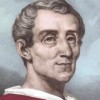






















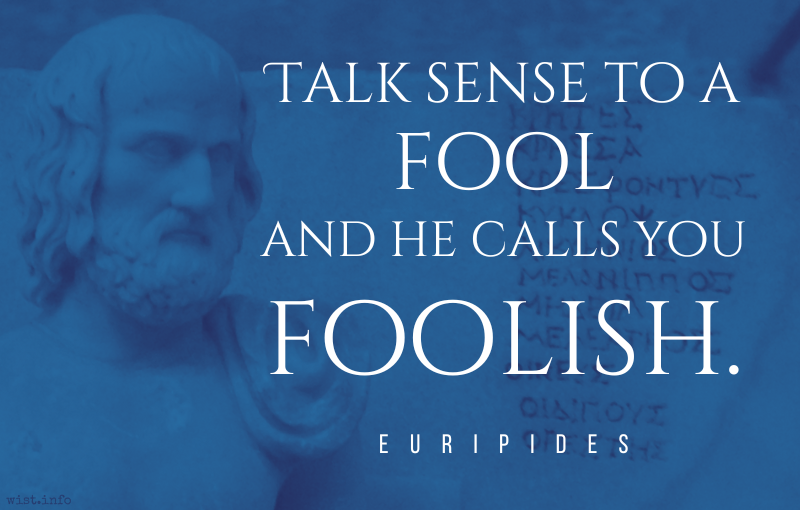











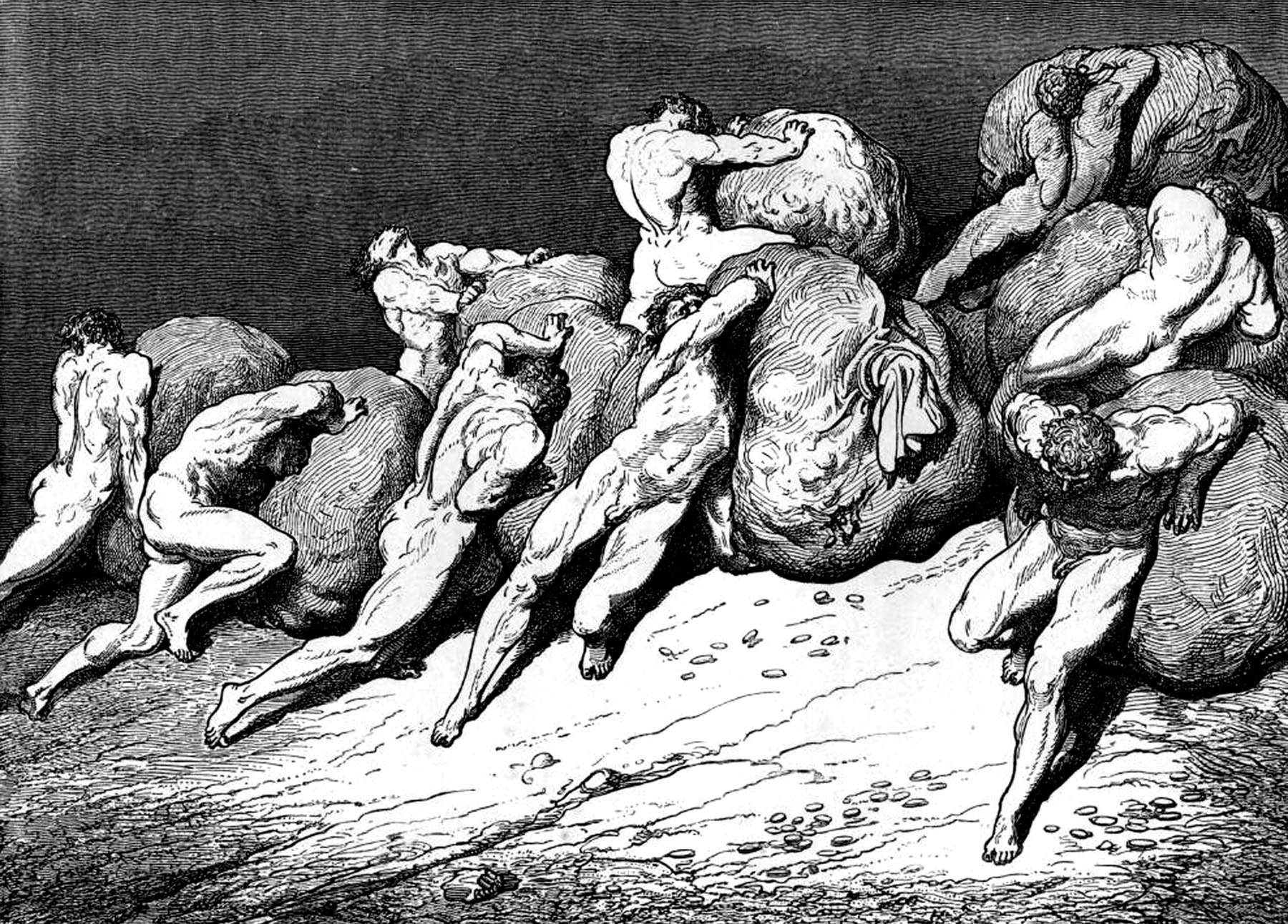





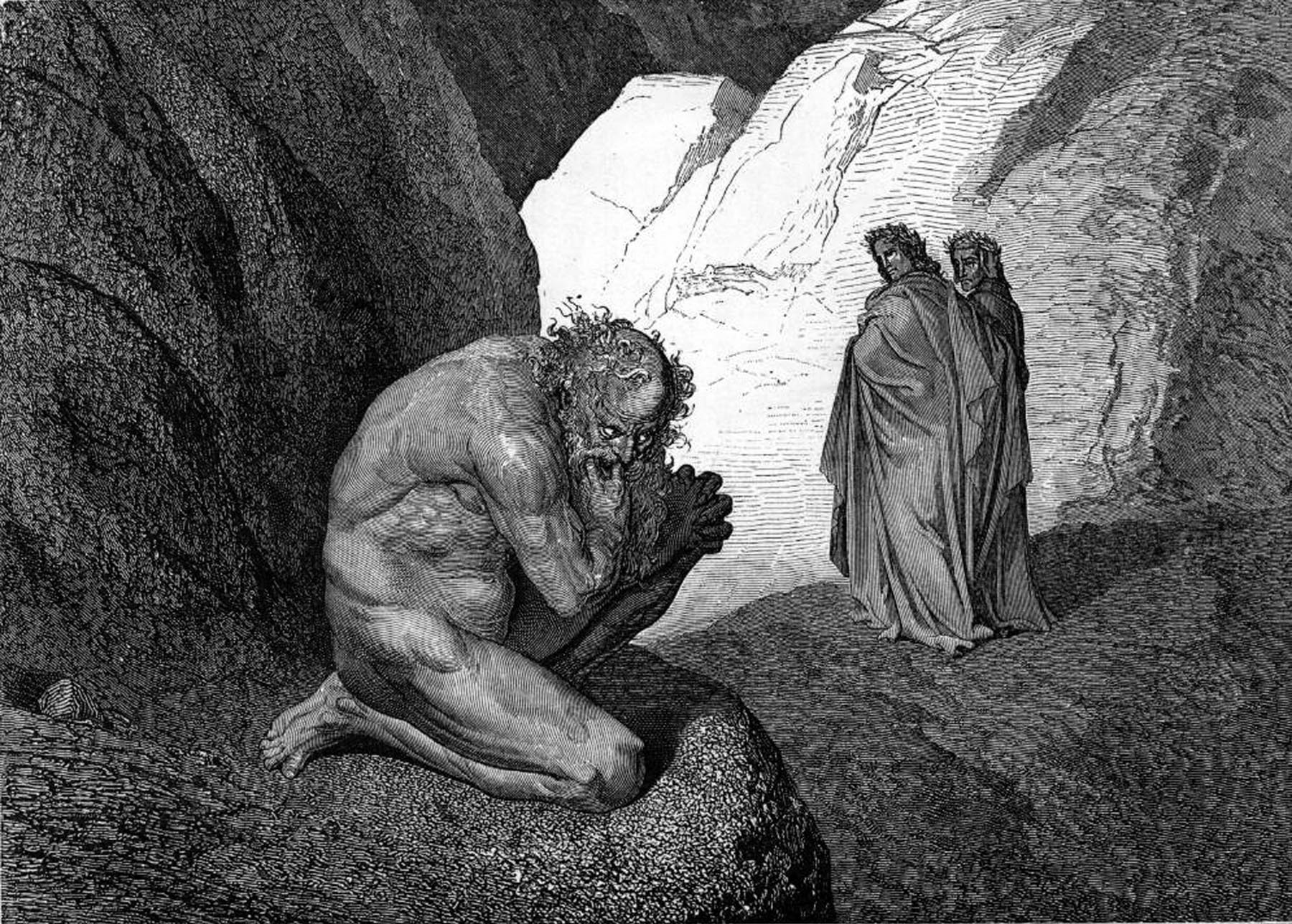


If there be any power