

THE DOCTOR: Oh, marvelous. You’re going to kill me. What a finely-tuned response to the situation.
Christopher H. Bidmead (1941-2025) English screenwriter, script editor, journalist
Doctor Who (1963), 21×03 “Frontios,” Part 2 (1984-01-27)
(Source)
Quotations about:
folly
Note not all quotations have been tagged, so Search may find additional quotes on this topic.

“Wait a moment,” said Winnie-the-Pooh, holding up his paw.
He sat down and thought, in the most thoughtful way he could think. Then he fitted his paw into one of the Tracks … and then he scratched his nose twice, and stood up.
“Yes,” said Winnie-the-Pooh.
“I see now,” said Winnie-the-Pooh.
“I have been Foolish and Deluded,” said he, “and I am a Bear of No Brain at All.”A. A. Milne (1882-1956) English poet and playwright [Alan Alexander Milne]
Winnie-the-Pooh, ch. 3 “Pooh and Piglet Go Hunting” (1926)
(Source)
Where the environment is stupid or prejudiced or cruel, it is a sign of merit to be out of harmony with it.
Bertrand Russell (1872-1970) English mathematician and philosopher
Conquest of Happiness, Part 1, ch. 9 “Fear of Public Opinion” (1930)
(Source)

There is some wisdom, and some foolishness in every people’s way.
Walter M. Miller Jr. (1923-1996) American writer
“The Soul-Empty Ones,” Astounding Science Fiction (1951-08)
(Source)
A man who does not see this is senseless; he who does see it, and still advocates such a measure, is impious.
[Hoc qui non videt, excors; qui, cum videt, decernit, impius est.]
Marcus Tullius Cicero (106-43 BC) Roman orator, statesman, philosopher
Philippics [Philippicae; Antonian Orations], No. 5, ch. 2 / sec. 5 (5.2/5.5) (43-01-01 BC) [tr. Yonge (1903)]
(Source)
On the suggestion that Mark Antony be bought off by giving him governorship of Transalpine Gaul, and how that would merely give him more troops and power to move against Rome.
(Source (Latin)). Other translations:He that does not see this is a fool; he that sees it, and proposes it, is disloyal.
[tr. Ker (Loeb) (1926)]Anyone who does not see this is a fool; anyone who does and makes the proposal all the same is treacherous.
[tr. Manuwald (2007)]Who does not see this is senseless; who sees and still approves is ungodly.
[E.g.]
ELMIRE: No, amorous men are gullible. Their conceit
So blinds them that they’re never hard to cheat.[Non; on est aisément dupé par ce qu’on aime.
Et l’amour-propre engage à se tromper soi-même.]Molière (1622-1673) French playwright, actor [stage name for Jean-Baptiste Poquelin]
Tartuffe, or the Hypocrite [Le Tartuffe, ou L’Imposteur], Act 4, sc. 3 (1669) [tr. Wilbur (1963)]
(Source)
When her maid is concerned that Tartuffe will see through Elmire's stratagem.
(Source (French)). Alternate translations:No, People are easily Dup'd by what they love, and Self-love helps 'em to deceive themselves.
[tr. Clitandre (1672)]No; people are easily duped by those whom they love, and conceit is apt to deceive itself.
[tr. Van Laun (1876)]No, we are easily duped by those we love, and we deceive ourselves through our own conceit.
[tr. Wall (1879)]No, people are easily duped by what they like; and self-love helps them to deceive themselves.
[tr. Mathew (1890), 4.2]No; people are easily duped by those whom they love. Self-love leads the way to self-deceit.
[tr. Waller (1903)]Oh no! A lover's never hard to cheat,
And self-conceit leads straight to self-deceit.
[tr. Page (1909)]No, one is easily fooled by one's belovèd,
And self-conceit will end in self-deception.
[tr. Bishop (1957)]Oh, no! A lover is not hard to cheat,
And self-deception springs from self-conceit.
[tr. Frame (1967)]He loves me, and he's also vain,
That double drug will dull his brain.
[tr. Bolt (2002)]No, it's easy to be fooled by what we want; our vanity is always ready to betray us.
[tr. Steiner (2008)]We long to be fooled by the one we love,
And pride lends a hand in its own downfall.
[tr. Campbell (2013)]
Now listen while I show you, how the rest
Who call you madman, are themselves possessed.
Just as in woods, when travellers step aside
From the true path for want of some good guide,
This to the right, that to the left hand strays,
And all are wrong, but wrong in different ways,
So, though you’re mad, yet he who banters you
Is not more wise, but wears his pigtail too.[Nunc accipe, quare
desipiant omnes aeque ac tu, qui tibi nomen
insano posuere. Velut silvis, ubi passim
palantis error certo de tramite pellit,
ille sinistrorsum, hic dextrorsum abit, unus utrique
error, sed variis inludit partibus: hoc te
crede modo insanum, nihilo ut sapientior ille
qui te deridet caudam trahat.]Horace (65–8 BC) Roman poet, satirist, soldier, politician [Quintus Horatius Flaccus]
Satires [Saturae, Sermones], Book 2, # 3 “Si raro scribes,” l. 46ff (2.3.46-53) (30 BC) [tr. Conington (1874)]
(Source)
Horace may be quoting or paraphrasing Stertinus here.
The odd "tail" metaphor was a proverbial expression for unknowingly being a fool. Apparently Roman children would tie sheep or other animal tails to the backs of innocent passers-by, then laugh at them.
(Source (Latin)). Alternate translations:Now leane thyne eares, and listen well, perceave howe all be mad,
Yea those who earste to make the woorse, such mockeries have had.
Admit there be through darkesum wood a speedie footepathe way,
On ryghte syde sum, on lefte syde sum, and all do go a stray
Through wilsumnes of wildernes: the error is all one,
Though through miswandringe diverslye, they diverslye have gone.
Thou maist be mad, frend Damasipp, thou maiste be muche unwyse,
Thy mockers staringe mad also, though in an other guyse.
[tr. Drant (1567)]Nay give me leave, and I'le demonstrate how
He who calls thee fool's as much fool as thou.
Like Trav'lers passing through a Wood, when they
Range up and down missing their ready way,
This to the right that to the left hand strayes,
One error fools them both, though several wayes.
And tho thou think'st thou'rt mad, yet even he
Is not a jot less mad that laughs at thee,
Both to Fool-coats have like propriety.
[tr. "A. B."; ed. Brome (1666)]Some call Thee mad, but those that call Thee so,
Observe, I'll prove them quite as mad as You:
As Men that lose their ways in Woods, divide;
Some go on this, and some on t'other side,
The Error is the same, all miss the Road,
Altho in different Quarters of the Wood.
Thus as they call thee, think that thou art mad;
But those that call thee so are quite as bad.
[tr. Creech (1684)]And they who call you fool, with equal claim
May plead an ample title to the name.
When in a wood we leave the certain way
One error fools us, though we various stray:
Some to the left, some turn to t'other side:
So he, who dares thy madness to deride,
Though you may frankly own yourself a fool,
Behind him trails his mark of ridicule.
[tr. Francis (1747)]Hear now why those who proudly call you mad,
In reason's view are every whit as bad.
As, when bewilder'd in a wood by night
This trav'ller takes the left and that the right,
Each strays, though in a different path he strays,
Mock'd by the self-same error various ways, --
So is it here; and he that laughs at you
May wear the cap; for he is crack-brain'd too.
[tr. Howes (1845)]Now learn, why all those, who have fixed the name of madman upon you, are as senseless as yourself. As in the woods, where a mistake makes people wander about from the proper path; one goes out of the way to the right, another to the left; there is the same blunder on both sides, only the illusion is in different directions: in this manner imagine yourself mad; so that he, who derides you, hangs his tail not one jot wiser than yourself.
[tr. Smart/Buckley (1853)]Now listen to the reason why all those who've called you "madman" are as mad as you. As in the woods, when some mistake drives from the beaten track men vaguely wandering, one goes off to the right, another to the left, -- they make the same mistake, but in quite opposite directions; -- so think that you're mad, and that the man who mocks you is no saner than yourself, and a fit laughingstock for boys.
[tr. Millington (1870)]Now let me show you why all who have dubbed you "madman" are quite as crazy as you. When men miss the path in a forest and go astray in every direction, all miss it equally, though one is led wrong on the right side of the road and one on the left. So for yourself, believe that if you are mad it is only in such a sense that the man who is laughing at you drags his tail also.
[tr. Wickham (1903)]Now learn why all, who have given you the name of madman, are quite as crazy as yourself. Just as in a forest, where some error drives men to wander to and fro from the proper path, and this one goes off to the left and that one to the right: both are under the same error, but are led astray in different ways: so believe yourself to be insane only so far that he who laughs at you drags a tail behind him, no whit the wiser man.
[tr. Fairclough (Loeb) (1926)]Now learn
Why it is that all who have fastened the name on you
Are quite as crazy as you. Just as men in a forest,
Whom confusion forces to wander away from the right path,
Will veer off, one to the left, the other to the right,
Misled by the same mistake but misled in different
Directions, so you may consider yourself deluded
To the exact degree of the man who makes fun of you,
Who is dragging a tail behind himself all unawares.
[tr. Palmer Bovie (1959)]Now, hear why you're no madder
than all those others, who bestowed on you the name
‘insane.’ Think of travelers in a forest who get lost
and leave the proper path: one might wander over
to the left, the other to the right. They're deceived
in different ways, but it's the same mistake. Similarly,
you think you're insane, but who is any wiser
among those tail-draggers who make fun of you?
[tr. Fuchs (1977)]Listen: here is why everyone
Who calls you mad is just as senseless himself.
It's like a forest, where people wander this way and that,
Hunting the path and never finding it, not right, or left,
Or center, all confused, all equally lost, but all
Lost in different directions. Believe yourself mad,
If you like, but as sane as the man who laughs at you
And never sees the tail tied behind him.
[tr. Raffel (1983)]Now hear me: why all those who have
called you crazy are brainless like yourself.
As in the woods folk wander off
the true path in error and scatter
here and there, this one to the left,
this one to the right, both of them in
different directions; in the same way
you may consider yourself insane.
Yet you know full well that he who
derides you is no wiser than you
but drags a tail behind him.
[tr. Alexander (1999)]Now, here’s how
those who call you mad are mad. In a wood,
error diverts men from the strict path, some
left, some right. They’re all wrong, each in his
way. Who says he’s right is of course wrong —
is he the one you’ll let pronounce you wrong?
[tr. Matthews (2002)]Now this is the reason
why those who call you mad are every bit as crazy
as you are: You know how people lose their way in the woods --
one goes wandering off to the left, another to the right;
both are equally wrong, though each has strayed in a different
direction. So you may rest assured that if you're to be counted
mad the fellow who laughs at you is no saner himself.
He too has straw in his hair.
[tr. Rudd (2005 ed.)]Now learn why all those who call
You insane, are every bit as foolish themselves.
It’s like a wood, where error leads men to wander
Here and there, from the true path, one off to the left,
Another off to the right, the same error both times,
But leading them in different directions: so know
You’re only as mad as the man no wiser than you
Who laughs at you, but still has a tail pinned behind.
[tr. Kline (2015)]
If thou trustest every one, thou wilt be known to be a Fool; if thou trustest none, thou wilt be suspected to be a Knave.
Thomas Fuller (1654-1734) English physician, preacher, aphorist, writer
Introductio ad Prudentiam, Vol. 2, # 1989 (1727)
(Source)
Thy greatest Wisdom consists in being acquainted with thy own Follies.
Thomas Fuller (1654-1734) English physician, preacher, aphorist, writer
Introductio ad Prudentiam, Vol. 2, # 1882 (1727)
(Source)
“He is mad as a hare, poor fellow,
And should be in chains” you say,
I haven’t a doubt of your statement,
But who isn’t mad, I pray?
Why, the world is a great asylum,
And the people are all insane,
Gone daft with pleasure or folly,
Or crazed with passion and pain.Ella Wheeler Wilcox (1850-1919) American author, poet, temperance advocate, spiritualist
Poem (1882), “All Mad,” st. 1, Maurine and Other Poems (1882 ed.)
(Source)
Also collected in Poems of Cheer (1910) and Poems of Life (1919).

There are more fools than wise men, and even in the wise there is more folly than wisdom.
[Il y a plus de fous que de sages, et dans le sage même, il y a plus de folie que de sagesse.]
Nicolas Chamfort (1741-1794) French writer, epigrammist (b. Nicolas-Sébastien Roch)
Products of Perfected Civilization [Produits de la Civilisation Perfectionée], Part 1 “Maxims and Thoughts [Maximes et Pensées],” ch. 2, ¶ 149 (1795) [tr. Merwin (1969)]
(Source)
(Source (French)). Alternate translations:There are more fools than wise men, and even in the wise man himself there is more folly than wisdom.
[tr. Hutchinson (1902)]There are more fools than wise men, and even in a wise man there is more folly than wisdom.
[tr. Mathers (1926)]There are more fools than wise people, and in wise people themselves there is more folly than wisdom.
[tr. Siniscalchi (1994)]

JESSICA: But love is blind, and lovers cannot see
The pretty follies that themselves commit.William Shakespeare (1564-1616) English dramatist and poet
Merchant of Venice, Act 2, sc. 6, l. 37ff (2.6.37-38) (1597)
(Source)
One of several times Shakespeare used the phrase, "Love is blind." He popularized it, but it was first used by Chaucer around 1404 in "The Merchant's Tale" ("For loue is blynd alday ...").

WOLSEY: You opposed me in the Council this morning, Thomas.
MORE: Yes, Your Grace.
WOLSEY: You were the only one.
MORE: Yes, Your Grace.
WOLSEY: You’re a fool.
MORE: Thank God there is only one fool on the Council.
Natur seldum makes a phool, she simply furnishes the raw materials, and lets the fellow finish the job to suit himself.
[Nature seldom makes a fool, she simply furnishes the raw materials and lets the fellow finish the job to suit himself.]

Of lingering and gain-seeking make an end;
Think, while there’s time, how soon Death’s pyre may blaze;
And some brief folly mix with prudent ways:
At the fit hour ’tis sweet to unbend.[Verum pone moras et studium lucri
nigrorumque memor, dum licet, ignium
misce stultitiam consiliis brevem:
dulce est desipere in loco.]Horace (65–8 BC) Roman poet, satirist, soldier, politician [Quintus Horatius Flaccus]
Odes [Carmina], Book 4, # 12, l. 25ff (4.12.25-28) (13 BC) [tr. Marshall (1908)]
(Source)
Usually subtitled by translators "To Virgil" or "Invitation to Virgil." There has been great controversy amongst scholars whether the Virgil mentioned in the ode refers to the famous poet who composed the Aeneid, among other works. The two knew each other, but that Virgil died in 19 BC. Some suggest this was an older poem of Horace's, finished and inserted into this later, final volume by him.
(Source (Latin)). Alternate translations:Think Life is short, forget thy fears,
And eager thoughts of Gain,
Short Folly mix with graver Cares,
'Tis decent sometimes to be vain.
[tr. Creech (1684)]Come, quit those covetous thoughts, those knitted brows,
Think on the last black embers, while you may,
And be for once unwise. When time allows,
'Tis sweet the fool to play.
[tr. Conington (1872)]But lay aside delay, and the desire of gain; and, mindful of the gloomy [funeral] flames, intermix, while you may, your grave studies with a little light gayety: it is delightful to give a loose on a proper occasion.
[tr. Smart/Buckley (1853)]To the winds with base lucre and pale melancholy ! --
In the flames of the pyre these, alas! will be vain,
Mix your sage ruminations with glimpses of folly, --
'T is delightful at times to be somewhat insane!
[tr. Martin (1864)]But put aside delays and care of gain,
Warned, while yet time, by the dark death-fires; mix
With thought brief thoughtlessness; to be unwise
In time and place is sweet.
[tr. Bulwer-Lytton (1870)]Then lay aside delays, pursuit of gain, and, mindful fo the funeral pyre, intermix, while it is permitted, a temporary foolishness with thy worldly plans. There is pleasure in indulging in folly on special occasions.
[tr. Elgood (1893)]Quick! ere the lurid death-fire's day,
Drive thou the lust of gain away!
Thy wisdom with unwisdom grace:
'Tis well to rave, in time and place.
[tr. Gladstone (1894)]Come! a truce to delay, and the desire of gain!
And, all mindful, in time, of the dark fun'ral fires.
Mingle with your grave plans some little folly's fling,
Sweet is folly at fitting times.
[tr. Phelps (1897)]Mingle a little folly with your wisdom; a little nonsense now and then is pleasant.
[Source (1908)]But put aside delay and thirst for gain, and, mindful of Death’s dark fires, mingle, while thou mayst, brief folly with thy wisdom. ’Tis sweet at the fitting time to cast serious thoughts aside.
[tr. Bennett (Loeb) (1912), "The Delights of Spring"]Quick, quit your usury. Time is fleet.
Think, while you may, of funeral flames,
And blend brief folly with your aims;
Folly, in folly's hour, is sweet.
[tr. Mills (1924)]Then come at once and pause for breath
In chasing wealth. Remembering death
And death's dark fires, mix, while you may,
Method and madness, work and play.
Folly is sweet, well-timed.
[tr. Michie (1963)]Don’t linger, don’t stop to be sensible,
Let a little folly mix with your wisdom,
Be aware of death’s dark fires:
Frivolity is sweet, in season.
[tr. Raffel (1983)]And, heedful of death's black fire, consent for a while
To mix a little pleasure in with your prudence.
It's right to be foolish when the time is right.
[tr. Ferry (1997)]Be mindful, while you may,
of black-smoked funeral pyres
and blend a bit of folly with your wisdom.
O it is sweet at the proper time
to play the fool!
[tr. Alexander (1999)]But abolish delay, and desire for profit,
and, remembering death’s sombre flames, while you can,
mix a little brief foolishness with your wisdom:
it’s sweet sometimes to play the fool.
[tr. Kline (2015), "Spring"]
Roald Dahl had Willy Wonka use the thematically similar line "A little nonsense now and then / Is relished by the wisest men" in both his screenplay for the movie Willy Wonka and the Chocolate Factory (1971) and in the book Charlie and the Great Glass Elevator. For more information in this variant and its possible origins, see Quote Origin: A Little Nonsense Now and Then is Relished by the Wisest Men – Quote Investigator®.
I post no possible objection to a man being a fool, if he so desires, but I do protest against his asking me to wear cap and bells in his company.
Minna Antrim (1861-1950) American epigrammatist, writer
Naked Truth and Veiled Allusions (1902)
(Source)
Yung phools are comparatiff harmless, it iz the old phools that make most ov the trubble in this world.
[Young fools are comparatively harmless; it is the old fools that make most of the trouble in this world.]
Josh Billings (1818-1885) American humorist, aphorist [pseud. of Henry Wheeler Shaw]
Josh Billings’ Trump Kards, ch. 6 “Pets” (1874)
(Source)
Stupidity would not be totally stupid if it did not go in terror of intelligence. Vice would not be entirely vicious if it did not hate virtue.
[La sottise ne serait pas tout-à-fait la sottise, si elle ne craignait pas l’esprit. Le vice ne serait pas tout-à-fait le vice, s’il ne haïssait pas la vertu.]
Nicolas Chamfort (1741-1794) French writer, epigrammist (b. Nicolas-Sébastien Roch)
Products of Perfected Civilization [Produits de la Civilisation Perfectionée], Part 1 “Maxims and Thoughts [Maximes et Pensées],” ch. 2, ¶ 139 (1795) [tr. Merwin (1969)]
(Source)
(Source (French)). Alternate translations:Stupidity would not be absolute stupidity did it not fear intelligence. Vice would not be absolute vice did it not hate virtue.
[tr. Hutchinson (1902), "The Cynic's Breviary"]Folly would not be altogether folly if it were not afraid of wit. Vice; would not be altogether vice if it did not hate virtue.
[tr. Mathers (1926)]
There are well-dressed foolish ideas just as there are well-dressed fools.
[Il y a des sottises bien habillées, comme il y a des sots très bien vêtus.]Nicolas Chamfort (1741-1794) French writer, epigrammist (b. Nicolas-Sébastien Roch)
Products of Perfected Civilization [Produits de la Civilisation Perfectionée], Part 1 “Maxims and Thoughts [Maximes et Pensées],” ch. 1, ¶ 40 (1795) [tr. Hutchinson (1902), “The Cynic’s Breviary”]
(Source)
(Source (French)). Alternate translations:There is such a thing as well-clothed foolishness, just as there are certain very well-dressed fools.
[tr. Mathers (1926)]There are presentably dressed follies just as there are well dressed fools.
[tr. Merwin (1969)]There are some well-turned inanities, just as there are very well turned-out fools.
[tr. Pearson (1973)]There is nonsense that is well said, just as there are fools who are very well dressed.
[tr. Siniscalchi (1994)]Foolishness can seem very smart and there are some very smartly dressed fools.
[tr. Parmée (2003), ¶34]
Custom is the law of one description of fools, and fashion of another; but the two parties often clash; for precedent is the legislator of the first, and novelty of the last.
Charles Caleb "C. C." Colton (1780-1832) English cleric, writer, aphorist
Lacon: Or, Many Things in Few Words, Vol. 1, § 547 (1820)
(Source)
Folly growes without watering.
George Herbert (1593-1633) Welsh priest, orator, poet.
Jacula Prudentum, or Outlandish Proverbs, Sentences, &c. (compiler), # 581 (1640 ed.)
(Source)
A foole may throw a stone into a well, which a hundred wise men cannot pull out.
George Herbert (1593-1633) Welsh priest, orator, poet.
Jacula Prudentum, or Outlandish Proverbs, Sentences, &c. (compiler), # 527 (1640 ed.)
(Source)
If thou hast not Sense enough to speak, have Wit enough to hold thy tongue.
How shallow, puny, and imperfect are efforts to sound the depths in the nature of things. In philosophical discussion, the merest hint of dogmatic certainty as to finality of statement is an exhibition of folly.
Alfred North Whitehead (1861-1947) English mathematician and philosopher
Process and Reality: An Essay in Cosmology, Preface (1929)
(Source)
The book is a collection of his Gifford Lectures, University of Edinburgh (1927-1928).
EXPERIENCE, n. The wisdom that enables us to recognize as an undesirable old acquaintance the folly that we have already embraced.
Ambrose Bierce (1842-1914?) American writer and journalist
“Experience,” The Cynic’s Word Book (1906)
(Source)
Included in The Devil's Dictionary (1911). Originally published in the "Devil's Dictionary" column in the San Francisco Wasp (1884-06-07).

It seems to be a wise provision of nature that the follies of men should be short-lived; but books interfere and immortalize them. A fool, not content with having bored all those who have lived with him, insists on tormenting generations to come; he would have his folly triumph over oblivion, which should have been as welcome to him as death; he wishes posterity to be informed of his existence, and he would have it remember for ever that he was fool.
[La nature sembloit avoir sagement pourvu à ce que les sottises des hommes fussent passagères, et les livres les immortalisent. Un sot devroit être content d’avoir ennuyé tous ceux qui ont vécu avec lui : il veut encore tourmenter les races futures, il veut que sa sottise triomphe de l’oubli, dont il auroit pu jouir comme du tombeau; il veut que la postérité soit informée qu’il a vécu, et qu’elle sache à jamais qu’il a été un sot.]
Charles-Lewis de Secondat, Baron de Montesquieu (1689-1755) French political philosopher
Persian Letters [Lettres Persanes], Letter 66, Rica to *** (1721) [tr. Davidson (1891)]
(Source)
Commonly paraphrased as "An author is a fool who, not content with having bored those who have lived with him, insists on boring future generations."
(Source (French)). Alternate translations:Nature seems wisely to have provided that the Follies of Men shou'd pass away, but Books perpetuate them. A Fool ought to be satisfy'd with having teaz'd those who liv'd at the same Time with him: but he is for going further, and is resolved to plague the Generations to come he is resolv'd to make his Impertinence triumph over Oblivion, which he might have enjoy'd as well as his Grave: he will have Posterity know that such a one liv'd, and all future Ages be inform'd that he was a Fool.
[tr. Ozell (1736 ed.), Letter 64]Nature seems to have provided, that the follies of men should be transient, but they by writing books render them permanent. A fool ought to content himself with having wearied those who lived with him: but he is for tormenting future generations; he is desirous that his folly should triumph over oblivion, which he ought to have enjoyed as well as his grave; he is desirous that posterity should be informed that he lived, and that it should be known for ever that he was a fool.
[tr. Floyd (1762)]Nature has wisely provided that the follies of men should be ephemeral; but, unhappily, these very follies are immortalised in books. A fool ought to have been satisfied with boring all those who have lived with him; yet he insists on torturing future races; he is determined that his folly shall triumph over the oblivion in which he ought to have been able to find as much enjoyment as he does in his last slumber; he wishes posterity to know that he has lived, and remember forever that he was a fool.
[tr. Betts (1897)]While nature seems wisely to have provided that the stupidities of men should be transient, books immortalize them. A fool should be content with boring everyone who has lived with him, but he further undertakes to torment future generations. He wants his folly to triumph over the oblivion which he should welcome like the sleep of the tomb; he wants to inform posterity that he has lived, and to have it forever remembered that he was a fool.
[tr. Healy (1964)]Nature in her wisdom seems to have arranged for man's follies to be short-lived, and books render them immortal. A fool ought to be satisfied with having bored all his own contemporaries, but he also seeks to torment those as yet unborn; he wants his stupidity to triumph over oblivion, which he might, like the tomb, have enjoyed; but no, he wants posterity to be notified that he has lived, and he wants her to know, for all eternity, that he was an idiot.
[tr. Mauldon (2008), Letter 64]Nature has so arranged things that the absurdities men say are passing things, but books give them immortal life. A fool ought to have been content to have annoyed those who live near him, but instead he wants the chance to torment future generations. He wants his absurdities to triumph over the complete oblivion that he really ought to have welcomed and enjoyed like a tomb. He wants posterity to be informed that he lived, and he wants it known for all time that he was a fool.
[tr. MacKenzie (2014), Letter 64]
No solitary miscreant, scarcely any solitary maniac, would venture on such actions and imaginations, as large communities of sane men have, in such circumstances, entertained as sound wisdom.
Thomas Carlyle (1795-1881) Scottish essayist and historian
Essay (1829-06), “Signs of the Times,” Edinburgh Review No. 98, Art. 7
(Source)
As favour and riches forsake a man, we discover in him the foolishness they concealed, and which no one perceived before.
[À mesure que la faveur et les grands biens se retirent d’un homme, ils laissent voir en lui le ridicule qu’ils couvraient, et qui y était sans que personne s’en aperçût.]Jean de La Bruyère (1645-1696) French essayist, moralist
The Characters [Les Caractères], ch. 6 “Of Gifts of Fortune [Des Biens de Fortune],” § 4 (6.4) (1688) [tr. Van Laun (1885)]
(Source)
(Source (French)). Alternate translations:When Riches and Favour forsake a Man, we see presently he was a Fool, but no body could find it out in his Prosperity.
[Bullord ed. (1696)]In proportion as Riches and Favour forsake a Man, we discover he was a Fool, which no body cou'd find out in his Prosperity.
[Curll ed. (1713)]As Riches and Favour forsake a Man, we discover him to be a Fool, but no body could find it out in his Prosperity.
[Browne ed. (1752)]As a man falls out of favour and his wealth declines, we discover for the first time the ridiculous aspects of his character, which were always there but which wealth and favour had concealed.
[tr. Stewart (1970)]

CAMILLO:My gracious lord,
I may be negligent, foolish, and fearful.
In every one of these no man is free,
But that his negligence, his folly, fear,
Among the infinite doings of the world,
Sometime puts forth. In your affairs, my lord,
If ever I were willful-negligent,
It was my folly; if industriously
I played the fool, it was my negligence,
Not weighing well the end; if ever fearful
To do a thing where I the issue doubted,
Whereof the execution did cry out
Against the non-performance, ’twas a fear
Which oft infects the wisest. These, my lord,
Are such allowed infirmities that honesty
Is never free of.William Shakespeare (1564-1616) English dramatist and poet
Winter’s Tale, Act 1, sc. 2, l. 310ff (1.2.310-325) (1611)
(Source)
A fool bolts pleasure, then complains of moral indigestion.
Minna Antrim (1861-1950) American epigrammatist, writer
Naked Truth and Veiled Allusions (1902)
(Source)
People say that age creeps up on them quicker than they expected. First of all, who forced them to think that way? Does age creep up on adults more quickly than maturity creeps up on children? And again, would their age lie less heavily upon them if they were in their eight hundredth year rather than their eightieth? It doesn’t matter how much time has passed; a foolish old man can never be consoled or comforted.
[Obrepere aiunt eam citius, quam putassent. Primum quis coegit eos falsum putare? Qui enim citius adulescentiae senectus quam pueritiae adulescentia obrepit? Deinde qui minus gravis esset eis senectus, si octingentesimum annum agerent quam si octogesimum? Praeterita enim aetas quamvis longa cum effluxisset, nulla consolatio permulcere posset stultam senectutem.]Marcus Tullius Cicero (106-43 BC) Roman orator, statesman, philosopher
De Senectute [Cato Maior; On Old Age], ch. 2 / sec. 4 (2.4) [Cato] (44 BC) [tr. Cobbold (2012)]
(Source)
(Source (Latin)). Alternate translations:All the folis seyn that olde age comyth in them sonner thenne they wend, but I demaunde a question of such men what maner foly constreyned them forto trowe or suppose the thyng the which is fals, for they can sey no reason how olde age entrith sonner in the man aftir adolescence no more than doeth adolescence aftir puerice callid chidlhode which is the seconde age, how be it that it is so ordeyned by nature that that one of the ages entrith aftir the ende of the othir. More ovir I demaunde such foolys how olde age shuld be lesse chargyng & lesse grevous to men if they myght lyve viii C yere, for how be it that the age past had be longer yit it may neithir comforte ne allege ne satisfye the foole olde man.
[tr. Worcester/Worcester/Scrope (1481)]They say [old age] creepeth and stealeth upon them faster and sooner than they thought it would. First, who causeth them to imagine and think such a false and peevish untruth? for why should they think that after their youth and adolescency, old age creepeth faster upon them, rather than their adolescency and youth doth after childhood? Seeing therefore they do not repine nor complain any whit after that they have been children to grow up to be tall striplings and lusty young men, why should they be aggrieved or think themselves discontented, after they have been striplings and young men, to be old and aged? Again, if they might reach ot the age of eight hundreth years, what greater pleasure and commodity is therein, or wherein should they think it to be less troublesome and tedious than it is when they be of the age of four-score years? for the age that is once passed and gone, be it never so long, can with no manner of pleasure or delectation comfort, recreate nor mitigate the old age that is in such fond persons.
[tr. Newton (1569)]They say that [age] creepeth upon them ere they are aware. First let me aske, who bade them over reckon themselves? for how much sooner doth age creep on youth, then youth on child-hood? then, how much more grievous would their age be to them, if they should as well live to the eight hundred year, as to the eighty year? for the former age (though long,) when it is past, can asswage a foolish old age, with no comfort.
[tr. Austin (1648)][They are] always complaining that [Old Age] stole upon them unawares. But pray whose fault is it, that they were so surprized by a wrong computation? Why may they not with equal reason exclaim, that their Youth came too quick upon their Childhood, as that Old Age stole upon their Youth? Or what reason have they to expect Old Age to be less burthensome at eight hundred, than at eighty? For the time they have passed, of what length soever it be, will administer no comfort to Old Age, if foolishly squandered away.
[tr. Hemming (1716)]They charge Old Age with stealing on them faster than it was expected. Who constrain'd them to think wrongfully? Does not Age gain sooner on Youth, than Youth does on Childhood? Besides, How much easier would Old Age fit upon them, where they in their eight-hundredth Year, than in their eightieth? Because the Effluction of Time thro' several Æras,, can give no Comfort to us in these Years of Dotage.
[tr. J. D. (1744)]But, oh! they say, [Old Age] has crept on us too fast, and overtaken us sooner than we thought or expected. In the first Place, pray who put them on thinking wrong? How can they say, Old Age creeps faster on Manhood, than Manhood succeeded Youth and Childhood? Or how would it sit lighter at the Age of Eight Hundred Years, if that were the Term of it, than at Eighty? For the longer Duration of the preceding Age, when once 'tis past, abates Nothing from the Effects of Old Age, when come; nor affords any Relief against the Follies and Weakness of such as sink under it.
[tr. Logan (1744)]It is usual with men at this season of life to complain that old age has stolen upon them by surprise, and much sooner than they expected. But if they were deceived by their own false calculations, must not the blame rest wholly on themselves? For, in the first place, old age surely does not gain by swifter and more imperceptible steps on manhood, than manhood advances on youth ; and in the next, in what respect would age have sitten less heavily upon them, had its progress been much slower, and, instead of making his visit at fourscore years, it had not reached them till four hundred? For the years that are elapsed, how numerous soever they may have been, can by no means console a weak and frivolous mind under the usual consequences of long life.
[tr. Melmoth (1773)]They say that [old age] steals upon them sooner than they had supposed. First, who compelled them to make a truthless supposition? For, what? Does old age steal upon adolescence sooner than adolescence upon boyhood? Then, how would old age be less onerous to them, if they were passing their eight-hundredth year than their eightieth? For the past life, however long, when it had run out, could sooth a foolish old age with no consolation.
[Cornish Bros. ed. (1847)]They say that [old age] steals over them more quickly than they had supposed. Now, first of all, who compelled them to form a false estimate of its progress? for how does old age more quickly steal upon youth, than youth upon boyhood? Then, again, how would old age be less burdensome to them, if they were in their 800th year than in their 80th? for the past time, however long, when it had flowed away, would not be able to soothe with any consolation an old age of folly.
[tr. Edmonds (1874)]They say that age creeps upon them faster than they had thought possible. In the first place, who forced them to make this false estimate? In the next place, how could old age be less burdensome to them if it came on their eight-hundredth year than it is in their eightieth? For the time past, however long, when it had elapsed, could furnish no comfort to soothe a foolish old age.
[tr. Peabody (1884)]They say that [old age] is stealing upon them faster than they expected. In the first place, who compelled them to hug an illusion? For in what respect did old age steal upon manhood faster than manhood upon childhood? In the next place, in what way would old age have been less disagreeable to them if they were in their eight-hundredth year than in their eightieth? For their past, however long, when once it was past, would have no consolation for a stupid old age.
[tr. Shuckburgh (1895)]They say that it has come with quicker step
Than they expected: pray, who was it then
Forced them to this illusion?
Did old age Come quicker upon youth, than youth itself
On childhood? Had it seemed a lighter load
If they had reached not to their eightieth year
But e'en to ten times that? For sure past years
Howe'er prolonged could ne'er endow with charm
A stupid old age.
[tr. Allison (1916)]They say that [old age] stole upon them faster than they had expected. In the first place, who has forced them to form a mistaken judgement? For how much more rapidly does old age steal upon youth than youth upon childhood? And again, how much less burdensome would old age be to them if they were in their eight hundredth rather than in their eightieth year? In fact, no lapse of time, however long, once it had slipped away, could solace or soothe a foolish old age.
[tr. Falconer (1923)]Old age, they protest, crept up on them more rapidly than they had expected. But, to begin with, who was to blame for their mistaken forecast? For age does not steal upon adults any faster than adulthood steals upon children. Besides, if they were approaching eight hundred instead of eight, they would complain of the burden just as loudly! If old people are stupid enough, then nothing can console them for the time that has gone by, however great its length.
[tr. Grant (1960, 1971 ed.)]They complain that [old age] crept up on them faster than they had thought it would. To begin with, who compelled them to accept something that is patently untrue? How does old age “creep up on” adulthood any faster than adulthood does on childhood? In the second place, how would old age be less burdensome to these people if it were to come at age eight hundred instead of at age eighty? No matter how many years of life might have gone by, there could be no effective word of comfort for the old, if they were foolish and thoughtless.
[tr. Copley (1967)]They also say old age creeps up on us more quickly than we thought it would. But tell me, just how does old age creep up on middle age any more quickly than middle age creeps up on youth? The length of time before the onset of old age is not the issue here. To those who think it is, a life in their 800th year would be just as bothersome as one in their 80th. No matter how long the past lasts, once it has gone, it is gone, and a past that has no other virtue than its length will offer no consolation for old age.
[tr. Gerberding (2014)]Faster than they thought, they say,
Senility worms its way
Into them but who obliged them to
Hold such an imaginary view?
But how much faster in truth
Does old age encroach on youth
Than youth itself upon infancy?
And again how overbearing would old age be
Were one eight hundred years old rather than eighty?
Indeed no past life could, as a rule,
Soothe and cheer the old age of a fool.
[tr. Bozzi (2015)]They say that old age crept up on them much faster than they expected. But, first of all, who is to blame for such poor judgment? Does old age steal upon youth any faster than youth does on childhood? Would growing old really be less of a burden to them if they were approaching eight hundred rather than eighty? If old people are foolish, nothing can console them for time slipping away, no matter how long they live.
[tr. Freeman (2016)]They say that [old age] came upon them faster than they had expected. Who forced them to this false belief? For, who would claim that old age succeeded adolescence any faster than adolescence succeeded childhood? Would old age seem any less a burden to them if they were living their eight-hundredth year instead of their eightieth? Once an age has passed and flown away, no consolation is able to soften the blow of a feeble-minded senescence.
[tr. Robinson / @sentantiq (2017)]
The world runs on from one folly to another; and the man who, solely from regard to the opinion of others, and without any wish or necessity of his own, toils after gold, honour, or any other phantom, is no better than a fool.
[Alles in der Welt läuft doch auf eine Lumperei hinaus, und ein Mensch, der um anderer willen, ohne daß es seine eigene Leidenschaft, sein eigenes Bedürfnis ist, sich um Geld oder Ehre oder sonst was abarbeitet, ist immer ein Tor.]
Johann Wolfgang von Goethe (1749-1832) German poet, statesman, scientist
Die Leiden des Jungen Werthers [The Sorrows of Young Werther], Book 1, “July 20” (1774) [tr. Boylen (1854)]
(Source)
(Source (German)). Alternate translation:A man who works at another’s will, not for his own passion or his own need, but for money or honor, is always a fool.
[tr. 1779]
Blind greed! Brainless rage!
In our brief lives they drive us beyond sense
And leave us misery for a heritage
Throughout eternity![Oh cieca cupidigia e ira folle,
che sì ci sproni ne la vita corta,
e ne l’etterna poi sì mal c’immolle!]Dante Alighieri (1265-1321) Italian poet
The Divine Comedy [Divina Commedia], Book 1 “Inferno,” Canto 12, l. 49ff (12.49-51) (1309) [tr. James (2013)]
(Source)
On seeing Phlegethon, the river of boiling blood, in which those who violently injured others (through greed or wrath) are forced to stand for all eternity.
Some versions have this as something Virgil says; most make it an exclamation of Dante's.
(Source (Italian)). Alternate translations:O foolish Rage, O blind desire,
That spurs you on, in the short life above,
To such dire Acts as to eternity
Will keep you in this wretched bath below!
[tr. Rogers (1782), l. 45ff]O blind lust!
O foolish wrath! who so dost goad us on
In the brief life, and in the eternal then
Thus miserably o’erwhelm us.
[tr. Cary (1814)]Oh blinded lust! oh anger void of sense!
To spur us o'er the shorter life so bold,
So fell to steep us in the life immense!
[tr. Dayman (1843)]Oh blind cupidity [both wicked and foolish],
which so incites us in the short life, and then,
in the eternal, steeps us so bitterly!
[tr. Carlyle (1849)]O blind cupidity! O foolish wrath!
Thorough this short life, that spurs them to the sleep,
Eternally in tide like this to steep.
[tr. Bannerman (1850), from Virgil]Oh, blinded greediness! oh, foolish rage!
Which spur us so in the short world of life,
And then in death so drown us in despair!
[tr. Johnston (1867)]O blind cupidity, O wrath insane,
That spurs us onward so in our short life,
And in the eternal then so badly steeps us!
[tr. Longfellow (1867)]O blind covetousness! O foolish wrath! that dost so spur us in our short life, and afterward in the life eternal dost in such evil wise steep us!
[tr. Butler (1885)]O blind cupidity, O foolish ire,
Which spurs us on so in our life's short day,
And soaks us till Eternity expire!
[tr. Minchin (1885)]Oh blind cupidity, both guilty and mad, that so spurs us in the brief life, and then, in the eternal, steeps us so ill!
[tr. Norton (1892)]O sightless greed! O foolish wrath! that dost in our short life, so goad us; and after, in the life that hath no end, dost sink us in such evil plight.
[tr. Sullivan (1893), from Virgil]Oh, blind cupidity! Oh, senseless anger,
Which in the brief life spurs us on so hotly.
And in the eternal then so sadly dips us !
[tr. Griffith (1908)]O blind covetousness and foolish anger, which in the brief life so goad us on and then, in the eternal, steep us in such misery!
[tr. Sinclair (1939)]O blind greed and mad anger, all astray
That in the short life goad us onward so,
And in the eternal with such plungings pay!
[tr. Binyon (1943)]O blind, O rash and wicked lust of spoil,
That drives our short life with so keen a goad
And steeps our life eternal in such broil!
[tr. Sayers (1949)]Oh blind!
Oh ignorant, self-seeking cupidity
which spurs us so in the short mortal life
and steeps us so through all eternity!
[tr. Ciardi (1954)]O blind cupidity and mad rage, which in the brief life so goad us on, and then, in the eternal, steep us so bitterly!
[tr. Singleton (1970)]O blind cupidity and insane wrath,
spurring us on through our short life on earth
to steep us then forever in such misery!
[tr. Musa (1971)]O blind cupidity and insane anger,
which goad us on so much in our short life,
then steep us in such grief eternally!
[tr. Mandelbaum (1980)]O blind cupidity and senseless anger,
Which so goads us in our short life here
And, in the eternal life, drenches us miserably!
[tr. Sisson (1981)]O blind desire
Of covetousness, O anger gone insane --
That goad us on through life, which is so brief,
to steep in eternal woe when life is done.
[tr. Pinsky (1994)]Oh blind cupidity and mad rage, that so spur us in this short life, and then in the eternal one cook us so evilly!
[tr. Durling (1996)]O blind desires, evil and foolish, which so goad us in our brief life, and then, in the eternal one, ruin us so bitterly!
[tr. Kline (2002)]O blind cupidity, that brew of bile
and foolishness, which bubbles our brief lives,
before it steeps us in eternal gall!
[tr. Carson (2002)]What blind cupidity, what crazy rage
impels us onwards in our little lives --
then dunks us in this stew to all eternity!
[tr. Kirkpatrick (2006)]O blind covetousness, insensate wrath,
which in this brief life goad us on and then,
in the eternal, steep us in such misery!
[tr. Hollander/Hollander (2007)]O greedy blindness and rage, insane and senseless,
Spurring us on in this, our so short life,
Then immolating us forever and ever!
[tr. Raffel (2010)]

So whatever you want to do, just do it. Don’t worry about making a damn fool of yourself. Making a damn fool of yourself is absolutely essential. And you will have a great time.
Gloria Steinem (b. 1934) American feminist, journalist, activist
Commencement address, Tufts University (1987-05-17)
(Source)

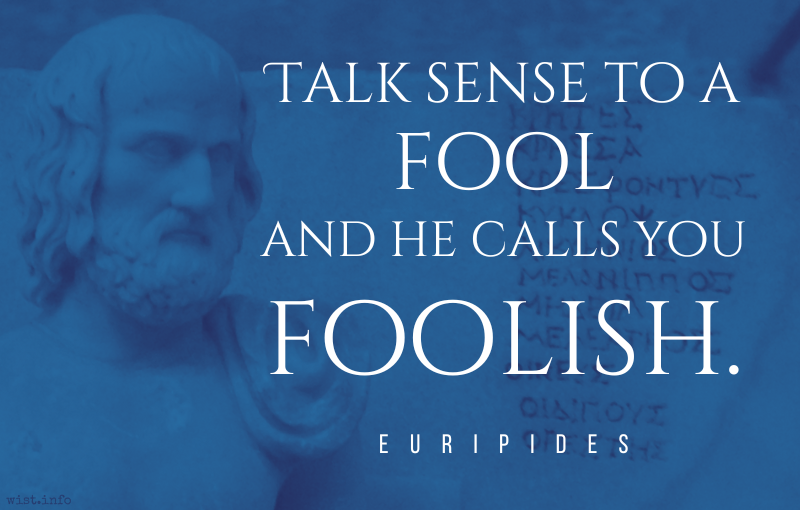
Talk sense to a fool
and he calls you foolish.[δόξει τις ἀμαθεῖ σοφὰ λέγων οὐκ εὖ φρονεῖν.]
Euripides (485?-406? BC) Greek tragic dramatist
Bacchæ [Βάκχαι], l. 480 [Dionysus/Διόνυσος] (405 BC) [tr. Arrowsmith (1960)]
(Source)
Replying to Pentheus' charge that he's being foolishly evasive.
(Source (Greek)). Alternate translations:He must seem devoid
Of reason, who mysterious truths unfolds
To those who lack discretion.
tr. Wodhull (1809)]One will seem to be foolish if he speaks wisely to an ignorant man.
[tr. Buckley (1850)]Who wiseliest speaks, to the fool speaks foolishness.
[tr. Milman (1865)]Boors think a wise man’s words devoid of sense.
[tr. Rogers (1872), l. 457]He were a fool, methinks, who would utter wisdom to a fool.
[tr. Coleridge (1891)]Wise answers seem but folly to a fool.
[tr. Way (1898)]Wise words being brought
To blinded eyes will seem as things of nought.
[tr. Murray (1902)]He who talks wisdom to an ignorant man will seem out of his senses.
[tr. Kirk (1970)]A wise speech sleeps in a foolish ear.
[tr. Vellacott (1973)]Talk truth to a deaf man and he
Begs your pardon.
[tr. Soyinka (1973)]Wise speech seems thoughtless to the ignorant.
[tr. Neuburg (1988)]What makes no sense is talking sense to a fool.
[tr. Cacoyannis (1982)]To the ignorant, wisdom will seem folly.
[tr. Blessington (1993)]To the ignorant man, any speaker of wisdom will seem foolish.
[tr. Esposito (1998)]Speak wisdom to a fool and he'll think you have no sense at all.
[tr. Woodruff (1999)]Wise things to the ignorant will sound like nonsense.
[tr. Gibbons/Segal (2000)]Speak wisdom to a fool and he will think you foolish.
[tr. Kovacs (2002)]Wise words spoken in the ear of a fool turn into nothingness.
[tr. Rao/Wolf (2004)]It is not wise for someone to say anything wise to the ignorant.
[tr. Theodoridis (2005)]Wise words will appear foolishness -- to an idiot.
[tr. Valerie (2005)]Yes, but, then,
a man can seem really ignorant
when speaking to a fool.
[tr. Johnston (2008)]Sense is nonsense to a fool.
[tr. Robertson (2014)]Wisdom always sounds silly to the unwise.
[tr. Pauly (2019)]Only a fool takes a warning for an insult.
[tr. Behr/Foster (2019)]One will seem to be foolish if he speaks wise things [sopha] to a senseless man.
[tr. Buckley/Sens/Nagy (2020)]
A foolish man speaks foolishness.
[Μῶρα γὰρ μῶρος λέγει.]
Euripides (485?-406? BC) Greek tragic dramatist
Bacchæ [Βάκχαι], l. 369 [Tiresias/Τειρεσίας] (405 BC) [tr. Wodhull (1809)]
(Source)
To Cadmus, about his grandson, Pentheus. (Source (Greek)). Alternate translations:Folly issues from the mouth of fools.
[tr. Buckley (1850)]Fools still speak folly.
[tr. Milman (1865)]Fools blurt their folly out.
[tr. Rogers (1872), l. 357]The words of a fool are folly.
[tr. Coleridge (1891)]Fools alone speak folly.
[tr. Way (1898)]Blind words and a blind heart.
[tr. Murray (1902)]The words of fools finish in folly.
[tr. Arrowsmith (1960)]He who speaks folly is himself a fool.
[tr. Kirk (1970)]The things he has said reveal the depth of his folly.
[tr. Vellacott (1973)]It is a fool who folly speaks.
[tr. Neuburg (1988)]You can tell a dangerous fool by his own words.
[tr. Cacoyannis (1982)]For a fool speaks folly.
[tr. Blessington (1993)]For Pentheus is a fool and says foolish things.
[tr. Esposito (1998)]He who speaks foolishness is a fool.
[tr. Woodruff (1999)]The fool speaks foolish things.
[tr. Gibbons/Segal (2000), l. 435]His talk is folly and he's a fool.
[tr. Kovacs (2002)]Often a fool speaks foolishly.
[tr. Valerie (2005)]A man who's mad tends to utter madness.
[tr. Johnston (2008)]His foolish words will end in folly.
[tr. Robertson (2014)]A fool says foolish things.
[tr. @sentantiq (2016)]The speech of the fool is foolish.
[tr. @sentantiq (2018)]The tongue of a fool makes a foolish noise.
[tr. Behr/Foster (2019)]For a foolish man says foolish things.
[tr. Buckley/Sens/Nagy (2020)]
I don’t care how smart you are, if you say something you are liable to say something foolish, and the smarter you are, and the longer you talk, the more foolish things you will say.
Will Rogers (1879-1935) American humorist
Column (1924-08-24), “Weekly Article: About Peggy, the Prince, Candidates, and Coolidge” [No. 89]
(Source)
Cleverness is not wisdom,
nor is thinking thoughts that are not mortal.
Life is short; this being so,
who would pursue great things
and not bear with what is at hand? These
are the ways of madmen and
men of evil counsel, at least
in my judgment.[τὸ σοφὸν δ’ οὐ σοφία,
τό τε μὴ θνατὰ φρονεῖν
βραχὺς αἰών· ἐπὶ τούτωι
δὲ τίς ἂν μεγάλα διώκων
τὰ παρόντ’ οὐχὶ φέροι; μαι
νομένων οἵδε τρόποι καὶ
κακοβούλων παρ’ ἔμοιγε φωτῶν.]Euripides (485?-406? BC) Greek tragic dramatist
Bacchæ [Βάκχαι], l. 395ff (Stasimon 1, Antiphon/Antistrophe 1) [Chorus/Χορός] (405 BC) [tr. Kirk (1970)]
(Source)
The chorus of Bacchantes is playing with the similarly-rooted sophon (cleverness) and sophia (wisdom). (Source (Greek)). Alternate translation:That science which beyond the scope
Of frail humanity aspires.
Haunts not the bosom of the Sage.
Short is life, and they who follow
Ambition's splendid treacherous lure
Taste not the blessings of the present hour:
I deem their conduct frantic and unwise.
[tr. Wodhull (1809)]But cleverness is not wisdom, nor is thinking on things unfit for mortals. Life is short, and on this account the one who pursues great things does not achieve that which is present. In my opinion, these are the ways of mad and ill-advised men.
[tr. Buckley (1850)]Beyond the range of mortal eyes
'Tis not wisdom to be wise.
Life is brief, the present clasp,
Nor after some bright future grasp.
Such were the wisdom, as I ween,
Only of frantic and ill-counseled men.
[tr. Milman (1865)]That wisdom is not wise Which aims beyond man’s power.
Short is our life; to grasp at much is but to lose the present good, --
And this to me seems like the deed of frenzied and of foolish men.
[tr. Rogers (1872), l. 378ff]Ah, not with knowledge is Wisdom bought;
And the spirit that soareth too high for mortals
Shall see few days: whosoever hath caught
At the things too great for a man's attaining,
Even blessings assured shall he lose in the gaining.
Such paths as this, meseemeth, be sought
Of the witless folly that roves distraught.
[tr. Way (1898)]But the world's Wise are not wise,
Claiming more than mortal may.
Life is such a little thing;
Lo, their present is departed,
And the dreams to which they cling
Come not. Mad imagining
Theirs, I ween, and empty-hearted!
[tr. Murray (1902)]Sophistry is not wisdom, and to indulge in thoughts beyond man’s ken is to shorten life; and if a man on such poor terms should aim too high, he may miss the pleasures in his reach. These, to my mind, are the ways of madmen and idiots.
[tr. Coleridge (1907)]And what passes for wisdom is not;
unwise are those who aspire,
who outrange the limits of man.
Briefly, we live. Briefly,
then die. Wherefore, I say,
he who hunts a glory, he who tracks
some boundless, superhuman dream,
may lose his harvest here and now
and garner death. Such men are mad,
their counsels evil.
[tr. Arrowsmith (1960)]To know much is not to be wise.
Pride more than mortal hastens life to its end;
And they who in pride pretend
Beyond man's limit, will lose what lay
Close to their hand and sure.
I count it madness, and know no cure can mend
The evil man and his evil way.
[tr. Vellacott (1973)]Wisdom is not what is wise,
nor to think non-mortal thoughts.
Life is fleeting; can it be, then, that one seeks after what is greater,
not accepting circumstance?
These are the manners of a madman and, to me, of evil counsel'd persons.
[tr. Neuburg (1988)]A knowing mind that ignores its own limits
has a very short span. And the man
who aims too high
never reaps what lies within his grasp.
Such is the folly --
and I know none worse --
of perversely ambitious, fanatical men.
[tr. Cacoyannis (1982)]But shallow wisdom is untrue.
To think beyond this life
Cuts short our life. He who
Pursues the great, forfeits
What lies at hand. Such temperaments
According to my thought, belong
To madmen and the ill-advised.
[tr. Blessington (1993)]So cleverness is not wisdom
nor is it wise to think thoughts unfit for mortals.
Life is short. Given such brevity
who would pursue ambitious ends
And lose what lies at hand?
These, in my opinion at least,
are the ways of madmen and evil counsellors.
[tr. Esposito (1998)]Wisdom? It's not wise
to lift our thoughts too high;
we are human, and our time is short.
A man who aims at greatness
will not live to own what he has now.
That, I believe, is the belief of men
whose judgment is foul.
They are insane.
[tr. Woodruff (1999)]Intellect is not wisdom.
And to think in a manner
not right for mortals means
Life will be short. Who
Would pursue great things
If doing so meant losing what
Is already his?
That is the way, as I see it,
And bad counsel, of madmen.
[tr. Gibbons/Segal (2000), l. 469ff]Cleverness is not wisdom
nor is it wise to think thoughts not mortal.
Our life is short: this being so,
a man who pursues great things
may miss what lies at hand. To live thus
is to be, in my judgment
a madman and a fool.
[tr. Kovacs (2002)]The wise are not wise if they don’t consider a human’s lot.
Life is short.
He who constantly pursues great achievements in this life, won’t have time to enjoy those he already has achieved.
So far as I can tell, these are the doings of madmen and evil minds.
[tr. Theodoridis (2005)]Cleverness is not wisdom;
Thinking heavenly
Thoughts, short life; in that case,
Who, in hunting greater things,
Would not be content with present fortune?
These are ways of men insane, with-
out understanding, so it seems to me.
[tr. Valerie (2005)]But being clever isn't wisdom.
And thinking deeply about things
isn't suitable for mortal men.
Our life is brief -- that's why
the man who chases greatness
fails to grasp what's near at hand.
That's what madmen do,
men who've lost their wits.
That's what I believe.
[tr. Johnston (2008), l. 497ff]Cleverness is not wisdom,
that over-reaching mortals
simply shorten their lives.
Life is brief enough as it is,
so hold it all to hand.
Wild ambition is a kind of madness:
stretch too hard for the summit
and you will fail and fall
and plummet back to land.
[tr. Robertson (2014)]Cleverness is not wisdom,
and neither is reaching beyond thoughts meant for mortals.
Our lives are short.
Spend all your time reaching
and you miss what’s in front of you.
This is the madman’s way.
Or at least the ill-counseled.
But that’s just my opinion.
[tr. Pauly (2019)]Cleverness is not wisdom, and those who'd seem wise as the gods -- their live will be short. Those who seek greatness will not see the snake at their feet. Mad ways set all on the road to disaster.
[tr. Behr/Foster (2019)]It is not wisdom [sophiā] to be overly sophos, and to think things unbefitting mortal men. Life is short, and in it he who pursues great things does not achieve that which is present. In my opinion, these are the ways of mad and ill-counseling men.
[tr. Buckley/Sens/Nagy (2020)]Wisdom is not wit;
Nor is thinking thoughts which belong not to mortals.
Life is brief. And because of this
Whoever seeks out great accomplishments
May not grasp the things at hand.
These are the ways of madmen
And wicked fools, I think.
[tr. @sentantiq (2021)]
One half of the world laughs at the other, and fools are they all.
[La mitad del mundo se está riendo de la otra mitad, con necedad de todos.]
Baltasar Gracián y Morales (1601-1658) Spanish Jesuit priest, writer, philosopher
The Art of Worldly Wisdom [Oráculo Manual y Arte de Prudencia], § 101 (1647) [tr. Jacobs (1892)]
(Source)
(Source (Spanish)). Alternate translations:One part of the world laughs at the other, and both laugh at their common folly.
[Flescher ed. (1685)]Half the world laughs at the other half, even though the lot are fools.
[tr. Fischer (1937)]Half the world is laughing at the other half, and folly rules over all.
[tr. Maurer (1992)]
It is supposed to be true that those who do not know history are doomed to repeat it. I don’t believe knowing can save us. What is constant in history is greed and foolishness and a love of blood, and this is a thing that even God — who knows all that can be known — seems powerless to change.
Do not persist in folly. Some make a duty of failure and having started down the wrong road, think it a badge of character to continue.
[No proseguir la necedad. Hacen algunos empeño del desacierto, y porque comenzaron a errar, les parece que es constancia el proseguir.]
Baltasar Gracián y Morales (1601-1658) Spanish Jesuit priest, writer, philosopher
The Art of Worldly Wisdom [Oráculo Manual y Arte de Prudencia], § 261 (1647) [tr. Fischer (1937)]
(Source)
(Source (Spanish)). Alternate translations:Not to continue a Foppery. Some make an engagement of their mistakes: when they have once begun to fail, they think they are concerned in honour to continue.
[Flesher ed. (1685)]Do not follow up a Folly. Many make an obligation out of a blunder, and because they have entered the wrong path thinks it proves their strength of character to go in it.
[tr. Jacobs (1892)]Don’t persist in folly. Some people commit themselves to their errors. They act mistakenly and consider it constancy to go on that way.
[tr. Maurer (1992)]
Folly is either related to, or identical with, the family of Lies, for in both cases it needs many to support one.
[Excusar una impertinencia con otra mayor es de casta de mentira, o esta lo es de necedad, que para sustentarse una necesita de muchas.]
Baltasar Gracián y Morales (1601-1658) Spanish Jesuit priest, writer, philosopher
The Art of Worldly Wisdom [Oráculo Manual y Arte de Prudencia], § 214 (1647) [tr. Jacobs (1892)]
(Source)
(Source (Spanish)). Alternate translations:Foppishness is of the race of Lying, or this of the race of that: to make good one, there is need of a great many others.
[Flesher ed. (1685)]Folly is either of the house of lies, or lies are the house of folly, for in order to stand, each needs the support of many.
[tr. Fischer (1937)]They say one lie leads to another, greater one, and it is the same with folly.
[tr. Maurer (1992)]
Well, that’s Philosophy I’ve read,
And Law and Medicine, and I fear
Theology, too, from A to Zed;
Hard studies all, that have cost me dear.
And so I sit, poor silly man
No wiser now than when I began.[Habe nun, ach! Philosophie,
Juristerei und Medizin,
Und leider auch Theologie
Durchaus studiert, mit heißem Bemühn.
Da steh ich nun, ich armer Tor!
Und bin so klug als wie zuvor.]Johann Wolfgang von Goethe (1749-1832) German poet, statesman, scientist
Faust: a Tragedy [eine Tragödie], Part 1, sc. 4 “Night,” ll. 354ff (1808-1829) [tr. Luke (1987)]
(Source)
Some translations (and this site) include the Declaration, Prelude on the Stage, and Prologue in Heaven as individual scenes; others do not, leading to their Part 1 scenes being numbered three lower.
See Marlowe (1594).
(Source (German)). Alternate translations:I've studied now Philosophy
And Jurisprudence, Medicine,
And even, alas! Theology
All through and through with ardour keen!
Here now I stand, poor fool, and see
I'm just as wise as formerly.
[tr. Priest (1808)]Now I have toil'd thro' all; philosophy,
Law, physic, and theology: alas!
All, all I have explor'd; and here I am
A weak blind fool at last: in wisdom risen
No higher than before.
[tr. Coleridge (1821)]I have now, alas, by zealous exertion, thoroughly mastered philosophy, the jurist's craft, and medicine -- and to my sorrow, theology too. Here I stand, poor fool that I am, just as wise as before.
[tr. Hayward (1831)]I have, alas! Philosophy,
Medicine, Jurisprudence too,
And to my cost Theology,
With ardent labour, studied through.
And here I stand, with all my lore,
Poor fool, no wiser than before.
[tr. Swanwick (1850)]Have now, alas! quite studied through
Philosophy and Medicine,
And Law, and ah! Theology, too,
With hot desire the truth to win!
And here, at last, I stand, poor fool!
As wise as when I entered school
[tr. Brooks (1868)]I've studied now Philosophy
And Jurisprudence, Medicine, --
And even, alas! Theology, --
From end to end, with labor keen;
And here, poor fool! with all my lore
I stand, no wiser than before:
[tr. Taylor (1870)]There now, I’ve toiled my way quite through
Law, Medicine, and Philosophy,
And, to my sorrow, also thee,
Theology, with much ado;
And here I stand, poor human fool,
As wise as when I went to school.
[tr. Blackie (1880)]I have studied, alas! Philosophy,
And Jurisprudence, and Medicine, too,
And saddest of all, Theology,
With arden labor, through and through!
And here I stick, as wise, poor fool,
As when my steps first turned to school.
[tr. Latham (1908)]I have, alas, studied philosophy,
Jurisprudence and medicine, too,
And, worst of all, theology
With keen endeavor, through and through --
And here I am, for all my lore,
The wretched fool I was before.
[tr. Kaufmann (1961)]Alas, I have studied philosophy,
the law as well as medicine,
and to my sorrow, theology;
studied them well with ardent zeal,
yet here I am, a wretched fool
no wiser than I was before.
[tr. Salm (1962)]I have pursued, alas, philosophy,
Jurisprudence, and medicine, And, help me God, theology,
With fervent zeal through thick and thin.
And here, poor fool, I stand once more,
No wiser than I was before.
[tr. Arndt (1976)]I've studied, alas, philosophy,
Law and medicine, recto and verso,
And how I regret it, theology also,
Oh God, how hard I've slaved away,
With what result? Poor foolish old man,
I'm not whit wiser than when I began!
[tr. Greenberg (1992)]Medicine, and Law, and Philosophy --
You've worked your way through every school,
Even, God help you, Theology,
And sweated at it like a fool.
Why labour at it any more?
You're no wiser now than you were before.
[tr. Williams (1999)]Ah! Now I’ve done Philosophy,
I’ve finished Law and Medicine,
And sadly even Theology:
Taken fierce pains, from end to end.
Now here I am, a fool for sure!
No wiser than I was before.
[tr. Kline (2003)]
He is as great a fool that laughs at all as he that weeps at all
[Tan necio es el que se ríe de todo como el que se pudre de todo.]
Baltasar Gracián y Morales (1601-1658) Spanish Jesuit priest, writer, philosopher
The Art of Worldly Wisdom [Oráculo Manual y Arte de Prudencia], § 209 (1647) [tr. Jacobs (1892)]
(Source)
(Source (Spanish)). Alternate translations:He is as great a Fool that laughs at all things, as he that vexes at every thing.
[Flesher ed. (1685)]As great a fool he who laughs at everything, as he who weeps over everything.
[tr. Fischer (1937)]The person who laughs at everything is just as foolish as the one made wretched by everything.
[tr. Maurer (1992)]
Free yourself from common foolishness. This requires a special sort of sanity. Common foolishness is authorized by custom, and some people who resisted the ignorance of individuals were unable to resist that of the multitude.
[Librarse de las necedades comunes. Es cordura bien especial. Están muy validas por lo introducido, y algunos, que no se rindieron a la ignorancia particular, no supieron escaparse de la común.]
Baltasar Gracián y Morales (1601-1658) Spanish Jesuit priest, writer, philosopher
The Art of Worldly Wisdom [Oráculo Manual y Arte de Prudencia], § 209 (1647) [tr. Maurer (1992)]
(Source)
(Source (Spanish)). Alternate translations:Not to imitate the folly of others is an effect of rare wisedome; for whatever is introduced by example and custome, is of great force. Some who have guarded against particular ignorance, have not been able to avoid the general.
[Flesher ed. (1685)]Keep yourself free from common Follies. This is a special stroke of policy. They are of special power because they are general, so that many who would not be led away by any individual folly cannot escape the universal failing.
[tr. Jacobs (1892)]To keep free from the popular inanities, marks especially good sense. They are highly esteemed because so well introduced, and many a man who could not be trapped by some particular stupidity could not except the general.
[tr. Fischer (1937)]
Every fool stands convinced; and everyone convinced is a fool; and the faultier a man’s judgment, the firmer his conviction.
[Todo necio es persuadido, y todo persuadido necio; y quanto mas erroneo su dictamen, es mayor su tenacidad.]
Baltasar Gracián y Morales (1601-1658) Spanish Jesuit priest, writer, philosopher
The Art of Worldly Wisdom [Oráculo Manual y Arte de Prudencia], § 183 (1647) [tr. Fischer (1937)]
(Source)
(Source (Spanish)). Alternate translation:All Fools are Opiniatours, and all Opiniatours are Fools. The more Erroneous their Opinions are, the more they hug them.
[Flesher ed. (1685)]Every fool is fully convinced, and every one fully persuaded is a fool: the more erroneous his judgment the more firmly he holds it.
[tr. Jacobs (1892)]Fools are stubborn, and the stubborn are fools, and the more erroneous their judgment is, the more they hold onto it.
[tr. Maurer (1992)]
But many do not know that they do not know, and many think they know when they know nothing. Failings of the intelligence are incorrigible since those who do not know do not know themselves and cannot therefore seek what they lack.
[Pero hay muchos que ignoran que no saben y otros que piensan que saben, no sabiendo. Achaques de necedad son irremediables, que como los ignorantes no se conocen, tampoco buscan lo que les falta.]
Baltasar Gracián y Morales (1601-1658) Spanish Jesuit priest, writer, philosopher
The Art of Worldly Wisdom [Oráculo Manual y Arte de Prudencia], § 176 (1647) [tr. Jacobs (1892)]
(Source)
(Source (Spanish)). Alternate translations:Yet there are some, who are ignorant that they know nothing; and others, who think they know, though they know nothing at all. The faults that proceed from the want of wit, are incurable. For as ignorants know not themselves, so they take no care to search for that they want.
[Flesher ed. (1685)]But there be many who do not know that they know nothing, and others who think that they know, but know nothing; these deformities of the mind are incurable, whence it is that the ignorant neither know themselves nor yet how to gain what they lack.
[tr. Fischer (1937)]But many people are unaware that they do not know, and others think they know when they do not. Attacks of foolishness have no remedy. Because the ignorant do not know themselves, they never look for what they're lacking.
[tr. Maurer (1992)]
This was unwise, but if autocrats always acted wisely they would not furnish history with moral lessons.
Barbara W. Tuchman (1912-1989) American historian and author
A Distant Mirror, ch. 21 “The Fiction Cracks” (1978)
(Source)
On young King Richard II's giving substantial offices and lands to his friend and mentor, the Earl of Oxford, in so doing making an enemy of the Duke of Gloucester.

There is more valour needed not to take up the affair of honor than to conquer in it. When there is one fool ready for the occasion, one may excuse oneself from being the second.
[Estima por más valor el no empeñarse que el vencer. y ya que haya un necio ocasionado, escusa que con él no sean dos.]
Baltasar Gracián y Morales (1601-1658) Spanish Jesuit priest, writer, philosopher
The Art of Worldly Wisdom [Oráculo Manual y Arte de Prudencia], § 47 (1647) [tr. Jacobs (1892)]
(Source)
(Source (Spanish)). Alternate translations:He finds greater advantage in not engaging, than in overcoming: and though some rash blockhead may be ready to begin, yet he has a care not to make a second.
[Flesher ed. (1685)]He will deem it better courage not to become ensnarled, than to win, and even should the everpresent fool bob up, he will excuse himself on the ground that he does not wish to be another.
[tr. Fischer (1937)]There is more courage in avoiding danger than in conquering it. He sees that there is already one rash fool, and avoids adding another.
[tr. Maurer (1992)]
So many times I’ve made myself stupid with the fear of being outsmarted.
James Richardson (b. 1950) American poet
“Vectors: 56 Aphorisms and Ten-second Essays,” Michigan Quarterly Review, #17 (Spring 1999)
(Source)

Folly is a child of power. We all know, from unending repetitions of Lord Acton’s dictum, that power corrupts. We are less less aware that it breeds folly: that the power to command frequently causes failure to think: that the responsibility of power often fades as its exercise augments.
I have always been among those who believed that the greatest freedom of speech was the greatest safety, because if a man is a fool, the best thing to do is to encourage him to advertise the fact by speaking. It cannot be so easily discovered if you allow him to remain silent and look wise, but if you let him speak, the secret is out, and the world knows that he is a fool. So it is by the exposure of folly that it is defeated, not by the seclusion of folly, and, in this free air of free speech, men get into that sort of communication with one another which constitutes the basis of all common achievement.
Woodrow Wilson (1856-1924) US President (1913-20), educator, political scientist
Speech, Institute of France, Paris (10 May 1919)
(Source)
Illusion is the dust the devil throws in the eyes of the foolish.
Minna Antrim (1861-1950) American epigrammatist, writer
Naked Truth and Veiled Allusions (1901)
Listen to me, Eumaeus and all of you.
I am going to boast and tell you a story. This is the effect of wine —
it makes people do crazy things; it sets the wisest man
singing and giggling stupidly; it lures him on to dance
and it makes him blurt out what’s better left unsaid.[κέκλυθι νῦν, Εὔμαιε καὶ ἄλλοι πάντες ἑταῖροι,
εὐξάμενός τι ἔπος ἐρέω: οἶνος γὰρ ἀνώγει
ἠλεός, ὅς τ᾽ ἐφέηκε πολύφρονά περ μάλ᾽ ἀεῖσαι
καί θ᾽ ἁπαλὸν γελάσαι, καί τ᾽ ὀρχήσασθαι ἀνῆκε,
καί τι ἔπος προέηκεν ὅ περ τ᾽ ἄρρητον ἄμεινον.]Homer (fl. 7th-8th C. BC) Greek author
The Odyssey [Ὀδύσσεια], Book 14, l. 462ff (14.462) [Odysseus] (c. 700 BC) [tr. DCH Rieu (2002)]
(Source)
(Source (Greek)). Alternate translations:Hear me, Eumæus, and my other friends,
I’ll use a speech that to my glory tends,
Since I have drunk wine past my usual guise.
Strong wine commands the fool and moves the wise,
Moves and impels him too to sing and dance,
And break in pleasant laughters, and, perchance,
Prefer a speech too that were better in.
[tr. Chapman (1616)]Hear me, Eumæus, says he, and you folk,
I have a tale to tell. This foolish wine
To laugh and dance is able to provoke
Grave men sometimes that have no such design,
And to speak that which better were unspoke.
[tr. Hobbes (1675), l. 448ff]Hear me, my friends! who this good banquet grace;
'Tis sweet to play the fool in time and place,
And wine can of their wits the wise beguile,
Make the sage frolic, and the serious smile,
The grave in merry measures frisk about,
And many a long-repented word bring out.
[tr. Pope (1725)]Hear now, Eumæus, and ye other swains
His fellow-lab’rers! I shall somewhat boast,
By wine befool’d, which forces ev’n the wise
To carol loud, to titter and to dance,
And words to utter, oft, better suppress’d.
[tr. Cowper (1792), l. 567ff]Hear now, Eumæus, and thy comrades all!
I speak for glory, since by wine made bold
Often to singing even the wise will fall,
Light laughter and the dance, nor can withhold
Words that in sooth were better far untold.
[tr. Worsley (1861), st. 59]Hear, now, the words,
Eumaeus! and all you who with him serve!
To which, although to vaunt I may appear,
I must give utt'rance; for that crazing wine
Has set me on, which oft the wisest man
Ere now hat stirr'd up into noisy song,
or into burst of friv'lous laughter thrown,
Nay, even rous'd to dancing, or some speech
Impulsive prompted, which 'twere better far
Had ne'er been utter'd.
[tr. Musgrave (1869), l. 772ff]Now list! Eumæus! and ye comrades all!
I'll glory somewhat in the tale I'll tell you;
For crazy wine urges me on to speak,
Which e'en a sage hat set to noisy singing;
And urged the shy to laughter loud and dancing;
And uttered words far better left unsaid!
[tr. Bigge-Wither (1869)]Listen now, Eumaeus, and all of you his companions, with a prayer will I utter my word; so bids me witless wine, which drives even the wisest to sing and to laugh softly, and rouses him to dance, yea and makes him to speak out a word which were better unspoken.
[tr. Butcher/Lang (1879)]Now hearken ye, Eumæus, and all our fellows here,
And a boasting word will I say; for befooling wine is strong
Within me: he who eggeth e'en the wise to raise the song
And laugh out softly, and dance for very lustihead,
And to say the word, it may be, that were better left unsaid.
[tr. Morris (1887)]Hearken, Eumaeus, and all you other men, and I will boast a bit and tell a story; for crazy wine so bids, which sets a man, even if wise, to skinging loud and laughing lightly, and makes him dance and brings out stories really better left untold.
[tr. Palmer (1891)]Listen to me, Eumæus and the rest of you; when I have said a prayer I will tell you something. It is the wine that makes me talk in this way; wine will make even a wise man fall to singing; it will make him chuckle and dance and say many a word that he had better leave unspoken
[tr. Butler (1898)]Listen to me now, Eumaios and all you other companions [hetairoi]! Speaking proudly, I will tell you a wording [epos]. The wine, which sets me loose, is telling me to do so. Wine impels even the thinking man to sing and to laugh softly. And it urges him on to dance. It even prompts an epos that may be better left unsaid.
[tr. Butler (1898), rev. Kim/McCray/Nagy/Power (2018)]Hear me now, Eumaeus and all the rest of you, his men, with a wish in my heart will I tell a tale; for the wine bids me, befooling wine, which sets one, even though he be right wise, to singing and laughing softly, and makes him stand up and dance, aye, and brings forth a word which were better unspoken.
[tr. Murray (1919)]Hear me now, O Eumaeus and you others, while I let myself go as your wine's intoxication tempts me. Drink will set the most solid man singing or giggling with laughter; if indeed it does not push him forward to dance or make him blurt out something better left unsaid.
[tr. Lawrence (1932)]Listen to me, Eumaeus and you men of his. I am going to put a wish of mine into the form of a story. This is the effect of your wine -- for wine is a crazy thing. It sets the wisest man singing and giggling like a girl; it lures him on to dance and it makes him blurt out what were better left unsaid.
[tr. Rieu (1946)]Eumaios, and you others, here's a wishful
tale I shall tell. The wine's behind it,
vaporing wine, that makes a serious man
break down and sing, kick up his heels and clown,
or tell some story that were best untold.
[tr. Fitzgerald (1961)]Hear me now, Eumaios and all you other companions.
What I say will be a bit of boasting. The mad wine tells me
to do it. Wine sets even a thoughtful man to singing,
or sets him into softly laughing, sets him to dancing.
Sometimes it tosses out a word that was better unspoken.
[tr. Lattimore (1965)]Listen, Eumaeus, and all you comrades here,
allow me to sing my praises for a moment.
Say it's the wine that leads me on, the wild wine
that sets the wisest man to sing at the top of his lungs,
laugh like a fool -- it drives the man to dancing ... it even
tempts him to blurt out stories better never told.
[tr. Fagles (1996)]Hear me now, Eumaeus, and the rest of you men,
While I boast a little. It must be the wine
Befuddling me, which gets even sensible men
Singing and laughing and up to dance,
And sometimes say things better left unsaid.
[tr. Lombardo (2000), l. 500ff]Eumaeus and you others, all of you, I want to brag a little. I am dizzy, under the influence fo wine, which makes even the wisest people sing and giggle, and dance, and say things best not spoken.
[tr. Wilson (2017), l. 461ff]Hear me out now, Eumaios, and you, all his other comrades, while I tell you a boastful story. It's the wine that's urging me -- mind-crazing stuff, that sets on even the quick-witted to singing and gentle laughter, drives him to get up and dance, or make some remark better left unspoken.
[tr. Green (2018)]Eumaeus and you others, his work mates,
hear me now -- I wish to tell a story,
prompted by this wine, which addles our wits.
Wine can make a man, even though he’s wise,
sing out loud, or laugh softly to himself,
or leap up and dance. It can bring out words
which were better left unspoken.
[tr. Johnston (2019), l. 601ff]
Sometimes it’s a good thing to scare people. Sometimes fear is all that will keep them from doing stupid things.

I must learn to love the fool in me, the one who feels too much, talks too much, takes too many chances, wins sometimes and loses often, lacks self-control, loves and hates, hurts and gets hurt, promises and breaks promises, laughs and cries. It alone protects me against that utterly self-controlled, masterful tyrant whom I also harbor and who would rob me of human aliveness, humility, and dignity, but for my fool.
Theodore Isaac Rubin (1923-2019) American psychiatrist and author
Love Me, Love My Fool (1976)
Sometimes quoted in the second person.
The recklessness of their ways destroyed them all.
[Αὐτῶν γὰρ σφετέρῃσιν ἀτασθαλίῃσιν ὄλοντο.]
Homer (fl. 7th-8th C. BC) Greek author
The Odyssey [Ὀδύσσεια], Book 1, l. 7ff (1.7) (c. 700 BC) [tr. Fagles (1996)]
(Source)
Original Greek. Alternate translations:
- "O men unwise, / They perish’d by their own impieties!" [tr. Chapman (1616)]
- "They lost themselves by their own insolence." [tr. Hobbes (1675), l. 9]
- "They perish’d self-destroy’d / By their own fault." [tr. Cowper (1792)]
- "For they were slain in their own foolishness." [tr. Worsley (1861), st. 2]
- "Destin'd as they were / In their mad arrogance to perish; fools!" [tr. Musgrave (1869)]
- "For they in their own wilful folly perished." [tr. Bigge-Wither (1869)]
- "For through the blindness of their own hearts they perished." [tr. Butcher/Lang (1879)]
- "They died of their own souls' folly." [tr. Morris (1887)]
- "For through their own perversity they perished." [tr. Palmer (1891)]
- "For they perished through their own sheer folly." [tr. Butler (1898)]
- "For they perished through their own deeds of sheer recklessness." [tr. Butler (1898), rev. Kim/McCray/Nagy/Power (2018)]
- "For through their own blind folly they perished." [tr. Murray (1919)]
- "For their own recklessness destroyed them all." [tr. Fitzgerald (1961)]
- "They were destroyed by their own wild recklessness, / fools." [tr. Lattimore (1965)]
- "Fools, they foiled themselves." [tr. Mendelbaum (1990)]
- "By their own mad recklessness they were brought to destruction, childish fools." [tr. Merrill (2002)]
- "It was their own transgression that brought them to their doom." [tr. DCH Rieu (2002)]
- "It was through their own blind recklessness that they perished, / the fools." [tr. Green (2018)]
- "They all died from their own stupidity, the fools." [tr. Johnston (2019)]
TIRESIAS: Oh god, is there a man alive who knows, who actually believes …
CREON: What now? What earth-shattering truth are you about to utter?
TIRESIAS: … just how much a sense of judgment, wisdom is the greatest gift we have?
CREON: Just as much, I’d say, as a twisted mind is the worst affliction known.
TIRESIAS: You’re the one who’s sick, Creon, sick to death.[Τειρεσίας: φεῦ. ἆρ᾽ οἶδεν ἀνθρώπων τις, ἆρα φράζεται,
Κρέων: τί χρῆμα; ποῖον τοῦτο πάγκοινον λέγεις;
Τειρεσίας: ὅσῳ κράτιστον κτημάτων εὐβουλία;
Κρέων: ὅσῳπερ, οἶμαι, μὴ φρονεῖν πλείστη βλάβη.
Τειρεσίας: ταύτης σὺ μέντοι τῆς νόσου πλήρης ἔφυς.]Sophocles (496-406 BC) Greek tragic playwright
Antigone, l. 1048ff (441 BC) [tr. Fagles (1982), l. 1162ff]
(Source)
Original Greek. Alternate translations:TEIRESIAS: Oh! What man is there that knows? who that considers --
KREON: In what? thou askest comprehensive questions.
TEIRESIAS: How far the best of goods good counsel is?
KREON: As far as folly is the greatest loss.
TEIRESIAS: Well, though, at least hast caught that grievous ailment.
[tr. Donaldson (1848), l. 1015]TEIRESIAS: Alas! doth any know and lay to heart --
CREON: Is this the prelude to some hackneyed saw?
TEIRESIAS: How far good counsel is the best of goods?
CREON: True, as unwisdom is the worst of ills.
TEIRESIAS: Thou art infected with that ill thyself.
[tr. Campbell (1873)]TIRESIAS: Ah! where is wisdom? who considereth?
CREON: Wherefore? what means this universal doubt?
TIRESIAS: How far the best of riches is good counsel!
CREON: As far as folly is the mightiest bane.
TIRESIAS: Yet thou art sick of that same pestilence.
[tr. Storr (1859)]TEIRESIAS: Alas! Does any man know, does any consider --
CREON: What is this? What universal truth are you announcing?
TEIRESIAS: -- by how much the most precious of our possessions is the power to reason wisely?
CREON: By as much, I think, as senselessness is the greatest affliction.
TEIRESIAS: Yet you came into being full of that disease.
[tr. Jebb (1891)]TEIRESIAS: Alas! Doth any man know, doth any consider ...
CREON: Whereof? What general truth dost thou announce?
TEIRESIAS: How precious, above all wealth, is good counsel.
CREON: As folly, I think, is the worst mischief.
TEIRESIAS: Yet thou art tainted with that distemper.
[tr. Jebb (1917)]TEIRESIAS: Ah Creon! Is there no man left in the world --
CREON: To do what? -- Come, let’s have the aphorism!
TEIRESIAS: No man who knows that wisdom outweighs any wealth?
CREON: As surely as bribes are baser than any baseness.
TEIRESIAS: You are sick, Creon! You are deathly sick!
[tr. Fitts/Fitzgerald (1939), l. 825ff]TEIRESIAS: Ah, is there any wisdom in the world?
CREON: Why, what is the meaning of that wide-flung taunt?
TEIRESIAS: What prize outweighs the priceless worth of prudence?
CREON: Ay, what indeed? What mischief matches the lack of it?
TEIRESIAS: And there you speak of your own symptom, sir.
[tr. Watling (1947)]TEIRESIAS: Alas! What man can tell me, has he thought at all ...
CREON: What hackneyed saw is coming from your lips?
TEIRESIAS: How better than all wealth is sound good counsel.
CREON: And so folly worse than anything.
TEIRESIAS: And you're infected with that same disease.
[tr. Wyckoff (1954)]TEIRESIAS: Does any man reflect, does any know ...
CREON: Know what? Why do you preach at me like this?
TEIRESIAS: How much the greatest blessing is good counsel?
CREON: As much, I think, as folly is his plague.
TEIRESIAS: Yet with this plague you are yourself infected.
[tr. Kitto (1962)]TIRESIAS: This is very sad: Does any human being know, or even question ...
CREON: What's this? More of your great "common knowledge"?
TIRESIAS: How powerful good judgment is, compared to wealth.
CREON: Exactly. And no harm compares with heedlessness.
TIRESIAS: Which runs through you like the plague.
[tr. Woodruff (2001)]TIRESIAS: Pheu, does any man know, does he consider ...
CREON: Just what? What old saw are you saying?
TIRESIAS: by how much the best of possessions is good counsel?
CREON: By as much, I suppose, as not to have sense is the greatest harm.
TIRESIAS: You certainly were full of this sickness.
[tr. Tyrell/Bennett (2002)]TEIRESIAS: Is there no one who ... does no one know ... Speak up! Speak up!
CREON: What? What are you trying to say to us?
TEIRESIAS: What? What I’m trying to tell you, Creon, is that man’s best endowment is wisdom.
CREON: Just as idiocy is our worst curse.
TEIRESIAS: You’re possessed by this illness to the full.
[tr. Theodoridis (2004)]TEIRESIAS: Alas, does any man know or think about ...
CREON: Think what? What sort of pithy common thought are you about to utter?
TEIRESIAS: ... how good advice is valuable -- worth more than all possessions.
CREON: I think that’s true, as much as foolishness is what harms us most.
TEIRESIAS: Yet that’s the sickness now infecting you.
[tr. Johnston (2005)]TIRESIAS: Does any man know, does any consider ...
CREON: What thing? What great aphorism will you speak?
TIRESIAS: ... how much prudence is the greatest of possessions?
CREON: As much as stupidity is the worst hurt?
TIRESIAS: You certainly seem full of this disease.
[tr. Thomas (2005)]
Those who live without enjoying life are fools.
[Ἀνοήμονες βιοῦσιν οὐ τερπόμενοι βιοτῆι.]
Democritus (c. 460 BC - c. 370 BC) Greek philosopher
Frag. 200 (Diels) [tr. @sententiq (2014)]
(Source)
What inconceivable madness! For it is not enough to call an opinion “foolishness” when it is utterly devoid of reason.
[O delirationem incredibilem! non enim omnis error stultitia dicenda est.]
Marcus Tullius Cicero (106-43 BC) Roman orator, statesman, philosopher
De Divinatione [On Divination], Book 2, ch. 43 (2.43) / sec. 90 (44 BC) [tr. Falconer (1923)]
(Source)
For thee — if this my deed seems foolishness,
The fool has caught the foolish in her folly.[σοὶ δ᾽ εἰ δοκῶ νῦν μῶρα δρῶσα τυγχάνειν,
σχεδόν τι μώρῳ μωρίαν ὀφλισκάνω.]Sophocles (496-406 BC) Greek tragic playwright
Antigone, l. 469ff [Antigone] (441 BC) [tr. Donaldson (1848)]
(Source)
Alt. trans.:And if my present actions are foolish in your sight, it may be that it is a fool who accuses me of folly.
[tr. Jebb (1891)]And if in this thou judgest me a fool,
Methinks the judge of folly's not acquit.
[tr. Storr (1859)]This to thee may seem
Madness and folly; if it be, 'tis fit
I should act thus; it but resembles thee.
[tr. Werner (1892)]But you! You think
I've been a fool? It takes a fool to think that.
[tr. Woodruff (2001)]If you think I’m a mindless woman then perhaps it's a mindless man who recognises a mindless woman.
[tr. Theodoridis (2004)]If you think what I’m doing now is stupid,
perhaps I’m being charged with foolishness
by someone who’s a fool.
[tr. Johnston (2005), ll. 531-33]And if you think my acts are foolishness
the foolishness may be in a fool's eye.
[tr. Wyckoff]
All free governments are managed by the combined wisdom and folly of the people.
James A. Garfield (1831-1881) US President (1881), lawyer, lay preacher, educator
Letter to B. A. Hinsdale (21 Apr 1880)
(Source)
If the hive be disturbed by rash and stupid hands, instead of honey, it will yield us bees.
Ralph Waldo Emerson (1803-1882) American essayist, lecturer, poet
Essay (1841), “Prudence,” Essays: First Series, No. 7
(Source)
Based on a lecture (winter 1837–1838), Boston, the seventh in his course on "Human Culture."
It says in the Constitution that we all have a guaranteed right to make fools of ourselves. I have taken every chance to reap the rewards of that guarantee. If forced to action, I mean to fight to defend that right, which includes the right to be wrong, queer, or just kooky. And how can I defend that unless I defend those kooks and queers who think (wrongly, of course) that I am kooky and queer?
John Ciardi (1916-1986) American poet, writer, critic
In Vince Clemente, “‘A Man Is What He Does With His Attention’: A Conversation with John Ciardi,” Poesis, Vol. 7 #2 (1986)
(Source)
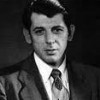
Idiot, not to know
his days are numbered who would fight the gods!
His children will not sing around his knees
“Papà! Papà!” on his return from war.Ὅττι μάλ’ οὐ δηναιὸς ὃς ἀθανάτοισι μάχηται,
οὐδέ τί μιν παῖδες ποτὶ γούνασι παππάζουσιν
ἐκ πολέμοιο καὶ αἰνῆς δηϊοτῆτος.Homer (fl. 7th-8th C. BC) Greek author
The Iliad [Ἰλιάς], Book 5, l. 407ff (5.407-409) (c. 750 BC) [tr. Fitzgerald (1974), l. 467ff]
(Source)
Alt. trans.:Not knowing he that fights with Heav’n hath never long to live,
And for this deed, he never shall have child about his knee
To call him father, coming home.
[tr. Chapman (1611), ll. 387-89]No man who fights with gods will live long or hear his children prattling about his knees when he returns from battle.
[tr. Butler (1898)]Know thou, whoe'er with heavenly power contends,
Short is his date, and soon his glory ends;
From fields of death when late he shall retire,
No infant on his knees shall call him sire.
[tr. Pope (1715-20)]Infatuate! he forgets
That whoso turns against the Gods his arm
Lives never long; he never, safe escaped
From furious fight, the lisp’d caresses hears
Of his own infants prattling at his knees.
[tr. Cowper (1791), ll. 474-78]Infatuate! nor does the son of Tydeus know this in his mind, that he is by no means long-lived who fights with the immortals, nor ever at his knees will sons lisp a father’s name, as he returns from war and dreadful battle.
[tr. Buckley (1860)]Unknowing he how short his term of life
Who fights against the Gods! for him no child
Upon his knee shall lisp a father's name,
Safe from the war and battle-field return'd.
[tr. Derby (1864), ll. 463-466]Verily he endureth not for long who fighteth with the immortals, nor do his children prattle about his knees when he is come back from war and the dread conflict.
[tr. Murray (1924)]That man who fights the immortals lives for no long time, his children do not gather to his knees to welcome their father when he returns home after the fighting and the bitter warfare.
[tr. Lattimore (1951)]Doesn't the son of Tydeus know, down deep,
the man who fights the gods does not live long?
Nor do his children ride his knees with cries of 'Father' --
home at last from the wars and heat of battle.
[tr. Fagles (1990), ll. 465-468]
I am trying to do two things: dare to be a radical and not be a fool, which, if I may judge by the exhibitions around me, is a matter of no small difficulty.
James A. Garfield (1831-1881) US President (1881), lawyer, lay preacher, educator
Letter to Burke Aaron Hinsdale (1 Jan 1867)
(Source)
DUKHAT: When others do a foolish thing, you should tell them it is a foolish thing. They can still continue to do it, but at least the truth is where it needs to be.
J. Michael (Joe) Straczynski (b. 1954) American screenwriter, producer, author [a/k/a "JMS"]
Babylon 5, 4×09 “Atonement” (24 Feb 1997)

There are three things which are real: God, human folly, and laughter. Since the first two pass our comprehension, we must do what we can with the third.
Aubrey Menen (1912-1989) British writer, novelist, satirist, theatre critic
Rama Retold, Book 3, ch. 7 [Valmiki] (1954)
(Source)
This book is a modern retelling of part of the Ramayana.
A variant of this was inscribed on a silver beer mug given on a gift that President John F Kennedy gave to David Powers:There are three things which are real:
God, human folly and laughter.
The first two are beyond our comprehension
So we must do what we can with the third.


CLITANDRE: A learned fool is more foolish than an ignorant fool.
[Un sot savant est sot plus qu’un sot ignorant.]
Molière (1622-1673) French playwright, actor [stage name for Jean-Baptiste Poquelin]
Les Femmes Savantes [The Learned Ladies], Act 4, sc. 3 (1692) [tr. Van Laun (1876)]
(Source)
(Source (French)). Other translations:A learned Fool is more foolish than an ignorant Fool.
[tr. Clitandre (1739)]A learned fool is more of a fool than an ignorant one.
[tr. Wall (1879), The Learned Women]A learned fool is more foolish than an ignorant one.
[tr. Matthew (1890), The Blue-Stockings]The learned fool is a far greater fool than the fool of ignorance.
[tr. Wormeley (1895), The Female Pedants]A learned fool is a bigger fool than an ignorant one.
[tr. Waller (1903)]There's no fool like a learned fool.
[tr. Page (1908)]A learned fool is more foolish than an ignorant fool.
[tr. Marks (2018)]
Long books, when read, are usually overpraised, because the reader wants to convince others and himself that he has not wasted his time.
E. M. Forster (1879-1970) English novelist, essayist, critic, librettist [Edward Morgan Forster]
Commonplace Book (1985) [ed. Gardner]
(Source)
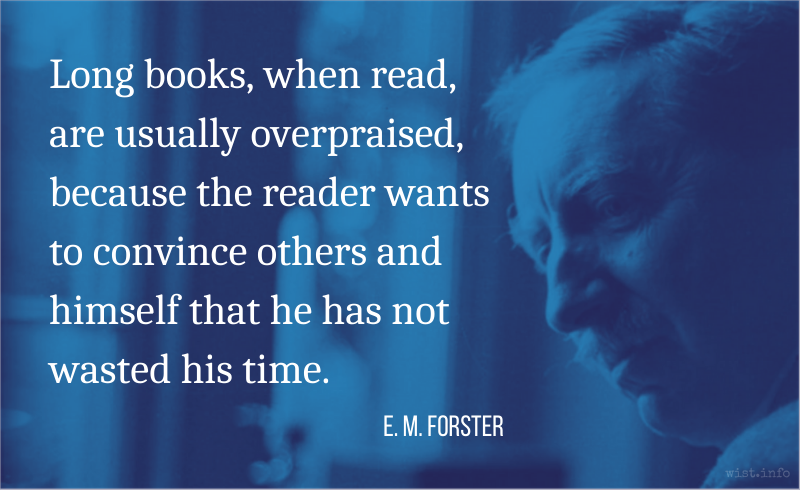
After all, to the well-organized mind, death is but the next great adventure. You know, the Stone was really not such a wonderful thing. As much money and life as you could want! The two things most human beings would choose above all — the trouble is, humans do have a knack for choosing precisely those things that are worst for them.
Joanne "Jo" Rowling (b. 1965) British novelist [writes as J. K. Rowling and Robert Galbraith]
Harry Potter and the Sorcerer’s Stone, ch. 17 [Dumbledore] (1997)

Your minds that once did stand erect and strong,
What madness swerves them from their wonted course?
[Quo vobis mentes, rectae quae stare solebant
antehac, dementis sese flexere viai?]Ennius (239-169 BC) Roman poet, writer [Quintus Ennius]
Annals, Book 6, frag. 11 [tr. Falconer (1923)]
(Source)
Setting the words of Appius Claudius to verse, when Appius in his old age berated the Senate for considering peace and alliance with King Pyrrhus of Epirus, who had defeated them (in a "Pyrhhic victory") at Heraclea (280 BC). Fragment recorded in Cicero, De Senectute, ch. 6 / sec. 16 (4.16) (44 BC).
(Source (Latin)). Alternate translations:Why seid Appius haue ye inclyned and revaled youre couragious hertys whiche til nowe were accustumyd to be ferme and stidfast. Be ye madd or for lak of discressyon agree ye for to condescend and desyre ye to make alliance and peas with kyng Pirrus bycause that he putteth in strength for to putt you downe and in subjection and wolde destroye yowe?
[tr. Worcester/Worcester/Scrope (1481)]Why do your wits
And senses so rave?
What foolish conceit
Doth encumber your brain?
Where be the ripe judgments,
Which wont you were to have,
To agree to your country's
Ruin most plain?
[tr. Newton (1569)]Whether now bend your minds, a headlong fall to bring,
Which heretofore had wont to stand, as straight as any thing.
[tr. Austin (1648)]Whither now do you bend your Thoughts
Which, heretofore, were firm and resolute,
What! madly on your Ruin. ? --
[tr. J. D. (1744)]What Frenzy now has your wild Minds possest?
You, who were first with sagest Counsels blest,
Your selves on sure Destruction thus to throw!
[tr. Logan (1744)]Shall folly now that honoured Council sway,
Where sacred wisdom wont to point the way!
[tr. Melmoth (1773)]Ah! wither have your minds demented turned themselves, wich heretofore were wont to stand erect?
[Cornish Bros. ed. (1847)]Whither have your minds, which used to stand upright before, in folly turned away?
[tr. Edmonds (1874)]Wont to stand firm, upon what devious way
Demented rush ye now?
[tr. Peabody (1884)]Whither have swerved the souls so firm of yore?
Is sense grown senseless? Can feet stand no more?
[tr. Shuckburgh (1895)]Where are the minds that used to stand serene,
where is the bravery that once has been?
[tr. Allison (1916)]What is this madness that has turned your minds, until now firm and strong, from their course?
[tr. Grant (1960, 1971 ed.)]Where are your minds? They always stood up straight till now! Are you mad? Where did you miss the road?
[tr. Copley (1967)]Up until now your minds were straight and firm.
What bends them now onto this foolish path?
[tr. Cobbold (2012)]How on earth could your mind
Once upright and dignified
Take a downturn and backslide?
[tr. Bozzi (2015)]What madness has turned your minds, once firm and strong, from their course?
[tr. Freeman (2016)]
Stupidity lies in wanting to draw conclusions.
[L’ineptie consiste à vouloir conclure. […] Oui, la bêtise consiste à vouloir conclure.]
Gustave Flaubert (1821-1880) French writer, novelist
Letter to Louis Bouilhet (4 Sep 1850)
(Source)
The phrase is used twice in the letter. The initial phrase is usually translated to "foolishness" or "folly," the second to "stupidity."
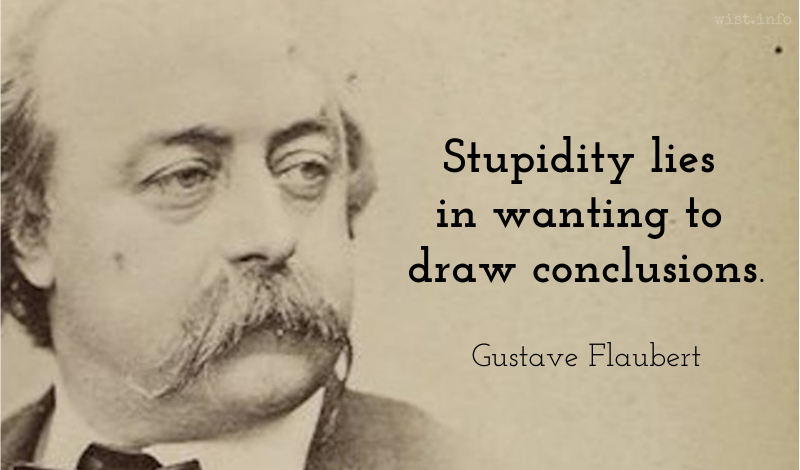
Man is a clever animal, who behaves like an imbecile.
Albert Schweitzer (1875-1965) Alsatian philosopher, physician, philanthropist, polymath
(Attributed)
The ratio of damn fools to villains is high.
‘Tis hard bewildering riddles to compose
And labour lost to work at nonsense prose.[Turpe est difficiles habere nugas,
Et stultus labor est ineptiarum.]Martial (AD c.39-c.103) Spanish Roman poet, satirist, epigrammatist [Marcus Valerius Martialis]
Epigrams [Epigrammata], Book 2, epigram 86 (2.86.9-10) (AD 86) [tr. Francis & Tatum (1924), #105]
(Source)
Discussing writing elaborate or highly stylized poetry forms. (Source (Latin)). Alternate translations:Disgraceful 't is unto a poet's name
Difficult toys to make his highest am:
The labour's foolish that doth rack the brains
For things have nothing in them, but much pains.
[tr. Killigrew (1695)]How foolish is the toil of trifling cares.
[tr. Johnson (1750); he credits the translation Elphinston]How pitifull the boast of petty feats!
How idle is the toil of mean conceits!
[tr. Elphinston (1782), 2.76]It is disgraceful to be engaged in difficult trifles; and the labour spent on frivolities is foolish.
[tr. Amos (1858), 2.19]It is absurd to make one's amusements difficult; and labor expended on follies is childish.
[tr. Bohn's Classical (1859)]'Tis mean and foolish to assign
Long care and pains to trifles light.
[tr. Webb (1879)]Disgraceful ’tis to treat small things as difficult;
‘Tis silly to waste time on foolish trifles.
[ed. Harbottle (1897)]'Tis degrading to undertake difficult trifles; and foolish is the labour spent on puerilities.
[tr. Ker (1919)]'Tis hard bewildering riddles to compose
And labor lost to work at nonsense prose.
[tr. Francis & Tatum (1924)]It's demeaning to make difficulties out of trifles, and labor over frivolities is foolish.
[tr. Shackleton Bailey (1993)]It is absurd to make trifling poetry difficult, and hard work on frivolities is foolish.
[tr. Williams (2004)]
The Latin phrase was used by Addison as the epigram of The Spectator #470 (29 Aug 1712).
Man has no greater enemy than himself. I have acted contrary to my sentiments and inclination; throughout our whole lives we do what we never intended, and what we proposed to do, we leave undone.
Francesco Petrarca (1304-1374) Italian scholar and poet [a.k.a. Petrarch]
(Attributed)
(Source)
Quoted in Johann Georg Ritter von Zimmermann, An Examination of the Advantages of Solitude and of Its Operations, ch. 5 (1783) [tr. F.S. (1808)].
Wine is a mocker, strong drink is raging: and whosoever is deceived thereby is not wise.
The Bible (The Old Testament) (14th - 2nd C BC) Judeo-Christian sacred scripture [Tanakh, Hebrew Bible], incl. the Apocrypha (Deuterocanonicals)
Proverbs 20: 1 [KJV (1611)]
(Source)
Alternate translations:Wine is a luxurious thing, and drunkenness riotous: whosoever is delighted therewith shall not be wise.
[DRA (1899)]Wine is reckless, strong drink quarrelsome; unwise is he whom it seduces.
[JB (1966)]Drinking too much makes you loud and foolish. It's stupid to get drunk.
[GNT (1976)]Wine is reckless, liquor rowdy; unwise is anyone whom it seduces.
[NJB (1985)]Wine is a mocker; beer a carouser.
Those it leads astray won’t become wise.
[CEB (2011)]Wine is a mocker and beer a brawler;
whoever is led astray by them is not wise.
[NIV (2011 ed.)]Wine is a mocker, strong drink a brawler,
and whoever is led astray by it is not wise.
[NRSV (2021 ed.)]Wine is a scoffer, strong drink a roisterer;
No one who is muddled by them will ever grow wise.
[RJPS (2023 ed.)]

There are two kinds of fools: those who suspect nothing and those who suspect everything.
Charles-Joseph Lamoral, Prince de Ligne (1735-1814) Belgian military leader, noble, writer [Karl Fürst von Ligne, Charles-Joseph de Ligne]
Mes écarts, ou, ma tête en liberté
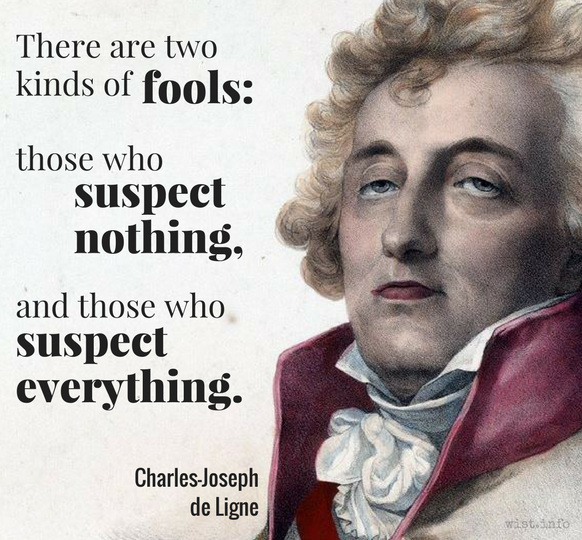
It was said that God, in order to test mankind which had become swelled with pride as in the time of Noah, had commanded the wise men of that age, among them the Blessed Leibowitz, to devise great engines of war such as had never before been upon the Earth, weapons of such might that they contained the very fires of Hell, and that God had suffered these magi to place the weapons in the hands of princes, and to say to each prince: “Only because the enemies have such a thing have we devised this for thee, in order that they may know that thou hast it also, and fear to strike. See to it, m’Lord, that thou fearest them as much as they shall now fear thee, that none may unleash this dread thing which we have wrought.” But the princes, putting the words of their wise men to naught, thought each to himself: If I but strike quickly enough, and in secret, I shall destroy these others in their sleep, and there will be none to fight back; the earth shall be mine.
Such was the folly of princes, and there followed the Flame Deluge.Walter M. Miller Jr. (1923-1996) American writer
A Canticle for Leibowitz, “Fiat Homo,” ch. 6 (1959)
Prejudices are what fools use for reason.
Voltaire (1694-1778) French writer [pseud. of Francois-Marie Arouet]
(Attributed)
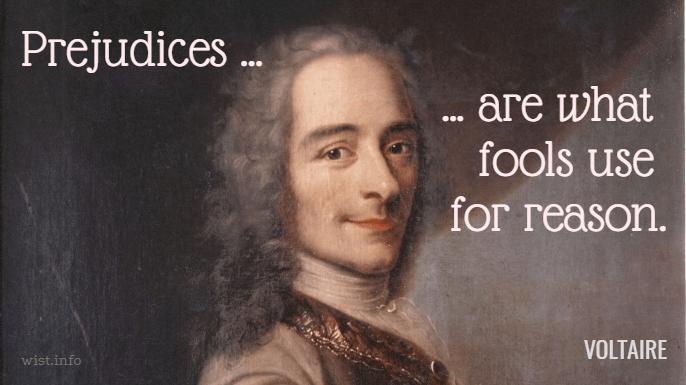

Of all the creatures that creep, swim, or fly,
Peopling the earth, the waters, and the sky,
From Rome to Iceland, Paris to Japan,
I really think the greatest fool is man.[De tous les animaux qui s’élèvent dans l’air,
Qui marchent sur la terre, ou nagent dans la mer,
De Paris au Pérou, du Japon jusqu’à Rome,
Le plus sot animal, à mon avis, c’est l’homme.]Nicolas Boileau-Despréaux (1636-1711) French poet and critic
Satires, Satire 8, l. 1 (1716)
In spite of every sage whom Greece can show,
Unerring wisdom never dwelt below;
Folly in all of every age we see,
The only difference lies in the degree.[N’en déplaise à ces fous nommés sages de Grèce,
En ce monde il n’est point de parfaite sagesse :
Tous les hommes sont fous, et, malgré tous leurs soins,
Ne diffèrenet entre eux que du plus ou du moins.]Nicolas Boileau-Despréaux (1636-1711) French poet and critic
Satires, Satire 4, l. 37 (1716)
A fool always finds one still more foolish to admire him.
[Un sot trouve toujours un plus sot qui l’admire.]
Nicolas Boileau-Despréaux (1636-1711) French poet and critic
The Art of Poetry [L’Art Poétique], Canto 1, l. 232 (1674)
Alt. trans.: "A fool always finds a greater fool to admire him."
The folly which we might have ourselves committed is the one which we are least ready to pardon in another.
Joseph Roux (1834-1886) French Catholic priest
Meditations of a Parish Priest: Thoughts, Part 4, #85 (1886)
(Source)
LADY MACBETH: Whither should I fly?
I have done no harm. But I remember now
I am in this earthly world; where to do harm
Is often laudable, to do good sometime
Accounted dangerous folly.William Shakespeare (1564-1616) English dramatist and poet
Macbeth, Act 4, sc. 2, l. 81ff (4.2.81-85) (1606)
(Source)
The world is full of fools, and he who would not wish to see one must not only shut himself up alone, but also break his looking glass.
Nicolas Boileau-Despréaux (1636-1711) French poet and critic
(Attributed)
A variant is also attributed to Charles le Petit (1640-1625), Discours satiriques (1686).
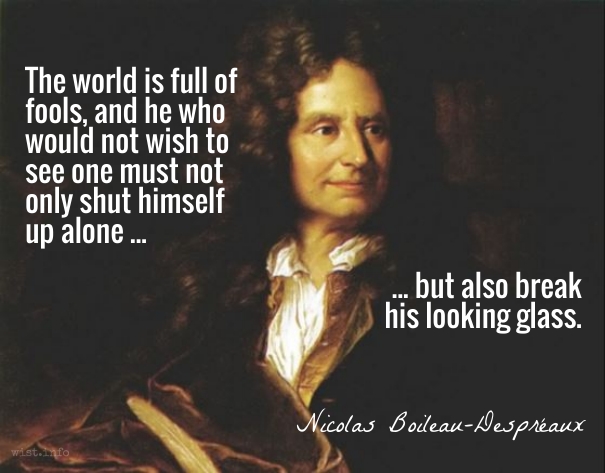
A fine quotation is a diamond on the finger of a man of wit, and a pebble in the hand of a fool.
Joseph Roux (1834-1886) French Catholic priest
Meditations of a Parish Priest: Thoughts, Part 1, #74 (1886)
(Source)
PAROLLES: Who knows himself a braggart,
Let him fear this; for it will come to pass
That every braggart shall be found an ass.
William Shakespeare (1564-1616) English dramatist and poet
All’s Well That Ends Well, Act 4, sc. 3, l. 356ff (4.3.356-358) (1602?)
(Source)
Some people swallow the universe like a pill; they travel on through the world, like smiling images pushed from behind. For God’s sake give me the young man who has brains enough to make a fool of himself!
Ignorance might be bliss for the ignorant, but for the rest of us it’s a right fucking pain in the arse.


It’s a sad fact of modern life that sooner or later you will end up on YouTube doing something stupid. The trick, according to my dad, is to make a fool of yourself to the best of your ability.
Ben Aaronovitch (b. 1964) British author
Broken Homes (2013)

The greatest height of heroism to which an individual, like a people, can attain is to know how to face ridicule; better still, to know how to make oneself ridiculous and not to shrink from the ridicule.
Miguel de Unamuno (1864-1936) Spanish philosopher and writer [Miguel de Unamuno y Jugo]
The Tragic Sense of Life [Del Sentimiento Trágico de la Vida], Conclusion (1913) [tr. Flitch (1921)]
(Source)
He tried
To cross
As fast train neared
Death didn’t draft him
He volunteered
Burma-Shave(Other Authors and Sources)
Burma-Shave sign

Men are contented to be laughed at for their wit, but not for their folly.
Jonathan Swift (1667-1745) English writer and churchman
“Thoughts on Various Subjects” (1706)
(Source)
It’s easier to fool people than to convince them that they have been fooled.
Mark Twain (1835-1910) American writer [pseud. of Samuel Clemens]
(Spurious)
Not found in Twain's writings. The earliest attribution to him appears to be in 2011. The connection to Twain may be his (authentic) comment, "How easy it is to make people believe a lie, and how hard it is to undo that work again!"
For more discussion of this quotation, see Quote Origin: It’s Easier To Fool People Than To Convince Them That They’ve Been Fooled – Quote Investigator®.
If I want to stop a research program I can always do it by getting a few experts to sit in on the subject, because they know right away that it was a fool thing to try in the first place.
Charles F. Kettering (1876-1958) American inventor, engineer, researcher, businessman
(Attributed)
It’s easy to think that as a result of the extinction of the dodo, we are now sadder and wiser, but there’s a lot of evidence to suggest that we are merely sadder and better informed.
Douglas Adams (1952-2001) English author, humorist, screenwriter
Last Chance to See, ch. 6 (1990)
(Source)

The only wa tu pleze evra boddy, is tu make evry boddy think yu ar a bigger fule than tha ar.
[The only way to please everybody is to make everybody think you are a bigger fool than they are.]
Josh Billings (1818-1885) American humorist, aphorist [pseud. of Henry Wheeler Shaw]
His Sayings, ch. 45 (1867)
Whenever you look at a piece of work and you think the fellow was crazy, then you want to pay some attention to that. One of you is likely to be, and you had better find out which one it is. It makes an awful lot of difference.
Charles F. Kettering (1876-1958) American inventor, engineer, researcher, businessman
Comment (1930)
(Source)
As attributed by Francis Davis, inventor of power steering.
However highly we must value courage and steadfastness in war, and however little prospect of victory there is for him who cannot resolve to seek it by the exertion of all his strength, still there is a point beyond which perseverance can only be called desperate folly, and therefore cannot be approved by any critic.
[Wie hoch auch der Wert des Mutes und der Standhaftigkeit im Kriege angeschlagen werden muß, und wie wenig Aussicht der zum Siege hat, der sich nicht entschließen kann, ihn mit der ganzen Kraftanstrengung zu suchen, so gibt es doch einen Punkt, über den hinaus das Verharren nur eine verzweiflungsvolle Torheit genannt und also von keiner Kritik gebilligt werden kann.]
Karl von Clausewitz (1780-1831) Prussian soldier, historian, military theorist
On War [Vom Kriege], Book 4, ch. 9 “The Battle: Its Decision [Die Hauptschlacht. Ihre Entscheidung],” (4.9) (1832) [tr. Jolles (1943)]
(Source)
(Source (German)). Alternate translations:However highly we must esteem courage and firmness in war, and however little prospect there is of victory to him who cannot resolve to seek it by the exertion of all his power, still there is a point beyond which perseverance can only be termed desperate folly, and therefore can meet with no approbation from any critic.
[tr. Graham (1873)]No matter how highly rated the qualities of courage and steadfastness may be in war, no matter how small the chance of victory may be for the leader who hesitates to go for it with all the power at his disposal, there is a point beyond which persistence becomes desperate folly, and can therefore never be condoned.
[tr. Howard & Paret (1976)]

You philosophers are sages in your maxims, and fools in your conduct.
Benjamin Franklin (1706-1790) American statesman, scientist, philosopher, aphorist
“Dialogue Between Franklin and the Gout” (22 Oct 1780)
Many talk like Philosophers, and live like Fools.
Thomas Fuller (1654-1734) English physician, preacher, aphorist, writer
Gnomologia: Adages and Proverbs (compiler), # 3358 (1732)
(Source)
MAL: Well, my days of not taking you seriously are certainly coming to a middle.
Joss Whedon (b. 1964) American screenwriter, author, producer [Joseph Hill Whedon]
Firefly, 1×06 “Our Mrs. Reynolds” (2 Oct 2002)

Wooden-headedness consists of assessing a situation in terms of preconceived, fixed notions while ignoring or rejecting any contrary signs. It is acting according to wish while not allowing oneself to be confused by the facts.
Barbara W. Tuchman (1912-1989) American historian and author
“An Inquiry into the Persistence of Unwisdom in Government,” Esquire (1980)
If forty million people say a foolish thing it does not become a wise one, but the wise man is foolish to give them the lie.
W. Somerset Maugham (1874-1965) English novelist and playwright [William Somerset Maugham]
A Writer’s Notebook (1949)
An entry dated 1901. More discussion about this quotation: If Fifty Million People Say a Foolish Thing, It Is Still a Foolish Thing – Quote Investigator
In public affairs, stupidity is more dangerous than knavery.
Woodrow Wilson (1856-1924) US President (1913-20), educator, political scientist
The New Freedom, ch. 3 (1913)
Whenever a man does a thoroughly stupid thing, it is always from the noblest motives.
Oscar Wilde (1854-1900) Irish poet, wit, dramatist
The Picture of Dorian Gray, ch. 6 (1891)

If it’s stupid but works, it ain’t stupid.
(Other Authors and Sources)
Murphy’s Law for Grunts
In Paul Dixon, "Getting a Handle on Life's Slippery Truths," San Francisco Chronicle (24 Dec 1992)
EDDIE: Kid, life’s hard. But it’s a lot harder if you’re stupid.
Paul Monash (1917-2003) American producer and screenwriter
The Friends of Eddie Coyle (movie) (1973)
Screenplay based on the novel by George V. Higgins (though the line is not in the book). Played in the movie by Robert Mitchum, to whom the quote is often attributed.

The probability of someone watching you is proportional to the stupidity of your action.
(Other Authors and Sources)
A. Kindsvater, “MIST’s Law” [Man in the Street]
When a war breaks out, people say: “It’s too stupid; it can’t last long.” But though the war may well be “too stupid,” that doesn’t prevent its lasting. Stupidity has a knack of getting its way; as we should see if we were not always so much wrapped up in ourselves.
Albert Camus (1913-1960) Algerian-French novelist, essayist, playwright
The Plague (1947)
Evil isn’t the real threat to the world. Stupid is just as destructive as Evil, maybe more so, and it’s a hell of a lot more common. What we really need is a crusade against Stupid. That might actually make a difference.
Jim Butcher (b. 1971) American author
(Attributed)
Often cited to the short story "Vignette" (also known as "Publicity and Advertising"), but not found there.

There are but two ways of rising in the world: either by your own industry or by the folly of others.
[Il n’y a au monde que deux manières de s’élever, ou par sa propre industrie, ou par l’imbécillité des autres.]
Jean de La Bruyère (1645-1696) French essayist, moralist
The Characters [Les Caractères], ch. 6 “Of Gifts of Fortune [Des Biens de Fortune],” § 52 (6.52) (1688) [tr. Van Laun (1885)]
(Source)
(Source (French)). Alternate translations:There is but two ways of rising in the World, by your own Industry, and another's Weakness.
[Bullord ed. (1696)]There are only two ways of rising in the World, by your own Industry, or by the Weakness of others.
[Curll ed. (1713)]There are but two ways of rising in the World, by your own Industry, or the Weakness of others.
[Browne ed. (1752)]There are only two ways of getting on in the world: either by one's own cunning efforts, or by other people's foolishness.
[tr. Stewart (1970)]
It’s better to keep your mouth shut and appear stupid, than to open it and remove all doubt.
Mark Twain (1835-1910) American writer [pseud. of Samuel Clemens]
(Spurious)
This quotation, and close variants, are frequently attributed to Twain or Abraham Lincoln, but appears to have first been phrased this way by Maurice Switzer, Mrs. Goose, Her Book (1906):It is better to remain silent at the risk of being thought a fool, than to talk and remove all doubt of it.
Another point of origin is in the Bible, Proverbs 17:28:Even a fool, when he holdeth his peace, is counted wise: and he that shutteth his lips is esteemed a man of understanding.
In short, the sentiment is not new. See also See also Fuller, Franklin, Thomas a Kempis, and Wilson. For more discussion, see:
Every organization appears to be headed by secret agents of its opponents.
Robert Conquest (b. 1917) Anglo-American historian, diplomat, poet
“Conquest’s Second Law”
Attributed in Kingsley Amis, Memoirs (1991). Also known as "Conquest's Law of Organizations."Variants:
- "Every organisation behaves as if it is run by secret agents of its opponents."
- "The behavior of any organization can best be predicted on the assumption that it is headed by a secret cabal of its enemies."

A sense of humor keen enough to show a man his own absurdities will keep him from the commission of all sins, or nearly all, save those that are worth committing.
Samuel Butler (1835-1902) English novelist, satirist, scholar
The Note-Books of Samuel Butler, ch. 1, “Life” (1912)
Tilting at windmills hurts you more than the windmills.
Robert A. Heinlein (1907-1988) American writer
Time Enough for Love (1973)
Answer not a fool according to his folly, lest thou also be like unto him.
The Bible (The Old Testament) (14th - 2nd C BC) Judeo-Christian sacred scripture [Tanakh, Hebrew Bible], incl. the Apocrypha (Deuterocanonicals)
Proverbs 26: 4 [KJV (1611)]
(Source)
Alternate translations:Do not answer a fool in the terms of his folly for fear you grow like him yourself.
[JB (1966)]If you answer a silly question, you are just as silly as the person who asked it.
[GNT (1976)]Do not answer a fool in the terms of his folly for fear you grow like him yourself.
[NJB (1985)]Don’t answer fools according to their folly,
or you will become like them yourself.
[CEB (2011)]Do not answer fools according to their folly,
lest you be a fool yourself.
[NRSV (2021 ed.)]Do not answer a dullard in accord with his folly,
Else you will become like him.
[RJPS (2023 ed.)]
If most of us are ashamed of shabby clothes and shoddy furniture, let us be more ashamed of shabby ideas and shoddy philosophies.
Albert Einstein (1879-1955) German-American physicist
(Attributed)
Attributed to Einstein, but no definitive citation found. See here for more discussion.
We think, I’m not a fool today. I’ve learned my lesson. I was a fool yesterday but not this morning. Then tomorrow we find out that, yes, we were a fool today too. I think the only way we can grow and get on in this world is to accept the fact we’re not perfect and live accordingly.
Ray Bradbury (1920-2012) American writer, futurist, fabulist
“No Particular Night or Morning” (1951)
April 1. This is the day upon which we are reminded of what we are on the other three hundred and sixty-four.
Mark Twain (1835-1910) American writer [pseud. of Samuel Clemens]
The Tragedy of Pudd’nhead Wilson, ch. 21 epigraph: “Pudd’nhead Wilson’s Calendar” (1894)
Have a Care of Passion. Anger begins with Folly, and ends with Repentance.
It is as natural and as right for a young man to be imprudent and exaggerated, to live in swoops and circles, and beat about his cage like any other wild thing newly captured, as it is for old men to turn grey, or mothers to love their offspring, or heroes to die for something more valuable than their lives.
When the torrent sweeps the man against a boulder, you must expect him to scream, and you need not be surprised if the scream is sometimes a theory. Shelley, chafing at the Church of England, discovered the cure of all evils in universal atheism. Generous lads irritated at the injustices of society, see nothing for it but the abolishment of everything and Kingdom Come of anarchy. Shelley was a young fool; so are these cocksparrow revolutionaries. But it is better to be a fool than to be dead. It is better to emit a scream in the shape of a theory than to be entirely insensible to the jars and incongruities of life and take everything as it comes in a forlorn stupidity.
The trouble ain’t that there is too many fools, but that the lightning ain’t distributed right.
Mark Twain (1835-1910) American writer [pseud. of Samuel Clemens]
Quoted in Merle Johnson, ed., More Maxims of Mark (1927)
(Source)
Not found in a primary source. Johnson was a rare book collector who published the first thorough bibilography of Twain's works in 1910. His 1927 work is a 15-page pamphlet, generally considered authentic by scholars, but it provides no other context for the saying.
For more information on the history of this quotation, see Quote Origin: The Trouble Ain’t That There Is Too Many Fools, But That the Lightning Ain’t Distributed Right – Quote Investigator®.
Variant: "The trouble isn’t that there are too many fools, but that the lightning isn’t distributed right."
There are more Fools than Knaves in the World,
Else the Knaves would not have enough to live upon.Samuel Butler (1835-1902) English novelist, satirist, scholar
Prose Observations, “Sundry Thoughts”
(Source)
Virtue begins by shunning vice; wisdom
By shunning folly.[Virtus est vitium fugere et sapientia prima
stultitia caruisse.]Horace (65–8 BC) Roman poet, satirist, soldier, politician [Quintus Horatius Flaccus]
Epistles [Epistularum, Letters], Book 1, ep. 1 “To Maecenas,” l. 41ff (1.1.41-42) (20 BC) [tr. Ferry (2001)]
(Source)
(Source (Latin)). Other translations:It is virtue, vice t'avoyde and wysedome chéefe of all
Follie to wante: these two ills lo do vex the at thy gall.
[tr. Drant (1567)]'Tis Vertue, to flie Vice: and the first Stair
Of Wisdome, to want Folly.
[tr. Fanshawe; ed. Brome (1666)]'Tis Vertue, Sir, to be but free from Vice,
And the first step tow'rds being truly Wise
Is to want folly.
[tr. Creech (1684)]Even in our flight from vice some virtue lies;
And free from folly, we to wisdom rise.
[tr. Francis (1747)]Vice to renounce is virtue's earliest rule,
Wisdom's first step is to lay aside the fool.
[tr. Howes (1845)]It is virtue, to fly vice; and the highest wisdom, to have lived free from folly.
[tr. Smart/Buckley (1853)]To fly from vice is virtue: to be free
From foolishness is wisdom's first degree.
[tr. Conington (1874)]To fly from vice is virtue, says the sage,
Not to be foolish, wisdom's earliest stage.
[tr. Martin (1881)]It is virtue to fly from vice, and the beginning of wisdom to be free from folly.
[tr. Elgood (1893)]To flee vice is the beginning of virtue, and to have got rid of folly is the beginning of wisdom.
[tr. Fairclough (Loeb) (1926)]Virtue means keeping from vice, and wisdom begins
When you stop being stupid.
[tr. Palmer Bovie (1959)]Virtue begins with fleeing vice and wisdom starts
in being a fool no longer.
[tr. Fuchs (1977)]Running when vice runs after you
Is the beginning of virtue; shaking
Foolishness off is the beginning
Of sense.
[tr. Raffel (1983)]Virtue's first rule is "avoid vice," and wisdom's
"get rid of folly."
[tr. Rudd (2005 ed.)]Virtue is to flee vice, and wisdoms’ beginning is
Freedom from foolishness.
[tr. Kline (2015)]
The moment the very name of Ireland is mentioned, the English seem to bid adieu to common feeling, common prudence, and common sense, and to act with the barbarity of tyrants, and the fatuity of idiots.
Sydney Smith (1771-1845) English clergyman, essayist, wit
The Letters of Peter Plymley, Letter 2 (1807)
(Source)
You can fool some of the people all of the time and all of the people some of the time, but you can make a damn fool of yourself any old time.
Lawrence J. Peter (1919-1990) American educator, management theorist
Peter’s Almanac, “3 December” (1982)
See Lincoln.
Experience keeps a dear school, yet Fools will learn in no other.
Benjamin Franklin (1706-1790) American statesman, scientist, philosopher, aphorist
Poor Richard’s Almanack (Dec 1743)
(Source)
Franklin quotes Poor Richard as well in The Way to Wealth (1758).
More discussion of this quotation, and an image of the original page: Experience Keeps a Dear School; Yet Fools Will Learn In No Other – Quote Investigator.
For it is the characteristic of folly, to have eyes for the faults of others, and blindness for its own.
[Est enim proprium stultitiae aliorum vitia cernere, oblivisci suorum.]
Marcus Tullius Cicero (106-43 BC) Roman orator, statesman, philosopher
Tusculan Disputations [Tusculanae Disputationes], Book 3, ch. 30 (3.30) / sec. 73 (45 BC) [tr. Otis (1839)]
(Source)
(Source (Latin)). Alternate translations:For it is the property of Folly, to look upon other mens Failings, and to forget their own.
[tr. Wase (1643)]For it is the peculiar characteristic of folly to discover the vices of others, forgetting its own.
[tr. Main (1824)]For it is the peculiar characteristic of folly to perceive the vices of others, but to forget its own.
[tr. Yonge (1853)]It is the peculiar quality of a fool to perceive the faults of others and to forget his own.
[Source (1882)]It is the property of folly to see the faults of others, to forget its own.
[tr. Peabody (1886)]This is just how foolish people behave: they observe the faults of others and forget their own.
[tr. Graver (2002)]It is a trait of fools to perceive the faults of others but not their own.
‘Tis an old maxim in the schools,
That flattery’s the food of fools;
Yet now and then your men of wit
Will condescend to take a bit.Jonathan Swift (1667-1745) English writer and churchman
“Cadenus and Vanessa,” l. 766ff (1713)
(Source)
He that’s cheated twice by the same Man is an Accomplice with the Cheater.
Thomas Fuller (1654-1734) English physician, preacher, aphorist, writer
Gnomologia: Adages and Proverbs (compiler), # 2281 (1732)
(Source)
Science is a way of trying not to fool yourself. The first principle is that you must not fool yourself, and you are the easiest person to fool.
Richard Feynman (1918-1988) American physicist
“What Is and What Should Be the Role of Scientific Culture in Modern Society,” lecture at the Galileo Symposium, Italy (1964)
In view of the fact that God limited the intelligence of man, it seems unfair that he did not also limit his stupidity.
Konrad Adenauer (1876-1967) German politician
(Attributed)
Quoted by Dean Atchison in Arthur Schlesinger, A Thousand Days, ch. 11 (1965).
To live is like to love — all reason is against it, and all healthy instinct for it.
Samuel Butler (1835-1902) English novelist, satirist, scholar
The Note-Books of Samuel Butler, “Life and Love” (1912)
(Source)
The World is full of fools and faint hearts; and yet every one has courage enough to bear the misfortunes, and wisdom enough to manage the Affairs of his neighbour.
Benjamin Franklin (1706-1790) American statesman, scientist, philosopher, aphorist
Poor Richard (1743 ed.)
(Source)
Against stupidity the very gods
Themselves contend in vain.[Mit der Dummheit kämpfen Götter selbst vergebens]
Friedrich Schiller (1759-1805) German poet, playwright, critic [Johann Christoph Friedrich von Schiller]
The Maid of Orleans [Die Jungfrau von Orleans], Act III, sc. vi (1801) [tr. Swanwick]Alt. trans:
- "Against stupidity the gods themselves contend in vain."
- "Against stupidity the gods themselves labor in vain."
- "Against stupidity the gods themselves fight unvictorious."
- "Against stupidity even the gods contend in vain."
- "With stupidity the gods themselves contend in vain."
- "With stupidity the gods themselves struggle in vain."
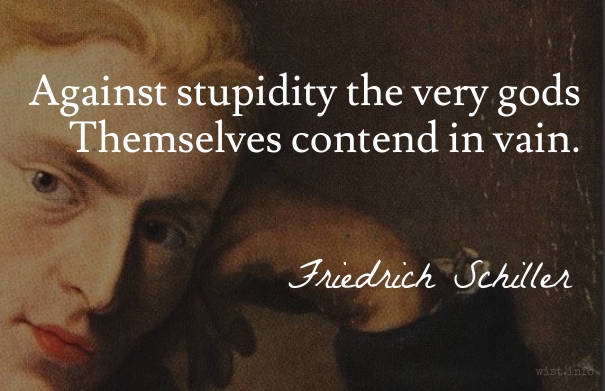
For those who want some proof that physicists are human, the proof is in the idiocy of all the different units which they use for measuring energy.
Richard Feynman (1918-1988) American physicist
The Character of Physical Laws ch. 3 “The Great Conservation Principles” (1965)
(Source)
Already I had learned from thee that because a thing is eloquently expressed it should not be taken to be as necessarily true; nor because it is uttered with stammering lips should it be supposed false. Nor, again, is it necessarily true because rudely uttered, nor untrue because the language is brilliant. Wisdom and folly both are like meats that are wholesome and unwholesome, and courtly or simple words are like town-made or rustic vessels — both kinds of food may be served in either kind of dish.
[Iam ergo abs te didiceram nec eo debere videri aliquid verum dici, quia eloquenter dicitur, nec eo falsum, quia incomposite sonant signa labiorum; rursus nec ideo verum, quia impolite enuntiatur, nec ideo falsum, quia splendidus sermo est, sed perinde esse sapientiam et stultitiam sicut sunt cibi utiles et inutiles, verbis autem ornatis et inornatis sicut vasis urbanis et rusticanis utrosque cibos posse ministrari.]
Augustine of Hippo (354-430) Christian church father, philosopher, saint [b. Aurelius Augustinus]
Confessions, Book 5, ch. 6 / ¶ 10 (5.6.10) (c. AD 398) [tr. Outler (1955)]
(Source)
(Source (Latin)). Alternate translations:Of Thyself therefore had I now learned, that neither ought any thing to seem to be spoken truly, because eloquently; nor therefore falsely, because the utterance of the lips is inharmonious; nor, again, therefore true, because rudely delivered; nor therefore false, because the language is rich; but that wisdom and folly are as wholesome and unwholesome food; and adorned or unadorned phrases as courtly or country vessels; either kind of meats may be served up in either kind of dishes.
[tr. Pusey (1838)]Of Thyself, therefore, had I now learned that neither ought anything to seem to be spoken truly, because eloquently; nor therefore falsely, because the utterance of the lips is inharmonious; nor, again, therefore true, because rudely delivered; nor therefore false, because the language is rich; but that wisdom and folly are as wholesome and unwholesome food; and adorned or unadorned phrases, as courtly or country vessels: either kind of meats may be served up in either kind of dishes.
[ed. Shedd (1860)]From Thee, therefore, I had now learned, that because a thing is eloquently expressed, it should not of necessity seem to be true; nor, because uttered with stammering lips, should it be false nor, again, perforce true, because unskillfully delivered; nor consequently untrue, because the language is fine; but that wisdom and folly are as food both wholesome and unwholesome, and courtly or simple words as town-made or rustic vessels, -- and both kinds of food may be served in either kind of dish.
[tr. Pilkington (1876)]I had learned, then, from Thee, that neither ought a thing to be regarded as true because it is eloquently uttered, nor on the other hand false because awkwardly expressed; neither is it true because the diction is ungraceful, nor false because clothed in glowing language; but that truth and folly are like wholesome and hurtful food, and language ornate and bald like fine and plain dishes, and either kind of meat may be served in either kind of dish.
[tr. Hutchings (1890)]Already I had learned from Thee, that nothing ought to seem true because it is well expressed, nor false because the word-symbols are inelegant; yet again, that nothing is true because rudely delivered, nor false because the diction is brilliant; but that wisdom and folly are like meats that are wholesome or unwholesome, and that either kind of meat can be served up in silver or in delf, that is to say, in courtly or in homely phrase.
[tr. Bigg (1897), 5.6.2]From You then I learned that a thing was not bound to be true because uttered eloquently, nor false because the utterance of the lips is ill-arranged; but that on the other hand a thing is not necessarily true because badly uttered, nor false because spoken magnificently. For it is with wisdom and folly as with wholesome and unwholesome food: just as either kind of food can be served equally well in rich dishes or simple, so plain or beautiful language may clothe either wisdom or folly indifferently.
[tr. Sheed (1943)]Already, therefore, I had learned from you that nothing should be held true merely be-cause it is eloquently expressed, nor false because its signs sound harsh upon the lips. Again, I learned that a thing is not true because rudely uttered, nor is it false because its utterance is splendid. I learned that wisdom is like wholesome food and folly like unwholesome food: they can be set forth in language ornate or plain, just as both kinds of food can be served on rich dishes or on peasant ware.
[tr. Ryan (1960)]But in your wonderful, secret way, my God, you had already taught me that a statement is not necessarily true because it is wrapped in fine language or false because it is awkwardly expressed. I believe that it was you who taught me this, because it is the truth and there is no other teacher of the truth besides yourself, no matter how or where it comes to light. You had already taught me this lesson and the converse truth, that an assertion is not necessarily true because it is badly expressed or false because it is finely spoken. I had learnt that wisdom and folly are like different kinds of food. Some are wholesome and others are not, but both can be served equally well on the finest china dish or the meanest earthenware. In just the same way, - wisdom and folly can be clothed alike in plain words or the finest flowers of speech.
[tr. Pine-Coffin (1961)]I had now learned this from you: that a thing is not necessarily true for being expressed eloquently, nor necessarily false if the sounds made by the lips are imperfectly pronounced; nor, on the other hand, is a thing true simply because it is expressed in a rough and ready way, nor false because it is uttered in a fine style. For with wisdom and folly the same thing holds good as with wholesome and unwholesome food. You can have silver or earthenware dishes on the table, just as you can have a decorated or undecorated use of language; either kind of food can be served in either kind of dish.
[tr. Warner (1963)]I believe that because you taught me and I had already learned from you that nothing should be deemed truly spoken because it is eloquently spoken, nor false because the indications of the lips are ill-arranged. Conversely, uncouth expression does not make something true, nor polished delivery make truth false. As with wholesome and unwholesome food, so it is with wisdom and folly, and as with adorned and unadorned language, so good food and bad can be served up in elegant or rustic dishes.
[tr. Blaiklock (1983)]

At thirty, man suspects himself a fool;
Knows it at forty, and reforms his plan;
At fifty, chides his infamous delay,
Pushes his prudent purpose to resolve;
In all the magnanimity of thought
Resolves, and re-resolves; then dies the same.
And why? Because he thinks himself immortal.
All men think all men mortal but themselves.Edward Young (1683-1765) English poet
Poem (1742-05), “Night the 1st: On Death, Life, and Immortality,” l. 418ff, The Complaint: Or, Night Thoughts, Vol. 1 (1744)
(Source)

To argue with a man who has renounced the use and authority of reason, and whose philosophy consists in holding humanity in contempt, is like administering medicine to the dead, or endeavoring to convert an Atheist by scripture.
Thomas Paine (1737-1809) American political philosopher and writer
The American Crisis #5, “To General Sir William Howe” (23 Mar 1778)
(Source)
Sometimes shortened as: "To argue with a man who has renounced his reason is like giving medicine to the dead."

Heaven-sent calamities you may stand up against, but you cannot survive those brought on by yourself.
Shu Ching (6th Century BC) Chinese collection of political philosophy [Shujing, Shu-kin, Shangshu, The Book of History, The Book of Documents, or The Classic of History]
T’ai Chia
Also cited as Shu Ching 4, 5
TOUCHSTONE: I do now remember a saying, “The fool doth think he is wise, but the wise man knows himself to be a fool.”
William Shakespeare (1564-1616) English dramatist and poet
As You Like It, Act 5, sc. 1, l. 30ff (5.1.30-32) (1599)
(Source)
Good sense is of all things in the world the most equally distributed, for everybody thinks he is so well supplied with it, that even those most difficult to please in all other matters never desire more of it than they already possess.
[Le bon sens est la chose du monde la mieux partagée; car chacun pense en être si bien pourvu, que ceux même qui sont les plus difficiles à contenter en toute autre chose n’ont point coutume d’en désirer plus qu’ils en ont.]
René Descartes (1596-1650) French philosopher, mathematician
Discourse on Method [Discours de la méthode], Part 1, Opening Words (1637) [tr. Haldane & Ross (1911)]
(Source)
(Source (French)). Alternate translations:Right understanding is the most equally divided thing in the World; for every one beleevs himself so well stor’d with it, that even those who in all other things are the hardest to be pleas’d, seldom desire more of it then they have.
[Newcombe ed. (1649)]Good sense is, of all things among men, the most equally distributed; for every one thinks himself so abundantly provided with it, that those even who are the most difficult to satisfy in everything else, do not usually desire a larger measure of this quality than they already possess.
[tr. Veitch (1850)]Good sense is the most fairly distributed thing in the world; for everyone thinks himself so well supplied with it, that even those who are hardest ot satisfy in every other way do not usually desire more of it than they already have.
[tr. Ascombe & Geach (1971)]Good sense is the best distributed thing in the world: for everyone thinks himself so well endowed with it that even those who are hardest to please in everything else do not usually desire more of it than they possess.
[tr. Cottingham, Stoothoff (1985), sec. 1]Common sense is the best distributed commodity in the world, for every man is convinced that he is well supplied with it.
[Oxford Reference]Of all things, good sense is the most fairly distributed: everyone thinks he is so well supplied with it that even those who are the hardest to satisfy in every other respect never desire more of it than they already have.Nothing is more fairly distributed than common sense: no one thinks he needs more of it than he already has.
If fifty million people say a foolish thing, it is still a foolish thing.
[Si 50 millions de personnes disent une bêtise, c’est quand même une bêtise.]
Anatole France (1844-1924) French poet, journalist, novelist, Nobel Laureate [pseud. of Jaques-Anatole-François Thibault]
(Spurious)
Sometimes also misattributed to Bertrand Russell. The closest to this specific quotation comes from W. Somerset Maugham. More information about this quotation, including the source of this misattribution and an analogous phrase France did use: If Fifty Million People Say a Foolish Thing, It Is Still a Foolish Thing – Quote Investigator.
The first principle is that you must not fool yourself — and you are the easiest person to fool.
Richard Feynman (1918-1988) American physicist
“Cargo Cult Science,” commencement address, California Institute of Technology (1974)
(Source)
The greatest follies, like the stoutest ropes, are often composed of a multitude of strands. Take the cable thread by thread, take separately each petty determining motive, and you can snap them one by one and say, “There’s no more to it than that!” Braid them and twist them together, and what you have is momentous.
[Les fortes sottises sont souvent faites, comme les grosses cordes, d’une multitude de brins. Prenez le câble fil à fil, prenez séparément tous les petits motifs déterminants, vous les cassez l’un après l’autre, et vous dites: Ce n’est que cela! Tressez-les et tordez-les ensemble, c’est une énormité.]Victor Hugo (1802-1885) French writer
Les Misérables, Part 2 “Cosette,” Book 5 “Dark Hunt, Mute Mutts,” ch. 10 (2.5.10) (1862) [tr. Donougher (2013)]
(Source)
(Source (French)). Alternate translations:Great blunders are often made, like large ropes, of a multitude of fibres. Take the cable thread by thread, take separately all the little determining motives, you break them one after another, and you say: that is all. Wind them and twist them together, they become an enormity.
[tr. Wilbour (1862)]Great follies are often made, like stout ropes, of a multitude of fibers. Take the cable, thread by thread, catch hold of the small determining motives separately, and you break them one after the other, and say to yourself, “It is only that”; but twist them together and you have an enormity.
[tr. Wraxall (1862)]The greatest follies are often composed, like the largest ropes, of a multitude of strands. Take the cable thread by thread, take all the petty determining motives separately, and you can break them one after the other, and you say, "That is all there is of it!" Braid them, twist them together; the result is enormous.
[tr. Hapgood (1887)]The greatest blunders, like the thickest ropes, are often compounded of a multitude of strands. Take the rope apart, separate it into the small threads that compose it, and you can break them one by one. You think, 'That is all there was!' But twist them all together, and you have something tremendous.
[tr. Denny (1976)]Great blunders are often made, like large ropes, of a multitude of fibers. Take the cable thread by thread, take all the little determining motives separately, you break them one after another, and you say: That is all it is. Braid them and twist them together, they become an enormity.
[tr. Wilbour/Fahnestock/MacAfee (1987)]
He that dies a martyr proves that he is not a knave, but by no means that he is not a fool.
Charles Caleb "C. C." Colton (1780-1832) English cleric, writer, aphorist
Lacon: Or, Many Things in Few Words, Vol. 1, § 410 (1820)
(Source)
Ask a question and you’re a fool for three minutes; do not ask a question and you’re a fool for the rest of your life.
Proverbs, Sayings, and Adages
Chinese proverb

O my son!
These are no trifles! Think: all men make mistakes,
But a good man yields when he knows his course is wrong,
And repairs the evil. The only crime is pride.Sophocles (496-406 BC) Greek tragic playwright
Antigone, l. 1022ff [Tiresias] (441 BC) [tr. Fitts/Fitzgerald (1939), ll. 803ff]
(Source)
Alt. trans.:Then take these things to heart, my son: for error
Is as the universal lot of man;
But whenso'er he errs, that man no longer
Is witless or unblessed, who, having fallen
Into misfortune, seeks to mend his ways
And is not obstinate: the stiffneckt temper
Must oft plead guilty to the charge of folly.
[tr. Donaldson (1848)]Now, then, my son, take thought. A man may err;
But he is not insensate or foredoomed
To ruin, who, when he hath lapsed to evil,
Stands not inflexible, but heals the harm.
The obstinate man still earns the name of fool.
[tr. Campbell (1873)]O ponder this, my son. To err is common
To all men, but the man who having erred
Hugs not his errors, but repents and seeks
The cure, is not a wastrel nor unwise.
No fool, the saw goes, like the obstinate fool.
[tr. Storr (1859)]Think, therefore, on these things, my son. All men are liable to err. But when an error is made, that man is no longer unwise or unblessed who heals the evil into which he has fallen and does not remain stubborn. Self-will, we know, invites the charge of foolishness.
[tr. Jebb (1891)]Consider this, my son! and, O remember,
To err is human; 'tis the common lot
Of frail mortality; and he alone
Is wise and happy, who, when ills are done,
Persists not, but would heal the wound he made.
[tr. Werner (1892)]Think, then, on these things, my son. All men are liable to err; but when an error hath been made, that man is no longer witless or unblest who heals the ill into which he hath fallen, and remains not stubborn. Self-will, we know, incurs the charge of folly.
[tr. Jebb (1917)]Mark this, my son: all men fall into sin.
But sinning, he is not forever lost
Hapless and helpless, who can make amends
And has not set his face against repentance.
Only a fool is governed by self-will.
[tr. Watling (1939)]Think of these things, my son. All men may err
but error once committed, he's no fool
nor yet unfortunate, who gives up his stiffness
ad cures the trouble he has fallen in.
Stubbornness and stupidity are twins.
[tr. Wyckoff (1954)]Be warned, my son, No man alive is free
From error, but the wise and prudent man
When he has fallen into evil courses
Does not persist, but tries to find amendment ....
[tr. Kitto (1962)]Take these things to heart, my son, I warn you.
All men make mistakes, it is only human.
But once the wrong is done, a man
can turn his back on folly, misfortune too,
if he tries to make amends, however low he's fallen,
and stops his bullnecked ways. Stubbornness
brands you for stupidity -- pride is a crime
[tr. Fagles (1982), l. 1131ff]Therefore, think about this, child. For men,
all of them, it is common to make mistakes.
Whenever he does make a mistake, that man is still not
foolish or unhappy who, fallen into evil,
applies a remedy and does not become immovable.
Stubborn self-will incurs a charge of stupidity.
[tr. Tyrell/Bennett (2002)]Understand this: All men make mistakes. But when they do, it would be a wise and well acting man who corrected that mistake and moved on rather than stayed there stubbornly and unrepentant. The stubborn man is rewarded with more errors.
[tr. Theodoridis (2004)]Consider this, my son.
All men make mistakes -- that's not uncommon.
But when they do, they’re no longer foolish
or subject to bad luck if they try to fix
the evil into which they’ve fallen,
once they give up their intransigence.
Men who put their stubbornness on show
invite accusations of stupidity.
[tr. Johnston (2005), l. 1138ff]Therefore, think on these things, my child; for every human being makes mistakes, but when he has made a mistake, that man is no longer foolish and unhappy who remedies the evil into which he has fallen and is not stubborn. Obstinacy brings the charge of stupidity.
[tr. Thomas (2005)]
In politics, what begins in fear usually ends in folly.
Samuel Taylor Coleridge (1772-1834) English poet and critic
Comment (1830-10-05), “Table Talk”
(Source)

Lending to a spendthrift is like pelting a trespassing dog with meat dumplings.
Proverbs, Sayings, and Adages
Chinese proverb
In a theatre it happened that a fire started off stage. The clown came out to tell the audience. They thought it was a joke and applauded. He told them again, and they became still more hilarious. This is the way, I suppose, that the world will be destroyed — amid the universal hilarity of wits and wags who think it is all a joke.
Søren Kierkegaard (1813-1855) Danish philosopher, theologian
Either/Or, “Diapsalmata” (1843)
Alternate translation: "It happened that a fire broke out backstage in a theater. The clown came out to inform the public. They thought it was a jest and applauded. He repeated his warning. They shouted even louder. So I think the world will come to an end amid the general applause from all the wits who believe that it is a joke."
Alternate translation: "A fire broke out backstage in a theatre. The clown came out to warn the public; they thought it was a joke and applauded. He repeated it; the acclaim was even greater. I think that's just how the world will come to an end: to the general applause of wits who believe it's a joke"

It is the Property of Fools, to be always judging.
Thomas Fuller (1654-1734) English physician, preacher, aphorist, writer
Gnomologia: Adages and Proverbs (compiler), # 3027 (1732)
(Source)
The only fool bigger than the person who knows it all is the person who argues with him.
Stanislaw Lec (1909-1966) Polish aphorist, poet, satirist
Unkempt Thoughts [Myśli nieuczesane] (1957) [tr. Gałązka (1962)]

All men make mistakes; but it is fools who persist in them.
[Cuiusvis hominis est errare, nullius nisi insipientis in errore perseverare.]
Marcus Tullius Cicero (106-43 BC) Roman orator, statesman, philosopher
Philippics [Philippicae; Antonian Orations], No. 12, ch. 2 / sec. 5 (12.2/12.5) (43-03 BC) [tr. @sentantiq (2012)]
(Source)
(Source (Latin)). Other translations:Every man may err, but no man who is not a fool may persist in error.
[ed. Harbottle (1897)]Any man is liable to a mistake; but no one but a downright fool will persist in error.
[tr. Yonge (1903)]Every man is liable to err; it is the part only of a fool to persevere in error.
[tr. Ker (Loeb) (1926)]Any man is liable to err, only a fool persists in error.
[ed. Guterman (1966)]Of any man at all it is to err, to persist in error is of none except unthinking.
[tr. Wiseman]

There is a foolish corner in the brain of the wisest man.
Aristotle (384-322 BC) Greek philosopher
(Attributed)
Not found anywhere except modern books of inspiring aphorisms and sites of citationless quotations. It also doesn't sound very Aristotelian.
Any fool can criticize, condemn, and complain — and most fools do.
Dale Carnegie (1888-1955) American writer, lecturer
How to Win Friends and Influence People, Part 1, ch. 1 (1936)
(Source)
Also attributed to Ben Franklin; this may be due to the preceding paragraph quoting Franklin.
Exactness is the sublimity of fools.
[L’exactitude est le sublime des sots.]
William Cowper (1731-1800) English poet
The Task, Book 3, l. 187 (1785)
Sometimes I wonder whether the world is being run by smart people who are putting us on or by imbeciles who really mean it.
Mark Twain (1835-1910) American writer [pseud. of Samuel Clemens]
(Misattributed)
Not found in Twain's work, and the phrase "putting [someone] on" post-dates Twain.
The quotation actually appears to come from Laurence J. Peter and Raymond Hull, The Peter Principle, ch. 7 (1969). Peter writes that during a lecture, a Latin American student named Caesare Innocente, said to him:Professor Peter, I'm afraid that what I want to know is not answered by all my studying. I don't know whether the world is run by smart men who are, how you Americans say, putting us on, or by imbeciles who really mean it.
More discussion: slang - What is the origin of "putting someone on" - English Language & Usage Stack Exchange.
But it’s no show just to protect the serious, the solemn, and the high-minded. We must protect the flippant, the zany, the heretical, and the downright queer. The Constitution gives every American the inalienable right to make a damn fool of himself.
The great pleasure of a dog is that you may make a fool of yourself with him and not only will he not scold you, but he will make a fool of himself, too.
Samuel Butler (1835-1902) English novelist, satirist, scholar
The Note-Books of Samuel Butler, “Dogs” (1912)
(Source)
Nothing is more terrible than ignorance in action.
Johann Wolfgang von Goethe (1749-1832) German poet, statesman, scientist
Sprüche in Prosa: Maximen und Reflexionen [Proverbs in Prose: Maxims and Reflections] (1833) [tr. Saunders (1893)]
(Source)
Goethe's use of this phrase comes up twice in the Maxims and Reflections. Alternate translations:
From Art and Antiquity, Vol. 5, #3, Individual Points (1826):Es ist nichts schrecklicher als eine tätige Unwissenheit.
(Source (German))Nothing is more terrible than ignorance in action.
[tr. Saunders (1893), "Life and Character," sec. 3, #231]There is nothing more frightful than ignorance in action.
[tr. Rönnfeldt (1900)]There is nothing more dreadful than active ignorance.
[tr. Stopp (1995), #367]
From Wilhelm Meister's Journeyman Years (1829):Auch nichts schrecklicher ist, als die Unwissenheit handeln zu sehen.
(Source(German))There is no more terrible sight than ignorance in action.
[tr. Saunders (1893), "Life and Character," sec. 1, #52]There is nothing more terrible than to see ignorance in action.
[tr. Rönnfeldt (1900)]Nothing is more frightful than to see ignorance in action.
[tr. Stopp (1995), #367]

“I have been Foolish and Deluded,” said Pooh, “and I am a Bear of No Brain at All.”
“You’re the Best Bear in All the World,” said Christopher Robin soothingly.A. A. Milne (1882-1956) English poet and playwright [Alan Alexander Milne]
Winnie-the-Pooh, ch. 3 “Pooh and Piglet Go Hunting” (1926)
(Source)