

The war on poverty is not a struggle simply to support people, to make them dependent on the generosity of others. It is a struggle to give people a chance. It is an effort to allow them to develop and use their capacities, as we have been allowed to develop and use ours, so that they can share, as others share, in the promise of this nation. We do this, first of all, because it is right that we should.
Lyndon B. Johnson (1908–1973) American politician, educator, US President (1963–69)
Letter (1964-03-16), “Special Message to the Congress Proposing a Nationwide War on the Sources of Poverty”
(Source)

It’s but little good you’ll do a-watering the last year’s crop.
George Eliot (1819–1880) English novelist [pseud. of Mary Ann Evans]
Adam Bede, ch. 18 [Mrs. Poyser] (1859)
(Source)
A good Cause doth not want any Bitterness to support it, as a bad one cannot subsist without it. It is indeed observable, that an Author is scurrilous in proportion as he is dull; and seems rather to be in a Passion, because he cannot find out what to say for his own Opinion, than because he has discovered any pernicious Absurdities in that of his Antagonists.
Joseph Addison (1672–1719) English essayist, poet, statesman
Essay (1716-06-29), The Freeholder, No. 55
(Source)

So be wise, because the world needs more wisdom, and if you cannot be wise, pretend to be someone who is wise, and then just behave like they would.
Neil Gaiman (b. 1960) British author, screenwriter, fabulist
Speech (2012-05-17), Commencement, University of the Arts, Philadelphia [19:05]
(Source)

Force shites upon Reason’s Back.
Benjamin Franklin (1706–1790) American statesman, scientist, philosopher, aphorist
Poor Richard (1736 ed.)
(Source)
A phool seems tew be a person who haz more will than judgment, and more vanity than either.
[A fool seems to be a person who has more will than judgment, and more vanity than either.]
Josh Billings (1818–1885) American humorist, aphorist [pseud. of Henry Wheeler Shaw]
Everybody’s Friend, Or; Josh Billing’s Encyclopedia and Proverbial Philosophy of Wit and Humor, ch. 155 “Affurisms: Ink Lings” (1874)
(Source)

If you cannot or will not imagine the results of your actions, there’s no way you can act morally or responsibly. Little kids can’t do it; babies are morally monsters—completely greedy. Their imagination has to be trained into foresight and empathy.
Ursula K. Le Guin (1929–2018) American writer
Interview (2005-12-17), “The Magician,” by Maya Jaggi, The Guardian
(Source)

And now ’tis done: more durable than brass
My monument shall he, and raise its head
O’er royal pyramids: it shall not dread
Corroding rain or angry Boreas,
Nor the long lapse of immemorial time.
[Exegi monumentum aere perennius
regalique situ pyramidum altius,
quod non imber edax, non aquilo impotens
possit diruere aut innumerabilis
annorum series et fuga temporum.]Horace (65–8 BC) Roman poet, satirist, soldier, politician [Quintus Horatius Flaccus]
Odes [Carmina], Book 3, # 30, l. 1ff (3.30.1-5) (23 BC) [tr. Conington (1872)]
(Source)
Concluding ode from the 3rd Book, but interpreted as covering all three books of odes published to that date (there was a fourth book, but a significant intreval before he published a 4th). This sort of claim to literary immortality, while sounding a bit crazy to moderns, was not unusual in Roman (or Greek) writing.
(Source (Latin)). Alternate translations:A Work out-lasting Brass, and higher
Then Regal Pyramids proud Spire,
I have absolv'd. Which storming windes,
The Sea that turrets undermines,
Tract of innumerable daies,
Nor the rout of time can raze.
[tr. Fanshawe, ed. Brome (1666)]'TIs finish't; I have rais'd a Monument
More strong than Brass, and of a vast extent:
Higher than Egypt's statelyest Pyramid,
That costly Monument of Kingly Pride;
As High as Heaven the top, as Earth the Basis wide:
Which eating showers, nor North wind's feeble blast,
Nor whirling Time, nor flight of Years can wast.
[tr. Creech (1684)]I have completed a monument more lasting than brass, and more sublime than the regal elevation of pyramids, which neither the wasting shower, the unavailing north wind, nor an innumerable succession of years, and the flight of seasons, shall be able to demolish.
[tr. Smart/Buckley (1853)]I've reared a monument, my own,
More durable than brass,
Yea, kingly pyramids of stone
In height it doth surpass.
Rain shall not sap, nor driving blast
Disturb its settled base.
Nor countless ages rolling past
Its symmetry deface.
[tr. Martin (1864)]I have built a monument than bronze more lasting,
Soaring more high than regal pyramids,
Which nor the stealthy gnawing of the rain-drop,
Nor the vain rush of Boreas shall destroy;
Nor shall it pass away with the unnumbered
Series of ages and the flight of time.
[tr. Bulwer-Lytton (1870)]I have built my mausoleum of more enduring material than brass, and loftier than the royal Pyramids. Neither corroding rain, the furious North wind, the recurring cycles of years, nor the flight of time, will be able to destroy it.
[tr. Elgood (1893)]Now have I reared a monument more durable than brass,
And one that doth the royal scale of pyramids surpass,
Nor shall defeated Aquilo destroy, nor soaking rain,
Nor yet the countless tide of years, nor seasons in their train.
[tr. Gladstone (1894)]I a statue have rear'd longer to live than brass,
And more lofty than height royal of Pyramids;
Which nor storm can devour, nor headlong Aquilo
Overwhelm, or the great series innum'rable
Of the years as they roll, and the swift flight of time.
[tr. Phelps (1897)]I have wrought out a monument more durable than bronze,
And higher than the regal structure of the Pyramids,
Which not corroding rain, nor blustering Aquilo
May overthrow, or the innumerable
Series of years, and flight of time.
[tr. Garnsey (1907)]A monument I've achieved more strong than brass,
Soaring kings' pyramids to overpass;
Which not corroding raindrip shall devour,
Or winds that from the north sweep down in power,
Or years unnumbered as the ages flee!
[tr. Marshall (1908)]I have finished a monument more lasting than bronze and loftier than the Pyramids’ royal pile, one that no wasting rain, no furious north wind can destroy, or the countless chain of years and the ages’ flight.
[tr. Bennett (Loeb) (1912)]Lo, I have reared a monument that bronze shall not outlast,
More lofty than the pyramids that despots piled of yore;
Its strength defies devouring rain, defies the ungoverned blast
Of Aquilo, the wind that blows from where the North seas roar;
It shall survive when the unnumbered tale of years is past,
When days and months have ceased to be, and Time shall be no more.
[tr. Mills (1924)]More durable than bronze, higher than Pharaoh’s
Pyramids is the monument I have made,
A shape that angry wind or hungry rain
Cannot demolish, nor the innumerable
Ranks of the years that march in centuries.
[tr. Michie (1963)]The monument I've made for myself will outlast
Brass, reaches higher than Egyptian
Kings and their pyramids; nothing can corrode it,
No rain, no wind, nor the endless years
Flying past.
[tr. Raffel (1983)]Today I have finished a work outlasting bronze
And the pyramids of ancient royal kings.
The North Wind raging cannot scatter it
Nor can the rain obliterate this work,
Nor can the years, nor can the ages passing.
[tr. Ferry (1997)]I have erected a monument more durable than bronze,
loftier than the regal pile of pyramids
that cannot be destroyed either by
corroding rains or the tempestuous North wind
or the endless passage of the years
or the flight of centuries.
[tr. Alexander (1999)]I’ve raised a monument, more durable than bronze,
one higher than the Pyramids’ royal towers,
that no devouring rain, or fierce northerly gale,
has power to destroy: nor the immeasurable
succession of years, and the swift passage of time.
[tr. Kline (2015)]I constructed a monument of pyramids more durable than bronze
and higher than a royal site,
which the greedy rain, the raging North Wind
would not be able to tear apart or countless
series of years and flight of time.
[tr. Wikisource (2021)]
The fact is that in order to do any thing in this world worth doing, we must not stand shivering on the bank thinking of the cold and the danger, but jump in and scramble through as well as we can.
Sydney Smith (1771–1845) English clergyman, essayist, wit
Lecture (1804-1806), Moral Philosophy, No. 9 “On the Conduct of the Understanding,” Royal Institution, London
(Source)
Collected in Elementary Sketches of Moral Philosophy (1849).

INNATE, adj. Natural; inherent — as, innate ideas, that is to say, ideas that we are born with, having had them previously imparted to us. The doctrine of innate ideas is one of the most admirable faiths of philosophy, being itself an innate idea and therefore inaccessible to disproof, though Locke foolishly supposed himself to have given it “a black eye.” Among innate ideas may be mentioned the belief in one’s ability to conduct a newspaper, in the greatness of one’s country, in the superiority of one’s civilization, in the importance of one’s personal affairs, and in the interesting nature of one’s diseases.
Ambrose Bierce (1842–1914?) American writer and journalist
“Innate,” The Cynic’s Word Book (1906)
(Source)
Referencing English philosopher John Locke (1632-1704) who argued against the notion of innate ideas in An Esssay Concerning Human Understanding, Book 1 (1690).
Included in The Devil's Dictionary (1911). Originally published in the "Devil's Dictionary" column in the San Francisco Wasp (1885-10-17).

Let no one who loves be called altogether unhappy. Even love unreturned has its rainbow.
J. M. Barrie (1860–1937) Scottish novelist and dramatist [James Matthew Barrie]
The Little Minister, ch. 24 “The New World, and the Woman Who May Not Dwell Therein” (1891)
(Source)
ODYSSEUS: He wants to go forth, full of wine and glee,
To his brother Cyclops for wild revelry.[ΟΔΥΣΣΕΥΣ: ἐπὶ κῶμον ἕρπειν πρὸς κασιγνήτους θέλει
Κύκλωπας ἡσθεὶς τῷδε Βακχίου ποτῷ.]Euripides (485?-406? BC) Greek tragic dramatist
Cyclops [Κύκλωψ], l. 445ff (c. 424-23 BC) [tr. Way (Loeb) (1916)]
(Source)
Regarding the Cyclops keeping he and his men prisoner, and who he has introduced to the wonders of wine.
(Source (Greek)). Alternate translations:ULYSSES: By wine enliven'd, he resolves to go
And revel with his brethren.
[tr. Wodhull (1809)]ULYSSES: Delighted with the Bacchic drink he goes
To call his brother Cyclops -- who inhabit
A village upon Aetna not far off.
[tr. Shelley (1824)]ODYSSEUS: Delighted with this liquor of the Bacchic god, he fain would go a-reveling with his brethren.
[tr. Coleridge (1913)]ODYSSEUS: He wants to go to his brother Cyclopes for a revel since he is delighted with this drink of Dionysus.
[tr. Kovacs (1994)]
Old friends are best. King James used to call for his old shoes; they were easiest for his feet.
John Selden (1584–1654) English jurist, legal scholar, antiquarian, polymath
Table Talk, § 45 “Friends” (1689)
(Source)

All members of the public should have equal access to facilities open to the public. All members of the public should be equally eligible for Federal benefits that are financed by the public. All members of the public should have an equal chance to vote for public officials and to send their children to good public schools and to contribute their talents to the public good.
Lyndon B. Johnson (1908–1973) American politician, educator, US President (1963–69)
Speech (1964-01-08), “State of the Union,” Joint Session of Congress, Washington, D. C.
(Source)
He thinkes not well, that thinkes not againe.
[He thinks not well, that thinks not again.]George Herbert (1593–1633) Welsh priest, orator, poet.
Jacula Prudentum, or Outlandish Proverbs, Sentences, &c. (compiler), # 836 (1640 ed.)
(Source)
History is the essence of innumerable Biographies.
Thomas Carlyle (1795–1881) Scottish essayist and historian
Essay (1830-11), “On History,” Fraser’s Magazine Vol. 2, No. 10.
(Source)
Collected as "History," Critical and Miscellaneous Essays (1827-1855).
A year and a half later, in his essay "Biography" (first published in Fraser's Magazine, Vol. 5, No. 28 (1832-05)), as he was wont to do, Carlyle anonymously quoted himself ("'History,' it has been said, 'is the essence of innumerable Biographies.'").
I am satisfied that thare iz more weakness among men than malice.
[I am satisfied that there is more weakness among men than malice.]
Josh Billings (1818–1885) American humorist, aphorist [pseud. of Henry Wheeler Shaw]
Everybody’s Friend, Or; Josh Billing’s Encyclopedia and Proverbial Philosophy of Wit and Humor, ch. 155 “Affurisms: Ink Lings” (1874)
(Source)
People keep working in a freelance world, and more and more of today’s world is freelance, because their work is good, and because they are easy to get along with, and because they deliver the work on time. And you don’t even need all three. Two out of three is fine. People will tolerate how unpleasant you are if your work is good and you deliver it on time. People will forgive the lateness of the work if it’s good, and if they like you. And you don’t have to be as good as the others if you’re on time and it’s always a pleasure to hear from you.
Neil Gaiman (b. 1960) British author, screenwriter, fabulist
Speech (2012-05-17), Commencement, University of the Arts, Philadelphia [14:10]
(Source)
Thanks to the flattering paint brush of the imagination, the cold skeleton of reason takes on rosy, living flesh. Through the imagination, the sciences flourish and grow in beauty; it makes woods speak, echoes sigh, marble breathe, and rocks cry; all inanimate bodies take on life. It is imagination once again that adds the piquant allure of sensuality to the tenderness of an amorous heart. Imagination causes the germination of sensuality in the dusty studies of philosophers and pedants. Finally, imagination forms learned men as well as orators and poets.
[Par elle, par son pinceau flatteur, le froid squelette de la raison prend des chairs vives et vermeilles; par elle les sciences fleurissent, les arts s’embellissent, les bois parlent, les échos soupirent, les rochers pleurent, le marbre respire, tout prend vie parmi les corps inanimés. C’est elle encore qui ajoute à la tendresse d’un cœur amoureux le piquant attrait de la volupté; elle la fait germer dans le cabinet du philosophe, et du pédant poudreux; elle forme enfin les savants comme les orateurs et les poëtes.]
Julien Offray de La Mettrie (1709–1751) French physician and philosopher
L’homme machine [Man a Machine] (1747) [tr. Watson/Rybalka (1994)]
(Source)
(Source (French)). Alternate translations:By [imagination's] flattering pencil the cold skeleton of abstract reason assumes living and vermillion flesh; by it the sciences flourish, arts are embellished, woods speak, echoes sigh, rocks weep, marbles breaths, and all the inanimate bodies are suddenly inspired with life. 'Tis it that adds to the tenderness of an amourous heart the poignant taste of pleasures; it makes love bud in the cabinet of the philosopher and dusty pedant: in fine it forms the scientific men as well as orators, and poets.
[ed. Owen (1746)]By the imagination, by its flattering brush, the cold skeleton of reason takes on living and ruddy flesh, by the imagination the sciences flourish, the arts are adorned, the wood speaks, the echoes sigh, the rocks weep, marble breathes, and all inanimate objects gain life. It is imagination again which adds the piquant charm of voluptuousness to the tenderness of an amorous heart; which makes tenderness bud in the study of the philosopher and of the dusty pedant, which, in a word, creates scholars as well as orators and poets.
[tr. Bussey (1912)]Thanks to the imagination, to its flattering touch, the cold skeleton of reason acquires living rosy flesh; thanks to it the sciences flourish, the arts are embellished, woods speak, echoes sign, rocks weep, marble breaths and all inanimate objects come to life. It is, again, the imagination that adds to the tenderness of a loving heart the spicy attraction of sensuality. It makes it flower in the study of the philosopher or the dry-as-dust pedant, and it moulds scientists as well as orators and poets.
[tr. Thomson (1996); Machine Man]
We must overcome our fear of each other by seeking out the humanity within each of us. The human heart contains every possibility of race, creed, language, religion and politics. We are one in our commonalities. Must we always fear our differences?

Dean Swift’s rule is as good for women as for men — never to talk above a half minute without pausing, and giving others an opportunity to strike in.
CYCLOPS: Are you the ones who went to punish Ilium on the Scamander for the theft of the worthless Helen?
ODYSSEUS: Yes, we are the ones who endured that terrible toil.
CYCLOPS: Disgraceful expedition, to sail for the sake of one woman to the land of the Phrygians!
ODYSSEUS: It was the doing of a god: blame no mortal for it.
[ΚΥΚΛΩΨ: ἦ τῆς κακίστης οἳ μετήλθεθ᾽ ἁρπαγὰς
Ἑλένης Σκαμάνδρου γείτον᾽ Ἰλίου πόλιν.ΟΔΥΣΣΕΥΣ: οὗτοι, πόνον τὸν δεινὸν ἐξηντληκότες.
ΚΥΚΛΩΨ: αἰσχρὸν στράτευμά γ᾽, οἵτινες μιᾶς χάριν
γυναικὸς ἐξεπλεύσατ᾽ ἐς γαῖαν Φρυγῶν.ΟΔΥΣΣΕΥΣ: θεοῦ τὸ πρᾶγμα: μηδέν᾽ αἰτιῶ βροτῶν.]
Euripides (485?-406? BC) Greek tragic dramatist
Cyclops [Κύκλωψ], l. 280ff (c. 424-23 BC) [tr. Kovacs (1994)]
(Source)
Regarding the Trojan War, as told in Homer's Illiad.
(Source (Greek)). Alternate translations:POLYPHEME:Are ye the men
Who worthless Helen's ravisher pursued
To Ilion's turrets on Scamander's bank?
ULYSSES: The same: most dreadful toils have we endured.
POLYPHEME: Dishonourable warfare; in the cause
Of one vile woman, ye to Phrygia sail'd.
ULYSSES: Such was the will of Jove; on no man charge
The fault.
[tr. Wodhull (1809)]CYCLOPS: What, have ye shared in the unenvied spoil
Of the false Helen, near Scamander's stream?
ULYSSES: The same, having endured a woeful toil.
CYCLOPS: Oh, basest expedition! sailed ye not
From Greece to Phrygia for one woman's sake?
ULYSSES: 'Twas the Gods' work -- no mortal was in fault.
[tr. Shelley (1824)]CYCLOPS: Are ye the men who visited on Ilium, that bordereth on Scamander's wave, the rape of Helen, worst of women?
ODYSSEUS: We are; that was the fearful labour we endured.
CYCLOPS: A sorry expedition yours, to have sailed to the land of Phrygia for the sake of one woman.
ODYSSEUS: It was a god's doing; blame not any son of man.
[tr. Coleridge (1913)]CYCLOPS: Oho ! then you’re the men who went in search
Of Helen, who left her husband in the lurch,
And ran away to Ilium by Scamander?
ODYSSEUS: Yes: slippery fish -- hard work to hook and land her.
CYCLOPS: Yes -- and a most disgraceful exhibition
You made of your own selves! -- an expedition
To Phrygia, for one petticoat! -- disgusting!
ODYSSEUS: Don’t blame us men: it was the Gods’ on-thrusting.
[tr. Way (1916)]
Everybody keeps calling for Excellence — excellence not just in schooling, throughout society. But as soon as somebody or something stands out as Excellent, the other shout goes up: “Elitism!” And whatever produced that thing, whoever praises that result, is promptly put down. “Standing out” is undemocratic.
Jacques Barzun (1907–2012) French-American historian, educator, polymath
Essay (1991), “Schooling No Mystery,” Begin Here: The Forgotten Conditions of Teaching and Learning, ch. 1
(Source)
INFIDEL, n. […] A kind of scoundrel imperfectly reverent of, and niggardly contributory to, divines, ecclesiastics, popes, parsons, canons, monks, mollahs, voodoos, presbyters, hierophants, prelates, obeah-men, abbés, nuns, missionaries, exhorters, deacons, friars, hadjis, high-priests, muezzins, brahmins, medicine-men, confessors, eminences, elders, primates, prebendaries, pilgrims, prophets, imaums, beneficiaries, clerks, vicars-choral, archbishops, bishops, abbots, priors, preachers, padres, abbotesses, caloyers, palmers, curates, patriarchs, bonzes, santons, beadsmen, canonesses, residentiaries, diocesans, deans, subdeans, rural deans, abdals, charm-sellers, archdeacons, hierarchs, class-leaders, incumbents, capitulars, sheiks, talapoins, postulants, scribes, gooroos, precentors, beadles, fakeers, sextons, reverences, revivalists, cenobites, perpetual curates, chaplains, mudjoes, readers, novices, vicars, pastors, rabbis, ulemas, lamas, sacristans, vergers, dervises, lecturers, churchwardens, cardinals, prioresses, suffragans, acolytes, rectors, curés, sophis, muftis, and pumpums.
Ambrose Bierce (1842–1914?) American writer and journalist
“Infidel,” The Cynic’s Word Book (1906)
(Source)
Included in The Devil's Dictionary (1911). Originally published in the "Devil's Dictionary" column in the San Francisco Wasp (1885-10-10).
During one Lent a youthful vicar came to preach in the cathedral at Digne and did so with some eloquence. His theme was charity. He urged the rich to give to the poor so that they might escape the torments of Hell, which he depicted in hideous terms, and attain to Paradise, which he made to sound altogether delightful, Among the congregation was a Monsieur Geborand, a wealthy and grasping retired merchant, who had made a fortune in the cloth-trade but had never been known to give anything to the poor. It was observed, after this sermon, that on Sundays he handed a single sou to the old beggar-women clustered outside the cathedral door. There were six of them to share it. Noting the event, the bishop smiled and said to his sister: “Monsieur Geborand is buying a penny-worth of Paradise.”
[Pendant un carême, un jeune vicaire vint à Digne et prêcha dans la cathédrale. Il fut assez éloquent. Le sujet de son sermon était la charité. Il invita les riches à donner aux indigents, afin d’éviter l’enfer, qu’il peignit le plus effroyable qu’il put, et de gagner le paradis, qu’il fit désirable et charmant. Il y avait dans l’auditoire un riche marchand retiré, un peu usurier, nommé M. Géborand, lequel avait gagné deux millions à fabriquer de gros draps, des serges, des cadis et des gasquets. De sa vie M. Géborand n’avait fait l’aumône à un malheureux. À partir de ce sermon, on remarqua qu’il donnait tous les dimanches un sou aux vieilles mendiantes du portail de la cathédrale. Elles étaient six à se partager cela. Un jour, l’évêque le vit faisant sa charité et dit à sa sœur avec un sourire : — Voilà monsieur Géborand qui achète pour un sou de paradis.]
Victor Hugo (1802–1885) French writer, journalist, human rights activist, politician
Les Misérables, Part 1 “Fantine,” Book 1 “An Upright Man,” ch. 4 (1.1.4) (1862) [tr. Denny (1976)]
(Source)
(Source (French)). Alternate translations:Once, during Lent, a young vicar came to D---, and preached in the cathedral. The subject of his sermon was charity, and he treated it very eloquently. He called upon the rich to give alms to the poor, if they would escape the tortures of hell, which he pictured in the most fearful colours, and enter that paradise which he painted as so desirable and inviting. There was a retired merchant of wealth in the audience, a little given to usury, M. Geborand, who had accumulated an estate of two millions in the manufacture of coarse cloths and serges. Never, in the whole course of his life, had M. Geborand given alms to the unfortunate ; but from the date of this sermon it was noticed that he gave regularly, every Sunday, a penny to the old beggar women at the door of the cathedral. There were six of them to share it. The bishop chanced to see him one day, as he was performing this act of charity, and said to his sister, with a smile, “See Monsieur Geborand, buying a pennyworth of paradise.”
[tr. Wilbour (1862)]During one Lent a young vicar came to D.... and preached at the cathedral. He was rather eloquent, and the subject of his sermon was charity. He invited the rich to give to the needy in order to escape hell, which he painted in the most frightful way he could, and reach paradise, which he made desirable and charming. There was among the congregation a rich retired merchant, somewhat of an usurer, who had acquired $400,000 by manufacturing coarse cloths, serges, and caddis. In his whole lifetime M. Géborand had never given alms to a beggar, but after this sermon it was remarked that he gave every Sunday a cent to the old beggars at the cathedral gate. There were six women to share it. One day the bishop saw him bestowing his charity, and said to his sister, with a smile, “Look at M. Géborand buying a bit of paradise for a cent.”
[tr. Wraxall (1862)]In the course of one Lent, a youthful vicar came to Digne, and preached in the cathedral. He was tolerably eloquent. The subject of his sermon was charity. He urged the rich to give to the poor, in order to avoid hell, which he depicted in the most frightful manner of which he was capable, and to win paradise, which he represented as charming and desirable. Among the audience there was a wealthy retired merchant, who was somewhat of a usurer, named M. Geborand, who had amassed two millions in the manufacture of coarse cloth, serges, and woolen galloons. Never in his whole life had M. Geborand bestowed alms on any poor wretch. After the delivery of that sermon, it was observed that he gave a sou every Sunday to the poor old beggar-women at the door of the cathedral. There were six of them to share it. One day the Bishop caught sight of him in the act of bestowing this charity, and said to his sister, with a smile, "There is M. Geborand purchasing paradise for a sou."
[tr. Hapgood (1887)]Once, during Lent, a young vicar came to Digne, and preached in the cathedral. The subject of his sermon was charity, and he treated it very eloquently. He called upon the rich to give alms to the poor, if they were to escape the tortures of hell, which he pictured in the most fearful colors, and enter paradise, which he portrayed as desirable and inviting. There was a wealthy retired merchant at the service, somewhat inclined to usury, a M. Geborand, who had accumulated an estate of two million from manufacturing coarse cloth and woolens. Never in all his life had M. Geborand given alms to the unfortunate; but from the day of this sermon it was noticed that regularly every Sunday he gave a penny to the old beggar women at the door of the cathedral. There were six of them to share it. One day the bishop, seeing him perform this act of charity, said to his sister with a smile, 'There's Monsieur Geborand, buying a pennyworth of paradise."
[tr. Wilbour/Fahnestock/MacAfee (1987)]Once, during Lent, a young vicar came to Digne and preached in the cathedral. He was quite eloquent. The subject of his sermon was charity. He urged the rich to give to the poor so to as avoid going to hell, which he depicted in the most dreadful terms he could, and to get to parasdise, which he represented as desirable and delightful. Among hsi audience was a somewhat tight-fisted retired wealthy merchant named Monsieur Géborand, who had amassed half a million in the manufacture of coarse cloth, serge, caddis and felt caps. Monsieur Géborand had never in his life been charitable to any poor unfortunate. After that sermon it was noticed he gave one sou every Sunday to the old beggar-women at the cathedral door. They had to share it between six of them. One day the bishop saw him making his donation and said to his sister with a smile, "There's Monsieur Géborand buying one sou's worth of paradise."
[tr. Donougher (2013)]

As for really new ideas of any kind — no matter how ultimately profitable or otherwise successful some of them might prove to be — there is no leeway for such chancy trial, error and experimentation in the high-overhead economy of new construction. Old ideas can sometimes use new buildings. New ideas must use old buildings.
Jane Jacobs (1916–2006) American-Canadian journalist, author, urban theorist, activist
The Death and Life of Great American Cities, Part 2, ch. 10 “The Need for Aged Buildings” (1961)
(Source)

Throw the lumber over, man! Let your boat of life be light, packed with only what you need — a homely home and simple pleasures, one or two friends, worth the name, someone to love and someone to love you, a cat, a dog, and a pipe or two, enough to eat and enough to wear, and a little more than enough to drink; for thirst is a dangerous thing.
Jerome K. Jerome (1859–1927) English writer, humorist [Jerome Klapka Jerome]
Three Men in a Boat (To Say Nothing of the Dog), ch. 3 (1889)
(Source)

MACBETH:The innocent sleep,
Sleep that knits up the raveled sleave of care,
The death of each day’s life, sore labor’s bath,
Balm of hurt minds, great nature’s second course,
Chief nourisher in life’s feast.William Shakespeare (1564–1616) English dramatist and poet
Macbeth, Act 2, sc. 2, l. 48ff (2.2.48-52) (1606)
(Source)

Men whose only concern is other people’s opinion of them are like actors who put on a poor performance to win the applause of people of poor taste; some of them would be capable of good acting in front of a good audience. A decent man plays his part to the best of his ability, regardless of the taste of the gallery.
[Ceux qui rapportent tout à l’opinion ressemblent à ces comédiens qui jouent mal pour être applaudis, quand le goût du Public est mauvais. Quelques-uns auraient le moyen de bien jouer si le goût du Public était bon. L’honnête homme joue son rôle le mieux qu’il peut, sans songer à la galerie.]
Nicolas Chamfort (1741–1794) French writer, epigrammist (b. Nicolas-Sébastien Roch)
Products of Perfected Civilization [Produits de la Civilisation Perfectionée], Part 1 “Maxims and Thoughts [Maximes et Pensées],” ch. 2, ¶ 141 (1795) [tr. Parmée (2003), ¶ 117]
(Source)
(Source (French)). Alternate translations:Those who refer everything to the opinion of others are like comedians who act badly, when the public taste is bad, in order to be applauded. Some of them could have acted well if the taste of the audience had been good. An upright man plays his part as excellently as he can, with no thought for the gallery.
[tr. Mathers (1926)]Those who defer in everything to the general opinion are like actors who act badly in the hope of applause, when the public’s taste is bad. Some of them would be able to act well, if the public’s taste were good. An honest man plays his part as well as he can, without a thought for the gallery.
[tr. Merwin (1969)]Those who refer everything to public opinion are like those actors who play badly in order to be applauded, when public taste is bad. some would have an opportunity to act well, if public taste were good. The respectable man plays his part as best he can, without thinking of the gallery.
[tr. Pearson (1973)]

Printer’s ink has been running a race against gunpowder these many, many years. Ink is handicapped, in a way, because you can blow up a man with gunpowder in half a second, while it may take twenty years to blow him up with a book. But the gunpowder destroys itself along with its victim, while a book can keep on exploding for centuries.
Christopher Morley (1890–1957) American journalist, novelist, essayist, poet
The Haunted Bookshop, ch. 6 [Roger Mifflin] (1919)
(Source)
Hee that marries for wealth sells his liberty.
George Herbert (1593–1633) Welsh priest, orator, poet.
Jacula Prudentum, or Outlandish Proverbs, Sentences, &c. (compiler), # 784 (1640 ed.)
(Source)
Eternal torment some sour wits foretell
For those who follow wine and love too well, —
Fear not, for God were left alone in Heaven
If all the lovely lovers burnt in hell.Omar Khayyám (1048–1123) Persian poet, mathematician, philosopher, astronomer [عمر خیام]
Rubáiyát [رباعیات], Bod. # 127 [tr. Le Gallienne (1897)]
(Source)
I am fairly certain I am conflating two different quatrains below, Bodleian 127 (which mentions hypocrisy in the second line), and one not found in that manuscript (see the Whinfield translations). But both conclude with the sentiment that if lovers and drinkers are to be sent to Hell, then Heaven will be empty. Further discernment is left as an exercise for the reader.
This quatrain(s) is also unique in FitzGerald only offering a single go at translation, and that in just the 2nd ed.
Alternate translations:If but the Vine and Love-abjuring Band
Are in the Prophet's Paradise to stand,
Alack, I doubt the Prophet's Paradise
Were empty as the hollow of one's hand.
[tr. FitzGerald, 2nd Ed (1868), # 65; this does not appear in other editions before or after]Folk say that there is a hell. This is a vain error, in which no trust should be placed, for if there were a hell for lovers and for bibbers of wine, why heaven would be, from to-morrow morn, as empty as the hollow of my hand.
[tr. McCarthy (1879), # 131]If wine be an unpardonable sin,
God help Khayyam and his wine-bibbing kin!
If all poor drouthy souls be lodged elsewhere,
Heaven's plains must be as bare as maiden's chin.
[tr. Whinfield (1882), # 33]Drunkards are doomed to hell, so men declare,
Believe it not, 'tis but a foolish scare;
Heaven will be empty as this hand of mine,
If none who love good drink find entrance there.
[tr. Whinfield (1883), # 67]To drain the cup, to hover round the fair,
Can hypocritic arts with these compare?
If all who love and drink are going wrong,
There's many a wight of heaven may well despair!
[tr. Winfield (1883), #381]With Tales of future pains men threaten me,
They say there is a Hell in store for thee; --
Love, if there is a Hell for all like us,
Their Heaven as empty as my Palm will be.
[tr. Garner (1887), 1.19]To drink wine and consort with a company of the beautiful
is better than practising the hypocrisy of the zealot;
if the lover and the drunkard are doomed to hell,
then no one will see the face of heaven.
[tr. Heron-Allen (1898), # 127]Better to drink, with fair maids wander free.
Than in deceit to practice piety;
If sots and lovers all in Hell will be.
Then who would wish the face of Heaven to see?
[tr. Thompson (1906), # 425]Tis better here with Love and Wine to sit
Than to become the zealous hypocrite;
If all who love or drink are doom'd to Hell,
On whom shall Heaven bestow a benefit?
[tr. Talbot (1908), # 127]Drinking wine and wooing fair ones
Is a better thing than the hypocrisy of fanatics.
If all who drink wine were to go to Hell
No one would then behold Paradise.
[tr. Rosen (1928), # 256]Better to drink and dance with rosy fairs,
Than cheat the folk with doubtful pious wares;
Tho' drunkards, so they say, are doomed to hell,
To go to heaven with cheats who ever cares?
[tr. Tirtha (1941), # 10.88]They say lovers and drunkards go to hell,
A controversial dictum not easy to accept:
If the lover and drunkard are for hell,
Tomorrow Paradise will be empty.
[tr. Avery/Heath-Stubbs (1979), # 87]

I hope you’ll make mistakes. If you make mistakes, it means you’re out there doing something. And the mistakes in themselves can be very useful. I once misspelled Caroline, in a letter, transposing the As and the O, and I thought, “Coraline looks almost like a real name…”
Neil Gaiman (b. 1960) British author, screenwriter, fabulist
Speech (2012-05-17), Commencement, University of the Arts, Philadelphia [09:17]
(Source)
Man has gradually become a fanciful animal, who has one more condition of existence to fulfil than any other animals: from time to time, man must think he knows why he exists; the human race cannot flourish without periodically renewed trust in life! Without believing in the reason in life!
[Der Mensch ist allmählich zu einem phantastischen Thiere geworden, welches eine Existenz -Bedingung mehr, als jedes andere Thier, zu erfüllen hat: der Mensch muss von Zeit zu Zeit glauben, zu wissen, warum er existirt, seine Gattung kann nicht gedeihen ohne ein periodisches Zutrauen zu dem Leben! Ohne Glauben an die Vernunft im Leben!]
Friedrich Nietzsche (1844–1900) German philosopher and poet
The Gay Science [Die fröhliche Wissenschaft], Book 1, § 1 (1882) [tr. Hill (2018)]
(Source)
Also known as La Gaya Scienza, The Joyful Wisdom, or The Joyous Science.
(Source (German)). Alternate translations:Man has gradually become a visionary animal, who has to fulfil one more condition of existence than the other animals: man must from time to time believe that he knows why he exists; his species cannot flourish without periodically confiding in life! Without the belief in reason in life!
[tr. Common (1911)]Gradually, man has become a fantastic animal that has to fulfil one more condition of existence than any other animal: man has to believe, to know, from time to time why he exists; his race cannot flourish without a periodic trust in life -- without faith in reason in life.
[tr. Kaufmann (1974)]Man has gradually become a fantastic animal that must fulfil one condition of existence more than any other animal: man must from time tot time believes he knows why he exists; his race cannot thrive without a periodic trust in life -- without faith in the reason in life!
[tr. Nauckhoff (2001)]
Everywhere the human soul stands between a hemisphere of light and another of darkness on the confines of two everlasting hostile empires, — Necessity and Free Will.
Thomas Carlyle (1795–1881) Scottish essayist and historian
Essay (1832-08), “Goethe’s Works,” Foreign Quarterly Review, No. 19, Art. 1
(Source)
A review of Goethes Werke. Vollständige Ausgabe letzer Hand [Goethe's Works. Completed, Final Edition (1827-1830). Reprinted in Carlyle, Critical and Miscellaneous Essays (1845).
I hav larn’t one thing, bi grate experience, and that iz, I want as much watching az mi nabors do.
[I have learned one thing, by great experience, and that is, I want as much watching as my neighbors do.]Josh Billings (1818–1885) American humorist, aphorist [pseud. of Henry Wheeler Shaw]
Everybody’s Friend, Or; Josh Billing’s Encyclopedia and Proverbial Philosophy of Wit and Humor, ch. 155 “Affurisms: Ink Lings” (1874)
(Source)
In H. Montague, ed., Wit and Wisdom of Josh Billings (1913), this is given:I've learned one thing from experience -- that I'll bear watching about as much as some of my neighbors.

It isn’t for the moment you are struck that you need courage, but for the long uphill climb back to sanity and faith and security.
Anne Morrow Lindbergh (1906–2001) American writer, pilot
Diary (1932-09-27), Hour of Gold, Hour of Lead (1973)
(Source)
Approximately six months after the kidnapping/murder of her son, Charles, Jr., and a month after the birth of her second son, Jon.

Give not thy Enemy Despair; for it is a weapon more dangerous than Valour it self.
Thomas Fuller (1654–1734) English physician, preacher, aphorist, writer
Introductio ad Prudentiam, Vol. 1, # 531 (1725)
(Source)

It is not a Fault in Company to talk much; but to continue it long, is certainly one; for, if the Majority of those who are got together be naturally silent or cautious, the Conversation will flag, unless it be often renewed by one among them, who can start new Subjects, provided he doth not dwell upon them, but leaveth Room for Answers and Replies.
Jonathan Swift (1667–1745) English writer and churchman
“Hints Towards an Essay on Conversation” (c. 1710)
(Source)

IMPUNITY, n. Wealth.
Ambrose Bierce (1842–1914?) American writer and journalist
“Impunity,” The Cynic’s Word Book (1906)
(Source)
Included in The Devil's Dictionary (1911). Originally published in the "Devil's Dictionary" column in the San Francisco Wasp (1885-09-19).
CYCLOPS: Little man, the wise regard wealth as the god to worship; all else is just prating and fine-sounding sentiments.
[ΚΥΚΛΩΨ: ὁ πλοῦτος, ἀνθρωπίσκε, τοῖς σοφοῖς θεός,
τὰ δ᾽ ἄλλα κόμποι καὶ λόγων εὐμορφία.]Euripides (485?-406? BC) Greek tragic dramatist
Cyclops [Κύκλωψ], l. 316ff (c. 424-23 BC) [tr. Kovacs (1994)]
(Source)
(Source (Greek)). Alternate translations:POLYPHEME:Vile caitiff,
Wealth is the deity the wise adore,
But all things else are unsubstantial boasts,
And specious words alone.
[tr. Wodhull (1809)]CYCLOPS: Wealth, my good fellow, is the wise man's God, All other things are a pretence and boast.
[tr. Shelley (1824)]CYCLOPS: Wealth, manikin, is the god for the wise; all else is mere vaunting and fine words.
[tr. Coleridge (1913)]CYCLOPS: Wealth, master Shrimp, is to the truly wise
The one true god; the rest are mockeries
Of tall talk, naught but mere word-pageantries.
[tr. Way (1916)]
M. Myriel had to submit to the fate of every newcomer in a small town, where many tongues talk but few heads think.
[M. Myriel devait subir le sort de tout nouveau venu dans une petite ville où il y a beaucoup de bouches qui parlent et fort peu de têtes qui pensent.]Victor Hugo (1802–1885) French writer, journalist, human rights activist, politician
Les Misérables, Part 1 “Fantine,” Book 1 “An Upright Man,” ch. 1 (1.1.1) (1862) [tr. Wilbour/Fahnestock/MacAfee (1987)]
(Source)
This quotation is often given with just the second clause ("Many tongues ..."), making a more general statement than the context provides.
(Source (French)). Alternate translations:M. Myriel had to submit to the fate of every new-comer in a small town, where there are many tongues to talk, and but few heads to think.
[tr. Wilbour (1862)]M. Myriel was fated to undergo the lot of every new-comer to a little town, where there are many mouths that speak, and but few heads that think.
[tr. Wraxall (1862)]M. Myriel had to undergo the fate of every newcomer in a little town, where there are many mouths which talk, and very few heads which think.
[tr. Hapgood (1887)]He had to accept the fate of every newcomer to a small town where are plenty of tongues that gossip and few minds that think.
[tr. Denny (1976)]Monsieur Myriel had to undergo the fate of every newcomer to a small town where there are plenty of tongues given to wagging and very few minds given to reflection.
[tr. Donougher (2013)]
The Universe appears to be a device contrived for the perpetual astonishment of astronomers.
Arthur C. Clarke (1917–2008) British writer
How the World Was One: Beyond the Global Village, Part 4, ch. 27 (1992)
(Source)
A number of variants can be found, e.g., "I sometimes think the universe is a machine designed for the perpetual astonishment of astronomers" or "The universe: a device contrived for the perpetual astonishment of astronomers." The above is the only one I could find from a source by Clarke himself.
There are dangers in sentimentalizing nature. Most sentimental ideas imply, at bottom, a deep if unacknowledged disrespect. It is no accident that we Americans, probably the world’s champion sentimentalizers about nature, are at one and the same time probably the world’s most voracious and disrespectful destroyers of wild and rural countryside.
Jane Jacobs (1916–2006) American-Canadian journalist, author, urban theorist, activist
The Death and Life of Great American Cities, Part 4, ch. 22 (1961)
(Source)
It always is wretched weather, according to us. The weather is like the Government, always in the wrong. In summer time we say it is stifling; in winter that it is killing; in spring and autumn we find fault with it for being neither one thing nor the other, and wish it would make up its mind. If it is fine, we say the country is being ruined for want of rain; if it does rain, we pray for fine weather. If December passes without snow, we indignantly demand to know what has become of our good old-fashioned winters, and talk as if we had been cheated out of something we had bought and paid for; and when it does snow, our language is a disgrace to a Christian nation. We shall never be content until each man makes his own weather, and keeps it to himself.
If that cannot be arranged, we would rather do without it altogether.Jerome K. Jerome (1859–1927) English writer, humorist [Jerome Klapka Jerome]
Idle Thoughts of an Idle Fellow, “On the Weather” (1886)
(Source)
First published in Home Chimes (1885-07-11).
Is this a dagger which I see before me,
The handle toward my hand? Come, let me clutch thee.
I have thee not, and yet I see thee still.
Art thou not, fatal vision, sensible
To feeling as to sight? Or art thou but
A dagger of the mind, a false creation
Proceeding from the heat-oppressèd brain?
I see thee yet, in form as palpable
As this which now I draw.William Shakespeare (1564–1616) English dramatist and poet
Macbeth, Act 2, sc. 1, l. 44ff (2.1.44-53) (1606)
(Source)
Don’t say “When I have time I will learn,” lest you never have time.
[וְאַל תֹּאמַר לִכְשֶׁאִפָּנֶה אֶשְׁנֶה, שֶׁמָּא לֹא תִפָּנֶה:]
Hillel (1st C. BC-1st C. AD) Jewish sage, rabbi [הלל]
Mishna, Seder Nezikin [Order of Damages], Pirkei Avot [Chapters of the Fathers] 2:4
(Source)
(Source (Hebrew)). Alternate translations:Say not, When I have leisure I will study; perchance thou mayest not have leisure.
[tr. Taylor (1897)]Say not: ‘when I shall have leisure I shall study;’ perhaps you will not have leisure.
[tr. Gorfinkle (1913)]Say not: ‘when I shall have leisure I shall study;’ perhaps you will not have leisure.
[tr. Kulp]Do not say: When I can free myself [of my affairs] I shall learn (Torah); perhaps you will not free yourself.
[tr. Shraga Silverstein]Do not say, "When I will be available I will study [Torah]," lest you never become available.
[Open Mishnah]Do not say "When I have leisure, I will study," perhaps you will not have leisure.
[Source]Say not, "When I have free time I shall study"; for you may perhaps never have any free time.

Administrivia: (2024-09-22) Slow Traffic Ahead
 My website host has shifted me to a new server which seems to be
 less well provisioned configured quite a bit differently than the one I was previously on, meaning that access to the site was very slow (if not actually timing out) over the weekend. I think I’ve gotten things battered into sufficient shape that I can actually post things (and have them readable), so, yay!
He that feares death lives not.
George Herbert (1593–1633) Welsh priest, orator, poet.
Jacula Prudentum, or Outlandish Proverbs, Sentences, &c. (compiler), # 781 (1640 ed.)
(Source)
Blame not this ball, impelled by bat’s hard blows,
That now to right and now to left it goes,
That One who wields the bat and smites the strokes
He knows what drives thee, yea He knows, He knows.Omar Khayyám (1048–1123) Persian poet, mathematician, philosopher, astronomer [عمر خیام]
Rubáiyát [رباعیات] [tr. Whinfield (1882), # 204]
(Source)
This metaphor of life as a polo game appears in some translations of the Rubaiyat (particularly FitzGerald), but not in the Bodleian manuscript.
Alternate translations:The Ball no Question makes of Ayes and Noes,
But Right or Left as strikes the Player goes;
And He that toss'd Thee down into the Field,
He knows about it all -- He knows -- HE knows!
[tr. FitzGerald, 1st ed. (1859), # 50]The Ball no Question makes of Ayes and Noes,
But Right or Left as strikes the Player goes;
And He that toss'd you down into the Field,
He knows about it all -- HE knows -- HE knows!
[tr. FitzGerald, 2nd ed. (1868), # 75; 3rd ed. (1872), 4th ed. (1879), 5th ed. (1889 ed.), # 70]Man, like a ball, hither and thither goes,
As fate's resistless bat directs the blows;
But He, who gives thee up to this rude sport,
He knows what drives thee, yea, He knows, He knows!
[tr. Whinfield (1883), # 401]Oh thou who art driven like a ball, by the bat of
Fate, go to the right or left -- drink wine and say
nothing, for that One who flung thee into the run
and search (mêlée) he knows, he knows, he knows, he -- .
[tr. Garner (1895 ms)]O thou who art gone to the club of fate like a ball!
Go to the left and to the right; but say nothing;
For He that threw thee down amidst the galloping,
He knows, and He knows, and He knows, and He --
[tr. Rodwell (1931) # 50/70]Poor ball, struck by Fate's heavy polo-mallet,
Running whichever way it drives you, numbed
Of sense, though He who set you on your course,
He knows, He knows, He knows.
[tr. Graves & Ali-Shah (1967), # 74]Whirling like a ball before the mallet of Fate, go running to right and left, and say nothing; for he that hurled thee into the chase, He knows, and He knows, and He knows!
[tr. Bowen (1976), # 43]Do not despair because to left and right
Fate drives you onward with his ballet-blows,
For He who flung you out into the fray,
He knows the game's technique -- He knows, He knows.
[tr. Bowen (1976), # 43]In the cosmic game of polo you are the ball
The mallet’s left and right becomes your call
He who causes your movements, your rise and fall
He is the one, the only one, who knows it all.
[tr. Shahriari (1998), literal]In the cosmic there is a flow
To which you must submit and bow
And though you act in this show
And seem to move to and fro
The plot you’ll never get to know
The only way you get to grow
Align yourself with this flow.
[tr. Shahriari (1998), figurative]
What does your conscience say? You should become who you are.
[Was sagt dein Gewissen? — „Du sollst der werden, der du bist.”]Friedrich Nietzsche (1844–1900) German philosopher and poet
The Gay Science [Die fröhliche Wissenschaft], Book 3, § 270 (1882) [tr. Nauckhoff (2001)]
(Source)
Also known as La Gaya Scienza, The Joyful Wisdom, or The Joyous Science.
(Source (German)). Alternate translations:What Saith thy Conscience? -- "Thou shalt become what thou art."
[tr. Common (1911)]What does your conscience say? -- "You shall become the person you are."
[tr. Kaufmann (1974)]What does your conscience say? "You shall become who you are."
[tr. Hill (2018)]
After all, brevity is the soul of wit! There is endless merit in a man’s knowing when to have done. The stupidest man, if he will be brief in proportion, may fairly claim some hearing from us: he too, the stupidest man, has seen something, heard something, which is his own, distinctly peculiar, never seen or heard by any man in this world before; let him tell us that, and if it were possible, nothing more than that, — he , brief in proportion shall be welcome!
Thomas Carlyle (1795–1881) Scottish essayist and historian
Essay (1843-07), “Dr. Francia,” Foreign Quarterly Review, No. 62, Art. 12
(Source)
Reviewing Rengger and Longchamp, Essai Historique sur la Révolution de Paraguay , et le Gouvernement Dictatorial du Docteur Francia (1827), et al.
Reprinted in Carlyle, Critical and Miscellaneous Essays (1845).
See Shakespeare.
Revenge sumtimes sleeps, but vanity always keeps one eye open.
Josh Billings (1818–1885) American humorist, aphorist [pseud. of Henry Wheeler Shaw]
Everybody’s Friend, Or; Josh Billing’s Encyclopedia and Proverbial Philosophy of Wit and Humor, ch. 155 “Affurisms: Ink Lings” (1874)
(Source)
When you start off, you have to deal with the problems of failure. You need to be thick skinned, to learn that not every project will survive. A freelance life, a life in the arts, is sometimes like putting messages in bottles, on a desert island, and hoping that someone will find one of your bottles and open it and read it, and put something in a bottle that will wash its way back to you: appreciation, or a commission, or money, or love. And you have to accept that you may put out a hundred things for every bottle that winds up coming back.
Neil Gaiman (b. 1960) British author, screenwriter, fabulist
Speech (2012-05-17), Commencement, University of the Arts, Philadelphia [04:53]
(Source)
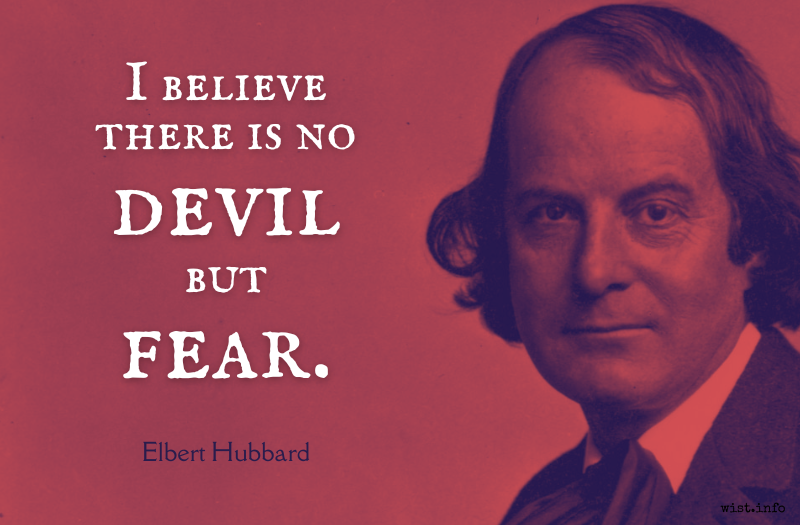
I believe there is no devil but fear.
Therefore ye Furies who with vengeful ire
Visit men’s deeds, whose brows with serpents crowned
Show the heart’s blast of wrath, haste hither, haste,
And listen to the words of my complaint
Forced from the depths of my unhappy heart,
O! helpless, burning, blinded, frenzied me!
But since it is God’s truth my heart reveals,
Suffer not yet my woe to come to nought,
But ev’n as Theseus left me desolate,
Such desolation whelm his life, his home.[Quare, facta virum multantes vindice poena
Eumenides, quibus anguino redimita capillo
frons exspirantis praeportat pectoris iras,
huc huc adventate, meas audite querelas,
quas ego, vae miserae, extremis proferre medullis
cogor inops, ardens, amenti caeca furore.
Quae quoniam verae nascuntur pectore ab imo,
vos nolite pati nostrum vanescere luctum,
sed quali solam Theseus me mente reliquit,
tali mente, deae, funestet seque suosque.]Catullus (c. 84 BC – c. 54 BC) Latin poet [Gaius Valerius Catullus]
Carmina # 64 “The Nuptuals of Peleus and Thetis,” ll. 193-202 [tr. MacNaghten (1925)]
(Source)
Ariadne's curse on Theseus, who abandoned her on a desert island after she eloped with him.
(Source (Latin)). Alternate translations:And you, Eumenides, with snaky hair,
Who for men's crimes due chastisements prepare;
Whose inward rage sits pictur'd on your brows;
O, hither come, and listen to my woes!
Woes pour'd in torture from my inmost soul,
Where burning phrenzy, and wild tumult roll!
Rack'd is this breast with no fictitious pain;
Then hear my pray'r, just maids, nor hear in vain!
And grant that Theseus, and his race may share
Such fate accurst, as now I'm doom'd to bear!
[tr. Nott (1795)]Ye, who avenge their crimes on all mankind,
Furies, whose hair with angry snakes entwined
Paint on the threatening brow the hell-born breast,
Haste, hither haste, and hear my fell request.
'Tis helpless frenzy, senseless, blind despair;
Teach me, 'tis all that's left, my frantic prayer;
Rend from my secret heart each cold restraint,
And pour forth all my soul in my complaint.
Since then it warmly flows from heartfelt pain,
Let me not speak my rage, my grief in vain;
But grant, that still the reckless, ruthless mind
Which made him fly, and leave a wretch behind,
May guide, may urge his life with headlong pace,
Till Theseus curse alike himself and all his race
[tr. Lamb (1821)]Come ye that wreak on man his guilt with retribution dire,
Ye maids, whose snake-wreathed brows bespeak your bosoms' vengeful ire!
Come ye , and hearken to the curse which I, of sense forlorn,
Hurl from the ruins of a heart with mighty anguish torn!
Though there be fury in my words, and madness in my brain,
Let not my cry of woe and wrong assail your ears in vain!
Urge the false heart that left me here still on with head long chase
From ill to worse, till Theseus curse himself and all his race!
[tr. T. Martin (1861)]Ye powers ! who to the crimes of men dire chastisement assign;
Eumenides! around whose heads the snaky ringlets twine;
Whose brows portray the hellish wrath that rankles in your breast;
Oh! hither, hither haste, and list to this the sad request
Which from my inmost soul, alas! to misery consigned,
I'm forced to pour -- a helpless wretch, with burning madness blind;
And since even from my bosom's depths these bursts of anguish stream,
Oh, doom them not to vanish like an airy, idle dream,
But let him in that soul, in which he has abandon'd me,
Bring on himself and all his race death and black infamy.
[tr. Cranstoun (1867)]Then, O sworn to requite man's evil wrathfully, Powers
Gracious, on whose grim brows, with viper tresses inorbed,
Looks red-breathing forth your bosom's feverous anger;
Now, yea now come surely, to these loud miseries harken,
All I cry, the afflicted, of inmost marrow arising,
Desolate, hot with pain, with blinding fury bewilder'd.
Yet, for of heart they spring, grief's children truly begotten,
Verily, Gods, these moans you will not idly to perish.
But with counsel of evil as he forsook me deceiving,
Death to his house, to his heart, bring also counsel of evil.
[tr. Ellis (1871)]Therefore, O you who 'venge man's deed with penalties direful,
Eumenides! aye wont to bind with viperous hairlocks
Foreheads, -- Oh, deign outspeak fierce wrath from bosom outbreathing,
Hither, Oh hither, speed, and lend you all ear to my grievance,
Which now sad I (alas!) outpour from innermost vitals
Maugre my will, sans help, blind, fired with furious madness.
And, as indeed all spring from veriest core of my bosom,
Suffer you not the cause of grief and woe to evanish;
But with the Will wherewith could Theseus leave me in loneness,
Goddesses! bid that Will lead him, lead his, to destruction.
[tr. Burton (1893)]Wherefore you requiters of men's deeds with avenging pains, O Eumenides, whose front enwreathed with serpent-locks blazons the wrath exhaled from your bosom, come here, here, listen to my complaint, which I, sad wretch, am urged to outpour from my innermost marrow, helpless, burning, and blind with frenzied fury. And since in truth they spring from the very depths of my heart, be unwilling to allow my agony to pass unheeded, but with such mind as Theseus forsook me, with like mind, O goddesses, may he bring evil on himself and on his kin.
[tr. Smithers (1894)]Therefore , O ye that visit the deeds of men with vengeful pains, ye Eumenides, whose foreheads bound with snaky hair bear on their front the wrath which breathes from your breast, hither, hither haste, hear my complaints which I ( ah , unhappy!) utter from my inmost heart perforce, helpless, burning, blinded with raging frenzy. For since my woes come truthfully from the depths of my heart, suffer not ye my grief to come to nothing but even as Theseus left me desolate, so, goddesses, may he bring ruin on himself and his own!
[tr. Warre Cornish (1904)]Wherefore, ye Furies, ye who on men's sin
Due punishment inflict, whose very hair
In viper's form reveals the rage within,
Hither in judgment come and hear my prayer;
The only outlet for my helpless wrath,
As blind with rage I burn and pour it forth.
And as I launch my curses from my soul,
I charge you guard them till they reach their goal;
God grant the shallow heart that left me here
Bring death on those that Theseus holds most dear.
[tr. Symons-Jeune (1923)]Ye, then, who vindicate their deeds of shame
On guilty men; whose vengeance-breathing breast
Speaks in the snaky hair, the withering flame:
Come, Furies, come! Give ear to the request
An injured woman makes, with maddening woe oppressed.
Since forced by sad misfortune I complain;
Since deep and true the sorrows that I bear;
Ah, let not my petition be in vain!
Let the vile author of my misery share
As sad a fate, as gloomy a despair,
As brought his cruel deed on wretched me!
[tr. Wright (1926)]Hear me gods whose antiquity flows backward beyond the time of man, whose vengeance falls on all, O wake again
with snakes circling your foreheads and now releasing rivers of blood pouring from sightless eyes,
make these the signals of the anger (red coals in your breasts) that brings you out of the forgotten
womb of time. Hear what I say, look at my heart, wrapped round with flames, my soul in madness, O remember
these last words spoken from my heart, O gods! And as Theseus has now forgotten me, make him a stranger
to his own soul, so that the architecture of his mind falls to ruin.
[tr. Gregory (1931)]O Furies, charged with vengeance that punishes evil,
you whose bleak foreheads are girded with writhing serpents
which clearly display the outrage yo7ur cold hearts keep hidden,
come here to me quickly, listen to my lamentation,
which I deliver in pain from the depths of my passion,
unwilling forced to, afire, blinded with madness!
-- Since what I say is the truth, since I say it sincerely,
do not allow my lament to fade with out issue:
but just as Theseus carelessly left me to die here,
may that same carelessness ruin him and his dearest!
[tr. C. Martin (1979)]Therefore, you that punish with avenging price men's crimes,
Furies, Eumenides, whose brows, bound with serpents for tresses,
announce the rages of your panting chests,
Be here! Be here! Respond to my complaints
which I -- pitiful I -- am forced to bring out from my very bones,
helpless, burning, blind with mindless rage.
Since those are true-born from my deepest heart,
do not allow my suffering to gutter out.
Goddesses, may the same intent that left me behind, alone,
defile Theseus himself and his own with death.
[tr. Banks (1997)]So you Eumenides who punish by avenging
the crimes of men, your foreheads crowned
with snaky hair, bearing anger in your breath,
here, here, come to me, listen to my complaints,
that I, wretched alas, force, weakened, burning,
out of the marrow of my bones, blind with mad rage.
Since these truths are born in the depths of my breast,
you won’t allow my lament to pass you by,
but as Theseus left me alone, through his intent,
goddesses, by that will, pursue him and his with murder.
[tr. Kline (2001)]So, you whose vengeful exactions answer men's crimes, you Furies whose snake-wreathed brows announce the wrath gusting up from your secret hearts, I summon you here to me now: give ear to the complaints which I in my misery am forced to dredge up from the inmost core of my being -- helpless, burning, blinded by mindless frenzy. But since they're the true products of my private heart, don't let my grief all go for nothing; rather in just such a mood as Theseus abandoned me to my lonely fate, let him, goddesses, now doom both himnself and his!
[tr. Green (2005)]Wherefore, Eumenides, punishing the deeds of men with avenging penalty,
to whom the forehead having been encircled with snaky hair
carries forth angers breathing out of the chest,
here come here, hear my complaints,
which I , alas wretched, have been compelled to bring forth
from the bottom marrows helpless, burning, blind with crazy fury.
Since such things are being born from the deepest chest,
you don't suffer our grief to wane,
but with what type of mind Theseus left me alone,
let him pollute both himself and his own with death, goddesses
[tr. Wikisource (2018)]

In the four quarters of the globe, who reads an American book? Or goes to an American play? or looks at an American picture or statue? What does the world yet owe to American physicians or surgeons? What new substances have their chemists discovered? Or what old ones have they advanced? What new constellations have been discovered by the telescopes of Americans? Who drinks out of American glasses? Or eats from American plates? Or wears American coats or gowns? or sleeps in American blankets? Finally, under which of the old tyrannical governments of Europe is every sixth man a slave, whom his fellow-creatures may buy and sell and torture?
Sydney Smith (1771–1845) English clergyman, essayist, wit
Edinburgh Review, No. 65, Article 3 (1820-01)
(Source)
Review of Adam Seybert, Statistical Annals of the United States of America (1818).
IMPARTIAL, adj. Unable to perceive any promise of personal advantage from espousing either side of a controversy or adopting either of two conflicting opinions.
Ambrose Bierce (1842–1914?) American writer and journalist
“Impartial,” The Cynic’s Word Book (1906)
(Source)
Included in The Devil's Dictionary (1911). Originally published in the "Devil's Dictionary" column in the San Francisco Wasp (1885-09-12).
A fresh hope is astir. From many quarters comes the call to a new kind of education with its initial assumption affirming that education is life — not a mere preparation for an unknown kind of future living. Consequently all static concepts of education which relegate the learning process to the period of youth are abandoned. The whole of life is learning, therefore education can have no endings,
Eduard C. Lindeman (1885–1953) American educator
The Meaning of Adult Education, ch. 1 (1926)
(Source)
CYCLOPS: I sacrifice to no one save myself and this belly, the greatest of deities; but to the gods, not I!
[ΚΥΚΛΩΨ: ἁγὼ οὔτινι θύω πλὴν ἐμοί, θεοῖσι δ᾽ οὔ,
καὶ τῇ μεγίστῃ, γαστρὶ τῇδε, δαιμόνων.]Euripides (485?-406? BC) Greek tragic dramatist
Cyclops [Κύκλωψ], l. 334ff (c. 424-23 BC) [tr. Coleridge (1913)]
(Source)
(Source (Greek)). Alternate translations:POLYPHEME:To no other God except myself,
And to this belly, greatest of the Gods,
I sacrifice.
[tr. Wodhull (1809)]CYCLOPS:To what other God but to myself
And this great belly, first of deities,
Should I be bound to sacrifice?
[tr. Shelley (1819)]CYCLOPS: I sacrifice to my great Self, sir Sprat,
And to no god beside -- except, that is,
My belly, greatest of all deities.
[tr. Way (1916)]CYCLOPS: I sacrifice to no god save myself --
And to my belly, greatest of deities.
[ed. Adams (1952)]CYCLOPS: I sacrifice to no one but myself -- never to the gods -- and to my belly, the greatest of divinities.
[tr. Kovacs (1994)]
As wealth grows, worry grows, and thirst for more wealth.
[Crescentem sequitur cura pecuniam,
Maiorumque fames.]Horace (65–8 BC) Roman poet, satirist, soldier, politician [Quintus Horatius Flaccus]
Odes [Carmina], Book 3, # 16, l. 17ff (3.16.17-18) (23 BC) [tr. Michie (1963)]
(Source)
(Source (Latin)). Alternate translations:With growing riches cares augment,
And thirst of greater.
[tr. Fanshawe; ed. Brome (1666)]Care still attends encreasing store,
And craving Appetite for more
[tr. Creech (1684)]As riches grow, care follows: men repine
And thirst for more.
[tr. Conington (1872)]Care, and a thirst for greater things, is the consequence of increasing wealth.
[tr. Smart/Buckley (1853)]But as wealth into our coffers flows in still increasing store,
So, too, still our care increases, and the hunger still for more.
[tr. Martin (1864)]Care grows with wealth, with wealth the greed for more.
[tr. Bulwer-Lytton (1870)]The care of wealth, together with the thirst for more, attend increasing riches.
[tr. Elgood (1893)]But care with growing treasure grows,
And thirst for more.
[tr. Gladstone (1894)]Wealth, the faster it grows, is but the prey of care,
And of lusting for more.
[tr. Phelps (1897)]Care follows growing wealth, and thirst for more.
[tr. Garnsey (1907)]As riches grow, care follows, and a thirst
For more and more.
[tr. Marshall (1908)]Yet as money grows, care and greed for greater riches follow after.
[tr. Bennett (Loeb) (1912)]Increase of wealth and greed bring on
Care.
[tr. Mills (1924)]But gold brings both greed and
Trouble on its back.
[tr. Raffel (1983)]The more the money grows the more the greed
Grows too; also the anxiety of greed.
[tr. Ferry (1997)]But with increasing wealth, follow
anxiety and greed for more and more.
[tr. Alexander (1999)]Anxiety, and the hunger for more, pursues
growing wealth.
[tr. Kline (2015)]
Praise out of season, or tactlessly bestowed, can freeze the heart as much as blame. To praise for the wrong possession or attribute can wound beyond amends.
Pearl S. Buck (1892–1973) American writer
To My Daughters, with Love, ch. 4 “First Meeting” (1967)
(Source)

Thus in the winter stands the lonely tree,
Nor knows what birds have vanished one by one,
Yet knows its boughs more silent than before:
I cannot say what loves have come and gone,
I only know that summer sang in me
A little while, that in me sings no more.Edna St. Vincent Millay (1892–1950) American poet
Sonnet 43 “What lips my lips have kissed, and where, and why,” ll. 9ff. (1920), The Harp-Weaver and Other Poems (1923)
(Source)
Originally published in Vanity Fair (1920-11).
If there’s another world, he lives in bliss;
If there is none, he made the best of this.Robert Burns (1759–1796) Scottish national poet
“Epitaph on My Own Friend and My Father’s Friend, William Muir in Tarbolton,” ll. 7-8 (1784-04), First Commonplace Book (1785).
(Source)
A mock epitaph for William Muir (1745-1793), a miller in Tarbolton and good friend to Burns' family.
The best smell is bread, the best savour, salt, the best love that of children.
George Herbert (1593–1633) Welsh priest, orator, poet.
Jacula Prudentum, or Outlandish Proverbs, Sentences, &c. (compiler), # 7841 (1640 ed.)
(Source)
In England such concepts as justice, liberty and objective truth are still believed in. They may be illusions, but they are very powerful illusions.
George Orwell (1903–1950) English journalist, essayist, writer [pseud. of Eric Arthur Blair]
Essay (1941-02-19), “The Lion and the Unicorn: Socialism and the English Genius,” Part 1 “England Your England,” sec. 2, The Searchlight Books [ed. Fyvel and Orwell]
(Source)
Part of Part 1, "England Your England" with the title "The Ruling Class" was previously published in Horizon (1940-12).

What counts now is not just what we are against, but what we are for. Who leads us is less important than what leads us — what convictions, what courage, what faith — win or lose. A man doesn’t save a century, or a civilization, but a militant party wedded to a principle can.
Adlai Stevenson II (1900–1965) American politician, diplomat, statesman
Speech (1952-07-21), Democratic National Convention, Chicago
(Source)
I will not say that your mulberry-trees are dead, but I am afraid they are not alive.

Custom is the law of one description of fools, and fashion of another; but the two parties often clash; for precedent is the legislator of the first, and novelty of the last.
Charles Caleb "C. C." Colton (1780–1832) English cleric, writer, aphorist
Lacon: Or, Many Things in Few Words, Vol. 1, § 547 (1820)
(Source)
IDLENESS, n. A model farm where the devil experiments with seeds of new sins and promotes the growth of untried vices.
Ambrose Bierce (1842–1914?) American writer and journalist
“Idleness,” The Cynic’s Word Book (1906)
(Source)
Included in The Devil's Dictionary (1911). Originally published in the "Devil's Dictionary" column in the San Francisco Wasp (1885-08-29).
DEAR MISS MANNERS: Is it ever possible to be too polite?
GENTLE READER: When politeness is used to show up other people, it is reclassified as rudeness. Thus it is technically impossible to be too polite.
Judith Martin (b. 1938) American author, journalist, etiquette expert [a.k.a. Miss Manners]
Miss Manners Rescues Civilization, ch. 13 “Tradition Moves Ahead” (1996)
(Source)
"Miss Manners's Parting Shot." Concluding words of the book.

There are very few human beings who receive the truth, complete and staggering, by instant illumination. Most of them acquire it fragment by fragment, on a small scale, by successive developments, cellularly, like a laborious mosaic.

If you are brave too often, people will come to expect it of you.
Mignon McLaughlin (1913–1983) American journalist and author
The Second Neurotic’s Notebook, ch. 5 (1966)
(Source)

God helps them that help themselves.
Benjamin Franklin (1706–1790) American statesman, scientist, philosopher, aphorist
Poor Richard (1736 ed.)
(Source)
Sometimes misattributed as a Biblical proverb. A modern variant is "God helps those that help themselves."
LADY MACBETH: Look like th’ innocent flower,
But be the serpent under ‘t.William Shakespeare (1564–1616) English dramatist and poet
Macbeth, Act 1, sc. 5, l. 75ff (1.5.75-76) (1606)
(Source)
Her mind lives tidily, apart
From cold and noise and pain,
And bolts the door against her heart,
Out wailing in the rain.

Anxiety is love’s greatest killer. It creates the failures. It makes others feel as you might when a drowning man holds on to you. You want to save him, but you know he will strangle you with his panic.
The real sin against life is to abuse and destroy beauty, even one’s own — even more, one’s own, for that has been put in our care and we are responsible for its well-being.
Katherine Anne Porter (1890–1980) American journalist, essayist, author, political activist [b. Callie Russell Porter]
Ship of Fools, Part 3 [Freytag] (1962)
(Source)

It’s impossible to be loyal to your family, your friends, your country, and your principles, all at the same time.
Mignon McLaughlin (1913–1983) American journalist and author
The Neurotic’s Notebook, ch. 5 (1963)
(Source)
MACBETH: If it were done when ’tis done, then ’twere well
It were done quickly.William Shakespeare (1564–1616) English dramatist and poet
Macbeth, Act 1, sc. 7, l. 1ff (1.7.1-2) (1606)
(Source)
The fust intimashun i had that i waz gitting old waz, i found myself telling to mi friends the same storys over again.
[The first intimation I had that I was getting old was, I found myself telling to my friends the same stories over again.]
Josh Billings (1818–1885) American humorist, aphorist [pseud. of Henry Wheeler Shaw]
Everybody’s Friend, Or; Josh Billing’s Encyclopedia and Proverbial Philosophy of Wit and Humor, ch. 155 “Affurisms: Ink Lings” (1874)
(Source)
There is a quality even meaner than outright ugliness or disorder, and this meaner quality is the dishonest mask of pretended order, achieved by ignoring or suppressing the real order that is struggling to exist and to be served.
Jane Jacobs (1916–2006) American-Canadian journalist, author, urban theorist, activist
The Death and Life of Great American Cities, Introduction (1961)
(Source)
On urban planning that disregards actual needs for gratuitous features that please outside observers.
“It’s just Eeyore,” said Piglet. “I thought your Idea was a very good Idea.”
Pooh began to feel a little more comfortable, because when you are a Bear of Very Little Brain, and you Think of Things, you find sometimes that a Thing which seemed very Thingish inside you is quite different when it gets out into the open and has other people looking at it.A. A. Milne (1882–1956) English poet and playwright [Alan Alexander Milne]
House at Pooh Corner, ch. 6 “Eeyore Joins the Game” (1928)
(Source)
TEMPTATION. An irresistible force at work on a movable body.
H. L. Mencken (1880–1956) American writer and journalist [Henry Lewis Mencken]
A Book of Burlesques, “The Jazz Webster” (1924)
(Source)
Variant:Temptation is an irresistible force at work on a movable body.
[Chrestomathy, ch. 30 "Sententiae" (1949)]
An Army of Trumpeters would give as great a Strength to a Cause, as this Confederacy of Tongue-Warriours; who like those military Musicians, content themselves with animating their Friends to Battel, and run out of the Engagement upon the first Onset.
Joseph Addison (1672–1719) English essayist, poet, statesman
Essay (1716-03-26), The Freeholder, No. 28
(Source)
Regarding those supporting the Jacobite risings of the late 17th and early 18th Centuries.
Do not allow your children to mix drinks. It is unseemly and they use too much vermouth.
Fran Lebowitz (b. 1950) American journalist, essayist
Social Studies, “Parental Guidance” (1981)
(Source)

There is a sort of man who pays no attention to his good actions, but is tormented by his bad ones. This is the type that most often writes about himself.
W. Somerset Maugham (1874–1965) English novelist and playwright [William Somerset Maugham]
The Summing Up, ch. 4 (1938)
(Source)

None are so desolate but something dear,
Dearer than self, possesses or possess’d
A thought, and claims the homage of a tear.George Gordon, Lord Byron (1788–1824) English poet
Childe Harold’s Pilgrimage, Canto 2, st. 24 (1812)
(Source)
When we think of loss we think of the loss, through death, of people we love. But loss is a far more encompassing theme in our life. For we lose not only through death, but also by leaving and being left, by changing and letting go and moving on. And our losses include not only our separations and departures from those we love, but our conscious and unconscious losses of romantic dreams, impossible expectations, illusions of freedom and power, illusions of safety — and the loss of our own younger self, the self that thought it would always be unwrinkled and invulnerable and immortal.
Judith Viorst (b. 1931) American writer, journalist, psychoanalysis researcher
Necessary Losses, Introduction (1986)
(Source)

I’m growing fonder of my staff;
I’m growing dimmer in the eyes;
I’m growing fainter in my laugh;
I’m growing deeper in my sighs;
I’m growing careless of my dress;
I’m growing frugal of my gold;
I’m growing wise; I’m growing, — yes, —
I’m growing old!
Let me make one principle of this administration abundantly clear: All of these increased opportunities — in employment, in education, in housing, and in every field — must be open to Americans of every color. As far as the writ of Federal law will run, we must abolish not some, but all racial discrimination. For this is not merely an economic issue, or a social, political, or international issue. It is a moral issue, and it must be met by the passage this session of the bill now pending in the House.
Lyndon B. Johnson (1908–1973) American politician, educator, US President (1963–69)
Speech (1964-01-08), “State of the Union,” Joint Session of Congress, Washington, D. C.
(Source)
Law sutes consume time, and mony, and rest, and friends.
[Lawsuits consume time, and money, and rest, and friends.]
George Herbert (1593–1633) Welsh priest, orator, poet.
Jacula Prudentum, or Outlandish Proverbs, Sentences, &c. (compiler), # 776 (1640 ed.)
(Source)
Gradually we become tired of the old, of what we safely possess, and we stretch out our hands again. Even the most beautiful scenery is no longer assured of our love after we have lived in it for three months, and some more distant coast attracts our avarice: possessions are generally diminished by possession.
[Wir werden des Alten, sicher Besessenen allmählich überdrüssig und strecken die Hände wieder aus; selbst die schönste Landschaft, in der wir drei Monate leben, ist unserer Liebe nicht mehr gewiss, und irgend eine fernere Küste reizt unsere Habsucht an: der Besitz wird durch das Besitzen zumeist geringer.]Friedrich Nietzsche (1844–1900) German philosopher and poet
The Gay Science [Die fröhliche Wissenschaft], Book 1, § 14 (1882) [tr. Kaufmann (1974)]
(Source)
Also known as La Gaya Scienza, The Joyful Wisdom, or The Joyous Science.
(Source (German)). Alternate translations:We gradually become satiated with the old, the securely possessed, and again stretch out our hands; even the finest landscape in which we live for three months is no longer certain of our love, and any kind of more distant coast excites our covetousness: the possession for the most part becomes smaller through possessing.
[tr. Common (1911)]We slowly grow tired of the old, of what we safely possess, and we stretch our our hands again; even the most beautiful landscape is no longer sure of our love after we have lived in it for three months, and some more distant coast excites our greed: possession usually diminishes the possession.
[tr. Nauckhoff (2001)]We gradually grow weary of the old, familiar things we securely hold, and again stretch forth our hands; even the most beautiful landscape lived in for three months is no longer assured of our love, and some more distant shore excites our avarice: what is had loses much in the having.
[tr. Hill (2018)]
… [T]he three great elements of modern civilization, Gunpowder, Printing, and the Protestant Religion ….
Thomas Carlyle (1795–1881) Scottish essayist and historian
“The State of German Literature,” Edinburgh Review No. 92, Art. 2 (1827-10)
(Source)
A review of Franz Horn's The Poetry and Oratory of the Germans, from Luther's Time to the Present (1822-1824), and Outlines for the History and Criticism of Polite Literature in German, 1790-1818 (1819).
Collected in Critical and Miscellaneous Essays (1827-1855).
On the other hand, even if we cannot see beauty in particular measured results, we can already claim to see a certain beauty in the equations which describe general physical laws. For example, in the wave equation (20.9), there’s something nice about the regularity of the appearance of the x, the y, the z, and the t. And this nice symmetry in appearance of the x, y, z, and t suggests to the mind still a greater beauty which has to do with the four dimensions, the possibility that space has four-dimensional symmetry, the possibility of analyzing that and the developments of the special theory of relativity. So there is plenty of intellectual beauty associated with the equations.
Richard Feynman (1918–1988) American physicist
The Feynman Lectures on Physics, Vol. 2, ch. 20 “Solutions of Maxwell’s Equations in Free Space,” sec. 20–3 “Scientific Imagination” (1964)
(Source)
We all git tired pretty soon looking at a goose standing on one leg.
Josh Billings (1818–1885) American humorist, aphorist [pseud. of Henry Wheeler Shaw]
Everybody’s Friend, Or; Josh Billing’s Encyclopedia and Proverbial Philosophy of Wit and Humor, ch. 155 “Affurisms: Ink Lings” (1874)
(Source)
Self-respect will keep a man from being abject when he is in the power of enemies, and will enable him to feel that he may be in the right when the world is against him. If a man has not this quality, he will feel that majority opinion, or governmental opinion, is to be treated as infallible, and such a way of feeling, if it is general, makes both moral and intellectual progress impossible.
Bertrand Russell (1872–1970) English mathematician and philosopher
Lecture (1949-01-16), “The Conflict of Technique and Human Nature,” Reith Lecture, “Authority and the Individual” No. 4, BBC Radio
(Source)
Any coward can fight a battle when he’s sure of winning; but give me the man who has pluck to fight when he’s sure of losing. That’s my way, sir; and there are many victories worse than a defeat.
George Eliot (1819–1880) English novelist [pseud. of Mary Ann Evans]
Scenes of Clerical Life, “Janet’s Repentance,” ch. 6 (1857)
(Source)
Endeavour rather to get the Approbation of a few good Men, than the Huzza of the Mob.
Thomas Fuller (1654–1734) English physician, preacher, aphorist, writer
Introductio ad Prudentiam, Vol. 1, # 512 (1725)
(Source)

Greed is not good. Being rapacious doesn’t make you a capitalist, it makes you a sociopath. And in an economy as dependent upon cooperation at scale as ours, sociopathy is as bad for business as it is for society.
Nick Hanauer (b. 1959) American entrepreneur and venture capitalist [Nicolas Joseph Hanauer]
Lecture (2019-07) “The Dirty Secret of Capitalism — and a New Way Forward,” TEDsummit, Edinburgh
(Source)
(Source (Video), 14:19)

But now persecution is good, because it exists; every law which originated in ignorance and malice, and gratifies the passions from whence it sprang, we call the wisdom of our ancestors: when such laws are repealed, they will be cruelty and madness; till they are repealed, they are policy and caution.
Sydney Smith (1771–1845) English clergyman, essayist, wit
The Letters of Peter Plymley, Letter 5 (1807)
(Source)
IGNORAMUS, n. A person unacquainted with certain kinds of knowledge familiar to yourself, and having certain other kinds that you know nothing about.
Ambrose Bierce (1842–1914?) American writer and journalist
“Ignoramus,” The Cynic’s Word Book (1906)
(Source)
Included in The Devil's Dictionary (1911). Originally published in the "Devil's Dictionary" column in the San Francisco Wasp (1885-08-29).
I had been gone a fortnight when the telegram was put into my hands. I had got a letter from my sister, a few hours before, saying that all was well at home. The telegram said in five words that she had died suddenly the previous night. There was no mention of my mother, and I was three days’ journey from home.
The news I got on reaching London was this: my mother did not understand that her daughter was dead, and they were waiting for me to tell her.J. M. Barrie (1860–1937) Scottish novelist and dramatist [James Matthew Barrie]
Margaret Ogilvy, ch. 10 “Art Thou Afraid His Power Shall Fail?” (1896)
(Source)
The book is a biographical work about his mother and family.
The need for a body of common knowledge and common reference does not disappear when a society is largely pluralistic, as ours has become. On the contrary, it grows more necessary, so that people of different origins and occupation may quickly find familiar ground and, as we say, speak a common language. It not only saves time and embarrassment, but it also ensures a kind of mutual confidence and good will. One is not addressing an alien, blank as a stone wall, but a responsive creature whose mind is filled with the same images, memories, and vocabulary as oneself.
True or false, what is said about men often figures as large in their lives, and above all in the fate that befalls them, as what they do.
[Vrai ou faux, ce qu’on dit des hommes tient souvent autant de place dans leur vie et souvent dans leur destinée que ce qu’ils font.]Victor Hugo (1802–1885) French writer, journalist, human rights activist, politician
Les Misérables, Part 1 “Fantine,” Book 1 “An Upright Man,” ch. 1 (1.1.1) (1862) [tr. Donougher (2013)]
(Source)
(Source (French)). Alternate translations:Be it true or false, what is said about men often has as much influence upon their lives, and especially upon their destinies, as what they do.
[tr. Wilbour (1862)]What is said of men, whether it be true or false, often occupies as much space in their life, and especially in their destiny, as what they do.
[tr. Wraxall (1862)]True or false, that which is said of men often occupies as important a place in their lives, and above all in their destinies, as that which they do.
[tr. Hapgood (1887)]What is reported of men, whether it be true or false, may play as large a part in their lives, and above all in their destiny, as the things they do.
[tr. Denny (1976)]Whether true or false, what is said about men often has as much influence on their lives, and particularly on their destinies, as what they do.
[tr. Wilbour/Fahnestock/MacAfee (1987)]
Unity, like so many good things, is good only in moderation. The same can be said of disunity.
Jane Jacobs (1916–2006) American-Canadian journalist, author, urban theorist, activist
Dark Age Ahead, ch. 1 “The Hazard” (2004)
(Source)
The rich are like beasts of burden, carrying treasure all day, and at the night of death unladen; they carry to their grave only the bruises and marks of their toil.
Augustine of Hippo (354–430) Christian church father, philosopher, saint [b. Aurelius Augustinus]
(Attributed)
I could not find something similar to this in searches of Augustine's writings. The usual earliest citation for this wording is Josiah Hotchkiss Gilbert, ed., Dictionary of Burning Words of Brilliant Writers (1895). But it previously shows up in Edward Payson Tenney, Jubilee Essays: A Plea for the Unselfish Life, "The Retributions" (1862), though again with no original citation.
See, in contrast, Matthew 11:28-30.

Come to me, all you who labour and are overburdened, and I will give you rest. Shoulder my yoke and learn from me, for I am gentle and humble in heart, and you will find rest for your souls. Yes, my yoke is easy and my burden light.
[Δεῦτε πρός με πάντες οἱ κοπιῶντες καὶ πεφορτισμένοι κἀγὼ ἀναπαύσω ὑμᾶς. ἄρατε τὸν ζυγόν μου ἐφ’ ὑμᾶς καὶ μάθετε ἀπ’ ἐμοῦ ὅτι πραΰς εἰμι καὶ ταπεινὸς τῇ καρδίᾳ καὶ εὑρήσετε ἀνάπαυσιν ταῖς ψυχαῖς ὑμῶν. ὁ γὰρ ζυγός μου χρηστὸς καὶ τὸ φορτίον μου ἐλαφρόν ἐστιν.]
The Bible (The New Testament) (AD 1st - 2nd C) Christian sacred scripture
Book 1. Gospel of Matthew 11:28ff (Matt 11:28–30) (Jesus) [JB (1966)]
(Source)
No Synoptic parallels.
(Source (Greek)). Alternate translations:Come unto me, all ye that labour and are heavy laden, and I will give you rest. Take my yoke upon you, and learn of me; for I am meek and lowly in heart: and ye shall find rest unto your souls. For my yoke is easy, and my burden is light.
[KJV (1611)]Come to me, all of you who are tired from carrying heavy loads, and I will give you rest. Take my yoke and put it on you, and learn from me, because I am gentle and humble in spirit; and you will find rest. For the yoke I will give you is easy, and the load I will put on you is light.
[GNT (1976)]Come to me, all you who labour and are overburdened, and I will give you rest. Shoulder my yoke and learn from me, for I am gentle and humble in heart, and you will find rest for your souls. Yes, my yoke is easy and my burden light.
[NJB (1985)]Come to me, all you who are struggling hard and carrying heavy loads, and I will give you rest. Put on my yoke, and learn from me. I’m gentle and humble. And you will find rest for yourselves. My yoke is easy to bear, and my burden is light.
[CEB (2011)]Come to me, all you who are weary and are carrying heavy burdens, and I will give you rest. Take my yoke upon you, and learn from me, for I am gentle and humble in heart, and you will find rest for your souls. For my yoke is easy, and my burden is light.
[NRSV (2021 ed.)]

We are so bound together that no man can labor for himself alone. Each blow he strikes in his own behalf helps to mold the Universe.
Jerome K. Jerome (1859–1927) English writer, humorist [Jerome Klapka Jerome]
Idle Thoughts of an Idle Fellow, “On Getting on in the World” (1886)
(Source)
First published in Home Chimes (1885-01-24).
MACBETH: If we should fail —
LADY MACBETH: We fail!
But screw your courage to the sticking-place,
And we’ll not fail.William Shakespeare (1564–1616) English dramatist and poet
Macbeth, Act 1, sc. 7, l. 68ff (1.7.68-71) (1606)
(Source)
The sticking-place on a crossbow was where the bowstring was screwed or wound to prior to its bolt being shot.
The line was most famously revived by Howard Ashman in the lyrics to "The Mob Song [Kill the Beast]" in Beauty and the Beast (1991). Lin-Manuel Miranda also included the line (amidst many other Macbeth references) in Hamilton (2015), in the song "Take a Break."
Poets, orators, even philosophes, say the same things about fame we were told as boys to encourage us to win prizes. What they tell children to make them prefer being praised by their nannies to eating jam tarts is the same idea constantly drummed into us to encourage us to sacrifice our real interests in the hope of being praised by our contemporaries or by posterity.
[Ce que les poètes, les orateurs, même quelques philosophes nous disent sur l’amour de la Gloire, on nous le disait au Collège, pour nous encourager à avoir les prix. Ce que l’on dit aux enfans pour les engager à préférer à une tartelette les louanges de leurs bonnes, c’est ce qu’on répète aux hommes pour leur faire préférer à un intérêt personnel les éloges de leurs contemporains ou de la postérité.]Nicolas Chamfort (1741–1794) French writer, epigrammist (b. Nicolas-Sébastien Roch)
Products of Perfected Civilization [Produits de la Civilisation Perfectionée], Part 1 “Maxims and Thoughts [Maximes et Pensées],” ch. 1, ¶ 85 (1795) [tr. Parmée (2003), ¶ 69]
(Source)
(Source (French)). Alternate translations:The things which poets, orators, and even a few philosophers tell us about the love of Glory, are exactly the things we are told at College to encourage us to win prizes. And what they say to children to make them prefer the praise of their nurses to a tartlet, they repeat to grown men to make them prefer the eulogy of their fellows or of posterity to personal advantage.
[tr. Mathers (1926)]All that the poets, the orators, and even certain philosophers tell us about the love of fame we were told at school to urge us to win prizes. All that is said to encourage children to prefer the praise of their mentors to a piece of pie is repeated to men to make them consider their personal profit less desirable than the plaudits of their contemporaries and of posterity.
[tr. Merwin (1969)]Things said by poets, orators, even some philosophers, about love of glory, were told to us at the Collège to encourage us to win prizes. What children are told to incline them to prefer a slice of tart to their nurses' approval, is the same as what men are repeatedly told to make them put the commendation of their contemporaries, or that of posterity, before their personal interest.
[tr. Pearson (1973)]What poets, orators, even several philosophers have said about the love of fame, was told to us at school to encourage us to win prizes.
[tr. Dusinberre (1992)]What poets, orators, and even philosophers say to us about love of glory is the same as what people said to us in the colleges to encourage us to compete for prizes. What people tell children to make them prefer the praise of their nurses to something silly is the same thing that people repeat to men to make them prefer the praise of their contemporaries or of posterity to their own self-interest.
[tr. Siniscalchi (1994)]
A book is not only a friend, it makes friends for you. When you have possessed a book with mind and spirit, you are enriched. But when you pass it on you are enriched threefold.
Henry Miller (1891–1980) American novelist
The Books in My Life, ch. 1 “They Were Alive and They Spoke to Me” (1952)
(Source)

I will explain myself more clearly, — the Germans add, when they have explained themselves clearly.
[Ich will mich deutlicher erklären, setzen die Deutschen hinzu, wenn sie sich deutlich erklärt haben.]
Jean Paul Richter (1763–1825) German writer, art historian, philosopher, littérateur [Johann Paul Friedrich Richter; pseud. Jean Paul]
Titan, Jubilee 31, cycle 122 [Schoppe] (1803) [tr. Brooks (1863)]
(Source)

Let Tom and Jane not think, because they see
one man is picking pockets and another
is offering all his goods to charity,
that they can judge their neighbors with God’s eyes:
for the pious man may fall, and the thief may rise.[Non creda donna Berta e ser Martino,
per vedere un furare, altro offerere,
vederli dentro al consiglio divino;
ché quel può surgere, e quel può cadere.]Dante Alighieri (1265–1321) Italian poet
The Divine Comedy [Divina Commedia], Book 3 “Paradiso,” Canto 13, l. 139ff (13.139-142) [Thomas Aquinas] (1320) [tr. Ciardi (1970)]
(Source)
Berta and Martino were common names in Dante's era, and stand in for "ordinary people" (with a sarcastic hint of pretension by giving them minor titles). Most translators use a straight translation of the names to Bertha and Martin; others change them to something more modern to reflect their everyman status.
(Source (Italian)). Alternate translations:The pious man
May fail ; the Penitent, altho' by spoil
He liv'd, may purchase Heav'n by arduous toil
Ere death: it is not our's their fate to scan.
[tr. Boyd (1802), st. 24]Seeing one steal,
Another bring, his offering to the priest,
Let not Dame Bertha and Sir Martin thence
Into heav’n’s counsels deem that they can pry:
For one of these may rise, the other fall.
[tr. Cary (1814)]Let not Nun Bertha and Saint Martin try,
Seeing one offer, and another steal,
The counsel of the heaven from that to tell:
For this may rise again, and that may fall.
[tr. Bannerman (1850)]Let not Dame Bertha nor Ser Martin think,
Seeing one steal, another offering make,
To see them in the arbitrament divine;
For one may rise, and fall the other may.
[tr. Longfellow (1867)]Let not Dame Bertha and Master Martin deem, for seeing one steal, another make offerings, that they are seeing them within the Divine counsel; for that one may be exalted and this may fall.
[tr. Butler (1885)]Let not Dame Bertha nor Sir Martin deem,
Because they see one rob, another pray,
That they can pry within the will supreme;
For one can rise, and one can fall away.
[tr. Minchin (1885)]Let not dame Bertha and master Martin, seeing one rob, and another make offering, believe to see them within the Divine counsel: for the one may rise and the other may fall.
[tr. Norton (1892)]Let not Dame Bertha or Squire Martin think, if they perceive one steal and one make offering, they therefore see them as in the divine counsel; for the one yet may rise and the other fall.
[tr. Wicksteed (1899)]Let not Dame Bertha and Master Martin, when they see one rob and another make an offering, think they see them within the divine counsel; for the one may rise and the other fall.
[tr. Sinclair (1939)]Let no Dame Bertha or Sir Martin deem,
Because they see one steal and one give all,
They see as divine forethought seéth them;
For the one yet may rise and the other fall.
[tr. Binyon (1943)]Let Jack and Jill not think they see so far
That, seeing this man pious, that a thief,
They see them such as in God's sight they are,
For one may rise, the other come to grief.
[tr. Sayers/Reynolds (1962)]Let not dame Bertha and squire Martin, if they see one steal and one make offering, believe to see them within the Divine Counsel: for the one may rise and the other may fall.
[tr. Singleton (1975)]Let not every Bertha and Martin think
Because they see one a thief, another respectable,
That they see how they are in the eyes of God;
For one may rise, and the other one may fall.
[tr. Sisson (1981)]Let not Dame Bertha or Master Martin think
that they have shared God’s Counsel when they see
one rob and see another who donates:
the last may fall, the other may be saved.
[tr. Mandelbaum (1984)]No Mr. or Miss Know-It-All should think,
when they see one man steal and one give alms
that they are seeing them through God's own eyes,
for one may yet rise up, the other fall.
[tr. Musa (1984)]Let not dame Bertha and messer Martin believe, because they see one stealing, another offering, that they see them within God’s counsel,
for that one can rise up, and this one can fall.
[tr. Durling (2011)]Do not let Jack and Jill think, that if they see someone steal or another make offering they therefore see them as Divine Wisdom does, since the one may still rise, and the other fall.
[tr. Kline (2002)]And so when Mrs Smith and Mr Jones
see one man steal, another offer alms,
don’t let them think they see this in God’s plan.
The thief may rise, the other take a fall.
[tr. Kirkpatrick (2007)]Let not Dame Bertha and Master Martin,
when they see one steal and another offer alms,
think that they behold them with God's wisdom,
for the first may still rise up, the other fall.
[tr. Hollander/Hollander (2007)]Let not Mrs. Judy and Mister John,
Seeing one man steal but another before
The altar with offerings, think one is sinful,
The other's in Heaven -- for people rise and fall.
[tr. Raffel (2010)]

The man of firm and righteous will,
No rabble, clamorous for the wrong,
No tyrant’s brow, whose frown may kill,
Can shake the strength that makes him strong.[Iustum et tenacem propositi virum
non civium ardor prava iubentium,
non voltus instantis tyranni
mente quatit solida]Horace (65–8 BC) Roman poet, satirist, soldier, politician [Quintus Horatius Flaccus]
Odes [Carmina], Book 3, # 3, l. 1ff (3.3.1-4) (23 BC) [tr. Conington (1872)]
(Source)
(Source (Latin)). Other translations:An honest and resolved man,
Neither a peoples tumults can,
Neither a Tyrants indignation,
Un-center from his fast foundation.
[tr. Fanshaw; ed. Brome (1666)]Not the rage of the people pressing to hurtful measures, not the aspect of a threatening tyrant can shake from his settled purpose the man who is just and determined in his resolution.
[tr. Smart/Buckley (1853)]He that is just, and firm of will
Doth not before the fury quake
Of mobs that instigate to ill,
Nor hath the tyrant's menace skill
His fixed resolve to shake.
[tr. Martin (1864)]Not the rage of the million commanding things evil,
Not the doom frowning near in the brows of the tyrant,
Shakes the upright and resolute man
In his solid completeness of soul.
[tr. Bulwer-Lytton (1870)]Neither the fury of the populace, commanding him to do what is wrong, nor the face of the despot which confronts him, [...] shakes from his solid resolve a just and determined man.
[tr. Elgood (1893)]The just man, in his purpose strong,
No madding crowd can bend to wrong.
The forceful tyrant's brow and word,
[...] His firm-set spirit cannot move.
[tr. Gladstone (1894)]Him who is just, and stands to his purpose true.
Not the unruly ardour of citizens
Shall shake from his firm resolution,
Nor visage of the oppressing tyrant.
[tr. Phelps (1897)]The upright man holding his purpose fast,
No heat of citizens enjoining wrongful acts,
No overbearing despot's countenance,
Shakes from his firm-set mind.
[tr. Garnsey (1907)]The man that's just and resolute of mood
No craze of people's perverse vote can shake,
Nor frown of threat'ning monarch make
To quit a purposed good.
[tr. Marshall (1908)]The man tenacious of his purpose in a righteous cause is not shaken from his firm resolve by the frenzy of his fellow citizens bidding what is wrong, not by the face of threatening tyrant.
[tr. Bennett (Loeb) (1912)]Who loves the Right, whose will is resolute,
His purpose naught can shake — nor rage of brute
Mob bidding him work evil; nor the eye
Of threatening despot
[tr. Mills (1924)]A mob of citizens clamouring for injustice,
An autocrat's grimace of rage [...] cannot stagger
The just and steady-purposed man.
[tr. Michie (1963)]The man who knows what's right and is tenacious
In the knowledge of what he knows cannot be shaken.
Not by people righteously impassioned
In a wrong cause, and not by menacings
Of tyrants' frowns.
[tr. Ferry (1997)]The just man, tenacious in his resolve,
will not be shaken from his settled purpose
by the frenzy of his fellow citizens
imposing that evil be done,
or by the frown of a threatening tyrant.
[tr. Alexander (1999)]The passion of the public, demanding what
is wrong, never shakes the man of just and firm
intention, from his settled purpose,
nor the tyrant’s threatening face.
[tr. Kline (2015)]Neither the passion of citizens demanding crooked things,
Not the face of a threatening tyrant
Shakes the man who is righteous and set in purpose
From his strong mind.
[tr. Wikisource (2021)]
What did you expect? I don’t know why we’re so surprised. When you put your foot on a man’s neck and hold him down for three hundred years, and then you let him up, what’s he going to do? He’s going to knock your block off.
Lyndon B. Johnson (1908–1973) American politician, educator, US President (1963–69)
Comment (1968-04-08) to George Christian
(Source)
Regarding the continuing rioting after the assassination of Martin Luther King, Jr., four days earlier.
Quoted in Nick Kotz, Judgment Days: Lyndon Baines Johnson, Martin Luther King, Jr., and the Laws that Changed America, ch. 14 (2005), from the author's interview with Christian.
Shew a good man his errour and he turnes it to a vertue, but an ill man doubles his fault.
George Herbert (1593–1633) Welsh priest, orator, poet.
Jacula Prudentum, or Outlandish Proverbs, Sentences, &c. (compiler), # 655 (1640 ed.)
(Source)
After awhile, when accusations are continually and sweepingly made against all men, good and bad, the public as a whole grow to believe that there is a little something bad about the decent man and that there is not much bad about the crook. No greater harm can be done to the body politic than by those men who, through reckless and indiscriminate accusation of good men and bad men, honest men and dishonest men alike, finally so hopelessly puzzle the public that they do not believe that any man in public life is entirely straight; while, on the other hand, they lose all indignation against the man who really is crooked.
Theodore Roosevelt (1858–1919) American politician, statesman, conservationist, writer; US President (1901–09)
Speech (1910-08-29) “The Nation and the States,” Colorado State Legislature, Denver
(Source)
Collected in Roosevelt, The New Nationalism, Part 1 (1910).
The thinker sees his own actions as experiments and questions, as seeking explanations of something: to him, success and failure are primarily answers.
[Der Denker sieht in seinen eigenen Handlungen Versuche und Fragen, irgend worüber Aufschluss zu erhalten: Erfolg und Misserfolg sind ihm zu allererst Antworten.]Friedrich Nietzsche (1844–1900) German philosopher and poet
The Gay Science [Die fröhliche Wissenschaft], Book 1, § 41 (1882) [tr. Nauckhoff (2001)]
(Source)
Also known as La Gaya Scienza, The Joyful Wisdom, or The Joyous Science.
(Source (German)). Other translations:The thinker sees in his own actions attempts and questionings to obtain information about something or other; success and failure are answers to him first and foremost.
[tr. Common (1911)]A thinker sees his own actions as experiments and questions -- as attempts to find out something. Success and failure are for him answers above all.
[tr. Kaufmann (1974)]In his own actions, the thinker sees experiments and enquiries from which he seeks to obtain insight: to him, success and failure are, first of all, answers.
[tr. Hill (2018)]
When we take people merely as they are, we make them worse; when we treat them as if they were what they should be, we improve them as far as they can be improved.
[Wenn wir die Menschen nur nehmen, wie sie sind, so machen wir sie schlechter; wenn wir sie behandeln, als wären sie, was sie sein sollten, so bringen wir sie dahin, wohin sie zu bringen sind.]Johann Wolfgang von Goethe (1749–1832) German poet, statesman, scientist
Wilhelm Meister’s Apprenticeship, Book 8, ch. 4 (1796) [tr. Carlyle (1824)]
(Source)
Theresa, quoting Wilhelm in a letter to him.
(Source (German)). Another translation:If all we do is take people as they are, we shall make them worse; if we treat them as if they were what they ought to be, we shall lead them to that place where they are to be led.
[tr. Waidson (1972)]
The following very similar passage is often cited to Haim Ginott, Teacher and Child: A Book for Parents and Teachers (1972), but does not appear in that work:If we treat people as they are, we make them worse. If we treat people as they ought to be, we help them become what they are capable of becoming.
There is no uniform of excellence, either in physical or spiritual nature: all genuine things are what they ought to be. The reindeer is good and beautiful, and so likewise is the elephant. In literature it is the same.
Thomas Carlyle (1795–1881) Scottish essayist and historian
“Jean Paul Friedrich Richter,” Edinburgh Review No. 91, Art. 7 (1827-06)
(Source)
A review of Heinrich Döring, Jean Paul Friedrich Richter's Life, with a Sketch of His Works (1826).
And so our kind of imagination is quite a difficult game. One has to have the imagination to think of something that has never been seen before, never been heard of before. At the same time the thoughts are restricted in a strait jacket, so to speak, limited by the conditions that come from our knowledge of the way nature really is. The problem of creating something which is new, but which is consistent with everything which has been seen before, is one of extreme difficulty.
Richard Feynman (1918–1988) American physicist
The Feynman Lectures on Physics, Vol. 2, ch. 20 “Solutions of Maxwell’s Equations in Free Space,” sec. 20–3 “Scientific Imagination” (1964)
(Source)
Then let no woman hence in man believe,
Or think a lover speaks but to deceive.
He, while ungratified desire is high,
Shrinks from no oath, no promise will deny;
Soon as his lust is satiate with its prize,
He spurns his vows and perjury’s curse defies.
[Nunc iam nulla viro iuranti femina credat,
nulla viri speret sermones esse fideles;
quis dum aliquid cupiens animus praegestit apisci,
nil metuunt iurare, nihil promittere parcunt:
sed simul ac cupidae mentis satiata libido est,
dicta nihil metuere, nihil periuria curant.]Catullus (c. 84 BC – c. 54 BC) Latin poet [Gaius Valerius Catullus]
Carmina # 64 “The Nuptuals of Peleus and Thetis,” ll. 144-149 [tr. Lamb (1821)]
(Source)
Ariadne lamenting Theseus' faithlessness.
(Source (Latin)). Other translations:Hear this, and wisdom learn, ye witless fair!
Ne'er let false man with empty oaths deceive,
No protestations of the sex believe!
Is there a wish their ardent souls would gain;
they swear, they promise, and at length obtain;
The wish obtain'd, they fearless break their word,
Nor plighted faith, nor solemn vows regard.
[tr. Nott (1795), # 61; ll. 173ff.]Henceforth let woman; never trust the oaths that man shall make,
Nor ever more his honeyed speech within her bosom take!
While yet the fire of his desire is hot within his breast,
What will he not to woman swear, to heav'n what not protest?
But let her in an evil hour resign her maiden trust,
And yield the blossom of her youth to sate his selfish lust,
Then what recks he of lavish oath, or vow, or whisper'd pray'r?
He triumphs in his perjuries, and spurns at her despair.
[tr. T. Martin (1861)]Henceforth let never woman trust an oath than man shall swear,
Nor count the tender speeches true his lying lips declare:
For when with lusting soul he yearns some object to enjoy,
No oath, no promise then he deems too sacred to employ;
But when his soul is sated, and his burning passion dies,
He fears to break no plighted vows, cares nought for perjuries.
[tr. Cranstoun (1867)]Let not a woman trust, since that first treason, a lover's
Desperate oath, none hope true lover's promise is earnest.
They, while fondly to win their amorous humour essayeth,
Fear no covetous oath, all false free promises heed not;
They if once lewd pleasure attain unruly possession,
Lo they fear not promise, of oath or perjury reck not.
[tr. Ellis (1871)]Now, let woman no more trust her to man when he sweareth,
Ne'er let her hope to find or truth or faith in his pleadings,
Who when lustful thought forelooks to somewhat attaining,
Never an oath they fear, shall spare no promise to promise.
Yet no sooner they sate all lewdness and lecherous fancy,
Nothing remember of words and reck they naught of fore-swearing.
[tr. Burton (1893)]Now, now, let no woman give credence to man's oath, let none hope for faithful vows from mankind; for while their eager desire strives for its end, nothing fear they to swear, nothing of promises forbear they: but instantly their lusting thoughts are satiate with lewdness, nothing of speech they remember, nothing of perjuries care.
[tr. Smithers (1894)]Henceforth let no woman believe a man's oath, let none believe that a man's speeches can be trustworthy. They, while their mind desires something and longs eagerly to gain it, nothing fear to swear, nothing spare to promise; but as soon as the lust of their greedy mind is satisfied, they fear not then their words, they heed not their perjuries.
[tr. Warre Cornish (1904)]Hereafter let; no woman trust man's promises, or hope for faithful words; for when they wish to attain their desires, there is nothing they will not swear, no promise do they scruple to make: but once their desires have been satisfied, they fear no broken words and care nothing for their perjuries.
[tr. Stuttaford (1912)]Never let maid believe a lover's oath;
Nor hope a man be faithful to his troth;
Long as men's hearts are spurred by keen desire,
No oath they shrink from and no promise spare;
Soon as their sated lust begins to tire
No oath they heed and nought for falsehood care.
[tr. Symons-Jeune (1923)]Henceforth, no woman trust the oath of man,
No woman dream the word of man is true:
They, whensoe'er they lust for anything,
Swear every oath and every promise make,
But, when their eager lust is satisfied,
Nor reck of oaths nor promises regard.
[tr. MacNaghten (1925)]Henceforth let never listening maid believe
Protesting man! When their false hearts conceive
The selfish wish, to all but pleasure blind,
No words they spare, no oaths unuttered leave.
But when possession cloys their pampered mind,
No care have they for oaths, no words their honour bind.
[tr. Wright (1926)]From this hour
may no woman believe what men say, for men (minds set upon a single end) will promise everything,
but once the shrewd mind satisfies its passion, it plunges forward (the broken promise merely words that trail behind tall bravery).
[tr. Gregory (1931)]Let no woman ever believe any oath that a man swears,
or ever expect him to keep faith with his fine speeches!
When they want something, when they are anxious to get it,
they take oaths without fear, and pour out promises freely;
but just as soon as their hot desire is sated,
none of their lies & deceptions ever disturb them.
[tr. C. Martin (1979)]From now on let no woman believe a man's sworn promises.
From now on let no woman hope a man's talk is true.
So long as their desiring minds are eager to get something,
they swear to anything. No promise do they spare.
But as soon as the lust in their desirous intent is gratified,
they remember nothing they said, they care nothing for their lies.
[tr. Banks (1997)]Now, no woman should believe a man’s pledges,
or believe there’s any truth in a man’s words:
when their minds are intent on their desire,
they have no fear of oaths, don’t spare their promises:
but as soon as the lust of their eager mind is slaked
they fear no words, they care nothing for perjury.
[tr. Kline (2001)]Henceforth let no woman trust a man's sworn promise,
or hope that he'll ever be true to his given word,
for as long as his lustful heart is bent on possession
he'll shrink from no oath, stop short at no promises,
but the moment hte urge of his ardent mind is sated
he forgets all he's said, breaks oaths without a tremor.
[tr. Green (2005)]Now already let no woman trust a man swearing,
let none hope that the speeches of man are faithful,
for whom while the desiring mind is eager to grasp something,
They fear to swear nothing, they spare to promise nothing.
But as soon as the lust of the desiring mind has been satisfied,
They feared the words as nothing, they care for the false oaths not at all.
[tr. Wikisource (2018)]
A life without adventure is likely to be unsatisfying, but a life in which adventure is allowed to take whatever form it will is sure to be short.
Bertrand Russell (1872–1970) English mathematician and philosopher
Lecture (1948-12-26), “Social Cohesion and Human Nature,” Reith Lecture, “Authority and the Individual” No. 1, BBC Radio
(Source)
As collected, with edits, in Authority and the Individual (1949).
If we command our wealth, we shall be rich and free; if our wealth commands us, we are poor indeed.
Edmund Burke (1729–1797) Anglo-Irish statesman, orator, philosopher
Letters on a Regicide Peace, Letter 1 “On the Overtures of Peace” (1796)
(Source)
The first letter -- on the Pitt government's efforts to negotiate a peace with Revolutionary France -- was written in January 1796, but not published (with the second) until October.
Look as much into the Intention of him that praises thee, as of him that calumniates thee.
Thomas Fuller (1654–1734) English physician, preacher, aphorist, writer
Introductio ad Prudentiam, Vol. 1, # 422 (1725)
(Source)
REBECCA: A child’s spirit is like a child, you cannot catch it by running after it; you must stand still, and, for love, it will soon itself come back.
Sincerity must be used in moderation, even with our most intimate friends. To be too frank is to put into an opinion what may be simply ill temper; it is to risk losing a friend because of a poorly digested roast, a headache, a thunderstorm.
André Maurois (1885–1967) French author [b. Émile Salomon Wilhelm Herzog]
Conversation, “Sincerity” (1930)
(Source)
Benevolence is a natural instinct of the human mind. When A sees B in grievous distress, his conscience always urges him to entreat C to help him.
Sydney Smith (1771–1845) English clergyman, essayist, wit
(Attributed)
(Source)
In Hesketh Pearson, The Smith of Smiths, ch. 10 (1934).
My mother’s favourite paraphrase is one known in our house as David’s because it was the last he learned to repeat. It was also the last thing she read —
Art thou afraid his power shall fail
When comes thy evil day?
And can an all-creating arm
Grow weary or decay?I heard her voice gain strength as she read it, I saw her timid face take courage, but when came my evil day, then at the dawning, alas for me, I was afraid.
J. M. Barrie (1860–1937) Scottish novelist and dramatist [James Matthew Barrie]
Margaret Ogilvy, ch. 10 “Art Thou Afraid His Power Shall Fail?” (1896)
(Source)
The book is a biographical work about his mother and family.
This college, therefore, from its earliest beginnings, has recognized and its graduates have recognized, that the purpose of education is not merely to advance the economic self-interest of its graduates. The people of California, as much if not more than the people of any other State, have supported their colleges and universities and their schools because they recognize how important it is to the maintenance of a free society that its citizens be well educated.
John F. Kennedy (1917–1963) American politician, author, journalist, US President (1961–63)
Speech (1962-03-23), University of California, Berkeley
(Source)
It may not therefore be unseasonable to recommend to this present Generation the Practice of that Virtue, for which their Ancestors were particularly famous, and which is called The Love of one’s Country. This Love to our Country, as a moral Virtue, is a fixed Disposition of Mind to promote the Safety; Welfare, and Reputation of the Community in which we are born, and of the Constitution under which we are protected.
Joseph Addison (1672–1719) English essayist, poet, statesman
Essay (1716-01-06), The Freeholder, No. 5
(Source)
Wealth is not his that has it, but his that enjoys it.
Benjamin Franklin (1706–1790) American statesman, scientist, philosopher, aphorist
Poor Richard (1736 ed.)
(Source)
To sacrifice the principles of manners, which require compassion and respect, and bat people over the head with their ignorance of etiquette rules they cannot be expected to know is both bad manners and poor etiquette. That social climbers and twits have misused etiquette throughout history should not be used as an argument for doing away with it.
Judith Martin (b. 1938) American author, journalist, etiquette expert [a.k.a. Miss Manners]
Miss Manners Rescues Civilization, ch. 1 “The Case Against Etiquette” (1996)
(Source)
We find a book eloquent not only when it forms our emotions, but also when it fortifies our opinions.
[Nous trouvons éloquent dans les livres, non-seulement tout ce qui augmente nos passions, mais aussi tout ce qui augmente nos opinions.]Joseph Joubert (1754–1824) French moralist, philosopher, essayist, poet
Pensées [Thoughts], ch. 23 “Des Qualités de l’Écrivain [Of the Qualities of Writers],” ¶ 157 (1850 ed.) [tr. Collins (1928), ch. 22]
(Source)
(Source (French)). Another translation:
In books we take for eloquence not only all that strengthens our passions, but also whatever strengthens our opinions. [tr. Lyttelton (1899), ch. 22, ¶ 74]
My notion about any artist is that we honor him best by reading him, by playing his music, by seeing his plays or by looking at his pictures. We don’t need to fall all over ourselves with adjectives and epithets. Let’s play him more.
Jacques Barzun (1907–2012) French-American historian, educator, polymath
Interview (1986-12-04) by John C. Tibbetts, “Jacques Barzun on Robert Schumann”
(Source)
Redundancy is expensive but indispensable.
Jane Jacobs (1916–2006) American-Canadian journalist, author, urban theorist, activist
Dark Age Ahead, ch. 7 “Unwinding Vicious Spirals” (2004)
(Source)
Says he, “I’d better call agin”;
Says she, “Think likely, Mister”;
Thet last word pricked him like a pin,
An’ …. Wal, he up an’ kist her.James Russell Lowell (1819–1891) American diplomat, essayist, poet
“The Courtin’,” st. 20 (1874)
(Source)
It is at school […] that he learns of the importance attached by the French nation to pens, ink, and paper. “Have you pens, ink, and paper?” is the first question asked by one Frenchman of another on their meeting. The other fellow has not any of them, as a rule, but says that the uncle of his brother has got them all three. The first fellow doesn’t appear to care a hang about the uncle of the other fellow’s brother; what he wants to know now is, has the neighbor of the other fellow’s mother got ’em? “The neighbor of my mother has no pens, no ink, and no paper,” replies the other man, beginning to get wild. “Has the child of thy female gardener some pens, some ink, or some paper?” He has him there. After worrying enough about these wretched inks, pens, and paper to make everybody miserable, it turns out that the child of his own female gardener hasn’t any. Such a discovery would shut up any one but a French exercise man. It has no effect at all, though, on this shameless creature. He never thinks of apologizing, but says his aunt has some mustard.
Jerome K. Jerome (1859–1927) English writer, humorist [Jerome Klapka Jerome]
Idle Thoughts of an Idle Fellow, “On Memory” (1886)
(Source)
First published in Home Chimes (1885-09-26).
LADY MACBETH:Come, you spirits
That tend on mortal thoughts, unsex me here,
And fill me from the crown to the toe top-full
Of direst cruelty. Make thick my blood.
Stop up th’ access and passage to remorse,
That no compunctious visitings of nature
Shake my fell purpose, nor keep peace between
Th’ effect and it. Come to my woman’s breasts
And take my milk for gall, you murd’ring ministers,
Wherever in your sightless substances
You wait on nature’s mischief. Come, thick night,
And pall thee in the dunnest smoke of hell,
That my keen knife see not the wound it makes,
Nor heaven peep through the blanket of the dark
To cry “Hold, hold!”William Shakespeare (1564–1616) English dramatist and poet
Macbeth, Act 1, sc. 5, l. 47ff (1.5.47-61) (1606)
(Source)
To give up the task of reforming society is to give up one’s responsibility as a free man. The task itself is endless, and large parts of it, sometimes the whole of it, must be performed anew by each succeeding generation.
Men should not be too smug in their own reason;
only a foolish man will walk his field
and count his ears too early in the season;
for I have seen a briar through winter’s snows
rattle its tough and menacing bare stems,
and then, in season, open its pale rose.
and I have seen a ship cross all the main,
true to its course and swift, and then go down
just as it entered its home port again.[Non sien le genti, ancor, troppo sicure
a giudicar, sì come quei che stima
le biade in campo pria che sien mature;
ch’i’ ho veduto tutto ’l verno prima
lo prun mostrarsi rigido e feroce,
poscia portar la rosa in su la cima;
e legno vidi già dritto e veloce
correr lo mar per tutto suo cammino,
perire al fine a l’intrar de la foce.]Dante Alighieri (1265–1321) Italian poet
The Divine Comedy [Divina Commedia], Book 3 “Paradiso,” Canto 13, l. 130ff (13.130-138) [Thomas Aquinas] (1320) [tr. Ciardi (1970)]
(Source)
(Source (Italian)). Other translations:Let none presume to fix his final state,
Or on such awful question hold debate;
Oft have I seen the vernal stem beguile
The reaper's hand: and oft the rigid thorn,
That to the blast of winter waves forlorn,
In June with rosy wreath is seen to smile.
Oft-times the bark that feuds with prosp'rous gale
Thro' the dividing waves with flowing sail.
Yet sinks in view of port, the pious man
May fail.
[tr. Boyd (1802), st. 23-24]Let not the people be too swift to judge,
As one who reckons on the blades in field,
Or ere the crop be ripe. For I have seen
The thorn frown rudely all the winter long
And after bear the rose upon its top;
And bark, that all the way across the sea
Ran straight and speedy, perish at the last,
E’en in the haven’s mouth.
[tr. Cary (1814)]Let not the people be too swift to judge,
Like one who looks upon the springing blade,
As if the harvest were already made.
For I have seen, the whole of winter long,
The thorn look rude and rough, and bare at top,
And after show the rose's reddening cup;
And seen the bark, already swift direct
Across the sea, in all its journey's way,
Perish at last when entering in the bay.
[tr. Bannerman (1850)]Nor yet shall people be too confident
In judging, even as he is who doth count
The corn in field or ever it be ripe.
For I have seen all winter long the thorn
First show itself intractable and fierce,
And after bear the rose upon its top;
And I have seen a ship direct and swift
Run o'er the sea throughout its course entire,
To perish at the harbour's mouth at last.
[tr. Longfellow (1867)]Let not the folk be yet too secure at judging, like him who values the corn in a field before it is ripe; for I have seen all winter long the plum-tree at first show itself rigid and stern, and afterward bear blossoms on its top ; and I saw on a time a craft trim and swift to sail the sea for its whole course, perish at the last in the entering of the sound.
[tr. Butler (1885)]Let not the people think themselves elected
To judge like one who counteth on the corn
Within his field ere it be ripe.
Dejected I have beheld through winter time a thorn
Its rude repelling aspect show, and bear
After a rose, upon its top forlorn.
And I have seen a vessel swiftly steer
Through all its voyage across the ocean stream.
Perish at last, the harbour's entrance near.
[tr. Minchin (1885)]Let not the people still be too secure in judgment, like him who reckons up the blades in the field ere they are ripe. For I have seen the briar first show itself stiff and wild all winter long, then bear the rose upon its top. And I have seen a bark ere now ran straight and swift across the sea through all its course, to perish at last at entrance of the harbor.
[tr. Norton (1892)]Let not folk yet be too secure in judgment, as who should count the ears upon the field ere they be ripe;
for I have seen first all the winter through the thorn display itself hard and forbidding and then upon its summit bear the rose;
and I have seen ere now a ship fare straight and swift over the sea through her entire course, and perish at the last, entering the harbour mouth.
[tr. Wicksteed (1899)]So also let not the people be too sure in judging, like those that reckon the corn in the field before it is ripe. For I have seen the briar first show harsh and rigid all through the winter and later bear the rose upon its top, and once I saw a ship that ran straight and swift over the sea through all its course perish at the last entering the harbour.
[tr. Sinclair (1939)]Let not the people be too self-assured
In judging early, as who should count the rows
Of green blades in the field ere they matured.
For I have seen how first the wild-brier shows
Her sprays, all winter through, thorny and stark,
And then upon the topmost bears the rose;
And I have seen ere now a speeding barque
Run all her sea-course with unswerving stem
And close on harbour go down to the dark.
[tr. Binyon (1943)]No one should ever be too self-assured
In judgement, like a farmer reckoning
His gains before the corn-crop is matured,
For I have seen the briar, a prickly thing
And tough the winter through, and on its tip
Bearing the very rose at close of spring;
And once I saw, her whole long ocean trip
Safe-done, a vessel wrecked upon the bar,
And down she went, that swift and stately ship.
[tr. Sayers/Reynolds (1962)]Moreover, let not folk be too secure in judgment, like one who should count the ears in the field before they are ripe; for I have seen first, all winter through, the thorn display itself hard and stiff, and then upon its summit bear the rose. And I have seen ere now a ship fare straight and swift over the sea through all her course, and perish at the last as she entered the harbor.
[tr. Singleton (1975)]Let people not be too sure of themselves
And their judgement, like someone who reckons
The field of corn before the ears are ripe:
For I have seen all the winter through
The thorn first show itself unyielding, wild,
And after all carry a rose on top;
And I have seen a ship sail straight and swiftly
Over the sea for the whole of its voyage
Yet perish at last at the harbour mouth.
[tr. Sisson (1981)]So too, let men not be too confident
in judging -- witness those who, in the field,
would count the ears before the corn is ripe;
for I have seen, all winter through, the brier
display itself a stiff and obstinate,
and later, on its summit, bear the rose;
and once I saw a ship sail straight and swift
through all its voyaging across the sea,
then perish at the end, at harbor entry.
[tr. Mandelbaum (1984)]Nor should one be too quick to trust his judgment;
be not like him who walks his field and counts
the ears of corn before the time is ripe,
for I have seen brier all winter long
showing its rough and prickly stem, and then
eventually produce a lovely rose,
and I have seen a ship sail straight and swift
over the sea through all its course, and then
about to enter in the harbor, sink.
[tr. Musa (1984)]And let not people be too sure to judge, like one who appraises the oats in the field before they are ripe:
for I have seen all the previous winter long the thornbush appear rigid and and fierce, but later bear the rose upon its tip,
and I have seen a ship run straight and swift across the sea for all in its course, only to perish at last when entering the port.
[tr. Durling (2011)]Do not let people be too secure in their judgements, like those who count the ears of corn in the field before the crop ripens, since I have seen, all winter long, the thorn display itself, sharp and forbidding, and then on its summit bear the rose; and before now I have seen a ship run straight and sure over the sea for her entire course, and sink in the end, entering the harbour mouth.
[tr. Kline (2002)]And then again, don't let folk be too sure
in passing judgement as do those who price
the harvest in the field before it's ripe.
For I have seen, at first, all winter through
a thorn bush shows itself as stark and fierce,
which after bears a rose upon its height.
And I have seen a keel, steered swift and well,
speed over oceans all its voyage through,
then perish at the entrance to the dock.
[tr. Kirkpatrick (2007)]Let the people, then, not be too certain
in their judgments, like those that harvest in their minds
corn still in the field before it ripens.
For I have seen the briar first look dry and thorny
right through all the winter's cold,
then later wear the bloom of roses at its tip,
and once I saw a ship, which had sailed straight
and swift upon the sea through all its voyage,
sinking at the end as it made its way to port.
[tr. Hollander/Hollander (2007)]But ordinary people, too, must guard
Their judgment, not like those who count up ears
Of corn before the field is ripe. For I
Have seen, all winter through, bushes of thorn
Covered with small but savage knives, hard
And fierce, but now comes summer, and they they're roses
All over. And I have seen a ship sail far,
Straight and swift, and on course, but once in the harbor
Down she goes, sinking like a stone.
[tr. Raffel (2010)]
One hundred years ago, the slave was freed. One hundred years later, the Negro remains in bondage to the color of his skin. The Negro today asks justice. We do not answer him — we do not answer those who lie beneath this soil — when we reply to the Negro by asking, “Patience.”
Lyndon B. Johnson (1908–1973) American politician, educator, US President (1963–69)
Speech (1963-05-30), Memorial Day, Gettysburg, Pennsylvania
(Source)
To Virtue shame is all unknown;
She shines with honours of her own;
Nor, as the public smile or frown,
Takes office up, or lays it down.[Virtus, repulsae nescia sordidae,
intaminatis fulget honoribus
nec sumit aut ponit securis
arbitrio popularis aurae.]Horace (65–8 BC) Roman poet, satirist, soldier, politician [Quintus Horatius Flaccus]
Odes [Carmina], Book 3, # 2, l. 17ff (3.2.17-20) (23 BC) [tr. Gladstone (1894)]
(Source)
The bundle of rods, sometimes encircling an axe, is known as the fasces, and was the symbol of government power in Rome. The reference to the axe (securis) is from this symbol.
(Source (Latin)). Other translations:Vertue, that ne're repulse admits,
In taintless honours, glorious sits,
Nor takes, or leaveth Dignities,
Rais'd with the noise of vulgar cries.
[tr. Sir T. H.; ed. Brome (1666)]Vertue, unlearn'd to bear the base
And shameful baffle of disgrace,
Nor takes, nor quits the tottering Throne,
As fickle Crowds shall smile or frown;
Nor from their wavering Breath receives the place.
[tr. Creech (1684)]True Virtue never knows defeat:
Her robes she keeps unsullied still,
Nor takes, nor quits, her curule seat
To please a people's veering will.
[tr. Conington (1872)]Virtue, unknowing of base repulse, shines with immaculate honors; nor does she assume nor lay aside the ensigns of her dignity, at the veering of the popular air.
[tr. Smart/Buckley (1853)]Worth, all-indifferent to the spurns
Of vulgar souls profane,
The honours wears, it proudly earns,
Unclouded by a stain:
Nor grasps, nor lays the fasces down,
As fickle mobs may smile or frown.
[tr. Martin (1864)]Virtue ne'er knows of a defeat which brings with it disgrace;
The blazon of her honors ne’er the breath of men can stain;
Her fasces she nor takes nor quits
As veers the popular gale.
[tr. Bulwer-Lytton (1870)]Virtue knows not base rejection, is radiant with the purest honour, and neither takes, nor resigns, the axes at the breath of the popular will.
[tr. Elgood (1893)]Virtue, that knows not how to be overthrown,
Shines with unsullied honours impregnable.
Nor at the lawless people's bidding
Does she take up or lay down her honours.
[tr. Phelps (1897)]Virtue that knows not base defeat
Shines with untarnished honours,
Nor takes nor lays aside the Consul's axe
Upon decision by the popular whim.
[tr. Garnsey (1907)]True Worth knows not defeat, and still preserves
His robe unsullied by base Envy's stain;
He takes not nor quits power again,
As mob-mood sways and swerves.
[tr. Marshall (1908)]True worth, that never knows ignoble defeat, shines with undimmed glory, nor takes up nor lays aside the axes at the fickle mob’s behest.
[tr. Bennett (Loeb) (1912)]Virtue, secure from shameful rout,
With honours all-unstained shines out;
Nor takes, nor drops, authority
To suit the crowd's oft-changing cry.
[tr. Mills (1924)]Unconscious of mere loss of votes and shining
With honours that the mob's breath cannot dim,
True worth is not found raising or resigning
The fasces at the wind of popular whim.
[tr. Michie (1963)]Virtue has no concern with reputation,
Shines for its own sake, neither takes up
Arms nor lays them down
Because the mob tells it so.
[tr. Raffel (1983)]Virtue, rejecting everything that's sordid,
Shines with unblemished honor, nor takes up office
Nor puts it down persuaded by any shift
Of the popular wind.
[tr. Ferry (1997)]Virtue, unconscious of disgraceful defeat,
shines with unsullied honors
nor does she raise up or lay down the Fasces
at the mere murmuring of the mob.
[tr. Willett (1998)]Virtue, that’s ignorant of sordid defeat,
shines out with its honour unstained, and never
takes up the axes or puts them down
at the request of a changeable mob.
[tr. Kline (2015)]Courage, unaware of putrid defeat,
gleams with unblemished honours,
and neither takes nor places the axes
on the judgement of the common ear.
[tr. Wikisource (2021)]
Folly growes without watering.
George Herbert (1593–1633) Welsh priest, orator, poet.
Jacula Prudentum, or Outlandish Proverbs, Sentences, &c. (compiler), # 581 (1640 ed.)
(Source)
Disturbing things have taken place in our own land. The pillorying of the innocent has caused the wise to stammer and the timid to retreat. I would shudder for this country if I thought that we too must surrender to the sinister figure of the Inquisition, of the great accuser. I hope that the time will never come in America when charges are taken as the equivalent of facts, when suspicions are confused with certainties, and when the voice of the accuser stills every other voice in the land.
Adlai Stevenson II (1900–1965) American politician, diplomat, statesman
Speech (1952-10-08), “The Area of Freedom,” University of Wisconsin, Madison
(Source)
Ah, make the most of what we yet may spend,
Before we too into the Dust Descend;
Dust into Dust, and under Dust, to lie,
Sans Wine, sans Song, sans Singer and — sans End!
Omar Khayyám (1048–1123) Persian poet, mathematician, philosopher, astronomer [عمر خیام]
Rubáiyát [رباعیات], Bod. # 129 [tr. FitzGerald (1859), # 23]
(Source)
FitzGerald used the same translation for all his editions, though the number changed -- #23 in the 1st, #26 in the 2nd, and #24 in the 3rd, 4th, and 5th. editions.
Other translations:Yon rolling heaven for our destruction, yours and mine,
Aims its stroke at our lives, yours and mine;
Come, live, sit on the grass - it will not be long
Ere grass grows out of our dust, yours and mine.
[tr. Cowell (1858), # 3]This wheel of heaven seeks my destruction and thine, it plots against my soul and thine. Come, seat thyself upon the grass, for in a little while fresh grass will spring from this dust of mine and thine.
[tr. McCarthy (1879), # 358]The wheel of heaven still holds his set design
To take away thy life, O love and mine,
Sit we on this green turf, 'twill not be long
Ere turf will hide my dust along with thine
[tr. Whinfield (1882), # 205]O Love, for ever doth heaven's wheel design
To take away thy precious life, and mine;
Sit we upon this turf, 't will not be long
Ere turf shall grow upon my dust, and thine!
[tr. Whinfield (1883), # 390]The "wheel of heaven" in its Fatal Play
Will soon our Breath of Being steal away, --
Come rest thee on this bank, for from our dust
Will spring the Vedure at no distant day.
[tr. Garner (1887), 3.3]The wheel of Heaven thy death and mine is bringing, friend!
Over our lives the cloud of doom 't is flinging, friend!
Come, sit upon this turf, for little time is left
Ere fresher turf shall from our dust be springing, friend!
[tr. M. K. (1888)]Beautiful wheel of blue above my head,
Will you be turning still when I am dead?
Were you still turning long before I came? --
O bitter thought to take with me to bed.
[tr. Le Gallienne (1897), # 54]The heavenly vault, for the sake of my destruction and thine,
wages war upon my pure sole and thine;
Sit upon the green sward, O my Idol! for it will not be long
ere that green sward shall grow from my dust and thine.
[tr. Heron-Allen (1898), # 129]Against our dear lives holding its design,
This wheel of Heaven doth plot thy death and mine;
Come sit upon this grass, 'twill not be long
Ere verdure springs up from my dust and thine.
[tr. Thompson (1906), # 442]The Heavens, that they may destroy us both,
On our pure souls to war are nothing loth;
Sit down, my Idol, on the grass, for soon
My dust and thine shall aid its vernal growth.
[tr. Talbot (1908), # 129]This wheel of Heaven, for the sake of my destruction
and thine, has designs upon my pure soul and thine.
Sit down on the grass, o idol, for it will not be long
ere grass shall spring from my dust and thine.
[tr. Christensen (1927), # 35]This Wheel of the Spheres revolves for your annihilation and for mine,
It has evil intentions on your pure soul and on mine.
Rest on the meadow, my Iove, for not much time will pass.
Until grass springs from your dust and from mine.
[tr. Rosen (1928), # 262]This Wheel of time effaces me and thee,
To slaughter us it chases me and thee;
Sit on the lawn and love, for time arrives
When lawn would hide our traces, me and thee.
[tr. Tirtha (1941), # 2.53]Allow no shadow of regret to cloud you,
No absurd grief to overcast your days.
Never renounce love-songs, or lawns, or kisses
Until your clay lies mixed with elder clay.
[tr. Graves & Ali-Shah (1967), # 24]This wheel of heaven, in order to destroy me and thee, has fell purpose against my innocent soul and thine: sit on the grass, and drink wine, and be happy, for this grass shall spring from my dust and thine.
[tr. Bowen (1976), # 14]The wheel of Fate is crooked. It destroys
Such innocent young souls as yours and mine:
So, joyously, sit down upon the grass
And while away this hour in drinking wine.
Alas! the herbage which delights our eyes,
On which you now recline your lovely head,
Is rooted in the dust of loves -- and
Will spring from ours one day when we are dead.
[alt. tr. Bowen (1976), # 14]Don’t permit sorrow to be your friend
Sadness and pain become your trend
Don’t let the book or the farm you tend
Rule your life before to earth you descend.
[tr. Shahriari (1998), literal]Before to dust you shall return
There is one thing that you must learn
Sorrow and pain your soul shall burn
Joy and bliss to light shall turn.
[tr. Shahriari (1998), figurative]
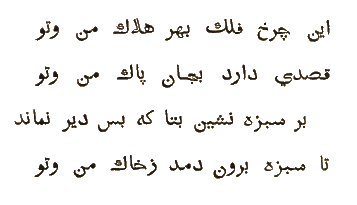
Parents often talk about the younger generation as if they didn’t have anything to do with it.
Haim Ginott (1922–1973) Israeli-American school teacher, child psychologist, psychotherapist [b. Haim Ginzburg]
(Attributed)
Widely attributed to Ginott, but I cannot find it in his printed works or any primary citation.
For the great law of culture is: Let each become all that he was created capable of being; expand, if possible, to his full growth; resisting all impediments, casting off all foreign, especially all noxious adhesions; and show himself at length in his own shape and stature, be these what they may.
Thomas Carlyle (1795–1881) Scottish essayist and historian
“Jean Paul Friedrich Richter,” Edinburgh Review No. 91, Art. 7 (1827-06)
(Source)
A review of Heinrich Döring, Jean Paul Friedrich Richter's Life, with a Sketch of His Works (1826).
PLATITUDE. An idea (a) that is admitted to be true by everyone, and (b) that is not true.
H. L. Mencken (1880–1956) American writer and journalist [Henry Lewis Mencken]
A Book of Burlesques, “The Jazz Webster” (1924)
(Source)
See his definition of "epigram."
Variant:Platitude — An idea (a) that is admitted to be true by everyone, and (b) that is not true.
[Chrestomathy, ch. 30 "Sententiae" (1949)]
We vaguely know the rules, and the system of scoring, but for God’s sake why don’t they tell us how long the game is?
Mignon McLaughlin (1913–1983) American journalist and author
The Second Neurotic’s Notebook, ch. 5 (1966)
(Source)
‘T is strange — but true; for truth is always strange;
Stranger than fiction; if it could be told,
How much would novels gain by the exchange!
How differently the world would men behold!George Gordon, Lord Byron (1788–1824) English poet
Don Juan, Canto 14, st. 101 (1823)
(Source)
Apparent origin of the phrase "Truth is stranger than fiction."
Were we as eloquent as angels, yet should we please some men, some women, and some children much more by listening than by talking.
Charles Caleb "C. C." Colton (1780–1832) English cleric, writer, aphorist
Lacon: Or, Many Things in Few Words, Vol. 1, § 13 (1820)
(Source)
People travel to learn; most ov them (before they start) should learn to travel.
Josh Billings (1818–1885) American humorist, aphorist [pseud. of Henry Wheeler Shaw]
Everybody’s Friend, Or; Josh Billing’s Encyclopedia and Proverbial Philosophy of Wit and Humor, ch. 148 “Affurisms: Ink Brats” (1874)
(Source)
The whole question of imagination in science is often misunderstood by people in other disciplines. They try to test our imagination in the following way. They say, “Here is a picture of some people in a situation. What do you imagine will happen next?” When we say, “I can’t imagine,” they may think we have a weak imagination. They overlook the fact that whatever we are allowed to imagine in science must be consistent with everything else we know: that the electric fields and the waves we talk about are not just some happy thoughts which we are free to make as we wish, but ideas which must be consistent with all the laws of physics we know. We can’t allow ourselves to seriously imagine things which are obviously in contradiction to the known laws of nature.
Richard Feynman (1918–1988) American physicist
The Feynman Lectures on Physics, Vol. 2, ch. 20 “Solutions of Maxwell’s Equations in Free Space,” sec. 20–3 “Scientific Imagination” (1964)
(Source)
Is there else a Heavenly power
That grants to men so sweet an hour?[Quid datur a divis felici optatius hora?]
Catullus (c. 84 BC – c. 54 BC) Latin poet [Gaius Valerius Catullus]
Carmina # 62 “Nuptual Song,” st. 5, l. 40 [Youths] [tr. Symons-Jeune (1923)]
(Source)
Singing to Hesperus, the Evening Star, in celebration of the hour of marriage. Or maybe the hour of the marriage bed; the translations are unclear.
(Source (Latin)). Other translations:Say, what more blissful can the gods bestow,
Than the fond hour that crowns each am'rous vow?
[tr. Nott (1795), # 59]What god can give, what proud celestial power,
A richer boon than thy connubial hour?
[tr. Lamb (1821)]What choicer hour sends heaven our life to cheer?
[tr. T. Martin (1861)]What by the gods to mortals given can match this blissful hour?
[tr. Cranstoun (1867)]When shone an happier hour than thy god-speeded arriving?
[tr. Ellis (1871)]What better boon can the gods bestow than hour so desirèd?
[tr. Burton (1893)]What more wished for do the gods give than that happy hour?
[tr. Smithers (1894)]What is given by the gods more desirable than the fortunate hour?
[tr. Warre Cornish (1904)]What hour happier than this glorious hour is given by the Gods?
[tr. Stuttaford (1912)]What gift of heaven excels the wishèd hour?
[tr. MacNaghten (1925)]Can Heaven give a greater boon than this?
[tr. Wright (1926)]What gift from heaven
greater than this gift from gods to man in a superlative hour of happiness?
[tr. Gregory (1931)]What gift from heaven surpasses this fortunate hour?
[tr. C. Martin (1979)]What gift of heaven is more desirable than this happy hour?
[tr. Goold (1983)]What wished-for hour by the gods is more happily granted?
[tr. Kline (2001)]What better gift have the gods than this most happy hour?
[tr. Green (2005)]What is given by the gods more desirable than the fortunate hour?
[tr. Wikisource (2018)]
Who are the greedy? Those who are not satisfied with what suffices for their own needs. Who are the robbers? Those who take for themselves what rightfully belongs to everyone. And you, are you not greedy? Are you not a robber? The things you received in trust as a stewardship, have you not appropriated them for yourself? Is not the person who strips another of clothing called a thief? And those who do not clothe the naked when they have the power to do so, should they not be called the same? The bread you are holding back is for the hungry, the clothes you keep put away are for the naked, the shoes that are rotting away with disuse are for those who have none, the silver you keep buried in the earth is for the needy. You are thus guilty of injustice toward as many as you might have aided, and did not.
Basil of Caesarea (AD 330–378) Christian bishop, theologian, monasticist, Doctor of the Church [Saint Basil the Great, Ἅγιος Βασίλειος ὁ Μέγας]
“I Will Tear Down My Barns [καθελῶ μου τὰς ἀποθήκας],” Sermon # 6 [tr. Schroeder (2009)]
(Source)

So long as little children are allowed to suffer, there is no true love in this world.

It is a stifling, stultifying world in which to live. It is a world in which every word and every thought is censored. In England it is hard even to imagine such an atmosphere. Everyone is free in England; we sell our souls in public and buy them back in private, among our friends. But even friendship can hardly exist when every white man is a cog in the wheels of despotism. Free speech is unthinkable. All other kinds of freedom are permitted. You are free to be a drunkard, an idler, a coward, a backbiter, a fornicator; but you are not free to think for yourself. Your opinion on every subject of any conceivable importance is dictated for you by the pukka sahibs’ code.
George Orwell (1903–1950) English journalist, essayist, writer [pseud. of Eric Arthur Blair]
Burmese Days, ch. 5 (1934)
(Source)
Of the life of the Englishman John Flory, the protagonist, in Burma, part of the 1920s British Raj. Orwell's first novel, it was based on his own experiences as a police officer in that part of the word. The pukka sahibs were the "excellent fellows," i.e., the European (white) colonialists of the region.
I have lived in one Reign, when the Prince, instead of invigorating the Laws of our Country, or giving them their proper Course, assumed a Power of dispensing with them: And in another, when the Sovereign was flattered by a Set of Men into a Persuasion, that the Regal Authority was unlimited and uncircumscribed. In either of these Cases, good Laws are at best but a dead Letter; and by shewing the People how happy they ought to be, only serve to aggravate the Sense of their Oppressions.
Joseph Addison (1672–1719) English essayist, poet, statesman
Essay (1715-12-26), The Freeholder, No. 2
(Source)
Horace and Aristotle already told us about the virtues of their forefathers and the vices of their times, and authors down through the centuries have spoken in like manner. If they had told the truth, men would nowadays be bears.
[Horace et Aristote nous ont déjà parlé des vertus de leurs pères, et des vices de leur temps, et les auteurs de siècle en siècle nous en ont parlé de même. S’ils avaient dit vrai, les hommes seraient à présent des ours.]Charles-Lewis de Secondat, Baron de Montesquieu (1689–1755) French political philosopher
Pensées Diverses [Assorted Thoughts], # 396 (1720-1755) [tr. Clark (2012)]
(Source)
(Source (French)). Another translation:Horace and Aristotle told us of the virtues of their fathers, and the vices of their own time, and authors down through the centuries have told us the same. If they were right, men would now be bears.
[E.g.]
The fourth and most important difference between a novel and a film (or play) is that when the reader tires of a novel he can mark his place, put it down, and return to it later. But the attention of an audience must be held continuously. There must be an unbroken progression. It may be progression of the emotion or the thought or the action, but emotion and thought must issue in action or threaten to. In a dramatic medium such as film the characters cannot pause to propound ideas and emotions not directly relevant to their own dramatic situation. In the middle of War and Peace Tolstoy can plant a substantial essay on the nature of military power. In a film script one unnecessary page, one page not furthering the progression, will lose the attention of the audience for the next ten.
Robert Bolt (1924–1995) English dramatist
Doctor Zhivago: The Screenplay, “Author’s Note” (1965)
(Source)
The voice of a man when he reads reveals not what he is, but what he wants to be. It is the voice of the personage whom he visualizes when he thinks of himself.
André Maurois (1885–1967) French author [b. Émile Salomon Wilhelm Herzog]
Conversation, “Confidences” (1930)
(Source)
The observances of the Church concerning feasts and fasts are tolerably well kept upon the whole, since the rich keep the feasts and the poor the fasts.
Sydney Smith (1771–1845) English clergyman, essayist, wit
(Attributed)
(Source)
In Hesketh Pearson, The Smith of Smiths, ch. 10 (1934).
IDIOT, n. A member of a large and powerful tribe whose influence in human affairs has always been dominant and controlling. The Idiot’s activity is not confined to any special field of thought or action, but “pervades and regulates the whole.” He has the last word in everything; his decision is unappealable. He sets the fashions of opinion and taste, dictates the limitations of speech and circumscribes conduct with a dead-line.
Ambrose Bierce (1842–1914?) American writer and journalist
“Idiot,” The Cynic’s Word Book (1906)
(Source)
Included in The Devil's Dictionary (1911). Originally published in the "Devil's Dictionary" column in the San Francisco Wasp (1885-08-29).
Power is supposed to be so corrupt. I don’t think it’s so much corrupt, in the usual sense of the word, as stupid and unrealistic. The more power a person has, the further he gets from reality.
I like to sit and have a talk sometimes with that odd little chap that was myself long ago. I think he likes it too, for he comes so often of an evening when I am alone with my pipe, listening to the whispering of the flames. I see his solemn little face looking at me through the scented smoke as it floats upward, and I smile at him; and he smiles back at me, but his is such a grave, old-fashioned smile. We chat about old times; and now and then he takes me by the hand, and then we slip through the black bars of the grate and down the dusky glowing caves to the land that lies behind the firelight. There we find the days that used to be, and we wander along them together. He tells me as we walk all he thinks and feels. I laugh at him now and then, but the next moment I wish I had not, for he looks so grave I am ashamed of being frivolous. Besides, it is not showing proper respect to one so much older than myself — to one who was myself so very long before I became myself.
Jerome K. Jerome (1859–1927) English writer, humorist [Jerome Klapka Jerome]
Idle Thoughts of an Idle Fellow, “On Memory” (1886)
(Source)
First published in Home Chimes (1885-09-26).
MACBETH:Stars, hide your fires;
Let not light see my black and deep desires.William Shakespeare (1564–1616) English dramatist and poet
Macbeth, Act 1, sc. 4, l. 57ff (1.4.57-58) (1606)
Do not do that which you would not have known.
Benjamin Franklin (1706–1790) American statesman, scientist, philosopher, aphorist
Poor Richard (1736 ed.)
(Source)
I had three chairs in my house; one for solitude, two for friendship, three for society. When visitors came in larger and unexpected numbers, there was but the third chair for them all, but they generally economized the room by standing up.
Henry David Thoreau (1817–1862) American philosopher and writer
Walden; or, Life in the Woods, ch. 6 “Visitors” (1854)
(Source)
Knowing that others have gone through similar tragedies may be a help, but it should be remembered that every tragedy is not only commonplace but also unique.
Judith Martin (b. 1938) American author, journalist, etiquette expert [a.k.a. Miss Manners]
Miss Manners Rescues Civilization, ch. 9 “Jettisoning Professional Behavior” (1996)
(Source)
We find little in a book but what we put there. But in great books, the mind finds room to put many things.
[On ne trouve guère dans un livre que ce qu’on y met. Mais dans les beaux livres, l’esprit trouve une place où il peut mettre beaucoup de choses.]
Joseph Joubert (1754–1824) French moralist, philosopher, essayist, poet
Pensées [Thoughts], ch. 23 “Des Qualités de l’Écrivain [Of the Qualities of Writers],” ¶ 212 (1850 ed.) [tr. Lyttelton (1899), ch. 22, ¶ 98]
(Source (French)). Another translation:There is little to be found in a book beyond what you bring to it. But in fine books the mind finds place to put many things.
[tr. Collins (1928), ch. 22]
We are held to our duty by laziness and timidity, but often our virtue gets all the credit.
[Pendant que la paresse et la timidité nous retiennent dans notre devoir, notre vertu en a souvent tout l’honneur.]François VI, duc de La Rochefoucauld (1613–1680) French epigrammatist, memoirist, noble
Réflexions ou sentences et maximes morales [Reflections; or Sentences and Moral Maxims], ¶169 (1665-1678) [tr. Tancock (1959)]
(Source)
Appeared in the 1st ed. (1665) as:While laziness and timidity alone have the merit of keeping us in our duty, our virtue often has all the honour.
[Pendant que la paresse et la timidité ont seules le mérite de nous tenir dans notre devoir, notre vertu en a souvent tout l’honneur.]
In the manuscript version this read:Shame, laziness and timidity alone retain the merit of holding us back from our duty, while our virtue has all the honor.
[La honte, la paresse et la timidité conservent toutes seules le mérite de nous retenir dans notre devoir, pendant que notre vertu en a tout l’honneur.]
In a letter to J. Esprit, La Rochefoucauld phrased it this way:It must be admitted that virtue, by which we boast of doing everything good that we do, would not always have the strength to hold us back from the rules of our duty, if laziness, timidity, or shame did not make us see the disadvantages of departing from them.
[Il faut avouer que la vertu, par qui nous nous vantons de faire tout ce que nous faisons de bien, n’aurait pas toujours la force de nous retenir dans les règles de notre devoir, si la paresse, la timidité, ou la honte ne nous faisoient voir les inconvénients qu’il y a d’en sortir.]
Variations of this sentiment around the hypocrisy of vices serving as virtue show up a lot in La Rochefoucauld's maxims. See the Epigraph, and ¶¶ 1, 200, 205, 218, 220, 237, 241, 253, 266, 354, and 442.
(Source (French)). Other translations:We are many times kept within the limits of our duty by Shame, Sloth, and Timorousness, while in the mean time our Virtue hath all the credit of it.
[tr. Davies (1669), ¶5]Many People are kept within their Duty, because they have not the Courage, or will not be at the pains of being wicked; and in such cases oftentimes our Vertue runs away with all the Praise.
[tr. Stanhope (1694), ¶170]Idleness, timidity, and shame, often keep us within the bounds of duty; whilst virtue seems to run away with the honour.
[pub. Donaldson (1783), ¶233; ed. Lepoittevin-Lacroix (1797), ¶163]Idleness, timidity, or shame, often keeps us within the bounds of duty; whilst virtue seems to run away with the honour of it.
[ed. Carvill (1835), ¶202]Indolence and timidity often keep us to our duty, while our virtue carries off all the credit of doing so.
[ed. Gowens (1851), ¶172]Idleness and fear keeps us in the path of duty, but our virtue often gets the praise.
[tr. Bund / Friswell (1871), ¶169]Although it is frequently laziness and timidity that keep us within the path of duty, it is virtue that reaps the credit.
[tr. Heard (1917), ¶169]Though indolence and timidity keep us to the path of duty, virtue often gets all the credit.
[tr. Stevens (1939), ¶169]When laziness or cowardice keeps us to the path of duty, the credit is often given entirely to our honour.
[tr. FitzGibbon (1957), ¶169]When laziness and timidity yokes us to our duties, we often give virtue the credit for it.
[tr. Kronenberger (1959), ¶169]While it is idleness and timidity that retain us in our duty, our virtue takes all the credit.
[tr. Whichello (2016), ¶169]

Administrivia: (2024-08-18) Doing the Numbers
Wow. It’s been over a year since I last did a “State of the WIST” post. I last ran this report in June 2023; time flies when you’re having fun.
I feel like my consistency level in getting new quotes in over the last year has been … not great. My back-of-the-head goal remains 5-6 quotes posted each weekday. The reality has had a lot wider variation than I’d want. Two factors in play here:
- I’ve been doing a lot more work at re-researching and cleaning up older, already-entered quotations. Digging up sources, reworking titles, sometimes expanding on little snippets, that sort of thing. Unfortunately, those revisions don’t show up on the front page of the blog, nor in the RSS feed or email; they do end up mirrored in the downstream systems I send these to (my Mastodon account and my Diaspora* site).
- A lot of the work I’ve done has been during time blocks that have become increasingly crowded over the last year.
The result is that people just looking at new stuff here may see five or six quotes … or may see just one or two.
I’ll be trying to improve that over the coming months, as well as trying to make “revised” quotations more visible.
What’s happened over here since last time?
Some changes that took place on the WordPress site the past year:
- Kept things updated — WIST is currently on WordPress 6.6.1. I usually wait a month or so after each point release, as the RSS feed program files have to be serviced manually when I do an update, and 0.x and 0.0.x can be fairly frequent after a release (though Automattic seems to be doing a better job about beta testing the past few releases). I have not updated to using the Gutenberg stuff that the WP folk seem so insistent on; I run a pretty basic blog here, and they keep trying to turn WP into a site editor. Sigh.
- I implemented some citation (post title) variations that will help sort posts, in certain contexts, more meaningfully (e.g., someone whose output is largely from speeches will have their speeches showing up sorted by date rather than title or location).
- I tried to implement a visitor Dark Mode tool, but the one I invested the most work into had issues with some of my design. So, if it ain’t broke, I won’t try to fix it.
So not a lot there, just a fair amount of grind.
Doing the Numbers
Let’s look at the numbers:

So continued progress, despite some housecleaning — deleting duplicates, and updating old posts with better metadata, etc. — as is shown by the graph (which normalizes the time frame):
Broken out into a graph (and normalizing the time frame):
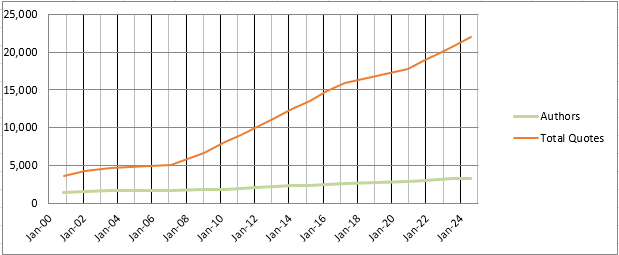
Note that, as always, all of these quotations are personally curated to some degree or another — digging out citations and online links when possible, finding author photos, etc. No mass uploads for me.
I currently stand at 732 quotes flagged as meme/visual quotations. That number’s gone up from 710 last year, though slowly; I generate one of these every few weeks.
Top Authors
Of the authors I have, who are the most quoted in WIST?
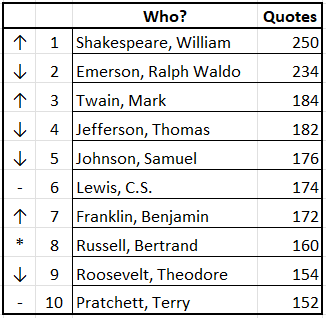
As the numbers get higher, it’s harder folk to do more than shuffle around, esp. barring I find any massive new source of quotations (and time to put them in). That said, Bertrand Russell did manage to push George Bernard Shaw out of the Top Ten. A lot of the ones who went “up” in the ratings did so because I have a big tranche of quotations that I’m entering in, usually one a week.
And, yes, that’s a bunch of old, dead, white guys. Sigh.
This table is more for curiosity’s sake than any real meaning, showing not just how prolific these folk are, but how interested I am in recording things these individuals said.
Top Quotations
Here are the Top 10 Most Visited Quotations Ever (with how they’ve changed since September 2022). I find these interesting, since it’s not driven anything I do, but page hits by visitors.
- – (13,551; was 12,036) John Kenneth Galbraith, Speech (1963-12-13), “Wealth and Poverty,” National Policy Committee on Pockets of Poverty
- – (8,551; was 7,763) Aeschylus, Agamemnon, ll. 175-183 [tr. Johnston (2007)]
- ↑ (8,117, was 5,812) Plato Republic, Book 1, 347c
- – (6,517, was 6,393) Robert Frost, “The Lesson for Today,” A Witness Tree (1942)
- – (6,399, was 6,072) Bertand Russell, “The Triumph of Stupidity” (1933-05-10)
- ↑ (6,340, was 5,390) Rainer Maria Rilke, Letter (1907-01-01) to Clara Rilke
- ↑ (5,531, was 4,635) Sa’adi “Bani Adam [The Children of Adam],” Gulistan [Rose Garden], ch. 1 “On the Conduct of Kings,” story 10 (1258)
- – (5,446, was 5,226) Fran Lebowitz, “Tips for Teens,” Social Studies (1981)
- – (5,013, was 5,013) John Steinbeck, Speech (1962-12-10), Nobel Prize acceptance, Stockholm
- ♥ (4,860; new on list) Isaac Asimov, “A Cult of Ignorance,” Newsweek (1980-01-21)
Asimov’s quote popped back onto the list; the one that bumped it off last year, from Sa’adi, has climbed the charts from 10 to 7. Plato looks to have been popular, too. In exchange, we lost a quote from William Hazlitt, alas.
The only constraint on that list is that it’s hard for a new quote (one I have just entered) to get anywhere near this list; in fact, the latest-entered quote here is the Rilke one, entered in 2015. Looking at quotes that were most popular over the last year provides a somewhat different set. Since 7/2023, the Top 10 viewed quotes were, according to Google Analytics:
- ↑ 1,789 Plato Republic, Book 1, 347c
- ♥ 1,331 Emerson, Ralph Waldo — (Misattributed)
- ♥ 1,109 Galbraith, John Kenneth — Speech (1963-12-13), “Wealth and Poverty,” National Policy Committee on Pockets of Poverty
- ♥ 966 Dante Alighieri — The Divine Comedy [Divina Commedia], Book 1 “Inferno,” Canto 3, l. 1ff (3.1-9) (1309) [tr. Hollander/Hollander (2007)]
- ↓ 887 Aristotle — (Attributed)
- ♥ 869 Dante Alighieri — The Divine Comedy [Divina Commedia], Book 1 “Inferno,” Canto 5, l. 121ff (5.121-123) [Francesca] (1309) [tr. James (2013), l. 141ff]
- ↓ 834 Aristotle — Nicomachean Ethics [Ἠθικὰ Νικομάχεια] (c. 325 BC) (paraphrase)
- ↓ 831 Rilke, Rainer Maria — Letter (1907-01-01) to Clara Rilke
- ↓ 823 Sa’adi “Bani Adam [The Children of Adam],” Gulistan [Rose Garden], ch. 1 “On the Conduct of Kings,” story 10 (1258)
- ↓ 803 Franz Kafka — Letter (1904-01-27) to Oskar Pollak [tr. Winston (1977)]
Four quotes jumped onto the leader board here. Galbraith’s quote has been here before (it not being on the list last time was actually an anomaly). The two Dante ones are a delight since they were entered into the system this year (I’m still going through the Divine Comedy, and am about a third of the way through Paradisio, which does not offer a lot in the way of quotations). I’m kind of thrilled about the Emerson quote being here; as I consider WIST to be at least in part an educational and reference work, having a lot of traffic to a post talking about how a commonly attibuted quote to Emerson is, in fact, not from him, is good to see.
Alas, still (almost entirely) it’s Old, Dead, White Guys. Unfortunately this year, we had quotes from Zora Neale Hurston, Eric Hoffer, Homer, and Aeschylus drop from the leader board.
Surprisingly, the author pages for Franz Kafka and Cicero both showed up near the top of the stack.
Who Are You People?
As Google Analytics gets more complex, figuring out old simplistic stats becomes a bit more difficult. As far as I can tell, though compared to 7/2023, I am getting 205 visitors / day (vs 196) and 320 pages visited / day (vs 215). So a nice upward trend there. Producing content drives visitors, I would hope.
I also have 21 follow-by-email users with Follow.it (up from 11) — this despite the fact that my RSS feed was frelled for a couple of months. Thanks for sticking with me. I have 6 email subscribers through JetPack, too (waves).
Over in social media, I am still on Mastodon, having given up on the cess pit that is Twitter. Back in the Twitter days, I ostensibly had 143 followers (including an uncertain number of bots), while on Mastodon I currently have 193 followers (up from 68) — but I’m getting a lot more interaction than I was on Twitter in terms of likes and forwards, so I’m happy there.
I have 93 contacts on my Diaspora* mirror (up from 86), and I actually get some good engagement over there as well with likes and discussion. That said, something broken in pulling images over to Diaspora* (for me), which is hampering the work I do there; hopefully, by the time the next report rolls around, it will be fixed.
An interesting things about the Internet — my home WIST.info blog gets a lot of hits — but it’s nearly all through search, rather than (as in the old days) people visiting through RSS or dropping in every few days to see what’s new. View counts on individual posts used to be in the tens, twenties, forties; these days, on the newest front page posts it’s a whole series of zeroes. That’s in part why I continue to push out to other sites (Mastodon, Diaspora*), to get feedback on the new things I am putting out there.
Demographics:
- As far as national representation of visitors to my website, we have the US (52%, up from 49%), UK (8%), Canada (5&%), China (back down to 4%), and India (4%).
- That mirrors the language, with English (82%) and Chinese (5%) as the vast majority of users (still 2% German, which continues to tickle me).
Hardware and software:
- From a platform perspective, visits to WIST.info come Desktop 56%, Mobile 42%, and Tablet (2%).
- Browser-wise, Chrome slipped slightly from 60% down to 58%; Safari remains at 31%, Edge and Firefox both jumped a point to 6% and 5% respectively.
- That’s interesting to cross-reference with OS, where Windows is 32% of the users, iOS 24%, Mac another 21%, and Android at 20%, showing very little difference from last year.
The Year Ahead
- I’d (still) like to figure out how to drive up traffic (or, framed another way, understand if I am somehow keeping traffic away).
- Continue backfilling tags as I come across quotes that have captured my eye again.
- Maybe do some tag cleanup (there are some that are redundant — plural vs singular — and others where I’ve inadvertently concatenated terms). I poked at that a bit, and it’s a heck of a lot more difficult than it should be, so we’ll see.
- Continue making some author sweeps to normalize how some works are organized.
- Continue work on parallel translations of foreign works.
And that’s the end of the Q3 report for 2024. See you next time I get an urge to do this!
Poverty must not be a bar to learning, and learning must offer an escape from poverty.
Lyndon B. Johnson (1908–1973) American politician, educator, US President (1963–69)
Speech (1964-05-22), Graduation, University of Michigan, Ann Arbor
(Source)
A foole may throw a stone into a well, which a hundred wise men cannot pull out.
George Herbert (1593–1633) Welsh priest, orator, poet.
Jacula Prudentum, or Outlandish Proverbs, Sentences, &c. (compiler), # 527 (1640 ed.)
(Source)
The plain fact is that responsibility cannot be imposed. It can only grow from within, fed and directed by values absorbed at home and in the community. Responsibility that is not anchored in positive values can be antisocial and destructive. Hoodlums often show great loyalty and strong responsibility in relation to one another and to their gang. Members of the Mafia, for instance, take their duties in dead earnest; they carry out commands, give legal aid to needy associates, and take care of prisoners’ families.
Haim Ginott (1922–1973) Israeli-American school teacher, child psychologist, psychotherapist [b. Haim Ginzburg]
Between Parent and Child, ch. 4 “Responsibility and Independence” (1965)
(Source)
In the updated version of the book, Between Parent and Child: Revised and Updated Edition, ch. 4 "Responsibility" (2003 ed.) [with A. Ginott and H. W. Goddard], this paragraph was revised as follows:The plain fact is that responsibility cannot be imposed. It can only grow from within, fed and directed by values absorbed at home and in the community. Responsibility that is not anchored in positive values can be antisocial and destructive. Gang members often show great loyalty and strong responsibility in relation to one another and to their gang. Terrorists take their duties in dead earnest; they carry out commands, even if they involve sacrificing their own lives.
Thoughts are the shadows of our feelings — always darker, emptier, and simpler.
[Gedanken sind die Schatten unserer Empfindungen, — immer dunkler, leerer, einfacher, als diese.]
Friedrich Nietzsche (1844–1900) German philosopher and poet
The Gay Science [Die fröhliche Wissenschaft], Book 3, § 179 (1882) [tr. Kaufmann (1974)]
(Source)
Also known as La Gaya Scienza, The Joyful Wisdom, or The Joyous Science.
(Source (German)). Other translations:Thoughts are the shadows of our sentiments -- always, however, obscurer, emptier, and simpler.
[tr. Common (1911)]Thoughts are the shadows of our sensations -- always darker, emptier, simpler.
[tr. Nauckhoff (2001)]Thoughts are shadows of our feelings -- always darker, emptier and simpler than these.
[tr. Hill (2018)]
To a shower of gold most things are penetrable.
Thomas Carlyle (1795–1881) Scottish essayist and historian
The French Revolution: A History, Part 1, Book 3, ch. 7 (1.3.7) (1837)
(Source)
On Jean-Jacques Duval d'Eprémesnil's use of bribery to obtain, in May 1788, an advance copy of a royal edict depriving the Parlement of Paris of its functions.
Not every great man is a great human being.
[Nicht jeder große Mann is ein großer Mensch.]
Marie von Ebner-Eschenbach (1830–1916) Austrian writer
Aphorisms [Aphorismen], No. 267 (1880) [tr. Scrase/Mieder (1994)]
(Source)
(Source (German)). Another translation:Not every great man is a grand human being.
[tr. Wister (1883)]

Sum folks, az they gro older, gro wizer; but most folks simply gro stubbornner.
[Some folks, as they grow older, grow wiser; but most folks simply grow more stubborn.]Josh Billings (1818–1885) American humorist, aphorist [pseud. of Henry Wheeler Shaw]
Everybody’s Friend, Or; Josh Billing’s Encyclopedia and Proverbial Philosophy of Wit and Humor, ch. 148 “Affurisms: Ink Brats” (1874)
(Source)
It is very good to copy what one sees; it is much better to draw what you can’t see any more but is in your memory. It is a transformation in which imagination and memory work together. You only reproduce what struck you, that is to say the necessary. There your memories and your fantasy are freed from the tyranny exercised by nature.
[C’est très bien de copier ce qu’on voit, c’est beaucoup mieux de dessiner ce que l’on ne voit plus que dans son mémoire. C’est une transformation pendant laquelle l’ingéniosité collabore avec la mémoire. Vous ne reproduisez que ce qui vous a frappé, c’est-à-dire le nécessaire. Là, vos souvenirs et votre fantaisie sont libérés de la tyrannie qu’exerce la nature.]
Edgar Degas (1834–1917) French Impressionist artist [b. Hilaire-Germain-Edgar De Gas]
Quoted in Georges Jeanniot, “Souvenirs sur Degas [Memories of Degas],” La Revue Universelle (1933-10-15)
(Source)
The quotation is often cited to Maurice Sérullaz, L'univers de Degas (1979), but Sérullaz says he is requoting Degas from Swiss-French Impressionist painter Pierre-Georges Jeanniot.
Instinctively we divide mankind into friends and foes — friends, towards whom we have the morality of co-operation; foes, towards whom we have that of competition. But this division is constantly changing; at one moment a man hates his business competitor, at another, when both are threatened by Socialism or by an external enemy, he suddenly begins to view him as a brother. Always when we pass beyond the limits of the family it is the external enemy which supplies the cohesive force. In times of safety we can afford to hate our neighbour, but in times of danger we must love him.
Bertrand Russell (1872–1970) English mathematician and philosopher
Lecture (1948-12-26), “Social Cohesion and Human Nature,” Reith Lecture, “Authority and the Individual” No. 1, BBC Radio
(Source)
Whatever thou undertakest, so do it as if it were to come to the Knowledge of all Men.
Thomas Fuller (1654–1734) English physician, preacher, aphorist, writer
Introductio ad Prudentiam, Vol. 1, # 415 (1725)
(Source)
The difficult part of an argument is not to defend one’s opinion, but rather to know it.
André Maurois (1885–1967) French author [b. Émile Salomon Wilhelm Herzog]
Conversation, “Action in Conversation” (1930)
(Source)
False greatness is unsociable and inaccessible; as it is sensible of its weakness, it conceals itself, or at least does not show itself openly, and only allows just so much to be seen as will carry on the deceit, so as not to appear what it really is, namely, undoubtedly mean. True greatness, on the contrary, is free, gentle, familiar, and popular; it allows itself to be touched and handled, loses nothing by being seen closely, and is the more admired the better it is known.
[La fausse grandeur est farouche et inaccessible: comme elle sent son faible, elle se cache, ou du moins ne se montre pas de front, et ne se fait voir qu’autant qu’il faut pour imposer et ne paraître point ce qu’elle est, je veux dire une vraie petitesse. La véritable grandeur est libre, douce, familière, populaire; elle se laisse toucher et manier, elle ne perd rien à être vue de près; plus on la connaît, plus on l’admire.]Jean de La Bruyère (1645–1696) French essayist, moralist
The Characters [Les Caractères], ch. 2 “Of Personal Merit [Du Mérite Personnel],” § 42 (2.42) (1688) [tr. Van Laun (1885)]
(Source)
(Source (French)). Other translations:False Greatness is unsociable, inaccessible, as if 'twere sensible of its weakness, and strove to conceal it. 'Twill not be seen, except just so much, as may carry on the Deceit, but dares not shew its Face for fear of being discover'd: Discover'd how really little and mean it is. True Greatness, on the contrary, is free, complaisant, familiar, popular, suffers it self to be touch'd and handl'd, loses nothing by being view'd near at hand, is rather more known and admir'd for it.
[Bullord ed. (1696)]False greatness is unsociable and remote: conscious of its own frailty, it hides, or at least averts its face, and reveals itself only enough to create an illusion and not be recognized as the meanness that it really is. True greatness is free, kind, familiar and popular; it lets itself be touched and handled, it loses nothing by being seen at close quarters; the better one knows it, the more one admires it.
[tr. Stewart (1970)]

HYPOCRITE, n. One who, professing virtues that he does not respect, secures the advantage of seeming to be what he despises.
Ambrose Bierce (1842–1914?) American writer and journalist
“Hypocrite,” The Cynic’s Word Book (1906)
(Source)
Included in The Devil's Dictionary (1911). Originally published in the "Devil's Dictionary" column in the San Francisco Wasp (1885-08-22).
You must remember this:
A kiss is just a kiss,
A sigh is just a sigh.
The fundamental things apply
As time goes by.Herman Hupfeld (1894–1951) American songwriter
“As Time Goes By” (1931)
(Source)
Hupfeld composed the music and lyrics for the song, which first appeared in the largely forgotten Broadway musical, Everybody's Welcome (1931). The song is more famous (and only remembered today) for its performance and use as a recurring theme in the film Casablanca (1942), where it was included over the objections of Max Steiner, who composed the rest of the music for the movie.
Whenever and wherever societies have flourished and prospered rather than stagnated and decayed, creative and workable cities have been at the core of the phenomenon. Decaying cities, declining economies, and mounting social troubles travel together. The combination is not coincidental.
Jane Jacobs (1916–2006) American-Canadian journalist, author, urban theorist, activist
The Death and Life of Great American Cities, Foreword (1993 ed.)
(Source)
FRANK: What do you do for a living, Rollie?
ROLAND: I deal in English paintings.
FRANK: Abstract or realistic?
ROLAND: Depends on which way you look at them, I suppose.
Steve Martin (b. 1945) American comedian, actor, writer, producer, musician
L. A. Story (1991)
(Source)

History, like a vast river, propels logs, vegetation, rafts, and debris; it is full of live and dead things, some destined for resurrection; it mingles many waters and holds in solution invisible substances stolen from distant soils. Anything may become part of it; that is why it can be an image of the continuity of mankind. And it is also why some of its freight turns up again in the social sciences: they were constructed out of the contents of history in the same way as houses in medieval Rome were made out of stones taken from the Coliseum.
Jacques Barzun (1907–2012) French-American historian, educator, polymath
Clio and the Doctors: Psycho-History, Quanto-History, & History, ch. 5 “History as Counter-Method and Anti-Abstraction” (1974)
(Source)
It is well we cannot see into the future. There are few boys of fourteen who would not feel ashamed of themselves at forty.
Jerome K. Jerome (1859–1927) English writer, humorist [Jerome Klapka Jerome]
Idle Thoughts of an Idle Fellow, “On Memory” (1886)
(Source)
First published in Home Chimes (1885-09-26).
MACBETH: If chance will have me king, why, chance may crown me
Without my stir.William Shakespeare (1564–1616) English dramatist and poet
Macbeth, Act 1, sc. 3, l. 158ff (1.3.158-159) (1606)
(Source)
The Fates, and Furies, too, glide with linked hands over life, as well as the Graces and Sirens.
[Die Parzen und Furien ziehen auch mit verbundnen Händen um das Leben, wie die Grazien und die Sirenen.]Jean Paul Richter (1763–1825) German writer, art historian, philosopher, littérateur [Johann Paul Friedrich Richter; pseud. Jean Paul]
Titan, Jubilee 35, cycle 140 [Siebenkäs] (1803) [tr. Brooks (1863)]
(Source)
(Source (German)). Another translation:The Fates and the Furies, as well as the Graces and Sirens, glide with linked hands over life.
[comp. Hoyt (1883)]
The purpose of protecting the life of our Nation and preserving the liberty of our citizens is to pursue the happiness of our people. Our success in that pursuit is the test of our success as a Nation.